Unlock your full potential by mastering the most common Geophysics and Data Processing interview questions. This blog offers a deep dive into the critical topics, ensuring you’re not only prepared to answer but to excel. With these insights, you’ll approach your interview with clarity and confidence.
Questions Asked in Geophysics and Data Processing Interview
Q 1. Explain the difference between reflection and refraction seismic methods.
Reflection and refraction are two fundamental seismic methods used to image the subsurface. They both rely on the principle that seismic waves change their behavior when encountering interfaces between layers with different physical properties (primarily density and elastic moduli). However, they differ in how they utilize these changes.
Reflection seismology focuses on the energy reflected back to the surface from subsurface interfaces. Imagine throwing a ball at a wall; some energy is reflected back to you. Similarly, a seismic wave encountering a significant impedance contrast (a sharp change in acoustic impedance) will reflect a portion of its energy. Reflection data is primarily used for imaging subsurface structures like geological layers, faults, and hydrocarbon reservoirs. We analyze the travel times of these reflections to determine the depths and geometry of these structures.
Refraction seismology, on the other hand, utilizes the refracted energy. When a seismic wave crosses an interface at an angle, it bends (refracts) due to the change in velocity. This refracted wave travels along the interface and may return to the surface at a point some distance away. This method is particularly useful for determining the velocity structure of the subsurface and identifying shallow, high-velocity layers, such as bedrock. Think of light bending as it passes from air to water; a similar phenomenon occurs with seismic waves.
In summary: reflection seismology primarily uses reflected waves for subsurface imaging, while refraction seismology uses refracted waves to map velocity variations.
Q 2. Describe the process of seismic data acquisition.
Seismic data acquisition is the process of generating and recording seismic waves to illuminate the subsurface. It’s a carefully orchestrated process involving several key steps:
- Source Generation: Seismic waves are generated using various sources, such as explosives (for land surveys), air guns (for marine surveys), or vibroseis trucks (for land surveys). The choice of source depends on the environment and desired penetration depth.
- Wave Propagation: The generated waves travel through the subsurface, reflecting and refracting off interfaces between layers with different properties.
- Geophone/Hydrophone Deployment: Geophones (land) or hydrophones (marine) are deployed in a controlled pattern (typically a grid or line) to record the returning seismic waves. The placement of these receivers is crucial for optimal data coverage and resolution.
- Data Recording: Specialized recording instruments capture the signals from the geophones or hydrophones, converting the analog signals into digital data for further processing.
- Navigation and Surveying: Accurate positioning of sources and receivers is critical. GPS and other surveying techniques are employed to precisely locate each measurement point. This is essential for accurate image construction.
A typical marine seismic acquisition involves a vessel towing an air gun array as a source and a long streamer of hydrophones. On land, crews might use vibroseis trucks and a network of geophones spread across the survey area. The recorded data is a complex dataset reflecting the wave’s interactions with the subsurface structures.
Q 3. What are the common noise types encountered in seismic data and how are they mitigated?
Seismic data is often contaminated by various noise sources. Effective noise mitigation is critical for achieving high-quality images.
- Ambient Noise: This includes wind, human activities, and other environmental factors. Careful survey design, data acquisition during quiet times, and filtering techniques can minimize ambient noise.
- Ground Roll: These are surface waves that travel along the earth’s surface at relatively low velocities. They are often characterized by their low frequencies and high amplitudes. Filtering techniques, such as f-k filtering, effectively attenuate ground roll.
- Multiple Reflections: These are reflections that bounce multiple times between subsurface interfaces before reaching the surface. They can obscure primary reflections and are often mitigated using techniques like predictive deconvolution and multiple attenuation algorithms.
- Direct Waves: These waves travel directly from the source to the receivers without reflecting, often overshadowing weaker reflections. Proper source-receiver geometry and filtering can reduce this.
- Electronic Noise: This noise arises from the recording equipment itself. Careful equipment calibration and quality control during data acquisition are crucial.
Noise mitigation often involves a combination of techniques, applied sequentially or in parallel. The specific approach depends on the type and characteristics of the noise present in the data.
Q 4. Explain the concept of deconvolution in seismic processing.
Deconvolution is a crucial seismic processing step aimed at improving the resolution and clarity of seismic data. The seismic wavelet (the signal generated by the source) is often convoluted (smeared out) by the earth’s filtering effect. Deconvolution aims to reverse this process, thereby sharpening the seismic reflections.
Think of it like this: imagine taking a clear photograph and then blurring it. Deconvolution is like using a sharpening filter to recover the original image’s details. In seismic terms, the wavelet is the blurring effect, and deconvolution sharpens the reflections to better resolve individual subsurface layers.
Various deconvolution methods exist, including:
- Predictive Deconvolution: This method aims to remove the effects of the source wavelet and multiple reflections. It uses statistical properties of the seismic trace to estimate and remove the wavelet’s influence.
- Spiking Deconvolution: This attempts to convert the seismic wavelet into a series of short spikes, enhancing resolution but potentially increasing noise.
The choice of deconvolution method depends on the specific characteristics of the data and the desired outcome. Properly applied deconvolution significantly improves the resolution of seismic images, leading to a more accurate interpretation of subsurface geology.
Q 5. Describe different types of seismic migration techniques.
Seismic migration is a critical step in seismic processing that corrects the apparent position of subsurface reflectors. Because seismic waves travel along curved paths, reflections are often misplaced on unmigrated seismic sections, causing a distorted image of the subsurface. Migration algorithms reposition these reflections to their true locations.
Several migration techniques exist, each with strengths and weaknesses:
- Kirchhoff Migration: A classic technique based on summation of seismic amplitudes along diffraction curves. It’s relatively straightforward to understand and implement but can be computationally expensive for large datasets.
- Finite-Difference Migration: This method solves a wave equation numerically using finite-difference approximations. It’s computationally intensive but capable of handling complex velocity models and producing high-quality images.
- Frequency-Wavenumber (f-k) Migration: This technique is performed in the frequency-wavenumber domain and is computationally efficient for simple velocity models. It is particularly well-suited for handling dipping events.
- Reverse-Time Migration (RTM): This advanced technique involves modeling the wavefield propagation backward in time, producing highly accurate images even with complex velocity models and steep dips. It’s computationally demanding but offers superior imaging capabilities.
The choice of migration technique depends on factors such as the complexity of the velocity model, the size of the dataset, and the desired accuracy. Modern seismic processing often employs a combination of migration techniques to achieve optimal results.
Q 6. What is velocity analysis and why is it crucial?
Velocity analysis is the process of determining the velocity of seismic waves at various depths within the subsurface. It’s a crucial step because the accuracy of seismic imaging heavily depends on an accurate velocity model. An inaccurate velocity model leads to distorted images and incorrect interpretation of subsurface structures.
Velocity analysis typically involves:
- Normal Moveout (NMO) Correction: Seismic reflections recorded at different offsets (distances from the source) arrive at different times. NMO corrects these time differences, aligning reflections from different offsets. Velocity information is extracted during NMO analysis.
- Velocity Spectra Analysis: This technique involves examining the semblance (similarity) of seismic traces after applying NMO corrections with different velocities. The velocity that yields the highest semblance is considered the most likely velocity.
- Velocity Model Building: Once velocities are determined for different layers, a velocity model is built representing the velocity variation with depth. This model is essential for subsequent processing steps like migration.
Accurate velocity analysis is paramount for obtaining high-quality seismic images and is the backbone of accurate depth conversion and structural interpretation. Without it, the resulting seismic images can be highly inaccurate, leading to flawed geological interpretations and potentially costly exploration decisions.
Q 7. How do you handle amplitude variations with offset (AVO) analysis?
Amplitude Variations with Offset (AVO) analysis is a technique that studies the changes in seismic reflection amplitudes as a function of offset. These amplitude changes are sensitive to the elastic properties (P-wave and S-wave velocities, density) of subsurface layers. AVO analysis is particularly useful in hydrocarbon exploration because different rock types (e.g., sandstones containing hydrocarbons versus water-saturated sandstones) exhibit different AVO responses.
Handling AVO involves:
- AVO gathers: These are displays of seismic traces at different offsets for a common midpoint (CMP). These gathers reveal the amplitude variation with offset for each reflector.
- AVO attributes: Various AVO attributes are extracted from the AVO gathers, quantifying the amplitude changes with offset. Common attributes include intercept and gradient, which are related to the rock’s elastic properties.
- AVO modeling and inversion: AVO modeling uses theoretical models to predict the expected AVO response for different rock properties. AVO inversion uses observed AVO attributes to estimate the subsurface rock properties.
- Interpretation: The interpreted AVO attributes and models help in distinguishing between different rock types and identifying potential hydrocarbon reservoirs.
AVO analysis is a powerful tool in exploration geophysics. Its careful application requires expert interpretation due to the complex relationship between seismic amplitudes and subsurface properties. However, successful AVO analysis can provide critical insights into the lithology and fluid content of subsurface formations, reducing exploration risk and improving the chance of hydrocarbon discovery.
Q 8. Explain the principles of gravity and magnetic methods in geophysical exploration.
Gravity and magnetic methods are passive geophysical techniques that measure variations in the Earth’s gravitational and magnetic fields, respectively, to infer subsurface geological structures. They’re passive because they don’t involve sending energy into the ground, unlike seismic methods. Instead, they measure naturally occurring fields.
Gravity Method: This method relies on the principle that variations in subsurface rock density cause corresponding variations in the Earth’s gravitational field. Denser rocks exert a stronger gravitational pull. Gravity meters measure these subtle variations. By processing the gravity data, we can create models showing density contrasts, which can help identify geological features like salt domes (denser than surrounding sediments), ore bodies (often denser than the host rock), or buried valleys (filled with less dense sediments).
Magnetic Method: This method leverages the fact that certain rocks, particularly those containing magnetic minerals like magnetite, possess a magnetic susceptibility. This means they become magnetized in the Earth’s magnetic field. Magnetometers measure the variations in the Earth’s magnetic field caused by these magnetized rocks. These variations can reveal features such as igneous intrusions (often rich in magnetic minerals), fault zones (which can alter the magnetization of rocks), or even buried pipelines (made of ferromagnetic materials).
Both methods are valuable in regional exploration, providing a broad overview of subsurface geology before more detailed surveys (like seismic) are undertaken. They are cost-effective and relatively easy to implement, making them crucial first steps in many exploration projects.
Q 9. What are the applications of well logs in reservoir characterization?
Well logs are invaluable in reservoir characterization because they provide detailed information about the properties of subsurface formations directly from within the borehole. This detailed, high-resolution data is crucial for understanding reservoir geometry, rock properties, and fluid content, ultimately allowing us to estimate the hydrocarbon reserves.
Applications include:
- Lithology Identification: Well logs help determine the type of rock (sandstone, shale, limestone, etc.) present at different depths.
- Porosity Determination: Logs measure the pore space within the rock, which indicates the rock’s capacity to hold fluids (oil, gas, water).
- Permeability Estimation: This refers to the rock’s ability to allow fluids to flow through it. High permeability is crucial for efficient hydrocarbon production.
- Fluid Saturation Analysis: Logs can distinguish between oil, gas, and water in the pore spaces, enabling estimation of hydrocarbon saturation.
- Reservoir Geometry Mapping: By combining data from multiple wells, we can create 3D models of the reservoir’s extent and shape.
- Reservoir Simulation Input: Well log data is essential input for numerical reservoir simulation models, which predict reservoir behavior under different production scenarios.
Q 10. Describe different types of well logs and their uses.
Numerous types of well logs exist, each measuring different physical properties. Here are a few key examples:
- Gamma Ray (GR): Measures the natural radioactivity of formations. High GR values typically indicate shale, while lower values suggest sandstone or carbonate rocks.
- Neutron Porosity (NPHI): Measures the hydrogen index of the formation, which is related to porosity. High NPHI indicates high porosity.
- Density (RHOB): Measures the bulk density of the formation, providing information about lithology and porosity.
- Resistivity (various types like deep, medium, shallow): Measures the ability of the formation to resist the flow of electrical current. High resistivity usually indicates the presence of hydrocarbons (oil or gas).
- Sonic (DT): Measures the travel time of sound waves through the formation. This data can be used to estimate porosity and lithology.
- Nuclear Magnetic Resonance (NMR): Provides detailed information about pore size distribution and fluid properties.
The specific logs run depend on the objectives of the well and the type of reservoir being investigated. For instance, in a gas reservoir, NMR logs are particularly useful for characterizing gas saturation and pore geometry.
Q 11. How do you interpret seismic sections?
Interpreting seismic sections involves analyzing the reflections of seismic waves to understand subsurface geological structures. It’s like looking at an ultrasound image of the Earth. It requires a systematic approach, combining geological knowledge with geophysical understanding.
The process generally involves:
- Identifying Key Reflectors: These are continuous, relatively strong reflections representing significant geological boundaries (e.g., unconformities, faults, stratigraphic layers).
- Mapping Horizons: Tracing these reflectors across the seismic section to create geological maps showing the geometry of subsurface formations.
- Analyzing Seismic Attributes: Utilizing quantitative measurements derived from the seismic data (e.g., amplitude, frequency, continuity) to characterize the rock properties and identify potential hydrocarbon traps.
- Integrating with Well Data: Correlating seismic data with well log information from existing wells helps to calibrate the seismic interpretation and improve accuracy.
- Geological Modeling: Creating 3D geological models based on the seismic interpretation to visualize the subsurface structure and estimate hydrocarbon resources.
Experience and understanding of regional geology are crucial for accurate interpretation. For instance, knowing the typical seismic signature of a specific formation type aids in identifying and mapping that formation on the seismic section.
Q 12. Explain the concept of impedance inversion.
Impedance inversion is a seismic data processing technique that aims to estimate the acoustic impedance of subsurface formations from seismic reflection data. Acoustic impedance is the product of rock density and seismic velocity (Z = ρV, where Z is impedance, ρ is density, and V is velocity). It’s a crucial parameter in reservoir characterization as it’s directly related to rock properties and fluid content.
The process typically involves:
- Seismic Data Preprocessing: Various processing steps to improve the quality of the seismic data (noise reduction, multiple attenuation, etc.).
- Wavelet Estimation: Determining the seismic wavelet (the shape of the seismic signal) which is used to model the reflection coefficients.
- Reflection Coefficient Calculation: Estimating the reflection coefficients from the seismic data. These coefficients represent the changes in acoustic impedance at interfaces between different layers.
- Impedance Inversion Algorithm: Applying an inversion algorithm (e.g., model-based inversion, least-squares inversion) to convert the reflection coefficients into an acoustic impedance log or volume. This step involves solving an inverse problem, which can be challenging due to non-uniqueness.
The resulting impedance model provides a quantitative measure of subsurface properties, which can be used to identify potential hydrocarbon reservoirs, map reservoir boundaries, and monitor changes over time. Impedance inversion is often combined with other data (well logs, geological information) to improve its accuracy.
Q 13. What are the different types of seismic attributes and their applications?
Seismic attributes are quantitative measures derived from seismic data that provide additional information beyond the basic amplitude and travel time. They enhance the interpretation by highlighting specific geological features and rock properties.
Examples:
- Amplitude Attributes: Such as instantaneous amplitude, which reflects the reflection strength at each point. Strong amplitudes often indicate hydrocarbon reservoirs.
- Frequency Attributes: Such as dominant frequency, which relates to the rock’s physical properties. Lower frequencies might indicate the presence of gas.
- Geometric Attributes: Such as curvature (based on the shape of the reflectors), which is useful for identifying faults and structural features.
- Coherence Attributes: Measure the similarity of seismic traces in a given window, helping to identify faults and discontinuities.
Applications:
- Fault Detection: Coherence and curvature attributes are very useful in identifying faults and fractures.
- Channel and Reservoir Identification: Amplitude and frequency attributes can help delineate channels, sand bodies, and other reservoir features.
- Lithology Discrimination: Combining multiple attributes can help distinguish between different rock types.
- Reservoir Monitoring: Time-lapse seismic data and attribute analysis can be used to monitor changes in the reservoir during production.
The choice of attributes depends on the specific geological problem being addressed. It’s often a case of applying multiple attributes in an integrated manner to achieve a better understanding of the subsurface.
Q 14. Describe your experience with seismic interpretation software (e.g., Petrel, Kingdom).
I have extensive experience with both Petrel and Kingdom, two leading seismic interpretation software packages. My work has involved all aspects of seismic interpretation, from data loading and quality control to advanced interpretation techniques and report generation. In Petrel, for example, I’ve regularly used its capabilities for horizon picking, fault interpretation, attribute analysis, and 3D geological modeling. I’m proficient in building and manipulating 3D geological models, integrating well log and seismic data seamlessly. I have also utilized Kingdom’s powerful interpretation and visualization tools to create complex seismic interpretations and perform detailed attribute analysis on large datasets. My experience spans various projects across different geological settings, demonstrating my ability to adapt my approach and utilize the software effectively to solve specific geological problems.
Specifically, I have:
- Used Petrel for building complex 3D reservoir models for several field development projects, including incorporating well logs, seismic data, and core analysis data.
- Applied seismic attributes in Kingdom to perform detailed fracture characterization in unconventional reservoirs, leading to optimized well placement strategies.
- Successfully used both platforms to identify subtle geological features such as stratigraphic traps and subtle faults using advanced interpretation techniques.
- Generated comprehensive reports and presentations, effectively communicating complex geophysical interpretations to both technical and non-technical audiences.
Q 15. What is your experience with processing software (e.g., ProMAX, SeisSpace)?
My experience with seismic processing software is extensive. I’ve worked extensively with both ProMAX and SeisSpace, using them for various projects ranging from 2D to complex 3D surveys. In ProMAX, I’m proficient in all stages of processing, from pre-processing steps like geometry definition and noise attenuation to advanced imaging workflows such as Kirchhoff and wave-equation migration. I’m familiar with its powerful modules for velocity analysis, multiple attenuation, and amplitude preservation. With SeisSpace, I’ve concentrated on its strengths in pre-stack depth migration and its robust handling of large 3D datasets. I’m comfortable scripting in both systems’ languages, allowing me to automate tasks and customize processing flows for optimal efficiency. For example, I’ve developed custom workflows in ProMAX to automatically detect and remove ground roll based on specific survey characteristics, significantly improving data quality and reducing processing time. My experience extends to other processing packages as well, including Kingdom and Petrel, showcasing adaptability and a broad skill set.
Career Expert Tips:
- Ace those interviews! Prepare effectively by reviewing the Top 50 Most Common Interview Questions on ResumeGemini.
- Navigate your job search with confidence! Explore a wide range of Career Tips on ResumeGemini. Learn about common challenges and recommendations to overcome them.
- Craft the perfect resume! Master the Art of Resume Writing with ResumeGemini’s guide. Showcase your unique qualifications and achievements effectively.
- Don’t miss out on holiday savings! Build your dream resume with ResumeGemini’s ATS optimized templates.
Q 16. How do you perform quality control (QC) checks on seismic data?
Quality control (QC) in seismic data processing is paramount. It’s an iterative process starting from the raw data and continuing through each processing step. My QC checks involve several stages. First, I visually inspect the raw data for obvious problems like bad traces, clipping, or excessive noise. I then monitor key processing parameters and intermediate results at each stage. This often involves comparing data before and after a particular processing step to assess its effectiveness. For example, after deconvolution, I check for an improvement in the wavelet shape and resolution. Specific QC checks include:
- Amplitude checks: Ensuring consistent amplitudes across different gathers and avoiding artificial amplitude variations.
- Noise analysis: Evaluating the effectiveness of noise attenuation techniques such as filtering and stacking.
- Velocity analysis QC: Checking the accuracy of velocity models through residual moveout analysis and comparing with well logs if available.
- Migration QC: Assessing the quality of migrated images by looking for focusing of reflections, proper alignment of events, and absence of artifacts.
I frequently use interactive displays and specialized QC tools to visualize and analyze the data. If issues are detected, I investigate the root cause, potentially adjusting parameters or applying additional processing steps. A detailed QC log is maintained throughout the project for traceability and auditing purposes.
Q 17. Explain the concept of pre-stack and post-stack processing.
Pre-stack and post-stack processing refer to different stages in seismic data processing where the fundamental difference lies in the timing of summation or stacking.
Pre-stack processing involves processing seismic traces before they are summed or stacked. This means processing individual seismic traces from different shot gathers before combining them. Key pre-stack processes include:
- Demultiplexing: Separating individual traces from the recorded data.
- Geometry corrections: Correcting for the source and receiver positions and elevations.
- Deconvolution: Improving the resolution of seismic data by removing the wavelet effects.
- Velocity analysis: Determining velocity models for later steps like migration.
- Pre-stack migration: Imaging reflections before stacking to preserve amplitude information and improve the accuracy of imaging.
Post-stack processing involves processing the data after summation or stacking. This simplifies the data, reducing the volume and allowing for more efficient processing. Common post-stack processes include:
- Normal moveout (NMO) correction: Correcting for the effect of offset on reflection travel times.
- Stacking: Combining traces to improve the signal-to-noise ratio.
- Post-stack migration: Imaging reflections after stacking, generally a faster but potentially less accurate method than pre-stack migration.
- Filtering: Removing unwanted frequencies or noise.
Pre-stack processing is generally more computationally expensive but often yields higher resolution images and better amplitude preservation, which are crucial for accurate reservoir characterization and hydrocarbon detection. Post-stack processing is simpler and faster but may compromise some of the detail captured in the pre-stack domain.
Q 18. What is your experience with depth imaging techniques?
I have considerable experience with various depth imaging techniques. My expertise spans both Kirchhoff and wave-equation migration methods. I understand the underlying principles of each, their strengths and weaknesses, and their applicability to different geological settings and data types. For instance, I’ve successfully used Kirchhoff migration for relatively simple structures and shallow targets where computational cost is a major concern. Conversely, wave-equation migration, particularly reverse-time migration (RTM), has been my go-to choice for complex subsurface structures, especially in areas with significant lateral velocity variations. RTM excels at handling steeply dipping reflectors and complex fault systems that often confuse Kirchhoff migration. I’m familiar with different strategies for velocity model building, including tomography and full-waveform inversion (FWI), crucial for achieving accurate depth images.
I’ve also worked with depth-imaging challenges such as pre-stack depth migration (PSDM) of land seismic data which often suffers from significant noise and irregular acquisition geometry. In these scenarios, I employ specialized pre-processing steps to mitigate these issues before the actual migration step. Experience with depth imaging includes handling issues like cycle skipping and correctly accounting for anisotropy, which can significantly affect the accuracy of depth conversions and therefore reservoir characterization.
Q 19. How do you handle multiples in seismic data?
Multiples in seismic data are unwanted reflections that have bounced multiple times between the surface and subsurface reflectors. They can mask the primary reflections, hindering accurate interpretation. My approach to handling multiples is multifaceted and depends on the type and severity of the multiples. I commonly employ several techniques:
- Predictive deconvolution: This statistical method estimates the characteristics of the multiples and subtracts them from the seismic data. It’s effective against short-period multiples.
- Surface-related multiple elimination (SRME): This sophisticated technique uses the known characteristics of the surface and near-surface reflectors to predict and remove multiples. It’s highly effective against longer-period multiples, especially those related to the sea surface in marine surveys.
- Radon transform: This technique transforms the seismic data into a domain where multiples have unique characteristics that can be easily separated from the primaries.
- Wave-equation-based multiple attenuation: This method uses numerical modeling to simulate the propagation of seismic waves and separate primary reflections from multiples.
The choice of technique often depends on data quality, the type of multiples present, and computational resources. Often, a combination of these techniques is employed for optimal results. For instance, I might use SRME to address strong surface-related multiples and then follow up with predictive deconvolution to attenuate remaining shorter-period multiples.
Q 20. What are the challenges in processing 3D seismic data?
Processing 3D seismic data presents several unique challenges compared to 2D. The sheer volume of data is a major hurdle, requiring significant computational resources and efficient processing workflows. Storage and management of the massive datasets are also critical considerations. Careful planning and implementation of parallel processing strategies are essential for timely project completion. Other challenges include:
- Increased complexity of velocity models: Accurate 3D velocity models are crucial for successful migration, and building these models for complex geological structures can be very challenging.
- Higher noise levels: 3D surveys often record more noise than 2D, necessitating advanced noise attenuation techniques.
- Handling of irregular acquisition geometries: 3D surveys can have irregular spatial sampling, requiring specialized processing techniques to mitigate artifacts.
- Difficulties in visualizing and interpreting the data: 3D visualization and interpretation require specialized software and expertise.
- Computational cost: 3D processing is significantly more computationally expensive than 2D, requiring powerful computers and optimized algorithms.
Overcoming these challenges requires expertise in advanced processing techniques, efficient data management strategies, and a strong understanding of both the geophysical principles and the limitations of the processing algorithms. For example, we might employ advanced noise attenuation techniques such as anisotropic filtering, and use iterative approaches to velocity model building.
Q 21. Explain the principles of time-lapse seismic (4D) analysis.
Time-lapse seismic, also known as 4D seismic, involves acquiring and processing seismic data repeatedly over time at the same location. By comparing these datasets, we can monitor changes in the subsurface, which are primarily related to fluid movements (e.g., due to production or injection) or changes in reservoir pressure. This is particularly useful in the oil and gas industry for reservoir monitoring and optimization.
The principles involve careful repeatability in the acquisition and processing. This means maintaining consistent source and receiver locations and using standardized processing workflows for all surveys to ensure that any observed changes in the data truly reflect changes in the subsurface rather than artifacts of the acquisition or processing. Subtraction of datasets, often after alignment using advanced techniques, is crucial for highlighting these changes which are often subtle. Analyzing the differences, such as changes in amplitude or reflection times, provides insights into reservoir behavior and helps optimize production strategies. For example, changes in seismic amplitudes could indicate the movement of hydrocarbons or the displacement of water, offering valuable information for enhanced oil recovery operations.
Challenges in 4D seismic include ensuring repeatability, accounting for variations due to natural factors, and interpreting the subtle changes in seismic data which require advanced processing and interpretation techniques. Properly handling 4D data requires not only expertise in seismic processing but also a solid understanding of reservoir engineering principles and fluid dynamics.
Q 22. What is your experience with geophysical modeling software?
My experience with geophysical modeling software spans several years and encompasses a wide range of packages. I’m proficient in using industry-standard software such as Petrel, Kingdom, and GOCAD for tasks including seismic modeling, gravity and magnetic modeling, and reservoir simulation. For instance, in a recent project involving a complex salt diapir, I utilized Petrel’s advanced modeling capabilities to create a 3D model that accurately represented the salt’s geometry and its impact on seismic reflections. This allowed for more accurate interpretation of subsurface structures and improved reservoir characterization. I also have experience with open-source tools like Madagascar, which I’ve used for specialized processing and customized workflows. My proficiency extends to developing and adapting existing models to address unique geological challenges, ensuring the models effectively reflect real-world conditions.
Q 23. Describe your experience with geophysical data visualization and interpretation.
Geophysical data visualization and interpretation are critical to my workflow. I’m highly experienced in using various software packages such as Petrel, SeisSpace, and PowerLog for visualizing seismic data (2D and 3D), well logs, and other geophysical datasets. My interpretation skills involve identifying key geological features such as faults, horizons, and stratigraphic units. I’m adept at using various visualization techniques, including attribute analysis, horizon slicing, and 3D volume rendering, to extract meaningful insights from the data. For example, I once identified a previously undetected fault zone by carefully analyzing seismic attributes like coherence and curvature. This discovery had significant implications for the subsequent drilling program, leading to a more efficient and less risky operation. My interpretation process always involves rigorous quality control and cross-validation with other geological and geophysical data to ensure accuracy and reliability.
Q 24. Explain your understanding of different coordinate systems used in geophysics.
Understanding coordinate systems is fundamental in geophysics. We typically work with geographic coordinates (latitude and longitude), projected coordinates (like UTM), and depth coordinates. Geographic coordinates are based on Earth’s spherical shape, while projected coordinates transform the Earth’s curved surface onto a flat plane, introducing some distortion. Depth coordinates describe the subsurface in relation to a reference datum (e.g., sea level or a specific elevation). The choice of coordinate system depends on the specific application and the type of geophysical data being processed. For example, while geographic coordinates are suitable for regional-scale studies, projected coordinates (like UTM) are often preferred for local-scale surveys to minimize distortion and simplify distance calculations. Accurate coordinate transformation is crucial to integrate data from various sources. Misalignment in coordinate systems can lead to significant errors in interpretation. I have extensive experience in managing and transforming data between different coordinate systems using software such as ArcGIS and specialized geophysical processing packages to ensure data integrity and accuracy in all my projects.
Q 25. Describe your experience with handling large geophysical datasets.
Handling large geophysical datasets is a routine part of my work. I’m proficient in utilizing techniques for efficient data storage, management, and processing. This includes using high-performance computing (HPC) resources, parallel processing techniques, and specialized data formats (e.g., SEG-Y, SEGY) for optimal storage and retrieval. For instance, I’ve worked with 3D seismic surveys encompassing terabytes of data, leveraging distributed computing environments to process the data in a timely and efficient manner. My experience includes employing data compression techniques and optimizing workflows to reduce processing time and storage requirements without sacrificing data quality. This includes careful data culling and focusing analysis on relevant sections of the dataset to increase efficiency, while implementing robust quality control procedures to ensure the reliability of results extracted from the extensive dataset. Furthermore, I am familiar with cloud-based storage and computing solutions to efficiently handle and analyze large volumes of data.
Q 26. How do you ensure the accuracy and reliability of your data processing results?
Ensuring the accuracy and reliability of my data processing results is paramount. My approach involves a multi-faceted strategy. Firstly, I employ rigorous quality control checks at every stage of the processing workflow. This includes checking for data noise, artifacts, and inconsistencies. Secondly, I use independent verification methods. For instance, I compare the results from different processing algorithms or cross-validate the geophysical data with other geological and geophysical information (like well logs and geological maps). Thirdly, I meticulously document every step of the processing workflow, including the parameters used for each processing module. This comprehensive documentation allows for reproducibility and facilitates troubleshooting in case of inconsistencies. Finally, I communicate the uncertainties associated with the data and the processing methods used, ensuring transparency and responsible interpretation. This comprehensive approach ensures the reliability and validity of my findings.
Q 27. Explain your approach to troubleshooting problems encountered during data processing.
Troubleshooting problems during data processing is a common occurrence. My approach involves a systematic process. I first identify the nature of the problem. Is it a software issue, a hardware issue, or a data quality problem? Once identified, I will investigate the problem systematically, starting from the point where the issue manifests itself, tracing it back towards the source of the problem. I often employ diagnostic tools and techniques to isolate the source of the error. This may include examining processing logs, analyzing data quality metrics, and experimenting with different processing parameters. If the problem is persistent, I use debugging techniques to identify the root cause. Collaboration with other geophysicists and engineers can help resolve complex issues. Furthermore, consulting technical documentation and online resources (while carefully assessing their reliability) plays an integral role in identifying and rectifying the issues. Good record keeping is crucial for efficient troubleshooting.
Q 28. Describe a challenging data processing project and how you overcame the challenges.
One challenging project involved processing a 3D seismic dataset acquired over a complex geological area characterized by significant variations in velocity and strong lateral variations. The dataset was affected by significant noise and artifacts, making the interpretation difficult. I overcame these challenges by implementing a multi-step approach. First, I used advanced noise attenuation techniques, including wavelet de-noising and radon filtering, to minimize the impact of noise. Secondly, I utilized pre-stack depth migration (PSDM) to compensate for the velocity variations. This required a detailed velocity model building process that incorporated well velocity data and seismic tomography. Thirdly, I employed advanced seismic attribute analysis to better visualize and understand the subsurface structures. This iterative process, coupled with careful quality control at each step, yielded interpretable images and allowed us to accurately map the subsurface geology, leading to successful hydrocarbon exploration.
Key Topics to Learn for Geophysics and Data Processing Interview
- Seismic Data Acquisition: Understanding different acquisition geometries (2D, 3D, 4D), source types, and receiver arrays. Practical application: Evaluating the trade-offs between acquisition parameters and data quality.
- Seismic Data Processing: Familiarize yourself with key processing steps like deconvolution, noise attenuation (e.g., multiples, random noise), velocity analysis, and migration. Practical application: Interpreting processing flows and identifying potential pitfalls in data quality.
- Seismic Interpretation: Developing skills in seismic attribute analysis, fault interpretation, horizon picking, and structural mapping. Practical application: Relating seismic images to geological models and reservoir characterization.
- Well Log Analysis: Understanding the principles of various well logs (e.g., density, sonic, resistivity) and their integration with seismic data. Practical application: Calibrating seismic interpretations with well data for accurate reservoir property estimation.
- Reservoir Characterization: Applying geophysical data to estimate reservoir properties (porosity, permeability, saturation) and predict fluid flow. Practical application: Building geological models for reservoir simulation and production forecasting.
- Geophysical Inversion: Understanding the principles of different inversion techniques (e.g., full waveform inversion, seismic tomography) and their applications. Practical application: Imaging subsurface structures and properties with improved resolution.
- Potential Fields (Gravity & Magnetics): Understanding data acquisition, processing, and interpretation techniques for gravity and magnetic surveys. Practical application: Mapping subsurface geological structures and mineral deposits.
- Data Analysis and Programming: Proficiency in programming languages (e.g., Python) and data analysis tools (e.g., seismic processing software) for efficient data handling and analysis. Practical application: Automating workflows and developing custom solutions for data processing and interpretation challenges.
Next Steps
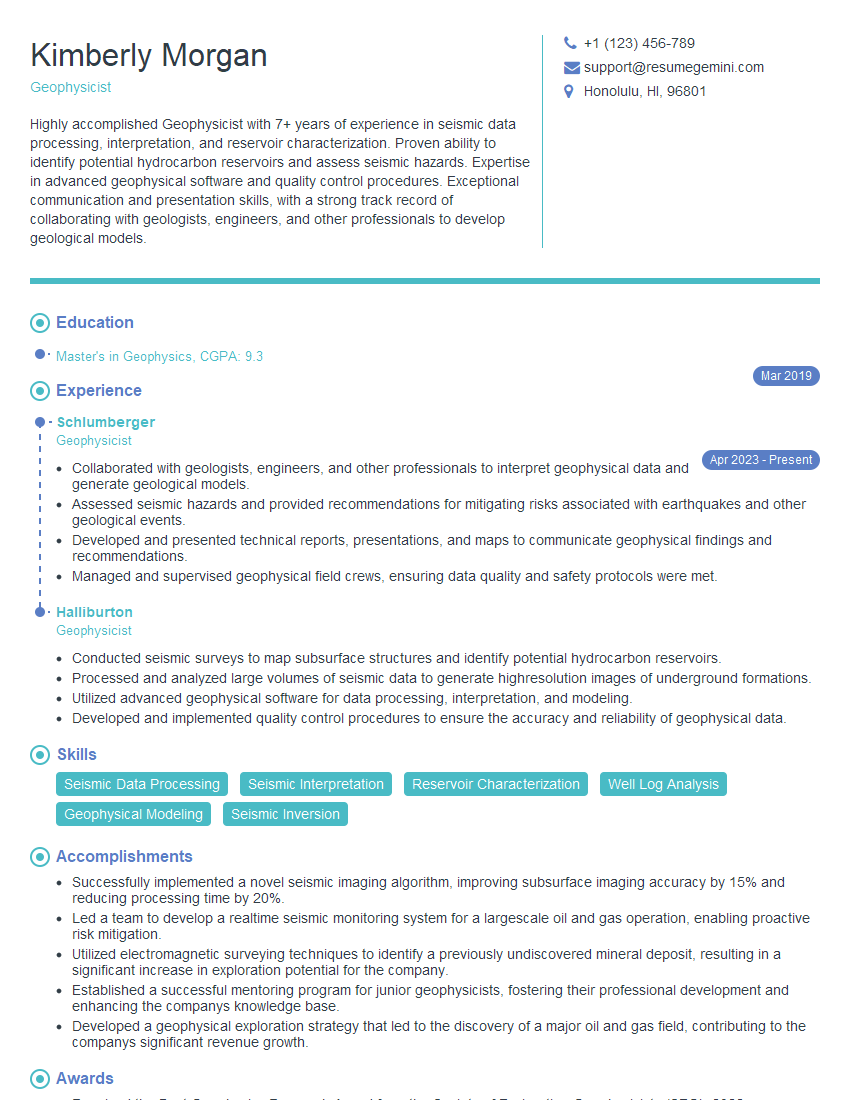
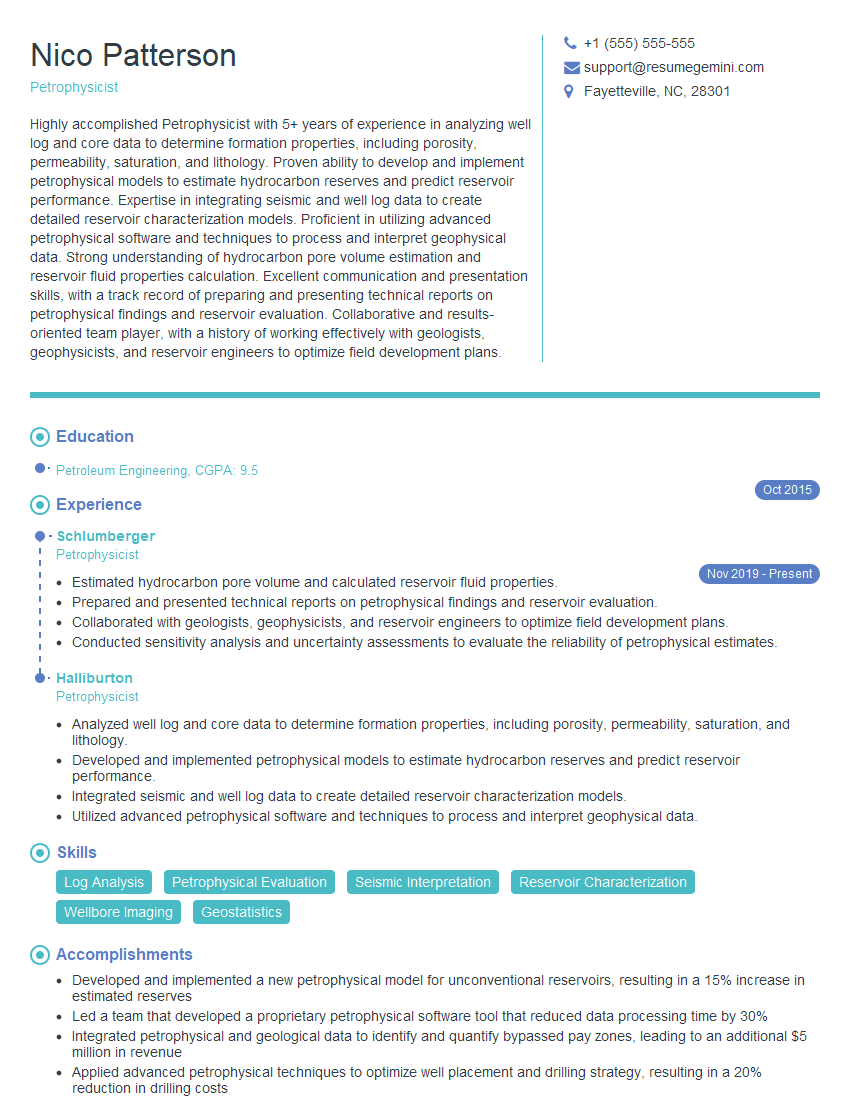
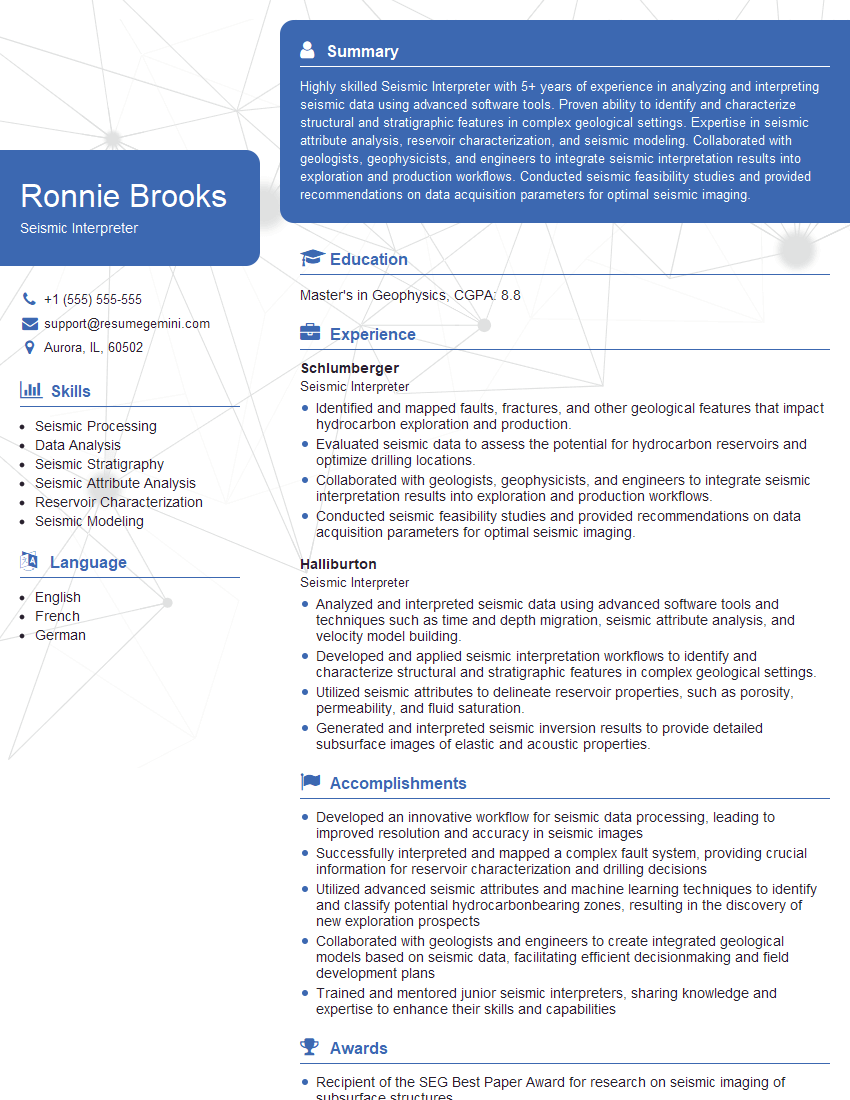
Mastering Geophysics and Data Processing opens doors to exciting and impactful careers in the energy sector and beyond. A strong understanding of these concepts is crucial for success in this competitive field. To significantly enhance your job prospects, focus on creating an ATS-friendly resume that showcases your skills and experience effectively. ResumeGemini is a trusted resource that can help you build a professional and impactful resume tailored to your specific background. Examples of resumes tailored to Geophysics and Data Processing are available to guide you.
Explore more articles
Users Rating of Our Blogs
Share Your Experience
We value your feedback! Please rate our content and share your thoughts (optional).
What Readers Say About Our Blog
Hello,
we currently offer a complimentary backlink and URL indexing test for search engine optimization professionals.
You can get complimentary indexing credits to test how link discovery works in practice.
No credit card is required and there is no recurring fee.
You can find details here:
https://wikipedia-backlinks.com/indexing/
Regards
NICE RESPONSE TO Q & A
hi
The aim of this message is regarding an unclaimed deposit of a deceased nationale that bears the same name as you. You are not relate to him as there are millions of people answering the names across around the world. But i will use my position to influence the release of the deposit to you for our mutual benefit.
Respond for full details and how to claim the deposit. This is 100% risk free. Send hello to my email id: [email protected]
Luka Chachibaialuka
Hey interviewgemini.com, just wanted to follow up on my last email.
We just launched Call the Monster, an parenting app that lets you summon friendly ‘monsters’ kids actually listen to.
We’re also running a giveaway for everyone who downloads the app. Since it’s brand new, there aren’t many users yet, which means you’ve got a much better chance of winning some great prizes.
You can check it out here: https://bit.ly/callamonsterapp
Or follow us on Instagram: https://www.instagram.com/callamonsterapp
Thanks,
Ryan
CEO – Call the Monster App
Hey interviewgemini.com, I saw your website and love your approach.
I just want this to look like spam email, but want to share something important to you. We just launched Call the Monster, a parenting app that lets you summon friendly ‘monsters’ kids actually listen to.
Parents are loving it for calming chaos before bedtime. Thought you might want to try it: https://bit.ly/callamonsterapp or just follow our fun monster lore on Instagram: https://www.instagram.com/callamonsterapp
Thanks,
Ryan
CEO – Call A Monster APP
To the interviewgemini.com Owner.
Dear interviewgemini.com Webmaster!
Hi interviewgemini.com Webmaster!
Dear interviewgemini.com Webmaster!
excellent
Hello,
We found issues with your domain’s email setup that may be sending your messages to spam or blocking them completely. InboxShield Mini shows you how to fix it in minutes — no tech skills required.
Scan your domain now for details: https://inboxshield-mini.com/
— Adam @ InboxShield Mini
Reply STOP to unsubscribe
Hi, are you owner of interviewgemini.com? What if I told you I could help you find extra time in your schedule, reconnect with leads you didn’t even realize you missed, and bring in more “I want to work with you” conversations, without increasing your ad spend or hiring a full-time employee?
All with a flexible, budget-friendly service that could easily pay for itself. Sounds good?
Would it be nice to jump on a quick 10-minute call so I can show you exactly how we make this work?
Best,
Hapei
Marketing Director
Hey, I know you’re the owner of interviewgemini.com. I’ll be quick.
Fundraising for your business is tough and time-consuming. We make it easier by guaranteeing two private investor meetings each month, for six months. No demos, no pitch events – just direct introductions to active investors matched to your startup.
If youR17;re raising, this could help you build real momentum. Want me to send more info?
Hi, I represent an SEO company that specialises in getting you AI citations and higher rankings on Google. I’d like to offer you a 100% free SEO audit for your website. Would you be interested?
Hi, I represent an SEO company that specialises in getting you AI citations and higher rankings on Google. I’d like to offer you a 100% free SEO audit for your website. Would you be interested?
good