Every successful interview starts with knowing what to expect. In this blog, we’ll take you through the top Hoisting and Rigging Techniques interview questions, breaking them down with expert tips to help you deliver impactful answers. Step into your next interview fully prepared and ready to succeed.
Questions Asked in Hoisting and Rigging Techniques Interview
Q 1. Explain the different types of slings and their appropriate applications.
Slings are the crucial components connecting the load to the lifting equipment. Choosing the right sling is paramount for safety and efficiency. Different materials and configurations cater to various lifting needs.
- Polyester/Nylon Web Slings: These are very common, relatively inexpensive, and easy to handle. They’re suitable for general lifting tasks, and their flexibility allows for lifting awkwardly shaped objects. However, they are susceptible to UV degradation and abrasion.
- Chain Slings: Durable and strong, chain slings are ideal for heavy-duty lifting and harsh environments. They are resistant to abrasion and heat, making them suitable for applications involving sharp edges or high temperatures. They are, however, heavier and less flexible than web slings.
- Wire Rope Slings: Known for exceptional strength, wire rope slings are used for extremely heavy lifts and demanding applications. Their strength is complemented by their resistance to abrasion and sharp edges. However, they require more careful handling due to their potential for damage from kinking or crushing.
- Round Slings: Made from synthetic fibers, round slings offer excellent flexibility and are suitable for lifting cylindrical objects and those with curved surfaces. They offer good shock absorption, which protects both the load and the equipment.
Appropriate Applications: The selection depends on factors like load weight, shape, environment, and required handling. For example, a web sling is suitable for lifting a pallet of goods, while a chain sling might be used to lift heavy steel beams. A wire rope sling might be necessary for a massive piece of industrial machinery.
Q 2. Describe the process of calculating load capacity for a given lift.
Calculating load capacity requires a methodical approach to ensure safe lifting. It’s not just about the weight of the object; it involves understanding the sling angle, sling configuration, and the equipment’s rated capacity.
Process:
- Determine the weight of the load: This is usually done through weighing scales or engineering drawings.
- Identify the sling type and its rated capacity: Check the manufacturer’s data plate for the sling’s safe working load (SWL).
- Determine the sling angle: Measure the angle between the sling legs and the vertical. A smaller angle means less load on each leg, but a sharper angle increases the stress on the sling.
- Apply the angle correction factor: For angles other than vertical, the load on each sling leg will be greater than the load’s weight, which necessitates using a correction factor. These are generally found in rigging manuals or manufacturer’s guidelines. The formula involves trigonometry and the angle between the sling leg and the vertical, often using cosine.
- Calculate the load on each leg: Divide the total load by the number of sling legs being used. For example, two legs each support half the total load, three legs one-third, etc.
- Ensure the load on each leg is less than the sling’s SWL (after angle correction): The load on each leg must be below the sling’s SWL.
- Check crane capacity: Ensure the crane’s lifting capacity exceeds the total calculated load.
Example: Let’s say a 1000kg load is lifted with two slings at a 30-degree angle. If the angle correction factor for 30 degrees is 1.15, then the load on each sling is (1000kg / 2) * 1.15 = 575kg. Each sling must have an SWL exceeding 575kg for a safe lift.
Q 3. What are the key safety considerations when using a crane?
Crane safety is paramount. Accidents can have devastating consequences. Key considerations include:
- Pre-lift inspection: Thoroughly inspecting the crane, slings, and load before each lift. Check for wear, damage, or any other defects.
- Load capacity: Never exceed the crane’s rated lifting capacity or the capacity of any rigging component. Using a load chart is crucial for this process.
- Proper rigging technique: Use appropriate slings and correctly attach them to the load and the crane hook. Avoid sharp bends and kinks in slings.
- Swing radius: Be aware of the crane’s swing radius and ensure there is sufficient clearance around the lift area to prevent collisions.
- Communication: Clear communication between the crane operator, riggers, and ground personnel is crucial. Establish hand signals or a communication system.
- Weather conditions: Avoid lifting in high winds or inclement weather unless absolutely necessary and appropriate safety measures are implemented. Strong winds can compromise stability.
- Load stability: Ensure the load is stable and secure on the hook before lifting it. The center of gravity should be properly assessed to prevent tipping or swinging.
- Emergency procedures: Have established emergency procedures for stopping the lift if a problem arises and a plan to deal with emergencies.
Ignoring these measures can lead to serious accidents, including equipment damage, injuries, or fatalities.
Q 4. How do you inspect lifting equipment before use?
A pre-use inspection is a critical step in preventing accidents. This is a visual check, sometimes supplemented by a more thorough inspection based on the nature of the equipment or frequency of use.
Inspection Process:
- Visual examination: Check for any visible damage such as cracks, bends, distortions, or corrosion on all components – the hook, chains, ropes, sheaves, and any other parts of the equipment or lifting gear.
- Check for wear and tear: Look for signs of excessive wear, fraying, or stretching of ropes or chains.
- Verify certifications: Ensure that all equipment has valid certification and inspection records. Check tags/labels for SWLs and other relevant information.
- Functional testing: For certain equipment, a functional test might be necessary, such as testing the crane’s braking system and hoist mechanism.
- Documentation: Always document your findings. Record any issues identified and corrective actions taken, and always sign off that the equipment is safe for use.
Remember, if there’s any doubt about the equipment’s condition, it should be taken out of service immediately and inspected by a qualified professional.
Q 5. What are the different types of crane hooks and their limitations?
Crane hooks are crucial load-bearing components. Their design influences their capacity and suitability for different jobs.
- Self-Closing Hooks: These hooks automatically close around the load, providing a secure connection. However, they have a maximum load limit and are suitable only for loads with suitable features.
- Open Hooks: These require manual attachment of the sling to the hook. They are versatile but require more careful handling to avoid accidental release. These are very common and can be used for a multitude of lifting tasks, however, caution is warranted to ensure proper attachment.
- Alloy Steel Hooks: Generally, hooks are constructed of alloy steel, providing excellent strength and durability, but they are susceptible to cracking and fatigue with repetitive use and must be inspected routinely.
Limitations:
- SWL: Every hook has a safe working load limit. Exceeding this limit can lead to catastrophic failure.
- Load type: Certain hook designs are suitable for specific load types. For instance, a hook designed for lifting beams might not be appropriate for delicate or oddly shaped loads.
- Damage risk: Hooks can be damaged from overload, impacts, or improper use. Damaged hooks must be replaced immediately.
Q 6. Explain the importance of proper rigging planning and documentation.
Rigging planning and documentation are essential for safety and efficiency. A well-planned lift minimizes risks and ensures smooth execution.
Importance:
- Risk mitigation: Proper planning identifies potential hazards and helps to develop strategies to mitigate them.
- Efficiency: A well-defined plan optimizes the lifting process, reducing the time and resources required.
- Legal compliance: Detailed documentation demonstrates compliance with safety regulations and provides a record for audits.
- Communication: Clear documentation ensures that all personnel involved in the lift understand the plan and their roles.
Documentation: Documentation should include a detailed plan with diagrams showing the lift setup, the type and capacity of all equipment and personnel involved, the weight and dimensions of the load, and an analysis of the relevant risks with control measures.
A thorough plan includes contingencies for unforeseen events and procedures for dealing with emergencies.
Q 7. Describe your experience with different types of rigging hardware.
Throughout my career, I’ve worked extensively with various rigging hardware including:
- Shackles: These are used to connect different components of the rigging system, such as connecting a sling to a hook or a chain to a beam. I have experience using bow shackles, D-shackles, and screw pin shackles, each suited to specific applications based on their strengths and ease of use.
- Turnbuckles: These adjustable connectors allow for fine-tuning tension in the rigging system and are crucial when precise adjustments are needed. I understand the importance of choosing the right size and material based on the load and environmental conditions.
- Swivels: These help to prevent twisting of slings and chains, reducing wear and tear and promoting better handling. I’ve used various swivels, selecting them based on the load type and sling material.
- Eye Bolts: These are used for attaching slings to loads that have lifting points. I understand the importance of using correctly rated eyebolts and always ensuring proper placement.
- Bridle Slings: Used for lifting loads requiring multiple points of attachment for better load distribution. I have experience calculating loads in these configurations, ensuring the system operates within the SWL.
My experience includes working with different materials, such as steel, alloy steel, and high-strength materials, selected based on the specific needs of each job. For instance, I’d use high-strength alloy steel for high-temperature applications and milder steel for other applications, always prioritizing safety and suitability for the load conditions.
Q 8. How do you ensure the safe handling of loads with unusual shapes or weights?
Safe handling of unusually shaped or weighted loads requires meticulous planning and execution. It’s not just about the weight, but also the load’s center of gravity, its stability, and potential shifting during the lift. Think of it like carrying a very awkwardly shaped box – you need to be aware of where its weight is concentrated to prevent it from tipping or slipping.
- Detailed Load Analysis: Before attempting any lift, we conduct a thorough analysis. This involves determining the load’s weight, dimensions, center of gravity, and any potential weak points. Special attention is given to fragile components.
- Specialized Rigging Gear: We select appropriate rigging hardware, including slings, chains, and shackles, capable of handling the load’s weight and unique shape. This might involve using multiple slings for better load distribution or specialized slings like web slings that conform to irregular shapes.
- Multiple Lift Points: For extremely awkward loads, we use multiple lift points to distribute the weight evenly and prevent excessive stress on any single point. This is particularly critical for loads with uneven weight distribution.
- Experienced Crew: A team of experienced riggers and crane operators is essential. Clear communication and coordination between team members are paramount to avoid accidents. For exceptionally challenging lifts, a rigging engineer might be consulted.
- Trial Lift: In some cases, a trial lift with a smaller load of similar shape and weight can be performed to test the rigging setup and identify potential issues before attempting the full lift.
For example, lifting a large, irregularly shaped piece of machinery might require us to use spreader beams to distribute the weight across multiple points, preventing any single attachment from exceeding its safe working load.
Q 9. What are the critical factors in selecting the appropriate lifting gear?
Selecting the right lifting gear is crucial for safety and efficiency. Think of it as choosing the right tool for a job – using the wrong one can lead to damage or disaster.
- Load Capacity: The most important factor is the load’s weight. We always select gear with a safe working load (SWL) significantly exceeding the load’s weight, often with a substantial safety factor (typically 5:1 or higher).
- Load Type and Shape: Different loads require different types of rigging gear. Sharp edges may require protective slings, while irregularly shaped loads might need multiple slings or specialized equipment.
- Environmental Conditions: Temperature extremes, exposure to chemicals, and weather conditions can affect the strength and durability of lifting gear. We choose materials suitable for the specific environment.
- Accessibility and Workspace: The workspace, accessibility to the load, and available space influence the type of lifting gear selected. For confined spaces, compact equipment might be necessary.
- Compatibility: Rigging gear should be compatible with the lifting equipment being used (e.g., crane hooks, shackles). Improper connections are a major source of accidents.
For instance, we wouldn’t use a nylon sling for a lift involving sharp metal edges, as it could easily be cut and fail. Similarly, we would use a heavier-duty chain sling for heavier loads compared to a lighter-duty web sling.
Q 10. Explain the concept of load charts and their significance in rigging.
Load charts are graphical representations showing the safe working loads (SWLs) of lifting equipment and rigging gear under various conditions. Think of them as the instruction manual for your lifting operation, indicating safe limits and configurations.
- Safety Assurance: Load charts help ensure that the selected gear is suitable for the load’s weight and the intended lifting method. They provide critical information on the maximum safe weight for different configurations (e.g., single leg, two-leg, three-leg slings).
- Angle of Lift: Load charts account for the angle of the sling, showing how SWL decreases as the angle deviates from vertical. A sling at a sharper angle carries a significantly reduced SWL.
- Types of Slings: Different types of slings (chain, wire rope, web) have different load charts. These charts often reflect the material’s characteristics and failure points.
- Legal Compliance: Using load charts is critical for adhering to OSHA and other relevant safety regulations. Failure to comply can result in fines and legal action.
Before any lift, we always consult the appropriate load chart for the specific rigging gear being used. This ensures that the lift is performed within safe operating parameters, preventing potential accidents.
Q 11. How do you manage risks associated with environmental factors during lifting operations?
Environmental factors pose significant risks to lifting operations. Adverse conditions can affect the load’s stability, the integrity of lifting gear, and the overall safety of personnel. We mitigate these risks through careful planning and proactive measures.
- Weather Monitoring: We monitor weather conditions closely, postponing lifts if wind speeds, rain, snow, or ice pose a significant threat. High winds can make it difficult to control the load and can cause the crane to become unstable.
- Ground Conditions: Soft ground, uneven terrain, or slippery surfaces can affect the stability of the crane and the load. We take measures like using ground mats or cribbing to ensure a stable base.
- Visibility: Poor visibility due to fog or darkness necessitates extra precautions, including additional lighting and communication measures. We also ensure that our communication protocols are fully understood and implemented effectively.
- Temperature Extremes: Extreme heat or cold can affect the strength of lifting gear. We choose appropriate materials and consider the effect of temperature on the load’s integrity.
For instance, in high winds, we might choose to reduce the load’s weight or use additional rigging equipment to improve stability. In slippery conditions, we would employ additional measures to prevent the crane or load from slipping.
Q 12. What is your experience with different types of cranes (e.g., tower, mobile, overhead)?
I have extensive experience with various crane types, each with its unique strengths and limitations.
- Tower Cranes: I’m proficient in the operation and rigging procedures for tower cranes, understanding their capacity, reach, and limitations in various construction scenarios. These are ideal for high-rise construction where repetitive lifts of heavy materials are required.
- Mobile Cranes: My experience includes operating and rigging for mobile cranes (both crawler and all-terrain), appreciating the advantages of mobility and adaptability for various job sites. These are very versatile, usable in many locations that fixed cranes can’t reach.
- Overhead Cranes: I have significant experience with overhead cranes in industrial settings, including their operation, maintenance, and safe use in manufacturing and warehousing. These are excellent for indoor operations and high-frequency lifting tasks.
I understand the safety regulations and operational procedures specific to each type, and I can effectively adapt my rigging techniques to match the crane’s capabilities.
Q 13. Describe your experience with different types of lifting methods (e.g., vertical, inclined, horizontal).
My experience encompasses various lifting methods, each requiring a different approach to ensure safety and efficiency.
- Vertical Lifts: These are the most common and generally the safest, but require careful planning to prevent swinging or collision with obstructions.
- Inclined Lifts: These are more challenging and require detailed calculations to ensure that the load remains stable and does not exceed the sling’s safe working load at an angle. We use specialized calculations that account for the increased stress on slings.
- Horizontal Lifts: These are often the most complex, requiring careful consideration of the load’s center of gravity, its stability during movement, and the potential for it to swing or collide with obstructions. We often use guide lines or specialized equipment.
I’ve worked on projects requiring each of these methods, adapting my techniques to ensure that all lifts are performed safely and efficiently, regardless of the complexity or unique challenges involved.
Q 14. What is your understanding of OSHA/relevant safety regulations for hoisting and rigging?
My understanding of OSHA regulations (and other relevant national and international standards) is comprehensive. Safety is paramount in all my work, and I adhere strictly to all applicable regulations. I know that ignoring these rules isn’t just irresponsible, it’s dangerous.
- Competency and Training: I’m fully certified and trained in safe rigging practices and the proper use of lifting equipment. I regularly participate in refresher courses and keep my knowledge current.
- Inspection and Maintenance: I’m meticulous about inspecting all rigging gear before each lift to ensure it’s free from damage and in compliance with regulations. I know the importance of regular maintenance to prolong equipment life and minimize risk.
- Safe Work Practices: I strictly follow safe work practices, ensuring that all team members are aware of their roles, responsibilities, and safety protocols. This includes pre-lift meetings, clear communication, and using proper signaling procedures.
- Incident Reporting and Investigation: I understand the procedures for reporting and investigating any incidents or near misses. This is crucial for identifying safety hazards and improving procedures for the future.
My commitment to safety extends beyond simply complying with regulations; I actively seek ways to improve safety practices and prevent accidents.
Q 15. How do you communicate effectively with crane operators and other personnel on a rigging crew?
Effective communication is paramount in rigging. It’s not just about giving instructions; it’s about ensuring everyone understands and agrees. With crane operators, I use clear, concise hand signals, supplemented by radio communication, especially for complex lifts. Hand signals must adhere to industry standards, eliminating ambiguity. For instance, a slow, deliberate hand signal for ‘hoist’ is crucial to avoid misinterpretations. Radio communication is used for more detailed information, such as load weight, lifting height, and any potential obstacles. With the rigging crew, I prefer a pre-lift briefing where everyone contributes their observations and concerns. This ensures we’re all on the same page and prevents accidents due to misunderstandings. I also emphasize open communication where team members feel comfortable voicing concerns or identifying potential hazards throughout the operation.
Example: Before a complex lift involving multiple points of attachment, I’ll conduct a thorough briefing outlining each step, responsibilities, and potential hazards, allowing for questions and discussions to ensure everyone understands their roles.
Career Expert Tips:
- Ace those interviews! Prepare effectively by reviewing the Top 50 Most Common Interview Questions on ResumeGemini.
- Navigate your job search with confidence! Explore a wide range of Career Tips on ResumeGemini. Learn about common challenges and recommendations to overcome them.
- Craft the perfect resume! Master the Art of Resume Writing with ResumeGemini’s guide. Showcase your unique qualifications and achievements effectively.
- Don’t miss out on holiday savings! Build your dream resume with ResumeGemini’s ATS optimized templates.
Q 16. Explain the process of troubleshooting common problems encountered during lifting operations.
Troubleshooting lifting operations involves systematic problem-solving. It starts with identifying the problem—is the lift not proceeding as planned, is there an unexpected sway, or a problem with equipment? Then I determine the root cause: is it a mechanical issue with the crane, a rigging problem, or a human error? Once the root cause is identified, the solution can be implemented. This often involves carefully evaluating the current situation, considering safety above all else. If, for instance, a load is swaying excessively, we might temporarily stop the lift to reassess the rigging configuration or check wind speed. If a mechanical problem occurs with the crane, I would immediately halt the operation and contact the crane operator and maintenance personnel. Proper documentation is essential; I meticulously record each step of the troubleshooting process, including the problem, the cause, and the solution implemented.
Example: During a lift, the load started to swing unexpectedly. I immediately stopped the lift, checked the wind speed, and inspected the rigging for any slack or damage. It turned out there was a slight imbalance in the load distribution. We adjusted the rigging and then resumed the lift after ensuring the load was balanced.
Q 17. What are the different types of knots used in rigging and their applications?
Many knots are used in rigging, each suited to specific applications. Understanding their strengths and limitations is critical. Here are a few examples:
- Bowline: Forms a strong, reliable loop that doesn’t tighten under load and is easy to untie. Used for attaching a load to a sling or creating a running loop.
- Clove Hitch: A quick, simple knot used for temporary attachments. While relatively easy to tie, it’s crucial to use it in conjunction with other securing methods for heavier loads or critical lifts.
- Figure Eight: A stopper knot, used to prevent a rope from running through a pulley or other device. It’s also commonly used as part of a larger rigging setup.
- Truckers Hitch: A versatile knot providing a mechanical advantage for tensioning loads, frequently used in conjunction with a snatch block.
The choice of knot depends heavily on the load, the material being used, and the specific lifting requirements. Incorrect knot selection can lead to catastrophic failures, so proper training and experience are essential.
Q 18. How do you handle emergency situations during a lift?
Emergency situations demand immediate, decisive action. The first priority is always safety. If a load is unstable, I would immediately signal the crane operator to lower the load slowly and cautiously. If there’s equipment malfunction, I’d initiate emergency shutdown procedures, ensuring all personnel are clear of the hazard zone. Communication is critical—I would quickly inform all team members of the situation and initiate evacuation if necessary. Depending on the nature of the emergency, I would either use established emergency procedures or improvise to resolve the situation, always putting the safety of personnel and the protection of property as top priorities. Thorough post-incident investigation and reporting are crucial for identifying causes and preventing future occurrences.
Example: If a sling breaks during a lift, the immediate action would be to signal the crane operator to lower the load as gently as possible. Once the load is down, a thorough investigation of the cause (wear and tear, improper use etc) would be conducted.
Q 19. What experience do you have with load monitoring and control systems?
I have extensive experience with load monitoring and control systems, both analog and digital. This includes using load cells to measure the weight of a load accurately, ensuring it remains within the crane’s capacity. I’m proficient in interpreting data from these systems, identifying potential overload situations or equipment malfunctions in real-time. My experience also includes working with systems that provide real-time feedback on load angle and stability, helping to prevent potential accidents. I understand the importance of calibrating load cells and maintaining the integrity of the monitoring system to ensure accurate readings.
Example: On a recent project, we used a digital load monitoring system that provided real-time data on the load weight and angle. This allowed us to make adjustments to the rigging configuration to maintain stability throughout the lift. The system also alerted us to potential overloads, allowing for corrective actions before a dangerous situation arose.
Q 20. Describe your experience with pre-lift planning meetings.
Pre-lift planning meetings are an essential part of every rigging operation. These meetings involve all relevant personnel – crane operators, riggers, engineers, and supervisors. The purpose is to thoroughly review the lift plan, addressing every detail of the process: the load’s weight, dimensions, center of gravity, rigging configuration, crane capacity, and any potential hazards. I actively participate in these meetings, contributing my expertise to ensure the plan is safe, efficient, and feasible. I encourage open communication and address any concerns or questions from the team members. Minutes from these meetings are recorded and kept on file as a safety record.
Example: In a recent pre-lift meeting, we identified a potential obstacle—a nearby power line—that wasn’t initially apparent on the drawings. We adjusted the lift plan to ensure a safe distance from the power line and included this as a key point of emphasis for the crane operator.
Q 21. Explain the importance of regular maintenance and inspection of rigging equipment.
Regular maintenance and inspection are crucial for preventing accidents and ensuring the safety of all personnel. Rigging equipment such as slings, shackles, and hooks is subjected to significant stress, and wear and tear can lead to catastrophic failures. I follow a strict inspection regime, visually inspecting all equipment before each lift for signs of damage, wear, corrosion, or deformation. Documentation of inspections is meticulously maintained, with any damaged or questionable equipment immediately removed from service and replaced. We also follow a schedule of planned maintenance, including thorough inspections and testing by qualified personnel at regular intervals, ensuring compliance with all relevant safety standards and regulations. This proactive approach significantly minimizes the risk of equipment failure and maximizes the safety of the operation.
Example: During a routine inspection, I noticed slight fraying on a sling. Although not immediately critical, this indicated potential for future failure. I promptly replaced the sling, preventing a potentially hazardous situation.
Q 22. How do you ensure compliance with safety regulations and company policies?
Ensuring compliance with safety regulations and company policies is paramount in rigging. It’s not just about following rules; it’s about protecting lives and preventing costly accidents. My approach is multifaceted.
- Proactive Training and Familiarization: I always ensure I’m up-to-date on all relevant safety standards, including OSHA regulations (or equivalent in other regions), and company-specific policies. Regular refresher courses are crucial for keeping my skills sharp and knowledge current.
- Pre-Lift Planning and Risk Assessment: Before any lift, I conduct a thorough risk assessment, identifying potential hazards and developing mitigation strategies. This involves checking equipment for defects, confirming load capacities, and analyzing the work environment for potential obstacles.
- Detailed Documentation: I meticulously document all aspects of a lift, from the initial planning phase to the completion of the operation. This includes the type of equipment used, load weights, rigging configurations, and any incidents or near misses. This detailed record-keeping assists in continuous improvement and incident investigation.
- Communication and Teamwork: Clear and concise communication is vital. I ensure everyone involved in the lift understands their roles and responsibilities. This includes riggers, crane operators, signal persons, and supervisors. Regular communication throughout the process helps prevent misunderstandings and potential errors.
- Adherence to Procedures: I strictly follow established lifting procedures and protocols. If I encounter a situation that deviates from these procedures, I immediately consult with my supervisor to address the issue before proceeding.
For example, during a recent project involving a heavy transformer, we identified a potential conflict between the crane’s swing radius and a nearby building. By proactively adjusting the lift plan, we eliminated the hazard and ensured a safe operation.
Q 23. What are the limitations of different types of slings?
Different sling types have varying limitations, impacting their suitability for specific loads and environments. Understanding these limitations is critical for safe rigging.
- Nylon Web Slings: Strong and relatively lightweight, but susceptible to damage from sharp edges and UV degradation. They also have a lower working load limit than other sling types for the same size.
- Wire Rope Slings: Extremely strong and durable, ideal for heavy lifting, but susceptible to kinking, crushing, and fatigue. Regular inspections are essential to detect wear and tear.
- Chain Slings: Very robust and suitable for harsh environments, but prone to wear and stretching over time. They can also snag or become damaged by sharp objects.
- Synthetic Web Slings: These offer a good balance of strength, flexibility, and relative light weight but are affected by certain chemicals and extreme temperatures.
For instance, using a nylon sling on a load with sharp edges would likely result in sling failure. Similarly, a wire rope sling showing signs of significant corrosion should never be used.
Q 24. Describe your experience with working at heights during rigging operations.
Working at heights during rigging requires meticulous planning and adherence to strict safety protocols. I have extensive experience with various fall protection systems, including harnesses, lanyards, and lifelines.
- Fall Arrest Systems: I always ensure that appropriate fall arrest systems are in place and properly inspected before commencing work at heights. This includes checking anchor points, harness fittings, and lanyard integrity.
- Rescue Plans: Emergency rescue plans are essential. I familiarize myself with the available rescue equipment and procedures before starting any work at heights. In case of a fall, the plan is meticulously communicated and practiced by the team.
- Safe Access and Egress: I ensure secure access and egress points to and from the work area, utilizing scaffolding, ladders, or other approved methods. These access points must be inspected for safety before usage.
- Weather Conditions: Weather conditions significantly impact work at heights. Strong winds, rain, and ice can all increase risks. I assess the weather forecast before commencement and will cease operations if conditions become unsafe.
In one instance, we were rigging a large sign onto a tall building. We implemented a comprehensive fall protection system, including a full-body harness, double lanyards, and an anchor point on the building’s structure. Regular checks of our equipment were carried out throughout the operation.
Q 25. How do you handle difficult or challenging lifting situations?
Challenging lifting situations require a systematic approach. I approach them by implementing a structured problem-solving methodology.
- Re-assessment of the situation: Thoroughly reassess the initial plan, considering all constraints. This could involve revising the rigging method, changing the lifting equipment, or adjusting the lifting angle.
- Consult with Experts: Seek guidance from experienced colleagues or engineers to brainstorm alternative solutions and ensure safety.
- Using Specialized Equipment: When necessary, I will request specialized lifting equipment such as spreader beams, shackles, or other load-distributing devices.
- Phased Lifting: Consider breaking down the lift into smaller, more manageable stages to reduce complexity and risk.
- Develop Contingency Plans: This includes having backup lifting methods and personnel in place in case of unforeseen difficulties.
One example involved lifting a massive piece of machinery into a tight space. The original plan proved unsuitable due to limited clearance. By consulting with an engineer, we devised a phased lifting technique using a combination of a crane and a smaller hoist, successfully completing the lift without incident.
Q 26. What is your understanding of load distribution and center of gravity?
Understanding load distribution and center of gravity is fundamental to safe lifting. Improper distribution can lead to equipment failure and serious accidents.
Load Distribution: This refers to how the weight of the load is distributed across the lifting points. The goal is to evenly distribute the weight to prevent overloading individual slings or lifting points. Uneven distribution can cause stress concentrations, leading to equipment failure.
Center of Gravity (CG): The CG is the point where the entire weight of an object is considered to be concentrated. Knowing the CG is crucial because it determines the load’s stability and how it will react to movement. An object with a high CG is more prone to tipping or instability during lifting.
To illustrate, consider lifting a long steel beam. If lifted from only one end, the beam is more likely to sag and the load is unevenly distributed. Using spreader bars allows even weight distribution across multiple points and lowers the center of gravity, enhancing stability.
Q 27. Explain the different types of hitches and their applications in rigging.
Various hitches are used in rigging, each with specific applications.
- Basic Hitch: A simple loop around a load, suitable for light loads and temporary securement.
- Clove Hitch: A versatile hitch used for securing ropes or slings to a post or hook, easy to tie and adjust.
- Bowline: Creates a strong, non-slipping loop at the end of a rope, suitable for lifting loops.
- Running Bowline: A variation of the bowline used when needing to secure a load with a rope that continues past the load.
- Timber Hitch: Used for securing a load of timber or other cylindrical objects around a hook or point.
The choice of hitch depends heavily on the type of load, the lifting equipment, and the overall risk profile. I would never use a basic hitch for a heavy load.
Q 28. Describe your experience with specialized rigging techniques (e.g., heavy lifts, underwater rigging).
My experience includes specialized rigging techniques.
- Heavy Lifts: I’ve participated in many heavy lifts involving specialized equipment, such as crawler cranes, strand jacks, and heavy-duty lifting beams. These projects involve detailed planning, load calculations, and precise execution.
- Underwater Rigging: This involves unique challenges related to buoyancy, visibility, and the corrosive nature of seawater. Specialized equipment and techniques, including divers and underwater cameras, are employed for safe and efficient operation. I have experience with underwater lifting bags to float heavy objects to the surface.
One memorable project involved lifting a massive generator into a power plant using a combination of a crawler crane and strand jacks. The project required careful planning of rigging angles, weight distribution, and precise synchronization of equipment to ensure safe operation.
Key Topics to Learn for Hoisting and Rigging Techniques Interview
- Fundamental Principles of Lifting: Understanding center of gravity, load distribution, and stability calculations. Practical application: Analyzing load charts and selecting appropriate lifting equipment.
- Rigging Hardware and Equipment: Familiarization with various types of slings, shackles, hooks, and wire ropes. Practical application: Selecting the right hardware for different lifting scenarios and assessing their condition for safety.
- Safe Lifting Practices and Procedures: Detailed knowledge of OSHA regulations and industry best practices for safe lifting operations. Practical application: Developing and implementing safe work procedures for various lifting tasks.
- Knot Tying and Splicing: Mastering essential knots used in rigging and understanding the importance of proper splicing techniques for wire ropes. Practical application: Demonstrating proficiency in tying various knots and inspecting splices for integrity.
- Lifting Plan Development and Execution: Creating comprehensive lifting plans, including risk assessment, equipment selection, and emergency procedures. Practical application: Developing and presenting a lifting plan for a specific scenario.
- Troubleshooting and Problem Solving: Identifying and resolving common rigging problems, such as load instability or equipment malfunction. Practical application: Describing strategies for handling unexpected situations during lifting operations.
- Inspection and Maintenance: Regular inspection of rigging equipment and understanding maintenance requirements to ensure safe operation. Practical application: Explaining procedures for inspecting slings, ropes, and other rigging hardware.
Next Steps
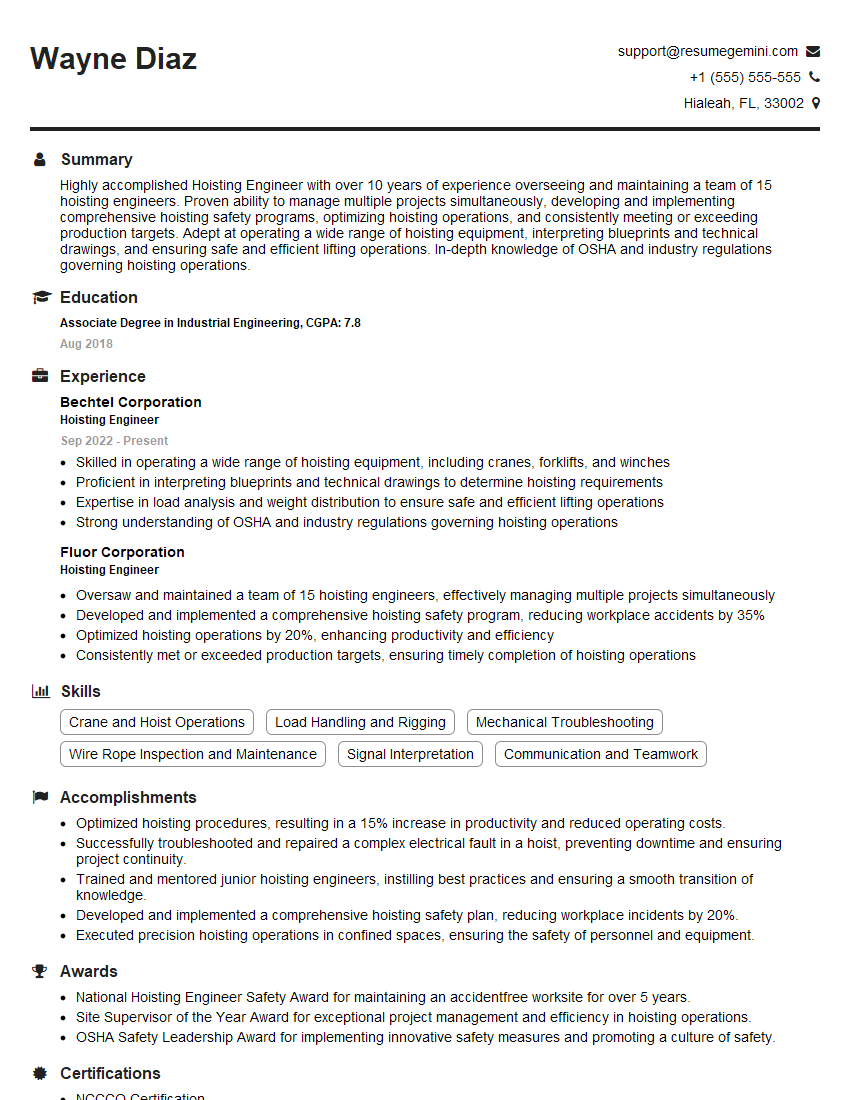
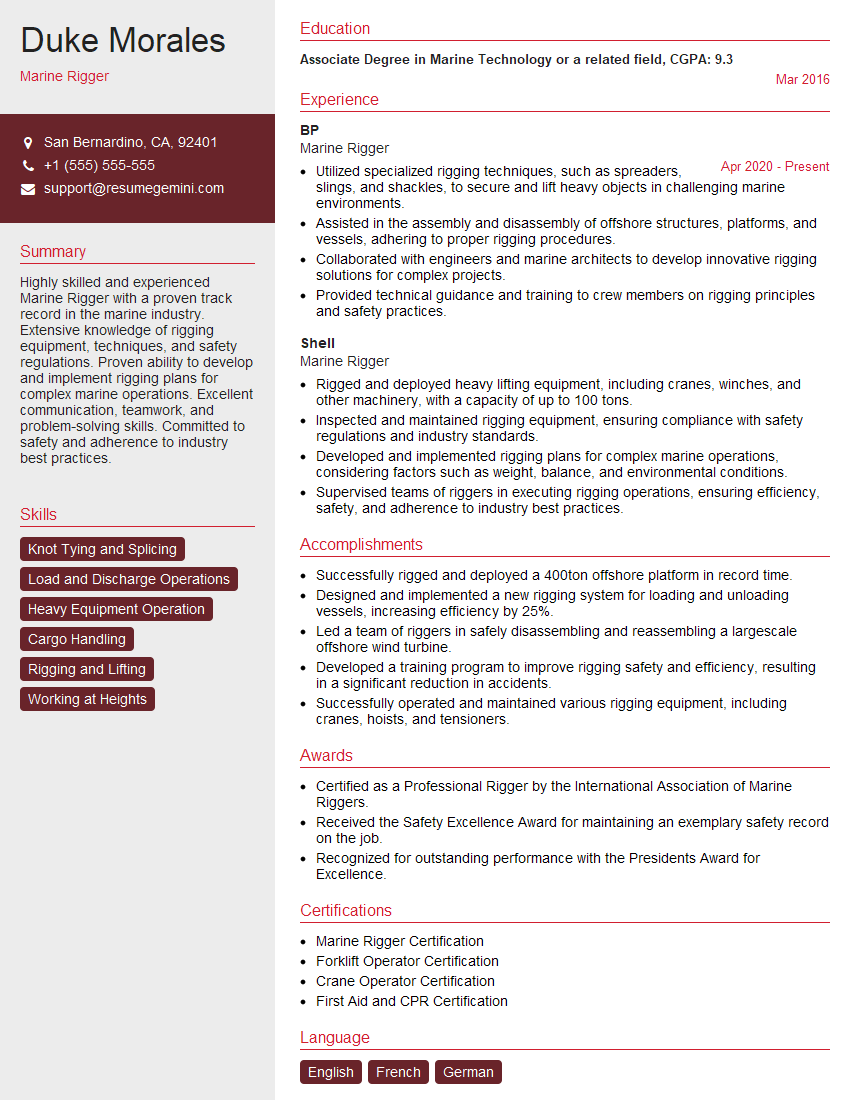
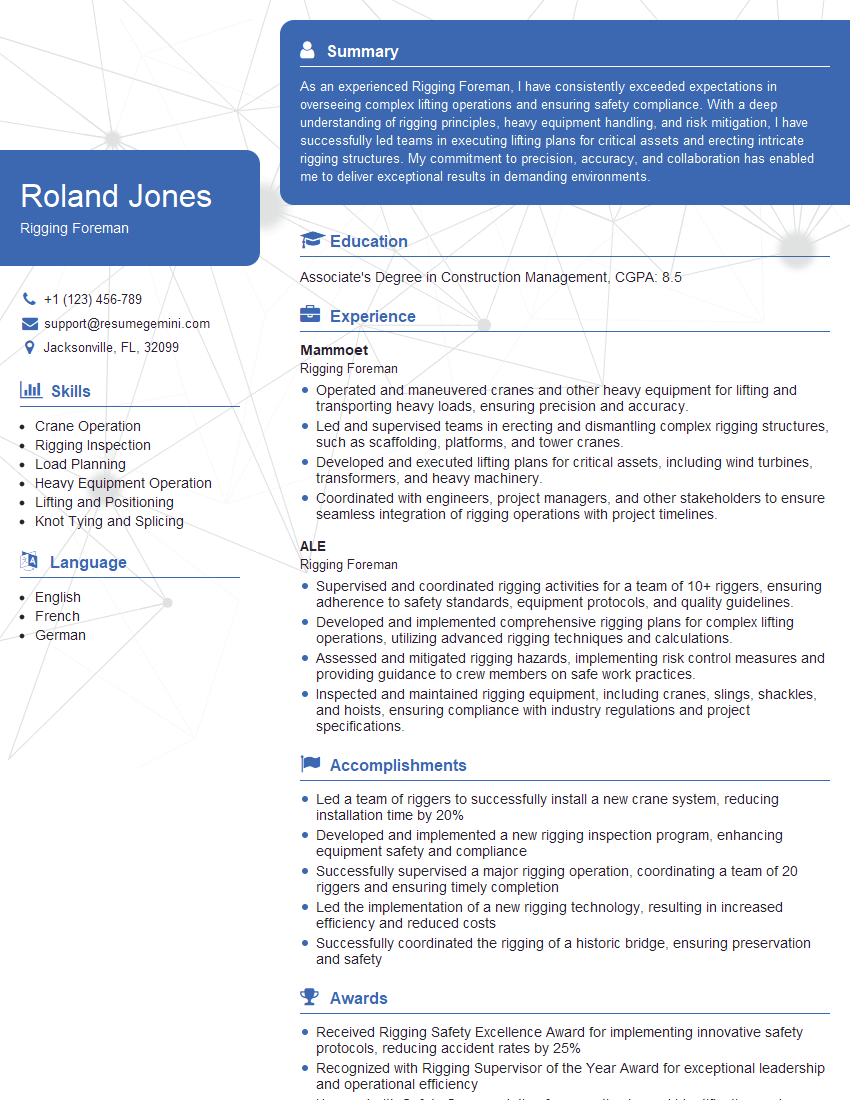
Mastering Hoisting and Rigging Techniques opens doors to exciting career opportunities in construction, manufacturing, and industrial settings. A strong understanding of these techniques demonstrates your commitment to safety and efficiency, making you a highly valuable asset to any team. To maximize your job prospects, crafting a compelling and ATS-friendly resume is crucial. ResumeGemini is a trusted resource to help you build a professional resume that highlights your skills and experience effectively. Examples of resumes tailored to Hoisting and Rigging Techniques are available to guide you. Invest time in perfecting your resume – it’s your first impression to potential employers.





Explore more articles
Users Rating of Our Blogs
Share Your Experience
We value your feedback! Please rate our content and share your thoughts (optional).
What Readers Say About Our Blog
Hello,
we currently offer a complimentary backlink and URL indexing test for search engine optimization professionals.
You can get complimentary indexing credits to test how link discovery works in practice.
No credit card is required and there is no recurring fee.
You can find details here:
https://wikipedia-backlinks.com/indexing/
Regards
NICE RESPONSE TO Q & A
hi
The aim of this message is regarding an unclaimed deposit of a deceased nationale that bears the same name as you. You are not relate to him as there are millions of people answering the names across around the world. But i will use my position to influence the release of the deposit to you for our mutual benefit.
Respond for full details and how to claim the deposit. This is 100% risk free. Send hello to my email id: [email protected]
Luka Chachibaialuka
Hey interviewgemini.com, just wanted to follow up on my last email.
We just launched Call the Monster, an parenting app that lets you summon friendly ‘monsters’ kids actually listen to.
We’re also running a giveaway for everyone who downloads the app. Since it’s brand new, there aren’t many users yet, which means you’ve got a much better chance of winning some great prizes.
You can check it out here: https://bit.ly/callamonsterapp
Or follow us on Instagram: https://www.instagram.com/callamonsterapp
Thanks,
Ryan
CEO – Call the Monster App
Hey interviewgemini.com, I saw your website and love your approach.
I just want this to look like spam email, but want to share something important to you. We just launched Call the Monster, a parenting app that lets you summon friendly ‘monsters’ kids actually listen to.
Parents are loving it for calming chaos before bedtime. Thought you might want to try it: https://bit.ly/callamonsterapp or just follow our fun monster lore on Instagram: https://www.instagram.com/callamonsterapp
Thanks,
Ryan
CEO – Call A Monster APP
To the interviewgemini.com Owner.
Dear interviewgemini.com Webmaster!
Hi interviewgemini.com Webmaster!
Dear interviewgemini.com Webmaster!
excellent
Hello,
We found issues with your domain’s email setup that may be sending your messages to spam or blocking them completely. InboxShield Mini shows you how to fix it in minutes — no tech skills required.
Scan your domain now for details: https://inboxshield-mini.com/
— Adam @ InboxShield Mini
Reply STOP to unsubscribe
Hi, are you owner of interviewgemini.com? What if I told you I could help you find extra time in your schedule, reconnect with leads you didn’t even realize you missed, and bring in more “I want to work with you” conversations, without increasing your ad spend or hiring a full-time employee?
All with a flexible, budget-friendly service that could easily pay for itself. Sounds good?
Would it be nice to jump on a quick 10-minute call so I can show you exactly how we make this work?
Best,
Hapei
Marketing Director
Hey, I know you’re the owner of interviewgemini.com. I’ll be quick.
Fundraising for your business is tough and time-consuming. We make it easier by guaranteeing two private investor meetings each month, for six months. No demos, no pitch events – just direct introductions to active investors matched to your startup.
If youR17;re raising, this could help you build real momentum. Want me to send more info?
Hi, I represent an SEO company that specialises in getting you AI citations and higher rankings on Google. I’d like to offer you a 100% free SEO audit for your website. Would you be interested?
Hi, I represent an SEO company that specialises in getting you AI citations and higher rankings on Google. I’d like to offer you a 100% free SEO audit for your website. Would you be interested?
good