Are you ready to stand out in your next interview? Understanding and preparing for Inline Quality Control interview questions is a game-changer. In this blog, we’ve compiled key questions and expert advice to help you showcase your skills with confidence and precision. Let’s get started on your journey to acing the interview.
Questions Asked in Inline Quality Control Interview
Q 1. Explain the principles of inline quality control.
Inline quality control (IQC) is a proactive approach to ensuring product quality. Instead of inspecting finished goods at the end of the production line (offline QC), IQC checks the quality of the product *during* the manufacturing process. This allows for immediate detection and correction of defects, preventing flawed products from progressing further. Think of it like a chef tasting the soup throughout the cooking process rather than only at the end. The core principles revolve around continuous monitoring, immediate feedback, and preventative actions. It prioritizes minimizing waste, reducing rework, and improving overall efficiency.
Effective IQC involves:
- Real-time monitoring: Utilizing sensors, automated systems, or visual inspections at various stages of production.
- Immediate corrective action: Addressing identified defects or deviations as soon as they occur, preventing propagation of errors.
- Process optimization: Using IQC data to identify and address root causes of defects, leading to continuous improvement.
- Data-driven decision making: Leveraging collected data to analyze trends, identify potential problems, and fine-tune the manufacturing process.
Q 2. What are the key differences between inline and offline quality control?
The primary difference lies in *when* quality checks are performed. Inline QC happens during manufacturing, providing immediate feedback and allowing for real-time adjustments. Offline QC, conversely, takes place after the product is complete. This means that any defects found are already present in the finished product, leading to higher costs associated with rework, scrap, or customer returns.
Here’s a table summarizing the key differences:
| Feature | Inline QC | Offline QC |
|---|---|---|
| Timing | During production | After production |
| Feedback | Immediate | Delayed |
| Cost | Lower (prevention focus) | Higher (correction focus) |
| Efficiency | Improved | Reduced |
| Defect Detection | Early detection, prevention | Late detection, more defects found |
In essence, IQC is preventative, aiming to stop defects from happening; offline QC is reactive, dealing with defects after they’ve occurred.
Q 3. Describe your experience with Statistical Process Control (SPC).
I have extensive experience utilizing Statistical Process Control (SPC) within inline quality control. SPC is crucial for monitoring process stability and identifying assignable causes of variation. My experience includes implementing and interpreting control charts, such as X-bar and R charts, and using them to monitor key process parameters. For instance, in a previous role manufacturing circuit boards, I used X-bar and R charts to monitor the thickness of solder paste during the screen printing process. By analyzing these charts, we could identify when the process went out of control – for example, due to a worn-out stencil or inconsistent paste viscosity – and take corrective action before a significant number of defective boards were produced. This significantly reduced scrap and rework.
Furthermore, I’m proficient in using capability analysis to assess the process’s ability to meet customer specifications, ensuring consistent product quality. I’ve also used advanced SPC techniques, such as moving average and exponentially weighted moving average (EWMA) charts for better sensitivity to smaller shifts in the process mean.
Q 4. How do you identify and address process variations using inline QC methods?
Identifying and addressing process variations using IQC methods involves a systematic approach. It starts with clearly defining key process parameters (KPIs) that are critical to product quality. Then, IQC tools are used to monitor these KPIs in real time. Variations are then categorized into common cause and assignable cause variations.
Common cause variation is inherent to the process and is considered normal, random fluctuation. Assignable cause variation is due to specific identifiable factors, requiring investigation and corrective action.
Here’s a step-by-step approach:
- Monitor KPIs: Collect data on critical process parameters using appropriate sensors and automated systems.
- Analyze data: Use control charts (e.g., X-bar and R charts) to analyze the data and identify points outside control limits, indicating assignable cause variation.
- Investigate assignable causes: Identify the root cause of the variation through techniques like Pareto charts, fishbone diagrams (Ishikawa diagrams), or 5 Whys analysis.
- Implement corrective actions: Address the root cause by adjusting machine settings, improving operator training, modifying the process, or addressing material issues.
- Verify effectiveness: Monitor the process after corrective action to ensure stability and the desired reduction in variation.
For example, if a control chart shows an increasing trend in defect rate, I would investigate potential reasons, such as tool wear or material degradation. Addressing these issues would then be the corrective action.
Q 5. What are the common tools and techniques used in inline quality control?
A variety of tools and techniques are used in IQC. The choice depends on the specific process and product characteristics.
- Control Charts: X-bar and R charts, p-charts, c-charts, u-charts to monitor process variation and stability.
- Checklists and Forms: Structured documents for consistent data collection and inspection.
- Gauges and Measurement Devices: Precise instruments for measuring critical dimensions, weights, or other properties.
- Automated Inspection Systems: Vision systems, laser scanners, and other automated equipment for high-volume, high-speed inspection.
- Statistical Software: Software packages for data analysis, control chart creation, and process capability studies (e.g., Minitab, JMP).
- Data Acquisition Systems: Systems for collecting and storing process data in real-time.
- Root Cause Analysis Tools: Techniques like 5 Whys, fishbone diagrams, and Pareto charts to identify the root causes of defects.
Q 6. Explain your experience with different types of inline inspection equipment.
My experience encompasses a range of inline inspection equipment, including:
- Vision systems: I’ve used vision systems for automated optical inspection (AOI) in electronics manufacturing, identifying defects like solder bridges, missing components, or scratches on circuit boards. These systems often incorporate machine learning algorithms for improved defect detection accuracy.
- Laser scanners: I’ve worked with laser scanners for dimensional measurements in various applications, ensuring parts conform to specifications. This is particularly useful in high-precision manufacturing where even minor deviations can affect functionality.
- X-ray inspection systems: I’ve utilized X-ray systems for inspecting internal components and hidden defects in sealed products, providing a non-destructive evaluation method.
- Weight and dimensional gauges: I have hands-on experience with various automated and manual gauges for precise measurement of weight, length, width, and other parameters during the production process.
The selection of the appropriate equipment is crucial and depends on the nature of the product, the types of defects to be detected, and the desired level of automation.
Q 7. How do you interpret control charts in an inline QC context?
Interpreting control charts within an inline QC context is fundamental to identifying process stability and addressing potential issues. Points falling outside the control limits (typically 3 standard deviations from the mean) signal a process that is out of statistical control. This suggests the presence of assignable causes of variation that need investigation.
Here are some key interpretations:
- Points outside control limits: Indicate a significant deviation from the expected process behavior. Investigation is required to identify and eliminate the root cause.
- Trends or runs: A series of points consistently increasing or decreasing indicates a systematic shift in the process mean. This requires investigation to determine the cause of the trend.
- Stratification: Data clustering around different values suggests the presence of multiple causes of variation.
- Cycles or patterns: Recurring patterns in data suggest a process influenced by periodic factors, which should be identified and controlled.
It’s crucial to remember that control charts show statistical variation. Isolated points outside the limits don’t automatically signal a problem; a pattern or trend is usually indicative of a process issue requiring corrective action. Using control charts in conjunction with other quality tools helps build a comprehensive IQC system.
Q 8. Describe your experience with root cause analysis in inline quality control settings.
Root cause analysis (RCA) in inline quality control is crucial for preventing defects and improving processes. It’s not just about identifying a problem; it’s about understanding why the problem occurred. My approach involves a structured methodology, often using tools like the ‘5 Whys’ or Fishbone diagrams.
For example, imagine a consistently high defect rate in a packaging line. A simple ‘5 Whys’ analysis might go like this:
- Problem: High defect rate in sealed packages.
- Why? Sealing machine malfunctioning.
- Why? Sensor not calibrated correctly.
- Why? Calibration procedure wasn’t followed.
- Why? Lack of proper training for operators.
- Why? Inadequate training materials.
This reveals the root cause isn’t a faulty machine, but a lack of training. Addressing this through improved training materials and operator competency assessments prevents future issues. I also utilize data analysis techniques to identify trends and patterns in defect occurrences, providing valuable insights for proactive problem-solving.
Q 9. How do you ensure data integrity and traceability in inline QC processes?
Data integrity and traceability are paramount in inline QC. We achieve this through a combination of strategies. First, all data is captured digitally, using automated systems whenever possible. This reduces human error and provides an auditable trail. Second, we use unique identifiers (serial numbers, timestamps, etc.) to trace each item throughout the entire production process. This allows us to pinpoint the source of any problem.
Consider a scenario where a batch of products is found to be defective. With proper traceability, we can quickly identify the exact time of production, the specific machine used, and even the raw materials involved. This allows for rapid isolation and resolution of the issue, preventing further defects and reducing waste.
Further, we employ robust data validation rules and checks to ensure data accuracy. Regular audits and system validations ensure the integrity of the entire data management system. This level of traceability and data validation are key to meeting regulatory requirements and building customer confidence.
Q 10. Explain your experience with implementing and maintaining quality control standards (e.g., ISO 9001).
I have extensive experience in implementing and maintaining ISO 9001 standards in inline QC settings. This involves developing and documenting quality management systems (QMS), establishing clear procedures for all QC activities, and ensuring consistent application of these procedures throughout the entire process.
My role involved creating and maintaining documented procedures (SOPs) for each step of the inline QC process. These SOPs outline the specific methods, equipment used, acceptance criteria, and corrective actions to be taken in case of non-conformances. Regular internal audits are conducted to verify compliance with the established standards and identify areas for improvement. This is critical not just for certifications but for ensuring consistently high quality.
Further, I’ve been involved in training personnel on the proper implementation and adherence to these standards, promoting a culture of continuous improvement and quality consciousness within the organization. This collaborative approach to Quality Management System (QMS) is key to success.
Q 11. How do you manage and resolve discrepancies identified during inline inspection?
Discrepancies identified during inline inspection are addressed through a structured process. First, the discrepancy is clearly documented, including the nature of the defect, its location, and the time of detection. Next, the severity of the discrepancy is assessed, determining its impact on product quality and safety. This assessment dictates the appropriate response.
Minor discrepancies might be corrected inline, while more serious issues necessitate halting production until the root cause is identified and corrected. In all cases, non-conforming products are segregated and their fate decided (rework, scrap, etc.) based on established procedures. The entire process is documented, including the corrective actions taken, to prevent recurrence. A crucial step is communicating the findings and corrective actions to all relevant stakeholders to ensure transparency and collaboration.
For example, if a minor labeling error is detected, it might be corrected directly on the line. However, if a major defect in the product itself is discovered, production would stop immediately while the RCA is performed and the issue resolved.
Q 12. Describe a situation where you had to troubleshoot an inline QC issue. What was your approach?
In a previous role, we experienced a sudden increase in the rejection rate of a particular component during the inline inspection of printed circuit boards (PCBs). My approach started with data analysis. I reviewed the historical data to identify any trends or patterns. I found that the increase correlated with a recent change in the supplier of a key component.
Next, I conducted a thorough visual inspection of the rejected PCBs, focusing on the suspected component. This revealed a subtle variation in the component’s dimensions leading to improper solder joints. I then collaborated with the supplier to investigate their manufacturing process and identify the root cause of the dimensional variation. It turned out a minor adjustment to their machinery was necessary. By working closely with the supplier and implementing stricter incoming inspection procedures, the issue was resolved effectively.
Q 13. What are the key metrics you use to evaluate the effectiveness of inline quality control?
Key metrics used to evaluate inline QC effectiveness include defect rate, the number of defects per unit produced, rejection rate (percentage of products rejected), and process capability indices (Cp and Cpk). These indices indicate how well the process is performing relative to its specifications. Additionally, we monitor the number of corrective actions taken, the time taken to resolve issues, and the cost associated with defects.
Other critical metrics include first-pass yield (the percentage of units that pass inspection on the first attempt), and mean time between failures (MTBF) for equipment. These provide a holistic view of the efficiency and effectiveness of the entire quality control system. By regularly monitoring these metrics, we can identify trends, anticipate potential issues, and make data-driven improvements.
Q 14. How do you balance the speed of production with the thoroughness of inline quality control?
Balancing speed of production with thoroughness in inline QC is a constant challenge. The key is optimization, not compromise. We achieve this through several strategies. Firstly, we leverage automation wherever possible. Automated inspection systems allow for high-speed, consistent quality checks without slowing down production significantly.
Secondly, we prioritize critical quality characteristics. We focus on inspecting the features that most significantly impact product function and safety. This allows us to be thorough in areas of most importance. We then use statistical process control (SPC) charts to monitor key process parameters and promptly detect deviations. This allows for early detection of issues before large numbers of defective products are produced.
Finally, continuous improvement is essential. We regularly evaluate our processes to identify areas for streamlining and enhancing efficiency without sacrificing quality. This iterative approach ensures that we maintain a balance between speed and thoroughness, continuously striving for optimal performance.
Q 15. Explain your experience with using data analytics to improve inline QC processes.
Data analytics plays a crucial role in optimizing inline QC. Instead of relying solely on random sampling, we can leverage data to identify trends, predict potential defects, and proactively adjust processes. For instance, in a manufacturing setting producing circuit boards, I’ve used statistical process control (SPC) charts to monitor key parameters like component placement accuracy and solder joint quality. By analyzing real-time data from automated optical inspection (AOI) systems, we could pinpoint specific machines or operators exhibiting higher defect rates. This allowed us to address the root cause, preventing further defects and significantly reducing scrap.
Another example involves using predictive modeling. By analyzing historical data on material properties, environmental conditions, and process parameters, I developed a model that accurately predicted the likelihood of defects before they even occurred. This enabled proactive adjustments to the process, preventing significant production losses. This predictive approach shifts the focus from reactive problem-solving to proactive prevention, a key advantage of data-driven inline QC.
Career Expert Tips:
- Ace those interviews! Prepare effectively by reviewing the Top 50 Most Common Interview Questions on ResumeGemini.
- Navigate your job search with confidence! Explore a wide range of Career Tips on ResumeGemini. Learn about common challenges and recommendations to overcome them.
- Craft the perfect resume! Master the Art of Resume Writing with ResumeGemini’s guide. Showcase your unique qualifications and achievements effectively.
- Don’t miss out on holiday savings! Build your dream resume with ResumeGemini’s ATS optimized templates.
Q 16. How do you ensure effective communication and collaboration with production teams regarding inline QC?
Effective communication is the backbone of successful inline QC. I foster a collaborative environment by actively involving the production team in the process. This starts with clearly defining the QC metrics, explaining their importance, and providing training on the inspection procedures. Regular meetings and open communication channels are essential. I use visual management tools like dashboards displaying key QC metrics in real-time, making it easy for everyone to understand the current state of quality. This transparency promotes ownership and empowers the production team to take proactive measures to improve quality.
In one project, I implemented a system of daily ‘huddle’ meetings with the production line supervisors. These brief meetings allowed us to address any immediate issues, review the previous day’s QC data, and plan for the day ahead. This fostered a collaborative problem-solving environment and strengthened the relationship between the QC team and the production team. Open dialogue and addressing concerns promptly are paramount in building trust and ensuring everyone feels valued in the process.
Q 17. Describe your experience with different sampling techniques used in inline quality control.
Selecting the right sampling technique is vital for efficient and effective inline QC. The choice depends on factors like the production volume, the defect rate, and the cost of inspection. I’ve used several techniques, including:
- Random Sampling: A simple technique where samples are selected randomly. This is suitable when the product population is homogenous and the defect rate is relatively low.
- Stratified Sampling: Useful when the product population is heterogeneous. Here, we divide the population into strata (e.g., based on production time or machine) and sample randomly from each stratum, ensuring representation from all subgroups.
- Systematic Sampling: Choosing samples at regular intervals (e.g., every tenth unit). This is efficient but can be problematic if there’s a cyclical pattern in the defects.
- Acceptance Sampling: Used when 100% inspection is impractical. A predefined number of samples are inspected, and the batch is accepted or rejected based on the number of defects found. This often uses statistical tables to determine acceptance criteria.
The selection process involves careful consideration of the specific context and potential biases. For example, in a high-volume production line with a low defect rate, systematic sampling might be efficient. However, for a line with a higher defect rate or potential for batch-specific issues, stratified sampling provides a more reliable representation.
Q 18. How do you handle situations where inline QC reveals significant quality issues?
Discovering significant quality issues during inline QC necessitates a swift and structured response. The first step is to immediately halt the production line to prevent further defective products. Then, a root cause analysis (RCA) is performed to identify the underlying factors contributing to the issue. This often involves reviewing process parameters, inspecting equipment, and interviewing operators. Using tools like fishbone diagrams or 5 Whys can help systematically uncover the root cause.
Once the root cause is identified, corrective actions are implemented to rectify the problem. This may include adjusting machine settings, replacing faulty equipment, retraining operators, or revising the manufacturing process. After corrective actions are taken, verification steps are crucial to ensure the problem is resolved. This often involves additional inline QC checks and potentially a full batch inspection. A detailed report documenting the entire process—from initial discovery to corrective action and verification—is essential for continuous improvement and preventing similar incidents in the future.
Q 19. What are some common challenges associated with inline quality control, and how have you overcome them?
Inline QC faces several challenges. One common issue is balancing the speed of production with the thoroughness of inspection. Striking this balance requires careful planning and the use of automated inspection tools where appropriate. Another challenge is the cost of implementing and maintaining inline QC systems. This requires a careful cost-benefit analysis, considering the cost of defects versus the cost of implementing QC measures. Resistance to change from production personnel can also hinder the success of inline QC. Addressing this requires clear communication, training, and emphasizing the benefits of a collaborative approach.
I’ve overcome these challenges by employing a phased approach. This begins with a pilot program focusing on a specific area or product to refine processes before full-scale implementation. Also, using data analytics to demonstrate the return on investment (ROI) of improved quality and reduced waste is crucial for securing buy-in from stakeholders. Finally, involving the production team in the design and implementation of the inline QC system fosters a sense of ownership and increases the likelihood of successful adoption.
Q 20. How do you stay updated with the latest advancements and best practices in inline quality control?
Staying updated in the rapidly evolving field of inline QC requires continuous learning. I actively participate in industry conferences, workshops, and webinars to learn about the latest advancements in technology and best practices. Professional certifications, such as those offered by ASQ (American Society for Quality), keep my skills current and demonstrate my commitment to excellence. I also regularly read industry publications, journals, and online resources to stay abreast of new techniques and emerging trends. This allows me to adapt my approach to inline QC to incorporate cutting-edge technologies and methodologies, ensuring we are always optimizing our processes.
Furthermore, actively participating in online communities and forums allows for valuable knowledge exchange with other professionals in the field. This collaborative learning helps identify and address challenges faced across different industries and allows for a broader perspective on best practices.
Q 21. Explain your proficiency with various measurement tools used in inline quality control.
My proficiency spans a range of measurement tools used in inline QC. This includes:
- Automated Optical Inspection (AOI) systems: These systems use cameras and image processing software to automatically inspect products for defects. They are particularly useful in high-volume manufacturing.
- Coordinate Measuring Machines (CMMs): Precision instruments used to measure the dimensions and geometry of parts. They are crucial for applications requiring high accuracy.
- Vision systems: Used for real-time inspection of products moving along a conveyor belt. They can identify defects based on pre-programmed criteria.
- Gauges: Simple and cost-effective tools used for measuring specific dimensions or parameters (e.g., calipers, micrometers).
- Sensors: Various sensors are employed to measure parameters like temperature, pressure, and weight, providing real-time process monitoring.
Selecting the appropriate tools depends on factors such as the product characteristics, the required accuracy, and the production volume. My experience encompasses not just using these tools but also calibrating, maintaining, and troubleshooting them to ensure accurate and reliable measurements.
Q 22. How do you define and measure key performance indicators (KPIs) for inline QC?
Defining and measuring KPIs for inline QC is crucial for continuous improvement. We need metrics that directly reflect the effectiveness of our quality control efforts at the point of production. This goes beyond simply tracking the number of defects found. Instead, we focus on metrics that provide actionable insights.
- Defect Rate: This classic KPI tracks the percentage of defective units produced. For example, if we produce 1000 units and 10 are defective, our defect rate is 1%. A decreasing trend shows improvement.
- First Pass Yield (FPY): This measures the percentage of units passing inspection on the first attempt, highlighting process efficiency. A high FPY indicates fewer rework or scrap cycles.
- Mean Time Between Failures (MTBF): For inline measurement equipment, MTBF is vital. A high MTBF indicates reliable equipment reducing downtime and improving efficiency. We track this meticulously and investigate any significant drop.
- Process Capability (Cp/Cpk): These statistical measures assess how well a process meets specifications. A Cp/Cpk value above 1.33 generally indicates a capable process with minimal defects.
- Cycle Time: The time it takes for a unit to pass through the inline QC process. A shorter cycle time, without compromising quality, is a key indicator of efficiency improvements.
Regularly monitoring these KPIs, using control charts and other statistical tools, allows us to identify trends, predict potential issues, and adjust processes proactively.
Q 23. Describe your experience with implementing corrective and preventive actions (CAPA) based on inline QC findings.
Implementing CAPA (Corrective and Preventive Actions) based on inline QC findings is a cornerstone of continuous improvement. My experience involves a structured, systematic approach.
- Defect Investigation: When a significant defect or trend is observed, a thorough investigation is initiated. This involves data analysis, process examination, and potentially root cause analysis techniques like the 5 Whys.
- Corrective Action: Addressing the immediate problem. This could involve adjusting machine settings, replacing faulty components, or retraining personnel. For example, if inconsistent temperature is causing defects, corrective action might involve recalibrating the temperature control system.
- Preventive Action: Preventing the defect from recurring. This often involves process improvements. If inconsistent temperature was due to poor maintenance, the preventive action would include a revised maintenance schedule and improved training for maintenance staff.
- Verification and Validation: After implementing corrective and preventive actions, we verify their effectiveness and validate that the defect rate has significantly reduced. This may involve retesting and monitoring the KPIs.
- Documentation: The entire CAPA process, including the root cause analysis, corrective and preventive actions, and verification results, is meticulously documented.
A recent example involved a defect rate spike in a packaging line. Root cause analysis revealed a problem with the sealing mechanism. We implemented a corrective action by replacing the faulty parts, and a preventive action by implementing regular lubrication checks. This reduced the defect rate back to acceptable levels and is now part of our standard operating procedure.
Q 24. How do you ensure the accuracy and reliability of inline measurement equipment?
Ensuring the accuracy and reliability of inline measurement equipment is paramount. This involves a multi-pronged strategy.
- Regular Calibration: We adhere to a strict calibration schedule, using traceable standards. Calibration certificates are carefully maintained and reviewed.
- Preventive Maintenance: Regular maintenance prevents equipment degradation and ensures optimal performance. This includes cleaning, lubrication, and part replacements as needed.
- Control Charts and Statistical Process Control (SPC): These tools allow us to monitor equipment performance over time, identifying any drifts or deviations from expected values. Early detection allows for timely intervention.
- Operator Training: Proper training ensures operators use the equipment correctly and report any anomalies promptly.
- Gauge R&R Studies: These studies assess the variability of the measurement process itself, separating equipment variability from other sources. This helps identify if the equipment is the source of measurement errors.
For instance, we recently implemented a system of automated data logging for our key measurement instruments, allowing for real-time monitoring and early detection of any discrepancies. This has significantly improved our ability to maintain equipment accuracy and prevent costly errors.
Q 25. What is your experience with automation in inline quality control processes?
Automation is transforming inline QC, allowing for higher throughput, improved accuracy, and reduced human error. My experience encompasses several automation aspects:
- Automated Vision Systems: These systems use cameras and image processing software to automatically inspect products for defects. This is particularly useful for detecting surface imperfections, dimensional inaccuracies, or missing components.
- Automated Gauging Systems: These systems automatically measure product dimensions, weight, or other critical parameters. This eliminates manual measurement errors and improves consistency.
- Robotic Systems: Robots can automate the handling and movement of products during the inline QC process. This is particularly effective in high-speed production lines.
- Data Acquisition and Analysis Systems: Automated systems collect and analyze vast amounts of data, providing real-time feedback and enabling predictive maintenance.
In one project, we automated a manual inspection process using a vision system. This significantly reduced inspection time, improved accuracy, and allowed us to free up personnel for other tasks. The ROI on this automation was substantial.
Q 26. Describe your experience with different types of inline quality control defects and their root causes.
My experience encompasses a wide range of inline QC defects. Understanding their root causes is key to implementing effective corrective and preventive actions.
- Dimensional Errors: Inaccurate dimensions often stem from tooling wear, machine misalignment, or incorrect material specifications. Root cause analysis might involve checking tool dimensions, verifying machine settings, or reviewing material certifications.
- Surface Defects: Scratches, dents, or discoloration can arise from poor handling, improper cleaning, or inadequate surface treatments. Investigating material handling processes and cleaning procedures often reveals the source.
- Functional Defects: These relate to the product’s functionality (e.g., a malfunctioning component). Root cause analysis might involve electrical testing, mechanical testing, and component level inspections.
- Assembly Errors: Missing parts or incorrectly assembled components can arise from insufficient training, poor assembly procedures, or inadequate quality checks in the assembly process. Reviewing assembly procedures and providing additional operator training often addresses this.
For instance, we once encountered a high rate of dimensional errors in a plastic part. Thorough investigation revealed that the tooling had worn beyond acceptable limits. Replacing the tooling immediately resolved the issue.
Q 27. How do you contribute to a culture of continuous improvement within an inline QC environment?
Contributing to a culture of continuous improvement in inline QC involves fostering a proactive and collaborative environment.
- Regular Team Meetings: These meetings provide a platform to discuss KPIs, analyze trends, and brainstorm improvement ideas. Everyone’s input is valued.
- Kaizen Events: Organizing focused improvement events to address specific problems or processes. These often involve cross-functional teams.
- Training and Development: Providing ongoing training to improve employee skills and knowledge. This includes training on new techniques, equipment, and quality standards.
- Open Communication: Creating an environment where employees feel comfortable reporting problems and suggesting improvements without fear of repercussions.
- Data-Driven Decision Making: Using data from inline QC to identify opportunities for improvement and track the effectiveness of implemented changes.
For example, we initiated a suggestion box program where employees could submit improvement ideas, incentivizing participation through recognition and rewards. This led to several significant process improvements and boosted team morale.
Q 28. Explain your understanding of the relationship between inline QC and overall equipment effectiveness (OEE).
Inline QC is directly linked to Overall Equipment Effectiveness (OEE). OEE measures the effectiveness of equipment in producing good quality products. Effective inline QC contributes significantly to higher OEE.
By identifying and reducing defects early in the process, inline QC minimizes:
- Downtime: Early detection of defects prevents large batches of defective products, reducing the time required for rework or scrap disposal.
- Rework: Detecting defects inline reduces the need for extensive rework, saving time and resources.
- Scrap: Early detection minimizes waste, directly improving the OEE.
A strong inline QC system improves product quality, resulting in a higher percentage of good units produced and therefore a higher OEE. The two are inextricably linked – improving one inherently improves the other. For example, a reduction in defect rate from 5% to 1% directly translates to a significant improvement in OEE.
Key Topics to Learn for Inline Quality Control Interview
- Understanding Inline Quality Control Principles: Grasp the core concepts of immediate quality checks during the production process. This includes understanding the benefits and limitations of inline inspection versus other quality control methods.
- Practical Application in Different Industries: Explore how inline quality control is implemented in various sectors like manufacturing, software development, and food processing. Consider the unique challenges and solutions in each.
- Statistical Process Control (SPC) in Inline QC: Familiarize yourself with the use of SPC tools and techniques for real-time monitoring and analysis of process variations. Understand how to interpret control charts and react to out-of-control signals.
- Implementing and Maintaining Inline QC Systems: Learn about the steps involved in designing, implementing, and maintaining an effective inline quality control system, including selecting appropriate equipment and defining clear acceptance criteria.
- Problem-Solving and Troubleshooting: Develop your ability to identify and resolve quality issues in real-time. Practice using root cause analysis techniques to effectively address recurring problems and prevent future defects.
- Automation and Technology in Inline QC: Explore the role of automation, sensors, and data analytics in enhancing the efficiency and accuracy of inline quality control processes. Understanding current technologies is crucial.
- Documentation and Reporting: Learn how to effectively document inline quality control procedures, record inspection data, and generate comprehensive reports for management review.
Next Steps
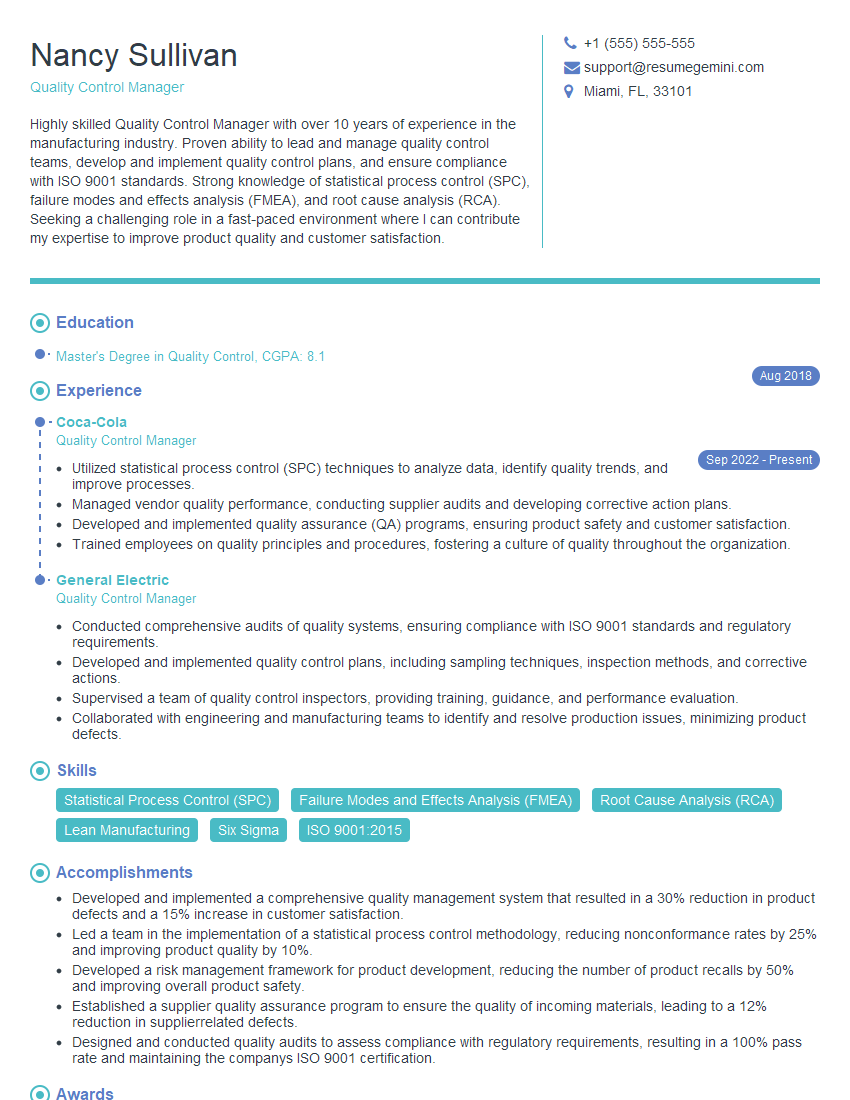
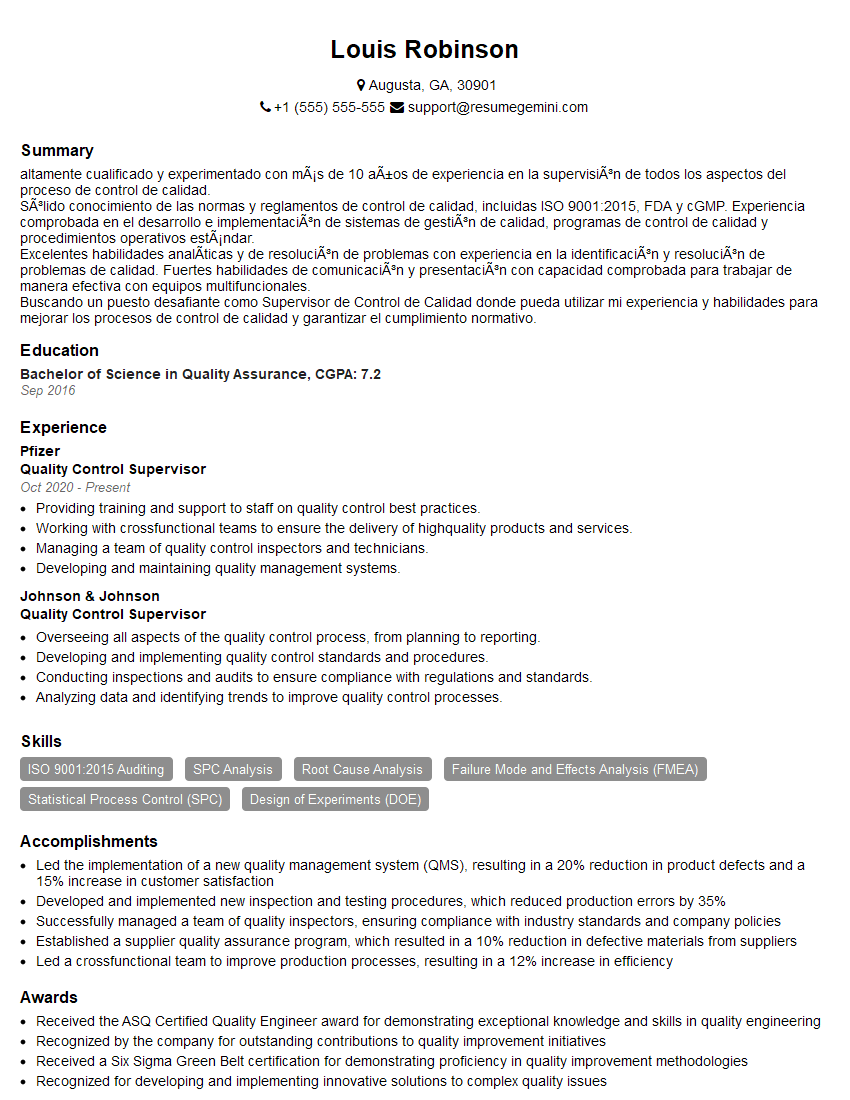
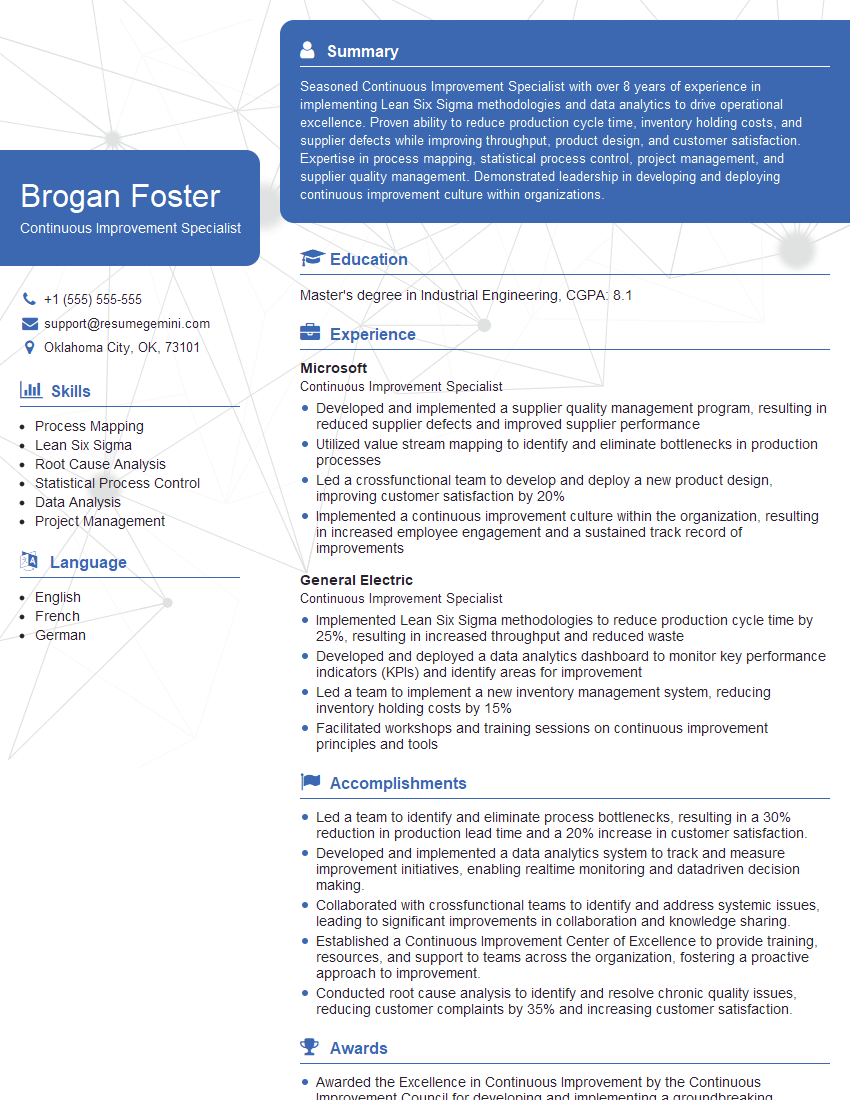
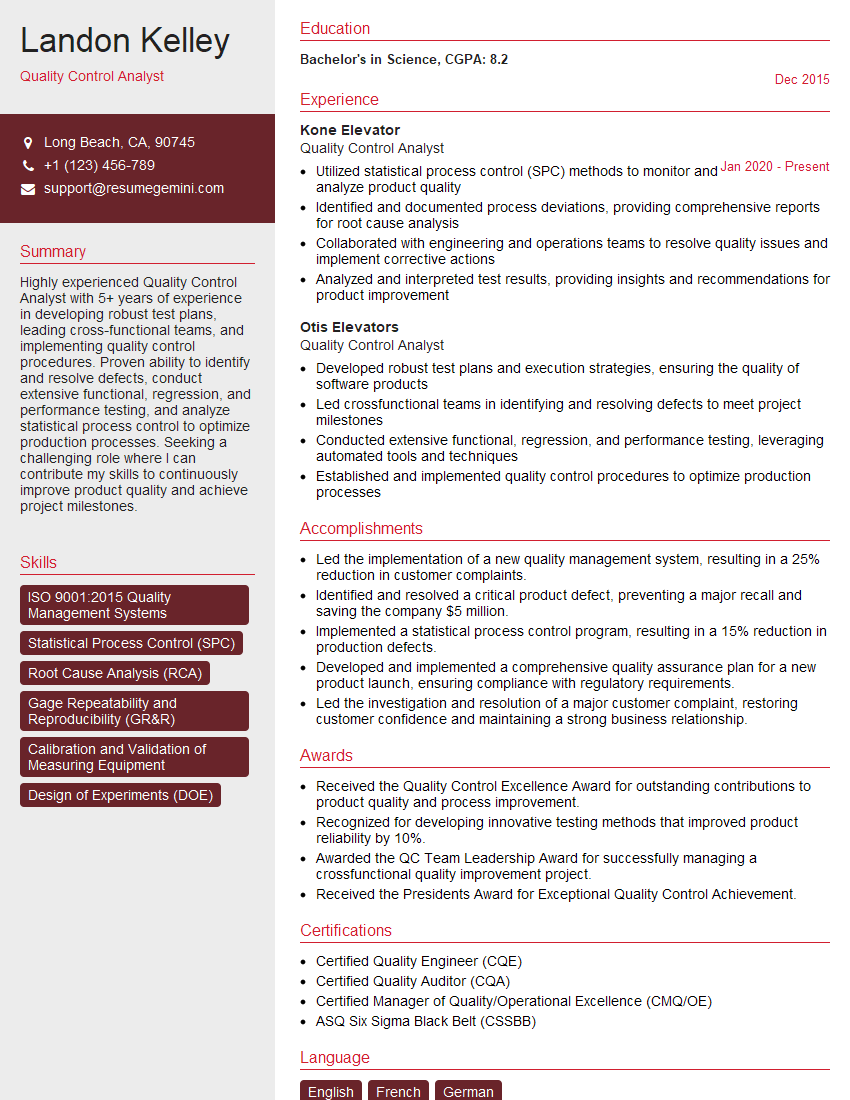
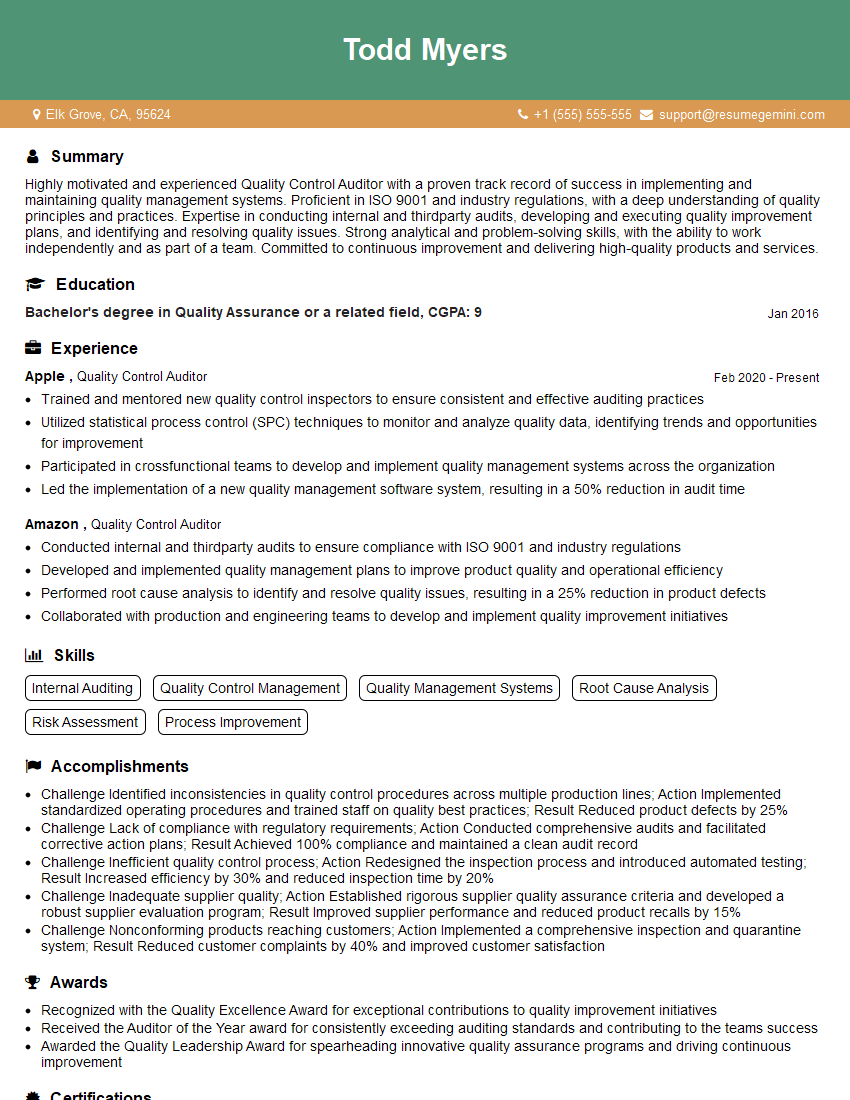
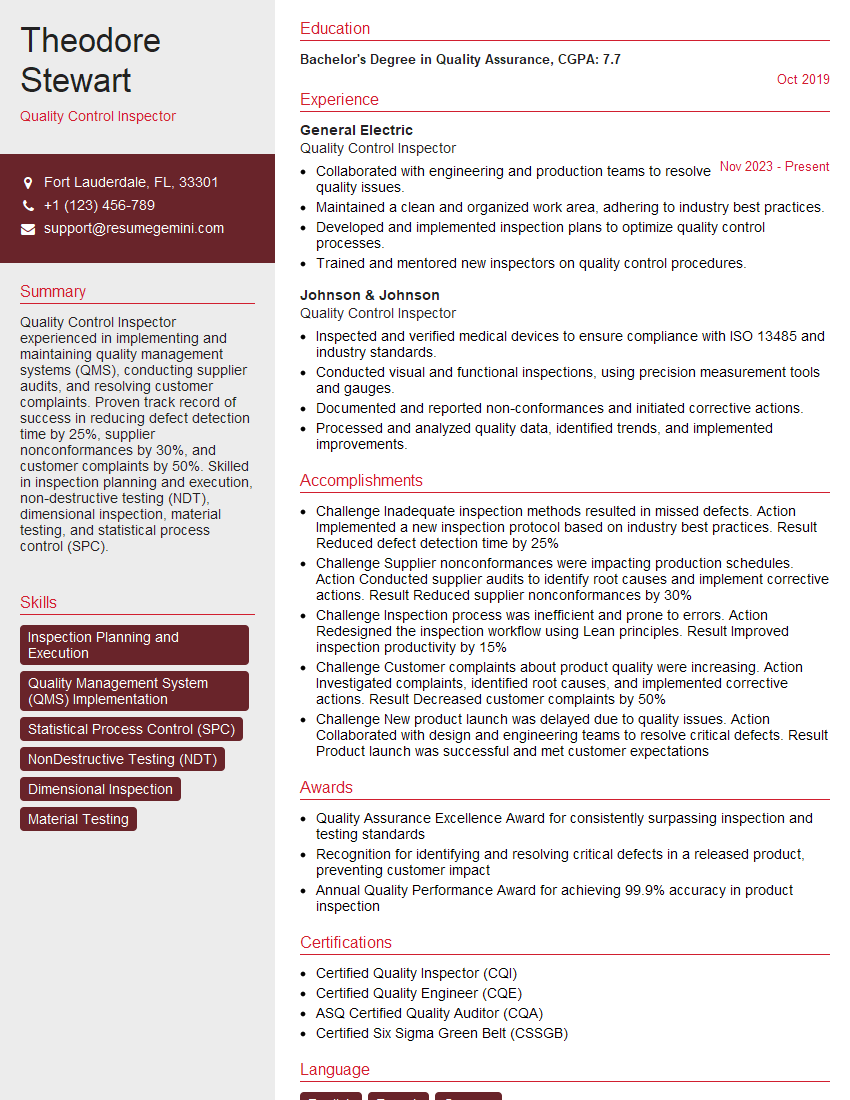
Mastering Inline Quality Control opens doors to exciting career opportunities with significant growth potential in various industries. A strong understanding of this crucial skillset will significantly enhance your job prospects and allow you to command higher salaries. To maximize your chances of landing your dream role, creating an ATS-friendly resume is paramount. ResumeGemini is a trusted resource that can help you build a professional and impactful resume that showcases your Inline Quality Control expertise. Examples of resumes tailored to Inline Quality Control are provided to help guide your resume-building process. Take advantage of these tools to make your application stand out.
Explore more articles
Users Rating of Our Blogs
Share Your Experience
We value your feedback! Please rate our content and share your thoughts (optional).
What Readers Say About Our Blog
Attention music lovers!
Wow, All the best Sax Summer music !!!
Spotify: https://open.spotify.com/artist/6ShcdIT7rPVVaFEpgZQbUk
Apple Music: https://music.apple.com/fr/artist/jimmy-sax-black/1530501936
YouTube: https://music.youtube.com/browse/VLOLAK5uy_noClmC7abM6YpZsnySxRqt3LoalPf88No
Other Platforms and Free Downloads : https://fanlink.tv/jimmysaxblack
on google : https://www.google.com/search?q=22+AND+22+AND+22
on ChatGPT : https://chat.openai.com?q=who20jlJimmy20Black20Sax20Producer
Get back into the groove with Jimmy sax Black
Best regards,
Jimmy sax Black
www.jimmysaxblack.com
Hi I am a troller at The aquatic interview center and I suddenly went so fast in Roblox and it was gone when I reset.
Hi,
Business owners spend hours every week worrying about their website—or avoiding it because it feels overwhelming.
We’d like to take that off your plate:
$69/month. Everything handled.
Our team will:
Design a custom website—or completely overhaul your current one
Take care of hosting as an option
Handle edits and improvements—up to 60 minutes of work included every month
No setup fees, no annual commitments. Just a site that makes a strong first impression.
Find out if it’s right for you:
https://websolutionsgenius.com/awardwinningwebsites
Hello,
we currently offer a complimentary backlink and URL indexing test for search engine optimization professionals.
You can get complimentary indexing credits to test how link discovery works in practice.
No credit card is required and there is no recurring fee.
You can find details here:
https://wikipedia-backlinks.com/indexing/
Regards
NICE RESPONSE TO Q & A
hi
The aim of this message is regarding an unclaimed deposit of a deceased nationale that bears the same name as you. You are not relate to him as there are millions of people answering the names across around the world. But i will use my position to influence the release of the deposit to you for our mutual benefit.
Respond for full details and how to claim the deposit. This is 100% risk free. Send hello to my email id: lukachachibaialuka@gmail.com
Luka Chachibaialuka
Hey interviewgemini.com, just wanted to follow up on my last email.
We just launched Call the Monster, an parenting app that lets you summon friendly ‘monsters’ kids actually listen to.
We’re also running a giveaway for everyone who downloads the app. Since it’s brand new, there aren’t many users yet, which means you’ve got a much better chance of winning some great prizes.
You can check it out here: https://bit.ly/callamonsterapp
Or follow us on Instagram: https://www.instagram.com/callamonsterapp
Thanks,
Ryan
CEO – Call the Monster App
Hey interviewgemini.com, I saw your website and love your approach.
I just want this to look like spam email, but want to share something important to you. We just launched Call the Monster, a parenting app that lets you summon friendly ‘monsters’ kids actually listen to.
Parents are loving it for calming chaos before bedtime. Thought you might want to try it: https://bit.ly/callamonsterapp or just follow our fun monster lore on Instagram: https://www.instagram.com/callamonsterapp
Thanks,
Ryan
CEO – Call A Monster APP
To the interviewgemini.com Owner.
Dear interviewgemini.com Webmaster!
Hi interviewgemini.com Webmaster!
Dear interviewgemini.com Webmaster!
excellent
Hello,
We found issues with your domain’s email setup that may be sending your messages to spam or blocking them completely. InboxShield Mini shows you how to fix it in minutes — no tech skills required.
Scan your domain now for details: https://inboxshield-mini.com/
— Adam @ InboxShield Mini
support@inboxshield-mini.com
Reply STOP to unsubscribe
Hi, are you owner of interviewgemini.com? What if I told you I could help you find extra time in your schedule, reconnect with leads you didn’t even realize you missed, and bring in more “I want to work with you” conversations, without increasing your ad spend or hiring a full-time employee?
All with a flexible, budget-friendly service that could easily pay for itself. Sounds good?
Would it be nice to jump on a quick 10-minute call so I can show you exactly how we make this work?
Best,
Hapei
Marketing Director
Hey, I know you’re the owner of interviewgemini.com. I’ll be quick.
Fundraising for your business is tough and time-consuming. We make it easier by guaranteeing two private investor meetings each month, for six months. No demos, no pitch events – just direct introductions to active investors matched to your startup.
If youR17;re raising, this could help you build real momentum. Want me to send more info?
Hi, I represent an SEO company that specialises in getting you AI citations and higher rankings on Google. I’d like to offer you a 100% free SEO audit for your website. Would you be interested?
Hi, I represent an SEO company that specialises in getting you AI citations and higher rankings on Google. I’d like to offer you a 100% free SEO audit for your website. Would you be interested?