Preparation is the key to success in any interview. In this post, we’ll explore crucial Jingle Production interview questions and equip you with strategies to craft impactful answers. Whether you’re a beginner or a pro, these tips will elevate your preparation.
Questions Asked in Jingle Production Interview
Q 1. Explain your process for composing a jingle, from concept to final product.
My jingle composition process is a collaborative journey, starting with a deep dive into the client’s brief. We begin by understanding their brand identity, target audience, and desired message. This initial phase involves thorough research and brainstorming to develop a strong concept.
Next, I develop a musical sketch, experimenting with melodies, harmonies, and rhythms that capture the essence of the brand. This often involves creating several variations to explore different sonic approaches. I might initially use a piano or guitar to develop the core melody before moving to a digital audio workstation (DAW).
The lyrics are crafted carefully to be memorable, impactful, and perfectly synchronized with the music. This stage frequently involves revisions and feedback to ensure the words resonate with the brand’s message. Once the music and lyrics are finalized, I arrange the jingle, adding instrumentation, layers, and production effects to enhance the overall sound.
Finally, we proceed to recording and mixing. This process involves selecting and working with a voice-over artist whose voice aligns perfectly with the brand’s image. After meticulous mixing and mastering, the final jingle is delivered, ready for use across various platforms.
For example, for a children’s toy company, I might compose a playful and upbeat jingle in a major key with bright instrumentation, while for a luxury car brand, I might opt for a sophisticated and elegant melody with a richer, more orchestral arrangement.
Q 2. Describe your experience with different musical styles and how you adapt to a client’s brand.
My experience spans a wide range of musical styles, from upbeat pop and catchy country to sophisticated jazz and soulful R&B. I’m adept at adapting my style to align seamlessly with a client’s brand. Understanding the brand’s personality is key. A youthful, energetic brand might benefit from a pop-infused jingle, while a classic, established brand might prefer a more timeless, orchestral approach.
For instance, I recently worked on a jingle for a tech startup, where a fast-paced, electronic style was appropriate, reflecting the innovation and speed of the company. In contrast, a recent project for a heritage clothing brand required a more traditional, folksy sound to reflect its history and craftsmanship. Flexibility and a deep musical understanding are crucial to successfully navigating these diverse styles and tailoring the music to the specific brand identity.
Q 3. How do you handle feedback and revisions during the jingle production process?
Feedback is integral to the jingle production process. I actively encourage collaboration and open communication throughout. I usually present clients with multiple versions or iterations of the jingle, allowing them to provide feedback on various aspects, including melody, lyrics, instrumentation, and overall feel.
I view revisions as opportunities for improvement, and I welcome constructive criticism. I meticulously document all feedback and incorporate changes strategically, ensuring the final product accurately reflects the client’s vision and preferences. A systematic approach, using a project management tool, helps track revisions and keeps the process organized and efficient. Transparency is key; I always keep the client informed of the progress and the rationale behind any decisions.
Q 4. What software and hardware are you proficient in for jingle creation?
My jingle creation relies on a robust suite of software and hardware. I’m proficient in Digital Audio Workstations (DAWs) such as Ableton Live, Logic Pro X, and Pro Tools. These platforms allow me to record, edit, mix, and master audio. I utilize a variety of virtual instruments and synthesizers to create diverse soundscapes, and I’m skilled in using audio plugins for effects processing.
My hardware includes high-quality studio monitors for accurate audio reproduction, professional microphones for voice recording and instrument capture, and audio interfaces for seamless integration between hardware and software. I’m also familiar with MIDI keyboards and controllers for composing and performing musical parts. This comprehensive set of tools ensures I can deliver a polished and professional jingle.
Q 5. How do you ensure a jingle aligns with a brand’s image and target audience?
Aligning a jingle with a brand’s image and target audience is paramount. This begins with an in-depth understanding of the brand’s values, personality, and target demographic. I meticulously research the brand’s marketing materials, analyzing its visual identity, tone of voice, and existing marketing campaigns. Understanding the target audience’s age, interests, and preferences is equally crucial.
For example, a youthful brand aiming for a younger demographic would require a different sonic approach than a luxury brand targeting a mature audience. The choice of instrumentation, melody, tempo, and lyrics all play a role in conveying the desired brand image and resonating with the target audience. Testing different versions of the jingle on focus groups can provide valuable insights and help fine-tune the final product.
Q 6. Describe your experience with voice-over recording and selection for jingles.
My experience with voice-over recording and selection is extensive. I understand the importance of finding a voice that complements the jingle’s musical style and the brand’s image. The selection process involves auditioning various voice-over artists and carefully considering their vocal tone, range, and acting ability. I provide detailed direction to ensure the voice performance captures the desired emotion and conveys the message effectively.
During the recording session, I utilize high-quality microphones and recording techniques to ensure a clean and professional audio capture. Post-production involves careful editing and processing to refine the voice-over, ensuring a seamless integration with the music. I often work with professional voice-over casting agencies to access a wider pool of talent, ensuring the best possible vocal performance for each project.
Q 7. Explain your understanding of copyright and licensing in relation to jingle production.
Copyright and licensing are crucial aspects of jingle production. I understand the importance of using royalty-free music samples or obtaining the necessary licenses for any copyrighted material. I meticulously track all sources of music and sound effects, ensuring that all elements used in the jingle are legally cleared for commercial use. I often work with music libraries that offer royalty-free tracks, ensuring compliance with copyright regulations.
For original compositions, I secure copyright protection to safeguard the intellectual property rights of the jingle. I clearly define the usage rights in contracts with clients, specifying the platforms where the jingle can be used and the duration of the license. This meticulous approach ensures that both the client and I are protected legally and avoid potential copyright infringement issues.
Q 8. How do you manage time constraints and deadlines in a fast-paced jingle production environment?
Managing time in jingle production is all about proactive planning and efficient workflow. I start by breaking down the project into smaller, manageable tasks with clearly defined deadlines. This often involves creating a detailed Gantt chart or using project management software. For instance, I’ll allocate specific time slots for lyric writing, melody composition, arrangement, recording, mixing, and mastering.
Communication is key. I maintain constant communication with the client and team members, providing regular updates and addressing any potential roadblocks immediately. If a task is running behind schedule, I proactively identify the problem and propose solutions, perhaps by re-prioritizing tasks or bringing in additional resources if necessary. Think of it like conducting an orchestra – every instrument (task) needs to be in harmony to produce the final masterpiece on time. I also always build in a buffer for unexpected delays – you never know when a vocalist might get sick or equipment might malfunction!
Q 9. What is your approach to collaborating with other professionals in a jingle production team?
Collaboration is the lifeblood of successful jingle production. My approach involves establishing clear communication channels and roles from the outset. This means holding regular brainstorming sessions where everyone feels empowered to contribute ideas. I actively listen to everyone’s input and ensure everyone understands the project goals and deadlines. For example, during the lyric writing phase, I’ll often collaborate closely with a copywriter to ensure the lyrics align perfectly with the client’s brand message and target audience. With the musicians and sound engineers, open communication ensures creative differences are resolved in a productive manner. I treat each team member as a vital part of the puzzle, each contributing to a complete and compelling final product.
Q 10. Describe a successful jingle you produced and the key elements that contributed to its success.
One successful jingle I produced was for a children’s cereal brand. The brief was to create something upbeat, memorable, and family-friendly. The key to its success was a combination of factors. First, the melody was simple and catchy, using a repetitive motif that kids easily picked up on. Second, the lyrics were playful and used rhyme and rhythm to create a fun, engaging experience. Third, the arrangement incorporated bright, cheerful instrumentation, including playful woodwinds and a lively percussion section. Finally, the vocal performance was energetic and expressive, delivered by a talented child vocalist. The combination of a catchy melody, engaging lyrics, appropriate instrumentation, and great vocals resulted in a jingle that resonated with its target audience and was extremely effective at branding the cereal.
Q 11. How do you handle creative differences with clients or other team members?
Creative differences are inevitable in any collaborative project. My approach is to foster an environment of open dialogue and mutual respect. I always start by actively listening to everyone’s perspectives, trying to understand the reasoning behind their suggestions or concerns. I then facilitate a discussion, focusing on finding common ground and exploring alternative solutions that satisfy everyone’s needs. Sometimes, it’s a matter of finding a compromise, combining elements from different ideas. Other times, it may involve presenting data or research that supports a particular approach. The goal is always to find a solution that’s creatively satisfying and aligns with the overall project goals and the client’s vision. It’s about collaboration, not compromise.
Q 12. What strategies do you employ to ensure the jingle’s memorability and effectiveness?
Memorability and effectiveness are paramount. I use several strategies to achieve this: First, I focus on creating a catchy melody – something simple, repetitive, and easy to hum along to. Think of classic jingles – they’re easy to recall because of their memorable tunes. Second, the lyrics need to be concise and impactful, conveying the key message effectively without being verbose. Third, I utilize strategic repetition – repeating key phrases or musical motifs to reinforce the brand message. Fourth, I carefully consider the overall arrangement, ensuring it’s dynamic and engaging, without being overwhelming or distracting. Finally, I always test the jingle on my target audience to get feedback on its memorability and effectiveness.
Q 13. Describe your experience with different audio mixing techniques and their applications in jingle production.
My experience with audio mixing techniques is extensive. I’m proficient in various mixing consoles (both analog and digital) and digital audio workstations (DAWs) like Pro Tools and Logic Pro X. For jingles, I often employ techniques like EQ (equalization) to shape the frequency response of individual instruments and vocals, ensuring clarity and balance. Compression is essential for controlling dynamics and making the mix sound more even and impactful. Reverb and delay are used to create a sense of space and atmosphere, tailoring the effect to the specific needs of each instrument or vocal. In some cases, I might use more advanced techniques like sidechaining or parallel processing to add depth and movement to the mix. The choice of techniques depends on the style and mood of the jingle and the client’s vision.
Q 14. How do you ensure the final jingle maintains high-quality audio across different platforms?
Maintaining high-quality audio across different platforms requires careful mastering. Mastering is the final stage of audio production, where the overall balance, loudness, and frequency response are optimized for various playback environments. I employ techniques like dynamic range compression and limiting to ensure the jingle translates well across different devices and platforms, from car radios to smartphones to streaming services. I also use specialized metering tools to check the levels and loudness, ensuring the jingle isn’t too quiet or distorted on any system. Furthermore, I always adhere to broadcast standards and file specifications to make sure the final product is ready for seamless implementation across all media. This final polish ensures the jingle’s impact remains consistent, regardless of how and where the audience listens.
Q 15. What are your strategies for making a jingle stand out in a crowded market?
Making a jingle stand out in today’s saturated market requires a multi-pronged approach focusing on memorability, originality, and target audience connection. It’s not just about a catchy tune; it’s about crafting a sonic brand identity.
- Unique Melody and Rhythm: Avoid clichés. Explore unconventional time signatures or rhythmic patterns to create an instantly recognizable sound. Think of the instantly memorable rhythm of the McDonald’s jingle – it’s simple yet effective because it’s unique.
- Memorable Lyrics: Keep it concise and impactful. Use strong imagery and repetition to aid recall. A jingle should convey the brand message clearly and memorably in a few short lines. Consider alliteration and rhyme schemes, but don’t force it if it compromises the natural flow.
- Targeted Messaging: Deeply understand the target demographic. Tailor the musical style, lyrics, and overall tone to resonate with their preferences and values. A jingle for a children’s toy will sound vastly different from one for a luxury car brand.
- High-Quality Production: Professional recording and mixing are non-negotiable. A poorly produced jingle will sound amateurish and detract from the brand image. Invest in quality instrumentation and vocal talent.
- Strategic Placement and Repetition: Ensure the jingle is used consistently across all relevant platforms. Strategic repetition increases memorability, making it more effective over time. Think about how often you hear the jingle for your favorite fast food place.
Career Expert Tips:
- Ace those interviews! Prepare effectively by reviewing the Top 50 Most Common Interview Questions on ResumeGemini.
- Navigate your job search with confidence! Explore a wide range of Career Tips on ResumeGemini. Learn about common challenges and recommendations to overcome them.
- Craft the perfect resume! Master the Art of Resume Writing with ResumeGemini’s guide. Showcase your unique qualifications and achievements effectively.
- Don’t miss out on holiday savings! Build your dream resume with ResumeGemini’s ATS optimized templates.
Q 16. Explain your understanding of music theory and its relevance in jingle composition.
Music theory is the foundation of effective jingle composition. A strong understanding of melody, harmony, rhythm, and form allows me to create jingles that are both catchy and emotionally resonant.
- Melody: I use melodic contours and intervals to create memorable and engaging melodies. Understanding melodic phrasing helps to create a natural and pleasing flow. For example, knowing which intervals create a sense of resolution or tension is crucial for a good hook.
- Harmony: Harmony provides the underlying structure and emotional depth. I utilize chord progressions that are appropriate for the genre and brand image, creating a sense of stability or excitement as needed. A well-chosen chord progression can dramatically alter the mood and feeling of the jingle.
- Rhythm: Rhythm dictates the pulse and energy of the jingle. I use rhythmic variations to add interest and avoid monotony. The rhythm is often the first thing that sticks with the listener.
- Form: The structure of the jingle (verse, chorus, bridge) guides the listener’s experience. A clear and well-defined form helps to create a sense of coherence and memorability. A simple AABA structure is often effective for jingles.
By applying these principles, I ensure the jingle is both musically pleasing and effective in conveying the brand message. For instance, using a major key often evokes feelings of happiness and optimism, while a minor key might convey a more melancholic or serious tone.
Q 17. Describe your experience with music arrangement and orchestration for jingles.
My experience encompasses a wide range of arrangement and orchestration styles for jingles. I’m proficient in both simple, acoustic arrangements and complex orchestral scores, adapting my approach to suit the specific needs of each project.
- Instrumentation: I select instruments that complement the style and message of the jingle. This could range from simple acoustic guitar and vocals to a full orchestra with strings, brass, and woodwinds. The choice of instruments directly impacts the jingle’s overall feel and emotional impact.
- Arrangement: I arrange the musical parts to create a balanced and engaging sonic landscape. This includes considering the interplay between different instruments, ensuring each part contributes to the overall effect without overwhelming others. The arrangement needs to support the vocal melody and lyrics while maintaining a captivating soundscape.
- Orchestration: For more complex projects, I create detailed orchestral scores, specifying the instrumentation, dynamics, and articulation for each section. This ensures a cohesive and professional-sounding final product. For example, I might use layered strings to create a lush and emotional backdrop for a sentimental jingle.
- Software Proficiency: I’m proficient in using Digital Audio Workstations (DAWs) such as Logic Pro X, Pro Tools, and Ableton Live to facilitate the arrangement and orchestration process. These tools allow for precise control over every aspect of the sound.
Ultimately, my goal is to create a memorable and effective soundscape that enhances the brand message and leaves a lasting impression on the listener.
Q 18. How do you incorporate a client’s specific requirements into the jingle composition?
Incorporating client requirements is paramount. I begin with a detailed briefing session to thoroughly understand their brand, target audience, and desired message. This includes discussing specific musical styles, lyrical themes, and overall tone.
- Mood Board Creation: Often, I create a mood board with the client, gathering visual and audio examples to define the desired aesthetic and sonic direction. This ensures we’re both on the same page from the outset.
- Iterative Feedback Process: I present initial sketches and demos to the client throughout the composition process, seeking feedback at each stage. This iterative approach allows for adjustments and ensures the final product perfectly aligns with their vision.
- Flexibility and Adaptability: I’m prepared to adapt my approach based on client feedback, recognizing that their input is crucial to the success of the project. This might involve adjustments to the melody, harmony, lyrics, or overall arrangement.
- Contractual Agreements: Clear contractual agreements outline expectations, timelines, and payment terms. This prevents misunderstandings and ensures a smooth workflow.
By prioritizing clear communication and collaboration, I ensure the jingle accurately reflects the client’s brand identity and achieves its intended marketing objectives.
Q 19. What are some common challenges in jingle production, and how have you overcome them?
Jingle production presents unique challenges. One common issue is balancing catchiness with memorability while conveying the brand message effectively. Another is meeting tight deadlines and budget constraints.
- Creative Blocks: Overcoming creative blocks often involves stepping away from the project temporarily or exploring different approaches. Brainstorming sessions with collaborators can also be beneficial. Sometimes a simple change of environment can spark fresh ideas.
- Client Feedback: Managing conflicting client feedback requires careful diplomacy and a focus on finding creative solutions that satisfy everyone involved. Clear and consistent communication is key here.
- Technical Difficulties: Troubleshooting technical issues, such as software glitches or equipment malfunctions, often requires patience and problem-solving skills. A backup plan is essential.
- Time Constraints: Meeting tight deadlines sometimes requires prioritizing tasks effectively and delegating work when possible. This might involve bringing in additional talent if needed.
I address these challenges proactively through meticulous planning, effective time management, and a collaborative approach. I also prioritize clear communication and maintain flexibility to adapt to unexpected circumstances.
Q 20. How do you use analytics and feedback to refine the effectiveness of a jingle?
Analytics and feedback are essential for refining a jingle’s effectiveness. This involves analyzing listener responses, measuring recall rates, and tracking the impact on brand awareness and sales.
- A/B Testing: A/B testing involves creating multiple versions of the jingle and comparing their performance using metrics such as listener recall and positive emotional response. This data-driven approach allows me to optimize the jingle for maximum impact.
- Focus Groups: Focus groups provide qualitative feedback on listener reactions to the jingle, helping to identify areas for improvement. This allows me to understand the emotional resonance of the jingle and how well it conveys the intended brand message.
- Sales Data: Tracking sales data following the jingle’s launch helps assess its impact on consumer behavior. This provides valuable data on the jingle’s effectiveness in driving sales or brand awareness.
- Social Media Monitoring: Monitoring social media mentions and online reviews can reveal public perception of the jingle, helping to identify any negative sentiment or areas that need attention.
By analyzing this data, I can iterate and refine the jingle to maximize its impact and effectiveness, making it a more valuable asset for the client.
Q 21. Describe your familiarity with different audio file formats and their pros and cons.
I’m familiar with various audio file formats, each with its strengths and weaknesses:
- WAV (Waveform Audio File Format): A lossless format offering high-quality audio but large file sizes. Ideal for mastering and archiving, but less suitable for online distribution due to its size.
- MP3 (MPEG Audio Layer III): A lossy compressed format offering smaller file sizes and good audio quality, making it suitable for online streaming and distribution. However, some quality loss is inherent in the compression process.
- AIFF (Audio Interchange File Format): Another lossless format similar to WAV, popular on Apple systems. It maintains high fidelity but with larger files sizes.
- AAC (Advanced Audio Coding): A lossy format providing better quality than MP3 at comparable bitrates, making it a popular choice for online streaming services. It’s a good balance between file size and quality.
- FLAC (Free Lossless Audio Codec): A lossless format offering high-quality audio with smaller file sizes compared to WAV or AIFF. It’s gaining popularity as a compromise between lossless quality and file size.
The choice of format depends on the intended use. For final delivery, I often provide multiple formats to cater to different platforms and requirements. For archiving and mastering I’ll stick to lossless formats like WAV or FLAC. For online distribution, MP3 or AAC are commonly used due to their smaller file sizes and compatibility.
Q 22. Explain your understanding of audio mastering and its importance in jingle production.
Audio mastering is the final stage of audio production, where the overall sound of a jingle is polished and optimized for its intended platform. It’s crucial in jingle production because it ensures the jingle sounds its best across various mediums. Think of it as the final coat of paint on a beautiful masterpiece.
In mastering, engineers use various techniques such as equalization (EQ), compression, limiting, and stereo widening to achieve a balanced, clear, and impactful sound. EQ adjusts the frequencies to emphasize or reduce certain elements. Compression controls the dynamic range, making quieter parts louder and louder parts softer for a more consistent sound. Limiting prevents clipping (distortion), ensuring the audio doesn’t exceed its maximum level. Stereo widening enhances the spatial impression of the sound. Mastering is essential because a poorly mastered jingle can sound muddy, thin, or unbalanced, impacting its memorability and effectiveness. For instance, a jingle meant for radio needs a strong presence in the mid-range frequencies, while a TV jingle might need more dynamic range for a fuller sound. A professionally mastered jingle stands out and commands attention.
Q 23. How do you maintain a balance between creativity and commercial viability in jingle production?
Balancing creativity and commercial viability in jingle production is a delicate act. It’s about crafting a jingle that’s both catchy and memorable, aligning perfectly with the brand’s message and target audience, while staying within the parameters of budget and time constraints. It’s like finding the perfect intersection of art and science.
My approach involves a collaborative process. I start by understanding the brand’s identity, target market, and marketing objectives through detailed discussions with the client. I then brainstorm creative concepts, exploring different musical styles, melodies, and lyrical approaches. Throughout the process, I present concepts and revisions to the client, ensuring their feedback is incorporated while maintaining the artistic integrity of the jingle. For example, I might propose a catchy pop jingle for a youthful brand or a sophisticated jazz tune for a more mature audience. The feedback loop helps refine the creative output while ensuring the end product resonates with the brand’s target audience and achieves its marketing goals, effectively linking creativity with profitability.
Q 24. Describe your experience working with different budgets and timelines in jingle projects.
I’ve worked on jingle projects across a wide spectrum of budgets and timelines. From small-scale projects with tight deadlines and limited resources to large-scale productions with extensive budgets and longer lead times, my approach adapts accordingly.
On projects with limited budgets, I focus on efficiency and resourcefulness. This involves employing cost-effective recording techniques, optimizing studio time, and utilizing readily available sound libraries. For instance, I might record instruments and vocals in stages instead of simultaneously to save on studio rental costs. With tighter deadlines, careful planning and efficient workflows are essential, possibly involving streamlined editing and mixing processes. On larger-budget projects, I have the flexibility to explore more complex arrangements, hire additional musicians, and utilize higher-quality recording equipment and post-production facilities. The key is adaptability and meticulous planning regardless of the scale.
Q 25. What’s your experience with conducting live sessions for jingles?
I have extensive experience conducting live sessions for jingles. This often involves working with a variety of musicians, from session players to full orchestras. The process requires meticulous preparation, including selecting the right musicians based on the musical style of the jingle, creating detailed arrangements and charts, and ensuring the recording environment is optimized for capturing high-quality audio. Good communication and leadership skills are paramount. It’s important to build a relaxed yet focused atmosphere where musicians can perform at their best.
A memorable experience was conducting a live string session for a high-end car commercial. The precision and expressiveness required from the string section greatly contributed to the emotional impact of the jingle, something that wouldn’t have been easily replicated with synthesized sounds. Coordinating the musicians and ensuring the overall performance aligned with the emotional and musical vision was a rewarding challenge.
Q 26. How do you adapt your composition techniques for various media formats (radio, television, digital)?
Adapting composition techniques for different media formats is crucial for maximizing impact. Radio jingles require strong melodies and lyrics that are easily remembered, with a clear vocal mix. Television jingles can incorporate more complex arrangements and sonic textures, often synchronizing with visuals. Digital jingles may need to be shorter and more attention-grabbing to compete for online viewers’ attention. The essence of the brand’s message, however, should be consistent across all platforms.
For instance, a radio jingle might focus on a catchy hook and memorable phrasing, while a TV jingle might layer musical and sound effects elements to enhance the visual narrative. Digital jingles, such as those used for social media, often require a shorter duration and incorporate popular music trends to ensure engagement. In each case, I tailor the music, instrumentation, and vocal arrangements to create the most engaging and effective listening experience for the specific platform.
Q 27. How do you protect your intellectual property when creating jingles?
Protecting intellectual property is paramount. My process involves several key steps: firstly, I maintain detailed records of all jingle compositions, including original scores and recordings. Secondly, I register my copyrights with the appropriate copyright offices (e.g., US Copyright Office) to establish legal ownership. Thirdly, I include clear copyright notices on all materials. Finally, and perhaps most importantly, I always have a legally binding contract with clients that clearly outlines ownership and usage rights of the jingle. This contract stipulates terms of usage, licensing fees and any restrictions on distribution or modification.
This multi-layered approach safeguards my work and ensures that I receive appropriate compensation for my creative efforts. It protects both my creative investments and my relationship with the client, establishing transparency and preventing future disputes.
Q 28. What are your salary expectations for a Jingle Production role?
My salary expectations depend on several factors, including project scope, complexity, experience required, and the overall market rate. My preferred approach is to negotiate a fair and competitive rate based on the specific project requirements. I am comfortable discussing my compensation expectations openly and transparently and am confident that I can deliver exceptional value for the agreed-upon remuneration.
Key Topics to Learn for Jingle Production Interview
- Music Theory Fundamentals: Understanding melody, harmony, rhythm, and form is crucial for crafting effective jingles. Consider exploring key signatures, chord progressions, and common musical structures.
- Audio Engineering Basics: Familiarity with recording techniques, microphone selection, signal processing (EQ, compression, reverb), and mixing is essential for producing high-quality jingles. Practice working with DAW software (Digital Audio Workstation).
- Lyric Writing and Composition: The ability to write catchy, memorable lyrics that effectively communicate a brand’s message is vital. Explore techniques for rhyming, meter, and creating memorable hooks.
- Branding and Marketing Principles: Understanding how jingles contribute to a brand’s overall marketing strategy is key. Research how jingles align with target audiences and brand identity.
- Collaboration and Communication: Jingle production often involves teamwork. Practice articulating your creative ideas clearly and effectively collaborating with clients, musicians, and other team members.
- Copyright and Licensing: Understanding the legal aspects of music production, including copyright laws and music licensing, is crucial for protecting your work and avoiding legal issues.
- Software Proficiency: Demonstrate your skills in relevant music production software (e.g., Pro Tools, Logic Pro X, Ableton Live). Be prepared to discuss your workflow and preferred techniques.
- Problem-Solving and Adaptability: Be ready to discuss how you approach creative challenges and adapt to changing client needs and project requirements.
Next Steps
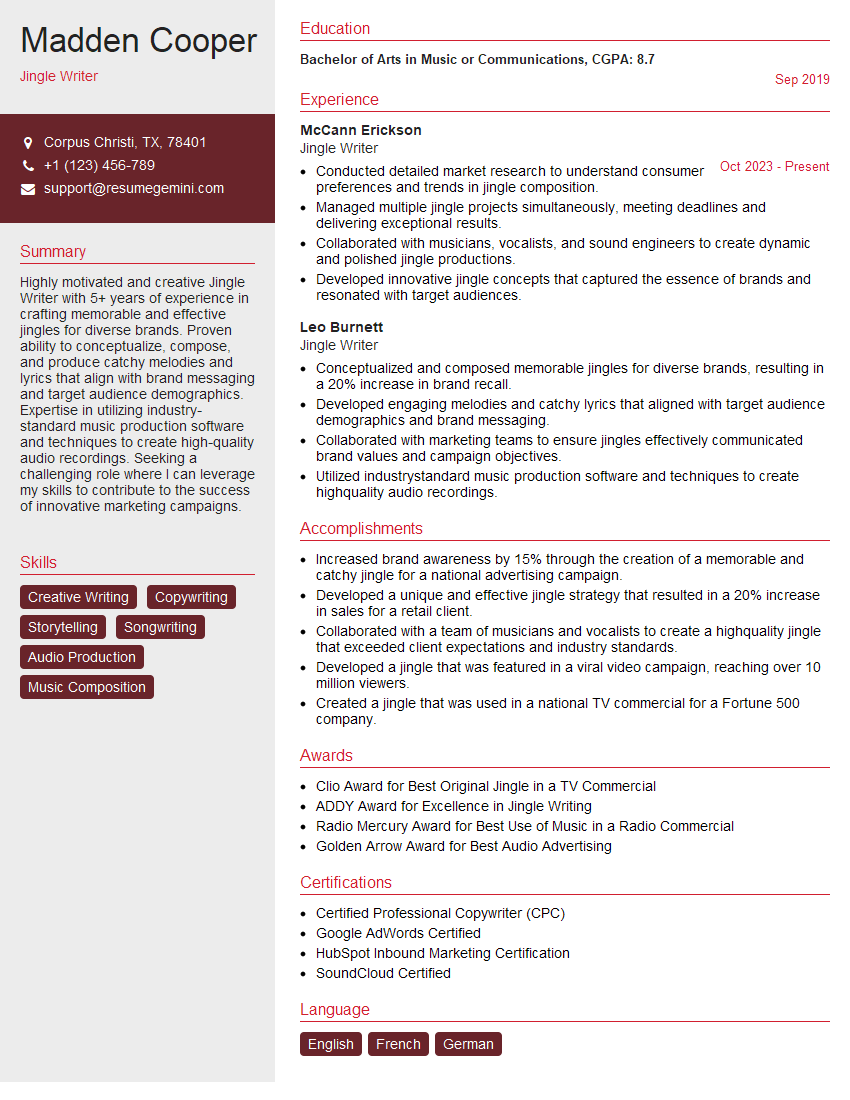
Mastering jingle production opens doors to exciting career opportunities in advertising, marketing, and the music industry. To maximize your chances of landing your dream job, focus on crafting an ATS-friendly resume that highlights your skills and experience effectively. ResumeGemini is a trusted resource that can help you build a professional and impactful resume. They even provide examples of resumes tailored to Jingle Production, giving you a head start in presenting your qualifications effectively.
Explore more articles
Users Rating of Our Blogs
Share Your Experience
We value your feedback! Please rate our content and share your thoughts (optional).
What Readers Say About Our Blog
Very informative content, great job.
good