Interviews are more than just a Q&A session—they’re a chance to prove your worth. This blog dives into essential Knowledge of Semiconductor Fabrication Processes interview questions and expert tips to help you align your answers with what hiring managers are looking for. Start preparing to shine!
Questions Asked in Knowledge of Semiconductor Fabrication Processes Interview
Q 1. Explain the steps involved in a typical CMOS fabrication process.
CMOS fabrication, at its core, is a layered process of building a complex circuit on a silicon wafer. Think of it like constructing a skyscraper – each floor represents a layer, and the process meticulously stacks these layers to create the final functional device.
- Wafer Preparation: The process begins with a highly polished silicon wafer, the foundation of our ‘skyscraper’. This is often cleaned and subjected to initial oxidation to create a protective layer.
- Gate Oxide Growth: A thin layer of silicon dioxide (SiO2) is grown on the wafer, acting as an insulator. This is crucial for controlling the flow of electrons in the transistors.
- Polysilicon Deposition and Patterning: Polycrystalline silicon (polysilicon), a semiconductor material, is deposited and then patterned using photolithography to create the gate electrodes of the transistors. Imagine this as creating the structural framework of each floor.
- Ion Implantation: Dopants (impurities like boron or phosphorus) are implanted into the silicon to create regions with different electrical conductivity (p-type or n-type). This is akin to installing the electrical systems and plumbing within each floor.
- Source/Drain Diffusion: More dopants are added to form the source and drain regions of the transistors, completing the transistor structure.
- Interconnects: Multiple layers of metal are deposited and patterned using photolithography to connect the transistors. This is like connecting each floor through staircases and elevators, forming the overall structure.
- Passivation: A protective layer is deposited on top to protect the circuit from external factors. This is like adding the roof and outer walls to protect the building.
- Testing and Packaging: The final wafer is tested, and individual chips are cut and packaged for use in electronic devices.
Each step involves intricate processes like photolithography, etching, and deposition, repeated many times to create the complex circuitry required for modern chips.
Q 2. Describe the differences between wet and dry etching techniques.
Wet and dry etching are two distinct methods for removing material from a wafer, essentially sculpting the layers of our ‘skyscraper’. Wet etching uses chemical solutions to dissolve the material, while dry etching uses plasma or ion beams.
- Wet Etching: This is like using a chemical solvent to dissolve unwanted material. It’s isotropic, meaning it etches in all directions equally, resulting in less precise patterns. However, it’s generally less expensive and easier to implement. An example is using hydrofluoric acid (HF) to etch silicon dioxide.
- Dry Etching: This is like using a precise laser cutter, allowing for anisotropic etching where the etching occurs predominantly in one direction. This results in much sharper and more defined patterns, crucial for advanced semiconductor manufacturing. Common techniques include plasma etching (using chemically reactive plasma) and reactive ion etching (RIE), utilizing ions to remove material. RIE offers better control of the etch rate and profile.
The choice between wet and dry etching depends on the desired precision, feature size, and cost constraints. For high-resolution features, dry etching is essential, while wet etching might suffice for less critical steps.
Q 3. What are the key challenges in controlling critical dimension (CD) uniformity?
Controlling critical dimension (CD) uniformity, the precise width of features on a chip, is paramount for chip functionality. Variations in CD can lead to malfunctioning circuits. Imagine building a skyscraper where each beam’s width varies significantly; it would compromise structural integrity.
- Photolithography Variations: Non-uniform light intensity across the wafer, imperfections in the mask, and variations in exposure time can all affect CD uniformity.
- Etch Process Variations: Uneven etching due to variations in temperature, pressure, or gas flow in dry etching processes can lead to CD variations. In wet etching, variations in the etchant concentration and temperature impact uniformity.
- Wafer Non-uniformity: Initial variations in wafer thickness, surface roughness, and crystallographic orientation can influence the final CD.
- Process Equipment Limitations: Variations in the performance of process equipment such as the stepper, etcher, or CMP machine can affect CD uniformity.
Advanced techniques like advanced metrology (precise measurement), process control algorithms (like feedback control systems), and sophisticated modeling are employed to minimize these variations and ensure consistent CD across the wafer.
Q 4. How does photolithography contribute to pattern transfer in semiconductor manufacturing?
Photolithography is the cornerstone of pattern transfer in semiconductor manufacturing, acting as the blueprint for creating the intricate circuitry. It’s analogous to printing a detailed architectural plan onto the building site. We use light to transfer a pattern from a photomask to a photosensitive material (photoresist) on the wafer.
- Photoresist Application: A thin layer of photoresist is spun onto the wafer, creating a uniform coating.
- Exposure: The wafer is exposed to UV light through a photomask, which contains the desired pattern. Only the areas exposed to light undergo a chemical change.
- Development: A developer solution is used to remove either the exposed or unexposed photoresist, leaving behind a pattern on the wafer.
- Etching: The exposed (or protected) areas are then etched using either wet or dry methods to transfer the pattern to the underlying layer.
- Photoresist Removal: The remaining photoresist is removed, revealing the etched pattern.
This process is repeated multiple times to create the layered structures necessary for complex integrated circuits. Advanced techniques like immersion lithography and EUV lithography are constantly being developed to create even smaller and more precise features.
Q 5. Explain the principles of chemical mechanical planarization (CMP).
Chemical Mechanical Planarization (CMP) is a crucial process for flattening the wafer surface after each layer deposition and etching. Imagine smoothing out the uneven surface of a half-built skyscraper before adding the next floor. It uses a rotating pad and a slurry of abrasive particles to achieve this.
The process involves:
- Chemical Action: The slurry contains chemical components that react with the surface material, making it more susceptible to mechanical removal.
- Mechanical Action: The rotating pad provides the mechanical force to remove the material.
- Planarization: Through a combination of chemical and mechanical actions, high points are removed faster than low points, leading to a globally flat surface.
Precise control of parameters such as pressure, pad speed, slurry chemistry, and downforce is critical to achieve the desired planarization while minimizing defects and maintaining acceptable removal rates. CMP is essential for achieving the flat surfaces necessary for subsequent layers in the fabrication process, enabling successful photolithography and interconnect formation.
Q 6. What are the common defects found in semiconductor wafers and their root causes?
Semiconductor wafers are susceptible to various defects that can compromise the performance and yield of the chips. These defects are analogous to construction flaws in a building that can weaken its structure or functionality.
- Particles: Microscopic particles can contaminate the wafer surface, leading to defects during subsequent processing steps. These particles can originate from the environment, process equipment, or even the wafer itself.
- Scratches: Scratches can be caused by improper handling or equipment malfunction, affecting the integrity of the underlying layers.
- Crystal Defects: Imperfections in the silicon crystal lattice can lead to variations in electrical properties and reduced performance.
- Etch Defects: Uneven or incomplete etching can result in defects in the patterns created during photolithography.
- Oxidation Defects: Non-uniform or incomplete oxide layer formation can hinder the transistor functionality.
- Stacking Faults: Defects that occur during epitaxial growth can negatively impact the device performance.
The root causes of these defects are varied, ranging from environmental contamination to equipment malfunction, process deviations, and material imperfections. Defect detection and analysis are vital for identifying root causes and implementing corrective actions to ensure high-quality chips.
Q 7. Describe different methods for measuring film thickness and critical dimensions.
Measuring film thickness and critical dimensions is crucial for process control and ensuring the quality of the fabricated chips. Accurate measurements are like having a precise measuring tape during the construction process to verify dimensions.
- Optical Methods: Ellipsometry, optical profilometry, and interference microscopy use light to measure film thickness and CD. Ellipsometry measures the change in polarization of light upon reflection, while optical profilometry measures surface topography.
- Scanning Electron Microscopy (SEM): SEM provides high-resolution images of the wafer surface, allowing for accurate CD measurements. It uses a focused beam of electrons to scan the sample.
- Transmission Electron Microscopy (TEM): TEM provides even higher resolution than SEM and is used for detailed characterization of material structures and defects. It uses a transmitted electron beam.
- Atomic Force Microscopy (AFM): AFM measures surface topography at the atomic level, providing very precise measurements of CD and surface roughness. It uses a sharp tip to scan the sample’s surface.
- Scatterometry: This optical technique measures the diffraction of light from patterned structures to determine their dimensions with high precision.
The choice of measurement technique depends on the required accuracy, resolution, and the specific features being measured. Often, multiple techniques are used in combination to obtain a complete understanding of film thickness and CD.
Q 8. How does ion implantation affect the electrical properties of a semiconductor?
Ion implantation is a crucial step in semiconductor fabrication where dopant ions are accelerated and embedded into a silicon wafer. This process dramatically alters the electrical properties of the semiconductor by precisely controlling the concentration and distribution of dopants. Think of it like adding specific ingredients to a cake batter – the type and amount of ingredient determine the final outcome (the electrical characteristics of the semiconductor).
For example, implanting boron (a p-type dopant) creates a region with a surplus of holes (positive charge carriers), while implanting phosphorus (an n-type dopant) introduces extra electrons (negative charge carriers). The concentration of these dopants directly impacts the conductivity of the region. A higher dopant concentration leads to higher conductivity. This precise control allows us to create junctions between p-type and n-type regions – the foundation for transistors and other semiconductor devices. The implantation process also affects other properties such as the threshold voltage of a transistor and its ability to switch efficiently. Insufficient or excessive doping can lead to device malfunction.
Q 9. Explain the concept of diffusion in semiconductor fabrication.
Diffusion, in the context of semiconductor fabrication, is the process of thermally driven movement of dopant atoms from a region of high concentration to a region of low concentration within a silicon substrate. Imagine dropping a dye tablet into water; the dye molecules spread out until evenly distributed. Similarly, dopant atoms, when heated, move through the silicon lattice. This movement allows for precise control of dopant concentration profiles, crucial for creating various device structures.
Two common methods are used: predeposition, where dopant atoms are introduced on the surface and then diffused into the substrate, and drive-in diffusion, which further diffuses the already introduced dopants to create desired profiles. The diffusion process is governed by Fick’s laws of diffusion, which describe the relationship between dopant concentration, diffusion coefficient (dependent on temperature and material properties), and time. Parameters such as temperature and time are precisely controlled to achieve specific doping profiles.
Q 10. What are the different types of semiconductor materials and their applications?
Semiconductors are broadly classified into elemental, compound, and alloy semiconductors.
- Elemental Semiconductors: The most common is silicon (Si), used extensively in integrated circuits due to its abundance, relatively high electron mobility, and ease of processing. Germanium (Ge) is another example, but it’s less commonly used due to its higher intrinsic conductivity and manufacturing challenges.
- Compound Semiconductors: These are formed by combining elements from groups III and V (e.g., GaAs, InP) or II and VI (e.g., CdS, CdTe) of the periodic table. They possess unique electronic and optical properties, making them suitable for high-speed electronics, optoelectronics (lasers, LEDs), and high-frequency applications. For example, Gallium Arsenide (GaAs) offers much higher electron mobility than silicon, leading to faster transistors.
- Alloy Semiconductors: These are mixtures of two or more elemental or compound semiconductors. For example, AlGaAs (Aluminum Gallium Arsenide) is widely used in laser diodes and high-electron-mobility transistors (HEMTs). Alloying allows for fine-tuning of material properties to meet specific requirements.
The choice of semiconductor material depends heavily on the intended application, requiring careful consideration of factors such as cost, performance requirements, temperature stability, and fabrication process compatibility.
Q 11. Describe the role of metrology in ensuring process control.
Metrology plays a vital role in semiconductor manufacturing by providing precise measurements throughout the fabrication process. It’s essentially the quality control system. Without accurate metrology, we wouldn’t know if our processes are working correctly or if the final product meets specifications. This includes measuring various parameters like layer thickness, critical dimensions (CD), surface roughness, dopant concentration profiles, and material composition.
Different techniques are employed at various stages. For instance, optical microscopy, scanning electron microscopy (SEM), and atomic force microscopy (AFM) are used for dimensional measurements. Secondary ion mass spectrometry (SIMS) and spreading resistance profiling (SRP) are employed for dopant concentration analysis. These measurements are crucial for process optimization, yield improvement, and ensuring consistent product quality. If a metrology measurement reveals a deviation from the target values, it can trigger corrective actions, preventing defects from propagating through the subsequent steps.
Q 12. How do you troubleshoot yield issues in a semiconductor fabrication process?
Troubleshooting yield issues in semiconductor fabrication is a complex but systematic process. It often involves a multidisciplinary team effort. The process generally involves a series of steps:
- Data Collection and Analysis: Begin by gathering data on the failing products, pinpointing the specific steps where defects are introduced. This might involve failure analysis, electrical testing, and detailed metrology measurements.
- Defect Classification: Categorize the defects to understand their root causes. Are they random or systematic? Are they related to specific processing steps or materials?
- Root Cause Identification: Use statistical process control (SPC) charts, design of experiments (DOE), and other analytical tools to identify the root causes. This might involve investigating equipment malfunctions, material issues, process parameter variations, or operator errors.
- Corrective Actions: Implement corrective actions based on the identified root causes. This could include adjusting process parameters, replacing faulty equipment, refining materials, or improving operator training.
- Verification and Monitoring: Monitor the process after corrective actions to ensure the yield has improved and the problem has been resolved. This often requires continuous monitoring using control charts and regular metrology checks.
A crucial aspect is the systematic approach, employing a combination of data analysis, process understanding, and teamwork to diagnose and resolve the yield issues efficiently.
Q 13. What are the different types of lithographic techniques used in semiconductor fabrication?
Lithography is the process of transferring a pattern from a mask to a photosensitive material (resist) on a silicon wafer. Several techniques exist, each with its own advantages and limitations:
- Optical Lithography: This is the most widely used technique, employing ultraviolet (UV) light to expose the photoresist. Advanced techniques like immersion lithography (using a liquid between the lens and wafer) and multiple patterning push the resolution limits. It’s relatively mature technology with high throughput.
- Extreme Ultraviolet (EUV) Lithography: This cutting-edge technique uses extremely short wavelength light (13.5 nm) to achieve resolutions well below optical lithography. It’s currently used for the most advanced nodes, but it is expensive and complex.
- Electron Beam Lithography (EBL): Uses a focused beam of electrons to write patterns directly onto the resist. It offers very high resolution, but it’s slow and less suitable for high-volume manufacturing.
- Nanoimprint Lithography (NIL): A template with the desired pattern is pressed onto the resist, transferring the pattern. It’s a relatively high-throughput technique with excellent resolution, but template fabrication can be challenging.
The choice of lithographic technique depends on factors such as resolution requirements, throughput, cost, and the complexity of the pattern.
Q 14. Explain the principles behind different etch processes (e.g., plasma etching, reactive ion etching).
Etching processes are used to selectively remove material from the wafer to create the desired three-dimensional structures. Two common types are:
- Plasma Etching: A plasma, consisting of ionized gases, is generated and used to etch the exposed areas of the wafer. This is a dry etching process, meaning it doesn’t use liquid chemicals. Different gases can be used to tailor the etching process for various materials. For example, CF4 (carbon tetrafluoride) is commonly used for etching silicon dioxide (SiO2).
- Reactive Ion Etching (RIE): A subtype of plasma etching that combines chemical reactions with ion bombardment to enhance the etching rate and achieve higher anisotropy (vertical etching profiles). The anisotropy is crucial for creating high-aspect-ratio features (tall and narrow structures) needed in modern chips. The specific gas chemistry and plasma conditions are carefully controlled to achieve desired selectivity and etching rate.
The choice of etching technique depends on factors such as the material to be etched, the desired etch profile (anisotropic vs. isotropic), etch rate, selectivity (etching one material without affecting another), and damage to the underlying layers.
Q 15. Discuss the importance of process control and monitoring in maintaining high yields.
In semiconductor manufacturing, achieving high yields—the percentage of successfully manufactured chips—is paramount. Process control and monitoring are the cornerstones of this achievement. Think of it like baking a cake: if you don’t carefully control the oven temperature, baking time, and ingredient ratios, you’re unlikely to get a perfect cake every time. Similarly, in chip fabrication, numerous steps are involved, each with its own parameters that need precise control. Variations in these parameters—temperature, pressure, time, gas flow, etc.—can lead to defects, impacting yield.
Effective process control involves implementing rigorous monitoring systems at each stage of the manufacturing process. This includes using in-line metrology tools to measure critical dimensions and properties, collecting data on equipment performance, and analyzing process parameters. Real-time monitoring allows for early detection of deviations from the ideal process window, enabling timely corrections to prevent widespread defects. Automated systems coupled with sophisticated algorithms often perform these tasks, but human expertise is still critical for analysis, decision making, and process optimization.
- Example: During photolithography, precise control of exposure time and intensity is critical. Real-time monitoring of the laser power and exposure dosage ensures that each wafer receives the correct amount of light, preventing under- or over-exposure that can lead to defects.
- Example: In chemical mechanical planarization (CMP), maintaining consistent slurry flow and pressure is crucial for achieving a flat wafer surface. Monitoring these parameters and adjusting them dynamically helps prevent defects caused by uneven polishing.
Career Expert Tips:
- Ace those interviews! Prepare effectively by reviewing the Top 50 Most Common Interview Questions on ResumeGemini.
- Navigate your job search with confidence! Explore a wide range of Career Tips on ResumeGemini. Learn about common challenges and recommendations to overcome them.
- Craft the perfect resume! Master the Art of Resume Writing with ResumeGemini’s guide. Showcase your unique qualifications and achievements effectively.
- Don’t miss out on holiday savings! Build your dream resume with ResumeGemini’s ATS optimized templates.
Q 16. Describe your experience with statistical process control (SPC) techniques.
Statistical Process Control (SPC) is my bread and butter. I’ve extensively used SPC techniques like control charts (X-bar and R charts, p-charts, c-charts) to monitor process stability and identify potential sources of variation. My experience ranges from implementing SPC to analyze etch rate variations in plasma etching to monitoring the particle count in cleanroom environments. I’m proficient in using software like Minitab and JMP for data analysis and creating control charts.
For instance, in one project, we used X-bar and R charts to track the critical dimension (CD) of transistors during photolithography. By analyzing the data, we identified a systematic variation in CD due to a subtle fluctuation in the stepper’s alignment. Addressing this issue resulted in a significant improvement in the process yield. Further, I have experience in implementing capability analysis (Cp, Cpk) to assess process performance relative to customer specifications. This helps quantify how well the process is meeting the required tolerance limits.
Beyond basic control charts, I have also applied advanced statistical methods like design of experiments (DOE) and regression analysis to optimize process parameters and identify factors that significantly impact yield. This data-driven approach allows for a more efficient and effective path to process improvement.
Q 17. How do you manage and resolve conflicts among different engineering teams?
Managing conflicts between engineering teams requires a collaborative and diplomatic approach. I firmly believe that the best solutions arise from open communication and mutual understanding. My strategy typically involves the following steps:
- Identify the root cause: Before jumping to solutions, it’s crucial to understand the underlying reasons for the conflict. Are there differing opinions on technical approaches, conflicting priorities, resource constraints, or miscommunication?
- Facilitate communication: I encourage open dialogue between all involved parties, fostering an environment where everyone feels heard and respected. This often involves holding structured meetings with clear agendas and facilitation techniques to ensure productive discussion.
- Focus on shared goals: Reminding teams of the larger project goals and the importance of collaboration can help redirect the focus from individual differences to shared success.
- Find common ground: I strive to identify common interests and objectives that all teams share. Highlighting these commonalities can create a foundation for compromise and collaborative solutions.
- Document decisions and agreements: Once a consensus or a compromise is reached, it’s crucial to document it clearly and distribute it to all stakeholders. This helps prevent future misunderstandings and ensures that everyone is on the same page.
In a recent scenario, two teams—one focused on front-end processing and the other on back-end processing—had conflicting opinions on the optimal processing temperature for a particular layer. By facilitating open communication and data sharing, we discovered a flaw in the back-end team’s measurement methodology. Addressing this issue led to consensus and a more efficient process.
Q 18. Explain the concept of defect density and its impact on yield.
Defect density refers to the number of defects per unit area on a semiconductor wafer. This is a critical metric in semiconductor manufacturing because it directly impacts yield. A higher defect density leads to a lower yield, as more chips will be unusable due to defects.
Imagine a field of wheat. Each wheat grain represents a transistor on a chip, and weeds in the field represent defects. The more weeds, the fewer harvestable grains you will have. Similarly, more defects on a wafer mean fewer functioning chips. Defect density is typically expressed as defects per square centimeter (defects/cm²). It’s calculated by counting the total number of defects on a wafer and dividing by the wafer’s area.
Several factors contribute to defect density, including particle contamination, process variations, and material imperfections. Reducing defect density is a major focus in improving yield. This involves advanced process control, improved materials, and enhanced cleanroom protocols.
The relationship between defect density (D) and yield (Y) is often modeled using an equation like this (though more complex models exist): Y = e-D*A where A is the sensitive area of a chip. This shows the exponential relationship: even a small increase in defect density leads to a significant drop in yield. Therefore, rigorous defect reduction strategies are vital for cost-effective semiconductor manufacturing.
Q 19. How do you assess the effectiveness of different process improvement initiatives?
Assessing the effectiveness of process improvement initiatives requires a structured approach that uses both quantitative and qualitative data. I typically follow these steps:
- Define key performance indicators (KPIs): Before implementing any initiative, I clearly define the KPIs that will be used to measure success. This might include yield improvement, defect reduction, throughput increase, or cost savings.
- Establish baseline metrics: Before the improvement initiative begins, I collect baseline data on the selected KPIs to establish a benchmark for comparison.
- Implement the initiative: The initiative is implemented according to a carefully defined plan.
- Monitor and collect data: Throughout the implementation, I continuously monitor the KPIs and collect data to track progress.
- Analyze the results: After a sufficient period, I analyze the collected data to determine the impact of the initiative on the KPIs. Statistical methods (like hypothesis testing) help assess if the observed improvements are statistically significant.
- Document findings and lessons learned: The results, along with lessons learned, are documented to inform future process improvements.
For example, when implementing a new etch process, we tracked the etch rate, uniformity, and defect density before and after the implementation. Using statistical analysis, we determined whether the changes were statistically significant, providing a clear picture of the initiative’s effectiveness. This approach ensures data-driven decision-making and allows for continuous improvement cycles.
Q 20. Describe your experience with data analysis and interpretation in a manufacturing setting.
Data analysis and interpretation are integral to my work. My experience involves leveraging various tools and techniques to extract meaningful insights from manufacturing data. I’m proficient in using statistical software packages like Minitab and JMP, as well as programming languages like Python (with libraries like Pandas and NumPy) for data manipulation, analysis, and visualization. My approach involves a systematic process:
- Data collection: Gathering relevant data from various sources, such as process equipment, metrology tools, and yield trackers.
- Data cleaning and preprocessing: Handling missing values, outliers, and inconsistencies in the data to ensure data quality and accuracy.
- Exploratory data analysis (EDA): Using descriptive statistics, visualizations (histograms, scatter plots, etc.), and data mining techniques to understand the data patterns and identify potential relationships.
- Statistical modeling: Applying appropriate statistical models (regression, ANOVA, etc.) to identify key factors influencing process parameters and yield.
- Interpretation and reporting: Drawing conclusions based on the analysis results, creating reports, and presenting the findings to stakeholders.
In one instance, we analyzed a large dataset of wafer mapping data to identify the root cause of a yield reduction. Using spatial analysis techniques, we were able to pinpoint a specific region on the wafer where defect density was unusually high, leading us to identify a problem with the wafer handling system.
Q 21. What are the key considerations in selecting a particular semiconductor material for a specific application?
Selecting a semiconductor material for a specific application requires careful consideration of various factors. The choice depends on the desired performance characteristics of the final device and often involves trade-offs.
- Bandgap: The bandgap energy determines the material’s electrical conductivity and its suitability for different applications. Wide bandgap materials (e.g., GaN, SiC) are better suited for high-power and high-temperature applications, while narrow bandgap materials (e.g., InAs, InSb) are preferred for infrared detectors.
- Mobility: Electron and hole mobility influence the device’s speed and power efficiency. Materials with high mobility are favored for high-speed applications such as microprocessors.
- Cost: The cost of the material and the fabrication process is a critical consideration. Silicon remains dominant due to its mature technology and low cost.
- Availability and processing challenges: Some materials are challenging to grow and process, leading to higher costs and lower yields. This needs careful evaluation.
- Specific application requirements: Factors like radiation hardness, temperature stability, and chemical resistance may be paramount depending on the application. For example, SiC is chosen for automotive applications due to its high radiation resistance.
For example, for high-power transistors, Silicon Carbide (SiC) is often preferred due to its wide bandgap, high breakdown voltage, and high-temperature operation, whereas for high-frequency applications, III-V semiconductors such as GaAs or InP might be selected because of their higher electron mobility.
Q 22. Explain the role of different dopants in semiconductor devices.
Dopants are crucial in semiconductor fabrication because they control the electrical conductivity of silicon, the most common semiconductor material. By introducing specific impurity atoms into the silicon crystal lattice, we can create either n-type or p-type semiconductor regions. This is fundamental to creating transistors and integrated circuits.
- n-type dopants: These introduce extra electrons into the silicon. Common examples include phosphorus (P) and arsenic (As). Think of them as adding extra ‘negative’ charge carriers. This creates regions with a surplus of electrons, which are free to move and carry current.
- p-type dopants: These introduce ‘holes’ – the absence of an electron – into the silicon. Boron (B) is a commonly used p-type dopant. Imagine it as creating spaces where electrons could move. This forms regions with a prevalence of these ‘holes,’ acting as positive charge carriers.
The precise control of doping concentration is essential. For example, in a MOSFET (Metal-Oxide-Semiconductor Field-Effect Transistor), the source and drain regions are heavily doped n-type or p-type, while the channel region has a much lower doping concentration. The difference in doping creates the necessary potential barriers to control the flow of current.
Q 23. How do you optimize a semiconductor fabrication process for cost-effectiveness?
Optimizing a semiconductor fabrication process for cost-effectiveness requires a holistic approach, focusing on several key areas:
- Yield Improvement: Reducing defects and increasing the number of functional chips per wafer is paramount. This involves meticulous process control, advanced metrology, and proactive defect analysis and reduction.
- Material Selection and Usage: Choosing cost-effective materials without compromising quality is crucial. This requires careful evaluation of the trade-offs between material cost, performance, and process compatibility.
- Process Optimization: Minimizing processing steps and reducing waste are essential. This includes using advanced process control techniques to minimize material usage, reduce cycle times, and maximize throughput.
- Equipment Utilization and Maintenance: Efficient equipment scheduling and preventive maintenance can significantly reduce downtime and increase productivity. Real-time monitoring and predictive maintenance are vital in this regard.
- Waste Reduction and Recycling: Implementing environmentally friendly practices to minimize waste generation and recycle chemicals and materials reduces costs and environmental impact. This aligns with the increasing emphasis on sustainable manufacturing.
For example, reducing the number of photolithography steps through advanced patterning techniques directly translates to cost savings in both materials and processing time. Similarly, implementing statistical process control (SPC) can help identify and correct process variations before they lead to significant yield losses.
Q 24. Describe your experience with equipment maintenance and troubleshooting.
My experience with equipment maintenance and troubleshooting spans several years and numerous semiconductor fabrication tools. I’m proficient in both preventive and corrective maintenance, including diagnosing equipment failures, identifying root causes, and implementing effective solutions.
For instance, I once worked on a malfunctioning Chemical Vapor Deposition (CVD) system where the deposition rate was inconsistent. Through systematic troubleshooting, involving gas flow analysis, temperature profile checks, and RF power optimization, I pinpointed the issue to a faulty gas flow controller. Replacing the controller restored consistent deposition rates and minimized production downtime.
My approach emphasizes a combination of hands-on experience, detailed documentation, and proactive maintenance to ensure the optimal performance and reliability of all equipment.
Q 25. Explain the concept of process capability and how it’s measured.
Process capability (Cp/Cpk) is a statistical measure that indicates how well a process performs relative to its specifications. It essentially quantifies the inherent variability of a process and its ability to consistently produce output within the defined tolerances.
Cp measures the potential capability of a process, assuming the process is centered on the target value. Cpk, on the other hand, considers both the process variability and its centering. A higher Cp or Cpk value indicates a more capable process, implying that it’s less likely to generate defects.
Cp and Cpk are typically calculated using data from process monitoring and statistical analysis. They are expressed as ratios, with higher values (generally above 1.33) being desirable. For example, a Cpk of 1.5 indicates that the process is capable of producing parts within the specifications with very little variation and a high level of certainty.
In a real-world scenario, we might measure the thickness of a deposited film during the fabrication of integrated circuits. Using historical data on the film thickness measurements and the specifications limits, we can calculate the Cpk to determine the capability of the deposition process. If it’s below 1.33, we investigate possible root causes and make adjustments to improve the process, perhaps by refining the CVD parameters or recalibrating equipment.
Q 26. How do you ensure compliance with safety regulations and environmental standards in a fab environment?
Ensuring compliance with safety regulations and environmental standards in a semiconductor fab is critical. It involves adhering to strict guidelines related to hazardous materials handling, waste disposal, and occupational safety.
Our procedures include:
- Rigorous training programs: All personnel receive thorough training on safety protocols, handling hazardous chemicals, emergency response procedures, and waste disposal methods.
- Regular safety audits: We conduct frequent safety inspections and audits to identify and mitigate potential hazards, ensuring compliance with local, national, and international regulations.
- Emergency response plans: Comprehensive emergency response plans are in place to address any potential accidents or incidents, including chemical spills, equipment failures, or fire.
- Waste management systems: Stringent waste management systems are implemented to handle and dispose of hazardous waste in accordance with environmental regulations. This includes tracking, proper packaging, and partnering with approved waste disposal vendors.
- Environmental monitoring: Regular environmental monitoring is conducted to ensure that emissions are within permissible limits and to minimize the environmental impact of the fabrication process.
These measures are not just regulatory requirements; they are fundamental to creating a safe and responsible work environment and ensuring the long-term sustainability of our operations.
Q 27. Describe your experience working with different types of semiconductor equipment (e.g., CVD, PVD).
I have extensive experience working with various semiconductor fabrication equipment, including CVD (Chemical Vapor Deposition) and PVD (Physical Vapor Deposition) systems, along with other crucial tools like photolithography systems, ion implanters, and metrology equipment.
With CVD systems, I’ve worked on optimizing deposition parameters (pressure, temperature, gas flow rates) to achieve the desired film thickness, uniformity, and composition. For example, I was instrumental in optimizing the deposition of silicon dioxide (SiO2) layers for gate dielectrics, achieving excellent control over layer thickness and uniformity, crucial for transistor performance.
Regarding PVD, I’ve worked with sputtering and evaporation techniques, focusing on deposition rate control, film adhesion, and stress management. For instance, I’ve optimized metallization processes by tuning sputtering parameters to achieve desired film properties and minimize defects. My expertise extends to troubleshooting equipment malfunctions, calibrating systems, and working with different materials and process recipes.
Q 28. What are the future trends in semiconductor fabrication technologies?
The future of semiconductor fabrication is driven by the relentless pursuit of miniaturization, increased performance, and reduced power consumption. Key trends include:
- EUV Lithography: Extreme ultraviolet lithography is becoming increasingly critical for fabricating smaller and more complex chip features. Further refinements and advancements in EUV technology will enable the creation of even denser integrated circuits.
- 3D Integration: Building chips vertically, using techniques like through-silicon vias (TSVs), enables increased functionality and reduced footprint. This will lead to more powerful and energy-efficient systems.
- Advanced Materials: Exploring new materials beyond silicon, such as gallium nitride (GaN) and silicon carbide (SiC), will pave the way for higher-performance and more power-efficient electronic devices.
- Artificial Intelligence (AI) in Fabrication: AI and machine learning are transforming semiconductor manufacturing by optimizing process parameters, improving yield, and enabling predictive maintenance of equipment.
- Sustainable Manufacturing: The industry is increasingly focused on sustainable manufacturing practices, reducing water and energy consumption, and minimizing the environmental impact of fabrication processes.
These trends will collectively contribute to the development of smaller, faster, more energy-efficient, and more capable semiconductor devices, driving innovation across various technological domains.
Key Topics to Learn for Knowledge of Semiconductor Fabrication Processes Interview
- Photolithography: Understand the principles of photolithography, including mask design, exposure techniques (e.g., deep UV, EUV), resist processing, and alignment accuracy. Consider the challenges of shrinking feature sizes and overlay precision.
- Thin Film Deposition: Explore various deposition methods (e.g., CVD, PVD, ALD) and their applications in creating different layers within a semiconductor device. Analyze the impact of film thickness, uniformity, and material properties on device performance.
- Etching: Master the concepts of wet and dry etching techniques, including plasma etching and reactive ion etching (RIE). Discuss the selectivity, anisotropy, and damage control aspects critical for precise pattern transfer.
- Ion Implantation: Learn about the process of doping semiconductors with specific impurities to control electrical properties. Analyze the effects of ion energy, dose, and annealing on the resulting dopant profile.
- Diffusion: Understand the principles of diffusion and its role in dopant distribution within semiconductor structures. Analyze how temperature and time impact the diffusion process and the resulting device characteristics.
- Metrology and Inspection: Familiarize yourself with various techniques used to measure and inspect wafer quality throughout the fabrication process. This includes optical microscopy, scanning electron microscopy (SEM), and other advanced metrology tools.
- Cleanroom Practices and Safety: Understand the importance of maintaining a cleanroom environment and adhering to strict safety protocols throughout the fabrication process.
- Process Integration and Optimization: Discuss the challenges and strategies involved in integrating various fabrication steps to achieve high yield and optimal device performance. Consider the impact of process variations and their mitigation.
- Defect Analysis and Troubleshooting: Develop your problem-solving skills by learning how to identify and analyze defects that can occur during fabrication. Practice diagnosing root causes and suggesting corrective actions.
Next Steps
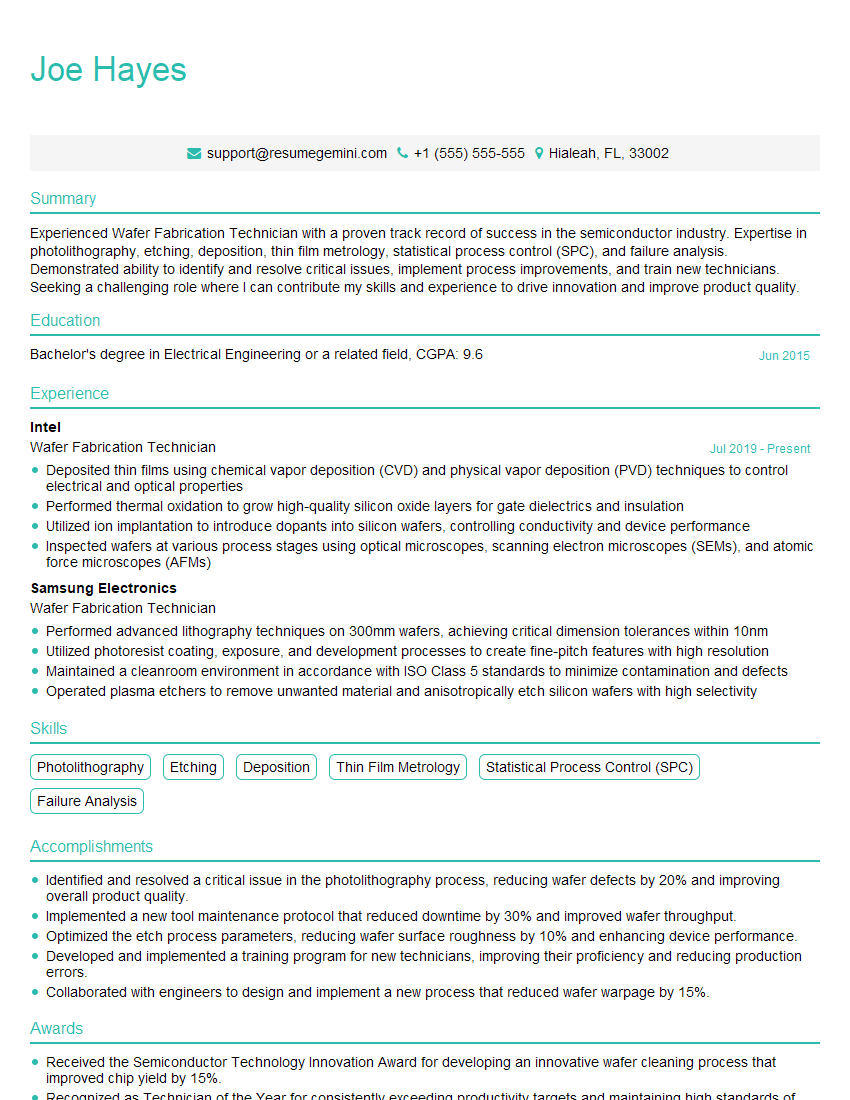
Mastering semiconductor fabrication processes is crucial for a successful career in this rapidly evolving field. A strong understanding of these processes opens doors to exciting roles in research, development, manufacturing, and quality control. To stand out from the competition, create an ATS-friendly resume that showcases your expertise. ResumeGemini is a trusted resource to help you build a professional and impactful resume tailored to highlight your specific skills and experience. Examples of resumes tailored to showcase Knowledge of Semiconductor Fabrication Processes are available to help guide you. Invest the time to craft a compelling resume; it’s your first impression on potential employers.


Explore more articles
Users Rating of Our Blogs
Share Your Experience
We value your feedback! Please rate our content and share your thoughts (optional).
What Readers Say About Our Blog
Attention music lovers!
Wow, All the best Sax Summer music !!!
Spotify: https://open.spotify.com/artist/6ShcdIT7rPVVaFEpgZQbUk
Apple Music: https://music.apple.com/fr/artist/jimmy-sax-black/1530501936
YouTube: https://music.youtube.com/browse/VLOLAK5uy_noClmC7abM6YpZsnySxRqt3LoalPf88No
Other Platforms and Free Downloads : https://fanlink.tv/jimmysaxblack
on google : https://www.google.com/search?q=22+AND+22+AND+22
on ChatGPT : https://chat.openai.com?q=who20jlJimmy20Black20Sax20Producer
Get back into the groove with Jimmy sax Black
Best regards,
Jimmy sax Black
www.jimmysaxblack.com
Hi I am a troller at The aquatic interview center and I suddenly went so fast in Roblox and it was gone when I reset.
Hi,
Business owners spend hours every week worrying about their website—or avoiding it because it feels overwhelming.
We’d like to take that off your plate:
$69/month. Everything handled.
Our team will:
Design a custom website—or completely overhaul your current one
Take care of hosting as an option
Handle edits and improvements—up to 60 minutes of work included every month
No setup fees, no annual commitments. Just a site that makes a strong first impression.
Find out if it’s right for you:
https://websolutionsgenius.com/awardwinningwebsites
Hello,
we currently offer a complimentary backlink and URL indexing test for search engine optimization professionals.
You can get complimentary indexing credits to test how link discovery works in practice.
No credit card is required and there is no recurring fee.
You can find details here:
https://wikipedia-backlinks.com/indexing/
Regards
NICE RESPONSE TO Q & A
hi
The aim of this message is regarding an unclaimed deposit of a deceased nationale that bears the same name as you. You are not relate to him as there are millions of people answering the names across around the world. But i will use my position to influence the release of the deposit to you for our mutual benefit.
Respond for full details and how to claim the deposit. This is 100% risk free. Send hello to my email id: lukachachibaialuka@gmail.com
Luka Chachibaialuka
Hey interviewgemini.com, just wanted to follow up on my last email.
We just launched Call the Monster, an parenting app that lets you summon friendly ‘monsters’ kids actually listen to.
We’re also running a giveaway for everyone who downloads the app. Since it’s brand new, there aren’t many users yet, which means you’ve got a much better chance of winning some great prizes.
You can check it out here: https://bit.ly/callamonsterapp
Or follow us on Instagram: https://www.instagram.com/callamonsterapp
Thanks,
Ryan
CEO – Call the Monster App
Hey interviewgemini.com, I saw your website and love your approach.
I just want this to look like spam email, but want to share something important to you. We just launched Call the Monster, a parenting app that lets you summon friendly ‘monsters’ kids actually listen to.
Parents are loving it for calming chaos before bedtime. Thought you might want to try it: https://bit.ly/callamonsterapp or just follow our fun monster lore on Instagram: https://www.instagram.com/callamonsterapp
Thanks,
Ryan
CEO – Call A Monster APP
To the interviewgemini.com Owner.
Dear interviewgemini.com Webmaster!
Hi interviewgemini.com Webmaster!
Dear interviewgemini.com Webmaster!
excellent
Hello,
We found issues with your domain’s email setup that may be sending your messages to spam or blocking them completely. InboxShield Mini shows you how to fix it in minutes — no tech skills required.
Scan your domain now for details: https://inboxshield-mini.com/
— Adam @ InboxShield Mini
support@inboxshield-mini.com
Reply STOP to unsubscribe
Hi, are you owner of interviewgemini.com? What if I told you I could help you find extra time in your schedule, reconnect with leads you didn’t even realize you missed, and bring in more “I want to work with you” conversations, without increasing your ad spend or hiring a full-time employee?
All with a flexible, budget-friendly service that could easily pay for itself. Sounds good?
Would it be nice to jump on a quick 10-minute call so I can show you exactly how we make this work?
Best,
Hapei
Marketing Director
Hey, I know you’re the owner of interviewgemini.com. I’ll be quick.
Fundraising for your business is tough and time-consuming. We make it easier by guaranteeing two private investor meetings each month, for six months. No demos, no pitch events – just direct introductions to active investors matched to your startup.
If youR17;re raising, this could help you build real momentum. Want me to send more info?
Hi, I represent an SEO company that specialises in getting you AI citations and higher rankings on Google. I’d like to offer you a 100% free SEO audit for your website. Would you be interested?
Hi, I represent an SEO company that specialises in getting you AI citations and higher rankings on Google. I’d like to offer you a 100% free SEO audit for your website. Would you be interested?