Every successful interview starts with knowing what to expect. In this blog, we’ll take you through the top Knowledge of Steam Pressing Techniques interview questions, breaking them down with expert tips to help you deliver impactful answers. Step into your next interview fully prepared and ready to succeed.
Questions Asked in Knowledge of Steam Pressing Techniques Interview
Q 1. Explain the different types of steam presses used in the industry.
The garment industry utilizes several types of steam presses, each tailored to specific needs. We have buck presses, large, powerful presses ideal for heavy-duty work like pressing suits or coats. Their strong pressure and even heat distribution make them perfect for crisp, professional finishes. Then there are sleeve presses, specialized for sleeves and smaller garment sections; their smaller size allows for precise work and avoids creasing other areas. Combination presses offer the versatility of both buck and sleeve pressing capabilities, often a cost-effective choice for busy settings. Finally, we have hand-held garment steamers which, while not technically presses, are valuable tools for quick touch-ups and delicate fabrics. The choice depends heavily on production volume, garment types, and budget.
Q 2. Describe the process of preparing garments for steam pressing.
Preparing garments for steam pressing is crucial for achieving optimal results. First, you need to pre-sort the garments by fabric type and color, grouping similar materials to maintain consistent pressing settings. Next, thoroughly inspect each garment for stains or damage – addressing those beforehand prevents setting them during pressing. Then comes the important step of pre-pressing: using a lower heat setting to remove major wrinkles, preparing the garment for the final press. This minimizes the need for aggressive pressing that could damage the fabric. Finally, make sure all buttons are properly secured and any zippers are closed to avoid any snags or damage to the press itself. Think of it like prepping a canvas before painting – a good base ensures a stunning final result.
Q 3. How do you identify and address common fabric issues during pressing?
Identifying fabric issues during pressing requires a keen eye and experience. Shiny marks (sheen) often appear from excessive heat or pressure; lowering settings or using a pressing cloth is the solution. Water spots show up as darker marks if the steam is too concentrated – reduce steam flow or use a pressing cloth. Burns manifest as scorch marks from extreme heat – immediately cease pressing and assess the damage. For delicate fabrics showing signs of stress, like stretching or tearing, switch to a lower heat setting and reduce pressure, or even consider a different method like hand steaming. Each issue demands a tailored approach, reflecting an understanding of fabric properties and the press’s capabilities.
Q 4. What are the safety precautions associated with operating steam presses?
Safety is paramount when operating steam presses. Always ensure the press is on a stable, level surface away from flammable materials. Never leave a hot, pressurized press unattended. Regularly inspect the power cord and steam hose for any damage and replace immediately if any are found. Wear protective gloves to avoid burns, and ensure the area is well-ventilated to prevent steam build-up. Finally, before operating, carefully read and follow all the manufacturer’s safety instructions. A moment of precaution can prevent serious injuries.
Q 5. Explain the importance of proper temperature and pressure settings for different fabrics.
Temperature and pressure settings are crucial and directly influence the final outcome. Different fabrics have different sensitivities to heat and pressure. Linen, for instance, can tolerate higher temperatures and pressure for a crisp finish, while delicate silks need low heat and minimal pressure to avoid damage. The pressure is adjusted by dial or lever mechanisms on many presses and this has a significant impact on crease removal. It’s essential to consult fabric care labels and rely on experience to choose the most suitable settings; Incorrect settings might lead to wrinkles, shine, or even fabric damage. For example, using high heat on a wool garment can result in irreversible shrinkage.
Q 6. How do you handle delicate fabrics during steam pressing?
Pressing delicate fabrics requires a gentler touch and careful consideration. Always use a press cloth to create a barrier between the fabric and the press head. Choose low temperatures and minimal pressure, opting for lighter presses for several repetitions, rather than one heavy press. Avoid direct steam contact on most delicates; instead, allow the steam to penetrate through the cloth. Furthermore, always test the settings on an inconspicuous area first to gauge the fabric’s response. Treating each delicate fabric with the respect it deserves leads to a flawlessly pressed result.
Q 7. How do you ensure consistent results when pressing large quantities of garments?
Maintaining consistent results with large garment quantities requires an organized approach and attention to detail. It starts with efficient garment sorting and pre-pressing as described earlier. Consistency in pressing techniques is vital: maintain a consistent rhythm and apply the same pressure and time to similar garments. Regularly check the steam pressure and temperature, making any necessary adjustments to compensate for any variations. Using a checklist for each garment type and regularly inspecting the pressed items helps in monitoring the consistency. In essence, it is a combination of meticulous preparation and disciplined execution. Think of it as an assembly line, where each step is performed with precision and attention to detail.
Q 8. What are some common problems encountered during steam pressing and how do you troubleshoot them?
Common problems during steam pressing often stem from incorrect settings or technique. For example, scorching can occur if the iron is too hot or the pressure is too high for the fabric type. Another common issue is wrinkles persisting after pressing, usually due to insufficient steam or improper application. Finally, unwanted shine can appear, particularly on delicate fabrics like silk, if the pressing surface is too hot or too much pressure is used.
- Scorching: Troubleshooting involves lowering the iron temperature, using a press cloth, and adjusting pressure. If scorching still occurs, consider using a lower steam setting.
- Persistent Wrinkles: This often calls for increasing steam, using a damp press cloth, or working methodically in smaller sections. A lower temperature setting can help too, especially with more delicate fabrics.
- Unwanted Shine: Use a lower temperature, less pressure, and always utilize a press cloth, particularly on fabrics prone to shine, such as silk or polyester blends. A silk pressing cloth (often made of a very fine material) provides an extra barrier.
Remember, the key to troubleshooting is systematic investigation. Start by identifying the symptom (scorching, wrinkles, shine), then adjust the settings accordingly. If the problem persists, consider the fabric type and its care instructions. This careful process is crucial for preserving garment quality and producing professional results.
Q 9. Describe your experience with different types of steam press equipment.
My experience encompasses a wide range of steam press equipment, from basic tabletop models to industrial-sized presses with automated features. I’ve worked extensively with both professional-grade industrial presses like those found in dry-cleaning establishments and smaller, more affordable models suitable for home use. The industrial presses often offer features like automated lift mechanisms, digital temperature and pressure controls, and larger platens suitable for pressing larger garments like curtains or bedsheets. In contrast, tabletop presses are more compact and are generally ideal for smaller items such as shirts and blouses. I’ve even experimented with specialized pressing equipment for particular tasks – for instance, a sleeve board is indispensable for perfect sleeve creases. Each machine has its own nuances, requiring precise calibration to achieve optimal results dependent on the fabric.
My experience has shown me that the choice of equipment should always align with the volume and type of work. A simple tabletop press might suffice for personal use, while a larger industrial press is better suited to high-volume production or specialist applications. Understanding the capabilities and limitations of each type allows for efficient and effective pressing regardless of the situation.
Q 10. How do you maintain and clean steam press equipment?
Maintaining and cleaning steam press equipment is vital for longevity and optimal performance. Regular maintenance includes daily cleaning of the pressing surface and weekly descaling. For cleaning the pressing surface, a soft, damp cloth should be used to wipe away any residue, followed by a thorough drying to prevent buildup and possible rust or discoloration. Descaling involves removing mineral deposits from the boiler that can impair steam generation. The frequency of descaling depends on the water hardness, but generally, it’s recommended weekly or monthly, depending on usage. Instructions regarding descaling procedures are usually detailed in the machine’s manual; some involve using commercial descaling solutions while others might utilize vinegar and water solutions.
In addition to routine cleaning, regular inspections are necessary to ensure that the steam vents are clear, and the heating elements are in good working order. Regular checks of the water tank, pressure gauge (if applicable), and electrical connections ensure proper functionality. Addressing any issues promptly is essential to prevent larger problems that could impact production.
Q 11. How do you determine the appropriate pressing techniques for different garment styles?
Determining the appropriate pressing techniques for different garment styles involves considering factors such as fabric type, construction details, and desired finish. For example, a crisp, tailored shirt would require a different approach than a flowing, bohemian dress. Tailored garments often require more precise pressing, focusing on well-defined seams, crisp creases, and sharp edges. For these, I typically work section-by-section, ensuring the pressing surface is smooth and that the garment is held flat to prevent wrinkles. Flowing garments, however, may benefit from a lighter touch, perhaps focusing more on smoothing out wrinkles rather than creating hard creases.
I always start with checking the care label for specific instructions before beginning. Understanding the fabric’s properties – its sensitivity to heat and moisture – guides my temperature and steam settings. I often utilize specialized pressing tools such as tailor’s ham or sleeve board to create clean edges and precise creases that are garment-specific.
Q 12. What is your experience with pressing different types of fabrics (e.g., cotton, silk, wool)?
Pressing different fabrics requires adjusting techniques to avoid damage. Cotton, for instance, is relatively durable and can withstand higher temperatures and pressure. I often use a higher steam setting with cotton to remove wrinkles effectively and achieve a crisp finish. Silk, on the other hand, is much more delicate. I always use a low temperature, lower steam pressure and a silk press cloth to prevent scorching or shine. Wool is also sensitive; I typically use a low to medium temperature, often with a press cloth, and press lightly to prevent damaging the fibers. The technique employed is crucial: for wool, I might prefer a light steam to lift fibers rather than high-pressure steam that could flatten the structure.
With each fabric type, understanding its unique properties helps determine the optimal temperature, steam level, and pressure needed. Working slowly and deliberately with smaller sections of the garment is crucial for preventing mistakes or unexpected damage.
Q 13. How do you prevent shine or damage to fabric during pressing?
Preventing shine and damage during pressing relies on several key practices. The use of a press cloth is paramount, especially on delicate fabrics like silk, wool, and rayon. The press cloth acts as a barrier between the hot iron and the garment, preventing direct heat contact. Choosing the appropriate temperature setting is also critical. Always start at a low setting and gradually increase if needed. Overheating is a primary cause of shine and damage. Gentle pressure is essential; avoid using excessive force that could crush or damage the fabric’s fibers. Press in the direction of the fabric’s nap to prevent flattening or unwanted distortions. For instance, pressing velvet should only be done in one direction, following the pile to avoid matting and loss of texture.
Remember, prevention is better than cure. Checking care labels is always my first step to ensure I am using the correct technique for the garment, considering fabric type and desired finish.
Q 14. Explain the importance of proper steam pressure and moisture control.
Proper steam pressure and moisture control are fundamental for effective steam pressing. Sufficient steam penetrates the fabric fibers, relaxing them and allowing for wrinkle removal. Insufficient steam results in incomplete wrinkle removal, while excessive steam can lead to excessive dampness and possibly prolonged drying times. The pressure of the press is also critical. Gentle pressure is needed for delicate fabrics to avoid shine or damage, whereas heavier pressure is often suitable for cotton or linen to achieve crisp edges and folds.
Think of steam as a gentle catalyst that helps reshape the fabric fibers. Proper moisture control, matched with an ideal pressure level, ensures the fibers are relaxed and set correctly, resulting in a smooth, professional finish. I always start with a lower setting and gradually adjust to ensure the optimal balance for the task at hand.
Q 15. How do you ensure the proper alignment and shape of garments after pressing?
Ensuring proper alignment and shape after pressing is paramount for a professional finish. It’s like sculpting with fabric! It requires careful attention to detail and a good understanding of the garment’s construction.
I begin by carefully studying the garment’s design, noting seams, darts, and any special features. Then, I use the steam press strategically, working section by section. For example, with a shirt, I’d start with the collar, meticulously aligning the points and smoothing out any wrinkles. I use a tailor’s ham or sleeve roll to support curved areas like sleeves and shoulders, ensuring they maintain their shape. For trousers, I’d use a pressing board with a leg form to prevent creases from setting in the wrong places. The key is to press *with* the grain of the fabric, following the natural drape. If a seam is puckering, I’ll gently stretch the fabric while pressing to ease the tension.
- Careful Observation: Before pressing, I carefully inspect the garment to identify potential issues like uneven seams or fabric distortions.
- Strategic Pressing: I work section by section, supporting curved areas with appropriate tools.
- Grain Alignment: Always press with the grain of the fabric to avoid distorting the garment.
Career Expert Tips:
- Ace those interviews! Prepare effectively by reviewing the Top 50 Most Common Interview Questions on ResumeGemini.
- Navigate your job search with confidence! Explore a wide range of Career Tips on ResumeGemini. Learn about common challenges and recommendations to overcome them.
- Craft the perfect resume! Master the Art of Resume Writing with ResumeGemini’s guide. Showcase your unique qualifications and achievements effectively.
- Don’t miss out on holiday savings! Build your dream resume with ResumeGemini’s ATS optimized templates.
Q 16. How do you handle wrinkles and creases during steam pressing?
Wrinkles and creases are the enemy of a well-pressed garment. My approach involves a combination of techniques to address them efficiently and prevent further damage.
I start by identifying the type of wrinkle. Are they surface wrinkles that respond to a light press, or are they deep, set-in creases? For light wrinkles, a quick pass with the steam press often suffices. However, for stubborn creases, I employ several strategies. I might use a damp pressing cloth to protect delicate fabrics and prevent shine. For very deep creases, I’ll sometimes pre-treat them by misting the area lightly with water and allowing it to rest before pressing. I avoid applying excessive pressure or heat, which can damage the fabric or cause unwanted shine. The goal is to gently coax the fibers back into their proper position.
- Damp Pressing Cloth: Protects delicate fabrics and prevents shine.
- Pre-Treatment: Misting stubborn creases before pressing helps relax fibers.
- Gradual Pressure: Avoid excessive pressure to prevent damage.
Q 17. What is your experience with industrial-grade steam presses?
My experience with industrial-grade steam presses spans over ten years. I’ve worked extensively with various models, from high-pressure systems used in large-scale production to smaller, more compact units suited for specialized tasks. This includes operating, maintaining, and troubleshooting different machines.
I’m proficient in understanding and utilizing their various features, such as pressure regulation, temperature control, and steam output adjustments. For instance, I know how crucial it is to select the correct pressure and temperature setting based on the fabric type. Using too much pressure on a delicate fabric can lead to damage, while insufficient pressure on a heavy fabric will leave wrinkles. I also understand the importance of regular maintenance, including cleaning and descaling, to ensure optimal performance and longevity of the equipment. This preventative maintenance minimizes downtime and prevents costly repairs.
Q 18. Describe your experience with different pressing techniques (e.g., blocking, shaping).
Different fabrics and garment styles demand different pressing techniques. Blocking involves shaping a garment using a stiff interfacing and press cloth to achieve a very structured form, often used for tailoring. Shaping, on the other hand, is more about refining and enhancing the garment’s natural drape. It’s a gentler process.
For instance, blocking is ideal for creating sharp creases on collars, cuffs, and lapels. I use a tailor’s ham and tailor’s clapper to achieve a crisp, clean look. Shaping, however, might involve carefully pressing darts to create a well-defined waistline or smoothing out wrinkles on a flowing skirt without creating sharp creases. This requires a delicate touch and a keen eye for detail. I’ve used both techniques extensively, adapting my approach depending on the garment’s fabric and desired outcome. Think of it like painting: blocking is bold strokes, while shaping is subtle blending.
- Blocking: Used for structured garments, requiring a stiff interfacing and press cloth.
- Shaping: Emphasizes the natural drape of the garment, using a lighter touch.
Q 19. How do you identify and correct pressing errors?
Identifying and correcting pressing errors requires a keen eye and a systematic approach. It’s all about observation and problem-solving.
First, I carefully examine the garment, focusing on areas that look off. Are the seams puckering? Are there unwanted creases or shine marks? Are the collar points uneven? Once I’ve pinpointed the problem, I investigate the cause. Did I use excessive pressure? Was the temperature too high? Was the fabric not properly supported? Then, I take corrective action. This could involve re-pressing the area using a different technique, changing the pressure or temperature, or using a different pressing tool. For example, if I’ve accidentally created shine marks, I’d use a press cloth or try a different pressing method to eliminate the shine. Sometimes, it’s a matter of re-steaming the area without applying direct pressure.
Q 20. What is your understanding of fabric shrinkage and how do you account for it during pressing?
Fabric shrinkage is a significant concern during pressing, especially with natural fibers like wool or cotton. The heat and moisture from the steam press can cause fibers to relax and contract, leading to unexpected alterations in the garment’s dimensions.
To account for this, I always check the fabric’s care instructions before pressing. Some fabrics are more prone to shrinkage than others. I might pre-wash some fabrics before pressing to pre-shrink them, but even then, I take precautions during the pressing process. I use lower temperatures and shorter press times for fabrics that are prone to shrinkage. I also avoid applying excessive pressure, and I’m very careful not to stretch the fabric during pressing. For delicate or easily-shrinking fabrics, I will often use a press cloth to protect against direct heat. I also ensure that the garment is completely dry after pressing to prevent uneven shrinking.
Q 21. How do you maintain a clean and organized workspace?
A clean and organized workspace is essential for efficient and effective work. It minimizes the risk of accidents and speeds up the work process.
Before I start, I make sure the pressing area is clear of any unnecessary items. This allows for a smooth workflow and prevents accidental damage to garments. The pressing board is clean and free of debris, and all necessary tools—pressing cloths, tailor’s ham, sleeve roll, and spray bottle—are easily accessible. After each garment, I clean the press surface with a damp cloth to remove any lint or residue. I also regularly empty the steam tank and clean the steam vents to prevent blockages and ensure optimal steam output. Maintaining a clean, clutter-free space improves efficiency and enhances the quality of my work. This makes me more focused, reduces mistakes, and keeps the overall workplace safe.
Q 22. Explain the importance of quality control in steam pressing.
Quality control in steam pressing is paramount to achieving a professional finish and ensuring client satisfaction. It’s not just about the final look; it’s about the structural integrity and longevity of the garment. Think of it like baking a cake – you wouldn’t skip checking the oven temperature or the ingredients, would you?
My quality control process involves several steps: First, a thorough pre-press inspection to identify any potential problems like wrinkles, stains, or loose seams. Then, during pressing, I carefully monitor steam pressure and temperature to avoid scorching or over-wetting. Finally, a post-press inspection ensures the garment is free from wrinkles, creases are sharp, and the overall finish is impeccable. I regularly check my equipment – maintaining the steam iron, ensuring proper water levels and descaling – to eliminate inconsistencies. Any deviation from expected quality is documented and addressed immediately. This might involve adjusting pressing techniques, addressing machine malfunctions, or even retraining staff if needed.
Q 23. Describe your experience with using different types of pressing boards and forms.
My experience spans a wide range of pressing boards and forms, each tailored to specific garment types and desired results. I’ve worked extensively with traditional padded pressing boards, utilizing their flat surface for basic garments. For more intricate pieces like shirts, I rely on specialized sleeve boards and tailor’s ham to create smooth, tailored curves and defined seams. The tailor’s ham, for instance, helps shape the curves of a jacket’s shoulder perfectly.
Additionally, I’m proficient in using various pressing forms, including those for collars, cuffs, and lapels. These forms ensure consistent shaping and prevent distortion. For example, a collar form helps to maintain the crispness and shape of a shirt collar, which would be very difficult to achieve with a standard board. The choice of board and form is completely dependent on the garment – I select the tool that will best enhance its form and quality.
Q 24. How do you adapt your pressing techniques to different garment construction methods?
Adaptability is key in steam pressing. Different garment construction methods require tailored techniques to avoid damage and ensure a clean, professional finish. For instance, pressing a garment constructed with fusible interfacing requires a lighter touch and lower temperature to prevent the adhesive from melting or scorching. Conversely, a garment with heavier canvas interlining might necessitate more pressure and steam to achieve the proper drape and stiffness.
Similarly, I adjust my techniques for various seams. A French seam, for example, requires careful pressing from the inside to ensure a smooth, flat finish that’s invisible from the outside. A welt seam may need pressing to flatten and define the seam allowances. My knowledge of various stitch types informs my pressing – understanding the construction allows me to effectively work with each piece without damaging the seam or altering its structural integrity. This ensures a high-quality, finished product.
Q 25. What is your experience working in a fast-paced production environment?
I thrive in fast-paced production environments. In my previous role, we routinely handled high-volume orders with tight deadlines. My efficiency stems from a well-organized workflow, prioritizing garments based on complexity and due dates. This involves breaking down larger projects into smaller, manageable tasks. I am also adept at quickly identifying and resolving any pressing-related problems that may arise. My ability to maintain accuracy and speed under pressure is a testament to my experience and efficiency. I am accustomed to meeting stringent quality requirements while consistently maintaining a high output.
Q 26. How do you prioritize tasks to meet deadlines?
Prioritizing tasks to meet deadlines involves a combination of planning and adaptability. I typically employ a system combining urgency and importance. Urgency considers the imminent deadline, while importance evaluates the overall impact of each task on the final product. This helps me to create a prioritized list that ensures pressing those garments with the most urgent deadlines, then progressing to the rest, prioritizing those that are most important for the overall quality of the product.
However, this is a flexible system; I frequently re-evaluate my priorities based on unexpected changes or issues that may arise during production. For instance, if a last-minute order comes in for a rush job, I may temporarily adjust my priorities to accommodate it without sacrificing the quality of other pending items. This requires constant monitoring and reassessment to maintain efficiency and meet all deadlines successfully.
Q 27. Describe a time you had to troubleshoot a pressing issue.
I once encountered a persistent shine on a dark-colored wool garment after pressing. Initially, I suspected the problem stemmed from excessive heat or pressure. However, after systematically eliminating these possibilities, I discovered the shine resulted from the iron’s surface being slightly contaminated. A thorough cleaning of the iron’s soleplate using a specialized cleaning agent and a soft cloth solved the issue immediately.
This experience reinforced the importance of regular equipment maintenance. My systematic troubleshooting involved: 1) Identifying the problem (shine); 2) Formulating potential causes (heat, pressure, contamination); 3) Eliminating possibilities (adjusting heat/pressure); 4) Identifying the root cause (contaminated iron); and 5) Implementing a solution (cleaning the iron). This systematic approach allowed me to quickly isolate the cause and solve the problem, ultimately preventing further damage or delays.
Q 28. How do you stay up-to-date on new developments in steam pressing techniques?
Staying current in the ever-evolving field of steam pressing involves continuous learning. I regularly attend industry workshops and seminars to learn about the latest pressing technologies and techniques. I also actively subscribe to trade publications and online forums where professionals share best practices and discuss new innovations. Moreover, I seek feedback from colleagues and mentors, staying connected to the broader community of experienced pressers to learn from their own unique approaches and insights.
Staying updated isn’t merely about keeping up with the latest gadgets, it also involves refining existing methods to optimize efficiency and quality. This constant learning process allows me to adapt my skills and knowledge to enhance my pressing skills and produce consistently high-quality results. I am always interested in learning new techniques and technologies, which ultimately benefits my work and my clients.
Key Topics to Learn for Knowledge of Steam Pressing Techniques Interview
- Understanding Steam Properties: Explore the impact of steam temperature, pressure, and moisture content on fabric types and pressing outcomes. Consider how these properties affect wrinkle removal, shaping, and overall garment finish.
- Equipment Operation & Maintenance: Demonstrate knowledge of various steam pressing equipment (e.g., industrial presses, hand-held steamers). Discuss safety procedures, routine maintenance, troubleshooting common malfunctions, and the importance of equipment hygiene.
- Fabric Knowledge & Selection of Pressing Techniques: Show your understanding of different fabric types (natural vs. synthetic, delicate vs. durable) and how appropriate pressing techniques vary based on fiber content and construction. Discuss the impact of heat and moisture on various fabrics.
- Pressing Techniques for Different Garments: Explain the specific pressing techniques needed for various garments (e.g., shirts, pants, jackets, dresses). Detail how to achieve sharp creases, smooth surfaces, and proper shaping for optimal results.
- Problem-Solving & Quality Control: Describe your approach to identifying and resolving pressing issues (e.g., scorch marks, uneven pressing, wrinkles). Explain your methods for ensuring consistent quality and adherence to industry standards.
- Health and Safety: Detail safety procedures related to operating steam pressing equipment, handling hot surfaces and steam, and maintaining a safe work environment.
Next Steps
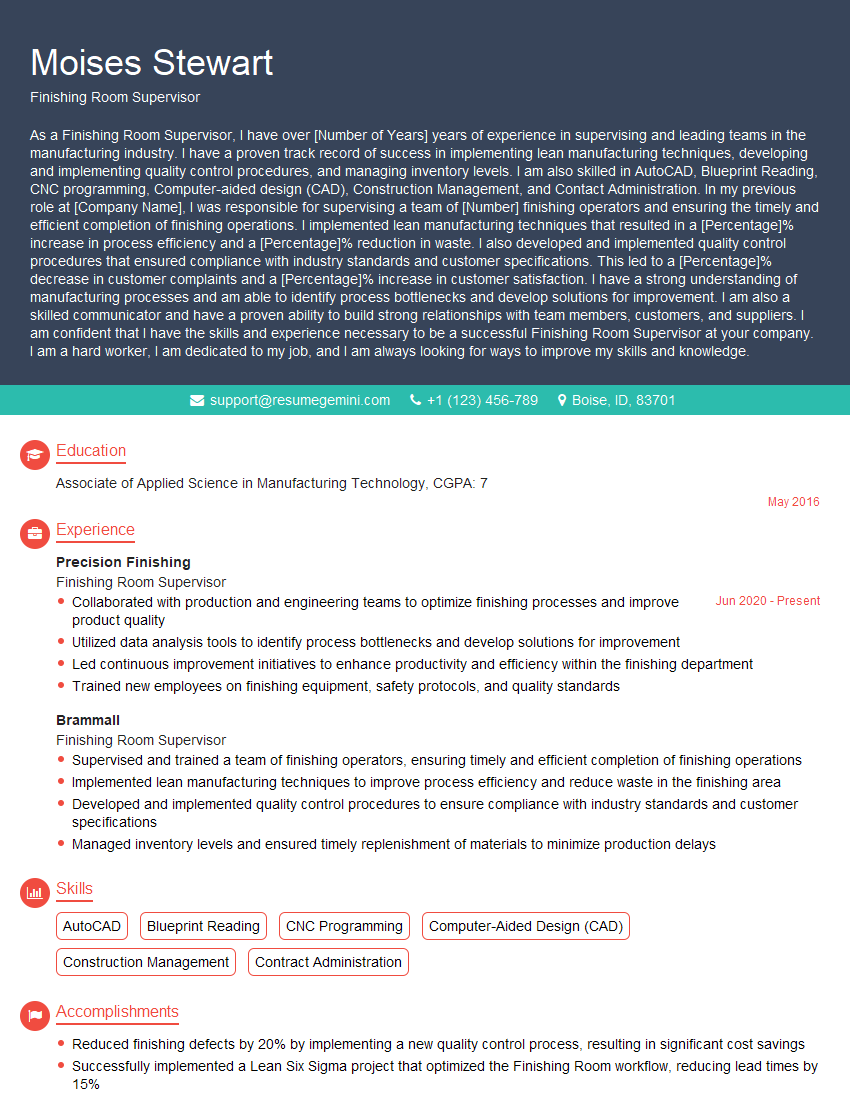
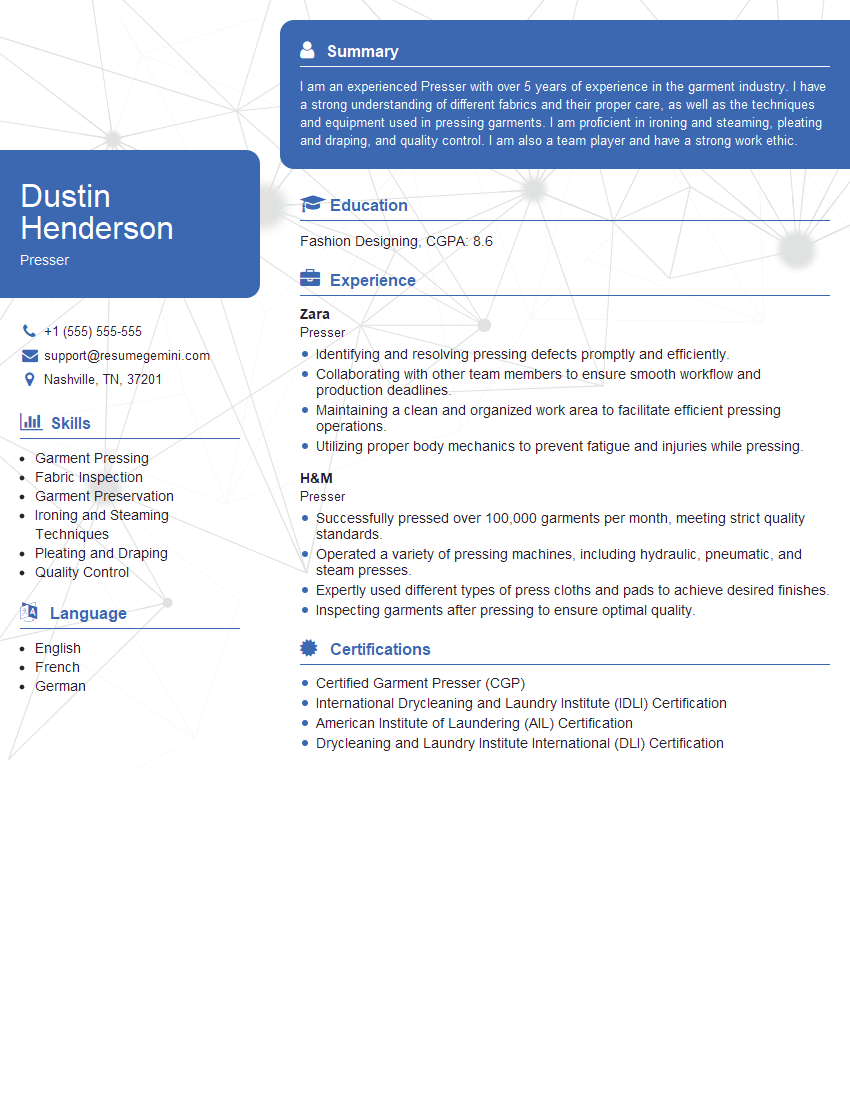
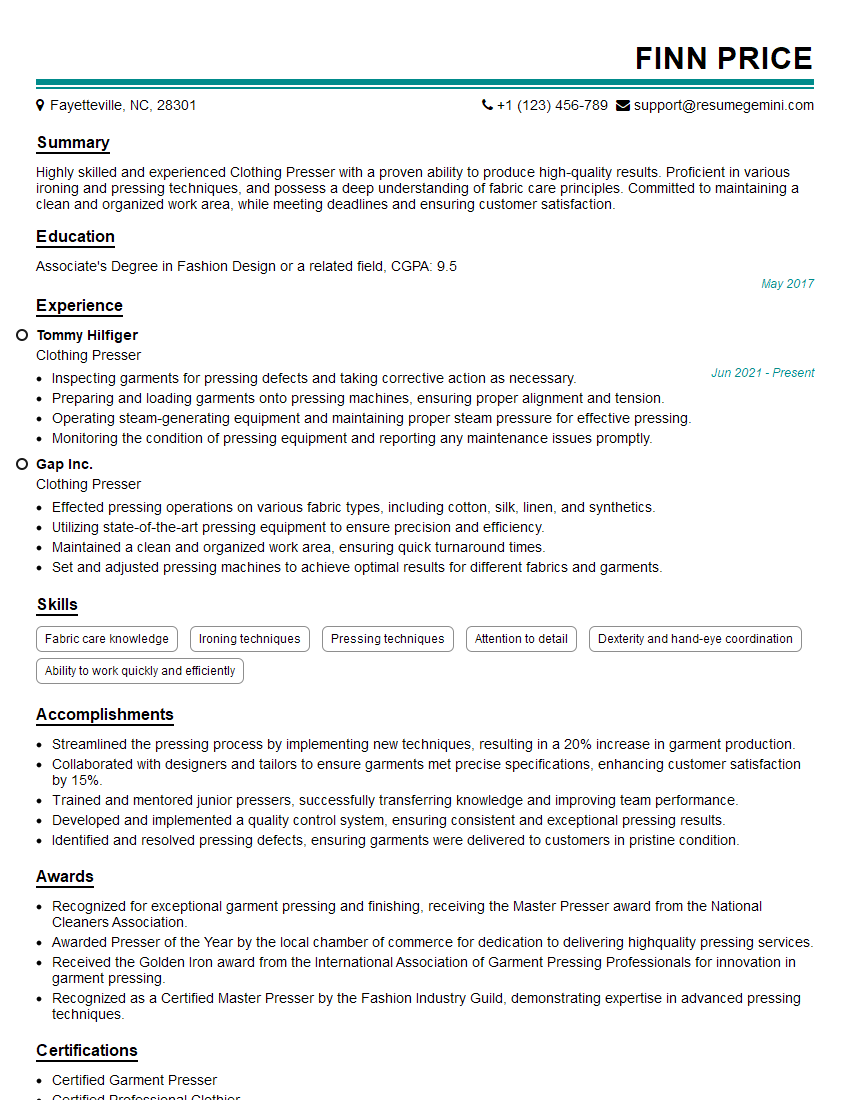
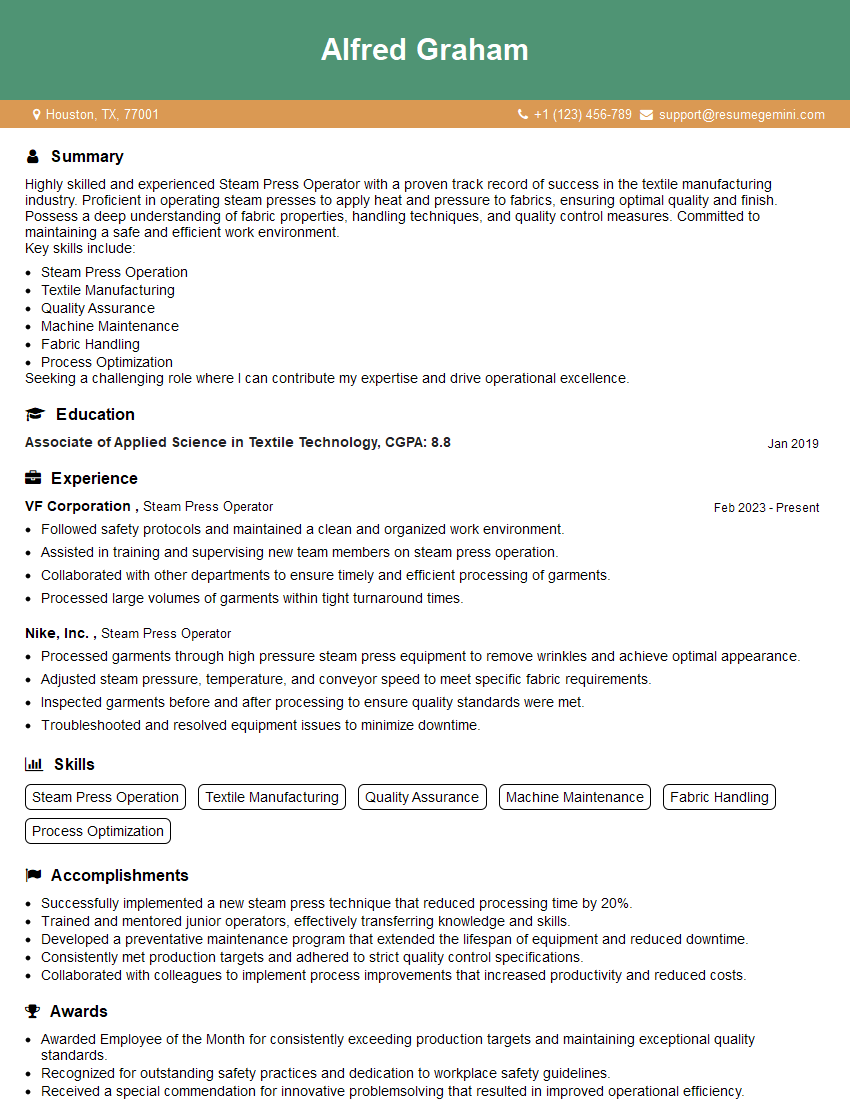
Mastering steam pressing techniques is crucial for career advancement in the garment industry, opening doors to higher-paying roles and increased responsibility. A strong resume is your key to unlocking these opportunities. Creating an ATS-friendly resume maximizes your chances of getting noticed by recruiters and landing interviews. ResumeGemini can help you build a compelling resume that highlights your skills and experience effectively. Examples of resumes tailored to showcase your Knowledge of Steam Pressing Techniques are available to help you get started.
Explore more articles
Users Rating of Our Blogs
Share Your Experience
We value your feedback! Please rate our content and share your thoughts (optional).
What Readers Say About Our Blog
Attention music lovers!
Wow, All the best Sax Summer music !!!
Spotify: https://open.spotify.com/artist/6ShcdIT7rPVVaFEpgZQbUk
Apple Music: https://music.apple.com/fr/artist/jimmy-sax-black/1530501936
YouTube: https://music.youtube.com/browse/VLOLAK5uy_noClmC7abM6YpZsnySxRqt3LoalPf88No
Other Platforms and Free Downloads : https://fanlink.tv/jimmysaxblack
on google : https://www.google.com/search?q=22+AND+22+AND+22
on ChatGPT : https://chat.openai.com?q=who20jlJimmy20Black20Sax20Producer
Get back into the groove with Jimmy sax Black
Best regards,
Jimmy sax Black
www.jimmysaxblack.com
Hi I am a troller at The aquatic interview center and I suddenly went so fast in Roblox and it was gone when I reset.
Hi,
Business owners spend hours every week worrying about their website—or avoiding it because it feels overwhelming.
We’d like to take that off your plate:
$69/month. Everything handled.
Our team will:
Design a custom website—or completely overhaul your current one
Take care of hosting as an option
Handle edits and improvements—up to 60 minutes of work included every month
No setup fees, no annual commitments. Just a site that makes a strong first impression.
Find out if it’s right for you:
https://websolutionsgenius.com/awardwinningwebsites
Hello,
we currently offer a complimentary backlink and URL indexing test for search engine optimization professionals.
You can get complimentary indexing credits to test how link discovery works in practice.
No credit card is required and there is no recurring fee.
You can find details here:
https://wikipedia-backlinks.com/indexing/
Regards
NICE RESPONSE TO Q & A
hi
The aim of this message is regarding an unclaimed deposit of a deceased nationale that bears the same name as you. You are not relate to him as there are millions of people answering the names across around the world. But i will use my position to influence the release of the deposit to you for our mutual benefit.
Respond for full details and how to claim the deposit. This is 100% risk free. Send hello to my email id: lukachachibaialuka@gmail.com
Luka Chachibaialuka
Hey interviewgemini.com, just wanted to follow up on my last email.
We just launched Call the Monster, an parenting app that lets you summon friendly ‘monsters’ kids actually listen to.
We’re also running a giveaway for everyone who downloads the app. Since it’s brand new, there aren’t many users yet, which means you’ve got a much better chance of winning some great prizes.
You can check it out here: https://bit.ly/callamonsterapp
Or follow us on Instagram: https://www.instagram.com/callamonsterapp
Thanks,
Ryan
CEO – Call the Monster App
Hey interviewgemini.com, I saw your website and love your approach.
I just want this to look like spam email, but want to share something important to you. We just launched Call the Monster, a parenting app that lets you summon friendly ‘monsters’ kids actually listen to.
Parents are loving it for calming chaos before bedtime. Thought you might want to try it: https://bit.ly/callamonsterapp or just follow our fun monster lore on Instagram: https://www.instagram.com/callamonsterapp
Thanks,
Ryan
CEO – Call A Monster APP
To the interviewgemini.com Owner.
Dear interviewgemini.com Webmaster!
Hi interviewgemini.com Webmaster!
Dear interviewgemini.com Webmaster!
excellent
Hello,
We found issues with your domain’s email setup that may be sending your messages to spam or blocking them completely. InboxShield Mini shows you how to fix it in minutes — no tech skills required.
Scan your domain now for details: https://inboxshield-mini.com/
— Adam @ InboxShield Mini
support@inboxshield-mini.com
Reply STOP to unsubscribe
Hi, are you owner of interviewgemini.com? What if I told you I could help you find extra time in your schedule, reconnect with leads you didn’t even realize you missed, and bring in more “I want to work with you” conversations, without increasing your ad spend or hiring a full-time employee?
All with a flexible, budget-friendly service that could easily pay for itself. Sounds good?
Would it be nice to jump on a quick 10-minute call so I can show you exactly how we make this work?
Best,
Hapei
Marketing Director
Hey, I know you’re the owner of interviewgemini.com. I’ll be quick.
Fundraising for your business is tough and time-consuming. We make it easier by guaranteeing two private investor meetings each month, for six months. No demos, no pitch events – just direct introductions to active investors matched to your startup.
If youR17;re raising, this could help you build real momentum. Want me to send more info?
Hi, I represent an SEO company that specialises in getting you AI citations and higher rankings on Google. I’d like to offer you a 100% free SEO audit for your website. Would you be interested?
Hi, I represent an SEO company that specialises in getting you AI citations and higher rankings on Google. I’d like to offer you a 100% free SEO audit for your website. Would you be interested?