Interviews are opportunities to demonstrate your expertise, and this guide is here to help you shine. Explore the essential Leather Craft interview questions that employers frequently ask, paired with strategies for crafting responses that set you apart from the competition.
Questions Asked in Leather Craft Interview
Q 1. What types of leather are best suited for handbags?
Choosing the right leather for a handbag depends on the desired look, durability, and price point. Full-grain leather is the best option for longevity and a luxurious feel; it’s strong, develops a beautiful patina over time, and shows character. However, it’s also the most expensive. Top-grain leather, a more affordable choice, offers good durability, but its top layer has been sanded, resulting in a smoother, less textured surface. It’s less resistant to scratches and wear than full-grain. For a more casual handbag, corrected-grain leather provides a consistent, even surface and is easy to clean, but it’s the least durable of the three. Finally, genuine leather, often used in less expensive bags, may have imperfections and won’t last as long. Consider the intended use of the bag; a daily-use work bag requires more robust leather like full-grain, while a special-occasion clutch might suit a more delicate top-grain leather.
For example, a high-end designer handbag would almost certainly use full-grain leather for its exceptional quality and longevity, whereas a less expensive, everyday bag might employ top-grain leather for a more accessible price point and still good durability. The choice ultimately hinges on balancing desired aesthetics, expected lifespan, and budget constraints.
Q 2. Explain the process of skiving leather.
Skiving leather is a crucial process that reduces the thickness of a leather piece while maintaining its integrity. It’s often used to create a smooth transition between layers of leather or to reduce bulk in areas like seams or edges. Imagine trying to sew together two thick pieces of leather – it would be nearly impossible! Skiving allows for cleaner, more even stitching. The process is achieved using a specialized tool called a skiving knife, which has a very sharp, curved blade. Leather is carefully fed into the blade’s path, and the blade slices off a controlled amount of material, creating a thinner, even edge.
The skill lies in maintaining a consistent thickness throughout the skiving process. Too much and the leather weakens; too little and the desired effect isn’t achieved. Experienced leatherworkers develop a keen eye and feel for how much pressure to apply to achieve a consistent result. This is essential for projects like creating wallets where different leather components are layered and need to have even thicknesses for a smooth, refined finish. For example, when constructing a wallet, the leather lining might be skived to match the thickness of the exterior leather, creating a smooth and even feel without bulky seams.
Q 3. Describe different leather finishing techniques.
Leather finishing techniques significantly impact the final appearance, feel, and durability of the leather. These processes are applied after the tanning phase. Common techniques include:
- Aniline dyeing: This method results in a leather with a natural, slightly uneven look and feel, allowing the grain to show through. It’s highly prized for its rich color and soft texture, but it’s susceptible to staining and scratching.
- Semi-aniline dyeing: A compromise between aniline and top-coat finishes, offering some protection while still maintaining a natural look. It’s more durable than aniline but less so than top-coat finishes.
- Top-coat dyeing: This creates a consistent, even color and finish with a protective layer, making it the most durable and easiest to clean. However, it can sometimes feel less natural.
- Embossing: Creates texture and designs by pressing patterns onto the leather’s surface. This can create a variety of looks, from subtle grain changes to elaborate raised designs.
- Waxing/Glazing: Applies a protective and often shiny coating, enhancing the leather’s look and water resistance.
The choice of finishing depends on the desired aesthetic and the intended use of the leather product. For instance, a high-end leather jacket might employ aniline dyeing for its natural beauty, while a work glove would benefit from a top-coat finish for its increased durability and water resistance.
Q 4. How do you choose the appropriate stitching for a project?
Stitch selection for a leather project is crucial for both aesthetics and functionality. The strength of the stitching needs to match the weight and intended use of the leather item. Factors to consider include:
- Stitch type: Saddle stitch (two needles, two threads interlocked) is the strongest and most traditional, offering excellent durability. Running stitch (single needle, single thread) is faster but less durable. Blind stitch creates a neat, inconspicuous seam.
- Thread weight: Heavier thread is needed for thicker leather and high-stress areas. Consider the thickness and density of the leather when choosing thread weight. Lighter thread may suffice for finer leathers and decorative elements.
- Needle size: The needle must match the thread and leather thickness for optimal stitching.
- Project requirements: A sturdy handbag needs strong stitching, while a decorative element requires aesthetic stitch patterns.
For instance, a heavy-duty leather belt would demand saddle stitching with strong, heavy thread, while a delicate leather bookmark may only need a simple running stitch with finer thread. Experimentation and experience help refine the knowledge of selecting the best stitch for every aspect of leatherwork.
Q 5. What are the common tools used in leather tooling?
Leather tooling involves shaping and decorating leather using specialized tools. Essential tools include:
- Mallet: Used to strike stamps and other tools, transferring designs and impressions to the leather.
- Stitching groover: Creates consistent channels for stitching, improving seam strength and appearance.
- Stamps: Create various shapes, patterns, and designs by pressing into the leather.
- Modeling tools: Shape and mold the leather, creating three-dimensional effects.
- Beveling tools: Create angled edges, adding detail and character.
- Pricking irons: Create evenly spaced holes for stitching, ensuring accuracy and consistency.
- Leather shears/knives: Precisely cut leather, ensuring clean lines.
The specific tools needed vary depending on the project’s complexity and desired outcome. A beginner might start with basic tools like a mallet, stamps, and a stitching groover, while a seasoned craftsman might possess a wide array of specialized tools for intricate designs.
Q 6. Explain the process of creating a leather pattern.
Creating a leather pattern is the foundational step in leather crafting. It’s like making a blueprint for your project. The process typically begins with a design sketch, followed by transferring that design onto paper or cardstock, which then serves as the pattern. It’s crucial to account for seam allowances, adding extra material around the edges to allow for stitching. For symmetrical items, cut only half the pattern to ensure an accurate match.
The pattern should be carefully tested by cutting it out in inexpensive material like paper first, before cutting the expensive leather. Adjustments can be made to the paper pattern before committing to the leather. Once the paper pattern is finalized, it’s used to trace the outline onto the leather, using a tracing wheel or marker. This creates the template for cutting the leather pieces precisely to match the design.
For complex projects, multiple patterns might be required, such as separate patterns for the different parts of a bag, the interior lining, and any external pockets. Accurate pattern making ensures that all the pieces fit together perfectly, resulting in a well-crafted, professional-looking product. Without careful pattern-making, the outcome will likely result in parts not fitting correctly leading to much frustration.
Q 7. How do you handle leather defects during production?
Dealing with leather defects during production is a critical skill for any leatherworker. Leather is a natural material, and imperfections such as scars, scratches, and variations in color are common. The approach depends on the severity of the defect and the project’s requirements.
Minor imperfections can often be incorporated into the design. For example, a small scratch might be cleverly hidden under a decorative element or used to add character to a rustic-style product. More significant defects might necessitate cutting the flawed area out and re-cutting from a different part of the leather hide. This requires careful planning and consideration during the initial pattern making stage, ensuring sufficient material is available to account for possible defects.
In some cases, strategically placing the leather hide might minimize the visibility of the imperfections. For example, a defect on a hide might be placed on the lining of a product, or hidden within a seam where it won’t be visible. If the defect is severe, the leather may need to be rejected for use in the specific project. The approach requires judgment and experience in assessing the leather’s quality and how it can be optimally used to minimize visible imperfections.
Q 8. What are the different types of leather dyes?
Leather dyes come in various types, each with its own characteristics and applications. The primary categories are:
- Water-based dyes: These are easy to use, penetrate the leather well, and offer vibrant colors. However, they are less lightfast than other options, meaning they fade more quickly in sunlight. They’re ideal for projects where intense color isn’t crucial or when the finished item will be kept indoors.
- Oil-based dyes: These dyes offer a richer, more intense color and are more lightfast than water-based dyes. They penetrate deeply into the leather’s grain, providing a more durable finish. However, they are more challenging to work with, requiring more careful application to avoid uneven coloring. They are excellent for high-quality goods exposed to sunlight.
- Acrylic dyes: These are water-based and are less likely to rub off after the dye is set. This makes them great for use on items that experience a lot of friction or wear and tear. The colors are generally less deep than oil-based dyes but still provide excellent coverage.
- Spirit dyes: These are fast-drying and ideal for achieving very intense colors. They are also the most lightfast but require more skill and attention to achieve a consistent and even finish, as they can dry rapidly.
- Solvent dyes: Used for highly saturated colors. It requires experience and specific safety equipment due to the hazardous solvents used.
Choosing the right dye depends on the project, the type of leather, and the desired finish. For example, I’d use a water-based dye for a simple wallet intended for everyday use, while an oil-based dye would be my choice for a high-end leather briefcase.
Q 9. Describe your experience with saddle stitching.
Saddle stitching is a crucial skill in leatherwork, known for its strength and aesthetic appeal. My experience spans many years, working with various leathers and thicknesses. It’s a meticulous process involving a specialized awl to create evenly spaced holes and a curved needle to weave the thread through. I’ve mastered various techniques, including variations in stitch density and thread selection to achieve different looks and levels of durability. I often use linen thread, known for its strength and longevity, in saddle stitching. I’ve also worked on complex projects requiring intricate stitching patterns, demonstrating proficiency in stitching across multiple layers and curved surfaces. For instance, I once crafted a bespoke leather journal with intricate saddle stitching which required significant patience and precision, highlighting my expertise.
The process is not just about the stitching itself; it’s about understanding the leather’s properties and choosing the appropriate needle and thread to ensure a flawless, durable finish. A poorly executed stitch can compromise the overall structural integrity of the leather goods, so mastering this technique is paramount.
Q 10. How do you maintain the quality and durability of your leather goods?
Maintaining the quality and durability of leather goods involves a multi-faceted approach. First, I select high-quality leather from reputable suppliers, focusing on thickness, grain, and tanning methods. Proper preparation is crucial; this includes ensuring the leather is clean, conditioned, and properly prepared before any dyeing or construction begins. After creation, I apply leather conditioners regularly to keep the leather supple and prevent cracking. I also advise clients on proper care, emphasizing avoiding exposure to excessive heat, moisture, or direct sunlight. For cleaning, I recommend using a soft cloth and a specialized leather cleaner, avoiding harsh chemicals.
The choice of construction methods also impacts longevity. Techniques like saddle stitching, as previously mentioned, contribute to the strength and durability of the final product. Finally, attention to detail throughout the entire process is critical. It’s the little things, like properly finishing edges and ensuring seams are well-reinforced, that make all the difference in the long-term lifespan of a piece.
Q 11. What are some common challenges in leatherworking, and how do you overcome them?
Leatherworking presents several challenges. One is working with inconsistent leather; thickness variations, scars, and imperfections can impact the final product. I overcome this by carefully selecting my leather, inspecting each piece thoroughly, and planning my designs to accommodate any irregularities. Sometimes, it requires creatively incorporating the leather’s natural markings into the design itself. Another challenge is achieving consistent color and finish. This requires understanding different types of dyes and their application techniques. I often do test runs on scrap pieces before starting on a project to ensure consistent results.
Tool maintenance is also crucial. Sharpening tools like knives and awls regularly is essential for precise and efficient work. A dull tool can lead to uneven cuts, stitch holes of inconsistent size, and overall lower quality results. Finally, time management is a challenge. Leatherwork is a time-consuming process. I use project management techniques, like detailed planning and breaking down large projects into smaller tasks to stay efficient and meet deadlines.
Q 12. Describe your experience with different types of leather adhesives.
My experience with leather adhesives includes a range of options, each suited for different applications. Contact cement is a common choice for bonding larger pieces of leather, offering a strong, permanent bond. However, it requires careful application to avoid a messy, uneven adhesive layer. I often use rubber cement for temporary bonding, especially during the construction phase of a project, as it allows for easy adjustment and repositioning. This is invaluable when working with intricate patterns or curved surfaces.
For smaller components or delicate work, I might choose a specialized leather glue. These glues often have a more precise tip applicator for better control, and may provide a more flexible bond, which is advantageous for items that flex or bend with use. The selection always depends on the specific needs of the project. For instance, I would use contact cement for attaching the leather to the frame of a bag, but rubber cement for temporarily holding a smaller pocket in place before stitching.
Q 13. How do you ensure consistent quality in your work?
Ensuring consistent quality requires attention to detail at every stage of the process. This starts with selecting high-quality materials, consistently using the same tools, and mastering the techniques to create clean, accurate cuts and stitches. I have developed a series of checklists to help me stay organized during each step of creation, ensuring I don’t miss any crucial aspects. This includes verifying the size and quality of materials, checking the alignment and precision of seams, and reviewing the overall finished piece before sending it to the client.
Regular calibration of my tools, like cutting mats and stitching guides, helps to maintain consistency in my work. Maintaining a clean and organized workspace also significantly contributes to my ability to produce consistent quality. Finally, I strive to improve my techniques continuously by seeking feedback, attending workshops, and practicing new methods to enhance the overall quality of my work.
Q 14. What safety precautions do you take when working with leather and its tools?
Safety is paramount in leatherworking. Sharp tools like knives, awls, and stitching chisels require constant vigilance. I always use cutting mats to protect my work surface and prevent accidental cuts. I maintain a sharp edge on all my blades, as dull tools require more force and increase the risk of accidents. When working with adhesives, I ensure proper ventilation and wear gloves to prevent skin irritation. I always wear eye protection, especially when using rotary tools or working with dyes, to protect against flying debris or splashes. Finally, I store my tools properly in a secure location to prevent accidents. Safety is not an afterthought but an integral part of my work process.
Q 15. Describe your experience with leather carving and stamping techniques.
Leather carving and stamping are fundamental techniques in leathercraft, allowing for the creation of intricate designs and personalized details. Carving involves using specialized tools like bevelers, backgrounders, and stamps to remove leather, creating depth and texture. Stamping uses pre-made stamps to imprint designs onto the leather’s surface. My experience spans a wide range of techniques, from traditional tooling using swivel knives and stamps to more modern approaches incorporating backgrounding techniques for dramatic shadowing and multiple layers of detail. For example, I’ve carved intricate floral patterns for custom-made wallets and created deeply embossed logos for corporate gifts, demonstrating the ability to adapt techniques to various project requirements and aesthetic preferences. I’m proficient in both hand-tooling and the use of electric rotary tools for efficient and precise work. I also understand the importance of pre-planning and transferring designs accurately onto the leather before commencing carving or stamping.
- Skillset: Beveling, backgrounding, stamping, hand-tooling, rotary tool usage.
- Experience: Custom wallets, corporate gifts, decorative panels.
Career Expert Tips:
- Ace those interviews! Prepare effectively by reviewing the Top 50 Most Common Interview Questions on ResumeGemini.
- Navigate your job search with confidence! Explore a wide range of Career Tips on ResumeGemini. Learn about common challenges and recommendations to overcome them.
- Craft the perfect resume! Master the Art of Resume Writing with ResumeGemini’s guide. Showcase your unique qualifications and achievements effectively.
- Don’t miss out on holiday savings! Build your dream resume with ResumeGemini’s ATS optimized templates.
Q 16. How do you determine the appropriate thickness of leather for a project?
Choosing the right leather thickness is crucial for the functionality and aesthetic appeal of a finished product. The thickness, measured in ounces (oz), directly influences the project’s durability, flexibility, and overall look. Thicker leathers (e.g., 8-12 oz) are ideal for items needing strength and structure, like belts or bags, while thinner leathers (e.g., 2-4 oz) are better suited for smaller items or those requiring flexibility like wallets or small pouches. For example, a saddle would require a very thick, durable leather, while a delicate bracelet might use a much thinner, softer one. I consider the following factors when choosing leather thickness:
- Intended use: Will the item experience significant wear and tear?
- Desired aesthetic: Should the leather be rigid or supple?
- Design complexity: Intricate carving might necessitate a thicker leather to avoid damaging the layers.
- Construction method: Some stitching methods require specific thicknesses for optimal results.
Often, I experiment with sample pieces of different thicknesses before committing to the final selection for a project, ensuring the chosen leather is both aesthetically pleasing and functionally sound.
Q 17. What software or CAD programs are you familiar with for leather design?
While leathercraft is primarily a hands-on craft, I utilize digital tools to enhance the design and planning phases. I’m proficient in Adobe Illustrator for creating vector-based designs, which allows for precise scaling and manipulation of patterns. This software is particularly useful for designing repeating patterns or complex logos that need to be accurately transferred to leather. I also utilize other programs, such as Photoshop to edit and prepare images for transfers and creating mock-ups to visualize the final product before I begin the actual leather work. While CAD programs aren’t as common in leather crafting as they are in other manufacturing processes, vector based software serves the same purpose of precise design and planning.
Q 18. Describe your process for designing a new leather product.
Designing a new leather product is an iterative process that blends creativity, technical skill, and attention to detail. I typically follow these steps:
- Concept & Research: Begin with a clear concept – what is the product’s purpose? Who is the target audience? What are the desired features and functionality?
- Sketching & Design: Create rough sketches and refine them into detailed drawings, considering ergonomics, practicality and aesthetics. I often create several sketches to explore different designs.
- Digital Design (Illustrator, Photoshop): Develop vector-based patterns in Illustrator for precise reproduction. I use Photoshop for texture manipulation and creating color palettes.
- Pattern Making & Prototyping: Cut and assemble sample pieces from scrap leather to test the pattern, refine the design, and determine leather requirements.
- Material Selection: Choosing the appropriate leather type, thickness, and color.
- Construction & Refinement: Constructing the product, paying attention to stitching, finishing, and overall quality.
- Testing & Iteration: Thoroughly test the final product, noting any areas for improvement and refining the design in future iterations. This includes testing durability and wear.
For example, when designing a new briefcase, I would research the needs of business travelers, sketch various designs, refine them digitally, create a pattern, and test the functionality and durability of a prototype before producing the final product.
Q 19. How do you manage your time and workload when working on multiple projects?
Managing multiple projects effectively requires a structured approach. I utilize project management tools, such as Trello or Asana, to organize tasks, deadlines, and project milestones. This allows for a clear overview of all active projects and their individual stages. Prioritization is key – I assess projects based on urgency and importance, focusing on those with imminent deadlines or critical components. I break down complex projects into smaller, manageable tasks, assigning realistic timelines to each. This chunking approach prevents feeling overwhelmed and promotes consistent progress. Regular reviews and adjustments to my schedule ensure I stay on track and address any potential delays promptly. Consistent communication with clients ensures they are informed of progress and any necessary adjustments.
Q 20. What are some common mistakes to avoid when working with leather?
Working with leather requires precision and attention to detail. Several common mistakes can lead to subpar results:
- Inadequate Planning: Failing to create detailed patterns or transfer designs accurately can result in significant wasted material and time.
- Incorrect Tool Usage: Using inappropriate tools or applying excessive pressure can damage the leather or create uneven cuts.
- Ignoring Leather Characteristics: Not considering the leather’s grain direction, thickness, or type can lead to stitching difficulties or unwanted stretching/warping.
- Poor Stitching Techniques: Inconsistent stitch length, improper needle selection, or inadequate tension can weaken the seams and negatively affect the item’s durability.
- Insufficient Finishing: Neglecting proper finishing (edge finishing, conditioning, etc.) can cause the leather to crack, fade, or lose its natural sheen.
Regular practice, attention to detail, and meticulous planning are crucial to avoiding these mistakes and producing high-quality leather goods.
Q 21. Explain your understanding of different leather tanning processes.
Leather tanning is a crucial process that transforms animal hides into durable, usable leather. Different tanning methods yield leather with varying characteristics. I have a working knowledge of several common techniques:
- Chrome Tanning: This is the most common method, using chromium salts to create a soft, supple leather that is widely used in clothing, bags, and other items. It is efficient and relatively inexpensive.
- Vegetable Tanning: This traditional method employs plant-based tannins (from tree bark, leaves, etc.) to create a firm, durable leather that ages gracefully. It’s often used for high-end goods and can offer unique color variations over time. Vegetable-tanned leather often has a unique smell and patina.
- Formaldehyde Tanning: This process is less common and mainly used for certain types of suede or leather that require particular properties.
- Alum Tanning: This method utilizes aluminum salts and is used for creating softer leathers, often used for more delicate items.
Understanding the different tanning methods and their impact on the leather’s properties is crucial for selecting appropriate leather for various projects. The choice depends on factors such as desired durability, flexibility, aesthetic appearance, and budget.
Q 22. How would you address a customer complaint about a damaged leather product?
Addressing a customer complaint about a damaged leather product requires a calm, professional, and empathetic approach. My first step is to actively listen to the customer, understanding their concerns and the specifics of the damage. I would then visually inspect the product myself to assess the extent of the damage and determine its cause. This helps to avoid misunderstandings and sets the stage for a fair resolution.
Depending on the situation, there are several potential solutions: If the damage is due to a manufacturing defect, I would offer a full replacement or repair at no cost to the customer. If the damage is due to misuse (e.g., improper cleaning), I might offer a repair service at a discounted rate or guide the customer on proper care. In instances of accidental damage, I would explore repair options and provide an accurate cost estimate upfront. Throughout the process, I maintain open communication, keeping the customer informed about progress and next steps. The goal is always to find a solution that satisfies the customer and maintains the reputation of the brand.
For instance, if a customer reported a tear in their leather bag, I would first listen carefully to their description of how the damage occurred. After inspecting the tear, I’d discuss possible solutions like stitching the tear, using leather patch repair or, if the damage was extensive, suggest a replacement if the bag is still under warranty.
Q 23. What are your preferred sources for sourcing high-quality leather?
Sourcing high-quality leather is paramount in leather crafting. My preferred sources prioritize ethical sourcing, sustainable practices, and superior craftsmanship. I primarily work with reputable tanneries known for their commitment to quality and transparency. I prefer to build long-term relationships with these tanneries, ensuring a consistent supply of high-quality hides.
- Directly from Tanneries: This allows for closer control over the selection process and ensures that I receive leather that meets my exact specifications regarding thickness, type, and finish.
- Specialized Leather Suppliers: These suppliers often curate a selection of premium leathers from various tanneries worldwide, offering a wider variety of choices.
- Local Artisans and Farmers: For unique and locally-sourced options, I occasionally collaborate with local farmers and artisans who specialize in specific breeds and tanning methods. This allows me to support local economies and obtain unique textures and qualities.
When selecting leather, I consider factors like the type of animal hide (e.g., cowhide, lambskin, goatskin), the tanning method (vegetable-tanned or chrome-tanned), the thickness and grain, and the overall feel and texture. I always prioritize ethically sourced leather and support sustainable tanning practices.
Q 24. Describe your experience with repairing damaged leather goods.
My experience in repairing damaged leather goods is extensive, encompassing a wide range of techniques and materials. I’m proficient in various repair methods, from simple stitching and patching to more complex repairs involving color matching, restoration, and the application of specialized finishes.
- Stitching and Patching: For minor tears and abrasions, I utilize precise stitching techniques to seamlessly repair the damage. The choice of thread and stitching pattern depends on the type of leather and the extent of the damage.
- Leather Filling and Shaping: For larger tears or holes, I may use leather fillers and carefully reshape the damaged area to restore its original form.
- Color Matching and Finishing: Maintaining the aesthetic integrity of the repaired area is crucial. I use high-quality dyes and finishes to achieve a perfect color match and a smooth, natural finish.
I’ve repaired everything from worn-out wallets and handbags to antique saddles and furniture. Each repair project requires careful assessment, planning and the selection of appropriate tools and materials. A recent example involved repairing a vintage leather briefcase with significant cracking and wear. Through meticulous cleaning, conditioning, and the application of appropriate leather dyes and fillers, I successfully restored it to its former glory.
Q 25. What are the key differences between vegetable-tanned and chrome-tanned leather?
Vegetable-tanned and chrome-tanned leathers are fundamentally different in their tanning processes, resulting in distinct characteristics.
- Vegetable-Tanned Leather: This traditional method uses plant-based tannins like oak bark or mimosa extract to tan the hides. It’s a slower, more environmentally friendly process that results in leather with a natural, full-bodied texture. Vegetable-tanned leather develops a beautiful patina over time, darkening and acquiring unique character with age. It’s generally more durable but also requires more care.
- Chrome-Tanned Leather: This process utilizes chromium salts, a faster and more efficient method compared to vegetable tanning. Chrome-tanned leather is generally softer, more pliable, and more consistent in color. It’s less expensive but often lacks the depth of character and natural variations seen in vegetable-tanned leather. It’s also less environmentally friendly due to the use of chromium salts.
The choice between vegetable-tanned and chrome-tanned leather depends on the desired properties and application. For items requiring durability and a unique patina, vegetable-tanned leather is preferred; while for softer, more pliable items, chrome-tanned leather might be a better choice.
Q 26. How do you stay updated on the latest trends and techniques in leather craft?
Staying updated on the latest trends and techniques in leather craft is crucial for remaining competitive and innovative. I employ several strategies:
- Professional Publications and Websites: I regularly read industry magazines, blogs, and online forums dedicated to leather craft. This provides insights into new techniques, tools, and materials.
- Workshops and Seminars: I actively participate in workshops and seminars led by experienced leather artisans and experts. These events provide hands-on learning opportunities and exposure to new techniques.
- Online Communities: Engaging with online communities and forums allows for interaction with other leather crafters, sharing knowledge and learning from diverse experiences.
- Trade Shows and Exhibitions: Attending trade shows and exhibitions provides exposure to the latest products, trends, and innovations in the industry.
For example, I recently learned a new stitching technique at a workshop that significantly improves the durability and aesthetics of my work. Continuous learning is vital for maintaining a high standard of craftsmanship.
Q 27. Describe your experience with working in a team environment on leather projects.
I have extensive experience working in team environments on leather projects. I thrive in collaborative settings and believe that teamwork enhances the creativity and efficiency of the process. I’ve worked on various team projects ranging from small-scale custom orders to large-scale production runs.
My approach involves clear communication, task delegation, and active collaboration. I’m adept at coordinating various tasks, ensuring that everyone understands their roles and responsibilities. My experience includes working alongside other artisans with diverse skillsets such as designers, pattern makers, and finishers. I’m able to effectively leverage the strengths of each team member to achieve optimal outcomes. For example, I’ve been part of a team that successfully executed a large custom leather furniture project by assigning tasks based on individual expertise and efficiently managing the workflow.
In addition to technical skills, I value the importance of maintaining positive relationships with my colleagues. A collaborative spirit leads to better results and promotes a more enjoyable work environment.
Q 28. What are your salary expectations for this position?
My salary expectations are commensurate with my experience, skills, and the demands of this position. Considering my extensive background in leather crafting, my expertise in various techniques, and my proven ability to manage projects and teams effectively, I am seeking a salary within the range of [Insert Salary Range] annually. This range reflects the market value for professionals with my qualifications and is open to negotiation based on the specifics of the position and its benefits package.
Key Topics to Learn for Your Leather Craft Interview
- Leather Selection & Properties: Understanding different types of leather (e.g., full-grain, top-grain, suede), their characteristics, and suitability for various projects. Practical application: Discussing the pros and cons of choosing specific leathers for a given design.
- Leatherworking Tools & Techniques: Familiarity with essential tools (e.g., stitching groovers, mallets, punches) and techniques (e.g., hand-stitching, saddle stitching, skiving). Practical application: Explaining your preferred methods for achieving specific design elements and the rationale behind your choices.
- Pattern Making & Cutting: Creating accurate patterns, transferring them to leather, and efficiently cutting the leather to minimize waste. Practical application: Describing your approach to pattern adjustments for different leather types and sizes.
- Finishing Techniques: Knowledge of various finishing techniques (e.g., dyeing, edge finishing, burnishing) to enhance the appearance and durability of the finished product. Practical application: Explaining how different finishes impact the overall look and feel of a piece.
- Design & Aesthetics: Understanding design principles and their application to leather craft, including considerations of form, function, and style. Practical application: Analyzing existing designs and discussing how you might improve or adapt them.
- Troubleshooting & Problem-Solving: Identifying and resolving common issues encountered during the leatherworking process, such as stitching problems or leather defects. Practical application: Describe a situation where you had to troubleshoot a problem and how you resolved it.
- Safety Procedures: Demonstrating understanding and adherence to safety regulations and best practices when using sharp tools and working with leather. Practical application: Detailing your experience in maintaining a safe work environment.
Next Steps
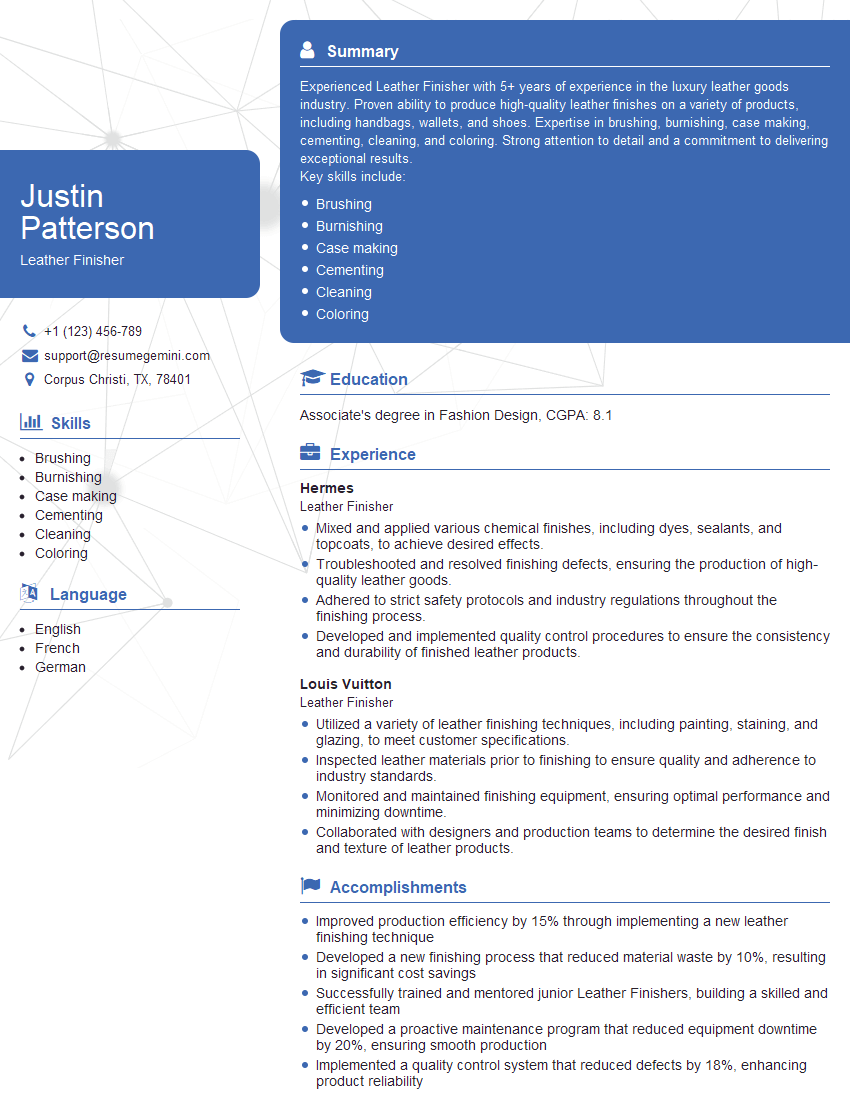
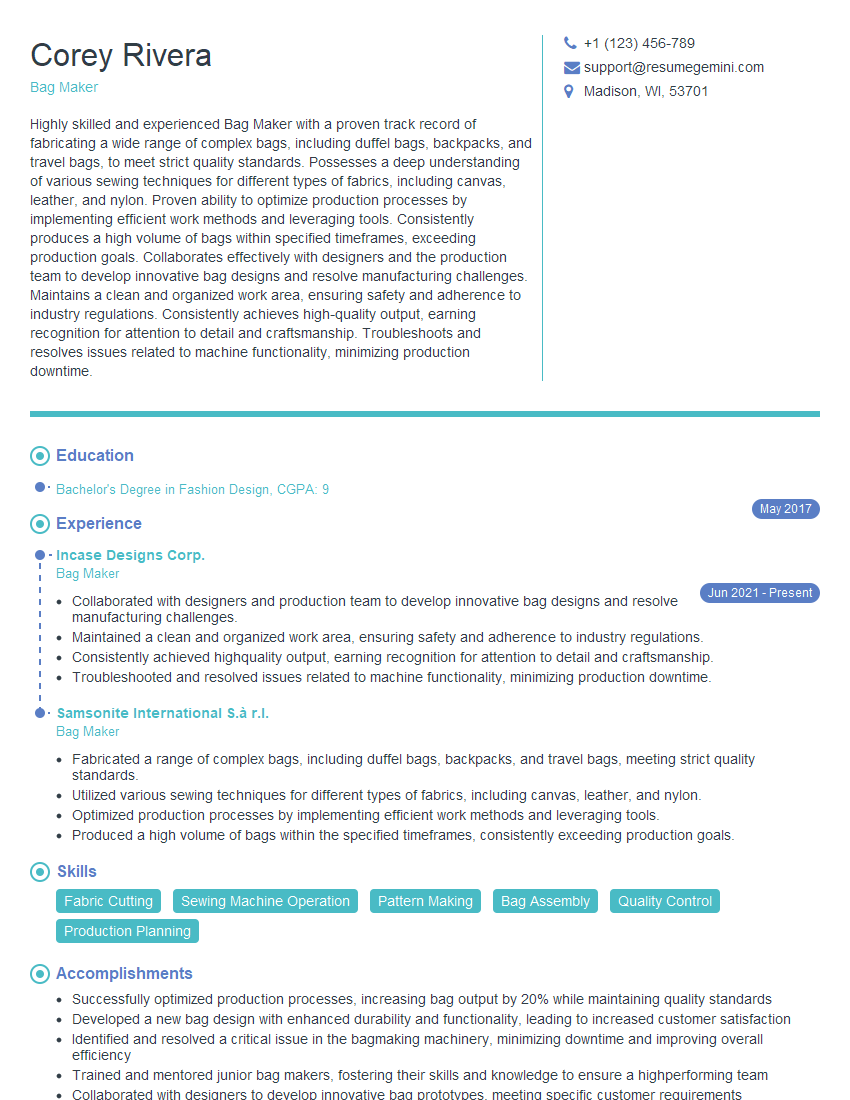
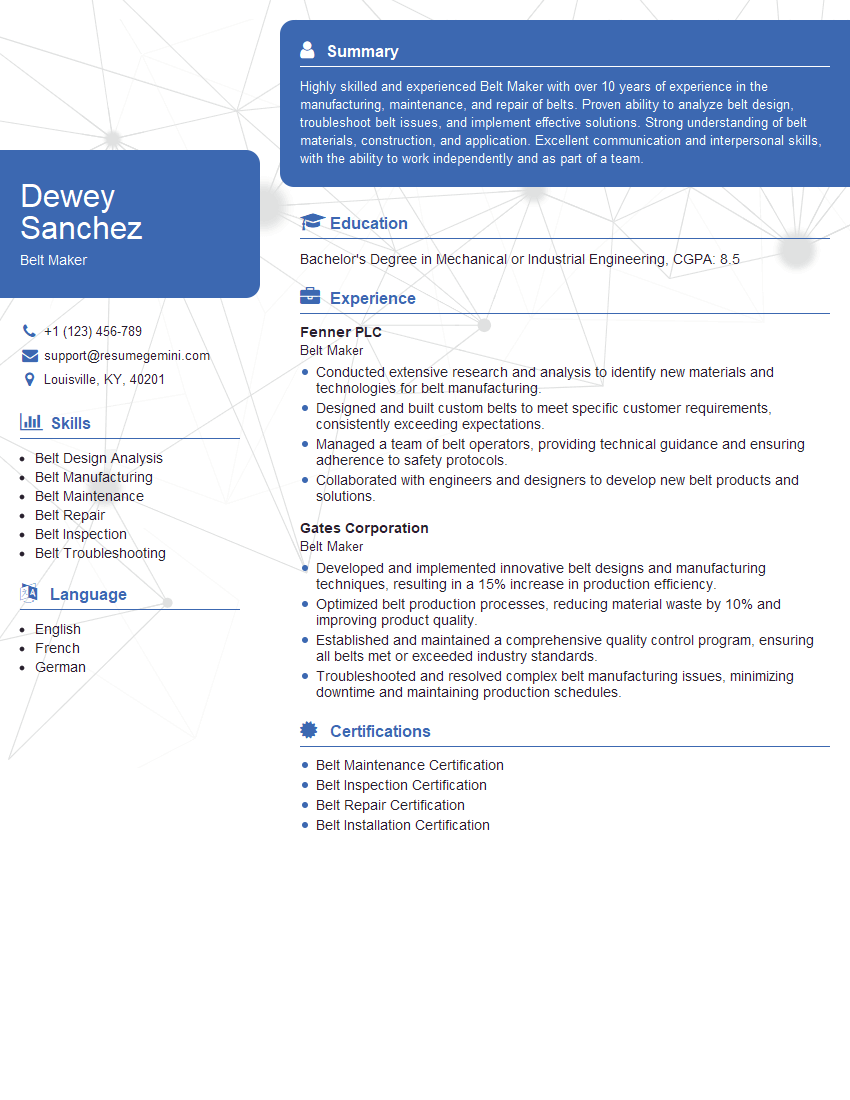
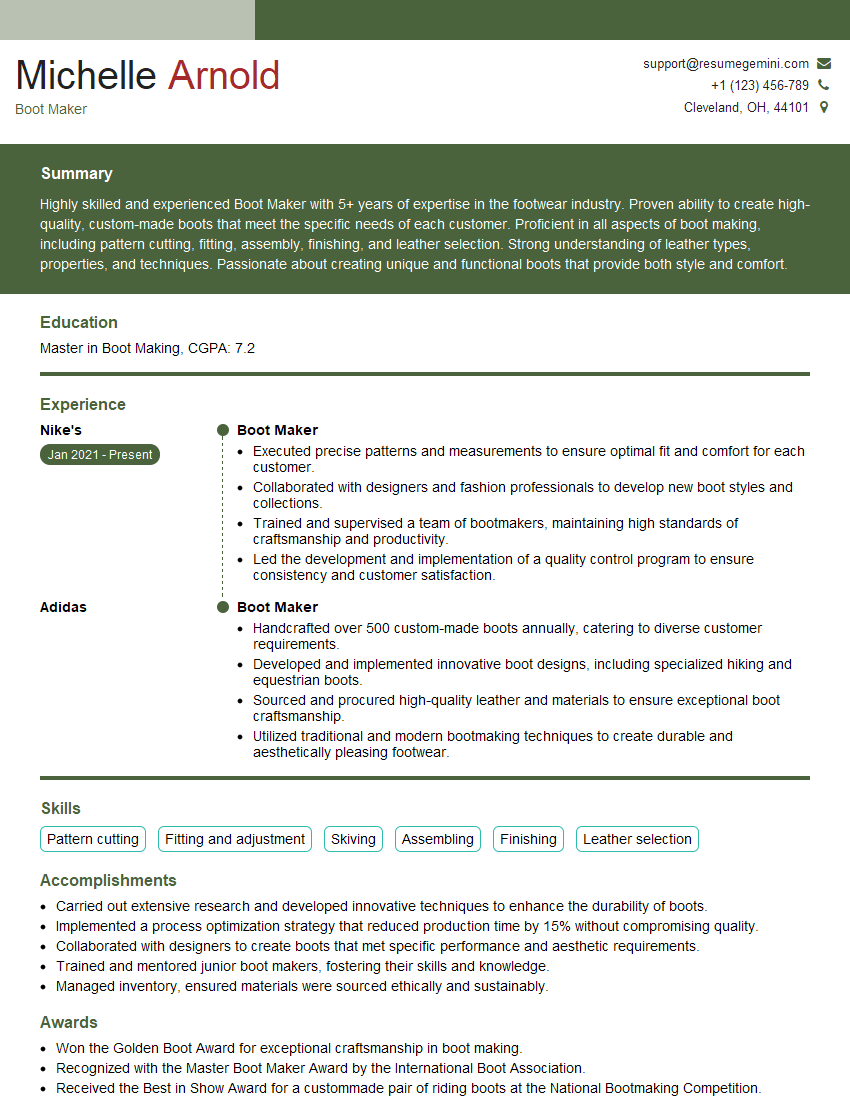
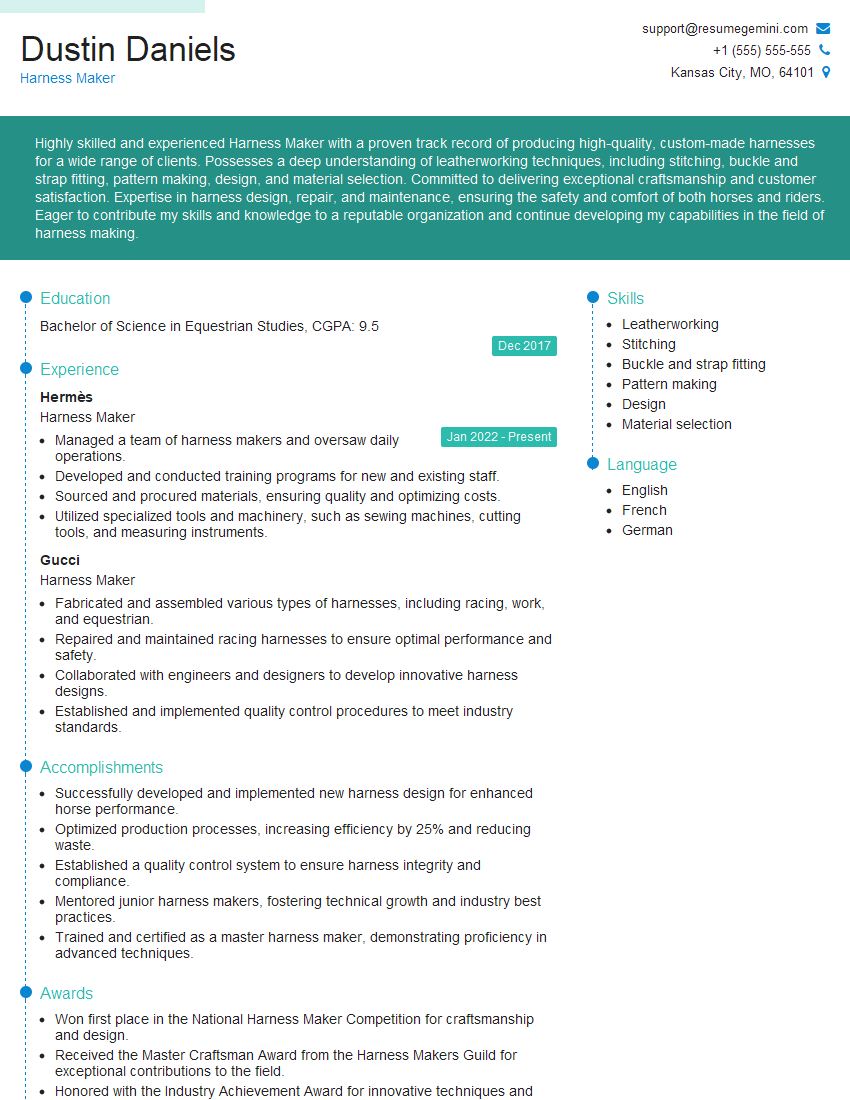
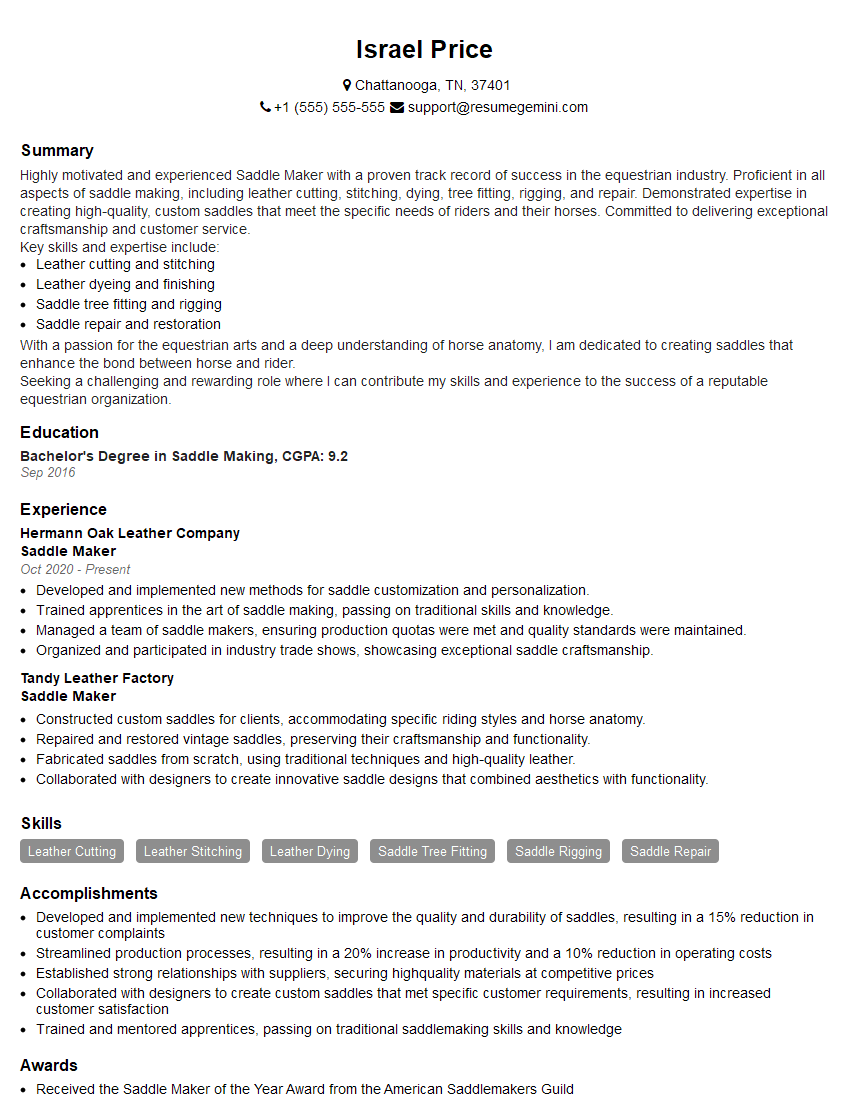
Mastering leather craft opens doors to exciting career opportunities, offering a blend of creativity and technical skill. To maximize your chances of landing your dream role, a well-crafted resume is crucial. An ATS-friendly resume ensures your application gets noticed by recruiters and hiring managers. We strongly recommend using ResumeGemini to create a professional and impactful resume that highlights your leather craft expertise. ResumeGemini offers examples of resumes tailored to the leather craft industry, helping you present your skills and experience effectively. Take the next step towards your successful career in leather craft!
Explore more articles
Users Rating of Our Blogs
Share Your Experience
We value your feedback! Please rate our content and share your thoughts (optional).
What Readers Say About Our Blog
Hello,
we currently offer a complimentary backlink and URL indexing test for search engine optimization professionals.
You can get complimentary indexing credits to test how link discovery works in practice.
No credit card is required and there is no recurring fee.
You can find details here:
https://wikipedia-backlinks.com/indexing/
Regards
NICE RESPONSE TO Q & A
hi
The aim of this message is regarding an unclaimed deposit of a deceased nationale that bears the same name as you. You are not relate to him as there are millions of people answering the names across around the world. But i will use my position to influence the release of the deposit to you for our mutual benefit.
Respond for full details and how to claim the deposit. This is 100% risk free. Send hello to my email id: [email protected]
Luka Chachibaialuka
Hey interviewgemini.com, just wanted to follow up on my last email.
We just launched Call the Monster, an parenting app that lets you summon friendly ‘monsters’ kids actually listen to.
We’re also running a giveaway for everyone who downloads the app. Since it’s brand new, there aren’t many users yet, which means you’ve got a much better chance of winning some great prizes.
You can check it out here: https://bit.ly/callamonsterapp
Or follow us on Instagram: https://www.instagram.com/callamonsterapp
Thanks,
Ryan
CEO – Call the Monster App
Hey interviewgemini.com, I saw your website and love your approach.
I just want this to look like spam email, but want to share something important to you. We just launched Call the Monster, a parenting app that lets you summon friendly ‘monsters’ kids actually listen to.
Parents are loving it for calming chaos before bedtime. Thought you might want to try it: https://bit.ly/callamonsterapp or just follow our fun monster lore on Instagram: https://www.instagram.com/callamonsterapp
Thanks,
Ryan
CEO – Call A Monster APP
To the interviewgemini.com Owner.
Dear interviewgemini.com Webmaster!
Hi interviewgemini.com Webmaster!
Dear interviewgemini.com Webmaster!
excellent
Hello,
We found issues with your domain’s email setup that may be sending your messages to spam or blocking them completely. InboxShield Mini shows you how to fix it in minutes — no tech skills required.
Scan your domain now for details: https://inboxshield-mini.com/
— Adam @ InboxShield Mini
Reply STOP to unsubscribe
Hi, are you owner of interviewgemini.com? What if I told you I could help you find extra time in your schedule, reconnect with leads you didn’t even realize you missed, and bring in more “I want to work with you” conversations, without increasing your ad spend or hiring a full-time employee?
All with a flexible, budget-friendly service that could easily pay for itself. Sounds good?
Would it be nice to jump on a quick 10-minute call so I can show you exactly how we make this work?
Best,
Hapei
Marketing Director
Hey, I know you’re the owner of interviewgemini.com. I’ll be quick.
Fundraising for your business is tough and time-consuming. We make it easier by guaranteeing two private investor meetings each month, for six months. No demos, no pitch events – just direct introductions to active investors matched to your startup.
If youR17;re raising, this could help you build real momentum. Want me to send more info?
Hi, I represent an SEO company that specialises in getting you AI citations and higher rankings on Google. I’d like to offer you a 100% free SEO audit for your website. Would you be interested?
Hi, I represent an SEO company that specialises in getting you AI citations and higher rankings on Google. I’d like to offer you a 100% free SEO audit for your website. Would you be interested?
good