Every successful interview starts with knowing what to expect. In this blog, we’ll take you through the top Liquefaction Analysis interview questions, breaking them down with expert tips to help you deliver impactful answers. Step into your next interview fully prepared and ready to succeed.
Questions Asked in Liquefaction Analysis Interview
Q 1. Explain the phenomenon of soil liquefaction.
Soil liquefaction is a phenomenon where saturated, loose sandy or silty soils temporarily lose their strength and stiffness due to increased pore water pressure caused by strong ground shaking, such as during an earthquake. Imagine a bucket of sand saturated with water. When shaken violently, the water pressure increases, pushing the sand grains apart, causing the mixture to behave like a liquid. This loss of strength can lead to significant ground deformation, including ground settlement, lateral spreading, and flow failures, causing considerable damage to structures.
Q 2. Describe the factors influencing liquefaction susceptibility.
Several factors influence a soil’s susceptibility to liquefaction. These include:
- Soil type: Loose, saturated sands and silts are most susceptible. Clayey soils are generally less prone to liquefaction due to their higher shear strength.
- Density: Denser soils have a higher resistance to liquefaction. Loosely packed soils are much more vulnerable.
- Grain size distribution: Uniformly graded sands are more susceptible than well-graded sands.
- Depth below ground surface: Liquefaction is more likely to occur at shallow depths where the pore water pressure can build up more readily.
- Groundwater level: The closer the water table is to the ground surface, the higher the susceptibility to liquefaction. The soil needs to be saturated.
- Magnitude and duration of earthquake shaking: Stronger and longer-lasting ground shaking increases the likelihood of liquefaction.
For example, a loosely packed, uniformly graded sand with a high water table located near the surface in an earthquake-prone region is at significantly higher risk of liquefaction compared to a dense, well-graded gravel located deeper underground in a seismically stable area.
Q 3. What are the key parameters used in liquefaction analysis?
Key parameters used in liquefaction analysis include:
- Cyclic stress ratio (CSR): This represents the shear stress imposed on the soil during an earthquake.
- Cyclic resistance ratio (CRR): This represents the soil’s resistance to liquefaction.
- Soil shear strength parameters: Such as friction angle and cohesion, obtained from laboratory testing.
- In-situ soil density and relative density: Obtained from field investigations.
- Groundwater level: Determined from field investigations.
- Earthquake ground motion characteristics: Peak ground acceleration (PGA) and the duration of shaking are crucial.
These parameters are used in various liquefaction analysis methods to assess the potential for liquefaction at a given site.
Q 4. Explain the difference between cyclic stress ratio (CSR) and cyclic resistance ratio (CRR).
The Cyclic Stress Ratio (CSR) represents the demand placed on the soil by earthquake shaking. It’s essentially how much stress the earthquake is imposing on the soil. A higher CSR implies a greater demand.
The Cyclic Resistance Ratio (CRR) represents the soil’s capacity to resist liquefaction. It reflects the soil’s inherent strength and its ability to withstand the imposed stress. A higher CRR indicates better resistance.
Liquefaction is likely to occur when the CSR exceeds the CRR (CSR > CRR). Think of it like a tug-of-war: CSR is the force pulling on the soil, and CRR is the soil’s resistance. If the pulling force (CSR) surpasses the resisting force (CRR), the soil liquefies.
Q 5. How do you determine the CSR for a given site?
Determining the CSR involves several steps:
- Determine the peak ground acceleration (PGA) at the site: This is typically obtained from seismic hazard analysis or from recorded earthquake data.
- Estimate the earthquake magnitude and distance to the causative fault: These factors influence the ground motion characteristics at the site.
- Calculate the shear wave velocity (Vs): This parameter reflects the soil’s stiffness and is typically determined through geophysical methods like down-hole seismic testing or cone penetration tests.
- Use empirical equations or site-specific response analyses: These methods utilize the PGA, Vs, and other site characteristics to estimate the cyclic shear stresses induced in the soil at various depths.
Various empirical relationships are available for estimating CSR, often based on the level of ground shaking and soil properties. These equations are typically developed based on past earthquake data and laboratory testing results.
Q 6. How do you determine the CRR for a given site?
Determining the CRR involves:
- Obtain undisturbed soil samples: Careful sampling is crucial for accurate laboratory testing.
- Perform laboratory tests: Common tests include cyclic triaxial testing or cyclic simple shear testing. These tests subject soil samples to cyclic loading to determine their resistance to liquefaction.
- Determine soil properties: Key parameters such as relative density, grain size distribution, and plasticity index are determined from the laboratory tests.
- Use empirical correlations: Several empirical correlations relate the laboratory-measured soil properties to the CRR. These correlations often consider the relative density of the soil, and other factors such as fines content and plasticity.
The chosen method depends on the available resources, site conditions, and the level of accuracy required. For instance, simpler methods may utilize correlations based on relative density, while more sophisticated methods incorporate the results from advanced laboratory testing.
Q 7. Describe different methods for liquefaction assessment (e.g., simplified procedures, advanced analyses).
Liquefaction assessment methods range from simplified procedures to sophisticated analyses:
- Simplified Procedures: These methods, like the Seed and Idriss (1971) procedure, use empirical correlations between CSR and CRR to assess liquefaction potential. They are relatively quick and easy to use, relying heavily on readily available data, making them suitable for preliminary assessments or screening purposes. They often involve factor of safety calculations based on the ratio of CRR to CSR.
- Advanced Analyses: These methods include:
- Equivalent Linear Site Response Analysis: These analyses use ground motion records as input and consider the soil’s nonlinear behavior. The soil properties are adjusted iteratively to better represent the nonlinear behavior during shaking. This method provides more accurate predictions of ground motion amplification.
- Nonlinear Site Response Analysis: These analyses model the soil’s nonlinear behavior explicitly. This results in a more accurate representation of the ground motion and the soil’s response, making them suitable for critical projects.
- Probabilistic liquefaction analysis: This accounts for uncertainties in the input parameters, providing a more realistic assessment of the risk.
The choice of method depends on the project’s importance, available data, and the desired level of accuracy. For high-consequence projects, more advanced analyses are generally warranted, while simplified procedures may suffice for preliminary screening or less critical projects.
Q 8. What are the limitations of simplified liquefaction analysis methods?
Simplified liquefaction analysis methods, while useful for preliminary assessments and screening, have inherent limitations. They often rely on simplified assumptions that may not accurately reflect the complexities of real-world soil conditions. These limitations include:
- Ignoring soil heterogeneity: Simplified methods often assume a homogeneous soil profile, neglecting the presence of layers with varying properties that significantly influence liquefaction potential.
- Oversimplification of cyclic stress: They may use simplified models to estimate the cyclic stress induced by an earthquake, which can lead to inaccurate predictions, especially for complex ground motions.
- Limited consideration of drainage conditions: Effective drainage significantly impacts liquefaction potential. Simplified methods might not adequately account for the influence of drainage during earthquake shaking.
- Lack of consideration of soil fabric and microstructure: The arrangement and bonding of soil particles (fabric) play a crucial role in liquefaction resistance. Simplified methods typically do not incorporate these aspects.
- Inaccurate estimation of soil parameters: The accuracy of the analysis is heavily dependent on accurate input parameters, which can be difficult to obtain in the field. Errors in these inputs can lead to significant deviations in the results.
For instance, a simplified method might predict a low liquefaction potential for a site with a complex layering of sands and silts, leading to an underestimation of risk. Advanced methods are necessary for such sites to accurately capture the behavior.
Q 9. Explain the role of Seed and Idriss simplified procedure.
The Seed and Idriss simplified procedure is a widely used method for evaluating liquefaction potential. It’s a semi-empirical approach that correlates the cyclic stress ratio (CSR) induced by an earthquake with the cyclic resistance ratio (CRR) of the soil. The CRR represents the soil’s resistance to liquefaction. The procedure uses Standard Penetration Test (SPT) N-values (discussed further in the next question) to estimate the CRR.
How it works: The procedure involves determining the CSR based on earthquake magnitude, distance to the fault, and soil properties. The CRR is then calculated using empirical correlations involving the SPT N-value, effective confining pressure, and correction factors. If CSR exceeds CRR, liquefaction is predicted.
Role: This procedure provides a relatively quick and easy way to assess liquefaction potential, making it suitable for preliminary site investigations and screening. However, its limitations (as discussed in the previous question) need to be considered, and results should be interpreted cautiously.
Q 10. Describe the use of the N-value in liquefaction analysis.
The N-value, obtained from the Standard Penetration Test (SPT), is a crucial parameter in liquefaction analysis. It represents the number of blows required to drive a standard split-barrel sampler a distance of 12 inches into the soil under specific conditions. A higher N-value generally indicates denser, stronger soil with greater resistance to liquefaction.
Use in liquefaction analysis: The N-value is primarily used in empirical correlations to estimate the soil’s cyclic resistance ratio (CRR), as in the Seed and Idriss method. Many correlations exist, adjusting for factors like overburden pressure and the energy imparted during the SPT. This CRR value is then compared against the cyclic stress ratio (CSR) to assess liquefaction potential.
Example: A high N-value (e.g., >30) typically suggests a low liquefaction potential, while a low N-value (e.g., <10) indicates a higher potential. However, the interpretation is always dependent on the specific correlation used and site-specific conditions.
Q 11. How do you account for soil heterogeneity in liquefaction analysis?
Soil heterogeneity significantly impacts liquefaction analysis. Ignoring it can lead to inaccurate predictions and potentially dangerous underestimations of risk. Accounting for it requires a layered approach.
Methods to account for heterogeneity:
- Site investigation: Thorough geotechnical investigations are crucial. This includes detailed boring logs with frequent sampling to delineate soil layers and accurately characterize their properties (e.g., grain size distribution, density, N-values).
- Layered analysis: Liquefaction analysis should be performed separately for each significant soil layer identified during the site investigation. This allows for considering the unique properties and behavior of each layer.
- Advanced numerical modelling: For highly heterogeneous sites, advanced numerical models (finite element or finite difference) can be employed to simulate the complex interaction between soil layers during earthquake shaking.
- Effective stress analysis: This approach explicitly considers the changes in effective stress during cyclic loading, accounting for different soil layers and their interactions.
Example: A site with alternating layers of dense and loose sands will require a layered analysis. The loose sand layers will likely have a higher liquefaction potential than the dense layers, requiring specific mitigation measures.
Q 12. What are the effects of soil layering on liquefaction?
Soil layering significantly influences liquefaction behavior. The presence of different layers with varying properties affects the overall stability of the ground during an earthquake. The key effects are:
- Differential settlement: Liquefaction in one layer can lead to uneven settlement, causing damage to structures. For example, a liquefied layer below a stiffer layer can cause the upper layer to settle unevenly.
- Lateral spreading: Liquefaction in a lower layer can cause the overlying layers to move laterally, creating ground deformation and damage. This is particularly common in sloping ground.
- Flow failure: If a layer completely liquefies, it can flow downslope, causing extensive damage. This is more likely in steeper slopes.
- Increased seismic demand: Liquefied layers can amplify seismic waves, increasing the shaking experienced by structures founded on them. This amplification further increases the liquefaction susceptibility of the upper layers.
Understanding these effects requires careful consideration of the stratigraphic profile and the properties of each layer during analysis. Simply averaging the properties across different layers is inadequate and will lead to inaccurate results.
Q 13. How does liquefaction affect different types of foundations?
Liquefaction affects different types of foundations differently. The severity of the impact depends on the foundation type, soil conditions, and earthquake intensity.
- Shallow foundations (spread footings, strip footings): These foundations are highly susceptible to settlement and tilting if the underlying soil liquefies. The bearing capacity of the foundation is significantly reduced.
- Deep foundations (piles, drilled shafts): Deep foundations generally perform better than shallow foundations during liquefaction. However, they can still experience settlement, lateral movement, or buckling if the soil around them liquefies. The effectiveness of deep foundations depends on factors such as pile length, spacing, and soil conditions along the pile shaft.
- Retaining structures: Liquefaction behind retaining walls can cause significant lateral pressure, leading to failure of the wall. The soil can even push the wall over.
The design of foundations in liquefiable soils requires careful consideration of the potential effects of liquefaction and the implementation of suitable mitigation measures.
Q 14. Describe mitigation techniques for liquefaction.
Several mitigation techniques exist to reduce the risk of liquefaction damage. The most effective approach often involves a combination of methods, tailored to the specific site conditions:
- Ground improvement techniques: These methods aim to increase the soil’s strength and resistance to liquefaction. Common techniques include:
- Vibrocompaction: This method uses vibrations to densify loose granular soils.
- Stone columns: Columns of compacted granular material are installed into the ground to improve its strength.
- Deep soil mixing: Cement or other stabilizing agents are mixed with the in-situ soil to increase its strength.
- Dynamic compaction: Heavy weights are dropped from a height to densify loose soil.
- Drainage improvement: Installing drainage layers can help dissipate excess pore water pressure during an earthquake, reducing the risk of liquefaction.
- Foundation design: Foundations can be designed to resist the effects of liquefaction. This might involve using deeper foundations, larger footing sizes, or special foundation systems like floating foundations.
- Seismic isolation: Isolating the structure from the ground using seismic isolators can significantly reduce the seismic forces transmitted to the foundation.
- Lateral restraints: Using tiebacks or ground anchors can restrict lateral movement of structures during liquefaction.
The choice of mitigation technique depends on several factors, including the site’s geology, the severity of the liquefaction hazard, and the cost-effectiveness of different options. A comprehensive risk assessment and detailed geotechnical investigation are crucial steps in selecting the appropriate mitigation strategy.
Q 15. How do you evaluate the liquefaction potential of a site using CPT data?
Evaluating liquefaction potential using Cone Penetration Test (CPT) data involves assessing the soil’s resistance to liquefaction under seismic loading. The CPT provides continuous measurements of cone resistance (qc) and sleeve friction (fs) as the cone is pushed into the ground. These parameters are crucial in determining the soil’s relative density and strength. We primarily use empirical correlations, developed from extensive laboratory and field data, to estimate the cyclic resistance ratio (CRR) from CPT data. CRR represents the soil’s capacity to resist liquefaction under a given earthquake. Then, this CRR is compared to the cyclic stress ratio (CSR), which is determined from earthquake ground motion parameters and site conditions (depth, soil type, etc.). If CSR exceeds CRR, liquefaction is likely. Many correlations exist, such as those by Robertson and Wride (1998) or Youd et al. (2001), and the choice often depends on the specific soil type and regional factors.
For example, a higher qc value generally indicates a denser and stronger soil with a higher CRR, hence a lower liquefaction potential. Conversely, a lower qc value suggests a looser soil with a higher probability of liquefaction. The ratio of qc/fs can also provide information about the soil’s grain size distribution and its susceptibility to liquefaction. Software packages are frequently used to streamline this process, automating the calculations and providing visual representations of the liquefaction potential profile with depth.
Career Expert Tips:
- Ace those interviews! Prepare effectively by reviewing the Top 50 Most Common Interview Questions on ResumeGemini.
- Navigate your job search with confidence! Explore a wide range of Career Tips on ResumeGemini. Learn about common challenges and recommendations to overcome them.
- Craft the perfect resume! Master the Art of Resume Writing with ResumeGemini’s guide. Showcase your unique qualifications and achievements effectively.
- Don’t miss out on holiday savings! Build your dream resume with ResumeGemini’s ATS optimized templates.
Q 16. What are the implications of liquefaction for ground deformation?
Liquefaction significantly impacts ground deformation. When saturated loose sandy soils lose their shear strength during an earthquake, they behave like a liquid. This leads to several forms of ground deformation:
- Lateral spreading: This involves the horizontal movement of soil masses, often along slopes or near bodies of water. It can cause damage to structures by tilting, fracturing, and even complete collapse.
- Ground settlements: The loss of soil volume due to compaction can result in substantial settlements, impacting building foundations and underground infrastructure.
- Flow failures: In severe cases, liquefied soil can flow downhill, causing significant damage and even loss of life. This often occurs on slopes or levees.
- Flotation: Lighter structures or buried objects may float to the surface as the soil loses its strength and density.
The extent and type of ground deformation depend on several factors, including the intensity of the earthquake, the thickness of the liquefiable layer, the soil’s properties, and the presence of any ground improvement measures. The consequences can range from minor cracking in pavements to catastrophic failures of buildings and infrastructure.
Q 17. How is liquefaction potential mapped?
Liquefaction potential mapping involves systematically assessing and presenting the likelihood of liquefaction across a geographical area. This typically involves a multi-step process:
- Data acquisition: This includes collecting geological information, conducting geotechnical investigations (CPTs, borings, laboratory testing), and obtaining historical seismic data for the region.
- Liquefaction analysis: Various methods are used to assess the liquefaction potential at different locations, utilizing data from the previous step and empirical correlations or numerical models. This often involves calculating CSR and CRR values for different soil layers at each site.
- Mapping: The results of the liquefaction analysis are then spatially represented on a map, often using different color scales or symbols to indicate varying degrees of liquefaction hazard. This may involve interpolating data between measured points to create a continuous surface.
- Validation: The produced map can be validated through comparison with historical liquefaction events in the area or by using independent data sets. This step ensures the accuracy and reliability of the map.
These maps are essential for land-use planning, infrastructure design, and emergency management. They help identify areas where special design considerations or ground improvement techniques are necessary to mitigate the risk of liquefaction-related damage.
Q 18. Explain the role of ground improvement techniques in mitigating liquefaction.
Ground improvement techniques play a crucial role in mitigating liquefaction risk by increasing the soil’s strength, stiffness, and drainage capacity. These techniques aim to either reduce the CSR (cyclic stress ratio) or increase the CRR (cyclic resistance ratio) such that CSR remains less than CRR. This prevents the loss of shear strength under seismic loading. The selection of appropriate techniques depends on several factors including the soil type, depth of the liquefiable layer, project budget, and environmental concerns.
For instance, densification techniques increase the soil’s density, reducing its susceptibility to liquefaction. Improved drainage techniques allow excess pore water pressure to dissipate more efficiently, preventing the build-up that leads to liquefaction. The choice of a particular method is critical for project success and cost-effectiveness.
Q 19. Describe different ground improvement techniques (e.g., vibro-compaction, stone columns).
Several ground improvement techniques are employed to mitigate liquefaction:
- Vibro-compaction: This technique uses vibratory equipment to compact loose granular soils. It’s cost-effective for relatively shallow depths and works by increasing the soil density and reducing its porosity, thus increasing its shear strength and CRR.
- Stone columns: These involve installing vertical columns of compacted granular material (often gravel or crushed stone) into the liquefiable soil layer. These columns act as strong, load-bearing elements within the weaker soil mass, improving its overall stiffness and bearing capacity and provide drainage paths for excess pore water. They’re particularly effective in reducing settlement and lateral spreading.
- Deep soil mixing: This involves mixing a cementitious or other binding agent into the soil in-situ, creating columns or panels of improved soil. This improves the soil’s shear strength and stiffness and helps to reduce settlement and lateral spreading.
- Dynamic compaction: This method involves dropping a heavy weight repeatedly from a height to compact the soil. It is effective for densifying relatively deep soil deposits.
- Preloading: This involves placing a surcharge load on the ground surface for an extended period. The load causes consolidation and densification of the soil layer. While it is a time-consuming method, it is cost effective and suitable for large area improvement projects.
The selection of the most appropriate technique is based on a thorough site investigation, considering factors such as soil type, depth of liquefiable layer, cost, and environmental impact.
Q 20. How do you assess the post-liquefaction behavior of a soil?
Assessing post-liquefaction soil behavior is crucial for understanding the extent of damage and for designing effective remedial measures. This typically involves:
- Field investigations: Post-earthquake field investigations are essential to collect data on ground deformation, settlement, and the extent of liquefaction. This involves conducting CPTs, borings, and in-situ tests on the affected area.
- Laboratory testing: Undisturbed soil samples are collected and tested in the laboratory to determine changes in soil properties like density, shear strength, and permeability after liquefaction. This allows better understanding of the effects of the event on soil parameters.
- Numerical modeling: Numerical models can simulate the liquefaction process and post-liquefaction behavior, providing insights into ground deformation and the effectiveness of various remedial strategies. This often involves sophisticated finite element analysis techniques.
- Case history analysis: Studying similar cases of liquefaction in different regions can provide valuable information on post-liquefaction behavior and potential damage scenarios.
By combining these approaches, engineers can develop a comprehensive understanding of the post-liquefaction behavior and provide appropriate design considerations for future constructions in similar areas.
Q 21. What are the common software used for liquefaction analysis?
Several software packages are commonly used for liquefaction analysis. The choice often depends on the project scope, available data, and the level of sophistication required. Some popular options include:
- Liquefaction Analysis Program (LAP): A widely used program specifically designed for liquefaction analysis using various methods and correlations.
- DEEPSOIL: A comprehensive geotechnical software package with capabilities for performing detailed liquefaction analysis, including one-dimensional and two-dimensional modeling.
- PLA-XIS: A powerful finite element software that can perform advanced geotechnical and liquefaction analyses, allowing for consideration of complex soil behavior and boundary conditions.
- ABAQUS: A general-purpose finite element software, widely used for complex and high-end simulations, can also perform liquefaction analysis with more involved modelling and assumptions.
These software packages streamline the process of calculating CSR, CRR, and assessing the overall liquefaction potential. They often offer graphical user interfaces and automated calculation procedures, improving the efficiency and accuracy of liquefaction assessment.
Q 22. Describe the role of laboratory testing in liquefaction analysis.
Laboratory testing plays a crucial role in liquefaction analysis by providing the essential geotechnical data needed to assess the susceptibility of soil to liquefaction. It allows us to determine the soil’s properties that directly influence its behavior under seismic loading.
Grain size distribution analysis: This determines the percentage of sand and silt particles, which are the primary constituents contributing to liquefaction potential. A high percentage of fines (silt and clay) can either increase or decrease the potential, depending on the specific characteristics. We use sieves and hydrometers for this.
Shear strength tests: These tests, such as the direct shear test and triaxial test, measure the soil’s resistance to deformation and failure. This data is crucial for calculating the factor of safety against liquefaction.
Consolidation tests: These tests determine the soil’s compressibility characteristics and preconsolidation pressure, providing insights into its past stress history and potential for settlement under loading.
Cyclic triaxial tests: This is the cornerstone of liquefaction analysis. The test simulates earthquake loading by subjecting saturated sand samples to repeated cycles of shear stress. The number of cycles to failure indicates the soil’s resistance to liquefaction. We then use this data to determine the cyclic resistance ratio (CRR).
For example, a project involving a proposed high-rise building near a river would necessitate extensive laboratory testing to characterize the potentially liquefiable alluvial deposits. The results directly feed into the liquefaction analysis, informing the design of the foundation and other mitigation measures.
Q 23. Explain how to interpret liquefaction hazard maps.
Liquefaction hazard maps illustrate the spatial distribution of liquefaction susceptibility within a region. They are typically color-coded, with colors representing different levels of hazard, ranging from low to high. Interpreting them requires understanding the underlying methodology and the limitations of the analysis.
Understanding the color scheme: A legend explains the meaning of each color. High hazard areas are typically denoted by darker or warmer colors, indicating a higher probability of liquefaction.
Considering the data source: The map’s accuracy depends on the quality and density of the input data (e.g., geotechnical boreholes, seismic data). Areas with limited data might have higher uncertainties.
Recognizing limitations: Liquefaction hazard maps provide a probabilistic assessment, not a definitive prediction. The maps often represent simplified scenarios and do not account for all potential influencing factors.
Analyzing the context: The map should be interpreted in conjunction with other geotechnical and geological information about the site, including groundwater levels and soil stratigraphy.
For instance, a site located in a high-hazard zone on a liquefaction hazard map may require more detailed site-specific investigations, including extensive geotechnical testing and more sophisticated numerical analysis, before any construction is undertaken. Conversely, a site in a low-hazard area might require less intensive investigation.
Q 24. How do you incorporate liquefaction analysis into structural design?
Incorporating liquefaction analysis into structural design involves a multi-step process aimed at ensuring the safety and stability of structures in liquefaction-prone areas. The analysis informs the design of the foundation system and the superstructure to mitigate potential damage.
Site characterization: This involves conducting thorough geotechnical investigations to determine the soil properties and liquefaction potential.
Liquefaction analysis: Using methods such as simplified procedures (e.g., Seed and Idriss method) or more advanced numerical analysis (e.g., finite element analysis), we determine the likelihood of liquefaction and its potential consequences.
Foundation design: Based on the liquefaction analysis, appropriate foundation types are selected. This might involve deep foundations (e.g., piles, drilled shafts) to transfer loads below the liquefiable layer or ground improvement techniques (e.g., vibro-compaction, stone columns) to enhance the soil’s resistance to liquefaction.
Superstructure design: The superstructure design should account for potential ground settlement and lateral spreading caused by liquefaction. This often involves enhancing the structural capacity to withstand the increased loads or deformations.
Mitigation measures: Implementing strategies to reduce the impact of liquefaction, such as using liquefaction mitigation techniques and incorporating appropriate safety factors in the design.
For example, designing a bridge in a liquefaction-prone zone might require using piles driven deep into the stable soil strata, combined with careful consideration of the potential for differential settlement during a seismic event.
Q 25. What are the key considerations for seismic design in liquefaction-prone areas?
Seismic design in liquefaction-prone areas requires a holistic approach that considers the unique challenges posed by soil liquefaction. It goes beyond standard seismic design practices.
Site-specific liquefaction analysis: A thorough assessment of liquefaction potential is essential, considering factors such as soil type, groundwater conditions, and earthquake characteristics.
Foundation design: The foundation system must be designed to resist the effects of liquefaction, such as ground settlement, lateral spreading, and loss of bearing capacity. Deep foundations, ground improvement techniques, or a combination of both are often necessary.
Superstructure design: The superstructure should be able to withstand the increased loads and deformations caused by liquefaction. This may involve using ductile structural elements and employing design strategies that account for differential settlement.
Mitigation measures: Implementing measures to reduce the risk of liquefaction, such as ground improvement techniques (e.g., densification, drainage), or employing strategies to accommodate potential ground movements (e.g., flexible design, isolation systems).
Ductile detailing: Designing the structure with ductile details allows for energy dissipation during an earthquake, reducing damage from the increased loads induced by liquefaction.
For instance, a hospital in a high liquefaction hazard area would require robust foundation design to ensure its continued functionality during and after an earthquake, possibly incorporating base isolation systems.
Q 26. Discuss the importance of considering uncertainties in liquefaction analysis.
Uncertainties are inherent in liquefaction analysis due to the complexity of soil behavior and the limitations of our understanding of earthquake ground motion. Ignoring these uncertainties can lead to inaccurate assessments and potentially unsafe designs.
Soil variability: Soil properties can vary significantly even within a small area, leading to uncertainties in the input parameters for the liquefaction analysis.
Earthquake ground motion: Predicting the magnitude and duration of future earthquakes is inherently uncertain. The variability in ground motion affects the cyclic stress experienced by the soil.
Laboratory testing limitations: Laboratory tests cannot perfectly replicate the in-situ conditions and the complex stress history experienced by the soil.
Modeling uncertainties: Various simplified and advanced methods exist for liquefaction analysis, each with its own assumptions and limitations. The chosen method introduces inherent uncertainty.
We account for these uncertainties using probabilistic methods. For example, we can perform multiple analyses using different input parameters, representing the range of uncertainty, and assess the probability of liquefaction occurrence. This allows for a more realistic and conservative design. Furthermore, incorporating a factor of safety accounts for the unavoidable uncertainties.
Q 27. Describe a challenging liquefaction analysis project you’ve worked on and how you overcame the challenges.
One challenging project involved analyzing liquefaction potential for a large-scale infrastructure development on a reclaimed coastal area. The site consisted of highly variable, poorly compacted fill materials overlying soft, saturated clays. The primary challenge was the significant uncertainty associated with the fill materials’ properties and their behavior under seismic loading.
To address this, we employed a multi-pronged approach:
Extensive site investigation: We conducted a detailed geotechnical investigation program, including numerous boreholes, in-situ tests (e.g., cone penetration tests, standard penetration tests), and extensive laboratory testing. This allowed us to characterize the heterogeneity of the fill materials.
Advanced numerical modeling: We used advanced finite element analysis (FEA) to model the complex soil stratigraphy and the dynamic behavior of the different soil layers under seismic loading. This allowed us to capture the interaction between the fill and the underlying clays.
Probabilistic analysis: We conducted probabilistic liquefaction analysis, accounting for the uncertainties associated with the soil properties and earthquake ground motion. This provided a more realistic assessment of the liquefaction risk.
Sensitivity analysis: We performed sensitivity analyses to identify the key parameters influencing the liquefaction potential and to quantify the uncertainty associated with those parameters.
This comprehensive approach allowed us to develop a robust design that successfully mitigated the liquefaction risk. The project demonstrated the importance of integrating detailed site investigation, advanced modeling techniques, and probabilistic analysis in addressing challenging liquefaction analysis problems. The outcome was a design that incorporated deep foundations and ground improvement techniques to ensure the stability of the infrastructure.
Key Topics to Learn for Liquefaction Analysis Interview
- Soil Properties and Characterization: Understanding the crucial role of soil type, grain size distribution, and density in liquefaction susceptibility.
- Cyclic Stress Ratio (CSR) and Cyclic Resistance Ratio (CRR): Mastering the concepts and calculations behind these key parameters in liquefaction assessment. Practical application includes interpreting laboratory and field test data to determine CSR and CRR values.
- Liquefaction Triggering Mechanisms: Exploring the underlying geological and seismic factors that initiate liquefaction. This includes understanding earthquake magnitude, ground motion characteristics, and site-specific conditions.
- Empirical Methods for Liquefaction Assessment: Familiarity with widely used methods like the Seed and Idriss simplified procedure and more advanced techniques. This involves understanding the limitations and applicability of each method.
- Probabilistic Liquefaction Analysis: Grasping the principles of probabilistic approaches and their role in quantifying uncertainty in liquefaction predictions.
- Case Studies and Real-World Applications: Analyzing past earthquake events and examining how liquefaction analysis was applied in design and remediation strategies. This strengthens problem-solving skills.
- Software and Tools for Liquefaction Analysis: Demonstrating proficiency with commonly used software packages for performing liquefaction analyses and interpreting results.
- Mitigation Strategies: Understanding various methods employed to mitigate liquefaction hazards, such as ground improvement techniques (e.g., densification, vibro-compaction) and foundation design considerations.
Next Steps
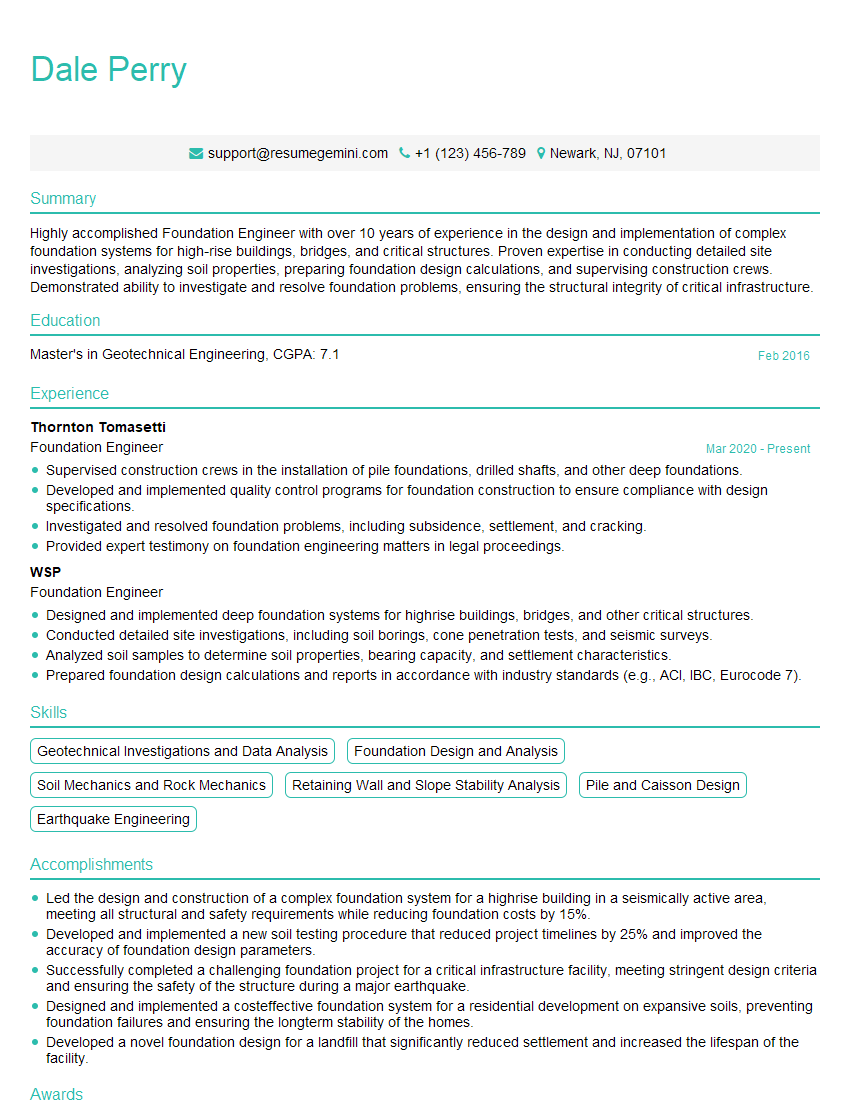
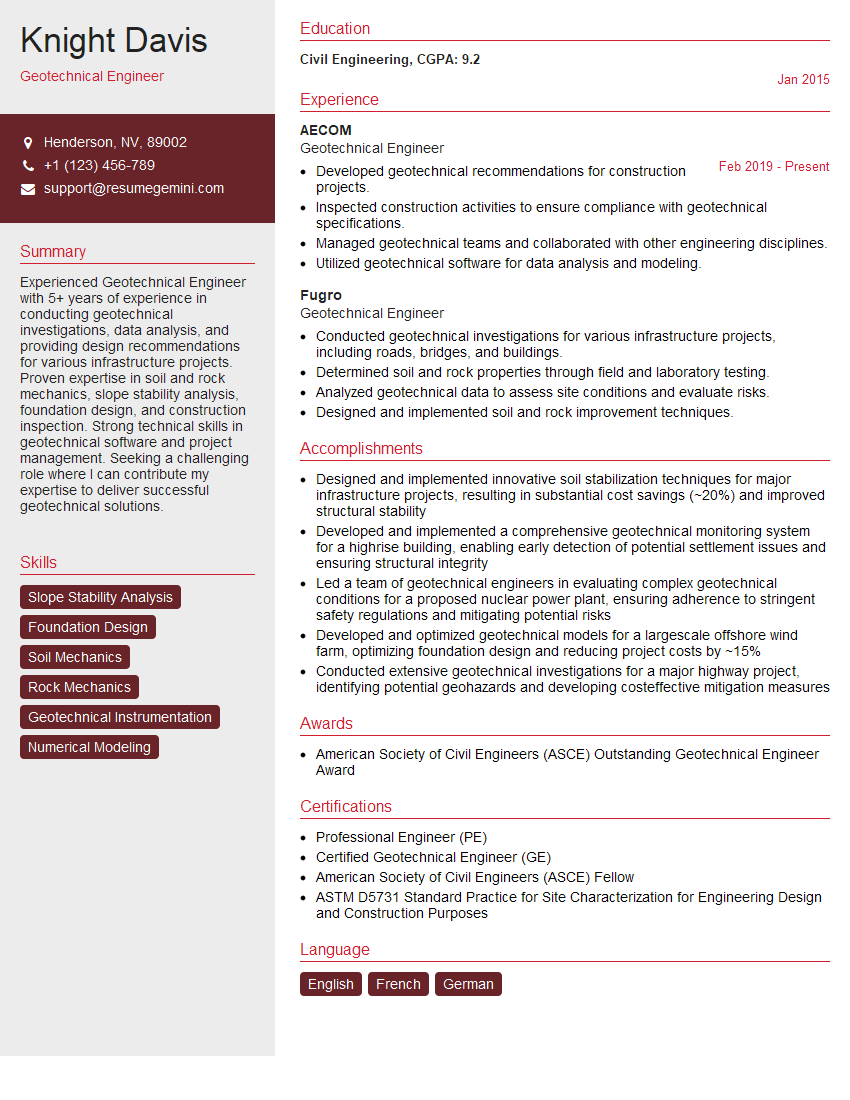
Mastering liquefaction analysis is crucial for career advancement in geotechnical engineering, opening doors to exciting projects and leadership opportunities. A strong understanding of these concepts is highly valued by employers. To maximize your job prospects, create an ATS-friendly resume that effectively highlights your skills and experience. ResumeGemini is a trusted resource that can help you build a professional resume optimized for applicant tracking systems. Examples of resumes tailored to Liquefaction Analysis are provided to guide you in showcasing your expertise. Invest in your future – build a resume that reflects your capabilities and gets you noticed!


Explore more articles
Users Rating of Our Blogs
Share Your Experience
We value your feedback! Please rate our content and share your thoughts (optional).
What Readers Say About Our Blog
Hi I am a troller at The aquatic interview center and I suddenly went so fast in Roblox and it was gone when I reset.
Hi,
Business owners spend hours every week worrying about their website—or avoiding it because it feels overwhelming.
We’d like to take that off your plate:
$69/month. Everything handled.
Our team will:
Design a custom website—or completely overhaul your current one
Take care of hosting as an option
Handle edits and improvements—up to 60 minutes of work included every month
No setup fees, no annual commitments. Just a site that makes a strong first impression.
Find out if it’s right for you:
https://websolutionsgenius.com/awardwinningwebsites
Hello,
we currently offer a complimentary backlink and URL indexing test for search engine optimization professionals.
You can get complimentary indexing credits to test how link discovery works in practice.
No credit card is required and there is no recurring fee.
You can find details here:
https://wikipedia-backlinks.com/indexing/
Regards
NICE RESPONSE TO Q & A
hi
The aim of this message is regarding an unclaimed deposit of a deceased nationale that bears the same name as you. You are not relate to him as there are millions of people answering the names across around the world. But i will use my position to influence the release of the deposit to you for our mutual benefit.
Respond for full details and how to claim the deposit. This is 100% risk free. Send hello to my email id: [email protected]
Luka Chachibaialuka
Hey interviewgemini.com, just wanted to follow up on my last email.
We just launched Call the Monster, an parenting app that lets you summon friendly ‘monsters’ kids actually listen to.
We’re also running a giveaway for everyone who downloads the app. Since it’s brand new, there aren’t many users yet, which means you’ve got a much better chance of winning some great prizes.
You can check it out here: https://bit.ly/callamonsterapp
Or follow us on Instagram: https://www.instagram.com/callamonsterapp
Thanks,
Ryan
CEO – Call the Monster App
Hey interviewgemini.com, I saw your website and love your approach.
I just want this to look like spam email, but want to share something important to you. We just launched Call the Monster, a parenting app that lets you summon friendly ‘monsters’ kids actually listen to.
Parents are loving it for calming chaos before bedtime. Thought you might want to try it: https://bit.ly/callamonsterapp or just follow our fun monster lore on Instagram: https://www.instagram.com/callamonsterapp
Thanks,
Ryan
CEO – Call A Monster APP
To the interviewgemini.com Owner.
Dear interviewgemini.com Webmaster!
Hi interviewgemini.com Webmaster!
Dear interviewgemini.com Webmaster!
excellent
Hello,
We found issues with your domain’s email setup that may be sending your messages to spam or blocking them completely. InboxShield Mini shows you how to fix it in minutes — no tech skills required.
Scan your domain now for details: https://inboxshield-mini.com/
— Adam @ InboxShield Mini
Reply STOP to unsubscribe
Hi, are you owner of interviewgemini.com? What if I told you I could help you find extra time in your schedule, reconnect with leads you didn’t even realize you missed, and bring in more “I want to work with you” conversations, without increasing your ad spend or hiring a full-time employee?
All with a flexible, budget-friendly service that could easily pay for itself. Sounds good?
Would it be nice to jump on a quick 10-minute call so I can show you exactly how we make this work?
Best,
Hapei
Marketing Director
Hey, I know you’re the owner of interviewgemini.com. I’ll be quick.
Fundraising for your business is tough and time-consuming. We make it easier by guaranteeing two private investor meetings each month, for six months. No demos, no pitch events – just direct introductions to active investors matched to your startup.
If youR17;re raising, this could help you build real momentum. Want me to send more info?
Hi, I represent an SEO company that specialises in getting you AI citations and higher rankings on Google. I’d like to offer you a 100% free SEO audit for your website. Would you be interested?
Hi, I represent an SEO company that specialises in getting you AI citations and higher rankings on Google. I’d like to offer you a 100% free SEO audit for your website. Would you be interested?
good