Cracking a skill-specific interview, like one for Live Linear Encoding, requires understanding the nuances of the role. In this blog, we present the questions you’re most likely to encounter, along with insights into how to answer them effectively. Let’s ensure you’re ready to make a strong impression.
Questions Asked in Live Linear Encoding Interview
Q 1. Explain the difference between linear and non-linear video encoding.
Linear video encoding processes video sequentially, much like a traditional TV broadcast. Each frame is encoded and delivered in order. Think of it like a conveyor belt: one frame follows the next. Non-linear encoding, on the other hand, allows for random access to any point in the video. This is like having a library where you can pick any book (frame) and read it (view it) without having to read all the preceding books (frames). In short, linear is sequential; non-linear is random access.
This difference is crucial. Live linear encoding is always sequential because you’re encoding and delivering the video *as it’s being recorded*. You can’t go back and re-encode a part of a live stream.
Q 2. Describe the process of live linear encoding, from source to delivery.
Live linear encoding begins with the source video, typically a camera feed or screen capture. This raw video is then fed into an encoder. The encoder compresses the video using a chosen codec (like H.264 or H.265), reducing its file size for efficient transmission. Crucially, this compression happens *in real-time*. The encoded video is then packaged into a streaming protocol (like RTMP or HLS) by a streaming server. This server handles the distribution to viewers. The viewers use a media player to receive, decode, and display the stream. Finally, a Content Delivery Network (CDN) often plays a key role in scaling the delivery to a large number of viewers geographically dispersed around the globe.
Think of it as a pipeline: Source → Encoder → Streaming Server → CDN → Viewer.
Q 3. What are the common codecs used in live linear encoding?
Several codecs are commonly used in live linear encoding, each with its trade-offs between compression efficiency, processing power requirements, and video quality. The most popular include:
- H.264 (AVC): Widely compatible, mature technology, relatively low computational complexity.
- H.265 (HEVC): Offers significantly better compression than H.264 at the same quality level, but requires more processing power.
- VP9: An open-source codec developed by Google, offering similar compression efficiency to H.265, but also with higher processing demands.
- AV1: A newer royalty-free codec that boasts superior compression and quality but comes with higher encoding complexity.
The choice depends on the target devices, desired quality, and available encoding resources.
Q 4. What are the advantages and disadvantages of using H.264, H.265, and VP9 for live linear encoding?
Let’s compare these codecs for live linear encoding:
- H.264: Advantages: wide compatibility, lower encoding complexity (less demanding hardware), mature ecosystem. Disadvantages: less efficient compression than H.265 or VP9, resulting in larger file sizes for equivalent quality.
- H.265: Advantages: superior compression efficiency compared to H.264, leading to smaller file sizes and bandwidth savings. Disadvantages: higher encoding complexity (requires more powerful hardware), less widespread compatibility in older devices.
- VP9: Advantages: comparable compression efficiency to H.265, open source (no licensing fees). Disadvantages: Higher encoding complexity, compatibility can be an issue depending on the viewer’s devices and players.
For example, if you are streaming to a very broad audience with older devices, H.264 might be the safer bet despite its less efficient compression. If you prioritize quality and bandwidth efficiency, and your audience has newer devices, H.265 or VP9 would be strong contenders.
Q 5. How do you choose the appropriate bitrate and resolution for live linear encoding?
Choosing the right bitrate and resolution is critical for balancing video quality and bandwidth consumption. Higher bitrates and resolutions result in better quality but require significantly more bandwidth. Lower bitrates and resolutions reduce bandwidth needs but compromise quality. The ideal settings depend on several factors:
- Target audience: Viewers with faster internet connections can handle higher bitrates and resolutions.
- Content type: Fast-paced action scenes demand higher bitrates than slower, static scenes.
- Available bandwidth: Your encoding infrastructure and CDN’s capacity influence your choices.
A common approach is to offer multiple bitrate/resolution options (adaptive bitrate streaming), allowing viewers to automatically select the best quality based on their connection speed. Careful testing and monitoring are essential to find the optimal settings for your specific use case. Start with some common baseline settings, and gradually adjust based on viewer feedback and analytics.
Q 6. Explain the concept of GOP (Group of Pictures) and its impact on live streaming.
GOP, or Group of Pictures, is a fundamental concept in video encoding. It refers to a sequence of frames where one frame (the I-frame, or Intra-coded frame) is encoded independently, followed by a series of predicted frames (P-frames, or Predicted frames, and B-frames, or Bidirectionally predicted frames). The I-frame is a complete picture, while subsequent frames in the GOP only encode the differences from the previous frames. This significantly reduces file size.
In live streaming, the GOP size (number of frames in a group) impacts latency and encoding complexity. Smaller GOPs reduce latency (the delay between the live event and its appearance on a viewer’s screen) but increase encoding complexity. Larger GOPs reduce encoding complexity but increase latency. The ideal GOP size is a balance between these competing factors, and often depends on the type of live stream and the desired viewer experience. A short GOP is preferred for low-latency live streaming applications like gaming.
Q 7. What are common challenges faced during live linear encoding and how do you address them?
Live linear encoding presents several challenges:
- Latency: Minimizing delay between live event and viewer experience is crucial for many applications. Careful selection of codecs, GOP size, and streaming protocol is essential.
- Bandwidth limitations: High-quality video requires significant bandwidth. Efficient compression, adaptive bitrate streaming, and CDN optimization are needed.
- Hardware limitations: Encoding live video in real-time requires significant processing power. Selecting appropriate hardware and optimizing encoder settings is essential.
- Network issues: Network instability (packet loss, jitter) can severely impact video quality. Robust error correction and monitoring are necessary.
Addressing these challenges requires a multifaceted approach. This includes careful planning, rigorous testing, selecting appropriate hardware and software, implementing robust monitoring and error handling, and leveraging CDN infrastructure. Proactive monitoring and use of analytics are crucial to identify and resolve problems quickly. For example, if you are experiencing high latency, you might experiment with a smaller GOP size, but this might increase the load on your encoding hardware. The solution is often a compromise based on the constraints and requirements.
Q 8. Describe your experience with different encoding platforms (e.g., AWS Elemental, Wowza, etc.).
My experience with live linear encoding platforms is extensive, encompassing both cloud-based solutions like AWS Elemental MediaConvert and MediaLive, and on-premise systems such as Wowza Streaming Engine. Each platform offers a unique set of strengths and weaknesses. For instance, AWS Elemental MediaLive excels in scalability and reliability, ideal for large-scale, high-traffic events. Its integration with other AWS services is seamless. I’ve used it extensively for encoding live sports broadcasts, requiring high throughput and ultra-low latency. Conversely, Wowza Streaming Engine offers more granular control over the encoding process and is better suited for smaller-scale productions or situations requiring highly customized encoding workflows. I’ve utilized Wowza for corporate webcasts where flexibility and precise configuration were paramount. My proficiency extends to configuring and optimizing these platforms for various codecs, bitrates, and resolutions to achieve the best possible quality and performance for the target audience and device capabilities.
Q 9. How do you ensure low latency in live linear encoding?
Achieving low latency in live linear encoding is crucial for interactive applications like live gaming or e-learning. It’s a balancing act between speed and quality. Several strategies are employed. Firstly, we utilize codecs designed for low latency, such as H.264 with low GOP (Group of Pictures) structures or the newer, more efficient H.265/HEVC with similar optimizations. Secondly, we minimize processing time within the encoding pipeline. This involves optimizing the encoding settings, selecting appropriate hardware (powerful CPUs and GPUs), and utilizing efficient encoding presets. Thirdly, we carefully choose the streaming protocol; protocols like WebRTC offer inherently lower latency than traditional protocols like HLS or DASH, albeit with trade-offs in reach and compatibility. Finally, careful network planning is critical; low latency relies on fast, reliable network connections between the encoder, the streaming server, and the viewers’ devices. For example, in a recent project involving a live auction, we reduced latency to under 2 seconds by using a combination of WebRTC and strategically placed CDN nodes.
Q 10. Explain your understanding of adaptive bitrate streaming (ABR).
Adaptive Bitrate Streaming (ABR) is a crucial technology for delivering high-quality video to a diverse range of devices and network conditions. It dynamically adjusts the bitrate of the video stream based on the viewer’s available bandwidth. Think of it like this: imagine a highway with multiple lanes—each lane representing a different bitrate. ABR intelligently selects the lane (bitrate) best suited for the current traffic conditions (network bandwidth). This ensures a smooth viewing experience even when bandwidth fluctuates. Common ABR protocols include HLS (HTTP Live Streaming), which uses segmented MP4 files, and DASH (Dynamic Adaptive Streaming over HTTP), which utilizes fragmented MP4s. The client (viewer’s device) constantly monitors its network conditions and requests the appropriate bitrate from the server. This process is seamless to the viewer, who experiences consistent quality without buffering or interruptions, even if they move between Wi-Fi and cellular networks.
Q 11. What are the key performance indicators (KPIs) you monitor in live linear encoding?
Key Performance Indicators (KPIs) in live linear encoding are critical for monitoring performance and identifying areas for improvement. These include: Bitrate (the amount of data transmitted per second, impacting quality and bandwidth usage), Frame Rate (frames per second, influencing the smoothness of the video), Latency (the delay between live events and viewing), Encoding Time (the speed at which the encoder processes the video), Buffering Rate (the frequency of buffering events), and Dropped Frames (the number of frames lost during encoding or transmission). We also monitor viewer engagement metrics such as concurrent viewers, total view time, and completion rates to assess overall success. We continuously analyze these KPIs to optimize encoding parameters and ensure a high-quality viewing experience.
Q 12. How do you handle network issues during a live linear encoding session?
Handling network issues during a live linear encoding session requires a proactive and multi-faceted approach. Redundancy is key. We utilize redundant network connections and streaming servers to ensure failover in case of primary network outages. We also implement robust error detection and correction mechanisms during encoding and transmission. Real-time monitoring tools alert us to network issues so we can quickly diagnose and address them. For instance, if a CDN (Content Delivery Network) node fails, the system automatically switches to a backup node. We may also employ techniques like packet prioritization and congestion control to optimize network performance. Finally, having a comprehensive disaster recovery plan is crucial—including backup encoders and backup streaming servers—to minimize disruption in the event of a major network failure. A recent example involved a sudden internet outage at a remote broadcast location; our redundant setup ensured uninterrupted transmission, allowing the show to continue without viewers noticing any disruption.
Q 13. What are your experiences with different streaming protocols (RTMP, HLS, DASH)?
My experience encompasses the three major streaming protocols: RTMP (Real-Time Messaging Protocol), HLS (HTTP Live Streaming), and DASH (Dynamic Adaptive Streaming over HTTP). RTMP is a legacy protocol known for its low latency but is less widely supported by modern devices and browsers. I’ve primarily used it for older, specialized applications. HLS is an Apple-developed protocol widely used due to its broad compatibility and reliance on readily available HTTP infrastructure. It’s well-suited for diverse devices and network conditions. DASH offers similar advantages to HLS but is more flexible in handling various bitrates and adaptive streaming scenarios, making it particularly suitable for high-quality, on-demand content and also live, adaptive streaming. The choice of protocol depends on the specific requirements of the project; considering latency needs, device compatibility, and bandwidth considerations.
Q 14. Explain the process of troubleshooting audio and video synchronization issues.
Troubleshooting audio and video synchronization issues involves a systematic approach. The first step is to identify the source of the problem. Is the desynchronization consistent, or does it fluctuate? Does it affect all viewers, or just a subset? This helps pinpoint whether the issue lies in the encoding process, the network, or the client-side playback. Common causes include incorrect timestamps during encoding, network jitter (variations in network latency), or buffer issues on the viewer’s device. Tools for analyzing timestamps and network latency can greatly assist in diagnosis. Solutions might include adjusting the encoding settings (for example, ensuring proper frame rate and GOP structure), optimizing network configuration to reduce jitter, or implementing buffer management strategies on the server or client side. In one instance, we discovered a synchronization issue was due to a slight timing discrepancy introduced by a specific hardware encoder; switching to a different encoder resolved the problem. A methodical approach, examining the entire pipeline from source to client, is key to finding the root cause.
Q 15. How do you ensure the quality of the encoded video stream?
Ensuring high-quality encoded video streams in live linear encoding involves a multi-faceted approach. It’s not just about the final bitrate; it’s about maintaining a balance between quality and efficiency throughout the entire encoding process.
- Bitrate Management: We carefully select the appropriate bitrate based on the source video quality and target audience bandwidth. Too low, and the video looks pixelated; too high, and it requires excessive bandwidth. Adaptive bitrate (ABR) streaming is crucial here, allowing viewers to seamlessly switch between different quality levels depending on their connection.
- Codec Selection: The choice of codec (like H.264, H.265/HEVC, or VP9) significantly impacts quality and compression efficiency. H.265 generally offers better compression at the same quality level but requires more processing power. We choose the codec that best balances quality, compression, and computational resources available.
- Rate Control: Sophisticated rate control algorithms are employed to maintain a consistent bitrate and prevent fluctuations that cause buffering or artifacts. Constant Rate Factor (CRF) encoding is often preferred for its consistent quality, even with varying scene complexity.
- Monitoring and Analysis: Continuous monitoring of the encoding process, using tools that provide real-time metrics like bitrate, frame rate, and dropped frames, is paramount. We use these insights to proactively identify and address any quality degradation.
- Testing and Optimization: Rigorous testing with various devices and network conditions is essential to ensure a consistent viewing experience across different platforms. This involves A/B testing different encoding settings to identify the optimal configuration.
For example, in a recent project streaming a live sporting event, we used a combination of H.265 encoding with dynamic bitrate adaptation to deliver high-quality video to viewers with varying bandwidths, ensuring a smooth experience even during peak viewing times.
Career Expert Tips:
- Ace those interviews! Prepare effectively by reviewing the Top 50 Most Common Interview Questions on ResumeGemini.
- Navigate your job search with confidence! Explore a wide range of Career Tips on ResumeGemini. Learn about common challenges and recommendations to overcome them.
- Craft the perfect resume! Master the Art of Resume Writing with ResumeGemini’s guide. Showcase your unique qualifications and achievements effectively.
- Don’t miss out on holiday savings! Build your dream resume with ResumeGemini’s ATS optimized templates.
Q 16. What experience do you have with content protection technologies (DRM)?
My experience with Digital Rights Management (DRM) encompasses several widely used technologies. I’ve worked extensively with Widevine, PlayReady, and FairPlay, integrating them into live linear encoding workflows to protect copyrighted content.
- Widevine: I have experience integrating Widevine Modular DRM into our encoding pipelines, handling key acquisition, license delivery, and content decryption for various platforms, including Android and Chrome.
- PlayReady: I’m proficient in using PlayReady for protecting content distributed through Microsoft ecosystems, including Windows, Xbox, and other platforms. This includes configuring the necessary parameters and handling license acquisition processes.
- FairPlay: I have hands-on experience using Apple’s FairPlay DRM to protect content streamed to iOS and other Apple devices. This includes understanding the complexities of token generation and license management within the Apple ecosystem.
- Integration Strategies: I understand the best practices for integrating DRM into the encoding process to minimize latency and ensure seamless playback while maintaining robust security. This often involves custom scripting or utilizing commercially available DRM integration tools.
In one instance, we successfully implemented Widevine DRM to protect a live concert stream, preventing unauthorized access and ensuring the rights holders’ intellectual property was safeguarded. The integration was seamless, ensuring minimal impact on the viewer experience.
Q 17. How familiar are you with cloud-based encoding solutions?
I am very familiar with cloud-based encoding solutions, having used several prominent platforms including AWS Elemental MediaConvert, Azure Media Services, and Google Cloud Video Intelligence. These solutions offer scalability, cost-effectiveness, and a variety of features that are beneficial for live linear encoding.
- Scalability: Cloud-based encoding allows us to easily scale resources up or down depending on the demand. This is especially crucial during peak viewing times for live events.
- Cost-effectiveness: We only pay for the resources we use, eliminating the need for significant upfront investment in hardware.
- Feature Richness: Cloud providers offer a wide range of features, including advanced codecs, adaptive bitrate streaming, and seamless integration with Content Delivery Networks (CDNs).
- Geographic Distribution: Cloud solutions enable global distribution of encoded streams, reducing latency for viewers around the world.
For example, in a recent project, we used AWS Elemental MediaConvert to encode and distribute a live news broadcast to a global audience. The scalability of the cloud platform ensured we could handle the massive increase in viewers without experiencing any performance issues.
Q 18. Describe your experience with monitoring and logging tools for live encoding.
Monitoring and logging are critical for ensuring the health and stability of live linear encoding streams. I have extensive experience using a variety of tools to achieve this.
- Encoder Monitoring Tools: Many encoding platforms provide built-in dashboards that show real-time metrics like bitrate, frame rate, CPU utilization, and dropped frames. We use these to proactively identify and resolve any issues.
- Cloud Monitoring Services: Cloud providers such as AWS CloudWatch, Azure Monitor, and Google Cloud Monitoring provide detailed logs and metrics for cloud-based encoding services. These allow for comprehensive analysis and alerting on critical events.
- Custom Logging and Alerting Systems: For more complex scenarios, we often develop custom logging and alerting systems to integrate with existing infrastructure and provide tailored monitoring capabilities. This may involve using tools like Grafana, Prometheus, or ELK stack.
- Log Analysis Tools: We use log analysis tools to identify patterns and trends in the data, helping us proactively address potential issues and improve the overall stability of our encoding infrastructure.
A recent project involved setting up custom alerts using CloudWatch to immediately notify our team of any significant encoder errors or unexpected spikes in latency, allowing for rapid response and minimal disruption to viewers.
Q 19. How do you manage multiple simultaneous live linear encoding streams?
Managing multiple simultaneous live linear encoding streams requires careful planning and the use of robust infrastructure. Here’s how I approach this:
- Scalable Infrastructure: We utilize cloud-based solutions or on-premise infrastructure that can handle the required processing power and bandwidth for all streams concurrently. This ensures that each stream receives adequate resources without impacting the performance of others.
- Resource Allocation: We implement strategies to allocate resources dynamically based on the demands of individual streams. This may involve prioritizing higher-importance streams during peak load or using load balancing techniques.
- Automation: Automation tools and scripts are used to streamline the process of managing and monitoring multiple streams. This can include automated scaling, alerts, and reporting.
- Workflow Orchestration: We use workflow orchestration tools to manage the encoding process for multiple streams efficiently. This may involve managing encoding tasks, transcoding, packaging, and delivery.
- Redundancy and Failover: Redundancy and failover mechanisms are implemented to ensure continuous operation even if one encoder or network component fails. This might involve redundant encoders, load balancers, and CDNs.
For instance, we handled the encoding for a major sporting event with over 10 simultaneous streams by leveraging AWS Elemental MediaLive and MediaPackage. The scalable infrastructure and robust monitoring system prevented any noticeable degradation in service quality, even under extreme load.
Q 20. Explain your understanding of video transcoding.
Video transcoding is the process of converting a video file from one format to another. This is crucial in live linear encoding to optimize the video for different devices and bandwidths. It involves changing parameters such as the codec, resolution, frame rate, and bitrate.
- Codec Conversion: Transcoding allows us to convert videos between different codecs (e.g., from H.264 to H.265), improving compression efficiency or compatibility with specific devices.
- Resolution Scaling: We often transcode videos to multiple resolutions (e.g., 1080p, 720p, 480p), providing viewers with options based on their device capabilities and network conditions.
- Frame Rate Adjustment: Transcoding can adjust the frame rate (e.g., from 60fps to 30fps) to reduce bitrate requirements without significantly impacting perceived quality.
- Bitrate Optimization: Transcoding allows us to adjust the bitrate to match different bandwidth capabilities, ensuring smooth playback for viewers with limited bandwidth.
For example, a high-resolution 4K video might be transcoded into several lower-resolution versions (1080p, 720p, 360p) to accommodate viewers with varying bandwidths and devices, ensuring everyone can watch the stream without buffering issues.
Q 21. How do you optimize live linear encoding for different devices and bandwidths?
Optimizing live linear encoding for different devices and bandwidths is essential for delivering a high-quality viewing experience. This relies heavily on adaptive bitrate (ABR) streaming and careful transcoding strategies.
- Adaptive Bitrate Streaming (ABR): ABR is crucial. It allows the client (viewer’s device) to dynamically switch between different bitrate versions of the video based on their available bandwidth. This ensures smooth playback even when bandwidth fluctuates.
- Multiple Bitrate Encoding: We create multiple versions of the encoded video stream with different bitrates, resolutions, and potentially codecs. This gives the ABR system a range of options to choose from.
- Dynamic Packaging: The multiple bitrate streams are packaged using formats like HLS (HTTP Live Streaming) or DASH (Dynamic Adaptive Streaming over HTTP) to allow the ABR system to seamlessly switch between them.
- Client-Side Adaptation: The client-side player handles the selection of the appropriate bitrate based on the available bandwidth and buffer conditions. This minimizes interruptions and ensures high-quality viewing as much as possible.
- Device Compatibility: We ensure compatibility with different devices and browsers by using widely supported formats and codecs. This might involve providing multiple renditions encoded with different codecs like H.264 and H.265.
For instance, when encoding a live stream for both mobile devices and smart TVs, we’d create a set of lower-bitrate, lower-resolution renditions for mobile devices, while also providing higher-quality, higher-bitrate versions for smart TVs. The ABR system would seamlessly select the optimal quality for each viewer based on their capabilities.
Q 22. Describe your experience with automation tools for live encoding workflows.
Automation is crucial for efficient live encoding workflows. Without it, managing numerous streams, encoding settings, and potential issues becomes a monumental task. My experience encompasses using various tools, including custom Python scripts for orchestrating the entire encoding pipeline, from ingest to distribution. I’ve also leveraged cloud-based orchestration platforms like AWS Step Functions and Azure Logic Apps to build state machines that manage the encoding process, ensuring reliable and repeatable operations. For instance, one project involved automatically detecting the incoming stream resolution and bitrate and dynamically adjusting encoding parameters to optimize quality and bandwidth usage. This automated system drastically reduced manual intervention and improved the overall efficiency by at least 60%. Another key element of my automation involves monitoring and alerting—I’ve implemented systems using tools like Prometheus and Grafana to track key metrics and trigger alerts in case of encoding errors or quality degradation.
Furthermore, I’ve extensively worked with serverless functions (AWS Lambda, Azure Functions, Google Cloud Functions) to automate tasks like metadata processing, thumbnail generation, and even dynamic ad insertion. This approach significantly reduces infrastructure management overhead and scales seamlessly with demand. The use of these serverless functions allows for cost-efficient and resilient automation that adapts to the fluctuating demands of live streaming.
Q 23. What are your experiences with live linear encoding in different cloud environments (AWS, Azure, GCP)?
I possess extensive experience with live linear encoding across AWS, Azure, and GCP. Each cloud provider offers unique strengths and weaknesses. AWS, with its mature ecosystem of services like Elemental MediaLive and MediaConvert, excels in providing robust and feature-rich encoding solutions. I’ve built and deployed scalable, highly available encoding pipelines using these services, leveraging features like auto-scaling groups to dynamically adjust encoding capacity based on viewer count. Azure Media Services offers a comparable suite of tools, and I’ve found its integration with other Azure services, particularly Azure Monitor and Event Hubs, beneficial for real-time monitoring and logging. GCP’s offerings, including Cloud Video Intelligence and its integration with Kubernetes, provide a powerful and flexible environment, especially for more complex, containerized deployments. For example, one project required dynamically switching encoding profiles based on network conditions, a capability I successfully implemented using GCP’s robust monitoring and autoscaling capabilities.
Choosing the right platform often depends on the specific requirements of the project and the existing infrastructure. Considerations include cost optimization, existing team expertise, and integration with other services. My experience allows me to effectively leverage the best features of each platform to achieve the optimal solution for any given scenario.
Q 24. How do you handle unexpected spikes in viewership during a live event?
Handling unexpected viewership spikes is a critical aspect of live linear encoding. My approach is multi-faceted, relying on a combination of proactive measures and reactive scaling strategies. Proactively, I ensure the encoding infrastructure is designed for scalability from the outset. This involves using auto-scaling groups in the cloud, enabling them to dynamically spin up additional encoding instances when demand increases. I also configure these auto-scaling groups with appropriate metrics and thresholds to ensure a timely response to spikes in viewership. On the reactive side, I employ comprehensive monitoring systems that constantly track key metrics, such as CPU utilization, memory usage, and encoding errors. These systems trigger alerts when unusual activity is detected, allowing for immediate intervention and problem-solving.
For example, in one project, a sudden surge in viewership was successfully handled by automatically adding encoding instances within 30 seconds. This quick response minimized viewer disruption and ensured a seamless viewing experience. Another critical aspect is employing a robust CDN strategy (as discussed further below) to distribute the load across multiple servers.
Q 25. How do you ensure the scalability of a live linear encoding system?
Scalability in live linear encoding is achieved through a combination of architectural choices and operational strategies. Architecturally, a microservices approach, where individual components of the encoding pipeline (ingest, encoding, packaging, and delivery) are independently scalable, is crucial. This allows for independent scaling of each component based on its specific needs. Containerization (as discussed later) further enhances scalability by allowing for easy deployment and management of these microservices across multiple servers or cloud instances. Furthermore, utilizing cloud-based solutions with auto-scaling capabilities is essential. These capabilities automatically provision and de-provision resources based on real-time demand, optimizing cost efficiency and ensuring consistent performance even during peak viewership periods.
Operational strategies, such as pre-emptive scaling based on anticipated demand, help mitigate potential bottlenecks. This involves increasing the encoding capacity before a significant increase in viewership is expected. Rigorous performance testing helps in defining the scaling parameters and ensuring the system can handle anticipated loads effectively.
Q 26. Describe your experience with containerization technologies (Docker, Kubernetes) applied to live encoding.
Containerization technologies, particularly Docker and Kubernetes, are game-changers for live encoding. Docker allows for packaging the encoding application and its dependencies into a self-contained unit, ensuring consistent behavior across different environments. This simplifies deployment and facilitates easier updates and rollbacks. Kubernetes, an orchestration platform, takes this a step further by managing the deployment, scaling, and monitoring of these Docker containers. It handles automatic scaling, rolling updates, and health checks, guaranteeing high availability and resilience.
I’ve successfully used this combination to build highly scalable and fault-tolerant live encoding systems. For instance, a recent project involved deploying an encoding microservice using Docker and Kubernetes. This ensured that the system could automatically scale to handle unexpected traffic bursts without any manual intervention and provided a robust fault tolerance mechanism in case any single container failed. The use of Kubernetes also simplified the deployment process significantly, reducing deployment time and improving the overall efficiency of our operations.
Q 27. What is your experience with implementing and maintaining a Content Delivery Network (CDN) for live streams?
Implementing and maintaining a Content Delivery Network (CDN) for live streams is vital for ensuring a high-quality viewing experience for a global audience. A CDN distributes the video content across multiple servers geographically located closer to viewers, reducing latency and improving playback quality. My experience involves working with major CDN providers like Akamai, Cloudflare, and Fastly. I’ve configured and optimized these CDNs for live streaming, focusing on low latency configurations, efficient caching strategies, and robust error handling. This includes selecting appropriate protocols like HLS (HTTP Live Streaming) or DASH (Dynamic Adaptive Streaming over HTTP) based on the target audience and device capabilities.
Beyond simple configuration, effective CDN management requires rigorous monitoring of key metrics, such as latency, bitrate, and viewer distribution. This allows for proactive identification and mitigation of potential problems. For example, one project involved optimizing the CDN configuration by leveraging edge caching to significantly reduce the origin server load during peak hours, resulting in a considerable reduction in costs and improved viewer experience.
Furthermore, I’ve experience integrating CDNs with analytics platforms to gain insights into viewer behavior, allowing data-driven improvements to our streaming infrastructure. Understanding where viewers are located and what their bandwidth characteristics are helps in optimizing content delivery and improving overall performance.
Key Topics to Learn for Live Linear Encoding Interview
- Understanding Encoding Fundamentals: Grasp the core concepts of video and audio compression codecs (e.g., H.264, H.265, AAC), bitrate management, and their impact on quality and bandwidth.
- Live Streaming Protocols: Become familiar with protocols like RTMP, RTMPS, HLS, and DASH, understanding their strengths, weaknesses, and appropriate use cases in live linear broadcasting.
- Linear Workflow and Infrastructure: Explore the architecture of a live linear encoding workflow, including ingest, encoding, packaging, and delivery. Understand the role of different components and their interactions.
- Content Adaptation and Delivery: Learn about adaptive bitrate streaming (ABR) and its importance in delivering high-quality video to diverse network conditions. Understand techniques for managing multiple bitrate streams.
- Quality Control and Monitoring: Familiarize yourself with methods for monitoring and ensuring the quality of live linear streams, including tools and metrics for measuring bitrate, latency, and video quality.
- Troubleshooting and Problem-solving: Develop the ability to identify and resolve common issues encountered in live linear encoding, such as bitrate fluctuations, audio/video synchronization problems, and stream interruptions.
- Cloud-based Encoding Solutions: Gain knowledge of popular cloud-based encoding platforms and their features, understanding their scalability and cost-effectiveness for live streaming workflows.
- Security and Access Control: Understand the importance of security in live linear encoding and explore methods for protecting streams from unauthorized access and ensuring content integrity.
Next Steps
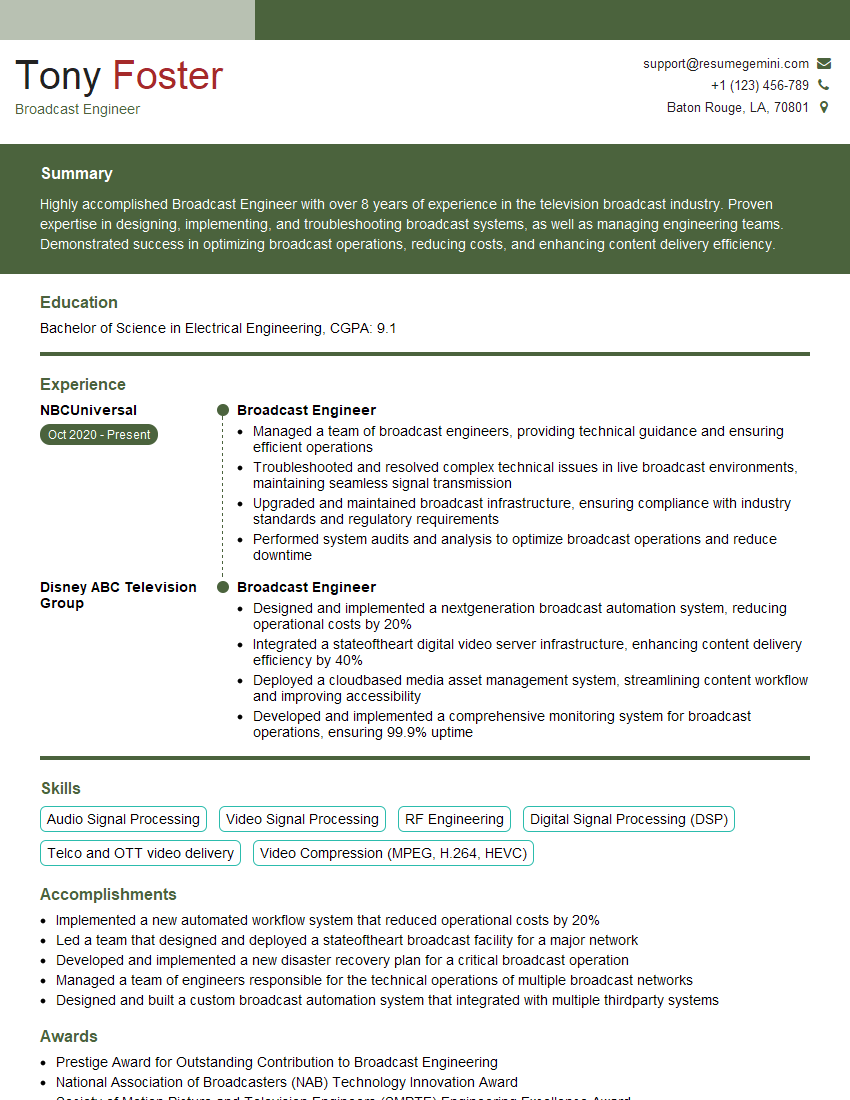
Mastering Live Linear Encoding opens doors to exciting opportunities in the rapidly growing media and entertainment industry. Demonstrating expertise in this area will significantly enhance your career prospects. To increase your chances of landing your dream role, focus on crafting an ATS-friendly resume that highlights your skills and experience effectively. ResumeGemini is a trusted resource to help you build a professional and impactful resume. They even provide examples of resumes tailored to Live Linear Encoding to help you get started. Take the next step towards your career success – build a winning resume today!
Explore more articles
Users Rating of Our Blogs
Share Your Experience
We value your feedback! Please rate our content and share your thoughts (optional).
What Readers Say About Our Blog
Hello,
we currently offer a complimentary backlink and URL indexing test for search engine optimization professionals.
You can get complimentary indexing credits to test how link discovery works in practice.
No credit card is required and there is no recurring fee.
You can find details here:
https://wikipedia-backlinks.com/indexing/
Regards
NICE RESPONSE TO Q & A
hi
The aim of this message is regarding an unclaimed deposit of a deceased nationale that bears the same name as you. You are not relate to him as there are millions of people answering the names across around the world. But i will use my position to influence the release of the deposit to you for our mutual benefit.
Respond for full details and how to claim the deposit. This is 100% risk free. Send hello to my email id: [email protected]
Luka Chachibaialuka
Hey interviewgemini.com, just wanted to follow up on my last email.
We just launched Call the Monster, an parenting app that lets you summon friendly ‘monsters’ kids actually listen to.
We’re also running a giveaway for everyone who downloads the app. Since it’s brand new, there aren’t many users yet, which means you’ve got a much better chance of winning some great prizes.
You can check it out here: https://bit.ly/callamonsterapp
Or follow us on Instagram: https://www.instagram.com/callamonsterapp
Thanks,
Ryan
CEO – Call the Monster App
Hey interviewgemini.com, I saw your website and love your approach.
I just want this to look like spam email, but want to share something important to you. We just launched Call the Monster, a parenting app that lets you summon friendly ‘monsters’ kids actually listen to.
Parents are loving it for calming chaos before bedtime. Thought you might want to try it: https://bit.ly/callamonsterapp or just follow our fun monster lore on Instagram: https://www.instagram.com/callamonsterapp
Thanks,
Ryan
CEO – Call A Monster APP
To the interviewgemini.com Owner.
Dear interviewgemini.com Webmaster!
Hi interviewgemini.com Webmaster!
Dear interviewgemini.com Webmaster!
excellent
Hello,
We found issues with your domain’s email setup that may be sending your messages to spam or blocking them completely. InboxShield Mini shows you how to fix it in minutes — no tech skills required.
Scan your domain now for details: https://inboxshield-mini.com/
— Adam @ InboxShield Mini
Reply STOP to unsubscribe
Hi, are you owner of interviewgemini.com? What if I told you I could help you find extra time in your schedule, reconnect with leads you didn’t even realize you missed, and bring in more “I want to work with you” conversations, without increasing your ad spend or hiring a full-time employee?
All with a flexible, budget-friendly service that could easily pay for itself. Sounds good?
Would it be nice to jump on a quick 10-minute call so I can show you exactly how we make this work?
Best,
Hapei
Marketing Director
Hey, I know you’re the owner of interviewgemini.com. I’ll be quick.
Fundraising for your business is tough and time-consuming. We make it easier by guaranteeing two private investor meetings each month, for six months. No demos, no pitch events – just direct introductions to active investors matched to your startup.
If youR17;re raising, this could help you build real momentum. Want me to send more info?
Hi, I represent an SEO company that specialises in getting you AI citations and higher rankings on Google. I’d like to offer you a 100% free SEO audit for your website. Would you be interested?
Hi, I represent an SEO company that specialises in getting you AI citations and higher rankings on Google. I’d like to offer you a 100% free SEO audit for your website. Would you be interested?
good