Every successful interview starts with knowing what to expect. In this blog, we’ll take you through the top Maintain accurate and confidential student records interview questions, breaking them down with expert tips to help you deliver impactful answers. Step into your next interview fully prepared and ready to succeed.
Questions Asked in Maintain accurate and confidential student records Interview
Q 1. Explain the importance of maintaining accurate student records.
Accurate student records are the bedrock of effective education administration. They’re crucial for tracking student progress, ensuring appropriate support services are provided, and maintaining compliance with various regulations. Inaccurate data leads to a cascade of problems, from incorrect financial aid disbursements and inaccurate transcripts to missed opportunities for intervention and ultimately, hindering a student’s success.
- Academic Tracking: Accurate GPA calculations, course history, and assessment scores are essential for evaluating student performance and identifying areas needing improvement. Imagine trying to advise a student on their course selection without knowing their current grades or past performance.
- Financial Aid & Scholarships: Correct information is critical for determining eligibility for financial aid and scholarships. Incorrect data could lead to students losing crucial funding.
- Compliance & Reporting: Accurate data is essential for meeting legal and institutional reporting requirements, such as those mandated by FERPA (Family Educational Rights and Privacy Act).
Q 2. Describe your experience with FERPA regulations.
My experience with FERPA regulations is extensive. I understand the law’s intricacies, including the rights of students to access their educational records, the requirements for parental consent (depending on the student’s age), and the limitations on the release of student information to third parties. I’ve been involved in developing and implementing policies and procedures to ensure compliance, including training staff on proper FERPA procedures and conducting regular audits to verify adherence to the regulations. I am intimately familiar with the specific requirements for directory information and the process for granting exceptions to FERPA guidelines.
For instance, in my previous role, I spearheaded an initiative to update our student record system to align with FERPA’s latest guidelines. This involved revising data access permissions, enhancing security protocols, and developing a comprehensive training program for all staff members handling student information.
Q 3. How do you ensure data privacy and confidentiality in student records?
Data privacy and confidentiality are paramount. We use a multi-layered approach to protect student information. This includes:
- Access Control: Implementing strict access controls based on the principle of least privilege. Only authorized personnel with a legitimate educational interest have access to specific student data.
- Data Encryption: Encrypting sensitive data both in transit and at rest to prevent unauthorized access even if a breach occurs. Think of it like using a strong lock and key to protect a valuable item.
- Secure Data Storage: Utilizing secure servers and cloud-based solutions with robust security measures to safeguard student information.
- Regular Security Audits: Conducting regular security audits and penetration testing to identify and address potential vulnerabilities. This is akin to having a security professional regularly inspect a building for weaknesses.
- Employee Training: Providing comprehensive training to all staff members on data privacy and security best practices, emphasizing the importance of confidentiality and highlighting the consequences of breaches.
Q 4. What methods do you use to maintain data integrity in student record systems?
Maintaining data integrity is crucial. We use several methods:
- Data Validation: Implementing data validation rules to ensure data accuracy during entry. For example, we might prevent entries of invalid dates or grades.
- Regular Data Backups: Regularly backing up the entire student information system to ensure data recovery in case of system failure or data loss. This is critical for business continuity.
- Data Reconciliation: Regularly reconciling data from different sources to identify and resolve discrepancies. This involves comparing data from various systems and identifying any inconsistencies.
- Audit Trails: Maintaining detailed audit trails of all data modifications, indicating who made the changes, when, and why. This is crucial for accountability and tracking down errors.
- Data Cleansing: Periodically conducting data cleansing operations to identify and correct inconsistencies, outdated information, and duplicates in the student records database.
Q 5. Describe your experience with student information systems (SIS).
I have extensive experience with various Student Information Systems (SIS), including [mention specific systems used, e.g., PowerSchool, Infinite Campus, etc.]. My experience encompasses data entry, data migration, report generation, system administration, and user training. I’m proficient in utilizing the system’s features to manage student demographics, academic records, attendance, and disciplinary information. I’ve also been involved in customizing SIS reports to meet specific institutional needs, such as generating reports for financial aid, scholarship awards, and state reporting requirements.
For example, in a previous role, I led the migration of student data from an outdated SIS to a new, more modern system. This involved meticulously planning the migration process, cleaning and validating the existing data, configuring the new system, and providing training to staff on the new system’s features and functionalities. The migration was completed successfully and on time, with minimal disruption to ongoing operations.
Q 6. How would you handle a discrepancy in a student’s record?
When a discrepancy arises, a methodical approach is crucial. I would first identify the nature of the discrepancy – is it a simple typographical error or a more significant data inconsistency? Then, I would trace the origin of the conflicting information. This might involve reviewing source documents, such as official transcripts or enrollment forms, and cross-referencing information from different data sources within the SIS. If needed, I would contact the student or relevant parties (parents, teachers) to clarify the information.
For instance, if a student’s GPA doesn’t match the calculation based on their individual course grades, I would thoroughly examine each grade entry, verifying against official grade reports. If the discrepancy is due to a missing grade, I’d contact the relevant instructor to obtain the missing information. If the error is in data entry, I’d make the necessary correction, documenting the change in the audit trail.
Q 7. What is your process for correcting errors in student records?
My process for correcting errors is thorough and documented. First, I would verify the error. Then, I’d make the necessary corrections directly within the SIS, ensuring that all impacted fields are updated consistently. Crucially, I would document the correction, including the date, the nature of the error, the steps taken to rectify it, and my initials. This documentation is essential for maintaining an audit trail, ensuring accountability, and facilitating future data reconciliation efforts. Finally, if the error impacts external documents such as transcripts, those documents would need to be corrected and reissued.
All corrections would adhere strictly to our established internal processes and comply with relevant regulations, including FERPA. Any significant changes would be reviewed by a supervisor before being finalized.
Q 8. How do you ensure the security of physical and digital student records?
Securing student records, both physical and digital, is paramount. Think of it like safeguarding a national treasure – each record represents a student’s academic journey and personal information. For physical records, we employ a multi-layered approach: secure, locked filing cabinets; restricted access to record rooms; and a detailed sign-out system for anyone needing access. Regular audits ensure proper storage and adherence to protocols. For digital records, we utilize robust security measures. This includes:
- Access Control: Role-based access control (RBAC) limits access to authorized personnel only, based on their job responsibilities. For example, a teacher might have access to their students’ grades, but not to their medical information.
- Data Encryption: Both data at rest (stored on servers) and data in transit (sent over a network) are encrypted using strong encryption algorithms, making them unreadable without the correct decryption key. Think of it like a secret code protecting sensitive data.
- Firewall and Intrusion Detection Systems: These act as security guards, preventing unauthorized access and alerting us to suspicious activity.
- Regular Security Audits and Penetration Testing: We conduct regular security checks to identify vulnerabilities and simulate attacks to test the robustness of our systems. This helps to proactively prevent breaches.
- Multi-Factor Authentication (MFA): Access to sensitive systems requires multiple forms of authentication – something you know (password), something you have (phone), and potentially something you are (biometric scan) – greatly reducing the risk of unauthorized access.
These layers work together to create a comprehensive security system, reducing the likelihood of unauthorized access or data breaches.
Q 9. Explain your experience with data backup and recovery procedures for student records.
Data backup and recovery are critical. Imagine losing years of student records – it would be a catastrophic event. We employ a 3-2-1 backup strategy. This means we have three copies of our data, on two different media types, with one copy stored offsite.
- First Copy: A daily backup is made to an on-site server, providing quick access for routine recovery.
- Second Copy: A weekly backup is made to a different on-site storage device, ideally a different physical location within the building.
- Third Copy: A monthly backup is stored offsite in a secure, geographically distant location. This could be a cloud service or another secure facility. This safeguards us against localized disasters like fires or floods.
Regular testing of the recovery process ensures that the backups are functional and can be restored efficiently. We simulate data loss scenarios to verify our restoration procedures and update them as needed. We document every step of this process in a clear, easy-to-follow procedure manual accessible to all authorized staff. This ensures consistency and efficiency in recovery efforts. Furthermore, we utilize version control systems to track changes made to records, allowing us to revert to previous versions if needed.
Q 10. How do you handle requests for student records from parents, students, and third parties?
Handling requests for student records involves a strict adherence to privacy regulations and institutional policies. We differentiate between requests based on the requester.
- Parents/Legal Guardians: They generally have full access to their child’s records, unless there is a legal order prohibiting it. We verify their identity using secure methods before granting access.
- Students (over 18): They have the right to access their own records. We follow procedures that ensure identity verification before providing access.
- Third Parties: Requests from third parties, such as colleges or employers, are handled with extreme caution and require explicit consent from the student or legal guardian. We only release specific data requested, and always within the bounds of the law. A detailed audit trail is maintained for all third-party requests. We adhere strictly to FERPA (Family Educational Rights and Privacy Act) and other relevant legislation.
In each case, requests are documented, and access is granted only after verifying the identity of the requester and their right to access the information. This ensures privacy and protects the rights of the student.
Q 11. Describe your experience with archiving student records.
Archiving student records is a crucial aspect of long-term data management. We follow established retention policies that comply with state and federal laws and our institutional guidelines. These policies dictate how long records must be kept (for example, transcripts are often kept indefinitely, while some other documentation might only need to be retained for a set number of years). We use a secure, off-site storage facility for long-term archival. This can involve both physical and digital archiving.
- Physical Records: These are stored in climate-controlled facilities to prevent deterioration.
- Digital Records: These are stored on secure, redundant storage systems and are regularly checked for data integrity.
Archiving ensures that records are safely and securely stored for the required duration and that we can access them should the need arise, even after the student has graduated or left the institution. A comprehensive inventory of archived records is maintained, with clear metadata to facilitate efficient retrieval.
Q 12. How do you maintain compliance with relevant data privacy laws and regulations?
Compliance with data privacy laws and regulations is paramount. We adhere to the Family Educational Rights and Privacy Act (FERPA) in the United States, and any other relevant state and local regulations. This includes:
- Regular Training: All staff involved in handling student data receive regular training on data privacy best practices and relevant laws.
- Data Minimization: We only collect and store the minimum amount of student data necessary for legitimate educational purposes.
- Privacy Impact Assessments: Before implementing any new systems or processes that involve student data, we conduct privacy impact assessments to identify and mitigate potential risks.
- Data Security Policies and Procedures: We have comprehensive policies and procedures in place to govern how student data is collected, stored, accessed, and disposed of.
- Ongoing Monitoring and Audits: We regularly monitor our systems and conduct audits to ensure that we are complying with all relevant regulations.
Staying informed about changes in legislation and adapting our practices accordingly is a continuous process. We treat this not just as compliance, but as a fundamental commitment to protecting student privacy.
Q 13. How would you address a data breach involving student records?
A data breach involving student records would require a swift and comprehensive response. Our plan involves:
- Immediate Containment: We would immediately isolate affected systems to prevent further data compromise.
- Investigation: A thorough investigation would be launched to determine the cause of the breach and the extent of the data compromised.
- Notification: We would notify affected students, parents, and relevant authorities (like the Department of Education) according to legal requirements and established timelines.
- Remediation: We would take steps to fix the vulnerabilities that led to the breach and implement enhanced security measures to prevent future incidents.
- Monitoring: Post-breach monitoring would be implemented to detect any ongoing malicious activity.
- Collaboration: We would collaborate with law enforcement and cybersecurity experts as needed.
Our response plan is regularly tested and updated to ensure its effectiveness. Transparency and communication are key elements of our approach.
Q 14. What strategies do you use to prevent data loss or corruption in student records?
Preventing data loss or corruption requires a proactive and multi-faceted approach. Think of it like building a strong dam to protect against a flood. Our strategies include:
- Redundancy: We use redundant systems and backups to ensure data availability even if one system fails. This is like having a backup generator during a power outage.
- Regular Data Backups: As mentioned previously, frequent backups ensure that we can recover data in case of loss or corruption.
- Data Validation: We implement data validation checks to ensure that the data entered is accurate and consistent. This prevents errors from entering the system in the first place.
- Access Control: Limiting access based on roles ensures that only authorized personnel can modify sensitive information, reducing the risk of accidental or malicious changes.
- Regular System Maintenance: Regular software updates, security patches, and hardware maintenance minimize the risk of system failures. This is like regularly servicing a car to prevent breakdowns.
- Disaster Recovery Plan: A comprehensive disaster recovery plan outlines steps to take in the event of a major disaster such as a fire or natural disaster. This ensures business continuity.
Continuous monitoring and improvement of our data management practices are crucial to minimizing the risk of data loss or corruption.
Q 15. Describe your experience with reporting and analysis of student data.
Reporting and analyzing student data is crucial for identifying trends, improving educational programs, and ensuring student success. My experience encompasses generating reports on various metrics, such as GPA distribution, graduation rates, enrollment patterns, and student demographics. I’m proficient in using data analysis tools to extract meaningful insights from large datasets. For example, in my previous role, I used SQL queries to analyze student performance data, identifying students at risk of failing and enabling early intervention strategies. I also created visualizations, such as charts and graphs, to present complex data in a clear and concise manner to administrators and faculty. This allowed them to make data-driven decisions regarding resource allocation and curriculum development.
I’m also experienced with using data to track the effectiveness of specific interventions or programs. For instance, I tracked participation and outcomes in a tutoring program to demonstrate its impact on student achievement and adjust program delivery as needed. Ultimately, my goal is to ensure that data analysis informs best practices and improves student outcomes.
Career Expert Tips:
- Ace those interviews! Prepare effectively by reviewing the Top 50 Most Common Interview Questions on ResumeGemini.
- Navigate your job search with confidence! Explore a wide range of Career Tips on ResumeGemini. Learn about common challenges and recommendations to overcome them.
- Craft the perfect resume! Master the Art of Resume Writing with ResumeGemini’s guide. Showcase your unique qualifications and achievements effectively.
- Don’t miss out on holiday savings! Build your dream resume with ResumeGemini’s ATS optimized templates.
Q 16. How do you handle confidential information related to student disciplinary actions?
Handling confidential student information, especially regarding disciplinary actions, requires strict adherence to privacy regulations like FERPA (Family Educational Rights and Privacy Act) and institutional policies. Access to these records is restricted to authorized personnel only, and I maintain a meticulous system of access control and audit trails. All documents are stored securely, both physically and digitally, using encryption and password protection. I never discuss confidential information with unauthorized individuals, and I ensure all communication regarding disciplinary matters adheres to strict confidentiality protocols.
For instance, if a request for a student’s disciplinary record comes from an unauthorized source, I immediately refuse the request and report the attempt to the appropriate authorities. Further, I am trained on proper disposal of sensitive documents, ensuring that any paper records are shredded securely, and digital records are deleted permanently according to institutional policies. My commitment to confidentiality is unwavering, and I prioritize the protection of student privacy above all else.
Q 17. How do you ensure the accuracy of student enrollment data?
Ensuring the accuracy of student enrollment data is paramount for accurate record-keeping and effective resource allocation. This involves meticulous data entry, regular data validation, and cross-referencing information from multiple sources. I verify information against official documents, such as transcripts, immunization records, and identification documents. I also regularly reconcile enrollment data with other systems, such as financial aid databases and course registration systems, to identify and correct discrepancies. Any inconsistencies are investigated thoroughly and corrected immediately, with detailed documentation of the changes made.
Think of it like a meticulous accountant balancing the books – careful attention to detail is essential. In one instance, I noticed a discrepancy in a student’s enrollment status due to an error in the online registration system. Promptly identifying and resolving this ensured the student received the correct financial aid and course scheduling. My commitment to accuracy prevents administrative errors and ensures students receive the services and support they are entitled to.
Q 18. What is your experience with managing student transcripts?
Managing student transcripts requires meticulous attention to detail and a thorough understanding of academic regulations. My experience includes generating official and unofficial transcripts, ensuring all coursework, grades, and degree information are accurately reflected. I also handle transcript requests, verifying student identity and following established procedures to release transcripts securely. I’m familiar with various transcript formats and am capable of generating transcripts that meet specific institutional and external requirements. Additionally, I am responsible for maintaining an accurate and up-to-date archive of student transcripts, both digital and (if applicable) physical copies.
For example, I’ve handled requests for transcripts from prospective employers, graduate schools, and other institutions, ensuring each transcript is properly authenticated and sent securely. I am also proficient in resolving discrepancies or inconsistencies discovered during transcript preparation, investigating and correcting any errors before releasing the official document.
Q 19. Describe your experience with different record-keeping systems (paper-based vs. digital).
I have experience with both paper-based and digital record-keeping systems and understand the advantages and disadvantages of each. Paper-based systems, while potentially offering a sense of permanence, are susceptible to damage, loss, and inefficient retrieval. Digital systems, on the other hand, offer better searchability, accessibility, and security features when properly implemented. However, they come with their own set of concerns, including data security and the potential for technological failures.
In my previous roles, I’ve worked with both systems. With paper-based records, I implemented robust filing and retrieval systems, employing clear labeling and indexing techniques to maintain organization. For digital systems, I’ve utilized Student Information Systems (SIS) such as Banner or PowerSchool, ensuring data integrity and security through proper access controls, regular backups, and adherence to data privacy regulations. My ability to effectively navigate both environments allows me to adapt to the specific needs of any institution.
Q 20. How do you prioritize tasks when dealing with multiple student record requests?
When managing multiple student record requests, I prioritize tasks based on urgency, deadlines, and the impact on students. Requests requiring immediate attention, such as those for urgent financial aid processing or admission decisions, take precedence. I use a ticketing system or task management software to track requests, assign priorities, and monitor progress. This allows me to effectively manage my workload and ensure timely response to all requests. I also communicate proactively with students and other stakeholders to manage their expectations and keep them informed of the progress of their requests.
For example, I might prioritize a request for a transcript needed for an upcoming scholarship deadline over a less time-sensitive request for an unofficial transcript. By using a systematic approach, I guarantee a fair and efficient handling of every request while avoiding any unnecessary delays that might impact students.
Q 21. How do you stay updated on changes to data privacy laws and regulations?
Staying updated on changes in data privacy laws and regulations is crucial for protecting student information. I regularly review updates from relevant organizations, such as the Department of Education and FERPA compliance sites. I also participate in professional development workshops and conferences related to data privacy and security best practices. Furthermore, I actively monitor changes in relevant state and federal regulations and incorporate these updates into my work procedures immediately. I make sure to keep detailed records of training and updates for audit purposes.
Staying informed in this dynamic landscape ensures that I remain compliant with all applicable laws and regulations. This commitment protects both the institution and the students from potential legal and ethical breaches. Continuous learning in this area is essential for maintaining best practices and safeguarding student data effectively.
Q 22. How do you handle requests for sensitive student information from authorized personnel?
Handling requests for sensitive student information requires a strict adherence to privacy regulations and institutional policies. I always begin by verifying the requester’s identity and authorization level. This often involves checking their credentials against our internal system and confirming their legitimate need for the information. For example, a teacher requesting a student’s grade would require different verification than a parent requesting their child’s immunization records. Once authorization is confirmed, I access only the specific data requested, ensuring I don’t release any unnecessary information. All requests are logged, documenting the date, time, requester, data accessed, and the purpose of the request. This detailed logging is crucial for auditing and accountability.
Furthermore, I am trained to handle requests from external agencies, such as court orders or subpoenas, following strict legal procedures and consulting with legal counsel when necessary. Confidentiality is paramount, and my actions are always guided by the principle of ‘need-to-know’ – releasing only the minimum necessary information while safeguarding the student’s privacy.
Q 23. Describe your experience with using data validation techniques to maintain data accuracy.
Data validation is critical for ensuring the accuracy and integrity of student records. I utilize a multi-pronged approach, incorporating both automated and manual checks. Automated checks involve using software with built-in validation rules. For example, a date of birth field might be validated to ensure it’s a valid date format and within a reasonable range. Similarly, social security numbers or student IDs are checked against established formats and for duplicates. These automated systems flag potential errors, allowing for immediate correction.
Manual checks, however, are equally important. This involves reviewing data for inconsistencies or illogical entries that might slip through automated validation. For example, a student’s address might be checked against a geographical database or their reported grade might be checked against their exam scores. This two-tiered system greatly reduces errors and ensures data reliability. I also regularly review data dictionaries and update them as needed to reflect changes in regulations and data requirements.
Q 24. How do you track and manage changes made to student records?
Tracking and managing changes to student records is essential for maintaining auditability and transparency. We utilize a robust record management system with version control. Every change made to a student’s record – whether it’s an updated address, a new grade, or a change in enrollment status – is automatically logged with a timestamp, the user who made the change, and a description of the modification. This detailed audit trail allows us to easily track any alterations made to the records, making it simple to identify potential errors or intentional changes and review the history of any specific data point. For instance, if a discrepancy arises, we can easily trace the change back to its origin and investigate the cause.
In addition to automated logging, we also conduct regular data reconciliation checks to compare data across different systems and identify any discrepancies that might have occurred. This proactive approach ensures data integrity and allows for timely corrections.
Q 25. What measures do you take to prevent unauthorized access to student records?
Preventing unauthorized access to student records is of utmost importance. We employ a multi-layered security approach. This begins with robust access control measures, using role-based access control (RBAC) to restrict access to sensitive data based on user roles and responsibilities. Only authorized personnel, such as teachers, counselors, and administrators with a legitimate need, are granted access to specific student data. Moreover, strong passwords, multi-factor authentication, and regular security audits are implemented to prevent unauthorized logins and data breaches. Furthermore, we regularly update our security software and firewalls to protect against emerging threats.
We also conduct regular security training for all staff members to emphasize the importance of data protection and to familiarize them with the institution’s security protocols. Finally, all access attempts are logged and monitored for suspicious activities to promptly detect and respond to any potential breaches.
Q 26. How do you reconcile discrepancies between different student data sources?
Reconciling discrepancies between different student data sources is a common challenge. I usually begin by identifying the sources of the discrepancies. This often involves carefully examining the data fields, comparing data entry methods, and understanding the possible reasons for the variations. Sometimes, discrepancies stem from data entry errors, while in other cases, they might reflect differences in data definitions or formats across various systems. For example, one system might record a student’s address in a slightly different format than another.
Once the sources are identified, I use data matching and reconciliation techniques to resolve the differences. This might involve manual review and correction, or the use of automated reconciliation tools that compare records across different systems and identify inconsistencies. The process always emphasizes maintaining data accuracy and integrity, and the resolutions are carefully documented and audited for transparency.
Q 27. Describe a time you had to resolve a complex issue related to student records.
In one instance, we discovered a significant discrepancy in a student’s transcript data. Their official transcript showed a lower GPA than the cumulative GPA calculated from their individual course grades. Initially, this discrepancy was perplexing, as both datasets were believed to be accurate. However, upon thorough investigation, we discovered that a recent system upgrade had resulted in an error in the GPA calculation algorithm. This error impacted a small subset of students whose grade records spanned across different systems during the upgrade. To resolve this, we carefully reviewed the individual course grades for each affected student, correcting the GPA calculation and updating their transcripts. We also implemented a thorough quality control check on the GPA calculation algorithm following the system upgrades to prevent future recurrences. This experience highlighted the critical role of data validation and regular system audits to ensure the accuracy of student records.
Q 28. What are your preferred methods for communicating changes or updates to student records?
Communicating changes or updates to student records depends on the nature of the update and the audience. For minor updates, such as address changes, automated notifications to the student and relevant staff members (e.g., teachers, counselors) are sent via email or through the student information system. For more significant updates that require immediate attention, such as changes to enrollment status, I directly communicate with the student and relevant staff, confirming their understanding and seeking clarification if necessary.
For sensitive information, I always prioritize secure communication channels and follow privacy protocols. A detailed log of all communications regarding updates, including the date, time, method of communication, and individuals involved, is maintained to ensure accountability and transparency.
Key Topics to Learn for Maintaining Accurate and Confidential Student Records Interview
- Data Entry and Management: Understanding different data entry methods, accuracy checks, and the importance of consistent formatting for efficient record-keeping.
- Data Security and Confidentiality: Implementing appropriate security measures (password protection, access controls), adhering to FERPA (or equivalent) regulations, and handling sensitive information responsibly.
- Record Organization and Retrieval: Utilizing filing systems (physical or digital) to ensure easy access to student information, employing effective search strategies, and understanding data archiving procedures.
- Data Integrity and Validation: Identifying and correcting errors in student records, understanding data validation techniques, and maintaining the accuracy and completeness of information.
- Record Retention Policies: Understanding legal and institutional guidelines for retaining and disposing of student records, ensuring compliance with all regulations.
- Technology and Software Proficiency: Familiarity with relevant software (databases, student information systems) and the ability to troubleshoot common technical issues.
- Problem-solving and Decision-making: Identifying and resolving discrepancies in student records, handling data conflicts, and making informed decisions based on available information.
- Communication and Collaboration: Effectively communicating with students, faculty, and administrative staff regarding record-related inquiries, and collaborating with colleagues to maintain data consistency.
Next Steps
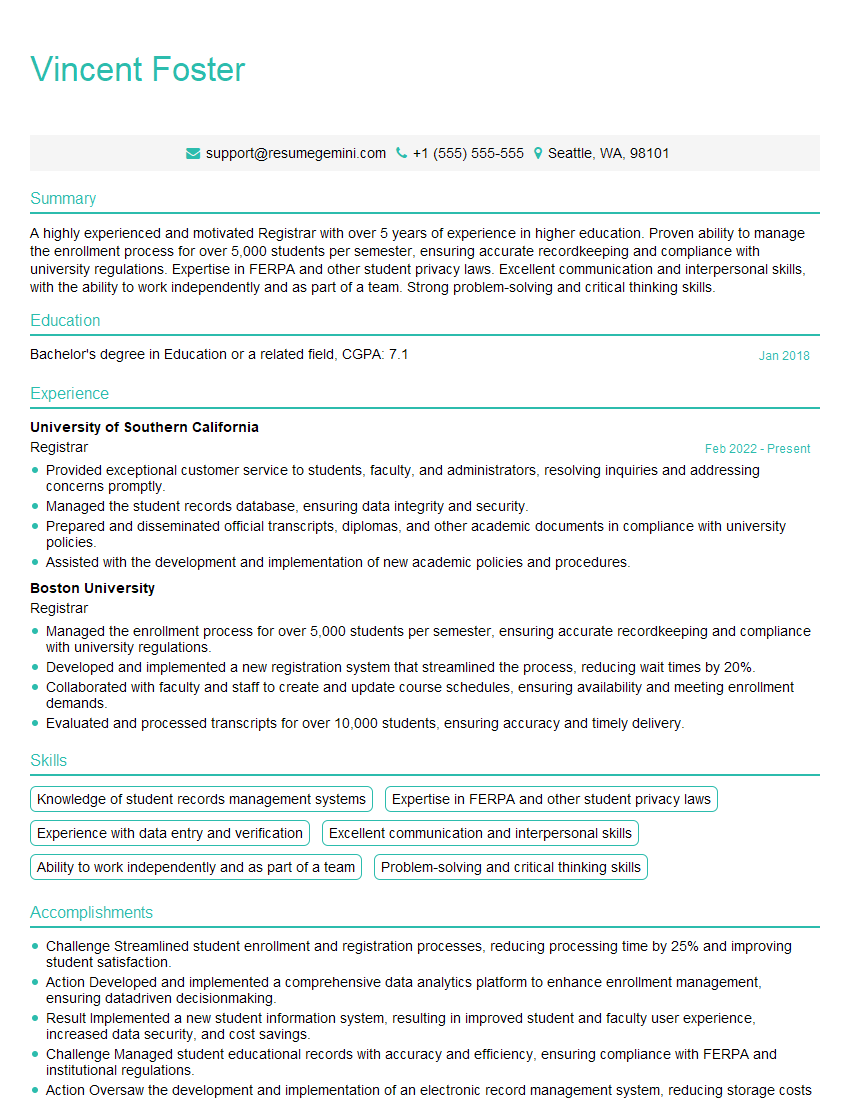
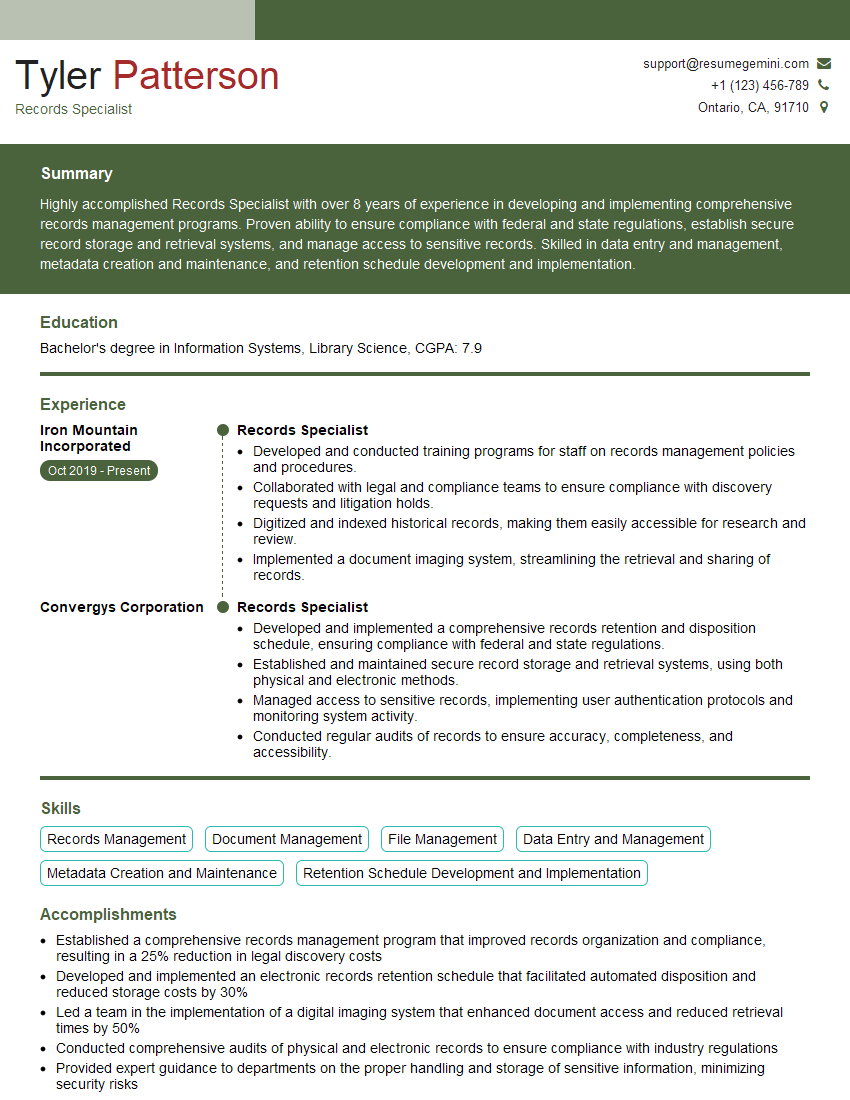
Mastering the skills needed to maintain accurate and confidential student records is crucial for career advancement in education and administration. It demonstrates your commitment to data integrity, ethical practices, and efficient workflow. To stand out to potential employers, create an ATS-friendly resume that highlights your relevant experience and skills. ResumeGemini is a trusted resource to help you build a compelling and effective resume that showcases your qualifications. Examples of resumes tailored to this specific skill set are available on ResumeGemini, helping you craft a document that resonates with hiring managers and gets you noticed.
Explore more articles
Users Rating of Our Blogs
Share Your Experience
We value your feedback! Please rate our content and share your thoughts (optional).
What Readers Say About Our Blog
Attention music lovers!
Wow, All the best Sax Summer music !!!
Spotify: https://open.spotify.com/artist/6ShcdIT7rPVVaFEpgZQbUk
Apple Music: https://music.apple.com/fr/artist/jimmy-sax-black/1530501936
YouTube: https://music.youtube.com/browse/VLOLAK5uy_noClmC7abM6YpZsnySxRqt3LoalPf88No
Other Platforms and Free Downloads : https://fanlink.tv/jimmysaxblack
on google : https://www.google.com/search?q=22+AND+22+AND+22
on ChatGPT : https://chat.openai.com?q=who20jlJimmy20Black20Sax20Producer
Get back into the groove with Jimmy sax Black
Best regards,
Jimmy sax Black
www.jimmysaxblack.com
Hi I am a troller at The aquatic interview center and I suddenly went so fast in Roblox and it was gone when I reset.
Hi,
Business owners spend hours every week worrying about their website—or avoiding it because it feels overwhelming.
We’d like to take that off your plate:
$69/month. Everything handled.
Our team will:
Design a custom website—or completely overhaul your current one
Take care of hosting as an option
Handle edits and improvements—up to 60 minutes of work included every month
No setup fees, no annual commitments. Just a site that makes a strong first impression.
Find out if it’s right for you:
https://websolutionsgenius.com/awardwinningwebsites
Hello,
we currently offer a complimentary backlink and URL indexing test for search engine optimization professionals.
You can get complimentary indexing credits to test how link discovery works in practice.
No credit card is required and there is no recurring fee.
You can find details here:
https://wikipedia-backlinks.com/indexing/
Regards
NICE RESPONSE TO Q & A
hi
The aim of this message is regarding an unclaimed deposit of a deceased nationale that bears the same name as you. You are not relate to him as there are millions of people answering the names across around the world. But i will use my position to influence the release of the deposit to you for our mutual benefit.
Respond for full details and how to claim the deposit. This is 100% risk free. Send hello to my email id: lukachachibaialuka@gmail.com
Luka Chachibaialuka
Hey interviewgemini.com, just wanted to follow up on my last email.
We just launched Call the Monster, an parenting app that lets you summon friendly ‘monsters’ kids actually listen to.
We’re also running a giveaway for everyone who downloads the app. Since it’s brand new, there aren’t many users yet, which means you’ve got a much better chance of winning some great prizes.
You can check it out here: https://bit.ly/callamonsterapp
Or follow us on Instagram: https://www.instagram.com/callamonsterapp
Thanks,
Ryan
CEO – Call the Monster App
Hey interviewgemini.com, I saw your website and love your approach.
I just want this to look like spam email, but want to share something important to you. We just launched Call the Monster, a parenting app that lets you summon friendly ‘monsters’ kids actually listen to.
Parents are loving it for calming chaos before bedtime. Thought you might want to try it: https://bit.ly/callamonsterapp or just follow our fun monster lore on Instagram: https://www.instagram.com/callamonsterapp
Thanks,
Ryan
CEO – Call A Monster APP
To the interviewgemini.com Owner.
Dear interviewgemini.com Webmaster!
Hi interviewgemini.com Webmaster!
Dear interviewgemini.com Webmaster!
excellent
Hello,
We found issues with your domain’s email setup that may be sending your messages to spam or blocking them completely. InboxShield Mini shows you how to fix it in minutes — no tech skills required.
Scan your domain now for details: https://inboxshield-mini.com/
— Adam @ InboxShield Mini
support@inboxshield-mini.com
Reply STOP to unsubscribe
Hi, are you owner of interviewgemini.com? What if I told you I could help you find extra time in your schedule, reconnect with leads you didn’t even realize you missed, and bring in more “I want to work with you” conversations, without increasing your ad spend or hiring a full-time employee?
All with a flexible, budget-friendly service that could easily pay for itself. Sounds good?
Would it be nice to jump on a quick 10-minute call so I can show you exactly how we make this work?
Best,
Hapei
Marketing Director
Hey, I know you’re the owner of interviewgemini.com. I’ll be quick.
Fundraising for your business is tough and time-consuming. We make it easier by guaranteeing two private investor meetings each month, for six months. No demos, no pitch events – just direct introductions to active investors matched to your startup.
If youR17;re raising, this could help you build real momentum. Want me to send more info?
Hi, I represent an SEO company that specialises in getting you AI citations and higher rankings on Google. I’d like to offer you a 100% free SEO audit for your website. Would you be interested?
Hi, I represent an SEO company that specialises in getting you AI citations and higher rankings on Google. I’d like to offer you a 100% free SEO audit for your website. Would you be interested?