Are you ready to stand out in your next interview? Understanding and preparing for Marine Ecosystem Management interview questions is a game-changer. In this blog, we’ve compiled key questions and expert advice to help you showcase your skills with confidence and precision. Let’s get started on your journey to acing the interview.
Questions Asked in Marine Ecosystem Management Interview
Q 1. Describe the key threats to marine biodiversity.
Marine biodiversity faces a multitude of threats, largely stemming from human activities. Think of the ocean as a complex web of life; disrupting one part can have cascading effects.
- Overfishing: Removing species at unsustainable rates disrupts food webs and can lead to population collapses, impacting the entire ecosystem. The collapse of cod fisheries in Newfoundland is a stark example.
- Habitat destruction: Coastal development, dredging, and destructive fishing practices destroy crucial habitats like coral reefs and seagrass beds, leaving species with nowhere to live and breed. Mangrove deforestation, for example, reduces coastal protection and nursery grounds for many species.
- Pollution: Plastic pollution, chemical runoff from agriculture and industry, and oil spills contaminate the water, harming marine life and disrupting ecosystem processes. The Great Pacific Garbage Patch serves as a sobering example of the scale of this problem.
- Climate change: Rising ocean temperatures, ocean acidification, and sea-level rise are altering ocean chemistry and causing widespread coral bleaching, disrupting migration patterns, and affecting the distribution of species. The increasing frequency and intensity of marine heatwaves is a major concern.
- Invasive species: The introduction of non-native species can outcompete native organisms for resources, disrupt food webs, and spread diseases. The Lionfish invasion in the Caribbean is a clear illustration.
Addressing these threats requires a multi-pronged approach involving sustainable fishing practices, habitat protection, pollution control, climate change mitigation, and invasive species management.
Q 2. Explain the concept of maximum sustainable yield in fisheries management.
Maximum Sustainable Yield (MSY) in fisheries management aims to harvest the largest possible amount of a fish stock consistently, year after year, without causing the population to decline. Imagine it like carefully pruning a fruit tree – you want to take enough fruit to enjoy, but not so much that you weaken the tree’s ability to produce more fruit in the future.
The MSY is theoretically determined by the point where the population growth rate is highest. However, calculating the MSY is challenging because it requires accurate estimates of fish population size, growth rate, and mortality rate, which can be difficult to obtain. Furthermore, it doesn’t account for the complexity of ecosystems, such as the interactions between different species.
The MSY approach has faced criticism due to its simplistic nature and its tendency to overestimate sustainable yields. Current management approaches increasingly focus on ecosystem-based management, which considers the entire ecosystem and aims for a more holistic approach to resource management, often prioritizing stock health above maximal yields.
Q 3. What are the different types of marine protected areas and their management strategies?
Marine Protected Areas (MPAs) are designated areas in the ocean where resource extraction and other harmful activities are restricted to protect marine biodiversity and ecosystem services. They come in various types, each with different management strategies:
- Strict Nature Reserves/Wilderness Areas: These offer the highest level of protection, with all extractive activities prohibited. They are essential for maintaining pristine ecosystems and conducting scientific research.
- National Parks: These allow for limited human access and activities, often focusing on recreation and education while protecting biodiversity.
- Habitat/Species Management Areas: These areas are managed to protect specific species or habitats through targeted interventions like controlling invasive species or restoring degraded areas.
- Sustainable Use MPAs: These areas allow for some resource extraction but with strict regulations to ensure sustainability, like sustainable fisheries or ecotourism.
- Protected Landscapes/Seascapes: These areas focus on the protection of cultural and natural heritage while balancing conservation with human activities.
Management strategies vary depending on the type of MPA and its objectives, but often involve zoning, regulations, monitoring, enforcement, community engagement, and adaptive management to adjust strategies based on monitoring data and scientific findings.
Q 4. Discuss the impacts of climate change on marine ecosystems.
Climate change is profoundly impacting marine ecosystems, leading to widespread changes in species distribution, abundance, and interactions. It’s like shifting the foundation of an intricate house of cards.
- Ocean warming: Rising ocean temperatures cause coral bleaching, shifts in species distributions, and increased frequency and intensity of marine heatwaves, harming many species. This can lead to changes in species composition and food web dynamics.
- Ocean acidification: Increased absorption of carbon dioxide by the ocean makes it more acidic, impacting shell-forming organisms like corals, shellfish, and plankton, compromising the base of many food webs.
- Sea-level rise: Rising sea levels inundate coastal habitats, displace species, and increase coastal erosion, threatening both biodiversity and human communities.
- Changes in ocean currents and stratification: These changes alter the distribution of nutrients and oxygen, impacting marine productivity and species survival.
- Increased storm intensity: More intense storms cause damage to coastal habitats and can directly harm marine life.
The impacts of climate change on marine ecosystems are complex and interconnected. Addressing it requires both mitigation (reducing greenhouse gas emissions) and adaptation (helping ecosystems and communities adapt to the changes already underway).
Q 5. How can integrated coastal zone management address conflicting resource uses?
Integrated Coastal Zone Management (ICZM) is a holistic approach that aims to balance competing interests and uses of coastal resources. Imagine a coastal community needing to balance fishing, tourism, port development, and conservation – ICZM helps mediate these different priorities.
ICZM addresses conflicting resource uses through participatory planning processes involving all stakeholders. This includes:
- Stakeholder identification and engagement: Bringing together all relevant groups such as fishermen, developers, conservationists, and government agencies to understand different perspectives and needs.
- Data collection and analysis: Gathering information on resources, environmental conditions, and human activities to support informed decision-making.
- Conflict resolution and negotiation: Facilitating dialogue and negotiation to find solutions that address the concerns of different stakeholders.
- Development of management plans: Creating comprehensive plans that outline strategies and actions for sustainable resource use and coastal development.
- Monitoring and evaluation: Regularly tracking the effectiveness of management strategies and making adjustments as needed.
The success of ICZM depends on strong collaboration, robust monitoring, and adaptive management strategies.
Q 6. Explain the principles of ecosystem-based management.
Ecosystem-based management (EBM) is a holistic approach that considers the entire ecosystem, rather than focusing on individual species or resources. Instead of viewing the ocean as a collection of separate parts, it recognizes the interconnectedness of all elements.
Key principles of EBM include:
- Holistic approach: Considering all components of the ecosystem, including physical, chemical, biological, and human dimensions.
- Adaptive management: Regularly monitoring and evaluating management actions and adjusting strategies based on new information.
- Precautionary approach: Taking action to prevent harm to the ecosystem even if there is uncertainty about the impacts of a particular activity.
- Collaboration and stakeholder involvement: Engaging all relevant stakeholders in the planning and management process.
- Long-term perspective: Considering the long-term consequences of management actions and ensuring sustainability for future generations.
EBM requires a shift from traditional single-species management to a more integrated approach, focusing on maintaining ecosystem health and resilience.
Q 7. What are the different methods for assessing marine ecosystem health?
Assessing marine ecosystem health involves multiple methods, combining biological, chemical, and physical indicators to paint a comprehensive picture. Think of it as a doctor performing a thorough check-up.
- Biological indicators: Assessing the abundance, diversity, and health of species, including fish stocks, invertebrates, and phytoplankton. This can involve surveys, species counts, and assessments of reproductive success.
- Chemical indicators: Monitoring water quality parameters such as nutrient levels, pollutants (heavy metals, pesticides, plastics), and pH. This helps identify sources of pollution and their impacts on marine life.
- Physical indicators: Measuring factors like temperature, salinity, oxygen levels, and sediment characteristics. Changes in these factors can indicate ecosystem stress or shifts.
- Remote sensing: Using satellites and aerial surveys to monitor large areas and observe changes in habitat distribution, water color, and sea surface temperature.
- Benthic surveys: Sampling and analyzing bottom sediments and organisms to assess the health of benthic habitats.
- Fishery-independent surveys: Conducting surveys to track fish populations and species diversity independently of commercial fishing data. This provides an unbiased assessment of population health.
The choice of indicators and methods depends on the specific objectives of the assessment and the resources available. Combining multiple methods provides a more robust and comprehensive evaluation of marine ecosystem health.
Q 8. Describe the role of marine reserves in biodiversity conservation.
Marine reserves are fully protected areas within the ocean, similar to national parks on land. Their primary role in biodiversity conservation is to allow marine life to thrive undisturbed by human activities like fishing and pollution. This protection enables species populations to recover, genetic diversity to increase, and overall ecosystem health to improve. Think of it like a refuge where marine organisms can reproduce and grow without constant pressure.
For example, the creation of marine reserves has been shown to increase the abundance and size of commercially important fish species in surrounding areas, benefiting fisheries. The spillover effect, where protected populations migrate outwards, replenishes populations in adjacent areas. Similarly, the recovery of key predator populations within reserves can trigger trophic cascades (which I will explain in another answer), benefiting the entire ecosystem.
- Increased species abundance and diversity
- Enhanced resilience to environmental change
- Improved fisheries productivity through spillover effects
- Protection of critical habitats and spawning grounds
Q 9. What are the challenges of managing transboundary marine resources?
Managing transboundary marine resources – resources that extend across the borders of multiple countries, like shared fish stocks or migratory marine mammals – presents unique challenges. The primary difficulty is coordinating management efforts across different jurisdictions, each with its own laws, regulations, and priorities. This lack of unified governance can lead to overexploitation of resources, conflicting interests, and ineffective conservation strategies.
For example, imagine two countries sharing a vital fishing ground. If one country aggressively overfishes, the resource will decline, impacting both nations. Agreeing on sustainable fishing quotas and enforcement mechanisms across borders is often difficult due to differing economic needs and political priorities. Lack of communication and transparency further exacerbates these problems. Successful management often requires international cooperation, shared scientific data, and the establishment of regional management bodies or agreements.
- Lack of unified governance and enforcement
- Differing national interests and priorities
- Difficulty in data sharing and scientific collaboration
- Potential for conflict and mistrust between nations
Q 10. How can marine spatial planning contribute to sustainable ocean use?
Marine spatial planning (MSP) is a process of analyzing and allocating ocean space to different activities, such as fishing, shipping, energy production, and conservation, in a way that balances competing interests and promotes sustainable use. It’s essentially zoning the ocean to minimize conflicts and maximize ecological and economic benefits. Imagine a city planner deciding where to place buildings, roads, and parks; MSP does the same for the ocean.
MSP contributes to sustainable ocean use by improving the efficiency of resource utilization, minimizing environmental impacts, and creating space for both economic development and conservation. For example, by designating specific areas for offshore wind farms, MSP can reduce conflicts with fishing activities and protect sensitive marine habitats. Similarly, it can help identify important areas for biodiversity conservation, reducing the negative impacts of other human activities.
- Reduced conflicts between different ocean users
- Improved environmental protection and biodiversity conservation
- Increased efficiency of resource use
- Enhanced resilience of marine ecosystems to climate change
Q 11. Explain the concept of trophic cascades in marine ecosystems.
A trophic cascade is an ecological process where changes at one trophic level (feeding level) have cascading effects on other levels. Think of it as a domino effect in a food web. In marine ecosystems, removing or significantly reducing a top predator, such as a shark or sea otter, can trigger a cascade of changes throughout the ecosystem.
For instance, the removal of sea otters from some areas led to an increase in sea urchins (their prey), which in turn overgrazed kelp forests, causing significant habitat loss. This illustrates how the removal of a top predator can drastically alter the structure and function of the entire ecosystem. Conversely, the reintroduction of wolves in Yellowstone National Park (a terrestrial example) similarly demonstrated a trophic cascade by impacting elk populations and forest regeneration.
Understanding trophic cascades is crucial for effective ecosystem management, as it highlights the interconnectedness of species and the importance of maintaining top predator populations for ecosystem health.
Q 12. Discuss the role of marine biodiversity in supporting ecosystem services.
Marine biodiversity is fundamental to supporting a wide range of ecosystem services – the benefits humans derive from marine ecosystems. These services include things like food provision (fisheries), climate regulation (carbon sequestration by seagrass and phytoplankton), coastal protection (coral reefs and mangroves acting as natural barriers), and recreation and tourism.
For example, healthy coral reefs support incredibly diverse fish populations, providing livelihoods for millions of people through fishing and tourism. Mangrove forests act as nurseries for many fish species and provide protection against coastal erosion, safeguarding coastal communities. Phytoplankton, microscopic marine plants, play a crucial role in regulating the global carbon cycle, absorbing massive amounts of CO2 from the atmosphere. Loss of biodiversity in any of these systems weakens these vital services, potentially impacting human well-being and economic stability.
- Provisioning services (e.g., seafood, pharmaceuticals)
- Regulating services (e.g., climate regulation, water purification)
- Supporting services (e.g., nutrient cycling, primary production)
- Cultural services (e.g., recreation, tourism, spiritual values)
Q 13. What are the impacts of pollution on marine ecosystems?
Pollution has devastating impacts on marine ecosystems. Different types of pollution have varying effects, but generally, they disrupt ecosystem processes, harm marine life, and threaten human health. Think of the ocean as a complex machine; pollution throws a wrench into its gears.
Plastic pollution, for instance, entangles and suffocates marine animals, while microplastics are ingested by a wide range of organisms, potentially leading to bioaccumulation of toxins in the food chain. Chemical pollution from agricultural runoff, industrial discharges, and sewage can cause algal blooms (harmful algal blooms, or HABs), oxygen depletion (hypoxia or anoxia), and damage to sensitive marine habitats. Oil spills can devastate coastal ecosystems, killing marine life and disrupting fisheries.
- Habitat destruction and degradation
- Species decline and extinction
- Disruption of food webs and ecosystem processes
- Human health risks through contaminated seafood
Q 14. Describe the different types of marine habitats and their associated species.
Marine habitats are diverse and vary significantly in their physical characteristics and the species they support. Some key habitats include:
- Coral reefs: Highly biodiverse ecosystems built by coral polyps, providing habitat for a vast array of fish, invertebrates, and algae. Examples include the Great Barrier Reef and the Coral Triangle.
- Seagrass beds: Underwater flowering plants that provide food and shelter for many species, acting as nurseries for fish and invertebrates. They also play a role in carbon sequestration.
- Mangrove forests: Salt-tolerant trees and shrubs growing in intertidal zones, acting as nurseries for many fish and shellfish species, and providing coastal protection.
- Kelp forests: Large brown algae that form underwater forests, providing habitat and food for many species, including sea otters and fish.
- Open ocean: The vast expanse of water beyond the continental shelf, supporting a wide range of pelagic (open ocean) species, such as whales, dolphins, tuna, and jellyfish.
- Deep sea: The dark, cold depths of the ocean, harboring unique and often bizarre life forms adapted to extreme pressure and darkness.
Each habitat supports a unique assemblage of species adapted to its specific conditions. Understanding these habitats and their associated species is crucial for effective marine conservation and management.
Q 15. How can you use remote sensing data to monitor marine ecosystems?
Remote sensing offers a powerful tool for monitoring marine ecosystems by providing a synoptic view of vast areas otherwise inaccessible or too costly to survey traditionally. We use various technologies, primarily satellite-based sensors, to collect data on oceanographic parameters crucial for understanding ecosystem health.
Satellite imagery: Provides information on sea surface temperature (SST), chlorophyll-a concentration (indicative of phytoplankton biomass), and ocean color, revealing details about water quality, algal blooms, and the distribution of marine life.
LiDAR (Light Detection and Ranging): Maps bathymetry (underwater depth) and coastal features, essential for understanding habitat structure and changes in coastal erosion.
Radar altimetry: Measures sea surface height, enabling the detection of currents, eddies, and upwelling zones, which significantly influence marine productivity and species distribution.
For example, monitoring changes in chlorophyll-a concentrations over time can reveal the impact of nutrient pollution or climate change on phytoplankton populations, a critical base of the marine food web. Analyzing SST data helps us predict coral bleaching events, allowing for timely intervention and conservation efforts.
Career Expert Tips:
- Ace those interviews! Prepare effectively by reviewing the Top 50 Most Common Interview Questions on ResumeGemini.
- Navigate your job search with confidence! Explore a wide range of Career Tips on ResumeGemini. Learn about common challenges and recommendations to overcome them.
- Craft the perfect resume! Master the Art of Resume Writing with ResumeGemini’s guide. Showcase your unique qualifications and achievements effectively.
- Don’t miss out on holiday savings! Build your dream resume with ResumeGemini’s ATS optimized templates.
Q 16. What are the ethical considerations involved in marine ecosystem management?
Ethical considerations in marine ecosystem management are paramount, ensuring we balance human needs with the long-term health of the ocean. Key ethical considerations include:
Intergenerational equity: We have a responsibility to ensure future generations inherit healthy marine ecosystems, demanding sustainable practices and resource management.
Precautionary principle: When there is uncertainty about the potential impacts of human activities, it is ethically responsible to take preventative action to avoid irreversible damage. This applies to issues like deep-sea mining or introducing non-native species.
Environmental justice: The impacts of marine ecosystem degradation are often disproportionately felt by vulnerable communities who rely heavily on the ocean for their livelihoods. Management strategies must address this inequity.
Animal welfare: Fisheries management must consider the welfare of targeted species as well as bycatch (unintentional capture of non-target species). Minimizing suffering and maximizing responsible harvest are crucial.
For instance, the development of Marine Protected Areas (MPAs) needs careful consideration of the potential displacement of fishing communities, demanding fair compensation and alternative livelihood support.
Q 17. How can you assess the economic value of marine ecosystem services?
Assessing the economic value of marine ecosystem services is crucial for informing decision-making and justifying investments in conservation. These services, often overlooked, provide immense benefits to humans.
Direct use values: These are the values derived from directly using marine resources, such as fishing, tourism, and recreation. They can be measured using market prices or surveys.
Indirect use values: These include the benefits derived from ecosystem processes without direct use, such as water purification, carbon sequestration, and climate regulation. Valuing these often involves complex techniques like contingent valuation (surveys asking people how much they would pay for a specific environmental benefit) or hedonic pricing (analyzing how ecosystem services affect property values).
Option values: These represent the value of maintaining the option to use marine resources in the future, even if we don’t currently use them (e.g., the potential for future discoveries of new medicines from marine organisms).
Existence values: These reflect the intrinsic value people place on the existence of marine ecosystems, irrespective of any direct or indirect use. Often assessed through surveys.
For example, the economic value of a coral reef can encompass its contribution to fisheries (direct), its role in coastal protection (indirect), the potential for future bioprospecting (option), and the intrinsic value people place on its beauty (existence).
Q 18. What are the key elements of a successful marine conservation strategy?
A successful marine conservation strategy requires a multifaceted approach encompassing:
Clear goals and objectives: Defining specific, measurable, achievable, relevant, and time-bound (SMART) goals is essential for effective management.
Scientific understanding: Robust scientific research to understand ecosystem dynamics, threats, and potential management solutions is crucial.
Effective governance and policy: Strong legislation, regulations, and enforcement mechanisms are vital for achieving conservation goals.
Marine Protected Areas (MPAs): Establishing well-managed and representative MPAs to protect biodiversity and key habitats is a cornerstone of marine conservation.
Sustainable fisheries management: Implementing strategies that prevent overfishing, reduce bycatch, and promote sustainable fishing practices is vital.
Addressing pollution: Reducing land-based pollution (nutrients, plastics, chemicals) that affects marine ecosystems is critical.
Climate change mitigation and adaptation: Addressing the impacts of climate change on marine ecosystems, such as ocean acidification and warming, requires global cooperation and actions.
Community engagement: Involving local communities in conservation efforts ensures long-term success.
A successful example is the Great Barrier Reef Marine Park in Australia, which combines various management approaches, including zoning within the park, research, and strong community involvement.
Q 19. Discuss the role of stakeholder engagement in marine ecosystem management.
Stakeholder engagement is fundamental to successful marine ecosystem management. It involves actively involving all interested parties – including fishermen, tourism operators, scientists, government agencies, and local communities – in the planning, implementation, and evaluation of management strategies. This collaborative approach fosters ownership and ensures that management plans are both effective and equitable.
Participatory approaches: Techniques like workshops, forums, and collaborative mapping can facilitate effective communication and build consensus among stakeholders.
Conflict resolution: Addressing conflicts among stakeholders regarding resource use and management decisions is critical.
Building trust: Transparency, open communication, and respectful dialogue are essential for building trust and collaboration.
Capacity building: Providing training and resources to local communities and other stakeholders empowers them to participate effectively in management.
For example, participatory mapping exercises can help identify important habitats, resource use patterns, and areas of potential conflict, leading to more effective and equitable management plans.
Q 20. What are the challenges of implementing marine management policies?
Implementing effective marine management policies faces numerous challenges:
Transboundary issues: Marine ecosystems often extend across national borders, requiring international cooperation and agreements, which can be complex and challenging to negotiate.
Enforcement: Monitoring and enforcing regulations in vast marine environments is difficult and requires significant resources.
Conflicting interests: Balancing the needs of various stakeholders, such as fishermen, developers, and conservationists, often presents significant challenges.
Lack of data: Insufficient data on ecosystem status and the effectiveness of management measures can hinder decision-making.
Funding limitations: Effective marine management requires significant financial resources, which may be limited in many countries.
Climate change: The impacts of climate change are exacerbating many existing challenges, such as ocean acidification and habitat loss, requiring adaptive management strategies.
For instance, managing migratory fish stocks requires international cooperation, as these fish often cross national boundaries. Lack of coordination among nations can lead to overfishing and stock collapse.
Q 21. Explain the concept of adaptive management in marine ecosystems.
Adaptive management is a structured, iterative approach to marine ecosystem management that embraces uncertainty and learning. Rather than implementing a rigid, fixed plan, adaptive management involves:
Formulating hypotheses: Developing testable hypotheses about the effects of management actions on ecosystem processes.
Monitoring and evaluation: Regularly monitoring key indicators to assess the effectiveness of management interventions.
Learning and adapting: Using monitoring data to adjust management strategies based on what is learned, acknowledging that our understanding of complex ecosystems is always evolving.
Transparency and communication: Openly sharing data and results to facilitate learning and stakeholder engagement.
Imagine managing a fishery. An adaptive management approach might start with a specific fishing quota. Regular monitoring of fish populations would then inform whether the quota needs to be adjusted to achieve sustainable levels, demonstrating a dynamic and responsive management process.
Q 22. How can you use modeling techniques to predict the impacts of marine management decisions?
Predicting the impacts of marine management decisions requires sophisticated modeling techniques. We use these models to simulate ecosystem dynamics under various scenarios, allowing us to test different management strategies before implementation. Think of it like a virtual marine world where we can run experiments without harming the real environment.
For example, we might use a population dynamics model to predict the impact of a fishing quota on a target fish species, considering factors like growth rates, natural mortality, and fishing mortality. Or, we could employ a biogeochemical model to assess the effects of nutrient runoff reduction on phytoplankton blooms and water quality. These models often incorporate complex equations and algorithms, sometimes requiring high-performance computing. The results are usually visualized through graphs and maps, making it easy to understand the predicted outcomes.
A common type of model is an agent-based model, where individual organisms or entities (e.g., fish, seabirds, or even fishing vessels) are simulated as independent agents interacting within their environment. This approach can provide detailed insights into how individual behaviors influence overall ecosystem dynamics.
The accuracy of these predictions depends heavily on the quality of the input data and the model’s ability to capture the essential processes. Model validation and sensitivity analysis are crucial steps in ensuring reliable predictions.
Q 23. Describe the importance of data collection and analysis in marine ecosystem management.
Data collection and analysis are the cornerstones of effective marine ecosystem management. It’s like having a detailed medical history for a patient – you need the data to understand the current state and to diagnose problems.
This involves a wide array of methods, including:
- Physical oceanography data: Temperature, salinity, currents, water depth.
- Biological data: Species abundance, distribution, population genetics, trophic interactions.
- Chemical data: Nutrient concentrations, pollutants, dissolved oxygen.
- Remote sensing data: Satellite imagery for habitat mapping and monitoring.
Analysis techniques range from simple descriptive statistics to complex statistical modeling, including time series analysis, spatial statistics, and multivariate analysis. Data visualization tools, such as GIS software, are essential for presenting this data in a clear and informative manner.
For example, analyzing long-term time series data on fish populations can reveal trends and identify potential threats like overfishing or habitat degradation. Spatial analysis can identify areas of high biodiversity or areas particularly vulnerable to pollution. This data-driven approach allows managers to make informed decisions, evaluate the success of management actions, and adapt their strategies as needed.
Q 24. What are the common indicators used to assess the status of marine ecosystems?
The health of a marine ecosystem isn’t something you can simply measure with one number, just like human health isn’t solely determined by body temperature. We rely on a suite of indicators, integrating physical, chemical, and biological aspects.
Common indicators include:
- Species diversity and abundance: The number and types of species present, reflecting ecosystem complexity and resilience.
- Trophic structure: The relationships between species in the food web, indicating the overall health and function of the ecosystem.
- Habitat quality: The condition of habitats such as seagrass beds, coral reefs, and kelp forests, vital for supporting marine life.
- Water quality parameters: Temperature, salinity, dissolved oxygen, nutrient levels, and pollutant concentrations.
- Population trends of key species: Monitoring the abundance of commercially important species or endangered species.
- Presence of indicator species: Certain species are particularly sensitive to environmental change, acting as early warning signals of ecosystem degradation.
By tracking these indicators over time, we can assess the overall status of the ecosystem, detect changes, and identify the causes of any problems.
Q 25. How can you communicate scientific findings to a non-scientific audience?
Communicating complex scientific findings to a non-scientific audience requires a clear, concise, and engaging approach. Forget the jargon! The key is to translate technical information into plain language everyone can understand.
Effective strategies include:
- Use simple language and avoid technical terms: Replace complex words with everyday equivalents. Define any necessary technical terms.
- Use visuals: Graphs, charts, maps, and photographs help illustrate complex concepts.
- Tell a story: Frame the information within a narrative that resonates with the audience, making it relatable and memorable.
- Focus on the key message: Identify the most important findings and communicate them clearly.
- Use analogies and metaphors: Compare complex concepts to everyday things to make them more easily understood.
- Engage with the audience: Encourage questions and discussion to ensure understanding and foster engagement.
For example, instead of saying ‘benthic community structure alteration,’ I’d describe it as ‘changes in the life on the seafloor, affecting fish and other creatures who depend on those habitats.’
Q 26. Explain your experience with marine habitat restoration projects.
I’ve been involved in several marine habitat restoration projects, focusing primarily on coral reef and seagrass bed rehabilitation. One particular project involved restoring a degraded seagrass bed in a coastal lagoon heavily impacted by sedimentation. Our strategy involved removing excess sediment, planting seagrass seedlings, and monitoring their growth over time.
We used a combination of techniques, including:
- Sediment removal: Using specialized equipment to carefully remove the excess sediment without causing further damage.
- Seagrass transplantation: Planting seagrass seedlings in carefully selected locations within the lagoon.
- Monitoring and evaluation: Regularly monitoring the growth and survival of the transplanted seagrass, assessing water quality parameters, and tracking changes in associated fauna.
This project demonstrated the importance of community involvement; we worked closely with local stakeholders to educate them about the importance of seagrass beds and to ensure the long-term sustainability of the restoration efforts. The success of the project was evaluated by measuring the increase in seagrass cover, the return of associated species, and improvement in water quality. The project not only restored the seagrass bed but also provided a valuable learning experience in community-based conservation.
Q 27. Describe your understanding of marine legislation and regulations.
My understanding of marine legislation and regulations is comprehensive, encompassing international, national, and regional laws governing marine resource management, pollution control, and conservation. These laws are complex and varied, but they’re all aimed at protecting marine ecosystems and ensuring their sustainable use.
Key areas of legislation I’m familiar with include:
- International treaties: Conventions on biodiversity, fisheries management, and marine pollution.
- National laws: Legislation related to fisheries management, coastal zone management, marine protected areas, and pollution control.
- Regional regulations: Rules governing specific areas or sectors, such as regional fisheries management organizations (RFMOs).
Understanding these legal frameworks is crucial for marine ecosystem management, as they provide the regulatory basis for conservation efforts, define permitted activities, and outline enforcement mechanisms. Compliance with these regulations is essential for the effective management and protection of marine resources.
Q 28. Discuss your experience using GIS software for marine spatial analysis.
GIS (Geographic Information System) software is an indispensable tool in my work. It allows me to visualize, analyze, and interpret spatial data related to marine ecosystems. It’s like having a powerful map-making and analysis tool specifically designed for understanding the marine environment.
I’ve used GIS extensively for tasks such as:
- Habitat mapping: Creating detailed maps of various marine habitats, such as seagrass beds, coral reefs, and kelp forests.
- Species distribution modeling: Analyzing species occurrence data to predict their distribution under different environmental conditions.
- Marine protected area (MPA) design: Identifying areas of high biodiversity or ecological significance for designation as MPAs.
- Spatial analysis of pollution data: Mapping pollutant concentrations and identifying pollution sources.
- Monitoring changes over time: Tracking changes in habitat extent, species distribution, and water quality using time series of GIS data.
For example, I recently used GIS to analyze data on sea turtle nesting sites and identify areas suitable for protection. By overlaying data on nesting sites, habitat suitability, and human activity, I was able to create a map identifying priority areas for conservation action. ArcGIS and QGIS are the two software packages I am most proficient in using.
Key Topics to Learn for Marine Ecosystem Management Interview
- Marine Biodiversity and Conservation: Understanding the diverse range of species and habitats, conservation strategies (e.g., marine protected areas, species recovery plans), and the impact of human activities on biodiversity.
- Fisheries Management: Sustainable fishing practices, stock assessment methods, bycatch reduction techniques, and the socio-economic aspects of fisheries management. Practical application: Analyzing data to develop fishing quotas or assess the effectiveness of conservation measures.
- Coastal Zone Management: Balancing competing uses of coastal areas (e.g., recreation, development, conservation), addressing coastal erosion and pollution, and implementing integrated coastal zone management plans.
- Pollution and its Impacts: Sources of marine pollution (e.g., plastics, nutrient runoff, chemical pollutants), their impacts on ecosystems and human health, and mitigation strategies. Practical application: Developing a pollution monitoring program or assessing the effectiveness of pollution control measures.
- Climate Change Impacts on Marine Ecosystems: Understanding the effects of climate change (e.g., ocean acidification, sea level rise, coral bleaching) on marine organisms and ecosystems, and adaptation strategies for mitigating these impacts.
- Marine Ecosystem Modeling and Data Analysis: Utilizing data analysis techniques and ecological models to understand ecosystem dynamics, predict future changes, and inform management decisions. Practical application: Interpreting data from oceanographic surveys or creating a model to predict the spread of invasive species.
- Marine Policy and Governance: International and national laws and policies related to marine conservation and management, stakeholder engagement, and effective implementation of regulations.
- Marine Spatial Planning: Developing and implementing strategies to allocate and manage marine resources and activities across space and time, minimizing conflicts and maximizing benefits.
Next Steps
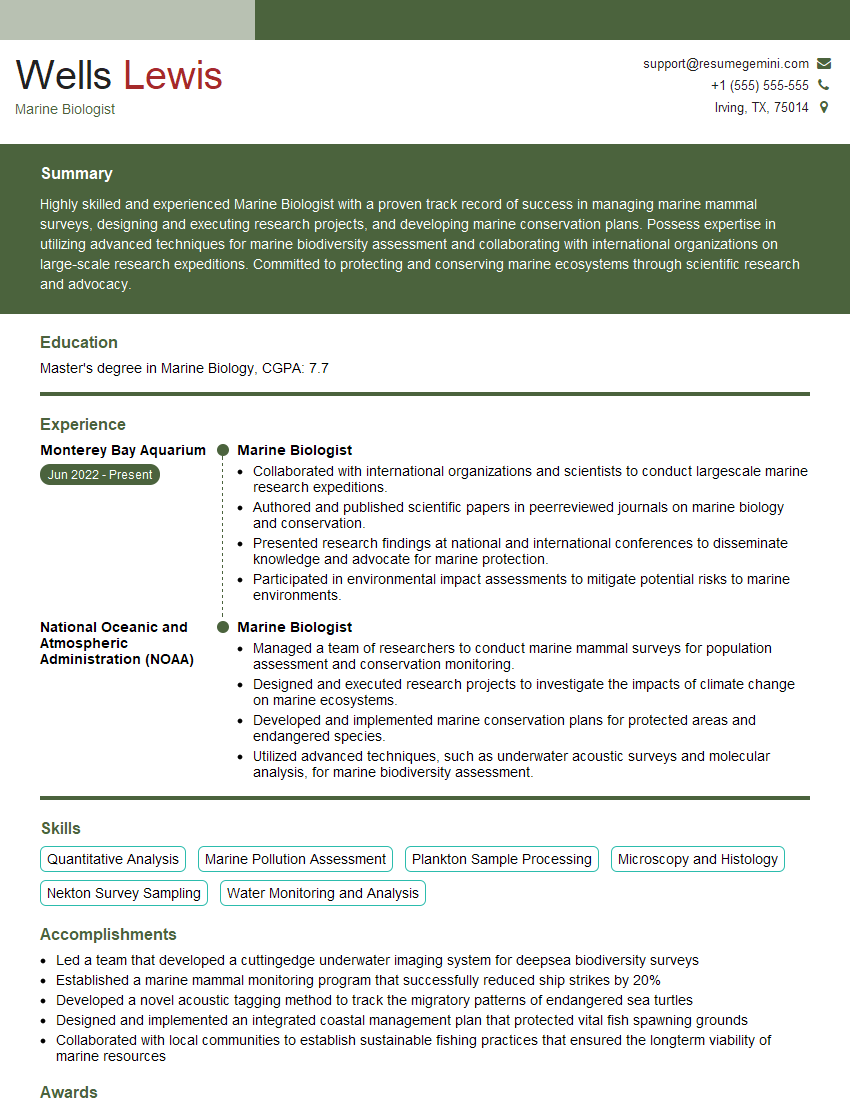
Mastering Marine Ecosystem Management is crucial for a rewarding and impactful career. It opens doors to diverse roles within government agencies, research institutions, non-profit organizations, and the private sector. To significantly boost your job prospects, creating an ATS-friendly resume is essential. This ensures your qualifications are effectively highlighted and easily searchable by hiring managers and Applicant Tracking Systems. We highly recommend using ResumeGemini to craft a professional and compelling resume. ResumeGemini provides a user-friendly platform and offers examples of resumes tailored to Marine Ecosystem Management, helping you showcase your skills and experience effectively.
Explore more articles
Users Rating of Our Blogs
Share Your Experience
We value your feedback! Please rate our content and share your thoughts (optional).
What Readers Say About Our Blog
Attention music lovers!
Wow, All the best Sax Summer music !!!
Spotify: https://open.spotify.com/artist/6ShcdIT7rPVVaFEpgZQbUk
Apple Music: https://music.apple.com/fr/artist/jimmy-sax-black/1530501936
YouTube: https://music.youtube.com/browse/VLOLAK5uy_noClmC7abM6YpZsnySxRqt3LoalPf88No
Other Platforms and Free Downloads : https://fanlink.tv/jimmysaxblack
on google : https://www.google.com/search?q=22+AND+22+AND+22
on ChatGPT : https://chat.openai.com?q=who20jlJimmy20Black20Sax20Producer
Get back into the groove with Jimmy sax Black
Best regards,
Jimmy sax Black
www.jimmysaxblack.com
Hi I am a troller at The aquatic interview center and I suddenly went so fast in Roblox and it was gone when I reset.
Hi,
Business owners spend hours every week worrying about their website—or avoiding it because it feels overwhelming.
We’d like to take that off your plate:
$69/month. Everything handled.
Our team will:
Design a custom website—or completely overhaul your current one
Take care of hosting as an option
Handle edits and improvements—up to 60 minutes of work included every month
No setup fees, no annual commitments. Just a site that makes a strong first impression.
Find out if it’s right for you:
https://websolutionsgenius.com/awardwinningwebsites
Hello,
we currently offer a complimentary backlink and URL indexing test for search engine optimization professionals.
You can get complimentary indexing credits to test how link discovery works in practice.
No credit card is required and there is no recurring fee.
You can find details here:
https://wikipedia-backlinks.com/indexing/
Regards
NICE RESPONSE TO Q & A
hi
The aim of this message is regarding an unclaimed deposit of a deceased nationale that bears the same name as you. You are not relate to him as there are millions of people answering the names across around the world. But i will use my position to influence the release of the deposit to you for our mutual benefit.
Respond for full details and how to claim the deposit. This is 100% risk free. Send hello to my email id: lukachachibaialuka@gmail.com
Luka Chachibaialuka
Hey interviewgemini.com, just wanted to follow up on my last email.
We just launched Call the Monster, an parenting app that lets you summon friendly ‘monsters’ kids actually listen to.
We’re also running a giveaway for everyone who downloads the app. Since it’s brand new, there aren’t many users yet, which means you’ve got a much better chance of winning some great prizes.
You can check it out here: https://bit.ly/callamonsterapp
Or follow us on Instagram: https://www.instagram.com/callamonsterapp
Thanks,
Ryan
CEO – Call the Monster App
Hey interviewgemini.com, I saw your website and love your approach.
I just want this to look like spam email, but want to share something important to you. We just launched Call the Monster, a parenting app that lets you summon friendly ‘monsters’ kids actually listen to.
Parents are loving it for calming chaos before bedtime. Thought you might want to try it: https://bit.ly/callamonsterapp or just follow our fun monster lore on Instagram: https://www.instagram.com/callamonsterapp
Thanks,
Ryan
CEO – Call A Monster APP
To the interviewgemini.com Owner.
Dear interviewgemini.com Webmaster!
Hi interviewgemini.com Webmaster!
Dear interviewgemini.com Webmaster!
excellent
Hello,
We found issues with your domain’s email setup that may be sending your messages to spam or blocking them completely. InboxShield Mini shows you how to fix it in minutes — no tech skills required.
Scan your domain now for details: https://inboxshield-mini.com/
— Adam @ InboxShield Mini
support@inboxshield-mini.com
Reply STOP to unsubscribe
Hi, are you owner of interviewgemini.com? What if I told you I could help you find extra time in your schedule, reconnect with leads you didn’t even realize you missed, and bring in more “I want to work with you” conversations, without increasing your ad spend or hiring a full-time employee?
All with a flexible, budget-friendly service that could easily pay for itself. Sounds good?
Would it be nice to jump on a quick 10-minute call so I can show you exactly how we make this work?
Best,
Hapei
Marketing Director
Hey, I know you’re the owner of interviewgemini.com. I’ll be quick.
Fundraising for your business is tough and time-consuming. We make it easier by guaranteeing two private investor meetings each month, for six months. No demos, no pitch events – just direct introductions to active investors matched to your startup.
If youR17;re raising, this could help you build real momentum. Want me to send more info?
Hi, I represent an SEO company that specialises in getting you AI citations and higher rankings on Google. I’d like to offer you a 100% free SEO audit for your website. Would you be interested?
Hi, I represent an SEO company that specialises in getting you AI citations and higher rankings on Google. I’d like to offer you a 100% free SEO audit for your website. Would you be interested?