Every successful interview starts with knowing what to expect. In this blog, we’ll take you through the top Merchandise assortment and display planning interview questions, breaking them down with expert tips to help you deliver impactful answers. Step into your next interview fully prepared and ready to succeed.
Questions Asked in Merchandise assortment and display planning Interview
Q 1. Explain your understanding of merchandise assortment planning.
Merchandise assortment planning is the strategic process of selecting the right products to offer to your customers at the right time and in the right place. It’s like curating a perfect menu for a restaurant – you wouldn’t offer only lobster if your target audience is families on a budget. It involves analyzing market trends, understanding your target customer, and considering your competitors’ offerings to create a product mix that maximizes sales and profitability. This includes decisions on product categories, brands, sizes, colors, and styles. A well-planned assortment attracts customers, enhances brand image, and ultimately drives sales.
- Product Breadth: The number of different product categories offered (e.g., clothing, shoes, accessories).
- Product Depth: The number of variations within each category (e.g., different sizes and colors of a particular shirt).
- Product Width: The overall range of products offered, encompassing both breadth and depth.
Q 2. How do you determine the optimal product assortment for a specific store location?
Determining the optimal product assortment for a specific store location requires a deep dive into local market characteristics. I use a multi-faceted approach:
- Demographic Analysis: Understanding the age, income, lifestyle, and preferences of the local population. For example, a store in a wealthy suburban area will likely carry higher-priced items than one in a college town.
- Competitor Analysis: Identifying competitors’ offerings and strategies to differentiate our assortment and capture market share. This includes analyzing their strengths and weaknesses to identify opportunities.
- Sales Data Analysis (historical): Examining past sales data from similar locations to predict future demand. This informs decisions about which products have historically performed well in similar environments.
- Local Market Research: Conducting surveys, focus groups, or other forms of research to gather direct customer feedback on product preferences. This ensures we’re actively responding to local desires.
- Store Format & Size: Considering the physical space available in the store. A smaller store will naturally have a more limited assortment compared to a large flagship store.
By combining these data points, I can develop an assortment that is tailored to the specific needs and preferences of the target market while optimizing the use of available space and resources.
Q 3. Describe your experience with planogram creation and implementation.
I have extensive experience in planogram creation and implementation, utilizing software such as JDA Space Planning and other specialized tools. A planogram is essentially a visual representation of how products should be arranged on shelves or displays. My process typically involves:
- Data Input: Entering product dimensions, sales data, and other relevant information into the planogram software.
- Planogram Design: Utilizing the software’s features to create visually appealing and efficient layouts that maximize space utilization and product visibility. This often includes considering factors like shelf height, product facing, and signage.
- Testing & Optimization: Simulating different planogram variations to assess their impact on sales and other key metrics. A/B testing in real-world scenarios is crucial to fine-tune the planogram.
- Implementation & Monitoring: Working with store personnel to ensure accurate and timely implementation of the planogram. Post-implementation monitoring tracks sales data and assesses the effectiveness of the planogram, informing future iterations.
For example, I once worked on a planogram for a grocery store’s snack aisle. By optimizing shelf placement and product facing based on sales data, we increased sales of a previously underperforming brand by 15% within three months.
Q 4. How do you analyze sales data to inform assortment decisions?
Sales data analysis is crucial for informing assortment decisions. I use various techniques to extract actionable insights:
- Sales Trend Analysis: Identifying upward or downward trends in sales for individual products and product categories. This helps predict future demand and adjust assortment accordingly.
- Sales Velocity Analysis: Measuring the rate at which products are sold. Products with high sales velocity are generally prioritized in the assortment.
- Seasonality Analysis: Understanding seasonal fluctuations in demand to optimize the assortment throughout the year. Summer clothing will be prioritized in spring and summer.
- ABC Analysis: Categorizing products into A, B, and C categories based on sales contribution. A products (high contribution) receive the most attention, while C products (low contribution) are reviewed for discontinuation.
- Regression Analysis: Identifying correlations between different factors and sales to predict future sales and optimize assortment decisions.
For instance, if sales data shows a consistent decline in demand for a particular product line, we might consider reducing the number of variations offered or removing it from the assortment entirely.
Q 5. What metrics do you use to measure the success of a merchandise assortment?
Several metrics are used to measure the success of a merchandise assortment:
- Sales Revenue: The total revenue generated from the assortment.
- Gross Margin Return on Investment (GMROI): A measure of profitability that indicates how effectively inventory is turned into profit.
- Sell-through Rate: The percentage of inventory sold within a given period.
- Inventory Turnover: The number of times inventory is sold and replaced within a given period.
- Customer Satisfaction: Measured through surveys, feedback forms, and other methods. A successful assortment meets customer needs and preferences.
- Stockout Rate: The percentage of times a product is out of stock when a customer wants to purchase it. A low stockout rate indicates efficient inventory management.
A holistic view of these metrics provides a comprehensive assessment of the assortment’s performance. For example, a high sales revenue might be offset by a low GMROI if profit margins are too thin.
Q 6. Explain your experience with inventory management as it relates to assortment planning.
Inventory management is intrinsically linked to assortment planning. Efficient inventory management ensures that the right products are available at the right time to meet customer demand while minimizing storage costs and waste. My experience includes:
- Demand Forecasting: Accurately predicting future demand to optimize inventory levels. Sophisticated forecasting models are often employed.
- Inventory Control Systems: Utilizing inventory management software to track inventory levels, monitor stockouts, and manage replenishment.
- Order Optimization: Determining the optimal quantities of each product to order based on demand forecasts and lead times.
- Inventory Turnover Management: Monitoring and managing inventory turnover to ensure efficient inventory flow and minimize the risk of obsolescence.
For example, I worked on implementing a new inventory management system that reduced stockouts by 10% and improved inventory turnover by 15%.
Q 7. How do you balance customer demand with inventory constraints when planning assortment?
Balancing customer demand with inventory constraints is a constant challenge in assortment planning. I employ several strategies:
- Demand Forecasting & Planning: Accurately forecasting demand using historical sales data, market trends, and promotional activities. This informs purchasing decisions.
- Prioritization of High-Demand Items: Allocating more inventory to products with high sales velocity and low stockout tolerance.
- Strategic Sourcing & Vendor Management: Working closely with suppliers to ensure reliable and timely product delivery. Negotiating favorable lead times can mitigate inventory constraints.
- Flexible Assortment Management: Adjusting the assortment based on actual sales data and available inventory. This allows for quick responses to unexpected surges or drops in demand.
- Real-Time Inventory Monitoring: Using technology to track inventory levels in real time, allowing for proactive replenishment and preventing stockouts.
For instance, if we anticipate a surge in demand for a particular product during a holiday season, we would increase our inventory levels proactively to meet the anticipated demand. However, if a product has consistently underperformed, we might reduce our inventory to avoid unnecessary stock accumulation.
Q 8. How do you incorporate seasonal trends into your merchandise assortment strategy?
Incorporating seasonal trends into merchandise assortment is crucial for maximizing sales and meeting customer demand. My strategy involves a multi-step process. First, I closely monitor market trends through trend forecasting reports, fashion blogs, social media analytics, and competitor analysis. This allows me to identify emerging colors, styles, and themes well in advance of the season. Second, I collaborate with the buying team to ensure that our product assortment reflects these trends. This includes adjusting our planned purchases to include items aligned with seasonal demands. For example, during the summer months, we might increase the stock of swimwear, light clothing, and summer-themed accessories while reducing the number of heavier winter items. Third, we implement a dynamic pricing strategy, adjusting prices to reflect seasonal demand. Popular seasonal items may see a slight price increase, while slow-moving items from the previous season will be discounted to make room for new stock. Lastly, we strategically place these seasonal items throughout the store to maximize visibility and create engaging displays.
For example, last year, we saw a huge increase in demand for sustainable and ethically sourced products during the holiday season. We adapted our assortment by procuring more eco-friendly gifts and prominently displaying them in our store and online. This proactive approach not only increased our sales but also enhanced our brand image.
Q 9. Describe your experience working with vendors to source products for your assortment.
Working with vendors is a collaborative effort requiring strong communication and relationship management. I start by clearly defining my assortment needs based on market trends and sales forecasts. This includes specifying product categories, desired styles, quality standards, pricing targets, and delivery timelines. I then identify potential vendors through industry directories, trade shows, and online research, carefully vetting them for their reliability, manufacturing capabilities, and ethical practices. Negotiations with vendors involve discussing pricing, minimum order quantities, payment terms, and quality control procedures. Throughout the process, I emphasize building strong relationships, fostering transparency, and ensuring consistent communication to avoid misunderstandings and maintain timely deliveries. Regular quality checks are essential to ensure the products meet the required standards. I use a vendor scorecard to track their performance on various metrics, such as on-time delivery, quality, and responsiveness.
For instance, when sourcing sustainable cotton clothing, I actively seek out vendors with certifications like GOTS (Global Organic Textile Standard) to ensure ethical and environmentally responsible production. Maintaining a strong vendor network allows for flexibility and innovation, providing a competitive edge in the marketplace.
Q 10. How do you handle product recalls or quality issues related to your assortment?
Product recalls and quality issues are handled with utmost urgency and transparency. Our first step is to immediately remove the affected products from shelves and our online store. We then launch a thorough investigation to determine the root cause of the issue, working closely with the vendor and relevant regulatory bodies. Depending on the severity of the issue, we may issue a public announcement, alerting customers about the recall and providing instructions on how to return the defective product. We provide full refunds or replacements as appropriate, aiming to maintain customer trust and minimize potential negative impact on our brand reputation. A post-incident review is conducted to analyze our processes and identify areas for improvement to prevent similar incidents in the future. This could involve strengthening our quality control procedures or enhancing communication channels with our vendors.
For instance, a few years ago, we had a recall on a batch of children’s toys due to a minor safety concern. We promptly handled the situation, communicated transparently with customers, and implemented stricter quality control measures at the manufacturing facility. The swift and effective response minimized the negative publicity and maintained customer confidence.
Q 11. Explain your understanding of different display techniques (e.g., promotional, lifestyle).
Display techniques are vital in showcasing products and driving sales. Promotional displays, often located at high-traffic areas, emphasize price reductions, special offers, or new arrivals using signage and strategic placement. These displays are usually temporary and designed to create a sense of urgency. Lifestyle displays, on the other hand, are more aspirational. They depict products in realistic settings, showing how they integrate into a customer’s life. For example, showcasing a complete outfit, including clothing, accessories, and shoes, together presents a coordinated look. Other common techniques include thematic displays (organized around a specific theme or holiday), grid displays (uniform arrangement for easy browsing), and feature displays (highlighting a single product or category). The choice of technique depends on the product, the target audience, and the overall marketing objectives.
For example, during back-to-school season, we use promotional displays to showcase discounted school supplies and lifestyle displays to show how different backpacks and lunchboxes can be styled for various school activities.
Q 12. How do you ensure consistency in visual merchandising across multiple locations?
Maintaining visual merchandising consistency across multiple locations requires a well-defined strategy and robust communication channels. We start by developing detailed visual merchandising guidelines, including color palettes, signage standards, display templates, and product placement rules. These guidelines are distributed to all store locations and visually communicated through detailed planograms (visual representations of product placement) and style guides. Regular training sessions for store staff are conducted to ensure they understand and consistently implement these guidelines. We use a centralized visual merchandising team to support stores, provide feedback, and conduct regular store visits to monitor compliance and ensure that displays meet the standards. Technology, like digital planogram software, helps in distributing and updating planograms instantly across all locations, minimizing discrepancies and ensuring consistency.
For instance, we might use a digital platform to share updated planograms, allowing store managers to easily adapt to seasonal changes and promotional activities. This ensures uniformity in the look and feel across all stores, irrespective of their geographical location.
Q 13. Describe your process for creating compelling product displays.
Creating compelling product displays involves a strategic approach. I begin by clearly defining the objectives of the display – is it to highlight a new product, promote a sale, or enhance brand image? Next, I consider the target audience and their preferences. The display’s design should resonate with the shoppers I’m trying to reach. This informs my choices about colors, lighting, signage, and overall aesthetic. Then, I select the appropriate display technique – promotional, lifestyle, thematic, etc. – and strategically arrange products to maximize visual appeal and accessibility. I use appropriate signage to highlight key selling points, prices, and promotions. Finally, I constantly monitor the display’s performance, tracking sales and customer feedback to make adjustments as needed. This iterative approach ensures that displays remain effective and engaging.
For example, for a new line of organic skincare products, I’d choose a lifestyle display, showcasing the products in a calming, natural setting with soft lighting and earthy tones. The signage would highlight the natural ingredients and eco-friendly packaging. Regular monitoring of sales data will help to determine the effectiveness of this display and any adjustments that might be needed.
Q 14. How do you utilize technology (e.g., planogram software) in your work?
Technology plays a vital role in optimizing merchandise assortment and display planning. We extensively use planogram software to create and manage shelf layouts, ensuring optimal product placement based on sales data, product dimensions, and customer behavior. This software allows us to simulate different display scenarios and compare their potential impact on sales. Furthermore, we utilize data analytics tools to track sales performance, identify best-selling products, and understand customer preferences. This data drives our assortment decisions and helps us refine our display strategies. Inventory management systems are integrated with our POS system for real-time stock updates, preventing stockouts and ensuring that popular items are always readily available. This integrated approach allows for a more data-driven, efficient, and responsive process in managing our merchandise assortment and displays.
For example, we use planogram software to optimize shelf space allocation. By analyzing sales data, we can identify which products are performing well and allocate more shelf space to them while adjusting shelf space for underperforming items. This ensures efficient use of space and drives overall sales.
Q 15. How do you measure the effectiveness of different display strategies?
Measuring the effectiveness of display strategies requires a multi-faceted approach, combining quantitative and qualitative data. We don’t just look at sales; we analyze the entire customer journey within the store.
Sales Lift: This is the most straightforward metric. We compare sales of products featured in specific displays against their sales in previous periods or in different locations without the display. A significant increase indicates a successful strategy.
Conversion Rates: We track the percentage of shoppers who view a display and then purchase the featured product. A high conversion rate suggests an effective display design and placement.
Traffic Flow: Analyzing customer traffic patterns around displays helps us understand if the display is attracting attention and drawing customers into the area. Heat maps and video analytics are invaluable here.
Customer Feedback: Surveys, focus groups, and in-store interviews provide crucial qualitative data. Understanding customer reactions—positive or negative—to the display is vital for improvement. We might ask: ‘Did the display make it easy to find the product?’ or ‘Was the display visually appealing?’
Inventory Turnover: Faster inventory turnover for products on display indicates strong demand and an effective display strategy. Conversely, slow turnover might point to issues with pricing, placement, or product appeal.
For example, in a recent project, we implemented a new end-cap display for a seasonal product line. By tracking sales lift, conversion rates, and customer feedback, we determined that the redesigned display increased sales by 25% and improved conversion rates by 15%. This data validated our display redesign and informed future strategies.
Career Expert Tips:
- Ace those interviews! Prepare effectively by reviewing the Top 50 Most Common Interview Questions on ResumeGemini.
- Navigate your job search with confidence! Explore a wide range of Career Tips on ResumeGemini. Learn about common challenges and recommendations to overcome them.
- Craft the perfect resume! Master the Art of Resume Writing with ResumeGemini’s guide. Showcase your unique qualifications and achievements effectively.
- Don’t miss out on holiday savings! Build your dream resume with ResumeGemini’s ATS optimized templates.
Q 16. Explain your understanding of pricing strategies in relation to assortment planning.
Pricing strategies are intrinsically linked to assortment planning. The price of an item significantly influences its placement within the overall assortment and how it’s presented to the customer.
Value Pricing: For value-oriented assortments, we might prioritize items with competitive pricing and strong value propositions, potentially placing them prominently to attract budget-conscious shoppers.
Premium Pricing: Premium products demand a different approach. They are often showcased in more exclusive areas of the store, highlighting their quality and unique features. The visual display must reflect this higher price point.
Promotional Pricing: Promotional pricing influences display strategy greatly. Discounted items are often placed strategically—end caps, promotional aisles—to drive traffic and increase sales volume. Clear signage is crucial here.
Price Bundling: Bundling products together at a discounted price can influence display planning. We might create displays specifically designed to showcase bundled items, making it easy for customers to see the value proposition.
For example, a grocery store might position its own-brand products (value pricing) prominently while showcasing premium organic items in a dedicated section with elegant displays. Similarly, end-caps might highlight weekly promotional deals.
Q 17. How do you incorporate customer feedback into your assortment planning process?
Customer feedback is vital for continuous improvement in assortment planning. We integrate feedback through various channels:
Surveys: Online and in-store surveys gather data on customer preferences, needs, and shopping experiences. These can be targeted to specific product categories or demographics.
Focus Groups: Focus groups provide rich qualitative data. We can directly observe customer reactions to different products and displays, gaining valuable insights into their decision-making process.
Social Media Monitoring: We track social media mentions of our brand and products, capturing customer sentiments and identifying emerging trends. This helps us understand what customers are saying about our assortment both positively and negatively.
Sales Data Analysis: Analyzing sales data reveals which products are performing well and which are lagging. This data, combined with other feedback, helps us understand the reasons behind the performance and make informed decisions.
Customer Relationship Management (CRM) Data: CRM data provides a detailed view of individual customer preferences, purchase history, and feedback. This allows for personalized recommendations and targeted assortment strategies.
For instance, if customer surveys consistently highlight a need for more sustainable products, we can adjust our assortment to incorporate a wider range of eco-friendly options, which then informs our display planning, potentially creating dedicated areas for these products.
Q 18. How do you manage changes in customer preferences or market trends?
Managing changes in customer preferences and market trends requires a proactive and data-driven approach. We employ several strategies:
Trend Monitoring: We actively track industry publications, market research reports, and competitor activity to anticipate shifts in consumer demand. This includes analyzing social media trends and emerging technologies.
Sales Data Analysis: Regularly analyzing sales data helps identify products experiencing declining sales or emerging trends. This allows for timely adjustments to the assortment.
Agile Assortment Planning: Moving towards more agile methods enables us to respond swiftly to changes in demand. This often involves smaller, more frequent adjustments to the assortment rather than large-scale overhauls.
Testing and Experimentation: We continuously test new products and display strategies on a smaller scale to gauge customer response before implementing large-scale changes. This minimizes risk and maximizes learning.
Collaboration and Communication: Open communication between merchandising, marketing, and sales teams ensures everyone is aware of changing trends and can adapt their strategies accordingly.
For example, if we observe a significant increase in demand for a particular product category, we quickly increase our inventory and adjust display strategies to highlight these products. Conversely, if a product consistently underperforms, we may reduce inventory or remove it from the assortment.
Q 19. How do you stay current on industry best practices in merchandise assortment and display?
Staying current requires a multifaceted approach encompassing continuous learning and networking.
Industry Publications and Trade Shows: Regularly reading industry publications such as trade magazines and attending relevant trade shows keeps me informed about the latest trends, technologies, and best practices in merchandise assortment and display planning.
Professional Organizations: Membership in professional organizations such as the Retail Management Association allows for networking with peers and access to industry insights and events.
Online Courses and Webinars: Online platforms offer valuable resources, including courses and webinars, on topics like visual merchandising, data analytics, and consumer behavior, providing ongoing professional development.
Benchmarking: Studying successful retail strategies and best practices from other companies helps identify effective approaches that can be adapted to our specific context.
Data Analytics Tools: Staying updated on the latest data analytics tools and techniques is essential for gaining deeper insights into consumer behavior and optimizing display strategies.
For instance, I recently completed a course on advanced data visualization techniques, allowing me to create more effective and informative reports to guide our assortment planning decisions.
Q 20. Describe a time you had to make a difficult decision regarding product assortment.
One challenging decision involved discontinuing a long-standing, but underperforming, product line. This product had sentimental value, but data clearly showed consistent low sales and negative customer feedback. Removing it meant losing some revenue in the short-term but freeing up valuable shelf space and resources.
The decision-making process involved:
Data Analysis: We meticulously reviewed sales data, customer feedback surveys, and competitor analysis to demonstrate the product’s underperformance.
Team Discussion: We held a team meeting to present the data and discuss the implications of discontinuation, addressing concerns and finding solutions for affected team members.
Alternative Exploration: We explored alternative uses for the freed-up shelf space—introducing new, potentially more successful products.
Communication Plan: We developed a plan to communicate the decision to stakeholders and customers, minimizing negative impact.
While initially difficult, the decision ultimately proved beneficial. The freed-up space was used for higher-performing products, resulting in a significant increase in overall sales and improved store profitability.
Q 21. Describe a time you had to troubleshoot a display issue.
We once experienced an issue with a newly implemented interactive display. The touchscreen was malfunctioning, causing significant frustration for customers. The problem was impacting sales and damaging the brand’s image.
Troubleshooting involved:
Identify the Issue: We first confirmed the touchscreen malfunction and the extent of its impact on customer experience.
Gather Data: We collected data from customer feedback and staff observations to understand the frequency and nature of the malfunction.
Diagnose the Root Cause: We investigated potential causes, ranging from software glitches to hardware failures.
Implement Temporary Fix: While awaiting a permanent solution, we placed temporary signage explaining the issue and apologizing for the inconvenience. We also assigned staff to assist customers.
Permanent Solution: We worked with the display vendor to diagnose the problem and implement a lasting solution. This involved a combination of software updates and hardware replacement.
By systematically addressing the problem, we minimized negative customer impact and preserved our brand reputation. The incident also led to better quality control procedures when implementing new displays.
Q 22. How do you collaborate with other departments (e.g., marketing, buying) in your role?
Collaboration is the cornerstone of successful merchandise planning. My role necessitates close partnerships with various departments. With the Marketing team, I work hand-in-hand to understand upcoming campaigns, target audiences, and promotional strategies. This ensures that our assortment aligns perfectly with marketing initiatives and maximizes their impact. For example, if a major marketing campaign is focused on sustainable products, I’ll prioritize those items in our assortment and placement. With the Buying team, the relationship is crucial for inventory management. I provide them with sales forecasts and insights into product performance, informing their purchasing decisions. We work together to optimize inventory levels, minimizing stockouts while avoiding excessive surplus. Finally, strong communication with Visual Merchandising is vital to ensure the right products are displayed effectively, enhancing customer experience and sales conversion.
Q 23. Explain your experience with forecasting demand for merchandise.
Forecasting demand is an iterative process that blends historical data with forward-looking insights. I leverage a variety of techniques. Firstly, historical sales data provides a baseline. Analyzing past trends – seasonal fluctuations, promotional responses, and product lifecycle – helps identify patterns and predict future demand. Secondly, market research, including competitor analysis and customer feedback, informs our understanding of evolving preferences. This helps us anticipate emerging trends and adjust our forecasts accordingly. Thirdly, external factors are considered such as economic conditions, weather patterns, and major events. For example, an unusually warm winter might significantly impact sales of winter coats. Finally, statistical modeling and forecasting software refine these predictions. This allows us to test different scenarios and quantify the potential impact of various variables. The forecast is continuously refined based on actual sales data, enabling us to adapt to unexpected changes in demand.
Q 24. How do you balance profitability with customer satisfaction in your assortment planning?
Balancing profitability and customer satisfaction is a delicate act, and it’s at the heart of effective assortment planning. We achieve this through a multi-pronged approach. Firstly, we analyze profit margins for each product category to identify high-performing items contributing significantly to profitability. However, we don’t solely focus on high-margin items. We must also consider customer demand and product breadth to avoid alienating customers. We use data analytics to understand what our customers want and value – price sensitivity, product features, etc. – guiding the balance. For example, we might include some lower-margin items that are essential to a complete customer experience, even if they don’t individually yield high profits. This approach also incorporates markdown strategies; we might introduce limited-time discounts on slower-moving items to boost sales without significantly impacting overall profitability. A well-balanced assortment increases both sales volume and average order value, ultimately enhancing the overall profitability whilst maintaining customer satisfaction.
Q 25. Describe your experience with different types of retail formats (e.g., brick-and-mortar, e-commerce).
My experience spans both brick-and-mortar and e-commerce retail formats, and understanding the nuances of each is crucial. In brick-and-mortar stores, spatial planning and visual merchandising play a huge role in influencing purchases. Product placement, signage, and overall store layout impact how customers interact with products and make purchasing decisions. In contrast, e-commerce relies heavily on user experience, search optimization, and compelling product descriptions. Merchandise assortment for online stores requires careful consideration of digital shelf space, image quality, and effective product filtering. In both, effective data analytics is vital. In brick-and-mortar, this involves analyzing sales data by location in the store, and online, analyzing conversion rates, click-through rates, and bounce rates to optimize both displays and digital presentations. The key difference lies in the presentation and customer journey, but the goal remains the same: to present the right product to the right customer at the right time.
Q 26. How would you approach creating a merchandise assortment for a new product launch?
Launching a new product requires a strategic approach to assortment planning. The process begins with market research to understand the target audience, their needs, and their buying behavior. Then, we carefully consider product variations – colors, sizes, styles – to cater to diverse preferences. Next, we analyze complementary products, items that often sell well together with the new product. We want to create a bundle that increases the average order value and satisfies customer needs. The placement of the new product is vital; it should be prominently featured, ideally within sections that complement its nature and target audience. Finally, we need a robust post-launch analysis plan, gathering feedback, monitoring sales data, and iteratively adjusting our assortment based on actual performance. This approach is crucial to ensure a successful launch and maximize sales potential.
Q 27. How do you handle situations where a key product is out of stock?
Stockouts are a significant concern, as they directly impact sales and customer satisfaction. My immediate response involves determining the root cause – was it inaccurate demand forecasting, a supply chain disruption, or unexpected high demand? Once the cause is identified, I work with the buying team to expedite replenishment. For immediate relief, we explore alternative solutions, such as offering substitute products, if possible, or providing clear communication to the customer about expected delivery dates. A transparent and empathetic approach is essential in managing customer expectations during stockouts. To prevent future occurrences, we analyze the data to understand why the stockout happened and adjust our forecasting models, supply chain processes, or safety stock levels accordingly. Post-incident reviews help to identify areas for improvement in the overall system.
Q 28. What are your salary expectations for this role?
My salary expectations are in line with the industry standard for a Merchandise Assortment and Display Planning professional with my experience and skillset. Considering my proven track record in optimizing assortments, improving profitability, and enhancing customer satisfaction, I am seeking a competitive compensation package that reflects my value to the organization. I’m open to discussing this further based on the specifics of the role and the overall compensation and benefits package offered.
Key Topics to Learn for Merchandise Assortment and Display Planning Interview
- Understanding Consumer Behavior: Analyze how consumer preferences, demographics, and buying patterns influence assortment choices and display strategies. Consider how data analytics can inform these decisions.
- Assortment Planning Strategies: Explore various approaches to building an optimal product assortment, including breadth, depth, and variety. Understand the trade-offs between maximizing sales and minimizing inventory costs.
- Visual Merchandising Principles: Learn about effective display techniques that enhance product visibility, create engaging shopping experiences, and drive sales conversions. This includes understanding color psychology, space planning, and storytelling through displays.
- Inventory Management & Forecasting: Understand the crucial link between assortment planning and inventory management. Learn to forecast demand accurately to avoid stockouts and overstocking.
- Planogram Development & Implementation: Master the creation and implementation of planograms—visual representations of product placement within a store or online shelf. Understand the software and tools used in this process.
- Data Analysis & Reporting: Develop your skills in analyzing sales data, market trends, and customer feedback to optimize assortment and display strategies. Learn to present your findings effectively.
- Category Management Techniques: Learn to manage product categories effectively, understanding how to identify and address category performance issues through assortment and display adjustments.
- Problem-Solving in Assortment & Display: Practice identifying and solving real-world challenges, such as slow-moving inventory, ineffective displays, or missed sales opportunities.
Next Steps
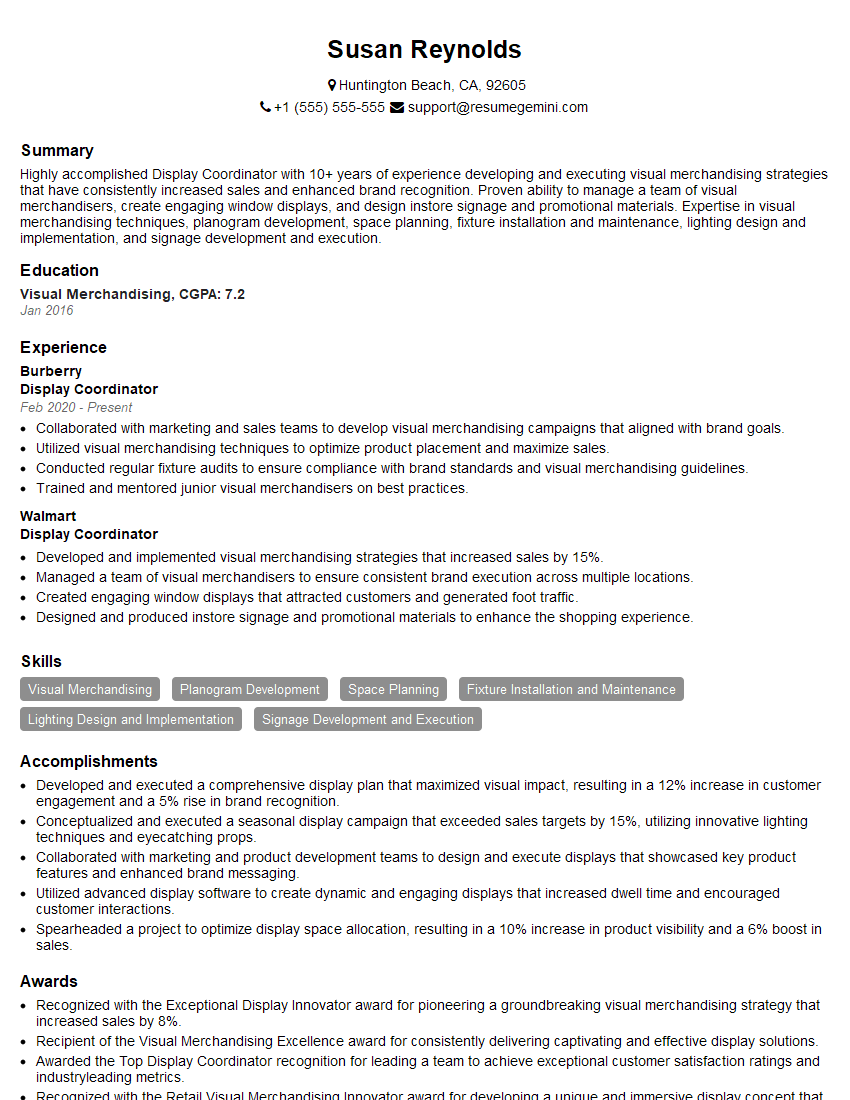
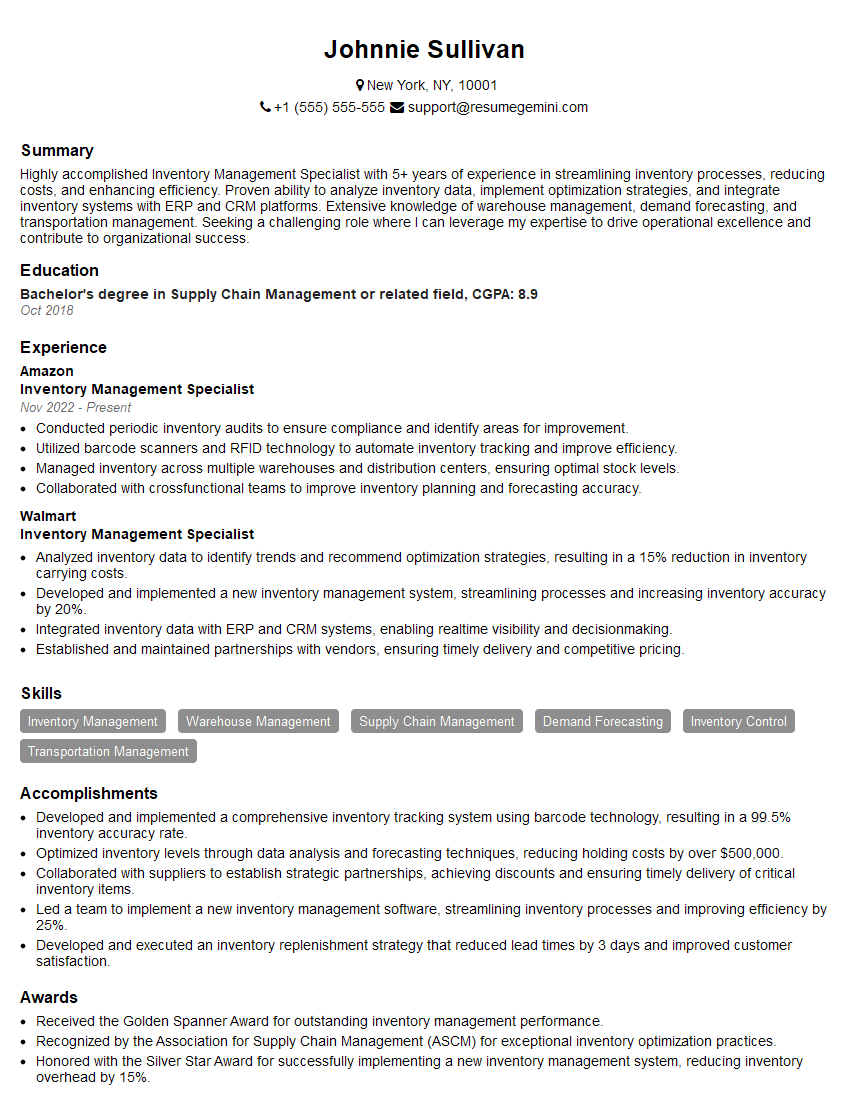
Mastering merchandise assortment and display planning is crucial for career advancement in retail, e-commerce, and related fields. It demonstrates a keen understanding of consumer behavior, business acumen, and a strategic approach to maximizing sales and profitability. To significantly boost your job prospects, create a compelling and ATS-friendly resume that showcases your skills and experience effectively. ResumeGemini is a trusted resource that can help you build a professional resume tailored to your specific skills and experience. Examples of resumes tailored to Merchandise Assortment and Display Planning are available to further enhance your job search strategy.
Explore more articles
Users Rating of Our Blogs
Share Your Experience
We value your feedback! Please rate our content and share your thoughts (optional).
What Readers Say About Our Blog
Attention music lovers!
Wow, All the best Sax Summer music !!!
Spotify: https://open.spotify.com/artist/6ShcdIT7rPVVaFEpgZQbUk
Apple Music: https://music.apple.com/fr/artist/jimmy-sax-black/1530501936
YouTube: https://music.youtube.com/browse/VLOLAK5uy_noClmC7abM6YpZsnySxRqt3LoalPf88No
Other Platforms and Free Downloads : https://fanlink.tv/jimmysaxblack
on google : https://www.google.com/search?q=22+AND+22+AND+22
on ChatGPT : https://chat.openai.com?q=who20jlJimmy20Black20Sax20Producer
Get back into the groove with Jimmy sax Black
Best regards,
Jimmy sax Black
www.jimmysaxblack.com
Hi I am a troller at The aquatic interview center and I suddenly went so fast in Roblox and it was gone when I reset.
Hi,
Business owners spend hours every week worrying about their website—or avoiding it because it feels overwhelming.
We’d like to take that off your plate:
$69/month. Everything handled.
Our team will:
Design a custom website—or completely overhaul your current one
Take care of hosting as an option
Handle edits and improvements—up to 60 minutes of work included every month
No setup fees, no annual commitments. Just a site that makes a strong first impression.
Find out if it’s right for you:
https://websolutionsgenius.com/awardwinningwebsites
Hello,
we currently offer a complimentary backlink and URL indexing test for search engine optimization professionals.
You can get complimentary indexing credits to test how link discovery works in practice.
No credit card is required and there is no recurring fee.
You can find details here:
https://wikipedia-backlinks.com/indexing/
Regards
NICE RESPONSE TO Q & A
hi
The aim of this message is regarding an unclaimed deposit of a deceased nationale that bears the same name as you. You are not relate to him as there are millions of people answering the names across around the world. But i will use my position to influence the release of the deposit to you for our mutual benefit.
Respond for full details and how to claim the deposit. This is 100% risk free. Send hello to my email id: lukachachibaialuka@gmail.com
Luka Chachibaialuka
Hey interviewgemini.com, just wanted to follow up on my last email.
We just launched Call the Monster, an parenting app that lets you summon friendly ‘monsters’ kids actually listen to.
We’re also running a giveaway for everyone who downloads the app. Since it’s brand new, there aren’t many users yet, which means you’ve got a much better chance of winning some great prizes.
You can check it out here: https://bit.ly/callamonsterapp
Or follow us on Instagram: https://www.instagram.com/callamonsterapp
Thanks,
Ryan
CEO – Call the Monster App
Hey interviewgemini.com, I saw your website and love your approach.
I just want this to look like spam email, but want to share something important to you. We just launched Call the Monster, a parenting app that lets you summon friendly ‘monsters’ kids actually listen to.
Parents are loving it for calming chaos before bedtime. Thought you might want to try it: https://bit.ly/callamonsterapp or just follow our fun monster lore on Instagram: https://www.instagram.com/callamonsterapp
Thanks,
Ryan
CEO – Call A Monster APP
To the interviewgemini.com Owner.
Dear interviewgemini.com Webmaster!
Hi interviewgemini.com Webmaster!
Dear interviewgemini.com Webmaster!
excellent
Hello,
We found issues with your domain’s email setup that may be sending your messages to spam or blocking them completely. InboxShield Mini shows you how to fix it in minutes — no tech skills required.
Scan your domain now for details: https://inboxshield-mini.com/
— Adam @ InboxShield Mini
support@inboxshield-mini.com
Reply STOP to unsubscribe
Hi, are you owner of interviewgemini.com? What if I told you I could help you find extra time in your schedule, reconnect with leads you didn’t even realize you missed, and bring in more “I want to work with you” conversations, without increasing your ad spend or hiring a full-time employee?
All with a flexible, budget-friendly service that could easily pay for itself. Sounds good?
Would it be nice to jump on a quick 10-minute call so I can show you exactly how we make this work?
Best,
Hapei
Marketing Director
Hey, I know you’re the owner of interviewgemini.com. I’ll be quick.
Fundraising for your business is tough and time-consuming. We make it easier by guaranteeing two private investor meetings each month, for six months. No demos, no pitch events – just direct introductions to active investors matched to your startup.
If youR17;re raising, this could help you build real momentum. Want me to send more info?
Hi, I represent an SEO company that specialises in getting you AI citations and higher rankings on Google. I’d like to offer you a 100% free SEO audit for your website. Would you be interested?
Hi, I represent an SEO company that specialises in getting you AI citations and higher rankings on Google. I’d like to offer you a 100% free SEO audit for your website. Would you be interested?