Are you ready to stand out in your next interview? Understanding and preparing for Microcontroller Programming (Arduino, Raspberry Pi) interview questions is a game-changer. In this blog, we’ve compiled key questions and expert advice to help you showcase your skills with confidence and precision. Let’s get started on your journey to acing the interview.
Questions Asked in Microcontroller Programming (Arduino, Raspberry Pi) Interview
Q 1. Explain the difference between an Arduino and a Raspberry Pi.
Arduinos and Raspberry Pis are both popular choices for embedded systems, but they cater to different needs. Think of it like this: an Arduino is a powerful, dedicated worker focused on a specific task, while a Raspberry Pi is a more versatile, general-purpose computer that can handle many tasks simultaneously.
- Arduino: A microcontroller board based on a single-chip microcontroller. It’s relatively low-cost, low-power, and excels at controlling hardware directly. It’s ideal for projects requiring precise timing and real-time control, like robotics or sensor integration. Arduinos usually run pre-compiled programs directly on the chip and have limited resources.
- Raspberry Pi: A single-board computer, running a full operating system like Linux. It’s more powerful than an Arduino and can run complex applications and handle networking tasks efficiently. It is better suited for projects requiring more processing power and sophisticated software, such as web servers or multimedia applications. The trade-off is that it consumes more power and has higher cost compared to an Arduino.
In short, choose an Arduino for dedicated, resource-constrained, real-time applications and a Raspberry Pi for more complex, software-intensive projects.
Q 2. Describe the architecture of an Arduino microcontroller.
The architecture of an Arduino microcontroller (typically based on the AVR family) is centered around a single chip that integrates a CPU, memory, and peripherals. Imagine it as a tiny, self-contained computer. Here’s a breakdown:
- CPU (Central Processing Unit): The brain of the operation, fetching and executing instructions from the program memory.
- Flash Memory: Stores the program code that the microcontroller executes. This memory is non-volatile, meaning it retains data even when the power is turned off.
- SRAM (Static Random-Access Memory): Used for storing temporary data during program execution. This memory is volatile, meaning data is lost when power is removed.
- ADC (Analog-to-Digital Converter): Converts analog signals (like sensor readings) into digital values that the microcontroller can understand.
- Timers/Counters: Essential for precise timing and counting events.
- UART (Universal Asynchronous Receiver/Transmitter): Used for serial communication.
- SPI (Serial Peripheral Interface) and I2C (Inter-Integrated Circuit): These are communication protocols for interfacing with other devices.
- GPIO (General Purpose Input/Output) Pins: Provide the interface to interact with external hardware (sensors, actuators, displays, etc.).
These components work together to allow the Arduino to receive input, process data, and send output according to the programmed instructions.
Q 3. What are the key differences between AVR and ARM microcontrollers?
AVR and ARM are two different architectures used in microcontrollers. They differ significantly in instruction set, performance, power consumption, and cost.
- AVR (Reduced Instruction Set Computer): These microcontrollers are typically found in smaller, less powerful applications. They have a simpler instruction set, making them easier to program but generally less powerful. AVRs are known for their low cost and low power consumption, making them ideal for battery-powered applications. The Arduino Uno, for instance, uses an AVR microcontroller.
- ARM (Advanced RISC Machine): ARM microcontrollers are more powerful and complex than AVRs. They have a more sophisticated instruction set and a larger range of peripherals. ARM processors are common in smartphones, tablets, and increasingly in more sophisticated embedded systems. They offer higher performance but usually consume more power and have a higher cost compared to AVRs.
Choosing between AVR and ARM depends on the project’s requirements. If you need low-cost, low-power operation with simple tasks, AVR is an excellent choice. For more complex projects needing higher processing power, ARM would be preferred.
Q 4. Explain the concept of interrupts and their use in microcontrollers.
Interrupts are like urgent messages that temporarily halt the microcontroller’s normal execution flow to handle a time-sensitive event. Think of it as someone interrupting a meeting to announce an emergency; the meeting is paused to address the immediate concern.
In microcontroller programming, interrupts are triggered by external events (like a button press or sensor reading) or internal events (like a timer reaching a specific value). When an interrupt occurs, the microcontroller saves its current state, executes an interrupt service routine (ISR) to handle the event, and then resumes its normal execution. This allows for efficient handling of time-critical events without constantly polling for changes.
Example: Imagine a system monitoring temperature. Instead of continuously checking the temperature sensor, an interrupt can be configured to trigger an ISR whenever the temperature exceeds a threshold. This is much more efficient than constantly polling.
// Example Arduino code showing interrupt handling (simplified) void setup() { // Configure pin 2 for interrupt pinMode(2, INPUT_PULLUP); attachInterrupt(digitalPinToInterrupt(2), interruptRoutine, FALLING); // Interrupt on falling edge } void loop() { // Main program loop } void interruptRoutine() { // Interrupt service routine (ISR) - executes when interrupt occurs // Perform actions based on the interrupt event (e.g., toggle an LED) } Q 5. How do you handle real-time constraints in microcontroller programming?
Real-time constraints in microcontroller programming refer to the requirement of tasks completing within strict time limits. Missing deadlines can have severe consequences, from malfunctioning equipment to safety hazards. To handle these, several strategies are crucial:
- Prioritize Tasks: Implement a scheduling algorithm (like Round Robin or Rate Monotonic Scheduling) to assign priorities to tasks based on their deadlines. Critical tasks get executed first.
- Optimize Code: Write efficient code minimizing function calls, memory usage, and loop iterations. Every microsecond counts!
- Use Interrupts: As discussed earlier, interrupts allow handling time-critical events without constant polling, improving responsiveness.
- Real-Time Operating Systems (RTOS): For more complex systems, an RTOS provides a framework for managing tasks, scheduling, and synchronization, ensuring tasks meet their deadlines reliably.
- Careful Timing: Use timers and counters precisely to control task execution intervals. This requires accurate calibration and synchronization.
Example: In a motor control application, precisely controlling the motor’s speed and position within a short timeframe is crucial for stability. Using a suitable RTOS and accurate timing mechanisms is vital to avoid oscillations or damage.
Q 6. Describe your experience with different communication protocols (e.g., I2C, SPI, UART).
I have extensive experience with several communication protocols used in microcontroller projects:
- I2C (Inter-Integrated Circuit): A two-wire serial communication protocol, ideal for connecting multiple devices on a single bus. It’s simple to implement but has limitations in speed and distance. I’ve used I2C to interface with sensors (like accelerometers, temperature sensors) and display modules (like OLED displays).
- SPI (Serial Peripheral Interface): A high-speed serial communication protocol, commonly used for connecting microcontrollers to peripherals needing faster data transfer. I’ve utilized SPI for interfacing with SD card modules and high-speed ADCs.
- UART (Universal Asynchronous Receiver/Transmitter): A common serial communication protocol used for simpler point-to-point connections. I’ve employed UART for debugging and communication with PCs, as well as interfacing with GPS modules and other devices.
My experience includes selecting the appropriate protocol based on project needs, implementing the communication logic, and troubleshooting connectivity issues. Choosing the correct protocol often involves balancing speed, complexity, and the number of devices to be connected.
Q 7. Explain how to use timers and counters in an Arduino program.
Timers and counters are fundamental components in microcontrollers used for generating precise timing intervals and counting events. In Arduino, they’re indispensable for tasks involving precise timing, controlling peripherals, and generating PWM signals.
Example: Let’s say we want to blink an LED every second:
// Arduino code to blink an LED every second using millis() unsigned long previousMillis = 0; const long interval = 1000; // milliseconds void setup() { pinMode(13, OUTPUT); // LED connected to pin 13 } void loop() { unsigned long currentMillis = millis(); if (currentMillis - previousMillis >= interval) { previousMillis = currentMillis; digitalWrite(13, !digitalRead(13)); // Toggle the LED state } } This code uses the millis() function, which returns the number of milliseconds since the program started. This approach is more flexible and accurate for longer intervals than relying solely on delay functions. Alternatively, you can utilize the Timer interrupts for more precise control in resource-intensive applications or for multiple timed tasks.
For more complex timing needs or higher precision, you would directly interact with the microcontroller’s timer registers. However, the Arduino libraries provide a simplified, easier-to-use interface in many cases.
Q 8. How do you debug embedded systems?
Debugging embedded systems is a crucial skill, often more challenging than debugging traditional software due to the limited resources and real-time constraints. My approach involves a multi-pronged strategy:
Print Statements (Serial Debugging): The simplest method, especially for Arduino projects, involves strategically placed
Serial.print()statements to monitor variable values and program flow. For example, I might addSerial.print("Sensor Value:", sensorValue);to track a sensor reading. This requires careful planning to avoid overwhelming the serial port.Logic Analyzers and Oscilloscopes: For more complex debugging, I use hardware tools like logic analyzers to examine digital signals and oscilloscopes to visualize analog signals. This allows direct observation of hardware-software interactions and pin behavior, crucial for identifying timing issues or hardware faults.
Integrated Debuggers (JTAG/SWD): Microcontrollers often support JTAG (Joint Test Action Group) or SWD (Serial Wire Debug) interfaces. These allow for in-circuit debugging, enabling setting breakpoints, stepping through code, and inspecting variables in real-time. I find this invaluable for understanding complex code execution and identifying subtle errors.
Simulators and Emulators: For complex systems, simulations and emulators can reproduce the target environment. This lets me test code before deploying it to the actual hardware, significantly reducing development time and debugging effort. I’ve used simulators like Proteus and emulators tailored to specific microcontroller families.
Static Analysis Tools: These tools analyze the code without actually executing it, identifying potential problems like undefined variables, memory leaks, or potential race conditions before runtime. This proactive approach saves considerable debugging time.
Often, I combine these techniques. For instance, I might use print statements for initial checks, then transition to a JTAG debugger for more in-depth analysis of a specific issue. The choice of method depends on the complexity of the system, the available tools, and the nature of the bug.
Q 9. What are the advantages and disadvantages of using polling versus interrupts?
Polling and interrupts are two fundamental methods for handling external events in embedded systems. Both have their strengths and weaknesses:
Polling: Polling involves repeatedly checking the status of an external device or input. Imagine constantly asking a door sensor, “Is the door open?”
- Advantages: Simple to implement, requiring minimal code and resources.
- Disadvantages: Inefficient, wasting CPU cycles checking even when nothing is happening; can lead to missed events if the polling rate is too low; not suitable for high-frequency or time-critical events.
Interrupts: Interrupts signal the microcontroller when an event occurs, allowing it to handle the event immediately without continuously checking. This is like the door sensor sending a message, “Door opened!” only when the door changes state.
- Advantages: Efficient, only consumes CPU cycles when an event happens; ensures timely response to events; better suited for time-critical applications.
- Disadvantages: More complex to implement than polling, requiring interrupt service routines (ISRs) that need to be carefully designed to avoid timing conflicts; potential for interrupt latency.
Choosing between them depends on the application. Polling is suitable for simple, low-frequency events, while interrupts are best for time-sensitive and high-frequency tasks, such as reading from high-speed sensors or handling external communication.
Q 10. Explain the concept of memory management in embedded systems.
Memory management in embedded systems is crucial because these systems often have limited memory resources. Effective memory management prevents errors and ensures efficient code execution. Key aspects include:
Memory Allocation: Embedded systems use both static and dynamic memory allocation. Static allocation assigns memory during compilation, while dynamic allocation happens during runtime using functions like
malloc()andfree()(though careful use is essential to avoid fragmentation). Incorrect allocation can lead to memory leaks or segmentation faults.Memory Layout: The memory is typically divided into distinct sections: code, data (initialized variables), bss (uninitialized variables), stack (function calls and local variables), and heap (dynamic memory). Understanding this layout is vital to prevent conflicts and optimize memory usage. The stack and heap often have a limited size, and careful programming is needed to avoid stack overflow or heap exhaustion.
Memory Protection: Many microcontrollers offer memory protection units (MPUs) to prevent unauthorized access to certain memory regions. This is particularly crucial for security and preventing crashes due to accidental overwrites.
Memory Fragmentation: Dynamic memory allocation can lead to fragmentation, where small, unused blocks of memory are scattered throughout the heap, making it difficult to allocate larger blocks. Techniques like memory compaction or using different memory allocation strategies can mitigate this.
I’ve had experience optimizing memory usage in resource-constrained applications by using techniques such as static allocation where feasible, carefully managing dynamic memory, and profiling memory usage to identify potential bottlenecks.
Q 11. How do you handle power management in battery-powered applications?
Power management is paramount in battery-powered applications to extend battery life. My strategies include:
Low-Power Modes: Microcontrollers offer various low-power modes (sleep, idle, etc.) that reduce power consumption. I often design the system to enter these modes when not actively processing data. For instance, a sensor node might sleep for most of the time, waking up periodically to take readings and transmit data.
Clock Management: Reducing the clock frequency lowers power consumption. The system might operate at a high clock speed during active tasks and switch to a lower frequency during periods of inactivity. This approach significantly impacts energy usage.
Power-Efficient Components: Selecting low-power components (sensors, radios, etc.) is fundamental. Consider the power consumption specifications when choosing hardware.
Software Optimization: Efficient code minimizes processing time and hence power consumption. Minimizing unnecessary calculations and using optimized libraries is important. I often profile code to identify sections that are power-intensive.
Duty Cycling: Activating components only when needed reduces average power consumption. Instead of constantly monitoring a sensor, it might be activated only for a brief period to capture data.
In a project involving a remote weather station, I implemented a system that used low-power sleep modes, duty cycling for the sensors, and a low-power radio module, extending battery life to over a year.
Q 12. Describe your experience with different sensor interfaces.
I have experience with various sensor interfaces, including:
I2C: A two-wire serial bus commonly used for communicating with multiple sensors. I’ve used it with accelerometers, gyroscopes, and environmental sensors. Its simplicity and low pin count make it attractive for resource-constrained systems. However, it’s sensitive to noise, requiring careful consideration of wiring and shielding.
SPI (Serial Peripheral Interface): A high-speed, multi-wire serial bus suitable for data-intensive sensors. I’ve integrated SPI with high-resolution ADCs and displays. Its higher speed compared to I2C makes it ideal for applications requiring fast data transfer.
UART (Universal Asynchronous Receiver/Transmitter): A simple serial interface often used for communication with GPS modules, Bluetooth devices, or other external systems. Its simplicity and widespread availability make it a versatile option. However, it can be slower than I2C or SPI.
Analog Interfaces: I’ve worked with analog sensors, requiring the use of Analog-to-Digital Converters (ADCs) integrated into the microcontroller. Proper calibration and signal conditioning are crucial to ensure accuracy and reliability.
My experience encompasses understanding the timing requirements, data formats, and communication protocols of each interface to successfully integrate various sensors into my projects. I am familiar with handling potential issues such as noise and communication errors.
Q 13. Explain your experience with RTOS (Real-Time Operating Systems).
My experience with Real-Time Operating Systems (RTOS) primarily involves FreeRTOS, a widely used, open-source RTOS. I’ve used it in projects demanding precise timing and multitasking, where multiple tasks need to run concurrently and efficiently.
Task Creation and Management: I’m proficient in creating tasks, defining their priorities, and managing their execution using FreeRTOS functions like
xTaskCreate(),vTaskStartScheduler(), andvTaskDelete(). This allows me to structure applications as independent tasks that interact through inter-process communication.Inter-Process Communication (IPC): I understand and utilize various IPC mechanisms offered by FreeRTOS, such as semaphores, mutexes, and queues, for safe and synchronized data exchange between tasks. This prevents race conditions and ensures data consistency.
Timers and Scheduling: FreeRTOS’s timer functionalities are crucial for time-critical tasks. I can implement periodic tasks and one-shot timers to achieve precise timing control and event handling.
Interrupt Handling within RTOS: Integrating interrupt service routines (ISRs) within the RTOS context is essential to handle external events efficiently without disrupting other tasks. I understand the importance of keeping ISRs short and avoiding blocking operations.
Using FreeRTOS, I developed a system controlling multiple motors and sensors simultaneously, each with its own timing requirements. The RTOS ensured reliable operation and precise synchronization of the different components.
Q 14. How would you design a state machine for a specific application?
Designing a state machine involves breaking down a complex system into a series of discrete states, each with its own set of actions and transitions. Let’s consider an example: designing a state machine for a simple traffic light.
States:
GreenYellowRed
Transitions:
Green -> Yellow(after a certain timer)Yellow -> Red(after a certain timer)Red -> Green(after a certain timer)
Actions:
Green:Activate green light, deactivate yellow and red lights.Yellow:Activate yellow light, deactivate green and red lights.Red:Activate red light, deactivate green and yellow lights.
Implementation (Conceptual):
A simple implementation might involve a variable representing the current state. Based on the current state and timer events, the state transitions and corresponding actions are executed. In a microcontroller, this could be implemented using a switch statement or a more sophisticated state machine library.
// Example (Conceptual)
enum TrafficLightState { GREEN, YELLOW, RED }; TrafficLightState currentState = GREEN; void updateTrafficLight() { switch (currentState) { case GREEN: // Activate green light, deactivate yellow and red if (timerExpired()) { currentState = YELLOW; } break; case YELLOW: // Activate yellow light, deactivate green and red if (timerExpired()) { currentState = RED; } break; case RED: // Activate red light, deactivate green and yellow if (timerExpired()) { currentState = GREEN; } break; } } More complex state machines could involve hierarchical states, asynchronous events, and guards (conditions for transitioning between states). The design of a state machine is highly dependent on the specific application’s requirements and complexity.
Q 15. Describe your experience with version control systems (e.g., Git).
Version control is crucial for collaborative development and managing code changes. My experience primarily revolves around Git, which I’ve used extensively in both personal and professional projects. I’m proficient in using Git for branching, merging, resolving conflicts, and managing remote repositories on platforms like GitHub and GitLab.
For instance, in a recent project involving a smart irrigation system using an Arduino, we used Git to manage different feature branches. One developer worked on the sensor integration while another focused on the control logic. This allowed for parallel development and efficient merging of code changes once each feature was tested. We utilized pull requests for code reviews and ensured a clean and consistent codebase.
Beyond basic commands, I’m comfortable using Git for more advanced tasks such as rebasing, cherry-picking, and managing complex merge conflicts. I understand the importance of writing clear commit messages for future reference and maintainability.
Career Expert Tips:
- Ace those interviews! Prepare effectively by reviewing the Top 50 Most Common Interview Questions on ResumeGemini.
- Navigate your job search with confidence! Explore a wide range of Career Tips on ResumeGemini. Learn about common challenges and recommendations to overcome them.
- Craft the perfect resume! Master the Art of Resume Writing with ResumeGemini’s guide. Showcase your unique qualifications and achievements effectively.
- Don’t miss out on holiday savings! Build your dream resume with ResumeGemini’s ATS optimized templates.
Q 16. How do you ensure code readability and maintainability in embedded projects?
Code readability and maintainability are paramount, especially in embedded systems where resources are often limited. I apply several strategies to achieve this. First and foremost, I adhere to a consistent coding style using clear and meaningful variable and function names. Think of it like writing a well-structured essay – clear headings and concise paragraphs make it easy to understand.
I liberally use comments to explain complex logic or non-obvious code sections. Comments should explain the *why* of the code, not just the *what*. I also break down complex functions into smaller, more manageable modules, each with a specific responsibility. This modular design promotes reusability and easier debugging.
For example, instead of one massive loop handling sensor readings, motor control, and data logging, I’d separate these functionalities into distinct functions: readSensors(), controlMotor(), and logData(). This structure makes the code much cleaner and easier to understand and maintain.
Q 17. Explain your experience with testing methodologies in embedded systems.
Testing is a critical part of my embedded systems development workflow. I employ a layered testing approach, combining unit testing, integration testing, and system testing. Unit testing focuses on individual functions or modules, verifying their correctness in isolation. Integration testing verifies the interaction between different modules. System testing validates the entire system against its requirements.
For unit testing, I often utilize a simple test framework, writing small functions to test the output of individual modules with various inputs. For example, if I have a function that calculates the square root, I’d write several tests with various inputs, ensuring the output matches the expected value. For more complex systems, I’ve also utilized unit testing frameworks like Unity or CppUTest.
Integration and system testing often involve hardware-in-the-loop (HIL) simulation or real-world testing. In the smart irrigation project, I created a simulated environment to test the interaction between the sensor readings and the motor control before deploying it to the physical hardware. This significantly reduced debugging time and risks.
Q 18. What are some common challenges you’ve faced in embedded systems development?
Embedded systems development presents unique challenges. One common challenge is resource constraints – limited memory, processing power, and storage. This necessitates careful code optimization and efficient algorithm design. Another significant challenge is debugging. Debugging on embedded systems can be significantly more difficult than on desktop systems due to limited debugging tools and the complexity of hardware interactions. Real-time constraints also pose a challenge; missed deadlines can lead to system instability or failure.
In a project involving a real-time control system for a robotic arm, we encountered significant challenges in meeting the strict timing requirements. Careful code optimization and the use of real-time operating systems (RTOS) were crucial to overcoming these constraints. We had to use profiling tools to identify and optimize performance bottlenecks.
Q 19. How do you handle memory leaks in embedded systems?
Memory leaks in embedded systems are especially problematic because they can lead to system crashes or unpredictable behavior. The limited memory resources in these systems make them extremely sensitive to even small memory leaks. My approach to preventing memory leaks involves careful memory management practices. This includes using appropriate data structures, avoiding dynamic memory allocation when possible (preferring static allocation), and always freeing dynamically allocated memory using functions like free() in C or delete in C++.
If dynamic memory allocation is unavoidable, I use tools like memory debuggers or static analysis tools to detect potential memory leaks during development. I also employ techniques such as reference counting or smart pointers (in C++) to help manage memory automatically. Regular code reviews also play an important role in identifying and addressing potential issues.
Q 20. How would you optimize code for size and speed in an embedded application?
Optimizing code for size and speed is vital in embedded systems. For size optimization, I focus on reducing code size by using efficient data structures and algorithms. This may involve replacing complex algorithms with simpler, faster ones, even if they are slightly less efficient in terms of computational complexity. I avoid unnecessary libraries and functions to keep the code size minimal. I might also employ compiler optimization flags to reduce the compiled code size.
Speed optimization involves identifying and eliminating performance bottlenecks. Profiling tools can pinpoint the functions or code sections that consume the most processing time. Once identified, I may employ techniques like loop unrolling, using inline functions, or re-writing code to avoid computationally expensive operations. Algorithmic changes could also significantly improve speed. For example, using a more efficient search algorithm can substantially reduce execution time.
Q 21. Explain your experience with different development environments (e.g., Arduino IDE, PlatformIO).
I’ve worked with several development environments for embedded systems. The Arduino IDE is great for quick prototyping and educational projects, providing a user-friendly interface and simplified build process. However, for larger, more complex projects, I find PlatformIO to be more powerful and flexible. It offers superior build system management, supports multiple frameworks (Arduino, ESP-IDF, etc.), and integrates with various tools including unit testing frameworks.
For example, in a recent project involving multiple microcontrollers and communication protocols, PlatformIO’s ability to manage dependencies and build configurations for different targets greatly simplified the development process. It also offered excellent integration with Git, facilitating version control and collaboration. I’ve also used other IDEs such as Eclipse with various plugins when working with more complex systems or specific microcontroller architectures.
Q 22. Describe your experience using libraries and APIs in microcontroller programming.
Libraries and APIs are fundamental to efficient microcontroller programming. They provide pre-written code modules that handle complex tasks, allowing developers to focus on the application’s unique logic rather than reinventing the wheel. Think of them as highly specialized toolkits. For instance, in Arduino, the Servo library simplifies controlling servo motors, abstracting away the low-level details of PWM signal generation. Similarly, on a Raspberry Pi, using the RPi.GPIO library allows for easy interaction with GPIO pins, avoiding the complexities of memory mapping and register manipulation.
My experience encompasses extensive use of libraries for various tasks, including:
- Sensor Integration: Using libraries like Adafruit’s sensor libraries for easy interfacing with various sensors (e.g., temperature, humidity, pressure) on both Arduino and Raspberry Pi.
- Communication Protocols: Leveraging libraries for handling communication protocols such as I2C, SPI, and UART, simplifying the implementation of inter-device communication. For example, I’ve used the
Wirelibrary in Arduino for I2C communication with an accelerometer. - Network Connectivity: Utilizing libraries for networking tasks, like the WiFi library for Arduino or the Python libraries for networking on Raspberry Pi. This enabled me to connect embedded systems to the cloud for data logging and remote control.
Beyond standard libraries, I have experience with creating and adapting custom APIs to integrate different software components within a microcontroller system. This is crucial for creating reusable and modular code, improving maintainability and scalability of projects.
Q 23. How would you approach designing a system with multiple microcontrollers?
Designing a system with multiple microcontrollers requires careful planning and consideration of communication, power distribution, and task allocation. The key is to break down the overall system into smaller, manageable tasks that can be efficiently assigned to individual microcontrollers, optimizing resource utilization. This is akin to teamwork; each member (microcontroller) is responsible for a specific role, working together to achieve the shared goal.
My approach involves these steps:
- System Decomposition: Identify the overall system functionalities and break them down into smaller, independent tasks.
- Microcontroller Selection: Choose appropriate microcontrollers for each task based on processing power, memory, I/O requirements, and power consumption.
- Communication Strategy: Define a reliable communication method between microcontrollers (e.g., I2C, SPI, UART, CAN bus). The choice depends on factors like speed, distance, and noise immunity. For instance, CAN bus is ideal for robust, real-time communication in automotive applications, while I2C is suitable for short-distance communication between sensors and a central microcontroller.
- Power Distribution: Design a power supply that provides sufficient and stable power to each microcontroller.
- Synchronization: Consider mechanisms to synchronize actions across microcontrollers, if needed.
- Software Development: Develop software for each microcontroller, ensuring proper communication and task execution. This may involve using Real-Time Operating Systems (RTOS) for complex systems requiring precise timing.
For example, in a robotic arm project, one microcontroller might manage motor control, another handles sensor data acquisition, and a third manages communication with a central computer. The communication between these microcontrollers would typically be handled via a protocol like I2C or SPI.
Q 24. Explain your understanding of different power supply configurations (e.g., linear regulators, switching regulators).
Power supply configurations are critical for the reliable operation of microcontrollers. The choice depends on factors like voltage regulation requirements, efficiency, cost, and heat dissipation. Two common types are linear regulators and switching regulators.
- Linear Regulators: These regulators work by dissipating excess voltage as heat. They are simple to implement but have lower efficiency, especially with large voltage drops. Think of it like a water valve; it simply reduces the flow (voltage) by partially closing. They are suitable for low-power applications where efficiency isn’t paramount.
- Switching Regulators: These regulators switch the voltage on and off rapidly, converting voltage with higher efficiency. They are more complex to design and implement but offer significantly better efficiency, especially at higher power levels. Imagine it like a pump; it efficiently moves the water (power) to the required level.
Choosing between them is a trade-off. Linear regulators are simpler but less efficient, while switching regulators are more complex but more efficient. I’ve used both extensively, selecting based on the project requirements. For example, a low-power sensor node might use a linear regulator due to its simplicity, while a motor control system would likely benefit from the higher efficiency of a switching regulator.
Q 25. How do you ensure the security of your embedded systems?
Ensuring the security of embedded systems is paramount, particularly when dealing with sensitive data or critical infrastructure. It’s a multifaceted challenge requiring a layered approach.
- Secure Boot Process: Implementing a secure boot process verifies the integrity of the firmware before execution, preventing malicious code from being loaded.
- Memory Protection: Using memory protection units (MPUs) to isolate critical code and data from unauthorized access.
- Secure Communication: Employing secure communication protocols (e.g., TLS/SSL) to protect data transmitted over networks.
- Regular Updates: Implementing a robust firmware update mechanism to patch security vulnerabilities promptly.
- Input Validation: Rigorously validating all inputs from external sources to prevent buffer overflows and other attacks.
- Secure Storage: Using secure storage mechanisms (e.g., encrypted storage) to protect sensitive data.
For example, in a system controlling a network of smart locks, I would employ strong encryption for communication, secure boot processes to prevent tampering, and regular updates to mitigate any discovered vulnerabilities. This holistic approach is essential for protecting the system’s integrity and safeguarding its users.
Q 26. What is your experience with data logging and analysis in embedded systems?
Data logging and analysis are crucial for monitoring system performance, debugging issues, and gaining insights from embedded systems. My experience includes implementing data logging solutions using various methods:
- SD Card Logging: Writing data to SD cards for offline analysis. This approach is suitable for systems without constant network connectivity.
- Cloud Logging: Transmitting data to cloud platforms (e.g., AWS IoT, Google Cloud IoT) for remote monitoring and analysis. This requires network connectivity but provides convenient access to data and powerful analytics tools.
- Serial Communication Logging: Sending data via serial communication to a computer for real-time monitoring and analysis. Simple but limited in scalability.
The choice of method depends on the project’s needs. After logging the data, I typically use tools like Python with libraries such as Pandas and Matplotlib for data analysis and visualization, gaining valuable insights into the system’s behavior and identifying potential problems.
For instance, in a weather monitoring system, data like temperature, humidity, and pressure would be logged and analyzed to identify trends and patterns, potentially used for predictive modeling or alerting systems.
Q 27. Describe your experience with different communication protocols (e.g., CAN, Modbus).
I have experience with a variety of communication protocols, each with its strengths and weaknesses. The selection depends on factors such as speed, reliability, distance, and power consumption.
- CAN (Controller Area Network): A robust, real-time protocol widely used in automotive and industrial applications. It offers high reliability and noise immunity. I’ve used CAN for communicating between microcontrollers in a robotics project, where real-time responsiveness was critical.
- Modbus: A widely used industrial communication protocol for connecting devices in a master-slave configuration. Its simplicity and broad support make it popular in industrial automation. I integrated a Modbus slave into a system for monitoring industrial sensors.
- I2C (Inter-Integrated Circuit): A simple, two-wire serial communication protocol suitable for short-distance communication between integrated circuits. I’ve used I2C extensively to connect various sensors to microcontrollers in many projects.
- SPI (Serial Peripheral Interface): Another serial communication protocol suitable for high-speed data transfer between microcontrollers and peripherals. I’ve employed SPI for fast data acquisition from high-speed sensors.
- UART (Universal Asynchronous Receiver/Transmitter): A simple, widely used serial communication protocol suitable for debugging and communication with computers. It’s invaluable for debugging and testing embedded systems.
Understanding the nuances of each protocol is crucial for selecting the best one for a given application. Factors such as data rate requirements, noise sensitivity, and the number of devices involved are important considerations.
Q 28. Explain your understanding of the concept of firmware updates.
Firmware updates are essential for maintaining the functionality and security of embedded systems. They allow for bug fixes, feature additions, and security patch deployment after the initial deployment. The method used depends on factors such as the system’s connectivity and resources.
- Over-the-Air (OTA) Updates: Updating firmware wirelessly using a network connection (e.g., WiFi, cellular). This requires network connectivity and careful consideration of security to prevent unauthorized updates.
- Serial Updates: Updating firmware through a serial connection. A simple method but requires physical access to the device.
- SD Card Updates: Updating firmware by copying a new firmware image to an SD card inserted into the device. Convenient but requires the presence of an SD card slot.
A robust firmware update mechanism typically includes:
- Versioning: Tracking firmware versions to ensure proper upgrade paths.
- Error Handling: Handling potential errors during the update process, such as power failures or communication interruptions. A rollback mechanism is often implemented to restore the previous version in case of an update failure.
- Security Measures: Employing security measures to prevent unauthorized firmware updates, such as digital signatures or encryption.
For example, in a smart home device, OTA updates provide a convenient way to deliver bug fixes and security patches without requiring physical access. The design should include checks to ensure update integrity and a rollback mechanism to prevent system failure.
Key Topics to Learn for Microcontroller Programming (Arduino, Raspberry Pi) Interview
- Fundamental Programming Concepts: Mastering C/C++ syntax, data types, control flow, functions, and memory management is crucial. Understanding these basics forms the foundation for all microcontroller programming.
- Microcontroller Architecture: Familiarize yourself with the architecture of both Arduino and Raspberry Pi. Understand the differences in their processing power, memory, and peripherals. This knowledge will help you choose the right platform for a given task.
- Input/Output (I/O) Operations: Learn how to interface with various sensors and actuators. Practice working with digital and analog inputs, and controlling outputs such as LEDs, motors, and displays. This is a heavily tested practical skill.
- Interrupts and Timers: Understand how interrupts work and how to use them to handle asynchronous events efficiently. Master the use of timers for precise timing and control of peripheral devices.
- Communication Protocols: Gain proficiency in serial communication (UART), I2C, SPI, and other relevant protocols for connecting microcontrollers to other devices and sensors.
- Real-Time Operating Systems (RTOS): For more advanced applications, familiarize yourself with the basics of RTOS and their benefits in managing tasks and resources efficiently. This demonstrates a higher level of understanding.
- Project Development and Debugging: Practice designing, implementing, and debugging embedded systems. Understand the importance of structured code, commenting, and version control. The ability to troubleshoot effectively is invaluable.
- Power Management Techniques: Learn how to optimize power consumption in your microcontroller applications, an important consideration for battery-powered devices.
Next Steps
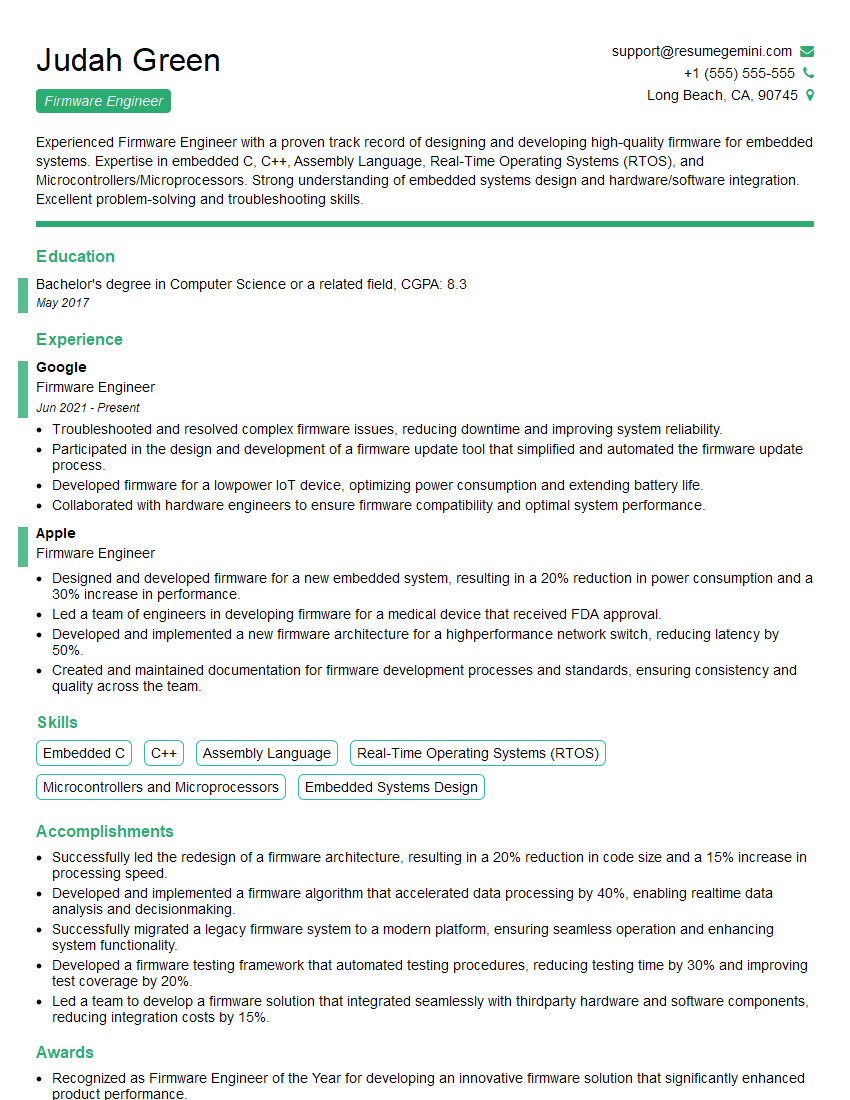
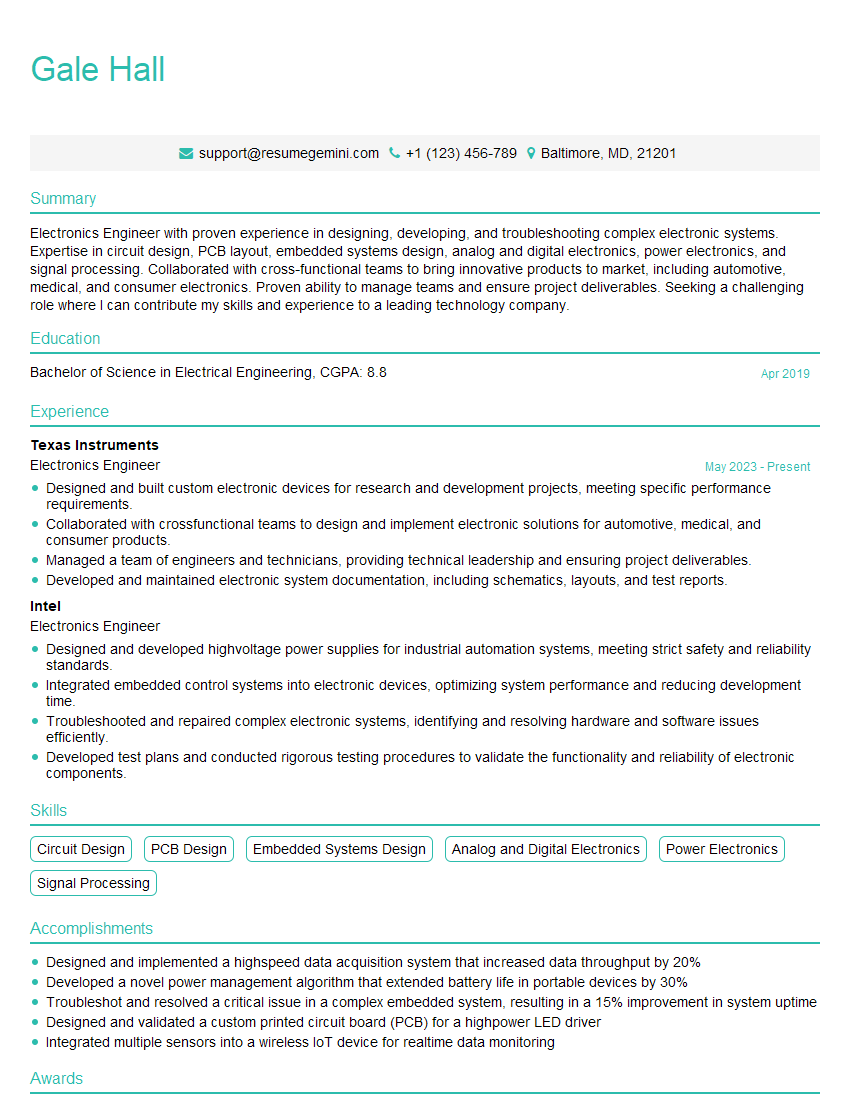
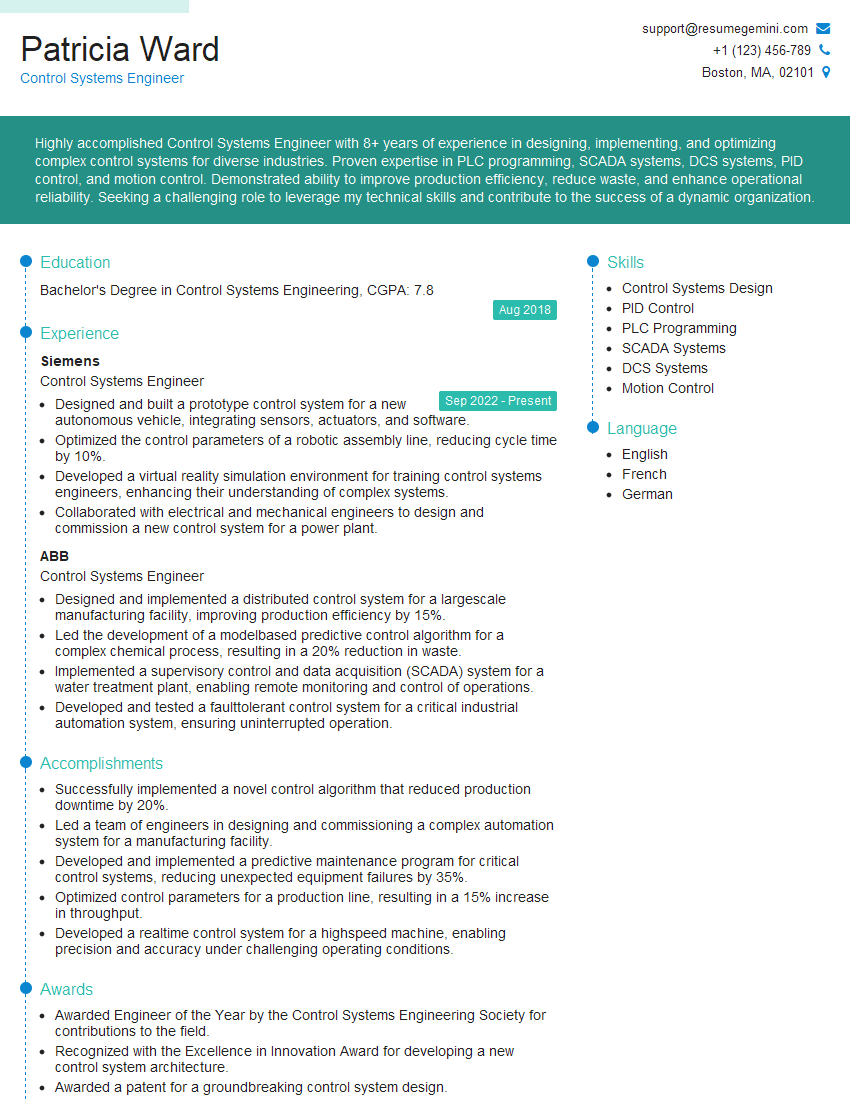
Mastering microcontroller programming with Arduino and Raspberry Pi opens doors to exciting career opportunities in fields like IoT, robotics, automation, and embedded systems. To maximize your job prospects, crafting an ATS-friendly resume is essential. ResumeGemini is a trusted resource that can help you build a professional and effective resume that highlights your skills and experience. ResumeGemini provides examples of resumes tailored to Microcontroller Programming (Arduino and Raspberry Pi) roles, ensuring your application stands out.


Explore more articles
Users Rating of Our Blogs
Share Your Experience
We value your feedback! Please rate our content and share your thoughts (optional).
What Readers Say About Our Blog
Hello,
we currently offer a complimentary backlink and URL indexing test for search engine optimization professionals.
You can get complimentary indexing credits to test how link discovery works in practice.
No credit card is required and there is no recurring fee.
You can find details here:
https://wikipedia-backlinks.com/indexing/
Regards
NICE RESPONSE TO Q & A
hi
The aim of this message is regarding an unclaimed deposit of a deceased nationale that bears the same name as you. You are not relate to him as there are millions of people answering the names across around the world. But i will use my position to influence the release of the deposit to you for our mutual benefit.
Respond for full details and how to claim the deposit. This is 100% risk free. Send hello to my email id: [email protected]
Luka Chachibaialuka
Hey interviewgemini.com, just wanted to follow up on my last email.
We just launched Call the Monster, an parenting app that lets you summon friendly ‘monsters’ kids actually listen to.
We’re also running a giveaway for everyone who downloads the app. Since it’s brand new, there aren’t many users yet, which means you’ve got a much better chance of winning some great prizes.
You can check it out here: https://bit.ly/callamonsterapp
Or follow us on Instagram: https://www.instagram.com/callamonsterapp
Thanks,
Ryan
CEO – Call the Monster App
Hey interviewgemini.com, I saw your website and love your approach.
I just want this to look like spam email, but want to share something important to you. We just launched Call the Monster, a parenting app that lets you summon friendly ‘monsters’ kids actually listen to.
Parents are loving it for calming chaos before bedtime. Thought you might want to try it: https://bit.ly/callamonsterapp or just follow our fun monster lore on Instagram: https://www.instagram.com/callamonsterapp
Thanks,
Ryan
CEO – Call A Monster APP
To the interviewgemini.com Owner.
Dear interviewgemini.com Webmaster!
Hi interviewgemini.com Webmaster!
Dear interviewgemini.com Webmaster!
excellent
Hello,
We found issues with your domain’s email setup that may be sending your messages to spam or blocking them completely. InboxShield Mini shows you how to fix it in minutes — no tech skills required.
Scan your domain now for details: https://inboxshield-mini.com/
— Adam @ InboxShield Mini
Reply STOP to unsubscribe
Hi, are you owner of interviewgemini.com? What if I told you I could help you find extra time in your schedule, reconnect with leads you didn’t even realize you missed, and bring in more “I want to work with you” conversations, without increasing your ad spend or hiring a full-time employee?
All with a flexible, budget-friendly service that could easily pay for itself. Sounds good?
Would it be nice to jump on a quick 10-minute call so I can show you exactly how we make this work?
Best,
Hapei
Marketing Director
Hey, I know you’re the owner of interviewgemini.com. I’ll be quick.
Fundraising for your business is tough and time-consuming. We make it easier by guaranteeing two private investor meetings each month, for six months. No demos, no pitch events – just direct introductions to active investors matched to your startup.
If youR17;re raising, this could help you build real momentum. Want me to send more info?
Hi, I represent an SEO company that specialises in getting you AI citations and higher rankings on Google. I’d like to offer you a 100% free SEO audit for your website. Would you be interested?
Hi, I represent an SEO company that specialises in getting you AI citations and higher rankings on Google. I’d like to offer you a 100% free SEO audit for your website. Would you be interested?
good