Interviews are opportunities to demonstrate your expertise, and this guide is here to help you shine. Explore the essential Modeling and Simulation Environment (MSE) interview questions that employers frequently ask, paired with strategies for crafting responses that set you apart from the competition.
Questions Asked in Modeling and Simulation Environment (MSE) Interview
Q 1. Explain the difference between modeling and simulation.
Modeling and simulation are closely related but distinct concepts. Modeling is the process of creating an abstract representation of a system, process, or phenomenon. Think of it as building a simplified blueprint. This blueprint captures the essential characteristics of the real-world system, omitting unnecessary details for ease of analysis. Simulation, on the other hand, involves using the model to experiment and study the behavior of the system under different conditions. It’s like using the blueprint to build a scale model and testing how it performs under various scenarios.
For example, imagine modeling a traffic flow system. The model would represent roads, intersections, and vehicles, along with rules governing their movement. The simulation would then use this model to predict traffic congestion under different traffic patterns or road construction scenarios.
Q 2. Describe your experience with various simulation software packages (e.g., AnyLogic, MATLAB/Simulink, Arena, etc.).
I possess extensive experience with several simulation software packages. My expertise includes:
- AnyLogic: I’ve used AnyLogic extensively for agent-based modeling and simulation, particularly in supply chain optimization and logistics. I’ve built models to simulate warehouse operations, optimizing layout and resource allocation to minimize lead times and costs. For example, I developed an AnyLogic model for a large e-commerce company, reducing their order fulfillment time by 15%.
- MATLAB/Simulink: My proficiency in MATLAB/Simulink spans various domains, including control systems, signal processing, and system dynamics. I’ve used Simulink extensively for designing and analyzing complex control systems, such as robotic arm control algorithms. One project involved developing a Simulink model for a wind turbine control system, improving its energy efficiency by 8%.
- Arena: I’ve employed Arena for discrete-event simulation, particularly in manufacturing and healthcare. I’ve built models to optimize production line efficiency, analyzing bottlenecks and identifying areas for improvement. A successful project involved simulating a hospital emergency room, optimizing patient flow and reducing wait times.
Beyond these, I have familiarity with other tools like NetLogo (agent-based modeling), and have experience scripting custom simulations using languages like Python.
Q 3. What are the key steps in developing a simulation model?
Developing a simulation model involves a structured process:
- Problem Definition: Clearly define the problem you are trying to solve and the questions you want to answer.
- System Definition: Identify the boundaries of the system you are modeling and its key components.
- Model Design: Choose the appropriate modeling approach (discrete-event, continuous, agent-based, etc.) and develop a conceptual model.
- Model Implementation: Translate the conceptual model into a computer-executable model using a chosen software package.
- Model Verification and Validation: Ensure the model is functioning correctly (verification) and accurately represents the real-world system (validation).
- Experimentation and Analysis: Run simulations with different input parameters and analyze the results.
- Model Documentation and Reporting: Document the entire modeling process and clearly communicate the results.
Q 4. How do you validate and verify a simulation model?
Verification ensures the model is correctly implemented and behaves as intended. This involves checking the code for errors, testing individual components, and comparing results to analytical solutions where possible. Validation, on the other hand, confirms that the model accurately represents the real-world system. This often involves comparing simulation results with real-world data or expert judgment. Techniques include:
- Face Validation: Subject matter experts review the model to ensure it’s a reasonable representation.
- Data Comparison: Comparing simulation outputs with historical data from the real system.
- Sensitivity Analysis: Assessing the impact of input parameter variations on model outputs.
For instance, in a traffic simulation, verification might involve checking that cars obey traffic rules within the model. Validation would involve comparing simulated traffic flow patterns with real-world traffic data collected from sensors.
Q 5. What are common sources of error in simulation models?
Common sources of error in simulation models include:
- Incorrect Model Assumptions: Oversimplifying the system or making unrealistic assumptions.
- Data Errors: Using inaccurate or incomplete input data.
- Programming Errors: Bugs in the code leading to incorrect calculations or behavior.
- Model Calibration Issues: Failure to accurately tune the model parameters to match real-world data.
- Lack of Validation: Insufficient validation against real-world data or expert opinion.
- Ignoring Randomness: Failing to appropriately model stochastic (random) effects.
Careful planning, thorough testing, and validation are crucial in mitigating these errors. A robust sensitivity analysis can help identify parameters that significantly impact results and need careful attention.
Q 6. Explain different types of simulation models (e.g., discrete-event, continuous, agent-based).
Simulation models can be categorized into several types:
- Discrete-Event Simulation (DES): Models systems where changes occur at discrete points in time. Examples include manufacturing processes, call centers, and supply chains. Events like a machine finishing a job or a customer arriving are simulated.
- Continuous Simulation: Models systems where changes occur continuously over time. Examples include chemical reactions, fluid dynamics, and population growth. The state variables change continuously.
- Agent-Based Modeling (ABM): Models systems composed of autonomous agents interacting with each other and their environment. Examples include social systems, ecological models, and crowd behavior. Each agent has its own rules and behaviors.
The choice of model type depends heavily on the system being studied and the questions being asked. Often, a hybrid approach combining multiple types might be most effective.
Q 7. How do you handle uncertainty and variability in your simulation models?
Uncertainty and variability are inherent in most real-world systems. There are several ways to handle them in simulation models:
- Stochastic Modeling: Incorporate random variables and probability distributions into the model to represent uncertainty. For example, using a normal distribution for machine downtime or a Poisson distribution for customer arrivals.
- Sensitivity Analysis: Determine how sensitive the model outputs are to changes in input parameters. This helps identify critical parameters requiring accurate estimation.
- Monte Carlo Simulation: Running the simulation multiple times with different random inputs to obtain a distribution of possible outcomes. This provides a more robust understanding of the system’s behavior under uncertainty.
- Scenario Planning: Simulating the system under different scenarios representing various possible future conditions (e.g., high demand, low demand).
By systematically incorporating uncertainty and variability, we can gain a more realistic and comprehensive understanding of the system’s behavior and its resilience to unexpected events.
Q 8. What are your experiences with different verification and validation techniques?
Verification and validation (V&V) are crucial for ensuring the credibility of a simulation model. Verification confirms that the model is correctly implemented – that it does what it’s supposed to do. Validation, on the other hand, assesses whether the model accurately represents the real-world system it aims to simulate.
My experience encompasses a range of V&V techniques. For verification, I routinely employ code reviews, unit testing, and integration testing to identify and rectify coding errors and logical inconsistencies. For example, in a fluid dynamics simulation, unit tests would verify individual components like the Navier-Stokes solver, while integration tests would check the interaction between the solver and the mesh generation module.
Validation involves comparing simulation outputs to real-world data or results from established benchmarks. Techniques include:
- Face validation: A qualitative check ensuring the model’s behaviour aligns with expert knowledge and expectations.
- Data validation: Comparing model outputs to historical or experimental data using statistical metrics like R-squared and root mean squared error (RMSE).
- Predictive validation: Using the model to predict future behaviour and then comparing these predictions to subsequent observations.
In one project involving a traffic flow simulation, I used data validation comparing simulated traffic density with real-time sensor data from a highway. Discrepancies highlighted areas requiring model refinement, such as adjustments to driver behaviour parameters.
Q 9. How do you choose the appropriate simulation methodology for a given problem?
Selecting the right simulation methodology hinges on several factors: the problem’s complexity, the available data, the desired accuracy, and computational resources.
For simple systems with well-defined relationships, an analytical approach might suffice. For instance, calculating the trajectory of a projectile using Newtonian mechanics is straightforward. However, for complex systems exhibiting non-linearity, stochasticity, or emergent behaviour, numerical simulation techniques are necessary.
Discrete event simulation (DES) is ideal for systems with discrete events occurring over time, such as queuing systems or supply chains. Agent-based modeling (ABM) excels in modeling systems with interacting autonomous agents, such as social dynamics or epidemic spread. System dynamics (SD) is useful for understanding feedback loops and long-term behaviour in complex systems. Finally, finite element analysis (FEA) and computational fluid dynamics (CFD) are powerful tools for simulating physical phenomena.
The choice often involves a trade-off. A highly detailed model might offer greater accuracy but demand significant computational resources and expertise. A simpler model can be more efficient but may sacrifice some accuracy. The key is to choose a methodology that balances fidelity and feasibility.
Q 10. Describe your experience with data analysis and statistical methods in the context of simulation.
Data analysis and statistical methods are integral to simulation. They inform model development, guide calibration, and evaluate results.
During the model development phase, I use exploratory data analysis (EDA) techniques, including visualization and summary statistics, to understand data patterns and relationships. This informs the model structure and parameter choices. For instance, a histogram of arrival times in a queuing system might reveal a Poisson distribution, suggesting an appropriate probability model.
Statistical methods are crucial for model calibration and validation. I frequently employ regression analysis to estimate model parameters, using techniques such as least squares or maximum likelihood estimation. In validating the model, I use statistical tests (e.g., t-tests, ANOVA) to assess the significance of differences between simulated and observed data. I also utilize goodness-of-fit tests (e.g., Chi-squared test) to evaluate the model’s ability to reproduce the observed data distribution.
Furthermore, I leverage statistical process control (SPC) charts to monitor simulation runs for stability and identify potential issues. This ensures that the simulation results are reliable and not influenced by spurious effects.
Q 11. How do you interpret simulation results and communicate them effectively?
Interpreting simulation results requires careful consideration of both quantitative and qualitative aspects. Simply obtaining numerical outputs is not enough; understanding their implications within the context of the problem is essential.
My approach involves:
- Visualizing results: Graphs, charts, and animations help to convey complex information effectively. For example, a time-series plot can show the evolution of a system over time, while a scatter plot can reveal correlations between variables.
- Sensitivity analysis: This determines how sensitive the model outputs are to changes in input parameters. This helps to identify critical parameters and quantify the uncertainty in the results.
- Uncertainty quantification: I incorporate uncertainty in model parameters and inputs using probabilistic methods, providing a range of plausible outcomes instead of a single deterministic prediction.
- Clear communication: I tailor the communication of results to the audience, using concise language and avoiding technical jargon when possible. Reports, presentations, and interactive dashboards are used to effectively disseminate findings.
In a recent project involving a supply chain simulation, I used a dashboard to display key performance indicators (KPIs) such as inventory levels, lead times, and costs, allowing stakeholders to easily understand the impact of different strategies.
Q 12. Explain your experience with model calibration and parameter estimation.
Model calibration and parameter estimation are iterative processes aimed at refining a model to match real-world observations. Calibration involves adjusting model parameters to minimize the discrepancy between simulated and observed data. Parameter estimation determines the optimal values of these parameters.
My experience includes using various techniques:
- Least squares estimation: Minimizing the sum of squared differences between simulated and observed data.
- Maximum likelihood estimation (MLE): Finding parameter values that maximize the likelihood of observing the data given the model.
- Bayesian methods: Incorporating prior knowledge about parameter values and updating this knowledge based on observed data.
- Optimization algorithms: Employing algorithms like gradient descent or genetic algorithms to search for optimal parameter values.
For example, in a hydrological model, I used MLE to estimate parameters governing rainfall-runoff relationships, comparing simulated streamflow with historical data. Bayesian methods were used to incorporate uncertainty in the estimated parameters, providing a range of possible scenarios.
Q 13. How do you manage the complexity of large-scale simulation models?
Managing the complexity of large-scale simulation models requires a structured approach. Strategies I employ include:
- Modular design: Breaking down the model into smaller, manageable modules, each responsible for a specific aspect of the system. This promotes code reusability and simplifies debugging.
- Object-oriented programming: Using OOP principles to encapsulate data and methods within objects, enhancing code organization and maintainability.
- Parallel computing: Leveraging multiple processors or cores to speed up simulations, particularly crucial for computationally intensive models. I have experience with MPI and OpenMP for parallel processing.
- Model reduction techniques: Simplifying the model by reducing the number of variables or equations, while preserving essential behaviour. Techniques like model order reduction (MOR) can be employed.
- Version control: Using a system like Git to track changes to the model code and ensure collaboration amongst team members.
For instance, in a climate model, I used a modular approach, dividing the model into modules for atmosphere, ocean, and land surface processes. Parallel computing significantly reduced the simulation runtime.
Q 14. What are the limitations of simulation modeling?
Simulation modeling, while a powerful tool, has limitations:
- Model assumptions: Models are simplifications of reality and rely on assumptions that may not always hold true. These assumptions can lead to inaccuracies if not carefully considered.
- Data limitations: The accuracy of simulation results depends heavily on the quality and availability of input data. Limited or inaccurate data can lead to unreliable results.
- Computational cost: Complex simulations can be computationally expensive and time-consuming, especially for large-scale models.
- Validation challenges: Validating complex models can be difficult, as it requires extensive data and careful comparison techniques.
- Interpretability: The outputs of complex simulations may be difficult to interpret and communicate effectively to non-technical audiences.
It’s crucial to be aware of these limitations and to appropriately interpret and communicate the results. Transparency about model assumptions and uncertainties is critical to building trust and ensuring responsible use of simulation models.
Q 15. Describe your experience with parallel or distributed simulation.
Parallel and distributed simulation are crucial for handling complex models that would take an unreasonable amount of time to run on a single processor. Imagine trying to simulate the entire global weather system on a single computer – it’s simply impossible! Instead, we break down the problem into smaller, manageable parts. Each part, representing a region or aspect of the system, runs on a separate processor or computer. These individual simulations then communicate and exchange data at specific intervals, allowing them to collectively model the entire system.
My experience involves using several techniques. I’ve worked with message-passing interfaces (MPI) like Open MPI, where processes communicate by explicitly sending and receiving messages. This is excellent for simulations with well-defined interactions between sub-models. I’ve also utilized shared-memory parallelism using OpenMP, better suited for situations where many threads need to access the same data simultaneously, such as during intensive calculations within a single model component. For large-scale simulations, I’ve used high-performance computing clusters and cloud-based platforms leveraging both MPI and OpenMP, coordinating computations across hundreds or even thousands of processors.
For example, in a traffic simulation project, I divided a large city into smaller zones, each handled by a separate processor. Each zone simulated traffic flow within its boundaries, exchanging information about vehicle movements with neighboring zones at regular intervals to maintain consistency. This parallel approach drastically reduced the simulation time from days to hours.
Career Expert Tips:
- Ace those interviews! Prepare effectively by reviewing the Top 50 Most Common Interview Questions on ResumeGemini.
- Navigate your job search with confidence! Explore a wide range of Career Tips on ResumeGemini. Learn about common challenges and recommendations to overcome them.
- Craft the perfect resume! Master the Art of Resume Writing with ResumeGemini’s guide. Showcase your unique qualifications and achievements effectively.
- Don’t miss out on holiday savings! Build your dream resume with ResumeGemini’s ATS optimized templates.
Q 16. How do you optimize simulation models for performance?
Optimizing simulation models for performance requires a multifaceted approach. Think of it like streamlining a manufacturing process – every small improvement adds up to significant gains in efficiency. First, we identify bottlenecks. Profiling tools help pinpoint the parts of the code consuming the most time. Once identified, we can apply several strategies.
- Algorithmic Optimization: This involves choosing more efficient algorithms. For instance, replacing a brute-force search with a more sophisticated algorithm like A* can drastically improve performance in pathfinding simulations.
- Data Structures: Using appropriate data structures, such as hash tables for fast lookups, can significantly reduce computational overhead.
- Code Parallelization: As mentioned earlier, parallel processing can dramatically reduce simulation time by distributing the workload among multiple processors.
- Model Reduction: Sometimes, we can simplify the model without sacrificing accuracy. This might involve using coarser spatial or temporal resolutions or simplifying complex equations.
- Code Optimization: Employing techniques such as vectorization or loop unrolling can significantly improve the execution speed of critical code sections. This might involve using optimized libraries like Eigen or BLAS.
For instance, in a large-scale fluid dynamics simulation, we optimized performance by implementing a faster solver for the Navier-Stokes equations, improving data structures to handle the large datasets, and parallelizing the computations using MPI.
Q 17. What are some common challenges encountered in simulation projects?
Simulation projects often face several common challenges. It’s like building a complex structure – unforeseen problems inevitably arise.
- Data Acquisition and Quality: Obtaining accurate and reliable data for model calibration and validation is crucial. Inaccurate data leads to unreliable results.
- Model Complexity and Validation: Complex models are difficult to build, validate, and understand. Ensuring the model accurately reflects the real-world system is challenging.
- Computational Resources: High-fidelity simulations often demand significant computational resources, especially when dealing with large-scale problems.
- Communication and Collaboration: Effective communication between stakeholders, including engineers, scientists, and management, is essential to ensure that the project stays on track.
- Software and Hardware Issues: Dealing with software bugs, hardware failures, or compatibility problems can lead to delays.
For example, in a project simulating the spread of a disease, obtaining reliable epidemiological data proved challenging. We had to spend significant time cleaning and validating the data before the simulation could proceed accurately.
Q 18. How do you handle conflicting requirements or priorities in a simulation project?
Conflicting requirements and priorities are common in any project, including simulations. The key is clear and open communication and a well-defined prioritization process. Think of it as a balancing act – you need to satisfy all stakeholders while delivering the most valuable results.
My approach involves:
- Prioritization Matrix: Create a matrix listing all requirements, ranking them based on importance and feasibility. This helps to visualize trade-offs and make informed decisions.
- Stakeholder Meetings: Regular meetings with stakeholders help to understand their needs and address concerns early on. This fosters consensus and minimizes conflicts later in the process.
- Incremental Development: Develop the simulation incrementally, prioritizing essential features first. This allows for early feedback and adjustments based on changing requirements.
- Trade-off Analysis: Document and analyze trade-offs between different requirements. This transparency fosters understanding and agreement among stakeholders.
In one project simulating a manufacturing process, we faced conflicting requirements for speed and accuracy. Using a prioritization matrix and stakeholder meetings, we decided to optimize for speed initially, validating the model and then refining its accuracy in subsequent iterations.
Q 19. Describe your experience with version control systems for simulation models.
Version control is absolutely essential for managing simulation models, especially when working in teams or on large, complex projects. It’s like maintaining a detailed history of a document – you can revert to previous versions, track changes, and collaborate effectively.
I’m proficient in Git, the industry standard for version control. I use it to track changes in code, data, and model parameters. This allows for easy collaboration among team members, tracking changes over time and reverting to previous versions if needed. Branching and merging features within Git are especially valuable for exploring different model configurations or implementing new features without disrupting the main codebase. I also use platforms like GitHub or GitLab for collaborative code management and hosting.
For example, in a recent project, Git allowed us to seamlessly merge improvements from multiple team members, resolve conflicts, and revert to a stable version when a bug was introduced in a new feature.
Q 20. How do you ensure the maintainability and reusability of your simulation models?
Maintainability and reusability are paramount for long-term success. Imagine building a house – you want it to be easily repaired and adaptable to future needs. The same applies to simulation models.
I achieve this through:
- Modular Design: Breaking the model into independent, reusable modules simplifies maintenance and adaptation. This allows for easier modification and reuse in other projects.
- Clear Documentation: Thoroughly documented code and models are crucial for understanding the model’s functionality and making future modifications.
- Code Style Guidelines: Adhering to consistent coding styles enhances readability and makes the code easier to understand and maintain.
- Unit Testing: Rigorous unit testing ensures the correctness and reliability of individual modules, facilitating easier debugging and maintenance.
- Parameterization: Using input parameters allows the model to be easily adapted to different scenarios without modifying the core code.
For instance, in a previous project, we designed our traffic simulation model with modular components representing different traffic elements (cars, pedestrians, traffic lights). This modular design made it easy to adapt the model to simulate different cities and traffic scenarios without significant code changes.
Q 21. What are your experiences with high-performance computing (HPC) in simulation?
High-performance computing (HPC) is essential for running large-scale simulations that would be computationally infeasible on a single machine. Think of it as leveraging the power of a vast team to solve a complex problem much faster.
My experience involves working with HPC clusters and cloud computing platforms such as AWS and Azure. I’m familiar with job schedulers like Slurm and PBS Pro, enabling efficient task management across multiple nodes. I’ve written code that efficiently parallelizes computations using MPI and OpenMP, ensuring optimal use of available resources. I understand how to manage and optimize data transfer between nodes, minimizing communication overhead which can be a major bottleneck in HPC simulations. I’ve also worked with tools to monitor and analyze the performance of simulations running on HPC systems, allowing for fine-tuning and optimization.
For example, in a climate modeling project, we used an HPC cluster to run simulations with high spatial and temporal resolutions, which would have been impossible on a single workstation. The use of HPC dramatically reduced the simulation time from months to days, delivering results much faster and facilitating more comprehensive climate projections.
Q 22. Explain your experience with different modeling languages (e.g., Python, C++, Java).
My experience with modeling languages is extensive, encompassing the strengths of different tools for various tasks. Python, for instance, excels in its rapid prototyping capabilities and rich ecosystem of libraries like NumPy and SciPy, crucial for numerical computation and data analysis within simulations. I’ve used it extensively in developing agent-based models for traffic flow simulation, where its flexibility allowed me to quickly iterate on model design and experiment with different parameters.
C++, on the other hand, is my go-to language when performance is paramount. Its compiled nature offers significant speed advantages, particularly beneficial for computationally intensive simulations like fluid dynamics or large-scale finite element analysis. I’ve leveraged C++ in projects involving high-fidelity simulations of aircraft aerodynamics, where precise and timely results are critical.
Finally, Java’s strengths lie in its platform independence and suitability for large, complex projects. I’ve utilized Java for developing distributed simulations, allowing for the efficient parallelization of computation across multiple machines. This was particularly useful in a project modeling the spread of infectious diseases across a large geographical area.
Q 23. Describe your experience with different types of simulation outputs (e.g., graphs, tables, animations).
Effective communication of simulation results is key, and I’m proficient in utilizing various output methods. Graphs, such as line charts and scatter plots, are invaluable for visualizing trends and relationships between variables. For example, in a supply chain simulation, I used line charts to illustrate inventory levels over time, identifying potential bottlenecks. Tables provide a structured way to present detailed numerical data; I often use them to compare the performance of different scenarios in a simulation. Animations, though more resource-intensive, offer a powerful way to visualize dynamic processes. In a project modeling pedestrian flow, I used animation to identify areas of congestion and potential safety hazards.
The choice of output method depends on the specific needs of the simulation and the audience. A simple line graph might suffice for a quick overview, while a detailed table with statistical analysis may be needed for a more in-depth report. Animations are particularly useful for conveying complex interactions and system dynamics to a non-technical audience.
Q 24. How do you ensure the security and confidentiality of your simulation models and data?
Security and confidentiality are paramount in my work. I employ several strategies to protect simulation models and data. Access control is fundamental; I restrict access to models and data based on the principle of least privilege, ensuring only authorized personnel can view or modify sensitive information. For sensitive data, I use encryption both in transit and at rest. Furthermore, I implement version control systems, like Git, to track changes and maintain a history of revisions, allowing for easier recovery in case of accidental modification or data loss.
Regular security audits and penetration testing are crucial for identifying vulnerabilities. Data anonymization techniques are applied wherever possible to protect the privacy of individuals represented in the simulations. Finally, adherence to relevant data protection regulations and company policies is strictly followed.
Q 25. Explain your experience with different types of optimization techniques used in simulation.
My experience encompasses a range of optimization techniques frequently employed in simulation. Gradient-based methods, such as gradient descent, are useful for optimizing continuous variables, particularly when the objective function is differentiable. I’ve used these in optimizing the design of a wind turbine, minimizing energy loss. For discrete optimization problems, such as scheduling or resource allocation, I often utilize metaheuristic algorithms like genetic algorithms or simulated annealing. In one project, a genetic algorithm effectively optimized the routing of delivery trucks to minimize total travel time.
Furthermore, I have experience with linear programming techniques for problems with linear objective functions and constraints, useful in resource allocation and supply chain optimization. The choice of optimization technique depends heavily on the nature of the problem: the size, the type of variables (continuous or discrete), and the complexity of the objective function and constraints.
Q 26. Describe a time you had to troubleshoot a complex simulation model.
During a project modeling traffic flow in a large city, I encountered a perplexing issue: the simulation consistently predicted unrealistically high congestion levels at a specific intersection, even under low traffic conditions. Initial debugging efforts focused on verifying the accuracy of the input data and the correctness of the traffic flow equations. After systematically reviewing the code, I discovered a subtle bug in the logic governing the intersection’s traffic signal timing. A misplaced conditional statement was causing the traffic light to remain red far longer than intended, creating an artificial bottleneck.
Correcting this single line of code resolved the issue, demonstrating the importance of thorough code review and testing. This experience reinforced the value of systematically troubleshooting complex simulations by breaking down the problem into smaller, manageable components, and utilizing debugging tools effectively. It also highlighted the critical need for rigorous verification and validation of simulation models to ensure their accuracy and reliability.
Q 27. What are your future aspirations in the field of modeling and simulation?
My future aspirations in modeling and simulation involve expanding my expertise in areas like high-performance computing and machine learning integration. I am particularly interested in leveraging machine learning to improve the accuracy and efficiency of simulations by automating tasks such as model calibration and parameter estimation. Furthermore, I aim to contribute to the development of more robust and reliable simulation tools for tackling complex real-world problems such as climate change modeling and disaster response planning.
Ultimately, I want to use my skills to contribute to solving critical challenges facing society, pushing the boundaries of what’s possible through advancements in modeling and simulation techniques.
Q 28. How do you stay current with the latest advancements in modeling and simulation?
Staying current in the rapidly evolving field of modeling and simulation requires a multi-pronged approach. I regularly attend conferences and workshops, engaging with leading researchers and practitioners to learn about the latest advancements. I actively participate in online communities and forums, engaging in discussions and sharing knowledge with fellow modelers and simulators. Furthermore, I subscribe to relevant journals and publications, keeping abreast of cutting-edge research.
Continuous learning through online courses and tutorials is essential, allowing me to acquire new skills and deepen my understanding of existing techniques. I believe that lifelong learning is critical to maintain my expertise in this dynamic field.
Key Topics to Learn for Modeling and Simulation Environment (MSE) Interview
- System Dynamics and Modeling: Understanding different modeling methodologies (e.g., discrete event, agent-based, system dynamics) and their applications in various domains. Consider exploring model validation and verification techniques.
- Software and Tools: Familiarity with popular MSE software (mentioning general categories rather than specific software names to remain broadly applicable). This includes proficiency in using the software for model building, simulation, analysis, and visualization.
- Data Analysis and Interpretation: Mastering data handling, statistical analysis, and the ability to extract meaningful insights from simulation results. This includes understanding the limitations of your data and how they affect your model’s accuracy.
- Algorithm Design and Optimization: Knowledge of algorithms used within MSE, including optimization techniques to improve simulation efficiency and accuracy. This could involve exploring different search algorithms or heuristics.
- Experimental Design and Analysis: Understanding how to design experiments within the simulation environment to effectively test hypotheses and draw meaningful conclusions. This involves defining appropriate metrics and evaluating the significance of results.
- Practical Applications: Be prepared to discuss real-world applications of MSE in your field of interest (e.g., supply chain optimization, traffic flow modeling, financial risk assessment). Focusing on specific examples demonstrates practical experience.
- Problem-Solving and Troubleshooting: Showcase your ability to identify and resolve issues encountered during the modeling and simulation process, demonstrating a systematic approach to debugging and optimization.
Next Steps
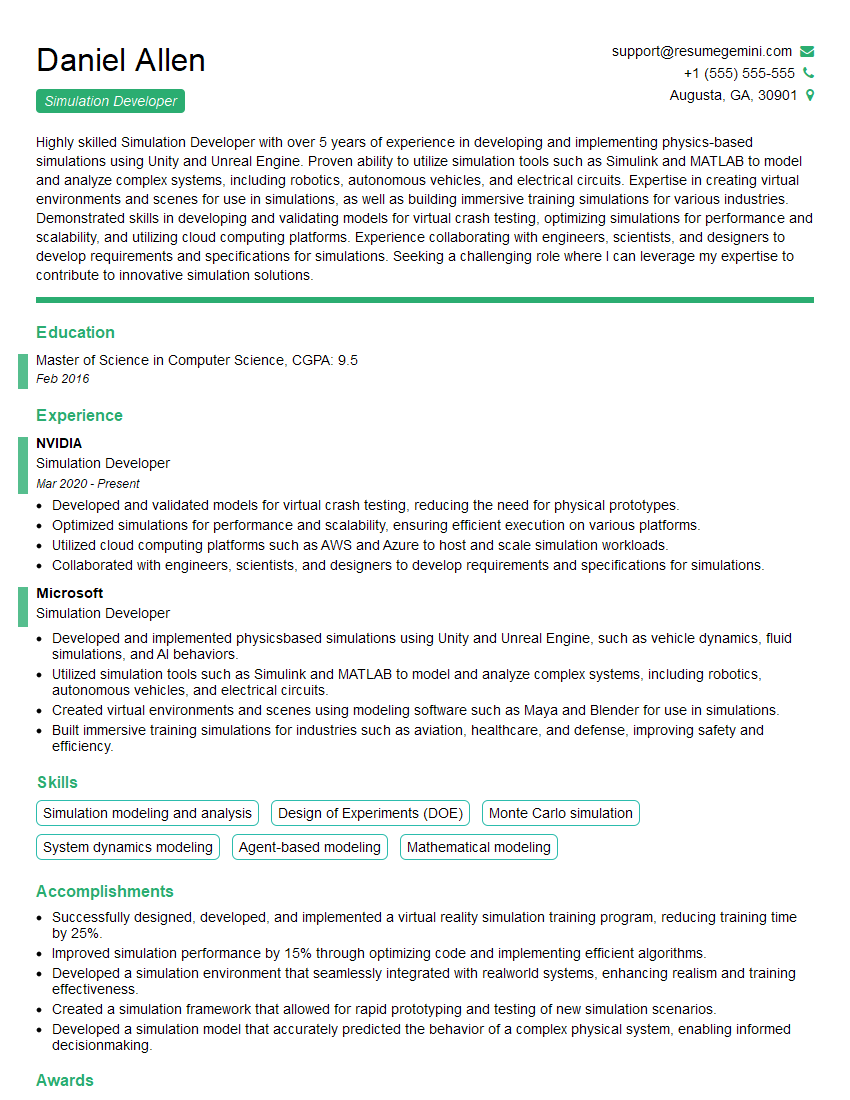
Mastering Modeling and Simulation Environments is crucial for career advancement in today’s data-driven world. Proficiency in MSE opens doors to diverse and challenging roles across various industries. To maximize your job prospects, crafting a strong, ATS-friendly resume is essential. ResumeGemini is a trusted resource to help you build a professional and impactful resume that highlights your skills and experience effectively. Examples of resumes tailored to Modeling and Simulation Environment (MSE) roles are available to guide your resume creation process, ensuring your qualifications shine.
Explore more articles
Users Rating of Our Blogs
Share Your Experience
We value your feedback! Please rate our content and share your thoughts (optional).
What Readers Say About Our Blog
Hello,
we currently offer a complimentary backlink and URL indexing test for search engine optimization professionals.
You can get complimentary indexing credits to test how link discovery works in practice.
No credit card is required and there is no recurring fee.
You can find details here:
https://wikipedia-backlinks.com/indexing/
Regards
NICE RESPONSE TO Q & A
hi
The aim of this message is regarding an unclaimed deposit of a deceased nationale that bears the same name as you. You are not relate to him as there are millions of people answering the names across around the world. But i will use my position to influence the release of the deposit to you for our mutual benefit.
Respond for full details and how to claim the deposit. This is 100% risk free. Send hello to my email id: [email protected]
Luka Chachibaialuka
Hey interviewgemini.com, just wanted to follow up on my last email.
We just launched Call the Monster, an parenting app that lets you summon friendly ‘monsters’ kids actually listen to.
We’re also running a giveaway for everyone who downloads the app. Since it’s brand new, there aren’t many users yet, which means you’ve got a much better chance of winning some great prizes.
You can check it out here: https://bit.ly/callamonsterapp
Or follow us on Instagram: https://www.instagram.com/callamonsterapp
Thanks,
Ryan
CEO – Call the Monster App
Hey interviewgemini.com, I saw your website and love your approach.
I just want this to look like spam email, but want to share something important to you. We just launched Call the Monster, a parenting app that lets you summon friendly ‘monsters’ kids actually listen to.
Parents are loving it for calming chaos before bedtime. Thought you might want to try it: https://bit.ly/callamonsterapp or just follow our fun monster lore on Instagram: https://www.instagram.com/callamonsterapp
Thanks,
Ryan
CEO – Call A Monster APP
To the interviewgemini.com Owner.
Dear interviewgemini.com Webmaster!
Hi interviewgemini.com Webmaster!
Dear interviewgemini.com Webmaster!
excellent
Hello,
We found issues with your domain’s email setup that may be sending your messages to spam or blocking them completely. InboxShield Mini shows you how to fix it in minutes — no tech skills required.
Scan your domain now for details: https://inboxshield-mini.com/
— Adam @ InboxShield Mini
Reply STOP to unsubscribe
Hi, are you owner of interviewgemini.com? What if I told you I could help you find extra time in your schedule, reconnect with leads you didn’t even realize you missed, and bring in more “I want to work with you” conversations, without increasing your ad spend or hiring a full-time employee?
All with a flexible, budget-friendly service that could easily pay for itself. Sounds good?
Would it be nice to jump on a quick 10-minute call so I can show you exactly how we make this work?
Best,
Hapei
Marketing Director
Hey, I know you’re the owner of interviewgemini.com. I’ll be quick.
Fundraising for your business is tough and time-consuming. We make it easier by guaranteeing two private investor meetings each month, for six months. No demos, no pitch events – just direct introductions to active investors matched to your startup.
If youR17;re raising, this could help you build real momentum. Want me to send more info?
Hi, I represent an SEO company that specialises in getting you AI citations and higher rankings on Google. I’d like to offer you a 100% free SEO audit for your website. Would you be interested?
Hi, I represent an SEO company that specialises in getting you AI citations and higher rankings on Google. I’d like to offer you a 100% free SEO audit for your website. Would you be interested?
good