Are you ready to stand out in your next interview? Understanding and preparing for Nuclear Criticality Safety Monte Carlo Analysis interview questions is a game-changer. In this blog, we’ve compiled key questions and expert advice to help you showcase your skills with confidence and precision. Let’s get started on your journey to acing the interview.
Questions Asked in Nuclear Criticality Safety Monte Carlo Analysis Interview
Q 1. Explain the principles of nuclear criticality.
Nuclear criticality refers to the state where a nuclear chain reaction becomes self-sustaining. Imagine a forest fire: a single spark (neutron) ignites a tree (fissionable material), releasing more sparks (neutrons) that ignite more trees, and so on. If enough sparks are created to keep the fire going, it’s critical. In nuclear terms, this means the neutron multiplication factor, k, is greater than or equal to 1. If k<1, the reaction dies out; if k>1, the reaction exponentially increases, leading to potentially hazardous situations. Criticality depends on several factors: the mass and geometry of fissile material, enrichment level, presence of moderators (slowing down neutrons), and reflectors (bouncing neutrons back).
Q 2. Describe the Monte Carlo method and its application in nuclear criticality safety.
The Monte Carlo method is a powerful computational technique that uses random sampling to obtain numerical results. Think of it as repeatedly throwing darts at a dartboard: by counting how many darts land within a specific area, you can estimate the area’s size. In nuclear criticality safety, we simulate the transport of neutrons through a system by randomly tracking their paths (direction, energy, etc.) using probability distributions based on nuclear cross-section data. By running millions of these simulations, we can accurately estimate the neutron multiplication factor (k), its uncertainty, and other crucial parameters like neutron flux distributions. This provides a detailed, probabilistic view of the system’s criticality, far beyond what simpler deterministic methods can offer.
Q 3. What are the key differences between MCNP, KENO, and SERPENT codes?
MCNP, KENO, and SERPENT are widely used Monte Carlo codes for criticality safety analysis, each with its strengths and weaknesses. MCNP (Monte Carlo N-Particle) is a very versatile code, capable of handling a wide range of particle transport problems, including criticality, shielding, and dosimetry. It’s highly regarded for its accuracy and extensive library of cross-sections. KENO is particularly tailored for criticality calculations, especially for fuel storage and handling applications. It’s known for its efficiency in handling complex geometries. SERPENT is a more recent code, open-source and designed for modern computational architectures. It boasts advanced features such as improved variance reduction techniques and efficient parallelization, making it faster than older codes for many problems. The choice of code depends on the specific problem, available computational resources, and user expertise. In my experience, I’ve found MCNP suitable for validating more complex geometries while KENO’s speed is advantageous for parametric studies.
Q 4. How do you define and assess the uncertainties in Monte Carlo calculations?
Uncertainty in Monte Carlo calculations stems from the inherent randomness of the method. Since we’re using random sampling, each run produces a slightly different result. We quantify this uncertainty using statistical methods. The most common metric is the standard deviation of the k-effective estimates from multiple independent simulations. This standard deviation, divided by the mean k-effective, gives the relative uncertainty. We typically aim for a relative uncertainty of less than 1% for criticality safety assessments, ensuring a high degree of confidence in our results. Additionally, uncertainties related to the nuclear data (cross-sections) must be considered and propagated through the calculations, often employing techniques like sensitivity analysis to determine the influence of cross-section uncertainties on the overall uncertainty in k-effective.
Q 5. Explain the concept of variance reduction techniques in Monte Carlo simulations.
Variance reduction techniques aim to reduce the statistical uncertainty of Monte Carlo results for a given number of simulations or, equivalently, to reduce the number of simulations needed to achieve a target uncertainty. This is crucial because performing millions of simulations can be computationally expensive. These techniques manipulate the simulation process to increase the importance of the ‘interesting’ events (e.g., neutrons interacting near the fissile material) while reducing the contribution of less influential events. Imagine our dartboard analogy: instead of throwing darts randomly, we focus our throws on the area of interest, thereby obtaining a more precise estimate of that area with fewer throws. Common variance reduction methods include importance sampling, splitting, Russian roulette, and weight windows.
Q 6. Describe your experience with different variance reduction techniques (e.g., importance sampling, splitting).
I’ve extensively used importance sampling, a technique that biases the random sampling towards regions of the system that significantly affect the criticality. For instance, in a fuel assembly, we might increase the probability of neutrons being transported near the fuel rods. Splitting is another technique where a particle is duplicated when it enters a high-importance region, effectively increasing the sampling in that area. I’ve successfully implemented these techniques in various projects, significantly reducing computational time and improving the accuracy of criticality calculations, especially in cases with complex geometries or highly localized neutron interactions. For example, in a spent fuel pool analysis, using importance sampling around the fuel assemblies dramatically reduced the required computational resources while maintaining the desired level of accuracy.
Q 7. How do you validate and verify Monte Carlo criticality safety calculations?
Validation and verification are crucial for ensuring the reliability of Monte Carlo criticality safety calculations. Verification focuses on confirming that the computer code is functioning as intended. This is often done by comparing the code’s results to analytical solutions for simplified problems or to results from other well-established codes. Validation, on the other hand, assesses whether the code accurately models the real-world system. This involves comparing the calculation results to experimental data, such as critical experiments or measurements from operating reactors. In my experience, a robust validation process often involves comparing calculations against critical experiments with similar geometries and materials to the design under consideration. Discrepancies between calculation and experiment must be thoroughly investigated and understood, often necessitating adjustments to input data or modeling assumptions.
Q 8. What are the limitations of Monte Carlo methods in nuclear criticality safety analysis?
Monte Carlo methods, while powerful for nuclear criticality safety analysis, have inherent limitations. Primarily, they are statistical in nature, meaning results are subject to uncertainties. The accuracy of the results depends heavily on the number of particle histories simulated – more histories generally lead to better precision, but at the cost of increased computational time. This is often referred to as the ‘statistical uncertainty’ or ‘variance’.
Another limitation stems from the reliance on nuclear data libraries. These libraries contain cross-section data (probabilities of nuclear reactions), which themselves have uncertainties. Inaccuracies or limitations in these libraries can propagate through the simulation, impacting the final results.
Furthermore, extremely complex geometries can be computationally expensive and challenging to model accurately. While advanced geometry modeling techniques exist, simplifying assumptions may still be necessary to manage simulation run times. Finally, Monte Carlo methods primarily focus on static conditions. Modeling time-dependent phenomena, such as reactor transients or changes in fuel composition over time, requires advanced techniques and additional computational resources.
Q 9. Explain the importance of cross-section data in criticality calculations.
Cross-section data are absolutely crucial in criticality calculations. They represent the probability of different nuclear reactions occurring when neutrons interact with the materials present in a system. These probabilities dictate how neutrons are scattered, absorbed, or cause fission. Accurate cross-section data directly influence the calculation of the neutron multiplication factor (keff), which is the primary indicator of criticality. A keff greater than 1 indicates a supercritical system, meaning the chain reaction will grow exponentially.
Different isotopes have vastly different cross-sections. For example, 235U has a much higher fission cross-section for thermal neutrons than 238U. Therefore, the isotopic composition of the nuclear fuel significantly affects the criticality. The use of outdated or inaccurate cross-section data can lead to significant errors in criticality predictions, potentially leading to unsafe designs.
The choice of the nuclear data library itself (e.g., ENDF/B-VIII.0, JEFF-3.3) is also important, as each library has its strengths and weaknesses. The selection process often involves a careful consideration of the specific application and the level of accuracy required.
Q 10. How do you handle the treatment of complex geometries in Monte Carlo simulations?
Handling complex geometries is a key challenge and strength of Monte Carlo simulations. Unlike deterministic methods, which often require significant simplification, Monte Carlo codes can, in principle, handle arbitrarily complex geometries directly. This is achieved using sophisticated geometry modeling techniques where the system is represented as a collection of distinct geometric primitives (e.g., cylinders, spheres, boxes).
Most Monte Carlo codes use combinatorial geometry (CG) where these primitives can be combined using Boolean operations (union, intersection, subtraction). This allows for the creation of extremely detailed representations of real-world systems. However, excessively complex models can lead to very long computation times. For this reason, careful modeling is essential to balance geometrical detail and computational efficiency.
Modern Monte Carlo codes often incorporate visualization tools which help the user to verify the geometry model’s correctness before running the simulation. This step is crucial for avoiding errors that might lead to inaccurate results.
Q 11. Describe your experience with different types of nuclear fuel and their impact on criticality.
My experience encompasses various nuclear fuels, each exhibiting unique criticality characteristics. For example, low-enriched uranium (LEU) fuel, commonly used in light water reactors (LWRs), has a significantly lower critical mass than highly enriched uranium (HEU) fuel, due to the lower concentration of fissile 235U. This implies that larger quantities of LEU fuel are required to achieve criticality compared to HEU.
Spent nuclear fuel, containing a mix of fission products and actinides, presents a different challenge. The presence of neutron absorbers (fission products) reduces the reactivity, but some long-lived actinides (like plutonium isotopes) can still contribute significantly to criticality. The accurate modeling of spent fuel requires detailed knowledge of its isotopic composition, which typically varies with burnup (the amount of energy produced per unit mass of fuel).
MOX fuel (mixed oxide fuel, containing plutonium and uranium oxides) presents another complex case. The criticality behavior of MOX fuel is strongly dependent on the plutonium isotopic composition and the overall U/Pu ratio. Accurately modeling this type of fuel requires precise knowledge of these parameters and careful consideration of the self-shielding effects within the fuel.
Q 12. How do you assess the criticality safety of a spent fuel storage facility?
Assessing the criticality safety of a spent fuel storage facility involves a multifaceted approach using Monte Carlo simulations. The analysis considers the geometry of the storage pools or dry casks, the arrangement and burnup of the spent fuel assemblies, the presence of neutron-moderating materials (e.g., water), and the potential presence of other materials. The primary objective is to demonstrate that even under accident scenarios (e.g., water loss, fuel assembly damage), the system will remain subcritical.
The simulations account for uncertainties in the spent fuel composition and the geometric configuration to ensure conservative results. Sensitivity studies are performed to determine which parameters have the most significant impact on the keff. These studies help identify potential vulnerabilities and areas needing further investigation. The results are typically presented with margins of safety, ensuring that the system remains safely subcritical even with considerable uncertainties.
Regulatory guidelines and standards, such as those from the IAEA, provide specific requirements and criteria for the safety analysis of spent fuel storage facilities. The analysis must meet these requirements to ensure compliance and the safety of the facility.
Q 13. Explain the role of criticality safety limits and their derivation.
Criticality safety limits define the boundaries of acceptable conditions within a nuclear facility to prevent accidental criticality. These limits are derived through rigorous calculations and experiments, often using Monte Carlo methods. They define constraints on parameters like mass, geometry, enrichment, and moderation of fissile materials.
The derivation involves evaluating the keff under various conditions, considering both normal operating procedures and potential accidents. Conservative assumptions are made to account for uncertainties in the input parameters. Safety margins are added to the calculated keff values to account for uncertainties and provide an additional level of safety. These margins are typically expressed as a limit on the keff, for example, a limit of keff ≤ 0.95.
The establishment of these limits is a crucial part of the safety assessment for any nuclear facility handling fissile material. They provide a quantitative basis for preventing criticality accidents, ensuring the safety of personnel and the environment.
Q 14. Discuss your experience with the development and use of criticality safety analysis reports.
I have extensive experience in the development and use of criticality safety analysis reports. These reports provide a comprehensive documentation of the safety assessment of nuclear systems, summarizing the methodology, input data, results, and conclusions. They are typically prepared according to specific regulatory guidelines and standards.
My experience includes creating reports for various applications, such as storage of fissile materials, transportation casks, and reactor fuel handling processes. A typical report includes a detailed description of the system being analyzed, the calculational methodology employed (including the Monte Carlo code used and the nuclear data libraries), and a presentation of the results with associated uncertainties.
The reports also include discussions of sensitivity studies and the identification of potential criticality hazards and mitigating factors. The conclusions clearly state whether the system meets the established criticality safety limits and if it is considered safe for its intended application. These reports are crucial for regulatory compliance and serve as vital documentation to demonstrate the safe operation of nuclear facilities.
Q 15. How do you incorporate human factors into criticality safety assessments?
Human factors are crucial in criticality safety because even the best designed system can fail due to human error. We incorporate them through a systematic approach, beginning with a thorough Human Reliability Analysis (HRA). This involves identifying potential human actions that could lead to criticality accidents, such as incorrect procedures, equipment misoperation, or inadequate training. We then estimate the probabilities of these errors occurring and their consequences.
For example, we might analyze the procedure for adding fissile material to a solution. The HRA would identify potential errors like adding the wrong amount, adding it too quickly, or forgetting a crucial step. We might use techniques like Failure Mode and Effects Analysis (FMEA) or Human Error Rate (HER) data to quantify these risks. Mitigation strategies, such as improved training, enhanced procedures with clear visual cues, and implementing double-checking mechanisms, are then developed and assessed to reduce the probability of human error causing a criticality accident. These strategies are then incorporated into the overall safety assessment.
Furthermore, the design of facilities and equipment needs to consider human factors such as ergonomic design to reduce fatigue and increase task efficiency, ultimately improving safety. This holistic approach ensures that human factors are not an afterthought but a fundamental component of the criticality safety assessment.
Career Expert Tips:
- Ace those interviews! Prepare effectively by reviewing the Top 50 Most Common Interview Questions on ResumeGemini.
- Navigate your job search with confidence! Explore a wide range of Career Tips on ResumeGemini. Learn about common challenges and recommendations to overcome them.
- Craft the perfect resume! Master the Art of Resume Writing with ResumeGemini’s guide. Showcase your unique qualifications and achievements effectively.
- Don’t miss out on holiday savings! Build your dream resume with ResumeGemini’s ATS optimized templates.
Q 16. Explain your understanding of different criticality accident scenarios.
Criticality accidents, while rare, can be devastating. They are broadly classified by the initiating event and resulting consequences. One common scenario is an uncontrolled chemical reaction, such as the rapid dissolution of highly enriched uranium (HEU) leading to a sudden increase in fissile material concentration. Another frequent scenario involves improper geometry where the spatial arrangement of fissile material unintentionally creates a supercritical configuration. This can occur during assembly, maintenance, or handling of nuclear materials.
Then there are accidents stemming from criticality excursions, where the chain reaction exceeds design limits. This can range from a brief, but significant, increase in neutron flux (resulting possibly in equipment damage and radiation exposure) to a more sustained and powerful excursion (with potentially catastrophic consequences). Accidents involving process equipment failures can also initiate a criticality accident, such as a pump failure leading to an unexpected accumulation of fissile solution in a restricted geometry. Each scenario needs careful consideration during the safety assessment, including modeling the accident progression using Monte Carlo codes and determining the potential consequences, like radiation dose to workers and the public, and potential damage to equipment and the environment.
We also need to consider human error as a crucial factor in almost all accident scenarios. Inadequate training, incorrect procedural steps, or flawed equipment design can contribute to or even initiate such incidents. Therefore, a comprehensive criticality safety analysis must always account for the human element.
Q 17. How do you apply your knowledge of criticality safety in the context of nuclear material transportation?
In nuclear material transportation, criticality safety is paramount. My expertise ensures that shipments are designed and conducted to prevent criticality. This involves several steps. Firstly, we need to perform careful package design analysis, using Monte Carlo simulations to demonstrate that even under accident conditions (e.g., impact, fire, water immersion) the fissile material remains subcritical. This analysis considers the geometry of the package, the shielding properties of its materials, and the interaction of neutrons with the fissile material. The design aims to ensure a large safety margin below criticality.
Secondly, I ensure compliance with regulatory requirements, such as those set by the IAEA or national regulatory bodies. These regulations specify the permissible limits of fissile material in a package, the required design features to ensure subcriticality, and the transportation procedures to prevent criticality accidents. We might use different computational methods to confirm the subcriticality under different conditions. For example, a simplified model can be used to screen out obviously safe configurations quickly, while more detailed Monte Carlo models are needed for the most challenging cases.
Thirdly, appropriate transport indices are assigned to each package reflecting the level of radiation and criticality safety risk. This information is crucial for safe handling and transport, informing the appropriate shielding and containment requirements.
Q 18. Describe your experience with the use of criticality safety software packages.
My experience encompasses a wide range of criticality safety software packages. I am proficient in using MCNP, SERPENT, and KENO, among others. I understand the strengths and limitations of each code, choosing the most appropriate one based on the specific problem at hand. For instance, MCNP’s detailed geometry capabilities are invaluable for complex package designs, while KENO’s speed makes it suitable for large-scale parametric studies. Understanding these nuances allows me to make informed choices and to obtain accurate and reliable results.
Beyond the core codes, I have experience utilizing various pre- and post-processing tools to efficiently manage the input and analyze the output data. These tools help in generating input files, visualizing results, and generating reports complying with regulatory requirements. I’ve utilized tools for mesh generation, visualization and uncertainty quantification. I can build complex models and analyze the results with confidence, ensuring accurate interpretation and meaningful conclusions for criticality safety assessment.
Q 19. What is your experience with peer review of criticality safety calculations?
Peer review is a cornerstone of criticality safety. I have extensive experience participating in and leading peer reviews of criticality safety calculations. This involves critically examining all aspects of the analysis, from the problem definition and assumptions to the computational methods and results. I follow structured guidelines ensuring all aspects of the calculation are validated and verified. I am capable of reviewing methodologies, modeling choices, and conclusions drawn.
The process includes verifying that appropriate codes and models have been used, that input data are accurate and consistent with the physical system, that uncertainties are appropriately quantified and propagated, and that the results are clearly presented and interpreted. I look for consistency and understand the sources of uncertainty. Through constructive discussions, the review process aims to improve the quality and accuracy of the analysis and to identify potential areas for improvement or refinement. This rigorous process is fundamental to ensuring the safety and reliability of criticality safety assessments.
Q 20. Explain your understanding of the regulatory requirements related to nuclear criticality safety.
Regulatory requirements for nuclear criticality safety vary depending on the country and the specific application, but some common themes prevail. These requirements often stem from international standards set by organizations such as the International Atomic Energy Agency (IAEA) and are then implemented at a national level. The regulations typically address various aspects of criticality safety, including the design and operation of facilities, handling and storage of fissile materials, and transportation of nuclear materials.
Specific requirements often cover the use of validated computational methods, documentation of safety analyses, and the implementation of safety management programs. These regulations often mandate the use of approved criticality safety software and procedures, emphasizing the demonstration of subcriticality under both normal operating conditions and accident scenarios. A crucial aspect is the need for independent verification and validation (IV&V) of methodologies, results, and implemented safety features, typically achieved via rigorous peer review processes as discussed previously. Strict compliance with regulatory requirements is paramount and forms a critical part of my work.
Q 21. How do you handle discrepancies between different computational methods or codes?
Discrepancies between computational methods are not uncommon. I address these through a structured approach focusing on understanding the reasons for the differences. Firstly, I meticulously review the input parameters for each method, checking for consistency in material properties, geometries, and boundary conditions. A detailed comparison of the models employed in each method is performed, focusing on the underlying assumptions and approximations. For instance, a difference could arise from different nuclear data libraries used.
Secondly, I investigate whether the differences are statistically significant. Uncertainty quantification is critical here. If the discrepancy is not statistically significant, it may be deemed acceptable, potentially attributed to inherent uncertainties in the computational methods. If statistically significant differences exist, I investigate the potential causes, which can involve model limitations, biases within specific codes, or errors in the input data. Further investigation might include sensitivity analyses to isolate the cause of the discrepancies. Documentation of these comparisons and their resolutions is crucial. The goal is to resolve the discrepancy, providing a detailed explanation and justification for the preferred approach or model, all documented transparently and thoroughly.
Q 22. Describe your experience with sensitivity and uncertainty analyses.
Sensitivity and uncertainty analyses are crucial in nuclear criticality safety to understand how variations in input parameters affect the calculated k-effective (the effective neutron multiplication factor). Sensitivity analysis identifies which parameters have the most significant impact on k-eff, while uncertainty analysis quantifies the uncertainty in the k-eff prediction due to uncertainties in the input parameters.
In a sensitivity analysis, we might systematically vary the density of fissile material, the isotopic composition of the fuel, or the dimensions of the system, one at a time, observing the resulting changes in k-eff. This helps us pinpoint critical parameters that require more precise measurement or modeling. We might use techniques like adjoint-weighted sensitivity analysis, which gives us more efficient insights.
Uncertainty analysis, on the other hand, often involves Monte Carlo simulations that incorporate probability distributions for all uncertain input parameters. The resulting distribution of k-eff predictions provides a quantitative measure of our confidence in the calculated value. We might employ methods like bootstrapping or Latin Hypercube Sampling for efficient uncertainty propagation. For example, if we are uncertain about the uranium enrichment in a fuel assembly, we would model this as a probability distribution, and the uncertainty analysis would propagate that uncertainty to the overall k-eff. The results are usually expressed as a confidence interval, for example, “k-eff = 0.95 ± 0.02 at 95% confidence level.”
Q 23. Explain your understanding of the concept of k-effective and its significance in criticality safety.
k-effective (keff) is the effective neutron multiplication factor, a dimensionless quantity that represents the average number of neutrons produced in one fission event that will cause further fissions in a nuclear system. It’s the cornerstone of criticality safety.
A keff of 1 indicates a critical system, where the chain reaction is self-sustaining. A keff less than 1 signifies a subcritical system, where the chain reaction will die out. A keff greater than 1 represents a supercritical system, where the chain reaction will rapidly accelerate.
In criticality safety, our goal is to ensure keff remains well below 1, typically with a significant safety margin, to prevent accidental criticality. Imagine a nuclear reactor; keff is constantly monitored and controlled through control rods, which absorb neutrons to regulate the reaction rate. In a fuel storage facility, careful geometry and spacing are designed to maintain a consistently subcritical configuration, relying on keff calculations to ensure safety.
Q 24. How do you determine the adequacy of a criticality safety margin?
The adequacy of a criticality safety margin is judged by considering several factors. It’s not just a single number but a holistic assessment. We generally aim for a substantial margin between the calculated keff and 1. A typical margin might be 0.05 or more below 1, depending on the specific application and regulatory requirements. This ensures that even with uncertainties and potential biases in the model, the system remains safely subcritical.
Several aspects determine adequacy:
- Magnitude of the keff: A lower keff indicates a larger safety margin.
- Uncertainty in keff: The uncertainty quantification from the analysis plays a critical role. A larger uncertainty reduces the effective safety margin.
- Potential for unforeseen events: We must consider potential credible accidents or operational errors. What is the impact of these on keff? A safety margin must account for these scenarios.
- Regulatory guidelines: National and international regulatory bodies set guidelines and requirements regarding acceptable safety margins. These vary by application (e.g., reactor design vs. spent fuel storage).
- Conservative modeling: We should always employ conservative modeling assumptions when performing calculations to account for uncertainties and potential biases in the model.
Ultimately, the determination of an adequate safety margin is a judgment call, balancing risk, practicality, and regulatory compliance. It often involves detailed documentation and justification.
Q 25. Describe a challenging criticality safety problem you encountered and how you solved it.
One challenging problem involved the criticality safety analysis of a spent fuel pool undergoing modifications. The addition of new fuel racks significantly altered the geometry and neutron moderation within the pool. Initial calculations showed keff values closer to the acceptable limit than desired. The challenge stemmed from the complex geometry and the inherent uncertainties in the spent fuel composition (burnup, isotopic inventory).
To solve this, we employed a multi-pronged approach:
- Refined 3D Modeling: We used high-fidelity Monte Carlo codes (e.g., MCNP or SERPENT) with detailed 3D models of the modified pool, including the new rack structure and fuel assemblies. This required careful consideration of material properties and spatial configurations.
- Sensitivity and Uncertainty Analyses: We performed extensive sensitivity and uncertainty analyses, identifying the most significant parameters and quantifying their uncertainties. This highlighted that uncertainties in spent fuel composition were dominant.
- Improved Spent Fuel Characterization: To reduce uncertainties, we collaborated with fuel management experts to obtain better characterization of the spent fuel assemblies, focusing on isotopic composition and burnup. Improved data led to more accurate input for our simulations.
- Conservative Biases: In the final analysis, conservative biases were incorporated into the fuel characteristics and geometry (e.g., slightly higher fissile content, less favorable geometry) to account for residual uncertainties.
Through this iterative process, we ultimately demonstrated a sufficient safety margin and secured regulatory approval for the modifications.
Q 26. What are the potential consequences of a criticality accident?
The consequences of a criticality accident are severe and potentially catastrophic. The immediate effects are dependent on the power level and duration of the excursion, but generally include:
- Radiation exposure: A sudden release of intense ionizing radiation—gamma rays and neutrons—would cause acute radiation syndrome (ARS) in personnel nearby, ranging in severity from mild radiation sickness to death. The extent of damage depends on the dose and duration of the exposure.
- Material damage: The intense radiation and heat generated can damage equipment and structures in the immediate vicinity. The radiation can cause embrittlement of materials and potentially lead to structural failures.
- Fission product release: If the fuel is damaged, radioactive fission products could be released into the environment, leading to environmental contamination and long-term health risks for a large population. The severity depends on the amount of radioactive material released and the environmental conditions.
- Secondary effects: These could range from explosions due to pressure buildup from rapid heating of water or other substances, to widespread disruption due to evacuation and containment efforts.
The long-term consequences would include extensive cleanup operations, potential legal liabilities, and long-lasting impacts on the surrounding environment and population.
Q 27. What are your strategies for staying up-to-date with advancements in nuclear criticality safety?
Staying current in nuclear criticality safety requires a multi-faceted approach:
- Professional Organizations: Active participation in professional organizations like the American Nuclear Society (ANS) provides access to conferences, publications, and networking opportunities with leading experts.
- Conferences and Workshops: Attending conferences and workshops dedicated to criticality safety provides a platform to learn about the latest research, best practices, and regulatory updates.
- Publications and Journals: Regularly reviewing technical publications and journals like Nuclear Science and Engineering, Nuclear Technology, and the ANS Transactions provides access to peer-reviewed research and advancements in the field.
- Regulatory Guidance: Staying informed about evolving regulatory guidelines and standards from agencies like the NRC (in the US) or equivalent international bodies is crucial.
- Continuing Education: Participation in continuing education courses and training programs offered by universities, national labs, and professional organizations helps refine and update existing knowledge and skills.
- Software Updates: Staying current with updates and improvements to Monte Carlo codes and other relevant software is vital, since software often includes updates and corrections to models and algorithms.
By combining these strategies, I ensure I maintain a high level of proficiency and remain at the forefront of the nuclear criticality safety field.
Key Topics to Learn for Nuclear Criticality Safety Monte Carlo Analysis Interview
- Fundamentals of Nuclear Criticality Safety: Understanding the principles of nuclear fission, criticality, and the factors influencing reactivity. This includes a solid grasp of neutron transport theory and the six-factor formula.
- Monte Carlo Methods in Nuclear Engineering: Deep understanding of the statistical nature of Monte Carlo simulations, including variance reduction techniques, error estimation, and convergence criteria. Familiarity with different Monte Carlo codes (e.g., MCNP, SERPENT) is crucial.
- Practical Applications of Monte Carlo Analysis in Criticality Safety: Experience with modeling various nuclear fuel cycle stages, analyzing storage configurations, and assessing the safety of transportation casks. Understanding the limitations and assumptions inherent in these simulations is key.
- Data Validation and Uncertainty Quantification: Methods for validating Monte Carlo results against experimental data or other computational methods. Understanding and quantifying uncertainties in input parameters and their propagation through the simulation is essential for credible results.
- Criticality Safety Analysis Techniques: Proficiency in applying different analysis techniques, including subcriticality margin calculations, k-effective estimations, and the assessment of accident scenarios. Understanding the regulatory framework and safety standards is vital.
- Problem Solving and Interpretation of Results: Ability to interpret Monte Carlo output, identify potential biases or inaccuracies, and draw meaningful conclusions relevant to criticality safety. This includes presenting complex technical information clearly and concisely.
- Specific Software Proficiency: Demonstrated expertise with at least one major Monte Carlo code used in criticality safety analysis (e.g., MCNP, SERPENT, KENO). This includes familiarity with input preparation, execution, and post-processing of results.
Next Steps
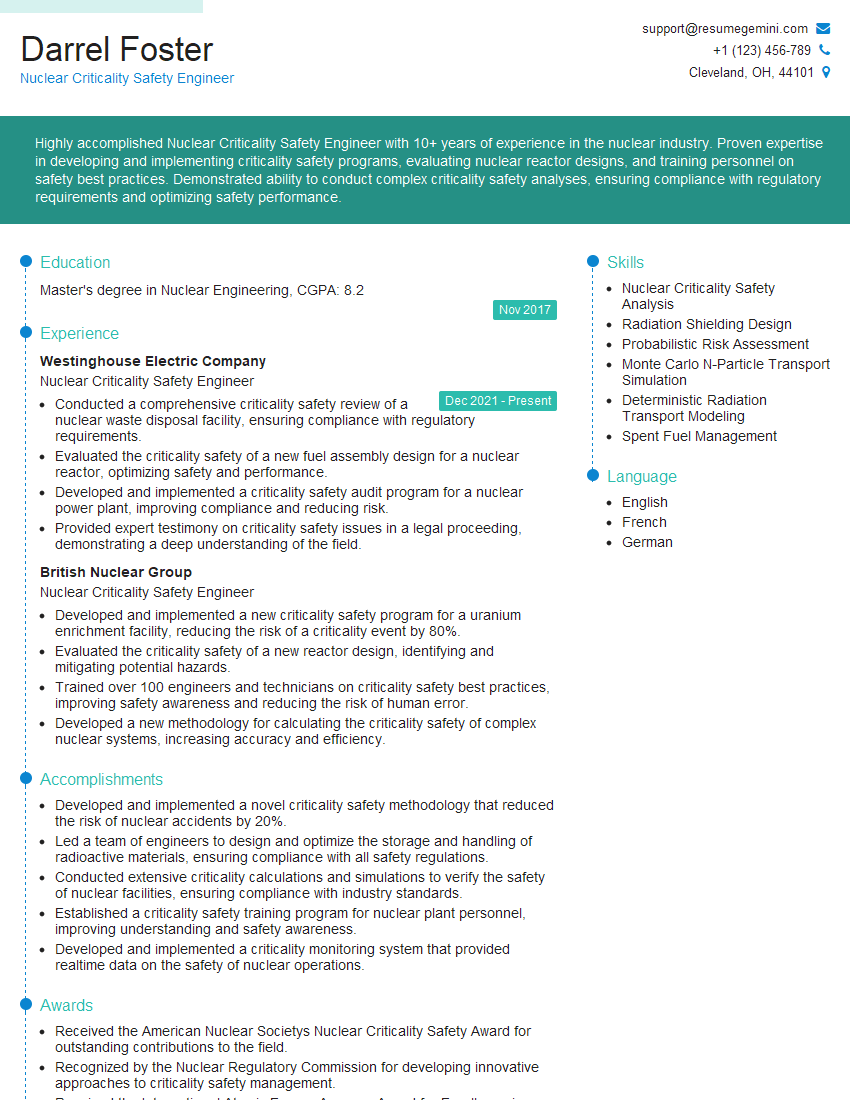
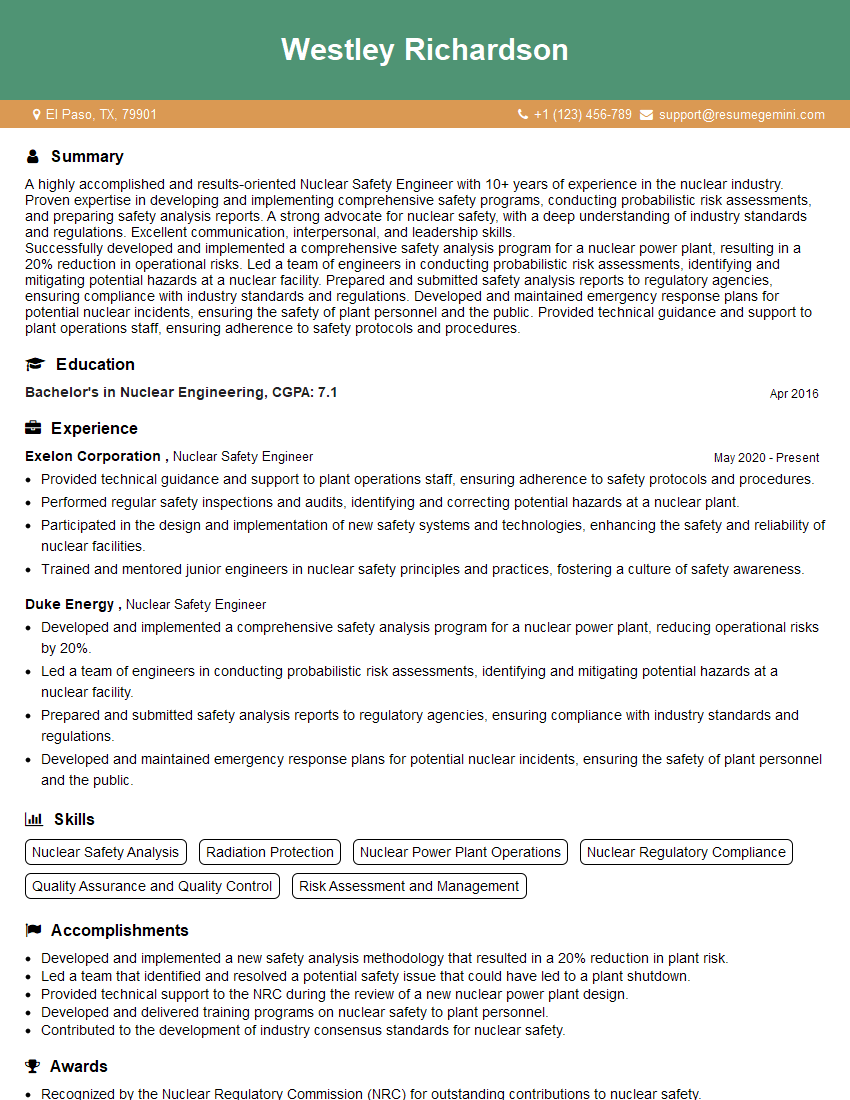
Mastering Nuclear Criticality Safety Monte Carlo Analysis opens doors to exciting and impactful careers in nuclear engineering, ensuring the safe handling and utilization of nuclear materials. A strong foundation in this field is highly sought after by employers. To enhance your job prospects, focus on creating a compelling and ATS-friendly resume that highlights your skills and experience. ResumeGemini is a trusted resource for building professional resumes, offering examples tailored to various career paths, including Nuclear Criticality Safety Monte Carlo Analysis. Use ResumeGemini to craft a resume that showcases your expertise and increases your chances of landing your dream job. Examples of resumes tailored to Nuclear Criticality Safety Monte Carlo Analysis are available to help guide you.
Explore more articles
Users Rating of Our Blogs
Share Your Experience
We value your feedback! Please rate our content and share your thoughts (optional).
What Readers Say About Our Blog
Attention music lovers!
Wow, All the best Sax Summer music !!!
Spotify: https://open.spotify.com/artist/6ShcdIT7rPVVaFEpgZQbUk
Apple Music: https://music.apple.com/fr/artist/jimmy-sax-black/1530501936
YouTube: https://music.youtube.com/browse/VLOLAK5uy_noClmC7abM6YpZsnySxRqt3LoalPf88No
Other Platforms and Free Downloads : https://fanlink.tv/jimmysaxblack
on google : https://www.google.com/search?q=22+AND+22+AND+22
on ChatGPT : https://chat.openai.com?q=who20jlJimmy20Black20Sax20Producer
Get back into the groove with Jimmy sax Black
Best regards,
Jimmy sax Black
www.jimmysaxblack.com
Hi I am a troller at The aquatic interview center and I suddenly went so fast in Roblox and it was gone when I reset.
Hi,
Business owners spend hours every week worrying about their website—or avoiding it because it feels overwhelming.
We’d like to take that off your plate:
$69/month. Everything handled.
Our team will:
Design a custom website—or completely overhaul your current one
Take care of hosting as an option
Handle edits and improvements—up to 60 minutes of work included every month
No setup fees, no annual commitments. Just a site that makes a strong first impression.
Find out if it’s right for you:
https://websolutionsgenius.com/awardwinningwebsites
Hello,
we currently offer a complimentary backlink and URL indexing test for search engine optimization professionals.
You can get complimentary indexing credits to test how link discovery works in practice.
No credit card is required and there is no recurring fee.
You can find details here:
https://wikipedia-backlinks.com/indexing/
Regards
NICE RESPONSE TO Q & A
hi
The aim of this message is regarding an unclaimed deposit of a deceased nationale that bears the same name as you. You are not relate to him as there are millions of people answering the names across around the world. But i will use my position to influence the release of the deposit to you for our mutual benefit.
Respond for full details and how to claim the deposit. This is 100% risk free. Send hello to my email id: lukachachibaialuka@gmail.com
Luka Chachibaialuka
Hey interviewgemini.com, just wanted to follow up on my last email.
We just launched Call the Monster, an parenting app that lets you summon friendly ‘monsters’ kids actually listen to.
We’re also running a giveaway for everyone who downloads the app. Since it’s brand new, there aren’t many users yet, which means you’ve got a much better chance of winning some great prizes.
You can check it out here: https://bit.ly/callamonsterapp
Or follow us on Instagram: https://www.instagram.com/callamonsterapp
Thanks,
Ryan
CEO – Call the Monster App
Hey interviewgemini.com, I saw your website and love your approach.
I just want this to look like spam email, but want to share something important to you. We just launched Call the Monster, a parenting app that lets you summon friendly ‘monsters’ kids actually listen to.
Parents are loving it for calming chaos before bedtime. Thought you might want to try it: https://bit.ly/callamonsterapp or just follow our fun monster lore on Instagram: https://www.instagram.com/callamonsterapp
Thanks,
Ryan
CEO – Call A Monster APP
To the interviewgemini.com Owner.
Dear interviewgemini.com Webmaster!
Hi interviewgemini.com Webmaster!
Dear interviewgemini.com Webmaster!
excellent
Hello,
We found issues with your domain’s email setup that may be sending your messages to spam or blocking them completely. InboxShield Mini shows you how to fix it in minutes — no tech skills required.
Scan your domain now for details: https://inboxshield-mini.com/
— Adam @ InboxShield Mini
support@inboxshield-mini.com
Reply STOP to unsubscribe
Hi, are you owner of interviewgemini.com? What if I told you I could help you find extra time in your schedule, reconnect with leads you didn’t even realize you missed, and bring in more “I want to work with you” conversations, without increasing your ad spend or hiring a full-time employee?
All with a flexible, budget-friendly service that could easily pay for itself. Sounds good?
Would it be nice to jump on a quick 10-minute call so I can show you exactly how we make this work?
Best,
Hapei
Marketing Director
Hey, I know you’re the owner of interviewgemini.com. I’ll be quick.
Fundraising for your business is tough and time-consuming. We make it easier by guaranteeing two private investor meetings each month, for six months. No demos, no pitch events – just direct introductions to active investors matched to your startup.
If youR17;re raising, this could help you build real momentum. Want me to send more info?
Hi, I represent an SEO company that specialises in getting you AI citations and higher rankings on Google. I’d like to offer you a 100% free SEO audit for your website. Would you be interested?
Hi, I represent an SEO company that specialises in getting you AI citations and higher rankings on Google. I’d like to offer you a 100% free SEO audit for your website. Would you be interested?