The thought of an interview can be nerve-wracking, but the right preparation can make all the difference. Explore this comprehensive guide to OpenSource Intelligence (OSINT) interview questions and gain the confidence you need to showcase your abilities and secure the role.
Questions Asked in OpenSource Intelligence (OSINT) Interview
Q 1. Explain the difference between OSINT and HUMINT.
OSINT (Open-Source Intelligence) and HUMINT (Human Intelligence) are both crucial intelligence gathering methods, but they differ significantly in their source and methodology. OSINT relies exclusively on publicly available information, such as news articles, social media posts, government documents, and open databases. Think of it like detective work using only publicly available clues. HUMINT, on the other hand, involves gathering intelligence through direct interaction with human sources, often requiring building trust and cultivating relationships. This might include interviews, informants, and undercover operations. The key difference is the source: OSINT uses publicly accessible information, while HUMINT uses direct human interaction.
For example, imagine trying to investigate a company’s potential for expansion. Using OSINT, you might analyze their press releases, investor reports, and social media presence. With HUMINT, you might interview employees, industry experts, or competitors to gain insights not publicly available.
Q 2. Describe your experience using different OSINT tools and techniques.
My OSINT toolkit is quite diverse and tailored to the specific investigation. I regularly employ tools like Maltego for link analysis, visualizing connections between people, organizations, and events. Shodan helps explore the internet’s exposed devices and servers, revealing potentially valuable information about an organization’s infrastructure. I’m proficient in using Google Dorking (advanced Google search techniques) to uncover specific information that might be buried within the vastness of the web. For social media analysis, I leverage tools that allow for efficient data collection and sentiment analysis across various platforms. I also regularly use specialized search engines like Censys for discovering and analyzing internet-connected devices.
Beyond these tools, I rely on a strong understanding of various online data sources, including WHOIS databases for domain registration information, government archives for public records, and forums or online communities where specific information might be discussed. I believe in combining different tools and techniques to triangulate information, ensuring a more robust and accurate result.
Q 3. How do you verify the credibility of information found through OSINT?
Verifying OSINT information is paramount. It’s not enough to simply find information; you must confirm its accuracy and reliability. My approach involves triangulation – finding the same information from multiple independent sources. This significantly increases the likelihood of accuracy. If information is only found on a single, obscure website with questionable credibility, I’m much more hesitant to accept it. I also cross-reference dates, locations, and names with other reliable sources. I investigate the author’s reputation and potential bias, looking for potential conflicts of interest or known inaccuracies in their past reporting.
For example, if I find an allegation against an individual on an anonymous forum, I’d try to find corroborating evidence from news articles, court records, or official statements. Simply accepting the forum post at face value would be reckless.
Q 4. What are some ethical considerations when conducting OSINT investigations?
Ethical considerations are paramount in OSINT investigations. We must always operate within legal boundaries and respect privacy. This involves adhering to terms of service of online platforms, respecting individuals’ rights to privacy, and avoiding actions that could be construed as harassment or stalking. Gathering data without consent, except where legally permissible, is ethically unacceptable. Anonymity and pseudonymity are considered, and personally identifiable information (PII) is treated with utmost care, avoiding its unnecessary disclosure or misuse. Documenting all research methodologies and sources is essential for transparency and accountability.
I always consider the potential impact of my findings and act responsibly, considering the potential consequences of my actions. Ethical OSINT is responsible OSINT.
Q 5. How do you handle large datasets gathered during OSINT investigations?
Handling large datasets is a significant challenge in OSINT. I use various techniques to manage and analyze them effectively. Firstly, I employ data organization strategies, using spreadsheets or databases to categorize and structure the information. Data cleaning and filtering are crucial to remove duplicates and irrelevant information. Next, I utilize data analysis tools and techniques, such as statistical analysis and visualization, to identify trends and patterns within the data. Tools like Python with libraries such as Pandas and network analysis software are extremely valuable for this stage. I often employ keyword searching and filtering to extract relevant information quickly.
For instance, if I am gathering social media data related to a specific event, I would use filters to isolate relevant posts and hashtags before performing sentiment analysis or network analysis on that refined subset.
Q 6. Describe your process for developing an OSINT research plan.
Developing a robust OSINT research plan is crucial for efficient and effective investigations. It starts with clearly defining the research objectives and questions. What specific information do we need? What are the key entities or individuals involved? Next, I identify potential sources of information, considering both publicly available databases and online communities relevant to the investigation. I prioritize sources based on their reliability and relevance. Then, I outline a methodical approach, specifying the tools and techniques to be employed and the sequence of steps to be followed. Regular progress reviews and adjustments to the plan are crucial as the investigation evolves.
For example, if investigating a potential cybercrime, the plan might include searching for leaked data online, analyzing website registries, and examining social media activity of potential suspects. A clear timeline is established for each stage to ensure efficient use of time and resources.
Q 7. Explain how you would investigate a specific online persona or individual using OSINT.
Investigating an online persona or individual using OSINT involves a systematic approach. I start by identifying the subject’s online presence across various platforms – social media, forums, professional networks, etc. I meticulously collect publicly available information, including profile data, posts, comments, and images. Next, I use link analysis to connect different online profiles and identify any relationships or affiliations. I then perform reverse image searches to find additional information about the subject’s photos or to identify the source and context of images used. I look for potential inconsistencies or contradictions in the information gathered to evaluate credibility. Finally, I correlate information from different sources to build a comprehensive profile of the individual.
For instance, I might uncover a person’s real name through a social media post, then use that name to find further information via search engines and professional networks. Careful record-keeping is essential throughout this process.
Q 8. How do you prioritize information gathered during an OSINT investigation?
Prioritizing information in OSINT is crucial for efficiency and accuracy. Think of it like sifting gold from sand – you need a systematic approach to find the valuable nuggets. I use a multi-stage process:
- Relevance: First, I assess how directly the information relates to the investigation’s objective. Highly relevant data gets top priority.
- Timeliness: Recent information is usually more valuable than outdated data. News from last week is more relevant than a news article from five years ago, unless the historical context is crucial.
- Source Credibility: I evaluate the reliability of the source. Information from reputable news outlets or government websites carries more weight than anonymous forum posts. Cross-referencing information from multiple credible sources is essential.
- Completeness and Consistency: Information needs to be complete and consistent with other findings. Discrepancies warrant further investigation to resolve the conflicts.
- Actionability: Finally, I prioritize information that leads to actionable intelligence—information that can directly inform next steps in the investigation.
For example, during an investigation into a cyberattack, a recent security blog post detailing the specific malware used would be prioritized over an older article about general cybersecurity threats.
Q 9. What are some common pitfalls to avoid when using OSINT?
OSINT investigations are prone to several pitfalls. Avoiding these traps requires a critical and methodical approach:
- Confirmation Bias: We tend to favor information confirming our pre-existing beliefs. Actively seeking contradictory evidence is crucial to avoid skewed conclusions.
- Misinterpretation of Data: Context is king! Data can be easily misinterpreted without understanding its source and surrounding circumstances. Always verify information from multiple independent sources.
- Overreliance on Single Sources: Relying on a single source can lead to inaccurate conclusions. Triangulating information from diverse sources provides robustness.
- Ignoring Negative Information: The absence of information can be as important as its presence. Failure to consider contradictory evidence can lead to flawed analyses.
- Neglecting Data Privacy and Legal Restrictions: Gathering and using information illegally can lead to serious legal consequences. Adhering to ethical and legal boundaries is paramount.
- Failure to Verify Information: Always cross-check information from different sources to ensure accuracy. One source is rarely enough.
Imagine investigating a person’s identity. Finding a social media profile with their name is a good start, but you should corroborate it with other sources like professional websites or news articles before drawing conclusions.
Q 10. How familiar are you with various social media platforms and their use in OSINT?
I’m highly familiar with numerous social media platforms and their OSINT applications. My experience spans platforms like:
- Facebook: Finding profiles, groups, and posts can reveal personal information, connections, and activities.
- Twitter: Analyzing tweets, retweets, and hashtags provides insights into opinions, affiliations, and real-time events.
- LinkedIn: A valuable resource for professional information, including employment history, skills, and connections.
- Instagram: Photos and geotags can pinpoint locations, activities, and social circles.
- YouTube: Videos can expose activities, opinions, and locations.
- Reddit: Subreddits can offer valuable information on specific topics, communities, and individuals.
For each platform, I understand the nuances of data visibility, privacy settings, and search techniques. I know how to leverage advanced search operators and utilize tools designed for social media OSINT.
Q 11. Describe your experience with analyzing unstructured data from OSINT sources.
Analyzing unstructured data is a core skill in OSINT. Much of the information gathered is not neatly organized in databases. My approach involves:
- Data Extraction: I use various tools to extract relevant data from diverse sources, including web scraping, data mining, and manual data entry.
- Data Cleaning and Preprocessing: Raw data is often messy. I clean, transform, and standardize it to facilitate analysis. This involves handling missing values, removing duplicates, and converting data into a usable format.
- Natural Language Processing (NLP): NLP techniques, such as sentiment analysis and topic modeling, help me understand the meaning and context of textual data.
- Network Analysis: I use network analysis to visualize and analyze relationships between entities, identifying key players and connections.
- Data Visualization: Visualizing data through charts, graphs, and maps helps to identify patterns, trends, and anomalies.
For example, during an investigation of an online disinformation campaign, I might use NLP to analyze the sentiment of posts, identify key themes, and map the network of accounts involved.
Q 12. How do you maintain situational awareness during an OSINT investigation?
Maintaining situational awareness is vital. I use several strategies:
- News Monitoring: I regularly monitor news sources and social media for relevant updates.
- Keyword Tracking: I set up alerts for keywords related to the investigation.
- RSS Feeds: I use RSS feeds to receive updates from relevant websites and blogs.
- Collaboration: When appropriate, I collaborate with others to share information and perspectives.
- Regular Review and Assessment: I regularly review my findings and adjust my approach as needed.
Think of it like tracking a moving target. The landscape constantly shifts, requiring continuous monitoring and adaptation to stay current.
Q 13. What are some techniques for identifying and mitigating bias in OSINT data?
Bias in OSINT data is a significant concern. My mitigation strategies include:
- Source Diversification: Gathering data from diverse sources helps to mitigate the influence of individual biases.
- Critical Evaluation: Scrutinizing sources for potential biases, including political affiliations, financial interests, or personal agendas, is critical.
- Fact-Checking and Verification: Cross-referencing information from multiple independent sources to confirm accuracy.
- Awareness of Own Biases: Recognizing and acknowledging my own potential biases is essential for objective analysis.
- Using Multiple Analysts: Involving multiple analysts with diverse backgrounds can help to identify and mitigate biases.
For instance, when researching a political event, I’d consult news sources from across the political spectrum to avoid a skewed perspective.
Q 14. Explain your understanding of data privacy and legal restrictions related to OSINT.
Data privacy and legal restrictions are paramount. I understand and adhere to:
- Data Protection Laws: Familiar with regulations like GDPR (General Data Protection Regulation) and CCPA (California Consumer Privacy Act), ensuring compliance in data collection and usage.
- Terms of Service: Always respecting the terms of service of the websites and platforms I access.
- Ethical Considerations: Prioritizing ethical data handling practices, avoiding the misuse of personal information.
- Consent and Transparency: Where applicable, seeking consent before collecting and using personal data and being transparent about my OSINT activities.
- Legal Counsel: Consulting with legal counsel when dealing with sensitive information or complex legal issues.
Violating privacy laws or ethical guidelines can have severe consequences, including legal penalties and reputational damage. My work always prioritizes legal and ethical considerations.
Q 15. How do you handle contradictory information found during an OSINT investigation?
Contradictory information is a common challenge in OSINT. Think of it like piecing together a puzzle with some missing pieces and some that don’t quite seem to fit. My approach involves a multi-step process: Source Verification: I meticulously assess the credibility of each source. This includes checking the domain’s reputation, author’s expertise, publication date, and any potential bias. Triangulation: I look for corroborating evidence from multiple independent sources. If multiple reliable sources support a particular piece of information, it’s more likely to be accurate. Contextual Analysis: I carefully examine the information’s context. A seemingly contradictory piece of data might actually be accurate within a specific timeframe or under certain circumstances. Data Reconciliation: If contradictions persist despite verification and triangulation, I acknowledge the uncertainty and clearly state it in my report. I may also explain the conflicting evidence and the reasons for choosing a particular interpretation. Finally, I document all sources and my reasoning, ensuring transparency and reproducibility.
For example, if one source claims a company’s CEO is John Smith, while another claims it’s Jane Doe, I’d check company websites, press releases, LinkedIn profiles, and news articles to find corroborating evidence. If the majority of reliable sources point towards John Smith, I’d use that as the most likely accurate information, but I’d note the discrepancy for transparency.
Career Expert Tips:
- Ace those interviews! Prepare effectively by reviewing the Top 50 Most Common Interview Questions on ResumeGemini.
- Navigate your job search with confidence! Explore a wide range of Career Tips on ResumeGemini. Learn about common challenges and recommendations to overcome them.
- Craft the perfect resume! Master the Art of Resume Writing with ResumeGemini’s guide. Showcase your unique qualifications and achievements effectively.
- Don’t miss out on holiday savings! Build your dream resume with ResumeGemini’s ATS optimized templates.
Q 16. How do you stay current with the ever-evolving landscape of OSINT tools and techniques?
The OSINT landscape is constantly evolving, so continuous learning is crucial. I actively engage in several strategies: Following OSINT Communities: I participate in online forums, attend webinars, and follow experts on social media platforms dedicated to OSINT to stay informed about new tools and techniques. Reading Industry Publications: I regularly read industry blogs, journals, and research papers that discuss cutting-edge developments in OSINT. Hands-on Practice: I regularly experiment with new tools and techniques on practice datasets to gain practical experience. This allows me to evaluate their effectiveness and understand their limitations. Experimentation: I’m always looking at how new technologies (AI, machine learning) are impacting OSINT and how these can be leveraged ethically and responsibly. This proactive approach helps me stay ahead of the curve and adapt to the ever-changing OSINT environment.
Q 17. Describe your experience with using advanced search operators (Google dorking).
Advanced search operators, also known as Google dorking, are essential for efficient OSINT investigations. My expertise involves using a range of operators to refine searches and uncover specific information. I commonly use operators like filetype:pdf to find specific file types, intitle: to search for keywords in webpage titles, site: to limit searches to a specific website, and inurl: to find keywords within URLs. I also use boolean operators like AND, OR, and - (minus) to combine and exclude keywords, increasing search precision.
For instance, if investigating a company’s data breach, I might use a query like filetype:pdf "data breach" site:companyname.com to locate potential internal reports or documents related to the incident. I might then follow up with other operators to find mentions of specific details within leaked data.
Q 18. How do you use OSINT to identify potential threats or risks?
OSINT plays a critical role in identifying potential threats and risks. I use it to gather information about individuals, organizations, and events to assess potential dangers. This involves: Identifying Malicious Actors: I use OSINT to uncover information about individuals or groups suspected of malicious activity, such as cybercriminals or extremist organizations, analyzing their online presence, associates, and past actions. Assessing Risk Profiles: I analyze publicly available data to assess the risk posed by various entities. For example, I might analyze a company’s online presence to identify vulnerabilities that could be exploited by attackers. Monitoring Emerging Threats: I actively monitor social media, forums, and news sources to identify emerging threats, such as the spread of misinformation or the emergence of new malware. This proactive approach allows for timely mitigation strategies.
Imagine a scenario where a company suspects a competitor is engaging in unethical practices. I would use OSINT to investigate the competitor’s online presence, looking for evidence of intellectual property theft, illegal dumping of waste, or other violations. This could involve analyzing their website, social media activity, news articles, and legal records.
Q 19. How do you document and report your findings from an OSINT investigation?
Thorough documentation and reporting are crucial for OSINT investigations. My reporting process involves several key steps: Maintaining a Detailed Log: I meticulously document every step of the investigation, including search queries, sources used, and the rationale behind my decisions. This is essential for reproducibility and transparency. Structured Reporting: I create a structured report with clear headings, subheadings, and a logical flow. The report includes an executive summary, methodology, findings, and conclusions. Visual Aids: I utilize visual aids such as charts, graphs, and timelines to present data effectively. Citation of Sources: All sources are meticulously cited to maintain accuracy and allow for verification. Conclusion and Recommendations: I summarize the key findings and provide clear, actionable recommendations based on the gathered evidence.
This structured approach ensures that my findings are clear, concise, and readily understandable to both technical and non-technical audiences. It also provides a clear audit trail of the investigation process.
Q 20. Describe a time you had to overcome a challenge during an OSINT investigation.
During an investigation involving a complex international cybercrime case, I faced significant challenges in accessing information due to language barriers and the need to navigate multiple international jurisdictions. Many relevant sources were in languages I didn’t speak fluently. To overcome this, I leveraged online translation tools (while acknowledging their limitations), and I collaborated with colleagues who had the necessary linguistic skills. I also had to carefully navigate varying legal frameworks for data access and privacy, ensuring all activities were compliant with international and local laws. This experience highlighted the importance of teamwork, adaptability, and a deep understanding of legal and ethical considerations in OSINT investigations.
Q 21. What are some common sources of OSINT data?
OSINT data sources are incredibly diverse. They can be broadly categorized into: Open Web Sources: These include search engines like Google, social media platforms such as Facebook, Twitter, and LinkedIn, news websites, and blogs. Government and Public Sector Data: Government websites, regulatory filings, and public records (court documents, property records) provide valuable information. Social Media: Platforms like Twitter, Facebook, Instagram, and others are rich sources of information, but caution is needed regarding accuracy and bias. Forums and Online Communities: Specialized online forums and communities can offer insights into specific topics or industries. Data Aggregators: Websites and services that compile information from various sources can be very helpful but it is crucial to assess their trustworthiness. Dark Web and Deep Web: Although requiring specialized tools and skills, these can reveal hidden information, but ethical considerations and security are paramount.
Understanding the strengths and weaknesses of each source is crucial for effective OSINT investigations. Always verify information from multiple independent sources to ensure accuracy.
Q 22. How do you assess the reliability of a website or online source?
Assessing the reliability of online sources is crucial in OSINT. It’s like being a detective – you need to verify your sources before building your case. I use a multi-layered approach:
- Authority: Who is publishing this information? Is it a reputable organization, a known expert, or an anonymous blogger? The author’s credentials and potential biases significantly influence reliability.
- Accuracy: Does the information presented align with facts from other trusted sources? I cross-reference information across multiple websites and databases to verify its consistency and accuracy. Discrepancies are red flags.
- Objectivity: Is the information presented in a neutral and unbiased manner, or does it show signs of propaganda or a specific agenda? Identifying potential biases helps determine the credibility of the source.
- Currency: How recent is the information? In the rapidly changing digital landscape, outdated information can be misleading. I always check publication dates to ensure relevance.
- Purpose: What is the website’s goal? Is it to inform, persuade, or sell something? Understanding the purpose helps to assess potential biases and motivations.
For example, a news article from a respected international news agency is generally more reliable than a random blog post on a social media platform. I always prioritize verifying information through multiple independent sources to build a comprehensive and reliable picture.
Q 23. What tools and technologies are you proficient in for OSINT analysis?
My OSINT toolkit is diverse and constantly evolving. It includes a combination of open-source tools and commercial platforms. I’m proficient in:
- Search Engines: Google, Bing, DuckDuckGo – mastering advanced search operators (
site:, intitle:, inurl:) is vital for efficient searching. - Social Media Analysis: I use tools to analyze social media platforms like Twitter, Facebook, Instagram, and LinkedIn for public information. This includes identifying key individuals, tracking trends, and understanding public sentiment.
- Data Mining and Scraping Tools: I’m familiar with tools that allow me to extract data from websites, and I understand the ethical and legal considerations surrounding web scraping. I always respect robots.txt rules.
- Mapping and Visualization Tools: Tools like Maltego, Gephi, and even Google My Maps help to visualize connections and relationships between different pieces of data, revealing patterns and insights that might otherwise be missed.
- Databases and Archives: I regularly consult online databases like Whois, archive.org, and various government open data portals.
I also leverage specialized tools based on the nature of the investigation, ranging from image reverse-search tools to network analysis software. My skillset is always growing as new tools and technologies emerge.
Q 24. How do you manage your time effectively during an OSINT investigation?
Effective time management in OSINT is crucial. A disorganized approach leads to wasted time and missed opportunities. I use a structured approach:
- Clear Objectives: Defining clear, measurable, achievable, relevant, and time-bound (SMART) objectives at the outset of the investigation is essential. This ensures a focused approach and prevents me from getting sidetracked.
- Prioritization: I prioritize tasks based on their importance and urgency. This might involve using techniques like Eisenhower Matrix to categorize tasks by importance and urgency.
- Task Breakdown: I break down large investigations into smaller, manageable tasks. This makes the overall investigation less daunting and allows for more effective tracking of progress.
- Timeboxing: I allocate specific time blocks to particular tasks, preventing myself from spending too much time on less productive activities.
- Note-Taking and Documentation: I meticulously document every step of the investigation, including sources, methods, and findings. This ensures accountability and allows for efficient review and knowledge sharing.
For instance, if I’m investigating a particular company, I might allocate a specific time block for analyzing their LinkedIn presence, another for searching news articles, and so on. This structured approach keeps me organized and productive.
Q 25. What is your experience with mapping and visualizing OSINT data?
Mapping and visualizing OSINT data is essential for identifying patterns and relationships between data points that would otherwise be hidden. This is like connecting the dots in a complex puzzle. I’m experienced in using various tools, such as:
- Maltego: This tool excels at visualizing relationships between entities, such as people, organizations, and websites, uncovering hidden connections.
- Gephi: A powerful tool for network analysis and visualization, particularly useful for representing large datasets and complex relationships.
- Google My Maps: Useful for geolocating data points and visualizing spatial relationships. This is particularly helpful when dealing with location-based information.
For example, when investigating a criminal network, I might use Maltego to map out the relationships between individuals involved, their online activities, and associated companies. This visual representation helps to identify key players and potential vulnerabilities.
Q 26. How do you collaborate with other team members during an OSINT investigation?
Collaboration is paramount in OSINT. Effective teamwork requires clear communication and a well-defined workflow. I prioritize:
- Regular Communication: I maintain consistent communication with team members through regular meetings, email updates, and shared documentation platforms.
- Shared Workspace: I often utilize collaborative platforms to share findings, notes, and resources, allowing team members to access and contribute to the investigation simultaneously.
- Clear Roles and Responsibilities: I believe in assigning specific roles and responsibilities to each team member, ensuring a division of labor that optimizes efficiency.
- Structured Data Sharing: We use standardized methods for recording and sharing data to maintain consistency and accuracy.
In a recent investigation, we used a shared project management platform to track progress, assign tasks, and share findings. This ensured everyone was on the same page and contributed effectively towards the investigation’s goals.
Q 27. Describe your experience with using OSINT for competitive intelligence gathering.
I’ve extensively utilized OSINT for competitive intelligence gathering, providing valuable insights into competitors’ strategies, market positioning, and overall performance. This helps organizations make informed business decisions.
My approach typically involves:
- Analyzing competitors’ websites: Identifying their products, services, target markets, and overall marketing strategies.
- Monitoring their social media presence: Gauging public perception, understanding their marketing campaigns, and identifying potential brand vulnerabilities.
- Tracking news and press releases: Staying up-to-date on their recent activities, such as new product launches, partnerships, or financial performance.
- Examining job postings: Gaining insights into their hiring priorities and strategic direction.
For example, by analyzing a competitor’s social media activity and press releases, I was able to identify a new product launch before it was publicly announced. This gave my client a valuable head start in planning their own product strategy.
Q 28. Explain your understanding of the legal and ethical implications of using OSINT in different jurisdictions.
Understanding the legal and ethical implications of OSINT is crucial. It’s about navigating the line between gathering publicly available information and violating privacy laws or ethical standards. This varies across jurisdictions.
Key considerations include:
- Data Privacy Regulations: Regulations like GDPR (in Europe) and CCPA (in California) place restrictions on the collection and use of personal data. OSINT practitioners must be aware of these laws and avoid collecting or using data in ways that violate them.
- Copyright Laws: Using copyrighted material without permission is illegal. It’s essential to respect intellectual property rights when using information gathered through OSINT.
- Terms of Service: Many websites and platforms have terms of service that prohibit scraping, automated data collection, or specific types of access. Adhering to these terms is crucial.
- Ethical Considerations: Even if something is legally permissible, it doesn’t mean it’s ethically sound. OSINT should be used responsibly and ethically, avoiding activities that could cause harm or distress.
I always ensure my OSINT activities are compliant with applicable laws and adhere to a strong ethical code. This includes respecting individual privacy, avoiding misrepresentation of information, and never engaging in malicious or illegal activities.
Key Topics to Learn for OpenSource Intelligence (OSINT) Interview
- Data Collection & Sources: Understanding various OSINT sources (social media, forums, public records, etc.) and methodologies for effective data gathering. Consider the legal and ethical implications of each source.
- Data Analysis & Interpretation: Developing skills in analyzing diverse data types (text, images, videos, geolocation data), identifying patterns, and drawing meaningful conclusions. Practice critical thinking and verification techniques to avoid misinformation.
- Investigative Techniques: Mastering techniques like footprinting, reconnaissance, and correlation of information from multiple sources. Familiarize yourself with different investigative methodologies and their applications.
- Tools & Technologies: Become proficient with relevant OSINT tools and technologies. This could include search engines, social media analyzers, mapping tools, and data visualization software. Understand their capabilities and limitations.
- Threat Intelligence & Risk Assessment: Learn to apply OSINT to identify potential threats, assess risks, and inform strategic decision-making. Understanding threat modeling and risk mitigation strategies is crucial.
- Data Visualization & Reporting: Practice presenting your findings clearly and concisely through visualizations and reports. This includes creating compelling narratives from complex data sets.
- Ethical Considerations & Legal Frameworks: Develop a strong understanding of the legal and ethical implications of OSINT investigations. Know the boundaries of acceptable practices and potential legal ramifications.
Next Steps
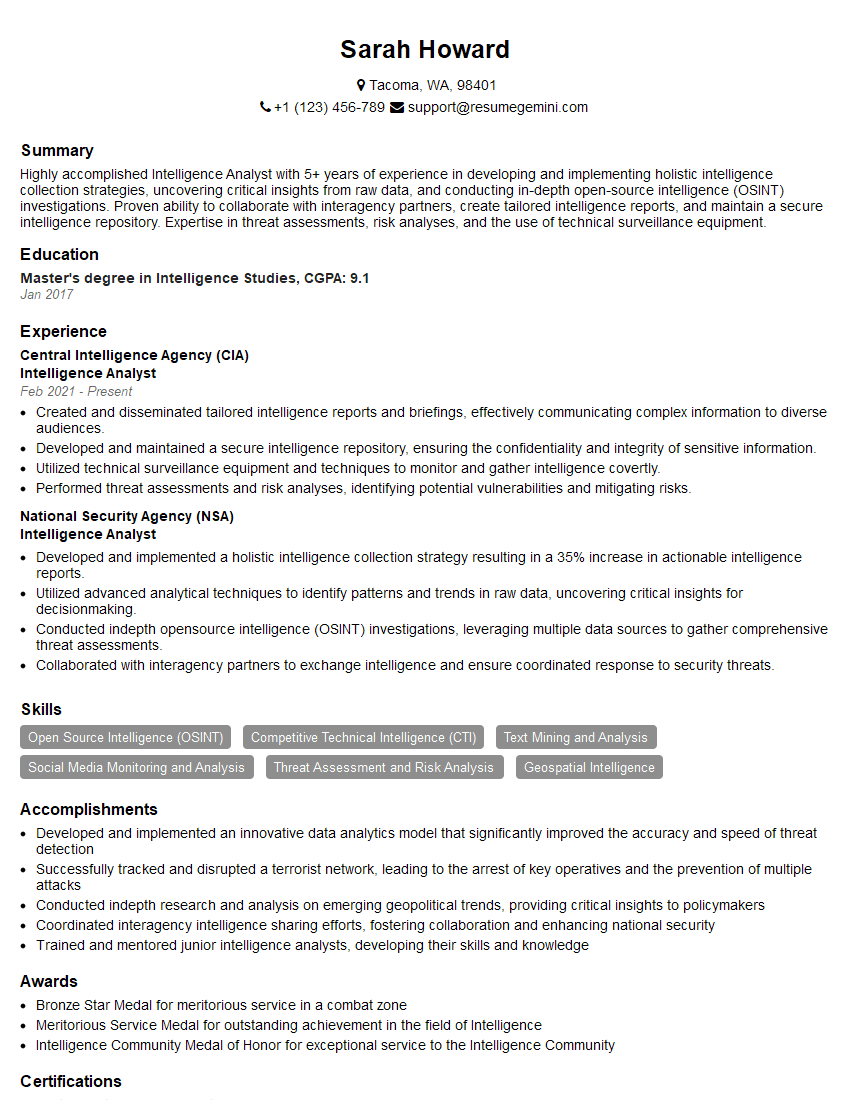
Mastering OpenSource Intelligence is vital for career advancement in today’s data-driven world. It opens doors to exciting opportunities in cybersecurity, intelligence analysis, investigations, and more. To maximize your job prospects, create an ATS-friendly resume that effectively highlights your skills and experience. ResumeGemini is a trusted resource to help you build a professional and impactful resume. Examples of resumes tailored to OpenSource Intelligence (OSINT) roles are available to help you get started. Take advantage of these resources to present your qualifications in the best possible light and land your dream OSINT job!
Explore more articles
Users Rating of Our Blogs
Share Your Experience
We value your feedback! Please rate our content and share your thoughts (optional).
What Readers Say About Our Blog
Attention music lovers!
Wow, All the best Sax Summer music !!!
Spotify: https://open.spotify.com/artist/6ShcdIT7rPVVaFEpgZQbUk
Apple Music: https://music.apple.com/fr/artist/jimmy-sax-black/1530501936
YouTube: https://music.youtube.com/browse/VLOLAK5uy_noClmC7abM6YpZsnySxRqt3LoalPf88No
Other Platforms and Free Downloads : https://fanlink.tv/jimmysaxblack
on google : https://www.google.com/search?q=22+AND+22+AND+22
on ChatGPT : https://chat.openai.com?q=who20jlJimmy20Black20Sax20Producer
Get back into the groove with Jimmy sax Black
Best regards,
Jimmy sax Black
www.jimmysaxblack.com
Hi I am a troller at The aquatic interview center and I suddenly went so fast in Roblox and it was gone when I reset.
Hi,
Business owners spend hours every week worrying about their website—or avoiding it because it feels overwhelming.
We’d like to take that off your plate:
$69/month. Everything handled.
Our team will:
Design a custom website—or completely overhaul your current one
Take care of hosting as an option
Handle edits and improvements—up to 60 minutes of work included every month
No setup fees, no annual commitments. Just a site that makes a strong first impression.
Find out if it’s right for you:
https://websolutionsgenius.com/awardwinningwebsites
Hello,
we currently offer a complimentary backlink and URL indexing test for search engine optimization professionals.
You can get complimentary indexing credits to test how link discovery works in practice.
No credit card is required and there is no recurring fee.
You can find details here:
https://wikipedia-backlinks.com/indexing/
Regards
NICE RESPONSE TO Q & A
hi
The aim of this message is regarding an unclaimed deposit of a deceased nationale that bears the same name as you. You are not relate to him as there are millions of people answering the names across around the world. But i will use my position to influence the release of the deposit to you for our mutual benefit.
Respond for full details and how to claim the deposit. This is 100% risk free. Send hello to my email id: lukachachibaialuka@gmail.com
Luka Chachibaialuka
Hey interviewgemini.com, just wanted to follow up on my last email.
We just launched Call the Monster, an parenting app that lets you summon friendly ‘monsters’ kids actually listen to.
We’re also running a giveaway for everyone who downloads the app. Since it’s brand new, there aren’t many users yet, which means you’ve got a much better chance of winning some great prizes.
You can check it out here: https://bit.ly/callamonsterapp
Or follow us on Instagram: https://www.instagram.com/callamonsterapp
Thanks,
Ryan
CEO – Call the Monster App
Hey interviewgemini.com, I saw your website and love your approach.
I just want this to look like spam email, but want to share something important to you. We just launched Call the Monster, a parenting app that lets you summon friendly ‘monsters’ kids actually listen to.
Parents are loving it for calming chaos before bedtime. Thought you might want to try it: https://bit.ly/callamonsterapp or just follow our fun monster lore on Instagram: https://www.instagram.com/callamonsterapp
Thanks,
Ryan
CEO – Call A Monster APP
To the interviewgemini.com Owner.
Dear interviewgemini.com Webmaster!
Hi interviewgemini.com Webmaster!
Dear interviewgemini.com Webmaster!
excellent
Hello,
We found issues with your domain’s email setup that may be sending your messages to spam or blocking them completely. InboxShield Mini shows you how to fix it in minutes — no tech skills required.
Scan your domain now for details: https://inboxshield-mini.com/
— Adam @ InboxShield Mini
support@inboxshield-mini.com
Reply STOP to unsubscribe
Hi, are you owner of interviewgemini.com? What if I told you I could help you find extra time in your schedule, reconnect with leads you didn’t even realize you missed, and bring in more “I want to work with you” conversations, without increasing your ad spend or hiring a full-time employee?
All with a flexible, budget-friendly service that could easily pay for itself. Sounds good?
Would it be nice to jump on a quick 10-minute call so I can show you exactly how we make this work?
Best,
Hapei
Marketing Director
Hey, I know you’re the owner of interviewgemini.com. I’ll be quick.
Fundraising for your business is tough and time-consuming. We make it easier by guaranteeing two private investor meetings each month, for six months. No demos, no pitch events – just direct introductions to active investors matched to your startup.
If youR17;re raising, this could help you build real momentum. Want me to send more info?
Hi, I represent an SEO company that specialises in getting you AI citations and higher rankings on Google. I’d like to offer you a 100% free SEO audit for your website. Would you be interested?
Hi, I represent an SEO company that specialises in getting you AI citations and higher rankings on Google. I’d like to offer you a 100% free SEO audit for your website. Would you be interested?