Interviews are opportunities to demonstrate your expertise, and this guide is here to help you shine. Explore the essential Pattern-making interview questions that employers frequently ask, paired with strategies for crafting responses that set you apart from the competition.
Questions Asked in Pattern-making Interview
Q 1. Explain the difference between a sloper and a block.
A sloper and a block are both foundational pattern pieces in garment construction, but they serve different purposes. Think of a sloper as a blank canvas, while a block is a more developed design.
Sloper: A sloper is a basic, foundational pattern piece that closely follows the body’s contours. It’s essentially a simplified, two-dimensional representation of a person’s body shape, tailored to specific measurements. It’s created from a set of base measurements and is usually drafted directly onto paper. It acts as the starting point for designing almost any garment. You’ll adjust the sloper to create your blocks and other patterns.
Block: A block, also known as a base pattern, is a more developed version of the sloper. It incorporates design elements such as ease (additional fabric for comfort and fit) and seam allowances. Blocks are generally used for specific garment types, such as a bodice block for tops or a skirt block for skirts. Different blocks are made from the sloper to make different styles.
In short: The sloper is the foundation; the block is a style-specific adaptation of that foundation. You would never use a sloper directly to cut out a garment; you must always adapt it first. A sloper is unique to an individual’s measurements, while blocks can be adapted to different sizes more easily.
Q 2. Describe your experience with various pattern-making software (e.g., Optitex, Gerber Accumark).
I have extensive experience with both Optitex and Gerber Accumark, two leading pattern-making software packages. My proficiency includes drafting, grading, and marker-making in both systems. I’ve used Optitex primarily for its 3D visualization capabilities, which are invaluable for predicting how a garment will drape and fit. This is particularly helpful when working with complex fabrics or designs. For large-scale production, Gerber Accumark is my preference. Its robust grading and marker-making features significantly streamline the production process, minimizing fabric waste and maximizing efficiency. I’ve successfully managed projects involving hundreds of styles across many different sizes using both systems.
For example, I recently used Optitex to design a complex draped bodice. The 3D simulation allowed me to identify and correct fit issues before cutting a single sample, saving considerable time and material. Then I used Accumark to grade the finalized pattern for mass production. The difference in the amount of time spent on pattern correction was significant.
Q 3. How do you ensure accurate grading of patterns?
Accurate grading is crucial for consistent sizing. My approach involves a combination of manual adjustments and software capabilities. I start with a well-drafted base pattern, ensuring all measurements are precise and consistent. The next step is to decide whether to grade manually or digitally. For manual grading, I use a grading ruler and carefully apply grading rules based on established industry standards (which vary slightly depending on the region and manufacturer), and my own in-depth knowledge of the subject matter. This process takes into account body-shape changes between sizes, increasing ease and making accommodations for things like dart placement. With digital grading, using software like Optitex or Accumark, I use the software’s grading tools and input my custom rules (or the manufacturer’s if I’m working on a contracted project). The software takes care of the incremental changes needed between sizes. Regular checks and quality control are critical. I always compare graded patterns to ensure consistent proportions and avoid distortions. For both methods, I consistently test grade patterns to ensure consistency and accuracy of sizes across the entire size range.
Q 4. What methods do you use to adjust patterns for fit issues?
Addressing fit issues requires a methodical approach. I begin by carefully analyzing the muslin fitting, identifying specific areas needing adjustment (e.g., tightness across the bust, looseness in the waist, etc.). My strategies include:
- Ease adjustments: Adding or removing ease (extra fabric) at specific areas to improve comfort and fit.
- Dart manipulation: Moving, reshaping, or adding darts to refine the garment’s shape and contour to the body.
- Seam line adjustments: Shifting seam lines to create a better fit. For example, slightly raising or lowering the shoulder seam can dramatically alter the garment’s fit.
- Pivot points: Using pivot points (locations where two pattern pieces meet) to make adjustments proportionately without causing distortion of the garment.
- Grading adjustments: Sometimes the fit issue is a result of grading errors and needs to be corrected in the base pattern. I’ll double-check that and re-grade the pattern if necessary.
I document all adjustments made to the pattern, ensuring future reproducibility. I might even create an entirely new sloper for a particularly difficult fit. It’s important to remember that fit is subjective, and collaborating with the client or model is crucial to achieve their desired fit.
Q 5. Explain your experience with different types of fabrics and how they impact pattern making.
Fabric choice significantly impacts pattern making. Different fabrics have unique draping characteristics, stretch, and weight. For example, a lightweight silk will drape differently than a heavy wool. My approach involves understanding these properties and adjusting the pattern accordingly.
- Drape: Fabrics with good drape require less ease than stiffer fabrics, while stiff fabrics may need additional ease to ensure movement and prevent a garment from appearing too constricted.
- Stretch: Stretchy fabrics require a reduction in pattern pieces to account for the material’s expansion. I often incorporate a ‘fit adjustment’ in the design to ensure that the garment fits appropriately.
- Weight: Heavier fabrics require more robust construction details like larger seam allowances to prevent breaking of stitches.
- Texture: Textured fabrics (e.g., corduroy, tweed) can affect the way the garment hangs and fits. Understanding how these textures influence the final result is essential.
I always consider the fabric’s characteristics when drafting and grading a pattern. For instance, a pattern drafted for a woven fabric needs significant modifications before it can be used with a knit fabric. Experience and a good understanding of fabric types allow me to anticipate these nuances and create patterns that work well with the chosen fabric.
Q 6. How do you create a pattern from a sketch or design?
Creating a pattern from a sketch or design involves a series of steps. First, I thoroughly analyze the design, noting key features, style lines, and construction details. Next, I create a set of measurements based on the sketch or design and my understanding of the proportions of the garment. Then, I use my expertise to convert those 2D drawings into a 3D pattern. I may start with a base block that is the most appropriate. Then I would begin to add style lines and cut lines that best match the sketch or design. Depending on the design’s complexity, I may use specialized draping techniques to create the initial pattern, while for simpler designs, I may directly draft the pattern onto paper. Once a first draft is complete, it will be tested on a muslin.
For instance, if the sketch shows a gathered skirt, I’d know to add extra fabric at the waistline for the gathers. If the design includes darts, I’d strategically place them to enhance the garment’s shape. This process is iterative; I’ll likely make multiple adjustments based on the muslins until the pattern reflects the original design accurately.
Q 7. Describe your process for creating a muslin.
Creating a muslin is a crucial step in the pattern-making process. It’s a test garment made from inexpensive fabric (like muslin, hence the name) to check the fit and design before using expensive fabric. My process involves:
- Cutting the muslin: I cut the pattern pieces from the muslin fabric, adding seam allowances as specified on the pattern.
- Constructing the muslin: I sew the muslin pieces together, using basic seams appropriate to the final garment. For example, I will use the same techniques (such as French seams or flat-felled seams) that will be used in the final garment.
- Fitting the muslin: I carefully fit the muslin on the model or client, making note of any areas needing adjustments. I use pins to mark areas that require alteration.
- Adjusting the pattern: Based on the fitting, I remove the muslin, carefully marking all alterations directly onto the fabric. Then, I transfer these adjustments to the original paper pattern pieces, creating a revised pattern.
- Repeat if necessary: Sometimes, a single muslin isn’t sufficient. I might create several muslins to ensure a perfect fit before cutting the final garment. Each muslin should correct a specific issue until the final fitting is complete.
Creating a well-fitting muslin takes patience and attention to detail. It allows me to fine-tune the pattern before committing to the final fabric, saving time and reducing the risk of errors or wasted material.
Q 8. How do you handle pattern adjustments during the fitting process?
Pattern adjustments during fitting are crucial for achieving a perfect fit. It’s an iterative process involving careful observation and precise alterations. I begin by identifying areas of looseness or tightness on the wearer, noting the specific location and extent of the problem. This might involve using pins to mark adjustments directly on the garment.
For example, if the shoulders are too tight, I’d make adjustments to the shoulder seam, possibly letting out a small amount at the shoulder point. Conversely, if the garment is too loose in the waist, I’d consider taking it in at the side seams or adding darts for a more tailored fit. These adjustments are then translated back onto the original pattern pieces, ensuring that all pattern markings are correctly amended. I always meticulously record all changes made, so the adjusted pattern can be used for future production or reference.
My approach emphasizes precise measurements and small, incremental changes, avoiding drastic alterations that might compromise the garment’s design or structure. Testing and refinement are key. I may create a muslin (a test garment) to check adjustments before applying them to the final fabric. This ensures the changes are effective and the final result is successful.
Q 9. Explain your understanding of different seam allowances and their applications.
Seam allowances are the extra fabric added to each pattern piece before sewing. They provide the necessary width for the seam itself and contribute significantly to the final garment’s finish and fit. Different seam allowances are chosen based on fabric weight, garment style, and construction technique.
- Standard Seam Allowance (5/8” or 1.5cm): This is a versatile allowance suitable for many garments and fabric types. It provides ample room for sewing and pressing.
- Narrow Seam Allowance (1/4” or 0.6cm): Used for fine fabrics or details where a minimal seam is desired, like delicate lingerie or tailored pieces.
- Wide Seam Allowance (1” or 2.5cm): Provides extra space for heavier fabrics or when a stronger, more durable seam is necessary. This is also helpful when creating hems or allowing for fitting adjustments.
- No Seam Allowance (0” or 0cm): Used when fabric edges are to be directly joined, such as in some appliqué techniques.
Incorrect seam allowances can significantly affect the final garment’s fit and overall appearance. A consistent seam allowance throughout the garment is essential for a professional finish. I always carefully check the pattern instructions or specific design requirements before beginning the cutting process to ensure I’m using the correct seam allowance.
Q 10. How do you create and utilize a marker?
A marker is a layout plan showing how pattern pieces are arranged efficiently on the fabric to minimize waste. Creating a marker involves careful planning and organization. I begin by carefully measuring each pattern piece and determining the most effective layout to fit within the fabric’s width and length, considering grainlines and fabric direction.
I typically use specialized software for large-scale production, allowing for precise calculations and visual representation. For smaller projects, I might use paper or graph paper to manually draft the marker. Each pattern piece is meticulously traced onto the layout, ensuring correct placement and orientation to consider the fabric’s selvedge, nap, or pattern.
Once the marker is complete, I transfer the layout onto the fabric using chalk or tailor’s tacks, ensuring the fabric is correctly aligned and smooth. Precise placement is essential to prevent errors and achieve efficient fabric utilization. Utilizing a marker is key for optimizing material usage, especially beneficial in reducing cost and waste in larger production runs. A well-constructed marker directly impacts efficiency and profitability.
Q 11. Describe your experience working with different types of pattern pieces (e.g., darts, princess seams).
I have extensive experience working with various pattern pieces, including darts, princess seams, and other shaping techniques. Darts are crucial for shaping garments to conform to the body’s curves. I understand how to manipulate dart placement and size to achieve the desired fit and silhouette – from a subtle curve to more dramatic shaping. Different dart types, such as bust darts, waist darts, and shoulder darts, require specific placement and techniques. I frequently work with both single and double darts to adjust for individual needs.
Princess seams, which run from the shoulder to the waist, provide a highly structured and fitted silhouette. They offer excellent shaping capabilities and can help create a defined waistline, particularly in structured garments such as jackets or dresses. My expertise includes adapting princess seams to suit diverse body shapes and styles.
I’m proficient in using other shaping methods like easing, shaping curves, and utilizing different types of seams to ensure a smooth, flattering fit. I often blend techniques to achieve the perfect balance of structure and drape in the garment.
Q 12. How familiar are you with industrial sewing equipment?
I’m very familiar with various industrial sewing equipment, including industrial sewing machines (various stitch types, including lockstitch and overlock), cutting tables, spreading machines, and pressing equipment. My experience includes both operation and maintenance, as well as recognizing the limitations of each machine and how to utilize their capabilities to achieve specific results. I understand the importance of proper machine maintenance and can troubleshoot minor mechanical issues to minimize production downtime.
My understanding extends beyond basic operation to comprehend the impact of machine settings on stitch quality, seam strength, and fabric handling. For example, I know the appropriate stitch length and tension settings for different fabrics and garment constructions. This proficiency is crucial for efficient and high-quality production. I am also familiar with Computer-Aided Design (CAD) systems used in conjunction with industrial sewing equipment for enhanced accuracy and precision in cutting and pattern layout.
Q 13. What are your strategies for troubleshooting pattern-making issues?
Troubleshooting pattern-making issues requires a systematic approach. I always begin by thoroughly reviewing the pattern itself, checking for any drafting errors or inconsistencies. This includes verifying measurements, seam allowances, and grainlines. Sometimes, a seemingly small error can lead to significant fitting problems.
If the issue isn’t readily apparent in the pattern, I would then assess the fabric. Inappropriate fabric selection, handling inconsistencies, or improper pre-treatment of the fabric could also lead to fitting problems. For instance, a fabric that stretches excessively might cause difficulty in achieving a good fit even if the pattern itself is accurate.
If the pattern and fabric check out, I move on to examine the construction process. Incorrect seam allowances, improper stitching, or inadequate pressing can also cause fitting issues. I meticulously assess each step of the construction process to identify where the problem occurred and how it can be addressed. Throughout the process, detailed notes and adjustments are kept for future reference and to streamline any necessary changes.
Q 14. How do you manage your time and priorities when working on multiple projects?
Managing multiple projects efficiently involves careful planning and prioritization. I use a project management system, often a combination of digital tools and physical task lists, to keep track of deadlines, tasks, and progress for each project. This involves breaking down larger projects into smaller, manageable tasks with assigned deadlines. I then prioritize these tasks based on urgency and importance, focusing on the most critical aspects first.
I regularly review my schedule to ensure I’m on track and allocate sufficient time for each project. Effective time management also involves understanding my personal work rhythm and utilizing peak productivity times for tasks demanding high focus. Clear communication with clients is vital to avoid misunderstandings and maintain realistic expectations. This involves setting clear deadlines and actively updating clients on progress. Proactive communication ensures a smooth workflow and avoids last-minute rushes.
Q 15. What are your preferred methods for documenting pattern changes and revisions?
Documenting pattern changes and revisions is crucial for maintaining accuracy and traceability throughout the design and production process. My preferred method involves a combination of digital and physical documentation.
- Digital: I utilize dedicated pattern design software (like CLO3D or OptiTex) which inherently tracks version history. Each alteration – be it a simple seam adjustment or a major design change – is automatically logged, allowing me to revert to previous versions if needed. I also maintain detailed notes within the software, explaining the rationale behind each modification.
- Physical: For physical patterns, I use a clear and consistent labeling system. Each revision is marked with a unique identifier (e.g., ‘V1’, ‘V2’), indicating the version number and the date of the change. I also add brief written notes directly on the pattern pieces, specifying the alterations made.
- Version Control: For larger projects, a formal version control system could be employed. Think of it as a digital filing cabinet meticulously organizing pattern files, ensuring each modification is carefully recorded and easily retrievable.
This dual approach ensures both a digital audit trail and a readily accessible physical record for quick reference during the manufacturing process.
Career Expert Tips:
- Ace those interviews! Prepare effectively by reviewing the Top 50 Most Common Interview Questions on ResumeGemini.
- Navigate your job search with confidence! Explore a wide range of Career Tips on ResumeGemini. Learn about common challenges and recommendations to overcome them.
- Craft the perfect resume! Master the Art of Resume Writing with ResumeGemini’s guide. Showcase your unique qualifications and achievements effectively.
- Don’t miss out on holiday savings! Build your dream resume with ResumeGemini’s ATS optimized templates.
Q 16. How do you ensure pattern consistency across different sizes?
Maintaining pattern consistency across different sizes is paramount for achieving a well-fitting garment. I achieve this through the use of grading rules and sophisticated software tools.
- Grading Rules: These are pre-defined rules specifying how measurements should change proportionally across sizes. For example, a grading rule might state that the chest circumference increases by 1 inch for every size increment. These rules are established based on body measurements data and ensure that the proportions remain consistent across all sizes.
- Automated Grading Software: Modern pattern design software automates the grading process, applying these rules efficiently and accurately. It can handle complex calculations and ensure smooth transitions between sizes, preventing distortions or disproportionate changes in the pattern pieces.
- Manual Checks: Even with automation, manual checks are critical. I always meticulously review the graded patterns, ensuring the proportions and balance remain consistent across sizes. A slight adjustment in one area might require a compensatory change elsewhere to preserve the garment’s overall design.
By combining standardized grading rules with the power of software and careful manual review, I guarantee a seamless sizing process and consistent fit for every size.
Q 17. Describe your process for creating a pattern for a specific garment type (e.g., trousers, dress).
Creating a pattern, say for trousers, involves a methodical approach. It begins with a base pattern (a sloper) which is then adapted and manipulated to achieve the desired style.
- Drafting the Base Pattern (Sloper): This is a fundamental step, creating a foundation pattern that accurately reflects the body measurements. A well-drafted sloper will significantly improve the accuracy and efficiency of the subsequent steps.
- Design Interpretation: I then analyze the design specifications and interpret them in terms of pattern adjustments. This involves determining the necessary modifications to the sloper to achieve the design elements, such as the trouser style (e.g., wide-leg, skinny), waist height, and pocket placement.
- Pattern Adjustments: I make the necessary adjustments to the sloper – this might involve adding or removing darts, changing seam lines, and adding design elements. Accurate calculations and a deep understanding of garment construction are vital here.
- Testing and Refinement: I test the pattern by creating a toile (a test garment made from inexpensive fabric). This allows me to identify any fitting issues or design flaws early on. Any necessary adjustments are made based on the toile’s fit.
- Finalization: Once the fit and design are satisfactory, the final pattern is created. This is the pattern that will be used for production.
This process, while seemingly straightforward, requires a thorough understanding of construction principles, fabric drape, and body proportions. Experience and attention to detail are key to achieving a high-quality pattern.
Q 18. Explain the importance of understanding ease in pattern making.
Ease, in pattern making, refers to the extra fabric added to a garment to allow for comfort and movement. Understanding ease is critical because insufficient ease results in a tight, uncomfortable garment, whereas excessive ease results in a baggy, ill-fitting one.
- Types of Ease: There are different types of ease, including ease for comfort, ease for design style, and ease for fit.
- Calculating Ease: The amount of ease required varies depending on factors such as the garment type, fabric, and fit preference. Calculations are crucial, and experience teaches you how to balance different aspects to achieve a perfect fit.
- Practical Implications: Accurate ease calculations impact the overall appearance and wearability of the garment. Consider a fitted dress—too little ease will restrict movement; too much will look sloppy.
Mastering ease is more than just adding extra inches. It’s about achieving that balance that makes a garment look great and feel comfortable, a crucial factor in the final product’s success.
Q 19. How do you incorporate design details (e.g., pockets, collars) into your patterns?
Incorporating design details like pockets and collars requires a keen eye for detail and a thorough understanding of garment construction. It’s not just about adding the detail; it’s about integrating it seamlessly into the existing pattern.
- Pocket Placement: Pockets are drafted separately as individual pattern pieces. Their placement requires careful consideration of the garment’s overall design and balance. This often involves adjusting the base pattern to accommodate the pocket’s shape and size.
- Collar Construction: Collars require precise drafting and understanding of the different types of collars (e.g., shirt collar, stand collar). The collar pattern needs to be carefully integrated with the neckline of the garment, ensuring a smooth and flattering fit.
- Integration Techniques: Seams and darts may need to be adjusted to accommodate the new design elements, maintaining the garment’s overall structure and silhouette. This usually involves adjusting the seam lines and adding new ones.
Think of adding pockets and collars as creating a well-integrated puzzle, each element placed strategically to improve the overall effect, not disrupt it. This requires not just technical skill, but also creative problem-solving.
Q 20. What is your experience with 3D pattern making software?
I have extensive experience with 3D pattern making software, specifically CLO3D and OptiTex. These tools revolutionize the pattern-making process, offering several advantages over traditional methods.
- Virtual Prototyping: 3D software allows for the creation of virtual prototypes, allowing for quick adjustments and iterations before cutting and sewing any fabric. This minimizes time and material waste.
- Enhanced Accuracy: The software ensures accuracy in grading and pattern adjustments. It automates processes that are time-consuming and prone to error when performed manually.
- Visualization: 3D visualization offers a realistic preview of the garment, aiding in design decision-making and ensuring the design intent is met.
Using 3D software has significantly improved my efficiency and accuracy, allowing for faster turnaround times and higher quality patterns.
Q 21. How do you work collaboratively with other team members (e.g., designers, sample makers)?
Collaboration is essential in the fashion industry. I work closely with designers and sample makers, maintaining clear communication and a shared understanding of the design goals throughout the entire process.
- Design Brief: I begin by thoroughly reviewing the design brief and specifications with the designer, ensuring a shared understanding of the garment’s intended style, fit, and function.
- Pattern Feedback: Throughout the pattern-making process, I actively solicit feedback from the designer and sample maker, incorporating their expertise and suggestions for improvements. This iterative approach refines the pattern and ensures the final product meets design expectations.
- Sample Making: I work closely with sample makers, providing them with clear instructions and addressing any questions they may have. Their feedback on the fit and construction of the sample helps to identify any further necessary pattern adjustments.
- Digital Communication: For large projects or when working remotely, digital platforms like Dropbox or dedicated design software platforms are used to share designs and collaborate effectively.
Effective communication, mutual respect, and a shared commitment to creating high-quality garments are the cornerstones of my collaborative approach.
Q 22. What is your approach to quality control in pattern making?
My approach to quality control in pattern making is multifaceted and begins even before the first sketch. It’s a continuous process, not just a final check. I believe in meticulous accuracy at every stage.
- Precise Measurements and Grading: I use accurate measuring tools and consistently apply grading rules, ensuring consistent sizing across the range. Any discrepancies are immediately investigated and corrected.
- Multiple Mock-Ups and Fittings: I create multiple mock-ups using inexpensive muslin to test the pattern’s fit and adjust it before using expensive fabrics. This iterative process significantly reduces errors and ensures a perfect final product. I always document changes made during each fitting.
- Detailed Documentation: Each step is meticulously documented, including measurements, adjustments, and any special notes. This ensures reproducibility and helps identify potential errors quickly if the pattern needs to be reworked in the future.
- Regular Checks and Inspections: Throughout the entire process, I perform regular checks for accuracy, using templates and rulers to confirm dimensions and angles. This allows me to identify and rectify errors early, before they become larger issues.
- Peer Review (Where Applicable): When working collaboratively, I always advocate for peer review of patterns before finalization. A fresh set of eyes can often spot errors that I might have missed.
By consistently applying these methods, I ensure that the final patterns are accurate, consistent, and produce high-quality garments.
Q 23. Describe a challenging pattern-making project you’ve worked on and how you overcame the challenges.
One challenging project involved creating patterns for a highly structured, asymmetrical jacket with complex draping details and integrated boning. The challenge stemmed from the asymmetry, which required precise calculations and careful consideration of the garment’s drape and fall. The boning added another layer of complexity, demanding careful placement and consideration of how it would affect the overall fit and structure.
To overcome these challenges, I adopted a systematic approach:
- Detailed Sketching and Drafting: I started with numerous detailed sketches and drafted the pattern in sections, focusing on each asymmetric element separately before assembling them.
- Multiple Muslin Mock-Ups: I created multiple muslin mock-ups, meticulously adjusting the pattern after each fitting. This was crucial in ensuring the boning was positioned correctly and the asymmetry flowed smoothly.
- Technological Aids: I utilized CAD software to help visualize and refine the complex curves and angles, ensuring precise symmetry and placement of the boning channels.
- Collaboration: I regularly collaborated with the designer and seamstresses to ensure everyone was on the same page and to incorporate feedback throughout the process.
This methodical approach, coupled with persistence and attention to detail, resulted in a successful final pattern that accurately represented the design’s complexity and achieved the desired fit and drape. The finished garments were well-received and highlighted the effectiveness of my strategy.
Q 24. How do you stay current with industry trends and technologies in pattern making?
Staying current in pattern making requires a proactive approach. I utilize several methods to stay ahead of industry trends and emerging technologies.
- Industry Publications and Websites: I regularly read trade magazines, online journals, and industry blogs focused on apparel design and manufacturing to keep abreast of new techniques and materials.
- Workshops and Conferences: Attending industry workshops and conferences offers hands-on training and networking opportunities, allowing me to learn about new technologies and best practices from leading experts.
- Online Courses and Tutorials: I utilize online learning platforms to expand my skillset in specialized areas like CAD software and advanced pattern-making techniques.
- Networking with Professionals: Building relationships with other pattern makers and designers allows me to share knowledge, learn from each other’s experiences, and stay informed about the latest trends.
- Experimentation: I constantly experiment with new materials, techniques, and technologies to improve my skill set and understand their applications.
This commitment to continuous learning ensures that I am always adapting to the ever-evolving landscape of pattern making.
Q 25. What are your strengths and weaknesses as a pattern maker?
My strengths as a pattern maker lie in my precision, attention to detail, and problem-solving abilities. I am adept at working independently and also thrive in collaborative environments. I’m highly organized and efficiently manage my time, consistently delivering high-quality results within deadlines. My experience with a range of software and techniques broadens my capabilities.
My weakness, if I had to identify one, is sometimes getting overly engrossed in perfecting details. However, I am actively working on balancing my perfectionism with effective time management to maintain optimal efficiency without compromising quality. I see this as an area for continuous improvement.
Q 26. What are your salary expectations?
My salary expectations are commensurate with my experience and skills, and competitive within the industry for a pattern maker with my qualifications. I am open to discussing a specific range based on the complete compensation package and responsibilities of the role.
Q 27. Where do you see yourself in 5 years?
In five years, I see myself as a highly skilled and sought-after pattern maker, potentially leading a team or taking on more senior responsibilities. I aim to further develop my expertise in advanced pattern-making techniques and CAD software, potentially specializing in areas like technical design or sustainable garment production. I am keen to contribute to innovative projects and contribute to a company’s success through my pattern-making skills.
Q 28. Do you have any questions for me?
Yes, I have a few questions. First, can you tell me more about the specific technologies and software used within the company? Second, what opportunities are there for professional development and training within the role? Finally, could you elaborate on the company’s design philosophy and the type of projects I would be involved in?
Key Topics to Learn for Your Pattern-Making Interview
Acing your pattern-making interview requires a blend of theoretical understanding and practical experience. Focus your preparation on these key areas to showcase your skills and expertise:
- Drafting Techniques: Mastering various drafting methods (e.g., sloper creation, basic blocks, flat pattern design) and understanding their applications for different garment styles.
- Pattern Alterations & Grading: Demonstrate your ability to adapt existing patterns to different sizes and body shapes, including knowledge of grading rules and techniques.
- Fabric Selection & Properties: Show your understanding of how fabric drape, stretch, and weight impact pattern design and construction. Be prepared to discuss different fabric types and their suitability for various garments.
- Computer-Aided Design (CAD) Software: If applicable to the role, highlight your proficiency in relevant CAD software and demonstrate your ability to create and manipulate patterns digitally.
- Patternmaking for Specific Garments: Prepare examples showcasing your expertise in creating patterns for specific garment types (e.g., jackets, trousers, dresses) and the challenges involved.
- Problem-Solving & Troubleshooting: Discuss your approach to identifying and resolving pattern-making issues, such as fit problems, inconsistencies, or technical difficulties. Showcasing your practical problem-solving skills is crucial.
- Industry Standards & Best Practices: Familiarize yourself with industry standards and best practices related to pattern-making, including terminology, techniques, and quality control.
Next Steps: Elevate Your Career with a Standout Resume
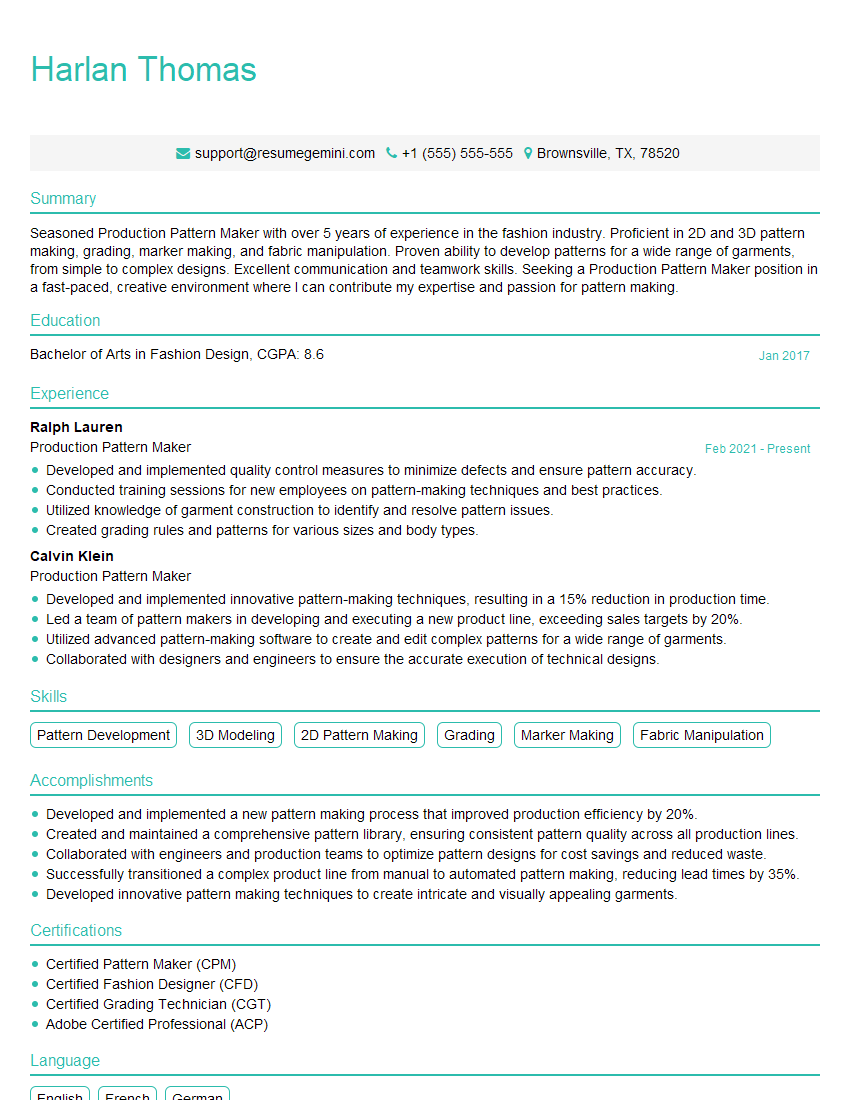
Mastering pattern-making is a highly valuable skill that opens doors to exciting career opportunities in the fashion industry. To make the most of your expertise, a strong, ATS-friendly resume is essential. This ensures your application gets noticed by recruiters and hiring managers.
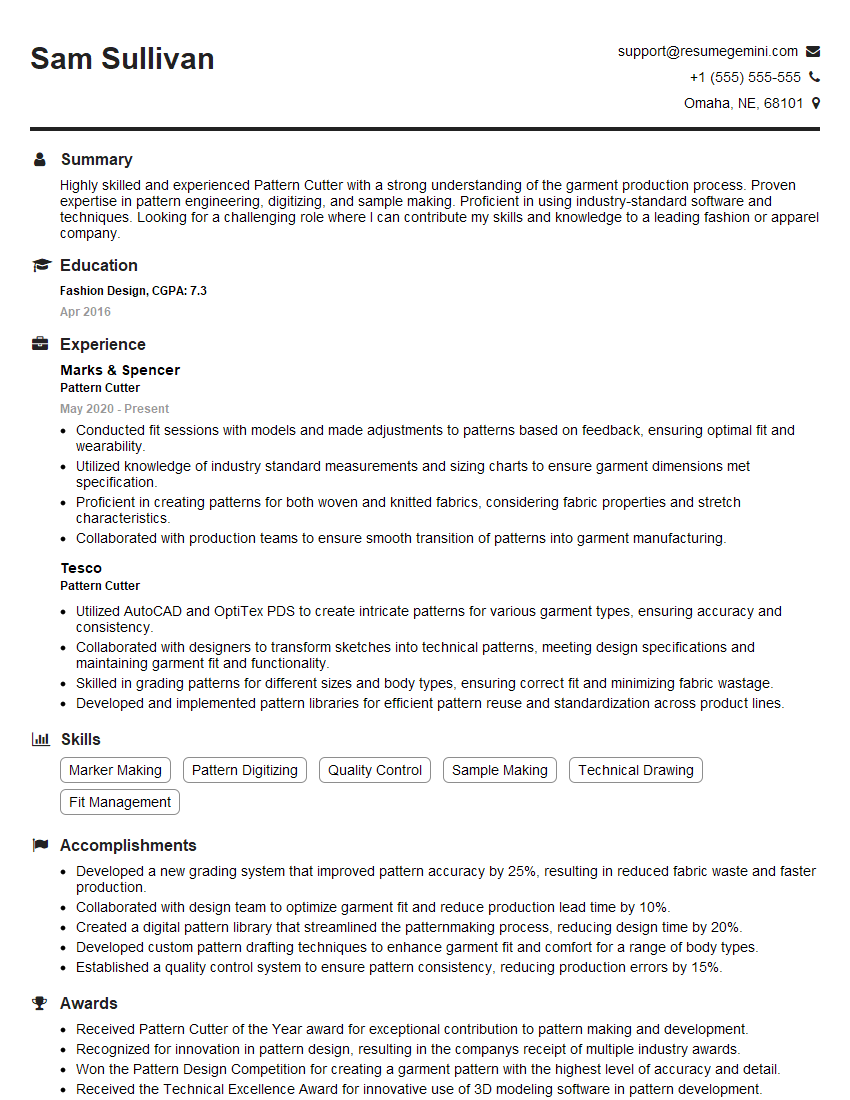
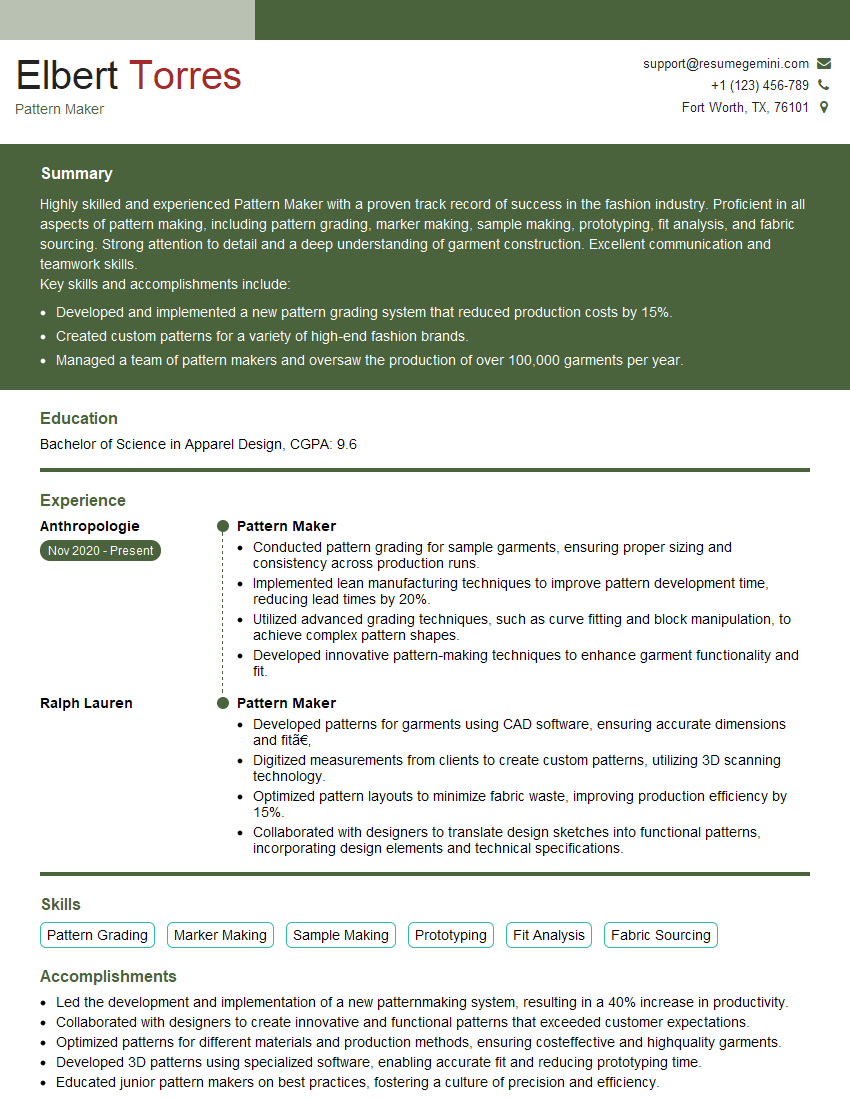
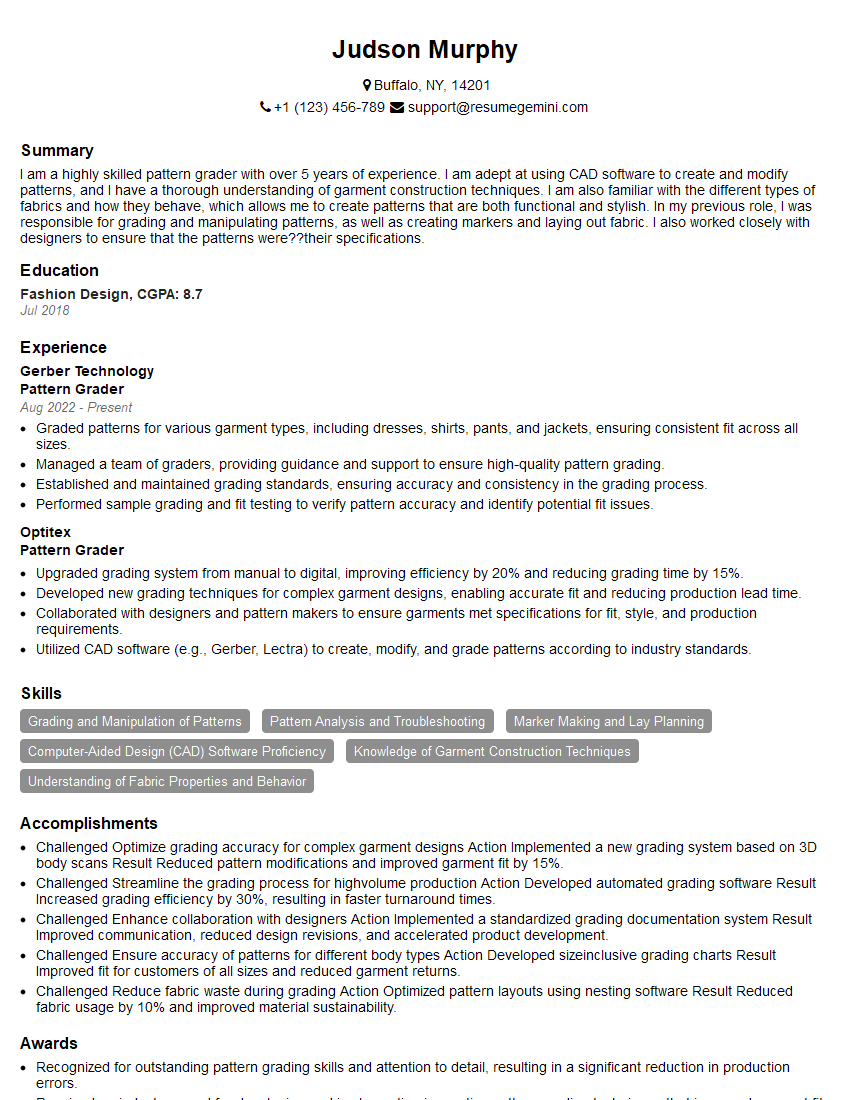
We recommend using ResumeGemini to craft a compelling and effective resume that highlights your skills and experience in the best possible light. ResumeGemini offers a streamlined process and provides examples of resumes tailored specifically to pattern-making roles, helping you present yourself as the ideal candidate. Invest time in crafting a professional resume; it’s your first impression and a crucial step towards your dream career.
Explore more articles
Users Rating of Our Blogs
Share Your Experience
We value your feedback! Please rate our content and share your thoughts (optional).
What Readers Say About Our Blog
Hello,
we currently offer a complimentary backlink and URL indexing test for search engine optimization professionals.
You can get complimentary indexing credits to test how link discovery works in practice.
No credit card is required and there is no recurring fee.
You can find details here:
https://wikipedia-backlinks.com/indexing/
Regards
NICE RESPONSE TO Q & A
hi
The aim of this message is regarding an unclaimed deposit of a deceased nationale that bears the same name as you. You are not relate to him as there are millions of people answering the names across around the world. But i will use my position to influence the release of the deposit to you for our mutual benefit.
Respond for full details and how to claim the deposit. This is 100% risk free. Send hello to my email id: [email protected]
Luka Chachibaialuka
Hey interviewgemini.com, just wanted to follow up on my last email.
We just launched Call the Monster, an parenting app that lets you summon friendly ‘monsters’ kids actually listen to.
We’re also running a giveaway for everyone who downloads the app. Since it’s brand new, there aren’t many users yet, which means you’ve got a much better chance of winning some great prizes.
You can check it out here: https://bit.ly/callamonsterapp
Or follow us on Instagram: https://www.instagram.com/callamonsterapp
Thanks,
Ryan
CEO – Call the Monster App
Hey interviewgemini.com, I saw your website and love your approach.
I just want this to look like spam email, but want to share something important to you. We just launched Call the Monster, a parenting app that lets you summon friendly ‘monsters’ kids actually listen to.
Parents are loving it for calming chaos before bedtime. Thought you might want to try it: https://bit.ly/callamonsterapp or just follow our fun monster lore on Instagram: https://www.instagram.com/callamonsterapp
Thanks,
Ryan
CEO – Call A Monster APP
To the interviewgemini.com Owner.
Dear interviewgemini.com Webmaster!
Hi interviewgemini.com Webmaster!
Dear interviewgemini.com Webmaster!
excellent
Hello,
We found issues with your domain’s email setup that may be sending your messages to spam or blocking them completely. InboxShield Mini shows you how to fix it in minutes — no tech skills required.
Scan your domain now for details: https://inboxshield-mini.com/
— Adam @ InboxShield Mini
Reply STOP to unsubscribe
Hi, are you owner of interviewgemini.com? What if I told you I could help you find extra time in your schedule, reconnect with leads you didn’t even realize you missed, and bring in more “I want to work with you” conversations, without increasing your ad spend or hiring a full-time employee?
All with a flexible, budget-friendly service that could easily pay for itself. Sounds good?
Would it be nice to jump on a quick 10-minute call so I can show you exactly how we make this work?
Best,
Hapei
Marketing Director
Hey, I know you’re the owner of interviewgemini.com. I’ll be quick.
Fundraising for your business is tough and time-consuming. We make it easier by guaranteeing two private investor meetings each month, for six months. No demos, no pitch events – just direct introductions to active investors matched to your startup.
If youR17;re raising, this could help you build real momentum. Want me to send more info?
Hi, I represent an SEO company that specialises in getting you AI citations and higher rankings on Google. I’d like to offer you a 100% free SEO audit for your website. Would you be interested?
Hi, I represent an SEO company that specialises in getting you AI citations and higher rankings on Google. I’d like to offer you a 100% free SEO audit for your website. Would you be interested?
good