The right preparation can turn an interview into an opportunity to showcase your expertise. This guide to Plasterboard interview questions is your ultimate resource, providing key insights and tips to help you ace your responses and stand out as a top candidate.
Questions Asked in Plasterboard Interview
Q 1. What are the different types of plasterboard available and their applications?
Plasterboard, also known as drywall, comes in various types, each suited for specific applications. The most common types include:
- Standard Plasterboard: This is the most widely used type, ideal for general-purpose wall and ceiling applications. It offers good sound insulation and fire resistance.
- Moisture-Resistant Plasterboard (MR): Designed for areas with higher humidity, such as bathrooms and kitchens. It features a green-colored backing board and offers better resistance to mold and mildew.
- Fire-Resistant Plasterboard (FR): Provides superior fire protection, often used in fire-rated walls and ceilings. It’s typically pink or red and significantly more resistant to fire spread.
- Sound-Insulating Plasterboard: Specifically engineered to reduce sound transmission between rooms. It’s often thicker than standard plasterboard and may contain dense materials to dampen sound waves.
- Water-Resistant Plasterboard (WR): Offers superior water resistance compared to MR board, useful in areas with a high risk of water exposure.
- Impact-Resistant Plasterboard: Designed to withstand impacts, suitable for areas prone to damage, such as hallways or areas with children.
Choosing the right type is crucial for ensuring the longevity and performance of your plasterboard installation. For instance, using standard plasterboard in a bathroom would be a mistake, leading to potential mold growth and damage. Always consult building codes and manufacturer specifications for appropriate application.
Q 2. Explain the process of preparing a surface for plasterboard installation.
Surface preparation is paramount for a successful plasterboard installation. A poorly prepared surface can lead to uneven finishes, poor adhesion, and ultimately, a subpar result. The process generally involves these steps:
- Cleaning: Remove any loose debris, dust, dirt, or old paint that may compromise adhesion. A wire brush, scraper, or pressure washer might be needed depending on the surface condition.
- Repairing: Repair any holes, cracks, or damaged areas in the existing surface using appropriate patching compounds. Ensure these repairs are completely dry before proceeding.
- Priming: Applying a primer creates a uniform surface, enhancing adhesion and preventing the plasterboard from absorbing moisture unevenly from the substrate. The choice of primer depends on the substrate material (e.g., concrete, brick, wood).
- Damp Proof Membrane (DPM): In damp environments, a DPM is essential to prevent moisture transfer from the substrate into the plasterboard. This is crucial, especially in basements or ground floor areas.
- Leveling: Use a bonding agent or render to level significantly uneven surfaces before applying plasterboard. Aim for a smooth, even surface to guarantee a seamless finish.
Think of surface preparation as laying a solid foundation for a house. Without a properly prepared base, your entire project will be unstable and compromised.
Q 3. Describe the correct methods for cutting and fitting plasterboard.
Cutting and fitting plasterboard requires precision and the right tools. Here’s how to do it properly:
- Cutting: For straight cuts, use a sharp utility knife or a plasterboard saw. Score the face of the board and snap it along the score line. For curved cuts, use a jigsaw with a fine-tooth blade. Always wear appropriate safety gear such as dust masks and gloves.
- Fitting: Sheets are generally fixed to wall or ceiling frameworks (studs or joists) using screws specifically designed for plasterboard. Ensure the screws are countersunk to avoid protruding and damaging the surface. The spacing of screws should follow manufacturer recommendations, typically every 150-200mm.
- Handling: Always support the full sheet of plasterboard when handling and installing. Avoid dropping or banging it, as it is prone to cracking and damage. Working with a partner often helps to make the installation process much easier and safer.
Precise cutting is key to a professional-looking finish. Sloppy cuts will be visible after finishing and will detract from the overall quality of your work. It’s always better to spend extra time ensuring your cuts are accurate.
Q 4. How do you ensure proper alignment and jointing of plasterboard sheets?
Achieving proper alignment and jointing is crucial for a flawless finish. Here’s how:
- Alignment: Before fixing the first sheet, establish a plumb line or level line to guide alignment. Use spacers to ensure consistent gaps between sheets and the wall/ceiling structure. This guarantees straight walls and ceilings.
- Jointing: Stagger the joints of adjacent sheets to avoid creating weak points. Aim for a minimum of 300mm overlap between sheets. Ensure that the long edges meet and butt tightly. Any gaps should be minimal to avoid requiring excessive filler.
- Tools: A spirit level, plumb bob, and measuring tape are essential tools to ensure accurate alignment. Using the correct tools will greatly reduce potential issues and save time in the long run.
Think of building a brick wall. Every brick is carefully placed in alignment to ensure strength and stability. Similarly, aligning and jointing plasterboard sheets correctly is fundamental for strength and a smooth, professional finish.
Q 5. What are the various jointing compounds used in plasterboard work and their applications?
Several jointing compounds are used in plasterboard work, each with specific applications:
- All-Purpose Joint Compound: A versatile compound suitable for most applications, offering good adhesion and filling capabilities.
- Lightweight Joint Compound: Ideal for larger areas, easier to sand and provides a lighter-weight finish. However, it might not be as strong as all-purpose compound for filling deep gaps.
- Setting-Type Joint Compound: Sets quickly, allowing for faster application and finishing, perfect for large-scale projects. However, it requires quick work to avoid drying out.
- Taping Compound: Specifically designed for embedding the tape, providing a strong bond and creating a smooth surface for subsequent coats.
Selecting the right compound is crucial for achieving a smooth, crack-free finish. For instance, using a lightweight compound for filling large holes would likely be inadequate; a stronger compound would be necessary for a durable repair.
Q 6. Explain the process of taping and filling plasterboard joints.
Taping and filling is a multi-step process that ensures strong and durable joints:
- Apply Taping Compound: Using a broad knife, apply a thin layer of taping compound over the joint, embedding the jointing tape firmly into the compound. Ensure that the compound completely covers the tape.
- Embed the Tape: Smooth the tape into the compound to ensure it’s securely fixed and avoid any air bubbles. A wet sponge or smoothing tool can be used to help with embedding the tape.
- Dry Completely: Allow the first coat to dry completely before applying subsequent coats. This may take several hours or even overnight depending on the environment.
- Apply Further Coats: Apply subsequent coats to build up a smooth, feathered edge. Use progressively wider knives for each coat to create a larger, smoother surface area.
- Sanding: Once completely dry, sand the filled joints smooth using fine-grit sandpaper. This is essential to achieve a perfectly smooth finish, ready for painting or decorating.
Careful taping and filling is crucial to prevent cracking and creates a smooth surface ready for a final finish. Rushing this stage will lead to a subpar outcome.
Q 7. How do you achieve a smooth, even finish on plasterboard surfaces?
Achieving a smooth, even finish requires attention to detail and proper techniques:
- Multiple Coats: Apply multiple thin coats of joint compound instead of one thick coat, allowing each coat to dry completely before sanding. This prevents cracking and provides a better, smoother finish.
- Sanding: Sand thoroughly using fine-grit sandpaper, paying careful attention to feather the edges to blend into the surrounding surface. Use a sanding block to avoid imperfections.
- Priming: Before painting, prime the surface with a high-quality primer designed for plasterboard. This ensures even paint coverage and prevents the appearance of any blemishes.
- Finish Coat: Apply a final coat of top-quality paint or emulsion to complete the project, enhancing the overall quality and finish of the plastered surface.
Think of it like baking a cake. Multiple thin layers, properly dried and smoothed, give you a far superior, more even result compared to attempting one thick layer. Patience and attention to detail are crucial in plasterboard finishing.
Q 8. What tools and equipment are essential for plasterboard installation?
Proper plasterboard installation requires a range of tools, ensuring efficient and accurate work. Think of it like a surgeon needing the right instruments for a precise operation. Here’s a breakdown of the essentials:
- Measuring Tools: Tape measure, spirit level (at least 2m for larger sheets), and a pencil for marking.
- Cutting Tools: Utility knife (with sharp blades) for scoring and snapping, plasterboard shears for curved cuts, and a handsaw for more complex cuts.
- Fixing Tools: A suitable drill with various drill bits (depending on the type of fixings used), and a screwdriver (magnetic tip is recommended for easier screw handling).
- Safety Equipment: Safety glasses, dust mask (plasterboard dust is irritating), and work gloves.
- Other Essentials: A jointing knife (for filling and finishing), a sanding block or electric sander, and a bucket and mixing paddle for jointing compound.
For instance, a precise spirit level ensures your sheets are perfectly plumb and level, preventing unsightly imperfections later. A sharp utility knife is crucial for clean, straight cuts – a dull blade will cause ragged edges and require more sanding.
Q 9. Describe the methods for dealing with corners and edges during plasterboard installation.
Corners and edges need special attention to create a professional finish. Imagine framing a picture – the frame needs to be perfect to showcase the artwork effectively. Here’s how we handle them:
- Internal Corners: Use corner bead (metal or plastic) to protect the corner and provide a smooth surface. This is secured to the plasterboard using appropriate screws.
- External Corners: Similar to internal corners, external corners utilize corner bead. Ensure the bead is firmly attached and properly aligned for a neat finish.
- Edges: For exposed edges, we can use a beading or simply ensure the edge is cleanly cut and appropriately finished with joint compound.
Properly fitted corner beads prevent damage and provide a clean, professional look. Remember, neat corners are a hallmark of quality workmanship.
Q 10. How do you handle damaged or defective plasterboard sheets?
Damaged or defective plasterboard sheets need immediate attention to avoid compromising the structural integrity and the overall aesthetic of the project. This is like dealing with a flawed building block – you can’t build a strong structure with broken pieces.
If a sheet has minor damage (small holes or scratches), it might be possible to repair it using joint compound and sanding. However, for significant damage (cracks, water damage, or significant dents), it’s usually best to replace the entire sheet. Carefully assessing the extent of the damage and acting accordingly will guarantee a high-quality result. Improper repair can lead to weakness and future problems.
Q 11. Explain the process of sanding and preparing plasterboard for painting.
Sanding and preparing plasterboard for painting is critical to achieving a smooth, even surface for a perfect paint finish. Imagine preparing a canvas for a masterpiece – a smooth surface ensures the paint adheres correctly.
- Filling and Taping: First, apply joint compound to fill the gaps between sheets and over screw heads. Use special jointing tape to reinforce the joints.
- Drying: Allow the compound to dry completely according to manufacturer’s instructions.
- Sanding: Use a sanding block or an electric sander (with fine grit sandpaper) to smooth out the filled areas and create a seamless surface. Focus on feathering the edges of the filled areas.
- Cleaning: Thoroughly clean the surface of dust before painting. Vacuum and use a damp cloth to remove all particles.
Proper sanding avoids imperfections visible in the paintwork, delivering a superior finish.
Q 12. What are the health and safety considerations when working with plasterboard?
Health and safety are paramount when working with plasterboard. Think of it like working in any construction environment – it’s crucial to protect yourself and others.
- Respiratory Protection: Plasterboard dust is harmful if inhaled. Always wear a suitable dust mask, preferably a respirator with P2 or higher filtration.
- Eye Protection: Safety glasses should be worn to prevent dust and debris from entering your eyes.
- Hand Protection: Wear work gloves to protect your hands from cuts and abrasions.
- Lifting Safely: Plasterboard sheets are heavy. Use proper lifting techniques and consider using a lifting assistant for larger sheets.
- Sharp Tools: Handle sharp tools carefully to prevent accidental cuts and injuries.
Neglecting safety precautions can lead to serious injuries, so prioritize your well-being throughout the project.
Q 13. How do you manage waste material during plasterboard installation?
Managing waste material during plasterboard installation is essential for environmental responsibility and efficient site management. Think of it as keeping your workspace clean and efficient.
Properly dispose of waste plasterboard according to local regulations. Many regions offer specific recycling programs for construction and demolition waste. Separate waste materials carefully – keeping clean scrap separate from contaminated waste, optimizing recycling opportunities. Avoid unnecessary waste by careful planning and accurate cutting.
Q 14. Explain the different types of screws used in plasterboard installation.
Different screws are used in plasterboard installation, each designed for specific applications. It’s like having the right tool for the right job.
- Plasterboard Screws: These are specifically designed for plasterboard. They have a sharp, self-tapping point and a coarse thread for a strong, secure hold. Different lengths and gauges are chosen based on the thickness of the plasterboard and supporting structure.
- Drywall Screws: Similar to plasterboard screws, these are also self-tapping and designed for use with plasterboard. They often feature a slightly different head design or a special coating for added holding power.
- Sheet Metal Screws: These are typically used for attaching metal framing or accessories. They have a strong holding capability and are designed to penetrate and grip metal efficiently.
Using the correct screw type ensures a robust and lasting installation. The wrong screw can lead to poor holding power and even damage to the board.
Q 15. What are the common problems encountered during plasterboard installation?
Common problems during plasterboard installation often stem from inadequate preparation or improper techniques. These can range from minor cosmetic issues to significant structural problems.
- Uneven surfaces: Working with walls or ceilings that aren’t perfectly flat can lead to gaps, uneven joints, and a poor finish. Imagine trying to paint a wobbly table – the result won’t be smooth!
- Incorrect fixing: Using the wrong type or number of screws, or failing to properly space them, compromises the board’s stability and can cause cracking or sagging over time.
- Joint taping and finishing issues: Poorly applied joint compound can lead to visible seams, cracking, and a less-than-professional appearance. This requires attention to detail and multiple coats for a smooth finish.
- Moisture damage: Using standard plasterboard in damp areas can result in mold growth and deterioration. This is why moisture-resistant board is crucial in bathrooms and kitchens.
- Improper handling and storage: Damaged boards due to dropping or improper stacking during storage can lead to wasted material and installation delays. Always handle boards carefully.
Addressing these issues proactively through proper planning and execution is vital for a successful installation.
Career Expert Tips:
- Ace those interviews! Prepare effectively by reviewing the Top 50 Most Common Interview Questions on ResumeGemini.
- Navigate your job search with confidence! Explore a wide range of Career Tips on ResumeGemini. Learn about common challenges and recommendations to overcome them.
- Craft the perfect resume! Master the Art of Resume Writing with ResumeGemini’s guide. Showcase your unique qualifications and achievements effectively.
- Don’t miss out on holiday savings! Build your dream resume with ResumeGemini’s ATS optimized templates.
Q 16. Describe your experience with different types of plasterboard adhesives.
My experience encompasses a variety of plasterboard adhesives, each suited for specific applications. The choice depends largely on the substrate, the type of plasterboard, and the desired level of adhesion.
- Powdered adhesive: This is a cost-effective option, often used for larger projects, but requires precise mixing and application to ensure even coverage. I’ve found it works best on well-prepared, porous substrates.
- Ready-mix adhesive: This offers convenience and ease of application, ideal for smaller jobs or when working against tight deadlines. It’s generally more expensive, however, and consistency is paramount for even adhesion.
- Contact adhesives: These provide a very strong bond, particularly useful when attaching plasterboard to unusual surfaces or in high-stress areas. Careful application is key as adjustments are limited after initial contact.
I always thoroughly assess the project requirements before selecting an adhesive, ensuring it aligns with the specific needs of the job and building regulations.
Q 17. How do you ensure the stability and durability of plasterboard installations?
Ensuring stability and durability in plasterboard installations is a multi-faceted process that begins long before the first board is hung. It’s about building a strong foundation for the finish.
- Proper substrate preparation: This is arguably the most critical step. Any unevenness or imperfections in the underlying structure will show through the finished plasterboard. I always start by ensuring the wall or ceiling is clean, dry, and structurally sound. Minor imperfections can be addressed with skim coats of plaster or other suitable materials.
- Correct fixing method: The type and spacing of fixings (screws or adhesive) are crucial. Under-fixing leads to instability, while over-fixing can damage the board. I adhere strictly to manufacturer recommendations and building codes.
- Careful jointing and finishing: Properly taping and filling the joints is essential to prevent cracking and ensure a smooth, seamless finish. Multiple coats of joint compound are usually needed, allowing each coat to dry thoroughly before applying the next.
- Appropriate board selection: Using the correct type of plasterboard is crucial—moisture-resistant board in bathrooms, fire-resistant board in fire-rated walls, etc. This ensures the longevity and safety of the installation.
By attending to these details, I can guarantee a plasterboard installation that’s not only aesthetically pleasing but also structurally robust and long-lasting.
Q 18. What are your methods for measuring and calculating plasterboard quantities?
Accurate measurement and calculation of plasterboard quantities is crucial to avoid waste and delays. I usually follow these steps:
- Detailed measurements: I carefully measure the walls and ceilings, taking into account door and window openings. I always double-check my measurements to avoid errors.
- Calculating surface area: I calculate the total surface area by multiplying the length and height of each wall or ceiling section. I then subtract the areas of any openings.
- Board dimensions: I account for the standard dimensions of plasterboard sheets (typically 1200mm x 2400mm). This allows me to determine how many sheets are needed for each wall or ceiling section.
- Waste factor: I always add a waste factor (typically 5-10%) to account for cutting, fitting, and potential damage. This is particularly important in rooms with complex layouts.
- Verification: I always double-check my calculations to ensure accuracy and avoid ordering too few or too many sheets.
Using this approach ensures I have the right amount of material on hand, preventing unnecessary expenses and project delays.
Q 19. How do you deal with uneven walls or ceilings during plasterboard installation?
Uneven walls or ceilings present a challenge, but with the right approach, a smooth, professional finish is achievable. I typically employ these techniques:
- Assess the unevenness: I first determine the extent and nature of the unevenness. Minor imperfections can be addressed differently than significant irregularities.
- Using shims or furring strips: For minor imperfections, I use shims or furring strips to create a more even surface before installing the plasterboard. These provide a level base to affix the plasterboard to.
- Skim coating: For more significant unevenness, I might apply a skim coat of plaster to create a smooth surface before installing the plasterboard. This ensures a better final finish.
- Multiple layers of plasterboard: In extreme cases, installing multiple layers of plasterboard, staggered to account for the unevenness, can be effective. This creates a stronger and more level surface, particularly for larger imperfections.
The key is to prepare the surface adequately to receive the plasterboard, ensuring a stable and aesthetically pleasing result. This might mean spending more time on preparation, but it pays off in the long run.
Q 20. Describe your experience with fire-resistant plasterboard.
Fire-resistant plasterboard, often denoted as F.R. plasterboard, is a crucial component in enhancing fire safety in buildings. My experience with it involves understanding its unique properties and application requirements.
- Material composition: F.R. plasterboard contains additives that significantly increase its resistance to fire, delaying the spread of flames and protecting the structure.
- Installation considerations: Installation procedures for F.R. plasterboard are similar to standard plasterboard, but the board must be installed according to the manufacturer’s recommendations and relevant building codes to ensure its fire-resistant properties are maintained.
- Specific applications: It’s frequently used in fire-rated walls, ceilings, and partitions, often in conjunction with other fire-protection measures, like fire-rated doors and insulation.
- Compliance and certification: I ensure that all the fire-resistant plasterboard I use is certified and compliant with relevant fire safety regulations. Proper documentation is essential for compliance and project acceptance.
Using fire-resistant plasterboard is not merely about following building codes; it’s about contributing to the safety and security of the building’s occupants.
Q 21. What is your experience with moisture-resistant plasterboard?
Moisture-resistant plasterboard, often referred to as MR plasterboard or sometimes greenboard due to its color, is designed specifically for areas prone to high humidity or moisture, such as bathrooms and kitchens. My experience highlights its importance in preventing mold growth and structural damage.
- Moisture resistance properties: MR plasterboard is treated to resist moisture absorption, significantly reducing the risk of mold growth and structural deterioration in damp environments. This treatment adds a level of protection unavailable in standard plasterboard.
- Installation considerations: While the installation is similar to standard plasterboard, proper ventilation is crucial in conjunction with the use of MR plasterboard to prevent moisture build-up. Avoiding direct contact with water sources is important.
- Choosing the right board: It’s essential to select MR plasterboard of appropriate thickness and size, ensuring it meets the project requirements and building codes.
- Sealant and finishing: Even with MR plasterboard, careful sealing of joints and any other possible entry points for moisture is crucial. This prevents moisture from penetrating behind the plasterboard.
Using moisture-resistant plasterboard significantly extends the lifespan of the installation and contributes to a healthier indoor environment by preventing moisture-related damage and mold growth.
Q 22. Explain the importance of using appropriate safety gear during plasterboard work.
Safety is paramount in plasterboard work. Failing to use appropriate safety gear can lead to serious injuries. Think of it like this: plasterboard is heavy, sharp edges can easily cause cuts, and dust can irritate your lungs. Therefore, personal protective equipment (PPE) is non-negotiable.
- Eye protection: Safety glasses or goggles are essential to prevent dust and debris from entering your eyes. I’ve seen firsthand how a tiny piece of plasterboard can cause a serious eye injury.
- Respiratory protection: A dust mask, preferably an N95 respirator, is crucial to protect your lungs from inhaling fine plasterboard dust, which can cause long-term respiratory problems. On large projects, a proper dust extraction system is a must.
- Hand protection: Work gloves protect your hands from cuts and abrasions caused by sharp edges and handling heavy sheets. I always prefer cut-resistant gloves for added safety.
- Head protection: A hard hat is necessary, especially on sites with overhead work or potential falling objects. It’s a simple precaution that can prevent serious head injuries.
- Foot protection: Steel-toe capped boots provide protection from dropped objects and punctures. A comfortable, supportive pair of boots is a significant factor in preventing fatigue and injuries.
Regular safety checks and adherence to site-specific safety procedures are also fundamental. It’s better to be safe than sorry; the consequences of neglecting safety can be devastating.
Q 23. Describe your problem-solving approach when facing unexpected issues during installation.
My problem-solving approach involves a systematic process: First, I assess the situation calmly, identifying the exact problem and its scope. Then, I gather information – checking the plans, the materials, and talking to the team. Next, I brainstorm possible solutions, considering their feasibility, cost, and safety implications. I weigh the pros and cons of each option before selecting the best course of action. Finally, I implement the chosen solution, documenting the process and the outcome. This ensures I can learn from the experience and refine my approach for future projects.
For example, if I encounter unexpected wall irregularities during installation, I wouldn’t just force the plasterboard. Instead, I’d carefully assess the irregularities, possibly using shims or furring strips to create a level surface before installing the board to ensure a smooth, professional finish. Open communication with the project manager is also key to finding the best solution and mitigating any potential delays.
Q 24. How do you ensure quality control throughout the plasterboard installation process?
Quality control is an ongoing process, starting from the initial assessment of the project requirements and continuing through to the final finishing touches. It’s like baking a cake – every step matters for a perfect result.
- Material inspection: Before starting, I inspect the plasterboard for any damage, ensuring it’s appropriate for the application. This includes checking for moisture content, cracks, or other defects.
- Substrate preparation: A smooth, level, and dry substrate is vital for successful installation. I carefully check the framing and walls before beginning.
- Accurate measurement and cutting: Precision in cutting avoids waste and ensures a perfect fit. I use measuring tools carefully and double-check measurements before making each cut.
- Secure fastening: Correct spacing and depth of screws are crucial for preventing cracking and ensuring a strong, long-lasting installation. I always use the correct screws for the type of plasterboard and framing material.
- Joint preparation and finishing: Careful taping and filling of joints are essential for a smooth, seamless finish. This includes using appropriate joint compound and sanding techniques.
- Regular inspections: Throughout the process, regular quality checks are made to identify and rectify any issues early on, preventing larger problems later.
At the end of each day, I conduct a thorough visual inspection to confirm the quality of my work and to identify potential problem areas for correction the next day. Documentation and photos are maintained to provide records of the quality of the work carried out.
Q 25. What are the key differences between taping and finishing plasterboard?
Taping and finishing are distinct but interconnected stages in plasterboard installation. Think of taping as the foundation and finishing as the cosmetic enhancement.
Taping involves applying tape over the joints between plasterboard sheets to create a strong, stable bond and prepare the surface for joint compound. This creates a strong, stable base for the finish coat. The goal is structural integrity. Different tapes exist; paper tape is common and provides good adhesion, but fiberglass tape offers superior crack resistance in areas prone to movement.
Finishing involves applying multiple coats of joint compound to cover the tape and create a smooth, seamless surface ready for painting or wallpapering. This is the aesthetic component, resulting in a smooth, paintable surface. Proper techniques include feathering the edges of the compound to minimize visible seams and achieving a flat, even surface. Sanding between coats is essential for a perfect finish.
In short: Taping provides structural strength, while finishing provides the aesthetic appeal.
Q 26. Describe your experience working with different types of drywall tools.
My experience encompasses a wide range of drywall tools, from the fundamental to the specialized. This expertise allows me to select the optimal tools for different tasks, ensuring efficiency and quality.
- Measuring tools: Tape measures, levels, squares – essential for accurate cutting and installation. I’m proficient in using laser levels for larger projects to ensure perfect alignment.
- Cutting tools: Utility knives, drywall saws, and scoring tools are used for precise cutting of plasterboard sheets. I’ve mastered techniques to minimize waste and create clean, straight cuts.
- Fastening tools: Various types of screw guns are crucial for efficient and accurate fastening. Selecting the right bit and adjusting the torque ensures proper screw depth without damaging the plasterboard.
- Finishing tools: Putty knives, taping knives, and sanding tools are necessary for creating smooth, seamless joints. I am skilled in using different sizes and shapes of knives to achieve different levels of finish.
- Specialized tools: Tools like lift systems, drywall hoists, and corner tools increase efficiency and safety, especially on larger projects. I can operate all these safely and effectively.
Beyond the tools themselves, I possess a deep understanding of their appropriate use and maintenance, ensuring optimal performance and longevity.
Q 27. How familiar are you with building codes and regulations related to plasterboard?
I am very familiar with building codes and regulations related to plasterboard. These codes vary by location but generally cover aspects like fire resistance, sound insulation, moisture resistance, and installation methods.
My knowledge extends to understanding the requirements for different types of plasterboard in various applications, such as fire-rated walls, moisture-resistant bathrooms, and soundproofed rooms. I understand the importance of using appropriate fasteners, ensuring proper spacing and depth for secure installation and compliance with local codes.
I regularly consult relevant building codes and standards to ensure all my work meets the required safety and performance standards. Staying updated on code changes is a continuous process, ensuring I consistently deliver compliant and high-quality work.
Q 28. What are your skills in estimating materials and labor costs for plasterboard projects?
Accurate material and labor cost estimation is crucial for successful project bidding and management. My experience allows me to generate realistic estimates based on detailed project plans.
I begin by carefully reviewing the project specifications, including the quantity of plasterboard needed, the type of plasterboard required, and the complexity of the installation. I account for factors such as wall sizes, number of corners, and the presence of any special features.
For material costs, I consult current pricing from reputable suppliers, factoring in waste and potential price fluctuations. For labor costs, I estimate the time required for each stage of the installation, considering the team size, skill level, and potential unforeseen challenges. I utilize historical data from past projects to refine my estimations. I also factor in overhead costs such as transportation and disposal of waste materials.
My estimations are detailed, transparent, and presented professionally, providing clients with a clear understanding of the project’s overall cost. I’m always willing to discuss and explain my cost estimation process, ensuring mutual understanding and agreement.
Key Topics to Learn for Plasterboard Interview
- Plasterboard Types and Properties: Understanding different types of plasterboard (e.g., standard, moisture-resistant, fire-resistant) and their respective properties (strength, density, moisture resistance) is crucial. Consider the applications where each type excels.
- Installation Techniques: Mastering the practical aspects of plasterboard installation, including cutting, fixing, taping, and finishing. Be prepared to discuss various fixing methods and their suitability for different situations.
- Joint Finishing and Preparation: Thorough knowledge of preparing joints for finishing, applying joint compound, and achieving a smooth, seamless finish is essential. Understand the importance of proper drying times and techniques for avoiding cracking.
- Health and Safety Regulations: Demonstrate your awareness of relevant health and safety regulations related to working with plasterboard, including dust control, personal protective equipment (PPE), and safe handling practices.
- Tools and Equipment: Familiarity with common tools and equipment used in plasterboard installation and finishing, including their proper use and maintenance.
- Problem-Solving and Troubleshooting: Be ready to discuss common problems encountered during plasterboard installation (e.g., uneven surfaces, damaged boards) and how to effectively troubleshoot and resolve them.
- Estimating and Quoting: For more senior roles, understanding how to accurately estimate materials and labor costs for plasterboard projects will be highly valued.
Next Steps
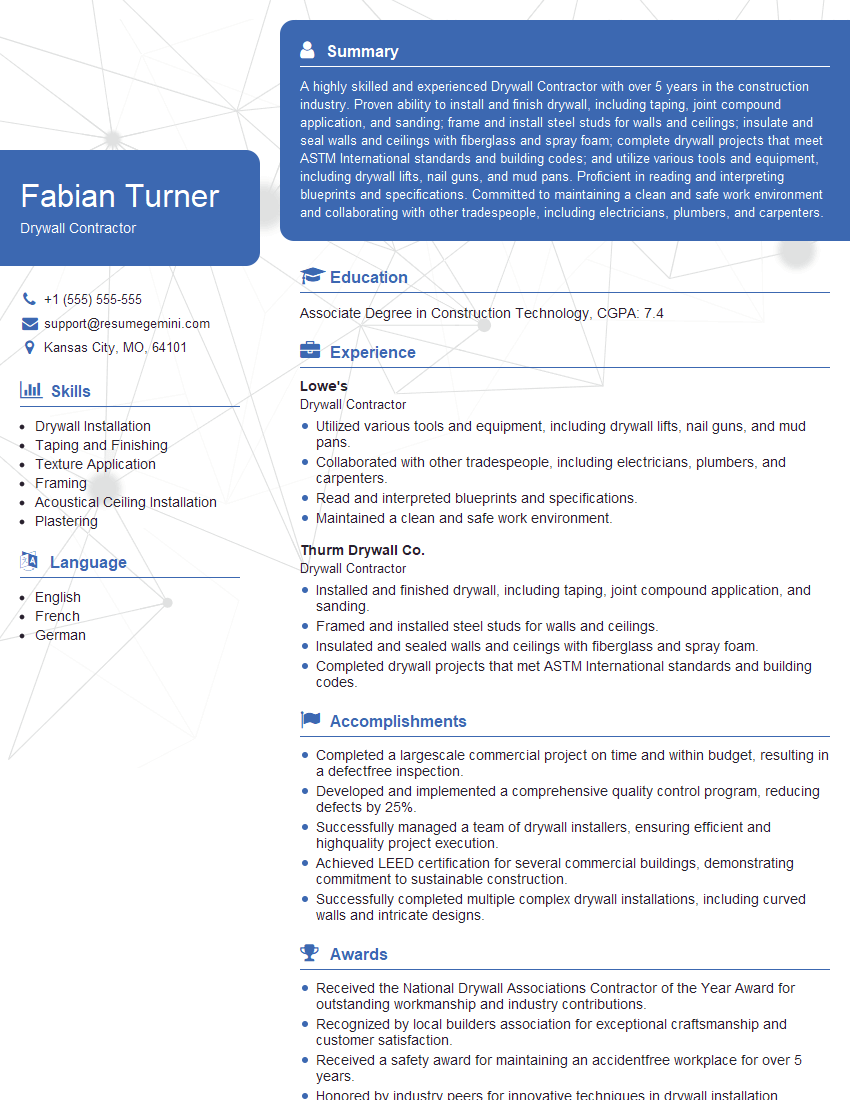
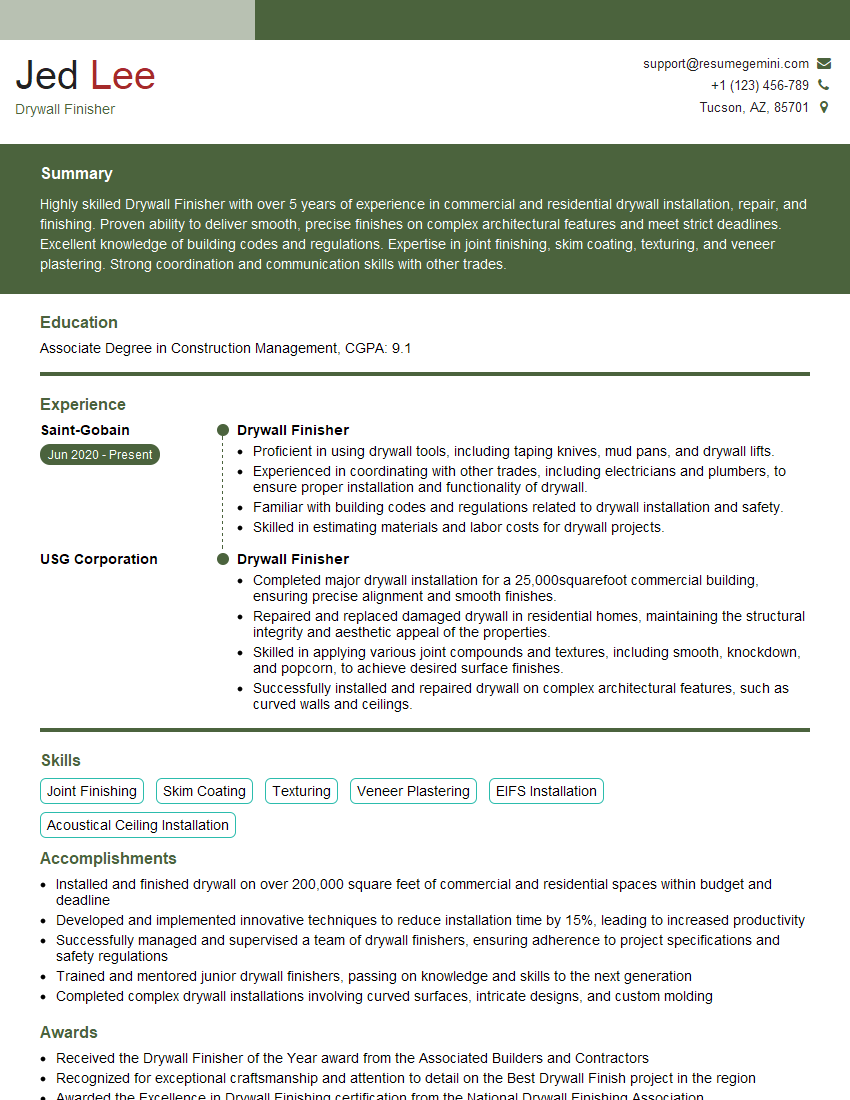
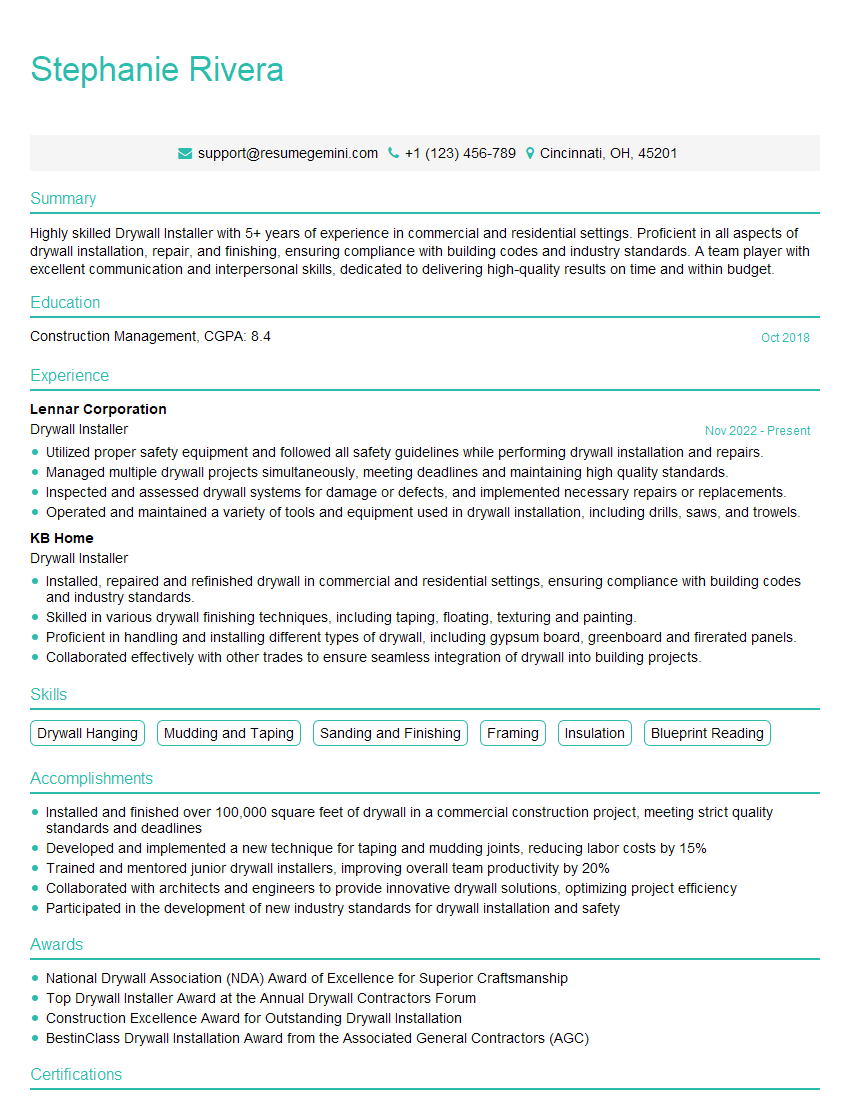
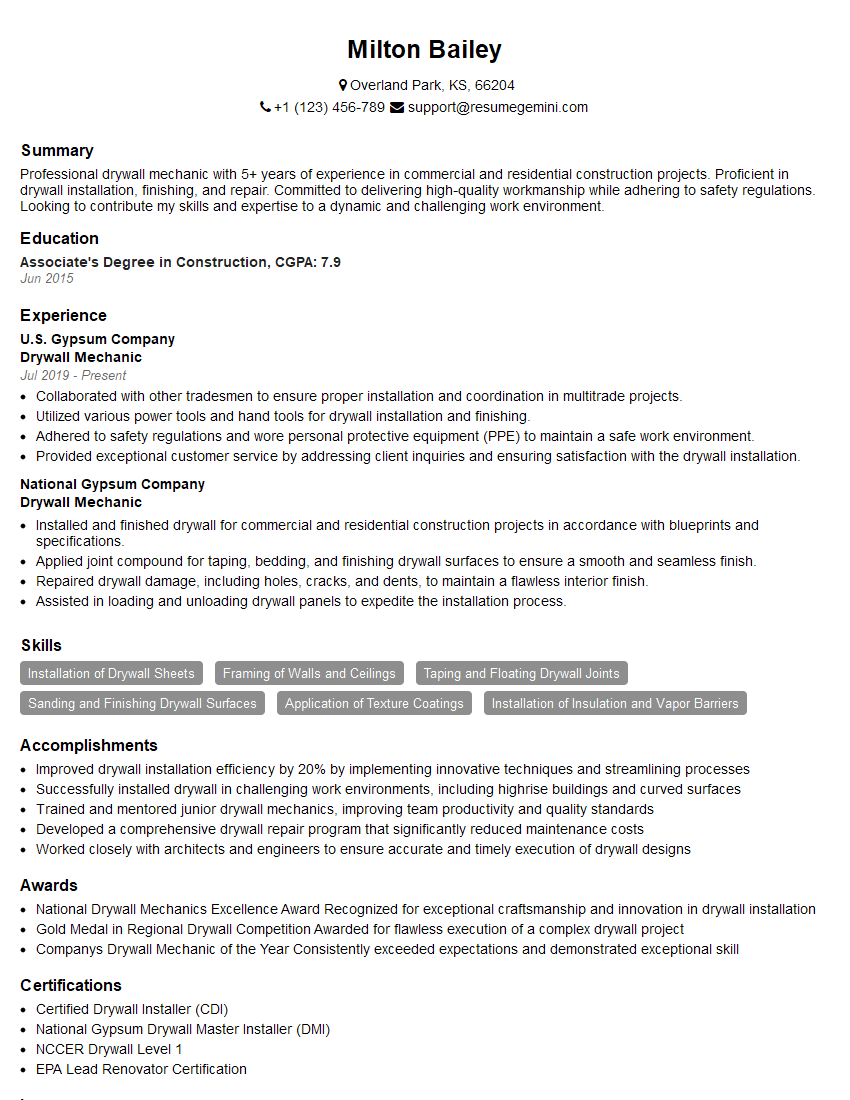
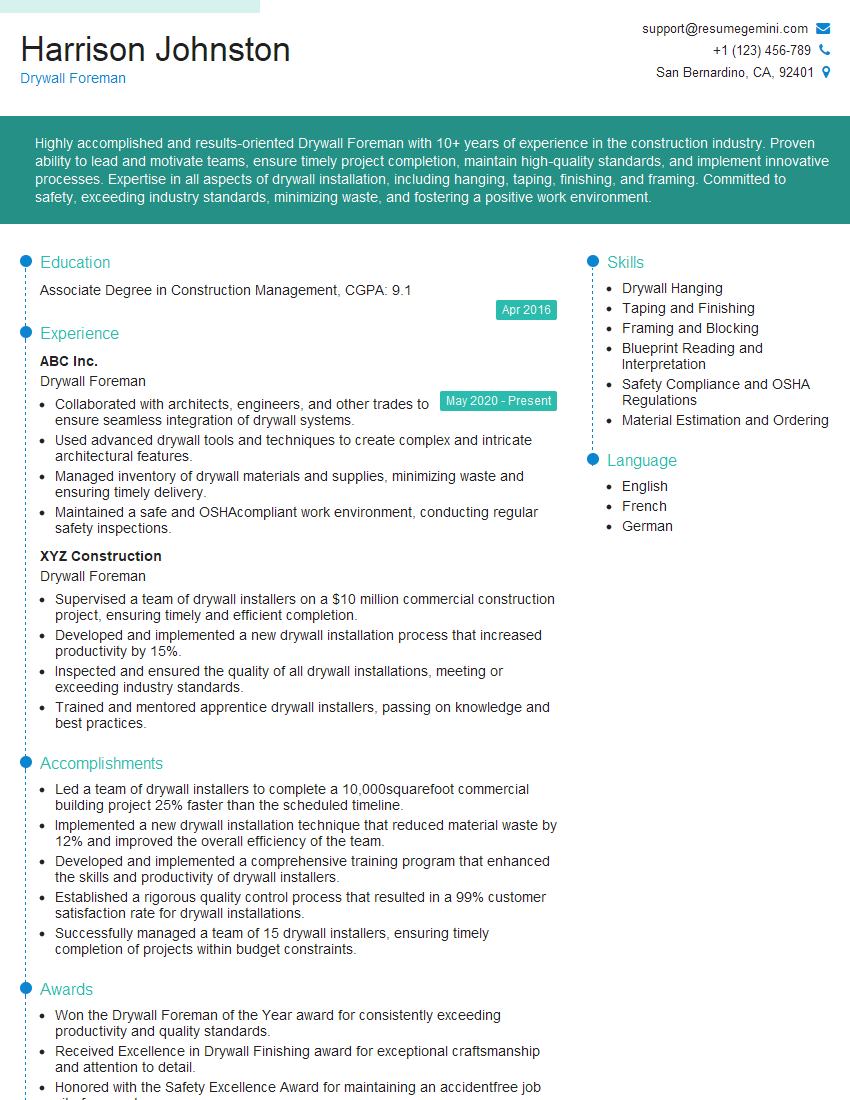
Mastering plasterboard installation and finishing opens doors to a rewarding career with diverse opportunities for growth and specialization. To maximize your job prospects, crafting a compelling and ATS-friendly resume is critical. ResumeGemini is a trusted resource to help you build a professional resume that showcases your skills and experience effectively. Examples of resumes tailored to the plasterboard industry are available to help guide your resume creation process.
Explore more articles
Users Rating of Our Blogs
Share Your Experience
We value your feedback! Please rate our content and share your thoughts (optional).
What Readers Say About Our Blog
Attention music lovers!
Wow, All the best Sax Summer music !!!
Spotify: https://open.spotify.com/artist/6ShcdIT7rPVVaFEpgZQbUk
Apple Music: https://music.apple.com/fr/artist/jimmy-sax-black/1530501936
YouTube: https://music.youtube.com/browse/VLOLAK5uy_noClmC7abM6YpZsnySxRqt3LoalPf88No
Other Platforms and Free Downloads : https://fanlink.tv/jimmysaxblack
on google : https://www.google.com/search?q=22+AND+22+AND+22
on ChatGPT : https://chat.openai.com?q=who20jlJimmy20Black20Sax20Producer
Get back into the groove with Jimmy sax Black
Best regards,
Jimmy sax Black
www.jimmysaxblack.com
Hi I am a troller at The aquatic interview center and I suddenly went so fast in Roblox and it was gone when I reset.
Hi,
Business owners spend hours every week worrying about their website—or avoiding it because it feels overwhelming.
We’d like to take that off your plate:
$69/month. Everything handled.
Our team will:
Design a custom website—or completely overhaul your current one
Take care of hosting as an option
Handle edits and improvements—up to 60 minutes of work included every month
No setup fees, no annual commitments. Just a site that makes a strong first impression.
Find out if it’s right for you:
https://websolutionsgenius.com/awardwinningwebsites
Hello,
we currently offer a complimentary backlink and URL indexing test for search engine optimization professionals.
You can get complimentary indexing credits to test how link discovery works in practice.
No credit card is required and there is no recurring fee.
You can find details here:
https://wikipedia-backlinks.com/indexing/
Regards
NICE RESPONSE TO Q & A
hi
The aim of this message is regarding an unclaimed deposit of a deceased nationale that bears the same name as you. You are not relate to him as there are millions of people answering the names across around the world. But i will use my position to influence the release of the deposit to you for our mutual benefit.
Respond for full details and how to claim the deposit. This is 100% risk free. Send hello to my email id: lukachachibaialuka@gmail.com
Luka Chachibaialuka
Hey interviewgemini.com, just wanted to follow up on my last email.
We just launched Call the Monster, an parenting app that lets you summon friendly ‘monsters’ kids actually listen to.
We’re also running a giveaway for everyone who downloads the app. Since it’s brand new, there aren’t many users yet, which means you’ve got a much better chance of winning some great prizes.
You can check it out here: https://bit.ly/callamonsterapp
Or follow us on Instagram: https://www.instagram.com/callamonsterapp
Thanks,
Ryan
CEO – Call the Monster App
Hey interviewgemini.com, I saw your website and love your approach.
I just want this to look like spam email, but want to share something important to you. We just launched Call the Monster, a parenting app that lets you summon friendly ‘monsters’ kids actually listen to.
Parents are loving it for calming chaos before bedtime. Thought you might want to try it: https://bit.ly/callamonsterapp or just follow our fun monster lore on Instagram: https://www.instagram.com/callamonsterapp
Thanks,
Ryan
CEO – Call A Monster APP
To the interviewgemini.com Owner.
Dear interviewgemini.com Webmaster!
Hi interviewgemini.com Webmaster!
Dear interviewgemini.com Webmaster!
excellent
Hello,
We found issues with your domain’s email setup that may be sending your messages to spam or blocking them completely. InboxShield Mini shows you how to fix it in minutes — no tech skills required.
Scan your domain now for details: https://inboxshield-mini.com/
— Adam @ InboxShield Mini
support@inboxshield-mini.com
Reply STOP to unsubscribe
Hi, are you owner of interviewgemini.com? What if I told you I could help you find extra time in your schedule, reconnect with leads you didn’t even realize you missed, and bring in more “I want to work with you” conversations, without increasing your ad spend or hiring a full-time employee?
All with a flexible, budget-friendly service that could easily pay for itself. Sounds good?
Would it be nice to jump on a quick 10-minute call so I can show you exactly how we make this work?
Best,
Hapei
Marketing Director
Hey, I know you’re the owner of interviewgemini.com. I’ll be quick.
Fundraising for your business is tough and time-consuming. We make it easier by guaranteeing two private investor meetings each month, for six months. No demos, no pitch events – just direct introductions to active investors matched to your startup.
If youR17;re raising, this could help you build real momentum. Want me to send more info?
Hi, I represent an SEO company that specialises in getting you AI citations and higher rankings on Google. I’d like to offer you a 100% free SEO audit for your website. Would you be interested?
Hi, I represent an SEO company that specialises in getting you AI citations and higher rankings on Google. I’d like to offer you a 100% free SEO audit for your website. Would you be interested?