The thought of an interview can be nerve-wracking, but the right preparation can make all the difference. Explore this comprehensive guide to Plate CtP interview questions and gain the confidence you need to showcase your abilities and secure the role.
Questions Asked in Plate CtP Interview
Q 1. Explain the process of Plate CtP from file to plate.
The Computer-to-Plate (CtP) process revolutionized platemaking by eliminating the need for film. It starts with a digital file, typically a PDF or TIFF, containing the image to be printed. This file is then processed by RIP (Raster Image Processor) software. The RIP converts the vector or high-resolution image data into a raster image, essentially a grid of dots, and assigns them to specific areas on the plate. This rasterized image is then sent to the CtP device, which exposes the plate according to the data. This exposure process utilizes either thermal or violet lasers to create latent images on the plate. Finally, the plate is processed in a processor unit where the exposed areas are chemically developed, resulting in a printing plate ready for use on a printing press. Think of it like a digital photograph being developed, but instead of paper, the “negative” is created on a printing plate.
For example, imagine creating a business card. The design file, created in Adobe Illustrator or InDesign, becomes the input. The RIP processes this file to make it suitable for plate exposure and the CtP device creates the printing plate from which thousands of cards are printed.
Q 2. What are the different types of CtP plates?
CtP plates are categorized primarily by their exposure method: thermal and violet. Within these categories, there are variations based on the plate material and the intended printing process.
- Thermal Plates: These plates utilize heat from a laser to create the image. They are generally easier to use, requiring less processing time and often less specialized equipment. However, they might have limitations in terms of resolution and durability compared to violet plates.
- Violet Plates: These plates use a violet laser to create the image, offering higher resolution and generally better print quality, especially for fine detail and sharp lines. They often require more stringent processing conditions and can be more expensive.
- Processless Plates: These require minimal or no chemical processing, making them environmentally friendly and reducing running costs. They often are either thermal or UV based.
The choice of plate type depends on the print job requirements, budget, and available equipment. A high-end magazine might use violet plates for superior image quality, while a short-run business card job might opt for the speed and convenience of thermal plates.
Q 3. Describe the advantages and disadvantages of thermal and violet CtP.
Both thermal and violet CtP plates have their strengths and weaknesses:
- Thermal CtP:
- Advantages: Relatively inexpensive plates and equipment, faster processing times, simpler operation.
- Disadvantages: Lower resolution compared to violet, potentially lower durability, more susceptible to scratching and damage.
- Violet CtP:
- Advantages: Higher resolution and print quality, greater detail and sharpness, better durability and scratch resistance.
- Disadvantages: More expensive plates and equipment, longer processing times, more complex operation, more stringent environmental control requirements during processing.
The choice often comes down to a balance between cost, quality, and throughput. If high-quality prints are paramount, violet is the better option. If speed and cost-effectiveness are key, thermal might be preferred.
Q 4. How do you troubleshoot common CtP platemaking issues?
Troubleshooting CtP platemaking issues requires a systematic approach. It often involves examining the entire workflow, from the design file to the final printed product. Here’s a step-by-step approach:
- Inspect the Digital File: Ensure the file is correctly formatted, high resolution, and free of errors. Incorrect color profiles or missing fonts can cause problems.
- Check the RIP Settings: Verify that the RIP settings (resolution, screening, color profiles) are appropriate for the plate type and printing press. Incorrect settings can lead to poor image quality or registration issues.
- Examine the Plate: Look for physical defects on the plate, such as scratches, dust, or uneven exposure. Cleaning or replacing the plate may be necessary.
- Evaluate the CtP Device: Check the laser power, focusing, and plate transport mechanisms. Poor laser performance can lead to inconsistent exposure.
- Verify the Processing Conditions: Ensure the processor unit is operating correctly and the processing chemicals are fresh and properly mixed. Incorrect processing can result in image defects or poor plate durability.
- Analyze the Printed Output: Examine the printed sheets for any inconsistencies in color, registration, or image quality. This can point to problems at any stage of the process.
Keeping detailed records of each job and troubleshooting steps is crucial for identifying recurring issues and improving the overall process.
Q 5. What are the key factors affecting plate quality?
Many factors influence CtP plate quality. Controlling these factors is vital for consistent, high-quality printing.
- Plate Type: The choice of thermal or violet, and the specific plate chemistry greatly affects the resolution, durability, and print quality.
- RIP Settings: Incorrect resolution, screening, or color profile settings can lead to various image defects.
- CtP Device Maintenance: Regular calibration and cleaning of the CtP device are crucial for consistent laser power and accurate image reproduction.
- Plate Handling: Careful handling of plates is necessary to avoid scratches, dust, and damage, which can lead to printing defects.
- Processing Conditions: Temperature, time, and the chemical concentration in the plate processor can significantly affect the final plate quality.
- Environmental Factors: Temperature, humidity, and cleanliness of the environment can influence plate sensitivity and processing.
- Press Conditions: The printing press itself (ink, pressure, temperature) impacts the final print. Poor press conditions can obscure potential plate quality issues.
Regular quality checks and process optimization are critical to minimize defects and ensure consistent plate quality.
Q 6. Explain the role of RIP software in Plate CtP.
The RIP (Raster Image Processor) software acts as the crucial bridge between the digital design file and the CtP device. Its functions are critical for successful platemaking:
- Image Conversion: The RIP converts vector-based files (like those from Adobe Illustrator) into raster images (a grid of pixels), suitable for plate exposure. It essentially translates the design into a language understood by the CtP device.
- Image Processing: The RIP performs image enhancements such as screening (breaking down images into dots for printing), color management (transforming colors to match the printing press and inks), and trapping (adjusting color overlaps to prevent gaps between colors).
- Plate Data Generation: It creates the data that directs the CtP device on how to expose the plate, including the position and intensity of the laser for each pixel.
- Device Control: The RIP interacts directly with the CtP device, sending the image data and controlling the exposure process.
Think of the RIP as the translator and image chef for the CtP process. It takes the raw design ingredients, carefully processes them, and makes sure the CtP device creates the final, printable “dish”.
Q 7. How do you ensure accurate color reproduction in Plate CtP?
Accurate color reproduction in CtP requires attention to detail throughout the workflow.
- Color Management: Using a consistent color profile throughout the workflow (design, RIP, CtP, and press) is critical. Profiles should accurately represent the colors of the monitor, the RIP, and the press inks.
- Calibration: Regular calibration of all devices (monitor, RIP, CtP, and press) is necessary to ensure consistency. Devices drift over time and need periodic adjustments to maintain accuracy.
- Proofing: Using color-accurate proofing methods (e.g., soft proofs or hard proofs) allows for early detection of color deviations before plates are created and printed. This helps to prevent costly reprints.
- Ink Selection: Choosing appropriate inks for the press and the substrate (paper, board, etc.) is crucial for accurate color reproduction. Inks behave differently on different substrates.
- RIP Settings: The RIP’s color management settings (including dot gain compensation) play a huge role in accurate color output. These settings require careful adjustment depending on the substrate, inks, and press.
Effective color management practices are essential for ensuring that the printed output closely matches the original design, maintaining consistency and accuracy across all print runs.
Q 8. Describe your experience with different CtP workflow systems.
My experience spans various CtP (Computer-to-Plate) workflow systems, encompassing both thermal and violet laser technologies. I’ve worked extensively with prepress software like Creo (now part of Kodak), Agfa Apogee, and Heidelberg Prinect, integrating them with various RIPs (Raster Image Processors) and workflow automation tools. This includes managing the entire process, from job submission and imposition to plate creation and output. For instance, in one role, I streamlined a workflow using Agfa Apogee, reducing platemaking time by 20% through optimized job queuing and automated quality control checks. Another project involved integrating a new thermal CtP system into an existing workflow, requiring careful configuration and testing to ensure seamless integration with existing software and hardware.
- Thermal CtP: Experience with Kodak Trendsetter and similar systems, focusing on optimizing plate processing parameters for different plate types and substrates.
- Violet CtP: Extensive experience with Agfa Avalon and Heidelberg Suprasetter, understanding the intricacies of laser power, resolution adjustments, and overall system optimization.
Q 9. How do you manage and maintain CtP equipment?
Maintaining CtP equipment requires a proactive and meticulous approach. It’s a blend of preventative maintenance, regular cleaning, and prompt troubleshooting. Preventative maintenance includes regularly checking laser power, cleaning the optics (lens, mirrors), and ensuring consistent cooling. I meticulously document all maintenance activities, following manufacturer recommendations and keeping a detailed log of service history. This helps in predicting potential issues and preventing downtime. For example, I developed a checklist for daily pre-flight checks, including checking laser power, imaging head alignment, and vacuum system performance. Cleaning involves using approved cleaning solutions and procedures to avoid damaging delicate components. When troubleshooting, a systematic approach is crucial, starting with simple checks like power supply and connectivity before moving on to more complex issues.
Q 10. Explain the concept of dot gain and its impact on print quality.
Dot gain is the increase in the size of a printed dot compared to the size of the dot on the plate. Think of it like this: you intend to print a tiny dot, but due to the printing process, it spreads out and becomes larger. This is crucial because it directly impacts the overall print quality. Excessive dot gain leads to darker and muddier prints, while insufficient dot gain results in prints that appear too light and lack detail. The ideal level of dot gain depends on the printing process, paper type, and ink used. Managing dot gain involves careful calibration of the CtP system, selection of appropriate RIP settings, and consideration of ink and substrate interactions. For example, a highly absorbent paper will often exhibit more dot gain than a coated stock, requiring adjustments to the original artwork to compensate.
Q 11. How do you calibrate a CtP system?
Calibrating a CtP system is a multi-step process ensuring accurate color reproduction and consistent dot gain. It typically involves using a densitometer and test targets. First, I’d print standardized test targets, carefully measuring the density of different dot sizes using a densitometer. These measurements are then compared against the expected values. Discrepancies indicate the need for adjustments within the RIP software, modifying parameters like dot gain compensation, tone curves, and color profiles. This is an iterative process, repeating the measurements and adjustments until the desired accuracy is achieved. Regular calibration, perhaps monthly or quarterly, depending on usage, is essential to maintain consistent print quality.
Q 12. What are the safety procedures associated with CtP equipment?
Safety is paramount when working with CtP equipment. Laser safety is the primary concern. Operators must always wear appropriate laser safety eyewear when the system is in operation. Furthermore, the system should be properly grounded to prevent electrical shocks. Regular safety checks and preventative maintenance are crucial to ensure proper functioning of safety interlocks and emergency shutdown mechanisms. I always follow the manufacturer’s safety guidelines and ensure proper training for all personnel using the CtP equipment, including emergency procedures. We maintain a clean and organized work area to prevent accidents. Regular inspections of electrical wiring and connections prevent potential hazards.
Q 13. How do you handle plate defects and errors?
Handling plate defects and errors involves a systematic approach. First, I carefully examine the defective plate to identify the nature of the problem. This could range from scratches and smudges to imaging errors or uneven exposure. The root cause needs to be determined before taking corrective action. For example, scratches might indicate a problem with the plate handling system, while imaging errors might point towards issues with the RIP settings or the CtP system itself. Once the cause is identified, corrective actions are taken—this might involve adjusting the RIP settings, recalibrating the CtP system, replacing defective parts, or even retraining operators if the error is user-related. A detailed record of all defects and corrective actions is maintained for quality control and process improvement.
Q 14. Describe your experience with different types of plate exposure units.
My experience encompasses various plate exposure units, predominantly thermal and violet laser systems. Thermal units employ heat to expose the plate, while violet lasers use a high-powered laser for exposure. I’ve worked with different generations of both technologies, observing their respective strengths and weaknesses. Thermal systems are generally known for their lower initial cost, but they can be less efficient than violet laser systems, especially at higher resolutions. Violet laser systems offer faster processing speeds, higher resolutions, and improved image quality, but come with higher upfront investment costs. Each system requires specific operational parameters, including laser power, exposure time, and focusing adjustments. Selecting the appropriate exposure unit depends on factors such as production volume, required resolution, and budget considerations.
Q 15. How do you optimize CtP settings for different substrates?
Optimizing CtP settings for different substrates is crucial for achieving consistent, high-quality print results. Each substrate—be it a thermal plate, a violet laser plate, or a different type—has unique characteristics affecting its sensitivity to light, resolution capabilities, and overall image reproduction. The key is to carefully adjust the exposure parameters (laser power, time, and frequency) and the processing parameters (developer time and temperature) based on the substrate’s specifications.
- Thermal plates often require lower laser power and shorter exposure times compared to violet laser plates, as they are more sensitive to heat.
- Violet laser plates, due to their higher resolution capabilities, may need finer adjustments in laser power and frequency to avoid overexposure or underexposure, impacting image sharpness and dot gain.
- Different plate manufacturers also provide specific recommendations in their technical guides which must be diligently followed. These guides often include recommended settings for different types of plates and printing applications.
For example, when switching from a standard thermal plate to a high-resolution version from the same manufacturer, you might need to reduce the laser power by 10-15% and slightly adjust the frequency. I always start with the manufacturer’s recommendations and then fine-tune through test prints, meticulously checking for dot gain, highlight detail, and shadow detail. Careful monitoring of these factors enables optimal image quality and minimizes waste.
Career Expert Tips:
- Ace those interviews! Prepare effectively by reviewing the Top 50 Most Common Interview Questions on ResumeGemini.
- Navigate your job search with confidence! Explore a wide range of Career Tips on ResumeGemini. Learn about common challenges and recommendations to overcome them.
- Craft the perfect resume! Master the Art of Resume Writing with ResumeGemini’s guide. Showcase your unique qualifications and achievements effectively.
- Don’t miss out on holiday savings! Build your dream resume with ResumeGemini’s ATS optimized templates.
Q 16. What are the environmental considerations in CtP platemaking?
Environmental considerations in CtP platemaking are critical for maintaining plate quality, ensuring consistent results, and protecting the environment. Key factors include:
- Temperature and Humidity: Fluctuations in temperature and humidity significantly affect plate processing chemistry, potentially leading to inconsistent results or even plate defects. Ideally, the platemaking area should be climate-controlled to maintain stable conditions.
- Dust and Air Quality: Dust and other airborne particles can contaminate plates, causing defects in the final print. A clean and well-ventilated environment is crucial to mitigate this. HEPA filtration systems are often used in professional environments.
- Chemical Handling and Storage: CtP plate processing involves chemicals that require careful handling and storage to ensure worker safety and environmental protection. Appropriate safety measures, including personal protective equipment (PPE), proper ventilation, and designated chemical storage areas, are essential. Furthermore, waste chemical management and proper disposal protocols must be meticulously followed.
- Energy Consumption: CtP devices consume considerable energy. Employing energy-efficient machines and practices, such as turning off the devices when not in use, can minimize environmental impact and reduce operational costs.
In my experience, ignoring these factors has led to problems like plate sticking, inconsistent dot gain, and reduced plate lifespan. Establishing and maintaining a clean, controlled environment is a fundamental aspect of ensuring high-quality platemaking and responsible manufacturing.
Q 17. Explain your experience with plate processing and chemicals.
My experience with plate processing and chemicals spans over [Number] years, encompassing various plate types and processing chemistries. I’m proficient in operating automated plate processors and manual plate processing techniques. My expertise includes understanding the different types of developers, conditioners, and gumming solutions used with thermal, violet, and UV plates. I have hands-on experience with troubleshooting common processing issues such as streaks, spots, and uneven development.
For example, I once encountered an issue with uneven development on a batch of violet plates. After systematically investigating possible causes—checking temperature, chemical concentrations, and processor settings—I discovered a slight imbalance in the developer replenishment system. Adjusting the replenishment rate resolved the problem, demonstrating the importance of meticulous attention to detail and preventative maintenance.
Furthermore, I have a strong understanding of safe handling procedures for processing chemicals, including the proper use of personal protective equipment (PPE), waste disposal, and adherence to environmental regulations. Safety is paramount in my workflow, and proper chemical management is a key part of that commitment. I’m also skilled in maintaining accurate records of chemical usage and disposal, ensuring compliance with industry best practices and regulations.
Q 18. How do you manage color profiles and ICC profiles in a CtP workflow?
Managing color profiles and ICC profiles is fundamental to achieving color accuracy in CtP workflows. ICC profiles act as translators, ensuring that the color you see on your monitor accurately translates to the printed output. The process involves:
- Creating or selecting appropriate ICC profiles: This involves using a spectrophotometer to measure the color characteristics of your monitor, printer, and plates. For consistency, standardized profiles from the plate manufacturer or RIP software are often preferred.
- Embedding ICC profiles in the workflow: This ensures that color information is consistently interpreted throughout the printing process, from the design software to the RIP and the CtP device.
- Color management software: Using dedicated color management software allows you to profile your devices and manage color conversions across different stages of the workflow. This software helps you create and apply ICC profiles, manage color transformations, and assess color consistency.
- Proofing and adjustments: Regular soft proofing and color calibration help identify and address inconsistencies in color rendering. These steps involve creating soft proofs before printing to visualize the output closely. Necessary adjustments to the design or color settings are made based on the proof’s results.
In practice, I routinely use [Name of Software] to manage ICC profiles. I ensure every file going to the CtP device has the correct profile embedded to guarantee color accuracy. Ignoring this step can result in significant color shifts and printing inconsistencies, leading to costly reprints and production delays.
Q 19. How do you troubleshoot issues related to image resolution and sharpness?
Troubleshooting image resolution and sharpness issues in CtP requires a systematic approach. The problem can stem from several sources:
- Low resolution source files: Insufficient resolution in the original design file will always result in a blurry or pixelated print. I always verify that the resolution of the input file meets the required resolution of the printing press.
- Incorrect downsampling: If a high-resolution image needs to be scaled down, improper downsampling techniques can result in a loss of sharpness. Using proper algorithms like bicubic resampling is vital.
- RIP settings: The RIP (Raster Image Processor) settings significantly influence resolution and sharpness. Incorrect settings for halftoning, screening, and sharpening can severely compromise image quality. Experimentation with these settings is often necessary for optimization.
- CtP device settings: The CtP device’s laser resolution and focusing accuracy also affect the final image. Regular maintenance and calibration of the device are vital.
- Plate type and processing: The chosen plate type and the quality of plate processing play a critical role. Improper chemical handling, improper developing, or incorrect plate exposure can result in blurry images.
For instance, if I encounter a blurry print, I start by checking the original design file’s resolution. Then, I inspect the RIP settings, paying close attention to halftoning and sharpening parameters. If those are correct, I move on to check the CtP device settings and, finally, the plate processing parameters. This systematic approach usually reveals the root cause and allows effective problem-solving.
Q 20. What are your experience with different CtP manufacturers (e.g., Creo, Kodak)?
I have extensive experience with various CtP manufacturers, including Creo (now part of Kodak), Kodak, and [mention other manufacturers if applicable]. Each manufacturer offers unique features and technologies. For instance:
- Kodak systems are known for their reliability and wide range of plate types. I have considerable experience with Kodak’s thermal and violet plates, optimizing their use for various applications.
- Creo systems (now integrated into Kodak) offered advanced features in color management and workflow integration. I’m familiar with their RIP software and its capabilities in streamlining the platemaking process.
- [Mention other manufacturers and specific experiences]
My experience working with different manufacturers has provided me with a broad understanding of the strengths and weaknesses of various CtP technologies and helps me approach troubleshooting with a comprehensive perspective. Understanding the nuances of each system’s software and hardware is crucial for effective operation and maintenance.
Q 21. Describe your experience with preflighting files for CtP.
Preflighting files for CtP is a critical step in preventing costly errors and ensuring smooth production. It involves a thorough check of the design files before they are sent to the CtP device. This includes:
- Checking for color spaces: Verifying that the design file is using the correct color space (e.g., CMYK) to avoid unexpected color shifts.
- Assessing image resolution: Ensuring the image resolution meets the required specifications for optimal print quality. Low resolution images will lead to poor quality prints.
- Font verification: Checking that all fonts are embedded or outlined to prevent font substitution issues.
- Checking for missing or corrupted files: Verifying the integrity of linked files and images.
- Image trapping and bleeds: Checking for correct overprinting and bleed settings to ensure clean and accurate registration.
- Checking for spot colors: Ensuring that spot colors are correctly converted and handled.
I use dedicated preflight software such as [mention specific software] to automate this process. The software automatically checks for various errors and provides detailed reports. This process significantly reduces the risk of production delays and reprints resulting from file errors, ensuring a smooth and efficient workflow.
Q 22. How do you ensure the consistent quality of plates over time?
Maintaining consistent plate quality over time in CtP is paramount for consistent print results. It’s a multi-faceted process that begins with meticulous control over several key areas.
- Regular Calibration: We perform regular calibrations of the CtP device, checking laser power, imaging drum cleanliness, and focusing mechanisms. This ensures consistent exposure and image quality. Think of it like tuning a musical instrument – regular maintenance ensures optimal performance.
- Plate Chemistry and Handling: Using the correct plate type for the printing press and following the manufacturer’s recommended processing procedures is critical. This includes proper plate storage, preventing scratches or damage, and controlling environmental factors like temperature and humidity, which can impact the plate’s chemical properties.
- Regular Maintenance: Preventative maintenance on the CtP device itself is key. This includes cleaning the imaging drum, checking laser alignment, and replacing worn parts. Just like a car needs regular servicing, the CtP needs attention to avoid costly breakdowns and quality issues.
- Quality Control Checks: We routinely inspect plates using a densitometer and a microscope to check for any imperfections or inconsistencies. This is our quality assurance step to catch potential issues before they reach the printing press.
- Operator Training: Well-trained operators are crucial. Proper training ensures consistent handling of plates, accurate settings, and efficient troubleshooting of common issues.
By combining these methods, we can consistently produce high-quality plates, minimizing waste and maximizing print quality.
Q 23. What are the key metrics you use to evaluate the performance of the CtP system?
Evaluating CtP system performance relies on several key metrics, allowing for proactive maintenance and optimization.
- Plate Production Speed: This measures the number of plates produced per hour. It reflects the efficiency of the system and the overall throughput.
- Plate Defects Rate: This is the percentage of plates with imperfections such as scratches, pinholes, or imaging flaws. A lower rate indicates better system performance and higher yield.
- Downtime: This tracks the time the system is unavailable due to maintenance, repairs, or malfunctions. Minimizing downtime is crucial for maintaining productivity.
- Consumable Usage: Monitoring the consumption of plates, chemicals, and other consumables helps in optimizing costs and identifying potential issues. For example, excessive chemical usage might signal a problem with the processing unit.
- Image Quality Metrics: We use a densitometer to measure density and dot gain, which ensures consistent color reproduction and print quality. This is critical for maintaining color accuracy across different jobs.
By regularly monitoring and analyzing these metrics, we can identify trends, pinpoint areas for improvement, and ultimately ensure the CtP system operates efficiently and delivers consistent quality.
Q 24. How do you handle urgent platemaking requests?
Handling urgent platemaking requests efficiently requires a well-defined process and a proactive approach.
- Prioritization: Urgent jobs are immediately prioritized in our workflow. This might involve adjusting the production schedule or temporarily reassigning resources.
- Dedicated Resources: We have dedicated personnel trained to handle urgent situations, ensuring fast turnaround times.
- Streamlined Workflow: We use a computerized system for efficient job routing and tracking. This allows us to monitor job progress and quickly identify bottlenecks.
- Overtime if Necessary: In critical situations, we might have to authorize overtime for operators to meet the deadline.
- Communication: Maintaining transparent communication with clients is crucial, keeping them informed of the progress and expected delivery times.
We’ve had instances where a critical job needed to be completed overnight, and by utilizing this process, we successfully met the client’s tight deadline and maintained excellent quality.
Q 25. Describe your experience with automated plate handling systems.
My experience with automated plate handling systems is extensive. I’ve worked with various systems, from simple automated plate loaders to fully integrated, robotic systems.
- Improved Efficiency: Automated systems significantly improve efficiency by automating tasks like plate loading, unloading, and transport. This reduces manual handling, minimizes the risk of human error, and frees up operators to focus on other tasks.
- Reduced Errors: Automation minimizes human error, resulting in fewer plate defects and improved consistency. This is particularly important for high-volume printing applications.
- Enhanced Safety: Automated systems reduce the risk of workplace accidents associated with manual handling of heavy plates. This makes the workplace safer and improves overall working conditions.
- Integration with CtP: The best systems seamlessly integrate with the CtP workflow, maximizing efficiency and streamlining the entire platemaking process.
- Maintenance and Troubleshooting: I’m proficient in performing routine maintenance and troubleshooting issues with automated plate handling systems. Understanding the mechanics and programming is crucial for effective operation.
For example, I recently upgraded a system that incorporated a robotic arm for plate handling; this dramatically reduced the time taken to process plates while improving overall accuracy and minimizing manual intervention.
Q 26. How do you maintain accurate inventory of plates and consumables?
Maintaining accurate inventory of plates and consumables is crucial for efficient operations and cost control.
- Inventory Management Software: We use dedicated inventory management software to track the quantity of each plate type, chemical, and other consumables in stock. This gives us real-time visibility of our inventory levels.
- Regular Stock Checks: Physical stock checks are performed regularly to verify the accuracy of the software data and to identify any discrepancies.
- Automated Ordering: The software is set up to automatically generate purchase orders when inventory levels reach a predetermined threshold. This ensures that we never run out of essential materials.
- FIFO (First-In, First-Out): We follow a FIFO system for managing consumables to ensure that the oldest materials are used first, preventing waste due to expiration.
- Storage Optimization: Proper storage conditions are maintained to ensure the longevity and quality of plates and consumables.
This comprehensive approach ensures we have the necessary materials on hand to meet our production demands while minimizing storage costs and waste.
Q 27. What are your skills in troubleshooting network connectivity issues related to CtP?
Troubleshooting network connectivity issues related to CtP requires a systematic approach. My skills include:
- Understanding Network Infrastructure: I have a solid understanding of network protocols, such as TCP/IP and Ethernet, and how they apply to the CtP workflow. This includes knowledge of network configurations, routers, switches, and firewalls.
- Diagnosing Connectivity Problems: I can use diagnostic tools like ping, traceroute, and network analyzers to pinpoint network connectivity issues. This involves examining network traffic, identifying bottlenecks, and isolating faulty components.
- Troubleshooting Network Settings: I can configure network settings on the CtP device and related equipment to ensure proper communication. This includes IP addresses, subnet masks, and DNS settings.
- Firewall Management: I understand how firewalls can impact network connectivity and can configure them to allow proper communication between the CtP and other systems.
- Remote Access and Support: I am proficient in using remote access tools to diagnose and resolve network issues remotely. This reduces downtime and allows for faster problem resolution.
For instance, I once resolved a network connectivity issue that prevented a job from being sent to the CtP by correctly identifying a misconfigured firewall rule. This was done through remote access and without any on-site visit. This quick solution avoided significant production delays.
Q 28. How familiar are you with different file formats used in prepress (e.g., PDF, TIFF, JPF)?
I am highly familiar with various file formats used in prepress, each with its strengths and weaknesses. My experience covers:
- PDF (Portable Document Format): The most common format for prepress, PDF offers high fidelity and excellent compatibility across different systems. It supports both raster and vector graphics and offers options for color management.
- TIFF (Tagged Image File Format): TIFF is a robust, high-resolution image format suitable for high-quality images and is often used for halftone images. However, it can be very large in file size.
- JPF (JPEG 2000): This format is known for its high compression ratios, making it suitable for large images and archiving. However, its support in some older RIP systems might be limited.
- Other Formats: I also have experience with other formats like EPS (Encapsulated PostScript) and DCS (Desktop Color Separation) though these are less common now.
Understanding the nuances of these file formats allows me to effectively process files for the CtP, ensuring accurate and efficient output. For instance, I know when to optimize a TIFF image for size without compromising quality or utilize the compression benefits of JPF for archiving large print projects.
Key Topics to Learn for Plate CtP Interview
- Plate CtP Workflow: Understand the entire process from file preparation to plate output, including prepress operations, imaging technologies, and plate making.
- RIP Software & Color Management: Gain a strong grasp of Raster Image Processors (RIPs), color profiles (ICC profiles), and their role in achieving accurate color reproduction on the final print.
- Plate Types & Characteristics: Familiarize yourself with various plate types (e.g., thermal, UV, offset) and their respective properties, advantages, and disadvantages in different printing applications.
- Image Resolution & Screening: Master the concepts of resolution, DPI, LPI, and screening techniques for optimal print quality and efficient plate production.
- Troubleshooting & Quality Control: Develop your problem-solving skills related to common issues in Plate CtP workflows, such as dot gain, moiré patterns, and plate defects. Learn about quality control measures and best practices.
- Prepress File Handling & Preparation: Understand file formats (e.g., PDF, TIFF), color spaces, and the importance of proper file preparation to avoid errors during the CtP process.
- Automation & Workflow Optimization: Explore methods to automate tasks, improve efficiency, and reduce bottlenecks within the Plate CtP workflow.
- Health & Safety: Be aware of relevant health and safety regulations and procedures associated with handling chemicals and operating Plate CtP equipment.
Next Steps
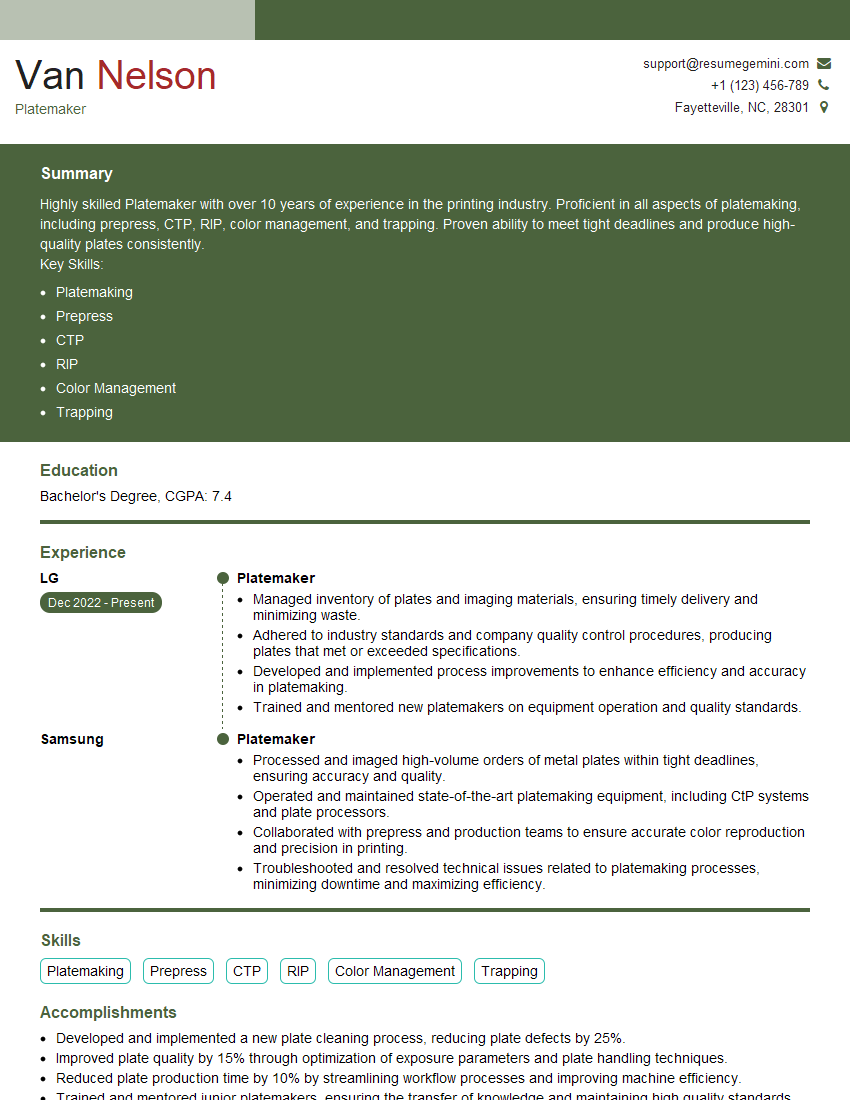
Mastering Plate CtP opens doors to exciting career opportunities in the printing industry, offering specialization and higher earning potential. A strong understanding of this technology is highly sought after by employers. To maximize your chances of securing your dream role, creating an ATS-friendly resume is crucial. This ensures your skills and experience are effectively communicated to potential employers. We highly recommend using ResumeGemini to build a professional and impactful resume tailored to the Plate CtP industry. ResumeGemini provides valuable tools and resources, including examples of resumes specifically crafted for Plate CtP positions. Take advantage of these resources to present yourself in the best possible light.





Explore more articles
Users Rating of Our Blogs
Share Your Experience
We value your feedback! Please rate our content and share your thoughts (optional).
What Readers Say About Our Blog
Hello,
we currently offer a complimentary backlink and URL indexing test for search engine optimization professionals.
You can get complimentary indexing credits to test how link discovery works in practice.
No credit card is required and there is no recurring fee.
You can find details here:
https://wikipedia-backlinks.com/indexing/
Regards
NICE RESPONSE TO Q & A
hi
The aim of this message is regarding an unclaimed deposit of a deceased nationale that bears the same name as you. You are not relate to him as there are millions of people answering the names across around the world. But i will use my position to influence the release of the deposit to you for our mutual benefit.
Respond for full details and how to claim the deposit. This is 100% risk free. Send hello to my email id: [email protected]
Luka Chachibaialuka
Hey interviewgemini.com, just wanted to follow up on my last email.
We just launched Call the Monster, an parenting app that lets you summon friendly ‘monsters’ kids actually listen to.
We’re also running a giveaway for everyone who downloads the app. Since it’s brand new, there aren’t many users yet, which means you’ve got a much better chance of winning some great prizes.
You can check it out here: https://bit.ly/callamonsterapp
Or follow us on Instagram: https://www.instagram.com/callamonsterapp
Thanks,
Ryan
CEO – Call the Monster App
Hey interviewgemini.com, I saw your website and love your approach.
I just want this to look like spam email, but want to share something important to you. We just launched Call the Monster, a parenting app that lets you summon friendly ‘monsters’ kids actually listen to.
Parents are loving it for calming chaos before bedtime. Thought you might want to try it: https://bit.ly/callamonsterapp or just follow our fun monster lore on Instagram: https://www.instagram.com/callamonsterapp
Thanks,
Ryan
CEO – Call A Monster APP
To the interviewgemini.com Owner.
Dear interviewgemini.com Webmaster!
Hi interviewgemini.com Webmaster!
Dear interviewgemini.com Webmaster!
excellent
Hello,
We found issues with your domain’s email setup that may be sending your messages to spam or blocking them completely. InboxShield Mini shows you how to fix it in minutes — no tech skills required.
Scan your domain now for details: https://inboxshield-mini.com/
— Adam @ InboxShield Mini
Reply STOP to unsubscribe
Hi, are you owner of interviewgemini.com? What if I told you I could help you find extra time in your schedule, reconnect with leads you didn’t even realize you missed, and bring in more “I want to work with you” conversations, without increasing your ad spend or hiring a full-time employee?
All with a flexible, budget-friendly service that could easily pay for itself. Sounds good?
Would it be nice to jump on a quick 10-minute call so I can show you exactly how we make this work?
Best,
Hapei
Marketing Director
Hey, I know you’re the owner of interviewgemini.com. I’ll be quick.
Fundraising for your business is tough and time-consuming. We make it easier by guaranteeing two private investor meetings each month, for six months. No demos, no pitch events – just direct introductions to active investors matched to your startup.
If youR17;re raising, this could help you build real momentum. Want me to send more info?
Hi, I represent an SEO company that specialises in getting you AI citations and higher rankings on Google. I’d like to offer you a 100% free SEO audit for your website. Would you be interested?
Hi, I represent an SEO company that specialises in getting you AI citations and higher rankings on Google. I’d like to offer you a 100% free SEO audit for your website. Would you be interested?
good