Unlock your full potential by mastering the most common Play Calling interview questions. This blog offers a deep dive into the critical topics, ensuring you’re not only prepared to answer but to excel. With these insights, you’ll approach your interview with clarity and confidence.
Questions Asked in Play Calling Interview
Q 1. Describe your process for identifying and exploiting defensive weaknesses.
Identifying and exploiting defensive weaknesses is the cornerstone of successful play-calling. My process involves a multi-faceted approach combining film study, statistical analysis, and real-time observation. First, I meticulously review film, looking for recurring patterns in the defense’s alignment, techniques, and player tendencies. For example, if a linebacker consistently over-pursues on outside runs, we can design plays to exploit that weakness. Second, I analyze statistical data to identify vulnerabilities. Perhaps a defense struggles significantly against specific formations or play types. Third, during the game itself, I observe the defense’s reactions to our initial plays. If they consistently adjust in a predictable manner, we can counter with plays designed to exploit those adjustments. Think of it like chess; we’re constantly trying to anticipate their moves and react accordingly. This iterative process, combining pre-game analysis and in-game observation, allows me to dynamically adjust my play-calling to maximize our offensive potential.
Q 2. Explain your approach to play selection in various game situations (e.g., 2-minute drill, 4th down).
Play selection in different game situations requires a completely different strategy. In a two-minute drill, time is of the essence. The objective is to move the ball down the field efficiently, avoiding turnovers and maximizing scoring opportunities. Quick passes, play-action passes, and running plays designed to gain short to intermediate yardage are crucial. We’d limit the riskier, longer plays. Conversely, in a fourth-down situation, the decision making becomes more nuanced. The risk/reward ratio changes drastically. Factors like field position, score differential, time remaining, and the opponent’s defensive alignment all come into play. A fourth-and-short might call for a run to gain a manageable amount of yardage. A fourth-and-long, however, requires a calculated risk, possibly a deep pass or even a field goal attempt. The decision hinges on the probability of success versus the potential payoff.
Q 3. How do you adapt your play calling based on opponent tendencies and personnel groupings?
Adapting to opponent tendencies and personnel groupings is crucial for successful play-calling. If the defense consistently shows a nickel package (five defensive backs), we may focus on running plays to the outside or using play-action passes to exploit their lighter defensive box. Conversely, if they frequently use a base defense (four linebackers), we may look for opportunities to pass the ball, taking advantage of potential mismatches. We also analyze opponent tendencies through film study. If a team consistently struggles to defend certain types of running plays or pass concepts, we’ll incorporate those plays into our game plan. By combining our pre-game analysis of personnel groupings and tendencies with in-game adjustments, we can find success in tailoring our offense to exploit specific vulnerabilities.
Q 4. What metrics do you use to evaluate the effectiveness of your play calling?
Evaluating the effectiveness of my play-calling isn’t solely about yards gained or points scored; it’s a holistic approach. I use a combination of metrics, including yards per play, third-down conversion rate, red-zone efficiency, and time of possession. These metrics provide a quantitative assessment of our offensive performance. However, I also consider qualitative factors such as the execution of plays, the decision-making of the quarterback, and the overall effectiveness of our game plan. For instance, a high yards-per-play average with low red-zone efficiency suggests a need to refine our short-yardage plays. A balanced approach, which combines quantitative data analysis with subjective evaluations, enables a more complete picture of our offensive success.
Q 5. Explain your philosophy on balancing run and pass plays.
My philosophy on balancing run and pass plays is centered around achieving a sustainable offensive rhythm. It’s not about a rigid 50/50 split; it’s about strategically utilizing both to keep the defense guessing. A well-balanced approach establishes a running game to control the clock and set up play-action opportunities, making the passing game more effective. Conversely, a strong passing game opens up running lanes, allowing us to exploit weaknesses in the run defense. The balance is dictated by many factors: game situation, opponent tendencies, our team’s strengths, and the effectiveness of our plays on the field. Sometimes we’ll run it down their throat, other times we’ll utilize short, quick passes to sustain drives. The goal is to be unpredictable and adaptable, creating an offensive rhythm that wears down the opponent over the course of the game.
Q 6. How do you incorporate pre-snap reads and adjustments into your play calling?
Pre-snap reads and adjustments are critical to offensive success. Before the snap, the quarterback and I communicate through signals and hand signals, allowing us to adjust the play based on the defense’s alignment. For example, if the defense shows a heavy blitz, we might audible into a quick pass to avoid the pressure or modify the protection scheme to account for the extra rushers. These adjustments are essential to maximizing the effectiveness of each play. The quarterback’s recognition of defensive tendencies and his ability to make quick decisions at the line of scrimmage is a critical component of this process. It’s about having a clear communication structure and trust between the quarterback and myself.
Q 7. Describe your experience with different offensive or defensive schemes.
Throughout my career, I’ve had the opportunity to work with various offensive and defensive schemes. My experience encompasses spread offenses, pro-style offenses, and even some elements of the air-raid offense. On the defensive side, I’ve faced 3-4 and 4-3 defenses, as well as variations and hybrid schemes. This broad exposure has significantly broadened my understanding of the game and play-calling strategies. I have found that understanding the strengths and weaknesses of different offensive and defensive schemes is fundamental for constructing an effective game plan. The diverse experiences have enabled me to become a more versatile and adaptable play-caller.
Q 8. How do you handle unexpected situations or adjustments during a game?
Handling unexpected situations during a game requires a blend of pre-game preparation, adaptability, and quick thinking. It’s like being a chef – you have a menu (game plan), but you need to be ready to improvise if a key ingredient (player) is unavailable or the dish (game situation) changes unexpectedly.
My approach involves several key steps: First, I constantly assess the game flow – momentum shifts, opponent adjustments, our team’s performance. Second, I have backup plans. For example, if our running game is stifled, I have passing plays ready that exploit the defense’s weakness. Third, I trust my players and their ability to execute adjustments. I’ll communicate any changes clearly and concisely, emphasizing the why behind the changes. Finally, I learn from every game, using post-game analysis to refine my strategies and identify areas where I can improve my response to unexpected situations.
In one game, our starting quarterback was injured in the second quarter. Instead of panicking, I immediately switched to our backup, adjusted the play calling to utilize his strengths (a stronger short passing game), and ensured the offensive line adjusted its blocking schemes. We managed to maintain a lead and ultimately win the game.
Q 9. How do you communicate your play calls effectively to the players?
Effective communication of play calls is paramount. It’s not just about delivering the play; it’s about ensuring every player understands their role and responsibilities clearly and quickly.
My approach uses a combination of methods. We have a well-established system of terminology and signals – a shared language that’s concise and unambiguous. We practice these extensively during training, ensuring players understand hand signals, verbal cues and visual aids. I use clear, concise language, avoiding jargon or overly technical terms. Additionally, I frequently use visual aids, such as diagrams on the tablet, to reinforce the play concepts. I also engage players in a dialogue – not just giving orders, but ensuring understanding. Are there questions? Any concerns about the play’s execution? Open communication fosters a team environment where everyone is on the same page.
Q 10. Describe your experience using technology (e.g., tablets, software) in play calling.
Technology has revolutionized play calling. Tablets and specialized software have significantly improved the efficiency and precision of our game preparation and in-game adjustments. I use the tablets to access game film, review opponent tendencies, and even create customized play diagrams during the game. The software allows for real-time adjustments based on down and distance, field position, and opponent alignment.
For example, I can quickly filter through plays in our playbook, choosing options that are optimal against the specific defensive formation we are facing. The ability to quickly review and adjust is a huge advantage. Moreover, the software’s statistics engine helps me make data-driven decisions, identifying areas of success or weakness in our current play-calling strategy. This technology is an essential tool, helping me make faster and smarter decisions on the field.
Q 11. Explain your approach to managing timeouts strategically.
Strategic timeout management is crucial. Timeouts aren’t just about catching your breath; they’re tactical tools used to disrupt momentum, create opportunities, or provide necessary adjustments. My approach involves a multi-faceted strategy:
- Pre-game planning: I establish a basic timeout strategy based on anticipated game scenarios. For instance, we often save one timeout for the final two minutes of a close game.
- In-game assessment: I continually assess the game state. A crucial momentum shift or a critical penalty might warrant calling a timeout even if it wasn’t in the initial plan.
- Offensive and Defensive considerations: Timeouts can be used to prevent the opponent from shifting defensive formations or to give the offense time to adapt to unexpected situations.
- Protecting the Clock: Knowing when to burn a timeout to stop the clock or allow it to run can be the difference between victory and defeat.
It’s a delicate balance; you don’t want to waste timeouts but you need them when needed. It’s about being decisive, proactive, and always thinking ahead.
Q 12. How do you incorporate situational awareness into your play calling decisions?
Situational awareness is the cornerstone of effective play calling. It’s about constantly scanning the game’s variables – score, time remaining, field position, down and distance, opponent’s tendencies, our team’s strengths and weaknesses, even the weather conditions. It’s like chess – you need to anticipate your opponent’s moves and adjust your strategy accordingly.
My approach involves several techniques. I carefully analyze opponent tendencies – their defensive schemes, play-calling patterns, their players’ strengths and weaknesses. I track our own team’s performance – are we successful running or passing? Are we facing fatigue? The game is a dynamic situation, and my calls must reflect that. I’m not stuck to a rigid plan; I adapt and adjust on the fly, balancing risk and reward based on the specific circumstances.
For example, if we’re close to the end zone and trailing with limited time, I might favor short, high-percentage passes over riskier long bombs. That balance between risk and reward changes every single play depending on the situation.
Q 13. What is your approach to game preparation and opponent scouting?
Game preparation and opponent scouting are fundamental to successful play calling. It’s like preparing for a major battle; you need to know your enemy and your own strengths. My approach is thorough and multi-layered.
Opponent Scouting: We extensively study game films of the opposing team. We focus on their defensive and offensive schemes, player tendencies, and weaknesses. We look for patterns in their play-calling, identifying tendencies based on down and distance or field position. We often use software that helps automate the analysis of film, enabling us to produce detailed reports and highlight potential vulnerabilities.
Game Preparation: This involves creating tailored game plans that exploit the opponent’s weaknesses and showcase our team’s strengths. We build multiple game plans to account for different scenarios and adjust as the game unfolds. I also work with the coaching staff to integrate strategies for special teams. Good preparation means anticipating multiple scenarios and having a solution ready for each one.
Q 14. How do you balance risk and reward in your play calling decisions?
Balancing risk and reward is a constant challenge. High-risk plays can lead to big gains, but they also carry a higher chance of failure. Conservative plays guarantee a certain level of progress, but may not yield high reward. My approach involves a careful assessment of the game situation, weighing the potential gains against the potential losses.
Several factors influence this decision. Game clock, score, field position, down and distance all play a crucial role. If we are down by a touchdown in the final minutes, I may take on more risks with our play calling compared to a situation with a comfortable lead. Similarly, early in the game, I might adopt a more conservative strategy to establish a solid foundation. This isn’t an exact science; it’s a judgment call based on extensive experience and analyzing the current game state.
It’s about knowing when to go for it and when to play it safe, always looking at the bigger picture and the long-term impact of each decision.
Q 15. Explain your experience with various formations and personnel packages.
My experience spans a wide range of offensive and defensive formations and personnel packages. I’m proficient in designing and implementing strategies tailored to specific opponent matchups and player strengths. For example, I’ve extensively used the following:
- Offensive Formations: I’m comfortable with various spread formations (e.g., Empty, Trips, Bunch), pro-style formations (e.g., I-formation, Strong I), and shotgun variations. The choice depends on exploiting the defense’s weaknesses and the skillset of our personnel. A team with strong running backs might benefit from a power-I, while a team with a dynamic quarterback might thrive in a spread formation.
- Defensive Formations: My experience includes deploying various 4-3, 3-4, and nickel packages. The selection is dictated by the opponent’s offensive tendencies and the overall game situation. A 3-4 defense excels against the run, while a nickel package is better suited for pass-heavy offenses.
- Personnel Packages: I understand the importance of tailoring personnel packages to specific situations. This involves strategically deploying personnel groups based on down and distance, field position, and opponent tendencies. For instance, using a heavy package (multiple tight ends) in short-yardage situations increases the likelihood of success running the ball.
Throughout my career, I’ve continuously adapted and refined my strategies based on game film study, statistical analysis, and player performance evaluations. This ensures our formations and personnel packages remain effective and maximize our chances of success.
Career Expert Tips:
- Ace those interviews! Prepare effectively by reviewing the Top 50 Most Common Interview Questions on ResumeGemini.
- Navigate your job search with confidence! Explore a wide range of Career Tips on ResumeGemini. Learn about common challenges and recommendations to overcome them.
- Craft the perfect resume! Master the Art of Resume Writing with ResumeGemini’s guide. Showcase your unique qualifications and achievements effectively.
- Don’t miss out on holiday savings! Build your dream resume with ResumeGemini’s ATS optimized templates.
Q 16. Describe a time when your play calling significantly impacted the outcome of a game.
In a crucial playoff game, we were down by seven points with two minutes left on the clock. Our opponent, known for a strong pass rush, was employing a blitz-heavy strategy. I recognized that their aggressive approach left them vulnerable against play-action passes. Instead of relying on our typical short passing game, I called a series of play-action passes that consistently caught their defense off guard. This strategy led to two crucial touchdowns in rapid succession, securing a dramatic victory.
The key was adapting to their defensive scheme. While many coaches would have stuck to the run, recognizing their tendency to blitz allowed me to anticipate their defensive alignment and capitalize on their aggressive approach. It’s not simply about calling the right plays, but about understanding the opposing team’s strategy and using their strengths against them. This situation showcases the importance of anticipating your opponents and understanding situational play calling.
Q 17. How do you manage the emotional aspects of coaching and play calling under pressure?
Managing emotional aspects under pressure is crucial in play calling. It’s a high-stakes environment where quick decisions with significant consequences are required. My approach involves:
- Maintaining composure: I focus on staying calm and objective, even during tense moments. Deep breathing techniques and mental imagery are helpful tools.
- Strategic thinking over emotional reactions: I prioritize strategic analysis of the game situation and opponent tendencies over immediate emotional responses.
- Positive self-talk: Repeating positive affirmations, focusing on past successes, and trusting my preparation helps maintain confidence.
- Team support: I rely on the support and input from my coaching staff. Open communication is key to bouncing ideas off each other and collectively finding the best solution.
Ultimately, a calm and controlled approach allows for more effective decision-making and better communication with players.
Q 18. How do you handle criticism or feedback on your play calling decisions?
Criticism and feedback are essential parts of growth and improvement in play calling. I approach it in a constructive manner:
- Active listening: I attentively listen to the feedback, seeking to understand the perspective of the critic.
- Objective evaluation: I analyze the feedback objectively, separating emotional responses from valid points.
- Self-reflection: I engage in self-reflection, examining my play-calling decisions and identifying areas for improvement.
- Collaboration and discussion: I engage in discussions with colleagues and staff to gain different perspectives and improve my understanding.
- Adapt and adjust: Based on the analysis and feedback, I adapt my approach, refining my strategy to improve future game outcomes.
Remember, the goal is not to avoid criticism but to learn from it and continually improve. It’s about adapting to feedback, incorporating new insights, and evolving as a play-caller.
Q 19. How do you develop and maintain positive relationships with players and coaching staff?
Building positive relationships with players and coaching staff is paramount to successful play calling. I believe in:
- Open communication: I foster an environment of open communication where players feel comfortable sharing feedback and concerns.
- Respect and trust: I demonstrate respect for all individuals, building a foundation of trust based on mutual understanding and respect.
- Mentorship and support: I serve as a mentor and support system, empowering players to reach their full potential.
- Collaboration: I approach play calling as a collaborative effort, involving the coaching staff in the strategic planning process.
- Recognition and appreciation: I recognize and appreciate the contributions of players and staff members, celebrating achievements and acknowledging hard work.
Strong relationships ensure effective communication, higher player morale, and a more collaborative approach to game strategy.
Q 20. Describe your understanding of different offensive and defensive concepts.
My understanding of offensive and defensive concepts is comprehensive. It encompasses:
- Offensive Concepts: I’m familiar with various running schemes (e.g., inside zone, outside zone, power), passing concepts (e.g., mesh, sail, dagger), and formations designed to create mismatches. Understanding route combinations, protection schemes, and tendencies of different offenses is critical.
- Defensive Concepts: My knowledge extends to various defensive schemes (e.g., man-to-man, zone, blitz packages), coverages (e.g., Cover 2, Cover 3, Cover 4), and techniques used to disrupt offensive plays. I understand how different defensive fronts (e.g., 4-3, 3-4) affect offensive play calls.
Furthermore, I’m adept at identifying and exploiting weaknesses in opposing offensive and defensive schemes. Understanding both sides of the ball enables me to devise play calls that create favorable matchups and maximize our chances of success. It’s about recognizing patterns, anticipating opponent reactions, and strategically exploiting any gaps in their approach.
Q 21. How do you evaluate the performance of your players based on play calling?
Evaluating player performance based on play calling requires a multi-faceted approach:
- Execution of assigned roles: Did the player execute their assigned responsibilities within the play call effectively? This includes blocking assignments, route running, tackling, etc. Poor execution might indicate a need for additional coaching or adjustments in play design.
- Reaction to defensive schemes: How did the player react and adjust to the defensive scheme? Did they identify and exploit weaknesses or make effective reads? Analyzing this helps identify players with exceptional instincts and awareness.
- Impact on game flow: Did the player’s performance, within the context of the called play, impact the game’s flow? Did their actions lead to positive yards, first downs, or scoring opportunities? This assessment provides a game context for evaluating effectiveness.
- Film Study and Statistics: Combining game film review with statistical data provides a more comprehensive understanding of individual player performance and how it relates to the success or failure of various play calls.
By combining these metrics, a nuanced understanding of player performance within the framework of specific play calls is achieved. This helps me identify strengths, weaknesses, and areas for improvement, informing future play calling decisions and player development.
Q 22. How do you incorporate analytics and data into your play calling strategy?
Incorporating analytics into play-calling isn’t just about crunching numbers; it’s about using data to make smarter, more informed decisions. My approach is multifaceted. First, we meticulously track every play: its success rate, yardage gained, down and distance situation, opponent’s defensive alignment, and even the weather conditions. This data is then fed into statistical models that help predict the likelihood of success for various plays in specific game situations.
For instance, if our model shows a high probability of success for a certain run play against a specific defensive formation, we’ll prioritize that play. Conversely, if the data suggests a particular pass play is consistently ineffective against a certain opponent’s coverage, we’ll adjust our strategy. We also use opponent scouting reports, analyzing film to identify weaknesses in their defense that our offense can exploit. This helps us tailor our play-calling to the specific match-up, maximizing our chances of success. Finally, we continuously refine our models, incorporating new data and adjusting parameters as needed to ensure our strategies remain current and effective.
Q 23. Explain your process for designing new plays and adjusting existing ones.
Designing new plays and refining existing ones is an iterative process that involves creativity, collaboration, and rigorous testing. It starts with identifying a specific weakness in the opponent’s defense or an opportunity to utilize our players’ strengths. We might brainstorm new concepts based on current NFL trends or adapt successful plays from other teams. We always consider personnel – a play might look great on paper but be ineffective if the players lack the necessary skills to execute it properly.
Once a potential play is drafted, we practice it extensively. This allows the players to become comfortable with the formations, timings, and responsibilities. We film these practices and meticulously review them, analyzing what worked and what didn’t. Feedback from the players themselves is crucial – their on-field experiences provide valuable insights that can lead to adjustments. This cycle of designing, testing, and refining ensures that our play book is not just a collection of plays, but a dynamic and effective system tailored to our team’s strengths and the opponent’s weaknesses.
Q 24. What is your approach to training and developing your coaching staff?
Developing my coaching staff is as important as developing the players. I believe in a collaborative and mentorship-driven approach. This includes regular film sessions where we dissect game footage, discussing both successes and failures. We use these sessions to analyze different play-calling scenarios and evaluate alternative strategies.
I encourage my staff to take ownership of specific aspects of play-calling, allowing them to develop their own expertise. For example, one coach might specialize in short-yardage situations, another in red-zone offenses. This not only distributes the workload but also fosters individual growth and development. Furthermore, we attend coaching clinics, workshops, and conferences to stay updated on the latest trends and best practices, ensuring everyone remains at the forefront of the field. This fosters a culture of continuous learning and improvement, leading to a more effective and cohesive coaching team.
Q 25. Describe your understanding of the rules and regulations governing play calling.
Understanding the rules and regulations governing play-calling is paramount. This goes beyond simply knowing the rules of the game; it involves a deep understanding of the nuances of the rulebook as they pertain to play design, clock management, and penalties. For instance, knowing the precise timing requirements for snapping the ball is crucial to avoid delays-of-game penalties. Similarly, understanding the legal and illegal formations, eligible receivers, and offensive interference is vital for designing plays that are both effective and legal.
We use rule books, online resources, and collaborate with officials to ensure we’re always up-to-date and compliant with the latest interpretations. This detailed knowledge prevents costly penalties and ensures that our play-calling remains within the boundaries of the rules, allowing us to focus on strategic decision-making rather than worrying about rule violations.
Q 26. How do you ensure that your play calling aligns with the team’s overall game plan?
Aligning play-calling with the overall game plan is crucial for consistent success. The game plan isn’t just about individual plays; it’s a holistic strategy encompassing various factors like time of possession, field position, and the opponent’s strengths and weaknesses. We begin by defining clear goals for the game – do we need to control the clock? Establish the run? Or focus on a quick-strike passing attack?
Our play-calling decisions then reflect these overarching goals. For instance, if our goal is to control the clock in the fourth quarter with a lead, we’ll prioritize running plays that are likely to gain positive yardage. If the goal is to score quickly, we’ll select plays that maximize our chances of reaching the end zone, even if it involves greater risk. This constant alignment ensures that each play call contributes toward the overarching game plan, ultimately increasing our probability of achieving victory.
Q 27. How do you stay updated on the latest trends and innovations in play calling?
Staying ahead of the curve in play-calling requires constant learning and adaptation. I leverage various resources to keep myself updated on the latest trends and innovations. This includes reviewing game films of other NFL teams to observe successful strategies and identify new offensive concepts. I also attend coaching clinics, participate in online forums, and subscribe to relevant publications. Furthermore, I maintain a professional network of colleagues and peers, exchanging ideas and insights through discussions and collaborative efforts.
The NFL is a dynamic environment. Offensive and defensive schemes constantly evolve, necessitating a commitment to continuous learning to maintain a competitive edge. By actively engaging with these resources, I ensure my play-calling strategies are informed by the most current advancements in the field, enabling us to adapt to changing circumstances and continually refine our approach.
Q 28. What are your career goals in relation to play calling?
My career goals revolve around achieving sustained success and leaving a lasting impact on the game. I aspire to be a respected leader in play-calling, known for developing innovative strategies and consistently leading my teams to victory. This involves fostering a culture of excellence, building strong relationships with players and coaches, and consistently adapting to the evolving landscape of the NFL.
Beyond individual achievements, I’m driven by a desire to contribute to the development of future play-callers. I envision mentoring and shaping the next generation of offensive minds, sharing my knowledge and experience to elevate the quality of coaching across the league. Ultimately, my goal is to leave a legacy of innovative play-calling and a positive influence on the game of football.
Key Topics to Learn for Play Calling Interview
- Offensive and Defensive Schemes: Understanding the nuances of various playbooks, formations, and their situational applications.
- Situational Awareness & Decision-Making: Analyzing game situations (down, distance, time remaining, score) to select optimal plays; practicing quick, informed decisions under pressure.
- Personnel & Player Strengths: Matching play calls to the skills and capabilities of individual players and team strengths; adapting to injuries or player performance.
- Pre-Snap Reads & Adjustments: Recognizing defensive formations and alignments to make informed adjustments to the planned play; understanding and reacting to defensive tendencies.
- Play Progression & Alternatives: Developing a plan B (and C!) if the initial play call is unsuccessful; demonstrating an understanding of play sequencing.
- Communication & Collaboration: Effectively communicating play calls to the team and coaching staff; working collaboratively with other coaches and staff.
- Game Film Analysis & Preparation: Breaking down game footage to identify trends, weaknesses, and potential exploitable opportunities; thorough preparation for opponents.
- Technology & Software Proficiency: Familiarity with play-calling software, digital playbooks, and other relevant technologies.
- Risk Assessment & Mitigation: Understanding the potential risks associated with different play calls and strategies, and developing strategies to mitigate those risks.
Next Steps
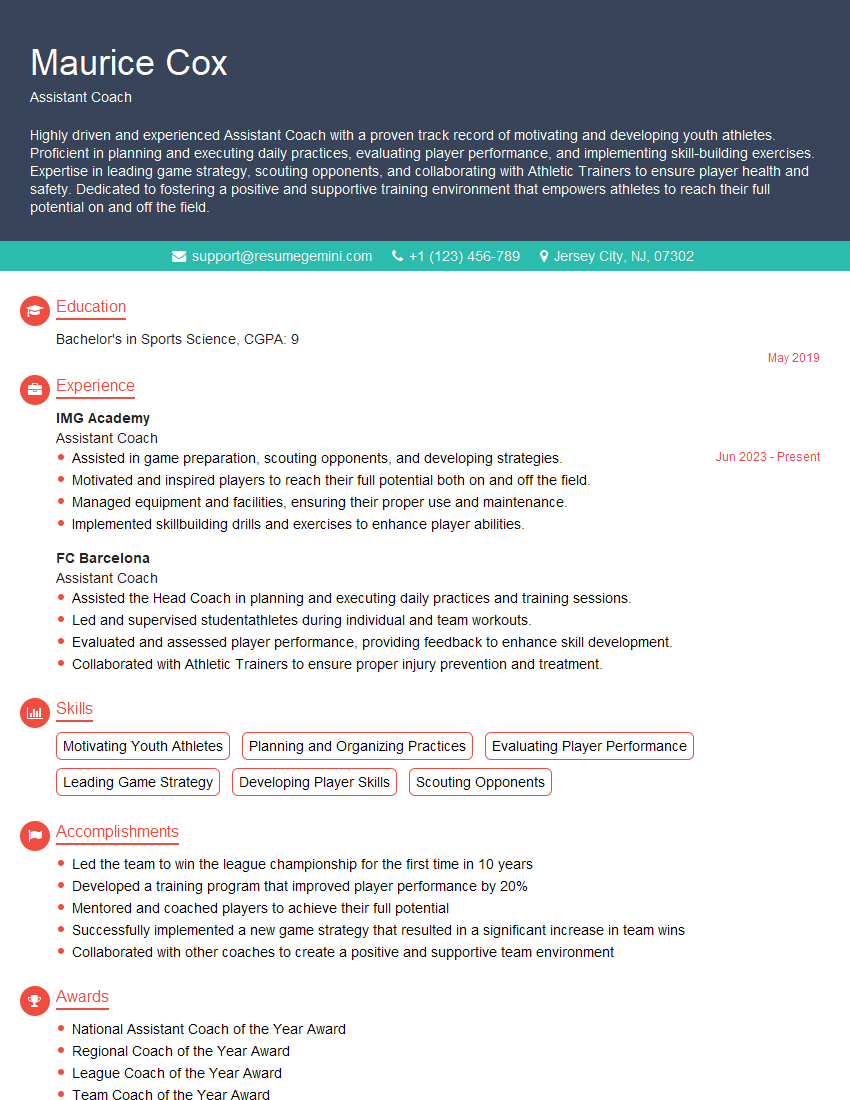
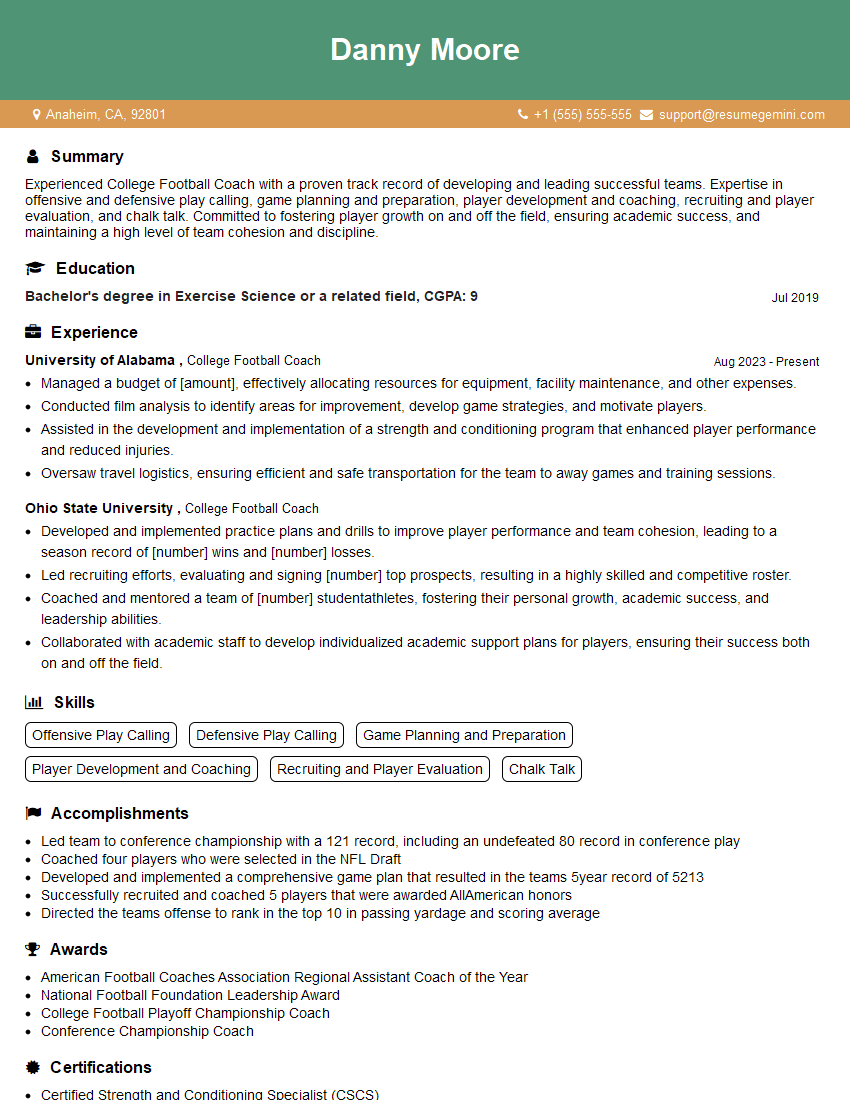
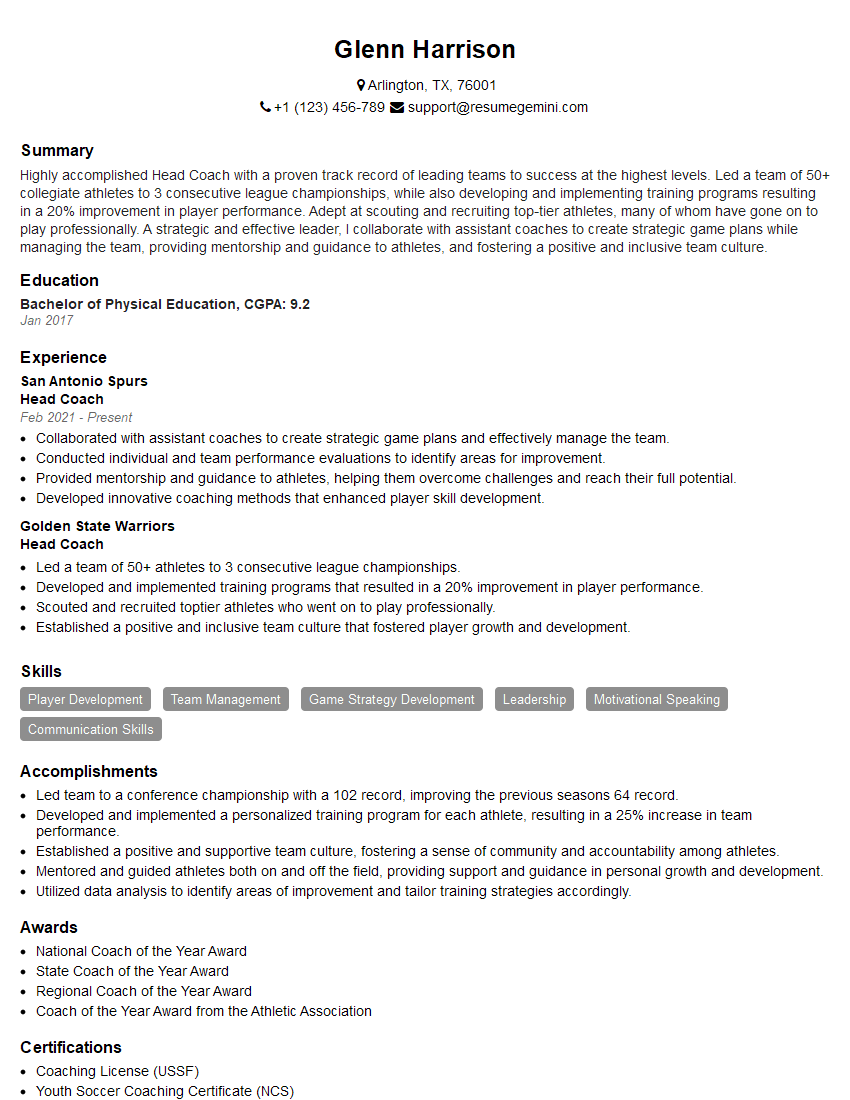
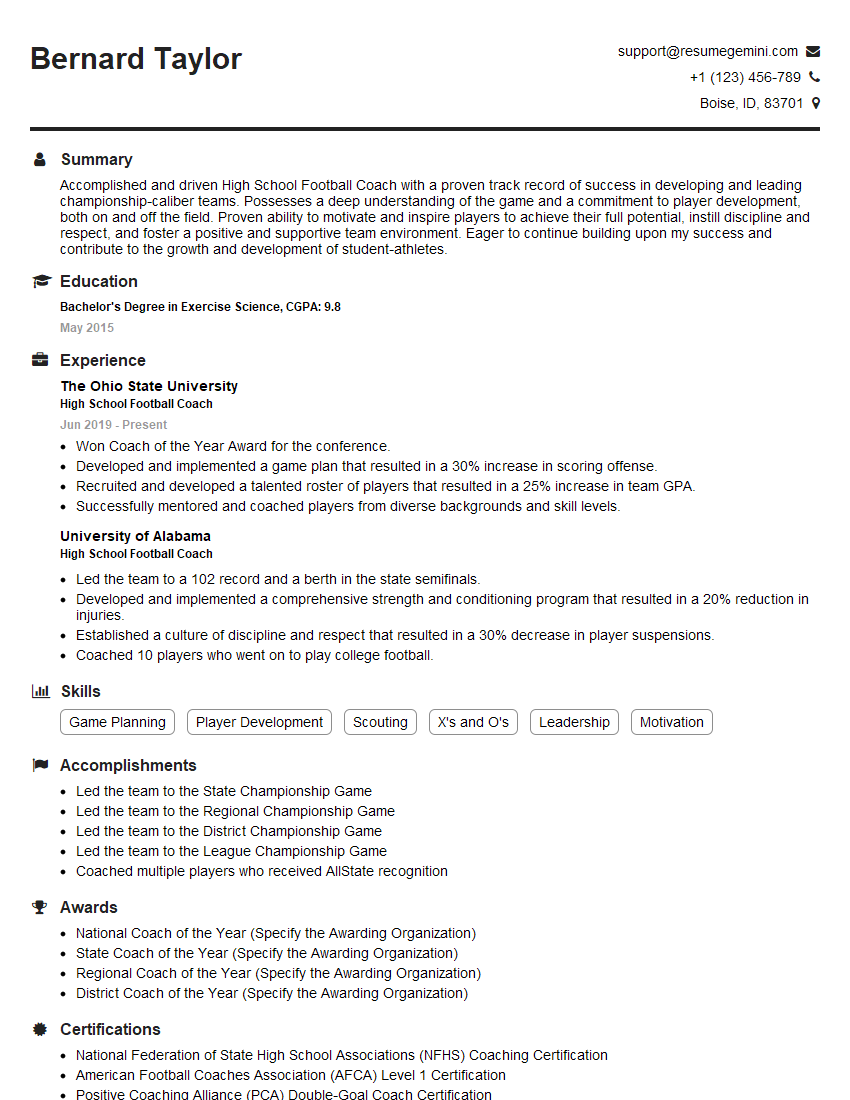
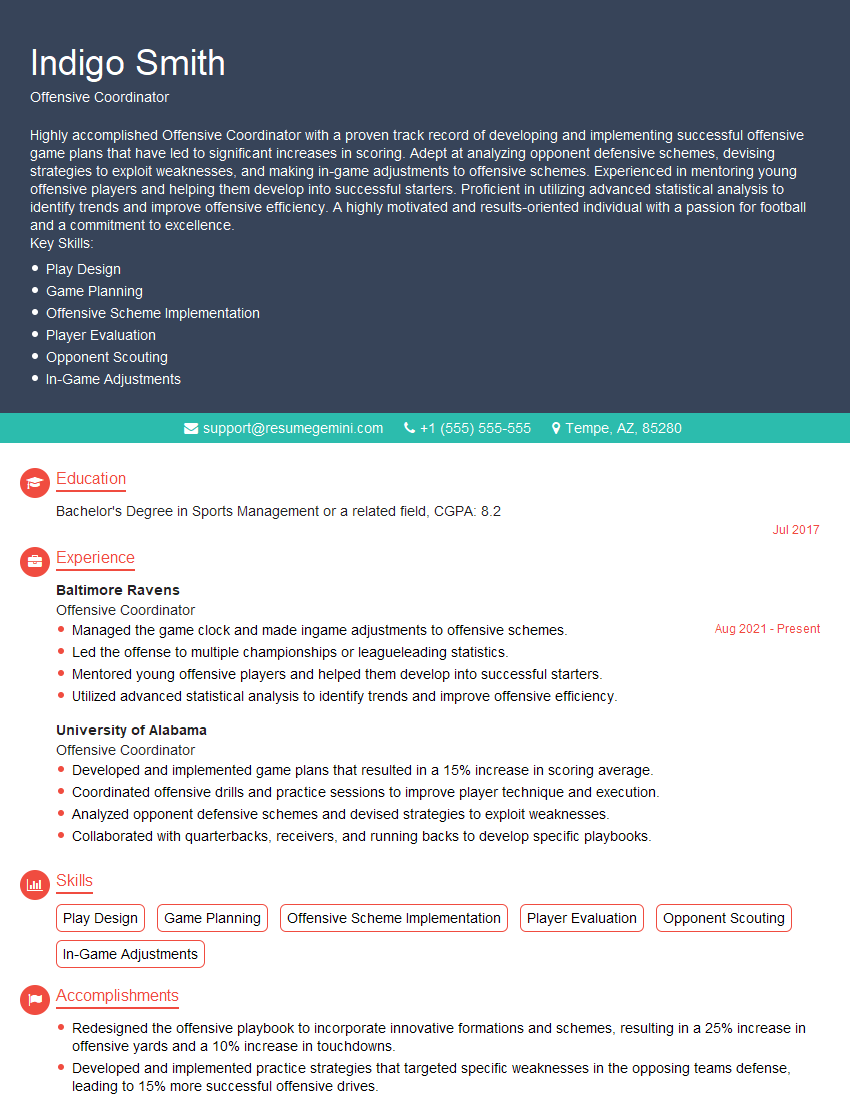
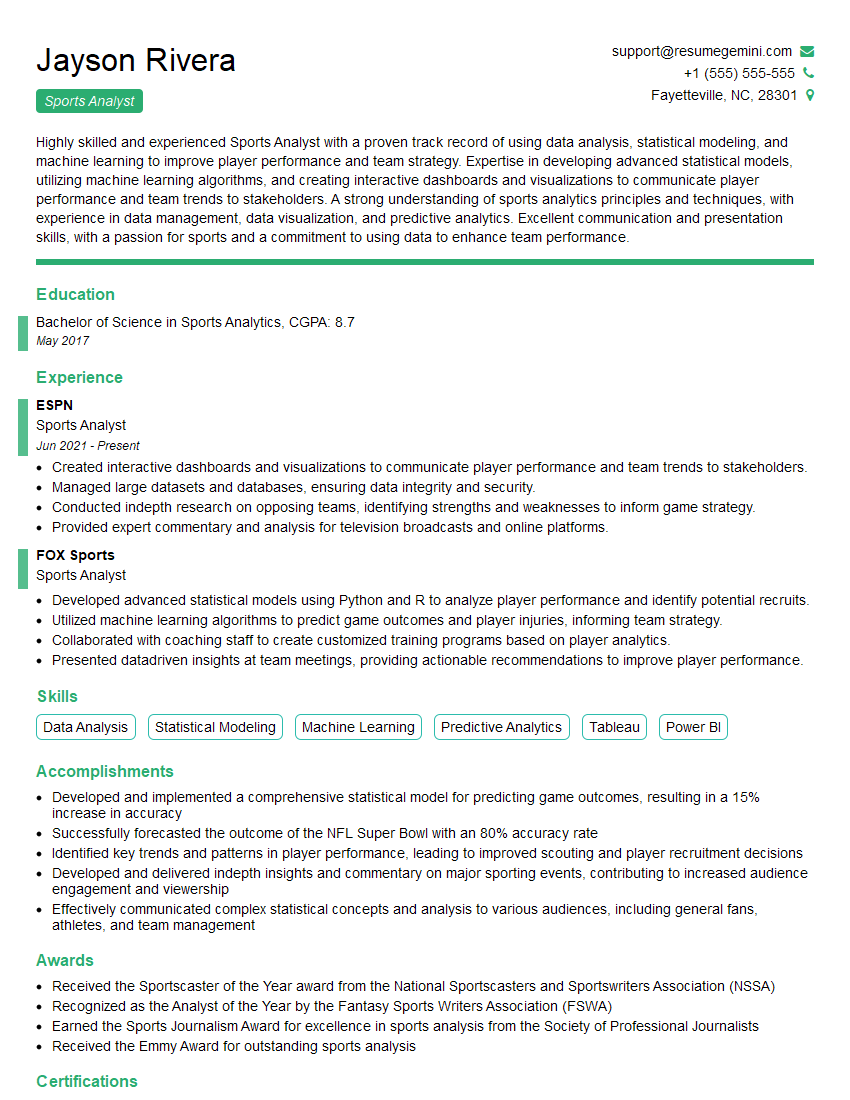
Mastering play calling significantly enhances your strategic thinking, problem-solving, and leadership skills – highly valued assets in any coaching role. To maximize your job prospects, focus on creating an ATS-friendly resume that effectively showcases these abilities. ResumeGemini is a trusted resource that can help you build a professional, impactful resume tailored to highlight your unique qualifications. Examples of resumes specifically tailored for Play Calling positions are available through ResumeGemini.
Explore more articles
Users Rating of Our Blogs
Share Your Experience
We value your feedback! Please rate our content and share your thoughts (optional).
What Readers Say About Our Blog
Attention music lovers!
Wow, All the best Sax Summer music !!!
Spotify: https://open.spotify.com/artist/6ShcdIT7rPVVaFEpgZQbUk
Apple Music: https://music.apple.com/fr/artist/jimmy-sax-black/1530501936
YouTube: https://music.youtube.com/browse/VLOLAK5uy_noClmC7abM6YpZsnySxRqt3LoalPf88No
Other Platforms and Free Downloads : https://fanlink.tv/jimmysaxblack
on google : https://www.google.com/search?q=22+AND+22+AND+22
on ChatGPT : https://chat.openai.com?q=who20jlJimmy20Black20Sax20Producer
Get back into the groove with Jimmy sax Black
Best regards,
Jimmy sax Black
www.jimmysaxblack.com
Hi I am a troller at The aquatic interview center and I suddenly went so fast in Roblox and it was gone when I reset.
Hi,
Business owners spend hours every week worrying about their website—or avoiding it because it feels overwhelming.
We’d like to take that off your plate:
$69/month. Everything handled.
Our team will:
Design a custom website—or completely overhaul your current one
Take care of hosting as an option
Handle edits and improvements—up to 60 minutes of work included every month
No setup fees, no annual commitments. Just a site that makes a strong first impression.
Find out if it’s right for you:
https://websolutionsgenius.com/awardwinningwebsites
Hello,
we currently offer a complimentary backlink and URL indexing test for search engine optimization professionals.
You can get complimentary indexing credits to test how link discovery works in practice.
No credit card is required and there is no recurring fee.
You can find details here:
https://wikipedia-backlinks.com/indexing/
Regards
NICE RESPONSE TO Q & A
hi
The aim of this message is regarding an unclaimed deposit of a deceased nationale that bears the same name as you. You are not relate to him as there are millions of people answering the names across around the world. But i will use my position to influence the release of the deposit to you for our mutual benefit.
Respond for full details and how to claim the deposit. This is 100% risk free. Send hello to my email id: lukachachibaialuka@gmail.com
Luka Chachibaialuka
Hey interviewgemini.com, just wanted to follow up on my last email.
We just launched Call the Monster, an parenting app that lets you summon friendly ‘monsters’ kids actually listen to.
We’re also running a giveaway for everyone who downloads the app. Since it’s brand new, there aren’t many users yet, which means you’ve got a much better chance of winning some great prizes.
You can check it out here: https://bit.ly/callamonsterapp
Or follow us on Instagram: https://www.instagram.com/callamonsterapp
Thanks,
Ryan
CEO – Call the Monster App
Hey interviewgemini.com, I saw your website and love your approach.
I just want this to look like spam email, but want to share something important to you. We just launched Call the Monster, a parenting app that lets you summon friendly ‘monsters’ kids actually listen to.
Parents are loving it for calming chaos before bedtime. Thought you might want to try it: https://bit.ly/callamonsterapp or just follow our fun monster lore on Instagram: https://www.instagram.com/callamonsterapp
Thanks,
Ryan
CEO – Call A Monster APP
To the interviewgemini.com Owner.
Dear interviewgemini.com Webmaster!
Hi interviewgemini.com Webmaster!
Dear interviewgemini.com Webmaster!
excellent
Hello,
We found issues with your domain’s email setup that may be sending your messages to spam or blocking them completely. InboxShield Mini shows you how to fix it in minutes — no tech skills required.
Scan your domain now for details: https://inboxshield-mini.com/
— Adam @ InboxShield Mini
support@inboxshield-mini.com
Reply STOP to unsubscribe
Hi, are you owner of interviewgemini.com? What if I told you I could help you find extra time in your schedule, reconnect with leads you didn’t even realize you missed, and bring in more “I want to work with you” conversations, without increasing your ad spend or hiring a full-time employee?
All with a flexible, budget-friendly service that could easily pay for itself. Sounds good?
Would it be nice to jump on a quick 10-minute call so I can show you exactly how we make this work?
Best,
Hapei
Marketing Director
Hey, I know you’re the owner of interviewgemini.com. I’ll be quick.
Fundraising for your business is tough and time-consuming. We make it easier by guaranteeing two private investor meetings each month, for six months. No demos, no pitch events – just direct introductions to active investors matched to your startup.
If youR17;re raising, this could help you build real momentum. Want me to send more info?
Hi, I represent an SEO company that specialises in getting you AI citations and higher rankings on Google. I’d like to offer you a 100% free SEO audit for your website. Would you be interested?
Hi, I represent an SEO company that specialises in getting you AI citations and higher rankings on Google. I’d like to offer you a 100% free SEO audit for your website. Would you be interested?