Unlock your full potential by mastering the most common Precision Marksmanship interview questions. This blog offers a deep dive into the critical topics, ensuring you’re not only prepared to answer but to excel. With these insights, you’ll approach your interview with clarity and confidence.
Questions Asked in Precision Marksmanship Interview
Q 1. Describe the principles of external ballistics.
External ballistics is the study of a projectile’s flight from the moment it leaves the muzzle until it impacts the target. It’s essentially physics in action, governing how gravity, air resistance, and the Earth’s rotation affect the bullet’s trajectory. Think of it like this: you’re not just aiming at a point; you’re predicting where a complex interaction of forces will carry your bullet.
Key principles include:
- Gravity: Pulls the bullet downwards throughout its flight, causing it to drop. This drop is more significant at longer ranges.
- Drag (Air Resistance): The air slows the bullet down, affecting both its speed and its trajectory. This effect is more pronounced at higher velocities and with less aerodynamic projectiles.
- Wind: Pushes the bullet off course. This is a significant factor, especially at longer ranges and with lighter bullets.
- Coriolis Effect: The Earth’s rotation subtly influences the bullet’s path, particularly over very long distances. This effect is typically negligible for most precision shooting applications unless we are discussing extreme long-range shooting.
Understanding these principles is crucial for accurate long-range shooting. Failure to account for these factors will lead to misses, even with a perfectly sighted rifle and impeccable shooting technique.
Q 2. Explain the concept of zeroing a rifle.
Zeroing a rifle is the process of adjusting the sights (or scope) to make the point of impact (POI) of the bullet match the point of aim (POA) at a specific range. It’s like calibrating your rifle for a particular distance. For example, you might zero your rifle at 100 yards, meaning that when you aim at a target 100 yards away, the bullet will hit the center of the target.
The process typically involves firing several shots at the chosen zeroing distance, observing the POI, and then making adjustments to the sights to bring the POI closer to the POA. This is an iterative process, requiring patience and precision. Modern scopes offer adjustable turrets for precise adjustments in minute-of-angle (MOA) or milliradians (mils).
Many shooters zero their rifles at two distances (e.g., 100 yards and 200 yards) to create a ‘battle zero’ or ‘compromise zero,’ accounting for the bullet’s trajectory in the range between those distances. This means that you will have minimal bullet drop in the range between both zeroing distances.
Q 3. What are the factors affecting bullet trajectory?
Numerous factors influence bullet trajectory, and understanding them is key to making accurate shots. These can be broadly categorized as:
- Environmental Factors:
- Temperature: Affects air density and thus drag.
- Altitude: Lower air density at higher altitudes leads to reduced drag.
- Humidity: Affects air density and can influence trajectory.
- Wind: A major factor, causing significant horizontal drift.
- Weapon Factors:
- Rifle Twist Rate: Affects bullet stability and accuracy.
- Muzzle Velocity: Higher velocity generally means a flatter trajectory but increased drag.
- Ammunition: Bullet weight, type, and quality all influence trajectory.
- Shooter Factors:
- Shooting Position: Impacts consistency and accuracy.
- Breathing Control: Vital for stability and consistent aiming.
- Trigger Control: Smooth trigger pull prevents unintended movements.
Neglecting these factors, particularly environmental ones, is a common cause of misses in precision shooting. A skilled marksman accounts for them using ballistic calculators or experience-based estimations.
Q 4. How do you compensate for wind drift?
Compensating for wind drift involves making adjustments to your aim to counter the force of the wind pushing the bullet off course. This requires estimating wind speed and direction, and understanding how this translates into the necessary adjustments. The further the target, the more wind will affect the bullet.
Methods for wind compensation include:
- Wind Calls: Experienced spotters or shooters assess wind conditions and provide wind calls to the shooter, which is an estimation of wind speed and direction in units like miles per hour (mph) or meters per second (m/s). These estimations are then converted into corrections applied to the aiming point.
- Wind Flags: Observing wind flags at different distances provides a visual indication of wind speed and direction at those ranges.
- Mil-Dots or MOA adjustments: Rifle scopes with mil-dot reticles or MOA adjustments allow for direct compensation by using the reticle to estimate the wind drift and adjust aiming accordingly.
- Ballistic Calculators/Apps: These tools, based on known environmental data and ammunition characteristics, calculate the necessary adjustments for wind drift and other factors.
Wind compensation is a highly skilled aspect of precision marksmanship, requiring extensive practice and experience.
Q 5. What are the different types of rifle scopes and their applications?
Several types of rifle scopes are available, each with specific applications:
- Fixed Power Scopes: Offer a single magnification level. They’re simple, durable, and lighter than variable power scopes, making them suitable for close-to-mid-range shooting where a specific magnification is preferred.
- Variable Power Scopes: Provide a range of magnification levels, allowing for flexibility to adapt to varying distances and lighting conditions. Highly versatile and suitable for most shooting disciplines.
- Tactical Scopes: Often feature advanced features like illuminated reticles, turrets with zero-stop mechanisms for precise adjustments, and robust construction for demanding conditions. Used in tactical, hunting and competitive shooting.
- Long-Range Scopes: Designed for extreme distances, these scopes typically offer high magnification, high-quality lenses, and features to compensate for environmental factors like wind and bullet drop. Used by long-range shooters, hunters and military marksmen.
- Low-Power Variable Scopes (LPVO): Combining the advantages of low magnification for CQB and higher magnification for longer ranges. A popular choice for Law Enforcement and Military personnel who operate in variable conditions.
The choice of scope depends on the intended application. For hunting at close to medium ranges, a fixed or low-power variable scope might suffice. Long-range precision shooting demands a high-quality variable or tactical scope.
Q 6. Explain the importance of proper breathing techniques in marksmanship.
Proper breathing techniques are paramount in marksmanship because they directly impact stability and accuracy. Holding your breath improperly can cause minute muscle tremors which will lead to poor shot placement.
A common technique involves:
- Controlled Breathing: Taking a full breath, then exhaling slowly to a comfortable point. This point should be chosen before the shot is taken and is consistent every time.
- Breath Hold: Pausing your breath in a comfortable position for a few seconds. Holding your breath for too long will lead to muscle fatigue and shaking, therefore it is important to know the limits of your body.
- Natural Pause: Relaxing the muscles whilst breath-holding and allowing the body to find a comfortable position, minimizing movement and tension, whilst the shot is taken.
- Controlled Exhale: When the shot is taken, slowly release the breath to further stabilize the body.
Inconsistent breathing leads to inconsistent shot placement. Mastering controlled breathing helps eliminate movement during the critical moment of trigger squeeze, significantly improving accuracy. This is as crucial as the technical aspects of marksmanship.
Q 7. Describe your experience with various sighting systems.
Throughout my career, I’ve had extensive experience with various sighting systems, including iron sights, red dot sights, and a wide range of telescopic sights. Iron sights offer a simple and reliable system, excellent for close-quarters scenarios and when simplicity is paramount. However, precision at longer ranges is more challenging. Red dot sights provide a quick target acquisition and excellent for both close-quarters and medium-range engagement where speed is more important than extreme precision. However, their lack of magnification limits their use at longer ranges.
My experience with telescopic sights is extensive, covering a wide range of magnifications, reticle types (mil-dot, MOA, and others), and features. I am proficient in using ballistic calculators and compensating for environmental conditions using various scope adjustment methods, allowing for consistently accurate long-range shots.
Beyond specific sighting systems, I possess a deep understanding of the principles of sight alignment, aiming, and trigger control, regardless of the specific system employed. This allows me to adapt quickly to any sighting system and maximize accuracy in various situations. This also includes experience with thermal and night-vision sighting systems.
Q 8. How do you maintain a firearm to ensure optimal accuracy?
Maintaining a firearm for optimal accuracy is a meticulous process that involves regular cleaning, lubrication, and inspection. Think of it like maintaining a high-performance engine – regular care ensures peak performance.
- Cleaning: After each range session, meticulously clean the barrel, action, and receiver to remove fouling (powder residue and lead). Improper cleaning can lead to malfunctions and accuracy degradation. Use the appropriate cleaning solvents and tools for your specific firearm.
- Lubrication: Apply a high-quality gun lubricant to moving parts to reduce friction and wear. Over-lubrication can attract dirt and debris, while insufficient lubrication can lead to increased wear and malfunctions.
- Inspection: Regularly inspect the firearm for any signs of damage, wear, or loose parts. Pay close attention to the bore (inside of the barrel) for any imperfections that could affect accuracy. A visual inspection should be done before every range trip.
- Storage: Store the firearm in a clean, dry, and secure location, away from extreme temperatures and humidity. Proper storage helps prevent corrosion and damage.
For example, failing to remove copper fouling from a barrel can cause increased friction and potentially affect bullet trajectory, leading to inconsistent groupings at the target. Regular and thorough cleaning prevents this.
Q 9. What are the safety procedures you follow when handling firearms?
Safety is paramount when handling firearms. The acronym R.U.L.E.S. serves as a helpful reminder:
- Respect the weapon: Treat every firearm as if it were loaded.
- Unload the weapon: Always check to ensure the firearm is unloaded before handling.
- Leave your finger off the trigger: Keep your finger outside the trigger guard until you are ready to shoot.
- Eye/target acquisition: Always maintain a clear sight picture and be aware of your surroundings.
- Safe direction: Point the firearm in a safe direction at all times.
Beyond R.U.L.E.S., I always follow these additional precautions:
- Never point a firearm at anything you don’t intend to shoot.
- Be certain of your target and what is beyond it.
- Always use appropriate hearing and eye protection.
- Never consume alcohol or drugs before or during shooting.
These safety rules are not suggestions; they are essential to prevent accidents and ensure the safety of yourself and others.
Q 10. Explain the concept of sight picture and sight alignment.
Sight picture and sight alignment are crucial for accurate shooting. Think of it like aligning the sights of a telescope to a distant star. You need precise alignment to achieve accuracy.
Sight Alignment refers to the precise positioning of the front sight in relation to the rear sights. Ideally, the front sight should be centered perfectly within the rear sight’s notch or aperture. Any misalignment introduces error into the shot.
Sight Picture refers to the overall image you see through the sights. It encompasses sight alignment and also the target itself, ensuring that the front sight, the rear sight, and the target are all properly aligned and appear as a single unit.
For example, if the front sight is off-center to the right in the rear sight’s notch, the bullet will consistently impact to the right of the intended point of aim. Maintaining correct sight picture and alignment eliminates this error.
Q 11. What are the common causes of inaccurate shooting?
Inaccurate shooting stems from various factors, both shooter-related and equipment-related. It’s like diagnosing a car’s malfunction; you need to systematically check different aspects to identify the problem.
- Shooter Errors:
- Improper Sight Alignment/Picture: As discussed, this is a fundamental source of error.
- Trigger Control: Jerking the trigger instead of applying smooth, consistent pressure will cause shots to deviate.
- Breathing: Holding your breath too long or breathing erratically disrupts steadiness.
- Stance and Grip: An unstable stance or improper grip can negatively impact accuracy.
- Follow-Through: Failing to maintain proper sight picture and position until the bullet leaves the barrel.
- Equipment Issues:
- Ammunition Issues: Variations in ammunition quality, type, and load can significantly affect accuracy.
- Firearm Malfunctions: Loose parts, a dirty barrel, or other mechanical issues.
- Scope or Sight Issues: Misalignment or improper zeroing of optical sights.
Identifying the root cause requires careful analysis of the shooter’s technique and the firearm’s condition. Keeping a shooting log is a useful way to track conditions and identify patterns.
Q 12. Describe your experience with different types of ammunition.
My experience encompasses a wide range of ammunition types, each with its own characteristics and applications. Choosing the right ammunition is crucial for accuracy and achieving desired performance.
- Full Metal Jacket (FMJ): These are commonly used for target practice due to their affordability and consistent performance. They are less damaging to targets, particularly paper targets.
- Hollow Point (HP): Designed for self-defense, hollow points expand upon impact, increasing stopping power. However, they may exhibit inconsistent trajectories at longer ranges.
- Match Grade Ammunition: These are precision-loaded cartridges designed for accuracy. They often use higher-quality components and tighter tolerances for enhanced performance.
- Subsonic Ammunition: These rounds are designed to travel slower than the speed of sound, reducing noise and making them suitable for suppressed firearms.
I’ve found that match-grade ammunition consistently provides the best accuracy in my rifles. However, the choice of ammunition depends heavily on the intended use; a match-grade round may not be the best choice in a self-defense situation.
Q 13. How do you calculate bullet drop compensation?
Bullet drop compensation accounts for the effect of gravity on a projectile’s trajectory. The further the bullet travels, the more it drops due to gravity. Think of throwing a ball; it doesn’t travel in a straight line, but rather in a parabolic arc.
Calculating bullet drop compensation involves several factors:
- Bullet Velocity: Higher velocity means less drop over a given distance.
- Distance to Target: The longer the distance, the greater the drop.
- Ballistic Coefficient (BC): This measures the bullet’s ability to overcome air resistance. A higher BC indicates less drop.
- Environmental Conditions: Wind, temperature, and altitude all affect trajectory.
While complex ballistic calculators and software exist, a simplified approach involves using a ballistic chart or data from the ammunition manufacturer which usually provide data for various distances. These charts show the amount of drop (in inches or centimeters) at various ranges. One then adjusts the aim accordingly to compensate for this drop.
Q 14. Explain the concept of lead when shooting moving targets.
Lead, in the context of shooting moving targets, refers to aiming ahead of the target to compensate for its movement. It’s like leading a dog on a leash; you have to anticipate its movement to keep the leash taut.
The amount of lead required depends on several factors:
- Target Speed: A faster-moving target requires more lead.
- Target Distance: Greater distance requires more lead, as the target covers more ground during the bullet’s flight time.
- Angle of Approach: The angle at which the target is moving relative to the shooter affects the amount of lead needed.
- Bullet Velocity: Faster bullets require less lead.
Estimating lead is a skill developed through practice and experience. Many shooters use instinctive methods based on their own judgment, however, there are techniques to help estimate this, such as using a swing-through method to get a feel for the movement.
Q 15. What are the different types of shooting positions?
Shooting positions are crucial for stability and accuracy. The choice depends on the shooting scenario, available support, and the shooter’s comfort and physical capabilities. Common positions include:
- Prone: Lying flat on the ground, offering maximum stability. This is often the most accurate position. Think of it like having the earth itself as a support structure.
- Sitting: More mobile than prone, but requires good posture and support to maintain stability. The legs act as a tripod, crucial for steady aim.
- Kneeling: Offers a balance between stability and mobility. Proper knee and leg placement is key to minimizing wobble.
- Standing: The least stable position, demanding significant skill and body control. This is where a strong shooting stance and consistent breathing techniques become essential.
- Supported/Saddle: Utilizing a rest, like a sandbag or bipod, significantly improves stability in any position. Imagine using a sturdy table to rest your rifle – you’ll have significantly less movement.
Each position requires specific techniques to optimize stability and accuracy. For instance, proper breathing control is vital in all positions, but especially in standing. I’ve found that focusing on controlled exhalation while aiming significantly reduces movement.
Career Expert Tips:
- Ace those interviews! Prepare effectively by reviewing the Top 50 Most Common Interview Questions on ResumeGemini.
- Navigate your job search with confidence! Explore a wide range of Career Tips on ResumeGemini. Learn about common challenges and recommendations to overcome them.
- Craft the perfect resume! Master the Art of Resume Writing with ResumeGemini’s guide. Showcase your unique qualifications and achievements effectively.
- Don’t miss out on holiday savings! Build your dream resume with ResumeGemini’s ATS optimized templates.
Q 16. How do you determine the range to a target?
Determining range to a target accurately is paramount. Several methods exist, each with its strengths and weaknesses:
- Mil-dots/Rangefinding Reticle: Riflescopes with mil-dot reticles allow range estimation based on the target’s known size and the apparent size in the scope. This requires knowing the target’s dimensions and understanding mil-dot calculations. It’s like using a scaled ruler in your scope.
- Laser Rangefinders: These devices emit a laser beam and measure the time it takes to return, accurately calculating the distance. They’re quick and convenient, but their use might be restricted in some competitive shooting events. Think of it like a super-fast tape measure.
- Estimation/Experience: Experienced marksmen can estimate range based on familiar landmarks and target size. This is highly dependent on experience and knowledge of the environment. It’s a skill that develops over time.
- Range Cards/Maps: Pre-determined range information, either documented or from map studies, helps to estimate range prior to engaging the target, increasing situational awareness and reducing time spent during actual engagement. Think of it as your pre-mission intel.
Often, a combination of methods is used for confirmation. For example, I might initially estimate range, then refine it using a laser rangefinder, ensuring accuracy before taking a shot.
Q 17. What are the effects of environmental factors on accuracy?
Environmental factors significantly impact accuracy. Neglecting these can lead to missed shots and frustration. Key considerations include:
- Wind: Wind is a major factor, affecting bullet trajectory. Wind speed and direction must be accounted for, often requiring wind calls and adjustments to point of aim. Strong winds can push bullets significantly off course.
- Temperature: Temperature changes affect air density, impacting bullet velocity and trajectory. Higher temperatures generally lead to slightly higher velocities, while lower temperatures reduce them.
- Humidity: Humidity influences air density as well, though the effect is less pronounced than temperature. High humidity can cause increased drag on the bullet.
- Altitude: At higher altitudes, the thinner air results in reduced air resistance, increasing bullet velocity and range. This changes bullet drop drastically, and adjustments must be made for accurate shooting at elevation.
- Light: Strong sunlight or glare can affect the shooter’s vision and aiming ability. This might necessitate the use of appropriate gear such as shooting glasses or filters.
Experienced marksmen employ various techniques to mitigate these effects, including using ballistic calculators, wind meters, and making adjustments to compensate for the environmental conditions during the shot.
Q 18. Describe your experience with different types of rifles.
My experience encompasses a wide range of rifles, each with its own characteristics and applications:
- Bolt-action Rifles: Precise, reliable, and often favored for long-range shooting. I’ve extensively used bolt-action rifles in competitions and hunting, appreciating their accuracy and the deliberate nature of each shot. The Remington 700 is a classic example, renowned for its accuracy and reliability.
- Semi-automatic Rifles: Offer faster follow-up shots, valuable in tactical situations or hunting multiple targets. The AR-15 platform, with its versatility and adaptability, is a prime example. I’ve used this in dynamic shooting courses, appreciating its capacity for rapid, yet controlled, fire.
- Lever-action Rifles: Historically significant, lever-actions offer fast cycling and are suitable for close-to-medium-range engagements. The Marlin 336 is an example I’m familiar with from both hunting and practical shooting.
Each type of rifle requires a distinct understanding of its mechanics, maintenance, and optimal usage. My experience allows me to adapt quickly to different platforms and confidently utilize their strengths.
Q 19. How do you handle malfunctions during a shooting exercise?
Malfunctions can occur, and the response must be swift, safe, and effective. My approach involves:
- Safety First: Maintain a safe direction of fire. Never point the weapon at anything you don’t intend to shoot.
- Identify the Malfunction: Determine the cause – is it a stoppage, misfire, or something else?
- Troubleshooting: Employ the appropriate remedial action. This often involves manipulating the weapon’s controls (e.g., charging handle, bolt, etc.) according to the specific firearm’s malfunction clearance procedures.
- Clear the Malfunction: Following established procedures, carefully clear the malfunction, ensuring the weapon is again ready to fire or safely unloaded if necessary.
- Resume/End Exercise: If the malfunction is cleared successfully, resume the exercise according to established protocols. If it cannot be resolved, safely end the exercise and report the problem.
Regular practice and thorough knowledge of the firearm’s mechanics are essential for efficiently handling malfunctions. I have repeatedly practiced malfunction drills under pressure to ensure a quick and safe response in any situation.
Q 20. What are your strategies for engaging multiple targets?
Engaging multiple targets requires a systematic approach prioritizing speed, accuracy, and safety. Key elements include:
- Target Prioritization: Identify the most immediate threats or targets of highest importance. This often involves assessing range, threat level, and the overall tactical situation.
- Efficient Target Acquisition: Quickly locate and identify targets. This is where training and practice in target recognition and identification is crucial.
- Controlled Fire: Maintain precise control over each shot, minimizing wasted rounds and maximizing accuracy. Controlled breathing is crucial to ensure accuracy in rapid engagements.
- Movement and Positioning: Use cover and concealment effectively to reposition for better angles and reduce your exposure to fire while maintaining the speed of the engagement.
- Communication (if applicable): In a team environment, clear and concise communication with teammates is vital to coordinate actions and share information on target locations.
The specific strategies employed depend heavily on the context. In a competition, the focus might be on speed and accuracy, while in a self-defense scenario, the priority shifts to neutralizing threats and ensuring safety.
Q 21. Explain your understanding of different types of bullet construction.
Bullet construction significantly impacts performance. Different designs cater to various needs and applications:
- Full Metal Jacket (FMJ): A lead core encased in a metal jacket, offering good penetration but limited expansion. Commonly used in military and law enforcement applications.
- Jacketed Hollow Point (JHP): A lead core with a hollow cavity in the tip, designed to expand upon impact, increasing stopping power. Widely used in self-defense and hunting.
- Soft Point (SP): Similar to JHP, but the hollow cavity is less pronounced or partially covered. They offer a balance between expansion and penetration.
- Ballistic Tip (BT): Features a polymer tip to enhance aerodynamics, increasing accuracy and range. Often used in hunting and long-range shooting.
- Controlled Expansion Ammunition: These are bullets specifically designed to consistently expand within specified ranges of velocity, ensuring reliable performance and mitigating over-penetration. It’s a balance of expansion and penetration that is precisely calibrated.
Understanding bullet construction allows marksmen to select ammunition optimized for their specific needs. Factors such as target type, range, and desired outcome all influence bullet choice. For instance, I would choose a JHP for self-defense, prioritizing stopping power, while a BT might be preferred for long-range hunting, emphasizing accuracy and range.
Q 22. Describe your experience with night vision or thermal imaging equipment.
My experience with night vision and thermal imaging equipment is extensive. I’ve utilized various generations of night vision devices, from the older, more cumbersome tube-based systems to the newer, lighter weight digital models. Understanding the limitations of each is crucial. For example, older generation night vision struggles with bright light, requiring careful adjustment and potentially leading to temporary blindness if improperly handled. Digital systems offer better resolution and less susceptibility to bright light, but are often more expensive.
Thermal imaging provides a completely different perspective, allowing target acquisition based on heat signatures rather than visible light. This is invaluable in environments with limited visibility, such as dense fog or smoke. I’m proficient in using both types of equipment for target identification, ranging, and tracking, and I understand the importance of proper calibration, battery management, and environmental considerations such as temperature and humidity on the performance of these systems. During a recent training exercise, my team was tasked with navigating a complex urban environment at night. Utilizing thermal imaging, I was able to detect concealed personnel and correctly identify potential threats, significantly aiding in our mission success.
Q 23. How do you maintain situational awareness while shooting?
Maintaining situational awareness while shooting is paramount. It’s not just about focusing on the target; it’s a 360-degree assessment of the environment. I use a systematic approach, incorporating scanning techniques and utilizing all available sensory inputs. This means constantly scanning my surroundings for potential threats, listening for unusual sounds, and being aware of wind conditions which greatly affect projectile trajectory. I often employ the ‘Combat Scan’ technique which involves a quick visual sweep of my surroundings, constantly moving my eyes and head to avoid fixating on any single point. This allows for quick detection of movement and immediate reaction to changing circumstances.
For example, during a long-range precision shot, I don’t just focus on the target. I’m also aware of the wind speed and direction, any potential collateral damage zones, and the positioning of my spotter and any supporting personnel. Failing to maintain situational awareness can be catastrophic.
Q 24. What are your methods for conducting target acquisition?
My target acquisition process is methodical and precise. It begins with a thorough reconnaissance of the target area, assessing potential observation points and engagement opportunities. Then, utilizing available tools – like spotting scopes, rangefinders, and potentially night vision or thermal – I identify the target. I employ a series of checks, verifying the target’s identity and ensuring there are no unintended casualties in the area before engaging.
This process involves confirming range through multiple methods (e.g. rangefinder, mil-dots), assessing wind conditions, calculating adjustments for bullet drop and drift, and understanding the influence of environmental factors like temperature and barometric pressure. It is a iterative process, refining my aim and adjustments until I am certain of a precise shot. This process often needs to be adapted to real-world situations – a moving target will require significantly different methods than a static one.
Q 25. How do you assess the risks involved in a shooting scenario?
Risk assessment in a shooting scenario is critical. My method involves a systematic evaluation of several key areas: First, I identify the target and validate its legitimacy. Then, I consider the surrounding environment and assess potential collateral damage, analyzing the trajectory of the round and the likelihood of hitting unintended targets. I then evaluate the potential for friendly fire incidents, ensuring the safety of my team and any civilians in the area. Next, I account for environmental factors, such as weather, terrain, and visibility, and how these factors might impact shot accuracy or safety.
Finally, I also consider the risk to myself – is my position exposed? Are there potential threats near my firing position? This entire risk assessment informs my decision-making process – from choosing the best position to selecting the appropriate ammunition and weapon system. For instance, if an unexpected civilian wanders into the line of fire, I will immediately cease fire, reassess the situation and take appropriate action to ensure their safety. I’m trained to prioritize safety above all else.
Q 26. Describe your experience with precision shooting competitions.
I’ve participated in numerous precision shooting competitions at both the national and international levels. These competitions have honed my skills, exposing me to various challenging environments and forcing me to consistently refine my techniques. My experience ranges from long-range precision rifle matches (such as those governed by organizations like PRS or NRL22) where accuracy, precision, and speed are all crucial, to more static, bench-rest competitions that emphasize the ultimate in minute accuracy. These competitions have not only improved my technical proficiency, but have also cultivated my mental fortitude and my ability to perform under pressure. In one competition, a sudden wind shift dramatically affected my shots. By quickly analyzing the change and adjusting my aim, I managed to recover and still achieve a high score, demonstrating my adaptability.
Q 27. What are your strengths and weaknesses as a precision marksman?
My strengths lie in my methodical approach, my ability to remain calm under pressure, and my deep understanding of ballistics and environmental factors. I excel at long-range precision shooting, effectively utilizing various techniques and adjusting for variables to ensure accuracy. I’m also a strong team player, always prioritizing the safety of others.
However, like any marksman, I recognize my weaknesses. I am constantly working to improve my speed of target acquisition in dynamic environments. While I am strong technically, continuous refinement is a crucial aspect of marksmanship, and I focus on consistently refining my abilities.
Q 28. How do you stay calm under pressure during a shooting exercise?
Maintaining composure under pressure is essential in precision marksmanship. My training emphasizes controlled breathing, mindfulness techniques, and a strong mental discipline. I practice visualization and stress inoculation techniques to better manage anxiety. Before any exercise, I run through my pre-shot routine methodically, this helps to center me and prepare for the task at hand. The pre-shot routine is always the same, from establishing a stable position, to breathing correctly, to calling my shots in order to ensure clear communication. The key is consistency. This approach helps to reduce stress and improves focus.
During high-stress scenarios, I consciously focus on my breathing, slowing it down and deepening it to regulate my heart rate. I also break down complex tasks into smaller, manageable steps. For example, rather than focusing on the entire shooting sequence, I concentrate on each step individually, from target acquisition to trigger control. Through consistent practice and mental conditioning, I’ve developed a high level of resilience to pressure, allowing me to perform effectively even in demanding situations.
Key Topics to Learn for Precision Marksmanship Interview
- Fundamentals of Ballistics: Understanding projectile motion, trajectory, and factors influencing accuracy (e.g., wind, gravity, spin drift).
- Weapon Systems & Maintenance: Demonstrate knowledge of various precision rifles, their components, and proper cleaning and maintenance procedures. Practical application includes troubleshooting malfunctions and ensuring optimal weapon functionality.
- Marksmanship Techniques: Mastering proper shooting stances, grip, aiming techniques (e.g., sight alignment, trigger control), and breathing control for consistent accuracy. This includes understanding and applying various shooting positions and adapting to diverse environmental conditions.
- Data Analysis & Precision Improvement: Analyzing shot groups to identify and correct errors in technique. Understanding the use of tools and technologies for performance evaluation and improvement (e.g., data logging, shot analysis software).
- Safety Procedures & Regulations: Demonstrating a comprehensive understanding of safe firearm handling, storage, and range etiquette. This includes knowledge of relevant safety regulations and legal requirements.
- Advanced Marksmanship Concepts: Exploring topics such as long-range shooting, wind reading techniques, and advanced ballistic calculations. Understanding the theoretical underpinnings of these advanced concepts and their practical implications.
Next Steps
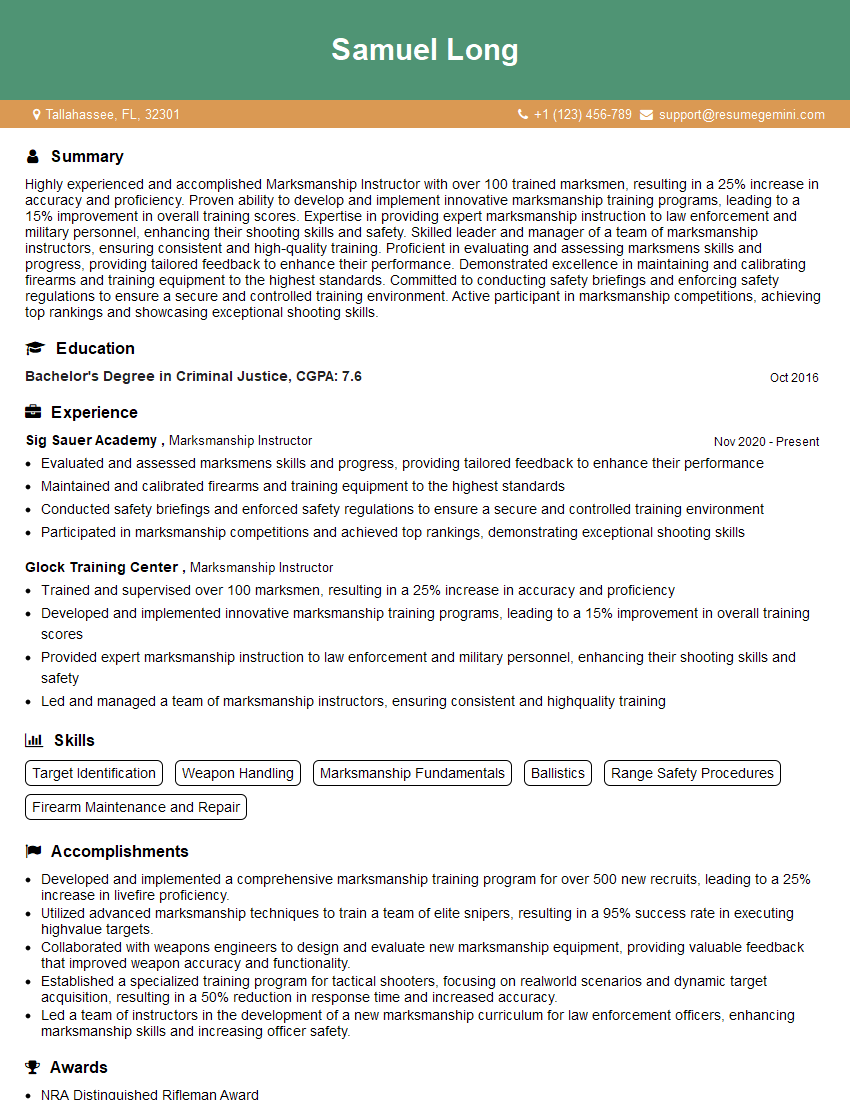
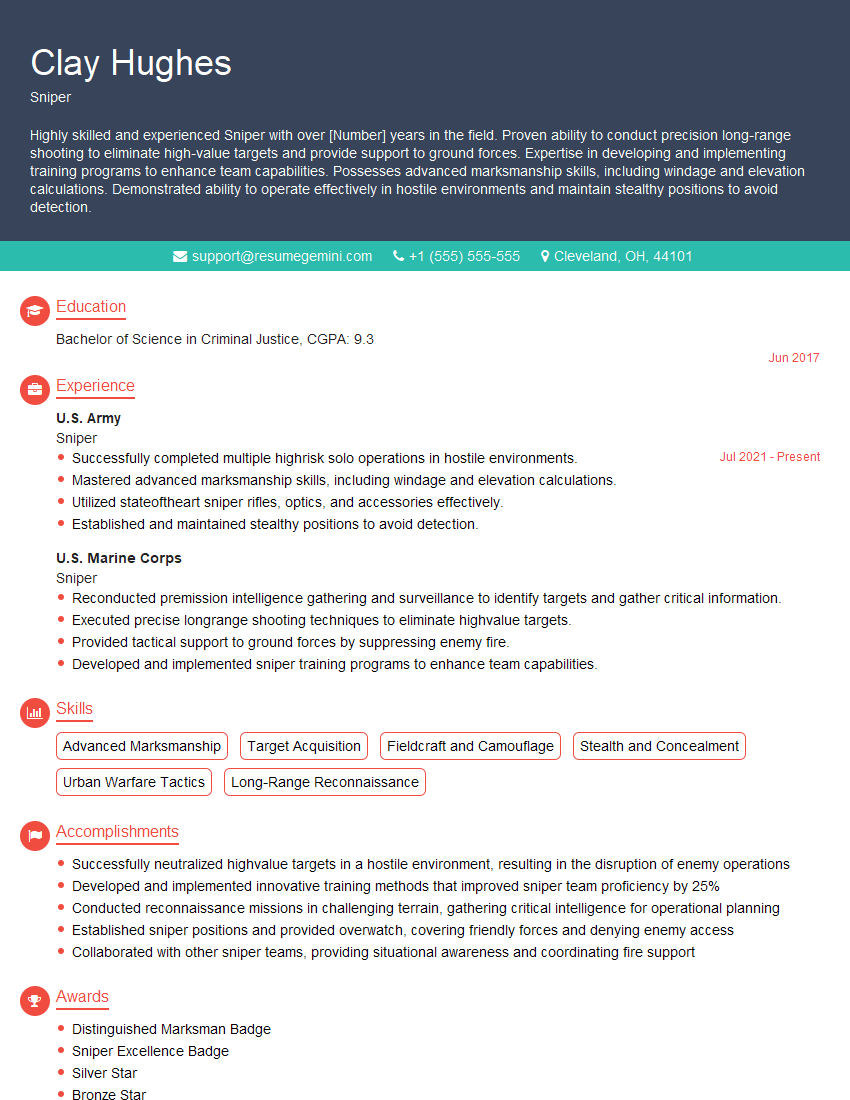
Mastering precision marksmanship opens doors to exciting and challenging careers requiring high levels of skill and precision. To significantly boost your job prospects, it’s crucial to present your expertise effectively through a well-crafted, ATS-friendly resume. ResumeGemini can help you build a professional and impactful resume that highlights your unique skills and experience. We provide examples of resumes tailored to Precision Marksmanship to help guide you. Take the next step towards your dream career – build a winning resume with ResumeGemini today.

Explore more articles
Users Rating of Our Blogs
Share Your Experience
We value your feedback! Please rate our content and share your thoughts (optional).
What Readers Say About Our Blog
Attention music lovers!
Wow, All the best Sax Summer music !!!
Spotify: https://open.spotify.com/artist/6ShcdIT7rPVVaFEpgZQbUk
Apple Music: https://music.apple.com/fr/artist/jimmy-sax-black/1530501936
YouTube: https://music.youtube.com/browse/VLOLAK5uy_noClmC7abM6YpZsnySxRqt3LoalPf88No
Other Platforms and Free Downloads : https://fanlink.tv/jimmysaxblack
on google : https://www.google.com/search?q=22+AND+22+AND+22
on ChatGPT : https://chat.openai.com?q=who20jlJimmy20Black20Sax20Producer
Get back into the groove with Jimmy sax Black
Best regards,
Jimmy sax Black
www.jimmysaxblack.com
Hi I am a troller at The aquatic interview center and I suddenly went so fast in Roblox and it was gone when I reset.
Hi,
Business owners spend hours every week worrying about their website—or avoiding it because it feels overwhelming.
We’d like to take that off your plate:
$69/month. Everything handled.
Our team will:
Design a custom website—or completely overhaul your current one
Take care of hosting as an option
Handle edits and improvements—up to 60 minutes of work included every month
No setup fees, no annual commitments. Just a site that makes a strong first impression.
Find out if it’s right for you:
https://websolutionsgenius.com/awardwinningwebsites
Hello,
we currently offer a complimentary backlink and URL indexing test for search engine optimization professionals.
You can get complimentary indexing credits to test how link discovery works in practice.
No credit card is required and there is no recurring fee.
You can find details here:
https://wikipedia-backlinks.com/indexing/
Regards
NICE RESPONSE TO Q & A
hi
The aim of this message is regarding an unclaimed deposit of a deceased nationale that bears the same name as you. You are not relate to him as there are millions of people answering the names across around the world. But i will use my position to influence the release of the deposit to you for our mutual benefit.
Respond for full details and how to claim the deposit. This is 100% risk free. Send hello to my email id: lukachachibaialuka@gmail.com
Luka Chachibaialuka
Hey interviewgemini.com, just wanted to follow up on my last email.
We just launched Call the Monster, an parenting app that lets you summon friendly ‘monsters’ kids actually listen to.
We’re also running a giveaway for everyone who downloads the app. Since it’s brand new, there aren’t many users yet, which means you’ve got a much better chance of winning some great prizes.
You can check it out here: https://bit.ly/callamonsterapp
Or follow us on Instagram: https://www.instagram.com/callamonsterapp
Thanks,
Ryan
CEO – Call the Monster App
Hey interviewgemini.com, I saw your website and love your approach.
I just want this to look like spam email, but want to share something important to you. We just launched Call the Monster, a parenting app that lets you summon friendly ‘monsters’ kids actually listen to.
Parents are loving it for calming chaos before bedtime. Thought you might want to try it: https://bit.ly/callamonsterapp or just follow our fun monster lore on Instagram: https://www.instagram.com/callamonsterapp
Thanks,
Ryan
CEO – Call A Monster APP
To the interviewgemini.com Owner.
Dear interviewgemini.com Webmaster!
Hi interviewgemini.com Webmaster!
Dear interviewgemini.com Webmaster!
excellent
Hello,
We found issues with your domain’s email setup that may be sending your messages to spam or blocking them completely. InboxShield Mini shows you how to fix it in minutes — no tech skills required.
Scan your domain now for details: https://inboxshield-mini.com/
— Adam @ InboxShield Mini
support@inboxshield-mini.com
Reply STOP to unsubscribe
Hi, are you owner of interviewgemini.com? What if I told you I could help you find extra time in your schedule, reconnect with leads you didn’t even realize you missed, and bring in more “I want to work with you” conversations, without increasing your ad spend or hiring a full-time employee?
All with a flexible, budget-friendly service that could easily pay for itself. Sounds good?
Would it be nice to jump on a quick 10-minute call so I can show you exactly how we make this work?
Best,
Hapei
Marketing Director
Hey, I know you’re the owner of interviewgemini.com. I’ll be quick.
Fundraising for your business is tough and time-consuming. We make it easier by guaranteeing two private investor meetings each month, for six months. No demos, no pitch events – just direct introductions to active investors matched to your startup.
If youR17;re raising, this could help you build real momentum. Want me to send more info?
Hi, I represent an SEO company that specialises in getting you AI citations and higher rankings on Google. I’d like to offer you a 100% free SEO audit for your website. Would you be interested?
Hi, I represent an SEO company that specialises in getting you AI citations and higher rankings on Google. I’d like to offer you a 100% free SEO audit for your website. Would you be interested?