Are you ready to stand out in your next interview? Understanding and preparing for Print Production Knowledge interview questions is a game-changer. In this blog, we’ve compiled key questions and expert advice to help you showcase your skills with confidence and precision. Let’s get started on your journey to acing the interview.
Questions Asked in Print Production Knowledge Interview
Q 1. Explain the difference between offset and digital printing.
Offset and digital printing are two distinct methods of printing, differing significantly in their processes and applications. Offset printing, a traditional method, uses an indirect printing process where the image is transferred from a plate to a rubber blanket, and then to the paper. This allows for high-volume, high-quality printing at a lower cost per unit, making it ideal for large print runs like magazines, books, and brochures. Think of it like making a stamp: you create a master image (plate), then use that to repeatedly create prints. Digital printing, on the other hand, prints directly onto the substrate (paper, etc.) using technology like inkjet or toner. It’s perfect for short runs, personalized pieces, and quick turnaround times, as there’s no need for plates. Imagine a standard inkjet printer, only scaled up to handle larger print sizes and potentially different paper types. The key difference lies in the production method: indirect (offset) versus direct (digital). Offset is best for large quantities, while digital is better for personalization and shorter runs.
Q 2. Describe your experience with color management and profiling.
Color management and profiling are crucial aspects of my work. I’ve extensively used color management software like X-Rite i1Profiler and ColorSync to create ICC profiles for various printers and substrates. This ensures consistent color reproduction across different devices and print runs. For example, I once worked on a project with a client who needed precise Pantone matching for their corporate branding. By carefully profiling their chosen paper stock and the printing press, I was able to guarantee their brand colors would appear exactly as intended, regardless of the volume printed. My experience extends to troubleshooting color discrepancies, identifying the source of the problem (whether it’s a monitor calibration issue, a printer setting, or an issue with the design file), and implementing solutions to achieve accurate color reproduction. This includes soft proofing and making necessary adjustments in the design phase to minimize issues during the printing process.
Q 3. What are the common file formats used in print production?
The print production workflow relies on several key file formats. PDF/X-1a and PDF/X-4 are industry standards for ensuring color accuracy and preventing font and image issues. PDF/X-1a is best for spot color projects, while PDF/X-4 handles CMYK and RGB data more flexibly. TIFF files are commonly used for high-resolution images, offering excellent quality for print. JPEGs are also used, but generally at lower resolutions due to compression. Furthermore, EPS (Encapsulated PostScript) files are employed for vector graphics, ensuring scalability without loss of quality. The choice of file format heavily depends on the printing method and the complexity of the design. For example, PDF/X-1a would be the preferred choice for a high-end brochure printed using offset, while a simple postcard using digital printing might only need a high-resolution JPEG and a PDF for the layout.
Q 4. How do you ensure color consistency across different printing processes?
Maintaining color consistency across different printing processes requires a multi-faceted approach. Firstly, establishing a robust color management system is paramount. This involves creating accurate ICC profiles for all devices involved (monitors, printers, and printing presses). Secondly, utilizing a standardized color space like CMYK (Cyan, Magenta, Yellow, Key/Black) for print files is crucial. Thirdly, I always recommend soft proofing during the design phase – checking the digital representation against how it will appear in print – to identify and correct any discrepancies early. In my experience, employing a color reference guide, such as a Pantone swatch book, and comparing print samples to this guide ensures accuracy. Finally, regular calibration and maintenance of printing equipment are critical to ensure its consistent performance. One project involved printing a large banner across multiple printers – by using a consistent color profile and regular print checks, we guaranteed seamless color across all print sections.
Q 5. What are your experiences with different types of paper stock?
My experience encompasses a wide variety of paper stocks, from uncoated offset papers to high-gloss coated stocks, textured papers, and specialty papers like recycled or linen-finish options. Understanding the characteristics of each paper type is critical. Coated stocks provide vibrant color reproduction and sharp details, ideal for magazines or brochures. Uncoated stocks offer a more natural feel and are often preferred for books or invitations. Textured papers add visual interest and tactile appeal, suitable for luxury products. Each paper affects the ink absorption and the final printed result. For example, a heavy-weight card stock requires different printing techniques and ink coverage compared to a thin newsprint. Selecting the correct paper is crucial for achieving the desired aesthetic and tactile experience; it’s not just about the visual appearance, it also impacts how the finished piece feels in your hands.
Q 6. Explain the role of prepress in the printing process.
Prepress is the critical stage preceding the actual printing process. It involves preparing all the necessary files and materials for efficient and accurate printing. This includes tasks like trapping (preventing white gaps between colors), imposition (arranging pages for efficient printing on sheets), color correction and proofing, and plate-making (for offset printing). The goal is to catch any errors before they reach the press, preventing costly reprints. A meticulous prepress phase minimizes waste and ensures the final print matches the design intent. I often use software like Adobe Acrobat and prepress workflow tools for this, ensuring all the technical elements (bleed, margins, color profiles) are correct before proceeding to print. Without a thorough prepress process, the risk of errors, such as misaligned images or incorrect colors, is significantly increased.
Q 7. Describe your experience with print finishing techniques (e.g., binding, lamination).
I have extensive experience with various print finishing techniques. Binding methods include saddle-stitch (for booklets), perfect binding (for books), wire-O binding (for notebooks), and case binding (for hardcovers). The choice depends on the project’s requirements. Lamination, both gloss and matte, adds protection and enhances the overall look and feel. Other techniques I’ve used include die-cutting (for creating custom shapes), embossing and debossing (for adding texture), and UV coating (for added shine and protection). Selecting the appropriate finishing techniques significantly impacts the final product’s quality, durability, and aesthetic appeal. For example, using a UV-coated cover on a high-end catalog ensures its longevity, adding to its perceived value. Choosing the right finishing options, based on project needs and budget, is a vital aspect of efficient and effective print production.
Q 8. How do you handle a printing error during production?
Handling printing errors requires a calm, methodical approach. The first step is to identify the source of the error. Is it a problem with the press itself (e.g., misregistration, ink issues), the pre-press files (e.g., incorrect color profiles, missing images), or the substrate (e.g., paper inconsistencies)?
Once identified, the solution depends on the nature of the error and its severity. Minor issues, like a slight misalignment on a small run, might be acceptable to the client, with perhaps a small discount offered. More significant errors, however, will need addressing. This might involve adjusting the press settings, correcting the digital files, or even reprinting a section or the entire job, depending on the extent of the damage and the client’s tolerance.
For instance, I once had a job where a small section of an image was blurry due to a problem with the ink density. We isolated the problem to a specific ink cartridge and replaced it, reprinting only the affected sheets. Thorough communication with the client throughout the process is crucial.
A detailed analysis of the error—including photos, production logs, and a description of the corrective actions—is crucial for future prevention. This information is added to our database to help us avoid repeating the same mistakes.
Q 9. What are your troubleshooting skills related to print machinery?
Troubleshooting print machinery demands a blend of technical knowledge, problem-solving skills, and practical experience. My approach involves a systematic process:
- Visual Inspection: I start with a careful visual check of the machine, looking for anything out of the ordinary, such as loose parts, frayed wires, or ink spills.
- Error Codes and Logs: Modern printing presses provide error codes and logs that can pinpoint the issue. My experience allows me to interpret these codes effectively and find relevant solutions.
- Systematic Elimination: If the problem isn’t immediately apparent, I use a process of elimination, checking each component systematically until the fault is isolated. For example, if there’s a feeding problem, I’d check the paper feeder, rollers, and sensors one by one.
- Testing: Once a potential cause is identified, I perform controlled tests to verify my hypothesis and ensure the solution works correctly before resuming full production.
For example, I once encountered a recurring paper jam in a high-speed offset press. By meticulously examining the feed system and analyzing the error logs, I traced the problem to a worn roller causing inconsistent paper feed. Replacing the roller immediately solved the issue.
Q 10. Explain your experience with different types of printing presses.
My experience encompasses various printing presses, including:
- Offset Printing: I’m proficient in operating and maintaining both sheet-fed and web offset presses. I understand the intricacies of ink balancing, plate mounting, and press configuration, including perfecting and perfecting the workflow. I have extensive experience working with different sizes and types of offset presses.
- Digital Printing: I’m well-versed in several digital printing technologies, such as toner-based and inkjet systems. I have practical experience with both high-volume production printers and smaller, more versatile models. I can work with various media and printing techniques.
- Screen Printing: I possess a solid understanding of screen printing techniques, including screen preparation, ink selection, and proper squeegee pressure. I have worked on both manual and automated screen printing machines.
Each technology presents unique challenges and opportunities, and I adapt my approach based on the specific requirements of the job and the available equipment.
Q 11. How do you manage deadlines and multiple projects simultaneously in a print production environment?
Managing deadlines and multiple projects in print production requires careful planning and organization. I use a combination of techniques:
- Project Prioritization: I prioritize projects based on deadlines and client urgency, focusing on tasks with the most critical timelines first.
- Detailed Scheduling: I create detailed schedules using project management software to allocate resources effectively and track progress against deadlines. This includes accounting for setup time, production time, and potential delays.
- Effective Communication: Open communication with clients and the team is essential to manage expectations and address potential conflicts promptly. Regular progress updates are crucial.
- Contingency Planning: I anticipate potential problems and develop contingency plans to mitigate their impact on deadlines. This could involve having backup resources or pre-empting potential delays.
For instance, in a situation where two high-priority projects were scheduled for the same week, I successfully juggled them by optimizing the production workflow and securing additional resources. Clear communication with the clients ensured they were kept in the loop and remained satisfied.
Q 12. Describe your experience with quality control in print production.
Quality control is paramount in print production. My approach is multifaceted:
- Pre-Press Quality Check: I meticulously review all pre-press files, verifying color accuracy, image resolution, and text integrity before sending them to the press. This often involves using software like Adobe Acrobat Pro to check PDF quality and ensure proper imposition.
- Press Checks: During the printing process, I conduct regular press checks to ensure proper color registration, ink density, and image sharpness. I use colorimeters and densitometers for accurate measurements.
- Post-Press Quality Inspection: After printing, I perform a thorough inspection of the finished product, checking for defects such as smudges, scratches, and miscuts. A random sampling method is used for large runs to ensure consistency.
- Documentation: All quality control steps are meticulously documented, including any issues found and the corrective actions taken. This documentation assists in continuous improvement efforts.
For example, during a large-scale poster printing job, I implemented a rigorous quality control process that involved checking color accuracy on every sheet using a spectrophotometer, leading to a significant reduction in color variations.
Q 13. What software are you proficient in (e.g., Adobe Creative Suite, RIP software)?
I’m proficient in a wide range of software essential for print production, including:
- Adobe Creative Suite: I have extensive experience with Photoshop, Illustrator, and InDesign for image editing, vector graphics, and page layout.
- RIP Software: I’m skilled in using various RIP (Raster Image Processor) software packages from different manufacturers to process and manage print jobs. I understand color management and optimization within the RIP workflow.
- Prepress Software: I have experience with prepress software for imposition, trapping, and color management. This usually includes a strong understanding of Pantone color matching systems.
- Project Management Software: I’m proficient in using project management tools for scheduling, tracking, and reporting on projects.
This diverse software skill set allows me to handle all aspects of print production from prepress to postpress stages with efficiency and accuracy. The ability to work across multiple platforms and software makes me a versatile and valuable asset to any print production team.
Q 14. How do you ensure the accuracy of print specifications?
Ensuring the accuracy of print specifications is a critical aspect of successful print production. I employ several strategies:
- Careful Review of Client Briefs: I meticulously review client briefs, paying close attention to details such as paper type, ink specifications, color profiles (e.g., CMYK, Pantone), finishing requirements (e.g., binding, lamination), and other relevant information. I clarify any ambiguities with the client before proceeding.
- Proofing and Approval: I provide clients with digital proofs and physical proofs to ensure the final product aligns with their expectations. Client approval is documented before proceeding with large-scale production.
- Color Management: I utilize color management systems and calibrated monitors to maintain color consistency throughout the workflow, from design to print. This ensures accurate color reproduction across different devices and media.
- Template Usage: Using standardized templates for different projects ensures consistent print specifications and reduces the risk of errors. This streamlines the workflow and ensures accuracy.
For example, I once encountered a project where the client specified a particular Pantone color but hadn’t provided the Pantone number. I contacted the client to confirm the color, preventing a potentially costly error.
Q 15. Explain your understanding of different printing inks.
Printing inks are the lifeblood of the print industry, and understanding their properties is crucial for achieving high-quality results. Different inks cater to various substrates and printing methods. Broadly, we can categorize them as follows:
- Solvent-based inks: These offer vibrant colors and excellent durability, often used in screen printing and flexographic printing on materials like plastics and metals. They require specialized ventilation due to their strong odor and volatile organic compounds (VOCs).
- Water-based inks: Environmentally friendlier, these inks are widely used in offset lithography and digital printing. They are less pungent and easier to clean up but might offer slightly less vibrancy compared to solvent-based inks. The drying process can be slower.
- UV (Ultraviolet) inks: These inks cure instantly upon exposure to UV light, resulting in a quick turnaround and high scratch resistance. They are commonly used in screen printing, digital printing, and offset printing, particularly for packaging and signage. However, specialized UV-curable equipment is necessary.
- Vegetable-based inks: These are gaining popularity due to their eco-friendly nature. Derived from soy, sunflower, or other plants, they offer a sustainable alternative but might have limitations in terms of color gamut and durability depending on the specific formulation.
Choosing the right ink depends on the project’s requirements: A food packaging project might demand food-safe, water-based inks, while a durable outdoor banner would benefit from UV-curable inks. My experience spans all these types, allowing me to advise clients on the optimal choice for their specific needs.
Career Expert Tips:
- Ace those interviews! Prepare effectively by reviewing the Top 50 Most Common Interview Questions on ResumeGemini.
- Navigate your job search with confidence! Explore a wide range of Career Tips on ResumeGemini. Learn about common challenges and recommendations to overcome them.
- Craft the perfect resume! Master the Art of Resume Writing with ResumeGemini’s guide. Showcase your unique qualifications and achievements effectively.
- Don’t miss out on holiday savings! Build your dream resume with ResumeGemini’s ATS optimized templates.
Q 16. Describe your experience with print estimations and costing.
Accurate print estimations and costing are vital for profitability and client satisfaction. My approach involves a systematic process:
- Gathering Information: I begin by carefully reviewing the project brief, including the quantity, size, paper stock, color requirements (full-color, black and white, etc.), finishing options (binding, lamination), and any special instructions.
- Material Costing: I obtain up-to-date pricing for paper stock, inks, and other materials from our reliable suppliers. Fluctuations in material costs are factored in to avoid unexpected expenses.
- Production Cost Calculation: This involves estimating the machine time, labor costs (pre-press, printing, finishing), and any additional setup charges. I use established industry standards and our company’s internal benchmarks for calculating these costs.
- Overhead and Profit Margin: I include an appropriate overhead percentage to cover operational expenses and ensure a healthy profit margin for the business.
- Presenting the Estimate: The final estimate is presented to the client clearly and transparently, detailing all cost components. This builds trust and avoids misunderstandings later in the process. I’m comfortable using various estimation software to streamline this process.
For example, a recent project involving 10,000 brochures required meticulous cost breakdown considering the paper weight, full-color printing, saddle-stitch binding, and delivery costs. The accuracy of my estimation ensured the project remained within budget and generated the anticipated profit margin.
Q 17. What is your experience with print workflow management systems?
I have extensive experience working with various print workflow management systems (PWMS), including both proprietary systems and cloud-based solutions. These systems streamline the entire print production process, from job submission and pre-flighting to production tracking and delivery. My expertise lies in optimizing workflows to maximize efficiency and minimize errors.
For instance, I’m proficient in using systems that integrate prepress software (for color management and imposition), RIP software (for raster image processing), and production scheduling tools. This integration allows for seamless data flow between different stages of the process. I understand the importance of implementing robust quality control checks at each stage, ensuring that the final product meets the client’s specifications and our company’s high standards.
Moreover, I can troubleshoot issues that arise within the workflow. My knowledge extends to implementing automation and utilizing reporting tools to monitor key performance indicators (KPIs) such as turnaround times, waste, and overall efficiency. This data-driven approach helps continuously improve our operations.
Q 18. How familiar are you with different binding methods?
Binding methods are essential for creating a finished product that is durable, aesthetically pleasing, and functional. My experience encompasses a wide range of binding options, each suitable for different applications:
- Saddle Stitch: A cost-effective method for booklets and magazines with a low page count, where pages are folded and stapled through the spine.
- Perfect Binding: Commonly used for books and magazines with higher page counts, the edges of the pages are glued together to create a smooth spine. This is the method often used for paperback books.
- Wire-O Binding: Pages are punched with holes and bound using double-loop wire, creating a durable and lay-flat book, frequently seen in calendars and notebooks.
- Spiral Binding: A plastic or metal coil is used to bind the pages, allowing them to easily turn and lay flat. This is commonly used for reports and documents.
- Case Binding: A high-quality binding method typically used for hardcover books, where the pages are sewn together and then glued into a cover.
Choosing the right binding method depends on the document’s size, page count, budget, and desired aesthetic. I can advise clients on the most appropriate method based on their specific needs, and I’m experienced in troubleshooting potential issues associated with each method to ensure a smooth production process.
Q 19. How do you manage client communication and expectations in print production?
Effective client communication is paramount in print production. I strive to build strong relationships based on trust and transparency. My approach includes:
- Active Listening: Carefully understanding the client’s vision, needs, and expectations is the first step. I ask clarifying questions to ensure I have a complete understanding of the project requirements.
- Clear and Concise Communication: I provide regular updates throughout the production process using various communication channels (email, phone calls, project management software), keeping the client informed of progress and potential challenges.
- Managing Expectations: I realistically assess production timelines and communicate them transparently to the client. If unforeseen delays occur, I proactively inform the client and explore solutions to minimize disruption.
- Proofing and Approvals: I provide digital proofs for client approval at key stages of production, allowing for feedback and adjustments before final printing. I maintain a detailed record of all communications and approvals.
- Addressing Concerns: I address client concerns promptly and professionally, finding solutions and ensuring their satisfaction.
For example, a recent project involved a client with very specific color requirements. Through open communication and collaboration, we ensured that the final product perfectly matched their expectations. My dedication to communication prevented potential disputes and resulted in a successful outcome.
Q 20. What are your experiences with various finishing options?
Finishing options significantly enhance the presentation and durability of printed materials. My experience includes a wide array of techniques:
- Lamination: Applying a protective film to the printed material, enhancing its durability and resistance to water and scratches. Gloss, matte, and UV lamination are common options.
- Die-Cutting: Creating custom shapes and designs by cutting the printed material using a die. This is commonly used for business cards, stickers, and packaging.
- Embossing/Debossing: Creating raised or indented designs, adding a tactile element and enhancing the visual appeal. This is often used for logos and other design elements.
- Foil Stamping: Applying metallic foil to the printed material, creating a luxurious and professional finish. This is often used for high-end packaging and invitations.
- Spot UV Coating: Applying a glossy UV coating to specific areas of the printed material, creating a unique visual effect and enhancing durability in those areas.
The selection of finishing options depends on the project’s budget, desired aesthetic, and functionality. My expertise ensures that the chosen options enhance the final product and meet client expectations. For example, using spot UV on a brochure can help highlight key elements and improve visual appeal while remaining cost-effective.
Q 21. What is your experience with large format printing?
Large format printing encompasses the production of large-scale printed materials, including banners, posters, signage, and vehicle wraps. My experience in this area covers various printing technologies and substrates:
- Solvent/Eco-Solvent Printing: Ideal for outdoor applications, these inks are durable and weather-resistant. I have experience working with various solvent and eco-solvent printers.
- UV Printing: Offers vibrant colors and quick drying times, suitable for both indoor and outdoor applications. I’m familiar with various UV large-format printers.
- Latex Printing: Environmentally friendly and producing high-quality prints, latex printing offers a great balance between quality and sustainability. I’ve worked with this technology for diverse applications.
- Substrate Expertise: I’m experienced in working with various substrates, including vinyl, canvas, mesh, and backlit films. Choosing the right substrate is crucial for the application and longevity of the print. Understanding substrate properties and their compatibility with specific inks is key.
A recent project involved printing large format banners for a trade show. Selecting the correct material and printing method, based on the location and duration of the show, ensured that the banners were highly visible and weather-resistant, leading to a successful marketing campaign for the client.
Q 22. Describe your understanding of print regulations and compliance.
Print regulations and compliance are crucial for ensuring legal and ethical production. This involves understanding and adhering to copyright laws, ensuring accessibility for individuals with disabilities (like using proper font sizes and color contrast), and complying with environmental regulations regarding ink and paper disposal. For example, the use of certain chemicals in inks might be restricted in some regions, requiring the use of eco-friendly alternatives. Similarly, packaging often has specific labeling requirements regarding materials and contents. Compliance often involves working with pre-press teams to verify all artwork adheres to these regulations and obtaining necessary certifications, such as those related to sustainable forestry practices for paper sourcing. Non-compliance can lead to significant legal penalties and reputational damage.
- Copyright infringement: Using images or text without proper permission.
- Accessibility standards: Failing to meet WCAG (Web Content Accessibility Guidelines) for print materials intended for public distribution.
- Environmental regulations: Improper disposal of inks and solvents.
Q 23. How do you prioritize tasks in a fast-paced print production environment?
Prioritizing tasks in a fast-paced print production environment requires a structured approach. I typically use a combination of methods, including the urgency/importance matrix (Eisenhower Matrix), where tasks are categorized by urgency and importance. High-urgency, high-importance tasks, such as urgent client orders with tight deadlines, get immediate attention. Less urgent but important tasks, like setting up new equipment for future projects, are scheduled proactively. Low-importance tasks are delegated or deferred. This system helps me ensure efficient allocation of resources and manpower. Additionally, robust project management software, which includes features like Gantt charts and task dependencies, is essential for visualising the workflow and managing deadlines effectively. This allows me to anticipate potential bottlenecks and allocate resources accordingly.
Q 24. Describe your problem-solving approach in a high-pressure print situation.
My problem-solving approach in high-pressure situations is methodical and focused. First, I identify the root cause of the problem, separating facts from assumptions. This often involves engaging directly with the team involved to gather information. Then, I explore potential solutions, considering both short-term fixes and long-term preventative measures. In choosing a solution, I weigh factors like efficiency, cost, and potential risks. Following implementation, I carefully monitor the results to ensure the problem is resolved and to learn from the experience. For instance, if a printing press malfunctions during a rush job, I wouldn’t just fix the immediate issue; I’d also investigate the root cause of the malfunction (e.g., lack of maintenance) to prevent recurrence.
- Identify the problem: Gather facts and avoid assumptions.
- Brainstorm solutions: Explore short-term and long-term solutions.
- Implement and monitor: Track effectiveness and learn from experience.
Q 25. Explain your experience with different imposition techniques.
Imposition is the process of arranging pages on a printing sheet before printing to minimize waste and optimize the workflow. I have extensive experience with various imposition techniques, including:
- Sheetwise imposition: Pages are arranged on a single sheet, ideal for smaller print runs and simpler layouts.
- Work and tumble imposition: Pages are arranged for efficient folding and binding, common for booklets and brochures.
- Signature imposition: Multiple sheets are printed and folded into sections (signatures) before final binding, efficient for large print runs.
- Gang run imposition: Several different jobs are printed on the same sheet to optimize press utilization.
The choice of imposition technique depends on factors like the number of pages, the type of binding, and the printing process. Software like Adobe Acrobat and dedicated imposition software are crucial for creating efficient and accurate imposition plans.
Q 26. How do you stay updated on the latest trends in print technology?
Staying updated on print technology trends is crucial for maintaining a competitive edge. I actively participate in industry conferences and webinars, subscribe to trade publications (both print and online), and follow key players in the print technology space on social media. I also network with other professionals in the field, attending workshops and participating in online forums. Reading industry blogs and case studies helps me understand how new technologies are being implemented in practice. This continuous learning ensures that I’m aware of new developments in printing processes, materials, software, and automation technologies.
Q 27. What is your experience with variable data printing?
Variable data printing (VDP) is a technique where each printed piece can be personalized with unique data. I have considerable experience with VDP, from creating personalized mail campaigns to producing customized product labels. My expertise includes working with different data sources, integrating them with design templates, and managing the printing process to ensure accurate and efficient production of highly customized output. We’ve used VDP to create personalized birthday cards with individual names and images, and also for high-volume marketing materials such as direct mail pieces tailored to specific customer demographics. The key is ensuring accurate data integration and robust pre-press checks to avoid errors during printing.
Q 28. Describe a time you had to meet a tight deadline in print production. What was your approach?
I once had to produce 10,000 brochures for a major conference with a deadline only three days away. The original design file had crucial errors discovered late in the process, requiring significant redesign work. My approach was to immediately assemble a core team, divide the tasks (redesign, data verification, and printing scheduling), and work extended hours. We utilized a fast-turnaround printing method, and I proactively communicated with the client to manage their expectations. Open communication with the client about the challenges and progress was key, as was maintaining focus and morale within the team. Through effective teamwork, clear communication, and leveraging the best available resources, we delivered the finished product on time. The experience reinforced the importance of thorough pre-press checks, contingency planning, and a highly collaborative work environment.
Key Topics to Learn for Your Print Production Knowledge Interview
Landing your dream print production role requires a deep understanding of the industry. This section outlines key areas to focus your preparation.
- Pre-press Processes: Understand file preparation, color management (CMYK, Pantone), image resolution, trapping, and imposition. Think about how different file formats impact the final printed product.
- Printing Techniques: Familiarize yourself with various printing methods (offset, digital, screen printing, etc.), their applications, pros, cons, and cost implications. Be prepared to discuss the suitability of each technique for different projects.
- Print Finishing and Binding: Master the knowledge of different finishing options like cutting, folding, laminating, die-cutting, and various binding methods (perfect binding, saddle stitch, wire-o, etc.). Consider how these impact the overall aesthetic and functionality of the final product.
- Paper and Substrate Knowledge: Develop a strong understanding of different paper types, weights, coatings, and their properties. Be able to discuss how paper choices affect print quality and cost.
- Quality Control and Troubleshooting: Prepare to discuss common print-related issues, such as color inconsistencies, misregistration, and paper defects. Knowing how to identify and troubleshoot these problems is crucial.
- Production Workflow and Scheduling: Understand the typical workflow stages in a print production environment, from job initiation to delivery. Discuss your experience managing timelines and resources effectively.
- Print Technology and Software: Showcase your familiarity with industry-standard software like Adobe Acrobat, InDesign, Illustrator, and relevant RIP software. Highlight your proficiency in handling large files and managing complex projects.
Next Steps: Boost Your Job Prospects
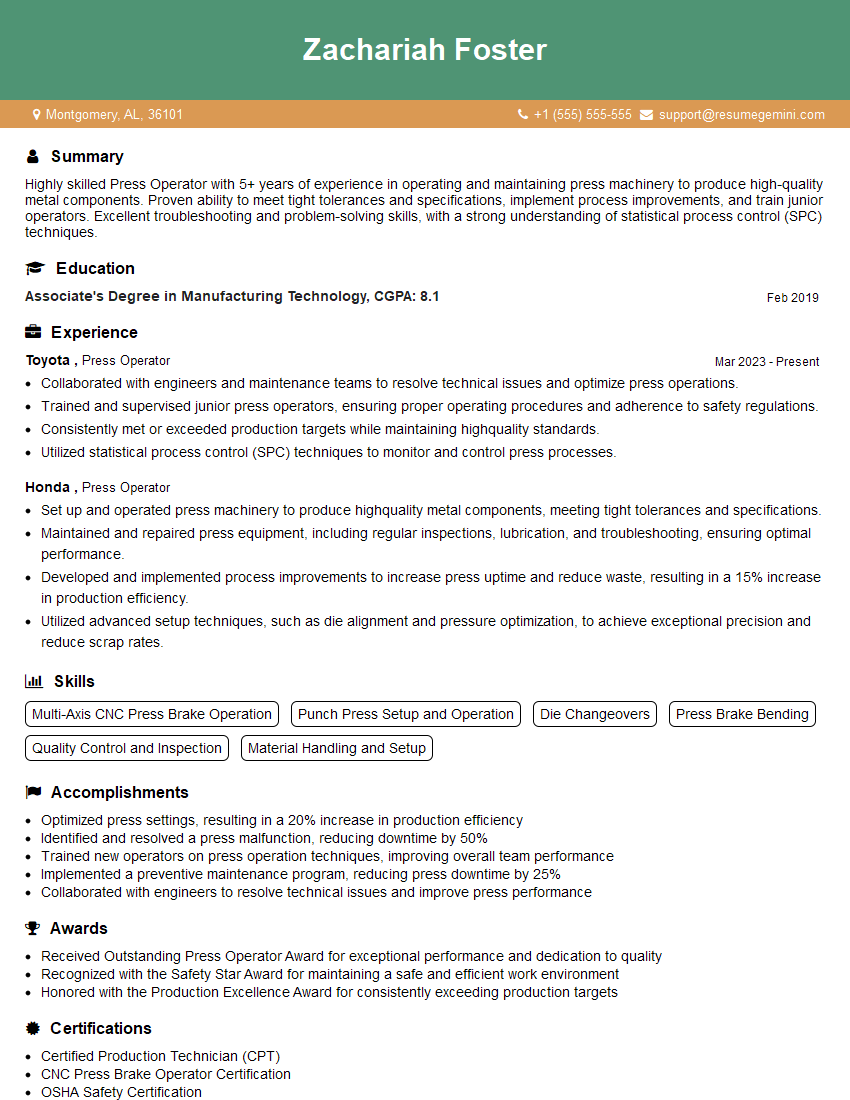
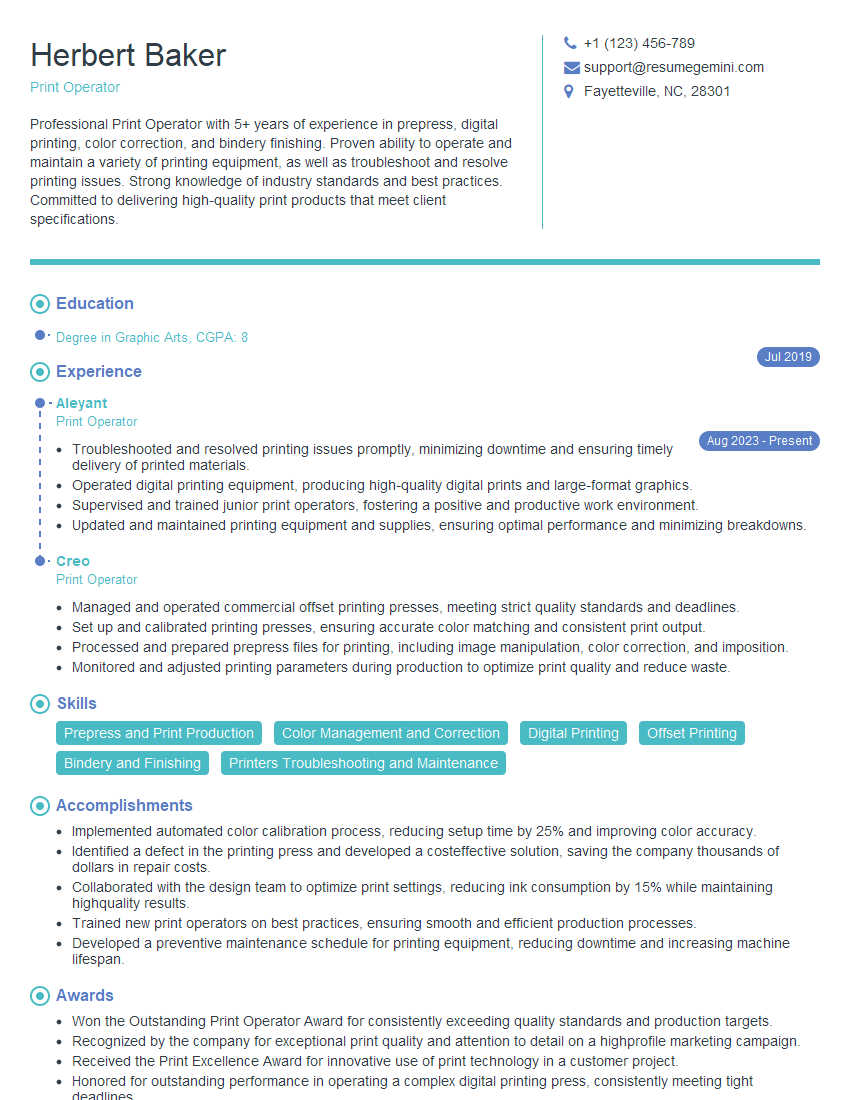
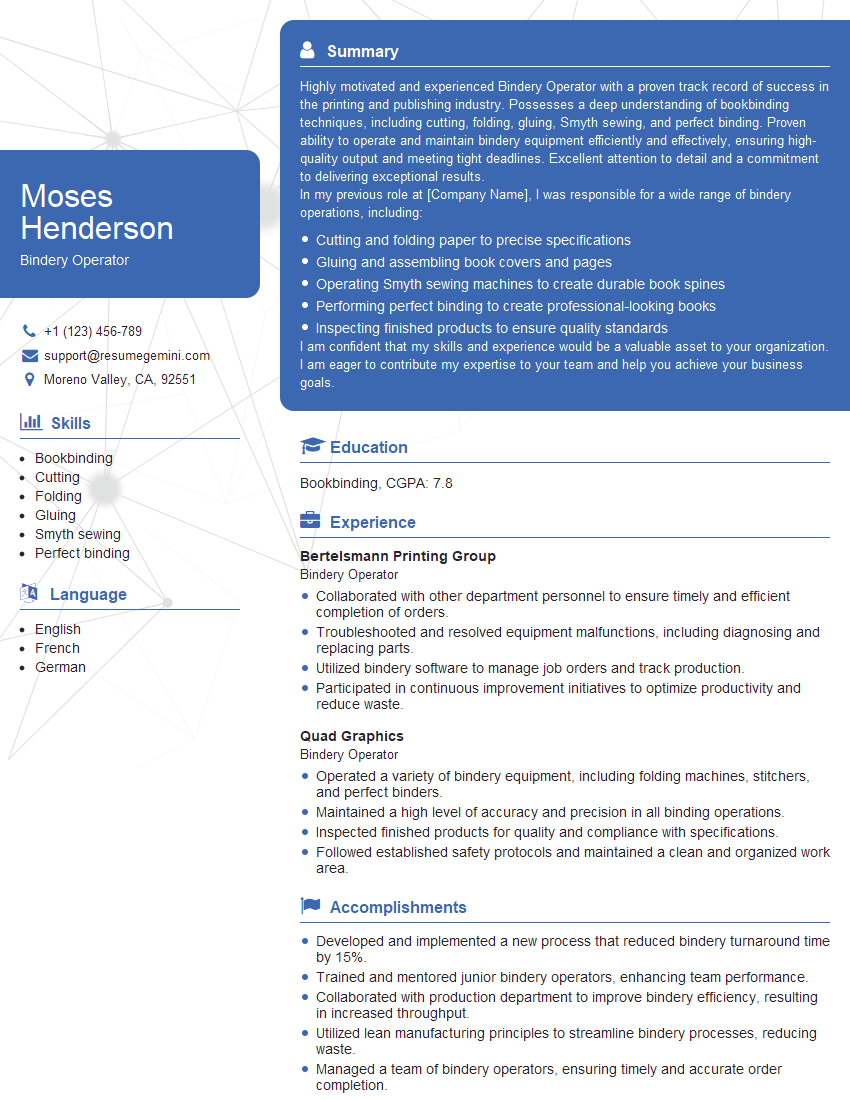
Mastering print production knowledge is key to unlocking exciting career opportunities and higher earning potential. A well-crafted resume is your first impression – make it count! Create an ATS-friendly resume that highlights your skills and experience effectively. ResumeGemini is a trusted resource to help you build a professional and impactful resume. We provide examples of resumes tailored to Print Production Knowledge to help you get started. Take the next step and craft a resume that showcases your expertise and lands you that interview!



Explore more articles
Users Rating of Our Blogs
Share Your Experience
We value your feedback! Please rate our content and share your thoughts (optional).
What Readers Say About Our Blog
Attention music lovers!
Wow, All the best Sax Summer music !!!
Spotify: https://open.spotify.com/artist/6ShcdIT7rPVVaFEpgZQbUk
Apple Music: https://music.apple.com/fr/artist/jimmy-sax-black/1530501936
YouTube: https://music.youtube.com/browse/VLOLAK5uy_noClmC7abM6YpZsnySxRqt3LoalPf88No
Other Platforms and Free Downloads : https://fanlink.tv/jimmysaxblack
on google : https://www.google.com/search?q=22+AND+22+AND+22
on ChatGPT : https://chat.openai.com?q=who20jlJimmy20Black20Sax20Producer
Get back into the groove with Jimmy sax Black
Best regards,
Jimmy sax Black
www.jimmysaxblack.com
Hi I am a troller at The aquatic interview center and I suddenly went so fast in Roblox and it was gone when I reset.
Hi,
Business owners spend hours every week worrying about their website—or avoiding it because it feels overwhelming.
We’d like to take that off your plate:
$69/month. Everything handled.
Our team will:
Design a custom website—or completely overhaul your current one
Take care of hosting as an option
Handle edits and improvements—up to 60 minutes of work included every month
No setup fees, no annual commitments. Just a site that makes a strong first impression.
Find out if it’s right for you:
https://websolutionsgenius.com/awardwinningwebsites
Hello,
we currently offer a complimentary backlink and URL indexing test for search engine optimization professionals.
You can get complimentary indexing credits to test how link discovery works in practice.
No credit card is required and there is no recurring fee.
You can find details here:
https://wikipedia-backlinks.com/indexing/
Regards
NICE RESPONSE TO Q & A
hi
The aim of this message is regarding an unclaimed deposit of a deceased nationale that bears the same name as you. You are not relate to him as there are millions of people answering the names across around the world. But i will use my position to influence the release of the deposit to you for our mutual benefit.
Respond for full details and how to claim the deposit. This is 100% risk free. Send hello to my email id: lukachachibaialuka@gmail.com
Luka Chachibaialuka
Hey interviewgemini.com, just wanted to follow up on my last email.
We just launched Call the Monster, an parenting app that lets you summon friendly ‘monsters’ kids actually listen to.
We’re also running a giveaway for everyone who downloads the app. Since it’s brand new, there aren’t many users yet, which means you’ve got a much better chance of winning some great prizes.
You can check it out here: https://bit.ly/callamonsterapp
Or follow us on Instagram: https://www.instagram.com/callamonsterapp
Thanks,
Ryan
CEO – Call the Monster App
Hey interviewgemini.com, I saw your website and love your approach.
I just want this to look like spam email, but want to share something important to you. We just launched Call the Monster, a parenting app that lets you summon friendly ‘monsters’ kids actually listen to.
Parents are loving it for calming chaos before bedtime. Thought you might want to try it: https://bit.ly/callamonsterapp or just follow our fun monster lore on Instagram: https://www.instagram.com/callamonsterapp
Thanks,
Ryan
CEO – Call A Monster APP
To the interviewgemini.com Owner.
Dear interviewgemini.com Webmaster!
Hi interviewgemini.com Webmaster!
Dear interviewgemini.com Webmaster!
excellent
Hello,
We found issues with your domain’s email setup that may be sending your messages to spam or blocking them completely. InboxShield Mini shows you how to fix it in minutes — no tech skills required.
Scan your domain now for details: https://inboxshield-mini.com/
— Adam @ InboxShield Mini
support@inboxshield-mini.com
Reply STOP to unsubscribe
Hi, are you owner of interviewgemini.com? What if I told you I could help you find extra time in your schedule, reconnect with leads you didn’t even realize you missed, and bring in more “I want to work with you” conversations, without increasing your ad spend or hiring a full-time employee?
All with a flexible, budget-friendly service that could easily pay for itself. Sounds good?
Would it be nice to jump on a quick 10-minute call so I can show you exactly how we make this work?
Best,
Hapei
Marketing Director
Hey, I know you’re the owner of interviewgemini.com. I’ll be quick.
Fundraising for your business is tough and time-consuming. We make it easier by guaranteeing two private investor meetings each month, for six months. No demos, no pitch events – just direct introductions to active investors matched to your startup.
If youR17;re raising, this could help you build real momentum. Want me to send more info?
Hi, I represent an SEO company that specialises in getting you AI citations and higher rankings on Google. I’d like to offer you a 100% free SEO audit for your website. Would you be interested?
Hi, I represent an SEO company that specialises in getting you AI citations and higher rankings on Google. I’d like to offer you a 100% free SEO audit for your website. Would you be interested?