The thought of an interview can be nerve-wracking, but the right preparation can make all the difference. Explore this comprehensive guide to Robot Operation interview questions and gain the confidence you need to showcase your abilities and secure the role.
Questions Asked in Robot Operation Interview
Q 1. Explain the different types of robot manipulators and their applications.
Robot manipulators are the robotic arms that perform the actual work. They come in various types, each suited for different tasks. Think of them as the ‘hands’ of the robot.
- Articulated Robots: These are the most common type, resembling a human arm with multiple rotary joints. Their flexibility makes them ideal for tasks requiring reaching into tight spaces or manipulating objects at various angles. Examples include robots used in car assembly, welding, and painting.
- Cartesian Robots (Gantry Robots): These robots move along three linear axes (X, Y, Z) like a giant mechanical hand. They’re excellent for pick-and-place operations where precision and repeatability are crucial, often found in CNC machining and automated warehousing.
- SCARA Robots (Selective Compliance Assembly Robot Arm): These robots are characterized by two parallel rotary joints and a linear vertical joint. They excel in applications requiring high-speed assembly operations, like inserting components into circuit boards.
- Cylindrical Robots: These robots have one rotary joint and two linear joints, resulting in a cylindrical work envelope. They are frequently used in material handling and spot welding.
- Spherical Robots (Polar Robots): These robots use one rotary joint and two linear joints, but their movement is more akin to a rotating arm with a vertical and radial movement. Their work envelope is spherical. They’re suitable for tasks like loading and unloading machines.
The choice of manipulator depends heavily on the application’s requirements, including the workspace, required degrees of freedom, payload capacity, and speed.
Q 2. Describe the process of robot programming using a specific language (e.g., RAPID, KRL).
Robot programming involves instructing the robot to perform specific tasks. I’ll use RAPID, ABB’s programming language, as an example. RAPID uses a structured approach, similar to other programming languages.
A typical RAPID program involves defining modules, which are self-contained blocks of code. These modules might contain procedures to handle specific tasks like moving the robot arm, gripping objects, or performing sensor readings.
Here’s a simplified example of a RAPID program that moves a robot to a specific point:
MODULE MoveToPosition;VAR position Point;{ ... Define the position variable ... }MoveJ pPoint, v1000, z50, tool1;ENDMODULE;This code snippet declares a module named ‘MoveToPosition’, defines a position variable ‘pPoint’, and then uses the ‘MoveJ’ function to move the robot to that point using a specified speed (‘v1000’) and zone (‘z50’) with a particular tool (‘tool1’). ‘MoveJ’ signifies a ‘joint movement,’ moving each joint smoothly to the target point. Other movement commands like ‘MoveL’ (linear movement) are also available.
Programming also includes configuring input/output signals to interact with sensors and external devices, handling error conditions, and integrating with the overall production system.
Q 3. How do you troubleshoot common robot malfunctions?
Troubleshooting robot malfunctions requires a systematic approach. It often starts with checking the obvious – is the power on? Are there any visible obstructions? Are any error lights illuminated?
A typical troubleshooting process might look like this:
- Identify the error: Check for error messages on the robot controller, look for unusual sounds or movements, and observe the overall behavior. What exactly is malfunctioning?
- Review logs and documentation: Consult the robot’s system logs for any error codes or recent events that may provide clues. The robot’s operation manual is an invaluable resource for identifying potential problems.
- Check sensors and actuators: Verify that all sensors are functioning correctly. Inspect actuators (motors, hydraulics, pneumatics) for damage or misalignment. Sometimes a simple reset or cleaning is all that’s needed.
- Inspect cables and connections: Loose or damaged cables can cause all kinds of problems. Thoroughly check all connections to ensure they’re secure.
- Test individual components: If necessary, isolate and test individual components to pinpoint the faulty part. This might involve using diagnostic tools provided by the robot manufacturer.
- Consult experts if needed: If the issue is beyond your expertise, contact the robot manufacturer’s support team or a qualified robotics technician.
Example: If a robot arm isn’t moving, it could be due to a tripped emergency stop, a faulty motor, a software error, or even a power supply issue. The systematic approach allows you to find the root cause efficiently.
Q 4. What safety protocols are essential when operating industrial robots?
Safety is paramount when working with industrial robots. A comprehensive safety program should include:
- Emergency Stop Systems: Easily accessible and reliable emergency stop buttons must be strategically placed throughout the robot’s work cell.
- Light Curtains and Safety Scanners: These sensors create a safety zone around the robot. If an object or person enters the zone, the robot automatically stops.
- Interlocks and Guards: Physical barriers prevent access to hazardous areas while the robot is operating. Interlocks ensure the robot stops if a guard is opened.
- Proper Training and Certification: Operators and maintenance personnel must receive thorough training on robot operation, safety procedures, and emergency response protocols.
- Risk Assessment and Job Safety Analysis (JSA): A thorough risk assessment is crucial before deploying a robot. A JSA identifies potential hazards and outlines the steps to mitigate them.
- Personal Protective Equipment (PPE): Appropriate PPE, such as safety glasses, gloves, and hearing protection, must be worn by all personnel in the robot’s vicinity.
- Regular Inspections and Maintenance: Regular inspection and maintenance of the robot and safety systems are crucial to ensure they remain functional and reliable.
Neglecting safety protocols can lead to serious accidents. These measures are not merely suggestions; they’re fundamental requirements for safe robot operation.
Q 5. Explain the concept of robot work envelope and its importance.
The robot work envelope defines the three-dimensional space within which the robot’s end effector (the tool or gripper at the end of the arm) can move. Think of it as the robot’s ‘reach’.
The work envelope’s shape and size depend on the robot’s design and configuration. An articulated robot’s work envelope is often complex and irregular, while a Cartesian robot’s is a rectangular prism. Understanding the work envelope is crucial for several reasons:
- Task Planning: The work envelope dictates the tasks a robot can perform. If a task requires reaching a point outside the envelope, the robot cannot complete it.
- Work Cell Design: The work cell must be designed to accommodate the robot’s work envelope. This ensures there’s enough space for the robot to move freely without collisions.
- Programming and Path Planning: When programming a robot, you must ensure that the programmed path remains within the work envelope to avoid errors or collisions.
- Safety Considerations: The work envelope plays a vital role in defining safety zones. Safety systems should be designed to prevent entry into the robot’s work envelope when it’s active.
Improperly defining or understanding the work envelope can result in collisions, damage to equipment, and even injury to personnel.
Q 6. Describe different robot control systems (e.g., point-to-point, continuous path).
Robot control systems determine how the robot moves and interacts with its environment. Two common types are:
- Point-to-Point (PTP) Control: In this system, the robot moves from one specified point to another without regard to the path taken between points. This is efficient for tasks where the path doesn’t matter, such as pick-and-place operations where the only important aspect is the start and end locations. Think of it like teleporting – you just appear at the destination.
- Continuous Path (CP) Control: This system allows the robot to follow a specified path precisely. This is crucial for tasks that require smooth, controlled movements, such as painting, welding, or cutting. The robot smoothly traces a pre-defined trajectory.
Other control methods include:
- Joint Control: The robot is controlled by individually specifying the angle of each joint.
- Cartesian Control: The robot is controlled by specifying the position and orientation of the end effector in Cartesian coordinates (X, Y, Z).
The choice of control system depends on the specific application. For example, a spot-welding robot would typically use PTP control, whereas a robotic arm painting a car body would require CP control.
Q 7. How do you perform robot calibration and maintenance?
Robot calibration and maintenance are crucial for ensuring accuracy, repeatability, and longevity. Calibration involves adjusting the robot’s internal parameters to match its physical configuration. This is essential because mechanical wear, thermal expansion, and other factors can affect the robot’s accuracy over time.
The calibration process usually involves:
- Establishing a reference point: Using precision measuring tools, a known reference point is established.
- Measuring deviations: The robot’s actual position is measured at various points in its work envelope and compared to the programmed positions.
- Adjusting parameters: Based on the measurements, the robot’s internal parameters (like joint offsets) are adjusted to minimize the deviations.
Maintenance includes:
- Regular inspections: Regularly inspecting the robot’s mechanical components, cables, sensors, and safety systems for wear, damage, or loose connections.
- Lubrication: Regularly lubricating moving parts to reduce friction and wear.
- Cleaning: Keeping the robot and its work area clean to prevent debris from interfering with operation.
- Software updates: Installing software updates provided by the manufacturer to improve performance and address any bugs.
A well-maintained robot will operate more accurately, reliably, and safely, leading to increased productivity and reduced downtime. Ignoring maintenance can lead to inaccurate movements, collisions, and costly repairs.
Q 8. What are the advantages and disadvantages of different robot drive systems?
Robot drive systems are the heart of a robot’s mobility, dictating its precision, speed, and payload capacity. Different systems offer various trade-offs.
- Hydraulic Drives: These use pressurized fluid to actuate cylinders. Advantages: High power-to-weight ratio, suitable for heavy lifting. Disadvantages: Leakage prone, require regular maintenance, less precise than other systems. Example: Large industrial robots in automotive manufacturing.
- Pneumatic Drives: Utilize compressed air for actuation. Advantages: Simple, inexpensive, inherently safe (air is compressible). Disadvantages: Lower power and precision compared to hydraulics or electrics, susceptible to environmental conditions. Example: Simple pick-and-place robots in light assembly.
- Electric Drives: Employ electric motors (AC or DC servo motors) for movement. Advantages: High precision, programmable speed and torque, clean operation. Disadvantages: Can be less powerful than hydraulic systems for the same size and weight, higher initial cost. Example: Most modern industrial robots, collaborative robots (cobots).
The choice of drive system depends heavily on the application. For high-precision tasks requiring fine control, electric drives are preferred. Heavy-duty applications needing significant force often favor hydraulic drives. Pneumatic drives find their niche in simpler, less demanding applications.
Q 9. Explain the role of sensors in robot operation and provide examples.
Sensors are crucial for a robot to perceive its environment and interact with it intelligently. They provide feedback to the control system, allowing for adaptive and responsive behavior.
- Proximity Sensors: Detect the presence of objects without physical contact. Types: Inductive, capacitive, ultrasonic. Example: Preventing a robot arm from colliding with a workpiece.
- Force/Torque Sensors: Measure the forces and torques applied to the robot’s end-effector. Example: Ensuring a delicate object is gripped gently, or adjusting pressure during assembly.
- Vision Systems (Cameras): Provide visual input, enabling robots to identify objects, navigate, and perform complex tasks. Example: Guiding a robot to pick specific parts from a conveyor belt.
- Encoders (Position Sensors): Monitor the position and movement of robot joints. Example: Ensuring accurate movement to a designated location.
- Laser Scanners: Create a 3D map of the environment, enabling autonomous navigation. Example: Used in autonomous mobile robots (AMRs) to avoid obstacles.
The type and number of sensors used depend on the specific robotic application. A simple pick-and-place robot may only need proximity sensors, while a sophisticated surgical robot requires a wide array of sensors for precision and safety.
Q 10. Describe your experience with robot vision systems and their applications.
I have extensive experience with robot vision systems, integrating them into various applications. My work involves selecting appropriate cameras (monochrome, color, 3D), designing lighting systems, and using computer vision algorithms to process image data.
- Object Recognition: I’ve developed systems that identify and classify objects based on their visual features. This is vital in applications like automated sorting and bin picking.
- Pose Estimation: Determining the position and orientation of objects relative to the robot. This is key for precise grasping and manipulation.
- Navigation and SLAM (Simultaneous Localization and Mapping): I’ve worked on enabling robots to autonomously navigate unknown environments by building a map and tracking their position within it.
For example, I recently implemented a vision system for a palletizing robot in a warehouse. The system uses a 3D camera to identify different types of boxes and their orientations on a conveyor belt, allowing the robot to accurately pick and place them onto pallets. This significantly improved efficiency and reduced the need for manual intervention.
Q 11. How do you handle robot collisions and errors?
Robot collisions and errors are inevitable. Robust error handling is crucial. My approach involves a multi-layered strategy:
- Preventive Measures: This includes careful programming, accurate sensor integration, and robust safety systems (e.g., emergency stops, light curtains). Proper risk assessment is paramount.
- Collision Detection: Using sensors like force/torque sensors or proximity sensors to detect impending collisions. This triggers a response like slowing down or stopping the robot.
- Error Recovery: Implementing algorithms that allow the robot to recover from minor errors. For instance, if the robot misplaces an object, it might retry the operation or signal a human for assistance.
- Safety Protocols: Following strict safety protocols, including regular maintenance and operator training, are fundamental.
- Logging and Analysis: Maintaining detailed logs of errors to identify patterns and improve system robustness. Post-incident analysis can uncover the root cause and prevent future occurrences.
Imagine a scenario where a robot arm unexpectedly encounters an obstacle. A properly designed system will detect the collision using force sensors, halt the robot immediately, and log the event for later review. The system might then initiate a recovery procedure, such as retracting the arm or attempting a different approach.
Q 12. Explain the concept of robot end-effectors and their selection criteria.
A robot end-effector is the device at the end of a robot arm that interacts with the environment. Selection criteria depend heavily on the application:
- Task Requirements: What is the robot supposed to do? Picking, placing, welding, painting, etc. This dictates the necessary tools and capabilities.
- Payload Capacity: The weight the end-effector needs to handle. Heavier payloads require more robust designs.
- Precision and Accuracy: The level of precision required for the task. Delicate tasks need precise end-effectors.
- Environment: Harsh environments might require specialized end-effectors that are durable and resistant to extreme conditions.
Examples: Grippers (for grasping objects), welding torches, paint sprayers, specialized tools for surgery or assembly. Choosing the wrong end-effector can lead to inefficiencies, damage to parts, or even robot failure.
Q 13. Describe your experience with PLC programming in relation to robot control.
Programmable Logic Controllers (PLCs) are commonly used to interface with and control robots. My experience includes using PLCs to manage the overall automation system, coordinating robot actions with other equipment like conveyors, sensors, and other machinery.
I’ve used PLCs to implement safety functions (emergency stops, light curtains), manage input/output signals from sensors, synchronize robot movements with other processes, and control peripheral devices. The programming usually involves ladder logic or structured text.
// Example Ladder Logic snippet (Illustrative) // If sensor detects object, then activate robot // ---[Sensor Input]---( )---[Robot Activate]---
In one project, I used a PLC to coordinate the actions of a robot arm with a conveyor system. The PLC received signals from sensors indicating the position of workpieces on the conveyor. Based on this information, it instructed the robot arm to pick and place the workpieces at the correct locations, ensuring a smooth and synchronized process.
Q 14. How do you ensure the safety and compliance of robotic systems?
Ensuring safety and compliance in robotic systems is paramount. My approach is proactive and multi-faceted:
- Risk Assessment: Thorough risk assessment identifies potential hazards associated with the robot and its environment. This leads to the implementation of appropriate safety measures.
- Safety Standards: Adherence to relevant safety standards (e.g., ISO 10218, ISO 13849) is crucial. This involves understanding and implementing the required safety features and certifications.
- Safety Systems: Implementing robust safety systems, such as emergency stops, light curtains, laser scanners, and pressure-sensitive mats, is essential to prevent accidents.
- Redundancy: Designing systems with redundancy in critical safety functions to ensure continued operation even if one component fails.
- Operator Training: Proper operator training is crucial. Operators need to understand the robot’s capabilities, limitations, and safety procedures.
- Regular Maintenance: Regular inspection and maintenance of the robot and its safety systems are vital to prevent malfunctions.
Compliance involves not only meeting safety standards but also adhering to all relevant regulations and legal requirements concerning the operation of robotic systems in a given region. Regular audits and documentation are key to demonstrating compliance.
Q 15. Explain your experience with robot simulation software.
Robot simulation software is crucial for testing and optimizing robot programs before deployment in real-world environments. It allows for virtual prototyping, reducing the risk of errors and costly downtime. My experience spans several leading platforms, including RoboDK, Gazebo, and Siemens Process Simulate. I’ve used these tools to model complex robotic workcells, simulate robot movements and interactions with objects, and test various control strategies. For example, in a recent project involving a palletizing robot, I used RoboDK to simulate the entire process, including the robot’s movements, the conveyor belt operation, and the pallet stacking sequence. This allowed us to identify potential collisions and optimize the robot’s path planning for maximum efficiency before even installing the physical robot.
Specifically, I’m proficient in using simulation software to:
- Create accurate 3D models of robots and their work environments.
- Program and test robot trajectories offline.
- Simulate sensor data and interactions.
- Analyze robot performance metrics such as cycle time and reach.
- Detect and resolve potential collisions before deployment.
This virtual testing significantly reduces the time and resources needed for on-site commissioning and troubleshooting.
Career Expert Tips:
- Ace those interviews! Prepare effectively by reviewing the Top 50 Most Common Interview Questions on ResumeGemini.
- Navigate your job search with confidence! Explore a wide range of Career Tips on ResumeGemini. Learn about common challenges and recommendations to overcome them.
- Craft the perfect resume! Master the Art of Resume Writing with ResumeGemini’s guide. Showcase your unique qualifications and achievements effectively.
- Don’t miss out on holiday savings! Build your dream resume with ResumeGemini’s ATS optimized templates.
Q 16. Describe your experience with different robot communication protocols.
Robot communication protocols are essential for enabling seamless data exchange between the robot controller, sensors, and other devices within a robotic system. My experience encompasses a range of protocols, including:
- Modbus: A widely used industrial communication protocol, particularly for connecting PLCs and other automation devices to the robot controller. I’ve extensively used Modbus to integrate robots with supervisory control systems.
- Profinet: A real-time industrial Ethernet protocol offering high bandwidth and deterministic communication. I’ve employed Profinet in projects requiring fast data exchange between robots and vision systems, crucial for tasks like precise part recognition and pick-and-place operations.
- EtherCAT: Another high-speed industrial Ethernet protocol known for its high efficiency and low latency. I’ve used EtherCAT in applications involving synchronized multi-axis robot control, ensuring smooth, coordinated movements.
- Proprietary protocols: I also have experience with manufacturer-specific protocols like those used by FANUC, KUKA, and ABB robots. This involves understanding the specific communication commands and data structures for each robot brand.
Understanding these diverse protocols is crucial for ensuring effective integration and control of robots in complex industrial automation systems. For example, in one project, I used Profinet to integrate a vision system providing real-time image feedback to a robot arm, enabling it to adapt to slight variations in object placement.
Q 17. How do you optimize robot programs for efficiency and speed?
Optimizing robot programs for efficiency and speed is a key aspect of my work. This involves a multi-faceted approach focused on minimizing cycle time and maximizing throughput without compromising safety or precision. The strategies I employ include:
- Path Optimization: Analyzing robot trajectories to identify and eliminate unnecessary movements. This often involves using specialized software tools or algorithms to generate the most efficient path. For instance, I’ve used algorithms to smooth out jerky movements and minimize acceleration/deceleration times.
- Joint Trajectory Planning: Carefully planning the movement of individual joints to minimize travel time and energy consumption. This often involves taking into account the kinematic and dynamic characteristics of the robot arm.
- I/O Optimization: Efficiently managing input/output operations to avoid unnecessary delays in program execution. This can involve optimizing data transfer rates and minimizing the number of I/O operations.
- Code Optimization: Writing concise and efficient robot code, avoiding unnecessary loops or calculations. This often involves using techniques like code profiling to identify performance bottlenecks.
Imagine a scenario where a robot is tasked with picking and placing objects on a conveyor belt. Through path optimization, we can ensure the robot picks up each object from the most efficient location and places it down without unnecessary movements. By combining these methods, significant gains in robot performance can be realized. I always document my optimization efforts, allowing for easy tracking and future improvement.
Q 18. What is your experience with different robot teaching methods?
Robot teaching methods vary depending on the robot’s capabilities and the complexity of the task. My experience encompasses several approaches:
- Lead-through Programming (Manual Guidance): Physically guiding the robot arm through the desired trajectory. This is a simple, intuitive method suitable for relatively simple tasks. This method is commonly used for teaching pick-and-place operations. I’ve found this particularly useful for initial demonstrations and training purposes.
- Teach Pendant Programming: Using a handheld device (teach pendant) to input joint angles, Cartesian coordinates, or other parameters to define the robot’s movements. This offers more precise control than lead-through programming and allows for offline programming as well.
- Offline Programming (Simulation-based): Creating robot programs using simulation software, allowing for virtual testing and optimization before deployment. This method significantly speeds up the programming process and reduces the risk of errors. We often use offline programming for complex tasks.
- Automatic Programming: Generating robot programs automatically based on CAD data or other input. This is useful for repetitive tasks, such as machining or welding. This type of program generation requires sophisticated algorithms and careful validation.
The choice of teaching method depends on factors such as task complexity, robot type, and available resources. In complex scenarios, a combination of methods is usually employed. For instance, I might use offline programming to develop the overall task logic and then refine specific movements through teach pendant programming.
Q 19. Describe your experience with robotic cell design and integration.
Robotic cell design and integration involve planning, designing, and implementing a complete robotic system, including the robot, end-effector, sensors, safety systems, and other peripheral equipment. My experience involves the complete process, from initial conceptual design to final commissioning. This includes:
- Needs Assessment: Clearly defining the objectives and requirements of the robotic cell. This includes specifying the tasks to be automated, the required throughput, and any safety considerations.
- Layout Design: Designing the physical layout of the robotic cell, considering factors such as workspace, accessibility, and ergonomics.
- Component Selection: Choosing appropriate robots, end-effectors, sensors, and other components based on the specific application requirements.
- Safety System Integration: Designing and implementing safety systems to ensure the safety of personnel and equipment. This includes light curtains, safety mats, and emergency stops.
- Software Integration: Developing and integrating the necessary software to control the robot and other components.
- Commissioning and Testing: Testing the complete robotic cell to ensure it meets the specified requirements.
For example, in designing a robotic welding cell, I’d consider the welding process, the geometry of the parts to be welded, the required welding speed, and the safety measures to be implemented, including the need for fume extraction. Proper cell design ensures a safe, efficient, and reliable automated process.
Q 20. How do you manage data acquired from robot sensors?
Data acquired from robot sensors is crucial for feedback control, process monitoring, and fault detection. My experience includes various techniques for managing this data:
- Data Acquisition: Using appropriate hardware and software to capture sensor data. This often involves configuring the communication protocols and data rates of the sensors.
- Data Filtering: Applying filtering techniques to remove noise and other unwanted artifacts from the sensor data. This is essential for improving the accuracy and reliability of the data.
- Data Processing: Processing the sensor data to extract meaningful information. This often involves using signal processing algorithms or machine learning techniques.
- Data Storage: Storing the sensor data in a structured and accessible manner. This might involve using databases, spreadsheets, or specialized data logging systems.
- Data Visualization: Visualizing the sensor data to identify trends and patterns. This often involves using specialized software tools or creating custom visualizations.
For instance, in a robotic assembly application, force/torque sensors provide crucial feedback on the interaction between the robot and the parts being assembled. I’d process this data to detect anomalies such as excessive force or unexpected slippage, allowing for immediate corrective actions and preventing damage. Real-time data visualization can provide valuable insights into the performance and reliability of the robotic system.
Q 21. Explain your understanding of robot kinematics and dynamics.
Robot kinematics and dynamics are fundamental concepts in robotics. Kinematics deals with the geometry of motion, while dynamics deals with the forces and torques involved. A strong understanding is crucial for robot control and path planning.
Kinematics: This involves analyzing the relationship between the robot’s joint angles and its end-effector position and orientation. I use forward kinematics (calculating the end-effector pose from joint angles) and inverse kinematics (calculating joint angles to achieve a desired end-effector pose). I’m proficient in using various kinematic models, including Denavit-Hartenberg (DH) parameters, for different robot configurations.
Dynamics: This involves analyzing the forces and torques required to move the robot arm and its payload. I use dynamic models to account for inertial forces, gravity, and friction. This is critical for accurate control, especially for high-speed or high-payload applications. Understanding dynamics allows me to design controllers that compensate for these effects, ensuring smooth and precise robot movements.
For example, in designing a robot trajectory, I’d use kinematic analysis to determine the joint angles needed to reach a specific point. Dynamic analysis would help determine the necessary torques and forces from the actuators, ensuring that the robot has sufficient power and control throughout its movement.
Q 22. Describe your experience with robot path planning algorithms.
Robot path planning is crucial for efficient and safe robot operation. It involves finding the optimal trajectory for a robot to move from a starting point to a destination, avoiding obstacles and adhering to constraints like speed and joint limits. I have extensive experience with various algorithms, including:
- A* search: A graph search algorithm that’s excellent for finding the shortest path in a known environment. Think of it like finding the quickest route on a map, considering roadblocks (obstacles).
- RRT (Rapidly-exploring Random Trees): Ideal for high-dimensional spaces and unknown environments. It’s like exploring a maze by randomly throwing spaghetti – eventually, you’ll find a way through.
- Potential Field Methods: These create a virtual ‘force field’ around obstacles, guiding the robot away. Imagine a robot navigating a room using repulsive forces from walls and attractive forces from the destination.
- Bezier Curves and Splines: These are used to create smooth and predictable trajectories, essential for delicate operations or high-speed movement. They allow for precise control over the robot’s path, like drawing a perfectly smooth curve.
In my previous role, I implemented an A* algorithm for a robotic arm tasked with picking and placing components on a PCB. By optimizing the path, we reduced cycle time by 15% and minimized wear and tear on the robot’s joints.
Q 23. How do you troubleshoot and resolve communication issues between a robot and its controller?
Troubleshooting communication issues between a robot and its controller requires a systematic approach. It usually involves checking several layers of the communication system. Here’s my process:
- Verify physical connections: Are cables securely connected? Are there any loose or damaged wires? This is the most basic but often overlooked step. A simple unplugged cable can cause major headaches.
- Check communication settings: Are the baud rate, parity, and other communication parameters correctly configured on both the robot and the controller? Mismatched settings are a common culprit. Imagine trying to have a conversation with someone speaking a different language – you won’t understand each other.
- Examine network connectivity (if applicable): For networked robots, verify network connectivity, IP addresses, and network settings. A simple network glitch can disrupt communication.
- Inspect error logs and diagnostic messages: Both the robot and controller will often log errors. Analyzing these logs can pinpoint the cause. Think of it as checking the car’s dashboard for warning lights.
- Test communication with simple commands: Send basic commands to test if communication is established. This is like a simple ping test in network troubleshooting.
- Check for software issues: Outdated firmware or software bugs can disrupt communication. Update to the latest versions, if available.
- Consult documentation and seek support: Robot manufacturers provide detailed documentation and support. Don’t hesitate to contact them for assistance.
In one instance, a seemingly random communication failure was traced back to a faulty network switch. Replacing the switch resolved the issue immediately.
Q 24. What experience do you have with integrating robots into existing manufacturing processes?
Integrating robots into existing manufacturing processes requires careful planning and execution. It’s not just about adding a robot; it’s about optimizing the entire workflow. My experience includes:
- Needs assessment and process analysis: Thoroughly understanding the existing process to identify bottlenecks and opportunities for automation. This involves observing the process, collecting data, and identifying areas where a robot can improve efficiency and quality.
- Robot selection and configuration: Choosing the right robot based on payload capacity, reach, speed, and precision requirements. Configuring the robot’s end-effector and programming its movements to fit the specific task.
- Integration with existing systems: Connecting the robot to the existing PLC (Programmable Logic Controller), SCADA (Supervisory Control and Data Acquisition) system, and other automation components. This involves ensuring seamless data exchange between the robot and other parts of the manufacturing process.
- Safety considerations: Implementing safety measures like light curtains, safety fences, and emergency stop buttons to prevent accidents. Safety is paramount in any robotic integration project.
- Testing and commissioning: Rigorously testing the integrated system to ensure its reliability and performance. This typically involves testing the robot’s performance under various operating conditions.
For example, I integrated a robotic arm into a packaging line, automating the palletizing process. This increased throughput by 30% and significantly reduced labor costs.
Q 25. Explain your understanding of robotic accuracy and repeatability.
Robotic accuracy and repeatability are critical performance indicators. Accuracy refers to how close the robot’s actual position is to its programmed position. Repeatability, on the other hand, refers to the robot’s ability to return to the same position consistently.
Imagine shooting an arrow at a target: accuracy is how close the arrow lands to the bullseye, while repeatability is how consistently the arrows cluster together, regardless of whether they hit the bullseye or not.
High accuracy is important for tasks requiring precise positioning, such as welding or assembly. High repeatability is essential for tasks that need consistent execution, such as painting or dispensing. Factors influencing these metrics include:
- Robot design and mechanics: The precision of the robot’s gears, motors, and other mechanical components.
- Calibration: Regular calibration is crucial to maintain accuracy. Think of it as regularly tuning a musical instrument to ensure it plays accurately.
- Environmental factors: Temperature fluctuations, vibrations, and other environmental factors can affect accuracy and repeatability.
- Programming and control: Precise programming minimizes errors.
Q 26. How do you ensure the quality control of robotic operations?
Ensuring quality control in robotic operations is paramount. My approach involves a multi-faceted strategy:
- Regular calibration and maintenance: Preventative maintenance and regular calibration of the robot and its end-effector minimizes errors and ensures consistent performance. This includes regular checks of motors, gears, sensors, and cables.
- Statistical Process Control (SPC): Using SPC techniques to monitor and analyze the robot’s performance data, identifying any trends or deviations from acceptable limits. This proactive approach allows for early detection of potential problems.
- Vision systems and sensors: Integrating vision systems and other sensors to monitor the robot’s actions and the quality of its work. Vision systems are used to verify part placement, identify defects, and perform quality checks.
- Automated inspection systems: Implementing automated inspection systems to check the quality of the output. For example, a vision system can check for defects in a product after the robot completes its assembly task.
- Operator training and procedures: Well-trained operators are crucial in maintaining quality. Clear procedures and standardized operating methods help minimize errors caused by human factors.
For example, in a packaging application, a vision system would verify that the product is correctly placed in the box before the box is sealed. This prevents defective products from being shipped to customers.
Q 27. What are your strategies for continuous improvement in robot performance?
Continuous improvement in robot performance is an ongoing process. My strategies include:
- Data analysis and performance monitoring: Regularly analyzing data from the robot’s operation to identify areas for improvement. This might involve analyzing cycle times, error rates, and other key performance indicators.
- Process optimization: Continuously evaluating and refining the robot’s program and work cell layout to increase efficiency and reduce cycle times. Small adjustments can lead to big improvements.
- Algorithm optimization: Exploring and implementing advanced path planning algorithms and control strategies to improve robot performance and precision. Advanced algorithms can reduce cycle times and improve path efficiency.
- Predictive maintenance: Using sensor data and machine learning to predict potential equipment failures and schedule maintenance proactively. This minimizes downtime and prevents unexpected issues.
- Operator feedback: Gathering feedback from operators to identify challenges and areas for improvement. Operators often have valuable insights into how to improve the robot’s operation.
In one project, we used data analysis to identify a bottleneck in the robot’s gripping mechanism. By upgrading to a faster gripper, we increased throughput by 10%.
Q 28. Describe your experience with different types of robotic grippers.
I have experience with a variety of robotic grippers, each suited for different tasks and object types. These include:
- Parallel grippers (two-finger grippers): Simple and reliable, ideal for grasping objects with parallel faces. Think of tongs or tweezers – simple yet effective for many applications.
- Three-finger grippers: Offer more dexterity and better object manipulation, suitable for handling irregularly shaped objects. They provide more secure gripping compared to two-finger grippers.
- Vacuum grippers: Use suction to grasp objects, suitable for smooth, flat surfaces. Think of a robotic hand picking up a sheet of glass – safe and efficient.
- Magnetic grippers: Ideal for handling ferrous materials. They are a simple, efficient solution for handling metallic parts.
- Adaptive grippers: These are more sophisticated grippers that can adapt to different object shapes and sizes. They may incorporate sensors and soft materials for compliant grasping. Think of a robot hand that can adjust to grip different shapes and sizes like a human hand.
The choice of gripper depends heavily on the application. For example, in a delicate assembly task, an adaptive gripper would be preferred for its ability to handle a variety of parts gently and accurately.
Key Topics to Learn for Robot Operation Interview
- Robot Programming Languages: Understanding common languages like RAPID, KRL, or Python for robotic control. Practical application: Writing and debugging programs for specific robotic tasks.
- Robotics Safety and Compliance: Knowledge of safety standards (e.g., ISO 10218) and risk assessment procedures. Practical application: Implementing safety measures to prevent accidents during operation and maintenance.
- Robot Calibration and Maintenance: Understanding procedures for calibrating robotic systems and performing routine maintenance tasks. Practical application: Troubleshooting malfunctions and ensuring optimal robot performance.
- Sensor Integration and Data Acquisition: Familiarity with various sensors (e.g., vision systems, force/torque sensors) and data acquisition techniques. Practical application: Using sensor data to improve robot accuracy and adaptability.
- Robot Kinematics and Dynamics: Theoretical understanding of robot movement and manipulation. Practical application: Optimizing robot trajectories for speed and efficiency.
- Troubleshooting and Problem-Solving: Ability to diagnose and resolve robotic system issues efficiently. Practical application: Identifying and fixing errors in robot programs or hardware.
- Industrial Automation Systems: Understanding integration of robots into larger automation systems (PLCs, SCADA). Practical application: Programming and coordinating robot actions within a complete production line.
- Specific Robot Models and Applications: Familiarity with the types of robots commonly used in your target industry (e.g., articulated arms, SCARA robots, collaborative robots). Practical application: Describing experience with specific robot brands and functionalities.
Next Steps
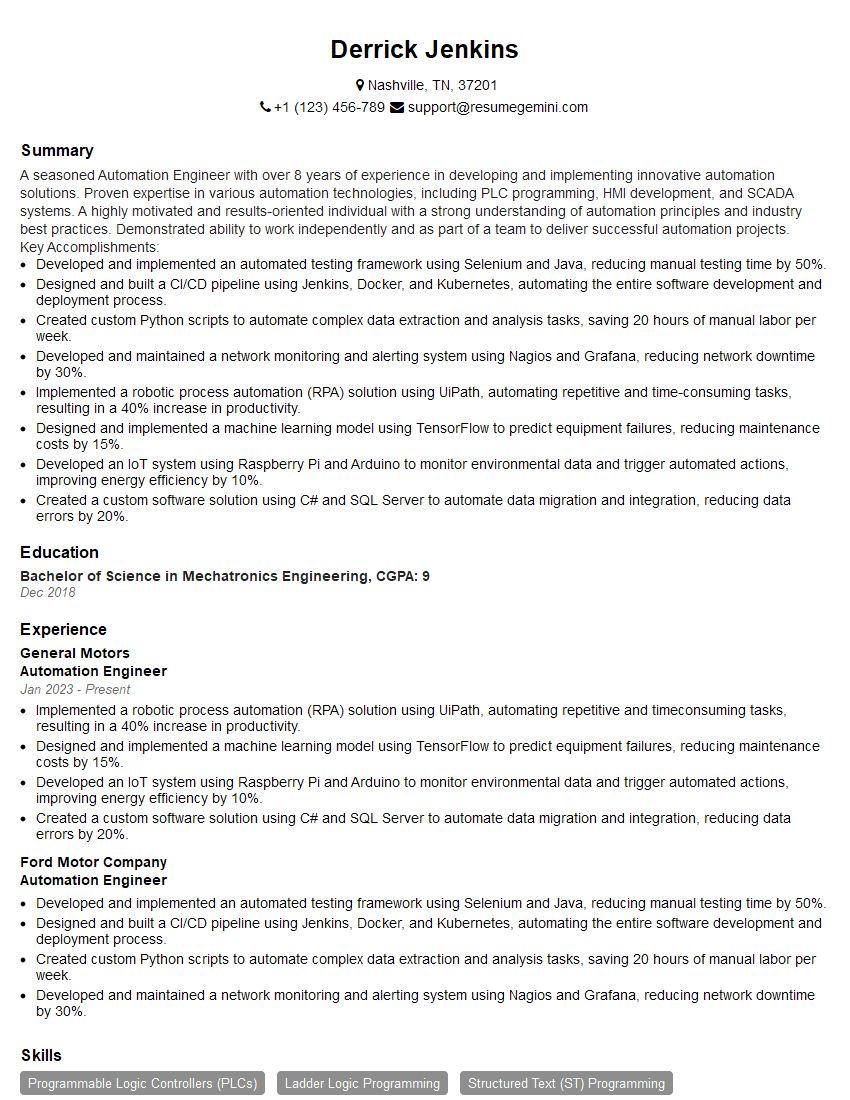
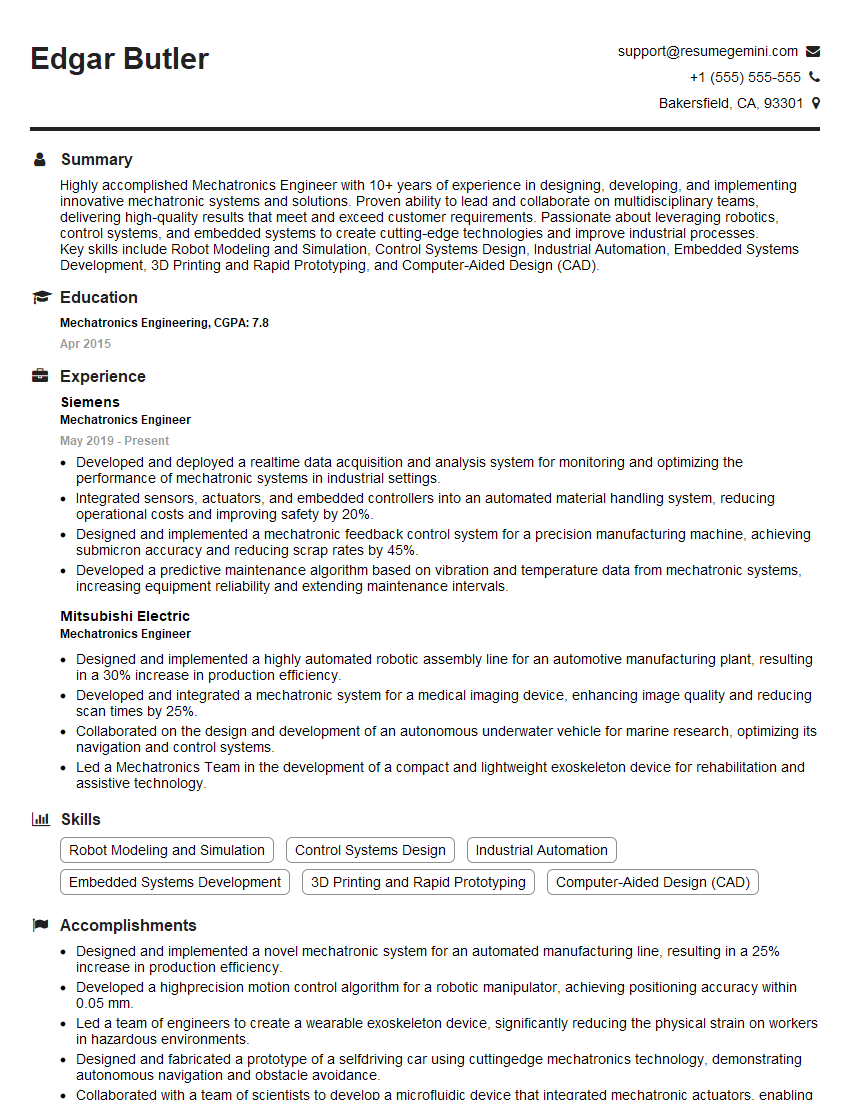
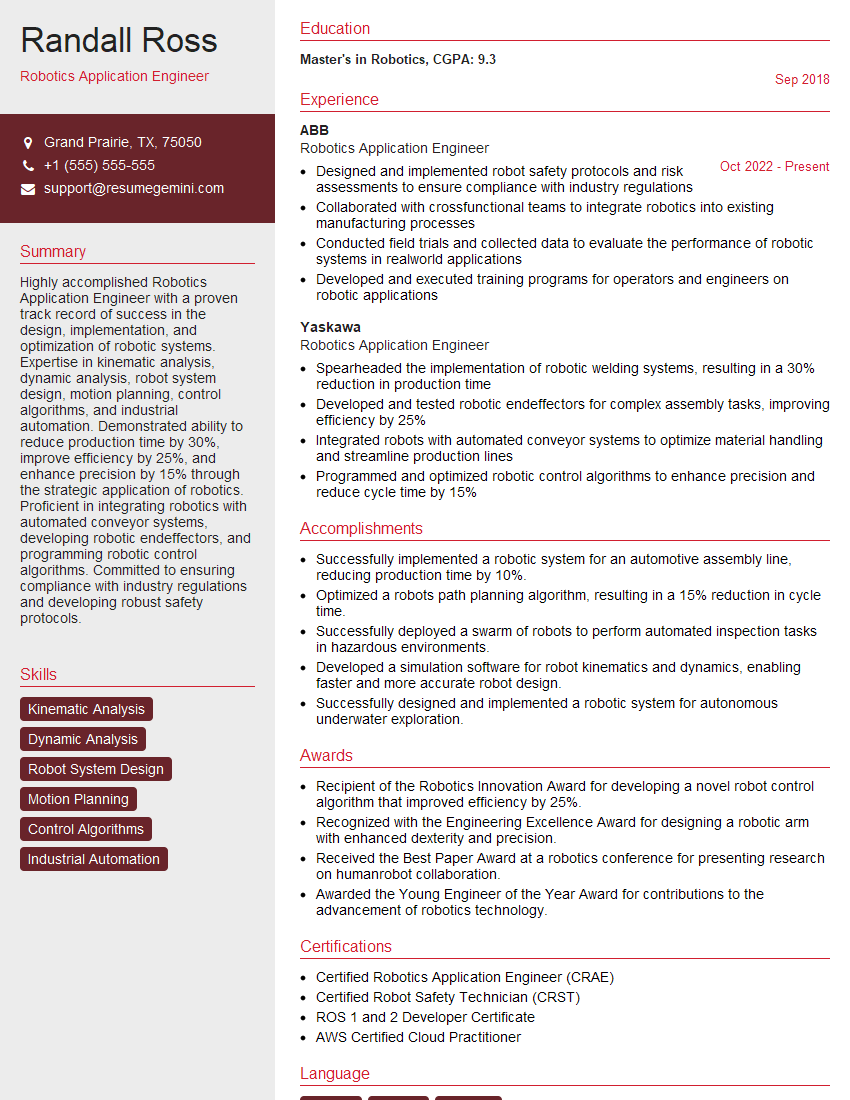
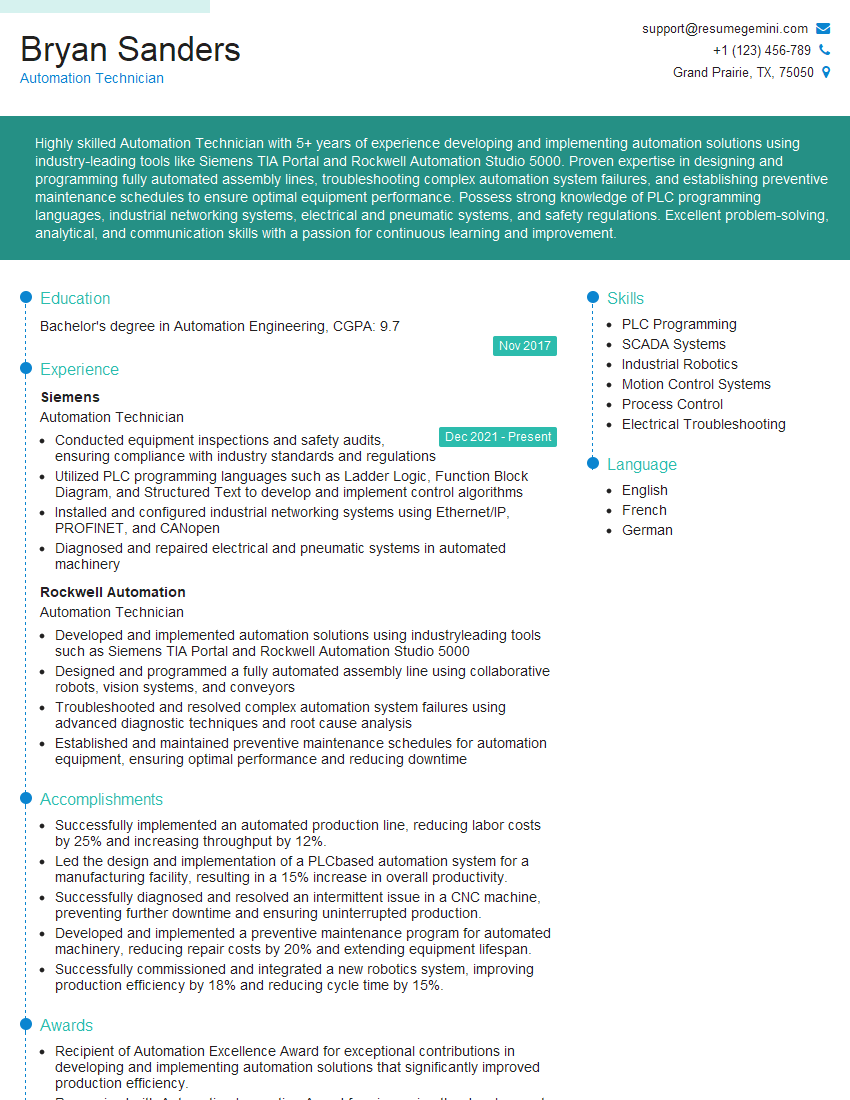
Mastering robot operation opens doors to exciting and rewarding careers in automation, manufacturing, and beyond. High demand for skilled professionals ensures strong job prospects and excellent career growth potential. To maximize your chances of landing your dream role, it’s crucial to create an ATS-friendly resume that highlights your skills and experience effectively. We strongly recommend leveraging ResumeGemini, a trusted resource for building professional resumes, to craft a compelling document that showcases your expertise. Examples of resumes tailored to Robot Operation are available to guide you through this process.


Explore more articles
Users Rating of Our Blogs
Share Your Experience
We value your feedback! Please rate our content and share your thoughts (optional).
What Readers Say About Our Blog
Hello,
we currently offer a complimentary backlink and URL indexing test for search engine optimization professionals.
You can get complimentary indexing credits to test how link discovery works in practice.
No credit card is required and there is no recurring fee.
You can find details here:
https://wikipedia-backlinks.com/indexing/
Regards
NICE RESPONSE TO Q & A
hi
The aim of this message is regarding an unclaimed deposit of a deceased nationale that bears the same name as you. You are not relate to him as there are millions of people answering the names across around the world. But i will use my position to influence the release of the deposit to you for our mutual benefit.
Respond for full details and how to claim the deposit. This is 100% risk free. Send hello to my email id: [email protected]
Luka Chachibaialuka
Hey interviewgemini.com, just wanted to follow up on my last email.
We just launched Call the Monster, an parenting app that lets you summon friendly ‘monsters’ kids actually listen to.
We’re also running a giveaway for everyone who downloads the app. Since it’s brand new, there aren’t many users yet, which means you’ve got a much better chance of winning some great prizes.
You can check it out here: https://bit.ly/callamonsterapp
Or follow us on Instagram: https://www.instagram.com/callamonsterapp
Thanks,
Ryan
CEO – Call the Monster App
Hey interviewgemini.com, I saw your website and love your approach.
I just want this to look like spam email, but want to share something important to you. We just launched Call the Monster, a parenting app that lets you summon friendly ‘monsters’ kids actually listen to.
Parents are loving it for calming chaos before bedtime. Thought you might want to try it: https://bit.ly/callamonsterapp or just follow our fun monster lore on Instagram: https://www.instagram.com/callamonsterapp
Thanks,
Ryan
CEO – Call A Monster APP
To the interviewgemini.com Owner.
Dear interviewgemini.com Webmaster!
Hi interviewgemini.com Webmaster!
Dear interviewgemini.com Webmaster!
excellent
Hello,
We found issues with your domain’s email setup that may be sending your messages to spam or blocking them completely. InboxShield Mini shows you how to fix it in minutes — no tech skills required.
Scan your domain now for details: https://inboxshield-mini.com/
— Adam @ InboxShield Mini
Reply STOP to unsubscribe
Hi, are you owner of interviewgemini.com? What if I told you I could help you find extra time in your schedule, reconnect with leads you didn’t even realize you missed, and bring in more “I want to work with you” conversations, without increasing your ad spend or hiring a full-time employee?
All with a flexible, budget-friendly service that could easily pay for itself. Sounds good?
Would it be nice to jump on a quick 10-minute call so I can show you exactly how we make this work?
Best,
Hapei
Marketing Director
Hey, I know you’re the owner of interviewgemini.com. I’ll be quick.
Fundraising for your business is tough and time-consuming. We make it easier by guaranteeing two private investor meetings each month, for six months. No demos, no pitch events – just direct introductions to active investors matched to your startup.
If youR17;re raising, this could help you build real momentum. Want me to send more info?
Hi, I represent an SEO company that specialises in getting you AI citations and higher rankings on Google. I’d like to offer you a 100% free SEO audit for your website. Would you be interested?
Hi, I represent an SEO company that specialises in getting you AI citations and higher rankings on Google. I’d like to offer you a 100% free SEO audit for your website. Would you be interested?
good