Preparation is the key to success in any interview. In this post, we’ll explore crucial Scripting and Copywriting interview questions and equip you with strategies to craft impactful answers. Whether you’re a beginner or a pro, these tips will elevate your preparation.
Questions Asked in Scripting and Copywriting Interview
Q 1. Explain the difference between copywriting and content writing.
While both copywriting and content writing involve crafting written material, their goals and approaches differ significantly. Copywriting is primarily focused on persuasion and driving a specific action, like making a purchase or signing up for a newsletter. It’s concise, targeted, and results-oriented. Think of the catchy tagline on a billboard or the compelling call to action in an email. Content writing, on the other hand, aims to inform, educate, or entertain. It’s broader in scope and can include blog posts, articles, website content, and more. The focus is on providing value to the reader and building brand awareness. A blog post about the benefits of a particular product is content writing, whereas an ad copy urging you to buy that product is copywriting.
Think of it this way: copywriting is like a direct sales pitch, while content writing is more like a conversation.
Q 2. Describe your process for developing a compelling marketing campaign.
My process for developing a compelling marketing campaign starts with a deep dive into understanding the target audience and the client’s goals. I use a structured approach:
- Research and Strategy: This involves analyzing market trends, competitor analysis, and defining clear objectives (e.g., increase brand awareness by 20%, generate 500 leads). I also create buyer personas to better understand the target audience’s needs, motivations, and pain points.
- Content Ideation and Planning: Based on the research, I brainstorm various content formats (blog posts, social media posts, email campaigns, video scripts, etc.) tailored to the target audience and marketing channels. I also determine the key messaging and call to action for each piece of content.
- Copywriting and Content Creation: This stage involves writing compelling copy that resonates with the target audience, employing various techniques like storytelling, humor, and emotional appeals. I meticulously craft headlines, body text, and calls to action.
- Testing and Optimization: Once the campaign is launched, I closely monitor its performance using analytics. A/B testing different versions of ads or landing pages allows for continuous improvement based on real-time data and user feedback. This ensures the campaign is constantly evolving to achieve optimal results.
For example, in a recent campaign for a sustainable clothing brand, I focused on storytelling to highlight the ethical sourcing and production methods. This resonated strongly with the environmentally conscious target audience, resulting in a significant increase in sales.
Q 3. How do you adapt your writing style for different audiences?
Adapting my writing style to different audiences is crucial for effective communication. I consider factors like age, education level, cultural background, interests, and the specific platform (e.g., LinkedIn versus Instagram).
- Formal vs. Informal: A LinkedIn post for professionals requires a more formal tone than a tweet targeting a younger demographic. I adjust vocabulary, sentence structure, and overall style to match the appropriate level of formality.
- Tone and Voice: I adapt the tone to reflect the brand’s personality and the desired emotional response. A humorous tone might suit a social media campaign for a playful brand, while a more serious and informative tone might be appropriate for a financial institution.
- Language and Jargon: I avoid technical jargon or overly complex language when addressing a general audience. Instead, I use clear and concise language that is easily understood. For specialized audiences, however, I can incorporate relevant technical terms.
For instance, when writing content for a tech startup targeting developers, I use more technical terms and explain complex concepts in detail. However, when creating marketing materials for their end-users, I simplify the language to focus on the benefits and ease of use.
Q 4. What are some common copywriting techniques you use?
I utilize a variety of copywriting techniques to create engaging and persuasive content. Some of my favorites include:
- Power words: Words with strong emotional connotations (e.g., ‘discover,’ ‘transform,’ ‘unleash’) are used to evoke a powerful response.
- Storytelling: Narratives create a connection with the audience and make the message memorable. This involves creating relatable characters and building suspense or intrigue.
- Problem/Solution: Identifying and addressing a specific problem the target audience faces and then presenting the product or service as the solution is highly effective.
- Scarcity and Urgency: Creating a sense of limited availability or time-sensitive offers motivates immediate action (‘limited-time offer,’ ‘only 5 spots left’).
- Social Proof: Leveraging testimonials, reviews, or statistics from satisfied customers builds trust and credibility.
- Call to Action (CTA): Clear and concise CTAs guide the reader towards the desired action (e.g., ‘Shop Now,’ ‘Learn More,’ ‘Sign Up’).
For example, in a campaign for a weight-loss program, I used storytelling to share the success story of a former client, incorporating social proof and a clear CTA to encourage sign-ups.
Q 5. How do you measure the success of a copywriting campaign?
Measuring the success of a copywriting campaign depends on the specific objectives set at the beginning. Key metrics include:
- Conversion rates: This measures the percentage of website visitors who complete a desired action (e.g., making a purchase, filling out a form).
- Click-through rates (CTR): The percentage of people who click on a link or ad.
- Return on investment (ROI): The overall profitability of the campaign, calculated by comparing the cost of the campaign with the revenue generated.
- Website traffic: The number of visitors to the website, indicating the campaign’s reach and effectiveness.
- Lead generation: The number of qualified leads generated as a result of the campaign.
- Brand awareness: This can be measured through surveys, social media engagement, and changes in search rankings.
By tracking these metrics, I can assess the effectiveness of the campaign and make data-driven adjustments to improve performance. For example, if the CTR is low, I might revise the ad copy or targeting.
Q 6. What is your experience with SEO copywriting?
I have extensive experience in SEO copywriting, which combines the principles of copywriting with search engine optimization (SEO) best practices. This means I craft compelling copy that not only persuades the reader but also ranks well in search engine results pages (SERPs).
My process involves:
- Keyword research: Identifying relevant keywords and phrases that target audiences use when searching for information related to the product or service.
- On-page optimization: Integrating keywords naturally throughout the content (in headings, subheadings, body text, meta descriptions, and image alt tags).
- Content optimization: Creating high-quality, valuable content that satisfies user intent and answers their search queries.
- Link building: Earning high-quality backlinks from other reputable websites to increase the authority of the content.
I have successfully implemented SEO copywriting strategies for various clients, resulting in increased organic traffic, improved search rankings, and ultimately, higher conversion rates.
Q 7. Explain the importance of keyword research in copywriting.
Keyword research is fundamental to successful SEO copywriting. It helps determine what terms and phrases people are using when searching online for information related to your product or service. This information is crucial for creating content that search engines can easily find and display to the right audience.
The process typically involves:
- Brainstorming keywords: Listing relevant terms and phrases associated with your product or service.
- Using keyword research tools: Employing tools like Google Keyword Planner, Ahrefs, SEMrush, etc., to identify keywords with high search volume, low competition, and high relevance.
- Analyzing search intent: Understanding what users are looking for when they search for a particular keyword. Are they looking for information, products to buy, or a service?
- Mapping keywords to content: Strategically incorporating keywords into your content in a natural and relevant manner.
Without keyword research, your content might not be discoverable by search engines, limiting its reach and potential impact. For example, writing a blog post about ‘running shoes’ without considering relevant keywords like ‘best running shoes for women,’ ‘trail running shoes,’ or ‘marathon running shoes’ would severely limit its visibility to potential customers.
Q 8. How do you handle writer’s block?
Writer’s block is a common challenge for creatives, but it’s rarely a complete absence of ideas; it’s often a blockage in the flow. My approach is multi-faceted and focuses on breaking the cycle rather than fighting it directly. First, I step away. A short walk, a cup of tea, or even just a change of scenery can often be enough to clear my head. If that doesn’t work, I engage in freewriting – writing whatever comes to mind, regardless of quality or relevance to the project, for a set amount of time (e.g., 15 minutes). This helps to unlock my creative flow. If the block persists, I try changing my environment, maybe working in a coffee shop or collaborating with a colleague. Sometimes, brainstorming with someone else can spark new ideas. Finally, I might revisit the project’s brief, re-evaluate my research, or try a different writing approach (e.g., outlining before writing, using a mind map).
Q 9. What is your preferred method for editing your own work?
My editing process is iterative and involves multiple passes. The first pass focuses on macro-level issues: structure, flow, and overall message. I ask myself: Does the copy achieve its objective? Is the narrative compelling? Is the information presented logically? The second pass focuses on micro-level issues: grammar, style, and word choice. I use grammar and style checkers but always rely on my own judgment, too. Finally, I take a break and come back to the work with fresh eyes. This allows me to catch any remaining errors or inconsistencies. I find reading the copy aloud particularly helpful in identifying awkward phrasing and rhythm issues.
Q 10. Describe your experience with different content management systems (CMS).
I have extensive experience with various CMS platforms, including WordPress, Drupal, and Contentful. WordPress, with its user-friendly interface and vast plugin ecosystem, is my go-to for most projects, particularly those focused on blogging and website content. Drupal, while more complex, offers greater flexibility and customization for large-scale projects requiring advanced functionalities. I’ve also utilized headless CMSs like Contentful for decoupled architectures, which allows for greater scalability and agility. My experience extends beyond simply using the interface; I’m comfortable with backend tasks such as customizing themes, integrating third-party tools, and troubleshooting technical issues. For example, I once successfully migrated a large client’s website from an outdated CMS to WordPress, significantly improving their SEO and content management efficiency.
Q 11. How familiar are you with A/B testing for copy?
A/B testing is crucial for optimizing copy performance. It involves creating two (or more) versions of a piece of copy with subtle differences (e.g., headline variations, call-to-action phrasing) and tracking their respective performance metrics (e.g., click-through rate, conversion rate). I’m proficient in using A/B testing tools like Google Optimize and Optimizely to conduct these experiments, ensuring statistically significant results. I carefully analyze the data to identify which version performs better and refine my approach accordingly. For example, in a recent campaign, A/B testing revealed that a more concise headline significantly increased click-through rates, demonstrating the value of testing even seemingly minor variations.
Q 12. Describe your understanding of brand voice and tone.
Brand voice and tone are essential for creating consistent and impactful communication. Brand voice refers to the overall personality of a brand – is it friendly, authoritative, playful, or sophisticated? Brand tone, on the other hand, is the specific approach used in a particular piece of content. It might be formal or informal, humorous or serious, depending on the context. Understanding and applying these elements consistently ensures that all communication reflects the brand’s identity and resonates with its target audience. I meticulously analyze a brand’s guidelines, marketing materials, and target audience to accurately capture its voice and tone. I ensure consistency across all my writing projects by referencing a comprehensive style guide that clearly defines the acceptable range for tone and voice.
Q 13. How do you ensure your writing is accessible to diverse audiences?
Creating accessible writing involves considering various aspects of inclusivity. This begins with clear, concise language, avoiding jargon and complex sentence structures. I use plain language principles to ensure everyone can understand the message. I also pay close attention to readability metrics like the Flesch-Kincaid readability test to assess and adjust the complexity of my writing. Furthermore, I ensure proper use of headings, subheadings, bullet points, and visuals to improve scannability and comprehension. Beyond this, I consider cultural sensitivity, avoiding stereotypes and using inclusive language. For example, instead of assuming gender, I might use gender-neutral terms or provide options. By meticulously considering these factors, I aim to make my writing inclusive and engaging for all audiences.
Q 14. What is your experience with different writing styles (e.g., persuasive, informative, narrative)?
My experience encompasses a wide range of writing styles. Persuasive writing, often used in marketing and sales materials, focuses on convincing the reader to take a specific action. I use techniques like strong calls-to-action, benefit-driven language, and compelling storytelling to achieve this. Informative writing, common in articles and blog posts, aims to educate the reader on a particular topic. Clarity, accuracy, and well-structured presentation are paramount here. Narrative writing, found in stories and case studies, uses storytelling to engage the reader and convey a message. I employ vivid imagery, compelling characters, and a well-defined plot to create an immersive experience. I have successfully utilized each of these styles in various projects, tailoring my approach to the specific needs of each task and audience.
Q 15. How do you incorporate calls to action (CTAs) effectively?
Effective calls to action (CTAs) are the bridge between engaging content and desired user behavior. They need to be clear, concise, and compelling, urging the audience to take a specific next step. Think of a CTA as the final, crucial sentence of a persuasive argument.
- Clarity: Avoid ambiguity. Instead of “Learn more,” try “Download your free guide now.” The clearer the action, the higher the conversion rate.
- Placement: Strategically place CTAs where they’re most visible and relevant. In a blog post, place them at the end and potentially mid-way through for maximum impact. In an email, use prominent buttons.
- Urgency/Scarcity: Create a sense of urgency or scarcity to incentivize immediate action. Examples include “Limited-time offer!” or “Only 5 spots left!”
- Value Proposition: Clearly communicate the benefit of taking the action. What will the user gain? This could be a free resource, exclusive content, or a discount.
For example, instead of a generic “Visit our website,” a stronger CTA would be “Discover our new spring collection and get 20% off your first order!” This CTA is clear, provides a value proposition, and includes urgency.
Career Expert Tips:
- Ace those interviews! Prepare effectively by reviewing the Top 50 Most Common Interview Questions on ResumeGemini.
- Navigate your job search with confidence! Explore a wide range of Career Tips on ResumeGemini. Learn about common challenges and recommendations to overcome them.
- Craft the perfect resume! Master the Art of Resume Writing with ResumeGemini’s guide. Showcase your unique qualifications and achievements effectively.
- Don’t miss out on holiday savings! Build your dream resume with ResumeGemini’s ATS optimized templates.
Q 16. Describe your experience with different types of scripts (e.g., video, podcast, presentation).
My scripting experience spans various formats, each requiring a distinct approach.
- Video Scripts: These need to be concise and visually driven, often incorporating scene descriptions and character dialogue. I’ve worked on explainer videos, product demos, and promotional videos, adapting the script to suit the visual style and target audience.
- Podcast Scripts: These are more conversational and less formal than video scripts. They usually prioritize natural flow and engaging storytelling. I’ve worked on interview-style podcasts and narrative-driven podcasts, ensuring the script sounds natural when spoken.
- Presentation Scripts: These scripts prioritize clarity and conciseness, focusing on key takeaways and using strong visuals to support the message. I’ve developed scripts for both internal presentations and public speaking engagements, balancing formality with audience engagement.
In each case, I tailor my writing style to the specific medium, ensuring the script is effective and engaging within its constraints.
Q 17. How do you structure a script for maximum impact?
Structuring a script for maximum impact involves a well-defined beginning, middle, and end. I often use a three-act structure, adapted to fit the length and purpose of the script.
- Act 1 (Setup): Introduce the topic, hook the audience, and establish the context.
- Act 2 (Rising Action/Conflict): Develop the main points, build suspense, or present a problem.
- Act 3 (Resolution/Call to Action): Summarize key takeaways, offer solutions, and include a clear CTA.
For example, a short video script about a new software might begin with a problem users face (Act 1), demonstrate how the software solves it (Act 2), and end with a call to download a free trial (Act 3). This structure ensures a clear narrative arc that keeps the audience engaged from beginning to end.
Q 18. How do you ensure a script is engaging and easy to understand?
Engaging and easy-to-understand scripts use simple language, clear structure, and relatable examples.
- Simple Language: Avoid jargon and technical terms unless the audience is familiar with them. Use active voice and short sentences.
- Clear Structure: Use headings, subheadings, and bullet points to break up large chunks of text. Maintain a logical flow of ideas.
- Relatable Examples: Use analogies, stories, or case studies to illustrate complex concepts and make them more relatable to the audience.
- Strong Verbs and Vivid Language: Use powerful verbs and descriptive language to paint a picture in the audience’s mind.
Imagine explaining a complex financial concept. Instead of using technical jargon, you can use a simple analogy, such as comparing investment to planting a seed that grows into a tree, making the concept more understandable and memorable.
Q 19. What are some common scriptwriting techniques you use?
My scriptwriting toolkit includes a variety of techniques:
- Storytelling: Weaving narratives to connect with the audience on an emotional level.
- Show, Don’t Tell: Using vivid descriptions and actions instead of merely stating facts.
- Dialogue: Creating believable and engaging conversations between characters.
- Humor: Injecting humor (where appropriate) to make the script more engaging and memorable.
- Rhetorical Questions: Using questions to stimulate thought and engagement.
- Pacing: Varying the pace and rhythm of the script to keep the audience interested.
For instance, instead of saying “The product is easy to use,” I might show this through a brief, engaging anecdote or a description of the user experience. This ‘show, don’t tell’ approach makes the message more impactful.
Q 20. How do you handle feedback on your scripts?
Feedback is crucial for refining a script. I approach feedback constructively, viewing it as an opportunity to improve the quality of my work.
- Active Listening: I carefully consider all feedback, regardless of the source.
- Prioritization: I prioritize feedback that addresses clarity, impact, and accuracy.
- Reiteration: I may ask clarifying questions if the feedback is unclear.
- Implementation: I incorporate constructive feedback into revisions, carefully considering its impact on the overall narrative and message.
For example, if feedback points to confusing phrasing, I’ll rewrite those sections, making sure the meaning is clearer and more easily understood by the target audience.
Q 21. Describe your experience with collaboration on writing projects.
Collaboration is essential in scriptwriting. I value diverse perspectives and believe that teamwork enhances the creative process.
- Open Communication: I maintain open communication channels with collaborators, sharing drafts and receiving feedback regularly.
- Respectful Collaboration: I treat all collaborators with respect and value their contributions. I am open to alternative ideas and approaches.
- Organized Workflow: I use project management tools to organize tasks, track progress, and ensure a smooth workflow.
For example, in a recent project, working with a subject matter expert helped me ensure the technical accuracy of a complex script. This collaboration produced a more informative and credible final product than I could have achieved alone.
Q 22. How do you manage multiple writing projects simultaneously?
Managing multiple writing projects effectively requires a structured approach. I utilize project management techniques, much like building a house – you wouldn’t just start throwing bricks together! First, I create a detailed project plan for each, outlining deadlines, deliverables, and target audiences. Then, I employ time-blocking, dedicating specific time slots in my day to each project. For instance, Mondays might be for scriptwriting, Tuesdays for copywriting, and so on. Prioritization is key; I tackle the most urgent or impactful tasks first, using tools like Trello or Asana to keep everything organized and visually track progress. Finally, regular review and adjustment are crucial. I revisit my plans weekly to ensure I’m on track and make necessary adjustments based on unforeseen challenges or changing priorities. This structured approach prevents overwhelm and ensures consistent, high-quality output across all projects.
Q 23. How do you stay up-to-date with trends in copywriting and scriptwriting?
Staying current in the dynamic fields of copywriting and scriptwriting is crucial. I actively engage with industry publications like Copyblogger and Content Marketing Institute for insights into best practices and emerging trends. I also follow influential writers and agencies on social media platforms like LinkedIn and Twitter. Regularly attending webinars, conferences, and workshops offers invaluable networking and learning opportunities. Furthermore, I dissect successful campaigns and analyze what makes them resonate with their target audiences. This could be anything from a viral social media campaign to a compelling TV commercial. By continuously analyzing and learning from the best, I can adapt and improve my skills to align with current market demands.
Q 24. What are your favorite tools or resources for writing?
My toolkit is a blend of both sophisticated and simple tools. For writing, I rely heavily on Grammarly for grammar and style checks and ProWritingAid for deeper analysis of my writing style and sentence structure. For research, Google Scholar and specialized industry databases are invaluable. However, I also appreciate the simplicity of a good notebook and pen for brainstorming and free-flowing ideas. For project management, as mentioned, I use Trello and Asana to keep projects organized and on track. Finally, the power of collaboration tools like Google Docs allows seamless teamwork and efficient feedback integration.
Q 25. How do you handle criticism of your work?
Constructive criticism is invaluable for growth. I approach it as an opportunity for learning and improvement. I start by actively listening and seeking to understand the critic’s perspective. I separate the feedback into objective observations and subjective opinions. Objective feedback, like grammatical errors or inconsistencies in tone, is immediately addressed. Subjective feedback, while potentially valuable, is considered in light of the project’s goals and target audience. Sometimes, differing opinions are valid and can even enhance a project. For instance, a client might prefer a more direct approach than I initially envisioned. In such cases, a professional discussion helps reach a mutually agreeable solution. Ignoring criticism is never an option, as it stunts growth and ultimately hampers quality.
Q 26. Describe a time you had to overcome a challenge in a writing project.
During a recent project developing a series of video scripts for a financial institution, I faced a significant challenge: the initial scripts were deemed too technical and inaccessible to the target audience, which consisted of individuals with limited financial literacy. My initial approach had focused heavily on accurate financial terminology. The solution involved a multi-pronged approach. Firstly, I conducted further audience research, engaging in interviews with potential viewers to better understand their knowledge level and communication preferences. Secondly, I simplified the language, using clear, concise sentences and avoiding jargon. Finally, I incorporated storytelling elements and relatable examples to make the information more engaging and easily digestible. The revised scripts were significantly better received, achieving higher audience engagement and demonstrating the importance of understanding and adapting to the target audience’s needs.
Q 27. What is your understanding of copyright and intellectual property?
Copyright and intellectual property are fundamental to my work. Copyright protects original creative works, including scripts and copy, from unauthorized use. Understanding copyright allows me to protect my own work and ensures I’m using others’ work legally and ethically. This includes proper attribution and obtaining necessary permissions before using copyrighted material. Intellectual property encompasses a broader range, including patents, trademarks, and trade secrets, but copyright is the most relevant to my writing. Understanding these legal frameworks is paramount to maintaining professional integrity and avoiding potential legal repercussions. This knowledge extends to advising clients on best practices concerning the legal use of their own content as well.
Q 28. What are your salary expectations?
My salary expectations are commensurate with my experience and expertise in the field. I’m comfortable discussing a salary range based on the specific project requirements and the overall compensation package, including benefits. I’m confident my contributions will provide significant value to your organization.
Key Topics to Learn for Scripting and Copywriting Interview
- Understanding Your Audience: Developing buyer personas and tailoring your messaging for different target demographics. Practical application: Analyzing existing marketing materials to identify target audience mismatches.
- Storytelling & Narrative Structure: Crafting compelling narratives to engage audiences and drive action. Practical application: Structuring a script for a video advertisement or a social media campaign.
- Copywriting Principles: Mastering headline writing, call-to-action creation, and persuasive language techniques. Practical application: A/B testing different versions of copy to optimize conversion rates.
- Scriptwriting Fundamentals: Understanding dialogue, scene construction, pacing, and character development in various script formats (e.g., video scripts, podcasts, radio ads). Practical application: Writing a short script for a product demo video.
- SEO & Keyword Integration: Optimizing copy for search engines to increase online visibility. Practical application: Researching relevant keywords and incorporating them naturally into website content and scripts.
- Style Guides & Brand Voice: Maintaining consistent brand messaging across different platforms and mediums. Practical application: Adapting writing style to match a given brand’s personality and tone.
- Different Copywriting Styles: Understanding and applying various copywriting styles (e.g., benefit-driven, problem/solution, storytelling). Practical application: Creating different copy variations for the same product, showcasing versatility.
- Proofreading and Editing: Mastering grammar, punctuation, and style to ensure error-free and polished final products. Practical application: Developing a robust editing checklist and implementing it consistently.
- Collaboration & Feedback: Effectively incorporating feedback from clients, colleagues, and stakeholders. Practical application: Presenting work confidently and responding constructively to criticism.
Next Steps
Mastering Scripting and Copywriting opens doors to diverse and rewarding career paths in marketing, advertising, media, and beyond. A strong portfolio showcases your skills, but a well-crafted resume is your key to unlocking those opportunities. Make sure your resume is ATS-friendly to maximize your chances of getting noticed. ResumeGemini can help you create a professional, impactful resume that highlights your abilities in Scripting and Copywriting. Examples of resumes tailored to this field are available to guide you. Take the next step and build a resume that truly represents your talent!

Creative Director Resume Sample
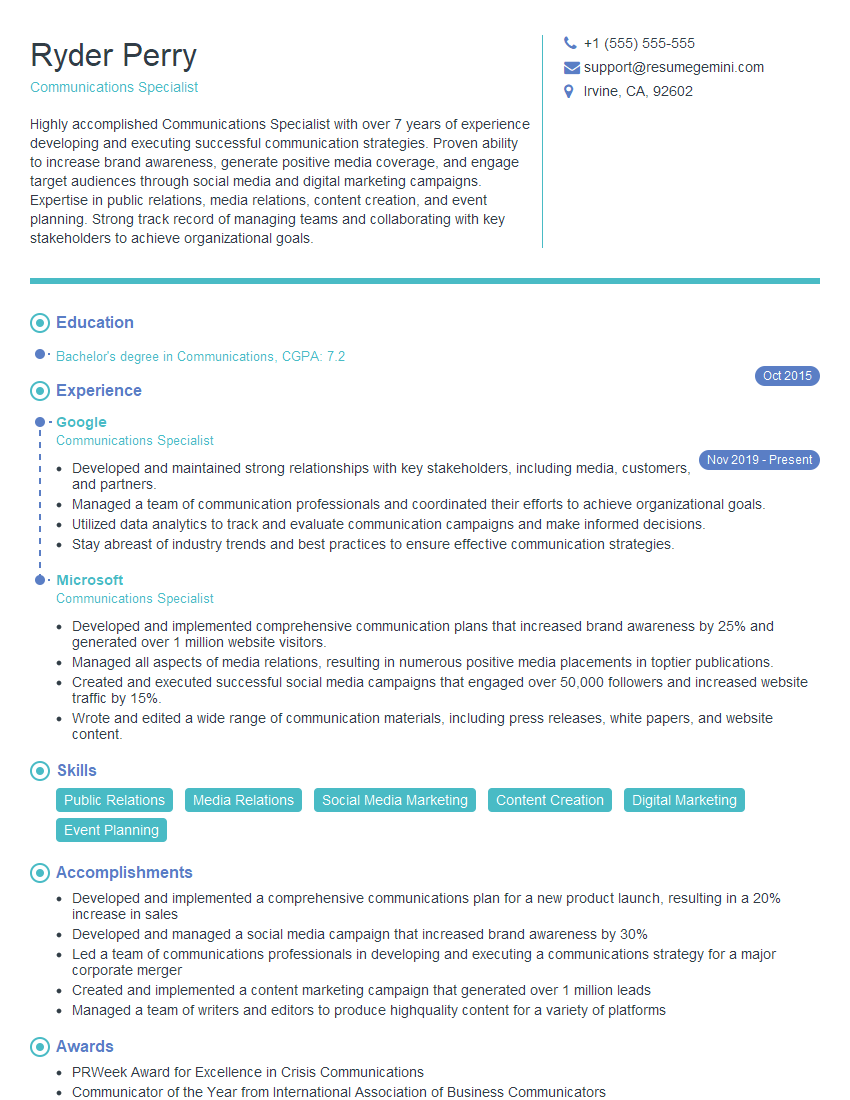
Communications Specialist Resume Sample

Social Media Manager Resume Sample
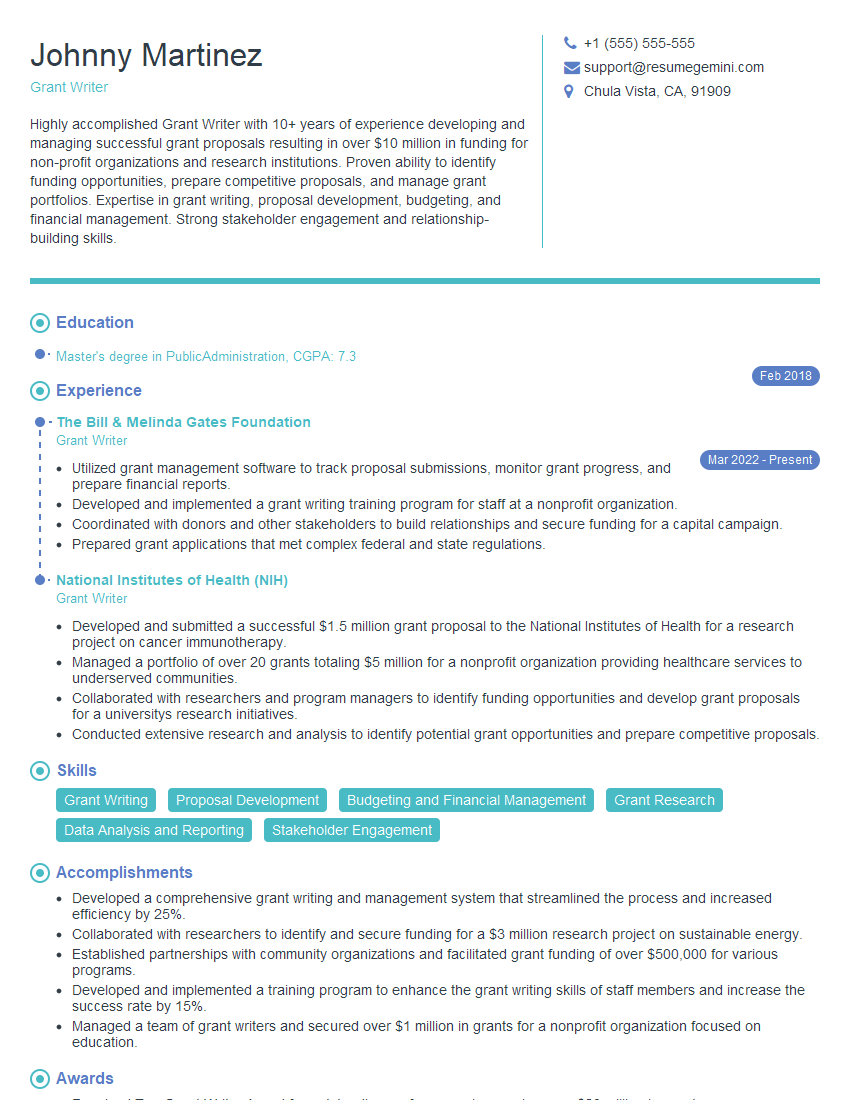
Grant Writer Resume Sample

Content Strategist Resume Sample
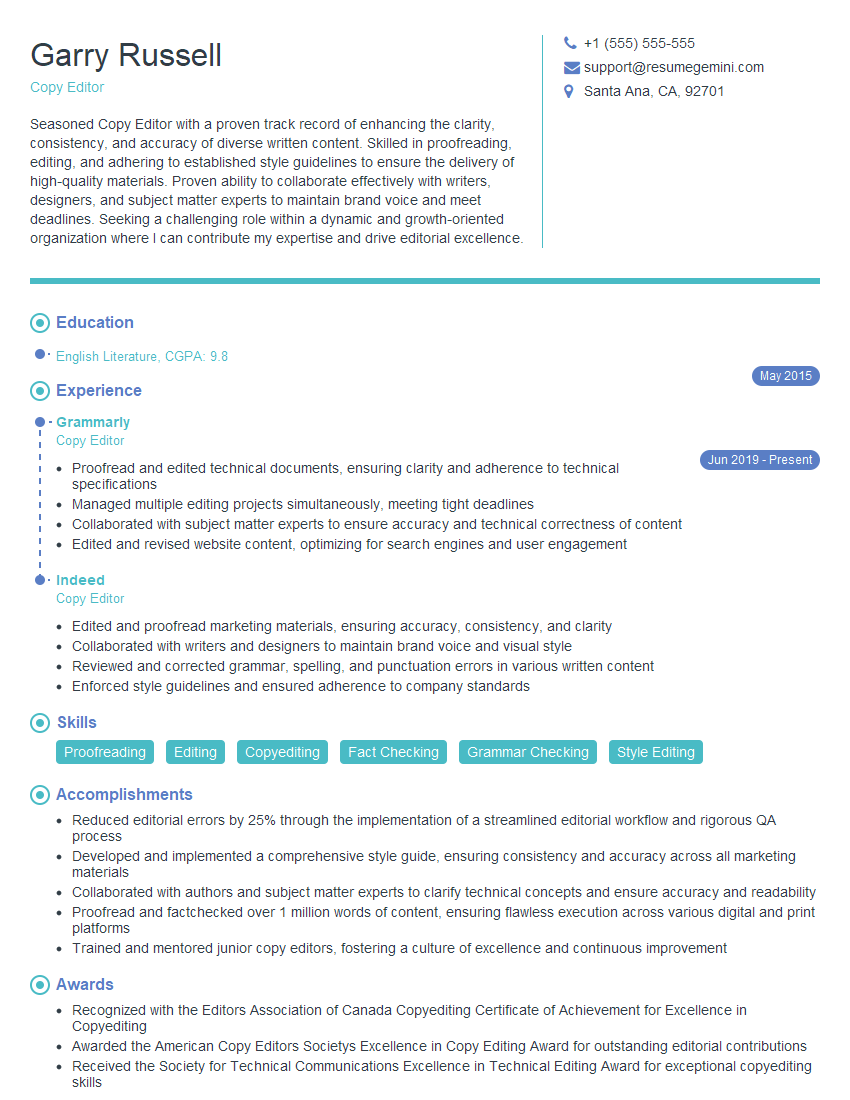
Copy Editor Resume Sample
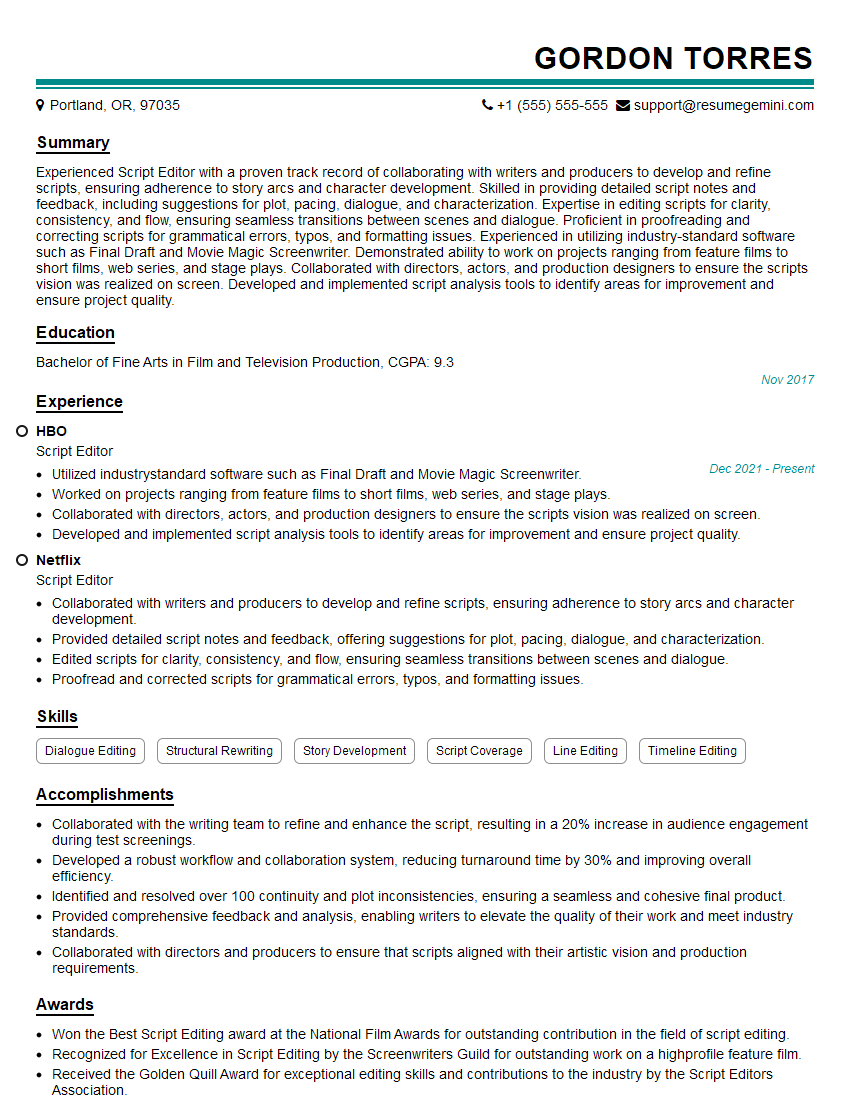
Script Editor Resume Sample
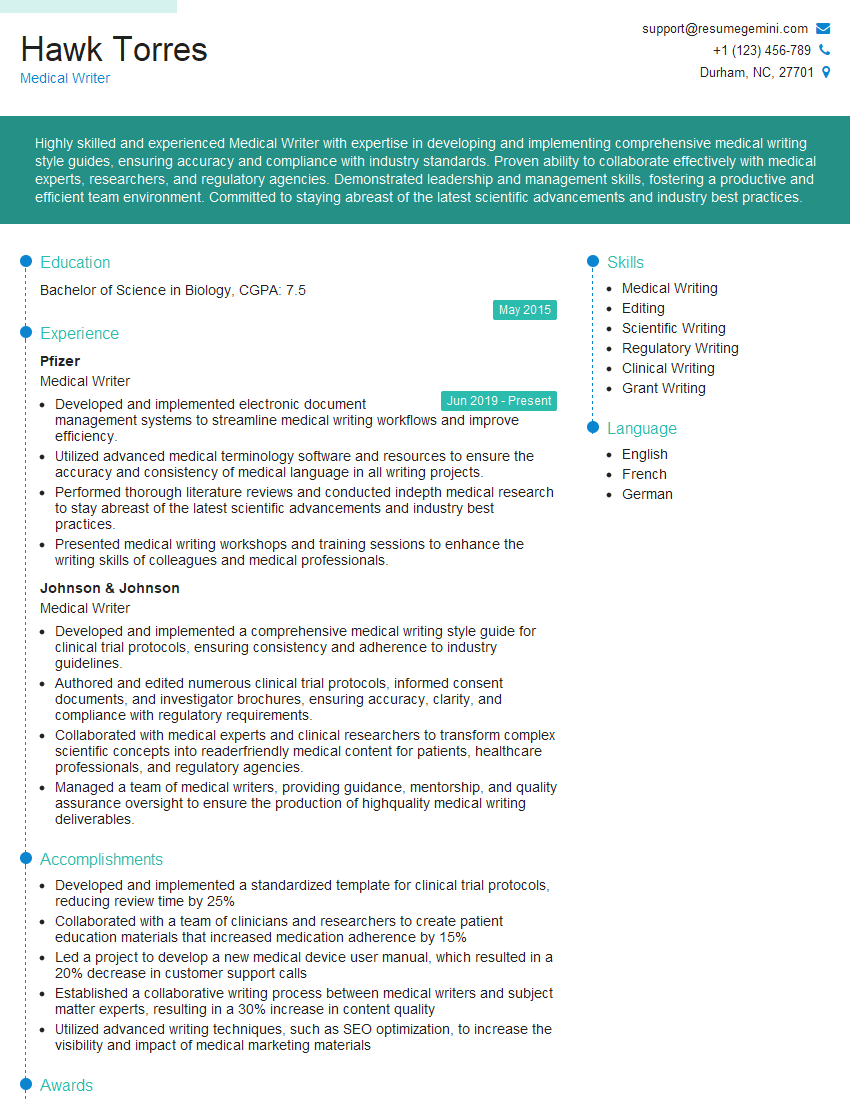
Medical Writer Resume Sample

Technical Writer Resume Sample
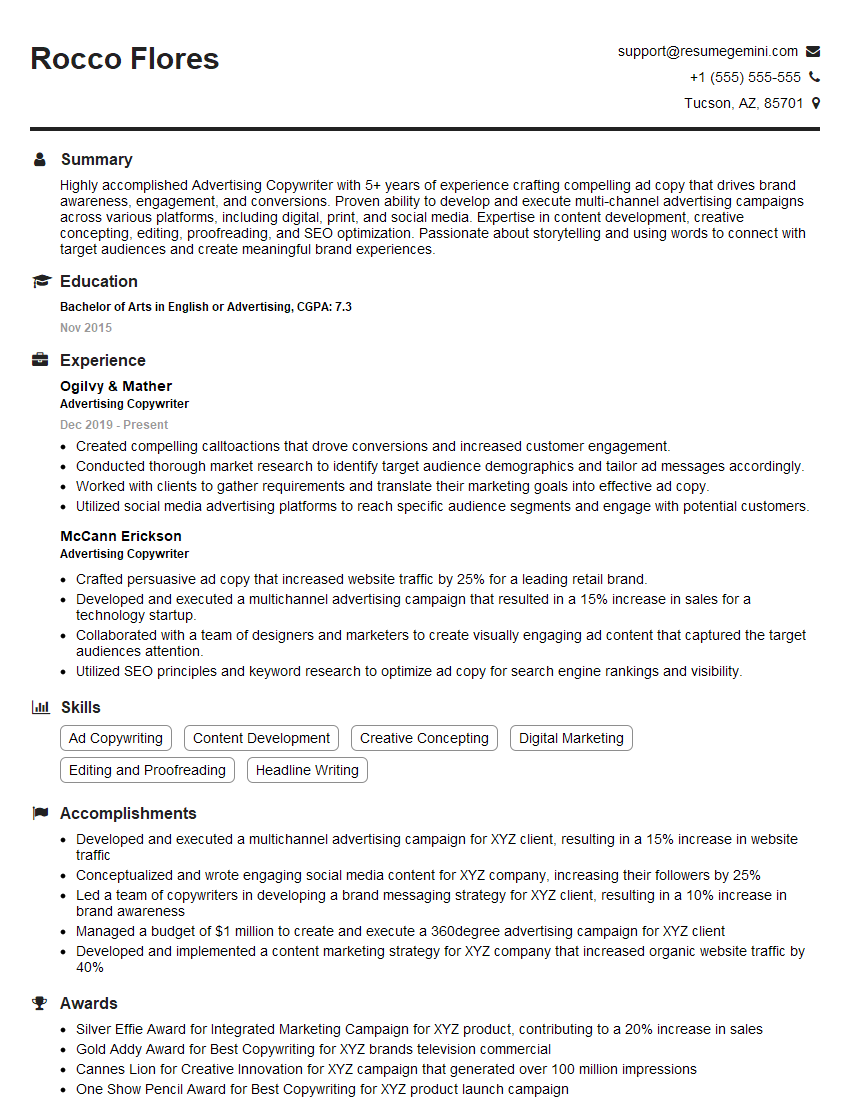
Advertising Copywriter Resume Sample

Copywriter Resume Sample
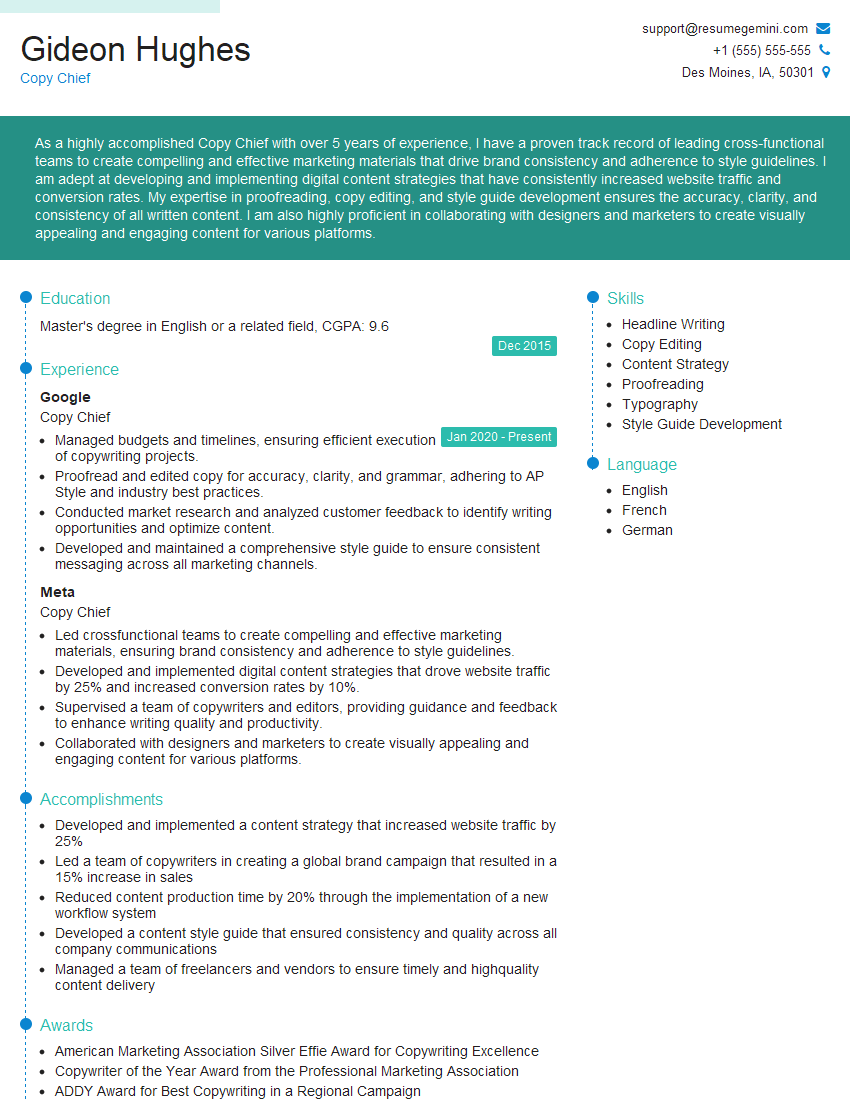
Copy Chief Resume Sample
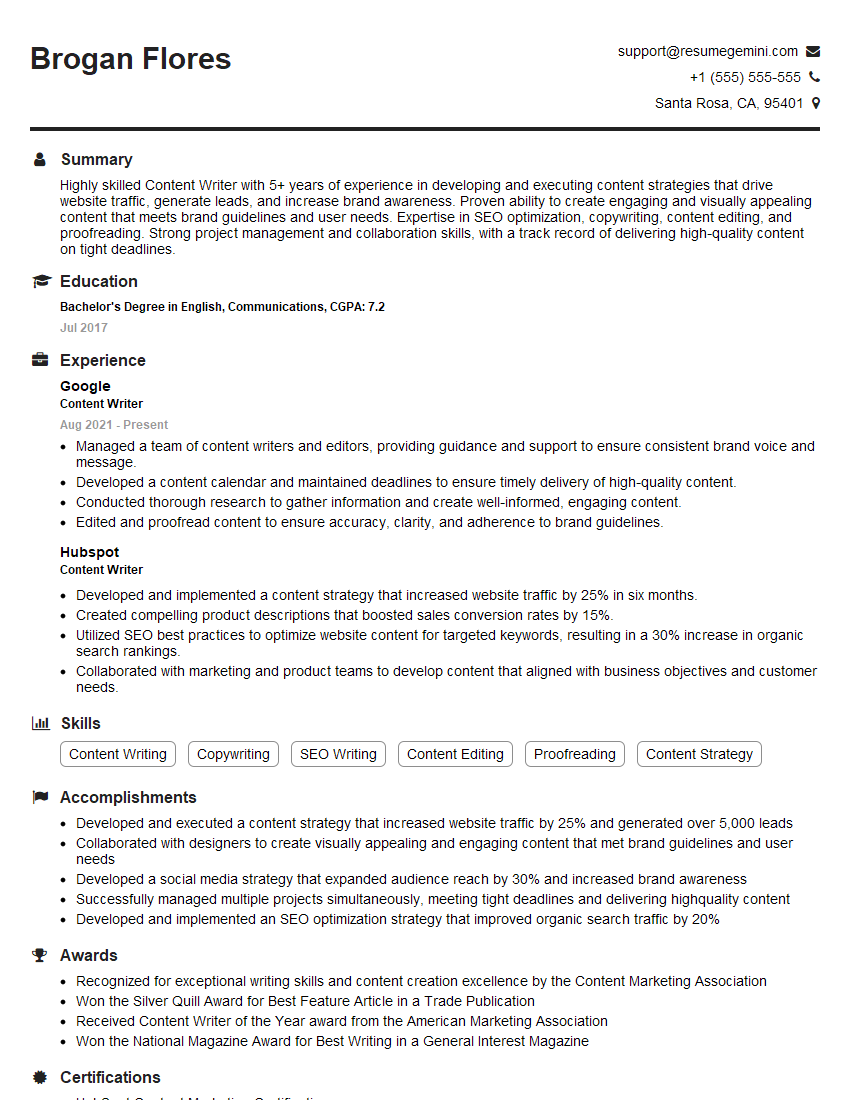
Content Writer Resume Sample
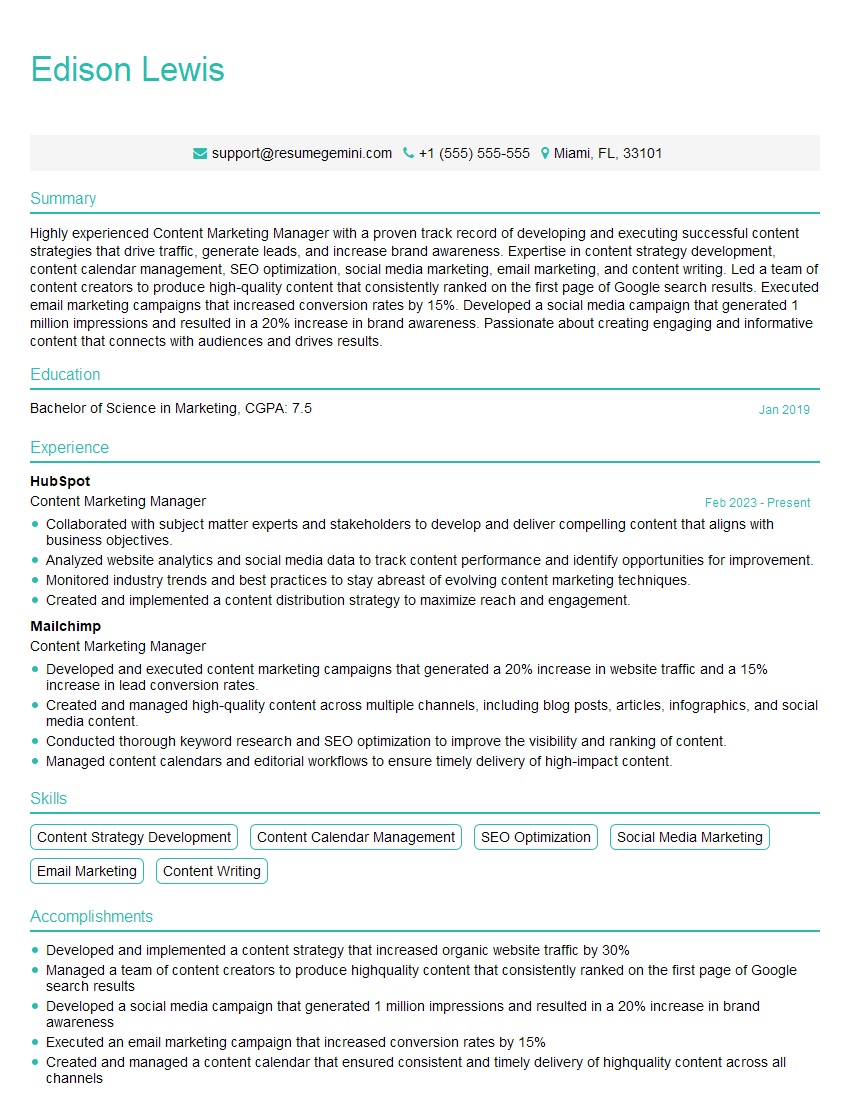
Content Marketing Manager Resume Sample
Explore more articles
Users Rating of Our Blogs
Share Your Experience
We value your feedback! Please rate our content and share your thoughts (optional).
What Readers Say About Our Blog
Hello,
we currently offer a complimentary backlink and URL indexing test for search engine optimization professionals.
You can get complimentary indexing credits to test how link discovery works in practice.
No credit card is required and there is no recurring fee.
You can find details here:
https://wikipedia-backlinks.com/indexing/
Regards
NICE RESPONSE TO Q & A
hi
The aim of this message is regarding an unclaimed deposit of a deceased nationale that bears the same name as you. You are not relate to him as there are millions of people answering the names across around the world. But i will use my position to influence the release of the deposit to you for our mutual benefit.
Respond for full details and how to claim the deposit. This is 100% risk free. Send hello to my email id: [email protected]
Luka Chachibaialuka
Hey interviewgemini.com, just wanted to follow up on my last email.
We just launched Call the Monster, an parenting app that lets you summon friendly ‘monsters’ kids actually listen to.
We’re also running a giveaway for everyone who downloads the app. Since it’s brand new, there aren’t many users yet, which means you’ve got a much better chance of winning some great prizes.
You can check it out here: https://bit.ly/callamonsterapp
Or follow us on Instagram: https://www.instagram.com/callamonsterapp
Thanks,
Ryan
CEO – Call the Monster App
Hey interviewgemini.com, I saw your website and love your approach.
I just want this to look like spam email, but want to share something important to you. We just launched Call the Monster, a parenting app that lets you summon friendly ‘monsters’ kids actually listen to.
Parents are loving it for calming chaos before bedtime. Thought you might want to try it: https://bit.ly/callamonsterapp or just follow our fun monster lore on Instagram: https://www.instagram.com/callamonsterapp
Thanks,
Ryan
CEO – Call A Monster APP
To the interviewgemini.com Owner.
Dear interviewgemini.com Webmaster!
Hi interviewgemini.com Webmaster!
Dear interviewgemini.com Webmaster!
excellent
Hello,
We found issues with your domain’s email setup that may be sending your messages to spam or blocking them completely. InboxShield Mini shows you how to fix it in minutes — no tech skills required.
Scan your domain now for details: https://inboxshield-mini.com/
— Adam @ InboxShield Mini
Reply STOP to unsubscribe
Hi, are you owner of interviewgemini.com? What if I told you I could help you find extra time in your schedule, reconnect with leads you didn’t even realize you missed, and bring in more “I want to work with you” conversations, without increasing your ad spend or hiring a full-time employee?
All with a flexible, budget-friendly service that could easily pay for itself. Sounds good?
Would it be nice to jump on a quick 10-minute call so I can show you exactly how we make this work?
Best,
Hapei
Marketing Director
Hey, I know you’re the owner of interviewgemini.com. I’ll be quick.
Fundraising for your business is tough and time-consuming. We make it easier by guaranteeing two private investor meetings each month, for six months. No demos, no pitch events – just direct introductions to active investors matched to your startup.
If youR17;re raising, this could help you build real momentum. Want me to send more info?
Hi, I represent an SEO company that specialises in getting you AI citations and higher rankings on Google. I’d like to offer you a 100% free SEO audit for your website. Would you be interested?
Hi, I represent an SEO company that specialises in getting you AI citations and higher rankings on Google. I’d like to offer you a 100% free SEO audit for your website. Would you be interested?
good