Cracking a skill-specific interview, like one for Semaphore Flag Signaling, requires understanding the nuances of the role. In this blog, we present the questions you’re most likely to encounter, along with insights into how to answer them effectively. Let’s ensure you’re ready to make a strong impression.
Questions Asked in Semaphore Flag Signaling Interview
Q 1. What are the standard semaphore flag codes and their meanings?
Semaphore flag signaling uses a standardized alphabet and numerals represented by specific flag positions. The exact codes vary slightly depending on the organization or historical context (e.g., naval vs. maritime), but the core principles remain consistent. Think of it like a visual Morse code, but using flags instead of dots and dashes. Flags are held in different positions to represent letters and numbers.
For instance, in a common system, holding a flag vertically represents the letter ‘A’, while holding both flags horizontally signifies ‘M’. Learning these codes requires dedicated study and practice. A complete table of standard semaphore flag codes would be lengthy, but comprehensive manuals exist that detail each signal.
- Numerals: These are often represented by a combination of flag positions, usually involving a numerical ‘flag’ (a flag of a different color, pattern, or shape) to distinguish from letters.
- Special Signals: Beyond letters and numbers, specific flag combinations represent commands such as ‘affirmative,’ ‘negative,’ ‘attention,’ and other crucial operational instructions.
This structured system ensures clear communication even in noisy or visually complex environments.
Q 2. Explain the proper flag hoisting and lowering techniques.
Proper flag hoisting and lowering procedures are essential for safety and effective communication. Imagine you’re signaling to a ship several miles away. A clumsy movement could easily be misinterpreted or lost altogether. This necessitates precise techniques.
Hoisting: Begin by holding the flags at your sides, then smoothly raise them to the signaling position, ensuring a clear, stable, and unambiguous display. Avoid jerky or abrupt movements. Each signal should be held long enough for the receiver to understand, usually for a few seconds.
Lowering: Once you’ve finished a signal, slowly lower the flags back to your sides. Never drop them suddenly; it’s vital for preventing damage to the flags and it also signals a lack of professionalism.
Important Considerations:
- Speed: Consistent speed during hoisting and lowering enhances clarity. Too fast, and the signal may be missed; too slow, and it leads to delays.
- Posture: Maintain a balanced stance and good posture to support consistent flag positioning and visual accuracy.
- Clarity: Ensure that the flags are visible against the background to avoid obscuring the signal. Consider background factors.
Practice is key to perfecting these techniques. Consider drills to develop muscle memory and maintain accuracy.
Q 3. Describe the different types of semaphore flags used and their applications.
Semaphore flags aren’t all created equal. Various types exist, each serving specific purposes and applications.
- Standard Flags: Typically square, brightly colored (often red and yellow or red and blue), and made of lightweight, durable material. These are the most common flags and suitable for most situations.
- Numeral Flags: Sometimes used in addition to standard flags to convey numbers quickly and accurately. They have a unique shape or color different from the alphabet flags.
- Large Flags: Larger versions of standard flags are useful for signaling at longer distances, where visibility is critical. However, larger flags become harder to handle.
- Specialized Flags: Flags may be specialized for specific uses, such as naval or maritime applications, which often have specific codified signals that need distinct flag identification.
The choice of flag type depends largely on the distance to the receiver, environmental conditions, and the specific communication needs.
Q 4. How do you maintain and care for semaphore flags?
Proper maintenance ensures the flags’ longevity and performance. Think of them like precision instruments that require care.
Cleaning: Regularly inspect and clean the flags to remove dirt, grime, and any potential damage to the fabric. Avoid harsh chemicals.
Storage: Store them properly when not in use to prevent damage. Ideally they should be stored folded neatly to reduce creasing. This prevents damage from moisture or harsh sunlight.
Repair: Promptly repair any tears or rips to maintain their structural integrity. Small tears can become larger holes over time.
Inspection: Before any signaling, visually inspect for wear and tear, ensure the color is vibrant, and verify there’s no damage which might affect the message.
By following these simple procedures, the flags will serve reliably for a longer time.
Q 5. How do you ensure clear and accurate semaphore signaling in adverse weather conditions?
Adverse weather conditions significantly challenge semaphore signaling. Imagine trying to communicate during a heavy downpour! Clear and accurate signaling requires adaptation.
Strategies for Adverse Weather:
- Visibility: Choose highly visible flags – perhaps larger than usual or with more contrasting colors against the background. Consider using reflective material, if possible.
- Positioning: Seek areas where the wind will not excessively affect flag movement and obscure the signal.
- Timing: If possible, postpone signaling until the weather improves. Consider time of day to take advantage of better visibility.
- Backup Methods: Have backup communication methods ready in case semaphore signaling becomes impossible.
Using flags designed for visibility or having additional signaling support allows for continued communication during adverse conditions, although it increases the complexity of signaling.
Q 6. Describe the challenges of semaphore signaling at long distances.
Signaling over long distances presents significant challenges. The further away the receiver, the harder it is to discern the flag positions. The human eye is limited.
Challenges:
- Size: Smaller flags are less visible over distance, requiring larger flags which are more difficult to maneuver.
- Atmospheric Conditions: Haze, fog, or heavy rain greatly reduce visibility, making accurate signaling nearly impossible.
- Background Interference: The background must offer a contrast with the colors of the flag, with a higher level of contrast needed at greater distances.
- Receiver’s Ability: The receiver needs excellent eyesight and the ability to clearly understand the semaphore alphabet.
Overcoming these challenges involves using larger, more visible flags, selecting suitable locations and environmental conditions, ensuring the receiver has optimal viewing conditions, and possibly incorporating technological improvements for magnification or additional signal communication.
Q 7. What are the limitations of semaphore signaling?
Despite its historical importance, semaphore signaling has limitations compared to modern communication technologies.
Limitations:
- Limited Range: Effective range is significantly shorter than radio or other electronic means of communication. Visibility is paramount.
- Weather Dependency: Adverse weather conditions (rain, fog, snow) severely restrict its effectiveness. Clear visibility is essential.
- Speed: The speed of communication is significantly slower than other methods. It’s not suitable for fast-paced communication.
- Complexity: Learning and mastering the semaphore code requires significant time and practice. It’s not intuitive.
- Limited Information: It is primarily useful for transmitting short messages, letters, numbers, and pre-determined signals, not lengthy communications.
These limitations are why it has largely been superseded in most applications, but its historical significance and niche use-cases persist.
Q 8. How does semaphore signaling compare to other visual signaling methods?
Semaphore signaling, using flags to convey messages, offers several advantages over other visual methods. Unlike simple hand signals which can be ambiguous or limited in vocabulary, semaphore has a standardized, codified system. This allows for a much wider range of communication, including complex sentences. Compared to methods like smoke signals or light signals, semaphore is more precise and less susceptible to environmental interference (within reasonable limits, of course). For instance, smoke signals can be obscured by wind or poor visibility, while light signals might be difficult to distinguish at a distance or in bright sunlight. Semaphore offers a relatively reliable means of long-distance communication where other options are impractical or unreliable.
Consider this: Imagine you need to transmit a detailed message across a wide expanse of water. A simple flag signal, even if understood, might not carry a detailed report on a ship’s condition. A semaphore message, however, could clearly convey that information.
Q 9. How do you handle signal errors or miscommunications during semaphore signaling?
Signal errors in semaphore are typically due to poor visibility (fog, rain, distance), incorrect flag handling, or misunderstandings of the code. To handle these:
- Repeat the message: The sender should always repeat the message, perhaps breaking it down into smaller segments to improve comprehension. This allows for immediate correction of any errors.
- Use acknowledgment signals: The receiver should use pre-arranged signals to confirm receipt of each segment. If a segment is unclear, the receiver signals for repetition.
- Employ a simple code: It might be advantageous to use a simplified code for critical messages, reducing the chances of errors in more complex communications.
- Multiple observers: Having multiple observers on the receiving end increases the likelihood of correctly interpreting the signal, even if one observer misses a detail.
- Check for environmental conditions: Before initiating communication, assess the visibility. If conditions are unfavorable, choose an alternative communication method or wait until conditions improve.
Remember, practice makes perfect. Regular training and drills significantly reduce the frequency of errors. Imagine a team of sailors constantly practicing their semaphore skills – this level of familiarity makes all the difference in a real-world scenario.
Q 10. Explain the importance of clear communication in semaphore signaling.
Clear communication is paramount in semaphore signaling because it’s a system entirely dependent on precise visual cues. Even small variations in flag position or timing can lead to misinterpretations. Think of it like a precise dance – every movement is critical to relaying the intended message. Ambiguity is the enemy.
The importance of clarity manifests in several ways:
- Accuracy: Misinterpreting a signal in a critical situation (like distress) could have dire consequences.
- Efficiency: Unclear signals require repetitions and clarifications, wasting valuable time.
- Trust: Clear, effective communication builds trust and confidence between the sender and receiver.
A well-trained semaphore operator adheres strictly to the code, ensuring signals are distinct and unambiguous. In the same way a surgeon performs meticulous work to ensure successful results, semaphore operation demands similar precision and discipline.
Q 11. What safety measures should be taken during semaphore signaling operations?
Safety during semaphore signaling focuses on both the signaler and the environment. Key measures include:
- Proper flag handling: Avoid swinging flags wildly, as this can cause injury or damage the flags. Maintain controlled movements.
- Awareness of surroundings: Be mindful of any obstacles that could cause trips or falls. Signal in an open area, if possible.
- Visibility: Ensure the signaling area is free from obstructions that could block the signal’s path.
- Weather conditions: Avoid signaling in severe weather (high winds, heavy rain, storms), as visibility and safety are greatly compromised. These can render the signals useless or dangerous.
- Appropriate clothing: Dress appropriately for the weather and environment to minimize risks from sun, cold, or other weather conditions.
- Partner signaling: For long-distance or critical signals, consider having another person confirm the accuracy of the message being transmitted.
Think of it like operating any piece of equipment – safety protocols are crucial before you even begin.
Q 12. How does the environment impact semaphore signaling effectiveness?
The environment significantly impacts semaphore signaling effectiveness. Factors include:
- Visibility: Fog, heavy rain, snow, or intense sunlight can severely reduce visibility and make accurate signaling impossible.
- Wind: Strong winds can make it difficult to control the flags and obscure the signals.
- Background: A cluttered or distracting background can hinder clear observation of the signals.
- Distance: The maximum effective range of semaphore depends on the size of the flags, the observer’s eyesight, and environmental conditions.
For example, signaling across a vast, open ocean on a clear day will yield much different results than signaling through a dense forest in a rainstorm. Adapt your technique according to the environment or choose alternative communication methods when conditions are not favorable. A well-trained semaphore user knows when to wait for better conditions or switch to another method.
Q 13. How do you adapt your signaling technique for different viewing distances?
Adapting signaling techniques for different viewing distances involves adjusting the size of the flags and the signaling style. For longer distances:
- Larger flags: Use larger, more easily visible flags. Brightly colored flags work best in most lighting conditions.
- Slower signals: Use slower, more deliberate movements to allow the receiver ample time to observe each signal. Speed is often sacrificed for clarity.
- Higher position: Signal from a higher vantage point if possible to maximize visibility above obstacles and to increase the signal’s reach.
- Signal amplification: If feasible, use signal amplification methods such as binoculars for the receiver and using larger, more visible flags.
In contrast, for closer distances, smaller flags and faster signaling are perfectly acceptable. The key is to optimize the signal for the specific conditions to guarantee effective communication.
Q 14. Describe the procedure for sending a distress signal using semaphore flags.
Distress signals in semaphore vary depending on the system used, but generally involve a standardized sequence easily recognizable as a call for help. Typically, this would involve repeated signals representing “SOS” or “MAYDAY”. There may also be standard signals to indicate the nature of the distress (e.g., sinking vessel, medical emergency). These distress signals would follow a strict protocol for clarity and to avoid ambiguity, similar to the international maritime distress signals.
The exact procedure and signal sequences are typically determined by the organization or entity employing the use of semaphore signaling. Before engaging in any activities using semaphore, understanding the established distress code is critical for safety and efficiency. Having a common understanding of the codes is essential in this type of communication. It’s crucial that the protocol is consistently practiced and understood to ensure effective and timely communication in the event of a true emergency.
Q 15. What are the most common errors made in semaphore signaling, and how can they be avoided?
Common errors in semaphore signaling often stem from poor technique or misunderstanding of the code. These include:
- Incorrect flag positions: Even a slight deviation from the precise angles can lead to misinterpretation. For example, confusing a ‘C’ with a ‘V’ is a common mistake.
- Ambiguous or hurried signals: Sending signals too quickly or without clear, sharp movements reduces accuracy and clarity.
- Lack of synchronization: The timing between flag movements needs to be consistent to avoid confusing the receiver.
- Ignoring environmental conditions: Strong winds, poor visibility, or bright sunlight can greatly impact signal clarity. Using contrasting colours against the backdrop helps greatly.
- Improper use of the code: Failure to adhere to the standard semaphore alphabet leads to significant errors in message transmission. This is especially true for less common letters.
Avoiding these errors involves:
- Thorough training: Practice is crucial to develop muscle memory and accurate flag manipulation.
- Consistent practice: Regular drills under various conditions hone skills and builds confidence.
- Careful observation: Always check that your signals are being clearly received and understood, seeking confirmation if unsure.
- Environmental awareness: Use appropriate techniques for varying weather conditions (e.g., shortening distances on windy days).
- Patience and concentration: Sending semaphore requires focus and methodical approach to ensure accurate transmission of messages.
Career Expert Tips:
- Ace those interviews! Prepare effectively by reviewing the Top 50 Most Common Interview Questions on ResumeGemini.
- Navigate your job search with confidence! Explore a wide range of Career Tips on ResumeGemini. Learn about common challenges and recommendations to overcome them.
- Craft the perfect resume! Master the Art of Resume Writing with ResumeGemini’s guide. Showcase your unique qualifications and achievements effectively.
- Don’t miss out on holiday savings! Build your dream resume with ResumeGemini’s ATS optimized templates.
Q 16. How do you interpret semaphore signals quickly and accurately?
Interpreting semaphore signals quickly and accurately requires a combination of practice and keen observation. It’s not just about recognizing individual letters, but about understanding the flow of the message.
- Familiarize yourself with the alphabet: Thoroughly learn the semaphore alphabet, practicing until you can identify each letter and number instantly.
- Focus on the whole signal: Avoid jumping to conclusions based on individual flag positions. Look at the complete signal to understand its context.
- Anticipate the message: Use context clues from prior communication or the situation to predict the likely message.
- Check for confirmation: If you are uncertain about any part of a message, politely ask for the sender to repeat it. Confirmation is vital.
- Practice under varied conditions: Improve your interpretive skills by practicing in different weather conditions, lighting, and distances to build resilience.
Think of it like reading a language – you don’t focus on each individual letter but the complete words and sentence to derive meaning. Similarly, recognizing the patterns and flows of semaphore signals is key to rapid interpretation.
Q 17. Explain the difference between day and night semaphore signaling techniques.
The main difference between day and night semaphore signaling lies in the equipment and techniques used to ensure visibility.
- Day signaling: Uses brightly coloured flags (typically red and yellow or red and white) against a clear background. The contrast is essential for readability at a distance. The flags themselves must be of a size appropriate to the distance for clear identification.
- Night signaling: Requires illuminated flags or lights. This often involves using lamps of specific colours and arrangements to mirror the shapes made by the day signals. For example, the signal ‘A’ with a red light at the top and white at the bottom could represent day flags in those colors.
The core semaphore alphabet remains the same, but the means of displaying it adapts to the lighting conditions to maintain consistent, legible communication.
Q 18. Describe how semaphore signaling can be used in various maritime contexts (e.g., docking, communication between vessels).
Semaphore signaling has several applications in maritime contexts:
- Docking procedures: Precise instructions regarding speed, direction, and position of the vessel can be relayed to the pilot or crew during docking maneuvers.
- Communication between vessels: Semaphore provides a visual means of communicating between ships at close range, particularly in situations where radio communication may be unavailable or unreliable.
- Emergency situations: In emergencies where radio failure occurs, semaphore can provide a vital communication channel.
- Pilot transfer: Signals can be used to coordinate the safe transfer of a pilot to or from a ship.
- Passing signals: Signals are employed to convey intentions during close-quarter maneuvers within confined waterways.
The clarity and unambiguous nature of semaphore makes it a valuable tool in situations where safety and precision are paramount.
Q 19. How can you improve the visibility of your semaphore signals?
Improving the visibility of semaphore signals involves several strategies:
- Using highly contrasting colours: Brightly coloured flags that stand out against the background are crucial. Red and yellow or red and white are common choices.
- Increasing flag size: Larger flags are more visible at greater distances. The scale should be suitable for the communication range.
- Optimizing background: Using a plain background behind the signaler ensures the flags are easily seen.
- Strategic positioning: Choosing a location with good visibility to minimize interference. Avoiding harsh backlighting or shadows is key.
- Illumination for night signalling: Using bright, appropriate lights ensures good visibility during nighttime.
Remember, the goal is to ensure the signals are easily seen and understood by the receiver, regardless of distance or environmental factors.
Q 20. What are the potential consequences of improper semaphore signaling?
Improper semaphore signaling can have severe consequences, particularly in maritime settings:
- Collisions: Misinterpreted instructions can result in collisions between vessels, causing damage or injuries.
- Grounding: Incorrect docking instructions could lead to a vessel running aground.
- Loss of life: In emergency situations, inaccurate communication can have fatal consequences.
- Delays and inefficiencies: Confusion caused by unclear signals can lead to delays in operations.
- Legal repercussions: Improper signaling can result in legal action and financial penalties.
The potential risks emphasize the critical need for rigorous training and adherence to standard procedures. Accuracy and precision are not mere suggestions, they are essential for safety.
Q 21. Describe your experience with semaphore signaling equipment.
My experience with semaphore signaling equipment includes extensive use of both standard flags and illuminated signaling devices. I’ve worked with different flag sizes and materials, selecting the most appropriate ones for various environmental conditions and communication distances. My experience extends to night signaling, requiring the use of specially designed signal lights to mimic the flag movements. I’m familiar with maintaining equipment, ensuring its functionality and suitability for safe and reliable communication.
I’ve participated in training sessions, both as a sender and receiver, refining my ability to interpret signals accurately under various challenging scenarios including windy conditions, high glare and reduced visibility. This hands-on experience has provided me with a deep understanding of practical applications and limitations of semaphore signaling equipment and its deployment.
Q 22. Have you ever had to troubleshoot semaphore signaling equipment failures?
Troubleshooting semaphore signaling equipment failures requires a systematic approach. It begins with identifying the nature of the failure. Is it a mechanical issue with the flag arms themselves (e.g., a broken hinge, stiff joints)? Is the problem with the signaling system’s structural integrity (e.g., a damaged mast or support)? Or is it a human error in signal execution?
My approach involves a thorough visual inspection, checking for wear and tear, loose connections, or any obvious damage. I then use a series of tests to isolate the problem. For instance, if the flags aren’t moving smoothly, I’d check the lubrication, examine the pulleys, and potentially adjust tensioning mechanisms. If the problem is with signal visibility, I’d check for obstructions, the condition of the flags themselves (fading, tears), and the lighting conditions. Finally, a detailed log of the issue, troubleshooting steps, and repairs made is always meticulously maintained.
For example, I once encountered a situation where a strong wind caused a flag arm to bend. After safely securing the equipment, I straightened the arm, reinforced it with additional bracing, and implemented a more robust anchoring system to prevent similar incidents in the future. This involved a detailed assessment of the wind load and the selection of appropriate reinforcement materials.
Q 23. What is your experience with the maintenance and repair of semaphore flags?
Maintenance and repair of semaphore flags are crucial for ensuring safe and effective communication. Regular maintenance is key. This includes inspecting the flags for wear and tear, such as fading, tears, or fraying. The fabric should be cleaned regularly and, if necessary, replaced. The flagpoles and supporting structures require regular inspection for rust, rot, or structural damage. Any loose bolts or connections need immediate attention.
Repair procedures depend on the nature of the damage. Minor repairs, such as mending small tears in the fabric, might involve simple stitching. More significant damage might require replacing sections of the flag or even the entire flag. Structural repairs to the flagpoles might involve welding, reinforcement, or even complete replacement. Regular lubrication of moving parts is essential to prevent jamming and ensure smooth operation.
For example, I’ve developed a checklist that includes daily, weekly, and monthly inspection procedures. This detailed schedule allows for proactive maintenance and prevents potential breakdowns. I also ensure the staff is well-trained in proper cleaning and maintenance techniques, and all repairs are documented for tracking and future reference.
Q 24. Describe a time when you had to adapt your semaphore signaling technique to a challenging situation.
During a maritime exercise, a sudden fog significantly reduced visibility. Our standard semaphore signaling was ineffective. To adapt, I introduced the use of high-intensity signal lamps in conjunction with the semaphore flags. The lamps flashed in synchronization with the semaphore signals, providing a visual cue even in low visibility. This adaptation ensured the clarity of our signals even under adverse conditions.
Another time, we faced a situation with limited space to deploy a standard semaphore system. To solve this, I created a miniaturized system with smaller flags and a shorter mast, effectively enabling communication within the constrained environment. This solution highlighted the importance of adaptability and resourcefulness, utilizing existing principles while modifying the approach to fit a specific context.
Q 25. How do you ensure consistency and standardization in your semaphore signals?
Consistency and standardization in semaphore signaling are critical for accurate communication. To ensure this, we utilize established international standards where possible and internal training protocols. This includes strict adherence to the official semaphore alphabet and signal codes, ensuring all personnel receive uniform training and practice. Regular drills and assessments verify competence in both the sending and receiving of signals.
We also maintain a detailed manual with illustrations and video examples for quick reference. The manual explains the proper arm positions for each letter, number, and standard signal. Regular practice sessions allow operators to refine their skills and maintain proficiency. All personnel must successfully complete a certification process to ensure competency before engaging in operational semaphore signalling.
Q 26. What are some common misinterpretations of semaphore signals and how to prevent them?
Common misinterpretations of semaphore signals often stem from improper flag positioning, inconsistent arm movements, or environmental interference (e.g., strong wind obscuring the signals). These can lead to crucial miscommunications. Prevention involves rigorous training focusing on precise arm movements and the understanding of variations in lighting conditions.
To prevent misinterpretations, we use a system of checks and confirmations. After transmitting a message, we always request acknowledgement from the receiver. If there is any ambiguity, we repeat the message or employ alternative communication methods to clarify. This method ensures that the message is understood correctly, and this feedback loop minimizes miscommunication.
For instance, a slight deviation in the angle of an arm can alter the meaning of the signal. Training must emphasize the precision and consistency needed to minimize the chance of such errors. We also use clear, well-maintained flags in good condition to eliminate any ambiguity due to the visibility of flags.
Q 27. How do you maintain situational awareness during semaphore signaling operations?
Maintaining situational awareness during semaphore signaling operations is paramount. It involves continuous observation of both the immediate environment and the surrounding context. This includes monitoring weather conditions, potential obstacles, and the overall operational environment. It’s also crucial to be aware of the receiver’s position, line of sight, and any potential distractions that might interfere with the signal transmission or reception.
To facilitate this, we use pre-defined communication protocols, including designated signal areas and communication channels, ensuring clear lines of sight. Operators are trained to regularly check their surroundings and adjust their positioning as needed to maintain optimal visibility. This includes checking for obstructions and accounting for changes in lighting conditions. Regular communication between sender and receiver also keeps both parties engaged and aware of each other’s status.
Q 28. Describe your knowledge of international semaphore signaling standards.
My knowledge of international semaphore signaling standards encompasses various systems and their applications across different sectors. I’m familiar with the International Code of Signals (ICS), which establishes a standardized system for maritime communications, including semaphore flags. This code defines specific flag combinations and signals for various purposes. I also understand the variations and adaptations of semaphore in other contexts, such as military signaling or specialized industrial settings.
Understanding these standards is essential for international cooperation and interoperability. For instance, knowing the ICS allows for seamless communication with vessels or individuals from different countries. Furthermore, familiarity with variations in semaphore signaling practices helps in adapting to diverse operational scenarios and ensuring effective communication regardless of location or context.
Key Topics to Learn for Semaphore Flag Signaling Interview
- Understanding Flag Movements: Mastering the precise hand movements and flag positions for each letter, number, and punctuation mark. This includes understanding the difference between upper and lower case letters.
- Flag Handling Techniques: Developing proficiency in smoothly and efficiently manipulating the flags, maintaining proper posture and ensuring clear, legible signals. Practice different wind conditions and visibility challenges.
- Decoding and Encoding Messages: Practice both receiving and sending messages accurately and efficiently. Focus on speed and accuracy while maintaining clarity.
- Semaphore Alphabet and Numerical Systems: Thorough knowledge of the standard semaphore alphabet and numerical systems, including any variations or regional differences.
- Practical Applications and Scenarios: Consider real-world applications such as maritime signaling, military communication, or emergency situations. Think through how you would adapt your technique based on the scenario.
- Troubleshooting Signal Issues: Identify potential challenges like poor visibility, wind interference, or distance limitations, and develop strategies to overcome them. This demonstrates problem-solving abilities.
- Safety Procedures and Regulations: Understanding the safety regulations and best practices associated with semaphore signaling, particularly in professional settings.
Next Steps
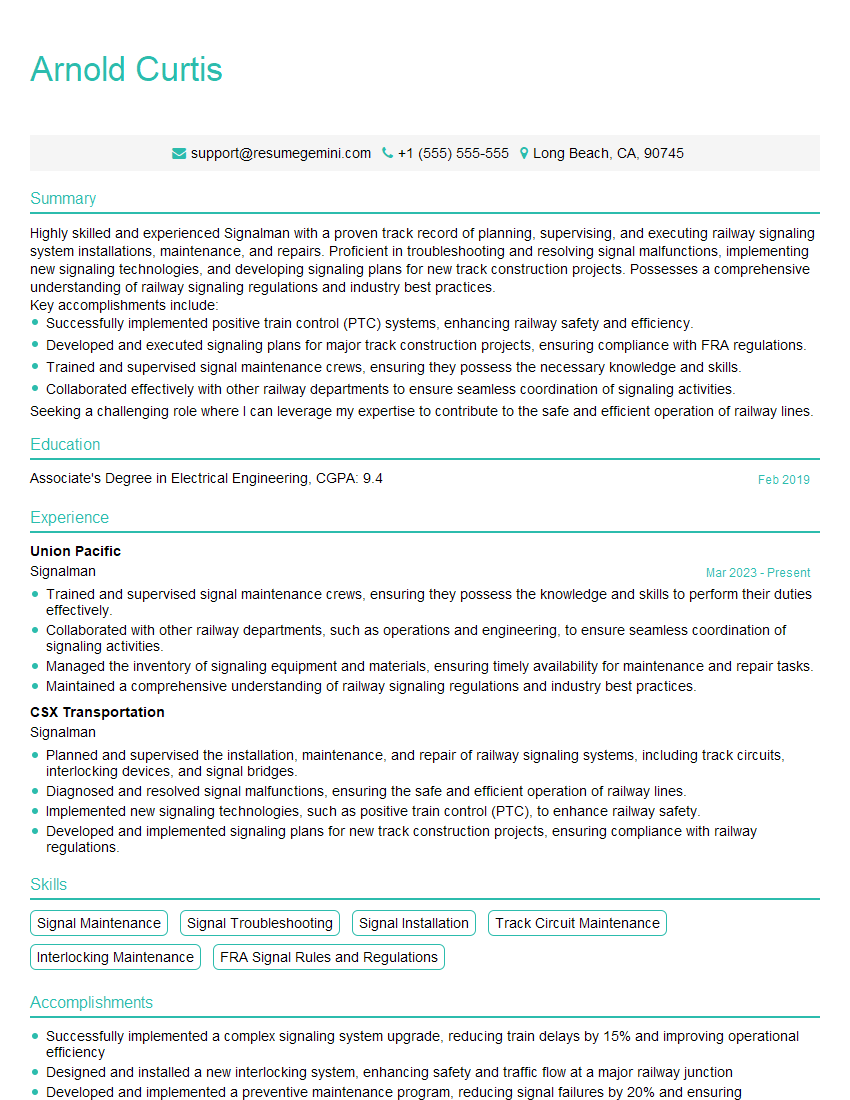
Mastering Semaphore Flag Signaling opens doors to specialized and highly skilled roles within various sectors. A strong grasp of this niche skill significantly enhances your employability and career prospects. To maximize your chances of securing your ideal position, crafting a compelling and ATS-friendly resume is crucial. ResumeGemini offers a trusted platform for building professional resumes, and we provide examples of resumes tailored to Semaphore Flag Signaling to help you showcase your expertise effectively. Take advantage of this resource and present yourself as the ideal candidate!
Explore more articles
Users Rating of Our Blogs
Share Your Experience
We value your feedback! Please rate our content and share your thoughts (optional).
What Readers Say About Our Blog
Hello,
we currently offer a complimentary backlink and URL indexing test for search engine optimization professionals.
You can get complimentary indexing credits to test how link discovery works in practice.
No credit card is required and there is no recurring fee.
You can find details here:
https://wikipedia-backlinks.com/indexing/
Regards
NICE RESPONSE TO Q & A
hi
The aim of this message is regarding an unclaimed deposit of a deceased nationale that bears the same name as you. You are not relate to him as there are millions of people answering the names across around the world. But i will use my position to influence the release of the deposit to you for our mutual benefit.
Respond for full details and how to claim the deposit. This is 100% risk free. Send hello to my email id: [email protected]
Luka Chachibaialuka
Hey interviewgemini.com, just wanted to follow up on my last email.
We just launched Call the Monster, an parenting app that lets you summon friendly ‘monsters’ kids actually listen to.
We’re also running a giveaway for everyone who downloads the app. Since it’s brand new, there aren’t many users yet, which means you’ve got a much better chance of winning some great prizes.
You can check it out here: https://bit.ly/callamonsterapp
Or follow us on Instagram: https://www.instagram.com/callamonsterapp
Thanks,
Ryan
CEO – Call the Monster App
Hey interviewgemini.com, I saw your website and love your approach.
I just want this to look like spam email, but want to share something important to you. We just launched Call the Monster, a parenting app that lets you summon friendly ‘monsters’ kids actually listen to.
Parents are loving it for calming chaos before bedtime. Thought you might want to try it: https://bit.ly/callamonsterapp or just follow our fun monster lore on Instagram: https://www.instagram.com/callamonsterapp
Thanks,
Ryan
CEO – Call A Monster APP
To the interviewgemini.com Owner.
Dear interviewgemini.com Webmaster!
Hi interviewgemini.com Webmaster!
Dear interviewgemini.com Webmaster!
excellent
Hello,
We found issues with your domain’s email setup that may be sending your messages to spam or blocking them completely. InboxShield Mini shows you how to fix it in minutes — no tech skills required.
Scan your domain now for details: https://inboxshield-mini.com/
— Adam @ InboxShield Mini
Reply STOP to unsubscribe
Hi, are you owner of interviewgemini.com? What if I told you I could help you find extra time in your schedule, reconnect with leads you didn’t even realize you missed, and bring in more “I want to work with you” conversations, without increasing your ad spend or hiring a full-time employee?
All with a flexible, budget-friendly service that could easily pay for itself. Sounds good?
Would it be nice to jump on a quick 10-minute call so I can show you exactly how we make this work?
Best,
Hapei
Marketing Director
Hey, I know you’re the owner of interviewgemini.com. I’ll be quick.
Fundraising for your business is tough and time-consuming. We make it easier by guaranteeing two private investor meetings each month, for six months. No demos, no pitch events – just direct introductions to active investors matched to your startup.
If youR17;re raising, this could help you build real momentum. Want me to send more info?
Hi, I represent an SEO company that specialises in getting you AI citations and higher rankings on Google. I’d like to offer you a 100% free SEO audit for your website. Would you be interested?
Hi, I represent an SEO company that specialises in getting you AI citations and higher rankings on Google. I’d like to offer you a 100% free SEO audit for your website. Would you be interested?
good