The thought of an interview can be nerve-wracking, but the right preparation can make all the difference. Explore this comprehensive guide to Sequential Art Composition interview questions and gain the confidence you need to showcase your abilities and secure the role.
Questions Asked in Sequential Art Composition Interview
Q 1. Explain the principles of visual storytelling in sequential art.
Visual storytelling in sequential art hinges on guiding the reader’s eye through a series of images to convey a narrative. It’s like directing a silent film, using composition, paneling, and visual cues to express emotion, action, and plot points. It’s not just about drawing pretty pictures; it’s about crafting a visual language that communicates effectively.
- Composition: Consider the rule of thirds, leading lines, and negative space to create visually appealing and impactful panels. A character positioned off-center creates more tension than one dead center.
- Pacing: Varying panel sizes and types significantly impacts pacing. Small, rapid-fire panels create excitement and speed, while large panels slow the pace and emphasize a specific moment.
- Symbolism and Metaphor: Images can convey abstract ideas or emotions beyond the literal. A wilting flower might symbolize loss or despair, while a soaring bird represents freedom.
- Character Expression and Body Language: These elements are crucial for conveying emotions and inner states. A slight frown or clenched fist speaks volumes.
For instance, in a fight scene, rapidly changing, small panels showing quick strikes build tension. Conversely, a large panel showing a character’s exhausted face after the fight provides a moment of reflection.
Q 2. Describe your process for creating compelling character designs.
Creating compelling character designs involves a multifaceted process that goes beyond simply drawing a pretty face. It’s about imbuing the character with personality, history, and believability. I start with brainstorming the character’s core traits and backstory—what motivates them, their flaws, and their aspirations. This informs every design choice.
- Silhouette: The character’s overall shape and form should immediately convey something about their personality. A sharp, angular silhouette might suggest aggression, while a softer, rounded one might suggest gentleness.
- Clothing and Accessories: These are powerful tools for expressing the character’s profession, social status, and even personality. A worn-out outfit might hint at hardship, while elaborate clothing could suggest wealth or vanity.
- Facial Features: Eyes are especially powerful. Large, expressive eyes can communicate innocence or vulnerability, while small, sharp eyes might suggest cunning or distrust. The shape of the nose, mouth, and jawline also contribute to the character’s overall expression.
- Color Palette: The color scheme used in a character’s design can profoundly affect how they’re perceived. Warm colors can convey friendliness, while cool colors might suggest coldness or mystery.
For example, I recently designed a character who was a cynical detective. I gave her a sharp, angular silhouette, dressed her in drab, practical clothing, and gave her narrowed eyes and a slightly downturned mouth to reflect her pessimism. These details helped her personality immediately translate to the reader.
Q 3. How do you use panel layouts to control pacing and narrative flow?
Panel layouts are the backbone of pacing and narrative flow in sequential art. They act as visual cues guiding the reader’s eye and determining the rhythm of the story. By carefully arranging panels, I can control the speed and intensity of the narrative.
- Size and Shape: Larger panels emphasize importance; smaller ones suggest brevity. Irregular shapes can be used to create visual interest or emphasize a specific detail.
- Arrangement: Linear arrangements create straightforward flow. More complex arrangements—like zigzags or grids— can build suspense or create visual chaos to reflect the events in the story.
- Panel Transitions: Transitions like ‘moment-to-moment,’ ‘action-to-action,’ and ‘subject-to-subject’ create different narrative effects. Moment-to-moment transitions maintain a consistent pace; action-to-action showcases a series of actions; and subject-to-subject shifts focus between elements.
For example, a chase scene would use small, quickly shifting panels to illustrate the rapid pace, whereas a quiet reflective scene would feature larger panels to allow the reader to linger on the details and emotions.
Q 4. Discuss the importance of gutters and their impact on the reader’s experience.
Gutters, the spaces between panels, are often overlooked but are incredibly important elements in sequential art. They’re not just empty space; they’re active participants in the storytelling process. They allow the reader to actively participate in constructing the narrative by bridging the gaps between panels.
- Implied Action: Gutters allow for implied action and time to pass between panels, creating a sense of dynamism and flow. The reader mentally fills the gaps, creating a unique experience.
- Pacing Control: Wider gutters slow the pace, encouraging reflection, while narrower gutters create a sense of urgency and speed.
- Visual Rhythm: The size and placement of gutters establish the visual rhythm of the page. Consistent gutters create a steady beat, while varied gutters create a more dynamic and engaging rhythm.
Imagine a panel showing a character reaching for a door knob, followed by a wide gutter, and then a panel showing the character on the other side of the door. The gutter allows the reader to mentally ‘experience’ the action of opening the door.
Q 5. Explain your understanding of visual hierarchy in comic book panels.
Visual hierarchy within a comic book panel directs the reader’s gaze and emphasizes key information. It’s about controlling what the reader sees first, second, and so on. This is achieved through various techniques.
- Size and Placement: Larger elements tend to dominate the viewer’s attention. Elements placed centrally or in the foreground generally draw the eye first.
- Color and Contrast: Bright, saturated colors, or colors that sharply contrast with their surroundings, immediately capture attention. This can highlight important details or characters.
- Line Weight: Thicker lines create emphasis, drawing attention to specific elements. Thinner lines recede into the background.
- Value and Light: Brighter areas tend to be noticed first. Using light and shadow can guide the eye and create a focal point.
Think of a panel with a character in bright red clothing amidst a muted gray background. The red clothing immediately attracts the reader’s attention, establishing a visual hierarchy emphasizing the character.
Q 6. How do you balance visual elements with written dialogue and narration?
Balancing visual elements with written dialogue and narration is a crucial aspect of sequential art. It’s about creating a synergistic relationship between the visuals and text, where each enhances the other rather than competing for attention.
- Text Placement: Carefully consider where to place dialogue and narration bubbles to avoid obstructing important visuals or creating visual clutter. The placement of captions can steer the reader’s focus.
- Font Choice: The style of font should align with the overall tone and style of the comic. A playful script font might suit a lighthearted story, while a more serious, sans-serif font might be better for a dramatic narrative.
- Visual Emphasis: Use visual cues to reinforce the written word. For example, if a character is shouting, illustrate this with exaggerated expressions and movement in the panel.
- Strategic Omission: Sometimes less is more. Allowing silence or implied meaning can be just as powerful as explicitly showing everything.
For instance, a dramatic moment of silence can be conveyed through a large panel depicting the characters’ reactions, with minimal dialogue or narration.
Q 7. Describe different methods for establishing setting and atmosphere in sequential art.
Establishing setting and atmosphere in sequential art requires a skillful combination of visual techniques to immerse the reader in the narrative’s world. It’s about creating a believable and engaging environment.
- Perspective and Composition: The use of perspective can significantly impact the atmosphere. Wide shots establish the environment, while close-ups create intimacy or tension.
- Lighting and Shadows: Light and shadow are powerful tools to create mood. Harsh shadows can suggest a threatening atmosphere, while soft light creates a more serene setting. The direction and quality of light drastically change how the environment is perceived.
- Color Palette: Color choices significantly influence the atmosphere. Warm colors suggest comfort and safety, while cool colors can create a sense of isolation or mystery. Muted colors establish realism; vibrant colors establish fantasy.
- Details and Background Elements: Incorporating specific details—architectural style, clothing, vegetation—provides context and builds a sense of realism or immersion. Backgrounds play an essential role in establishing the context and mood.
For a gothic horror story, I might use a dark color palette with strong shadows, detailed architecture featuring decaying structures, and dramatic lighting to create a sense of unease and mystery.
Q 8. How do you use perspective and camera angles to enhance storytelling?
Perspective and camera angles are fundamental tools in sequential art for manipulating the viewer’s emotional response and guiding their eye through the narrative. Think of it like directing a film – you control what the audience sees and how they interpret it.
Perspective establishes the spatial relationship between elements. A wide shot, utilizing a low vantage point, can create a sense of vastness or vulnerability, while a tight close-up on a character’s face emphasizes emotion and intimacy. For example, a wide shot depicting a lone figure standing on a vast, desolate landscape immediately conveys feelings of isolation and loneliness.
Camera angles further enhance this effect. A high-angle shot can make a character appear small and insignificant, perhaps conveying fear or powerlessness, while a low-angle shot can create the opposite effect, imbuing the character with power and dominance. Consider a scene where a villain looms over a helpless protagonist – the low angle on the villain, coupled with a high angle on the protagonist, powerfully establishes the power dynamic.
In practice, I constantly consider the emotional impact of these choices. A change in perspective can drastically shift the scene’s meaning. By carefully selecting perspective and camera angle, I can subtly manipulate the reader’s understanding of the scene and the characters involved.
Q 9. Explain your approach to creating dynamic action sequences.
Dynamic action sequences require a meticulous approach, blending visual storytelling with clear panel layout and motion lines. My process begins with a strong understanding of the action itself – I storyboard extensively, breaking down the movement into smaller, manageable segments. This allows me to focus on specific poses and expressions that convey the energy and flow of the action.
I use a combination of techniques to create a sense of speed and momentum. This includes: panel transitions (like a rapid succession of smaller panels for a quick series of blows); motion lines (to indicate movement, speed, and direction); blurred lines and backgrounds to suggest speed and motion; and dynamic poses and angles to enhance the impact of the action itself. For example, when depicting a punch, I might use a close-up on the fist, a motion line trailing behind it, and a slightly blurred background to make the motion visually intense.
Furthermore, I pay close attention to the timing and pacing of the sequence. Certain actions might require more panels to highlight details while others can be streamlined for a faster effect. This is achieved by carefully considering how many panels represent a particular action and how much space between each panel is utilized.
It’s like choreographing a fight scene – every movement must be precise and purposeful to create a visually stunning and compelling sequence.
Q 10. How do you incorporate symbolism and metaphors into your artwork?
Symbolism and metaphors are crucial in elevating sequential art beyond mere visual representation to convey deeper meaning and themes. I often use recurring motifs or objects to represent abstract concepts or character traits. For example, a recurring image of a wilting flower might symbolize a decaying relationship, while a persistent shadow could represent a lurking threat or inner conflict.
Metaphors are frequently incorporated through visual parallels. I might visually represent a character’s inner turmoil through a stormy landscape in the background, or their burgeoning hope through a sunrise. Color palettes play a huge role too. Warm colors might represent safety and comfort, while cool colors could symbolize isolation or danger. The setting itself acts as a potent metaphor; a cramped, dark space could signify a character’s emotional confinement.
I consider these elements throughout the creation process, ensuring consistency and clarity. The symbolism shouldn’t be so subtle as to be missed entirely, nor so obvious that it feels heavy-handed. The goal is to enrich the narrative subtly, adding layers of meaning for attentive readers.
Q 11. Discuss your experience with different art styles relevant to sequential art.
My experience spans various art styles, each lending itself differently to sequential art. I’m proficient in manga-style art, with its expressive character designs and dynamic action lines; the clean lines and detailed realism of American comic book art; and the more illustrative, painterly styles found in European comics and graphic novels. Each style offers unique advantages.
For instance, the simplified anatomy and exaggerated expressions of manga style excel in capturing emotion and conveying quick action. Conversely, the meticulous detail of American comic art allows for intricate world-building and character development. A painterly style, however, provides a richer, more atmospheric feel, often suited to genres such as fantasy or historical fiction.
My approach is adaptable; I select the style that best suits the story’s genre, tone, and overall aesthetic. I often blend styles to achieve unique visual effects, creating a visually distinct and memorable experience for the reader.
Q 12. Describe your proficiency in relevant software (e.g., Photoshop, Clip Studio Paint).
I’m highly proficient in both Adobe Photoshop and Clip Studio Paint. Photoshop’s strength lies in its versatility for image manipulation and digital painting, making it ideal for detailed backgrounds and complex character designs. I use it extensively for color grading, photo manipulation and more complex tasks.
Clip Studio Paint, on the other hand, excels in its tools specifically designed for comic creation. Its features like the 3D models, perspective rulers, and manga-specific brushes significantly streamline my workflow when it comes to panels, layouts, and character creation. I favor Clip Studio Paint for the core comic creation process.
My proficiency extends beyond simple brush strokes – I’m adept at utilizing layers effectively, mastering masking techniques, and optimizing my workflow for efficiency. This ensures consistent quality and reduces time spent on technical aspects, allowing more focus on the creative process.
Q 13. How do you handle feedback and critiques on your artwork?
Feedback and critiques are essential for growth. I actively seek constructive criticism from peers, mentors, and even potential readers. I approach feedback with an open mind, recognizing that different perspectives can highlight areas for improvement I might have overlooked.
My process for handling feedback involves carefully analyzing each critique. I consider the source’s expertise and the context of the feedback. Valid criticisms are incorporated to refine my work, while less relevant suggestions are weighed against my artistic vision. Sometimes a critique prompts experimentation, leading to unexpected breakthroughs in style or technique.
It’s crucial to separate constructive criticism from subjective opinions. Not every suggestion should be adopted; the goal is refinement, not complete overhaul. Open dialogue with the critic helps establish a shared understanding and clarifies the intention behind the feedback, allowing me to make informed decisions.
Q 14. Explain your process for creating a detailed storyboard.
Creating a detailed storyboard is a crucial preliminary step. My process is iterative and involves several stages. It begins with a clear understanding of the narrative, including the plot points, character arcs, and emotional beats.
Stage 1: Thumbnail Sketches: I begin with rough thumbnail sketches, focusing on the overall layout and pacing of the story. These are quick, small sketches, concentrating on composition and scene transitions.
Stage 2: Panel Layout: Once I’m satisfied with the overall flow, I move to a more detailed panel layout. This stage focuses on the composition of each panel, considering camera angles, character positioning, and visual storytelling elements.
Stage 3: Detailed Sketches: With the panel layout finalized, I create detailed sketches for each panel, including character poses, expressions, and background details. This phase fleshes out the visual elements, ensuring clarity and consistency.
Stage 4: Dialogue and Captions: Finally, I add dialogue and captions to the storyboard, ensuring seamless integration with the visuals. This completes the narrative and helps in identifying any inconsistencies or areas needing further refinement.
Throughout this process, I regularly review and revise the storyboard, ensuring the narrative flows smoothly and the visuals effectively support the story.
Q 15. Describe your workflow from initial concept to final product.
My workflow is a meticulous process, starting with a deep dive into the script. I begin by creating thumbnails, essentially small, rough sketches of each page, focusing on panel layout and pacing. This stage is crucial for establishing the narrative flow and visual storytelling. Think of it as a blueprint for the comic. Once the thumbnails are approved, I move on to pencils, refining the compositions, character poses, and backgrounds. This is where the details start coming in, but it still retains a looseness that allows for adjustments. After penciling, I proceed to inking, which defines the linework and gives the art its final shape. This is often done digitally nowadays, providing flexibility and clean lines. Finally, I do the coloring and lettering, integrating the text and color palette to enhance the mood and overall visual appeal. Throughout the entire process, I maintain close communication with the writer and editor, ensuring that the visual narrative aligns perfectly with the script. For example, on a recent project featuring a tense interrogation scene, my thumbnails focused on close-ups and tight panel arrangements to heighten the suspense. The final product, after careful revision, successfully conveyed the scene’s intensity.
Career Expert Tips:
- Ace those interviews! Prepare effectively by reviewing the Top 50 Most Common Interview Questions on ResumeGemini.
- Navigate your job search with confidence! Explore a wide range of Career Tips on ResumeGemini. Learn about common challenges and recommendations to overcome them.
- Craft the perfect resume! Master the Art of Resume Writing with ResumeGemini’s guide. Showcase your unique qualifications and achievements effectively.
- Don’t miss out on holiday savings! Build your dream resume with ResumeGemini’s ATS optimized templates.
Q 16. How do you manage deadlines and workload in a fast-paced environment?
Managing deadlines and workload in a fast-paced environment requires meticulous planning and prioritization. I use project management tools to break down large tasks into smaller, manageable chunks. This allows for a clear understanding of daily goals and progress tracking. For example, I might dedicate Monday to penciling pages 1-5, Tuesday to inking the same pages, and so on. I also set realistic deadlines for each stage, building in buffer time to account for unexpected delays. This ‘buffer’ is crucial – it’s like having an emergency kit for a long journey. Communication is key; I maintain open lines of communication with the client and team, informing them of any potential issues or delays proactively. Finally, learning to say ‘no’ to overwhelming projects, or negotiating realistic deadlines is equally vital for maintaining quality and preventing burnout.
Q 17. Describe your experience with different printing and publishing processes.
My experience with printing and publishing spans both traditional and digital methods. I’ve worked with offset printing for large-scale comic book publications, understanding the intricacies of color separations, halftone screens, and the importance of high-resolution artwork. I’m also proficient in digital printing, familiar with different file formats (like PDF/X-1a) and their requirements. I’ve worked with various publishers, each with their own specific printing specifications and deadlines; therefore, my approach is always to understand their requirements beforehand and ensure the art files meet their exact standards. One project required adapting artwork for both print and digital release, highlighting the differences in resolution, color spaces, and file optimization for different platforms. Navigating these diverse workflows necessitates constant learning and adaptation.
Q 18. How do you adapt your style to different genres (e.g., superhero, horror, romance)?
Adapting my style to different genres involves understanding the visual conventions associated with each. For a superhero comic, I might use dynamic action lines, exaggerated poses, and a more vibrant color palette. In contrast, a horror comic demands darker tones, more visceral imagery, and a focus on atmosphere and suspense. A romance comic, conversely, calls for softer lines, intimate compositions, and a more subdued color palette. For example, when illustrating a superhero fight scene, I’d employ highly dynamic panel layouts and intense action lines to create a sense of movement and energy. However, for a quiet, introspective scene in a romance comic, I’d opt for a gentler approach, focusing on subtle expressions and nuanced body language. The key is to be versatile and sensitive to the emotional and thematic requirements of each genre.
Q 19. Explain your understanding of color theory and its application in sequential art.
Color theory is fundamental to sequential art. My understanding encompasses color harmony (complementary, analogous, triadic), color temperature (warm vs. cool), and the psychological impact of color on the viewer. I use color to establish mood, highlight key elements, and guide the reader’s eye. For instance, warm colors (reds, oranges, yellows) often denote excitement, anger, or warmth, while cool colors (blues, greens, purples) suggest calmness, sadness, or mystery. The interplay of color saturation and value also plays a crucial role in creating depth and contrast. A recent project involved creating a dream sequence, where I used a vibrant, surreal palette of highly saturated, almost phosphorescent colors to achieve the desired ethereal effect. Understanding these principles enables me to craft a visually cohesive and emotionally resonant narrative.
Q 20. How do you create believable and engaging character expressions?
Creating believable and engaging character expressions relies on understanding human anatomy, particularly facial muscles and their impact on expression. I study photographs and real-life observation to capture subtle nuances. I focus on the eyes – their shape, size, and the direction of the gaze – as they often communicate the most emotion. The mouth and eyebrows are equally important. For example, a slight twitch of the mouth can convey subtle irony, while furrowed eyebrows suggest worry or anger. I also consider the context of the scene and the character’s personality; a character’s usual expression helps viewers quickly gauge their internal state. I use exaggerated expressions for emphasis, but always within the bounds of believability. The key is to ensure the expressions are congruent with the narrative and the character’s established personality.
Q 21. Discuss your experience collaborating with writers and other artists.
Collaboration is paramount in sequential art. I’ve had extensive experience working with writers, editors, and other artists. Effective collaboration requires clear communication and mutual respect. With writers, I discuss the script in detail, exchanging ideas about panel layouts, character design, and overall visual storytelling. With other artists, such as colorists and letterers, I ensure a smooth workflow and consistent visual style. I find open communication, regular feedback sessions, and a shared vision crucial. A recent project involved close collaboration with the writer to visualize key emotional moments, ensuring that the visuals accurately reflected the underlying narrative. The success of this project truly showcased the power of a strong collaborative effort.
Q 22. Explain your process for developing a compelling narrative arc.
Developing a compelling narrative arc is the backbone of any successful sequential art project. It’s about crafting a journey that resonates with the reader, keeping them engaged from beginning to end. My process begins with a strong core concept – a central idea or conflict that will drive the story. Then, I meticulously map out the plot using a combination of traditional outlining and visual brainstorming. Think of it like building a house; you need a solid foundation (the core concept) and a detailed blueprint (the outline) before you start constructing the walls (the individual panels).
I break down the story into three key acts: the setup (introducing characters and the central conflict), the confrontation (the rising action and climax, where the protagonist faces their greatest challenge), and the resolution (the falling action and denouement, where the conflict is resolved and the story concludes). Within each act, I identify key plot points – pivotal moments that advance the narrative and raise the stakes. I also consider the pacing; some parts of the story might need more detailed panels to build tension, while others might benefit from quicker transitions to maintain momentum. Finally, I always consider the emotional arc of my characters and how their journey mirrors the story’s overall arc. For example, in a story about overcoming grief, the character’s emotional journey needs to parallel the narrative’s progress towards resolution.
- Example: In a superhero comic, the setup might introduce the hero and their world, the confrontation might involve a major battle with the villain, and the resolution could show the aftermath and the hero’s growth.
Q 23. How do you ensure consistency in your art style throughout a long project?
Maintaining consistent art style across a long project is crucial for establishing a unified visual identity and preventing reader confusion. My approach involves creating a comprehensive style guide right at the start. This includes detailed character model sheets with multiple angles and expressions, examples of background styles, and a defined color palette. I also create a sample page that sets the tone and visual standard for the entire project. Digital tools are indispensable for this task; I utilize layers and custom brushes in my digital painting software (e.g., Photoshop, Clip Studio Paint) to ensure uniformity in line weight, shading techniques, and overall aesthetic.
Regular self-checks are critical. I periodically review previously completed pages against my style guide to catch any deviations early. This process can be time-consuming but it’s far less costly than having to redraw whole sequences later. It’s helpful to occasionally step away from the project for a fresh perspective. Sometimes, a second pair of eyes (a trusted friend or fellow artist) can spot inconsistencies I may have missed.
- Example: If I’m drawing a character with a specific hairstyle, I will create a reference image and make sure that every instance of this character in the comic adheres to that standard.
Q 24. Describe your experience with self-promotion and marketing your work.
Self-promotion and marketing are essential aspects of being a sequential artist. I employ a multi-pronged strategy that blends online and offline approaches. Online, I actively maintain a professional website showcasing my portfolio, a strong presence on social media platforms like Instagram and Twitter, and an active participation in relevant online communities. This involves regularly posting updates on my progress, sharing behind-the-scenes content, and interacting with potential clients and fans. I also explore collaborations with other creators, participating in online art events and competitions.
Offline, I attend comic conventions and art fairs, where I can network with other professionals and showcase my work directly to potential readers. I participate in portfolio reviews and seek feedback from experienced professionals. Building personal relationships with other artists and industry professionals is invaluable; networking and word-of-mouth promotion often lead to unexpected opportunities. Creating high-quality business cards and marketing materials is also essential for leaving a lasting impression at events. Finally, I actively seek out freelance opportunities, pitching my services for webcomics, graphic novels, and illustration work.
Q 25. How do you stay current with industry trends and innovations in sequential art?
Staying current in the dynamic world of sequential art requires continuous effort and a multi-faceted approach. I regularly attend industry events, workshops, and conferences to learn about new techniques, software, and emerging trends. Following prominent artists, studios, and publishers on social media keeps me informed about their work and their creative processes. Subscribing to relevant industry publications and online forums provides insightful analysis and perspectives.
Experimentation is vital. I dedicate time to exploring different art styles, software, and storytelling approaches. This might involve trying out new digital painting techniques, experimenting with different color palettes, or exploring new narrative structures. Engaging in online courses, tutorials, and webinars, particularly those that focus on specific software, expands my technical skills. Moreover, reviewing successful examples of sequential art, both classic and contemporary, allows me to analyze their strengths and weaknesses, enhancing my creative insights.
Q 26. Explain your approach to research and world-building for your projects.
Research and world-building are fundamental to creating believable and engaging narratives. My approach is iterative and involves several steps. I begin by defining the core elements of my world: its setting (time period, geography, culture), its rules (laws of physics, magic systems, societal structures), and its inhabitants (races, cultures, key characters). I then conduct thorough research, utilizing a variety of sources such as historical records, anthropological studies, scientific papers, and fiction works, depending on the needs of the project.
Visual brainstorming plays a crucial role. I create mood boards, concept art, and maps to solidify the visual aspects of my world. This visual representation guides my storytelling and helps to unify the visual style of the project. I also consider the internal consistency of my world, ensuring that all elements—from the smallest details to the grandest landscapes—work together harmoniously to create a believable and immersive experience for the reader. For example, if my world features a unique type of magic, I need to establish clear rules and limitations for that magic system and ensure consistency in its application across the entire narrative.
Q 27. Describe your understanding of copyright and intellectual property issues.
Copyright and intellectual property are critical aspects of the sequential art profession. My understanding encompasses various facets, including copyright law, trademarks, and fair use. I understand that copyright automatically protects original creative works as soon as they are fixed in a tangible form, such as a drawing or a digital file. This protection grants the creator exclusive rights to reproduce, distribute, display, and adapt their work. I am aware of the importance of registering my copyright with the relevant authorities to secure legal protection and potential remedies in case of infringement.
I understand that using elements from existing works without permission constitutes copyright infringement. This includes copying characters, plot elements, or even visual styles too closely. Fair use is a legal doctrine that allows limited use of copyrighted material for purposes like criticism, commentary, news reporting, education, and research, but it’s a complex area that requires careful consideration. I always prioritize obtaining the necessary permissions before using any copyrighted material in my work. I am also aware of trademark law, understanding the importance of not using existing trademarks that could lead to legal disputes.
Q 28. How do you handle creative differences with collaborators?
Creative differences are inevitable when working with collaborators. My approach prioritizes open communication and mutual respect. I believe that healthy disagreements can lead to innovative solutions. Before starting a project, I clearly define roles, responsibilities, and creative goals to minimize misunderstandings. I encourage open dialogue and active listening; each collaborator has a chance to express their ideas and concerns without interruption. We strive for collaborative brainstorming sessions, exploring various creative solutions together.
If disagreements arise, I advocate for a structured approach. We define the specific points of contention, consider each perspective objectively, and seek a compromise that incorporates elements from all viewpoints. When necessary, we can seek external feedback from a neutral third party to gain a fresh perspective. The goal is to always prioritize the overall vision of the project and find a solution that benefits everyone. Compromise is key, and sometimes it involves letting go of certain ideas for the benefit of the project’s overall success.
Key Topics to Learn for Sequential Art Composition Interview
- Panel Composition and Layout: Understanding the principles of visual storytelling through panel arrangement, size, and shape. Practical application: analyzing existing comics for effective panel sequencing and justifying your choices.
- Visual Storytelling Techniques: Mastering techniques like pacing, rhythm, and the use of gutters to control the reader’s experience. Practical application: sketching different panel layouts to achieve specific narrative effects.
- Character Design and Movement: Creating believable and expressive characters, and depicting dynamic movement within the constraints of a panel. Practical application: developing character sketches and demonstrating understanding of anatomy and posing.
- Perspective and Spatial Relationships: Applying principles of perspective and composition to create believable and immersive environments. Practical application: creating quick sketches demonstrating understanding of one-point, two-point, and three-point perspective.
- Color Theory and Application: Utilizing color to enhance mood, atmosphere, and character development. Practical application: explaining color choices in a sample comic page and their narrative impact.
- Typography and Lettering: Understanding the role of typography in enhancing readability and visual appeal. Practical application: designing different lettering styles to suit various characters and situations.
- Narrative Structure and Pacing: Constructing a compelling narrative through careful sequencing of events and pacing. Practical application: breaking down the narrative structure of a chosen comic and analyzing its effectiveness.
- Genre Conventions and Styles: Demonstrating familiarity with various genres (e.g., superhero, manga, graphic novel) and their associated stylistic conventions. Practical application: comparing and contrasting different styles and their impact on storytelling.
Next Steps
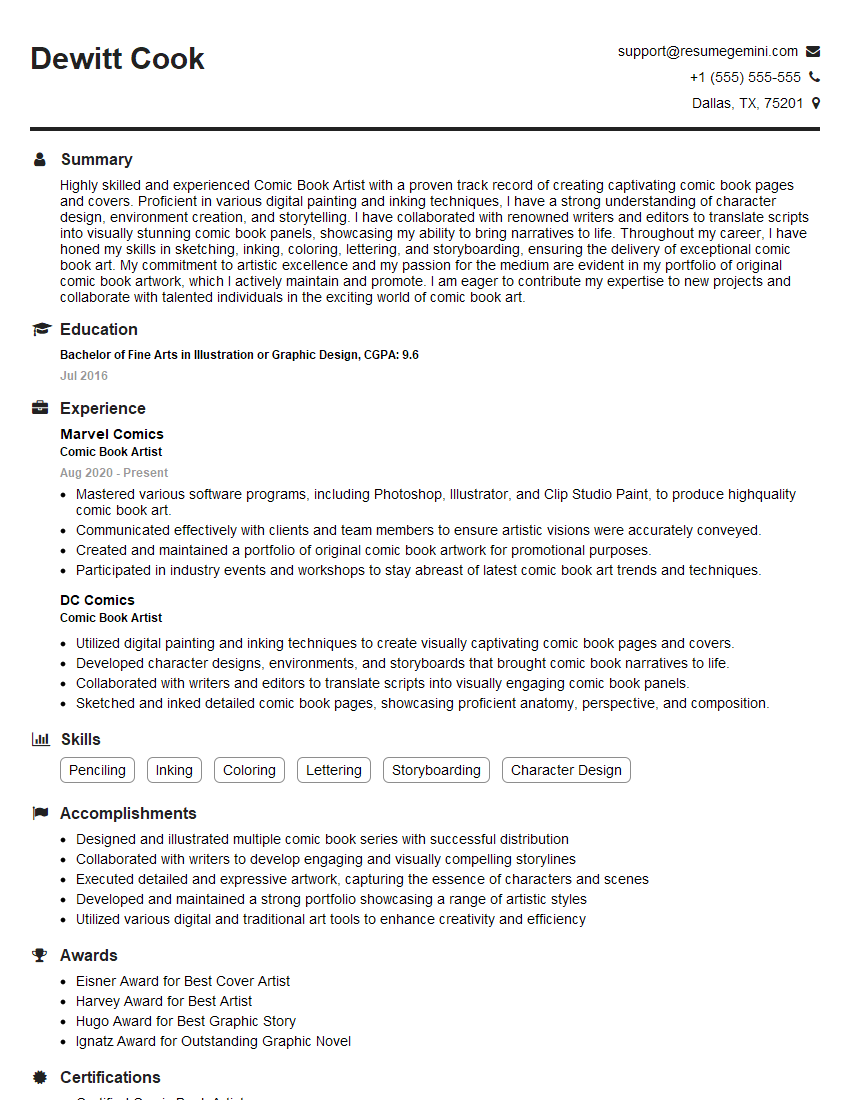
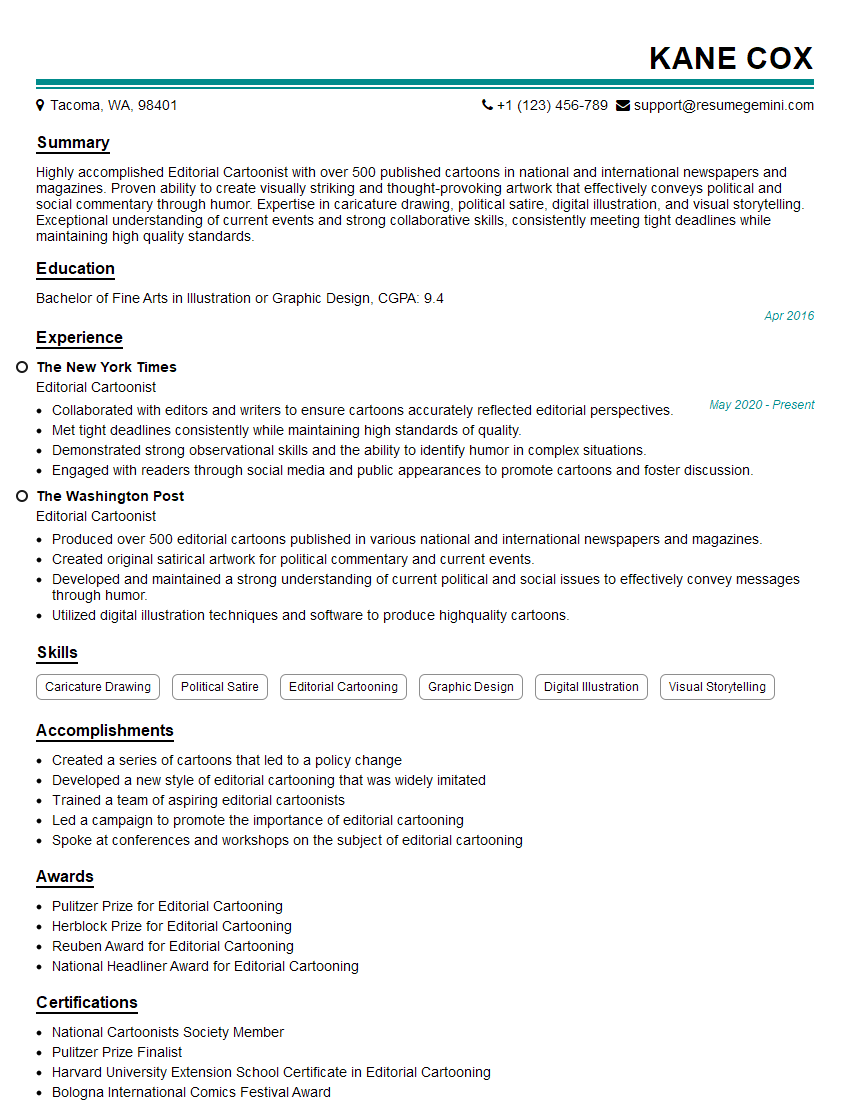
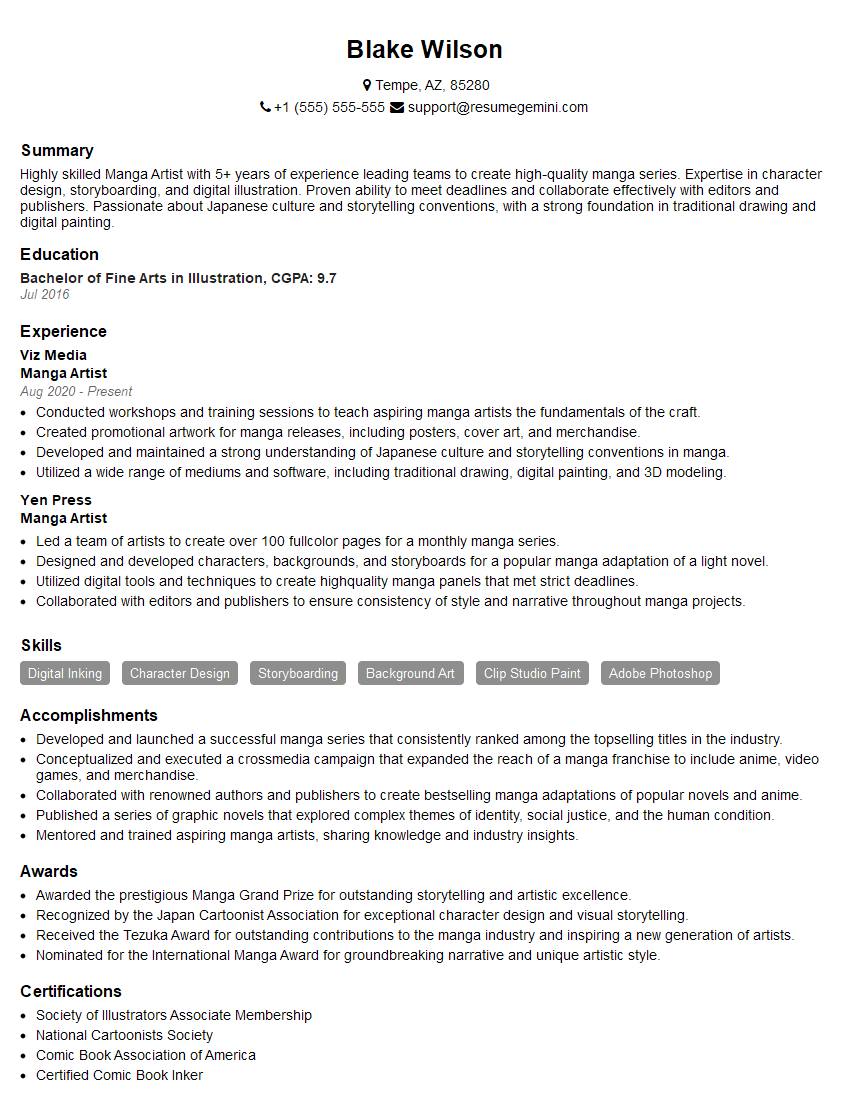
Mastering sequential art composition is crucial for a successful career in comics, animation, graphic design, and related fields. A strong portfolio is essential, but a well-crafted resume is your first step to landing your dream interview. Creating an ATS-friendly resume will significantly increase your chances of getting noticed by potential employers. To help you build a professional and impactful resume, we recommend using ResumeGemini. ResumeGemini provides a user-friendly platform and offers examples of resumes tailored to Sequential Art Composition, ensuring your application stands out.
Explore more articles
Users Rating of Our Blogs
Share Your Experience
We value your feedback! Please rate our content and share your thoughts (optional).
What Readers Say About Our Blog
Attention music lovers!
Wow, All the best Sax Summer music !!!
Spotify: https://open.spotify.com/artist/6ShcdIT7rPVVaFEpgZQbUk
Apple Music: https://music.apple.com/fr/artist/jimmy-sax-black/1530501936
YouTube: https://music.youtube.com/browse/VLOLAK5uy_noClmC7abM6YpZsnySxRqt3LoalPf88No
Other Platforms and Free Downloads : https://fanlink.tv/jimmysaxblack
on google : https://www.google.com/search?q=22+AND+22+AND+22
on ChatGPT : https://chat.openai.com?q=who20jlJimmy20Black20Sax20Producer
Get back into the groove with Jimmy sax Black
Best regards,
Jimmy sax Black
www.jimmysaxblack.com
Hi I am a troller at The aquatic interview center and I suddenly went so fast in Roblox and it was gone when I reset.
Hi,
Business owners spend hours every week worrying about their website—or avoiding it because it feels overwhelming.
We’d like to take that off your plate:
$69/month. Everything handled.
Our team will:
Design a custom website—or completely overhaul your current one
Take care of hosting as an option
Handle edits and improvements—up to 60 minutes of work included every month
No setup fees, no annual commitments. Just a site that makes a strong first impression.
Find out if it’s right for you:
https://websolutionsgenius.com/awardwinningwebsites
Hello,
we currently offer a complimentary backlink and URL indexing test for search engine optimization professionals.
You can get complimentary indexing credits to test how link discovery works in practice.
No credit card is required and there is no recurring fee.
You can find details here:
https://wikipedia-backlinks.com/indexing/
Regards
NICE RESPONSE TO Q & A
hi
The aim of this message is regarding an unclaimed deposit of a deceased nationale that bears the same name as you. You are not relate to him as there are millions of people answering the names across around the world. But i will use my position to influence the release of the deposit to you for our mutual benefit.
Respond for full details and how to claim the deposit. This is 100% risk free. Send hello to my email id: [email protected]
Luka Chachibaialuka
Hey interviewgemini.com, just wanted to follow up on my last email.
We just launched Call the Monster, an parenting app that lets you summon friendly ‘monsters’ kids actually listen to.
We’re also running a giveaway for everyone who downloads the app. Since it’s brand new, there aren’t many users yet, which means you’ve got a much better chance of winning some great prizes.
You can check it out here: https://bit.ly/callamonsterapp
Or follow us on Instagram: https://www.instagram.com/callamonsterapp
Thanks,
Ryan
CEO – Call the Monster App
Hey interviewgemini.com, I saw your website and love your approach.
I just want this to look like spam email, but want to share something important to you. We just launched Call the Monster, a parenting app that lets you summon friendly ‘monsters’ kids actually listen to.
Parents are loving it for calming chaos before bedtime. Thought you might want to try it: https://bit.ly/callamonsterapp or just follow our fun monster lore on Instagram: https://www.instagram.com/callamonsterapp
Thanks,
Ryan
CEO – Call A Monster APP
To the interviewgemini.com Owner.
Dear interviewgemini.com Webmaster!
Hi interviewgemini.com Webmaster!
Dear interviewgemini.com Webmaster!
excellent
Hello,
We found issues with your domain’s email setup that may be sending your messages to spam or blocking them completely. InboxShield Mini shows you how to fix it in minutes — no tech skills required.
Scan your domain now for details: https://inboxshield-mini.com/
— Adam @ InboxShield Mini
Reply STOP to unsubscribe
Hi, are you owner of interviewgemini.com? What if I told you I could help you find extra time in your schedule, reconnect with leads you didn’t even realize you missed, and bring in more “I want to work with you” conversations, without increasing your ad spend or hiring a full-time employee?
All with a flexible, budget-friendly service that could easily pay for itself. Sounds good?
Would it be nice to jump on a quick 10-minute call so I can show you exactly how we make this work?
Best,
Hapei
Marketing Director
Hey, I know you’re the owner of interviewgemini.com. I’ll be quick.
Fundraising for your business is tough and time-consuming. We make it easier by guaranteeing two private investor meetings each month, for six months. No demos, no pitch events – just direct introductions to active investors matched to your startup.
If youR17;re raising, this could help you build real momentum. Want me to send more info?
Hi, I represent an SEO company that specialises in getting you AI citations and higher rankings on Google. I’d like to offer you a 100% free SEO audit for your website. Would you be interested?
Hi, I represent an SEO company that specialises in getting you AI citations and higher rankings on Google. I’d like to offer you a 100% free SEO audit for your website. Would you be interested?