Are you ready to stand out in your next interview? Understanding and preparing for Signal Exploitation interview questions is a game-changer. In this blog, we’ve compiled key questions and expert advice to help you showcase your skills with confidence and precision. Let’s get started on your journey to acing the interview.
Questions Asked in Signal Exploitation Interview
Q 1. Explain the difference between COMINT, ELINT, and FISINT.
SIGINT (Signals Intelligence) is a broad umbrella term encompassing three major disciplines: COMINT, ELINT, and FISINT. They all involve intercepting and analyzing electromagnetic emissions, but they focus on different sources and types of information.
- COMINT (Communications Intelligence): This focuses on the content of communications, such as voice, data, and text messages. Think intercepted phone calls, email traffic, or radio chatter. The goal is to understand the message itself.
- ELINT (Electronic Intelligence): ELINT concentrates on non-communication electromagnetic emissions. This includes radar signals, electronic warfare systems, and other electronic devices. The focus isn’t the content, but rather the technical characteristics of the emissions, like frequency, modulation, and power levels, which can reveal the type of system being used and its operational parameters. Think of analyzing a radar signal to determine the type of radar and its range.
- FISINT (Foreign Instrumentation Signals Intelligence): FISINT targets signals from foreign weapons systems and other sophisticated technology. This often involves analyzing the telemetry data from missiles or satellites to understand their performance and capabilities. Imagine intercepting data from a missile test to understand its trajectory and performance.
In short: COMINT is about what is being said, ELINT is about how it’s being said technically, and FISINT is about understanding the capabilities of sophisticated foreign systems.
Q 2. Describe the signal processing techniques used in SIGINT.
Signal processing in SIGINT is crucial for extracting meaningful information from often weak and noisy signals. Key techniques include:
- Filtering: This isolates the signal of interest from noise and other interfering signals. Different filter types (e.g., bandpass, low-pass, high-pass) are used depending on the characteristics of the target signal. Imagine filtering out the static on a radio to hear a clear conversation.
- Demodulation: This recovers the original information from a modulated signal. Various demodulation techniques are used based on the modulation scheme (e.g., AM, FM, ASK, PSK). This is analogous to unwrapping a present – the modulated signal is the wrapping, and demodulation is the process of unwrapping to get to the information inside.
- Signal Detection and Classification: Algorithms are used to detect the presence of a signal and classify it based on its features (frequency, modulation, time characteristics). Think of a spam filter for emails – it uses various criteria to identify and sort unwanted messages. The same principle applies to automatically categorizing intercepted signals based on their features.
- Signal Enhancement: Techniques like matched filtering and adaptive equalization are used to improve the signal-to-noise ratio (SNR) and make weak signals easier to detect and analyze. This is like turning up the volume on a faint radio transmission to improve clarity.
- Time-Frequency Analysis: Techniques like Short-Time Fourier Transform (STFT) and Wavelet Transform are used to analyze how the frequency content of a signal changes over time. This is useful for identifying changing signal characteristics, particularly in analyzing signals from moving targets or changing communication patterns.
Q 3. What are the common challenges in intercepting and analyzing signals?
Intercepting and analyzing signals presents several challenges:
- Weak Signals: Signals may be very weak due to distance, atmospheric conditions, or intentional jamming. This requires sensitive receivers and sophisticated signal processing techniques.
- Noise and Interference: Natural and man-made sources of interference (e.g., atmospheric noise, other transmissions) can mask the signal of interest, requiring advanced filtering and signal enhancement techniques.
- Signal Jamming: Adversaries may intentionally jam signals to prevent interception. This requires robust signal processing and possibly countermeasures.
- Signal Hopping and Frequency Agility: Communications systems may hop between frequencies to make interception more difficult. This demands wideband receivers and sophisticated tracking algorithms.
- Data Encryption and Security: The use of encryption makes the content of communications unintelligible without breaking the encryption.
- Signal Obfuscation: Techniques like spread spectrum can make signals difficult to detect and analyze. This requires advanced knowledge and specialized techniques.
- Limited Bandwidth and Resources: There is always the limitation of equipment, computational resources and personnel to deal with the abundance of signals.
Overcoming these challenges requires a combination of advanced technology, skilled analysts, and innovative signal processing techniques.
Q 4. How do you identify and classify different types of signals?
Signal identification and classification involve several steps:
- Parameter Extraction: Initially, we extract key parameters from the intercepted signal, including frequency, bandwidth, modulation type, pulse characteristics (for pulsed signals), and signal strength. This often involves automatic feature extraction algorithms.
- Signal Signature Database Comparison: These parameters are then compared against a database of known signal signatures. This database contains information about the characteristics of different communication systems and electronic devices. A match suggests the type of signal.
- Machine Learning Techniques: Advanced machine learning algorithms can automatically classify signals based on their features. These algorithms can learn to identify new signal types and improve their classification accuracy over time.
- Manual Analysis: In cases where automatic classification is inconclusive, human experts use their knowledge and experience to analyze the signal characteristics and determine its type. This often involves visual inspection of spectrograms and other signal representations.
The process is iterative, often refining the analysis as more information becomes available. Imagine a detective using different clues (frequency, modulation etc.) to identify a suspect (the signal source).
Q 5. Explain the role of direction-finding in SIGINT.
Direction-finding (DF) is crucial in SIGINT for locating the source of intercepted signals. It involves using antennas and signal processing techniques to determine the direction from which a signal is arriving.
- Multiple Antennas: DF systems typically use multiple antennas to measure the time difference of arrival (TDOA) or phase difference of arrival (PDO) of the signal. This allows calculating the direction of arrival.
- Signal Processing Algorithms: Sophisticated algorithms are used to process the signals from multiple antennas and estimate the direction of arrival accurately. These algorithms account for factors like multipath propagation (signals arriving via multiple paths) and environmental effects.
- Accuracy and Precision: The accuracy of DF depends on several factors, including the frequency of the signal, the number and spacing of the antennas, and the signal-to-noise ratio. Advanced systems can achieve very high accuracy.
- Applications: DF is used to locate the geographic position of transmitters, track moving targets, and support other SIGINT operations.
Imagine DF as a sound locator – multiple microphones can pinpoint the source of a sound, and DF systems use a similar principle to locate radio frequency signals.
Q 6. Describe your experience with signal demodulation techniques.
My experience with signal demodulation techniques is extensive. I’ve worked with various modulation schemes, including:
- Amplitude Modulation (AM): This involves recovering the information signal from an amplitude-varying carrier wave. I’ve used envelope detectors and coherent demodulators for this.
- Frequency Modulation (FM): Here, the information signal modulates the frequency of the carrier wave. I’ve used discriminators and phase-locked loops (PLLs) for FM demodulation.
- Phase Shift Keying (PSK): This digital modulation technique uses changes in the phase of the carrier wave to represent data. I’ve implemented various PSK demodulation algorithms, including differential PSK (DPSK).
- Frequency Shift Keying (FSK): Similar to PSK, but changes the frequency of the carrier instead of phase. I’ve used various techniques for FSK demodulation, including threshold detectors and matched filters.
- Spread Spectrum Techniques: These techniques spread the signal over a wide bandwidth to improve resistance to interference and jamming. I have experience with demodulating signals using direct sequence spread spectrum (DSSS) and frequency hopping spread spectrum (FHSS).
My experience includes both theoretical understanding and practical application of these techniques using software-defined radios (SDRs) and custom signal processing algorithms. I’m proficient in using various signal processing tools and programming languages (e.g., MATLAB, Python) to implement and test these demodulation schemes.
Q 7. How do you handle noisy or corrupted signals?
Handling noisy or corrupted signals requires a multi-faceted approach:
- Filtering: This is the first line of defense against noise. Adaptive filters can dynamically adjust to changing noise characteristics, providing better noise reduction than fixed filters.
- Signal Averaging: Repeating the acquisition process and averaging the results can reduce random noise significantly. This is particularly effective for periodic signals.
- Matched Filtering: This technique is optimized to maximize the signal-to-noise ratio for a known signal shape, improving detection in noisy conditions.
- Error Correction Codes (ECC): If the signal is carrying data, error correction codes can help recover information lost due to corruption. These codes add redundancy to the data to allow for correction of errors.
- Interpolation and Extrapolation: These techniques can be used to fill in gaps in the signal caused by dropouts or corruption. This is often used in conjunction with other techniques.
- Wavelet Denoising: This technique uses wavelet transforms to separate the signal from noise based on their different frequency characteristics.
The best approach often involves a combination of these methods, depending on the nature and severity of the noise and corruption. It’s like cleaning a dirty antique – you might use several tools and techniques to restore it to its former glory. Careful analysis is crucial in choosing the appropriate method or combination of methods.
Q 8. What are some common signal encryption methods and how can they be exploited?
Signal encryption methods protect sensitive information transmitted over various communication channels. Common methods include symmetric encryption (like AES), where the same key is used for encryption and decryption, and asymmetric encryption (like RSA), which utilizes a public and private key pair. Exploiting these methods often involves cryptanalysis – the science of breaking encryption.
- Symmetric Encryption Exploitation: Attacks can focus on obtaining the encryption key, perhaps through brute-force attacks (trying all possible keys), known-plaintext attacks (knowing some encrypted and unencrypted text), or exploiting vulnerabilities in the implementation of the algorithm. For example, a poorly implemented AES implementation might have timing flaws that leak information about the key.
- Asymmetric Encryption Exploitation: These are generally harder to break than symmetric methods. Attacks might center around factoring large numbers (for RSA) or exploiting weaknesses in the key generation process. A compromised private key would allow access to all communications encrypted with the corresponding public key.
- Side-Channel Attacks: These attacks don’t directly target the encryption algorithm but exploit unintended information leaks, such as power consumption, electromagnetic emissions, or timing variations during encryption/decryption. These can reveal information about the secret keys even with strong algorithms.
Imagine intercepting encrypted bank transactions. Successful exploitation could range from revealing account details to manipulating the transactions themselves. It’s a complex field requiring deep understanding of mathematics, computer science, and the specific encryption methods used.
Q 9. Explain the concept of signal jamming and anti-jamming techniques.
Signal jamming involves intentionally transmitting interfering signals to disrupt legitimate communication. Anti-jamming techniques counter these efforts. Think of it like shouting over someone else to prevent them from being heard.
- Jamming: Techniques range from simple noise generation to sophisticated, targeted interference designed to disrupt specific frequencies or modulation schemes. The effectiveness depends on the power and sophistication of the jammer and the distance between the jammer and the receiver.
- Anti-Jamming Techniques: These aim to mitigate jamming effects. Common methods include:
- Frequency Hopping Spread Spectrum (FHSS): The communication signal rapidly switches between different frequencies, making it harder for a jammer to consistently target the signal. Imagine a conversation happening across multiple radio channels simultaneously.
- Direct Sequence Spread Spectrum (DSSS): The signal is spread across a wider bandwidth, making it more robust against narrowband jamming. This is similar to hiding a message within a larger, seemingly random signal.
- Adaptive Techniques: These dynamically adjust transmission parameters based on detected interference, effectively “learning” to avoid the jammer’s attack.
- Redundancy and Diversity: Using multiple communication paths and repeating transmissions increases resilience against signal disruption.
Imagine a military operation where secure communication is critical. Jamming could cripple coordination, while effective anti-jamming ensures the mission’s success. The ongoing arms race between jamming and anti-jamming techniques is a constant challenge in signal intelligence.
Q 10. Describe your experience with SIGINT software and tools.
My experience encompasses a broad range of SIGINT software and tools, from commercial off-the-shelf (COTS) solutions to bespoke, highly specialized systems. I’m proficient in utilizing software for signal acquisition, processing, analysis, and reporting. Specific examples include:
- Signal Acquisition Software: Experience with software defined radios (SDRs) and related control software to capture and digitize various signals (radio, satellite, etc.).
- Signal Processing Software: Expertise in using signal processing tools for tasks like demodulation, filtering, and feature extraction. This often involves working with MATLAB, Python (with libraries like SciPy and NumPy), or specialized SIGINT processing packages.
- Data Analysis and Visualization Tools: Proficient in using tools like Tableau, Power BI, or custom scripting to visualize and analyze processed SIGINT data. Identifying patterns and anomalies requires advanced statistical and machine learning techniques.
- Specialized SIGINT Platforms: Experience working with dedicated SIGINT platforms that integrate various capabilities, from signal acquisition to intelligence reporting. These often involve secure, high-performance computing environments.
For example, in one project, I used MATLAB and a custom-developed algorithm to extract timing information from a series of encrypted satellite communications. This timing data, when correlated with other intelligence, provided critical insights into the adversary’s activities.
Q 11. How do you prioritize and manage multiple signal sources?
Prioritizing and managing multiple signal sources requires a systematic approach. It’s akin to a detective investigating a crime scene – some clues are more relevant than others. I use a combination of factors for prioritization:
- Intelligence Value: Signals from known high-value targets or those associated with critical events are given priority.
- Urgency: Signals indicating immediate threats or time-sensitive information are handled first.
- Technical Feasibility: The likelihood of successful signal exploitation, given the available resources and technical challenges, influences prioritization.
- Resource Allocation: The available personnel, processing power, and other resources guide the allocation of effort across multiple signal sources.
A framework like the Eisenhower Matrix (urgent/important) can be valuable for organizing tasks, ensuring time-sensitive matters get immediate attention. Automation tools and workflow management systems are crucial for efficiently handling a high volume of signal sources.
Q 12. How do you ensure the security and integrity of SIGINT data?
Ensuring the security and integrity of SIGINT data is paramount. Breaches can have severe consequences. This involves a multi-layered approach:
- Secure Data Handling Procedures: Strict protocols for accessing, handling, and storing SIGINT data are crucial. This includes access control lists, encryption at rest and in transit, and audit trails to track data usage.
- Data Encryption: All SIGINT data, whether in transit or at rest, should be strongly encrypted using industry-standard encryption algorithms (e.g., AES-256).
- Data Validation and Integrity Checks: Mechanisms to verify the authenticity and integrity of data are essential. Hashing algorithms and digital signatures are frequently used.
- Network Security: Secure network infrastructure, firewalls, intrusion detection systems, and regular security audits are vital to protect SIGINT systems from unauthorized access.
- Personnel Security: Background checks and security clearances for personnel handling sensitive SIGINT data are essential.
Imagine a scenario where compromised SIGINT data leads to the exposure of sensitive operational plans. The consequences could be catastrophic. Therefore, robust security measures are not optional; they are fundamental to the integrity and effectiveness of SIGINT operations.
Q 13. Explain your understanding of the legal and ethical considerations of SIGINT.
SIGINT activities are subject to strict legal and ethical constraints. Operations must adhere to both domestic and international laws, as well as ethical guidelines. A strong understanding of these boundaries is critical.
- Legal Frameworks: Vary by country, but generally dictate permissible targets and collection methods. Violations can lead to severe legal repercussions.
- Privacy Concerns: SIGINT activities must respect individual privacy rights. Collection must be targeted, proportionate, and conducted only with appropriate legal authorization.
- Ethical Considerations: Even when legally permissible, SIGINT operations should be guided by ethical principles, ensuring proportionality, minimizing harm, and adhering to transparency and accountability standards.
- Oversight and Accountability: Effective oversight mechanisms and accountability frameworks are essential to ensure adherence to legal and ethical guidelines. This often includes external review and auditing processes.
For instance, the collection of SIGINT data on US citizens without proper warrants is unlawful and unethical. A clear understanding of legal and ethical boundaries prevents the accidental or intentional violation of these principles, safeguarding both individuals and national interests.
Q 14. Describe your experience with data analysis and reporting in SIGINT.
Data analysis and reporting are integral to the SIGINT process. Raw signals are meaningless without analysis to extract actionable intelligence. My experience covers a broad spectrum of techniques.
- Data Cleaning and Preprocessing: Removing noise and artifacts from the data is the first step. This often requires specialized signal processing techniques.
- Pattern Recognition and Anomaly Detection: Identifying unusual patterns and anomalies in the data, often requiring statistical analysis and machine learning algorithms, is crucial for discovering hidden information.
- Correlation and Fusion: Combining SIGINT data with other intelligence sources (HUMINT, IMINT, etc.) significantly enhances the value of analysis.
- Report Writing and Presentation: Clear and concise reporting is essential to communicate findings to decision-makers, often using visualization techniques to highlight key insights.
In a recent project, I used statistical analysis to identify recurring communication patterns that revealed a covert communication network. The resulting report provided crucial information for decision-makers.
Q 15. How do you validate and verify SIGINT findings?
Validating and verifying SIGINT findings is crucial for ensuring the accuracy and reliability of our intelligence. It’s a multi-step process involving both technical and analytical checks.
Firstly, we use technical validation to confirm the integrity of the intercepted signals. This involves checking the signal’s characteristics – frequency, modulation, signal strength – against known parameters of the target system. Inconsistencies could point to signal anomalies, jamming, or spoofing. For example, detecting a significant deviation in a known radio frequency used by a specific military aircraft might indicate a change in their communication protocols or an attempt at deception.
Secondly, we perform analytical verification. This involves comparing our findings with other intelligence sources – open-source information, HUMINT (human intelligence), or IMINT (imagery intelligence) – to corroborate the information extracted from the intercepted signals. Let’s say we intercept communications suggesting troop movements. We would then cross-reference this with satellite imagery to confirm troop presence and movement in the suggested area. This triangulation helps eliminate false positives and provides a more complete picture.
Finally, we employ source reliability assessment. We evaluate the credibility of the signal source by considering factors such as the signal’s security, the target’s known communication practices, and the context in which the signal was intercepted. We might look for patterns in communication or analyze the metadata associated with the signals to confirm their authenticity.
Career Expert Tips:
- Ace those interviews! Prepare effectively by reviewing the Top 50 Most Common Interview Questions on ResumeGemini.
- Navigate your job search with confidence! Explore a wide range of Career Tips on ResumeGemini. Learn about common challenges and recommendations to overcome them.
- Craft the perfect resume! Master the Art of Resume Writing with ResumeGemini’s guide. Showcase your unique qualifications and achievements effectively.
- Don’t miss out on holiday savings! Build your dream resume with ResumeGemini’s ATS optimized templates.
Q 16. How do you integrate SIGINT data with other intelligence sources?
Integrating SIGINT with other intelligence sources is essential for a comprehensive understanding of a target. Think of it like assembling a jigsaw puzzle – each intelligence source contributes a piece, and only by combining them do you get a clear picture.
We use a process of data fusion. This involves comparing and contrasting SIGINT data with information gathered from other sources. For instance, if SIGINT reveals coded communications from a suspected terrorist group, we might cross-reference this with HUMINT from an informant, or IMINT from a drone providing visual confirmation of their activity at a specific location. This allows us to confirm the information received and understand the context of those communications, for example, planning an attack or a meeting.
Data correlation is crucial here, highlighting similarities or differences between the different intelligence streams. Discrepancies might lead to further investigation, while confirmations reinforce intelligence assessments. Sophisticated software tools assist in this process, matching key data points, filtering noise, and creating comprehensive reports.
Q 17. Describe your experience with different antenna types and their applications in SIGINT.
My experience encompasses a wide range of antenna types, each suited to specific SIGINT applications.
- Yagi-Uda antennas are directional and efficient for intercepting signals from a known direction. They’re commonly used for receiving specific frequency bands.
- Log-periodic antennas offer a wide frequency range, making them ideal for detecting unknown or changing signals. This is particularly useful when searching for new communication systems or identifying unexpected transmissions.
- Helical antennas are circularly polarized and are effective for intercepting signals from satellites or aircraft that utilize circular polarization. Their advantage is the reduced effect of polarization mismatch which can significantly decrease reception capabilities.
- Direction-finding (DF) antennas, such as Adcock arrays, are used to pinpoint the location of a signal source. These usually require multiple antenna elements to accomplish this.
The choice of antenna depends greatly on the mission parameters. For example, if we are tasked with monitoring a known communication system from a specific location, a highly directional Yagi-Uda antenna would be appropriate. However, for wide-area surveillance, a log-periodic antenna or an array of antennas would be more effective.
Q 18. What are the limitations of SIGINT and how can they be overcome?
SIGINT has several limitations. One key limitation is signal ambiguity. Intercepted signals can be easily misinterpreted without the proper context. Encryption further obscures the meaning of communications, requiring specialized cryptanalysis techniques to break them. For instance, a seemingly innocuous coded conversation might actually be a complex set of instructions for a military operation.
Another significant issue is signal degradation. Atmospheric conditions, terrain, and distance all affect signal quality, making it difficult to receive clear transmissions and diminishing the quality of signal intelligence. We frequently encounter situations where environmental noise overwhelms the signals we are trying to collect.
Finally, target countermeasures, like encryption, frequency hopping, and jamming, can render SIGINT ineffective. To overcome these challenges, we utilize advanced signal processing techniques, improved antenna technologies, and sophisticated cryptanalysis methods. Employing multiple intelligence sources to corroborate findings and developing robust signal detection techniques allow us to minimize these limitations.
Q 19. Explain your understanding of signal propagation and its impact on SIGINT.
Signal propagation is the manner in which electromagnetic waves travel from a source to a receiver. Understanding it is fundamental to successful SIGINT. Factors like frequency, terrain, atmospheric conditions, and obstacles significantly impact signal strength and clarity.
Frequency directly influences propagation. Higher frequencies experience greater attenuation (signal loss) than lower frequencies and are often affected by obstacles. Lower frequencies, on the other hand, can propagate much further. This knowledge is key for selecting the appropriate antenna and frequency for signal reception.
Terrain affects propagation by either blocking, reflecting, or scattering signals. Mountains, buildings, and even foliage can significantly affect signal reception. We use sophisticated propagation models to predict signal paths and compensate for signal losses or distortions caused by obstacles.
Atmospheric conditions also play a role. Rain, fog, and even temperature inversions can cause signal attenuation or refraction. These atmospheric effects need to be considered when analyzing signal strength and planning intercept operations.
Understanding these factors allows us to optimize antenna placement, predict signal range, and interpret the received signals accurately, even when faced with difficult conditions.
Q 20. How do you identify and mitigate threats to SIGINT operations?
Threats to SIGINT operations are multifaceted, ranging from physical security breaches to sophisticated electronic attacks. To mitigate these threats, we employ several strategies.
Physical security is paramount. This includes protecting our equipment, facilities, and personnel from unauthorized access or sabotage. This involves robust physical security measures such as access controls, surveillance systems, and regular security audits.
Electronic security is equally vital. We implement techniques to protect our systems and data from cyberattacks and electronic espionage. This can include encryption, intrusion detection systems, and regular security updates.
COMSEC (Communications Security) protocols are crucial to maintaining the confidentiality of our intercepted signals. This involves secure communication channels and the use of encryption to protect sensitive information from unauthorized access.
Personnel security is a critical aspect. We regularly train our personnel on security awareness, handling classified information, and reporting any suspicious activities. Background checks and security clearances are essential components of personnel vetting.
Q 21. Describe your experience with working in a team environment on SIGINT projects.
Teamwork is essential for successful SIGINT operations. I’ve been fortunate to participate in several complex projects where collaboration was key. My role typically involves working closely with signal analysts, linguists, and intelligence officers, each contributing their specialized skills.
One project I worked on involved analyzing intercepted communications from a foreign government. This required close collaboration with linguists to translate the communications, analysts to interpret the meaning, and intelligence officers to incorporate the findings into broader intelligence assessments. Effective communication and a clear understanding of roles and responsibilities were vital to project success.
In another instance, we faced technical challenges in processing high volumes of intercepted data. I had to work closely with our data scientists to develop and implement advanced signal processing algorithms to improve data analysis. This involved constant communication, exchanging ideas, and tackling problems collaboratively. This teamwork resulted in increased data processing speed and the identification of previously undetected patterns in signal transmission.
Q 22. How familiar are you with various modulation schemes (e.g., AM, FM, PSK)?
My familiarity with modulation schemes is extensive. I understand them as the process of encoding information onto a carrier wave, enabling transmission over a distance. Different schemes offer trade-offs in terms of bandwidth efficiency, power consumption, and resistance to noise.
- Amplitude Modulation (AM): The amplitude of the carrier wave is varied proportionally to the message signal. It’s simple to implement but susceptible to noise and inefficient in bandwidth usage. Think of it like changing the volume of a sound to represent information.
- Frequency Modulation (FM): The frequency of the carrier wave is varied proportionally to the message signal. It’s more robust against noise than AM and offers better audio quality, but requires more bandwidth. Imagine changing the pitch of a sound to convey information.
- Phase-Shift Keying (PSK): The phase of the carrier wave is shifted to represent different bits of information. Various types exist (BPSK, QPSK, etc.), with higher-order PSK offering greater data rates but increased complexity and susceptibility to errors. This is like using different angles to represent data points.
I have practical experience analyzing and demodulating signals using all three, and many others, including advanced techniques like OFDM (Orthogonal Frequency-Division Multiplexing).
Q 23. Explain the concept of frequency hopping and its implications for SIGINT.
Frequency hopping spread spectrum (FHSS) is a modulation technique where a signal’s carrier frequency rapidly changes according to a pseudorandom sequence. This makes interception significantly more challenging because the receiver needs to know the hopping sequence to demodulate the signal effectively.
For SIGINT, FHSS presents significant hurdles. A successful interception requires synchronizing with the hopping sequence, which may involve sophisticated signal processing and potentially breaking encryption if the hopping sequence is secured. Without the correct hopping sequence, the intercepted signal appears as noise. To combat this, SIGINT specialists employ techniques like wideband receivers capable of capturing the entire frequency band where hopping might occur, followed by signal processing to identify and track the hops.
Imagine trying to catch a bird constantly jumping between branches – it’s much harder than if it stayed in one place.
Q 24. What is your experience with spectral analysis techniques?
My experience with spectral analysis is core to my SIGINT expertise. It’s the process of analyzing the frequency content of a signal. I’m proficient in using tools like Fast Fourier Transforms (FFTs) to decompose signals into their constituent frequencies, identify characteristic spectral signatures, and perform tasks like signal classification and demodulation.
I utilize various spectral analysis techniques including:
- Short-Time Fourier Transform (STFT): Analyzing the frequency content over time, useful for non-stationary signals.
- Wavelet Transform: Analyzing signals at multiple resolutions, allowing for better detection of transient events.
My experience extends to using commercial software packages like MATLAB and specialized SIGINT tools for advanced spectral analysis and visualization.
Q 25. How do you handle real-time SIGINT data streams?
Handling real-time SIGINT data streams necessitates efficient processing and storage solutions. These streams are often voluminous and require specialized hardware and software. My approach involves a multi-stage process:
- Data Acquisition: Utilizing high-speed data acquisition systems to capture signals.
- Preprocessing: Removing noise and artifacts, potentially using adaptive filtering techniques.
- Feature Extraction: Identifying key characteristics of the signal, such as modulation type, bandwidth, and frequency.
- Classification/Detection: Utilizing machine learning algorithms or rule-based systems to identify targets of interest.
- Data Storage & Archiving: Storing processed data in a structured format for later analysis.
I have experience with parallel processing techniques and distributed computing architectures to manage the high data throughput of real-time SIGINT applications.
Q 26. Describe your experience with signal identification using software-defined radios.
Software-defined radios (SDRs) are invaluable tools for signal identification. They allow for flexible and programmable signal processing. My experience with SDRs includes utilizing them for:
- Signal Acquisition: Tuning to specific frequencies and bandwidths to capture signals of interest.
- Signal Demodulation: Implementing various demodulation algorithms to recover the original information.
- Signal Classification: Utilizing machine learning models trained on various signal types to automatically identify unknown signals.
I’ve used SDRs from various manufacturers like Ettus Research and HackRF, and am proficient in using GNU Radio and other SDR software platforms. A recent project involved using an SDR and machine learning to identify and classify various types of radar signals in a cluttered electromagnetic environment.
Q 27. How do you interpret and analyze metadata associated with intercepted signals?
Metadata associated with intercepted signals provides crucial context. This includes information like timestamps, frequencies, modulation types, signal strength, and potentially geolocation data. Interpreting and analyzing this metadata is crucial for understanding the context of a signal.
For example, analyzing timestamps can reveal patterns and communication schedules. Signal strength data can help estimate the distance to the emitter. Knowing the modulation type helps with demodulation and understanding the complexity of the communication. Geolocation data, when available, pinpoints the signal’s origin.
Correlating this metadata with other intelligence sources significantly enhances the value of SIGINT data, enabling a more comprehensive understanding of the target’s activities.
Q 28. Explain your understanding of the signal-to-noise ratio and its importance in SIGINT.
The signal-to-noise ratio (SNR) represents the power ratio between a desired signal and unwanted noise. A high SNR means the signal is strong relative to the noise, making it easier to detect and demodulate. A low SNR makes it difficult, or even impossible, to extract useful information from the signal.
In SIGINT, SNR is paramount. Low SNR often necessitates sophisticated signal processing techniques to extract the signal from the noise, sometimes employing advanced techniques like matched filtering. The SNR directly impacts the quality and reliability of the intercepted information. A signal with a low SNR could be misinterpreted or completely undetectable. Understanding and improving SNR is a continual focus for SIGINT professionals.
Key Topics to Learn for Signal Exploitation Interview
- Fundamentals of Signals and Systems: Understanding signal types, properties (frequency, amplitude, phase), and fundamental signal processing techniques like filtering and modulation is crucial. This forms the bedrock of your knowledge.
- Digital Signal Processing (DSP): Mastering concepts like sampling, quantization, Fourier transforms, and digital filter design is essential for analyzing and manipulating digital signals. Practical application includes analyzing intercepted communication data.
- Software Defined Radio (SDR): Familiarity with SDR principles, architecture, and programming interfaces (e.g., GNU Radio) is vital for practical signal exploitation tasks. Be prepared to discuss projects or experience involving SDRs.
- Signal Modulation and Demodulation Techniques: A deep understanding of various modulation schemes (AM, FM, QAM, etc.) and their demodulation processes is key to recovering information from intercepted signals. Be prepared to explain the strengths and weaknesses of different techniques.
- Cryptoanalysis and Cryptanalysis: Basic knowledge of common cryptographic algorithms and techniques used to secure communication systems is important, especially in understanding how to potentially overcome these protections (within legal and ethical boundaries). This is a crucial aspect for advanced signal exploitation.
- Protocol Analysis and Reverse Engineering: Understanding how communication protocols work, and the ability to analyze and reverse engineer them is crucial for uncovering hidden information within signal traffic. Focus on practical techniques for dissecting data packets.
- Antenna Theory and Propagation: A solid grasp of antenna types, characteristics, and signal propagation models is important for understanding signal reception and transmission. This helps in understanding the limitations and possibilities of signal interception.
- Problem-Solving and Analytical Skills: Demonstrate your ability to approach complex signal processing challenges systematically. Practice breaking down problems into smaller, manageable parts, and articulating your solution approach clearly.
Next Steps
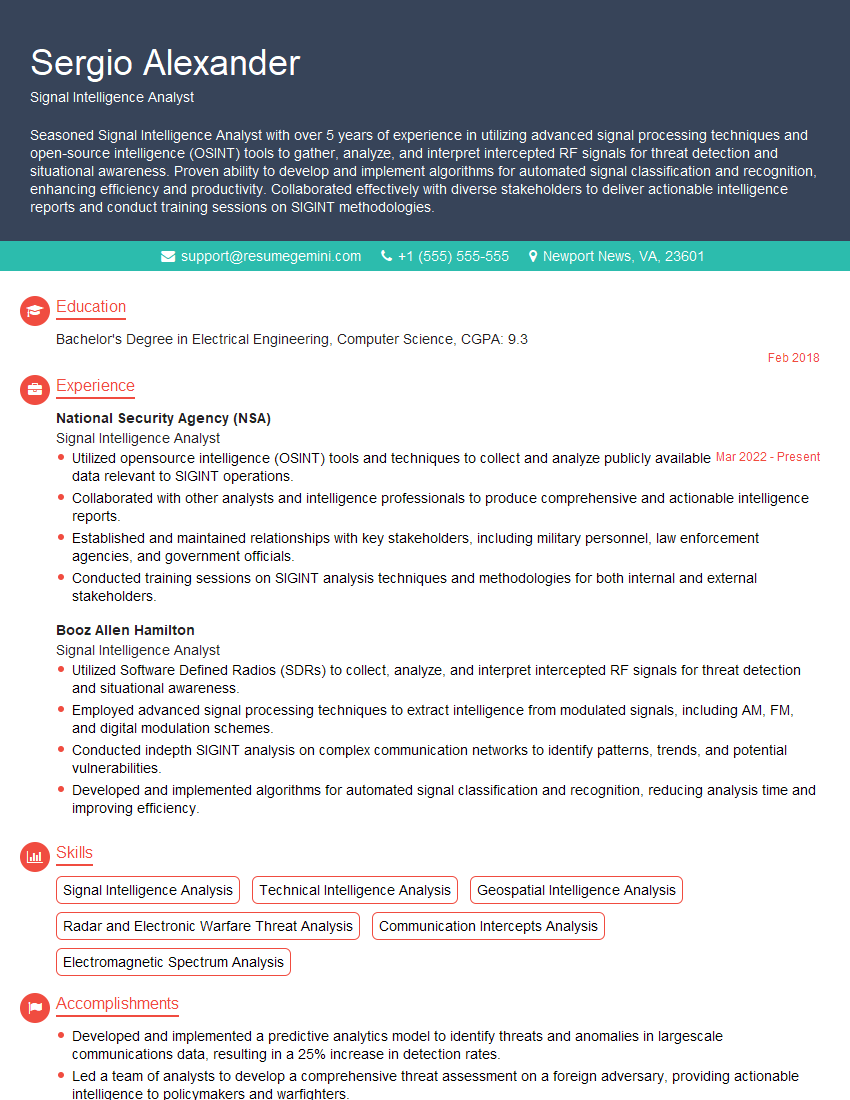
Mastering Signal Exploitation opens doors to exciting and impactful careers in cybersecurity, intelligence, and telecommunications. To maximize your job prospects, create a compelling and ATS-friendly resume that highlights your skills and experience. ResumeGemini is a trusted resource that can help you build a professional and effective resume tailored to the specific requirements of Signal Exploitation roles. Examples of resumes tailored to Signal Exploitation are available to guide you.
Explore more articles
Users Rating of Our Blogs
Share Your Experience
We value your feedback! Please rate our content and share your thoughts (optional).
What Readers Say About Our Blog
Hello,
we currently offer a complimentary backlink and URL indexing test for search engine optimization professionals.
You can get complimentary indexing credits to test how link discovery works in practice.
No credit card is required and there is no recurring fee.
You can find details here:
https://wikipedia-backlinks.com/indexing/
Regards
NICE RESPONSE TO Q & A
hi
The aim of this message is regarding an unclaimed deposit of a deceased nationale that bears the same name as you. You are not relate to him as there are millions of people answering the names across around the world. But i will use my position to influence the release of the deposit to you for our mutual benefit.
Respond for full details and how to claim the deposit. This is 100% risk free. Send hello to my email id: [email protected]
Luka Chachibaialuka
Hey interviewgemini.com, just wanted to follow up on my last email.
We just launched Call the Monster, an parenting app that lets you summon friendly ‘monsters’ kids actually listen to.
We’re also running a giveaway for everyone who downloads the app. Since it’s brand new, there aren’t many users yet, which means you’ve got a much better chance of winning some great prizes.
You can check it out here: https://bit.ly/callamonsterapp
Or follow us on Instagram: https://www.instagram.com/callamonsterapp
Thanks,
Ryan
CEO – Call the Monster App
Hey interviewgemini.com, I saw your website and love your approach.
I just want this to look like spam email, but want to share something important to you. We just launched Call the Monster, a parenting app that lets you summon friendly ‘monsters’ kids actually listen to.
Parents are loving it for calming chaos before bedtime. Thought you might want to try it: https://bit.ly/callamonsterapp or just follow our fun monster lore on Instagram: https://www.instagram.com/callamonsterapp
Thanks,
Ryan
CEO – Call A Monster APP
To the interviewgemini.com Owner.
Dear interviewgemini.com Webmaster!
Hi interviewgemini.com Webmaster!
Dear interviewgemini.com Webmaster!
excellent
Hello,
We found issues with your domain’s email setup that may be sending your messages to spam or blocking them completely. InboxShield Mini shows you how to fix it in minutes — no tech skills required.
Scan your domain now for details: https://inboxshield-mini.com/
— Adam @ InboxShield Mini
Reply STOP to unsubscribe
Hi, are you owner of interviewgemini.com? What if I told you I could help you find extra time in your schedule, reconnect with leads you didn’t even realize you missed, and bring in more “I want to work with you” conversations, without increasing your ad spend or hiring a full-time employee?
All with a flexible, budget-friendly service that could easily pay for itself. Sounds good?
Would it be nice to jump on a quick 10-minute call so I can show you exactly how we make this work?
Best,
Hapei
Marketing Director
Hey, I know you’re the owner of interviewgemini.com. I’ll be quick.
Fundraising for your business is tough and time-consuming. We make it easier by guaranteeing two private investor meetings each month, for six months. No demos, no pitch events – just direct introductions to active investors matched to your startup.
If youR17;re raising, this could help you build real momentum. Want me to send more info?
Hi, I represent an SEO company that specialises in getting you AI citations and higher rankings on Google. I’d like to offer you a 100% free SEO audit for your website. Would you be interested?
Hi, I represent an SEO company that specialises in getting you AI citations and higher rankings on Google. I’d like to offer you a 100% free SEO audit for your website. Would you be interested?
good