Interviews are opportunities to demonstrate your expertise, and this guide is here to help you shine. Explore the essential Spooling and Winding interview questions that employers frequently ask, paired with strategies for crafting responses that set you apart from the competition.
Questions Asked in Spooling and Winding Interview
Q 1. Explain the difference between spooling and winding.
While both spooling and winding involve the coiling of material onto a core, they differ significantly in their purpose and methodology. Spooling is primarily concerned with storing material in a manageable and organized way, often for later use in other processes. Think of spooling thread onto a sewing machine spool – the focus is on neat storage. Winding, on the other hand, is often part of a larger manufacturing or production process. It involves precisely controlling the way material is laid onto a bobbin or reel, often to create a specific structure or tension for subsequent use. An example is winding copper wire onto a coil for an electric motor – precise layering and tension are critical.
In essence, spooling is about storage; winding is about controlled layering and preparation for further use.
Q 2. Describe various types of spools and their applications.
Spool types vary widely based on material, application, and required properties. Some common examples include:
- Paper spools: Used extensively in the textile industry for yarn and thread, these are typically cardboard or plastic. They are inexpensive and readily available.
- Metal spools: These are often used for heavier materials like wire, cable, or ribbon, offering greater durability and strength. Steel, aluminum, and brass are commonly used materials.
- Plastic spools: Offer a balance of cost and durability, suitable for many applications including film, tape, and thin wires. Different plastics are chosen based on the material being spooled and environmental conditions.
- Precision spools: For applications requiring extremely high precision and consistent winding, these are engineered to exacting specifications, often with features like flanges and tapered designs.
The choice of spool depends heavily on the material properties (weight, diameter, fragility), the winding process, and the final application of the spooled material. A delicate fiber will require a different spool than a heavy-gauge wire.
Q 3. What are the different types of winding techniques?
Numerous winding techniques exist, each optimized for specific materials and applications. Here are a few key types:
- Center-wind: The material is wound from the center outwards, creating a uniform, cylindrical package. Commonly used for yarn and thread.
- Edge-wind: Material is wound from the edge, building the coil outwards. This is often employed when the material needs a specific profile or when controlling tension at the edges is critical.
- Spiral-wind: Creates a spiral pattern on the spool, commonly used for applications where even distribution of material is essential, such as in manufacturing coils for transformers.
- Cheese-wind: This technique results in a layered package resembling a wheel of cheese. It’s often used when consistent layer thickness is required.
- Layer-wind: Material is laid down in distinct layers, often with controlled tension and overlap. This is useful for precision winding applications.
The choice of winding technique often depends on the material, the desired final product, and the equipment capabilities.
Q 4. How do you ensure consistent tension during the winding process?
Maintaining consistent tension is crucial for producing high-quality spools and preventing defects. Several methods are employed:
- Tension control devices: Mechanical devices like brakes, clutches, and tension rollers regulate the payout of material from the source. These often incorporate sensors and feedback mechanisms to maintain the target tension.
- Closed-loop control systems: These systems constantly monitor the tension and adjust the payout speed accordingly, ensuring consistency even with variations in material properties or winding speed.
- Material properties: Understanding the material’s elasticity and stiffness is vital. Adjusting the tension based on these properties helps in avoiding over-tensioning or slack.
- Spool design: Spool design itself plays a role. For instance, tapered spools can help in managing tension distribution during winding.
Often, a combination of these approaches is used to optimize tension control for different materials and winding processes.
Q 5. Explain the importance of proper tension control in spooling and winding.
Proper tension control is paramount in spooling and winding for several reasons:
- Preventing defects: Inconsistencies in tension lead to loose or tight areas on the spool, which can cause breakage, uneven layering, and ultimately, product failure.
- Ensuring consistent quality: Uniform tension ensures the final product meets the required specifications, whether it’s a precisely wound coil or a neatly packaged yarn.
- Optimizing material usage: Proper tension minimizes material waste and maximizes the efficiency of the process.
- Improving process efficiency: Consistent tension reduces downtime associated with defects, rework, and machine adjustments.
In short, consistent tension translates to better product quality, higher production efficiency, and reduced waste – all vital considerations in manufacturing.
Q 6. What are the common causes of spooling and winding defects?
Common defects in spooling and winding stem from various issues. These include:
- Uneven tension: This can lead to loose loops, tight wraps, or even breakage of the material.
- Birdnesting: This refers to the material overlapping or bunching up on the spool, often caused by inconsistent tension or improper winding technique.
- Over-winding: Winding beyond the spool’s capacity can cause damage to the material and the spool itself.
- Spool damage: Scratches, dents, or other damage to the spool can affect the winding process and potentially cause defects in the final product.
- Material defects: Imperfections in the material itself, such as knots or weak spots, can disrupt the winding process and lead to defects.
Identifying the root cause of these defects requires careful observation and analysis of the winding process.
Q 7. How do you troubleshoot common problems encountered during spooling and winding?
Troubleshooting spooling and winding problems requires a systematic approach. Here’s a step-by-step process:
- Identify the defect: Carefully examine the spooled material to pinpoint the specific type of defect (e.g., uneven tension, birdnesting).
- Review the process parameters: Check tension settings, winding speed, and spool type to ensure they are appropriate for the material.
- Inspect the equipment: Examine the winding machine for any mechanical issues such as worn parts, misalignment, or faulty sensors.
- Check the material: Inspect the material for any defects that could be causing the problem (e.g., knots, weak points).
- Adjust parameters: Based on your observations, adjust relevant parameters such as tension, speed, or winding technique.
- Test and repeat: Test the adjustments, monitoring the spooling process carefully. Repeat steps 1-5 as necessary until the defect is resolved.
Often, a combination of adjustments is needed. Keeping detailed records of parameters and observations is essential for troubleshooting and preventing future problems.
Q 8. Describe your experience with different types of winding machines.
My experience encompasses a wide range of winding machines, from simple manual winders used for small-scale operations to highly automated, computer-controlled systems for large-scale production. I’ve worked extensively with several types, including:
Capstan Winders: These are versatile machines ideal for winding yarns, wires, and tapes onto spools or bobbins. I’ve used them in applications requiring precise tension control and consistent winding patterns.
Turret Winders: These machines excel in high-speed, high-volume winding of multiple spools simultaneously. My experience includes optimizing turret winders for efficient production of various textile products.
Cheese Winders: Used primarily for winding large quantities of yarn into cylindrical packages known as ‘cheeses,’ these machines demand meticulous attention to tension and package density. I’ve successfully trouble-shot and maintained several cheese winding machines in a manufacturing setting.
Drum Winders: These are effective for winding materials onto large drums, often utilized in industrial applications for cable, wire, and film winding. I’m proficient in configuring drum winders to accommodate varying material diameters and lengths.
My expertise extends beyond simply operating these machines; I also possess a strong understanding of their mechanics, enabling me to troubleshoot malfunctions and optimize their performance for various applications.
Q 9. What are the safety precautions you take while operating spooling and winding machines?
Safety is paramount in spooling and winding operations. My safety protocols are rigorous and include:
Personal Protective Equipment (PPE): Always wearing safety glasses, gloves (appropriate to the material being handled), and hearing protection, especially when working with high-speed machinery.
Machine Guards: Ensuring all machine guards are in place and functioning correctly before starting any operation to prevent accidental contact with moving parts.
Lockout/Tagout Procedures: Following strict lockout/tagout procedures whenever performing maintenance or repairs on any equipment to prevent accidental energization.
Proper Training: Thorough training on the operation and safety features of each machine before operating it. This includes understanding emergency stop procedures.
Housekeeping: Maintaining a clean and organized work area to prevent tripping hazards and ensure efficient workflow. This also helps identify potential hazards quickly.
Material Handling: Following proper procedures for handling materials to prevent injuries from heavy or unwieldy packages.
Regular safety inspections and adherence to company safety policies are critical aspects of my work.
Q 10. How do you maintain and clean spooling and winding equipment?
Maintaining and cleaning spooling and winding equipment is crucial for optimal performance and longevity. My maintenance routine includes:
Regular Inspections: Daily visual inspections to identify any loose parts, wear and tear, or potential problems.
Lubrication: Regular lubrication of moving parts according to the manufacturer’s recommendations to reduce friction and extend the lifespan of the machinery.
Cleaning: Cleaning the machines regularly to remove dust, debris, and material buildup. This prevents jamming and ensures consistent performance. Compressed air is often used, but care must be taken not to damage sensitive components.
Tension Adjustment: Periodic adjustments to tension settings to ensure optimal winding parameters for different materials and applications.
Calibration: Regular calibration of sensors and control systems to maintain accuracy in winding parameters.
Preventative Maintenance: Scheduled preventative maintenance activities, such as replacing worn parts before they cause failures.
Detailed records are kept of all maintenance activities to track machine history and ensure adherence to best practices.
Q 11. Explain the role of quality control in spooling and winding processes.
Quality control is integral to the spooling and winding process, ensuring the final product meets required specifications. It involves:
Material Inspection: Incoming material inspection to verify quality and identify any defects before processing.
Process Monitoring: Continuous monitoring of the winding process using sensors and automated systems to detect deviations from set parameters.
Regular Sampling: Regular sampling of wound materials for testing parameters such as tension, density, and diameter uniformity.
Defect Detection: Implementing mechanisms to detect defects such as yarn breaks, loose ends, or uneven winding during the process.
Statistical Process Control (SPC): Utilizing statistical methods to monitor process variability and identify areas for improvement.
Documentation: Maintaining detailed records of all quality control checks and any identified defects.
A robust quality control system minimizes waste, ensures product consistency, and enhances customer satisfaction.
Q 12. How do you measure the quality of spools and wound materials?
Measuring the quality of spools and wound materials involves various techniques depending on the material and application:
Diameter Measurement: Using digital calipers or specialized measuring devices to assess the diameter of the wound package at various points to ensure consistency.
Tension Measurement: Employing tensiometers to measure the tension of the wound material to ensure it meets specified standards.
Density Measurement: Determining the density of the wound package to assess its overall compactness and stability.
Visual Inspection: Careful visual inspection of the spool or wound material for defects such as yarn breaks, knots, or uneven winding.
Package Uniformity: Assessing the overall uniformity of the wound package, looking for imperfections or inconsistencies in shape and size.
Sophisticated automated systems often incorporate sensors to monitor these parameters during the winding process in real-time, allowing for immediate adjustments and defect detection.
Q 13. Describe your experience with different materials used in spooling and winding.
My experience spans a broad range of materials used in spooling and winding, including:
Yarns (Natural and Synthetic): From delicate silk yarns to robust industrial threads, I’ve worked with various fiber types requiring specialized winding techniques and tension settings. Understanding the properties of each fiber type is essential for successful winding.
Wires and Cables: I have experience winding various types of wires and cables, including copper, aluminum, and fiber optic cables, each demanding specific tension control and winding techniques to prevent damage.
Films and Tapes: Successfully handled a variety of films and tapes in various thicknesses and materials, requiring precise control of winding tension to avoid wrinkling or stretching.
Ribbons and Fabrics: I’ve wound various ribbons and fabrics, adapting techniques to handle their specific properties, such as elasticity or drape.
Adaptability is key when working with different materials, as each requires adjustments to the winding parameters to ensure the quality and integrity of the finished product.
Q 14. How do you handle different diameters of materials during spooling and winding?
Handling different diameters of materials requires careful adjustment of the winding machine parameters. The key is to maintain consistent tension and avoid overlapping or excessive gaps between layers. This often involves:
Adjusting the Winding Core: Using different sized cores or mandrels depending on the material diameter to create a stable base for winding.
Modifying Tension Settings: Adjusting the tension settings to accommodate different material diameters. Thinner materials may require lower tensions to avoid breakage, while thicker materials may require higher tensions to maintain a tight, stable package.
Changing Winding Speed: Adjusting the winding speed may be necessary to ensure even layering and prevent defects.
Using Specialized Guides: Utilizing specialized guides or rollers to guide the material onto the spool, maintaining consistent positioning across different diameters.
Programming Adjustments: For automated machines, the programming needs to be adjusted to accommodate different material diameters, incorporating the appropriate tension and winding speed settings.
Understanding the relationship between material diameter, winding tension, and winding speed is crucial for successful operation with varying material sizes.
Q 15. What is your experience with automated spooling and winding systems?
My experience with automated spooling and winding systems spans over 10 years, encompassing various industries like textiles, wire and cable manufacturing, and packaging. I’ve worked extensively with both standalone machines and integrated production lines. This includes hands-on experience with leading brands such as [Insert Brand Names], designing, commissioning, troubleshooting, and optimizing these systems. For instance, in a recent project involving a high-speed wire winding machine, I implemented a new sensor system to improve tension control, resulting in a 15% reduction in waste and a significant increase in production throughput.
My expertise extends to various automation technologies such as robotics, vision systems, and sophisticated tension control algorithms used in modern winding applications. I’m comfortable working with different types of materials, from delicate fibers to heavy-gauge wires and cables, ensuring each material is handled according to its specific requirements. I have been involved in selecting, configuring, and integrating these systems to meet various production needs and performance targets.
Career Expert Tips:
- Ace those interviews! Prepare effectively by reviewing the Top 50 Most Common Interview Questions on ResumeGemini.
- Navigate your job search with confidence! Explore a wide range of Career Tips on ResumeGemini. Learn about common challenges and recommendations to overcome them.
- Craft the perfect resume! Master the Art of Resume Writing with ResumeGemini’s guide. Showcase your unique qualifications and achievements effectively.
- Don’t miss out on holiday savings! Build your dream resume with ResumeGemini’s ATS optimized templates.
Q 16. Explain your understanding of PLC programming in relation to spooling and winding machines.
PLC programming is the backbone of automated spooling and winding. I’m proficient in several PLC programming languages, primarily Allen-Bradley (RSLogix 5000) and Siemens TIA Portal. I use PLCs to control every aspect of the process, from material feed and winding speed to tension control, diameter monitoring, and fault detection.
For example, a typical PLC program for a winding machine would incorporate feedback loops from sensors measuring torque, tension, and spool diameter. These readings are constantly compared to setpoints, and the PLC adjusts motor speeds and other parameters to maintain optimal winding conditions. //Example PLC Code Snippet (Illustrative): IF (Tension > Setpoint) THEN Reduce Motor Speed; END_IF; This ensures consistent winding quality and prevents issues like broken wires or uneven winding.
My expertise also includes implementing safety protocols and emergency stop mechanisms into the PLC programs to ensure operator safety and equipment protection. I also have experience integrating PLCs with SCADA systems for real-time monitoring and data acquisition.
Q 17. How do you optimize the spooling and winding process for efficiency?
Optimizing the spooling and winding process for efficiency involves a multi-faceted approach, focusing on maximizing throughput, minimizing waste, and improving product quality. It requires a deep understanding of the entire production line and the ability to identify and address bottlenecks.
- Material Handling: Efficient material feed mechanisms are crucial. This includes using automated systems for loading and unloading materials, optimized unwinding systems to avoid wrinkles or creases and ensuring smooth transition of the material to the winding station.
- Tension Control: Precise tension control is paramount to prevent breakage, ensure uniform winding density, and maintain consistent product quality. This often involves using advanced algorithms and sensor feedback loops within the PLC.
- Winding Parameters: Optimizing winding parameters such as speed, tension, and winding pattern significantly affects efficiency. Experimentation and data analysis are essential to find the ideal parameters for a given material and application.
- Preventive Maintenance: Regular maintenance, including cleaning, lubrication, and part replacement, is crucial to prevent downtime and extend the lifespan of equipment. This is often done using predictive maintenance techniques that rely on data from sensors and machine performance.
- Process Monitoring and Data Analysis: Real-time monitoring of key parameters through SCADA systems and post-production analysis provides valuable insights to further optimize the process over time.
A real-world example: In one project, we improved efficiency by 20% by optimizing the winding parameters and implementing a predictive maintenance program. We used data from the machine’s sensors to predict when maintenance was needed, preventing unexpected downtime.
Q 18. Describe your experience with different types of winding patterns.
I have extensive experience with various winding patterns, each chosen based on the material properties, application requirements, and desired spool characteristics. Common patterns include:
- Conical Winding: Used for creating spools with a tapered profile, often suitable for materials that need to be easily dispensed.
- Cylindrical Winding: The most basic pattern, creating spools with a constant diameter. Suitable for a wide range of applications.
- Spiral Winding: Creates a tightly packed spool by layering the material in a spiral pattern, maximizing space utilization.
- Cheese Winding: A specialized technique where the material is wound in layers, creating a distinctive shape reminiscent of a cheese wheel.
- Overlapping Winding: Used for materials that need extra protection or where layer-to-layer adhesion is desired.
The choice of winding pattern directly influences the spool’s strength, stability, and ease of handling. I also have experience with more complex patterns tailored to specific customer needs. Understanding these patterns and their implications is critical for selecting the right equipment and ensuring optimal performance.
Q 19. How do you ensure the proper labeling and packaging of spools?
Proper labeling and packaging are essential for traceability, inventory management, and customer satisfaction. My approach involves a combination of automated and manual processes.
- Automated Labeling: I’ve integrated automated labeling systems that print and apply labels directly to spools. These systems can incorporate barcodes or RFID tags for improved tracking and identification. The labels usually include information such as part number, date of manufacture, batch number, and quality control data.
- Manual Inspection and Verification: While automation is crucial, manual inspection is often necessary to ensure labels are correctly positioned and the information is accurate.
- Packaging: Packaging depends on the material and its sensitivity to environmental factors. This could involve shrink-wrapping, placing spools into protective containers, or using specialized pallets for transport. The packaging must protect the spools from damage during handling and shipping.
In my experience, clear and consistent labeling practices significantly reduce errors and improve efficiency in downstream processes like warehousing and order fulfillment. Implementing a robust labeling system is a crucial part of ensuring high-quality output.
Q 20. What is your experience with different types of adhesives or coatings used in spooling?
My experience includes working with a variety of adhesives and coatings in spooling applications, each selected based on material compatibility, environmental conditions, and the desired final product properties. These include:
- Hot Melt Adhesives: Commonly used for bonding layers of material during winding, providing a strong and quick bond. The selection depends on the material being wound and the temperature resistance needed.
- Water-Based Adhesives: Environmentally friendly options often used for less demanding applications. Their performance can be affected by humidity and temperature.
- UV-Curable Adhesives: Offer fast curing times and excellent adhesion properties, suitable for high-speed applications. They require specialized UV curing equipment.
- Protective Coatings: Coatings are applied to protect the wound material from environmental factors like moisture, UV radiation, or abrasion. The choice depends on the material being protected and the environmental challenges anticipated.
Understanding the properties and limitations of different adhesives and coatings is critical for selecting the right materials and preventing issues such as delamination, poor adhesion, or chemical incompatibility. I also consider the potential health and environmental impact of these materials during selection.
Q 21. How do you manage production targets in a spooling and winding environment?
Managing production targets in a spooling and winding environment requires a systematic approach. It starts with understanding the production requirements and translating them into achievable targets for individual machines and operators. This involves:
- Production Planning: Developing realistic production schedules based on available resources, machine capabilities, and order demands.
- Real-Time Monitoring: Utilizing SCADA systems and other monitoring tools to track production progress in real-time. This allows for early identification of bottlenecks or potential issues.
- Performance Analysis: Regularly analyzing production data to identify areas for improvement and adjust strategies accordingly. This includes identifying and addressing root causes of production slowdowns or defects.
- Operator Training and Empowerment: Well-trained and empowered operators are crucial for achieving production targets. This includes providing adequate training and providing them with the authority to make decisions that ensure efficient production.
- Continuous Improvement: Embracing a culture of continuous improvement through regular process reviews and the implementation of best practices. Lean manufacturing principles can be highly effective in this context.
For example, in one scenario, by analyzing production data we identified a small adjustment to the winding tension that increased output by 8% without compromising quality. This shows the value of continuous data-driven optimization in meeting and exceeding production targets.
Q 22. Describe a time you had to solve a complex problem related to spooling and winding.
One particularly challenging situation involved a high-speed winding operation for a delicate fiber optic cable. The cable kept breaking during the winding process, resulting in significant production downtime and material waste. The initial assumption was a tension issue. However, after meticulously analyzing the process, I discovered the root cause was a subtle vibration in the winding machine’s spindle, amplified at the high speed, causing the delicate fiber to fatigue and break. The solution involved a multi-step approach:
- Isolation: We systematically identified the source of the vibration by using vibration sensors and isolating sections of the machine.
- Calibration: We recalibrated the spindle bearings to reduce play and friction.
- Dampening: We introduced vibration dampeners to the machine’s frame, effectively mitigating the resonance.
- Testing: We gradually increased the winding speed, carefully monitoring the tension and observing for breakage. This iterative testing ensured we found the optimal balance between speed and cable integrity.
This experience taught me the importance of systematic troubleshooting, the value of precision in high-speed winding, and the critical role of vibration dampening in preventing cable damage.
Q 23. What is your experience with preventative maintenance on spooling and winding equipment?
Preventative maintenance is crucial for maximizing the lifespan and efficiency of spooling and winding equipment. My approach involves a comprehensive strategy combining regular inspections, lubrication, and component replacement. This includes:
- Daily Checks: Visual inspections for loose components, frayed belts, and signs of wear on critical parts like the spindle, rollers, and tensioning mechanisms.
- Weekly Lubrication: Regular lubrication of moving parts prevents friction, wear, and tear, extending their operational life. The type of lubricant used depends on the materials involved.
- Monthly Inspections: More thorough checks of motor and drive systems, including belt alignment and tension. This also includes verification of the electrical connections and safety mechanisms.
- Preventative Replacements: Parts with a predetermined lifespan, such as belts and bearings, are replaced proactively before they fail, preventing costly downtime.
- Documentation: Meticulous record-keeping of all maintenance activities is crucial for tracking performance, identifying trends, and optimizing the maintenance schedule.
For instance, regularly checking and replacing worn guide rollers prevents uneven winding and potential product damage. Similarly, proactively replacing a worn spindle bearing prevents vibrations, improving the quality of the spooled product.
Q 24. How do you handle situations where there is a machine malfunction?
When a machine malfunction occurs, my approach is systematic and prioritizes safety. First and foremost, I ensure the machine is safely shut down and secured to prevent further damage or injury. Then, I follow these steps:
- Diagnosis: Identify the problem through observation, checking error logs, and consulting the machine’s operational manual. For example, a sudden stop could be due to a sensor malfunction, a power surge, or a mechanical failure.
- Troubleshooting: Attempt to resolve the issue using standard diagnostic procedures and available tools. Simple problems, such as a power outage or a jammed sensor, can often be rectified quickly.
- Escalation: If I can’t resolve the issue independently, I escalate the problem to the appropriate maintenance personnel or engineers. This ensures timely and effective repair by specialists.
- Documentation: Document the entire process, including the malfunction, the troubleshooting steps taken, and the solution implemented. This assists in future problem-solving and preventative maintenance planning.
For example, if a tension sensor fails, I might temporarily use an alternative method to monitor tension while the sensor is being replaced to minimize downtime.
Q 25. Describe your experience with different types of winding speeds and their impact on quality.
Winding speed significantly impacts the quality of the final product. Faster speeds can increase production output, but they can also lead to issues if not carefully managed. Different materials and applications require different winding speeds. Here’s a breakdown:
- High-Speed Winding: Allows for high production rates, but requires precise tension control to avoid breaking or damaging the material, especially delicate materials like thin wires or fibers. Requires sophisticated tension control systems and robust machine components.
- Medium-Speed Winding: A balance between production speed and quality for many applications. Provides a reasonable compromise between throughput and product quality.
- Low-Speed Winding: Ideal for delicate or sensitive materials that can easily be damaged at higher speeds. Allows for careful layering and prevents stress buildup.
For instance, winding thick copper wire can tolerate higher speeds compared to winding thin filament yarns, which require lower speeds and gentler handling to prevent breakage and maintain consistent winding density. Properly managing winding speed ensures the optimal balance between production efficiency and product quality.
Q 26. What are your preferred methods for documenting spooling and winding processes?
My preferred methods for documenting spooling and winding processes involve a combination of digital and physical records to ensure a complete and auditable trail.
- Electronic Data Acquisition (EDA): Most modern winding machines have integrated systems for data acquisition and storage. This includes parameters like winding speed, tension, torque, and any detected errors. The data can be stored in databases, allowing analysis for process optimization.
- Standard Operating Procedures (SOPs): Detailed SOPs are crucial for consistency in operation. They outline the steps involved in setting up the machine, adjusting parameters for different materials, and troubleshooting common issues.
- Visual Inspection Records: Physical records of visual inspections and maintenance activities are maintained. Photographs or videos can be used to document any significant findings or defects.
- Quality Control Records: Each spool or wound product should have associated quality control records, documenting measurements, testing results, and any identified defects.
Using a combination of these methods provides a comprehensive record of all aspects of the spooling and winding process. This enables accurate tracking of process parameters, troubleshooting of issues, and continuous improvement through data-driven decision-making.
Q 27. How familiar are you with different types of sensors used in automated spooling systems?
My experience encompasses a wide range of sensors used in automated spooling systems. These sensors play a crucial role in monitoring process parameters and ensuring consistent quality. Common types include:
- Tension Sensors: Measure the tension of the material as it is being wound. These are crucial for preventing breaks and ensuring consistent winding density. Load cells and strain gauges are commonly used.
- Diameter Sensors: Measure the diameter of the spool or bobbin as it grows. This allows for automated control of winding speed and prevents overfilling or uneven winding.
- Position Sensors: Provide precise position information for accurate material placement and guiding. Encoders and proximity sensors are commonly employed.
- Speed Sensors: Monitor the rotational speed of the winding spindle to maintain consistency. Tachometers and optical encoders are commonly used.
- Web Guiding Sensors: Used to ensure the material is correctly centered on the winding axis. Optical sensors and proximity sensors can be employed.
Understanding the characteristics and limitations of different sensor types is essential for selecting the appropriate sensors for a specific application. For example, a high-precision tension sensor is needed for delicate materials, while a more robust sensor might be suitable for heavy-duty applications.
Q 28. Describe your experience with using various software for monitoring and controlling spooling and winding processes.
I have experience using various software packages for monitoring and controlling spooling and winding processes. These systems provide real-time data visualization, process automation, and data analysis capabilities. Examples include:
- SCADA Systems: Supervisory Control and Data Acquisition systems provide comprehensive monitoring and control of multiple winding machines simultaneously. They display real-time data on parameters such as speed, tension, and diameter, allowing operators to make adjustments as needed.
- PLC Programming Software: Programmable Logic Controllers (PLCs) are used for automated control of winding machines. Software like RSLogix, TIA Portal, or similar platforms are used to program the PLCs to implement control algorithms and respond to sensor inputs.
- Data Acquisition and Analysis Software: Software such as LabVIEW or specialized data logging programs allow for detailed acquisition and analysis of winding data. This helps in identifying trends, optimizing parameters, and improving overall process efficiency.
My experience with these software packages extends to both configuring existing systems and developing custom solutions to meet specific application needs. For instance, I’ve developed custom software routines to optimize tension control algorithms based on the material properties and desired winding parameters.
Key Topics to Learn for Spooling and Winding Interviews
- Yarn Properties and Their Impact: Understand the influence of yarn characteristics (fiber type, twist, strength, etc.) on spooling and winding processes. Consider how these properties affect optimal tension, speed, and winding patterns.
- Winding Methods and Their Applications: Familiarize yourself with various winding techniques (e.g., parallel winding, cross winding, universal winding) and their suitability for different yarn types and end-use applications. Be prepared to discuss the advantages and limitations of each method.
- Spooling Parameters and Optimization: Learn about the key parameters involved in spooling, such as package density, winding tension, and traverse speed. Understand how to optimize these parameters to achieve desired package quality and efficiency.
- Troubleshooting and Problem-Solving: Develop your ability to identify and resolve common issues encountered during spooling and winding, such as yarn breakage, package defects, and machine malfunctions. Practice describing your problem-solving approach in a structured manner.
- Machine Operation and Maintenance: Gain a working knowledge of the various types of spooling and winding machines and their operation. Be able to discuss basic maintenance procedures and safety protocols.
- Quality Control and Assurance: Understand the importance of quality control in spooling and winding and the methods used to ensure consistent product quality. This includes understanding relevant quality metrics and inspection techniques.
- Material Handling and Logistics: Discuss the importance of efficient material handling and logistics in a spooling and winding environment, including storage, transportation, and inventory management.
Next Steps
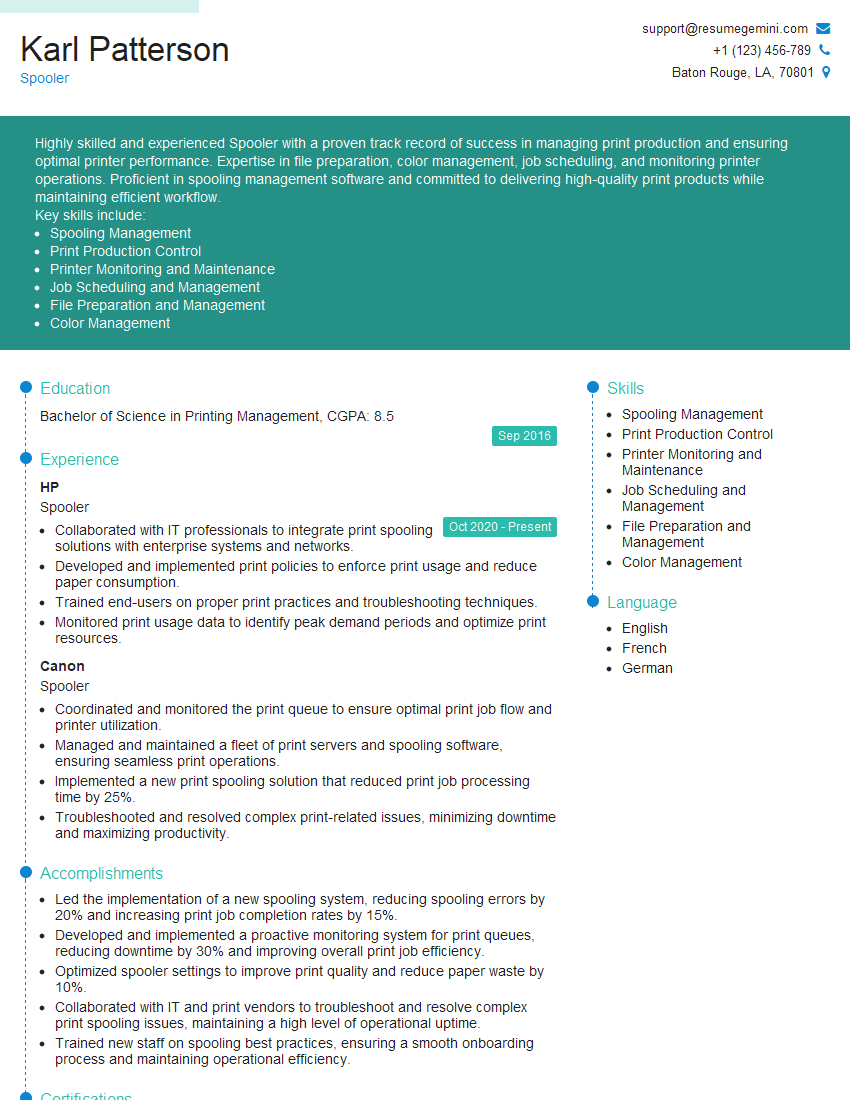
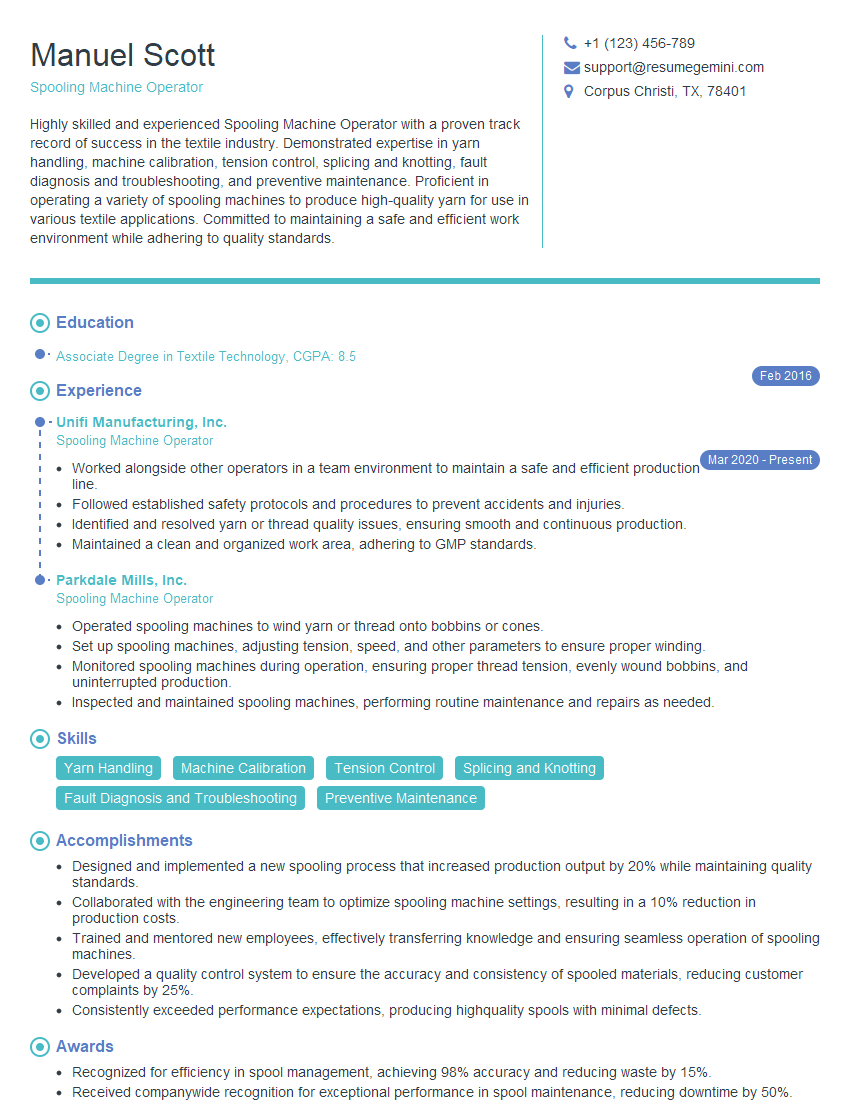
Mastering spooling and winding techniques is crucial for advancing your career in textile manufacturing, offering opportunities for specialized roles and increased earning potential. A strong resume is your key to unlocking these opportunities. Crafting an ATS-friendly resume, optimized for applicant tracking systems, is essential for getting your application noticed. ResumeGemini is a trusted resource to help you build a professional and impactful resume that highlights your skills and experience. Examples of resumes tailored to the Spooling and Winding field are available to help guide you through the process.





Explore more articles
Users Rating of Our Blogs
Share Your Experience
We value your feedback! Please rate our content and share your thoughts (optional).
What Readers Say About Our Blog
Very informative content, great job.
good