Feeling uncertain about what to expect in your upcoming interview? We’ve got you covered! This blog highlights the most important Stitching and Binding Operations interview questions and provides actionable advice to help you stand out as the ideal candidate. Let’s pave the way for your success.
Questions Asked in Stitching and Binding Operations Interview
Q 1. Explain the difference between saddle stitching and perfect binding.
Saddle stitching and perfect binding are two common methods for securing the pages of a book, but they differ significantly in their process and the resulting product. Saddle stitching involves folding sheets of paper in half and stapling them along the spine. Think of a typical magazine – that’s saddle stitched. It’s simple, cost-effective, and suitable for relatively thin documents. Perfect binding, on the other hand, involves gluing the edges of the pages together to create a smooth spine. This method is used for books with a higher page count and requires a more sophisticated process.
The key differences lie in the page count (saddle stitching is limited, perfect binding isn’t), the spine (saddle stitched spines are visible staples, perfect binding creates a smooth, glued spine), and the overall cost (saddle stitching is cheaper).
Imagine you’re making a booklet: for a short pamphlet with only a few pages, saddle stitching is perfect. However, for a novel with hundreds of pages, perfect binding is the better choice to create a more durable and professional-looking book.
Q 2. Describe the process of case binding.
Case binding is a high-end bookbinding method that produces a very durable and aesthetically pleasing book. It’s often used for high-quality books, textbooks, and journals. The process involves several steps:
- Section Sewing: The book’s sections (groups of folded sheets) are sewn together using different techniques, such as oversewing or side-sewing. This creates a strong, flexible spine.
- Adhesive Application: An adhesive is applied to the spine to secure the sewn sections.
- Case Making: A separate cover (the ‘case’) is created using heavy board and cloth covering, often with decorative elements like foil stamping or embossing.
- Case Attachment: The glued text block is then attached to the cover boards. This step requires precision and careful alignment.
- Trimming and Finishing: The book is trimmed to its final size, and any final finishing touches like headbands or endpapers are added.
Think of a classic hardcover novel; chances are it was case bound. It’s a more labor-intensive method than others, resulting in a longer production time and higher cost, but the quality is unmatched.
Q 3. What are the common types of stitching used in bookbinding?
Numerous stitching methods exist in bookbinding, each chosen based on the document’s thickness, desired aesthetic, and budget. Here are some of the most common:
- Saddle Stitch: As discussed earlier, this involves folding sheets and stapling them through the fold.
- Wire-O Binding: Double-loop wire is inserted through punched holes along the spine, offering a lay-flat feature.
- Spiral Binding (Coil Binding): Plastic or metal coils are inserted through punched holes, commonly seen in notebooks and calendars.
- Perfect Binding: Though primarily a binding method, the gluing process often involves pre-stitching the sections for added strength.
- Sewn Binding (various types including oversewing and side-sewing): Sections are sewn together using thread, creating a durable spine. This is a crucial step in case binding.
The choice of stitching method impacts the book’s flexibility, durability, and overall appearance. For example, sewn binding is best for heavier books that need to lay flat, whereas saddle stitching works well for lighter, less durable materials.
Q 4. How do you identify and troubleshoot common problems with a perfect binding machine?
Troubleshooting a perfect binding machine requires systematic checks and understanding of the machine’s workflow. Common problems include:
- Poor Glue Application: Uneven glue application leads to pages falling out. Check the glue tank level, nozzle settings, and the glue itself for consistency. A clogged nozzle is a common culprit.
- Incorrect Spine Preparation: The spine needs proper preparation to ensure good adhesion. Insufficient trimming or rough edges can hinder the bond. Check the trimming and roughening processes.
- Machine Misalignment: Problems with the rollers or other moving parts can cause misalignment leading to poor binding. Check for wear and tear, and ensure proper alignment according to the manufacturer’s specifications.
- Glue Type and Temperature: The wrong type or temperature of glue can impact its effectiveness. Consult the glue manufacturer’s instructions and check the machine’s temperature settings.
A step-by-step troubleshooting process might involve visually inspecting the glue application, checking the alignment of rollers and conveyors, verifying the glue temperature and type, and examining the spine preparation for any irregularities. A maintenance log is key for keeping track of issues and preventing future problems.
Q 5. What are the different types of adhesives used in bookbinding, and when would you choose each one?
Several adhesives are used in bookbinding, each with specific properties:
- PUR (Polyurethane Reactive): A strong, durable adhesive that creates a flexible, long-lasting bond. Excellent for perfect binding and case binding of high-quality books.
- EVA (Ethylene Vinyl Acetate): A thermoplastic hot melt adhesive that’s cost-effective and widely used. Suitable for applications where high flexibility isn’t critical, like some paperback books.
- Animal Glue: A traditional adhesive that’s environmentally friendly but can be more sensitive to moisture and temperature changes. Its use is more common in specialized or historical bookbinding.
- PVAc (Polyvinyl Acetate): A water-based adhesive, often used for less demanding binding applications, such as simple paperback books or pamphlets. It’s easier to clean up than hot melts.
The choice depends on the type of binding, budget, required durability, and environmental concerns. For instance, PUR is favored for high-quality hardcovers due to its flexibility and strength, while EVA is suitable for mass-market paperbacks where cost is a primary factor.
Q 6. What safety precautions should be taken while operating bindery machinery?
Safety is paramount when operating bindery machinery. Always follow these precautions:
- Proper Training: Never operate any machine without proper training. Understand the machine’s controls and safety features.
- Personal Protective Equipment (PPE): Wear appropriate PPE, including safety glasses, gloves, and hearing protection. Some machines may require additional protection.
- Machine Guards: Ensure all safety guards are in place before operating the machine. Never attempt to bypass safety features.
- Loose Clothing and Jewelry: Avoid wearing loose clothing or jewelry that could get caught in moving parts.
- Emergency Stop: Know the location of the emergency stop button and how to use it.
- Regular Maintenance: Regular maintenance helps prevent malfunctions and ensures safe operation.
Ignoring safety protocols can lead to serious injury. Always prioritize safety – it’s not just a rule, it’s a responsibility.
Q 7. How do you ensure the quality of stitched and bound products?
Ensuring the quality of stitched and bound products requires attention to detail throughout the entire process. This involves:
- Material Selection: Using high-quality paper and board is crucial for durability and appearance.
- Process Control: Consistent monitoring of each step ensures accurate stitching, gluing, and trimming.
- Quality Checks: Regular checks at each stage of the process identify and rectify any issues early on.
- Testing and Sampling: Testing the strength and durability of the finished product through samples prevents large-scale defects.
- Equipment Maintenance: Regular maintenance of binding equipment is crucial to maintaining consistent quality.
- Operator Skill: Well-trained operators contribute significantly to the quality of the final product.
Implementing a robust quality control system involving both visual inspection and functional testing helps maintain high standards and produce high-quality, durable books.
Q 8. What is the role of the spine in bookbinding?
The spine is the crucial backbone of a book, literally and figuratively. It’s the vertical edge where all the pages are bound together, forming a cohesive unit. Think of it as the spine of a human body – it provides structural support and holds everything in place. A strong and well-constructed spine is essential for the durability and longevity of a book, ensuring it can withstand repeated opening and closing without falling apart. The spine also provides the surface area for the title and author information to be displayed, hence its critical role in book identification.
Q 9. Describe the process of creating a cover for a casebound book.
Creating a casebound book cover is a multi-step process requiring precision and attention to detail. First, the cover boards (usually sturdy cardboard or chipboard) are cut to the precise dimensions of the book block (the gathered and sewn pages). These boards provide rigidity and protection. Next, the cover material (cloth, leather, or paper) is carefully measured and adhered to the boards using an adhesive suitable for the chosen material. This process ensures a smooth, professional finish. The book block is then glued to the cover boards. The headbands (decorative fabric strips at the top and bottom of the spine) are attached for aesthetic appeal and added protection for the spine. Finally, any additional embellishments, such as foil stamping or embossing, are applied to complete the cover.
Q 10. Explain the different types of covers used in bookbinding.
Book covers vary greatly in material and construction, influencing the book’s look, feel, and durability. Common types include:
- Casebound: The most durable, using boards covered in cloth, leather, or paper. Ideal for high-quality books and those expected to withstand much handling.
- Perfect Bound: Pages are glued together along the spine, then glued to a cover. Common for paperback books and magazines. Offers a flatter spine.
- Saddle Stitch: Pages are folded in half and stapled along the spine. Simple and cost-effective, best for small booklets or magazines with a low page count.
- Spiral Bound: Pages are punched with holes and bound with a plastic or metal comb. Offers easy page turning and lay-flat functionality, often used for calendars or notebooks.
- Wire-O Bound: Similar to spiral binding, but utilizes double-loop wire for a more professional and durable binding.
The choice of cover depends on factors such as budget, intended use, and desired aesthetic.
Q 11. What are the advantages and disadvantages of different binding methods?
Each binding method has its own set of advantages and disadvantages:
- Case Binding: Advantages: Durable, prestigious appearance, suitable for large books. Disadvantages: Expensive, complex process, not suitable for low page counts.
- Perfect Binding: Advantages: Cost-effective, suitable for medium page counts, flat spine. Disadvantages: Spine can be prone to cracking, pages can be easily damaged if heavily used.
- Saddle Stitch Binding: Advantages: Inexpensive, quick and easy. Disadvantages: Limited page count, spine is not very durable.
- Spiral/Wire-O Binding: Advantages: Pages lay flat, easy to turn pages, durable. Disadvantages: Not suitable for high-quality books, can be bulky.
Selecting the right method involves considering the book’s content, length, intended audience, and budget constraints.
Q 12. How do you measure the thickness of a book block for binding?
Accurately measuring the book block’s thickness is critical for accurate cover creation. A simple caliper is typically used, measuring the thickness of the folded and gathered pages. It’s crucial to measure at multiple points along the spine to account for any variations in paper thickness or density. The measurement is recorded in millimeters, often with the addition of a small tolerance to account for any adhesive used during cover attachment. For example, if the measurement is 20mm, we might add 1-2mm for glue, resulting in cover board measurements that accommodate both the book block and the adhesive.
Q 13. How do you handle different paper types and weights during the binding process?
Different paper types and weights require adjustments to the binding process. Heavier papers, like card stock, require more robust stitching and may need pre-scoring to avoid cracking during folding. Thinner papers, while easier to fold and stitch, may require more care to avoid tearing. The choice of adhesive is also crucial; certain glues work better with different paper types. For instance, a hot melt adhesive might be suitable for heavy paper, while a PVA glue might be preferred for thinner, more delicate sheets. Understanding the paper’s properties – absorption rate, tensile strength, and grain direction – allows for optimal machine settings and material selection to prevent jams and ensure a high-quality bind.
Q 14. What are the common causes of jams or misfeeds in stitching or binding machines?
Jams or misfeeds in stitching or binding machines are common issues, often stemming from several causes:
- Paper problems: Damaged, wrinkled, or excessively damp paper can easily cause jams. Incorrect paper alignment or misfeeds. Improper paper type for the machine.
- Machine malfunction: Worn parts, incorrect machine settings, lack of lubrication, or a build-up of debris in the machine can lead to jams.
- Operator error: Incorrect paper loading, improper feeding, or failing to clear jams promptly can exacerbate the issue.
- Material issues: Incorrectly sized or prepared book sections, issues with the glue application or type, or problems with the cover boards (e.g., warping).
Troubleshooting involves systematically checking each of these potential causes. Regular maintenance and operator training can significantly reduce these occurrences.
Q 15. Describe your experience with different types of finishing equipment.
My experience encompasses a wide range of finishing equipment, from basic to highly specialized machines. I’m proficient with various types of stitching machines, including saddle stitchers (perfect for magazines and brochures), wire-o binding machines (ideal for calendars and notebooks), and perfect binding machines (commonly used for books and journals). I’ve also worked extensively with cutting and creasing machines for precise paper handling, and automated collating systems that ensure accurate document assembly before binding. Furthermore, my experience includes operating three-knife trimmers for achieving clean, even edges after binding. Working with these machines requires a good understanding of their mechanics, safety protocols, and the specific settings needed to achieve the desired results for different projects.
- Saddle Stitchers: I’m skilled in adjusting stitch margins and ensuring consistent stitch depth for various paper weights.
- Perfect Binders: I can handle both adhesive application and book spine preparation for flawless binding.
- Wire-O Binding: I’m adept at selecting the correct wire gauge and ensuring even wire placement.
Career Expert Tips:
- Ace those interviews! Prepare effectively by reviewing the Top 50 Most Common Interview Questions on ResumeGemini.
- Navigate your job search with confidence! Explore a wide range of Career Tips on ResumeGemini. Learn about common challenges and recommendations to overcome them.
- Craft the perfect resume! Master the Art of Resume Writing with ResumeGemini’s guide. Showcase your unique qualifications and achievements effectively.
- Don’t miss out on holiday savings! Build your dream resume with ResumeGemini’s ATS optimized templates.
Q 16. How do you maintain and clean bindery machinery?
Maintaining bindery machinery is crucial for both operational efficiency and product quality. My maintenance routine includes regular cleaning, lubrication, and preventative checks. Daily cleaning involves removing paper dust and debris using compressed air and brushes. I carefully lubricate moving parts according to the manufacturer’s recommendations, paying close attention to avoid over-lubrication which can cause problems. Weekly checks involve inspecting belts, rollers, and other components for wear and tear. I also perform more comprehensive preventative maintenance according to a scheduled plan, which might include replacing worn parts or adjusting machine settings. This proactive approach minimizes downtime and prevents costly repairs. For instance, a simple cleaning of the glue rollers in a perfect binding machine can prevent glue smears and ensure clean binds. I meticulously document all maintenance activities for tracking and future reference.
Q 17. What is your experience with different types of binding glues?
I have experience with a variety of binding glues, each with its own properties and applications. For example, PUR (Polyurethane Reactive) glue is excellent for perfect binding due to its strong bond and durability, even with challenging paper types. It’s particularly useful for books requiring a long lifespan. Hot melt adhesives are faster and more cost-effective for simpler applications like saddle stitching, but might not be as durable. I understand the importance of selecting the right glue based on factors such as the type of paper, the binding method, and the desired level of durability. I have experience working with different glue viscosities and setting times, which allows me to adjust the machine settings for optimal performance. In addition, I’m familiar with the safety precautions associated with handling and using various types of binding glues, ensuring a safe work environment.
Q 18. What are your troubleshooting skills when dealing with binding machine malfunctions?
Troubleshooting binding machine malfunctions is a critical part of my role. My approach is systematic and starts with observing the problem. I carefully examine the machine for any visible signs of issues, such as jammed paper, worn parts, or loose connections. If the problem is not immediately apparent, I consult the machine’s manual and troubleshoot using a logical process of elimination. I might start by checking the power supply, followed by examining the settings and adjusting them as needed. I then move on to checking the various components, such as rollers, belts, and sensors. My experience allows me to quickly identify common problems and implement effective solutions. For instance, a misfeed in a saddle stitcher might be resolved by adjusting the paper guides, whereas a weak glue bond in a perfect binder might indicate the need to adjust the glue temperature or viscosity. I meticulously document all troubleshooting steps and solutions to aid future diagnosis.
Q 19. How familiar are you with different types of paper and their suitability for various binding methods?
Understanding paper properties is vital for successful binding. Different paper types have varying weights, thicknesses, and finishes, each impacting the binding process. For instance, lightweight paper is suitable for saddle stitching, while thicker papers may require perfect binding. Coated papers may present challenges with certain glues, requiring careful selection. I’m knowledgeable about different paper stocks, including offset, matte, glossy, and textured paper, and how their characteristics affect the outcome of different binding methods. I know how to match paper type with the appropriate binding technique to guarantee a high-quality end product. For example, a heavy-duty cover stock might be required for a perfect bound book for increased durability.
Q 20. Describe your experience working with large volumes of materials
I possess extensive experience in high-volume production environments. I’ve handled projects involving tens of thousands of pieces, requiring efficient workflow management and adherence to strict deadlines. My experience includes working with automated systems that enhance efficiency, such as high-speed collators and automated binding machines. I’m adept at organizing materials, managing inventory, and scheduling operations to meet production goals without compromising quality. In a recent large-scale project involving a high-volume book production run, meticulous planning and efficient teamwork helped us complete the project on schedule and to the client’s satisfaction. Effective use of time, proactive problem-solving, and clear communication are key to achieving success in high-volume projects.
Q 21. How do you ensure the consistent quality of your work across large batches?
Maintaining consistent quality across large batches requires a combination of meticulous attention to detail, regular quality checks, and proactive problem-solving. Before starting a large run, I perform thorough machine calibration and test runs to ensure consistent settings. During the process, I regularly inspect the output for any inconsistencies, addressing issues immediately to prevent large-scale defects. I also maintain detailed records of machine settings and material properties. If any discrepancies occur, I analyze the root cause and take corrective action to prevent recurrence. Using quality control checklists and regular spot checks helps me maintain consistency and meet the high standards expected. It’s similar to baking a large batch of cookies: you need to ensure all ingredients are measured correctly and the baking temperature remains consistent to maintain uniform quality across all cookies.
Q 22. Describe a time you had to solve a complex problem related to binding.
One challenging binding project involved a large-scale, high-end coffee table book with intricate, oversized pages and a unique binding style – a Japanese stab binding with a custom-designed cover. The complexity arose from the pages’ weight and size, making traditional stitching methods impractical and potentially damaging. The client also specified a tight deadline.
To solve this, I first meticulously analyzed the page weight and dimensions to determine the optimal stitch spacing and thread strength for the Japanese binding. We conducted several test runs with different thread types and stitch patterns, carefully measuring the binding’s strength and aesthetic appeal. We discovered that using a heavier-gauge thread and slightly modifying the traditional stitch pattern provided the necessary strength and durability without compromising the book’s elegant design. To manage the deadline, I implemented a parallel workflow, dividing the stitching process into smaller tasks assigned to different team members, ensuring a more efficient and timely completion.
The result was a stunning book that met the client’s expectations for both quality and aesthetics, demonstrating my ability to adapt traditional techniques to meet unique challenges. It also taught me the value of meticulous planning and efficient workflow management in complex binding projects.
Q 23. What are the key quality control checks you perform throughout the binding process?
Quality control in binding is a multi-step process that begins well before the actual binding. We perform checks at every stage:
- Pre-press: We verify that the pages are correctly collated, the paper is of acceptable quality and free from defects, and the page count matches the specification.
- Stitching: We check for consistent stitch spacing, secure stitching, and the absence of loose threads. Any misaligned pages are corrected immediately. Visual inspection and random sampling of the stitched sections ensure quality.
- Cover Attachment: We inspect for proper alignment and secure adhesion of the cover to the text block. We check for any gaps or unevenness in the cover attachment.
- Finishing: Final checks involve verifying that all finishing elements, such as embossing, foil stamping, or other add-ons, are correctly applied and are of high quality. We also inspect for any damage during the process.
- Packaging: Before the final packaging, the finished books undergo a final quality check to ensure no damage occurred. We inspect for correct identification, proper packaging, and overall visual appeal.
Throughout the process, detailed records are maintained, and any deviations from the quality standards are documented and addressed promptly.
Q 24. What are your experience with different types of covers (hard, soft, etc.)?
My experience encompasses a wide range of cover types, including hardcovers, softcovers, and specialty bindings. Hardcovers, typically used for high-end books and publications, involve case making—constructing a rigid cover from boards and fabric—and applying this case to the text block. I’m proficient in various case-making techniques, including the use of different types of boards, cloth, and adhesives. I understand the importance of choosing appropriate materials for durability, aesthetic appeal, and budget.
Softcovers, commonly used for magazines, paperbacks, and less expensive books, typically involve glue binding or saddle stitching. I’m experienced in determining the appropriate glue type and application method to ensure a secure and durable binding for different paper types and thicknesses. My experience extends to the creation of specialty softcovers using unique materials or embellishments.
Beyond these standard types, I’ve worked with numerous unique cover designs, including those requiring complex die-cutting, embossing, and specialized printing techniques.
Q 25. How familiar are you with different finishing techniques (e.g., embossing, foil stamping)?
I’m highly familiar with various finishing techniques that enhance the visual appeal and tactile quality of a book. Embossing, for example, creates raised or indented designs on the cover, adding texture and depth. Foil stamping uses heat and pressure to apply metallic or colored foil to the cover, resulting in a sophisticated and luxurious look. I understand the nuances of each technique, including the selection of appropriate dies, foils, and pressure settings to achieve optimal results. Other techniques I’m proficient in include:
- Spot UV Coating: Applying a glossy UV coating to specific areas of the cover for a visually striking effect.
- Debossing: The opposite of embossing, creating a recessed design.
- Die-cutting: Creating unique shapes and cutouts in the cover.
My expertise in these techniques allows me to create finished products that perfectly reflect the client’s design vision and target audience.
Q 26. Describe your understanding of print finishing workflow
The print finishing workflow begins with the printed sheets, which are collated and then prepared for binding. This may involve folding, gathering, stitching, or other operations depending on the type of binding. Following this, the text block is ready for cover attachment, where the prepared cover is affixed. Next comes the finishing stage, which includes processes like embossing, foil stamping, or laminating. Finally, the finished books are inspected, packaged, and prepared for shipment.
The workflow is highly dependent on the type of binding and the client’s specifications. A key aspect is ensuring a smooth flow between each stage. This often requires careful planning and coordination with other departments (printing, design, etc.) to minimize bottlenecks and meet deadlines.
Q 27. How do you manage deadlines and prioritize tasks in a fast-paced bindery environment?
In a fast-paced bindery environment, effective deadline management and task prioritization are critical. I use a combination of techniques:
- Prioritization Matrix: I employ a prioritization matrix (like an Eisenhower Matrix) to categorize tasks by urgency and importance. This ensures that critical tasks are addressed first.
- Project Scheduling: I use project scheduling tools to break down complex projects into smaller, manageable tasks with clear deadlines. This allows for better tracking of progress and identification of potential delays.
- Communication: Open communication with team members and clients is crucial. This enables proactive identification and resolution of potential issues before they escalate.
- Flexibility: The ability to adapt to unexpected changes and prioritize tasks dynamically is essential. This often requires a willingness to re-allocate resources and adjust schedules as needed.
My experience in managing multiple projects simultaneously under tight deadlines allows me to efficiently balance various tasks and deliver high-quality results on time.
Q 28. What are your salary expectations?
My salary expectations are in the range of [Insert Salary Range] per year. This is based on my experience of [Number] years in the industry, my proven expertise in various binding techniques, and my consistent record of exceeding expectations. I am confident that my skills and contributions will be a valuable asset to your team.
Key Topics to Learn for Stitching and Binding Operations Interview
- Machine Operation & Maintenance: Understanding the mechanics of various stitching and binding machines (e.g., saddle stitch, perfect bind, wire-o), their capabilities, limitations, and routine maintenance procedures.
- Material Selection & Handling: Knowledge of different paper types, cover stock, and binding materials, and their suitability for various projects. Includes understanding proper handling to prevent damage and ensure efficient processing.
- Quality Control & Troubleshooting: Identifying common stitching and binding defects (e.g., misaligned pages, crooked spines, improper glue application), and implementing solutions to maintain high-quality output. This includes understanding root cause analysis for recurring problems.
- Production Planning & Efficiency: Familiarity with workflow optimization, job scheduling, and managing production timelines to meet deadlines and optimize resource utilization.
- Safety Procedures & Regulations: Adherence to safety protocols related to machinery operation, material handling, and workplace safety regulations. Understanding the importance of personal protective equipment (PPE).
- Finishing Techniques: Knowledge of various finishing techniques like trimming, scoring, embossing, and lamination, and their impact on the final product’s aesthetic appeal and durability.
- Understanding different binding methods: A comprehensive understanding of various binding techniques, including their strengths, weaknesses, and appropriate applications (e.g., perfect binding, saddle stitching, spiral binding, case binding).
Next Steps
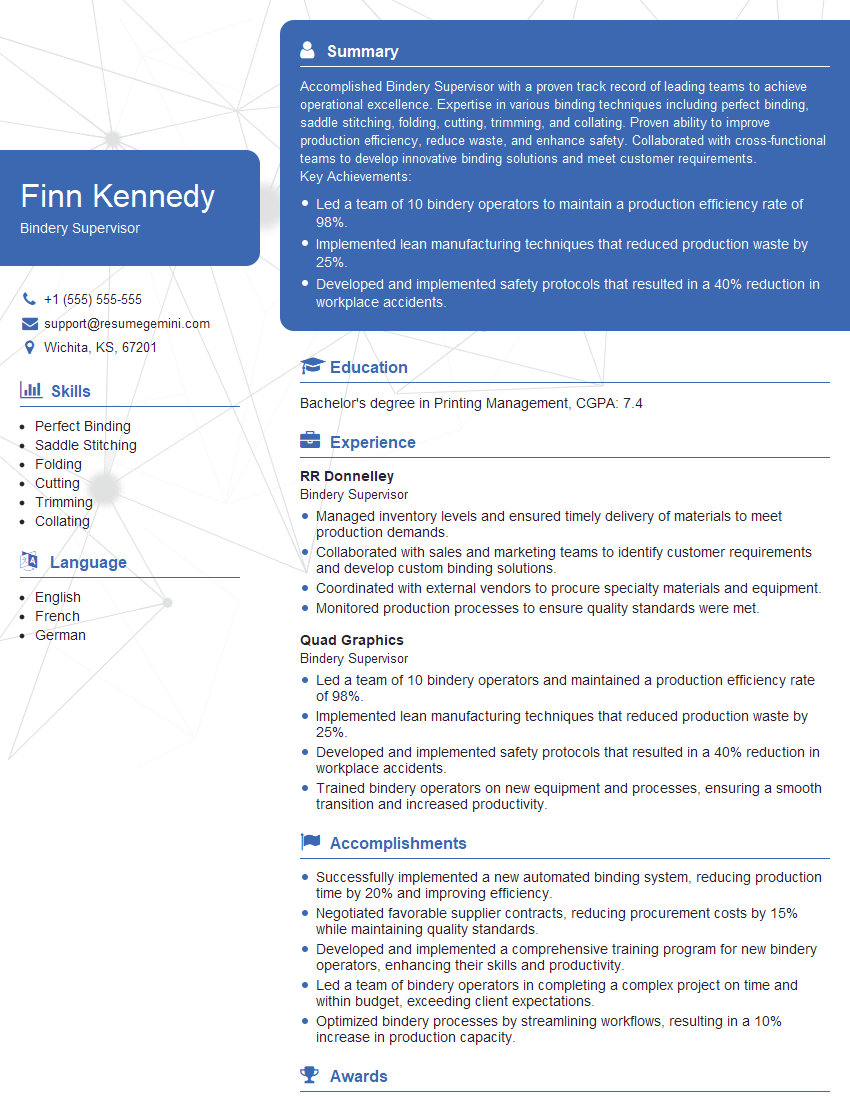
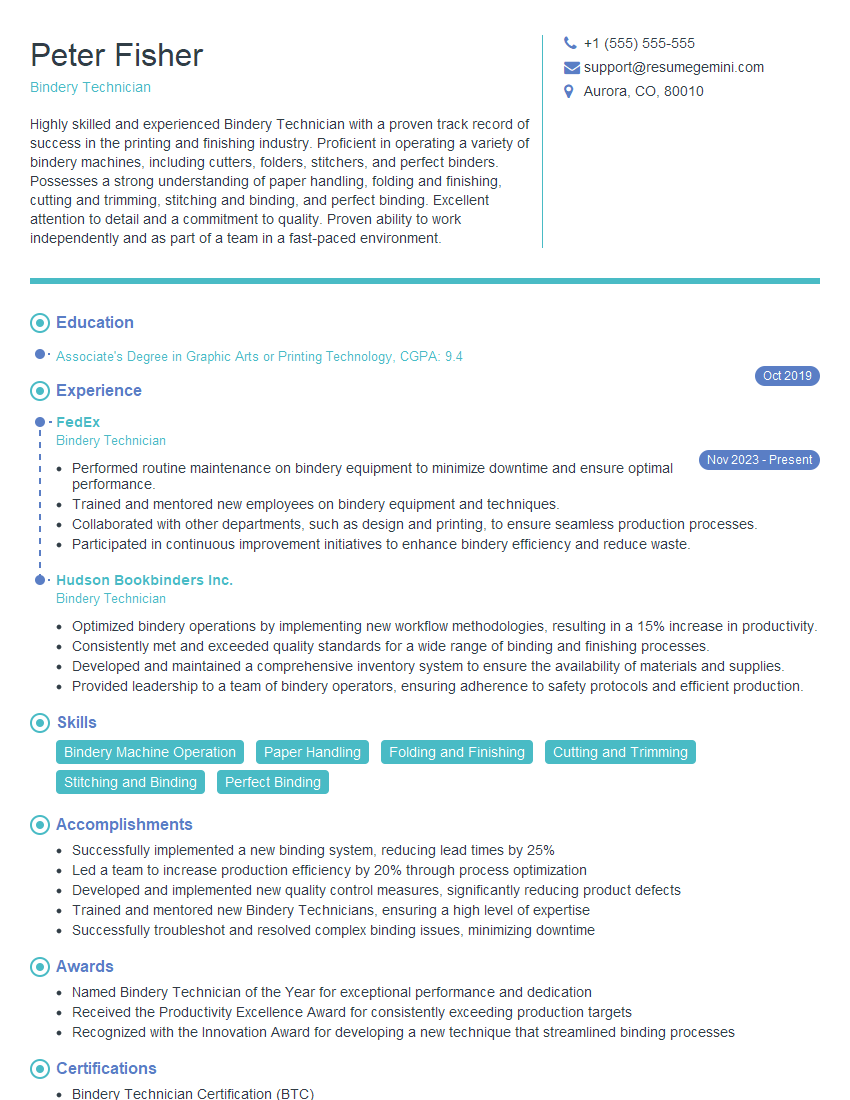
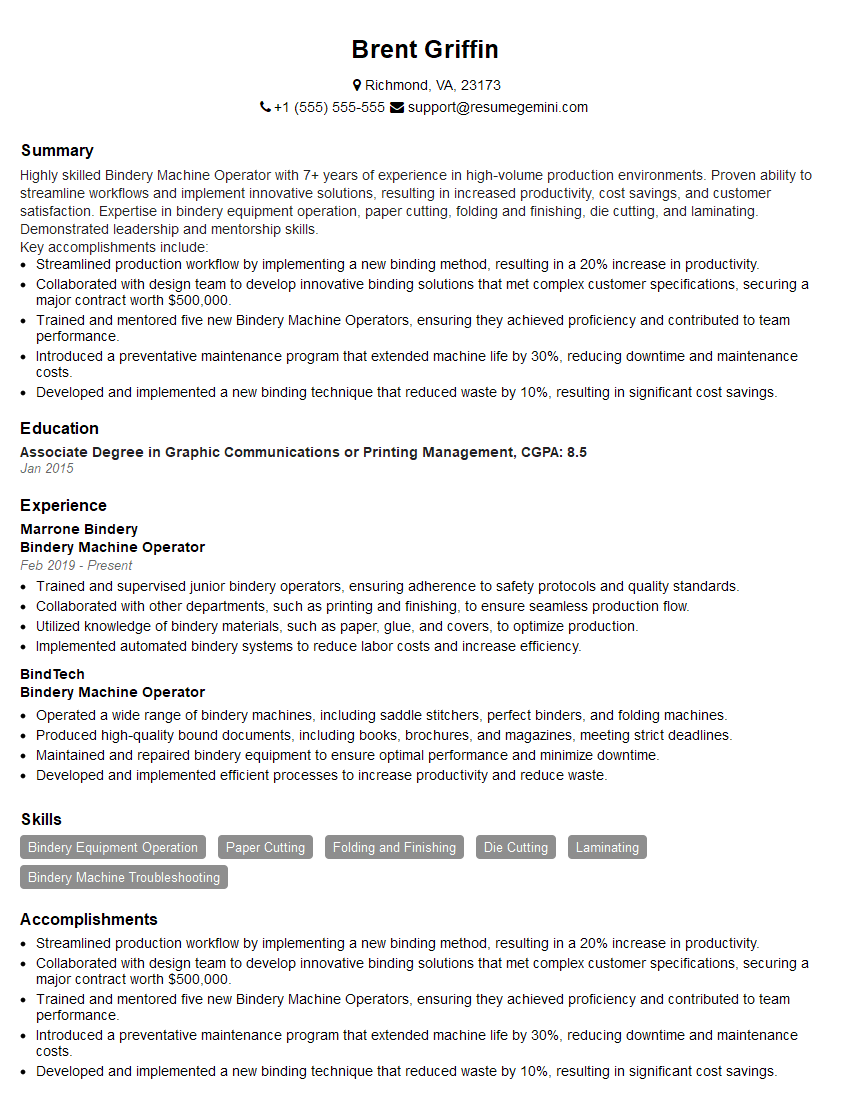
Mastering Stitching and Binding Operations opens doors to exciting career opportunities with growth potential in production management, quality control, and specialized finishing techniques. A strong resume is crucial for showcasing your skills and experience to potential employers. Creating an ATS-friendly resume is vital for maximizing your job prospects. ResumeGemini is a trusted resource to help you build a professional and effective resume that highlights your capabilities. Examples of resumes tailored to Stitching and Binding Operations are available to help guide you in showcasing your unique skillset. Take the next step towards your dream career today!
Explore more articles
Users Rating of Our Blogs
Share Your Experience
We value your feedback! Please rate our content and share your thoughts (optional).
What Readers Say About Our Blog
Hello,
we currently offer a complimentary backlink and URL indexing test for search engine optimization professionals.
You can get complimentary indexing credits to test how link discovery works in practice.
No credit card is required and there is no recurring fee.
You can find details here:
https://wikipedia-backlinks.com/indexing/
Regards
NICE RESPONSE TO Q & A
hi
The aim of this message is regarding an unclaimed deposit of a deceased nationale that bears the same name as you. You are not relate to him as there are millions of people answering the names across around the world. But i will use my position to influence the release of the deposit to you for our mutual benefit.
Respond for full details and how to claim the deposit. This is 100% risk free. Send hello to my email id: [email protected]
Luka Chachibaialuka
Hey interviewgemini.com, just wanted to follow up on my last email.
We just launched Call the Monster, an parenting app that lets you summon friendly ‘monsters’ kids actually listen to.
We’re also running a giveaway for everyone who downloads the app. Since it’s brand new, there aren’t many users yet, which means you’ve got a much better chance of winning some great prizes.
You can check it out here: https://bit.ly/callamonsterapp
Or follow us on Instagram: https://www.instagram.com/callamonsterapp
Thanks,
Ryan
CEO – Call the Monster App
Hey interviewgemini.com, I saw your website and love your approach.
I just want this to look like spam email, but want to share something important to you. We just launched Call the Monster, a parenting app that lets you summon friendly ‘monsters’ kids actually listen to.
Parents are loving it for calming chaos before bedtime. Thought you might want to try it: https://bit.ly/callamonsterapp or just follow our fun monster lore on Instagram: https://www.instagram.com/callamonsterapp
Thanks,
Ryan
CEO – Call A Monster APP
To the interviewgemini.com Owner.
Dear interviewgemini.com Webmaster!
Hi interviewgemini.com Webmaster!
Dear interviewgemini.com Webmaster!
excellent
Hello,
We found issues with your domain’s email setup that may be sending your messages to spam or blocking them completely. InboxShield Mini shows you how to fix it in minutes — no tech skills required.
Scan your domain now for details: https://inboxshield-mini.com/
— Adam @ InboxShield Mini
Reply STOP to unsubscribe
Hi, are you owner of interviewgemini.com? What if I told you I could help you find extra time in your schedule, reconnect with leads you didn’t even realize you missed, and bring in more “I want to work with you” conversations, without increasing your ad spend or hiring a full-time employee?
All with a flexible, budget-friendly service that could easily pay for itself. Sounds good?
Would it be nice to jump on a quick 10-minute call so I can show you exactly how we make this work?
Best,
Hapei
Marketing Director
Hey, I know you’re the owner of interviewgemini.com. I’ll be quick.
Fundraising for your business is tough and time-consuming. We make it easier by guaranteeing two private investor meetings each month, for six months. No demos, no pitch events – just direct introductions to active investors matched to your startup.
If youR17;re raising, this could help you build real momentum. Want me to send more info?
Hi, I represent an SEO company that specialises in getting you AI citations and higher rankings on Google. I’d like to offer you a 100% free SEO audit for your website. Would you be interested?
Hi, I represent an SEO company that specialises in getting you AI citations and higher rankings on Google. I’d like to offer you a 100% free SEO audit for your website. Would you be interested?
good