The thought of an interview can be nerve-wracking, but the right preparation can make all the difference. Explore this comprehensive guide to System Simulation and Modeling interview questions and gain the confidence you need to showcase your abilities and secure the role.
Questions Asked in System Simulation and Modeling Interview
Q 1. Explain the difference between continuous and discrete-event simulation.
The core difference between continuous and discrete-event simulation lies in how they model time and system changes. Continuous simulation models systems where changes occur continuously over time. Think of it like a smoothly flowing river – the water level changes constantly. These models typically use differential equations to describe the system’s behavior. Examples include simulating chemical reactions, fluid dynamics, or the trajectory of a spacecraft. In contrast, discrete-event simulation models systems where changes occur at specific points in time, triggered by events. Imagine a factory assembly line – changes only happen when a part arrives, an operation is completed, or a product leaves the line. Discrete-event simulation uses events and their timing to update the system’s state.
Let’s illustrate with an example: Simulating a traffic intersection. A continuous simulation might model the flow of traffic using differential equations to describe vehicle density and speed. A discrete-event simulation would model individual vehicles arriving at the intersection, waiting at lights, and proceeding through, with changes occurring at the discrete moments when a vehicle arrives or the light changes.
Q 2. Describe your experience with various simulation software packages (e.g., MATLAB, Simulink, AnyLogic, Arena).
My experience with simulation software is extensive, encompassing both general-purpose and specialized packages. I’ve worked extensively with MATLAB and Simulink for modeling and simulating dynamic systems, leveraging their powerful numerical solvers and visualization capabilities. For instance, I used Simulink to model and analyze the control system for a robotic arm, simulating its response to various commands and disturbances. I am also proficient in AnyLogic, which I have employed for agent-based modeling and simulation of complex systems, such as supply chains and logistics networks. A recent project involved simulating the impact of different warehouse layouts on overall throughput using AnyLogic’s rich agent-based features. Further, I’ve utilized Arena for discrete-event simulations of manufacturing processes and queuing systems, focusing on optimizing production schedules and resource allocation. In one project, I used Arena to simulate a call center’s performance under various staffing scenarios, resulting in significant improvements in call handling times and customer satisfaction.
Q 3. What are the key steps in the system simulation process?
The system simulation process follows a structured approach. It starts with problem definition: clearly articulating the system to be simulated and the questions to be answered. Next comes model conceptualization, where you decide on the appropriate modeling approach (continuous, discrete-event, agent-based, etc.), identify key variables, and define relationships between them. Model building involves translating the conceptual model into a formal representation using chosen software. This usually involves coding, defining parameters, and setting up the simulation environment. Model verification checks that the model is correctly representing the intended system behavior. Model validation ensures the model accurately reflects the real-world system. Then comes experimental design, where you determine the simulation scenarios to run and the data to collect. The simulation runs themselves produce the necessary data. Finally, analysis and interpretation involve drawing meaningful conclusions from the simulation results and reporting findings.
Q 4. How do you validate and verify a simulation model?
Validation and verification are crucial steps to ensure the credibility of a simulation model. Verification is the process of ensuring the model is correctly implemented – does the software correctly represent the conceptual model? This often involves techniques like code reviews, unit testing, and debugging. For example, verifying a queueing model means ensuring the queueing discipline (FIFO, LIFO, etc.) is correctly coded. Validation assesses the model’s accuracy in representing the real system. This usually involves comparing simulation outputs to real-world data or expert judgment. Techniques include face validation (experts judging model plausibility), comparing simulation results to historical data, and statistical analysis to assess the goodness of fit between simulated and real-world observations. In a manufacturing simulation, validation might involve comparing simulated production rates to actual production data from the factory floor. Discrepancies highlight areas needing refinement in the model.
Q 5. Explain the concept of model calibration and its importance.
Model calibration is the process of adjusting model parameters to improve the agreement between simulation outputs and real-world data. It’s an iterative process that involves comparing simulation results to actual data, identifying discrepancies, adjusting parameters based on those discrepancies, and re-running the simulation. Think of it like tuning a musical instrument: you adjust the parameters (tuning pegs) until the sound (simulation output) matches the desired notes (real-world data). The importance of calibration lies in improving the model’s predictive power and its ability to provide accurate insights. A well-calibrated model leads to more reliable conclusions and better informed decision-making. For example, in a hydrological model, parameters representing soil properties and rainfall infiltration rates would be adjusted to match observed streamflow data.
Q 6. What are some common sources of error in system simulation?
Errors in system simulation can stem from various sources. Incorrect model formulation is a significant risk—a flawed conceptual model will inevitably lead to inaccurate results. Data errors, such as using inaccurate or incomplete input data, can also lead to flawed outputs. Coding errors can introduce bugs that affect simulation accuracy. Simplifications and assumptions made during model development are a common source of error; all models are inherently simplifications of reality. Random number generator issues can affect stochastic simulations; poor quality random number generators can lead to biased results. Insufficient model validation can result in models that are not representative of the real system. A common example is using overly simplistic assumptions on human behavior in an agent-based simulation.
Q 7. How do you handle uncertainty and variability in your models?
Handling uncertainty and variability is crucial for building robust and realistic models. We use several methods: Monte Carlo simulation involves running the simulation many times, each with different random inputs based on probability distributions reflecting uncertainty in the parameters. This provides a range of possible outcomes, giving a more realistic picture than a single simulation run. Sensitivity analysis helps identify parameters with the largest impact on the model’s output. This allows focusing calibration efforts and further investigation on the most influential factors. Stochastic modeling incorporates probabilistic elements directly into the model, allowing for variability in the system’s behavior. This is especially important when dealing with random events. For example, in a supply chain simulation, we might use probability distributions to model lead times, demand variability, and equipment failure rates. This approach provides valuable insights into the system’s robustness and resilience under various scenarios.
Q 8. Describe your experience with different simulation modeling techniques (e.g., Monte Carlo, agent-based).
My experience encompasses a wide range of simulation modeling techniques. I’ve extensively used Monte Carlo simulation for projects involving uncertainty quantification, such as predicting project completion times given variable task durations. For example, in a software development project, I used Monte Carlo to model the impact of potential delays in individual sprints on the overall project timeline, generating a probability distribution of possible completion dates. Agent-based modeling (ABM) has been crucial in simulating complex systems with interacting agents, like customer behavior in a market. In one project, I developed an ABM to simulate the spread of a new product in a social network, considering factors like individual adoption rates, word-of-mouth effects, and marketing campaigns. Discrete-event simulation (DES) is another strong area of my expertise. I’ve employed DES to model manufacturing processes, optimizing production flow and resource allocation to minimize bottlenecks. Finally, I’m also proficient in system dynamics modeling, which is particularly useful for understanding feedback loops in complex systems, such as population growth or environmental changes. I’ve applied this to modelling the impact of climate change on agricultural yields.
Q 9. How do you choose the appropriate simulation method for a given problem?
Choosing the right simulation method depends heavily on the problem’s characteristics. First, we need to define the problem’s scope and identify the key variables and their relationships. Then, we consider the level of detail required. For example, if we’re dealing with a system with many interacting entities, an agent-based model would be more suitable than a simple analytical model. If uncertainty is a major concern, Monte Carlo simulation is ideal. If we’re analyzing a system with distinct events occurring over time, then discrete-event simulation is a good choice. We also assess the computational resources available and the complexity of the relationships between system components. Finally, the available data and the model’s intended purpose greatly influence the selection. For instance, modeling the spread of an epidemic might require an ABM simulating individual interactions, while optimizing a supply chain might be efficiently handled by DES focusing on event sequences and resource allocation.
Q 10. Explain the concept of sensitivity analysis in simulation.
Sensitivity analysis is crucial in simulation because it helps us understand how changes in input variables affect the model’s output. Essentially, we systematically vary the inputs (e.g., parameters, initial conditions) and observe how the output changes. This allows us to identify which inputs are most influential in shaping the model’s behavior. For instance, in a financial model, we might run sensitivity analysis to see how changes in interest rates affect the profitability of an investment. We can use several techniques: One common approach is to vary each input individually while holding others constant (one-at-a-time method). Another approach is to use variance-based methods to assess the relative importance of multiple inputs simultaneously. The results of a sensitivity analysis are usually presented graphically (e.g., tornado diagrams) to provide a clear visualization of which parameters have the most significant impact. This helps to prioritize efforts in data collection and model refinement, focusing on the most impactful variables. This is extremely important for resource allocation and decision-making.
Q 11. How do you optimize a simulation model for performance?
Optimizing a simulation model for performance involves several strategies. First, we need to ensure the model is correctly designed; this includes efficient data structures and algorithms. Secondly, we can employ techniques such as code profiling to pinpoint performance bottlenecks. Profiling tools help identify computationally expensive parts of the code which can then be optimized. Third, model simplification, by reducing the level of detail where appropriate, can significantly improve performance. This involves identifying and removing unnecessary variables or reducing the resolution of certain elements without significantly compromising accuracy. Fourth, parallel and distributed computing can be employed to distribute the computational load across multiple processors or machines, drastically reducing simulation run times, especially for large-scale models. Finally, choosing appropriate simulation software with optimized libraries and solvers can also enhance efficiency.
Q 12. Describe your experience with parallel and distributed simulation.
I have significant experience with parallel and distributed simulation. In one project involving the simulation of a large-scale transportation network, we used a distributed approach to simulate traffic flow across different regions concurrently, significantly reducing the simulation time. We used Message Passing Interface (MPI) to coordinate the communication and data exchange between the different processors. Parallel simulation techniques, such as time-parallel simulation, allow for the exploration of different time segments in parallel, also improving efficiency. This involves splitting the simulation time into segments and solving them concurrently. Choosing the right parallel approach depends on the characteristics of the model and the available hardware. For example, if the model involves many independent processes, a data-parallel approach (e.g., using GPUs) may be the most efficient. However, if interactions between processes are significant, a more sophisticated approach may be required. Careful consideration must be given to the communication overhead which can negate performance benefits.
Q 13. What are the limitations of system simulation?
While system simulation is a powerful tool, it has limitations. One significant limitation is the inherent simplification of reality. Models are always abstractions of complex systems, and neglecting certain factors can lead to inaccurate results. The accuracy of a simulation is heavily dependent on the quality and quantity of the input data. Garbage in, garbage out is a well-known maxim in this field. Another limitation is the computational cost, especially for large and complex systems. Simulation can be computationally intensive, especially when dealing with high-dimensional models or long simulation horizons. Finally, the validation and verification of simulation models can be challenging. Ensuring that the model accurately represents the real-world system and that the simulation code is free of errors requires careful planning and rigorous testing. The interpretation of results can also be complex and require substantial expertise to avoid misinterpretations.
Q 14. How do you present simulation results effectively?
Effective presentation of simulation results is key to conveying insights and informing decision-making. I use a combination of techniques to achieve this. First, I always start with a clear summary of the model and its assumptions. Then, I use a combination of visual aids such as charts, graphs, and animations to present the key findings clearly and concisely. For instance, I might use histograms to show the probability distributions of outputs, time series plots to illustrate changes over time, and scatter plots to explore correlations between variables. Tables can be used to present numerical results in a well-organized format. I avoid overly technical jargon and tailor the presentation to the audience’s level of understanding. Finally, I emphasize the implications of the findings and suggest concrete recommendations based on the simulation results. The ultimate goal is to make the results readily understandable and actionable for the decision-makers.
Q 15. Explain your experience with data acquisition and preprocessing for simulation.
Data acquisition and preprocessing are crucial first steps in any successful simulation project. It involves collecting raw data from various sources – sensors, databases, experiments – and transforming it into a usable format for your simulation model. Think of it like preparing ingredients before cooking a complex dish.
My experience encompasses various techniques. For instance, I’ve worked with sensor data from industrial processes, where noise reduction and signal filtering were vital. I used techniques like moving averages and Kalman filters to smooth out the noisy signals and extract meaningful trends. In other projects, I’ve dealt with large datasets requiring dimensionality reduction using Principal Component Analysis (PCA) to manage computational complexity and improve model accuracy. Data cleaning, handling missing values (through imputation methods like k-Nearest Neighbors), and outlier detection are all standard procedures I employ. For example, I once worked on a project simulating traffic flow where detecting and handling outliers (e.g., extremely slow vehicles due to accidents) was crucial to prevent skewing the simulation results.
Finally, data needs to be formatted correctly for the chosen simulation software or language. This might involve converting data formats (e.g., from CSV to MATLAB’s .mat format), scaling variables to appropriate ranges, and ensuring data consistency.
Career Expert Tips:
- Ace those interviews! Prepare effectively by reviewing the Top 50 Most Common Interview Questions on ResumeGemini.
- Navigate your job search with confidence! Explore a wide range of Career Tips on ResumeGemini. Learn about common challenges and recommendations to overcome them.
- Craft the perfect resume! Master the Art of Resume Writing with ResumeGemini’s guide. Showcase your unique qualifications and achievements effectively.
- Don’t miss out on holiday savings! Build your dream resume with ResumeGemini’s ATS optimized templates.
Q 16. Describe your experience with model-based design.
Model-based design (MBD) is a powerful approach to system development where a mathematical model serves as the central artifact throughout the entire lifecycle, from initial design to implementation and verification. It’s like having a blueprint for a building that you constantly refine and test before actually starting construction.
My experience with MBD includes using tools like Simulink and MATLAB. I’ve built models ranging from simple control systems to complex, multi-domain systems incorporating mechanical, electrical, and hydraulic components. The key advantage is the ability to simulate and test the design early in the development process, identifying potential flaws and optimizing performance before committing to expensive physical prototypes. For example, I once used MBD to design a control system for a robotic arm. Simulating different control algorithms within Simulink allowed us to identify the optimal controller before physically implementing it, saving considerable time and resources.
MBD also facilitates automated code generation, reducing development time and ensuring code consistency. This is particularly beneficial in embedded systems applications where generating efficient and reliable code is paramount.
Q 17. How do you integrate simulation models with other systems?
Integrating simulation models with other systems is crucial for creating holistic and realistic simulations. This often involves using Application Programming Interfaces (APIs) or co-simulation techniques.
APIs allow different software components to communicate and exchange data. I’ve used APIs to connect simulation models with databases (for real-time data input), visualization tools (for interactive displays of results), and other software applications (e.g., connecting a weather simulation to a traffic simulation to study their interdependence). For example, I used a RESTful API to integrate a traffic simulation model with a real-time traffic data feed from a city’s transportation management system.
Co-simulation involves running multiple simulation models concurrently, where each model simulates a different aspect of the overall system. This is particularly useful when dealing with complex, heterogeneous systems where different parts are best modeled using different tools or approaches. I’ve used co-simulation techniques to integrate a mechanical simulation of a vehicle’s chassis with a control system simulation running in a separate environment, allowing for a more accurate representation of the entire system’s behavior.
Q 18. What are your preferred methods for debugging and troubleshooting simulation models?
Debugging and troubleshooting simulation models can be challenging. My approach involves a systematic process that includes:
- Verification and Validation: I carefully verify the model’s structure and equations against the underlying theory or specifications. Validation involves comparing simulation results with real-world data to assess accuracy.
- Modular Design: Breaking down complex models into smaller, manageable modules makes it easier to isolate and identify problem areas.
- Logging and Monitoring: Thorough logging of variables during simulation runs allows for the identification of unexpected behavior or inconsistencies. Visualization tools are also essential for tracking variables and identifying anomalies.
- Step-by-step Execution: Using debuggers to step through the model’s execution line by line helps pinpoint the source of errors.
- Sensitivity Analysis: This technique helps identify parameters that have a large impact on the model’s behavior, assisting in focusing debugging efforts.
For instance, in a recent project, I discovered a modeling error through careful examination of simulation logs which indicated an unexpected surge in a specific variable. This led to the correction of a formula in one of the modules.
Q 19. Explain your understanding of different types of simulation models (e.g., deterministic, stochastic).
Simulation models can be broadly classified into deterministic and stochastic models. Deterministic models produce the same output for a given input, as their behavior is completely predictable. Imagine a simple calculator; the same inputs always give the same output. Stochastic models, on the other hand, incorporate randomness. Their output varies even with the same input, reflecting real-world uncertainties. Think of simulating weather; even with the same initial conditions, the outcome might vary due to inherent randomness.
Other types include:
- Continuous Models: Variables change continuously over time (e.g., simulating fluid flow).
- Discrete Models: Variables change at discrete points in time (e.g., simulating a queueing system).
- Agent-Based Models: Simulate the interactions of individual agents within a system (e.g., simulating traffic using individual vehicle agents).
Choosing the appropriate model type depends heavily on the system being simulated and the level of detail and accuracy required. A simple pendulum might be modeled deterministically, while a financial market would require a stochastic approach.
Q 20. How do you handle complex system interactions in your simulations?
Handling complex system interactions effectively is paramount in system simulation. My approach focuses on:
- Modular Design: Decomposing the system into interacting modules simplifies the modeling and analysis of individual components and their interactions.
- Co-simulation: Combining different simulation tools and techniques helps model distinct components efficiently and accurately, later integrating them into a unified simulation.
- Data Exchange Standards: Employing standardized data exchange formats (e.g., Functional Mockup Interface (FMI)) allows for seamless integration of modules developed using different tools.
- System Dynamics Modeling: This approach is ideal for capturing feedback loops and complex interactions between different system components, highlighting causal relationships.
For example, in a simulation of a power grid, I might use a combination of power flow analysis tools for the grid itself, and detailed models for individual generators and loads that interact dynamically within the system. Careful consideration of the timing and synchronization of data exchange between those models is crucial to obtain reliable results.
Q 21. Describe your experience with different simulation languages (e.g., Python, C++, Java).
My experience spans several simulation languages, each with strengths in different areas:
- Python: Python’s versatility and extensive libraries (e.g., SimPy, Pyomo) make it excellent for prototyping, agent-based modeling, and discrete-event simulations. Its readability enhances collaboration and maintainability.
- C++: C++ offers superior performance for computationally intensive simulations, making it suitable for real-time applications or simulations with large datasets requiring speed optimization. I’ve used it for building high-performance simulations of complex physical systems.
- Java: Java’s platform independence and robust object-oriented features are well-suited for building complex, large-scale simulations requiring modularity and scalability. I’ve utilized it in projects requiring distributed simulations across multiple machines.
The choice of language depends on the project’s specific needs, considering factors like performance requirements, team expertise, available libraries, and maintainability.
//Example C++ code snippet for a simple simulation loop:for (int i = 0; i < 1000; ++i) { // Simulation logic updateState();}
Q 22. How do you ensure the reproducibility of your simulation results?
Reproducibility in simulation is paramount for validating results and ensuring consistent behavior. It's like baking a cake – you want the same delicious result every time, following the same recipe. We achieve this through meticulous documentation and version control.
Detailed Documentation: Every step of the simulation process, from model creation to parameter settings and random number generation, needs to be meticulously documented. This includes the software used, versions of libraries, and any pre-processing steps applied to the input data. Think of it as a detailed recipe for your simulation.
Version Control Systems (e.g., Git): Using a version control system is essential for tracking changes to the simulation code and input data. This allows us to easily revert to previous versions if needed and compare different iterations. It's like having a history log of every change made to your cake recipe.
Seed Values for Random Number Generators: When randomness is involved (e.g., stochastic models), we set a seed value for the random number generator. This ensures that the same sequence of random numbers is generated each time the simulation is run, making the results consistent. It's like using the same bag of flour and sugar every time you bake.
Standardized Input Data: Using a standardized format for input data, such as CSV or JSON, avoids ambiguity and ensures consistency. This is similar to using standard measuring cups and spoons for your ingredients.
Q 23. What are your experience with different types of input data for simulation?
Simulation input data can take many forms, each with its strengths and weaknesses. The choice depends heavily on the system being modeled.
Experimental Data: This is real-world data collected through experiments or observations. For example, in traffic simulation, we might use historical traffic flow data. The advantage is realism, but it can be noisy and incomplete.
Simulated Data: This data is generated by another simulation model, often used in hierarchical or coupled simulations. For instance, a weather simulation might provide input for a power grid simulation.
Synthetic Data: This data is artificially generated, often based on statistical distributions or probabilistic models. We use this when real data is scarce or unavailable. For example, we could model customer arrival times at a bank using a Poisson distribution.
Parameter Sweeps: Instead of fixed values, we can systematically vary input parameters across a range to explore the model's sensitivity to different conditions. This helps to understand the model's robustness and identify critical parameters.
Proper data cleaning, validation, and preprocessing are crucial steps regardless of the data type. We need to ensure data quality and consistency before using it in our simulations. Imagine baking with spoiled ingredients!
Q 24. Explain your understanding of different performance metrics used in system simulation.
Performance metrics in system simulation help quantify the system's behavior and evaluate its effectiveness. The choice of metrics depends on the specific goals of the simulation.
Throughput: Measures the amount of work completed per unit of time. In a manufacturing simulation, this might be the number of units produced per hour.
Latency: Measures the delay between the start and completion of a task. In a network simulation, this could be the time it takes for a packet to travel from source to destination.
Utilization: Measures how much of a resource is being used. In a server simulation, this might be the percentage of time a server is busy processing requests.
Queue Length: Measures the number of entities waiting in a queue. In a call center simulation, this is the number of callers waiting on hold.
Cost: Measures the total cost associated with the system's operation. This could include production costs, energy consumption, or labor costs.
These metrics are often combined and analyzed to provide a comprehensive picture of the system's performance.
Q 25. How do you manage large and complex simulation projects?
Managing large and complex simulation projects requires a structured approach, much like managing a large construction project.
Modular Design: Breaking down the system into smaller, manageable modules simplifies development, testing, and debugging. It's like building a house room by room instead of all at once.
Version Control: As mentioned earlier, using a version control system is essential for tracking changes and coordinating the efforts of multiple team members.
Parallel Computing: For computationally intensive simulations, we leverage parallel computing techniques to reduce runtime. Think of it as having multiple workers build the house simultaneously.
Automated Testing: Implementing automated tests helps ensure the accuracy and reliability of the simulation code. This is like regularly inspecting the building materials and structure during construction.
Project Management Tools: Using project management tools (e.g., Jira, Trello) helps track progress, manage tasks, and facilitate communication among team members.
Effective communication and collaboration are crucial for success in large-scale projects. Regular meetings and clear documentation are necessary to keep everyone on the same page.
Q 26. Describe a challenging simulation project you worked on and how you overcame the challenges.
One challenging project involved simulating a large-scale supply chain network for a global logistics company. The complexity arose from the vast number of nodes (warehouses, factories, distribution centers), the intricate network structure, and the stochastic nature of demand and transportation times.
The biggest challenge was ensuring the accuracy and efficiency of the simulation. The sheer size of the network resulted in long simulation runtimes. We overcame this by:
Model Simplification: We carefully analyzed the network and identified areas where simplification could be made without sacrificing accuracy. This involved aggregating some smaller nodes into larger ones and using approximate models for less critical parts of the network.
Parallel Computing: We leveraged parallel processing capabilities to significantly reduce the simulation runtime.
Smart Data Handling: We implemented efficient data structures and algorithms to reduce memory consumption and improve performance.
The project was successful, delivering valuable insights into the company's supply chain efficiency and resilience. It highlighted the importance of a combination of modeling expertise, computational power, and efficient data handling techniques in tackling complex simulation problems.
Q 27. What are the ethical considerations involved in system simulation?
Ethical considerations in system simulation are crucial to ensure responsible and beneficial application of this powerful tool. Just like any powerful technology, simulations can be misused.
Bias and Fairness: Simulations can perpetuate or amplify biases present in the input data or model assumptions. We need to be mindful of potential biases and actively work to mitigate them. For instance, a hiring algorithm trained on biased data might unfairly disadvantage certain groups.
Transparency and Explainability: The simulation model and its assumptions should be transparent and easily understood by stakeholders. This helps build trust and accountability.
Data Privacy: If the simulation uses sensitive data, it's crucial to protect individual privacy and comply with relevant data protection regulations.
Misuse and Misinterpretation: The results of a simulation should be interpreted carefully and not used to justify unethical or harmful actions. For example, a simulation predicting a catastrophic event shouldn't be used to spread panic unnecessarily.
Ethical considerations require a proactive and responsible approach throughout the simulation lifecycle, from model design to result interpretation and communication.
Q 28. How do you stay up-to-date with the latest advancements in system simulation?
Staying current in the rapidly evolving field of system simulation requires a multifaceted approach.
Conferences and Workshops: Attending conferences (e.g., Winter Simulation Conference) and workshops allows interaction with leading researchers and practitioners, exposure to cutting-edge techniques, and networking opportunities.
Publications: Regularly reading journals (e.g., ACM Transactions on Modeling and Computer Simulation) and conference proceedings keeps me abreast of the latest research findings and methodologies.
Online Courses and Tutorials: Numerous online platforms (e.g., Coursera, edX) offer courses and tutorials on various aspects of system simulation, allowing for continuous learning.
Professional Networks: Engaging in professional networks (e.g., INFORMS) provides access to online forums, discussions, and expert advice.
Open Source Projects: Contributing to or closely following open-source simulation projects exposes me to innovative approaches and collaborative development practices.
Continuous learning is essential in this dynamic field to stay competitive and adapt to new technologies and challenges.
Key Topics to Learn for System Simulation and Modeling Interview
- Discrete-Event Simulation: Understanding its principles, applications (e.g., manufacturing, supply chain), and common software tools (e.g., Arena, AnyLogic).
- Agent-Based Modeling: Explore its use in simulating complex systems with autonomous agents, focusing on model design, validation, and analysis. Consider applications in social sciences or biology.
- System Dynamics: Learn about feedback loops, causal loop diagrams, and stock and flow modeling, and how these are applied to understand system behavior over time. Examples include modeling population growth or economic systems.
- Model Verification and Validation: Master techniques for ensuring your model accurately represents the real-world system and produces reliable results. This includes statistical analysis and sensitivity analysis.
- Data Analysis and Statistical Methods: Develop proficiency in data analysis techniques relevant to simulation, including regression analysis and hypothesis testing, to support model calibration and validation.
- Programming for Simulation: Showcase your skills in relevant programming languages like Python, MATLAB, or Java, highlighting your ability to implement and adapt simulation models.
- Optimization Techniques: Understand how optimization methods can be integrated with simulation models to improve system performance. Examples include linear programming and genetic algorithms.
Next Steps
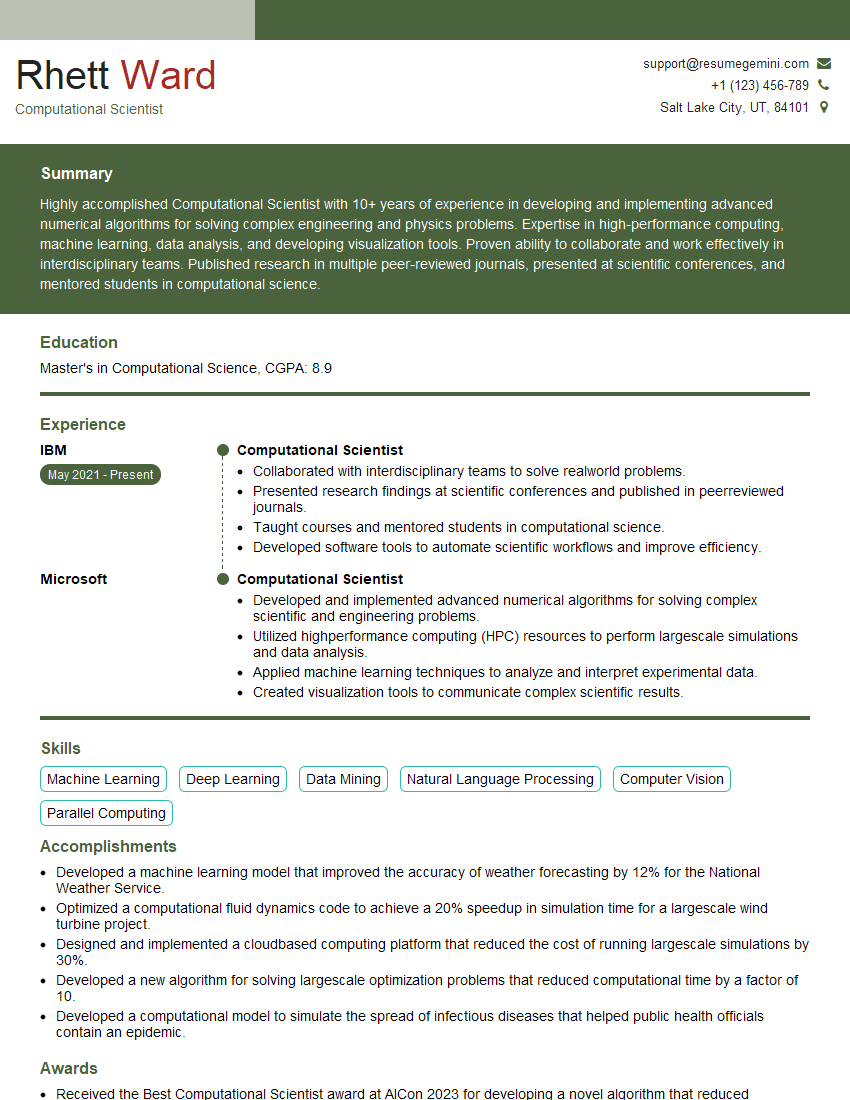
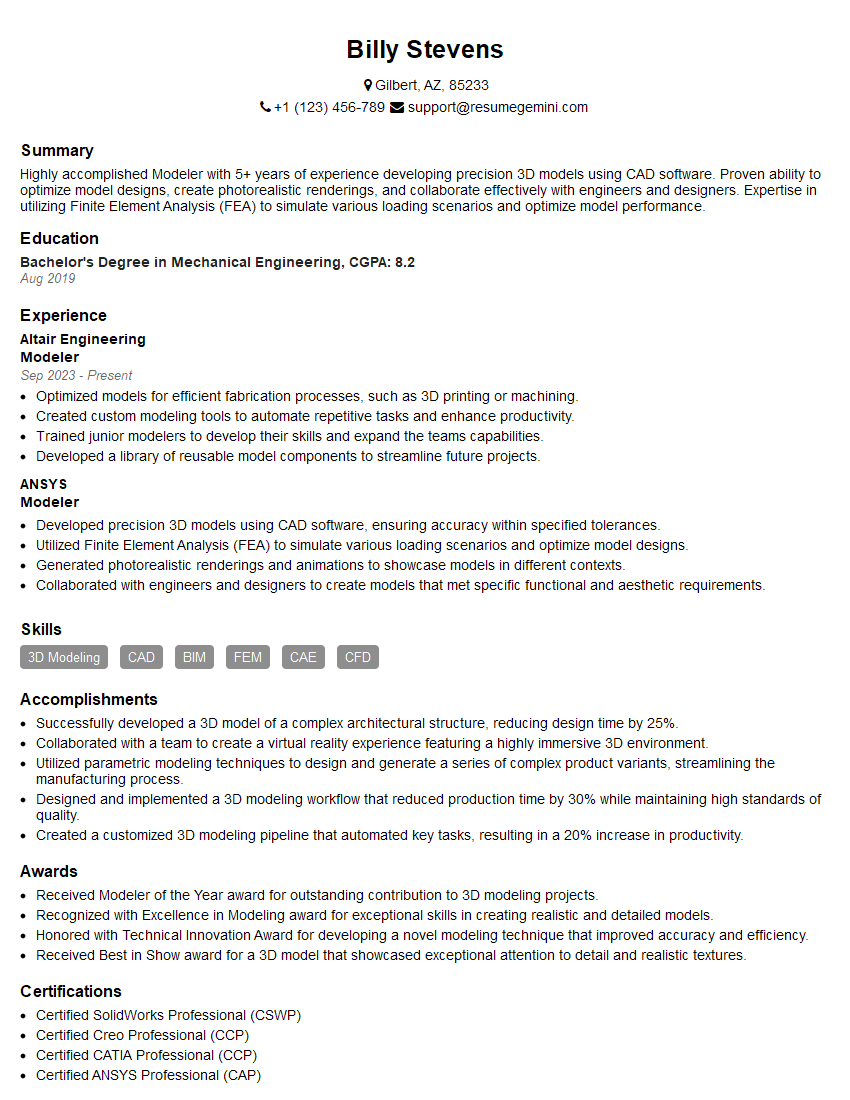
Mastering System Simulation and Modeling opens doors to exciting and impactful careers across diverse industries. Proficiency in this area demonstrates valuable analytical and problem-solving skills highly sought after by employers. To significantly boost your job prospects, create a compelling and ATS-friendly resume that effectively highlights your skills and experience. ResumeGemini is a trusted resource to help you build a professional and impactful resume. We provide examples of resumes tailored specifically to System Simulation and Modeling to help guide you in showcasing your expertise.
Explore more articles
Users Rating of Our Blogs
Share Your Experience
We value your feedback! Please rate our content and share your thoughts (optional).
What Readers Say About Our Blog
Hello,
we currently offer a complimentary backlink and URL indexing test for search engine optimization professionals.
You can get complimentary indexing credits to test how link discovery works in practice.
No credit card is required and there is no recurring fee.
You can find details here:
https://wikipedia-backlinks.com/indexing/
Regards
NICE RESPONSE TO Q & A
hi
The aim of this message is regarding an unclaimed deposit of a deceased nationale that bears the same name as you. You are not relate to him as there are millions of people answering the names across around the world. But i will use my position to influence the release of the deposit to you for our mutual benefit.
Respond for full details and how to claim the deposit. This is 100% risk free. Send hello to my email id: [email protected]
Luka Chachibaialuka
Hey interviewgemini.com, just wanted to follow up on my last email.
We just launched Call the Monster, an parenting app that lets you summon friendly ‘monsters’ kids actually listen to.
We’re also running a giveaway for everyone who downloads the app. Since it’s brand new, there aren’t many users yet, which means you’ve got a much better chance of winning some great prizes.
You can check it out here: https://bit.ly/callamonsterapp
Or follow us on Instagram: https://www.instagram.com/callamonsterapp
Thanks,
Ryan
CEO – Call the Monster App
Hey interviewgemini.com, I saw your website and love your approach.
I just want this to look like spam email, but want to share something important to you. We just launched Call the Monster, a parenting app that lets you summon friendly ‘monsters’ kids actually listen to.
Parents are loving it for calming chaos before bedtime. Thought you might want to try it: https://bit.ly/callamonsterapp or just follow our fun monster lore on Instagram: https://www.instagram.com/callamonsterapp
Thanks,
Ryan
CEO – Call A Monster APP
To the interviewgemini.com Owner.
Dear interviewgemini.com Webmaster!
Hi interviewgemini.com Webmaster!
Dear interviewgemini.com Webmaster!
excellent
Hello,
We found issues with your domain’s email setup that may be sending your messages to spam or blocking them completely. InboxShield Mini shows you how to fix it in minutes — no tech skills required.
Scan your domain now for details: https://inboxshield-mini.com/
— Adam @ InboxShield Mini
Reply STOP to unsubscribe
Hi, are you owner of interviewgemini.com? What if I told you I could help you find extra time in your schedule, reconnect with leads you didn’t even realize you missed, and bring in more “I want to work with you” conversations, without increasing your ad spend or hiring a full-time employee?
All with a flexible, budget-friendly service that could easily pay for itself. Sounds good?
Would it be nice to jump on a quick 10-minute call so I can show you exactly how we make this work?
Best,
Hapei
Marketing Director
Hey, I know you’re the owner of interviewgemini.com. I’ll be quick.
Fundraising for your business is tough and time-consuming. We make it easier by guaranteeing two private investor meetings each month, for six months. No demos, no pitch events – just direct introductions to active investors matched to your startup.
If youR17;re raising, this could help you build real momentum. Want me to send more info?
Hi, I represent an SEO company that specialises in getting you AI citations and higher rankings on Google. I’d like to offer you a 100% free SEO audit for your website. Would you be interested?
Hi, I represent an SEO company that specialises in getting you AI citations and higher rankings on Google. I’d like to offer you a 100% free SEO audit for your website. Would you be interested?
good