Every successful interview starts with knowing what to expect. In this blog, we’ll take you through the top Testing and Validation Techniques interview questions, breaking them down with expert tips to help you deliver impactful answers. Step into your next interview fully prepared and ready to succeed.
Questions Asked in Testing and Validation Techniques Interview
Q 1. Explain the difference between Verification and Validation.
Verification and validation are two crucial processes in software development, often confused but distinctly different. Think of it like this: verification is about building the product right, while validation is about building the right product.
Verification focuses on the internal consistency of the software. It checks if the software conforms to its specifications and design. This involves reviewing documents, conducting code inspections, and using static analysis tools to identify defects early in the development cycle. For example, verifying that the code adheres to coding standards or that a specific function works as designed based on its specification.
Validation, on the other hand, assesses whether the software meets the user’s needs and requirements. This is done through testing activities such as user acceptance testing (UAT), where the software is evaluated by the end-users. For example, validating if an e-commerce website allows users to successfully add items to their cart and complete a purchase.
In short: Verification answers ‘Are we building the product right?’, while validation answers ‘Are we building the right product?’. Both are essential for ensuring software quality.
Q 2. Describe the various levels of software testing.
Software testing is conducted at various levels to ensure comprehensive quality assurance. These levels build upon each other, providing a layered approach to identifying defects.
- Unit Testing: Testing individual components or modules of the software in isolation. This is typically performed by developers.
- Integration Testing: Testing the interaction between different modules or components after unit testing. This verifies that the modules work together correctly.
- System Testing: Testing the entire system as a whole, including all integrated components. It evaluates the system’s functionality and performance.
- Acceptance Testing: Testing conducted by end-users or clients to validate whether the system meets their requirements and expectations. This often includes User Acceptance Testing (UAT).
These levels are not always strictly separated; there can be overlaps and dependencies. For example, integration testing can’t happen effectively until unit testing is complete.
Q 3. What is the difference between black-box and white-box testing?
Black-box and white-box testing are two fundamental approaches to software testing, differing primarily in their knowledge of the internal structure of the software under test.
Black-box testing treats the software as a ‘black box,’ meaning the internal workings are unknown or ignored. Testers focus solely on the inputs and outputs of the system, checking if the software behaves as expected based on the requirements. This approach is excellent for uncovering functional defects and usability issues. Examples include functional testing, regression testing, and acceptance testing.
White-box testing, conversely, has full knowledge of the internal code and structure. Testers use this knowledge to design test cases that cover specific code paths, branches, and statements. This approach is particularly effective at finding structural defects like logic errors or code coverage gaps. Examples include unit testing, integration testing, and code inspections.
The choice between black-box and white-box testing depends on the testing phase and objectives. A comprehensive testing strategy typically involves both approaches for optimal defect detection.
Q 4. Explain your experience with test case design techniques (e.g., equivalence partitioning, boundary value analysis).
I have extensive experience designing test cases using various techniques, including equivalence partitioning and boundary value analysis. These techniques enhance test case efficiency and effectiveness by strategically selecting test data.
Equivalence Partitioning: This technique divides the input data into groups (partitions) that are expected to be processed similarly by the software. Testing one value from each partition is often sufficient to cover the entire partition. For example, if a field accepts an age between 0 and 120, I would create three partitions: 0-17 (minor), 18-64 (adult), and 65-120 (senior). I’d then test one value from each partition, rather than testing every possible age.
Boundary Value Analysis: This technique focuses on testing values at the boundaries of valid input ranges. This is crucial as defects often occur at these boundaries. For the same age field, I would test values such as 0, 1, 17, 18, 64, 65, 119, and 120, in addition to values slightly outside these boundaries (e.g., -1, 180).
These techniques, along with other methods such as decision table testing and state transition testing, ensure comprehensive test coverage and efficient test case creation.
Q 5. How do you prioritize test cases?
Prioritizing test cases is crucial for maximizing the effectiveness of testing within time and resource constraints. A common approach is to use a risk-based prioritization strategy.
I typically prioritize test cases based on factors such as:
- Risk: Test cases covering critical functionalities, high-risk areas, or areas with a higher chance of failure are prioritized.
- Business Impact: Test cases affecting core business processes or user experience are given higher priority.
- Frequency of Use: Test cases for frequently used features are prioritized to ensure reliability.
- Severity: Test cases for bugs likely to cause significant system errors or data loss have higher priority.
Using a combination of these factors, I create a prioritized list of test cases. Prioritization might be further refined using a method like MoSCoW (Must have, Should have, Could have, Won’t have) to categorize test cases based on their importance.
Q 6. What are the different types of software testing?
Software testing encompasses a wide range of types, each targeting specific aspects of the software. Here are some prominent types:
- Functional Testing: Verifying that the software performs its intended functions correctly.
- Non-functional Testing: Evaluating aspects like performance, security, usability, and scalability.
- Unit Testing: Testing individual components or modules.
- Integration Testing: Testing the interaction between modules.
- System Testing: Testing the complete system.
- Regression Testing: Ensuring that new changes haven’t broken existing functionality.
- Performance Testing: Assessing responsiveness and stability under various loads.
- Security Testing: Identifying vulnerabilities and weaknesses.
- Usability Testing: Evaluating how easy and enjoyable the software is to use.
- Acceptance Testing: Verifying that the software meets user and client requirements.
The specific types of testing employed depend heavily on the project’s needs and priorities.
Q 7. Describe your experience with test automation frameworks (e.g., Selenium, Appium, Cypress).
I have considerable experience with various test automation frameworks, including Selenium, Appium, and Cypress. My experience involves not just using these tools but also designing and implementing robust automation frameworks tailored to specific project needs.
Selenium: I’ve used Selenium extensively for automating web application testing, leveraging its WebDriver API to interact with browser elements. I’ve utilized various programming languages such as Java and Python for writing Selenium test scripts, incorporating techniques like page object model for better maintainability and reusability.
Appium: For mobile application testing, I’ve used Appium to automate tests on both Android and iOS platforms. Appium’s cross-platform capabilities are crucial for ensuring consistent testing across different mobile operating systems.
Cypress: I’ve worked with Cypress for end-to-end testing of web applications, appreciating its ease of use and real-time feedback. Its focus on modern JavaScript and its excellent debugging capabilities make it a powerful tool for rapid development and reliable test execution.
My experience includes not only writing automated tests but also setting up CI/CD pipelines to integrate these tests into the development workflow, leading to earlier defect detection and continuous quality improvement.
Q 8. Explain your experience with Agile testing methodologies.
Agile testing methodologies emphasize close collaboration with developers and frequent feedback loops throughout the software development lifecycle. Instead of lengthy testing phases at the end, testing is integrated into each sprint. This iterative approach allows for early detection of defects and faster adaptation to changing requirements. My experience encompasses various Agile frameworks like Scrum and Kanban. In Scrum, for instance, I actively participate in sprint planning, daily stand-ups, sprint reviews, and retrospectives, ensuring testing activities are aligned with sprint goals. I’ve utilized techniques like Test-Driven Development (TDD), where tests are written before the code, and Acceptance Test-Driven Development (ATDD), where acceptance criteria are defined collaboratively and translated into automated tests. This ensures the software meets stakeholder expectations from the outset. I’m proficient in using various Agile testing techniques, including exploratory testing, session-based testing, and risk-based testing, to maximize efficiency and impact within short iterations. In a recent project using Scrum, I implemented a shift-left testing approach, integrating testing activities early in the sprint, preventing major issues later.
Q 9. How do you handle bugs or defects found during testing?
When a bug is discovered, my process prioritizes thorough documentation and effective communication. First, I reproduce the bug consistently to confirm its validity. Then, I meticulously document the bug using a standardized format, including steps to reproduce, actual results, expected results, severity, and priority. This detailed information is crucial for developers to understand and fix the issue effectively. I use clear and concise language avoiding technical jargon when communicating with stakeholders. Furthermore, I assign an appropriate severity and priority level to each bug, helping prioritize the bug fixes. Critical bugs are addressed immediately, while lower priority bugs are scheduled for later fixes. After the developer fixes the bug, I perform thorough retesting to ensure the issue is resolved and doesn’t introduce new problems. I then close the bug report in the defect tracking system. Think of it like a doctor diagnosing a patient: a precise diagnosis (bug report) is key for successful treatment (bug fix).
Q 10. Describe your experience with defect tracking tools (e.g., Jira, Bugzilla).
I have extensive experience using Jira and Bugzilla for defect tracking. These tools are indispensable for managing the entire bug lifecycle, from reporting to resolution. I’m proficient in creating and managing bug reports, assigning them to developers, tracking their status, and generating reports to monitor the overall quality of the software. In Jira, I leverage its workflow capabilities to customize the bug tracking process based on project needs, including defining custom fields and transitions. In Bugzilla, I’m adept at using its powerful query features to filter and analyze bug reports based on various criteria, helping identify trends and patterns. For instance, in a recent project using Jira, we used its Kanban board to visually track the bug fixing process, enabling better collaboration and transparency between testers and developers. The use of these tools ensures that all bugs are properly documented, tracked, and resolved, contributing to a more efficient and streamlined development process.
Q 11. What is your experience with performance testing tools (e.g., JMeter, LoadRunner)?
I’m experienced in using performance testing tools like JMeter and LoadRunner. JMeter is excellent for creating and running load tests to simulate a large number of concurrent users. I’ve used it to analyze response times, identify bottlenecks, and measure the overall performance of web applications under stress. LoadRunner, while more complex, offers more advanced features for simulating realistic user behavior and analyzing performance metrics in detail. I’ve used LoadRunner in projects requiring sophisticated performance testing scenarios. For example, in one project, I used JMeter to test the scalability of a web application expecting a significant increase in user traffic during a promotional event. The test results helped identify performance bottlenecks, allowing the development team to optimize the application and avoid potential issues during the event. My approach is to create realistic load test scenarios based on expected user behavior, analyzing the results to identify performance issues and propose solutions to improve application performance.
Q 12. How do you ensure test coverage?
Ensuring comprehensive test coverage is paramount. I use a combination of techniques to achieve this, including requirement traceability matrices, test case design techniques, and code coverage analysis. Requirement traceability matrices map test cases back to specific requirements, ensuring all requirements are tested. I employ various test case design techniques like equivalence partitioning, boundary value analysis, and state transition testing to cover different scenarios and input values. For code coverage analysis, I use tools that measure the percentage of code executed during testing, identifying areas with low coverage that might need additional tests. A practical example: in a recent project, we used a requirement traceability matrix to ensure all user stories were covered by test cases. We then used code coverage analysis to ensure all critical code paths were tested. This multi-faceted approach ensures our tests cover the requirements comprehensively.
Q 13. Explain your experience with security testing.
My security testing experience includes performing various types of security assessments, including vulnerability scanning, penetration testing, and security code reviews. I’m familiar with OWASP Top 10 vulnerabilities and use various tools and techniques to identify and report security flaws. Vulnerability scanners automate the process of identifying common vulnerabilities, while penetration testing simulates real-world attacks to discover exploitable weaknesses. Security code reviews examine the source code for security vulnerabilities. In one project, I conducted penetration testing on a web application to identify vulnerabilities before its release. I discovered several SQL injection vulnerabilities that were promptly fixed by the development team. My focus is on proactive security testing to prevent vulnerabilities from impacting the application and its users. I approach security testing systematically, following industry best practices and standards.
Q 14. What is regression testing and why is it important?
Regression testing is the process of retesting a software application after making changes to it, to ensure that the changes haven’t introduced new bugs or broken existing functionality. It’s critical because software development is iterative; new features are added, bugs are fixed, and changes are made continuously. These changes can unintentionally impact other parts of the system, leading to unforeseen issues. Regression testing helps catch such regressions before they reach users. I employ various techniques for regression testing, including rerunning existing test cases, using automated test scripts, and prioritizing tests based on risk. For example, when a new feature is added, I prioritize regression tests covering the impacted areas of the application to ensure the new feature doesn’t negatively affect other functionalities. Imagine building with Lego bricks; adding new bricks can sometimes cause the existing structure to collapse. Regression testing is like checking the whole structure after each new brick is added, ensuring stability.
Q 15. Describe your experience with different types of testing documentation.
Throughout my career, I’ve worked extensively with various testing documentation, understanding their crucial role in ensuring a smooth and efficient testing process. These documents serve as a central repository of information, facilitating communication and collaboration among team members. Key types I frequently use include:
- Test Plans: These documents outline the scope, objectives, approach, resources, and schedule for testing activities. A well-structured test plan, for example, might specify which testing methodologies will be employed (e.g., Agile, Waterfall), the types of tests to be conducted (unit, integration, system, user acceptance testing), and the entry and exit criteria for each testing phase.
- Test Cases: These detail the individual steps involved in verifying a specific functionality or feature. A typical test case will include a unique ID, test objective, preconditions, steps to execute, expected results, and postconditions. For instance, a test case for a login form might specify steps such as entering a valid username, entering a valid password, clicking the login button, and verifying successful redirection to the user’s dashboard.
- Test Scripts: These are automated test procedures, often written in programming languages like Python or Java. They help automate repetitive tests, improving efficiency and consistency. For example, a test script could automatically verify the functionality of a web form by submitting various data sets and checking for accurate responses.
- Bug Reports: These are detailed reports documenting identified defects. A comprehensive bug report typically includes the steps to reproduce the issue, the observed behavior, the expected behavior, the severity of the bug, and screenshots or logs as evidence.
- Test Summary Reports: These documents provide a high-level overview of the testing process, summarizing the results and overall status. This might include metrics such as the number of tests executed, the number of bugs found, the overall pass/fail rate, and an assessment of the software’s readiness for release.
My experience ensures I can create and utilize these documents effectively, contributing significantly to the success of testing projects.
Career Expert Tips:
- Ace those interviews! Prepare effectively by reviewing the Top 50 Most Common Interview Questions on ResumeGemini.
- Navigate your job search with confidence! Explore a wide range of Career Tips on ResumeGemini. Learn about common challenges and recommendations to overcome them.
- Craft the perfect resume! Master the Art of Resume Writing with ResumeGemini’s guide. Showcase your unique qualifications and achievements effectively.
- Don’t miss out on holiday savings! Build your dream resume with ResumeGemini’s ATS optimized templates.
Q 16. How do you handle conflicting priorities in testing?
Conflicting priorities in testing are inevitable, especially in fast-paced environments. My approach involves a structured process to resolve these conflicts:
- Prioritization Matrix: I begin by creating a prioritization matrix, ranking test cases based on factors like risk, business impact, and frequency of use. This helps me focus on the most critical areas first.
- Risk Assessment: I conduct a thorough risk assessment to identify potential areas of high risk and allocate testing resources accordingly. This ensures that critical functionalities are thoroughly tested even under pressure.
- Communication and Negotiation: I communicate openly with stakeholders (developers, project managers, clients) to explain the implications of prioritizing certain tasks over others. This allows for a collaborative decision-making process, preventing misunderstandings and ensuring buy-in from all parties.
- Scope Management: If necessary, I work with the project team to adjust the testing scope, focusing on the most crucial functionalities if deadlines are extremely tight. This requires careful consideration of risks and trade-offs but ensures the release of a product with minimal critical issues.
- Test Automation: Where possible, I leverage test automation to expedite the testing process. This allows me to cover more ground in less time, addressing more priorities within the allocated timeframe.
For example, in one project, we had conflicting priorities between testing a new feature and thoroughly testing existing functionalities. By applying the above strategies, I prioritized testing critical components of the existing system, using automation where appropriate and clearly communicating the trade-offs to stakeholders, successfully delivering a high-quality product.
Q 17. What metrics do you use to measure the effectiveness of your testing efforts?
Measuring the effectiveness of testing efforts requires a multi-faceted approach. I regularly track several key metrics:
- Defect Density: The number of defects found per 1000 lines of code (or similar unit of measure). A lower defect density indicates higher software quality.
- Defect Severity: Classifying defects based on their impact (critical, major, minor, trivial). This helps to focus on fixing the most critical issues first.
- Test Coverage: The percentage of code or functionality covered by tests. High test coverage generally indicates more thorough testing.
- Test Execution Time: Measuring the time taken to execute tests. This helps identify bottlenecks and areas for improvement in efficiency.
- Bug Leakage Rate: The number of defects found in production after release. This metric helps assess the effectiveness of the testing process and highlights areas for improvement in preventing bugs from reaching production.
- Time to Resolution: This measures the time it takes to identify, report, and resolve defects. A shorter time to resolution suggests a more efficient testing and development process.
These metrics, taken together, provide a comprehensive picture of testing effectiveness and inform continuous improvement efforts. For example, a high bug leakage rate might suggest the need for more rigorous testing, or improved test case design.
Q 18. How do you deal with a tight deadline in testing?
Tight deadlines necessitate strategic planning and efficient execution. My approach involves:
- Prioritization: I immediately prioritize critical functionalities, focusing on the most impactful areas and deferring less critical testing until later or, if necessary, removing it altogether. This ensures that the core functionality is tested adequately.
- Risk-Based Testing: I focus my testing efforts on areas with the highest risk of failure, leveraging risk-based testing techniques to ensure that the most critical areas are adequately covered. This approach allows me to effectively mitigate potential risks under time constraints.
- Test Automation: I use test automation tools to automate repetitive tests, significantly reducing testing time and allowing me to cover more ground in less time.
- Parallel Testing: I organize testing efforts to run in parallel when possible, leveraging the strengths of multiple testers to cover more ground more quickly.
- Communication: I maintain open communication with stakeholders, providing regular updates on testing progress and any potential issues. This transparency helps prevent surprises and ensures that decisions are made collaboratively.
In one instance, a critical bug was found just days before the deadline. Using a combination of test automation and parallel testing, I was able to isolate and resolve the issue, ensuring the successful launch of the product despite the time pressure.
Q 19. What is your experience with API testing?
I have extensive experience in API testing, utilizing various tools and techniques to ensure the quality and reliability of APIs. My experience spans different testing types, including:
- Functional Testing: Verifying that the API functions as expected, handling various inputs and producing correct outputs. This includes testing different HTTP methods (GET, POST, PUT, DELETE), validating responses, and checking for error handling.
- Performance Testing: Assessing the API’s responsiveness, stability, and scalability under various load conditions. This involves tools like JMeter or LoadRunner to simulate high traffic and analyze response times and resource utilization.
- Security Testing: Identifying vulnerabilities in the API, such as SQL injection, cross-site scripting (XSS), and authentication flaws. Tools like OWASP ZAP can assist in automating this.
- Contract Testing: Verifying that the API adheres to its defined contract (e.g., OpenAPI specification). This ensures that the API’s interface remains consistent and compatible with consumers.
I often use tools like Postman, REST-assured (Java), or Insomnia to execute API tests, and frameworks like Karate DSL for more complex automation scenarios. For example, I’ve used Postman to create and run automated tests that verify the correct responses of an e-commerce API handling functions like adding items to a cart, processing payments, and managing user accounts.
Q 20. Explain your approach to testing mobile applications.
Testing mobile applications requires a multifaceted approach considering different platforms (iOS, Android), screen sizes, network conditions, and user interactions. My testing strategy includes:
- Functional Testing: Verifying that all features and functionalities work as expected across different devices and operating systems.
- Usability Testing: Assessing the ease of use and overall user experience, paying attention to navigation, intuitiveness, and overall design.
- Performance Testing: Evaluating the app’s responsiveness, speed, and stability under various conditions, including network connectivity and device load.
- Compatibility Testing: Ensuring that the app functions correctly on various devices with different screen resolutions, operating systems, and hardware configurations.
- Security Testing: Identifying vulnerabilities related to data security and user privacy. This includes assessing protection against unauthorized access, data breaches, and malicious attacks.
- Localization Testing: Ensuring the app adapts correctly to different languages and regions, verifying text, date formats, currency, and other locale-specific elements.
I utilize both real devices and emulators/simulators for testing and employ tools such as Appium for automated UI testing and Firebase Test Lab for comprehensive device and OS coverage. For example, I recently used Appium to automate UI tests for a mobile banking application, verifying functions like account login, fund transfers, and bill payments across different iOS and Android versions.
Q 21. How do you approach testing a new, unfamiliar system?
Approaching a new and unfamiliar system requires a systematic and thorough strategy. My steps include:
- Requirements Gathering: I start by thoroughly reviewing available documentation (requirements documents, design specifications, user manuals) to understand the system’s purpose, functionality, and intended behavior.
- Risk Assessment: I identify potential areas of high risk within the system, based on complexity, criticality, and potential impact of failures. This helps me prioritize my testing efforts.
- Exploratory Testing: I conduct exploratory testing sessions to gain a hands-on understanding of the system’s functionality. This helps me uncover unforeseen issues and design more effective tests.
- Test Case Design: Based on my understanding of the system and the identified risks, I develop comprehensive test cases to cover various functionalities and scenarios. This involves careful consideration of inputs, outputs, and expected behaviors.
- Test Execution and Reporting: I execute the tests, meticulously documenting the results and reporting any issues or defects. I also leverage automation where possible, helping increase efficiency and coverage.
- Collaboration: I maintain open communication with developers and stakeholders to gain a deeper understanding of the system and address any questions or uncertainties.
Imagine encountering a new CRM system. Using this approach, I would first thoroughly read the documentation, then explore the system’s interface, create test cases focusing on critical functions like lead management and report generation, and finally execute those tests, documenting findings and reporting any issues to the development team.
Q 22. What is your experience with database testing?
Database testing is a crucial aspect of software testing that focuses on verifying the integrity, accuracy, and performance of the application’s database. This involves testing everything from the database schema and stored procedures to data integrity constraints and query performance. My experience spans various database systems, including relational databases like MySQL, PostgreSQL, and SQL Server, and NoSQL databases like MongoDB.
My approach typically involves several key activities:
- Data validation: I verify the accuracy and consistency of data stored in the database, checking for duplicates, null values, and data type mismatches.
- Schema testing: I validate the database schema against the requirements, ensuring tables, columns, data types, and relationships are correctly defined and implemented.
- Stored procedure testing: I test stored procedures to ensure they function correctly and produce the expected results. This often includes boundary condition and negative testing.
- Query performance testing: I assess the performance of database queries to identify bottlenecks and ensure they meet response time requirements.
- Data migration testing: When applicable, I test the process of migrating data from one database to another, ensuring data integrity is maintained.
For example, in a recent project involving an e-commerce platform, I used SQL queries to verify the accuracy of order information, ensuring that order totals matched individual item prices and quantities. I also performed load testing on the database to simulate high traffic and identify potential performance issues under stress.
Q 23. How do you ensure test data is properly managed?
Proper test data management is paramount for reliable and repeatable testing. Poorly managed test data can lead to inaccurate test results, wasted time, and ultimately, software failures in production. My approach emphasizes the following:
- Test data creation and generation: I utilize tools and techniques to generate realistic and representative test data. This often involves anonymizing or masking real production data to protect sensitive information while preserving data structure and integrity. I’ve used tools like SQL Server Data Generator and Faker for this purpose.
- Test data subsetting: I create smaller subsets of the production data that are sufficient for testing specific functionalities without requiring the entire dataset, thus reducing testing time and resource consumption.
- Test data refresh: Regularly refreshing the test data ensures that tests are run against up-to-date information, reflecting the current state of the application.
- Data masking and anonymization: This is crucial for protecting sensitive data during testing, replacing sensitive information (like names, addresses, and credit card details) with fake but structurally correct data.
- Test data versioning: Managing versions of test data allows for easy rollback and comparison of test results across different iterations.
Think of it like building a miniature replica of a city to test a new traffic management system – you don’t need the entire city, just a representative section with similar characteristics.
Q 24. Describe your experience with non-functional testing (e.g., performance, security, usability).
Non-functional testing is as critical as functional testing, focusing on the ‘how’ rather than the ‘what’ of the system. My experience encompasses various aspects of non-functional testing, including performance, security, and usability.
- Performance testing: I use tools like JMeter and LoadRunner to assess the system’s responsiveness, stability, and scalability under various load conditions. This includes load testing, stress testing, and endurance testing to pinpoint performance bottlenecks.
- Security testing: My security testing experience involves identifying and mitigating vulnerabilities. This includes penetration testing, vulnerability scanning, and security audits to protect against common threats like SQL injection and cross-site scripting.
- Usability testing: I employ methods like user observation and feedback sessions to evaluate the system’s ease of use and user experience. This helps identify areas where the system can be improved to enhance user satisfaction.
For instance, during a recent project, performance testing revealed a database query that was slowing down the entire system. By optimizing the query, we improved response times significantly. In another project, a security audit uncovered a vulnerability that could have allowed unauthorized access to sensitive customer data; addressing this vulnerability was prioritized.
Q 25. What are some common challenges you face in software testing?
Software testing presents several common challenges:
- Time constraints: Often, testing deadlines are tight, requiring efficient prioritization and effective test case design to ensure thorough testing within the allotted time.
- Resource limitations: Access to testing resources such as environments, tools, and skilled testers can be limited, impacting the scope and depth of testing.
- Changing requirements: Frequent changes in requirements during the development lifecycle can necessitate adjustments to test plans and test cases, potentially leading to delays and increased costs.
- Test environment inconsistencies: Differences between development, testing, and production environments can lead to unexpected results and errors that are difficult to reproduce and fix.
- Identifying and reproducing complex bugs: Tracking down the root cause of a complex bug can be time-consuming and require a systematic approach involving detailed logging, debugging, and collaboration.
Addressing these challenges often involves careful planning, risk assessment, prioritization, and effective communication among the development and testing teams.
Q 26. How do you stay up-to-date with the latest testing technologies and trends?
Staying current with the ever-evolving landscape of testing technologies and trends is essential. I actively employ several strategies:
- Online courses and certifications: Platforms like Coursera, Udemy, and LinkedIn Learning offer valuable courses on various testing methodologies and technologies. I regularly participate in online courses to enhance my skills.
- Industry conferences and webinars: Attending conferences and webinars keeps me updated on the latest industry trends and best practices. This provides opportunities to network and learn from leading experts.
- Professional communities and forums: Participating in online communities and forums such as Stack Overflow and Reddit allows me to engage with other testers, share knowledge, and learn from their experiences.
- Reading industry publications and blogs: Following reputable industry blogs and publications provides insights into emerging trends and technologies in the software testing space.
- Hands-on experience with new tools and technologies: I actively seek opportunities to work with new testing tools and technologies, gaining practical experience and enhancing my skillset.
Continuous learning is an ongoing process, and staying informed is crucial for success in this dynamic field.
Q 27. Explain your experience with test environment setup and configuration.
Setting up and configuring test environments is a vital part of my role. This process involves ensuring that the testing environment accurately mirrors the production environment in terms of hardware, software, and data. My experience includes working with various environments, from virtual machines to cloud-based platforms.
My approach typically involves the following steps:
- Requirements gathering: I begin by thoroughly understanding the requirements for the test environment, including hardware specifications, software configurations, and data requirements.
- Environment provisioning: I utilize tools and technologies like Docker and Kubernetes to create and manage virtual machines or cloud-based instances.
- Software installation and configuration: I install and configure the necessary software components, including the application under test, databases, and other supporting systems.
- Data setup: I populate the test environment with the appropriate test data, ensuring it’s representative of the production data but doesn’t compromise sensitive information.
- Environment validation: I verify that the environment is properly configured and functioning as expected, performing various checks to ensure everything works as designed.
In a recent project, we used a cloud-based environment to ensure scalability and cost-effectiveness for our testing. This allowed us to easily provision and manage multiple test environments with varying configurations.
Q 28. Describe a time you had to troubleshoot a complex technical issue during testing.
During testing of a large-scale e-commerce application, we encountered a perplexing issue where order processing would intermittently fail under high load. Initial investigations pointed towards various potential causes, including database performance, application logic, and network issues.
My approach involved a systematic troubleshooting process:
- Reproducing the issue: First, we worked to consistently reproduce the failure. This involved carefully scripting the load test to isolate the conditions under which the error occurred.
- Log analysis: We carefully examined the application logs, database logs, and network logs, searching for clues indicating the root cause. This helped pinpoint specific error messages and timing correlations.
- Debugging: We utilized debugging tools to step through the application code and track down the point of failure. This highlighted a race condition in the order processing logic where two threads could simultaneously access and modify the same database record.
- Code review and analysis: We reviewed the relevant sections of the code to understand the logic flow and identify the flaw in the design that led to the race condition.
- Solution implementation and verification: We implemented a solution by adding proper synchronization mechanisms to prevent simultaneous access to the shared resource. After implementing this, rigorous testing verified the fix and eliminated the intermittent failure.
This experience underscored the value of a systematic and collaborative approach to debugging. By patiently working through the steps, we successfully identified and resolved a complex and intermittent issue that could have seriously impacted the application’s performance and stability.
Key Topics to Learn for Testing and Validation Techniques Interview
- Software Testing Fundamentals: Understanding different testing levels (unit, integration, system, acceptance), testing methodologies (waterfall, agile), and the software development lifecycle (SDLC).
- Test Case Design Techniques: Mastering techniques like equivalence partitioning, boundary value analysis, decision table testing, and state transition testing to create effective test cases.
- Test Automation: Familiarity with automation frameworks, scripting languages (e.g., Python, Java), and tools used for automating test execution and reporting. Understanding the advantages and limitations of test automation.
- Defect Management: Proficiency in identifying, reporting, tracking, and verifying the resolution of defects using defect tracking systems (e.g., Jira, Bugzilla).
- Performance Testing: Understanding concepts like load testing, stress testing, and performance bottlenecks. Experience with performance testing tools is a plus.
- Security Testing: Knowledge of common security vulnerabilities and techniques for identifying and mitigating them. Understanding OWASP Top 10 is beneficial.
- Validation and Verification: Understanding the difference between validation and verification, and how they contribute to ensuring software quality.
- Test Data Management: Strategies for creating, managing, and securing test data to support testing activities.
- Practical Application: Be prepared to discuss real-world scenarios where you applied these techniques, highlighting your problem-solving skills and ability to adapt to different situations. Focus on the impact of your testing efforts.
Next Steps
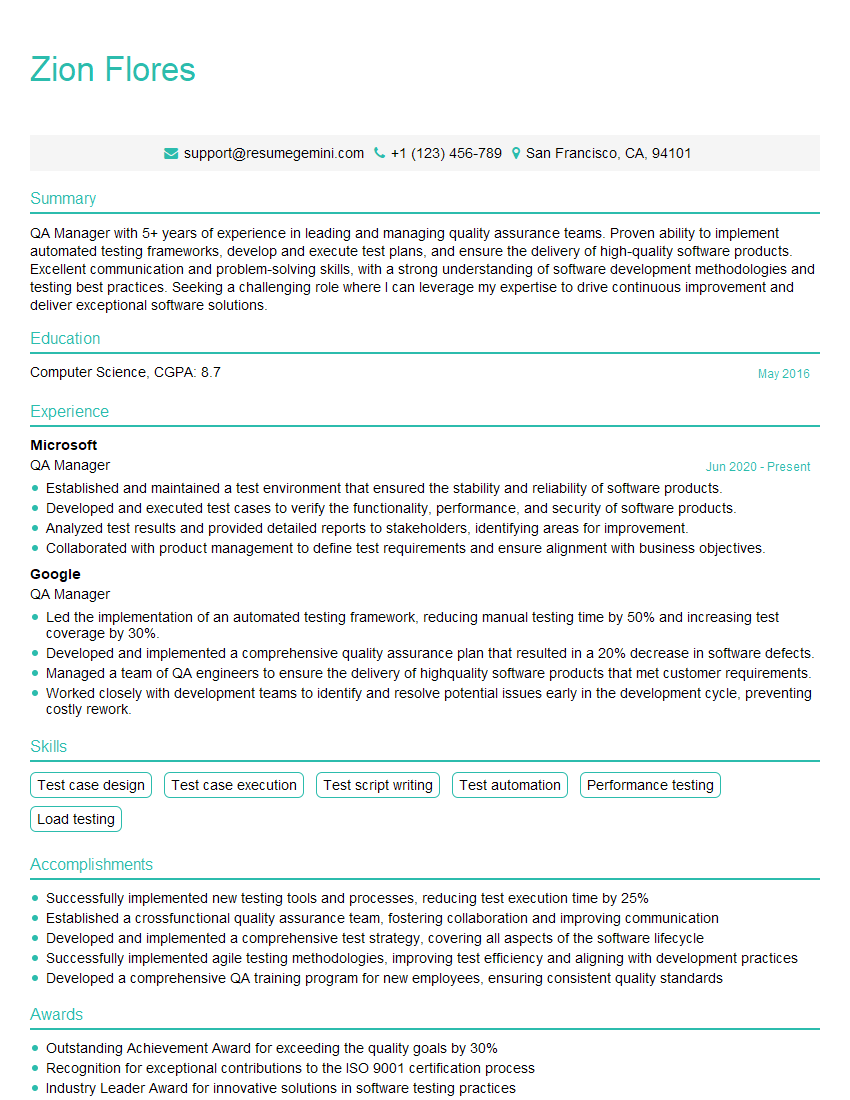
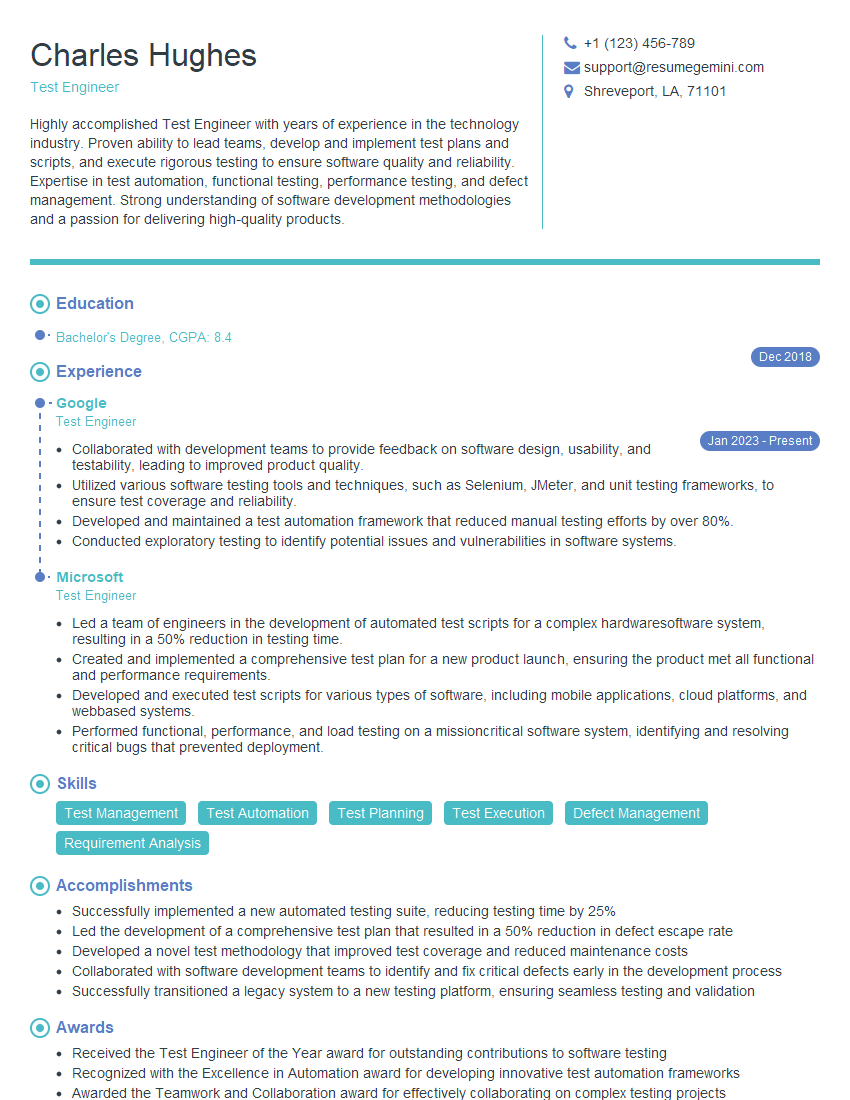
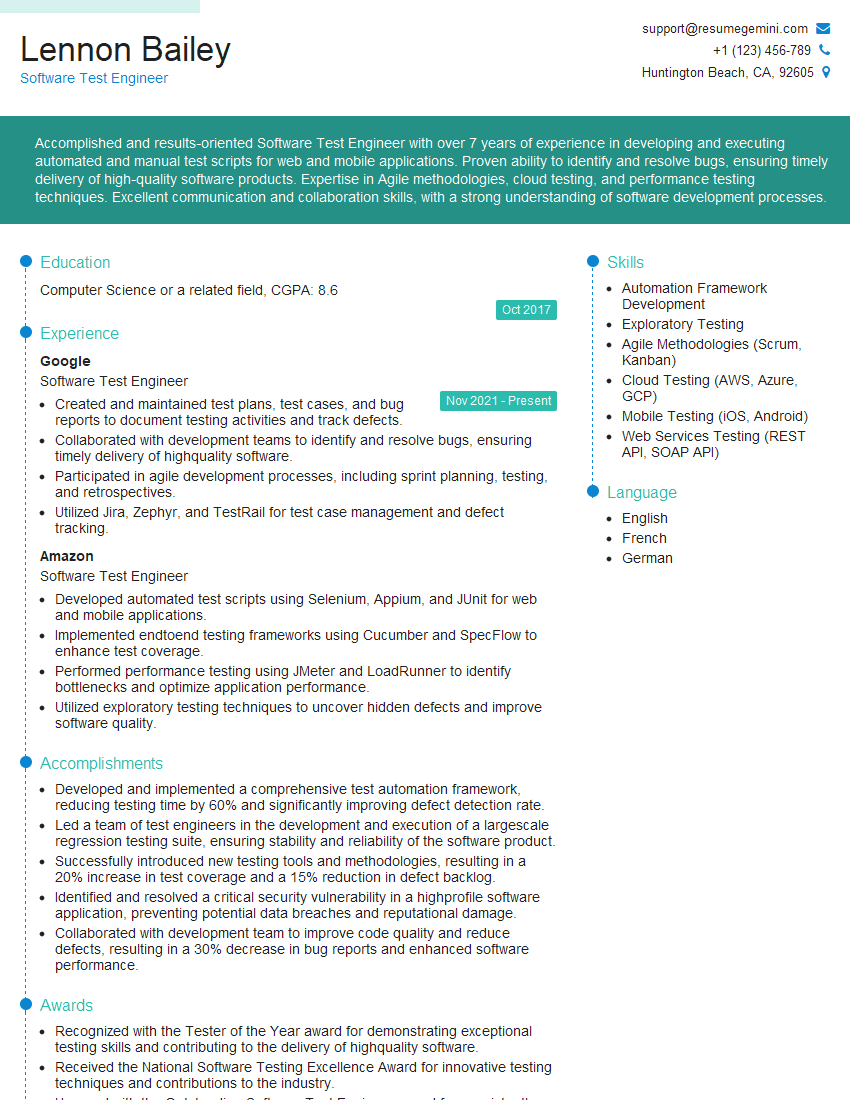
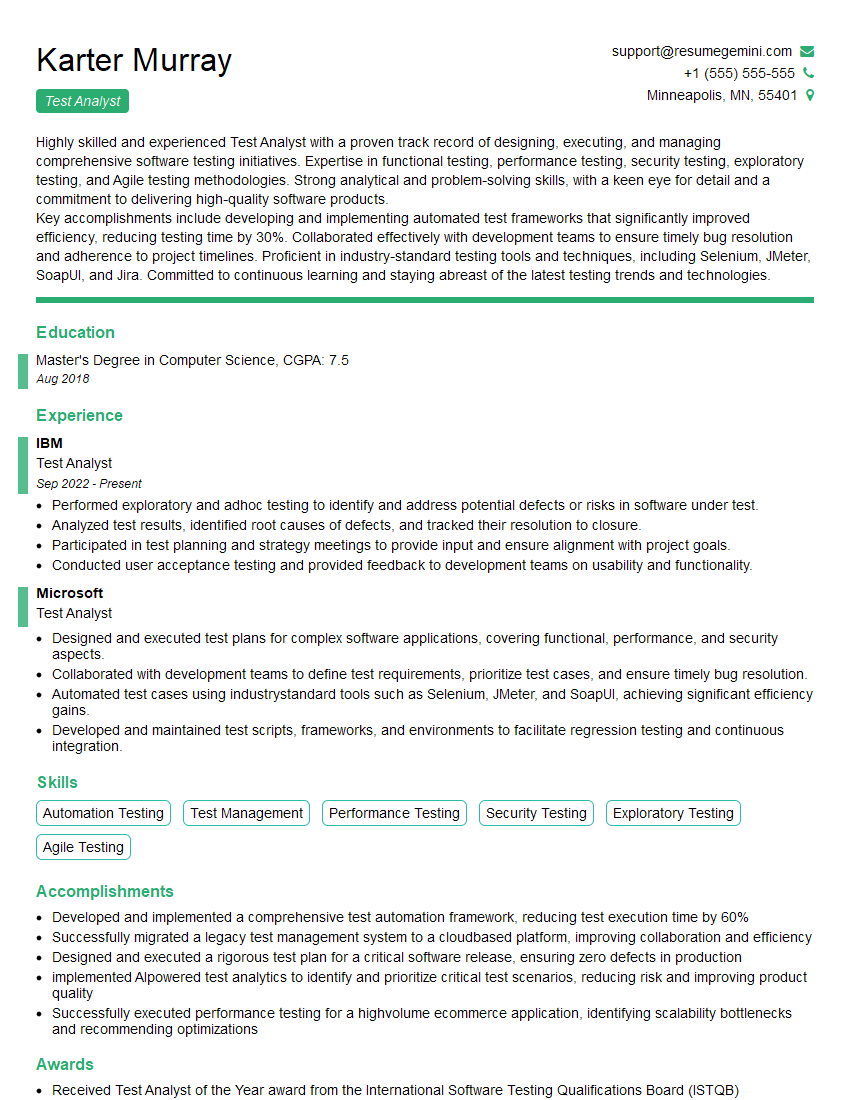
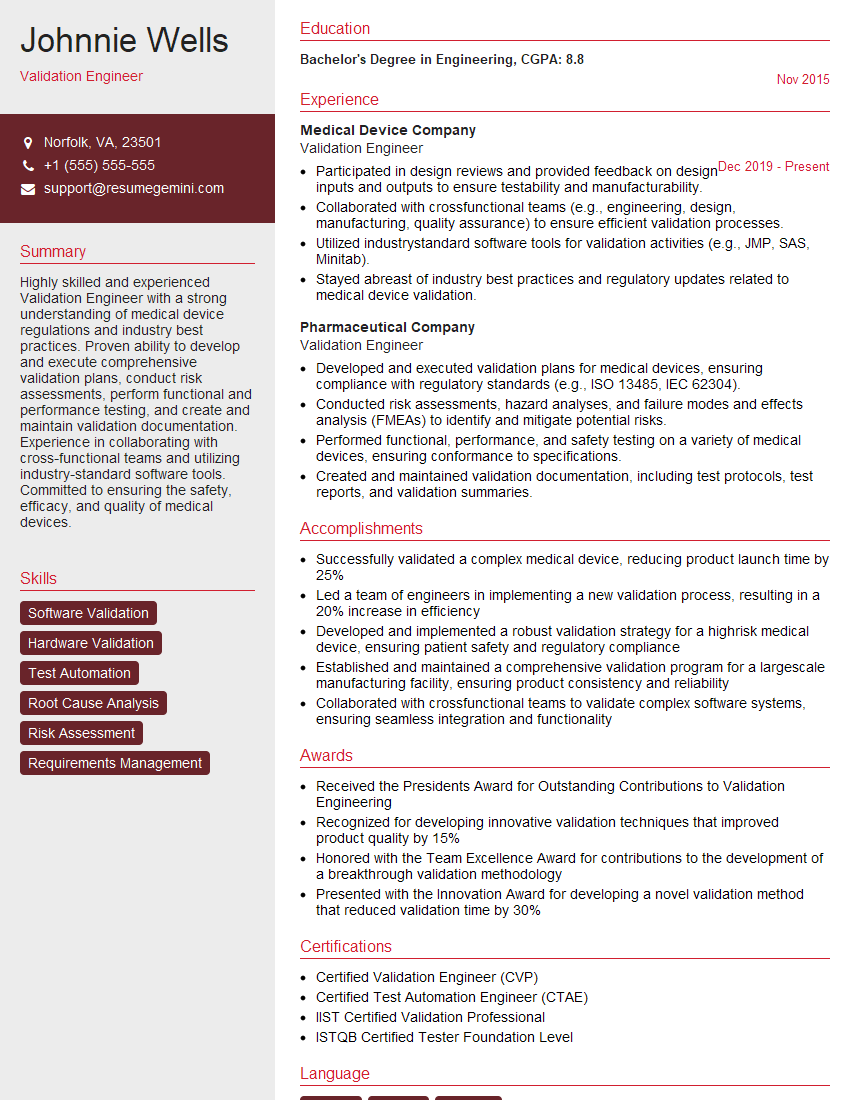
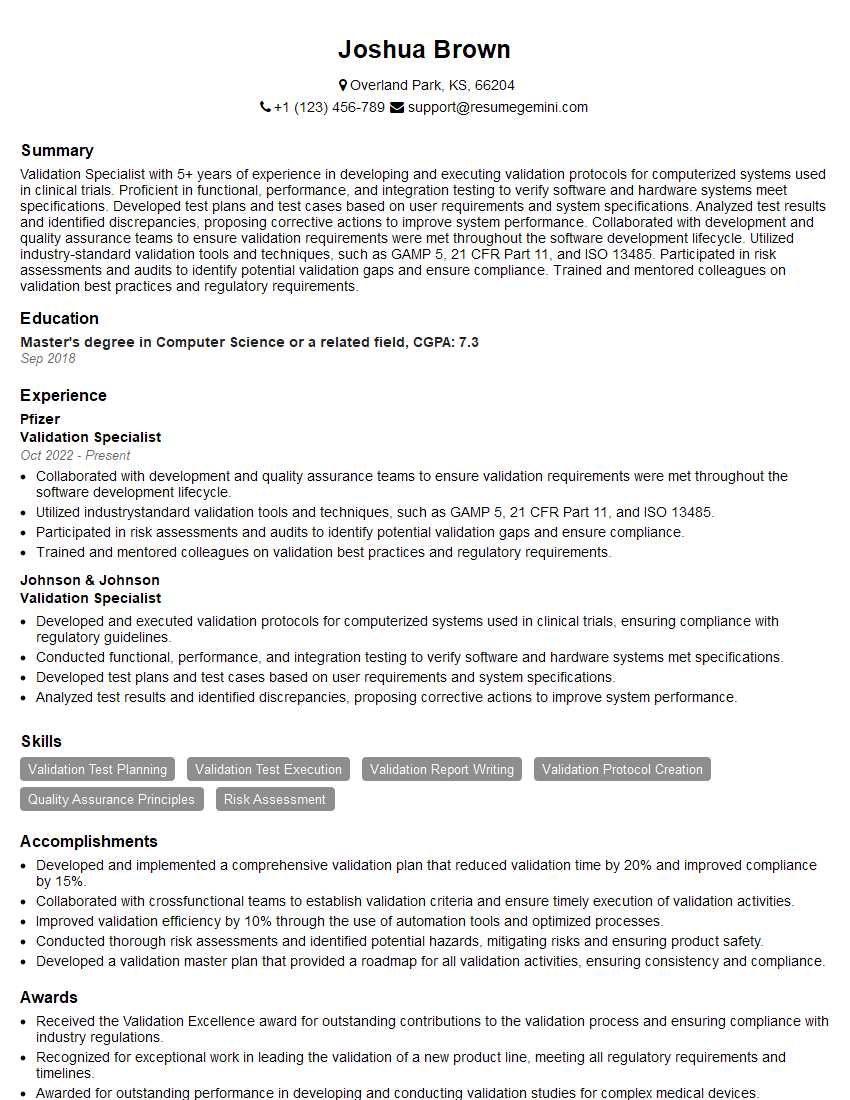
Mastering Testing and Validation Techniques is crucial for career advancement in the software industry. A strong understanding of these concepts demonstrates your commitment to quality and your ability to contribute to successful software development projects. To significantly boost your job prospects, creating an ATS-friendly resume is essential. This ensures your application gets noticed by recruiters and hiring managers. We highly recommend using ResumeGemini to build a professional and impactful resume. ResumeGemini offers a streamlined process and provides examples of resumes tailored to Testing and Validation Techniques to help you create a compelling application.
Explore more articles
Users Rating of Our Blogs
Share Your Experience
We value your feedback! Please rate our content and share your thoughts (optional).
What Readers Say About Our Blog
Hello,
we currently offer a complimentary backlink and URL indexing test for search engine optimization professionals.
You can get complimentary indexing credits to test how link discovery works in practice.
No credit card is required and there is no recurring fee.
You can find details here:
https://wikipedia-backlinks.com/indexing/
Regards
NICE RESPONSE TO Q & A
hi
The aim of this message is regarding an unclaimed deposit of a deceased nationale that bears the same name as you. You are not relate to him as there are millions of people answering the names across around the world. But i will use my position to influence the release of the deposit to you for our mutual benefit.
Respond for full details and how to claim the deposit. This is 100% risk free. Send hello to my email id: [email protected]
Luka Chachibaialuka
Hey interviewgemini.com, just wanted to follow up on my last email.
We just launched Call the Monster, an parenting app that lets you summon friendly ‘monsters’ kids actually listen to.
We’re also running a giveaway for everyone who downloads the app. Since it’s brand new, there aren’t many users yet, which means you’ve got a much better chance of winning some great prizes.
You can check it out here: https://bit.ly/callamonsterapp
Or follow us on Instagram: https://www.instagram.com/callamonsterapp
Thanks,
Ryan
CEO – Call the Monster App
Hey interviewgemini.com, I saw your website and love your approach.
I just want this to look like spam email, but want to share something important to you. We just launched Call the Monster, a parenting app that lets you summon friendly ‘monsters’ kids actually listen to.
Parents are loving it for calming chaos before bedtime. Thought you might want to try it: https://bit.ly/callamonsterapp or just follow our fun monster lore on Instagram: https://www.instagram.com/callamonsterapp
Thanks,
Ryan
CEO – Call A Monster APP
To the interviewgemini.com Owner.
Dear interviewgemini.com Webmaster!
Hi interviewgemini.com Webmaster!
Dear interviewgemini.com Webmaster!
excellent
Hello,
We found issues with your domain’s email setup that may be sending your messages to spam or blocking them completely. InboxShield Mini shows you how to fix it in minutes — no tech skills required.
Scan your domain now for details: https://inboxshield-mini.com/
— Adam @ InboxShield Mini
Reply STOP to unsubscribe
Hi, are you owner of interviewgemini.com? What if I told you I could help you find extra time in your schedule, reconnect with leads you didn’t even realize you missed, and bring in more “I want to work with you” conversations, without increasing your ad spend or hiring a full-time employee?
All with a flexible, budget-friendly service that could easily pay for itself. Sounds good?
Would it be nice to jump on a quick 10-minute call so I can show you exactly how we make this work?
Best,
Hapei
Marketing Director
Hey, I know you’re the owner of interviewgemini.com. I’ll be quick.
Fundraising for your business is tough and time-consuming. We make it easier by guaranteeing two private investor meetings each month, for six months. No demos, no pitch events – just direct introductions to active investors matched to your startup.
If youR17;re raising, this could help you build real momentum. Want me to send more info?
Hi, I represent an SEO company that specialises in getting you AI citations and higher rankings on Google. I’d like to offer you a 100% free SEO audit for your website. Would you be interested?
Hi, I represent an SEO company that specialises in getting you AI citations and higher rankings on Google. I’d like to offer you a 100% free SEO audit for your website. Would you be interested?
good