Every successful interview starts with knowing what to expect. In this blog, we’ll take you through the top Timber Valuation interview questions, breaking them down with expert tips to help you deliver impactful answers. Step into your next interview fully prepared and ready to succeed.
Questions Asked in Timber Valuation Interview
Q 1. Explain the different methods used for timber valuation.
Timber valuation employs several methods, each with its strengths and weaknesses. The choice depends on factors like the data available, the purpose of the valuation, and the type of timber involved. The most common methods include:
- Market Comparison Approach: This is arguably the most straightforward method. It involves comparing the subject timber stand to similar recently sold properties. The key is finding truly comparable sales – similar species, volume, location, access, and market conditions. Adjustments are made for differences. For example, if a comparable sale had better access, a deduction might be made from its sale price before using it as a benchmark.
- Income Approach: This method focuses on the future income the timber will generate. It projects the expected net revenue from harvesting and selling the timber over a specific time horizon, then discounts this future income stream back to its present value. This requires detailed forecasting of timber growth, market prices, and harvesting costs. The Discounted Cash Flow (DCF) analysis is frequently used within this approach.
- Cost Approach: This method estimates the value by determining the cost of replacing the timber. It’s rarely used independently for timber valuation due to the difficulty in accurately estimating regeneration costs and the time it takes for trees to mature to harvestable size. However, it can be a useful supplementary technique.
Often, a combination of these methods is used to arrive at a robust valuation, providing a range of values rather than a single point estimate. This triangulation process enhances the reliability of the final valuation.
Q 2. Describe the factors influencing timber value.
Numerous factors influence timber value, broadly categorized into:
- Timber characteristics: Species, volume, quality (e.g., knottiness, straightness), and age significantly impact value. Rare or high-demand species command higher prices. A large volume of high-quality timber will naturally be worth more.
- Market conditions: Current and projected demand for timber, lumber prices, and competition among buyers all play a crucial role. A booming construction market, for example, drives up timber prices. Conversely, a recession could severely depress value.
- Location: Accessibility significantly impacts logging costs. Stands located near mills or transportation networks have higher values. Legal and regulatory aspects, including environmental restrictions, also impact value. Stands in environmentally sensitive areas could face restrictions on harvesting.
- Risk factors: Disease, fire, insect infestation, and market volatility are major risks that affect value negatively. A stand at risk of insect damage might be valued lower than a healthy stand.
- Land value: While timber value is primarily related to the trees, the underlying land value contributes to the overall property value. This is particularly important for longer-term investments.
Imagine comparing two identical stands: one easily accessible near a mill, the other remote and difficult to harvest. The accessible stand will have a much higher value due to lower logging costs, even if the timber itself is identical.
Q 3. How do you account for risk in timber valuation?
Risk is inherent in timber valuation because of the long-term nature of timber growth and the variability of market prices. We account for risk through several methods:
- Sensitivity analysis: This involves varying key inputs (e.g., timber prices, growth rates, discount rates) to see how the valuation changes. This illustrates the potential range of outcomes.
- Probability distributions: Assigning probabilities to different future scenarios (e.g., high, medium, low timber prices) and calculating a weighted average valuation. This accounts for the uncertainty of future events.
- Discount rate adjustment: Using a higher discount rate to reflect the increased risk associated with longer time horizons and unpredictable market conditions. A higher discount rate reduces the present value of future income streams, reflecting a risk premium.
- Contingency reserves: Including a buffer within the valuation to account for unexpected events, such as disease outbreaks or harvesting delays.
For instance, if we’re projecting timber prices over 20 years, it’s prudent to conduct sensitivity analysis to assess the valuation’s resilience to various price fluctuations. A higher discount rate might be applied to reflect the inherent uncertainty of long-term market projections.
Q 4. What are the key differences between stumpage value and timber value?
Stumpage value and timber value are closely related but distinct concepts.
- Stumpage value refers to the value of timber in situ— standing in the forest, before harvesting. It represents the price paid for the right to harvest the trees, essentially the value of the timber at the stump.
- Timber value is a broader term encompassing the value of the timber once it’s been harvested and processed. It considers not just the standing trees but also the value added through logging, transportation, and processing into lumber or other products.
Think of it this way: stumpage value is like the price of raw materials, while timber value includes the value added during manufacturing. The difference between the two reflects the costs of harvesting, transportation, and processing. A timber sale agreement will usually specify the stumpage value, which the buyer will then use to determine their profit margin, considering all post-harvest costs.
Q 5. Explain the concept of ‘growth and yield’ in timber valuation.
Growth and yield is a crucial concept in timber valuation, referring to the prediction of how much timber a stand will produce over time. Accurate growth and yield projections are essential for income-based valuation methods. These projections are based on:
- Species-specific growth models: These models use factors such as site quality (soil, climate), age, density, and past growth to predict future growth. Sophisticated models incorporate interactions among these factors.
- Forest inventory data: Detailed measurements of tree size, species composition, and stand density are necessary inputs for the models.
- Yield tables: These tables provide average growth and yield data for specific species and sites, often based on long-term observational studies. They provide a simpler, more readily available source of growth projection information.
Accurate growth and yield predictions are vital for assessing the profitability of a timber investment. If the growth rate is underestimated, the projected future revenue will be too low, leading to an undervaluation. Conversely, an overestimation will inflate the valuation.
Q 6. How do you account for land value in a timber valuation?
Land value is an important component of the overall value of timberland. Several methods exist for separating timber value from land value:
- Direct sales comparison: Comparing sales of similar properties with and without timber to estimate the land value independently. This requires finding comparable properties with similar characteristics but different timber stocking levels.
- Residual method: Estimating the timber value using one of the methods described earlier (market, income, or cost approach), then subtracting the timber value from the total property value to arrive at the land value. This requires a reliable estimate of the total property value, which can be challenging.
- Income capitalization: Using a capitalization rate (which reflects the market’s required return for similar land) to capitalize the expected future income from the land (e.g., from hunting leases or future timber rotations) to obtain an estimate of the land value. This is appropriate for land with recurring income streams.
The preferred method often depends on the specific circumstances. If recent sales data for similar bare land is available, the direct sales comparison would be the most straightforward. However, if timber is the primary source of revenue, the residual method might be more suitable.
Q 7. What are the common appraisal methods used for timberland?
Several appraisal methods are commonly used for timberland, many of which build upon the valuation methods already discussed:
- Fee appraisal: A professional appraiser conducts a thorough evaluation of the property, considering all relevant factors and applying appropriate methods to determine a market value. This provides the most comprehensive and reliable valuation, but also tends to be the most expensive option.
- Comparative market analysis (CMA): Similar to the market comparison approach, but often less rigorous, relying on readily available sales data. This is a quicker and less expensive alternative to a full fee appraisal, often suitable for preliminary assessments.
- Income capitalization method: Uses the expected future income from timber harvesting and other land uses (e.g., hunting leases) to determine the present value of the timberland. This is well suited to valuing properties expected to generate consistent revenue streams from timber harvests over time.
- Financial modeling (DCF Analysis): A sophisticated approach for modeling future cash flows from timber harvesting and other income sources to determine the property’s present value. This method requires expertise in financial modeling and accurate future projections.
The best approach depends on the context: A buyer looking to make a large investment would likely need a formal fee appraisal, whereas a quick preliminary assessment might only require a CMA. Often, a combination of methods is used to bolster confidence in the valuation.
Q 8. How do you determine the appropriate discount rate for timber valuation?
Determining the appropriate discount rate is crucial in timber valuation, as it reflects the time value of money and the risk associated with the investment. A higher discount rate reduces the present value of future timber harvests, while a lower rate increases it. The selection process isn’t a simple formula but rather a considered judgment incorporating several factors.
- Risk-Free Rate: This is the baseline, usually based on the yield of government bonds. It represents the return you’d get on a virtually risk-free investment.
- Risk Premium: This accounts for the inherent risks in timber investment, such as market fluctuations, disease, fire, and economic downturns. It’s often expressed as a percentage added to the risk-free rate. Factors influencing this premium include the location’s susceptibility to natural disasters, market volatility of the specific timber species, and the length of the investment horizon.
- Inflation Rate: Inflation erodes the purchasing power of future returns. Therefore, the discount rate should incorporate an expected inflation rate to ensure the present value accurately reflects future real returns.
- Specific Project Risks: Unique aspects of a particular timber stand, like disease susceptibility, access challenges, or regulatory hurdles, should influence the risk premium.
For example, if the risk-free rate is 3%, the inflation rate is 2%, and we assess a risk premium of 5% for a particular timber stand, the discount rate would be 10% (3% + 2% + 5%). This is just an illustration; each project requires a thorough risk assessment.
Q 9. Discuss the importance of site-specific data in timber valuation.
Site-specific data is paramount in accurate timber valuation. Ignoring this leads to significant errors and miscalculations, potentially costing thousands or even millions of dollars depending on the scale of the operation. It’s like trying to build a house without blueprints; you may end up with something structurally unsound.
- Species Composition and Volume: Detailed inventories are critical. This means knowing exactly which species are present, their diameter at breast height (DBH), height, and ultimately, the volume of merchantable timber per hectare.
- Site Quality: Factors like soil type, topography, elevation, and aspect all influence timber growth and yield. Inferior sites lead to slower growth and smaller trees, reducing the overall value.
- Accessibility: The cost of harvesting significantly depends on accessibility. Remote locations with difficult terrain increase harvesting costs and consequently lower the net present value.
- Forest Health: The presence of diseases, pests, or fire damage directly impacts timber quality and volume, reducing the potential value.
- Legal and Regulatory Considerations: Local regulations, harvesting restrictions, and environmental concerns impact the feasibility and cost of harvesting, therefore influencing the value of the timber.
Imagine two seemingly identical stands of Douglas Fir. One is on fertile, flat land with easy access to roads, while the other is on a steep, rocky slope with limited access. Their volume might be similar, but the second stand will have a significantly lower value due to higher harvesting costs.
Q 10. Explain the impact of market conditions on timber prices.
Market conditions exert a powerful influence on timber prices, affecting the entire valuation process. Prices are influenced by supply and demand dynamics, but also economic trends, technological advancements and global events.
- Supply and Demand: A surge in demand (e.g., due to increased construction activity) with limited supply leads to higher prices. Conversely, ample supply and reduced demand depress prices.
- Economic Cycles: Recessions typically reduce demand for lumber, leading to lower prices. Economic booms lead to increased demand and higher prices.
- Substitutes and Alternatives: The availability and cost of substitute materials (e.g., steel, concrete) can affect timber demand.
- Global Trade: International timber trade significantly impacts local prices. Imports can increase supply, while export restrictions can reduce it.
- Technological Advancements: New technologies in processing or construction can influence demand and thus prices. For example, innovations in engineered wood products might increase demand for certain timber species.
For example, the recent increase in house construction has led to heightened demand for lumber, driving up prices for many timber species. Conversely, during the 2008 financial crisis, a sharp decline in construction activity led to a significant drop in lumber prices.
Q 11. How do you handle uncertainty in timber volume projections?
Uncertainty is inherent in timber volume projections, due to factors like growth variability, mortality, and potential damage. We address this uncertainty using several techniques to generate a range of plausible outcomes rather than a single point estimate.
- Probabilistic Modeling: Instead of relying on single point estimates, we use statistical models that incorporate variability in growth rates and mortality. This allows us to generate a range of possible volumes, each with an associated probability.
- Sensitivity Analysis: We assess the impact of changes in key assumptions (e.g., growth rate, mortality rate, discount rate) on the final valuation. This highlights the variables most sensitive to uncertainty.
- Scenario Planning: We develop different scenarios (e.g., best-case, most-likely-case, worst-case) based on varying assumptions about future conditions. This provides a range of possible outcomes and helps to understand the range of potential values.
- Monte Carlo Simulation: This sophisticated statistical technique involves running numerous simulations using random inputs based on probability distributions. The result is a distribution of possible values, providing a more robust understanding of uncertainty.
For instance, when valuing a young stand, we would incorporate a range of possible growth rates based on historical data and site-specific factors. This helps to quantify the risk associated with potential underperformance.
Q 12. What software or tools do you use for timber valuation?
Several software and tools aid in timber valuation. The choice depends on the complexity of the project and the data available. Here are a few examples:
- Specialized Timber Valuation Software: Software packages like TimberManager, ForestManager, or similar proprietary applications are designed specifically for timber valuation. These often incorporate advanced modeling capabilities and can handle large datasets.
- Spreadsheet Software (Excel): While less sophisticated, Excel can be used for simpler valuations, particularly for smaller projects. Custom formulas can be developed for volume calculations and discounted cash flow analysis.
- Geographic Information Systems (GIS): GIS software (like ArcGIS) helps manage and visualize spatial data, which is essential for analyzing site characteristics and timber distribution across large areas.
- Statistical Software (R, SAS): These packages are powerful tools for statistical analysis, useful for probabilistic modeling, sensitivity analysis, and Monte Carlo simulations.
My personal preference leans toward using a combination of specialized software for data management and complex analysis alongside statistical packages for more advanced modeling and uncertainty analysis. The choice ultimately depends on the scale and complexity of the particular project.
Q 13. How do you assess the impact of forest management practices on timber value?
Forest management practices significantly impact timber value, influencing both the quantity and quality of the timber produced. Effective management can lead to substantially increased value, while poor management can decrease it. It’s akin to comparing an organically-farmed crop versus a conventionally-grown one; the quality and yield are different.
- Thinning: Removing less desirable trees allows remaining trees to grow faster and larger, resulting in higher-quality timber and increased overall volume.
- Pruning: Removing lower branches improves timber quality by reducing knots, which enhance the value of the wood for higher-grade uses.
- Pest and Disease Management: Proactive measures to control pests and diseases protect the stand, ensuring higher volume and quality timber.
- Fire Management: Controlled burns can reduce fuel loads and prevent catastrophic wildfires that could devastate the stand.
- Site Preparation: Preparing the site for regeneration after harvesting can improve the growth of future timber crops.
For example, a well-managed stand of Loblolly Pine undergoing regular thinning and pruning will yield higher-quality lumber, commanding a better price in the market compared to an unmanaged stand with many knots and smaller trees.
Q 14. Describe your experience with different timber species and their valuation.
My experience encompasses a wide range of timber species, each with unique valuation considerations. The value of a species depends on its growth rate, wood properties, market demand, and susceptibility to pests and diseases. It’s not a simple case of ‘all timber is equal.’
- Softwoods (e.g., Douglas Fir, Pine, Spruce): Generally used for construction lumber, plywood, and pulp. Valuation depends heavily on the size, grade, and species-specific market demand. Fast-growing species like Loblolly Pine might have a different valuation approach than slower-growing but higher-quality species like Douglas Fir.
- Hardwoods (e.g., Oak, Maple, Walnut): Prized for their durability, strength, and aesthetic qualities, hardwoods are often used in furniture, flooring, and fine cabinetry. Valuation considerations include grain pattern, color, and the presence of defects, significantly influencing the final price.
- Specialty Species: Some species like Redwood or Black Walnut are highly valued due to their unique characteristics. Their rarity and demand influence their pricing, often leading to premium values.
For instance, a high-quality, clear-grained Walnut log intended for furniture making commands a considerably higher price per cubic foot than a standard-grade Pine log intended for construction lumber. These differences stem from the unique properties and end-use applications of each species.
Q 15. How do you account for harvesting costs in timber valuation?
Harvesting costs are a crucial deduction in timber valuation, as they directly impact the net value of the timber. We account for these costs by estimating all expenses associated with felling, extracting, transporting, and processing the harvested timber. This isn’t a simple ‘one-size-fits-all’ calculation; it requires careful consideration of several factors.
- Felling costs: These include labor, equipment (chainsaws, feller bunchers), and any associated permits or fees.
- Extraction costs: The method of extraction – skidding, forwarding, or trucking – heavily influences cost. Terrain, distance to the landing, and the size and type of timber all play a role.
- Transportation costs: This involves the cost of moving the logs from the landing to the mill or processing facility, which is dependent on distance, fuel prices, and the type of transport used.
- Processing costs: This stage encompasses debarking, sawing, and any value-added processing like drying or planing. These costs are often determined by the type and grade of timber.
For example, valuing a stand of Douglas Fir in mountainous terrain will have significantly higher extraction costs compared to a stand of Poplar on flat land. We use detailed cost estimation models, often incorporating data from local contractors and historical cost records, to arrive at an accurate figure, ultimately deducting these costs from the estimated gross value of the standing timber to arrive at the net stumpage value.
Career Expert Tips:
- Ace those interviews! Prepare effectively by reviewing the Top 50 Most Common Interview Questions on ResumeGemini.
- Navigate your job search with confidence! Explore a wide range of Career Tips on ResumeGemini. Learn about common challenges and recommendations to overcome them.
- Craft the perfect resume! Master the Art of Resume Writing with ResumeGemini’s guide. Showcase your unique qualifications and achievements effectively.
- Don’t miss out on holiday savings! Build your dream resume with ResumeGemini’s ATS optimized templates.
Q 16. What are some of the common challenges faced in timber valuation?
Timber valuation presents several unique challenges. One major hurdle is the inherent variability of forest stands. Unlike a standardized product, trees vary in size, species, quality, and location, making consistent assessment difficult.
- Market volatility: Lumber prices fluctuate based on supply, demand, economic conditions, and global events. Accurately forecasting future prices is a significant challenge.
- Accessibility and remoteness: Some stands are located in difficult-to-access areas, increasing extraction and transportation costs, and making accurate assessments more challenging.
- Risk assessment: Factors such as fire, disease, pests, and windthrow can significantly impact timber value. Incorporating these risks requires expert judgment and advanced modelling.
- Data limitations: Obtaining accurate and comprehensive data on stand characteristics, including tree volume and quality, can be time-consuming and expensive. This is particularly true in older growth forests.
- Legal and regulatory issues: Compliance with various forest management regulations and environmental laws is crucial and adds another layer of complexity to the valuation process.
For instance, accurately assessing the impact of a recent bark beetle infestation on a pine stand requires sophisticated knowledge of both entomology and timber valuation. We overcome these challenges by combining field data collection with advanced spatial analysis techniques and sophisticated modelling, leveraging multiple data sources to improve estimation accuracy.
Q 17. Explain the role of GIS in timber valuation.
Geographic Information Systems (GIS) are indispensable tools in modern timber valuation. They allow us to integrate and analyze diverse spatial data, drastically improving the accuracy and efficiency of our valuations.
- Stand delineation and mapping: GIS facilitates precise mapping of forest stands, identifying boundaries and characteristics.
- Data integration: We can seamlessly integrate data from various sources, such as aerial photography, LiDAR (Light Detection and Ranging), satellite imagery, and field measurements, into a single GIS platform.
- Spatial analysis: GIS enables us to perform spatial analysis to assess factors like slope, aspect, elevation, and proximity to roads, which directly affect accessibility and harvesting costs.
- Volume estimation: Using remote sensing data and GIS, we can create accurate volumetric estimates of timber stands, reducing the need for extensive field measurements.
- Risk assessment: GIS can help us identify and map areas at higher risk of fire, pests, or disease, allowing for better incorporation of risk factors into valuations.
Imagine trying to value a large forest tract without GIS – it would be a tedious, potentially inaccurate, process. GIS allows us to visualise the data and integrate it in a way that provides a far more comprehensive and accurate picture, resulting in more robust valuations.
Q 18. How do you ensure the accuracy and reliability of your timber valuations?
Ensuring accuracy and reliability is paramount in timber valuation. We employ a multi-pronged approach:
- Rigorous field data collection: We conduct thorough field surveys, employing standardized measurement techniques and using calibrated instruments to ensure precise data collection.
- Multiple data sources: We utilize data from multiple sources – field measurements, remote sensing, and historical data – to cross-validate our findings and reduce reliance on any single data source.
- Advanced modelling techniques: We use sophisticated statistical and spatial modelling techniques to incorporate various factors and improve prediction accuracy.
- Quality control checks: We implement rigorous quality control checks throughout the valuation process to identify and correct potential errors.
- Peer review: Our valuations often undergo peer review by other experienced timber valuers to ensure accuracy and objectivity.
For example, we might use LiDAR data to estimate volume, then ground-truth this data with sample plots to validate the accuracy of the remote sensing data. This layered approach dramatically reduces the risk of error.
Q 19. How do you communicate complex valuation information to non-technical audiences?
Communicating complex valuation information to non-technical audiences requires clear, concise, and visually appealing presentations. We avoid technical jargon and use plain language.
- Visual aids: We utilize charts, graphs, and maps to present key findings in an easily digestible format.
- Analogies and metaphors: We employ relatable analogies to explain complex concepts, such as comparing timber value to real estate valuation.
- Summary reports: We prepare summary reports that highlight key findings and recommendations without getting bogged down in technical details.
- Interactive presentations: We often use interactive presentations to engage the audience and answer their questions.
- Focus on key takeaways: We emphasize the key financial implications of the valuation, focusing on the bottom line and actionable insights.
For a client unfamiliar with forestry, instead of stating ‘the net present value is $X based on a 5% discount rate,’ we might say, ‘This forest has an estimated value of $X, meaning you could expect to receive this much if you sold it today, taking into account future growth and potential income.’
Q 20. Describe your experience with regulatory compliance in forestry.
Regulatory compliance is crucial in forestry. My experience spans several jurisdictions and involves navigating various regulations, including:
- Forest practices acts: These acts dictate sustainable harvesting practices and environmental protection measures. We ensure our valuations comply with the relevant regulations in the area.
- Environmental regulations: We consider environmental impact assessments and ensure valuations align with environmental protection laws and regulations.
- Tax regulations: We are familiar with tax laws related to forest land and timber harvesting, ensuring valuations are prepared for tax reporting purposes.
- Land use planning regulations: We factor in land use planning regulations, including zoning restrictions and permitted uses.
For example, in a specific region, there might be restrictions on clear-cutting, necessitating a valuation approach that reflects the allowable harvesting methods. We actively stay updated on all relevant legislation and incorporate it into our valuations.
Q 21. Explain your understanding of sustainable forestry practices and their impact on valuation.
Sustainable forestry practices are vital for long-term forest health and economic viability. They directly impact timber valuation in several ways:
- Increased long-term value: Sustainable practices, such as selective harvesting and reforestation, ensure the long-term productivity of the forest, enhancing its future value.
- Reduced risk: Sustainable management minimizes the risk of forest degradation, disease, and pest outbreaks, contributing to more stable and predictable valuations.
- Market premiums: Timber certified under sustainable forestry schemes often commands premium prices in the market, reflecting its higher value.
- Carbon sequestration: Sustainable practices can increase carbon sequestration in forests, potentially creating additional value through carbon credits or other offsetting schemes.
A sustainably managed forest will generally have a higher overall valuation than an unsustainably managed one, reflecting its long-term productivity and reduced risk profile. We often factor in these factors when evaluating timber, using models that take future growth and sustainable management practices into account.
Q 22. How do you determine the appropriate time horizon for timber valuation?
Determining the appropriate time horizon for timber valuation is crucial, as it directly impacts the estimated value. The time horizon isn’t a one-size-fits-all; it depends heavily on the intended use of the valuation. Think of it like planning a road trip – a short weekend getaway requires a different plan than a cross-country adventure.
- Short-term horizons (1-5 years): These are suitable for operational decisions, such as determining the optimal time to harvest a stand for immediate profit. The focus is on current growth rates and near-term market conditions. For example, a pulpwood operation might use a 3-year horizon to optimize its harvest schedule based on projected pulp prices.
- Medium-term horizons (5-15 years): This is common for investment analysis and long-term forest management planning. It accounts for factors like growth, mortality, and potential changes in market demand. A company considering a major reforestation project might adopt a 10-year horizon to assess the return on investment.
- Long-term horizons (15+ years): These are relevant for estate planning, carbon sequestration assessments, and large-scale ecological considerations. The analysis requires incorporating long-term trends in climate change, market fluctuations, and potential shifts in forestry practices. For instance, a conservation organization might use a 50-year horizon to evaluate the long-term carbon storage potential of a forest.
Ultimately, selecting the right time horizon involves careful consideration of the specific objectives of the valuation, the characteristics of the timber stand, and the relevant market conditions. A well-defined time horizon is fundamental to a reliable valuation.
Q 23. Describe your experience with different types of timber sales contracts.
My experience encompasses a broad range of timber sales contracts, each with its own unique characteristics and risk profiles. Choosing the right contract is as critical as choosing the right tool for a job; the wrong choice can lead to costly mistakes.
- Lump-sum sales: The simplest form, where a buyer pays a fixed price for the entire timber stand. This minimizes risk for the seller but exposes the buyer to potential variations in timber volume or quality.
- Scale sales: The buyer pays a price per unit of volume (e.g., board feet, cubic meters) after the timber is harvested and measured. This shifts more risk to the buyer, who is responsible for accurately estimating the volume and quality of the timber.
- Stumpage sales: The seller retains ownership of the timber until it’s harvested, and the buyer pays a price per unit of volume based on the volume harvested. This approach is often used for high-value timber species or when detailed inventory data is unavailable.
- Performance-based contracts: These are more complex and often include incentives for meeting specific criteria, such as sustainable harvesting practices or minimizing environmental impact. These contracts offer more flexibility and may better align the interests of both parties.
In my work, I’ve had extensive experience negotiating and evaluating these different contract types, ensuring the terms fairly represent the value of the timber and mitigate potential risks for both buyers and sellers. Thorough due diligence and a clear understanding of market conditions are key to successful contract negotiation.
Q 24. How do you incorporate carbon sequestration value into timber valuation?
Incorporating carbon sequestration value into timber valuation is increasingly important, reflecting the growing recognition of forests as vital carbon sinks. It adds another layer of complexity to the valuation process, requiring specialized knowledge and data.
The approach typically involves estimating the amount of carbon stored in the timber and the soil, and then assigning a monetary value to this carbon stock. This value is based on the carbon price in the relevant market (e.g., carbon credit markets) or estimated based on the avoided social cost of carbon emissions. Several methods are employed, including:
- Carbon accounting methodologies: These provide standardized frameworks for quantifying carbon stocks and flows in forest ecosystems.
- Market-based approaches: These leverage the prices of carbon credits in voluntary or compliance markets to estimate the carbon value.
- Cost-based approaches: These estimate the carbon value based on the cost of avoiding emissions through alternative methods (e.g., fossil fuel-based energy production).
Adding carbon sequestration value can significantly increase the overall valuation of a timber stand, particularly for long-term horizons, making it attractive for investors interested in both financial returns and environmental benefits. However, this requires careful consideration of uncertainty associated with carbon prices and future climate change scenarios.
Q 25. What are the ethical considerations in timber valuation?
Ethical considerations in timber valuation are paramount. The process should be transparent, objective, and consider the broader societal and environmental impacts of timber harvesting. Similar to a doctor’s oath, our responsibility isn’t solely focused on numbers but on the well-being of the forest and community.
- Transparency and disclosure: All assumptions, methods, and data sources used in the valuation should be clearly documented and disclosed to ensure accountability and avoid potential conflicts of interest.
- Sustainable forestry practices: Valuations should consider the long-term sustainability of forest management practices. This includes assessing the impacts of harvesting on biodiversity, water resources, and soil health.
- Social equity: Valuations should consider the social and economic impacts of timber harvesting on local communities, including employment opportunities and potential displacement.
- Indigenous rights: In areas where Indigenous communities have traditional rights to forest resources, valuations must respect these rights and ensure that they benefit from timber harvesting activities.
Failing to consider these ethical dimensions can lead to valuations that undervalue the true worth of the forest and its multiple benefits, potentially contributing to unsustainable practices and social injustice.
Q 26. How do you handle conflicting data sources in timber valuation?
Conflicting data sources are a common challenge in timber valuation. It’s like trying to assemble a puzzle with pieces from different boxes; some might fit, some might not, and you need to figure out which ones are reliable.
My approach involves a multi-step process:
- Data source evaluation: I assess the credibility, accuracy, and relevance of each data source. This involves considering the source’s reputation, methodology, and potential biases.
- Data reconciliation: I attempt to reconcile conflicting data by identifying potential reasons for discrepancies (e.g., differences in measurement techniques, sampling errors, or data age).
- Statistical analysis: Where appropriate, I use statistical methods to analyze the data and determine the most likely values. This might involve using weighted averages or regression analysis to account for variations between data sources.
- Sensitivity analysis: I perform sensitivity analysis to determine the impact of different data assumptions on the final valuation. This helps to quantify the uncertainty associated with the conflicting data.
- Expert judgment: In situations where data reconciliation is not possible, I may rely on expert judgment to make informed decisions based on experience and professional knowledge.
Transparency is vital in these scenarios. My final report clearly documents the data sources used, the methods employed to handle conflicts, and the uncertainty associated with the resulting valuation.
Q 27. How do you stay up-to-date with changes in the timber market?
Staying current in the dynamic timber market is essential for accurate and relevant valuations. It’s a constantly evolving field, and falling behind can severely impact the reliability of your work.
- Market reports and publications: I regularly review industry publications, market reports from firms like Timber Mart-South, and government agency data to track timber prices, demand trends, and supply forecasts.
- Industry conferences and workshops: Attending conferences and workshops allows me to network with other professionals, learn about the latest research, and stay abreast of emerging trends.
- Professional organizations: Membership in organizations like the Society of American Foresters provides access to resources, publications, and networking opportunities.
- Online resources and databases: I leverage online databases and resources to access real-time market data, timber inventory information, and relevant research.
- Client interaction: Regular communication with clients helps me understand their specific needs and anticipate potential market changes impacting their timber holdings.
Continuous learning is crucial in this field. By combining these approaches, I ensure my valuations remain accurate, reliable, and reflect the most current market conditions.
Q 28. Describe a challenging timber valuation project and how you overcame the challenges.
One particularly challenging project involved valuing a large, mixed-species forest with significant variations in timber quality and accessibility. The initial inventory data was incomplete and inconsistent, with different sections measured using varying methods and units. The terrain was also extremely rugged, making ground truthing difficult and expensive.
To overcome these challenges, I adopted a multi-faceted approach:
- Data augmentation: I supplemented the existing inventory data with high-resolution aerial imagery and LiDAR data to create a more comprehensive and accurate representation of the forest stand. This allowed me to fill in gaps and correct inconsistencies in the original data.
- Stratified sampling: I implemented a stratified sampling strategy to account for the variations in timber quality and accessibility. This ensured that the sample was representative of the entire stand, minimizing bias.
- Advanced statistical modeling: I used advanced statistical modeling techniques to account for the inherent uncertainty in the data and the complex interactions between different variables (e.g., species, diameter, height, and accessibility). This enhanced the precision of the final valuation.
- Collaboration with experts: I collaborated with forestry experts and GIS specialists to leverage their expertise in data analysis and spatial modeling. This facilitated the effective integration of different data sources and methodologies.
The final valuation successfully addressed the initial challenges and provided a reliable estimate of the forest’s value despite the complexities. This project highlighted the importance of adaptability, resourcefulness, and a holistic approach to timber valuation.
Key Topics to Learn for Timber Valuation Interview
- Timber Growth and Yield Models: Understanding different growth models (e.g., stand-level, individual tree) and their applications in predicting future timber volume and value.
- Crucial Data Sources for Valuation: Practical application of using inventory data, market price reports, and GIS data to inform valuation methodologies.
- Valuation Methods: Mastering various approaches including the Discounted Cash Flow (DCF) method, residual value analysis, and comparative market analysis.
- Risk Assessment and Uncertainty: Incorporating factors such as market volatility, disease, fire, and insect infestations into valuation models.
- Stumpage Prices and Market Analysis: Understanding how stumpage prices are determined and conducting thorough market research to support valuation conclusions.
- Cost Estimation: Accurately estimating harvesting, transportation, and processing costs to determine net present value.
- Financial Modeling and Analysis: Applying financial modeling techniques (e.g., NPV, IRR) to assess the profitability of timber investments.
- Legal and Regulatory Frameworks: Understanding relevant forestry regulations and their impact on timber valuation.
- Sustainable Forestry Practices: Integrating principles of sustainable forestry into valuation considerations.
- Software and Tools: Familiarity with commonly used software and tools for timber valuation and data analysis.
Next Steps
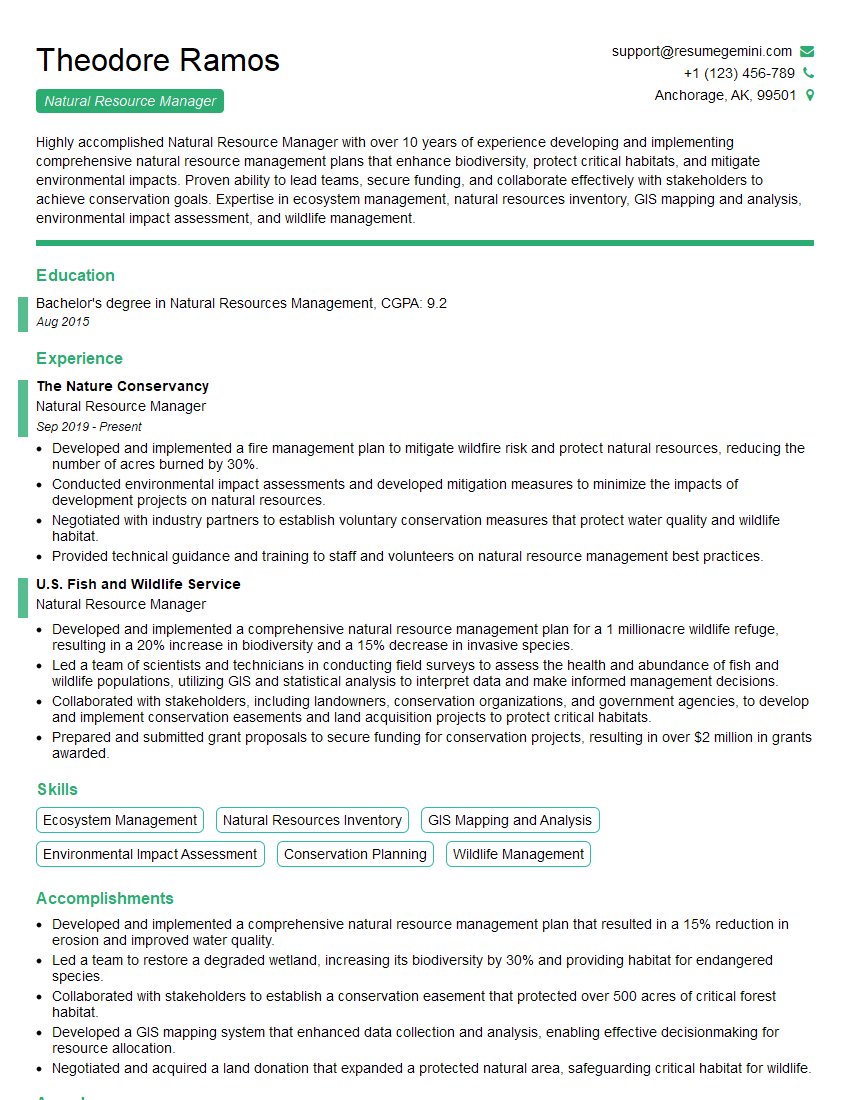
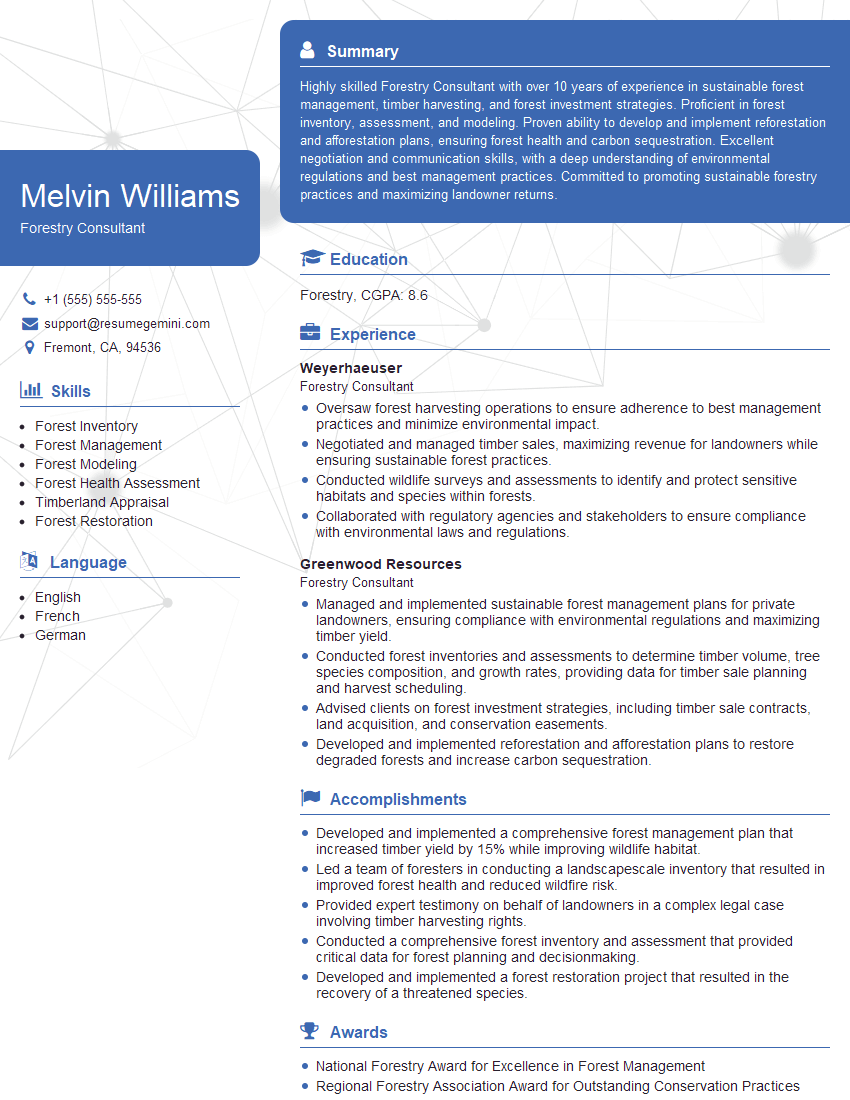
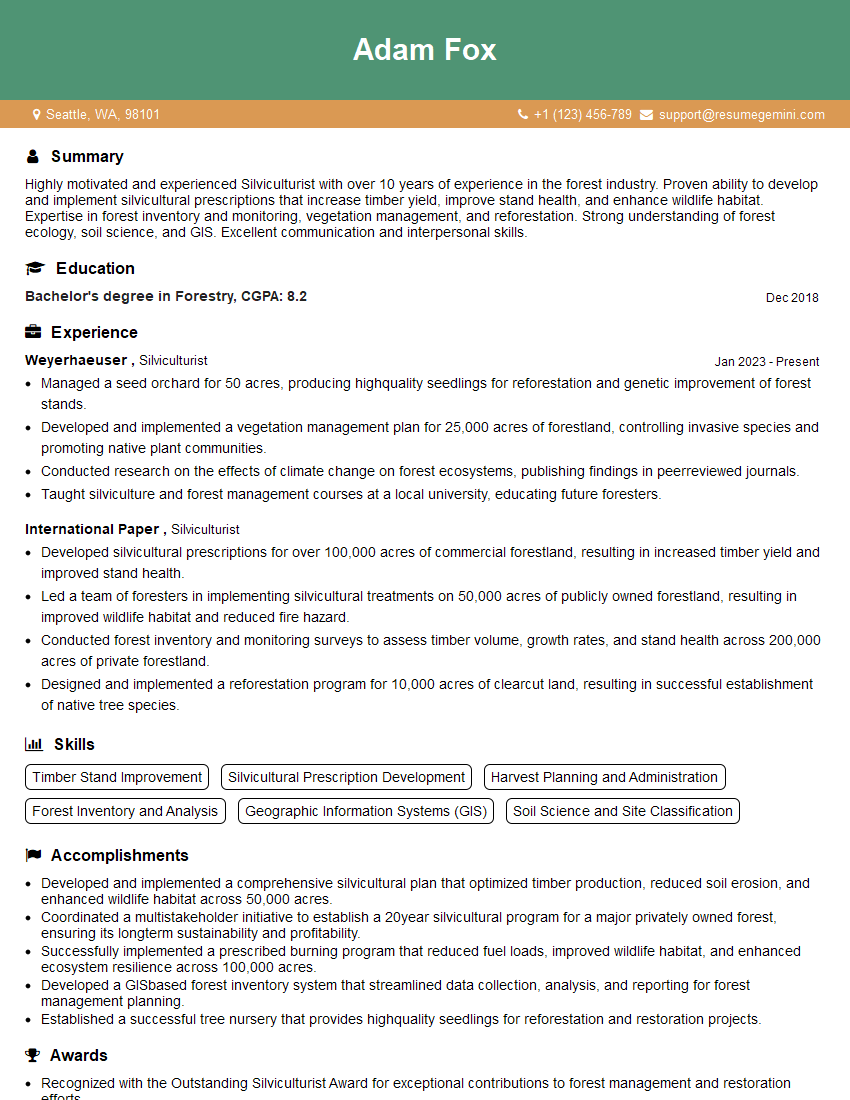
Mastering Timber Valuation is crucial for career advancement in the forestry and natural resource management sectors, opening doors to exciting roles with increased responsibility and earning potential. A strong resume is your first impression – make it count! Creating an ATS-friendly resume significantly increases your chances of getting your application noticed. We highly recommend using ResumeGemini to build a professional and effective resume. ResumeGemini offers a user-friendly platform and provides examples of resumes specifically tailored to Timber Valuation roles to guide you through the process. Invest time in crafting a compelling resume; it’s a vital step in securing your dream job.
Explore more articles
Users Rating of Our Blogs
Share Your Experience
We value your feedback! Please rate our content and share your thoughts (optional).
What Readers Say About Our Blog
Attention music lovers!
Wow, All the best Sax Summer music !!!
Spotify: https://open.spotify.com/artist/6ShcdIT7rPVVaFEpgZQbUk
Apple Music: https://music.apple.com/fr/artist/jimmy-sax-black/1530501936
YouTube: https://music.youtube.com/browse/VLOLAK5uy_noClmC7abM6YpZsnySxRqt3LoalPf88No
Other Platforms and Free Downloads : https://fanlink.tv/jimmysaxblack
on google : https://www.google.com/search?q=22+AND+22+AND+22
on ChatGPT : https://chat.openai.com?q=who20jlJimmy20Black20Sax20Producer
Get back into the groove with Jimmy sax Black
Best regards,
Jimmy sax Black
www.jimmysaxblack.com
Hi I am a troller at The aquatic interview center and I suddenly went so fast in Roblox and it was gone when I reset.
Hi,
Business owners spend hours every week worrying about their website—or avoiding it because it feels overwhelming.
We’d like to take that off your plate:
$69/month. Everything handled.
Our team will:
Design a custom website—or completely overhaul your current one
Take care of hosting as an option
Handle edits and improvements—up to 60 minutes of work included every month
No setup fees, no annual commitments. Just a site that makes a strong first impression.
Find out if it’s right for you:
https://websolutionsgenius.com/awardwinningwebsites
Hello,
we currently offer a complimentary backlink and URL indexing test for search engine optimization professionals.
You can get complimentary indexing credits to test how link discovery works in practice.
No credit card is required and there is no recurring fee.
You can find details here:
https://wikipedia-backlinks.com/indexing/
Regards
NICE RESPONSE TO Q & A
hi
The aim of this message is regarding an unclaimed deposit of a deceased nationale that bears the same name as you. You are not relate to him as there are millions of people answering the names across around the world. But i will use my position to influence the release of the deposit to you for our mutual benefit.
Respond for full details and how to claim the deposit. This is 100% risk free. Send hello to my email id: lukachachibaialuka@gmail.com
Luka Chachibaialuka
Hey interviewgemini.com, just wanted to follow up on my last email.
We just launched Call the Monster, an parenting app that lets you summon friendly ‘monsters’ kids actually listen to.
We’re also running a giveaway for everyone who downloads the app. Since it’s brand new, there aren’t many users yet, which means you’ve got a much better chance of winning some great prizes.
You can check it out here: https://bit.ly/callamonsterapp
Or follow us on Instagram: https://www.instagram.com/callamonsterapp
Thanks,
Ryan
CEO – Call the Monster App
Hey interviewgemini.com, I saw your website and love your approach.
I just want this to look like spam email, but want to share something important to you. We just launched Call the Monster, a parenting app that lets you summon friendly ‘monsters’ kids actually listen to.
Parents are loving it for calming chaos before bedtime. Thought you might want to try it: https://bit.ly/callamonsterapp or just follow our fun monster lore on Instagram: https://www.instagram.com/callamonsterapp
Thanks,
Ryan
CEO – Call A Monster APP
To the interviewgemini.com Owner.
Dear interviewgemini.com Webmaster!
Hi interviewgemini.com Webmaster!
Dear interviewgemini.com Webmaster!
excellent
Hello,
We found issues with your domain’s email setup that may be sending your messages to spam or blocking them completely. InboxShield Mini shows you how to fix it in minutes — no tech skills required.
Scan your domain now for details: https://inboxshield-mini.com/
— Adam @ InboxShield Mini
support@inboxshield-mini.com
Reply STOP to unsubscribe
Hi, are you owner of interviewgemini.com? What if I told you I could help you find extra time in your schedule, reconnect with leads you didn’t even realize you missed, and bring in more “I want to work with you” conversations, without increasing your ad spend or hiring a full-time employee?
All with a flexible, budget-friendly service that could easily pay for itself. Sounds good?
Would it be nice to jump on a quick 10-minute call so I can show you exactly how we make this work?
Best,
Hapei
Marketing Director
Hey, I know you’re the owner of interviewgemini.com. I’ll be quick.
Fundraising for your business is tough and time-consuming. We make it easier by guaranteeing two private investor meetings each month, for six months. No demos, no pitch events – just direct introductions to active investors matched to your startup.
If youR17;re raising, this could help you build real momentum. Want me to send more info?
Hi, I represent an SEO company that specialises in getting you AI citations and higher rankings on Google. I’d like to offer you a 100% free SEO audit for your website. Would you be interested?
Hi, I represent an SEO company that specialises in getting you AI citations and higher rankings on Google. I’d like to offer you a 100% free SEO audit for your website. Would you be interested?