Interviews are opportunities to demonstrate your expertise, and this guide is here to help you shine. Explore the essential Understanding of Electrical Systems and Safety interview questions that employers frequently ask, paired with strategies for crafting responses that set you apart from the competition.
Questions Asked in Understanding of Electrical Systems and Safety Interview
Q 1. Explain Ohm’s Law and its applications.
Ohm’s Law is a fundamental principle in electricity that describes the relationship between voltage, current, and resistance in a circuit. It states that the current (I) flowing through a conductor is directly proportional to the voltage (V) applied across it and inversely proportional to its resistance (R). This relationship is expressed mathematically as:
V = I * R
Applications: Ohm’s Law is incredibly versatile and has countless applications. For example, it’s used to calculate the current draw of a device given its voltage rating and resistance. In circuit design, it helps engineers determine the appropriate resistor values to limit current flow and protect components. It is also crucial in power distribution systems for calculating voltage drops across transmission lines and determining the appropriate conductor size to minimize energy loss.
Example: Imagine a simple light bulb with a resistance of 10 ohms connected to a 120-volt power supply. Using Ohm’s Law, we can calculate the current flowing through the bulb: I = V / R = 120V / 10Ω = 12A. This means 12 amps of current will flow through the light bulb.
Q 2. Describe different types of electrical circuits (series, parallel, etc.).
Electrical circuits can be categorized into several types, with series and parallel circuits being the most fundamental.
- Series Circuit: In a series circuit, components are connected end-to-end, forming a single path for current flow. The current is the same through each component, but the voltage is divided across them. If one component fails, the entire circuit breaks.
- Parallel Circuit: In a parallel circuit, components are connected across each other, providing multiple paths for current flow. The voltage is the same across each component, but the current is divided among them. If one component fails, the others continue to function.
- Combination Circuits: Many real-world circuits are a combination of series and parallel arrangements, increasing complexity but offering flexibility in design.
Example: Christmas tree lights often use series circuits; if one bulb burns out, the entire string goes dark. Household wiring, on the other hand, uses parallel circuits; if one appliance malfunctions, the others remain operational. Understanding these circuit types is critical for troubleshooting and design.
Q 3. What are the safety precautions for working with high voltage equipment?
Working with high-voltage equipment presents significant risks of electric shock, burns, and even death. Safety precautions are paramount and must be strictly adhered to. These include:
- Proper Training and Certification: Only qualified and trained personnel should work with high-voltage systems.
- Lockout/Tagout Procedures: Always follow established lockout/tagout procedures to de-energize and isolate equipment before working on it.
- Personal Protective Equipment (PPE): Use appropriate PPE such as insulated gloves, safety glasses, arc flash suits, and safety footwear.
- Proper Tools and Equipment: Use insulated tools and equipment rated for the voltage level.
- Safe Work Practices: Maintain awareness of surroundings, avoid contact with energized components, and never work alone.
- Regular Inspections: Regularly inspect equipment for damage or wear and tear before use.
- Emergency Procedures: Have a clear plan in place for handling emergencies, including access to first aid and emergency services.
Ignoring these safety precautions can lead to severe injuries or fatalities. Safety should always be the top priority.
Q 4. How do you perform a lockout/tagout procedure?
Lockout/Tagout (LOTO) is a safety procedure used to prevent the unexpected energization of equipment during maintenance or repair. It’s a critical step to ensure worker safety. The procedure typically involves these steps:
- Plan the Work: Identify the equipment to be de-energized, and determine the appropriate isolation points.
- Turn Off the Equipment: Turn off the power switch or breaker for the equipment.
- Verify Power is Off: Use a voltage tester to confirm that the power is off at the isolation point.
- Apply Lockout Devices: Attach a lockout device (lock) to the power switch or breaker, preventing it from being turned back on.
- Apply Tagout Devices: Attach a tagout device (tag) indicating that the equipment is locked out and should not be operated.
- Verify Lockout/Tagout: Ensure that all lockout/tagout devices are properly secured before starting any work.
- Release Lockout/Tagout: Once the work is completed, remove the lockout/tagout devices, verifying the power is still off before energizing the equipment.
LOTO is a crucial safety measure that prevents accidental energization and protects workers from electrical hazards.
Q 5. Explain the concept of grounding and its importance.
Grounding, also known as earthing, is the process of connecting electrical equipment or systems to the earth. It provides a path for fault currents to flow safely to the ground, preventing electrical shock and equipment damage.
Importance:
- Safety: Grounding provides a low-impedance path for fault currents, diverting them away from personnel and minimizing the risk of electric shock.
- Equipment Protection: Grounding helps protect equipment from voltage surges and other electrical disturbances.
- Noise Reduction: Grounding helps reduce electrical noise and interference.
Example: The grounding wire in a typical household electrical system connects the metal casing of appliances to the ground. If a fault occurs, the current flows through the grounding wire to the earth, preventing the appliance casing from becoming energized.
Q 6. What are the different types of electrical protection devices (fuses, circuit breakers, etc.)?
Several electrical protection devices are used to safeguard electrical circuits and equipment from overcurrents, short circuits, and other electrical faults:
- Fuses: Fuses contain a thin wire that melts and breaks the circuit when excessive current flows. They are one-time use devices that need to be replaced after they blow.
- Circuit Breakers: Circuit breakers are reusable devices that automatically interrupt the circuit when an overcurrent or short circuit is detected. They can be manually reset after the fault is cleared.
- Ground Fault Circuit Interrupters (GFCIs): GFCIs detect small imbalances in current flow and quickly interrupt the circuit to prevent electric shock. They are commonly used in bathrooms, kitchens, and outdoor locations.
- Arc Fault Circuit Interrupters (AFCIs): AFCIs detect and interrupt the circuit in response to arcing faults which can cause fires.
The choice of protection device depends on the application and the specific hazards involved. For example, GFCIs are essential in areas where water is present, while AFCIs are crucial for protecting against electrical fires.
Q 7. Describe the function of a transformer.
A transformer is a passive electrical device that transfers electrical energy between two or more circuits through electromagnetic induction. It is primarily used to change the voltage level of alternating current (AC).
Function: A transformer consists of two or more coils of wire wound around a common magnetic core. When AC flows through the primary coil, it creates a fluctuating magnetic field in the core. This field induces a voltage in the secondary coil, which is proportional to the ratio of the number of turns in the primary and secondary coils. This allows for stepping up (increasing) or stepping down (decreasing) the voltage.
Example: Power distribution systems use step-down transformers to reduce high-voltage transmission lines to safer, usable voltages in homes and businesses. Similarly, step-up transformers increase voltage for efficient long-distance transmission. Transformers are essential components in virtually all electrical power systems and many electronic devices.
Q 8. Explain the difference between AC and DC current.
The fundamental difference between AC (Alternating Current) and DC (Direct Current) lies in the direction of electron flow. In DC, electrons flow consistently in one direction, like water flowing down a river. This is the type of current produced by batteries and solar cells. AC, on the other hand, is characterized by electrons that periodically change direction, oscillating back and forth like a pendulum. This cyclical change is what gives AC its defining characteristic – a constantly changing voltage and current magnitude.
Think of it like this: DC is a smooth, steady stream, while AC is a wave, constantly rising and falling. This oscillating nature allows for efficient long-distance transmission of electricity through transformers, which step up voltage for transmission and then step it down for household use. DC power is typically used in smaller-scale applications like electronics and battery-powered devices, while AC is the standard for power grids worldwide.
Q 9. What are the common causes of electrical hazards?
Electrical hazards are a significant concern in various workplaces. Common causes stem from faulty equipment, improper wiring, and human error. Let’s break down the most prevalent sources:
- Faulty Equipment: Damaged insulation on wires, frayed cords, malfunctioning appliances, and overloaded circuits are major culprits. Imagine an old hair dryer with a cracked plug – direct contact with exposed wires could be fatal.
- Improper Wiring: Poorly installed wiring, inadequate grounding, and the use of unsuitable materials increase the risk of shorts, fires, and electric shocks. Improperly sized wire can overheat, melting insulation and causing a fire hazard.
- Environmental Factors: Exposure to moisture, excessive heat, or corrosive substances can degrade electrical insulation, making it more likely to fail. A dripping faucet near a junction box is a recipe for disaster.
- Human Error: Neglecting safety protocols, such as working on energized circuits without proper lockout/tagout procedures, bypassing safety devices, and ignoring warning signs, significantly increase the probability of accidents. For example, working on a live circuit without proper PPE can cause severe injuries or death.
Q 10. How do you identify and mitigate electrical hazards in a workplace?
Identifying and mitigating electrical hazards requires a multi-pronged approach involving regular inspections, proper training, and adherence to safety regulations. Here’s a step-by-step process:
- Regular Inspections: Conduct routine visual inspections of electrical equipment, wiring, and installations. Check for damaged insulation, loose connections, overloaded circuits, and any signs of overheating.
- Testing and Maintenance: Perform regular testing of electrical systems using appropriate equipment like insulation testers and circuit testers to ensure everything is functioning correctly. Schedule preventative maintenance for electrical equipment.
- Lockout/Tagout Procedures: Implement and rigorously enforce lockout/tagout procedures before working on any electrical equipment. This ensures the circuit is completely de-energized to prevent accidental shocks.
- Grounding and Bonding: Ensure proper grounding and bonding to prevent the buildup of static electricity and provide a safe path for fault currents. Grounding rods and bonding wires are essential safety measures.
- Personal Protective Equipment (PPE): Always use appropriate PPE, including insulated gloves, safety glasses, and arc-flash protective clothing when working with electricity. This safeguards against potential injuries.
- Training and Awareness: Provide comprehensive electrical safety training to all employees, covering hazard recognition, safe work practices, and emergency procedures. The goal is to instill a safety-first culture.
Q 11. Explain the National Electrical Code (NEC) or relevant local codes.
The National Electrical Code (NEC) in the United States, and equivalent codes in other countries, provides a comprehensive set of safety standards for electrical installations. It’s a highly detailed document that covers everything from wiring methods and overcurrent protection to grounding requirements and special occupancies (like hospitals or industrial facilities). The NEC is not a law itself but is adopted by local jurisdictions into legal building codes. Compliance is essential for safety and legality.
The code is organized into articles covering various aspects of electrical systems. It specifies acceptable materials, installation practices, and safety measures to minimize hazards. Regular updates to the NEC ensure it remains current with advancements in technology and evolving safety concerns. Ignoring the NEC can lead to serious consequences, including fines, legal liability, and potentially life-threatening accidents.
Q 12. Describe different types of wiring methods and their applications.
Several wiring methods cater to different applications, each with its own advantages and disadvantages. Here are a few common examples:
- Romex (NM-B): Non-metallic sheathed cable commonly used in residential construction for its ease of installation and cost-effectiveness. It’s suitable for interior wiring but generally not for damp or wet locations.
- BX (AC): Armored cable, offering better protection against physical damage compared to Romex. Often used in areas prone to impact or abrasion.
- Conduit (Rigid or EMT): Metal pipes that protect wires and offer the highest level of protection against physical damage, fire, and moisture. Commonly used in industrial settings and commercial buildings.
- MC Cable: Metal-clad cable, combining the advantages of sheathed cable and conduit protection. Offers a balance between ease of installation and robust protection.
The choice of wiring method depends on factors like the environment, the type of building, the amperage and voltage requirements, and the overall safety considerations. Incorrect wiring methods can compromise safety and lead to hazards.
Q 13. What is the purpose of an earth leakage circuit breaker (ELCB)?
An Earth Leakage Circuit Breaker (ELCB), also known as a Ground Fault Circuit Interrupter (GFCI), is a crucial safety device designed to protect against electric shock. It works by continuously monitoring the current flowing in the live and neutral wires. In a normal situation, the current in both wires should be equal. However, if a fault occurs, such as a person touching a live wire, a small amount of current will leak to the ground. This imbalance is immediately detected by the ELCB, which rapidly trips and cuts off the power, preventing serious injury or death. ELCBs are essential safety features in bathrooms, kitchens, and outdoor outlets where the risk of ground faults is higher.
Think of it as a highly sensitive current watchdog. Any tiny imbalance signifies a potential hazard, and the ELCB acts swiftly to protect.
Q 14. How do you interpret electrical schematics and drawings?
Interpreting electrical schematics and drawings requires a solid understanding of electrical symbols and conventions. These drawings represent the layout and connections of electrical components in a circuit. They are crucial for installation, troubleshooting, and maintenance. Begin by understanding the symbols used for different components like switches, breakers, lights, motors, and more. Each symbol has a specific meaning and representation.
Next, trace the flow of current through the circuit. Follow the lines connecting different components, paying close attention to the direction of current flow. Look for branch circuits, parallel paths, and series connections. Understanding these relationships is critical for comprehending how the entire circuit functions.
Finally, utilize the information on the drawings to understand the voltage, amperage, and other specifications for each component. The drawing will also generally reference panel locations and the types of protection devices in use. With practice and experience, you’ll develop the ability to quickly and accurately decipher electrical schematics and utilize this information effectively in practical settings.
Q 15. Explain the concept of impedance and its significance.
Impedance is the opposition to the flow of alternating current (AC) in an electrical circuit. Unlike resistance, which only considers the opposition to direct current (DC), impedance takes into account both resistance and reactance. Reactance is the opposition to current flow caused by capacitance or inductance in the circuit. Think of it like this: resistance is like friction slowing down a ball rolling down a hill, while reactance is like the hill itself, changing the ball’s path and speed. Impedance is the combined effect of both friction and the hill’s shape on the ball’s motion.
Its significance lies in its crucial role in AC circuit analysis. Knowing the impedance of a circuit component allows us to calculate the current flow, voltage drop, and power consumption within that circuit. This is fundamental for designing and troubleshooting electrical systems operating on AC power, such as power grids, industrial machinery, and household appliances. For instance, a mismatch in impedance between a power source and a load can lead to significant power loss and inefficient operation. Proper impedance matching is critical in many applications, like antenna design and audio systems.
Career Expert Tips:
- Ace those interviews! Prepare effectively by reviewing the Top 50 Most Common Interview Questions on ResumeGemini.
- Navigate your job search with confidence! Explore a wide range of Career Tips on ResumeGemini. Learn about common challenges and recommendations to overcome them.
- Craft the perfect resume! Master the Art of Resume Writing with ResumeGemini’s guide. Showcase your unique qualifications and achievements effectively.
- Don’t miss out on holiday savings! Build your dream resume with ResumeGemini’s ATS optimized templates.
Q 16. Describe different types of motors (AC, DC, etc.) and their applications.
There are several types of electric motors, broadly classified into AC and DC motors.
- DC Motors: These motors operate on direct current. They are known for their precise speed control and high starting torque. Sub-types include brushed DC motors (simple, but require maintenance) and brushless DC motors (more efficient, longer lifespan). Applications include small appliances, robotics, and electric vehicles.
- AC Motors: These motors operate on alternating current. They are generally more robust and require less maintenance than DC motors. Major types include:
- Induction Motors: These are the most common AC motors, simple in design, and relatively inexpensive. They use electromagnetic induction to generate torque. Applications include fans, pumps, and industrial machinery.
- Synchronous Motors: These motors run at a constant speed synchronized with the AC power frequency. They offer high efficiency and precise speed control, albeit often at a higher cost. Applications include clocks, precision machinery, and some power generation systems.
- Stepper Motors: These motors rotate in discrete steps, allowing for precise positioning and control. Applications include robotics, 3D printers, and CNC machines.
The choice of motor depends heavily on the specific application requirements, considering factors like speed control precision, torque needs, cost, efficiency, and maintenance requirements.
Q 17. How do you troubleshoot electrical problems in a system?
Troubleshooting electrical problems involves a systematic approach. Safety is paramount – always de-energize the system before working on it. The process typically involves:
- Visual Inspection: Look for obvious problems like loose connections, damaged wires, burned components, or overheating.
- Testing with Multimeter: Use a multimeter to check voltage, current, and resistance at various points in the circuit. This helps identify shorts, open circuits, or faulty components.
- Schematic Diagram Analysis: If available, use a schematic diagram to trace the circuit and pinpoint the location of the fault. Understanding the circuit is critical.
- Isolation of Faulty Components: Systematically isolate sections of the circuit to narrow down the source of the problem. This might involve temporarily disconnecting components or using test probes.
- Component Replacement: Once the faulty component is identified, replace it with a known good component. Always ensure compatibility.
- Documentation: Record all measurements, findings, and corrective actions. This aids future troubleshooting and maintenance.
For example, if a circuit isn’t receiving power, you’d start by checking the fuse or circuit breaker, then move to the power supply and then trace the wires looking for breaks or poor connections.
Q 18. Explain the principle of operation of a relay.
A relay is an electrically operated switch. It uses a small control current to switch a larger power circuit on or off. Imagine it like a remote control for a light switch, where the remote (small current) operates the switch (large current).
The principle of operation is based on electromagnetism. When a control current flows through a coil, it generates a magnetic field. This magnetic field attracts an armature, which is a movable part of the relay. The armature’s movement closes or opens contacts in the power circuit, switching the larger current on or off. Relays are used extensively in automation, control systems, and protection circuits to isolate high-power circuits from low-power control signals, enhancing safety and reliability. For example, a car’s starter motor uses a relay to control the high-current draw from the battery.
Q 19. What is the purpose of a surge protector?
A surge protector, also known as a surge suppressor or transient voltage suppressor, is a device designed to protect electronic equipment from voltage spikes or surges. These surges are short-duration bursts of high voltage that can occur from lightning strikes, power line faults, or switching transients. Think of it as a safety valve that prevents excessive pressure from damaging a system.
Surge protectors typically use metal-oxide varistors (MOVs) or other components that shunt excess voltage to ground. When a surge occurs, the MOV conducts the excess current, protecting connected equipment. However, MOVs are not designed to handle ongoing overvoltage; a continuous overvoltage condition will damage the surge protector. Surge protectors are essential for protecting expensive electronic equipment from potentially damaging voltage surges.
Q 20. Describe different types of batteries and their characteristics.
Batteries are electrochemical devices that convert chemical energy into electrical energy. There are various types, each with distinct characteristics:
- Lead-Acid Batteries: These are relatively inexpensive, readily available, and have high current output. However, they are heavy, have a shorter lifespan than other types, and require regular maintenance. Applications include car batteries and some backup power systems.
- Nickel-Cadmium (NiCd) Batteries: These are rechargeable batteries known for their high discharge rate and tolerance to deep discharges. However, they suffer from the memory effect (reduced capacity if not fully discharged) and contain toxic cadmium. Applications were once widespread but are now less common due to environmental concerns.
- Nickel-Metal Hydride (NiMH) Batteries: These offer higher energy density than NiCd batteries and avoid the memory effect. They are rechargeable and environmentally friendlier. Applications include portable electronics and hybrid vehicles.
- Lithium-ion (Li-ion) Batteries: These are currently the most popular rechargeable battery type. They offer high energy density, a long lifespan, and relatively low self-discharge. However, they can be expensive and require careful handling to prevent overheating and potential fire hazards. Applications are widespread, including laptops, smartphones, and electric vehicles.
The selection of battery type depends on the application’s specific energy and power requirements, cost constraints, environmental considerations, and safety factors.
Q 21. How do you test the insulation resistance of a cable?
Insulation resistance testing measures the ability of a cable’s insulation to resist the flow of current. A high insulation resistance indicates good insulation quality, while a low resistance suggests insulation breakdown or damage, posing a significant safety risk. The test is performed using a megohmmeter (also known as a mega-ohmmeter or insulation tester).
The procedure typically involves:
- Preparation: Ensure the cable is de-energized and disconnected from any circuits. If possible, ground the cable to eliminate stray voltage.
- Connection: Connect the megohmmeter leads to the cable conductors and the cable’s metallic sheath or armor (if applicable).
- Testing: Set the megohmmeter to the desired test voltage (usually 500V or 1000V, depending on the cable voltage rating). The megohmmeter applies a high DC voltage and measures the leakage current through the insulation. The insulation resistance is calculated as the ratio of voltage to current.
- Interpretation: Compare the measured resistance to the manufacturer’s specifications or acceptable limits. A lower-than-expected resistance indicates potential insulation problems requiring attention.
This test is crucial for ensuring the safety of electrical installations and preventing electrical shocks or fires. Regular insulation resistance testing is a standard practice for maintaining electrical equipment and ensuring compliance with safety regulations.
Q 22. Explain the concept of power factor and its importance.
Power factor (PF) is the ratio of real power (kW) used by a load to the apparent power (kVA) supplied to the load. It essentially represents how efficiently electrical power is utilized. A power factor of 1 indicates perfect efficiency, where all the power supplied is used to do work. Values less than 1 indicate that some power is wasted, typically due to reactive loads like motors and transformers.
Importance: A low power factor leads to several problems:
- Increased electricity costs: Utilities charge for the apparent power (kVA), not just the real power (kW). A low power factor means you pay for more power than you actually use.
- Oversized equipment: A lower power factor necessitates larger generators, transformers, and cables to handle the higher apparent power, increasing initial investment costs.
- Increased energy losses: Power loss in the system increases with a lower power factor, leading to higher operating costs and potentially overheating of equipment.
Example: Imagine two factories with the same real power demand (kW). One has a PF of 0.8, the other has a PF of 1. The factory with a PF of 0.8 will pay more for electricity and will likely have larger, more expensive equipment than the factory with a PF of 1.
Improving the power factor typically involves using power factor correction capacitors to compensate for reactive loads. This reduces the apparent power demand, leading to cost savings and improved system efficiency.
Q 23. What are the safety regulations for working at heights involving electrical equipment?
Safety regulations for working at heights involving electrical equipment are stringent and vary depending on location, but generally include:
- Proper training and certification: Workers must be adequately trained in both electrical safety and working at heights.
- Permit-to-work system: A formal system must be in place to assess the risks, implement control measures, and authorize work.
- Fall protection: Harness systems, safety nets, and guardrails must be used to prevent falls. The specific requirements depend on the height and the surrounding environment.
- Insulated tools and equipment: All tools and equipment used must be appropriately insulated for the voltage level being worked on.
- Lockout/Tagout procedures: Before working on any electrical equipment, power must be isolated, and lockout/tagout procedures must be followed to prevent accidental energization.
- Rescue plan: A well-defined rescue plan must be in place in case of a fall or other emergency.
- Regular inspections: All equipment and safety devices must be regularly inspected and maintained.
- Appropriate PPE: Personal protective equipment (PPE) such as safety helmets, gloves, and eye protection must be worn.
Failure to comply with these regulations can lead to serious injuries or fatalities. A comprehensive risk assessment is crucial before undertaking any work involving electrical equipment at heights.
Q 24. Describe the process of installing and terminating electrical cables.
Installing and terminating electrical cables involves several steps, and the specifics depend on the cable type, voltage rating, and application. However, general principles include:
- Preparation: Plan the cable route, ensuring adequate space and avoiding obstacles. Check for existing underground utilities to prevent damage.
- Cable pulling: Carefully pull the cables through conduits or trenches, using appropriate pulling equipment to avoid damage. Lubrication may be needed.
- Termination: This is the most critical step. It involves preparing the cable ends by stripping the outer sheath and insulation to the appropriate length. The conductors must be properly stripped and prepared for connection. The chosen termination method will depend on the type of connection (e.g. wire nuts, crimping, soldering).
- Connection: Connect the conductors to the termination points (e.g., circuit breakers, switchgear, receptacles). Ensure proper torque on screws and secure connections to prevent overheating and fire hazards.
- Testing: After installation, test the circuit for continuity, insulation resistance, and ground continuity to ensure safety and proper function.
- Documentation: Document the installation, including cable type, routing, and termination points for future reference and maintenance.
Example: Terminating a high-voltage cable requires specialized tools and techniques to ensure safety and proper insulation. Improper termination can lead to arcing, overheating, and potential fire hazards.
Q 25. Explain the difference between single-phase and three-phase power.
The main difference between single-phase and three-phase power lies in the number of alternating current (AC) waveforms used to supply power:
- Single-phase power: Uses a single AC waveform. This is the type of power typically used in homes and smaller businesses. It is simpler and less expensive to implement but has limitations in terms of power capacity.
- Three-phase power: Uses three AC waveforms, each displaced by 120 degrees. This system provides higher power capacity, more efficient motor operation, and is typically used in industrial settings and large buildings. Three-phase motors are more efficient and have better starting torque compared to single-phase motors.
Analogy: Imagine carrying buckets of water. Single-phase is like carrying one bucket at a time, while three-phase is like having three people carry buckets simultaneously, resulting in a much faster rate of water transfer (power delivery).
The choice between single-phase and three-phase depends entirely on power requirements. High-power applications necessitate the use of three-phase systems.
Q 26. What are the common causes of electrical fires and how can they be prevented?
Electrical fires are often caused by a combination of factors, but some common causes include:
- Overloaded circuits: When too many appliances or devices are connected to a single circuit, it can overheat and start a fire.
- Faulty wiring: Damaged or deteriorated wiring, especially old and poorly maintained wiring, can create sparks and cause fires.
- Short circuits: When a bare wire touches another wire or a grounded surface, a short circuit occurs, leading to a rapid flow of current and potential fire.
- Overheating of appliances: Malfunctioning or poorly maintained appliances can overheat and ignite flammable materials.
- Loose connections: Loose connections can create arcing and spark, igniting nearby materials.
- Improper grounding: Insufficient or faulty grounding can allow voltage to leak into the chassis of appliances, creating a shock hazard and a potential fire hazard if the current finds a path to ground through combustible materials.
Prevention:
- Regular inspections: Regular inspection of electrical systems by qualified personnel can identify and address potential hazards before they cause a fire.
- Proper wiring: Ensure proper installation of electrical wiring by a qualified electrician. Use appropriate-sized conductors and circuit breakers.
- Avoid overloading circuits: Don’t overload electrical circuits. Use multiple circuits to spread the load.
- Regular appliance maintenance: Keep appliances in good working condition and clean to avoid overheating.
- Ground fault circuit interrupters (GFCIs): Install GFCIs in areas with potential water exposure.
- Smoke detectors: Install and regularly test smoke detectors.
Q 27. How do you select the appropriate size of conductors for a given application?
Selecting the appropriate conductor size depends on several factors including the current carrying capacity, voltage drop, temperature rating, installation method, and environmental conditions. The process typically involves:
- Determine the required current: Calculate the load current based on the power demand and voltage. Allow for future expansion.
- Consult electrical codes: Refer to relevant electrical codes (e.g., NEC in the US) for guidelines on minimum conductor sizes based on current rating, insulation type, and installation method.
- Calculate voltage drop: Excessive voltage drop can lead to inefficient operation and potential damage to equipment. The voltage drop needs to be kept within acceptable limits, usually specified by codes or equipment manufacturers.
- Consider temperature rating: The conductor’s temperature rating must be suitable for the anticipated ambient temperature and load current.
- Choose the installation method: The installation method (e.g., conduit, raceway, direct burial) affects the ampacity (current carrying capacity) of the conductor.
- Verify ampacity with derating factors: If more than one conductor is installed within a conduit or raceway, derating factors must be applied to the conductor’s ampacity to account for the increased temperature.
Example: A high-current application, such as supplying power to a large motor, requires larger conductors to handle the current and minimize voltage drop. Selecting an undersized conductor could lead to overheating, fires, and premature failure.
Proper conductor sizing is critical for ensuring safe and reliable operation of electrical systems.
Q 28. Explain the concept of harmonic distortion in electrical systems.
Harmonic distortion in electrical systems refers to the presence of frequencies that are multiples of the fundamental frequency (typically 50 Hz or 60 Hz). These higher-order frequencies, called harmonics, are generated by non-linear loads such as rectifiers, variable speed drives, and switching power supplies.
Effect: Harmonics can cause several problems:
- Overheating of equipment: Harmonics can cause increased heating in transformers, cables, and other components, reducing their lifespan.
- Increased losses: Increased losses in the system due to harmonic currents.
- Malfunction of sensitive equipment: Harmonics can interfere with the operation of sensitive electronic equipment.
- Neutral current imbalance: In three-phase systems, harmonics can lead to an imbalance in the neutral current, potentially overloading the neutral conductor.
- Resonance: Harmonics can interact with the system’s impedance to create resonance, potentially causing excessive voltage and current fluctuations.
Mitigation: Harmonic mitigation techniques include using harmonic filters, passive filters, and active power filters. Proper load balancing can also reduce harmonic problems. Careful consideration of harmonic currents during system design is crucial to prevent issues.
Example: A factory with many variable speed drives may experience significant harmonic distortion, leading to increased equipment maintenance and potential failures. Installing harmonic filters can mitigate these issues.
Key Topics to Learn for Understanding of Electrical Systems and Safety Interview
- Fundamentals of Electricity: Ohm’s Law, Kirchhoff’s Laws, series and parallel circuits, power calculations. Understand the practical application of these laws in real-world scenarios.
- AC/DC Circuits: Differences between AC and DC power, characteristics of each, and their respective applications in various systems. Be prepared to discuss practical applications and troubleshooting scenarios.
- Electrical Safety Regulations and Codes: Familiarity with relevant safety standards (e.g., NEC, OSHA regulations) and their practical implications in workplace safety. Be able to discuss safe work practices and hazard identification.
- Protective Devices: Understanding the function and operation of fuses, circuit breakers, ground fault circuit interrupters (GFCIs), and other safety devices. Be ready to explain how they prevent electrical hazards.
- Wiring and Cable Systems: Knowledge of different types of wiring, cable sizing, and installation methods. Be prepared to discuss practical considerations for safe and efficient wiring practices.
- Electrical Testing and Measurement: Understanding the use of multimeters, clamp meters, and other testing equipment for troubleshooting and ensuring safety. Be able to explain different testing procedures and interpret results.
- Electrical System Troubleshooting: Develop your problem-solving skills by practicing identifying and resolving common electrical system faults. Familiarize yourself with diagnostic techniques and methodologies.
- Motors and Drives: Basic understanding of motor types (AC, DC), motor control circuits, and variable frequency drives (VFDs). Focus on practical applications and common issues.
Next Steps
Mastering the understanding of electrical systems and safety is crucial for career advancement in numerous fields. A strong foundation in this area demonstrates competence and commitment to safety, leading to increased opportunities and higher earning potential. To maximize your job prospects, create a compelling and ATS-friendly resume that highlights your skills and experience effectively. ResumeGemini is a trusted resource that can help you build a professional resume that showcases your qualifications. They provide examples of resumes tailored to the understanding of electrical systems and safety, giving you a head start in creating a document that stands out from the competition. Take the next step towards your dream career – invest in crafting a standout resume today.
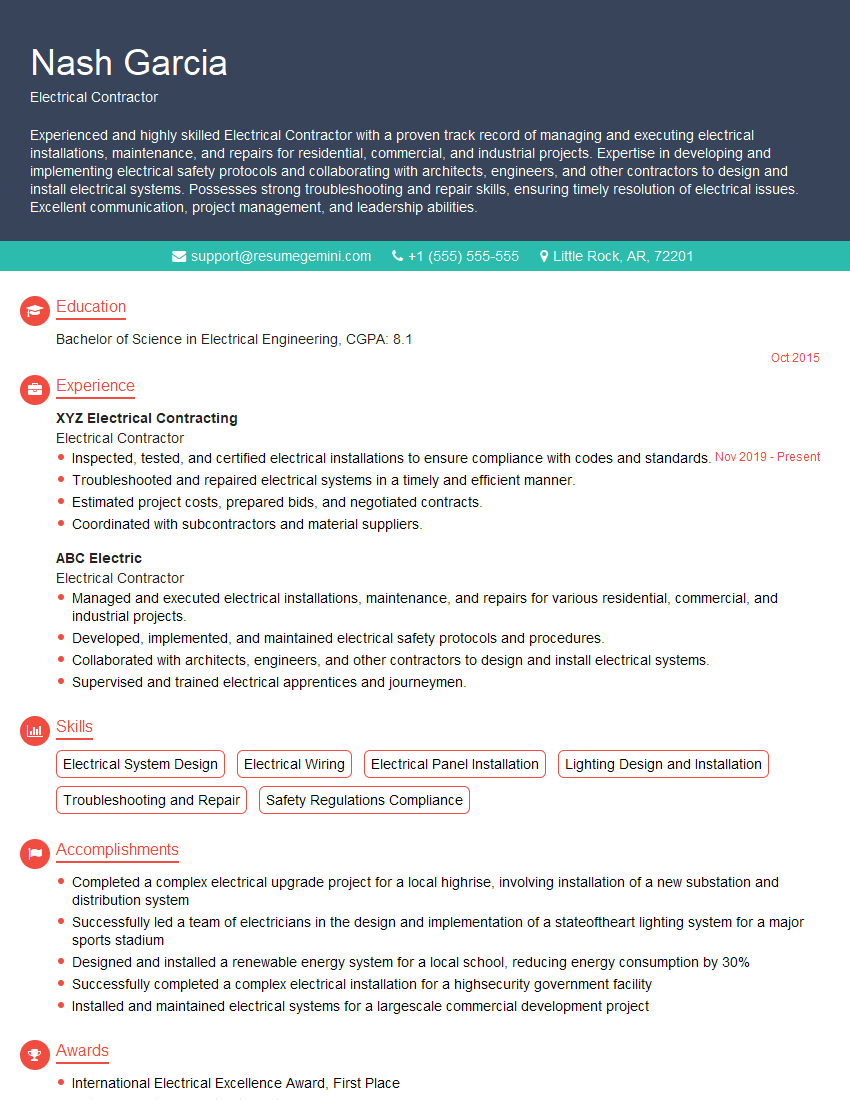
Electrical Contractor Resume Sample
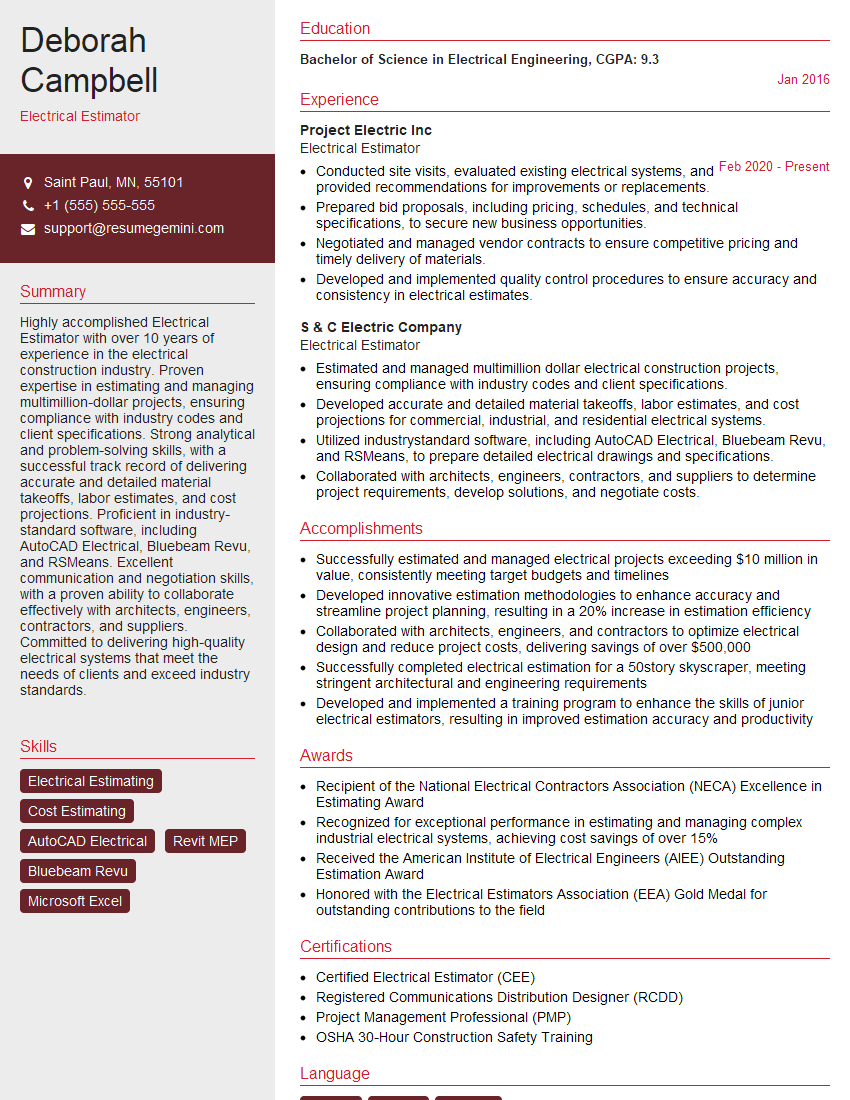
Electrical Estimator Resume Sample
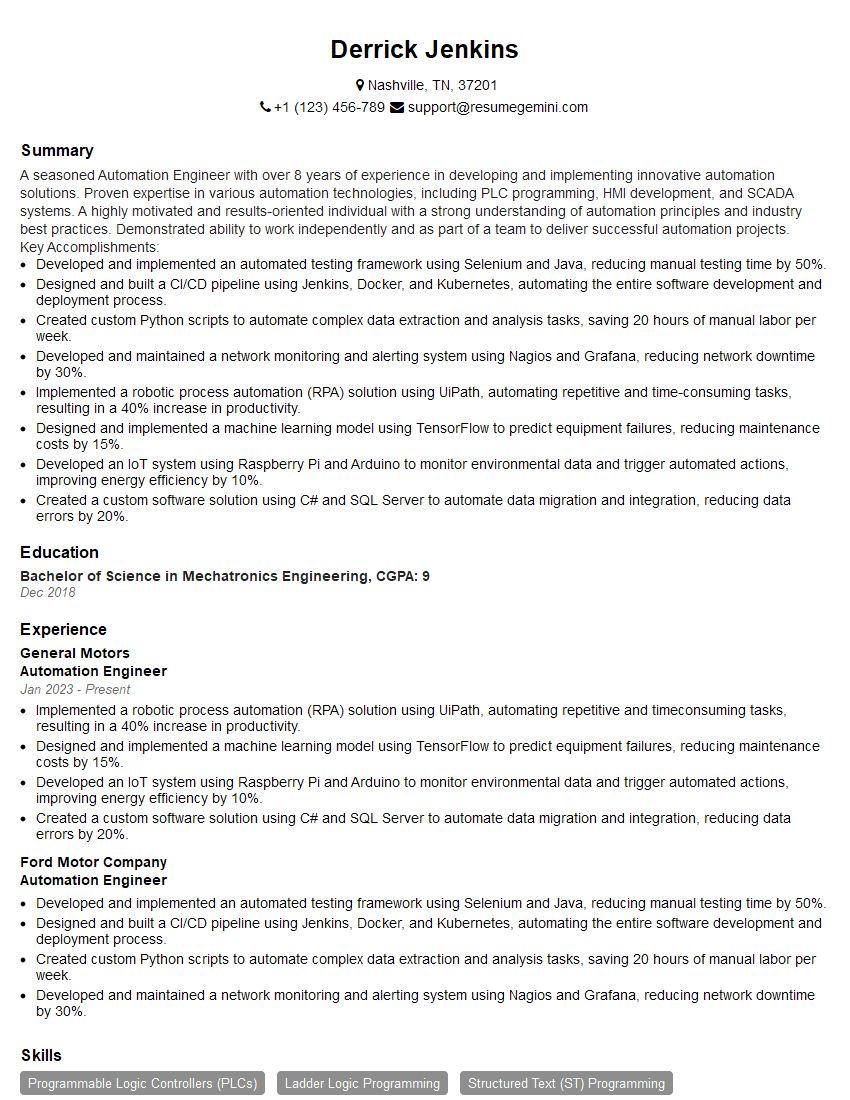
Automation Engineer Resume Sample
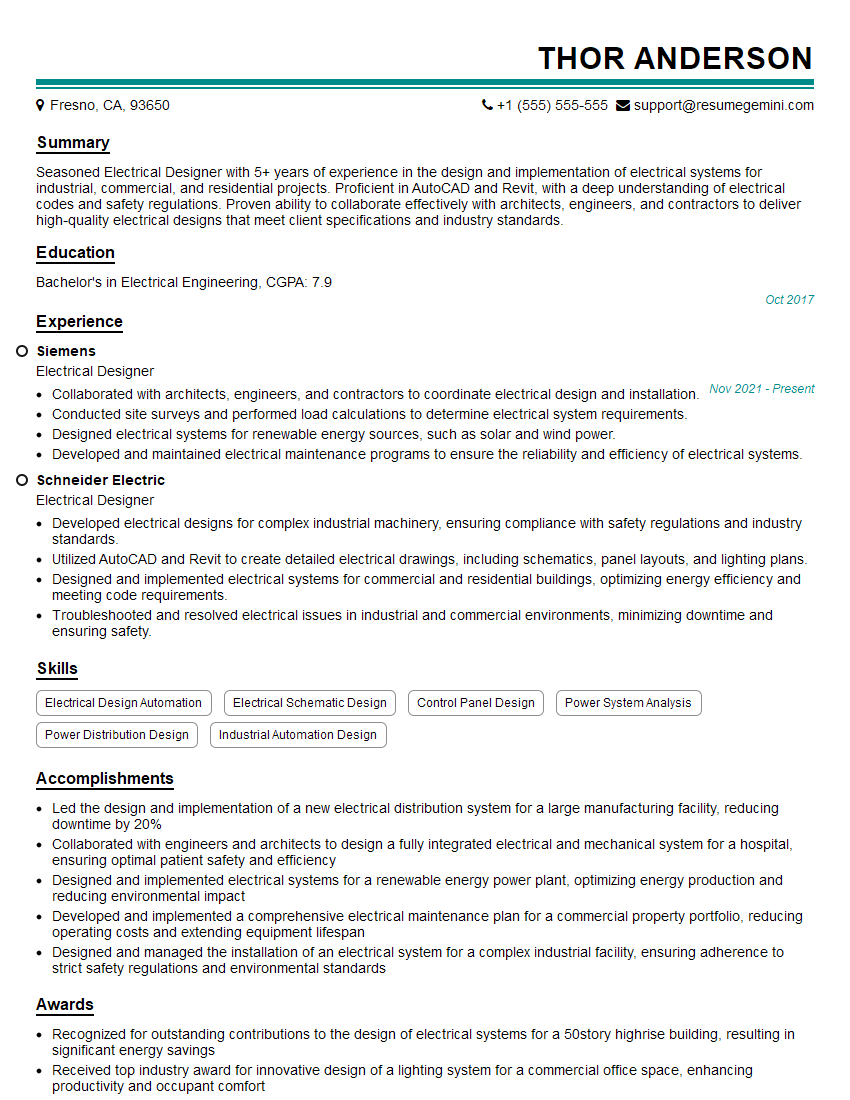
Electrical Designer Resume Sample
Electrical Engineer Resume Sample
Instrumentation Engineer Resume Sample
Power Distribution Engineer Resume Sample
Power Systems Engineer Resume Sample
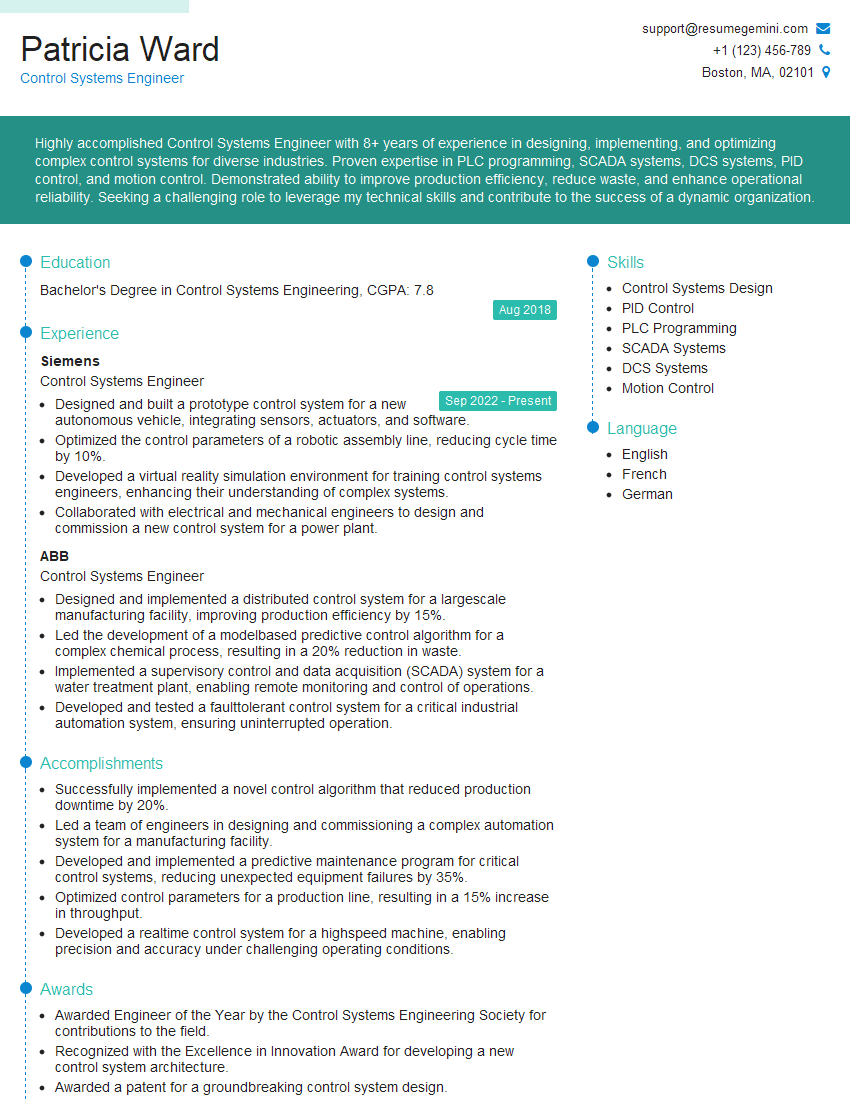
Control Systems Engineer Resume Sample
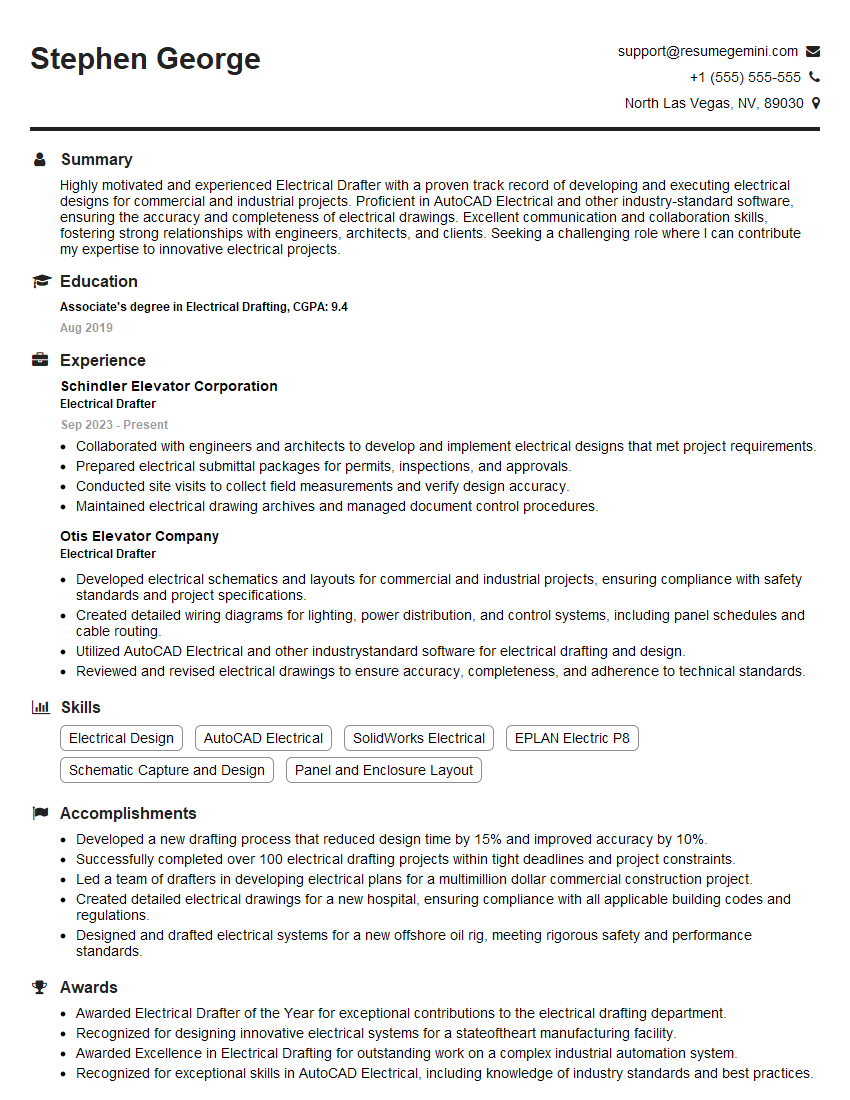
Electrical Drafter Resume Sample
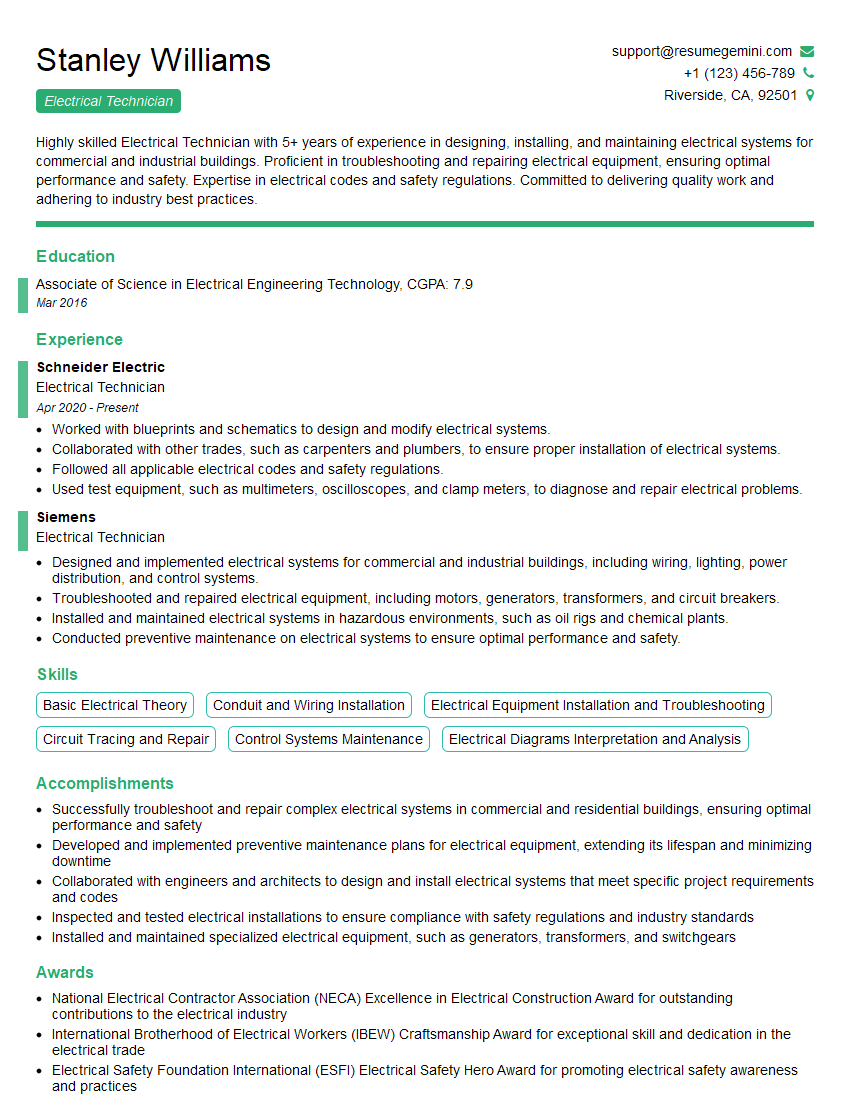
Electrical Technician Resume Sample
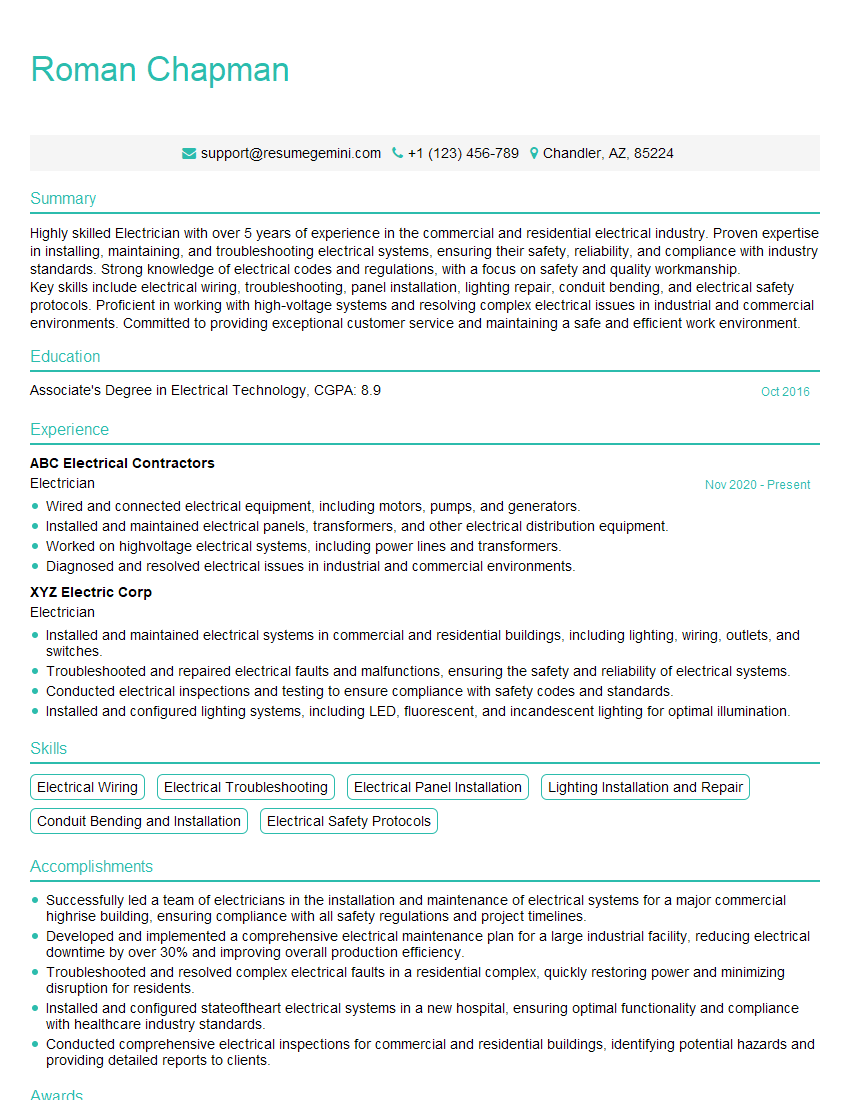
Electrician Resume Sample
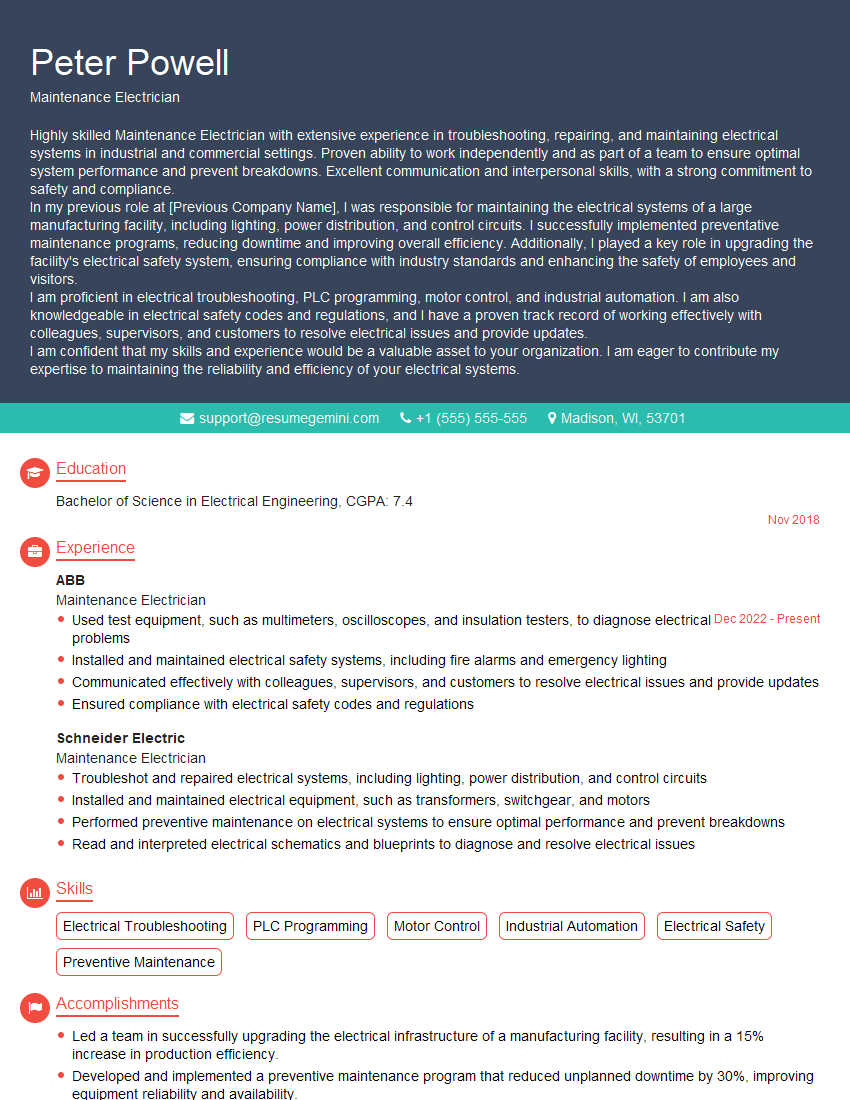
Maintenance Electrician Resume Sample
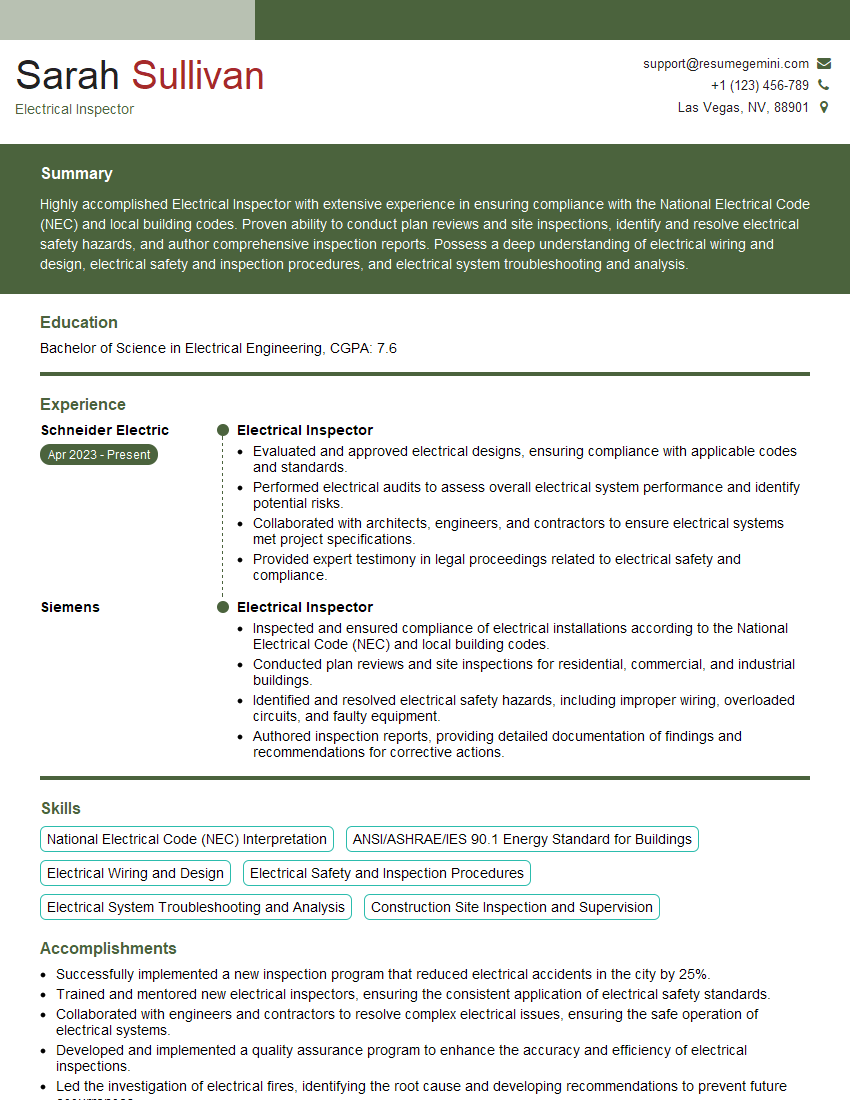
Electrical Inspector Resume Sample
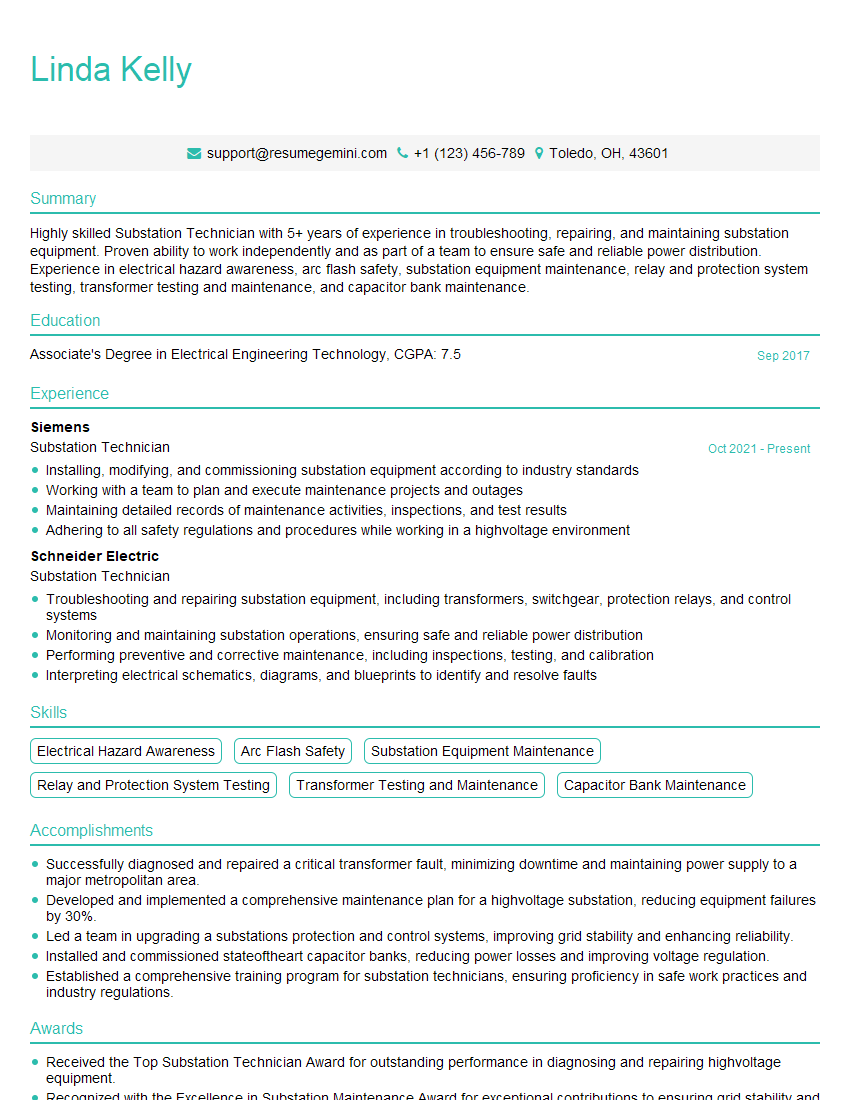
Substation Technician Resume Sample
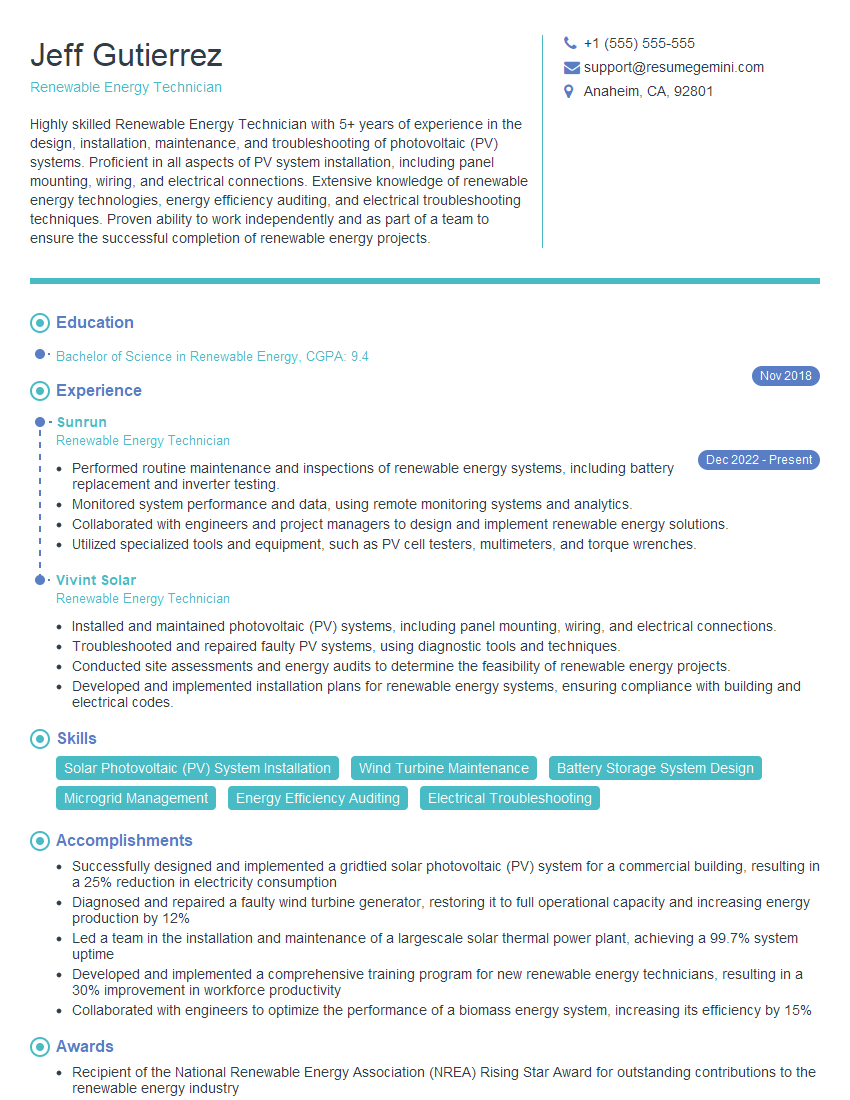
Renewable Energy Technician Resume Sample
- Electrical Contractor
- Electrical Estimator
- Automation Engineer
- Electrical Designer
- Electrical Engineer
- Instrumentation Engineer
- Power Distribution Engineer
- Power Systems Engineer
- Control Systems Engineer
- Electrical Drafter
- Electrical Technician
- Electrician
- Maintenance Electrician
- Electrical Inspector
- Substation Technician
- Renewable Energy Technician
Explore more articles
Users Rating of Our Blogs
Share Your Experience
We value your feedback! Please rate our content and share your thoughts (optional).
What Readers Say About Our Blog
Attention music lovers!
Wow, All the best Sax Summer music !!!
Spotify: https://open.spotify.com/artist/6ShcdIT7rPVVaFEpgZQbUk
Apple Music: https://music.apple.com/fr/artist/jimmy-sax-black/1530501936
YouTube: https://music.youtube.com/browse/VLOLAK5uy_noClmC7abM6YpZsnySxRqt3LoalPf88No
Other Platforms and Free Downloads : https://fanlink.tv/jimmysaxblack
on google : https://www.google.com/search?q=22+AND+22+AND+22
on ChatGPT : https://chat.openai.com?q=who20jlJimmy20Black20Sax20Producer
Get back into the groove with Jimmy sax Black
Best regards,
Jimmy sax Black
www.jimmysaxblack.com
Hi I am a troller at The aquatic interview center and I suddenly went so fast in Roblox and it was gone when I reset.
Hi,
Business owners spend hours every week worrying about their website—or avoiding it because it feels overwhelming.
We’d like to take that off your plate:
$69/month. Everything handled.
Our team will:
Design a custom website—or completely overhaul your current one
Take care of hosting as an option
Handle edits and improvements—up to 60 minutes of work included every month
No setup fees, no annual commitments. Just a site that makes a strong first impression.
Find out if it’s right for you:
https://websolutionsgenius.com/awardwinningwebsites
Hello,
we currently offer a complimentary backlink and URL indexing test for search engine optimization professionals.
You can get complimentary indexing credits to test how link discovery works in practice.
No credit card is required and there is no recurring fee.
You can find details here:
https://wikipedia-backlinks.com/indexing/
Regards
NICE RESPONSE TO Q & A
hi
The aim of this message is regarding an unclaimed deposit of a deceased nationale that bears the same name as you. You are not relate to him as there are millions of people answering the names across around the world. But i will use my position to influence the release of the deposit to you for our mutual benefit.
Respond for full details and how to claim the deposit. This is 100% risk free. Send hello to my email id: lukachachibaialuka@gmail.com
Luka Chachibaialuka
Hey interviewgemini.com, just wanted to follow up on my last email.
We just launched Call the Monster, an parenting app that lets you summon friendly ‘monsters’ kids actually listen to.
We’re also running a giveaway for everyone who downloads the app. Since it’s brand new, there aren’t many users yet, which means you’ve got a much better chance of winning some great prizes.
You can check it out here: https://bit.ly/callamonsterapp
Or follow us on Instagram: https://www.instagram.com/callamonsterapp
Thanks,
Ryan
CEO – Call the Monster App
Hey interviewgemini.com, I saw your website and love your approach.
I just want this to look like spam email, but want to share something important to you. We just launched Call the Monster, a parenting app that lets you summon friendly ‘monsters’ kids actually listen to.
Parents are loving it for calming chaos before bedtime. Thought you might want to try it: https://bit.ly/callamonsterapp or just follow our fun monster lore on Instagram: https://www.instagram.com/callamonsterapp
Thanks,
Ryan
CEO – Call A Monster APP
To the interviewgemini.com Owner.
Dear interviewgemini.com Webmaster!
Hi interviewgemini.com Webmaster!
Dear interviewgemini.com Webmaster!
excellent
Hello,
We found issues with your domain’s email setup that may be sending your messages to spam or blocking them completely. InboxShield Mini shows you how to fix it in minutes — no tech skills required.
Scan your domain now for details: https://inboxshield-mini.com/
— Adam @ InboxShield Mini
support@inboxshield-mini.com
Reply STOP to unsubscribe
Hi, are you owner of interviewgemini.com? What if I told you I could help you find extra time in your schedule, reconnect with leads you didn’t even realize you missed, and bring in more “I want to work with you” conversations, without increasing your ad spend or hiring a full-time employee?
All with a flexible, budget-friendly service that could easily pay for itself. Sounds good?
Would it be nice to jump on a quick 10-minute call so I can show you exactly how we make this work?
Best,
Hapei
Marketing Director
Hey, I know you’re the owner of interviewgemini.com. I’ll be quick.
Fundraising for your business is tough and time-consuming. We make it easier by guaranteeing two private investor meetings each month, for six months. No demos, no pitch events – just direct introductions to active investors matched to your startup.
If youR17;re raising, this could help you build real momentum. Want me to send more info?
Hi, I represent an SEO company that specialises in getting you AI citations and higher rankings on Google. I’d like to offer you a 100% free SEO audit for your website. Would you be interested?
Hi, I represent an SEO company that specialises in getting you AI citations and higher rankings on Google. I’d like to offer you a 100% free SEO audit for your website. Would you be interested?