Preparation is the key to success in any interview. In this post, we’ll explore crucial Validation Protocol interview questions and equip you with strategies to craft impactful answers. Whether you’re a beginner or a pro, these tips will elevate your preparation.
Questions Asked in Validation Protocol Interview
Q 1. Define Validation Protocol and its importance in regulated industries.
A Validation Protocol is a detailed, pre-approved document that outlines the plan for validating a process, system, or equipment. It’s essentially a roadmap ensuring that your system consistently produces accurate and reliable results. In regulated industries like pharmaceuticals, medical devices, and food processing, validation protocols are crucial because they demonstrate compliance with stringent regulatory requirements like GMP (Good Manufacturing Practices), ensuring product safety and quality. Without proper validation, companies risk producing faulty products, facing regulatory sanctions, and damaging their reputation.
Think of it like this: Before a new airplane model is allowed to fly commercially, it undergoes rigorous testing to ensure its safety and reliability. Similarly, a validation protocol ensures the reliability and accuracy of a process or system before it’s used in production.
Q 2. Explain the difference between Validation and Verification.
While both validation and verification are critical for ensuring quality, they address different aspects:
- Verification answers the question: “Are we building the product right?” It confirms that a system or process is designed and built according to the specifications. This involves checking documents, designs, and procedures against pre-defined requirements.
- Validation answers the question: “Are we building the right product?” It demonstrates that a system or process consistently performs as intended and produces the desired results. It’s about demonstrating that the system actually works in practice, as designed.
Example: Verifying a temperature monitoring system involves checking if the sensors are correctly installed and calibrated according to the specifications. Validating the same system involves demonstrating that it accurately and consistently monitors the temperature within the required range under real-world operating conditions.
Q 3. Describe the phases involved in a typical Validation lifecycle.
A typical validation lifecycle generally consists of these phases:
- Requirement Definition: Defining the purpose and scope of the validation, specifying acceptance criteria, and identifying critical parameters.
- Protocol Development: Creating a detailed validation protocol document outlining the validation strategy, methods, and acceptance criteria.
- Protocol Execution: Performing the validation activities as outlined in the protocol, meticulously documenting all steps and observations.
- Data Analysis & Reporting: Analyzing the collected data to determine whether the validation criteria have been met. This includes generating a comprehensive validation report.
- Approval & Review: Submitting the validation report to relevant personnel for review and approval. Any deviations or issues identified must be resolved.
- Maintenance & Retesting: Establishing a schedule for periodic revalidation or re-qualification to maintain the validated state of the system.
Q 4. What are the key elements of a well-written Validation Protocol?
A well-written Validation Protocol should include:
- Title and Purpose: Clearly stating the objective of the validation.
- Scope: Defining the specific systems, equipment, and processes covered by the validation.
- Methodology: Detailing the methods and procedures used to conduct the validation, including test parameters, sample sizes, and acceptance criteria.
- Materials and Equipment: Listing all necessary materials, equipment, and software used during the validation.
- Acceptance Criteria: Defining the specific criteria that must be met for the validation to be successful.
- Deviation Plan: Outlining the procedures for handling any deviations from the protocol during execution.
- Responsibilities: Assigning roles and responsibilities to the individuals involved in the validation process.
- Approval Signatures: Sections for signatures of individuals approving the protocol and the validation report.
Q 5. How do you determine the scope of a Validation Protocol?
The scope of a Validation Protocol is determined by the specific system or process being validated and its impact on product quality and safety. Factors to consider include:
- Regulatory Requirements: Compliance with regulations like GMP, FDA guidelines, or ISO standards.
- Risk Assessment: Identifying the potential risks associated with the system or process and prioritizing critical parameters for validation.
- System Complexity: The level of complexity of the system and the number of parameters that need to be validated.
- Previous Validation Data: Leveraging past validation data and experience to refine the scope.
Example: Validating a new drug formulation would require a broader scope than validating a simple cleaning procedure, due to the significant impact on patient safety.
Q 6. Explain the concept of risk assessment in Validation.
Risk assessment is a critical part of validation planning. It involves identifying potential hazards and assessing the likelihood and severity of their occurrence. This helps in determining the appropriate validation strategy and resource allocation. It helps focus validation efforts on the most critical aspects of the system or process. A thorough risk assessment should consider:
- Failure Modes: Potential ways the system could fail to meet its intended purpose.
- Failure Effects: The potential consequences of system failure on product quality, safety, and compliance.
- Failure Probability: The likelihood of each failure mode occurring.
- Risk Mitigation Strategies: Methods to reduce or eliminate the identified risks.
Using a risk assessment matrix helps to prioritize validation activities, ensuring resources are focused on the most critical aspects.
Q 7. How do you handle deviations during Validation activities?
Deviations from the validation protocol must be documented, investigated, and addressed. A deviation is any unplanned event that occurs during the validation process that differs from the pre-approved protocol. Handling deviations involves:
- Immediate Action: Stop the validation activity and take appropriate corrective actions to prevent further issues.
- Documentation: Thoroughly document all aspects of the deviation, including the cause, impact, and corrective actions taken.
- Investigation: Conduct a thorough investigation to determine the root cause of the deviation.
- Corrective and Preventive Actions (CAPA): Implement appropriate corrective actions to address the immediate issue and preventive actions to prevent recurrence.
- Impact Assessment: Evaluate the impact of the deviation on the validation results and overall system performance.
- Approval: Seek approval from relevant management to document the deviation and any necessary changes to the validation plan.
Deviations may require supplemental validation or even a complete re-validation if the impact on the system’s reliability is significant.
Q 8. What are the different types of validation protocols (e.g., equipment, process, cleaning)?
Validation protocols are systematic procedures used to demonstrate that equipment, processes, or systems consistently perform as intended. Different types exist, each with specific requirements and approaches. The most common categories include:
- Equipment Validation: This verifies that equipment used in manufacturing or testing consistently performs within predefined specifications. Examples include validating an autoclave’s sterilization cycle or the accuracy of a balance used for weighing raw materials. This typically involves IQ (Installation Qualification), OQ (Operational Qualification), and PQ (Performance Qualification) phases.
- Process Validation: This ensures that manufacturing processes reliably produce products that meet predetermined quality attributes. For example, a process validation might demonstrate that a specific drug formulation consistently achieves the desired purity and potency. It often involves evaluating critical process parameters (CPPs) and critical quality attributes (CQAs).
- Cleaning Validation: This confirms that cleaning procedures effectively remove residues from equipment or surfaces between production runs, preventing cross-contamination. This often involves swabbing surfaces, analyzing samples for residue levels, and comparing the results to pre-defined acceptance criteria.
- Computer System Validation (CSV): This focuses on validating the software and hardware systems used in regulated environments, ensuring data integrity, accuracy, and reliability. This involves assessing different aspects like security, audit trails, and system functionality.
Each validation type necessitates a well-defined protocol that outlines the steps, testing methods, acceptance criteria, and documentation requirements.
Q 9. Describe your experience with Computer System Validation (CSV).
My experience with Computer System Validation (CSV) spans over eight years, encompassing various projects in pharmaceutical and medical device industries. I’ve been involved in all phases of the CSV lifecycle, from initial risk assessment and defining the validation scope to execution, documentation, and ongoing maintenance. I’m proficient in using risk-based approaches to define validation activities, focusing on the critical systems impacting data integrity.
For example, in a recent project involving a laboratory information management system (LIMS), I led a team in developing and executing the validation plan. This included defining the validation scope, conducting gap analysis against regulatory requirements (like 21 CFR Part 11), creating test scripts, and managing the execution and documentation of the entire process. We utilized a combination of manual and automated testing to ensure thorough validation and address potential risks. The successful completion of this project resulted in a compliant and efficient LIMS, improving data management and traceability across the laboratory.
I am also familiar with various CSV methodologies and tools, and experienced in working with different regulatory bodies, allowing me to adapt my approach based on specific requirements and industry best practices. I am always up-to-date with the latest regulatory changes and guidelines.
Q 10. What are the regulatory requirements for Validation in your industry?
Regulatory requirements for validation vary depending on the industry and specific product. However, common regulations driving validation activities include:
- Pharmaceutical Industry: Current Good Manufacturing Practices (cGMP) guidelines, specifically 21 CFR Part 11 in the US and similar regulations in other countries (e.g., EU Annex 11), dictate requirements for data integrity, system validation, and electronic records. These regulations stress the importance of documented processes, controlled environments, and verified equipment to ensure product quality and safety.
- Medical Device Industry: Regulations like 21 CFR Part 820 (Quality System Regulation) in the US and the Medical Device Regulation (MDR) in Europe emphasize the need to validate processes and equipment critical to the safety and efficacy of medical devices. This includes validation of manufacturing processes, software used in design and manufacturing, and performance testing of the devices.
- Other Regulated Industries: Similar regulatory frameworks exist in other industries like food and cosmetics, emphasizing the necessity of validated processes to ensure product quality, safety, and compliance.
Staying updated on these regulations is crucial for ensuring compliance and maintaining product quality. Non-compliance can lead to significant consequences, including regulatory actions, product recalls, and reputational damage.
Q 11. Explain the importance of documentation in Validation.
Documentation is the cornerstone of any successful validation project. It provides irrefutable evidence that the validation activities were conducted thoroughly and meet regulatory expectations. Without proper documentation, the validation effort is essentially worthless.
The documentation should meticulously record every step of the validation process, including:
- Validation Plan: Outlines the scope, objectives, methodology, and timelines of the validation activities.
- Validation Protocols: Detailed procedures for each validation test, specifying the parameters, acceptance criteria, and testing methods.
- Validation Reports: Summarize the results of the validation tests, including any deviations or investigations.
- Deviation Reports: Document any unexpected results or issues encountered during validation, along with the corrective actions taken.
- Change Control Documentation: Tracks any changes made to validated systems or processes after validation.
Well-maintained documentation not only ensures compliance but also facilitates troubleshooting, future audits, and continuous improvement of validated systems.
Q 12. How do you ensure data integrity during Validation activities?
Ensuring data integrity during validation activities is paramount, especially in regulated industries. This involves implementing a robust system of controls to prevent data manipulation, loss, or alteration. Key strategies include:
- Use of Electronic Systems with Audit Trails: Utilizing electronic systems with comprehensive audit trails provides a clear record of all changes and modifications made to validated systems or data. This enables traceability and facilitates investigation of any discrepancies.
- Access Control: Implementing strict access control measures ensures only authorized personnel can access and modify validated systems and data. Role-based access controls help restrict access to specific functionalities based on individual responsibilities.
- Data Backup and Recovery: Implementing robust data backup and recovery procedures minimizes the risk of data loss due to system failures or other unforeseen events. Regularly tested backups provide confidence in data recoverability.
- Data Validation Checks: Incorporating data validation checks, such as range checks, format checks, and reasonableness checks, helps prevent the entry of erroneous data. These checks act as a crucial safeguard against data integrity issues.
- Regular System Audits: Conducting regular system audits assesses the effectiveness of data integrity controls and identifies areas for improvement. These audits are crucial to prevent long-term integrity issues.
A combination of these strategies ensures a high level of data integrity throughout the validation lifecycle, thereby maintaining compliance and preventing costly errors.
Q 13. What are some common challenges in Validation projects?
Validation projects often present various challenges, including:
- Scope Creep: The initial scope may not encompass all necessary aspects of the system or process. This can lead to delays, budget overruns, and insufficient validation coverage.
- Resource Constraints: Limited time, personnel, or budget can hinder the thoroughness of validation activities. This often necessitates prioritization and efficient resource allocation.
- Complexity of Systems: Validating complex systems, such as integrated manufacturing systems or enterprise resource planning (ERP) software, presents unique challenges due to the interconnectedness of components. This demands a systematic and well-planned approach.
- Regulatory Changes: Changes in regulatory requirements can impact the validation strategy and necessitate modifications to existing protocols or processes. Regular regulatory updates are essential to ensure compliance.
- Unexpected Results: Deviation from expected results during testing can require extensive investigation and potentially necessitate remedial actions or protocol revisions.
Effective project management, meticulous planning, and a robust risk assessment strategy are crucial to mitigate these challenges and ensure the successful completion of validation projects.
Q 14. How do you manage and resolve conflicts within a Validation team?
Conflict resolution within a validation team is crucial for maintaining project momentum and achieving validation goals. My approach involves:
- Open Communication: Establishing a culture of open and respectful communication is essential for identifying and addressing potential conflicts early on. Regular team meetings provide opportunities for discussing concerns and fostering collaboration.
- Active Listening: Actively listening to all team members’ perspectives, even if they differ from my own, ensures that all viewpoints are considered and understood. This demonstrates respect and helps reach mutually acceptable solutions.
- Facilitation of Discussion: When conflicts arise, I facilitate constructive discussions, guiding the team towards identifying the root causes of the disagreement and exploring potential solutions collaboratively. This approach promotes teamwork and problem-solving.
- Objective Decision-Making: Once all viewpoints are considered, I make objective decisions based on scientific rationale and regulatory requirements. The decision-making process is transparent and documented to ensure everyone understands the reasoning behind the decision.
- Documentation of Resolution: Once a resolution is reached, it is meticulously documented and communicated to all team members. This creates a clear record and prevents future misunderstandings related to the conflict.
By adopting this approach, I ensure conflicts are resolved fairly and efficiently, reinforcing teamwork and maintaining a positive working environment, crucial to a successful validation endeavor.
Q 15. Describe your experience with different Validation methodologies.
My experience encompasses a wide range of validation methodologies, tailored to the specific needs of the system or process being validated. I’ve worked extensively with various approaches, including but not limited to:
- CSV (Computer System Validation): This is crucial for software and systems used in regulated industries. My experience includes validating everything from Laboratory Information Management Systems (LIMS) to Chromatography Data Systems (CDS) using risk-based approaches to define the scope and depth of testing.
- Process Validation: This focuses on validating manufacturing processes to ensure consistent product quality. I’ve been involved in the validation of various unit operations, including mixing, filling, sterilization, and packaging processes. This often involves statistical process control (SPC) and Design of Experiments (DOE) techniques to optimize processes and demonstrate robustness.
- Equipment Validation: This focuses on ensuring that equipment performs as intended. I’ve worked extensively on the IQ (Installation Qualification), OQ (Operational Qualification), and PQ (Performance Qualification) of various instruments and equipment, such as autoclaves, freezers, and analytical balances. I’m familiar with the detailed documentation and testing required for each stage.
- Cleaning Validation: This critical process verifies the effectiveness of cleaning procedures to prevent cross-contamination. My experience involves employing various analytical techniques to quantify residual levels and ensure compliance with regulatory limits. I understand the importance of designing robust cleaning procedures and selecting appropriate analytical methods.
My approach is always risk-based. I analyze the system or process to identify critical parameters and focus validation efforts on those areas where the risk of failure is highest.
Career Expert Tips:
- Ace those interviews! Prepare effectively by reviewing the Top 50 Most Common Interview Questions on ResumeGemini.
- Navigate your job search with confidence! Explore a wide range of Career Tips on ResumeGemini. Learn about common challenges and recommendations to overcome them.
- Craft the perfect resume! Master the Art of Resume Writing with ResumeGemini’s guide. Showcase your unique qualifications and achievements effectively.
- Don’t miss out on holiday savings! Build your dream resume with ResumeGemini’s ATS optimized templates.
Q 16. Explain your understanding of 21 CFR Part 11 and its relevance to Validation.
21 CFR Part 11 is a set of regulations from the US Food and Drug Administration (FDA) that addresses the use of electronic records and signatures in regulated industries. It’s incredibly relevant to validation because it dictates the requirements for ensuring the integrity, accuracy, and reliability of electronic data generated during validation activities. This includes:
- System security: Ensuring access controls, audit trails, and data security measures are in place to prevent unauthorized access or modification of validation data.
- Data integrity: Maintaining the completeness, consistency, and accuracy of all electronic data generated throughout the validation lifecycle. This often involves implementing robust data backup and recovery procedures.
- Electronic signatures: Using electronic signatures that are equivalent to handwritten signatures in terms of legal validity and authenticity.
Failure to comply with 21 CFR Part 11 can lead to serious consequences, including regulatory sanctions and product recalls. Therefore, I ensure that all aspects of the validation process adhere strictly to these regulations.
For example, when validating a LIMS, I would ensure the system has robust user access controls, comprehensive audit trails, and a secure electronic signature system that meets 21 CFR Part 11 requirements. The validation documentation would then demonstrate compliance with these requirements.
Q 17. How do you ensure the traceability of Validation activities?
Traceability is paramount in validation. It’s essential to maintain a clear and unbroken chain of documentation demonstrating every step taken, from initial planning to final report. This is achieved through a meticulous documentation system. I employ several key strategies to ensure complete traceability:
- Unique identifiers: Assigning unique identifiers (e.g., batch numbers, document version numbers) to all validation documents and data.
- Cross-referencing: Clearly cross-referencing documents and data to establish links between different stages of the validation process.
- Version control: Implementing a version control system to manage changes to documents and data, ensuring that only the most current version is used.
- Electronic systems: Leveraging electronic document management systems (EDMS) to improve organization and ensure version control, and providing an auditable trail of changes and access.
- Batch records and reports: Linking test results to specific batches or runs of equipment/product, allowing for a complete view of the production process and validation data.
Imagine a situation where a validation failure occurs. With robust traceability, we can quickly identify the source of the problem by retracing the steps through the documented process. This allows for efficient troubleshooting and corrective actions.
Q 18. How do you manage changes to a Validation Protocol during execution?
Changes to a validation protocol during execution are inevitable and should be managed rigorously. My approach involves a formal change control process:
- Documentation: Any changes are documented in a change control log, detailing the reason for the change, the impact assessment, and the proposed revisions to the protocol.
- Approval: All changes require approval from appropriate personnel (e.g., validation manager, quality control manager), ensuring that the changes are justified and do not compromise the integrity of the validation.
- Retesting: Depending on the nature and significance of the change, retesting may be necessary to ensure that the validation remains valid. This retesting is documented and fully justified.
- Impact assessment: A thorough impact assessment of the change on the overall validation results is essential. This may involve re-evaluation of risk assessment and updating any applicable documents.
By formally documenting and controlling changes, we maintain the integrity of the validation process and ensure that any deviations are fully justified and documented.
Q 19. What is your approach to troubleshooting validation failures?
Troubleshooting validation failures requires a systematic and methodical approach. My strategy involves:
- Review of Documentation: Start by thoroughly reviewing all validation documentation, including the protocol, test results, and any associated logs. This often highlights potential issues.
- Root Cause Analysis: Conduct a root cause analysis to identify the underlying cause of the failure. Tools like Fishbone diagrams or 5 Whys can be valuable here. This step often requires collaboration with subject matter experts.
- Corrective and Preventive Actions (CAPA): Develop and implement appropriate corrective and preventive actions (CAPA) to address the root cause. These actions should be documented and verified to ensure effectiveness.
- Retesting: Once corrective actions are implemented, retesting is usually required to verify that the problem has been resolved. The results of retesting are documented and reviewed.
For example, if a cleaning validation fails, the root cause analysis may reveal an issue with the cleaning procedure, the cleaning agent, or the analytical method used to measure residual levels. The CAPA may involve modifying the cleaning procedure, switching to a more effective cleaning agent, or improving the analytical method.
Q 20. Describe your experience with Validation reporting and documentation.
Validation reporting and documentation are crucial for demonstrating compliance and ensuring the long-term integrity of the validation process. My experience includes creating comprehensive validation reports that include:
- Summary: A concise summary of the validation activities and results.
- Protocol: A detailed protocol outlining the planned validation activities.
- Test Results: Complete and accurate documentation of all test results, including raw data and calculations.
- Deviations and Out-of-Specification Results: Detailed investigation and documentation of any deviations from the protocol or out-of-specification results.
- Conclusion: A clear conclusion stating whether the validation was successful or not, along with any recommendations.
- Approvals: Signatures and approvals from relevant personnel.
I ensure all documentation is compliant with regulatory requirements (e.g., 21 CFR Part 11) and maintained in a secure and easily accessible system. The reports are written clearly and concisely, ensuring that they are easily understood by both technical and non-technical audiences.
Q 21. Explain your understanding of different validation approaches (e.g., IQ, OQ, PQ).
IQ, OQ, and PQ are the three phases of equipment qualification. These are crucial for demonstrating that equipment is correctly installed, operates as intended, and consistently delivers the expected results. Let’s break them down:
- Installation Qualification (IQ): This verifies that the equipment has been installed correctly according to the manufacturer’s specifications and any site-specific requirements. It involves checking aspects such as the installation environment, utilities connections, and documentation review.
- Operational Qualification (OQ): This verifies that the equipment operates within its specified parameters. It involves testing the equipment’s functionality and performance through a series of pre-defined tests. This phase tests the equipment without the introduction of product.
- Performance Qualification (PQ): This demonstrates that the equipment consistently produces the expected results under normal operating conditions. This phase involves testing with a representative product under expected conditions to confirm system performance.
Imagine validating an autoclave: IQ would involve verifying the installation of the autoclave, checking utility connections and ensuring the chamber is properly sealed. OQ would involve testing the temperature and pressure sensors, and the ability of the autoclave to reach and maintain the desired sterilization parameters. PQ would involve running sterilization cycles with test packs to verify that the autoclave successfully sterilizes the product.
Q 22. How do you ensure compliance with GMP/GLP principles in your validation work?
Ensuring compliance with Good Manufacturing Practices (GMP) and Good Laboratory Practices (GLP) in validation is paramount. It’s not just about ticking boxes; it’s about building a culture of quality and integrity into every step of the process. This involves meticulous documentation, adherence to established procedures, and a commitment to continuous improvement.
- Documented Procedures: Every validation activity, from planning to report generation, must be meticulously documented according to SOPs (Standard Operating Procedures) that are compliant with GMP/GLP regulations. This includes equipment calibration, personnel training records, and detailed descriptions of all test methods.
- Traceability: Complete traceability is crucial. We need to be able to track every step of the validation process, from the origin of materials to the final report. This ensures that if any issues arise, we can quickly identify the root cause and take corrective action. This often involves using unique identifiers for samples and equipment, and maintaining detailed audit trails.
- Deviation Management: Deviations from established procedures must be documented, investigated, and corrective and preventative actions (CAPA) must be implemented to prevent recurrence. A robust CAPA system is essential for maintaining compliance.
- Regular Audits: Internal and external audits are vital for identifying areas for improvement and verifying compliance with GMP/GLP regulations. Audits assess the entire validation process for completeness and adherence to regulatory guidelines.
- Training and Competency: All personnel involved in validation activities must be properly trained and competent in their respective roles. This includes theoretical knowledge of validation principles as well as practical hands-on experience.
For example, during the validation of an analytical method, we meticulously document every step, including the preparation of standards, the calibration of equipment, and the analysis of samples. Any deviations from the established procedure are thoroughly investigated and documented. We also ensure that all personnel involved are adequately trained and qualified to perform the analysis.
Q 23. What metrics do you use to measure the success of a validation project?
Measuring the success of a validation project goes beyond simply obtaining passing results. It involves a multifaceted assessment that considers several key metrics. These metrics ensure not only that the system or process meets its intended purpose but also that it does so reliably and efficiently.
- Accuracy and Precision: Validation data should demonstrate that the system or process produces accurate and precise results within acceptable limits. This might involve comparing results to a reference method or established standard.
- Repeatability and Reproducibility: The system or process should consistently produce similar results under various conditions. Repeatability assesses the variation within a single operator and instrument, while reproducibility evaluates the variation across different operators, instruments, and even labs.
- Linearity and Range: For analytical methods, the linearity and range of the method must be determined and validated to ensure accurate measurement across the desired concentration range.
- Robustness: The system or process should be able to withstand minor variations in operating conditions (temperature, humidity, etc.) without significantly affecting the results.
- Compliance: Ultimately, the validation project’s success hinges on its compliance with all relevant regulations, guidelines (e.g., GMP, GLP, FDA guidelines), and internal standards.
- Timeliness and Budget Adherence: Meeting deadlines and staying within budget are crucial for project success. These demonstrate efficient project management.
For instance, in validating a new HPLC (High-Performance Liquid Chromatography) method, we would assess the accuracy, precision, linearity, and robustness of the method, comparing its results to a known reference method. We’d also meticulously document everything to ensure compliance with regulatory requirements. Project timelines and budget adherence would also be measured against initial project plans.
Q 24. Describe a time you had to deal with a significant validation challenge. What was the outcome?
During the validation of a high-throughput automated liquid handling system, we encountered unexpected variability in dispensing volumes. Initial troubleshooting pointed to potential issues with the system’s pipetting heads. However, after several days of investigation, it became evident that the variability wasn’t solely attributable to the equipment. The problem stemmed from a subtle variation in the viscosity of the reagent being dispensed due to temperature fluctuations in the lab.
The solution involved a multi-pronged approach:
- Improved Environmental Control: We implemented measures to better control the temperature of the laboratory environment to minimize variations in reagent viscosity.
- Process Optimization: We adjusted the dispensing parameters of the liquid handling system to compensate for the observed viscosity changes.
- Enhanced Monitoring: We implemented a system for continuously monitoring reagent temperature and integrating this data into the dispensing process for real-time adjustments.
- Documentation and Training: We thoroughly documented the entire process, including the troubleshooting steps, findings, and corrective actions. This included updating SOPs and providing additional training to laboratory personnel on the new procedures.
The outcome was successful. After implementing these changes, the validation was successfully completed. We demonstrated that the dispensing volumes were within acceptable limits under controlled conditions. The incident highlighted the importance of considering environmental factors during validation and the necessity of a comprehensive troubleshooting process.
Q 25. How do you prioritize competing validation projects?
Prioritizing competing validation projects requires a systematic approach that considers risk, urgency, and resource allocation. I typically use a risk-based prioritization framework.
- Risk Assessment: Each project is assessed based on its potential impact on product quality, patient safety (if applicable), regulatory compliance, and operational efficiency. Higher-risk projects, such as those involving critical equipment or processes with a high potential for failure, are prioritized.
- Urgency: Projects with imminent deadlines or those critical for ongoing operations are given higher priority. These may include projects related to production delays or regulatory deadlines.
- Resource Availability: Project prioritization also considers the availability of personnel, equipment, and resources. Projects that can be efficiently completed with available resources are prioritized over projects that may require extensive resource allocation.
- Dependency Analysis: Sometimes, one validation project is dependent on the completion of another. In this case, a project that enables the progress of multiple subsequent projects is considered high priority.
For example, if I have projects to validate a new analytical method, a new piece of critical manufacturing equipment and an upgrade to a process monitoring system, I would likely prioritize the validation of the critical manufacturing equipment due to its significant impact on production and potential regulatory consequences if it fails. Then the process monitoring system upgrade (to ensure that issues can be quickly identified), followed by the analytical method validation which can often be performed in parallel or later without impacting immediate production. Using a matrix or spreadsheet to visualize and track these factors makes this process more efficient.
Q 26. What are your strengths and weaknesses related to Validation?
My strengths lie in my deep understanding of validation principles, my meticulous attention to detail, and my ability to effectively communicate complex technical information. I possess extensive experience in various validation methodologies and am proficient in using statistical software for data analysis. I’m also adept at troubleshooting complex problems and finding efficient, cost-effective solutions.
One area where I’m always striving for improvement is staying abreast of the latest advancements in validation technology and regulations. The field is constantly evolving, and continuous learning is essential to maintaining my expertise. I actively participate in industry conferences and professional development programs to address this.
Q 27. What are your salary expectations for this role?
My salary expectations for this role are in the range of [Insert Salary Range] annually. This range is based on my experience, skills, and the responsibilities of this position as well as market rates for similar roles in the area.
Q 28. What are your long-term career goals related to Validation?
My long-term career goals involve becoming a recognized leader in the field of validation. I aspire to contribute to the development of innovative validation strategies and technologies. I’m particularly interested in expanding my knowledge in areas such as digital technologies applied to validation and advanced analytics, to improve efficiency and reduce overall validation time and cost. Ultimately, I want to use my expertise to improve product quality and patient safety.
Key Topics to Learn for Validation Protocol Interview
- Validation Planning & Strategy: Understanding the principles of designing robust validation protocols, including risk assessment and defining acceptance criteria.
- IQ/OQ/PQ: Mastering the concepts of Installation Qualification, Operational Qualification, and Performance Qualification and their practical application in different validation scenarios. Understand how to document each stage thoroughly.
- Validation Methods: Familiarize yourself with various validation techniques, such as calibration, accuracy, precision, and linearity studies. Be prepared to discuss their strengths and limitations.
- Data Integrity and Compliance: Understand the importance of maintaining data integrity throughout the validation process and adhering to relevant regulatory guidelines (e.g., GMP, 21 CFR Part 11).
- Deviation Management and CAPA: Learn how to handle deviations effectively during the validation process and implement Corrective and Preventive Actions (CAPA) to prevent recurrence.
- Documentation and Reporting: Understand the critical role of clear, concise, and compliant documentation in supporting validation activities and preparing comprehensive validation reports.
- Validation Lifecycle: Gain a comprehensive understanding of the entire validation lifecycle, from initial planning and execution to ongoing maintenance and updates.
- Troubleshooting and Problem-Solving: Develop your ability to identify and resolve technical challenges encountered during validation studies, demonstrating practical problem-solving skills.
Next Steps
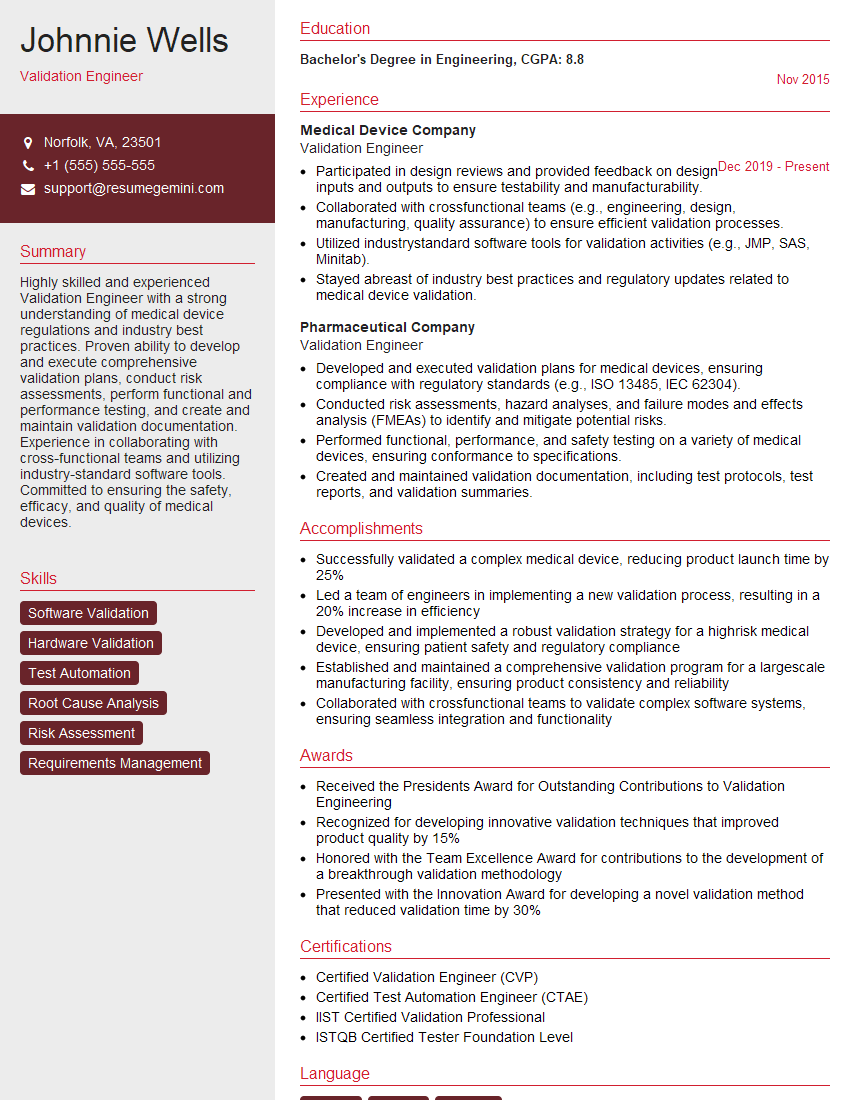
Mastering Validation Protocol is crucial for advancing your career in regulated industries. A strong understanding of these principles demonstrates your commitment to quality and compliance, opening doors to exciting opportunities. To maximize your job prospects, creating an ATS-friendly resume is essential. ResumeGemini can help you build a professional and impactful resume that showcases your skills and experience effectively. Examples of resumes tailored to Validation Protocol are available within ResumeGemini to guide you.

Explore more articles
Users Rating of Our Blogs
Share Your Experience
We value your feedback! Please rate our content and share your thoughts (optional).
What Readers Say About Our Blog
Hello,
we currently offer a complimentary backlink and URL indexing test for search engine optimization professionals.
You can get complimentary indexing credits to test how link discovery works in practice.
No credit card is required and there is no recurring fee.
You can find details here:
https://wikipedia-backlinks.com/indexing/
Regards
NICE RESPONSE TO Q & A
hi
The aim of this message is regarding an unclaimed deposit of a deceased nationale that bears the same name as you. You are not relate to him as there are millions of people answering the names across around the world. But i will use my position to influence the release of the deposit to you for our mutual benefit.
Respond for full details and how to claim the deposit. This is 100% risk free. Send hello to my email id: [email protected]
Luka Chachibaialuka
Hey interviewgemini.com, just wanted to follow up on my last email.
We just launched Call the Monster, an parenting app that lets you summon friendly ‘monsters’ kids actually listen to.
We’re also running a giveaway for everyone who downloads the app. Since it’s brand new, there aren’t many users yet, which means you’ve got a much better chance of winning some great prizes.
You can check it out here: https://bit.ly/callamonsterapp
Or follow us on Instagram: https://www.instagram.com/callamonsterapp
Thanks,
Ryan
CEO – Call the Monster App
Hey interviewgemini.com, I saw your website and love your approach.
I just want this to look like spam email, but want to share something important to you. We just launched Call the Monster, a parenting app that lets you summon friendly ‘monsters’ kids actually listen to.
Parents are loving it for calming chaos before bedtime. Thought you might want to try it: https://bit.ly/callamonsterapp or just follow our fun monster lore on Instagram: https://www.instagram.com/callamonsterapp
Thanks,
Ryan
CEO – Call A Monster APP
To the interviewgemini.com Owner.
Dear interviewgemini.com Webmaster!
Hi interviewgemini.com Webmaster!
Dear interviewgemini.com Webmaster!
excellent
Hello,
We found issues with your domain’s email setup that may be sending your messages to spam or blocking them completely. InboxShield Mini shows you how to fix it in minutes — no tech skills required.
Scan your domain now for details: https://inboxshield-mini.com/
— Adam @ InboxShield Mini
Reply STOP to unsubscribe
Hi, are you owner of interviewgemini.com? What if I told you I could help you find extra time in your schedule, reconnect with leads you didn’t even realize you missed, and bring in more “I want to work with you” conversations, without increasing your ad spend or hiring a full-time employee?
All with a flexible, budget-friendly service that could easily pay for itself. Sounds good?
Would it be nice to jump on a quick 10-minute call so I can show you exactly how we make this work?
Best,
Hapei
Marketing Director
Hey, I know you’re the owner of interviewgemini.com. I’ll be quick.
Fundraising for your business is tough and time-consuming. We make it easier by guaranteeing two private investor meetings each month, for six months. No demos, no pitch events – just direct introductions to active investors matched to your startup.
If youR17;re raising, this could help you build real momentum. Want me to send more info?
Hi, I represent an SEO company that specialises in getting you AI citations and higher rankings on Google. I’d like to offer you a 100% free SEO audit for your website. Would you be interested?
Hi, I represent an SEO company that specialises in getting you AI citations and higher rankings on Google. I’d like to offer you a 100% free SEO audit for your website. Would you be interested?
good