Preparation is the key to success in any interview. In this post, we’ll explore crucial Warehouse Experience interview questions and equip you with strategies to craft impactful answers. Whether you’re a beginner or a pro, these tips will elevate your preparation.
Questions Asked in Warehouse Experience Interview
Q 1. Describe your experience with Warehouse Management Systems (WMS).
Warehouse Management Systems (WMS) are the backbone of efficient warehouse operations. They are software solutions that manage and optimize all aspects of warehouse functions, from receiving and putaway to order fulfillment and shipping. My experience encompasses working with several leading WMS platforms, including Oracle WMS and Manhattan Associates WMS. I’ve been involved in the entire lifecycle – from system implementation and configuration to daily operations and process improvement. For example, at my previous role, we implemented a new WMS to streamline our picking process. This resulted in a 15% reduction in order fulfillment time and a 10% decrease in picking errors. I’m proficient in using WMS features such as inventory tracking, order management, labor management, and reporting and analytics. Understanding how to leverage the reporting capabilities of a WMS is crucial for identifying bottlenecks and optimizing performance. I’m comfortable with both cloud-based and on-premise WMS deployments.
Q 2. Explain your process for receiving and inspecting incoming shipments.
Receiving and inspecting incoming shipments is a critical process that ensures accuracy and minimizes potential problems. My process starts with verifying the shipment against the purchase order, checking for quantity discrepancies, and noting any damage. This involves using handheld scanners to record the received items and their quantities, cross-referencing with the accompanying paperwork (e.g., packing slips, bills of lading). Then, I meticulously inspect the condition of the goods, looking for any signs of damage or defects. If discrepancies or damages are found, I immediately document them, taking photos as evidence, and contact the supplier to initiate a claim. Following the inspection, items are put away in designated locations within the warehouse based on the WMS instructions. This process is crucial to maintaining inventory accuracy and preventing losses due to damage or miscounts. For example, I once discovered a significant discrepancy in a large shipment due to damaged packaging that was not immediately apparent. Early identification through rigorous inspection prevented further issues downstream.
Q 3. How do you ensure accuracy in inventory control?
Ensuring inventory accuracy is paramount. We utilize a multi-faceted approach that combines technology and rigorous procedures. Firstly, we rely heavily on our WMS, which tracks inventory in real-time through bar code scanning and RFID technology. Regular cycle counting is performed – instead of a full inventory count, we count a small portion of inventory regularly, reducing downtime and ensuring timely identification of discrepancies. We also use a system of quality checks and audits to verify inventory data and address discrepancies promptly. Discrepancies are thoroughly investigated to identify and correct the root cause, preventing similar errors in the future. Furthermore, we regularly reconcile our physical inventory with our WMS data, addressing any inconsistencies immediately. Think of it as a continuous process of verification and adjustment to maintain the highest possible level of inventory accuracy. We’ve also implemented a system of alerts that notify us of unusual inventory fluctuations or discrepancies which requires immediate action.
Q 4. What methods do you use to optimize warehouse layout and workflow?
Optimizing warehouse layout and workflow is key to efficiency and productivity. This involves applying principles of lean manufacturing and warehouse design to minimize movement and maximize space utilization. I employ several methods, including the use of slotting optimization software to strategically assign locations for frequently picked items. We also utilize the concept of cross-docking to reduce storage time and improve order fulfillment speed. Furthermore, we regularly analyze workflows, identifying bottlenecks and inefficiencies, and implement changes as necessary. This often involves rearranging warehouse sections, modifying picking routes, and improving material handling processes. For instance, in a previous role, we redesigned the picking area to implement a ‘U-shaped’ layout, resulting in a significant reduction in travel time for pickers. Visual management tools, such as color-coded zones and clear signage, are also critical to ensuring a smooth and efficient workflow.
Q 5. Describe your experience with different types of warehouse equipment (forklifts, scanners, etc.).
My experience with warehouse equipment is extensive. I’m proficient in operating various types of forklifts (sit-down, stand-up, reach trucks) and am certified in their safe operation. I am also experienced with warehouse scanners, both handheld and stationary, including RF scanners for inventory tracking and barcode scanning. I am familiar with various Material Handling Equipment (MHE), including conveyor systems, automated guided vehicles (AGVs), and other automated equipment. I understand the importance of regular maintenance and safety procedures for all equipment, and I always prioritize safe operation. Moreover, I understand the role technology plays in optimizing equipment utilization, such as route optimization software for forklifts and predictive maintenance systems for all machinery. Safety is paramount; we conduct regular safety training and inspections to ensure compliance with all regulations and procedures.
Q 6. How do you prioritize tasks in a fast-paced warehouse environment?
Prioritizing tasks in a fast-paced environment requires a structured approach. We employ a combination of methods to ensure urgent orders are fulfilled promptly while managing less time-sensitive tasks efficiently. We use a task management system that prioritizes orders based on factors such as delivery deadlines, order size, and customer priority. The WMS often dictates prioritization through its order management features. I often apply techniques like the Eisenhower Matrix (urgent/important) to categorize tasks and allocate resources accordingly. Communication is crucial. I keep the team informed about priorities, ensuring everyone is focused on the most critical tasks. Flexibility is also key. Being able to adapt to unexpected changes or urgent requests is essential to maintaining smooth operations. For example, if a high-priority order comes in unexpectedly, we may adjust our workflow temporarily to accommodate it, ensuring timely delivery to the customer while mitigating any disruptions to other processes.
Q 7. Explain your experience with order fulfillment processes.
Order fulfillment is the core of warehouse operations, and I have extensive experience in managing this process. It encompasses everything from receiving an order to its shipment. I’m proficient in various order fulfillment methods, including pick-and-pack, wave picking, and batch picking. My experience includes working with different order management systems and integrating them with the WMS. I ensure accuracy in picking and packing by using bar code scanners and double-checking orders before they leave the warehouse. I also oversee the packing process, ensuring proper packaging materials are used and goods are securely packaged to prevent damage during transit. We continuously monitor our order fulfillment metrics, such as order accuracy, picking speed, and on-time delivery rates, to identify areas for improvement. For example, we implemented a new wave picking strategy, which reduced our order fulfillment time by 12% and improved order accuracy. In addition to fulfilling customer orders, I am also experienced with managing returns and managing inventory levels to support timely fulfillment.
Q 8. How do you handle discrepancies in inventory counts?
Inventory discrepancies are a common challenge in warehouse management. My approach involves a systematic investigation to pinpoint the root cause and implement corrective actions. I start by verifying the physical count against the system records, meticulously checking for data entry errors, damaged or misplaced goods, and potential theft.
For instance, if a discrepancy arises for a specific SKU, I would first examine the recent transactions for that item – reviewing inbound and outbound records, checking for any potential errors in the system (perhaps a wrong quantity entered during receiving or shipping), and physically inspecting the designated storage location for the product. If the discrepancy persists, I’ll often involve a second team member for an independent verification count.
Once the cause is identified, I implement a solution. This might involve retraining staff on proper inventory procedures, improving data entry protocols, enhancing security measures, or implementing better stock organization. Regular cycle counting (explained further in answer 4) is a proactive strategy to minimize these discrepancies.
Q 9. What safety procedures are you familiar with in a warehouse setting?
Safety is paramount in a warehouse environment. I’m extensively familiar with OSHA regulations and best practices, including proper use of material handling equipment like forklifts and pallet jacks, maintaining a clean and organized workspace to prevent slips, trips, and falls, and the correct usage of personal protective equipment (PPE) such as safety glasses, steel-toed boots, and high-visibility vests.
My experience includes conducting regular safety training for warehouse staff, emphasizing the importance of following established procedures, reporting hazards promptly, and participating in safety audits. I’m also proficient in identifying and mitigating potential hazards such as blocked aisles, damaged equipment, and improper stacking of materials. For example, I’ve implemented a color-coded system for identifying hazardous materials and ensuring their proper storage and handling in accordance with relevant regulations.
Q 10. How do you maintain accurate records of inventory transactions?
Maintaining accurate inventory records requires a robust system and meticulous attention to detail. I utilize warehouse management systems (WMS) to track inventory transactions, ensuring that every movement – receiving, put-away, picking, packing, and shipping – is recorded accurately and in real-time. This involves using barcode scanners or RFID technology for efficient data capture and minimizing manual data entry.
Regular reconciliation between the physical inventory and the WMS data is crucial. This involves comparing the system records to the actual physical count (often through cycle counting), identifying any discrepancies, and investigating their root causes as discussed earlier. Proper documentation of all transactions, including receiving reports, picking lists, and shipping manifests, is essential for audit trail purposes and maintaining transparency in the inventory process.
Q 11. Describe your experience with cycle counting and stock rotation.
Cycle counting is a crucial part of inventory management, involving counting a subset of inventory items regularly rather than performing a complete physical inventory count. This allows for the identification and correction of discrepancies early on, before they escalate. For example, we might count fast-moving items more frequently than slow-moving items. This is a more efficient approach than a full annual stock take.
Stock rotation, also known as FIFO (First-In, First-Out), ensures that older inventory is used or shipped before newer inventory. This prevents spoilage, obsolescence, and minimizes potential losses. I’ve implemented and managed FIFO systems using various techniques, from clear labeling with dates to dedicated storage areas organized by arrival date, ensuring we use older stock first. A proper stock rotation strategy also helps optimize warehouse space by avoiding unnecessary storage of excess or outdated inventory.
Q 12. How do you resolve conflicts between warehouse staff members?
Resolving conflicts among warehouse staff requires a fair, impartial, and effective approach. My strategy begins with open communication and active listening. I strive to understand each individual’s perspective, encouraging them to clearly express their concerns in a professional manner. I avoid taking sides initially but rather focus on identifying the underlying issue.
If the conflict involves a procedural issue, I provide clarity on the relevant policies and procedures, ensuring everyone understands the expectations. If it’s a personality clash, I might facilitate a mediated discussion to encourage mutual understanding and resolution. In more serious cases, I might implement disciplinary actions in accordance with company policy. The goal is always to maintain a positive and productive work environment, emphasizing teamwork and respect.
Q 13. Explain your experience with shipping and receiving procedures.
My experience with shipping and receiving procedures includes overseeing the entire process, from verifying incoming shipments against purchase orders to preparing outgoing shipments for delivery. This involves checking for damages, discrepancies in quantities, and ensuring the accuracy of documentation (packing slips, bills of lading, etc.).
I’m proficient in using various shipping software and transportation management systems (TMS) to manage logistics, schedule carriers, generate shipping labels, and track shipments. For example, I’ve implemented a system to optimize carrier selection based on cost, transit time, and reliability, leading to significant cost savings and improved on-time delivery rates. Effective communication with carriers and customers is essential throughout this process to ensure timely and accurate delivery.
Q 14. What are your strengths in a team-oriented warehouse environment?
My strengths in a team-oriented warehouse environment include strong communication skills, collaborative problem-solving abilities, and a commitment to shared success. I actively participate in team meetings, contribute my expertise, and readily assist colleagues when needed. I believe in fostering a supportive and inclusive work environment where everyone feels valued and respected.
For example, in a previous role, I initiated a cross-training program to enhance team members’ skill sets and improve overall efficiency. This collaborative effort not only improved individual performance but also strengthened team cohesion and camaraderie. I believe that a strong team is the foundation of a high-performing warehouse operation, and I consistently strive to create and maintain such an environment.
Q 15. Describe your experience with various picking methods (e.g., batch picking, zone picking).
Picking methods are crucial for efficient order fulfillment. I have extensive experience with several, including batch picking, zone picking, and wave picking. Batch picking involves collecting multiple orders simultaneously, optimizing travel time but requiring careful order separation afterward. Think of it like grocery shopping – you grab all the dairy products at once, then the produce, etc. This is great for similar items or high-volume orders. Zone picking divides the warehouse into sections, assigning pickers to specific zones to specialize and speed up the process. Imagine a factory assembly line – each worker focuses on their area of expertise. Wave picking combines elements of batch and zone picking, releasing batches of orders to pickers assigned to specific zones based on scheduled waves. This balances efficiency with accuracy and is effective for managing complex order schedules.
In one project, transitioning from single-order picking to zone picking reduced order fulfillment time by 30%. This was achieved by analyzing order patterns and strategically dividing the warehouse based on item frequency and location. We also implemented a color-coded zone system for ease of navigation and error reduction.
Career Expert Tips:
- Ace those interviews! Prepare effectively by reviewing the Top 50 Most Common Interview Questions on ResumeGemini.
- Navigate your job search with confidence! Explore a wide range of Career Tips on ResumeGemini. Learn about common challenges and recommendations to overcome them.
- Craft the perfect resume! Master the Art of Resume Writing with ResumeGemini’s guide. Showcase your unique qualifications and achievements effectively.
- Don’t miss out on holiday savings! Build your dream resume with ResumeGemini’s ATS optimized templates.
Q 16. How do you ensure timely order fulfillment?
Timely order fulfillment depends on a well-oiled machine combining optimized processes and accurate data. Key strategies include accurate forecasting to anticipate demand, efficient picking and packing processes as described earlier, a robust inventory management system with real-time tracking, and efficient shipping logistics. Proactive communication with carriers and customers is also essential, keeping everyone informed of potential delays or changes.
In a previous role, we tackled persistent late order issues. Through process mapping, we identified bottlenecks in the packing station. By implementing a two-stage packing system and providing additional training to packers, we decreased average order packing time by 15%, dramatically improving on-time delivery rates.
Q 17. Explain your experience with warehouse KPIs (Key Performance Indicators).
Warehouse KPIs are vital for measuring efficiency and identifying areas for improvement. I’m familiar with a range of metrics, including order fulfillment rate (percentage of orders fulfilled on time and in full), inventory accuracy (percentage of inventory correctly reflected in the system), picking accuracy (percentage of items picked correctly), storage utilization (percentage of available warehouse space used), and cost per order (total warehouse costs divided by the number of orders fulfilled). These metrics help in understanding warehouse performance.
For example, consistently low picking accuracy might indicate a need for better training, improved equipment, or changes in warehouse layout. A low inventory accuracy rate could mean that inventory counts need to be improved. These are not merely numbers; they are indicators that tell a story about operational efficiency and provide a roadmap for improvement.
Q 18. How do you handle damaged or lost goods?
Handling damaged or lost goods requires a robust system combining prevention and remediation. Prevention includes proper handling procedures during receiving, storage, and picking, regular inspections to identify potential issues, and use of protective packaging. Remediation involves creating a detailed damage or loss report, involving relevant stakeholders (e.g., suppliers, insurance), conducting root cause analysis to prevent recurrence, updating inventory records, and potentially initiating claims processes with carriers or suppliers.
In one instance, we reduced damage rates by 20% by implementing standardized handling procedures and providing refresher training to warehouse staff on proper techniques for handling fragile items. We also introduced a visual inspection checklist, which helped to identify and mitigate potential damage before it occurred. This improved accuracy in our inventory and saved the company a significant amount of money on damaged goods and insurance claims.
Q 19. Describe your experience with managing warehouse space efficiently.
Efficient warehouse space management involves optimizing storage strategies, implementing proper slotting (location of items based on frequency of use and demand), utilizing vertical space with racking systems, and employing lean principles to eliminate waste. Regular audits and space optimization software are important in ensuring that space is used effectively.
In one of my previous roles, we implemented a new slotting system that improved pick-path optimization which reduced travel time for order picking by 18% leading to increased productivity. We also upgraded our racking system to allow for greater vertical space utilization, increasing our storage capacity by 25% without increasing the footprint of our warehouse.
Q 20. What software are you proficient in using within a warehouse environment?
My experience encompasses a wide range of warehouse management software. I’m proficient in using Warehouse Management Systems (WMS) such as Oracle WMS, SAP EWM, and Manhattan Associates WMS. I have also used inventory management systems, such as Fishbowl Inventory, and transportation management systems. I am also familiar with different types of scanners (barcode, RFID) and warehouse management software commonly integrated with enterprise resource planning (ERP) systems such as SAP and Oracle.
My familiarity with these systems allows me to quickly adapt to new software and seamlessly integrate new technologies into warehouse operations. This proficiency extends to data analysis and report generation within these systems, contributing greatly to data-driven decision-making for warehouse optimization.
Q 21. How do you track and report on warehouse performance metrics?
Tracking and reporting on warehouse performance metrics involves utilizing the data generated by WMS and other systems. This entails extracting key data points, analyzing trends and patterns, generating reports using data visualization tools (such as Excel, Tableau, or Power BI), and presenting findings to stakeholders. Regular reporting allows for performance evaluation, identification of areas needing improvement, and proactive adjustment of processes for improved efficiency.
For example, we created a weekly dashboard that tracked key KPIs like order fulfillment rate, inventory accuracy, and picking accuracy. This enabled us to identify trends, such as a drop in picking accuracy during peak season, and take immediate corrective actions such as additional training, process improvements, or temporary staff augmentation. This data-driven approach to warehouse management proved crucial in improving our operational efficiency.
Q 22. How do you handle customer returns and processing?
Handling customer returns efficiently is crucial for maintaining customer satisfaction and minimizing losses. My approach involves a multi-step process. First, we verify the return authorization, checking for eligibility and ensuring the product is in resalable condition. This often involves scanning the return label and checking against our database. Second, we inspect the returned item for any damage or defects. Depending on the condition, we may either restock the item, send it for repair, or mark it as damaged for disposal or liquidation. Third, we update the inventory system to reflect the return and adjust stock levels accordingly. This often involves using a Warehouse Management System (WMS) to track the movement and status of returned goods. Finally, we process the refund or exchange, depending on the customer’s request and our return policy. For instance, if a customer returns an item damaged due to our shipping, a full refund is issued and the item is scrapped. However, for returns due to buyer’s remorse, restocking fees might apply, and the process is more focused on careful inspection before restocking.
Q 23. Describe your experience with inventory forecasting and planning.
Inventory forecasting and planning is the backbone of efficient warehouse operations. My experience involves utilizing various methods, including historical sales data analysis, seasonal trends identification, and predictive modeling techniques. We use sophisticated software to analyze past sales patterns, taking into account factors such as promotional activities, economic conditions, and product lifecycles. For example, we might observe a significant increase in demand for winter coats in October and November. This historical data helps us accurately predict future demand and proactively adjust inventory levels to meet expected customer needs. We also consider safety stock levels, which are minimum inventory levels maintained to account for unexpected surges in demand or supply chain disruptions. This ensures we avoid stockouts while also minimizing holding costs. Through forecasting, we aim for the sweet spot of optimal inventory levels that minimize storage costs, prevent stockouts, and capitalize on sales opportunities.
Q 24. What are your strategies for maintaining a clean and organized warehouse?
Maintaining a clean and organized warehouse is paramount for safety, efficiency, and productivity. My strategies involve implementing 5S methodology – Sort, Set in Order, Shine, Standardize, and Sustain. We start by sorting through items, removing unnecessary clutter and disposing of obsolete materials. Next, we organize the remaining items, assigning designated locations for everything using a clear labeling system. Regular cleaning is crucial; hence, we implement a schedule for cleaning aisles, racking systems, and equipment. Standardization involves documenting cleaning procedures, organizing schedules, and training staff on best practices. Finally, sustaining the clean and organized environment is an ongoing effort, requiring regular audits, feedback loops, and consistent reinforcement of good housekeeping habits. For instance, we’ve incorporated color-coded zones for different product categories, making it easier for staff to locate items and maintain order. Regular visual inspections are also crucial for quick detection and resolution of any organizational issues.
Q 25. How do you ensure compliance with safety regulations and company policies?
Ensuring compliance with safety regulations and company policies is a top priority. We achieve this through a comprehensive approach involving regular safety training for all warehouse personnel, covering topics like forklift operation, proper lifting techniques, and hazard identification. We conduct regular safety inspections, identifying potential hazards and implementing corrective measures. Our procedures are documented and readily available to all employees. We maintain detailed records of training and inspections, ensuring complete compliance documentation. We also ensure that all safety equipment, such as forklift safety devices, personal protective equipment (PPE), and emergency exits, are in proper working condition and readily accessible. For example, we use a checklist system for daily forklift inspections, and all new employees undergo a comprehensive safety orientation before handling any equipment. Furthermore, we actively encourage a culture of safety through regular communication, safety meetings, and by rewarding safe work practices.
Q 26. Explain your experience with different warehouse layout designs.
My experience encompasses various warehouse layout designs, including U-shaped, I-shaped, L-shaped and more complex layouts optimized for specific needs. The choice of layout depends heavily on the operational processes and the types of goods being handled. For example, a U-shaped layout is ideal for assembly processes, where materials flow efficiently through different workstations. An I-shaped layout is simple and efficient for through-put operations with a clear linear workflow. We’ve used a combination approach in the past, adapting different sections of the warehouse to optimize for particular products or processes. I’ve been involved in analyzing warehouse workflows to identify bottlenecks and inefficiencies. Then, we leverage this data to design or redesign the warehouse layout to streamline operations, reduce travel times, and increase overall efficiency. This may involve the strategic placement of racking systems, conveyor belts, and workstations to create the most efficient flow of goods through the warehouse. Understanding the specific needs and limitations is paramount before committing to any design, which is why detailed analysis is key.
Q 27. How do you handle peak season demands in the warehouse?
Handling peak season demands requires meticulous planning and proactive measures. We start by forecasting demand based on historical data and market trends. This informs our staffing strategies, ensuring we have sufficient personnel to handle the increased workload. We may utilize temporary staffing agencies or cross-train existing employees to ensure adequate coverage during peak periods. Secondly, we optimize warehouse processes, streamlining picking and packing procedures, and increasing throughput capacity. This might involve adjusting our warehouse layout, implementing more efficient picking methods (like batch picking), or optimizing our routing systems. We also build up safety stock levels for high-demand items to mitigate the risk of stockouts. Finally, effective communication is critical, keeping our employees informed of expectations and any changes in procedures. In past experiences, we’ve utilized wave picking techniques during peak seasons, improving the coordination and speed of order fulfillment. This helped significantly reduce order fulfillment times and improve overall efficiency during periods of high demand.
Q 28. Describe your experience with implementing process improvements in a warehouse.
Implementing process improvements requires a systematic approach. I typically start by identifying areas for improvement through data analysis and observation of current processes. This may involve examining metrics such as order fulfillment times, picking accuracy rates, and inventory turnover. Once bottlenecks are identified, we explore potential solutions. These solutions might include automating tasks (like using automated guided vehicles or conveyor systems), optimizing picking routes, or implementing new software systems. We then pilot the changes in a controlled environment, monitoring their impact on key performance indicators (KPIs). Based on the results of the pilot, we scale up the improvements across the entire warehouse. For example, we once implemented a new WMS (Warehouse Management System) which significantly improved order accuracy and reduced picking times by approximately 20%. The key to successful process improvement is a combination of careful planning, data-driven decision-making, and a willingness to embrace change and adapt to optimize operations and efficiency.
Key Topics to Learn for Warehouse Experience Interview
- Inventory Management: Understanding inventory control systems, cycle counting, stock rotation (FIFO/LIFO), and the impact of accurate inventory data on operational efficiency.
- Order Fulfillment: Practical application of picking, packing, and shipping processes; experience with different order fulfillment methods (e.g., single-order picking, batch picking); understanding of order accuracy and speed metrics.
- Warehouse Safety & Compliance: Knowledge of OSHA regulations, safe operating procedures for machinery (forklifts, conveyor belts etc.), and accident prevention strategies. Demonstrating a commitment to a safe work environment.
- Warehouse Technology: Familiarity with Warehouse Management Systems (WMS), RF scanners, barcode readers, and other technologies used for tracking and managing inventory and orders. Ability to troubleshoot basic technical issues.
- Logistics & Supply Chain: Understanding the broader context of warehouse operations within the supply chain; knowledge of inbound and outbound logistics, transportation management, and the impact of warehouse efficiency on overall supply chain performance.
- Problem-Solving & Teamwork: Describing situations where you had to solve problems related to warehouse operations (e.g., addressing order discrepancies, resolving equipment malfunctions, managing peak season demands); highlighting your teamwork and collaboration skills in a warehouse environment.
- Process Improvement: Identifying areas for improvement in warehouse processes and suggesting solutions to optimize efficiency, reduce costs, and improve overall productivity. Experience with Lean principles or Six Sigma methodologies is a plus.
Next Steps
Mastering warehouse experience is crucial for career progression within logistics, supply chain, and operations management. A strong understanding of these concepts will significantly enhance your interview performance and job prospects. Creating an ATS-friendly resume is vital for getting your application noticed by recruiters. To maximize your chances, we recommend using ResumeGemini to build a professional and impactful resume that highlights your skills and achievements effectively. ResumeGemini provides examples of resumes tailored to Warehouse Experience to help you craft the perfect application.

Supply Chain Manager Resume Sample
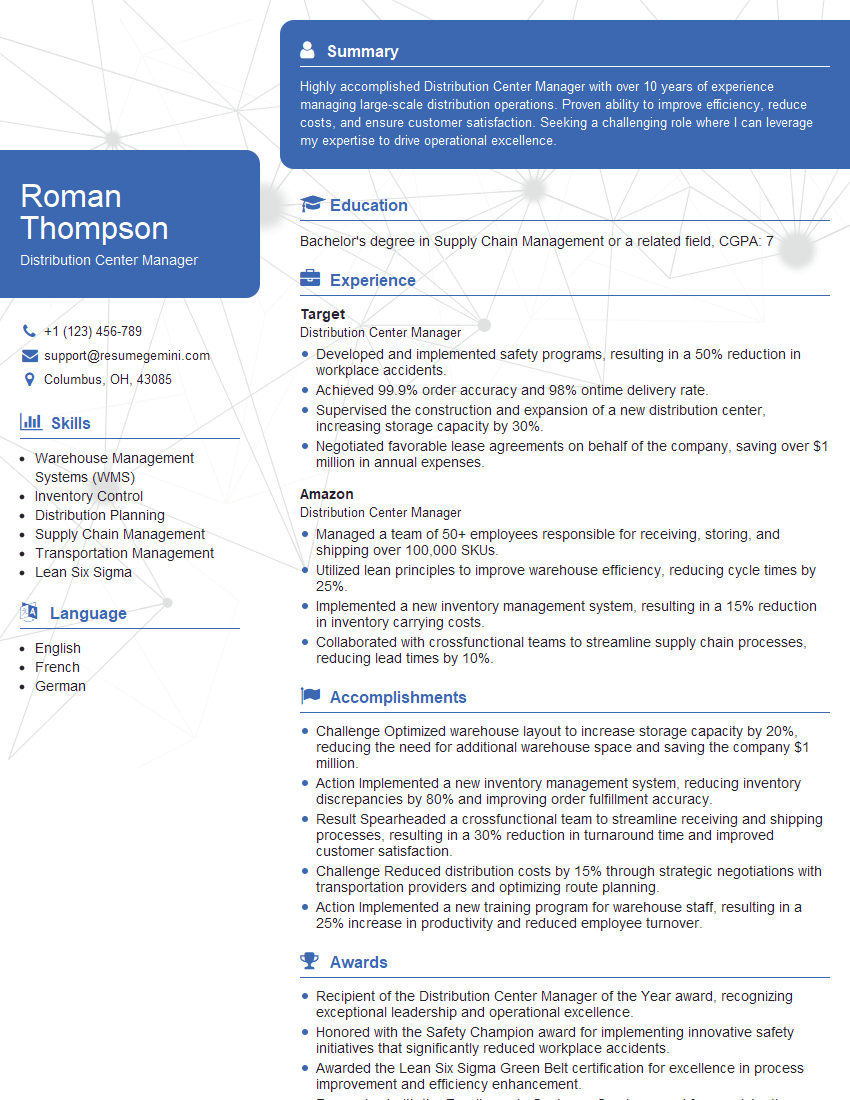
Distribution Center Manager Resume Sample
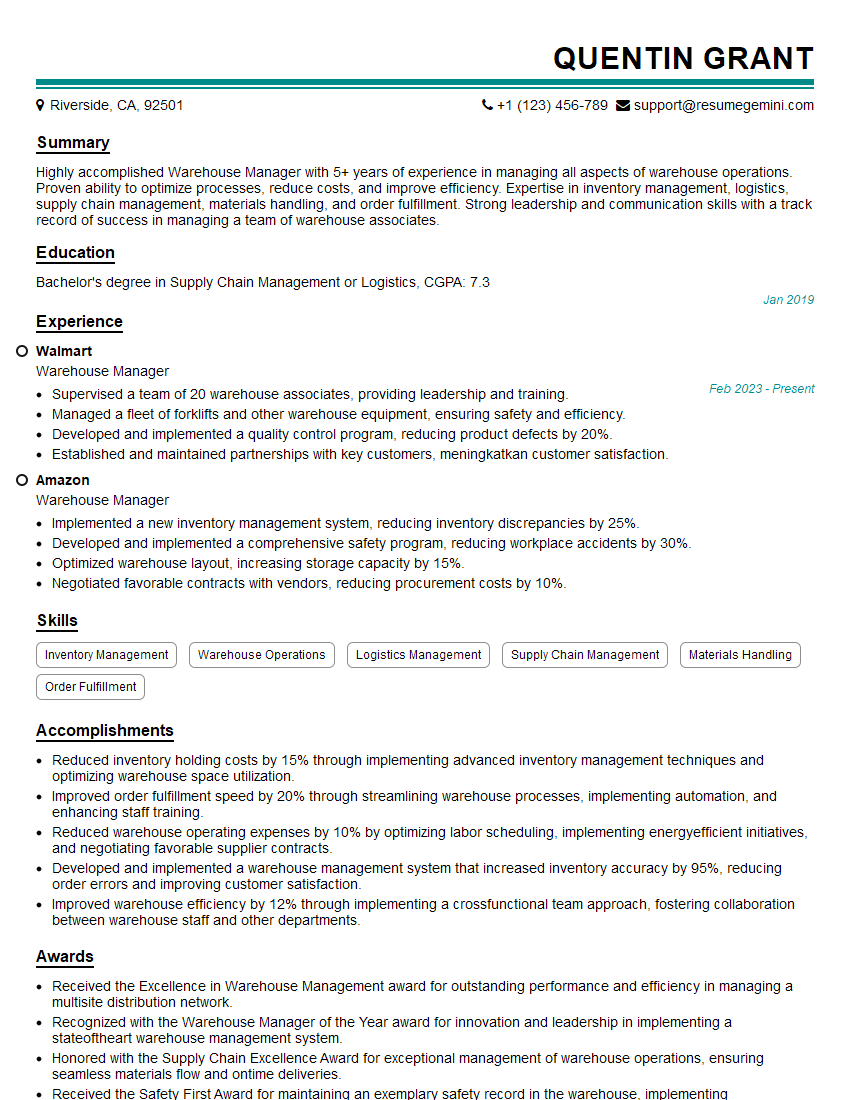
Warehouse Manager Resume Sample
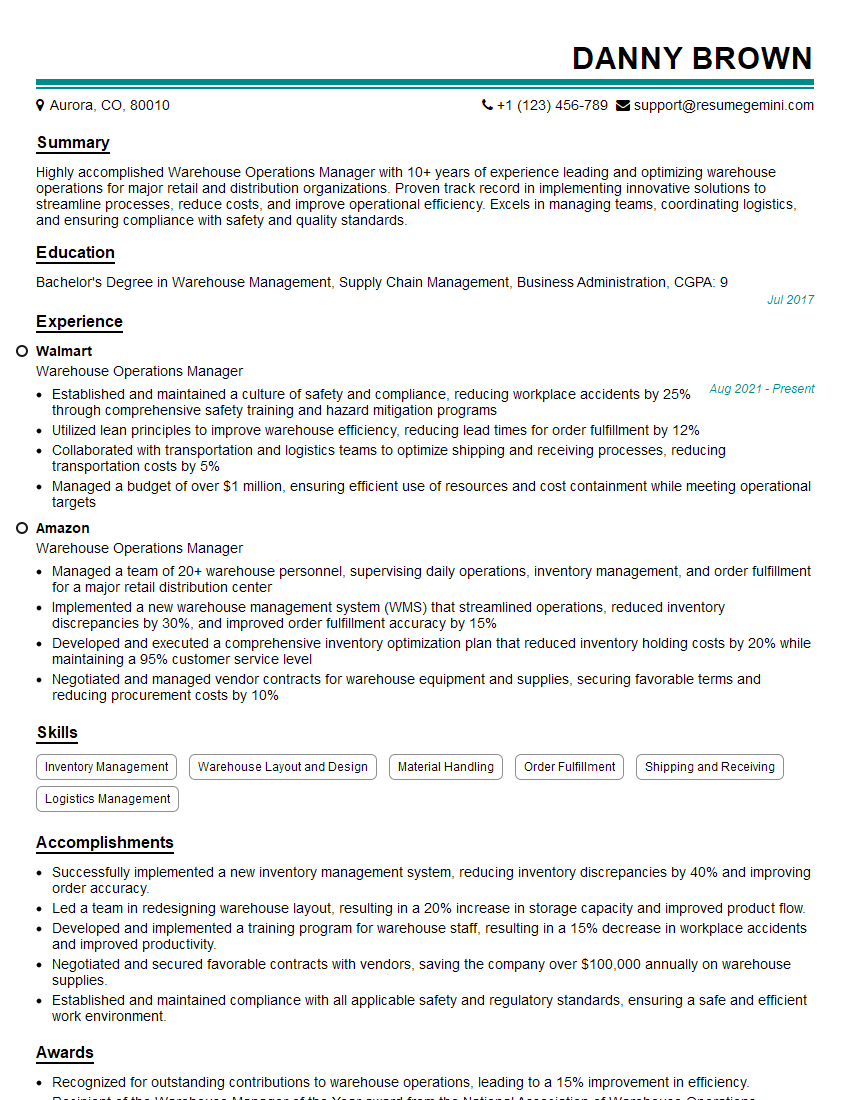
Warehouse Operations Manager Resume Sample
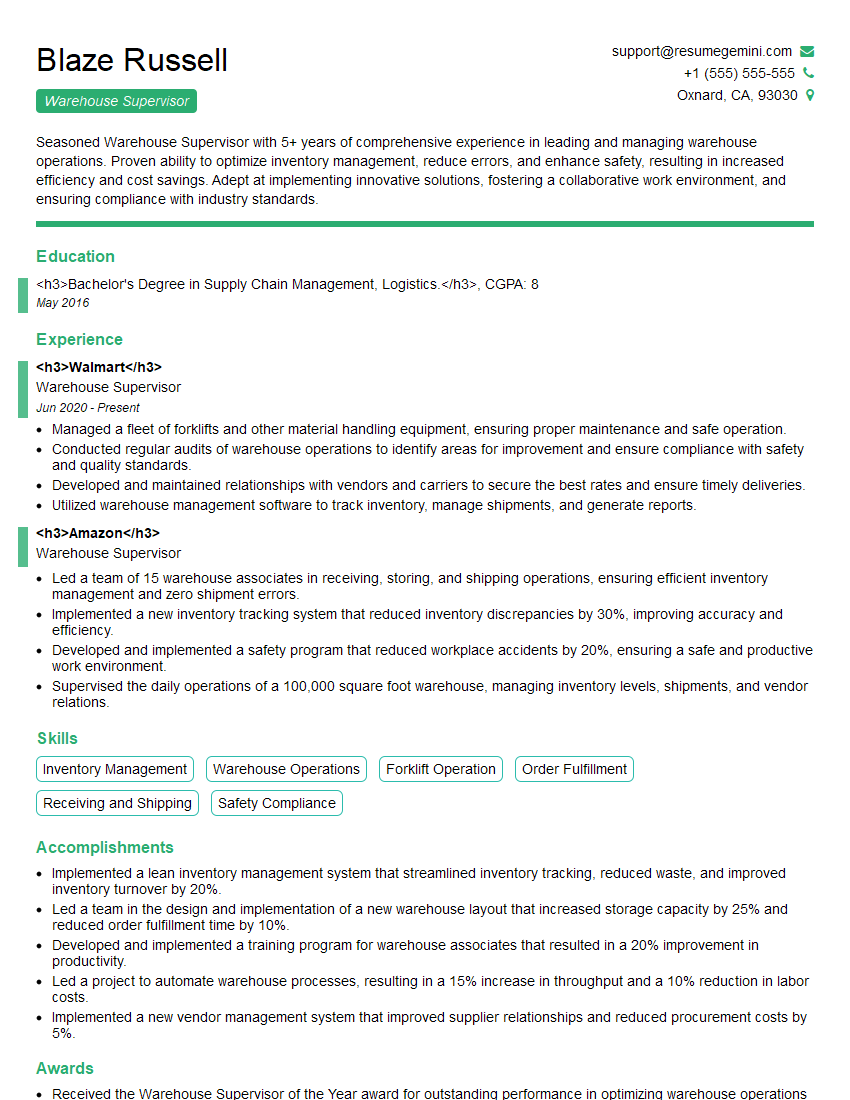
Warehouse Supervisor Resume Sample
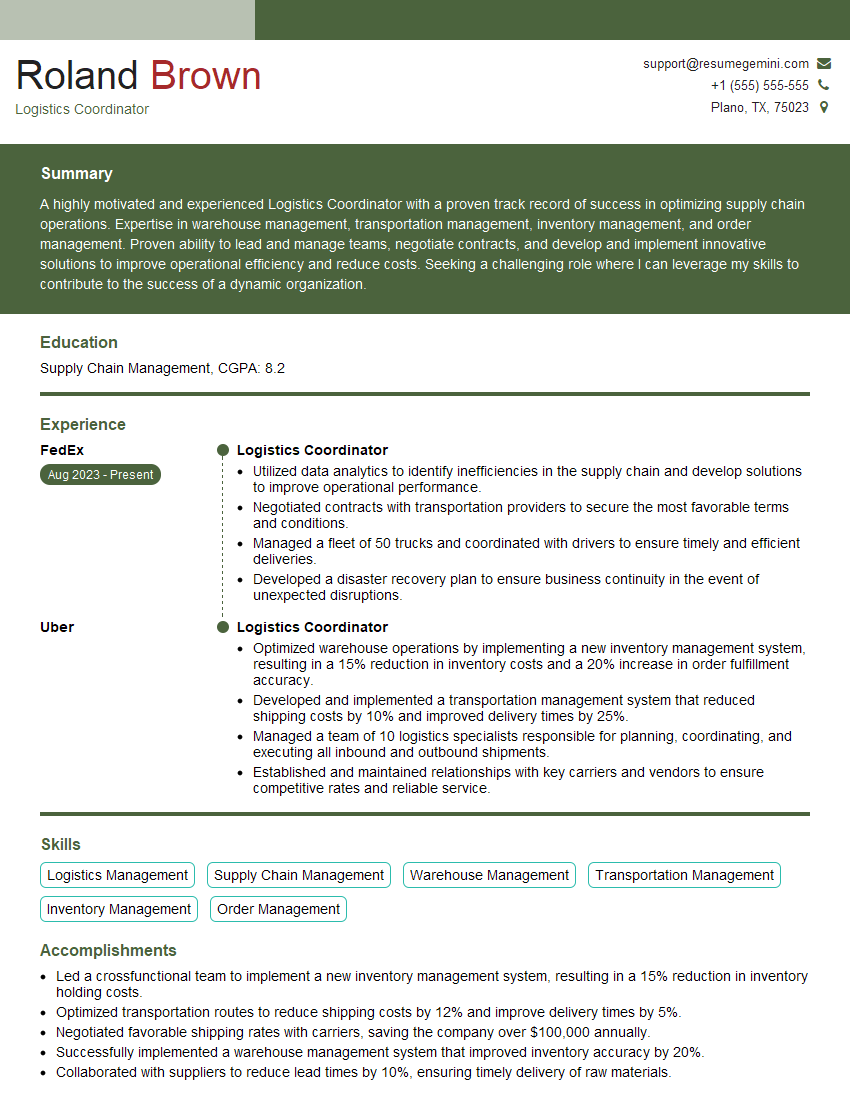
Logistics Coordinator Resume Sample
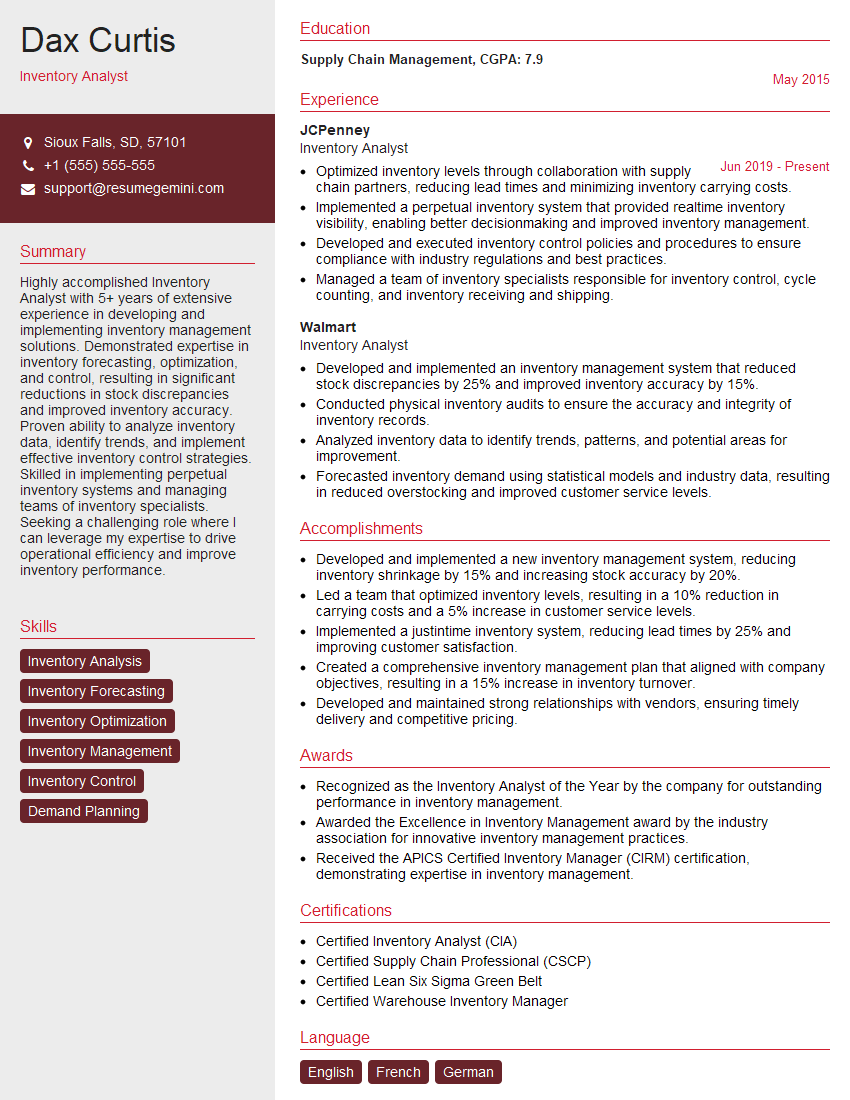
Inventory Analyst Resume Sample
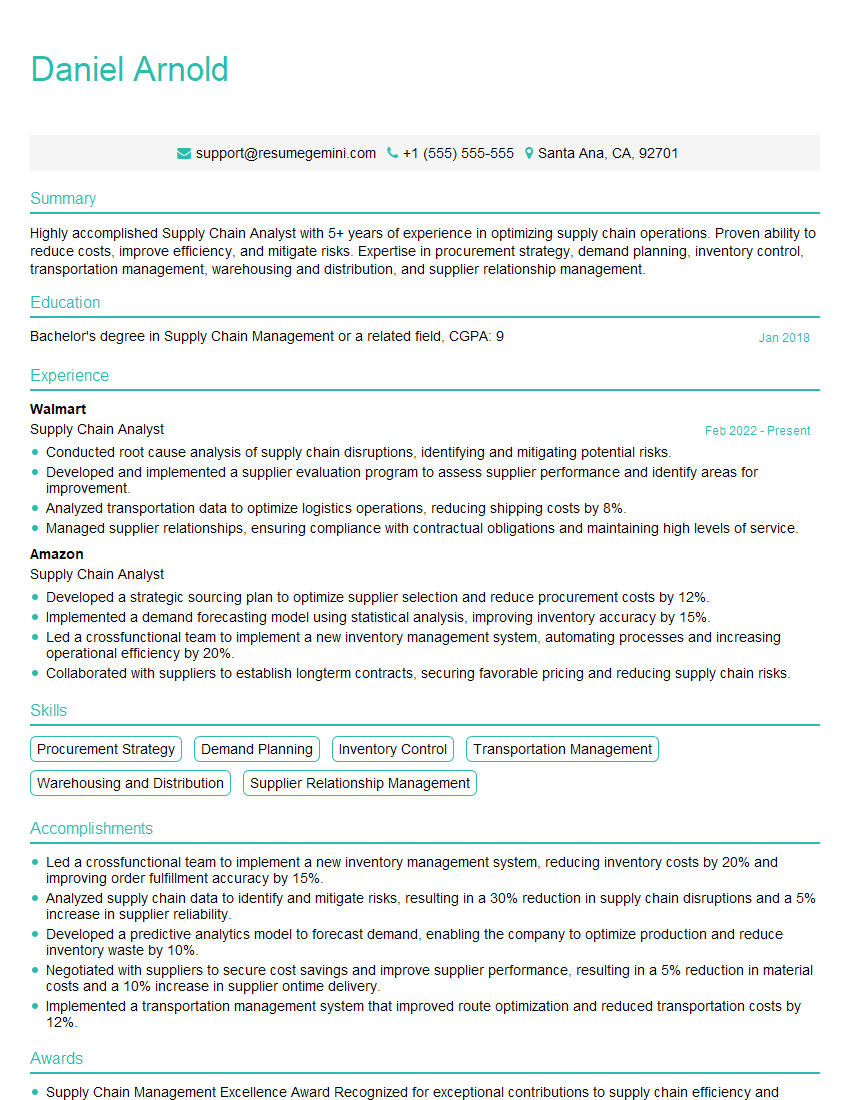
Supply Chain Analyst Resume Sample
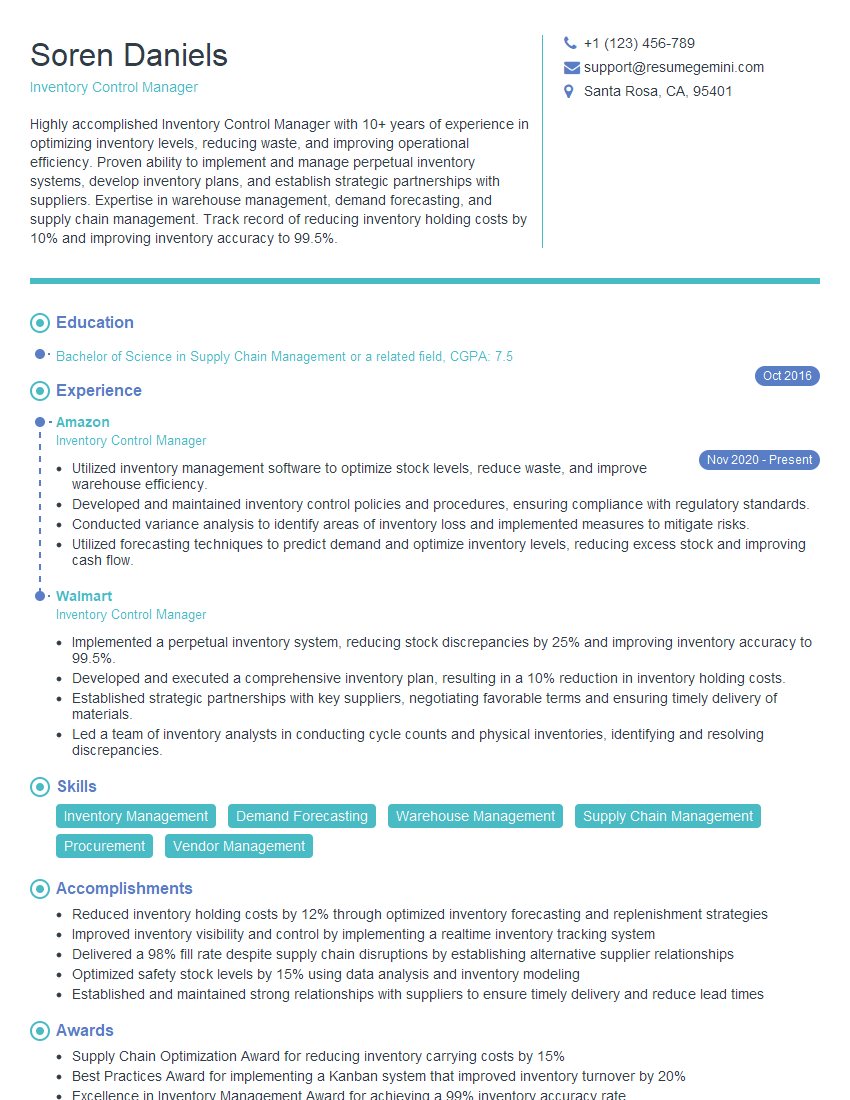
Inventory Control Manager Resume Sample
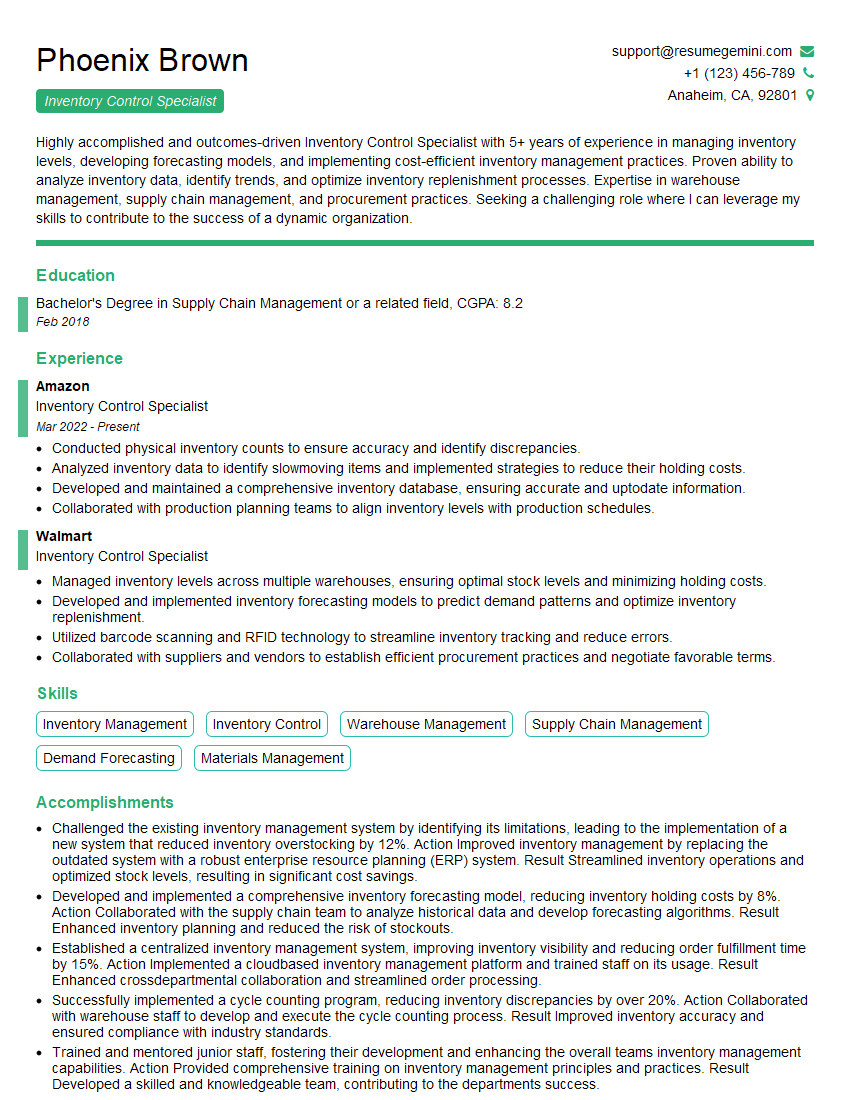
Inventory Control Specialist Resume Sample
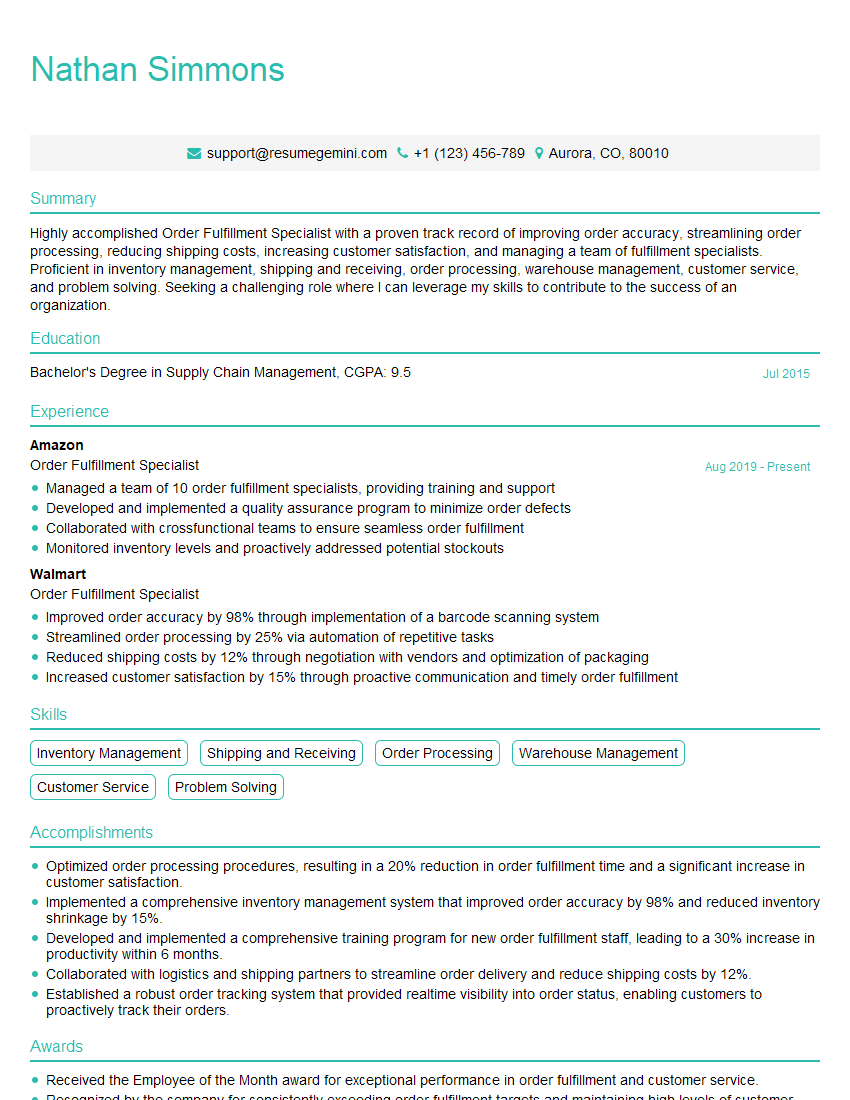
Order Fulfillment Specialist Resume Sample
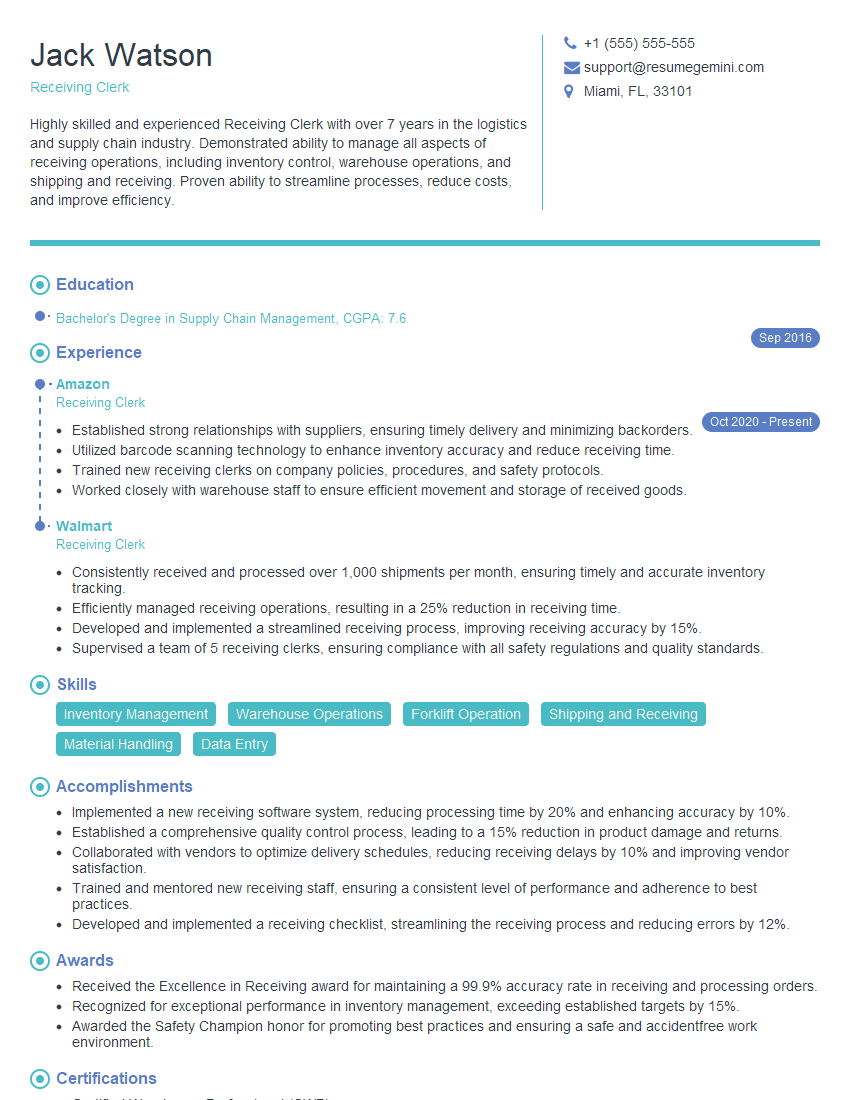
Receiving Clerk Resume Sample

Shipping and Receiving Clerk Resume Sample
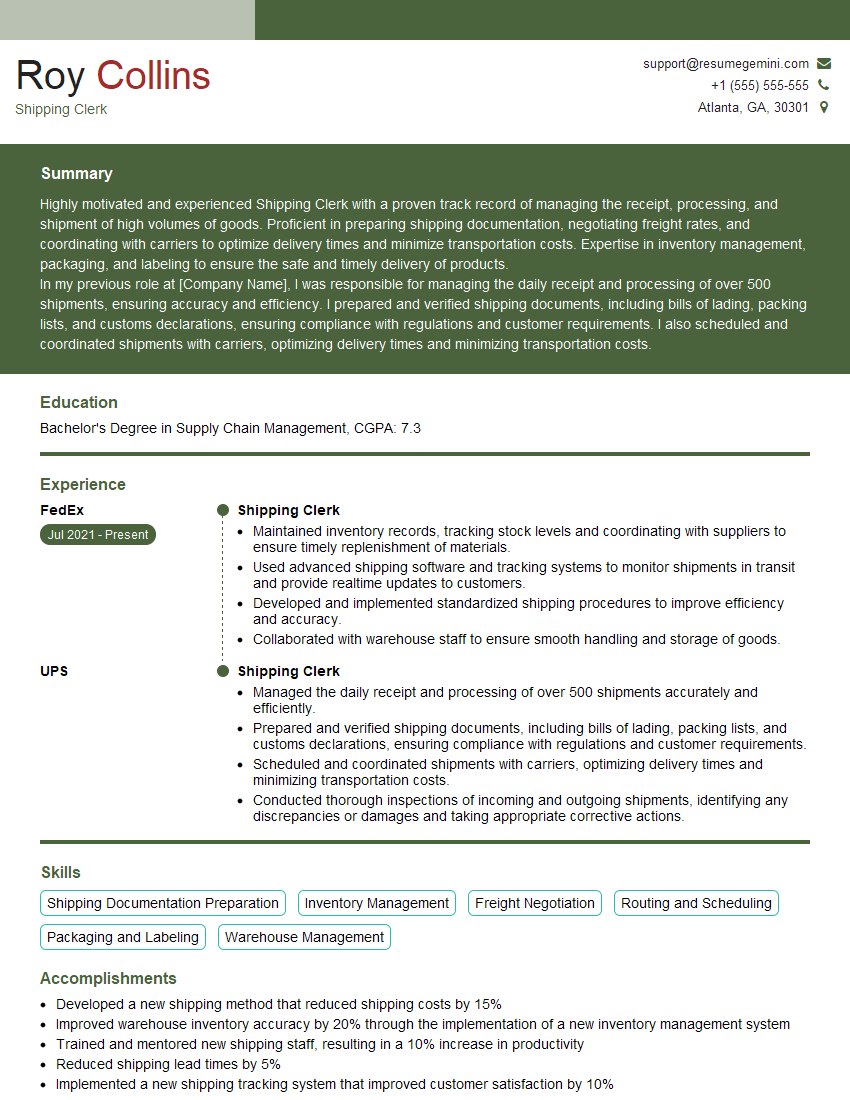
Shipping Clerk Resume Sample
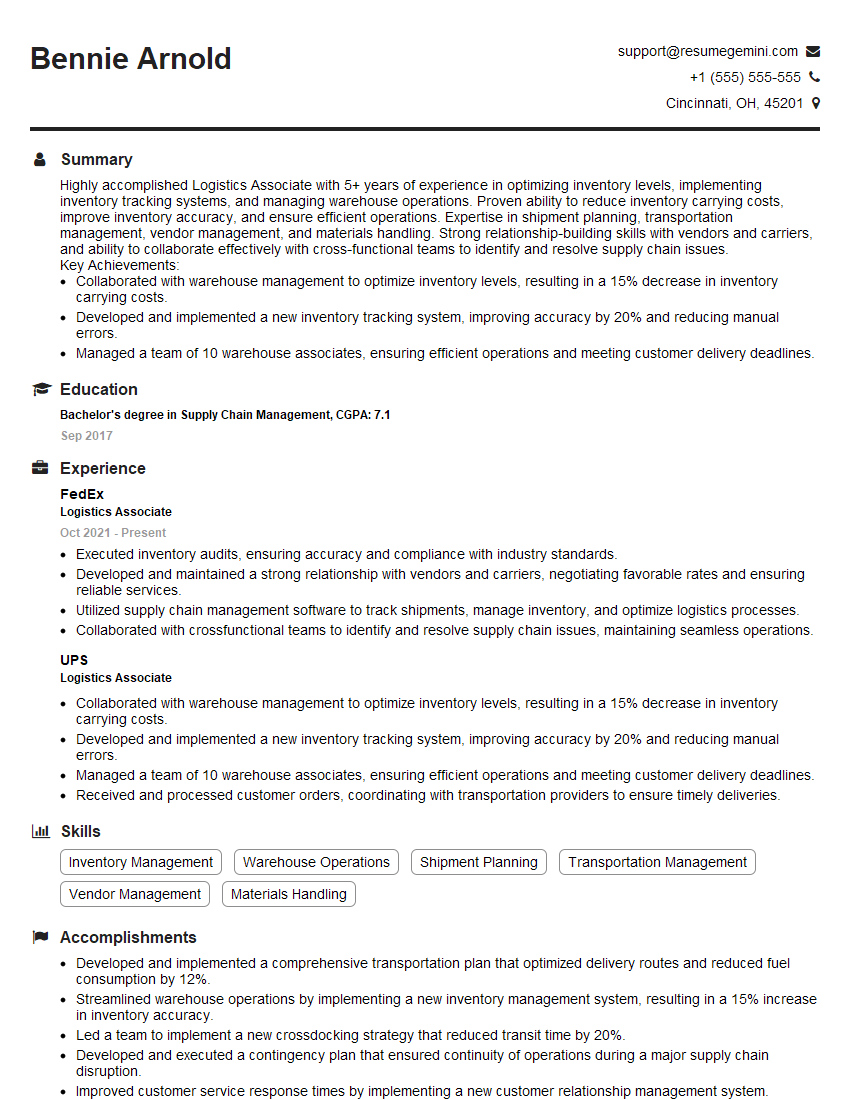
Logistics Associate Resume Sample
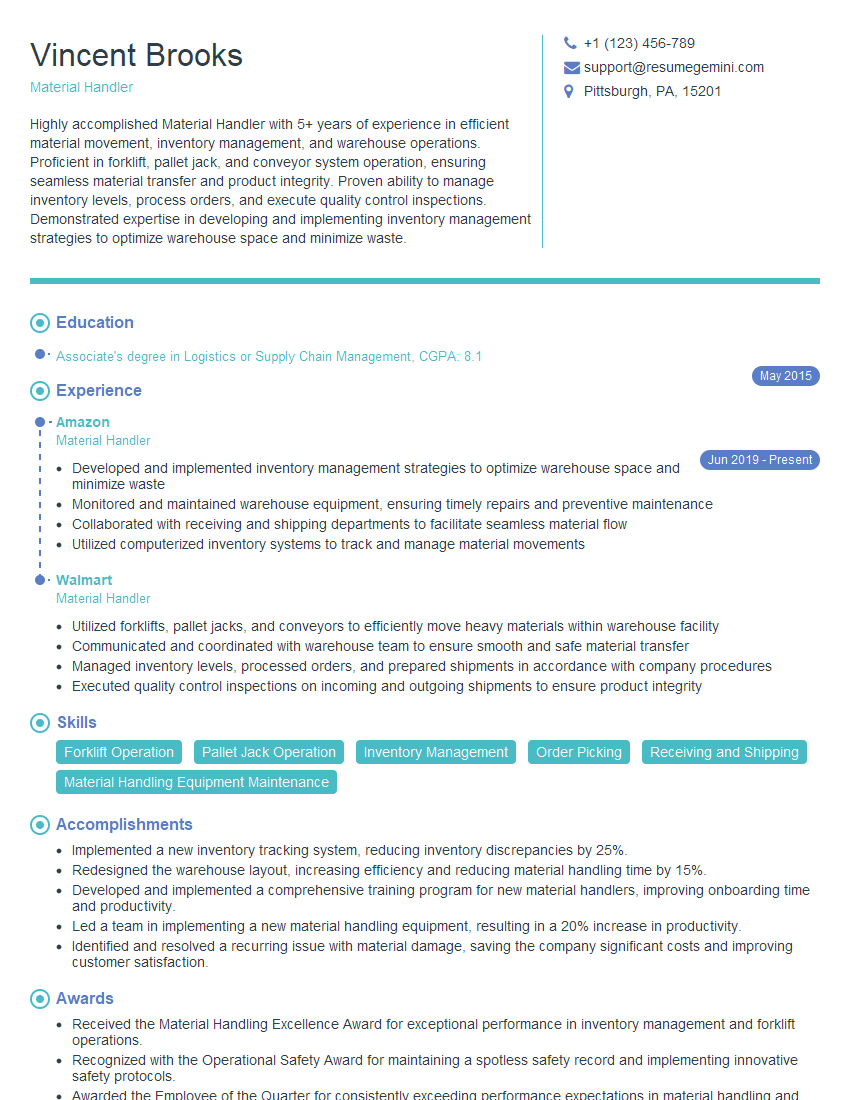
Material Handler Resume Sample
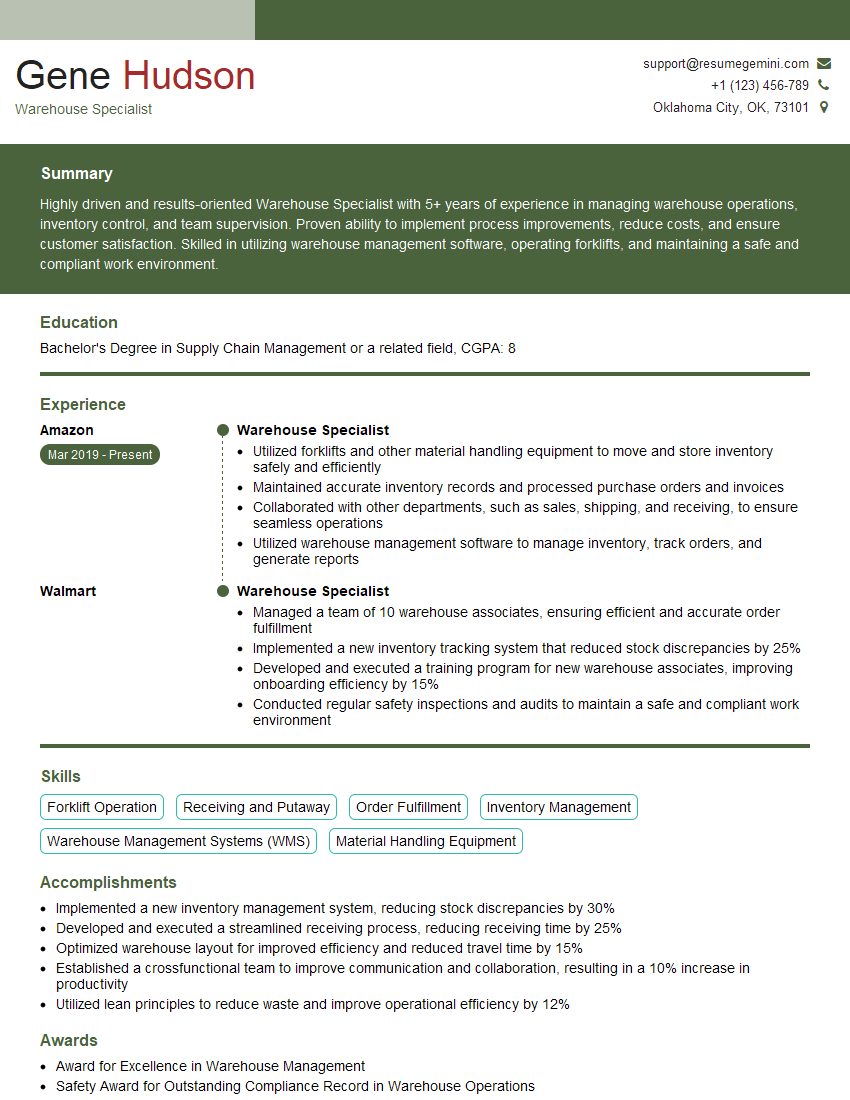
Warehouse Specialist Resume Sample
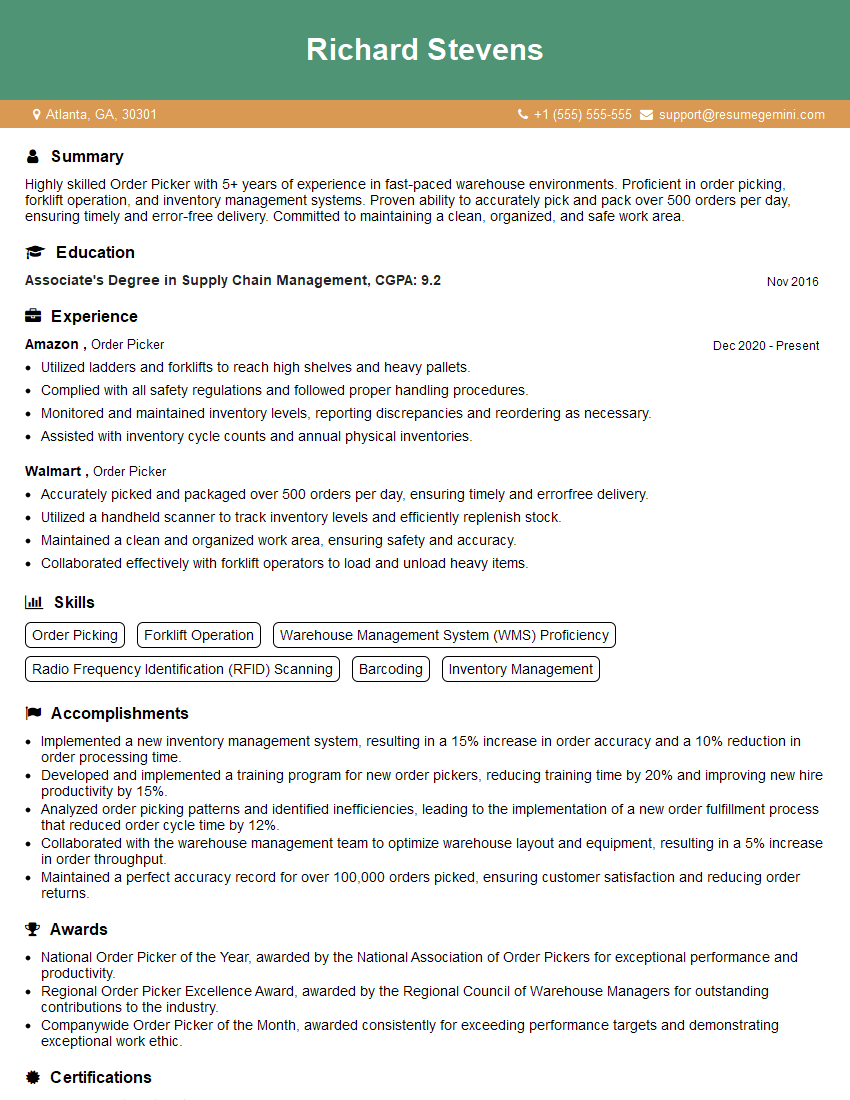
Order Picker Resume Sample
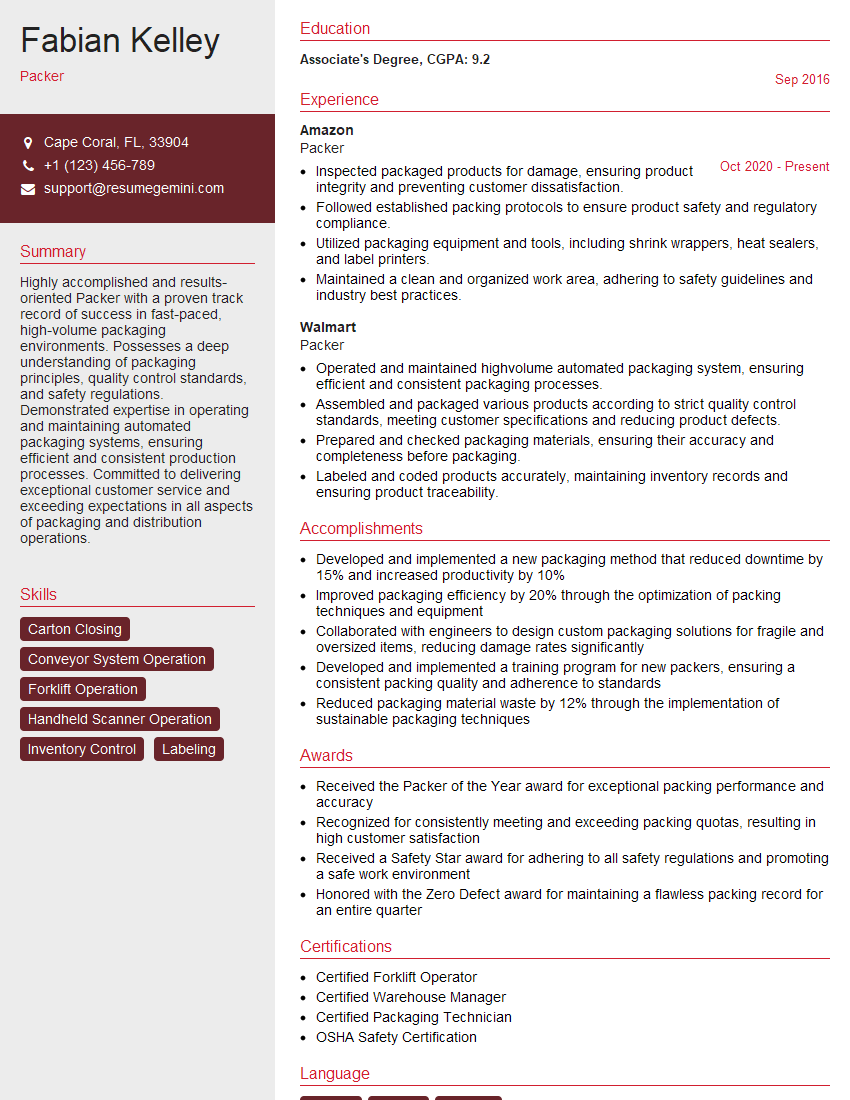
Packer Resume Sample
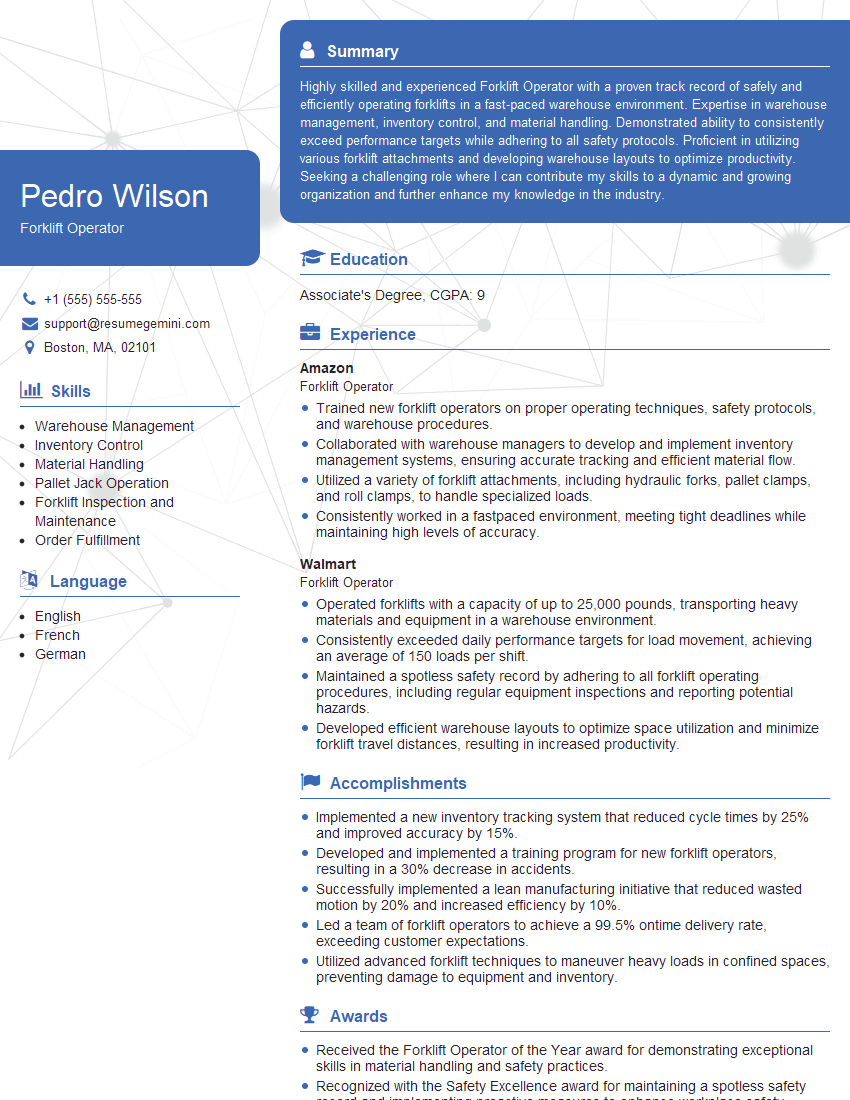
Forklift Operator Resume Sample
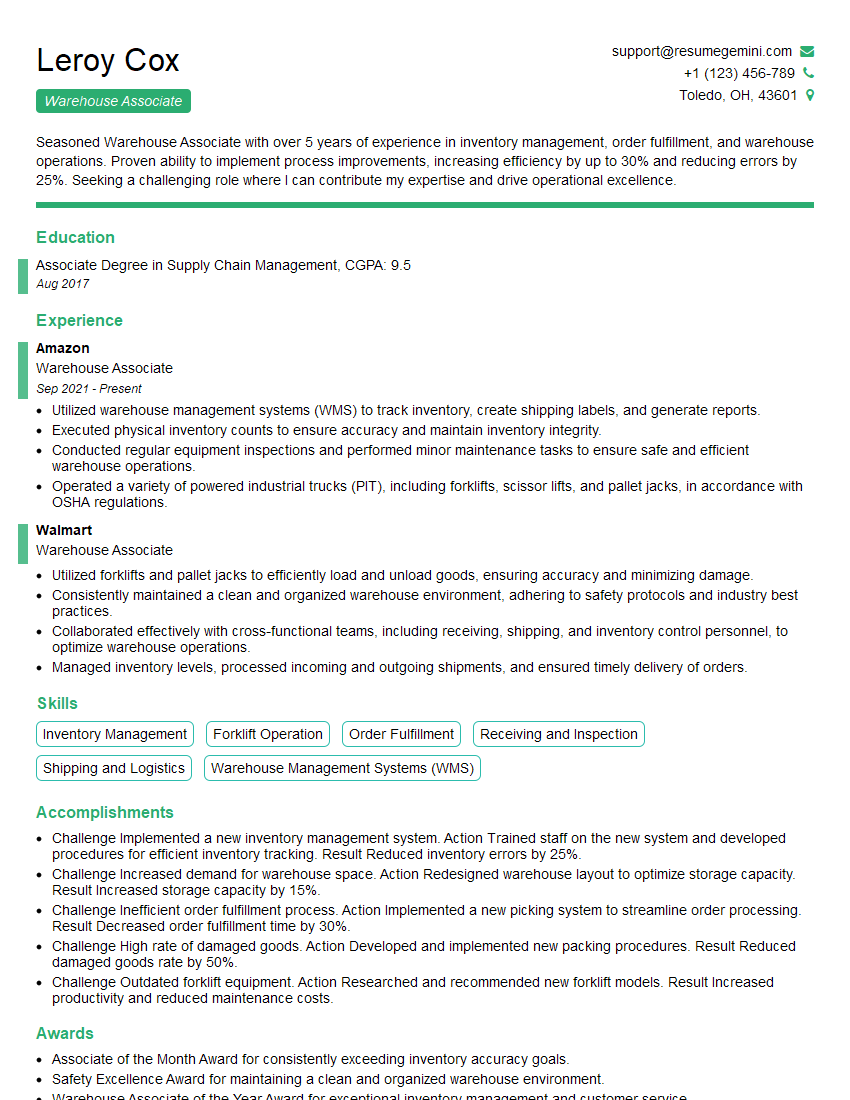
Warehouse Associate Resume Sample
- Supply Chain Manager
- Distribution Center Manager
- Warehouse Manager
- Warehouse Operations Manager
- Warehouse Supervisor
- Logistics Coordinator
- Inventory Analyst
- Supply Chain Analyst
- Inventory Control Manager
- Inventory Control Specialist
- Order Fulfillment Specialist
- Receiving Clerk
- Shipping and Receiving Clerk
- Shipping Clerk
- Logistics Associate
- Material Handler
- Warehouse Specialist
- Order Picker
- Packer
- Forklift Operator
- Warehouse Associate
Explore more articles
Users Rating of Our Blogs
Share Your Experience
We value your feedback! Please rate our content and share your thoughts (optional).
What Readers Say About Our Blog
Attention music lovers!
Wow, All the best Sax Summer music !!!
Spotify: https://open.spotify.com/artist/6ShcdIT7rPVVaFEpgZQbUk
Apple Music: https://music.apple.com/fr/artist/jimmy-sax-black/1530501936
YouTube: https://music.youtube.com/browse/VLOLAK5uy_noClmC7abM6YpZsnySxRqt3LoalPf88No
Other Platforms and Free Downloads : https://fanlink.tv/jimmysaxblack
on google : https://www.google.com/search?q=22+AND+22+AND+22
on ChatGPT : https://chat.openai.com?q=who20jlJimmy20Black20Sax20Producer
Get back into the groove with Jimmy sax Black
Best regards,
Jimmy sax Black
www.jimmysaxblack.com
Hi I am a troller at The aquatic interview center and I suddenly went so fast in Roblox and it was gone when I reset.
Hi,
Business owners spend hours every week worrying about their website—or avoiding it because it feels overwhelming.
We’d like to take that off your plate:
$69/month. Everything handled.
Our team will:
Design a custom website—or completely overhaul your current one
Take care of hosting as an option
Handle edits and improvements—up to 60 minutes of work included every month
No setup fees, no annual commitments. Just a site that makes a strong first impression.
Find out if it’s right for you:
https://websolutionsgenius.com/awardwinningwebsites
Hello,
we currently offer a complimentary backlink and URL indexing test for search engine optimization professionals.
You can get complimentary indexing credits to test how link discovery works in practice.
No credit card is required and there is no recurring fee.
You can find details here:
https://wikipedia-backlinks.com/indexing/
Regards
NICE RESPONSE TO Q & A
hi
The aim of this message is regarding an unclaimed deposit of a deceased nationale that bears the same name as you. You are not relate to him as there are millions of people answering the names across around the world. But i will use my position to influence the release of the deposit to you for our mutual benefit.
Respond for full details and how to claim the deposit. This is 100% risk free. Send hello to my email id: lukachachibaialuka@gmail.com
Luka Chachibaialuka
Hey interviewgemini.com, just wanted to follow up on my last email.
We just launched Call the Monster, an parenting app that lets you summon friendly ‘monsters’ kids actually listen to.
We’re also running a giveaway for everyone who downloads the app. Since it’s brand new, there aren’t many users yet, which means you’ve got a much better chance of winning some great prizes.
You can check it out here: https://bit.ly/callamonsterapp
Or follow us on Instagram: https://www.instagram.com/callamonsterapp
Thanks,
Ryan
CEO – Call the Monster App
Hey interviewgemini.com, I saw your website and love your approach.
I just want this to look like spam email, but want to share something important to you. We just launched Call the Monster, a parenting app that lets you summon friendly ‘monsters’ kids actually listen to.
Parents are loving it for calming chaos before bedtime. Thought you might want to try it: https://bit.ly/callamonsterapp or just follow our fun monster lore on Instagram: https://www.instagram.com/callamonsterapp
Thanks,
Ryan
CEO – Call A Monster APP
To the interviewgemini.com Owner.
Dear interviewgemini.com Webmaster!
Hi interviewgemini.com Webmaster!
Dear interviewgemini.com Webmaster!
excellent
Hello,
We found issues with your domain’s email setup that may be sending your messages to spam or blocking them completely. InboxShield Mini shows you how to fix it in minutes — no tech skills required.
Scan your domain now for details: https://inboxshield-mini.com/
— Adam @ InboxShield Mini
support@inboxshield-mini.com
Reply STOP to unsubscribe
Hi, are you owner of interviewgemini.com? What if I told you I could help you find extra time in your schedule, reconnect with leads you didn’t even realize you missed, and bring in more “I want to work with you” conversations, without increasing your ad spend or hiring a full-time employee?
All with a flexible, budget-friendly service that could easily pay for itself. Sounds good?
Would it be nice to jump on a quick 10-minute call so I can show you exactly how we make this work?
Best,
Hapei
Marketing Director
Hey, I know you’re the owner of interviewgemini.com. I’ll be quick.
Fundraising for your business is tough and time-consuming. We make it easier by guaranteeing two private investor meetings each month, for six months. No demos, no pitch events – just direct introductions to active investors matched to your startup.
If youR17;re raising, this could help you build real momentum. Want me to send more info?
Hi, I represent an SEO company that specialises in getting you AI citations and higher rankings on Google. I’d like to offer you a 100% free SEO audit for your website. Would you be interested?
Hi, I represent an SEO company that specialises in getting you AI citations and higher rankings on Google. I’d like to offer you a 100% free SEO audit for your website. Would you be interested?