Preparation is the key to success in any interview. In this post, we’ll explore crucial Weather Forecasting and Numerical Weather Prediction interview questions and equip you with strategies to craft impactful answers. Whether you’re a beginner or a pro, these tips will elevate your preparation.
Questions Asked in Weather Forecasting and Numerical Weather Prediction Interview
Q 1. Explain the difference between synoptic and mesoscale meteorology.
Synoptic meteorology and mesoscale meteorology both deal with weather forecasting, but differ significantly in their spatial and temporal scales. Think of it like zooming in on a map: synoptic meteorology focuses on the larger picture, examining weather systems across vast areas (hundreds to thousands of kilometers) and over longer timeframes (days to weeks). Mesoscale meteorology, on the other hand, zooms in on smaller-scale weather phenomena, typically ranging from a few kilometers to a few hundred kilometers, and observing changes over shorter timescales (minutes to hours).
Synoptic meteorology uses surface and upper-air charts to analyze large-scale weather patterns like high and low-pressure systems, fronts, and jet streams. For example, tracking a hurricane’s path across an ocean basin falls under synoptic meteorology. The daily weather maps you see on television are primarily based on synoptic analysis.
Mesoscale meteorology focuses on events like thunderstorms, tornadoes, sea breezes, and mountain waves, which are often embedded within the larger synoptic patterns. Understanding how a localized thunderstorm develops and its potential for severe hail or flooding would fall within the realm of mesoscale meteorology. Sophisticated numerical weather prediction (NWP) models are crucial for both scales but require different resolutions and physical parameterizations to accurately capture the characteristics of each.
Q 2. Describe the process of data assimilation in NWP.
Data assimilation in Numerical Weather Prediction (NWP) is a crucial process that combines observational data with the model’s prediction to produce an improved initial state for the forecast. Imagine trying to build a puzzle with some pieces missing; data assimilation fills in those gaps, creating a more complete and accurate picture of the atmosphere’s current state. It uses various mathematical techniques to blend observations (from satellites, weather stations, radar, etc.) that are often scattered in space and time, with information already present in the forecast model’s representation of the atmosphere.
The process generally involves:
- Observation preprocessing: Quality control and correction of observational data.
- Model forecast: Running the numerical weather prediction model to generate a forecast.
- Analysis step: Combining the model forecast with observations to create a better estimate of the current atmospheric state. This often uses sophisticated algorithms such as variational methods (like 4D-Var) or Kalman filtering.
- Forecast step: Using the improved analysis as the initial condition to run the model and generate the final forecast.
Different data assimilation systems use varying approaches, but the core aim remains the same: to optimally integrate data to obtain the most accurate possible initial state for the weather prediction model. Improved data assimilation leads to more accurate and reliable weather forecasts.
Q 3. What are the limitations of numerical weather prediction models?
While NWP models have significantly improved forecasting accuracy, several limitations persist. Think of them as inherent challenges in trying to simulate a chaotic system as complex as the atmosphere.
- Model physics: Our understanding of atmospheric processes isn’t perfect, and simplified representations of complex physical processes (like cloud formation or turbulent mixing) within the model inevitably lead to errors.
- Data limitations: We don’t have perfect observational coverage of the entire atmosphere. Data sparsity in certain regions (e.g., over oceans or remote areas) can limit the accuracy of data assimilation and, consequently, the forecast.
- Computational limitations: The atmosphere is a complex system, and simulating its evolution requires immense computing power. While resolution is continuously increasing, there are inherent limits to how finely we can resolve all scales of atmospheric motion.
- Chaos and predictability: The atmosphere is a chaotic system; small uncertainties in the initial conditions can lead to large differences in the forecast over time. This is often referred to as the ‘butterfly effect’. Long-range forecasts are inherently less accurate due to this chaotic nature.
- Subgrid-scale processes: Processes occurring at scales smaller than the model’s grid resolution cannot be explicitly resolved. Their impact must be parameterized, introducing additional uncertainty.
These limitations highlight the ongoing need for research and improvement in both model development and data collection techniques.
Q 4. How do you interpret weather charts and maps (e.g., surface analysis, upper-air charts)?
Interpreting weather charts and maps requires a good understanding of meteorological symbols and conventions. Surface analysis charts show the distribution of weather elements (temperature, pressure, wind, precipitation) at a specific time across a geographical area. Upper-air charts, on the other hand, display these elements at different levels in the atmosphere (e.g., 500mb, 850mb).
Surface analysis: Look for patterns like high and low-pressure systems (indicated by ‘H’ and ‘L’), fronts (lines separating air masses with different temperatures and humidity), and wind direction and speed (using wind barbs). Isobars (lines of constant pressure) reveal the pressure gradient, indicating the strength of the wind. Isotherms (lines of constant temperature) provide temperature patterns. Precipitation is usually indicated with symbols showing the type and intensity of the rainfall or snowfall.
Upper-air charts: These provide a vertical perspective, showing the structure of the atmosphere. Analysis of contours (lines of constant height) on geopotential height charts provides information about upper-level wind flow and jet streams. Temperature and moisture patterns at various altitudes are crucial for understanding the potential for cloud development and precipitation. For example, a strong temperature gradient aloft might suggest the presence of instability, conducive to thunderstorm development.
Effective chart interpretation relies on understanding the relationships between different weather elements and their interaction in the context of the overall synoptic situation. It’s a skill developed through experience and practice, combining knowledge of meteorology with pattern recognition.
Q 5. Explain the concept of model resolution and its impact on forecast accuracy.
Model resolution refers to the grid spacing used in a numerical weather prediction model. It represents the smallest spatial scale the model can explicitly resolve. Think of it like the pixels on a screen: higher resolution means smaller pixels, providing a sharper and more detailed image. Similarly, higher resolution in a weather model means it can capture finer-scale weather features.
Impact on forecast accuracy: Higher resolution models generally lead to more accurate forecasts, particularly for smaller-scale weather phenomena. They can better resolve features like thunderstorms, fronts, and mountain waves, capturing details that coarser-resolution models miss. However, higher resolution comes at a cost – significantly increased computational demands. A high-resolution model requires much more processing power and memory, limiting the feasible forecast range and the ability to run many ensemble members.
For example, a high-resolution model might accurately predict the location and intensity of a local thunderstorm, while a low-resolution model might only show the general area of thunderstorm activity. The choice of resolution involves a trade-off between accuracy and computational feasibility, considering the intended forecast timeframe and spatial scales of interest.
Q 6. Describe different types of weather forecasting models (e.g., global, regional, ensemble).
Different types of weather forecasting models are designed to address different spatial and temporal scales. The choice of model depends on the specific forecasting needs.
- Global models: These models cover the entire globe and provide forecasts at coarser resolutions. They’re used for predicting large-scale weather patterns, including the general movement of storms and the evolution of major weather systems. Examples include the Global Forecast System (GFS) and the European Centre for Medium-Range Weather Forecasts (ECMWF) model.
- Regional models: These models focus on a specific region, allowing for higher resolution and more detailed forecasts within that area. They often use the output from global models as boundary conditions. Regional models can provide more accurate predictions for smaller-scale events, such as local thunderstorms or snowfall amounts. Examples include the Weather Research and Forecasting (WRF) model and the High-Resolution Rapid Refresh (HRRR) model.
- Ensemble models: These involve running the same model multiple times with slightly different initial conditions or model parameters. The ensemble of forecasts provides a range of possible outcomes, representing the uncertainty inherent in the forecasting process. This allows forecasters to assess the probability of various weather events and communicate the uncertainty associated with the prediction.
Each model type plays a crucial role in the overall forecasting process, contributing to a more complete and comprehensive understanding of the weather.
Q 7. What are the common sources of error in weather forecasting?
Weather forecasting is inherently uncertain, and several factors contribute to errors in the predictions:
- Initial condition errors: Inaccuracies in the initial state of the atmosphere (due to imperfect observations or data assimilation limitations) propagate through the forecast, leading to errors over time. Even small errors can be amplified in a chaotic system.
- Model errors: Imperfect representation of physical processes in the model (e.g., simplified parameterizations of cloud physics or turbulent mixing) introduce systematic and random errors.
- Data sparsity and quality: Limited or inaccurate observations, particularly over data-sparse regions, can lead to significant uncertainties.
- Computational limitations: Resolution limits prevent the accurate representation of smaller-scale weather systems.
- Subgrid-scale processes: The effects of processes occurring at scales smaller than the grid resolution can’t be fully captured, leading to errors.
- Human error: Forecasters interpreting model outputs and making subjective adjustments can introduce human error.
Understanding and quantifying these error sources is crucial for improving forecast accuracy and communicating uncertainty effectively. Ongoing research and development in NWP models and data assimilation techniques aim to minimize these errors.
Q 8. How do you evaluate the performance of a weather forecast model?
Evaluating the performance of a weather forecast model involves comparing its predictions to observed weather data using various statistical metrics. Think of it like grading a student’s test – we need objective measures to assess accuracy.
Common metrics include:
- Root Mean Square Error (RMSE): Measures the average difference between predicted and observed values. A lower RMSE indicates better accuracy.
- Mean Absolute Error (MAE): Similar to RMSE, but it uses the absolute differences, making it less sensitive to outliers (extreme errors).
- Bias: Represents the systematic over- or underestimation of the forecast. A zero bias is ideal.
- Correlation Coefficient (r): Measures the linear relationship between predicted and observed values. A value close to +1 indicates a strong positive correlation.
- Skill Score: Compares the forecast’s performance against a simpler forecast, such as a climatological forecast (average values for a given time of year). A positive skill score suggests the model outperforms the simpler method.
Beyond these metrics, we also consider things like forecast resolution (how detailed the prediction is) and lead time (how far in advance the prediction is made). A model might be highly accurate for short-range predictions but less reliable for longer-range ones. Visual inspection of forecast maps alongside observed data is crucial for a comprehensive evaluation. For instance, we might examine how well a model captures the spatial distribution of precipitation or temperature.
Q 9. Explain the concept of ensemble forecasting.
Ensemble forecasting is a powerful technique that leverages the inherent uncertainties in weather prediction. Instead of relying on a single model run, we run multiple simulations using slightly different initial conditions, model parameters, or even different models entirely. Imagine it like asking multiple weather experts for their opinion; each might have a slightly different perspective, but the collective assessment tends to be more robust.
These individual forecasts are then combined to create an ensemble forecast, which provides a probability distribution of possible future weather scenarios. This distribution highlights the uncertainty associated with the forecast, giving us a better understanding of the range of likely outcomes. For example, an ensemble might predict a 70% chance of rain with a range of precipitation amounts. This probabilistic approach allows us to better communicate the uncertainty inherent in weather forecasting and make more informed decisions.
Q 10. Discuss the role of atmospheric physics in NWP.
Atmospheric physics forms the very foundation of Numerical Weather Prediction (NWP). The equations governing atmospheric motion, thermodynamics, and radiative transfer are at the heart of NWP models. These equations describe how various physical processes interact to shape the weather.
For example:
- Thermodynamics: Models use thermodynamic equations to calculate temperature changes due to processes like adiabatic expansion or condensation (cloud formation). This is crucial for predicting precipitation.
- Radiation: The absorption and emission of solar and terrestrial radiation influence temperature profiles significantly. Models incorporate complex radiative transfer schemes to capture this impact accurately.
- Fluid Dynamics: The Navier-Stokes equations describe the motion of air masses, accounting for pressure gradients, Coriolis force, and friction. This is fundamental to predicting wind speed and direction.
- Microphysics: The study of cloud formation, precipitation processes (rain, snow, hail), and cloud-radiation interaction is incorporated through sophisticated parameterizations in NWP models. These parameterizations represent complex processes that occur at scales too small to be explicitly resolved by the model.
Accurate representation of these physical processes is crucial for generating reliable weather forecasts. The complexity and ongoing research in atmospheric physics directly influence the ongoing improvement and accuracy of NWP models.
Q 11. What are the different types of atmospheric instability and their impact on weather?
Atmospheric instability refers to the tendency of the atmosphere to amplify small disturbances, leading to the development of vertical motion and severe weather. Several types exist:
- Convective Instability: This occurs when a rising parcel of air becomes warmer than its surroundings, causing it to continue rising. This leads to thunderstorms, particularly on hot, humid days. Imagine a hot air balloon—the heated air inside is less dense and rises.
- Conditional Instability: A parcel of air is stable when lifted only a short distance, but becomes unstable if lifted sufficiently high. This often requires an initial lift, like a frontal boundary or terrain forcing, to trigger convection.
- Inertial Instability: This arises from horizontal wind shear (changes in wind speed or direction with height). It can lead to the formation of turbulent eddies and enhance vertical motion.
- Baroclinic Instability: This occurs when there are horizontal temperature gradients, often associated with fronts. It is a fundamental mechanism for the development of mid-latitude cyclones (low-pressure systems), which bring widespread precipitation and significant temperature changes.
The impact of atmospheric instability on weather varies depending on the type and intensity. Convective instability can result in severe thunderstorms, heavy rainfall, hail, and even tornadoes. Baroclinic instability drives larger-scale weather systems that can impact extensive regions for several days.
Q 12. Describe the life cycle of a thunderstorm.
The life cycle of a thunderstorm typically involves three stages:
- Cumulus Stage: This is the developing stage, characterized by updrafts of warm, moist air. Clouds build vertically, and precipitation hasn’t yet begun. Think of it as the ‘growing’ phase.
- Mature Stage: This is the most intense stage. Updrafts continue, but downdrafts of cooler, heavier precipitation begin to form. Heavy rainfall, lightning, hail, and strong winds are common during this stage. It’s the thunderstorm’s peak intensity.
- Dissipating Stage: Downdrafts become dominant, suppressing updrafts and cutting off the supply of warm, moist air. Precipitation weakens, and the storm gradually dissipates. The storm is essentially ‘running out of fuel’.
The duration of each stage can vary greatly depending on environmental conditions such as atmospheric instability, wind shear, and moisture availability. Some thunderstorms are relatively short-lived, lasting only a few minutes, while others can persist for hours and evolve into supercell thunderstorms capable of producing devastating tornadoes or large hail.
Q 13. Explain the concept of vorticity and its role in weather forecasting.
Vorticity is a measure of the rotation of air within a fluid. Imagine swirling water in a drain – that’s vorticity. In the atmosphere, vorticity is a key factor influencing the development and movement of weather systems.
Positive vorticity indicates counterclockwise rotation (in the Northern Hemisphere), while negative vorticity indicates clockwise rotation. Areas of high vorticity are associated with strong vertical motion and the development of severe weather, because the rotation helps organize and intensify thunderstorms. The Coriolis force, caused by the Earth’s rotation, plays a significant role in creating and influencing vorticity.
In weather forecasting, vorticity analysis helps us to:
- Track the movement of weather systems: Areas of high vorticity often indicate the location of developing cyclones or jet streams.
- Predict the intensification of storms: Changes in vorticity can indicate whether a thunderstorm will strengthen or weaken.
- Forecast the development of tornadoes: Strong, localized vorticity is a key indicator of tornadic development.
By studying vorticity fields derived from numerical weather prediction models and observational data, forecasters can obtain valuable insights into the dynamic evolution of atmospheric systems and improve the accuracy of their forecasts.
Q 14. How do you interpret weather radar and satellite imagery?
Weather radar and satellite imagery provide crucial observational data for weather forecasting. They offer complementary perspectives on atmospheric conditions.
Weather Radar: Radar emits microwave pulses, and the backscattered signal provides information about precipitation intensity, type (rain, snow, hail), and movement. Different colors on radar imagery represent different precipitation intensities, allowing us to identify areas of heavy rainfall, which is crucial for flood warnings. Doppler radar also measures the velocity of precipitation particles, which helps to detect rotation in thunderstorms, potentially indicating the presence of tornadoes.
Satellite Imagery: Satellites use sensors to detect visible light, infrared radiation, and water vapor. Visible imagery shows cloud cover, and is best during daytime. Infrared imagery measures cloud top temperature, which helps to determine cloud height and type. Water vapor imagery reveals the distribution of moisture in the atmosphere, which is important for predicting precipitation and cloud development.
The interpretation of this imagery involves understanding the relationship between the observed patterns and various atmospheric processes. For instance, a large area of cold cloud tops on infrared imagery often indicates a mature thunderstorm. Similarly, a hook-shaped echo on radar imagery may suggest the presence of a tornado. Forecasters use sophisticated software to analyze this data in conjunction with NWP model output, providing a comprehensive picture of the current weather and its future evolution.
Q 15. Explain the concept of atmospheric boundary layer and its importance in forecasting.
The atmospheric boundary layer (ABL), also known as the planetary boundary layer (PBL), is the lowest part of the troposphere and is directly influenced by the Earth’s surface. Think of it as a transitional zone where the atmosphere is significantly affected by friction and heat exchange with the ground. This layer’s depth varies throughout the day and with weather conditions, typically ranging from a few hundred meters to a couple of kilometers.
Its importance in forecasting is paramount because it dictates many weather phenomena we experience daily. Surface-based weather observations, such as temperature, humidity, and wind speed, are primarily measured within the ABL. Accurate forecasting of these parameters is crucial for predicting things like:
- Surface winds: The ABL is where wind shear and turbulence are most pronounced, directly affecting aviation safety and wind energy production.
- Temperature inversions: These are common in stable ABLs and trap pollutants, leading to poor air quality. Predicting inversions is critical for pollution monitoring and public health.
- Fog and low clouds: These form readily when the ABL is saturated and cooled. Accurate forecasting requires a precise understanding of ABL processes.
- Mixing and dispersion: The ABL’s vertical mixing processes determine how pollutants and other airborne substances are dispersed, influencing air quality models.
Numerical Weather Prediction (NWP) models incorporate complex parameterizations to represent ABL processes, ensuring accurate simulations of these crucial surface-level weather variables. Failure to accurately model the ABL can result in significant errors in forecasts, particularly for short-range predictions.
Career Expert Tips:
- Ace those interviews! Prepare effectively by reviewing the Top 50 Most Common Interview Questions on ResumeGemini.
- Navigate your job search with confidence! Explore a wide range of Career Tips on ResumeGemini. Learn about common challenges and recommendations to overcome them.
- Craft the perfect resume! Master the Art of Resume Writing with ResumeGemini’s guide. Showcase your unique qualifications and achievements effectively.
- Don’t miss out on holiday savings! Build your dream resume with ResumeGemini’s ATS optimized templates.
Q 16. Describe the impact of topography on weather patterns.
Topography, or the shape of the Earth’s surface, plays a significant role in shaping weather patterns. Mountains, valleys, and even smaller hills can dramatically alter wind flow, precipitation, and temperature. Imagine a river encountering a large rock; its flow is redirected and changed. Similarly, air masses are deflected, forced upwards, or channeled by topographic features.
Here are some key impacts:
- Orographic lift: As air masses are forced to rise over mountains, they cool and condense, leading to increased precipitation on the windward side (the side facing the wind). This often creates a rain shadow on the leeward side (the side sheltered from the wind), resulting in drier conditions.
- Wind channeling and acceleration: Narrow valleys can channel winds, leading to increased wind speeds, while mountain ranges can act as barriers, reducing wind speeds in sheltered areas.
- Local temperature variations: Elevated areas are typically cooler than lower-lying areas due to adiabatic cooling (cooling due to expansion of rising air). This temperature difference can drive local circulations and influence cloud formation.
- Formation of local weather systems: Complex topographic features can trigger the development of mesoscale weather systems, such as mountain waves, which are significant for aviation safety and can impact local precipitation patterns.
NWP models incorporate high-resolution terrain data to accurately represent the effect of topography. Without this detailed representation, forecasts, especially regional forecasts, would be significantly less accurate.
Q 17. How do you forecast precipitation using NWP models?
Forecasting precipitation using NWP models involves complex interactions between atmospheric dynamics and microphysical processes. It’s not simply a matter of predicting cloud formation; the models must simulate the entire process, from water vapor condensation to the formation and growth of precipitation particles.
The process involves:
- Atmospheric moisture: The model first calculates the amount of water vapor in the atmosphere, which is crucial for cloud formation.
- Cloud formation: Based on atmospheric stability and dynamics, the model simulates the formation of clouds, considering factors such as uplift, cooling, and condensation nuclei.
- Microphysics: The model then simulates microphysical processes within the clouds, including the formation, growth, and collision of precipitation particles (rain, snow, hail). This involves sophisticated parameterizations representing the complex interactions between cloud droplets and ice crystals.
- Precipitation type: The model determines the type of precipitation based on temperature profiles in the atmosphere. Whether it’ll be rain, snow, sleet, or freezing rain depends heavily on the temperature profile.
- Precipitation amount: Finally, the model integrates all these processes to predict the amount of precipitation expected at a given location and time.
It’s important to remember that precipitation forecasting is one of the most challenging aspects of NWP, with significant uncertainties remaining due to the complexity of cloud processes. Model output undergoes post-processing using techniques like statistical corrections to improve accuracy and reliability.
Q 18. How do you handle uncertainties in weather forecasting?
Uncertainties in weather forecasting are inherent due to the chaotic nature of the atmosphere and limitations in our observations and models. Imagine trying to predict the path of a leaf blowing in the wind – it’s affected by so many subtle factors that precise prediction is nearly impossible.
We address these uncertainties through several strategies:
- Ensemble forecasting: Running multiple NWP model simulations with slightly varied initial conditions and model configurations generates an ensemble of possible forecasts. The spread of these forecasts provides a measure of forecast uncertainty. A larger spread indicates higher uncertainty.
- Probabilistic forecasting: Instead of providing a single deterministic forecast (e.g., 2 inches of rain), probabilistic forecasts express the likelihood of different outcomes (e.g., 70% chance of more than 1 inch of rain). This acknowledges the inherent uncertainty.
- Data assimilation: Continuously incorporating new observational data into the NWP model helps reduce uncertainty by improving the accuracy of the initial conditions.
- Model improvement: Researchers constantly work on refining NWP models, adding new physics and improving parameterizations to better represent atmospheric processes.
- Post-processing techniques: Statistical methods are applied to the model output to calibrate forecasts, reduce biases, and improve their skill.
Transparent communication of uncertainties is crucial. Forecasters should clearly communicate the degree of uncertainty associated with their predictions, allowing users to make informed decisions based on the likelihood of different weather outcomes.
Q 19. Explain the concept of lead time in weather forecasting.
Lead time in weather forecasting refers to the time interval between the forecast issue time and the time for which the forecast is valid. A forecast issued at 12:00 PM for the next 24 hours has a lead time of 24 hours. It’s essentially how far into the future we are making predictions.
Lead time significantly influences forecast accuracy. Short-range forecasts (lead times of a few hours to a few days) are generally more accurate than longer-range forecasts (lead times of several days to weeks). This is because the chaotic nature of the atmosphere amplifies small initial errors over time.
The choice of appropriate lead time depends heavily on the weather phenomenon being predicted. For rapidly evolving systems like thunderstorms, short lead times are essential for effective warning. For slower-evolving phenomena like large-scale temperature changes, longer lead times may be more practical, even if the accuracy is reduced.
Understanding lead time is vital for users of weather forecasts. A user should evaluate the forecast’s reliability based on the lead time and the specific weather phenomenon. A 7-day forecast for rain will naturally have more uncertainty than a 24-hour forecast.
Q 20. Discuss the challenges of forecasting extreme weather events.
Forecasting extreme weather events, such as hurricanes, tornadoes, and severe thunderstorms, presents significant challenges. These events are characterized by high intensity, rapid evolution, and small spatial scales. They are difficult to predict accurately because:
- High sensitivity to initial conditions: Small changes in the initial atmospheric state can dramatically alter the evolution of extreme weather, making accurate prediction challenging.
- Complex physical processes: These events involve intricate interactions between various atmospheric processes, many of which are not fully understood or accurately represented in NWP models.
- Data limitations: The spatial and temporal resolution of observational data may not be sufficient to capture the detailed structure and evolution of these events. Sparse data over oceans or remote areas further complicates things.
- Computational demands: Simulating these events accurately requires high-resolution NWP models, placing significant demands on computing power.
Despite these challenges, significant advancements are being made. Higher-resolution models, improved data assimilation techniques, and better understanding of extreme weather processes are leading to improvements in forecast accuracy and lead time. Ensemble forecasting plays a particularly important role in communicating the uncertainties associated with predicting such unpredictable events.
Q 21. How do you communicate weather information effectively to different audiences?
Effective communication of weather information is crucial for preparedness and safety. The key is tailoring the message to the specific audience’s needs and understanding.
Consider these approaches:
- Audience segmentation: Different audiences have different needs and levels of meteorological understanding. A farmer needs different information than a pilot or the general public. Forecasts should be tailored to these groups.
- Clarity and simplicity: Avoid technical jargon whenever possible. Use clear, concise language and avoid ambiguous terms. Use visuals like maps, charts, and icons to supplement text.
- Use of multiple media: Combine different communication channels to reach a wider audience – weather websites, social media, mobile apps, radio, and television.
- Accessibility: Ensure information is accessible to people with disabilities, utilizing plain language and alternative formats.
- Emphasis on actionable information: Focus on what people need to know to stay safe and make informed decisions. Translate forecast information into easily understood actions.
- Feedback mechanisms: Collect feedback from users to understand their needs and improve communication strategies.
Effective weather communication isn’t just about providing numbers; it’s about empowering people to make safe and informed decisions in the face of changing weather conditions.
Q 22. What are the ethical considerations in weather forecasting?
Ethical considerations in weather forecasting are crucial because our predictions directly impact public safety and economic decisions. Accuracy is paramount, but so is responsible communication. For example, overhyping a storm can lead to unnecessary panic and resource depletion, while downplaying a significant threat can have devastating consequences.
- Transparency: We must be upfront about the uncertainties inherent in forecasting. Probabilistic forecasts, which express the likelihood of different outcomes, are essential for conveying this uncertainty effectively. For example, instead of saying ‘there will be 2 inches of rain’, a more ethical statement might be ‘there is a 70% chance of 1-3 inches of rain’.
- Data Privacy: Weather forecasting often relies on vast datasets, including location data. Protecting the privacy of individuals whose data contributes to forecasts is vital. Anonymization and responsible data handling are crucial.
- Bias Mitigation: Algorithmic bias in NWP models can lead to inaccurate or unfair predictions for certain regions or populations. Constant vigilance and testing are needed to identify and address these biases. For instance, historical data might underrepresent extreme events in certain areas leading to underestimation of risks.
- Accessibility: Forecasts should be accessible to everyone, regardless of language, literacy level, or socioeconomic status. Using clear, simple language and multiple communication channels are critical for ensuring equitable access to vital information.
Q 23. Describe your experience with specific NWP models (e.g., WRF, GFS, ECMWF).
I have extensive experience with several Numerical Weather Prediction (NWP) models, including the Weather Research and Forecasting (WRF) model, the Global Forecast System (GFS), and the European Centre for Medium-Range Weather Forecasts (ECMWF) model. Each has its strengths and weaknesses.
- WRF: I’ve used WRF extensively for high-resolution regional forecasting. Its flexibility allows for customized configurations, making it ideal for studying specific phenomena or regions with complex terrain. I’ve implemented various physics schemes within WRF to optimize forecasts for different meteorological challenges, such as severe convective storms or coastal flooding. I’m familiar with WRF’s data assimilation capabilities, which are crucial for integrating observations into the model.
- GFS: The GFS provides global-scale forecasts and serves as a valuable tool for understanding large-scale weather patterns. I frequently utilize its output as boundary conditions for higher-resolution regional models like WRF, improving the accuracy of downscaled predictions. I’m familiar with interpreting the GFS’s output parameters, such as geopotential height, wind speed, and temperature, to understand atmospheric dynamics.
- ECMWF: The ECMWF model is renowned for its high accuracy and sophisticated data assimilation techniques. I regularly consult ECMWF forecasts for medium-range predictions and for comparison against other model outputs. Its ensemble forecasts are particularly useful for assessing forecast uncertainty.
My experience spans model initialization, configuration, post-processing, and validation. I am proficient in evaluating model performance using various metrics, such as root mean square error (RMSE) and bias, to identify areas for improvement.
Q 24. Explain your experience with data analysis and visualization tools for meteorology.
Data analysis and visualization are fundamental to my work. I’m proficient in using several tools for meteorological data processing and presentation.
- Programming Languages: I’m skilled in Python, using libraries such as NumPy, Pandas, and SciPy for data manipulation and analysis. I leverage Matplotlib and Cartopy for creating informative visualizations of meteorological data.
- GIS Software: ArcGIS and QGIS are essential for spatial data analysis and map creation. This is particularly important for visualizing forecast products in a geographical context.
- GRIB Data Handling: I have experience working with GRIB files (the standard format for meteorological data) using tools like wgrib2 and Pygrib. This allows me to extract specific data fields from NWP model outputs.
- Visualization Tools: I use a variety of tools to visualize forecast data effectively, including interactive web maps and animated sequences showing the evolution of weather systems.
An example of my workflow is using Python to process model output, then using Cartopy to create maps showing precipitation forecasts with associated uncertainties. This allows clear communication of the forecast to both technical and non-technical audiences.
Q 25. How do you stay updated with advancements in weather forecasting technology?
Staying current in this rapidly evolving field is critical. I employ several strategies to ensure I’m up-to-date on the latest advancements in weather forecasting technology.
- Scientific Literature: I regularly read peer-reviewed journals like the Monthly Weather Review and the Journal of the Atmospheric Sciences to stay abreast of the latest research findings.
- Conferences and Workshops: I attend national and international conferences and workshops to learn about new techniques and interact with leading experts in the field.
- Online Resources: I actively follow relevant websites, blogs, and online communities, such as those of the American Meteorological Society and the World Meteorological Organization.
- Professional Networks: I maintain a strong network of colleagues and mentors in the weather forecasting community, engaging in discussions and exchanging knowledge.
- Short Courses and Workshops: I actively participate in online and in-person training on new software, modeling techniques, and data analysis methods.
Continuous learning is essential to remain proficient and effective in this dynamic field. I consider it a vital part of my professional development.
Q 26. Describe a challenging forecasting situation you faced and how you overcame it.
One particularly challenging situation involved forecasting a rapidly developing severe thunderstorm during a large outdoor event. Initial model guidance was inconsistent, with some models predicting a significant threat while others showed only minor activity.
My approach involved:
- Multiple Model Consensus: I carefully analyzed output from several NWP models, including WRF, GFS, and NAM, looking for any convergence in their predictions.
- High-Resolution Data: I incorporated data from high-resolution radar and surface observations to supplement the model guidance. This provided real-time information on storm development and intensity.
- Collaboration: I collaborated closely with colleagues specializing in severe weather to get different perspectives and refine the forecast.
- Uncertainty Communication: I communicated the uncertainties of the forecast clearly to event organizers, emphasizing the potential for rapid intensification and the need for contingency plans.
Ultimately, the storm developed more intensely than the consensus of the initial model predictions. However, because of our proactive approach, warnings were issued early, allowing for appropriate safety measures and minimizing disruption to the event.
Q 27. Explain the role of climate change in influencing weather patterns.
Climate change significantly influences weather patterns, making it a crucial factor in modern weather forecasting. The warming planet alters the fundamental characteristics of the atmosphere, leading to changes in several key aspects:
- Increased Frequency and Intensity of Extreme Events: Climate change is linked to more frequent and intense heatwaves, droughts, floods, and severe storms. Forecasters need to account for these shifts in the probability distributions of weather events when producing forecasts. For example, historic data may not accurately reflect the likelihood of unprecedented temperature extremes in a changing climate.
- Changes in Atmospheric Circulation: Shifts in atmospheric pressure systems and jet stream patterns can alter the tracks and intensity of storms. These changes need to be incorporated into NWP models to improve forecast accuracy. For example, a warming Arctic could lead to a wavier jet stream, resulting in more frequent extreme weather events at mid-latitudes.
- Sea Level Rise and Coastal Impacts: Rising sea levels increase the vulnerability of coastal communities to storm surges and flooding. Accurate forecasts of storm surge and coastal flooding need to consider the changing baseline sea level.
- Changes in Precipitation Patterns: Climate change is impacting precipitation patterns, with some regions experiencing increased rainfall and others experiencing more severe droughts. This necessitates adjustments in both the statistical and physical parameterizations used in weather models.
Therefore, integrating climate change information into weather forecasting is not optional but essential for producing accurate and effective predictions, and mitigating the impacts of extreme weather events.
Q 28. What are your career aspirations in the field of weather forecasting?
My career aspirations involve leveraging my expertise to contribute to advancements in weather forecasting and its application to societal benefit. This includes:
- Research and Development: I aim to contribute to research efforts focused on improving NWP models, particularly in addressing the challenges posed by climate change and improving the representation of high-impact weather phenomena.
- Operational Forecasting: I aspire to contribute to operational forecasting, whether in a public service or private sector setting, using my skills to protect life and property.
- Data Assimilation Techniques: I’m interested in further developing my skills in data assimilation techniques to optimize the use of observational data in improving forecast accuracy.
- Communicating Science Effectively: I aspire to play a role in enhancing the communication of weather forecasts to the public, ensuring they are accessible, understandable, and effectively used for risk mitigation.
Ultimately, I want to contribute to a future where weather forecasts are increasingly accurate and effectively used to build more resilient communities and improve global preparedness for extreme weather events.
Key Topics to Learn for Weather Forecasting and Numerical Weather Prediction Interview
- Atmospheric Thermodynamics: Understanding atmospheric stability, lapse rates, and their impact on weather systems. Practical application: Interpreting sounding data to predict convective potential.
- Synoptic Meteorology: Analyzing surface and upper-air weather charts to identify weather patterns and forecast their evolution. Practical application: Predicting the track and intensity of cyclones using satellite imagery and model output.
- Numerical Weather Prediction (NWP) Models: Familiarization with the fundamental principles behind NWP models, including data assimilation, model physics, and forecast verification. Practical application: Evaluating the strengths and weaknesses of different NWP model outputs.
- Data Assimilation Techniques: Understanding how observations are integrated into NWP models to improve forecast accuracy. Practical application: Analyzing the impact of different observation types on forecast skill.
- Mesoscale Meteorology: Focusing on weather phenomena occurring on smaller spatial scales, like thunderstorms and tornadoes. Practical application: Applying high-resolution models to forecast severe weather events.
- Forecast Verification and Uncertainty: Understanding methods for evaluating forecast accuracy and quantifying forecast uncertainty. Practical application: Communicating uncertainty effectively to stakeholders.
- Climate Change Impacts on Forecasting: Understanding how climate change affects weather patterns and the challenges it poses to forecasting. Practical application: Assessing the reliability of long-range forecasts in a changing climate.
- Advanced Topics (for Senior Roles): Ensemble forecasting, data mining techniques in meteorology, model development and improvement.
Next Steps
Mastering Weather Forecasting and Numerical Weather Prediction opens doors to exciting careers in meteorology, research, and environmental consulting. A strong foundation in these areas is crucial for securing your dream role. To maximize your chances, creating an ATS-friendly resume is essential. ResumeGemini is a trusted resource that can help you build a professional and impactful resume tailored to the specific requirements of your target jobs. We provide examples of resumes specifically designed for professionals in Weather Forecasting and Numerical Weather Prediction to guide you in the process.

Atmospheric Scientist Resume Sample

Broadcast Meteorologist Resume Sample
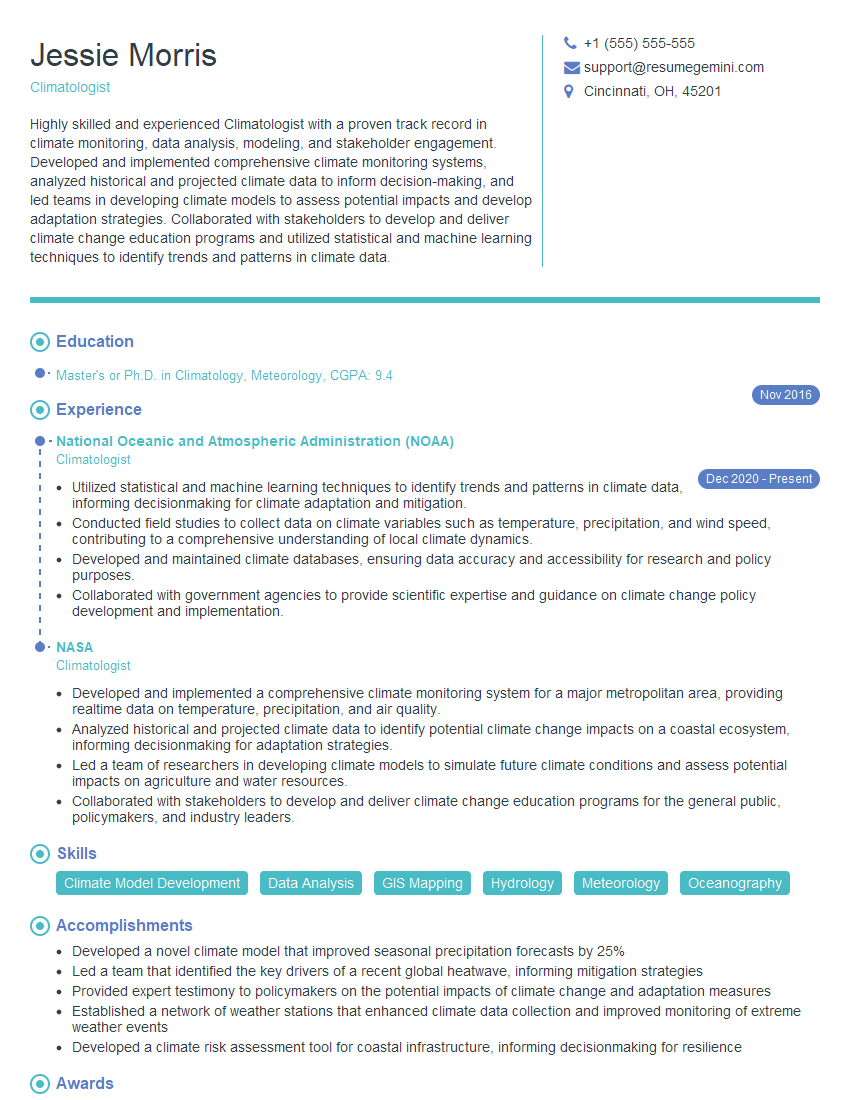
Climatologist Resume Sample
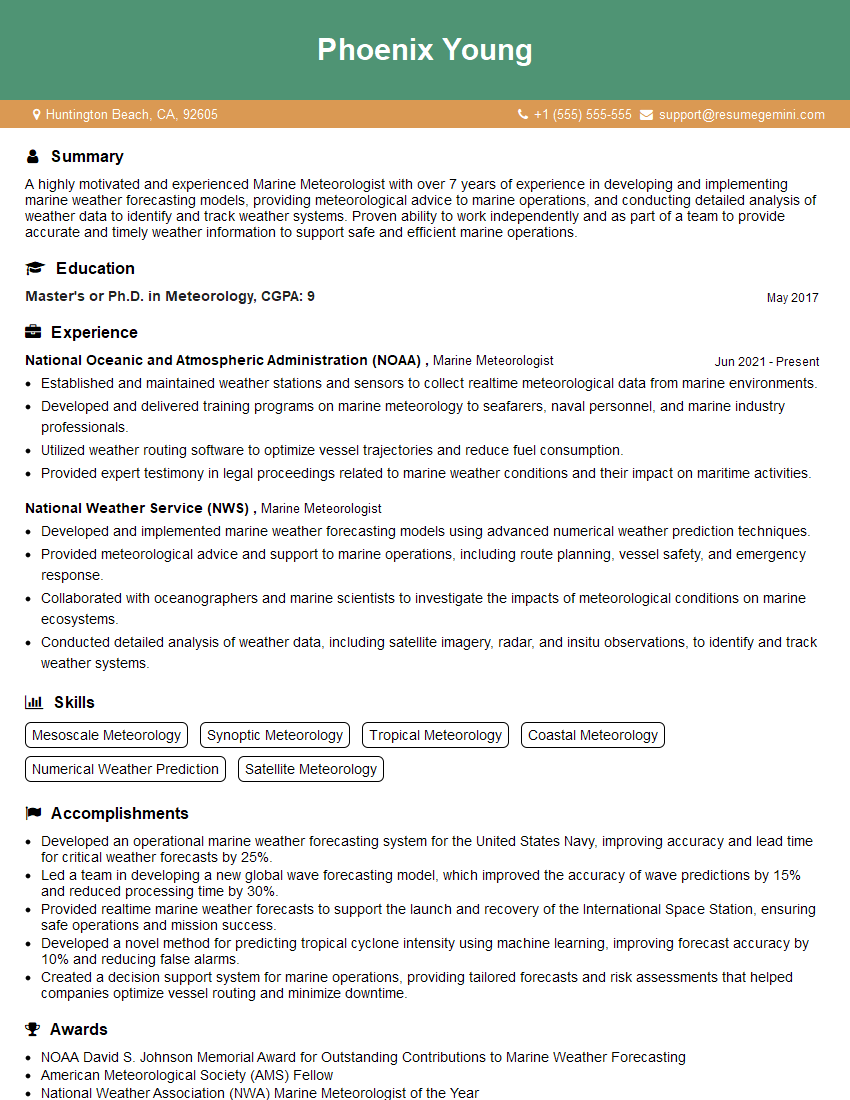
Marine Meteorologist Resume Sample

Meteorologist Resume Sample

Operational Meteorologist Resume Sample

Synoptic Meteorologist Resume Sample

Weather Analyst Resume Sample
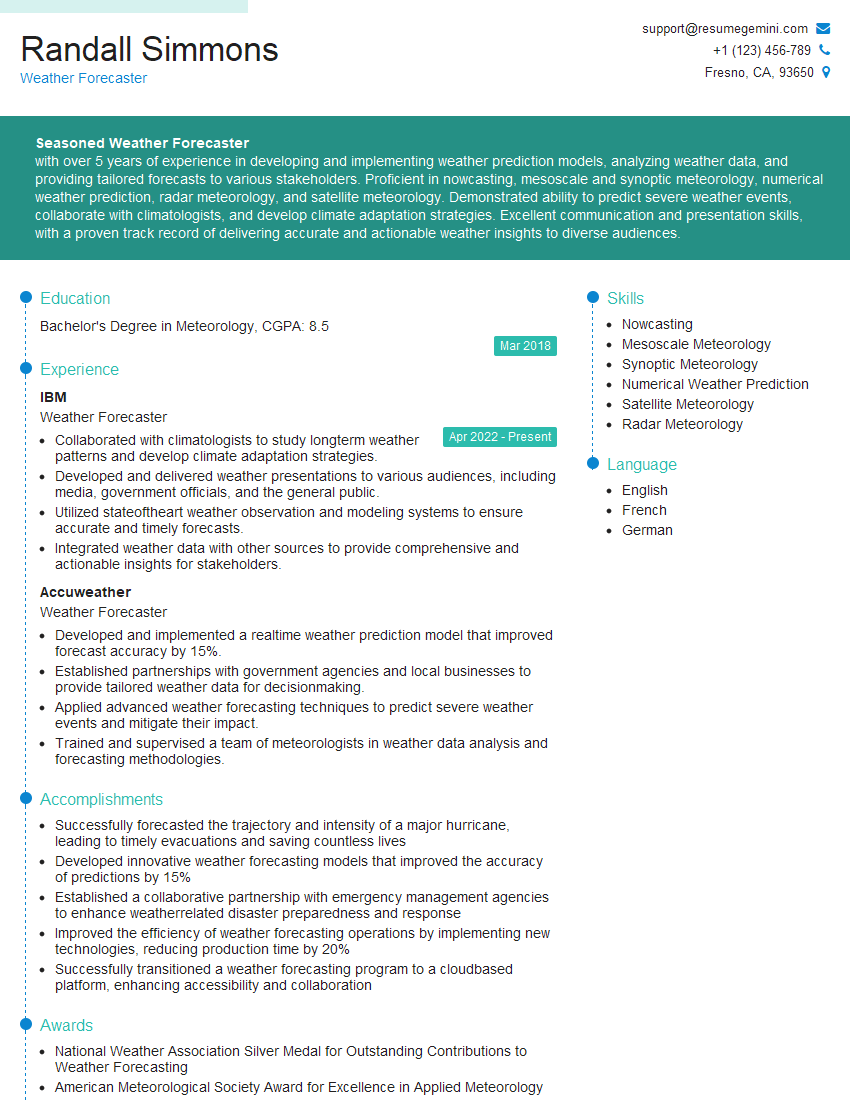
Weather Forecaster Resume Sample
Explore more articles
Users Rating of Our Blogs
Share Your Experience
We value your feedback! Please rate our content and share your thoughts (optional).
What Readers Say About Our Blog
Hello,
we currently offer a complimentary backlink and URL indexing test for search engine optimization professionals.
You can get complimentary indexing credits to test how link discovery works in practice.
No credit card is required and there is no recurring fee.
You can find details here:
https://wikipedia-backlinks.com/indexing/
Regards
NICE RESPONSE TO Q & A
hi
The aim of this message is regarding an unclaimed deposit of a deceased nationale that bears the same name as you. You are not relate to him as there are millions of people answering the names across around the world. But i will use my position to influence the release of the deposit to you for our mutual benefit.
Respond for full details and how to claim the deposit. This is 100% risk free. Send hello to my email id: [email protected]
Luka Chachibaialuka
Hey interviewgemini.com, just wanted to follow up on my last email.
We just launched Call the Monster, an parenting app that lets you summon friendly ‘monsters’ kids actually listen to.
We’re also running a giveaway for everyone who downloads the app. Since it’s brand new, there aren’t many users yet, which means you’ve got a much better chance of winning some great prizes.
You can check it out here: https://bit.ly/callamonsterapp
Or follow us on Instagram: https://www.instagram.com/callamonsterapp
Thanks,
Ryan
CEO – Call the Monster App
Hey interviewgemini.com, I saw your website and love your approach.
I just want this to look like spam email, but want to share something important to you. We just launched Call the Monster, a parenting app that lets you summon friendly ‘monsters’ kids actually listen to.
Parents are loving it for calming chaos before bedtime. Thought you might want to try it: https://bit.ly/callamonsterapp or just follow our fun monster lore on Instagram: https://www.instagram.com/callamonsterapp
Thanks,
Ryan
CEO – Call A Monster APP
To the interviewgemini.com Owner.
Dear interviewgemini.com Webmaster!
Hi interviewgemini.com Webmaster!
Dear interviewgemini.com Webmaster!
excellent
Hello,
We found issues with your domain’s email setup that may be sending your messages to spam or blocking them completely. InboxShield Mini shows you how to fix it in minutes — no tech skills required.
Scan your domain now for details: https://inboxshield-mini.com/
— Adam @ InboxShield Mini
Reply STOP to unsubscribe
Hi, are you owner of interviewgemini.com? What if I told you I could help you find extra time in your schedule, reconnect with leads you didn’t even realize you missed, and bring in more “I want to work with you” conversations, without increasing your ad spend or hiring a full-time employee?
All with a flexible, budget-friendly service that could easily pay for itself. Sounds good?
Would it be nice to jump on a quick 10-minute call so I can show you exactly how we make this work?
Best,
Hapei
Marketing Director
Hey, I know you’re the owner of interviewgemini.com. I’ll be quick.
Fundraising for your business is tough and time-consuming. We make it easier by guaranteeing two private investor meetings each month, for six months. No demos, no pitch events – just direct introductions to active investors matched to your startup.
If youR17;re raising, this could help you build real momentum. Want me to send more info?
Hi, I represent an SEO company that specialises in getting you AI citations and higher rankings on Google. I’d like to offer you a 100% free SEO audit for your website. Would you be interested?
Hi, I represent an SEO company that specialises in getting you AI citations and higher rankings on Google. I’d like to offer you a 100% free SEO audit for your website. Would you be interested?
good