Cracking a skill-specific interview, like one for Webfed Offset press operations, requires understanding the nuances of the role. In this blog, we present the questions you’re most likely to encounter, along with insights into how to answer them effectively. Let’s ensure you’re ready to make a strong impression.
Questions Asked in Webfed Offset press operations Interview
Q 1. Describe your experience with different types of web offset presses (e.g., perfecting, heatset, coldset).
My experience encompasses a wide range of web offset presses, including perfecting, heatset, and coldset systems. Perfecting presses print both sides of the sheet simultaneously, increasing efficiency. Heatset presses utilize heat to dry the ink, allowing for high-quality images on glossy paper – think magazines. Coldset presses, on the other hand, dry ink through absorption into the paper, making them ideal for newspapers and other publications requiring a quicker turnaround and lower cost. I’ve worked extensively on Goss, MAN Roland, and Komori presses, gaining proficiency in their unique features and maintenance requirements. For instance, I’ve fine-tuned the drying systems on a heatset press to optimize ink drying time while minimizing paper damage. On coldset presses, my expertise lies in maintaining consistent ink viscosity in varied environmental conditions to ensure consistent print quality. My experience also includes troubleshooting and maintenance on different configurations, from single-width to double-wide presses.
Q 2. Explain the process of makeready on a web offset press.
Makeready in web offset printing is a crucial, multifaceted process that prepares the press for a specific print job. It’s like meticulously setting up a complex machine for a specific task. The process typically begins with installing the printing plates onto the plate cylinders. This requires careful alignment and clamping to ensure accurate image registration. Then, the ink and dampening systems are adjusted. This includes setting the ink fountain rollers, dampening solution concentration, and ensuring the correct balance between ink and water. Next, the paper path is checked and adjusted to ensure smooth paper flow, and the cutting and folding mechanisms are configured according to the job specifications. Finally, a test run is performed to check for any imperfections – misregistration, poor ink transfer, or color inconsistencies. Adjustments are made until the desired quality is achieved. A significant part of makeready is the meticulous adjustment of impression cylinders to ensure proper contact between plate and blanket, leading to consistent ink transfer. I always follow a checklist to ensure a smooth makeready process and to minimize waste.
Q 3. How do you identify and troubleshoot common web offset printing problems (e.g., slurring, misregister, poor ink transfer)?
Troubleshooting web offset printing problems requires a systematic approach. For example, slurring, where the printed image appears blurred, often indicates issues with the dampening system (too much water) or ink viscosity. Misregister, where colors don’t align, usually points to problems with plate mounting, cylinder alignment, or gripper bar issues. Poor ink transfer could stem from worn rollers, insufficient ink, incorrect impression pressure, or problems with the blanket cylinder. My approach involves inspecting each component systematically, starting from the paper feed to the final delivery. For slurring, I would check water level and pH, then ink viscosity and roller condition. For misregister, I’d carefully examine plate mounting, cylinder alignment using precision gauges, and gripper bar functionality. For poor ink transfer, I’d analyze impression pressure, ink fountain settings, roller condition, and blanket surface. Detailed documentation and logging of adjustments are vital for tracing the cause and preventing recurrence. Think of it like diagnosing a medical condition – a careful observation and systematic investigation are needed.
Q 4. What are the different types of printing plates used in web offset printing?
Web offset printing utilizes various types of printing plates, primarily categorized by their material and imaging process. Polymer plates, known for their durability and cost-effectiveness, are commonly used in high-volume newspaper printing. Aluminum plates, often processed using computer-to-plate (CTP) technology, offer superior image quality and are prevalent in commercial printing. Within aluminum plates, there are variations in surface treatments and thicknesses to optimize performance depending on the press speed and print quality needs. The choice of plate type depends on factors such as the printing speed, paper type, and desired image quality. For instance, a high-speed newspaper press might utilize a rugged polymer plate, while a high-quality magazine job would likely demand a high-resolution aluminum plate. The selection and proper handling of plates are crucial for achieving consistent print quality throughout the run.
Q 5. Describe your experience with color management and ink balancing.
Color management and ink balancing are essential for achieving consistent and accurate color reproduction. My experience includes using color management systems like G7 and ISO standards to ensure consistent color across different print jobs. I’m proficient in using spectrophotometers and densitometers to measure and adjust ink densities and achieve target color values. Ink balancing is an iterative process involving adjusting the ink fountain rollers and dampening system to achieve the proper balance between different ink colors. I’ve worked with various ink types and always consider the interplay between ink, water, and paper. For instance, I’ve addressed color variations by adjusting ink viscosity, dampening solution percentage, and optimizing the relationship between ink and water balance. The whole process relies on a combination of precise measurement and practical experience. It’s like being a color artist, using precision instruments to orchestrate the perfect color harmony.
Q 6. Explain your understanding of paper handling and web guiding.
Paper handling and web guiding are critical for ensuring a smooth and uninterrupted printing process. Proper web guiding keeps the paper aligned correctly, preventing misregistration and avoiding damage. I understand how different paper types (coated, uncoated, newsprint) behave differently in the press and how environmental factors like humidity can affect paper behavior. Web guiding systems utilize sensors and automated adjustments to maintain the precise paper path. This involves understanding the mechanics of tension control, web break detection, and the operation of various web guiding systems. Improper paper handling can lead to paper breaks, wrinkles, and misregistration. My experience includes troubleshooting paper path jams, optimizing tension settings, and configuring web guiding systems to minimize waste and maximize production efficiency. It’s about understanding the intricate dance between the paper and the machine.
Q 7. How do you maintain optimal print quality throughout a long press run?
Maintaining optimal print quality throughout a long press run requires proactive monitoring and adjustments. This involves regular checks of ink density, water balance, and paper path alignment. Regular cleaning of the rollers, blankets, and other components of the press is essential to maintain consistent ink transfer. The use of automated systems for ink and dampening control can help minimize variations during long runs. Continuous monitoring of the print output, using tools like densitometers and spectrophotometers, helps identify and address any deviations from the target color and quality. Proactive maintenance, including scheduled preventative maintenance and regular inspection of wear and tear, is crucial for minimizing downtime and ensuring a consistent quality output. Think of it as regular checkups for a car, ensuring that everything is in top working condition. Consistent monitoring and thoughtful attention to detail ensure the press remains a high-performance print machine throughout the entire job.
Q 8. What safety procedures do you follow while operating a web offset press?
Safety is paramount in web offset printing. Before even approaching the press, I always ensure I’m wearing the appropriate personal protective equipment (PPE), including safety glasses, hearing protection, and sturdy closed-toe shoes. My routine begins with a thorough machine inspection, checking for any loose parts, frayed wires, or leaks. I verify that all safety guards are in place and functioning correctly. During operation, I maintain a safe distance from moving parts and never attempt to adjust anything while the press is running. Regular cleaning and maintenance are crucial, and I always follow the lock-out/tag-out procedure before performing any maintenance tasks. This ensures the press is completely de-energized and prevents accidental starts. For example, if I need to replace an ink fountain roller, I’ll always follow the prescribed lockout procedure, ensuring the power is off and the press is safely secured before proceeding. This is not only a matter of personal safety but also a legal requirement and vital for maintaining a safe work environment for everyone on the team.
Q 9. Describe your experience with different types of ink and their application.
My experience encompasses a wide range of inks, including UV curable, conventional oil-based, and water-based inks. Each type has unique properties influencing its application and the resulting print quality. For example, UV inks require specialized lamps for curing, necessitating a different setup compared to conventional inks which rely on absorption and oxidation. Water-based inks are environmentally friendlier but require more precise dampening system control to avoid mottle. I’m proficient in adjusting ink viscosity using various methods, such as adding reducers or flow modifiers. I’ve worked with different ink densities and colors, understanding how each affects the overall print quality and press speed. I’ve found that fine-tuning the ink-key settings, including the metering rollers and fountain pressure, is crucial for maintaining consistent ink coverage and avoiding slur or excessive ink accumulation. During a recent job involving a metallic ink, I had to carefully adjust the ink duct settings and speeds to prevent clogging, ensuring smooth and consistent metallic print throughout the run.
Q 10. How familiar are you with pre-press procedures and their impact on press operation?
Pre-press procedures are fundamental to successful press operation. I’m intimately familiar with the process, from file preparation and color management to platemaking and proofing. Issues like incorrect color profiles, poorly designed trapping, or defects in the plates can directly impact press performance. For instance, improper trapping can lead to significant color shifts or gaps between colors on the printed sheet, necessitating adjustments on the press. Plate quality is equally critical; if plates have defects, it causes stoppages and reduces print quality. I routinely review pre-press proofs to identify potential problems before they reach the press, actively participating in pre-flight checks and communicating with the pre-press department to ensure a seamless workflow. My involvement ensures early detection of errors which reduces press downtime and waste. On a recent project, I flagged a potential issue with the resolution of an image on a proof that may have resulted in blurriness. The pre-press team adjusted it, preventing a significant problem during the actual print run.
Q 11. What is your experience with press automation and control systems?
I’m experienced with various press automation systems, including automated plate changing, automatic blanket washing, and closed-loop color control systems. These systems are essential for optimizing productivity and consistency. I’m comfortable using the control panels and software interfaces associated with these systems, monitoring parameters like ink density, register, and cut-off accuracy. My understanding of PLC (Programmable Logic Controller) programming is basic, sufficient to troubleshoot minor automation issues. For example, I’ve utilized automated blanket washing systems to reduce downtime and ensure consistent print quality. If a sensor indicates an issue, I can readily diagnose the problem through the system’s diagnostic tools or consult the maintenance manuals to rectify the issue efficiently. One instance involved troubleshooting a malfunction in the automated plate-changing system. I used the system’s diagnostic logs to identify a faulty sensor, which was quickly replaced, minimizing downtime.
Q 12. Explain your troubleshooting experience with dampening systems.
Dampening system troubleshooting is a crucial aspect of my role. I’m proficient in identifying and resolving issues like water distribution imbalances, incorrect pH levels, and roller wear. Troubleshooting typically involves examining the dampening system components, including the rollers, pumps, and water supply. I use various instruments, like pH meters and alcohol meters, to measure the water characteristics. For example, if I encounter excessive mottle, I would systematically check the fountain roller condition, dampening solution concentration and pH, and the roller pressure. If the problem persists, I’ll move to investigate the metering roller settings and check for any obstructions in the water supply lines. I’m familiar with adjusting dampening solution components to resolve different print issues. In one instance, a significant mottle problem was solved by simply adjusting the dampening roller pressure, highlighting the importance of systematic analysis and hands-on experience.
Q 13. How do you monitor and maintain press registration?
Maintaining press registration is critical for accurate and high-quality printing. I monitor registration throughout the print run using various methods such as visual inspection of printed sheets, and using the press’s built-in registration controls and sensors. I make adjustments using the sidelay and register controls on the press, making minor adjustments as needed to maintain accurate alignment. Regular checks of the grippers, rollers, and impression cylinders are crucial for maintaining proper registration. I perform regular maintenance to minimize wear and tear, and address any identified issues promptly. A consistent, well-maintained press is far more likely to stay in register throughout long print runs than one that has suffered from neglect. In one instance, minor misalignment of a printing unit was addressed by tightening a loose screw. A proactive approach minimizes larger problems down the line.
Q 14. How do you handle paper jams and other press stoppages?
Paper jams and other press stoppages are inevitable, requiring prompt and effective troubleshooting. My approach is systematic. First, I prioritize safety by turning off the press and following the safety procedures. Then, I identify the location of the jam, utilizing the press’s diagnostic displays and visual inspection. I carefully remove the jammed paper, taking care not to damage the press components. After clearing the jam, I meticulously inspect the paper path for any foreign objects or obstructions. For recurring jams, I investigate factors like paper misfeeds, roller wear or misalignment, or tension issues in the paper feed system. In one case, a recurring jam was traced to a slightly bent roller causing the paper to wrinkle. Replacing the roller resolved the issue. Understanding the cause rather than just the symptom is critical to preventing future stoppages and maximizing press uptime.
Q 15. What are your methods for ensuring consistent print quality across multiple press runs?
Maintaining consistent print quality across multiple press runs on a webfed offset press requires a meticulous approach, encompassing every stage from pre-press to post-press. It’s like baking a cake – if you don’t follow the recipe precisely each time, the results will vary.
Standardized Pre-press Procedures: This involves using calibrated color profiles, ensuring consistent file preparation (resolution, color space, etc.), and rigorous proofing processes. Any deviation from these standards can lead to inconsistencies across runs.
Precise Ink and Water Balance: Maintaining a stable ink-water balance throughout the run is crucial. We use automated systems and regular monitoring to ensure consistent ink density and color reproduction. Think of it like adjusting the seasoning in your cooking – too much or too little will ruin the taste.
Regular Press Checks and Adjustments: Continuous monitoring of print quality using densitometers, spectrophotometers, and various quality control software helps us identify and address small variations in real-time. This is like constantly tasting the cake as it bakes to ensure it’s developing correctly.
Substrate Consistency: Using the same type and batch of paper for each run is extremely important. Variations in paper properties, such as moisture content and surface finish, can directly affect print quality.
Temperature and Humidity Control: The pressroom environment needs to be stable. Fluctuations in temperature and humidity can impact ink drying and paper handling, leading to inconsistencies.
Career Expert Tips:
- Ace those interviews! Prepare effectively by reviewing the Top 50 Most Common Interview Questions on ResumeGemini.
- Navigate your job search with confidence! Explore a wide range of Career Tips on ResumeGemini. Learn about common challenges and recommendations to overcome them.
- Craft the perfect resume! Master the Art of Resume Writing with ResumeGemini’s guide. Showcase your unique qualifications and achievements effectively.
- Don’t miss out on holiday savings! Build your dream resume with ResumeGemini’s ATS optimized templates.
Q 16. Describe your experience with different types of printing substrates.
My experience encompasses a wide range of printing substrates commonly used in web offset printing, including various paper grades (newsprint, coated, uncoated), board stocks, and even some synthetic materials. Each substrate presents unique challenges and requires careful consideration of press settings.
Newsprint: This is a cost-effective substrate, but its absorbency and relatively low surface quality require specific ink formulations and press settings to achieve satisfactory print quality. We often need to adjust the ink viscosity and dampening solution balance to avoid ink show-through and poor color saturation.
Coated Papers: These offer a smoother surface, leading to sharper images and better color reproduction. However, they can sometimes cause problems with ink drying and require careful adjustment of the drying system on the press.
Uncoated Papers: These present a more porous surface compared to coated papers, resulting in different ink absorption rates. We need to consider ink formulation and dampening solutions to prevent feathering and achieve uniform color reproduction.
Understanding the properties of each substrate allows for precise press adjustments, resulting in optimal print quality and efficient production.
Q 17. How familiar are you with quality control procedures and metrics?
I am very familiar with quality control procedures and metrics used in web offset printing. These are essential for ensuring the final product meets the required standards.
Visual Inspection: This involves carefully checking the printed sheets for defects such as color variations, misregistration, slurring, and other common printing flaws. It’s the first line of defense, catching obvious issues.
Densitometry: Using a densitometer, we measure the optical density of the ink, ensuring accurate color reproduction based on the specifications. This is a precise quantitative measure of color.
Spectrophotometry: For more detailed color analysis, we use spectrophotometers. They provide a broader color gamut measurement, ensuring consistency throughout the run and between runs.
Statistical Process Control (SPC): Employing SPC charts helps monitor key press variables and identify potential problems before they significantly impact print quality. It’s like monitoring the temperature of the oven while baking, allowing for preventative actions.
Waste and Efficiency Metrics: We also constantly track waste (paper spoilage) and press speed to identify areas for improvement. Minimizing waste is a core aspect of efficient production.
These metrics are crucial for identifying trends, initiating corrective actions, and improving overall process efficiency and print quality.
Q 18. What software or systems do you use to monitor press performance and productivity?
Monitoring press performance and productivity involves utilizing a combination of software and hardware systems. It’s like having a dashboard for your press, providing real-time insights.
Press Control Systems: Most modern web offset presses have sophisticated computer control systems that monitor and regulate various aspects of the printing process, including ink flow, dampening solution, register, and speed. These provide a wealth of real-time data.
Production Management Software (e.g., MIS systems): These systems track jobs, manage materials, and provide reports on productivity, efficiency, and costs. They offer a holistic view of production performance.
Data Acquisition Systems: More advanced systems collect data from various sensors on the press, providing detailed information on performance metrics and enabling predictive maintenance.
Data analysis from these systems guides optimization strategies, identifying bottlenecks and areas for improvements in press efficiency and overall output quality.
Q 19. Explain your experience with preventative maintenance and troubleshooting.
Preventative maintenance and troubleshooting are fundamental to maintaining a web offset press’s efficiency and print quality. It’s like regularly servicing your car to prevent breakdowns.
Preventative Maintenance Schedule: We adhere to a strict PM schedule, including regular cleaning and lubrication of critical components, checking for wear and tear, and replacing parts proactively before they fail. This schedule is meticulously documented and followed.
Troubleshooting: When issues arise, a systematic approach is essential. We use diagnostic tools and our experience to pinpoint the problem’s source. This often involves checking for obvious problems first – like a jammed roller – and then moving to more complex diagnostics as needed. This may also include consultation with the press manufacturer’s service team.
Documentation: We maintain thorough records of all maintenance activities and repairs, including the date, issue, solution, and parts replaced. This allows us to track trends and address recurring problems more effectively.
Proactive maintenance not only minimizes downtime but also enhances press longevity and print quality. An ounce of prevention is worth a pound of cure.
Q 20. Describe your experience with different types of blanket and roller cleaning.
Blanket and roller cleaning are essential for maintaining print quality and press efficiency. Neglecting this can lead to poor print quality and increased downtime. It’s like keeping your cooking utensils clean – otherwise, the food will be affected.
Blanket Cleaning: We use a variety of methods, including specialized cleaning solutions and automated blanket washers. Regular cleaning removes ink and debris buildup, preventing defects like scratches and smudging.
Roller Cleaning: Similar to blankets, rollers need regular cleaning to remove ink and other residues. This is often done using solvent-based cleaners and specialized tools designed for this purpose.
Cleaning Frequency: The frequency of cleaning depends on various factors, including the type of ink used, the substrate, and the press speed. However, consistent cleaning is vital for maintaining optimal performance.
Proper cleaning techniques ensure the longevity of these components and, therefore, contribute to better print quality and minimized downtime.
Q 21. How do you handle different types of printing defects?
Handling printing defects requires a systematic approach. Identifying the root cause is crucial before applying a solution. It’s like diagnosing a patient’s illness before prescribing treatment.
Misregistration: This occurs when colors or images are not aligned properly. This is often caused by issues with the press’s register system and can be resolved through adjustments to the register controls.
Color Variations: Inconsistent color may be due to ink imbalances, problems with the dampening system, or variations in the substrate. We’d investigate ink density, water balance, and paper characteristics to identify and rectify the problem.
Mottle: This is an uneven distribution of ink that may be caused by problems with the ink rollers or the ink fountain. Cleaning or adjusting the system is often the solution.
Slurring: This is a fuzzy or blurred print, often caused by excessive water, worn blankets, or incorrect press settings. We may need to adjust water levels, replace the blankets, or fine-tune press settings.
Using a combination of our expertise, press diagnostics, and quality control tools, we quickly identify, diagnose, and correct these issues to maintain high-quality printing.
Q 22. What are the common causes of ink smearing and how do you address them?
Ink smearing on a web offset press is a common printing defect, usually resulting from an imbalance in the printing process. Think of it like trying to spread butter that’s too soft – it’ll run everywhere! Several factors contribute to this.
- Excessive ink viscosity: Ink that’s too thin will flow excessively, leading to smearing. This is particularly noticeable on areas with large ink coverage.
- Improper ink-water balance: Insufficient fountain solution (water) can cause the ink to be too tacky and smear. Too much water, however, can lead to other issues such as mottling.
- High temperature and humidity: Heat and humidity can thin the ink, increasing its tendency to smear, especially during long press runs.
- Damaged or worn rollers: Damaged rollers – whether inking or dampening – can cause uneven ink transfer, leading to smearing in some areas. Think of it like trying to spread butter with a bumpy knife.
- Plate defects: A poorly made or damaged printing plate can cause inconsistent ink transfer, possibly resulting in smearing.
- Paper problems: Excessive paper roughness or a poor paper-ink interaction can also contribute to smearing. A very absorbent paper might soak up the ink too quickly, leaving the surface dry and the underlying ink prone to offsetting.
Addressing ink smearing involves a systematic approach. We’d first check the ink viscosity using a viscosimeter, adjusting it with appropriate thinners or additives if necessary. Then, we would carefully evaluate the ink-water balance, making small adjustments to the fountain solution. Roller condition is vital; worn or damaged rollers must be replaced. Plate quality is also checked for any defects. Finally, paper characteristics need consideration; sometimes switching to a smoother paper grade resolves the issue.
Q 23. Explain the importance of proper plate mounting and cylinder adjustments.
Proper plate mounting and cylinder adjustments are critical for achieving high-quality prints in web offset printing. Think of it as building a perfectly aligned machine – every component needs to be in the right place and perfectly synchronized. Improper mounting or adjustments lead to misregistration, slurring, and other print defects.
Plate Mounting: Plates need to be precisely mounted onto the printing cylinders. Even a slight misalignment can cause significant issues. This involves ensuring the plate is firmly secured, accurately positioned, and free of any distortion. We use specialized tools and techniques to guarantee perfect alignment and registration. Any gap between the plate and cylinder can cause problems.
Cylinder Adjustments: Cylinder adjustments are equally important. They control the relationship between the printing plates and the impression cylinder which presses the paper onto the plate. Accurate cylinder adjustments ensure consistent pressure across the entire plate and prevent variations in ink transfer. Incorrect adjustments lead to uneven pressure, resulting in light and dark areas (printing density issues) throughout the print. We use precision measuring instruments to maintain accurate cylinder gaps, optimizing print quality. For example, setting up the correct lateral register ensures that colors line up precisely across multiple printing units.
Q 24. What is your experience with cylinder packing and its impact on print quality?
Cylinder packing plays a crucial role in print quality, acting as a shock absorber between the printing and impression cylinders. It’s like a cushion ensuring uniform pressure across the entire printing surface. Incorrect packing can lead to various problems.
My experience shows that worn or improperly installed packing can lead to uneven impression, causing variations in ink density and potentially resulting in print defects like slurring or ghosting. The correct packing thickness is paramount for obtaining the right impression. Too thin packing leads to excessive pressure, damaging plates and causing poor quality, while too thick packing leads to insufficient pressure, resulting in light and blurry prints. I have experience with different types of packing materials, including rubber and polyurethane, each having specific characteristics that affect print quality and press longevity.
Regular inspection and replacement of cylinder packing are necessary to maintain consistent print quality. The condition of the packing should be checked frequently to identify any wear or damage. We monitor print density and look for any inconsistencies indicating potential problems with the packing. Replacements are scheduled proactively based on usage and wear patterns.
Q 25. How familiar are you with different types of paper drying systems?
Web offset presses utilize various paper drying systems, each with its advantages and disadvantages. The choice depends on factors such as paper type, ink formulation, and production speed.
- Infrared (IR) dryers: IR dryers use infrared radiation to heat the paper, accelerating ink drying. They are commonly used in high-speed presses and are effective for many types of inks.
- Hot air dryers: These dryers use hot air to evaporate the ink solvents. They are relatively simple and economical but less efficient than IR dryers for many applications.
- Combination dryers: Often, a combination of IR and hot air is used to optimize drying efficiency. IR heat penetrates the paper to drive out moisture from the ink while hot air provides additional surface drying.
- Ultraviolet (UV) dryers: UV dryers use UV radiation to cure certain types of inks instantly. This offers advantages in speed and provides a very robust, scratch-resistant print.
My experience encompasses all these systems. Selecting the appropriate system involves considering the properties of the ink being used and the overall press speed. For example, UV curing is ideal for high-speed production of packaging materials where instant drying is critical but may not be suitable for all inks. Proper maintenance and monitoring of these systems are vital for consistent and reliable drying performance. For instance, regular cleaning of IR lamps and checking air flow in hot air dryers ensures optimal performance.
Q 26. How do you assess and adjust ink viscosity?
Ink viscosity is a crucial factor affecting print quality. Think of it as the thickness of the ink. Incorrect viscosity results in poor ink transfer, leading to issues such as mottle, slurring, and poor print density.
I assess ink viscosity using a viscosimeter, a device that measures the resistance of the ink to flow. The readings are compared to the manufacturer’s recommendations for the specific ink and printing conditions. The viscosity is adjusted using appropriate additives like reducers (thinners) or extenders, depending on whether the ink is too thick or too thin. We make small, incremental adjustments, carefully monitoring the print results after each change. Overcorrection can lead to a series of issues far more complex to solve. The optimal viscosity ensures the ink transfers evenly and efficiently onto the paper, resulting in a crisp, well-defined print.
Practical experience involves understanding the impact of temperature and humidity on ink viscosity. Higher temperatures and humidity generally reduce viscosity, whereas lower temperatures and humidity increase it. We make adjustments considering the environmental conditions to maintain the desired viscosity throughout the run. It’s a continuous monitoring process that is integral to obtaining consistent high-quality prints.
Q 27. What is your experience with waste reduction techniques in web offset printing?
Waste reduction is a critical aspect of environmentally and economically responsible web offset printing. My experience involves implementing various techniques to minimize waste in all stages of the process.
- Plate optimization: Careful plate design and imposition (arrangement of images on the plate) minimizes paper waste. This includes optimizing page layouts to reduce the number of plates required.
- Ink and fountain solution management: Careful monitoring and control of ink and fountain solution usage reduce waste, while efficient cleaning procedures minimize ink waste during wash-ups.
- Paper waste reduction: Minimizing makeready waste through careful preparation and adjustments prior to production is critical. Improved press handling reduces spoilage during long runs.
- Automated systems: Implementing automation and sophisticated control systems reduces waste associated with manual adjustments and errors.
- Recycling programs: Implementing effective recycling programs for waste paper, plates, and other materials contributes to a reduced environmental impact.
For example, we utilize makeready systems that minimize waste during setup. We accurately measure and control ink and fountain solution usage, reducing waste and ensuring a consistent print quality. Through training and regular monitoring of press operations, we minimize waste due to press stops and operator error. We also actively participate in programs for recycling waste products, actively minimizing our environmental impact.
Q 28. Describe your experience with process color control and adjustment.
Process color control and adjustment is crucial for achieving consistent and accurate color reproduction in web offset printing. Think of it like mixing paint to match a specific shade precisely. It’s a multi-step process that requires careful monitoring and adjustment.
My experience involves utilizing spectrophotometers and densitometers to measure and control ink densities and color values. These measurements are compared to the target color values, and adjustments are made to the ink keys or fountain solutions to achieve the desired results. This often involves fine-tuning ink-water balance and color balance throughout the printing process. We regularly monitor color throughout the run, compensating for any drift that may occur due to variations in temperature, humidity, or ink viscosity.
A key aspect is understanding color management systems and profiles. These profiles help translate the digital color data into accurate physical colors on the printed material. I have extensive experience working with these systems to maintain accurate color reproduction across different printing substrates and under changing conditions. Regular calibration of equipment is vital to ensure color consistency.
Key Topics to Learn for Webfed Offset Press Operations Interview
- Press Operation Fundamentals: Understanding the entire workflow, from plate mounting and ink settings to makeready and production runs. This includes knowledge of different types of web offset presses and their functionalities.
- Color Management and Ink Control: Practical application of color theory, understanding color profiles (e.g., ISO Coated v2), and troubleshooting color inconsistencies. This includes experience with spectrophotometers and densitometers.
- Paper Handling and Feed Systems: Understanding the intricacies of web path adjustments, tension control, and troubleshooting paper jams and breaks. This includes knowledge of different paper types and their properties.
- Quality Control and Troubleshooting: Practical experience identifying and resolving print defects, such as slurring, misregistration, and hickeys. This includes implementing corrective actions and preventative maintenance procedures.
- Safety Procedures and Regulations: Understanding and adhering to all safety protocols related to operating heavy machinery and handling chemicals. This is vital for a safe and productive work environment.
- Pre-press Knowledge: Familiarity with aspects like proofing, imposition, and platemaking, and how they directly affect the press operation.
- Maintenance and Preventative Maintenance: Understanding basic press maintenance tasks and the importance of preventative maintenance to minimize downtime and maximize efficiency.
- Production Planning and Scheduling: Understanding job tickets, press speeds, and optimizing production schedules for maximum output and efficiency.
Next Steps
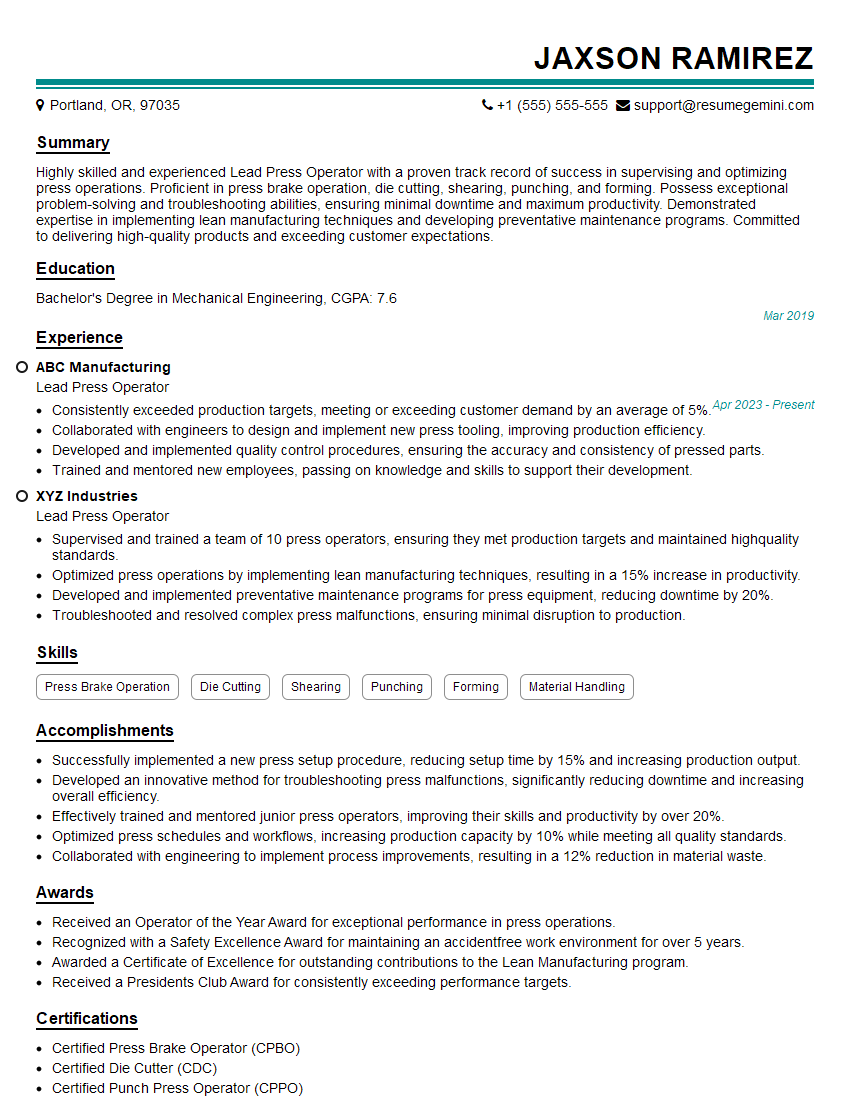
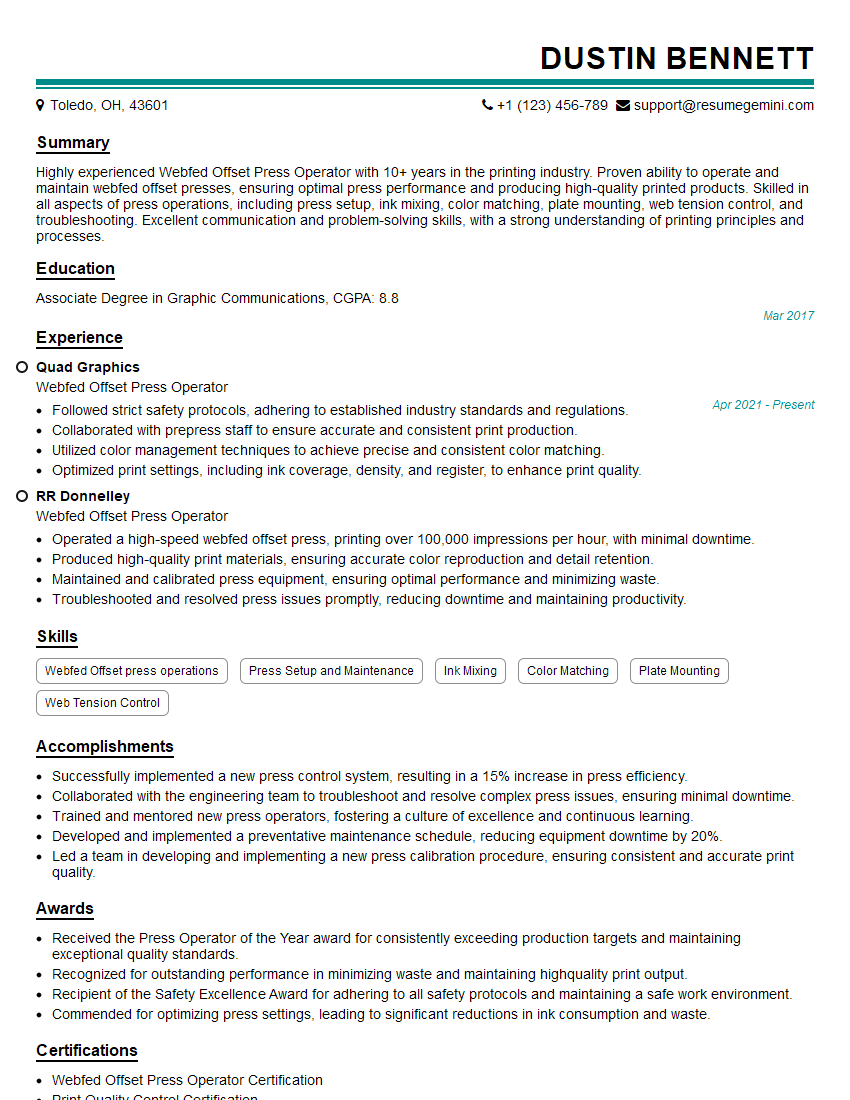
Mastering Webfed Offset press operations opens doors to rewarding and high-demand careers within the printing industry. Your expertise in this specialized area will make you a valuable asset to any printing company, offering opportunities for advancement and increased earning potential. To secure your dream job, a well-crafted resume is crucial. Creating an ATS-friendly resume increases your chances of getting noticed by recruiters and hiring managers. We highly recommend using ResumeGemini to build a professional and impactful resume. ResumeGemini offers tools and resources to ensure your resume stands out, and we provide examples of resumes tailored to Webfed Offset press operations to guide you.




Explore more articles
Users Rating of Our Blogs
Share Your Experience
We value your feedback! Please rate our content and share your thoughts (optional).
What Readers Say About Our Blog
Hello,
we currently offer a complimentary backlink and URL indexing test for search engine optimization professionals.
You can get complimentary indexing credits to test how link discovery works in practice.
No credit card is required and there is no recurring fee.
You can find details here:
https://wikipedia-backlinks.com/indexing/
Regards
NICE RESPONSE TO Q & A
hi
The aim of this message is regarding an unclaimed deposit of a deceased nationale that bears the same name as you. You are not relate to him as there are millions of people answering the names across around the world. But i will use my position to influence the release of the deposit to you for our mutual benefit.
Respond for full details and how to claim the deposit. This is 100% risk free. Send hello to my email id: [email protected]
Luka Chachibaialuka
Hey interviewgemini.com, just wanted to follow up on my last email.
We just launched Call the Monster, an parenting app that lets you summon friendly ‘monsters’ kids actually listen to.
We’re also running a giveaway for everyone who downloads the app. Since it’s brand new, there aren’t many users yet, which means you’ve got a much better chance of winning some great prizes.
You can check it out here: https://bit.ly/callamonsterapp
Or follow us on Instagram: https://www.instagram.com/callamonsterapp
Thanks,
Ryan
CEO – Call the Monster App
Hey interviewgemini.com, I saw your website and love your approach.
I just want this to look like spam email, but want to share something important to you. We just launched Call the Monster, a parenting app that lets you summon friendly ‘monsters’ kids actually listen to.
Parents are loving it for calming chaos before bedtime. Thought you might want to try it: https://bit.ly/callamonsterapp or just follow our fun monster lore on Instagram: https://www.instagram.com/callamonsterapp
Thanks,
Ryan
CEO – Call A Monster APP
To the interviewgemini.com Owner.
Dear interviewgemini.com Webmaster!
Hi interviewgemini.com Webmaster!
Dear interviewgemini.com Webmaster!
excellent
Hello,
We found issues with your domain’s email setup that may be sending your messages to spam or blocking them completely. InboxShield Mini shows you how to fix it in minutes — no tech skills required.
Scan your domain now for details: https://inboxshield-mini.com/
— Adam @ InboxShield Mini
Reply STOP to unsubscribe
Hi, are you owner of interviewgemini.com? What if I told you I could help you find extra time in your schedule, reconnect with leads you didn’t even realize you missed, and bring in more “I want to work with you” conversations, without increasing your ad spend or hiring a full-time employee?
All with a flexible, budget-friendly service that could easily pay for itself. Sounds good?
Would it be nice to jump on a quick 10-minute call so I can show you exactly how we make this work?
Best,
Hapei
Marketing Director
Hey, I know you’re the owner of interviewgemini.com. I’ll be quick.
Fundraising for your business is tough and time-consuming. We make it easier by guaranteeing two private investor meetings each month, for six months. No demos, no pitch events – just direct introductions to active investors matched to your startup.
If youR17;re raising, this could help you build real momentum. Want me to send more info?
Hi, I represent an SEO company that specialises in getting you AI citations and higher rankings on Google. I’d like to offer you a 100% free SEO audit for your website. Would you be interested?
Hi, I represent an SEO company that specialises in getting you AI citations and higher rankings on Google. I’d like to offer you a 100% free SEO audit for your website. Would you be interested?
good