Every successful interview starts with knowing what to expect. In this blog, we’ll take you through the top Wind Tunnel Testing and Analysis interview questions, breaking them down with expert tips to help you deliver impactful answers. Step into your next interview fully prepared and ready to succeed.
Questions Asked in Wind Tunnel Testing and Analysis Interview
Q 1. Explain the principle of Bernoulli’s equation and its application in wind tunnel testing.
Bernoulli’s equation is a fundamental principle in fluid dynamics stating that an increase in the speed of a fluid occurs simultaneously with a decrease in static pressure or a decrease in the fluid’s potential energy. In simpler terms, faster-moving air has lower pressure. Think of blowing over a piece of paper – the faster-moving air above the paper creates lower pressure, causing the paper to lift.
In wind tunnel testing, Bernoulli’s principle is crucial for understanding aerodynamic forces. When air flows over a model in a wind tunnel, the pressure distribution around the model varies depending on the shape and airflow. By measuring these pressure differences, we can calculate the lift and drag forces acting on the model. For example, the curved shape of an airplane wing creates higher airspeed and lower pressure on the top surface compared to the bottom, generating lift.
The equation itself is expressed as: P + 1/2ρv² + ρgh = constant, where P is static pressure, ρ is fluid density, v is fluid velocity, g is acceleration due to gravity, and h is height. While the gravity term is often negligible in wind tunnel tests, the relationship between pressure and velocity is paramount in analyzing lift and drag.
Q 2. Describe different types of wind tunnels and their applications.
Wind tunnels come in various types, each designed for specific applications. The choice depends on the test objectives, model size, and required flow conditions.
- Closed-circuit wind tunnels: These tunnels recirculate the air, minimizing energy consumption and providing more stable flow conditions. They are commonly used for detailed aerodynamic testing of aircraft and automobiles.
- Open-circuit wind tunnels: Air flows through the tunnel once and is then discharged into the atmosphere. They are generally simpler and less expensive to build than closed-circuit tunnels but require a significant power source to continuously supply air.
- Low-speed wind tunnels: These tunnels operate at speeds below the speed of sound (Mach 1), typically used for testing large models or at low Reynolds numbers. They’re suitable for architectural models, automobiles and other larger scale objects.
- High-speed wind tunnels: These tunnels are capable of generating supersonic and hypersonic speeds (Mach numbers greater than 1). They’re essential for testing aerospace vehicles designed for high-speed flight.
- Transonic wind tunnels: These wind tunnels can test at speeds close to the speed of sound where complex flow phenomena occur. They are critical in the design of aircraft that operate near the sound barrier.
- Water tunnels: These use water instead of air, allowing for the testing of marine vehicles and other underwater objects. The higher density of water makes it easier to visualize flow patterns.
Q 3. What are the key parameters measured in a wind tunnel test?
The key parameters measured in a wind tunnel test depend on the specific objectives but typically include:
- Forces and moments: Lift, drag, and pitching moment are typically measured using a balance system. This helps to calculate aerodynamic coefficients and understand the stability and control characteristics of the model.
- Pressure distribution: Surface pressure measurements are taken using pressure taps or pressure-sensitive paint (PSP). This data is used to understand the pressure field around the model and to calculate the forces.
- Velocity and flow visualization: Velocity measurements are obtained using techniques such as hot-wire anemometry or particle image velocimetry (PIV). Flow visualization techniques like smoke or tufts are often used to qualitatively observe flow separation and other flow features.
- Surface temperature: This is particularly important in high-speed testing where aerodynamic heating is significant.
- Turbulence intensity: This indicates the level of unsteadiness in the flow, impacting test results.
Q 4. Explain the concept of Reynolds number and its significance in wind tunnel testing.
The Reynolds number (Re) is a dimensionless quantity that represents the ratio of inertial forces to viscous forces in a fluid flow. It’s a crucial parameter in wind tunnel testing because it determines the flow regime (laminar or turbulent). A low Reynolds number indicates a laminar flow (smooth and predictable), while a high Reynolds number suggests a turbulent flow (chaotic and less predictable).
The Reynolds number is calculated using the formula: Re = (ρVL)/μ, where ρ is the fluid density, V is the flow velocity, L is a characteristic length (e.g., the length of the model), and μ is the dynamic viscosity of the fluid.
The significance of Reynolds number lies in its ability to predict the similarity between flows at different scales. Accurate scaling of wind tunnel tests requires matching the Reynolds number of the full-scale prototype with that of the model. If Reynolds numbers are not matched, the flow patterns around the model in the tunnel may not accurately represent those around the full-scale object, leading to inaccurate results. This is often addressed using techniques like scaling the model or adjusting flow parameters in the tunnel.
Q 5. How do you ensure accurate data acquisition in a wind tunnel?
Ensuring accurate data acquisition in a wind tunnel requires careful attention to both hardware and procedures.
- Calibration: All measurement instruments (balances, pressure transducers, anemometers) must be meticulously calibrated before and after the test to verify their accuracy and sensitivity.
- Signal conditioning: Signals from the sensors require amplification, filtering, and digitization to eliminate noise and improve signal-to-noise ratio.
- Data acquisition system (DAQ): A high-quality DAQ system is essential for acquiring data at a high sampling rate and with sufficient resolution. The DAQ system’s accuracy and functionality should be rigorously verified.
- Environmental monitoring: Factors such as temperature and humidity can affect the test results; hence, these parameters must be monitored and controlled within acceptable ranges.
- Redundancy and cross-validation: Using multiple sensors to measure the same parameter allows for cross-checking of results, ensuring the reliability of data.
- Data processing and analysis: Appropriate data processing techniques should be used to correct for systematic errors and to extract meaningful information from the acquired data.
Q 6. Describe various methods for model mounting and support systems in wind tunnel testing.
Model mounting and support systems are critical for minimizing interference with the airflow and ensuring accurate measurements. Poor mounting can lead to significant errors.
- Sting mounts: These are slender support structures that minimize blockage and interference. They are commonly used for aerodynamic models, attaching to the model at a single point. Carefully designed sting mounts minimize interference with the airflow around the model.
- Force balances: These devices measure the forces and moments acting on the model. Integrated into the sting mount or other support, they provide crucial data for aerodynamic analysis.
- Struts: Used for supporting larger models or those that require more substantial support, struts must be designed to minimize their impact on flow, often using fairings to streamline the support structure.
- Magnetic suspensions: These advanced systems minimize interference by suspending the model using magnetic forces, allowing for truly free movement, mostly used for high-precision tests. However, they are more complex and costly than other methods.
- Support design considerations: The support system should be designed to minimize blockage and interference; streamlining and use of fairings are important to reduce flow distortion.
Q 7. What are the common sources of error in wind tunnel testing, and how can they be mitigated?
Several sources of error can impact the accuracy of wind tunnel testing:
- Model support interference: The supports used to hold the model in the test section can disrupt the airflow, leading to inaccurate measurements. Careful design of supports and use of fairings can mitigate this.
- Blockage effects: The model itself can block the airflow in the test section, altering the flow field. This effect is more pronounced with larger models in smaller test sections. Corrections can be applied based on blockage ratio calculations.
- Wall interference: The walls of the wind tunnel can affect the airflow around the model, particularly in tunnels with a small test section. This can be mitigated by using larger test sections or applying computational corrections.
- Turbulence in the freestream: Turbulence in the incoming airflow can create variations in the flow around the model. Careful design of the wind tunnel contraction and screens can minimize this effect.
- Instrumentation errors: Inaccurate calibration or malfunctioning sensors can lead to errors in the data. Regular calibration and maintenance of instrumentation are vital.
- Data processing errors: Errors in data reduction, processing, and analysis can also affect the accuracy of results. Careful selection of appropriate methods and thorough quality checks are important to avoid such errors.
Mitigating these errors requires careful planning, rigorous calibration procedures, and the application of corrections based on computational fluid dynamics (CFD) or other established methods. Thorough documentation and analysis of potential errors is crucial to maintaining the credibility of results.
Q 8. Explain the process of data reduction and analysis in wind tunnel testing.
Data reduction and analysis in wind tunnel testing is a crucial step that transforms raw measurements into meaningful engineering insights. It involves a multi-step process beginning with the acquisition of raw data from various sensors like pressure transducers, load cells, and hot-wire anemometers. This data is then subjected to several corrections and calibrations.
- Corrections for instrument offsets and drifts: This initial step removes systematic errors inherent in the measurement devices themselves.
- Corrections for environmental conditions: Factors like temperature, humidity, and atmospheric pressure can affect measurements; we correct for these deviations.
- Wall interference corrections: Wind tunnels have walls that affect the airflow; sophisticated techniques, like blockage corrections or computational methods, account for these influences.
- Data smoothing and filtering: This reduces noise and random errors in the data, improving the accuracy of the results.
After these corrections, the data is analyzed to extract relevant aerodynamic parameters. This often involves calculating coefficients like lift (CL), drag (CD), and pitching moment (Cm), which are dimensionless quantities that represent the forces and moments acting on the model. We might also analyze pressure distributions on the model’s surface or flow visualization data to understand the flow characteristics.
For instance, if testing an aircraft wing, we might present the CL and CD coefficients as a function of the angle of attack to determine the wing’s performance across a range of flight conditions. We’d use statistical tools to assess data quality and error margins. Advanced techniques like uncertainty quantification are also employed to understand the confidence level in our derived results.
Q 9. How do you interpret and present wind tunnel test results?
Interpreting and presenting wind tunnel test results requires a clear understanding of the aerodynamic principles at play and effective visualization techniques. We typically present data using various graphs, charts, and tables, tailored to the specific objectives of the test. For example:
- Coefficient plots: Plots of lift (CL), drag (CD), and pitching moment (Cm) coefficients versus angle of attack, Reynolds number, or Mach number are common. This allows easy identification of critical aerodynamic characteristics, such as stall angle or maximum lift.
- Pressure distribution plots: These show the pressure distribution on the model’s surface, providing insights into flow separation, pressure drag, and other flow phenomena. Contour plots or surface plots are frequently used.
- Streamline visualizations: These offer a visual representation of the flow field around the model, enhancing the understanding of complex flow patterns.
- Tables of key parameters: This presents summarized data, such as maximum lift coefficient, minimum drag coefficient, and stall angle, in a concise and readily interpretable format.
In presenting the results, it is crucial to clearly state the test conditions (e.g., Reynolds number, Mach number, tunnel configuration) and associated uncertainties. We will also clearly explain any limitations and assumptions made during the analysis. Effective communication is key to ensure that stakeholders (engineers, designers, etc.) can clearly understand the findings and apply them appropriately. Often, a comprehensive report, combining graphical data with clear explanations, is used.
Q 10. What are the limitations of wind tunnel testing?
Wind tunnel testing, while powerful, is not without limitations. Some key limitations include:
- Wall interference effects: The presence of tunnel walls inevitably affects the flow field, leading to deviations from free-air conditions. Sophisticated corrections are needed, but they may not be perfect.
- Scale effects: Testing is often performed on smaller-scale models. Scaling to full-size conditions may introduce uncertainties, particularly in areas where Reynolds number effects are significant (e.g., boundary layer transition).
- Tunnel turbulence: The level of turbulence in the tunnel can affect the results, particularly for sensitive aerodynamic features. High-quality tunnels strive for low turbulence levels, but achieving perfect laminar flow is impossible.
- Test model simplification: It is often not feasible to reproduce the complete complexity of a real-world object in the wind tunnel. Simplifications in the model geometry or operating conditions can influence the results.
- Cost and time constraints: Wind tunnel testing can be expensive and time-consuming, limiting the number of test cases that can be run.
Acknowledging and quantifying these limitations is crucial for proper interpretation of the data. Understanding the potential sources of error is essential for deriving reliable and credible conclusions from wind tunnel experiments.
Q 11. How do you account for wall interference effects in a wind tunnel?
Wall interference effects in a wind tunnel arise from the interaction of the model with the tunnel walls. These effects distort the flow field around the model, leading to inaccurate measurements of aerodynamic forces and moments. Addressing this requires careful consideration and appropriate correction methods.
The most common approaches include:
- Blockage corrections: These corrections account for the blockage of the tunnel cross-sectional area by the model. This blockage alters the velocity profile and pressure distribution in the tunnel, affecting the forces on the model.
- Computational methods: Sophisticated Computational Fluid Dynamics (CFD) simulations can accurately predict the flow field around the model, including the influence of the walls. These simulations can be used to estimate and correct for wall interference effects.
- Open-jet wind tunnels: These tunnels have an open test section, minimizing wall interference, but at the cost of increased turbulence levels and challenges in controlling the test conditions.
- Proper model placement: Strategic placement of the model to minimize the influence of boundary layers or other wall effects is essential.
The choice of the correction method depends on several factors, including the tunnel geometry, model size, and the desired accuracy. Accurate correction is vital to ensure that the wind tunnel results are representative of the free-air conditions.
Q 12. Describe different turbulence generation techniques in wind tunnels.
Turbulence generation techniques in wind tunnels are essential for simulating real-world atmospheric conditions and for studying the effects of turbulence on aerodynamic performance. Different methods are used to achieve desired turbulence intensities and length scales.
- Passive techniques: These methods use fixed components within the wind tunnel to generate turbulence. Examples include screens, grids, and spires, placed upstream of the test section. The size, spacing, and geometry of these elements determine the characteristics of the generated turbulence. Screens produce isotropic turbulence (turbulence with equal intensity in all directions), whereas grids and spires generate more complex and anisotropic flows.
- Active techniques: Active methods utilize moving or controlled components to create turbulence. This might involve oscillating vanes, jets, or other actuators, providing more precise control over the turbulence properties. This offers more flexibility in reproducing specific atmospheric conditions or simulating different turbulence scenarios.
- Combination techniques: Many wind tunnels use a combination of passive and active techniques to achieve a desired turbulence spectrum. This allows for a wider range of turbulence intensities and scales to be reproduced.
The specific choice of turbulence generation method depends on the testing requirements. For example, simulating atmospheric boundary layers often requires complex combinations to mimic the natural variability in the atmosphere. Careful calibration and measurement of the resulting turbulence properties are essential to ensure the validity of the test results.
Q 13. What is the role of Computational Fluid Dynamics (CFD) in conjunction with wind tunnel testing?
Computational Fluid Dynamics (CFD) and wind tunnel testing are complementary techniques that can significantly enhance the aerodynamic design process. CFD offers a virtual wind tunnel, capable of simulating complex flow phenomena at a fraction of the cost and time required for physical wind tunnel testing. This allows for a broader range of design explorations and parameter studies.
The synergy between CFD and wind tunnel testing lies in their combined use:
- CFD for preliminary design studies: CFD can quickly assess the performance of numerous design concepts, narrowing down the options for wind tunnel testing.
- Wind tunnel testing for validation of CFD models: Wind tunnel data can be used to validate and refine CFD models, ensuring their accuracy and reliability.
- CFD for detailed flow field analysis: CFD can provide detailed insights into the flow field around the model, which is difficult to obtain directly from wind tunnel measurements. This includes flow separation zones, vortex structures, and shock waves.
- CFD for wall interference correction: CFD can be used to correct for the effects of wind tunnel walls on the test results.
By combining these tools, engineers can gain a more comprehensive understanding of the aerodynamic behavior of designs. The iterative process involving both techniques leads to more efficient and optimized designs.
Q 14. Explain the concept of wind tunnel calibration and its importance.
Wind tunnel calibration is the process of precisely measuring and characterizing the performance of a wind tunnel. It is essential to ensure the accuracy and reliability of the test results. Calibration involves verifying the uniformity of the flow in the test section, assessing the turbulence level, and determining the accuracy of the measurement devices.
The calibration process often involves:
- Velocity surveys: Using advanced instruments like hot-wire anemometers, the velocity profile across the test section is mapped to quantify its uniformity and identify potential flow distortions.
- Turbulence intensity measurements: The level of turbulence in the test section is measured to ensure it meets the requirements of the test.
- Pressure calibration: Pressure transducers and other pressure-measuring devices are carefully calibrated against known standards. This ensures the accuracy of pressure measurements on the model’s surface.
- Force and moment balance calibration: The force and moment balances used to measure aerodynamic forces and moments are calibrated to eliminate systematic errors.
A well-calibrated wind tunnel is essential for producing reliable and repeatable aerodynamic data. Without proper calibration, the results can be significantly compromised, leading to incorrect conclusions and potentially flawed design decisions. Regular calibration is a vital part of maintaining the integrity and accuracy of wind tunnel test data.
Q 15. How do you handle unexpected results or anomalies during a wind tunnel test?
Unexpected results in wind tunnel testing are a common occurrence, often stemming from issues with the model, the tunnel itself, or the testing procedure. My approach involves a systematic investigation to identify the root cause.
First, I meticulously review the test setup. This includes checking the model’s mounting, ensuring proper alignment and freedom from interference. I also verify the accuracy of instrumentation, including pressure taps, load cells, and data acquisition systems.
Second, if the problem persists, I examine the wind tunnel conditions themselves. This involves assessing the flow quality, checking for disturbances such as turbulence or flow separation, and verifying the accuracy of the tunnel’s calibration. For example, a sudden change in temperature or humidity might affect the results.
Third, I analyze the acquired data for inconsistencies. This might include outlier points or unusual trends. Statistical methods, such as outlier detection algorithms, are employed to identify these anomalies. A common example is a sudden spike in drag coefficient that doesn’t correlate with other parameters.
Finally, if the problem can’t be immediately resolved, I’d consult with colleagues, review literature on similar test cases and, in some situations, repeat the test under more controlled conditions to validate the findings. Documentation of every step is crucial for future reference and troubleshooting.
Career Expert Tips:
- Ace those interviews! Prepare effectively by reviewing the Top 50 Most Common Interview Questions on ResumeGemini.
- Navigate your job search with confidence! Explore a wide range of Career Tips on ResumeGemini. Learn about common challenges and recommendations to overcome them.
- Craft the perfect resume! Master the Art of Resume Writing with ResumeGemini’s guide. Showcase your unique qualifications and achievements effectively.
- Don’t miss out on holiday savings! Build your dream resume with ResumeGemini’s ATS optimized templates.
Q 16. Describe your experience with different types of wind tunnel balances.
My experience encompasses various types of wind tunnel balances, each with unique strengths and limitations. I’ve worked extensively with internal and external balances, ranging from simple strain gauge balances for basic force and moment measurements to more complex six-component balances for detailed aerodynamic characterization.
Internal balances, housed within the model itself, are advantageous for streamlined models, minimizing flow interference. However, they limit accessibility and can be more challenging to calibrate and maintain.
External balances, mounted outside the model, offer better accessibility for calibration and adjustments. These are often used for larger, more complex models, but can introduce flow disturbances that need careful consideration.
I’ve also utilized electronic balances featuring advanced data acquisition capabilities and high precision, offering better resolution and faster response times than traditional mechanical systems. For instance, I used a six-component strain gauge balance during testing of a high-speed train model, providing accurate measurements of lift, drag, yaw, pitch, and roll moments.
Q 17. Explain your understanding of uncertainty analysis in wind tunnel testing.
Uncertainty analysis is crucial for interpreting wind tunnel data reliably. It quantifies the uncertainty associated with each measurement, providing a range of values within which the true value likely lies. This involves considering various sources of uncertainty, such as:
Instrumentation uncertainty: Inherent limitations of sensors and measurement devices, for example, the accuracy of a pressure transducer.
Model uncertainty: Manufacturing tolerances, surface roughness, and the accuracy of model representation compared to the actual object.
Flow uncertainty: Variations in wind speed, turbulence intensity, and flow uniformity within the test section. This is often addressed through careful calibration of the wind tunnel and using turbulence screens or flow conditioners.
Test procedure uncertainty: Operator error, data processing methods, and other variations in the testing procedure itself.
These uncertainties are often propagated through the data reduction process using statistical methods. The final uncertainty is expressed as a confidence interval around the measured value, e.g., a drag coefficient of 0.25 ± 0.01 (95% confidence), indicating the range within which the true drag coefficient is likely to be found.
Q 18. How do you ensure the safety and proper operation of a wind tunnel?
Safety and proper operation of a wind tunnel are paramount. This involves strict adherence to safety protocols and regular maintenance procedures.
Pre-test checks include verifying the integrity of the tunnel structure, the functionality of safety interlocks, and the calibration of all instrumentation. Before every session, we ensure the test section is clear, the model is properly secured, and the emergency shut-off mechanisms are readily accessible.
During the test, we maintain constant monitoring of the wind tunnel’s operation, paying close attention to pressure, temperature, and speed parameters. Access to the test section is restricted during operation, and appropriate personal protective equipment (PPE) is mandatory.
Post-test procedures include a thorough inspection of the model and tunnel for any damage or anomalies. Regular maintenance, such as cleaning the test section and calibrating the instrumentation, is critical for ensuring the continued safe and accurate operation of the tunnel. A rigorous maintenance schedule, including preventative measures, is essential for longevity and safety. For instance, routine checks on the balance calibration and the tunnel’s structural integrity are paramount.
Q 19. Describe your experience with data acquisition systems used in wind tunnel testing.
My experience with data acquisition systems in wind tunnel testing includes the use of both dedicated wind tunnel data acquisition systems and general-purpose data loggers. These systems are responsible for collecting data from various sensors, including pressure transducers, load cells, thermocouples, and accelerometers.
Dedicated systems often offer advanced features, such as synchronized data acquisition from multiple channels and built-in signal conditioning capabilities. They are designed to handle the high-speed data streams often generated during wind tunnel tests.
General-purpose data loggers provide a more flexible approach and can be used for a wider range of applications. However, they may require additional signal conditioning and data processing steps.
In many cases, these systems are integrated with software that allows for real-time monitoring of data during the test, enabling immediate identification of any problems or anomalies. For example, a sudden drop in pressure might indicate a malfunction within the tunnel.
Regardless of the system used, proper calibration and validation of all sensors is crucial for reliable data acquisition. For example, we regularly calibrate pressure transducers against known standards to ensure accurate measurements.
Q 20. What software are you familiar with for wind tunnel data processing and analysis?
I am proficient in several software packages commonly used for wind tunnel data processing and analysis. This includes:
Tecplot: Excellent for visualizing complex 3D flow fields and performing post-processing analysis of CFD (Computational Fluid Dynamics) data. It’s a great tool to understand the intricate details of the airflow around a model.
MATLAB: Used extensively for custom data processing, statistical analysis, and generating custom plots. Its scripting capabilities allow for efficient automation of repetitive tasks and development of complex analytical tools tailored to specific research needs.
LabVIEW: Often employed in real-time data acquisition and control systems, LabVIEW enables integrating data from various sensors in the wind tunnel and automating the testing procedure.
Beyond these, I have experience using spreadsheets (like Excel) for basic data analysis and presentation, and I have experience with specific in-house developed software for handling proprietary data formats and analysis routines at previous projects.
Q 21. Explain the differences between subsonic, transonic, supersonic, and hypersonic wind tunnels.
Wind tunnels are classified based on the speed range they can achieve, each type requiring different design considerations and operating procedures:
Subsonic wind tunnels operate at speeds below the speed of sound (Mach number < 1). These are the most common type and are relatively simple to design and operate. They are widely used for testing aircraft, automobiles, and other objects at low speeds. For example, aerodynamic testing of a Formula 1 car would typically be carried out in a subsonic wind tunnel.
Transonic wind tunnels operate near the speed of sound (Mach number ≈ 1), where complex flow phenomena such as shock waves appear. Careful design of the test section is required to minimize reflections and interference. Transonic tunnels are crucial for understanding the behavior of aircraft during transonic flight.
Supersonic wind tunnels operate at speeds greater than the speed of sound (Mach number > 1), generating supersonic flows. These require specialized designs, such as a converging-diverging nozzle, to accelerate the flow to supersonic speeds and often require sophisticated control systems. They are crucial for the design of high-speed aircraft and missiles.
Hypersonic wind tunnels operate at extremely high speeds (Mach number > 5), where the flow undergoes significant changes in temperature and density. These are among the most challenging and expensive wind tunnels to construct and operate, mainly used for testing vehicles that fly at hypersonic speeds, like re-entry vehicles or space vehicles.
Q 22. How do you select the appropriate wind tunnel for a specific testing purpose?
Selecting the right wind tunnel is crucial for accurate and efficient testing. It’s like choosing the right tool for a job – a hammer won’t work for screwing in a screw! The selection process depends heavily on the test object’s size, the desired flow conditions (speed, turbulence intensity, Reynolds number), and the type of data needed.
- Test Object Size: Large objects like aircraft require large wind tunnels, while smaller models, like a car’s aerodynamic components, can be tested in smaller facilities.
- Required Flow Conditions: The desired speed range dictates the tunnel’s power and design. For example, high-speed aerodynamics requires a high-speed wind tunnel capable of supersonic or hypersonic speeds. The level of turbulence, crucial for mimicking real-world conditions, also influences the selection. A low-turbulence tunnel is necessary for precise measurements.
- Data Requirements: Force measurements require a balance system; surface pressure measurements necessitate pressure taps and scanning systems; flow visualization needs specific optical access and lighting. The tunnel needs to be equipped with the appropriate instrumentation.
For instance, testing a new airfoil design for a small aircraft would require a subsonic wind tunnel with good turbulence control and pressure-measuring capabilities. In contrast, testing a high-speed train would necessitate a larger wind tunnel capable of higher speeds and potentially atmospheric simulation.
Q 23. Explain your experience with different model scaling techniques.
Model scaling is essential because testing full-scale objects is often impractical or prohibitively expensive. We use geometric similarity principles, ensuring that the model accurately represents the full-scale object’s proportions. Different techniques exist, each with its own advantages and limitations.
- Geometric Similarity: This is the most fundamental technique, ensuring the model’s dimensions are proportional to the full-scale object. The scale factor is consistently applied across all dimensions.
- Dynamic Similarity: This is more complex and aims to match the dimensionless numbers (Reynolds number, Mach number) between the model and the full-scale object. This ensures that the flow around the model accurately reflects the full-scale flow. Achieving dynamic similarity often involves adjusting the wind tunnel conditions (e.g., adjusting the speed to match the Reynolds number).
- Scale Effects: It’s crucial to account for scale effects, as the flow behavior might not perfectly scale down. For example, surface roughness relative to the model size can become more significant at smaller scales, impacting the results.
In my experience, I’ve worked extensively on scaling both aircraft and automotive models. One project involved scaling down a Formula 1 car to 1:5 scale. We carefully considered the Reynolds number matching, using computational fluid dynamics (CFD) to refine the model and ensure accurate aerodynamic predictions.
Q 24. Describe your understanding of boundary layer control techniques.
Boundary layer control techniques manipulate the flow near the surface of a test object to improve measurement accuracy and reduce interference effects. Think of it as managing a thin layer of air right next to the object.
- Boundary Layer Suction: This involves removing the slow-moving air near the surface, reducing drag and delaying boundary layer separation, thereby ensuring a more uniform flow over the model’s surface.
- Boundary Layer Blowing: This introduces high-speed air into the boundary layer to energize it and prevent separation. This is often used on airfoil control surfaces to improve lift and control at high angles of attack.
- Vortex Generators: Small vanes or bumps on the surface create vortices that mix the boundary layer, delaying separation and increasing energy. This technique is commonly applied to aircraft wings to enhance lift at high angles of attack.
For example, in testing an airfoil at high angles of attack, boundary layer suction might be used to prevent flow separation and stall, allowing accurate measurement of lift and drag characteristics even under challenging conditions. Mismanaged boundary layers lead to inaccurate results.
Q 25. How would you troubleshoot a malfunctioning wind tunnel system?
Troubleshooting a wind tunnel involves systematic investigation. It’s like detective work, needing a methodical approach to identify the root cause.
- Initial Assessment: Start with a thorough visual inspection of the system, checking for any obvious issues such as leaks, damaged components, or loose connections.
- Instrumentation Check: Verify that all sensors (pressure transducers, force balances, etc.) are properly calibrated and functioning correctly. Compare readings to established baseline values.
- Flow Condition Assessment: Evaluate the uniformity and steadiness of the flow. Techniques such as pitot tube surveys or flow visualization can help pinpoint flow distortions or inconsistencies.
- Data Analysis: Analyze the collected data to identify any anomalies or inconsistencies. Look for unexpected fluctuations or trends in pressure, force, or velocity measurements.
- Systematic Fault Isolation: If the problem persists, isolate potential fault areas one by one, checking power supplies, control systems, and individual components.
I once encountered a situation where the wind tunnel’s flow was unexpectedly turbulent. Through systematic investigation, we found a loose panel in the settling chamber that was generating vortices, compromising the quality of the flow. Replacing and securing the panel resolved the issue.
Q 26. What is your experience with different types of flow visualization techniques?
Flow visualization techniques provide a visual representation of the flow field around a model. They are essential for understanding complex flow phenomena and validating computational models.
- Smoke Wire/Streamlines: A fine wire is coated with oil and smoke. When the wind tunnel starts, the smoke trails visualize streamlines, showing the flow direction and pattern.
- Tuft Grid: A grid of small tufts attached to the model’s surface reveals surface flow patterns, indicating separation, vortex formation, or other flow features. It’s like seeing the hair standing up in a wind.
- Oil Flow Visualization: Oil is painted on the model’s surface. The oil flow patterns reveal streamlines and separation lines. This is especially useful for observing flow separation.
- Schlieren Photography: This technique reveals density gradients in the flow field, making shock waves and other density changes visible. It’s particularly useful in high-speed flows.
In one project, we used a combination of tuft grids and oil flow visualization to identify areas of flow separation on an aircraft wing model at high angles of attack. This allowed us to refine the wing design to improve its performance.
Q 27. Explain your experience with the design and fabrication of wind tunnel models.
Designing and fabricating wind tunnel models requires precision and attention to detail. The model must accurately represent the full-scale object’s geometry and surface finish to ensure reliable results.
- CAD Modeling: Computer-aided design (CAD) software is used to create a detailed 3D model of the object, ensuring geometric accuracy.
- Material Selection: Material choice depends on the model’s size, complexity, and the required surface finish. Common materials include wood, aluminum, plastics, and composites.
- Manufacturing Techniques: Manufacturing methods vary depending on the model’s geometry and complexity. Techniques include CNC machining, 3D printing, and casting.
- Surface Finish: Surface finish is critical for accurate results. Any imperfections can significantly affect the flow and lead to inaccurate measurements. Careful attention must be paid to surface roughness and the application of paint or coatings.
I have extensive experience in this area, including the design and fabrication of complex aircraft and automotive models using a mix of CNC machining and 3D printing. The key is to balance cost-effectiveness with the need for precise geometric accuracy and surface finish. A poorly made model can render the entire experiment worthless.
Q 28. Describe your knowledge of different types of pressure measurement systems.
Pressure measurement systems are fundamental in wind tunnel testing, providing data on surface pressure distributions, which are vital for calculating aerodynamic forces and moments.
- Static Pressure Taps: Small holes drilled into the model surface connect to pressure transducers, which measure the static pressure at specific locations. This is a classic and reliable method.
- Scans: Scanning pressure systems use a single pressure transducer that moves across the model surface, measuring pressure at numerous points. This offers high spatial resolution.
- Data Acquisition Systems: Modern data acquisition systems are used to record and process the large amounts of pressure data generated by scanning systems or multiple pressure taps.
In my experience, I’ve used both static pressure taps and scanning systems. For detailed pressure distributions, scanning systems are preferred, providing a comprehensive map of the surface pressure field, which is crucial in understanding complex flow phenomena like shock waves or flow separation.
Key Topics to Learn for Wind Tunnel Testing and Analysis Interview
- Fundamental Aerodynamics: Understanding principles like lift, drag, pressure distribution, and boundary layers. This forms the bedrock of all wind tunnel interpretations.
- Wind Tunnel Types and Capabilities: Familiarity with different wind tunnel designs (e.g., closed-circuit, open-circuit, subsonic, supersonic) and their respective applications. Knowing the limitations of each type is crucial for choosing the appropriate facility.
- Experimental Techniques: Mastering techniques such as force and moment measurements, pressure measurements, flow visualization (e.g., oil flow, tufts, smoke), and particle image velocimetry (PIV). Practical experience in these areas is highly valuable.
- Data Acquisition and Reduction: Proficiency in using data acquisition systems, understanding data uncertainty and error analysis, and applying appropriate data reduction methods to extract meaningful results. This includes proficiency with relevant software packages.
- Computational Fluid Dynamics (CFD) Correlation: Understanding how wind tunnel results are compared and validated against CFD simulations. This involves appreciating the strengths and weaknesses of both experimental and numerical approaches.
- Uncertainty Quantification: Understanding and communicating the uncertainty associated with experimental measurements and their impact on the conclusions drawn from the data. This demonstrates a rigorous and professional approach to analysis.
- Applications in various industries: Demonstrating knowledge of how wind tunnel testing applies across diverse sectors (e.g., aerospace, automotive, civil engineering). Examples and case studies are extremely helpful to showcase your understanding.
- Problem-solving and troubleshooting: Preparing for questions related to identifying and resolving experimental issues, interpreting unexpected results, and presenting findings effectively. Think of past experiences that highlight your analytical skills.
Next Steps
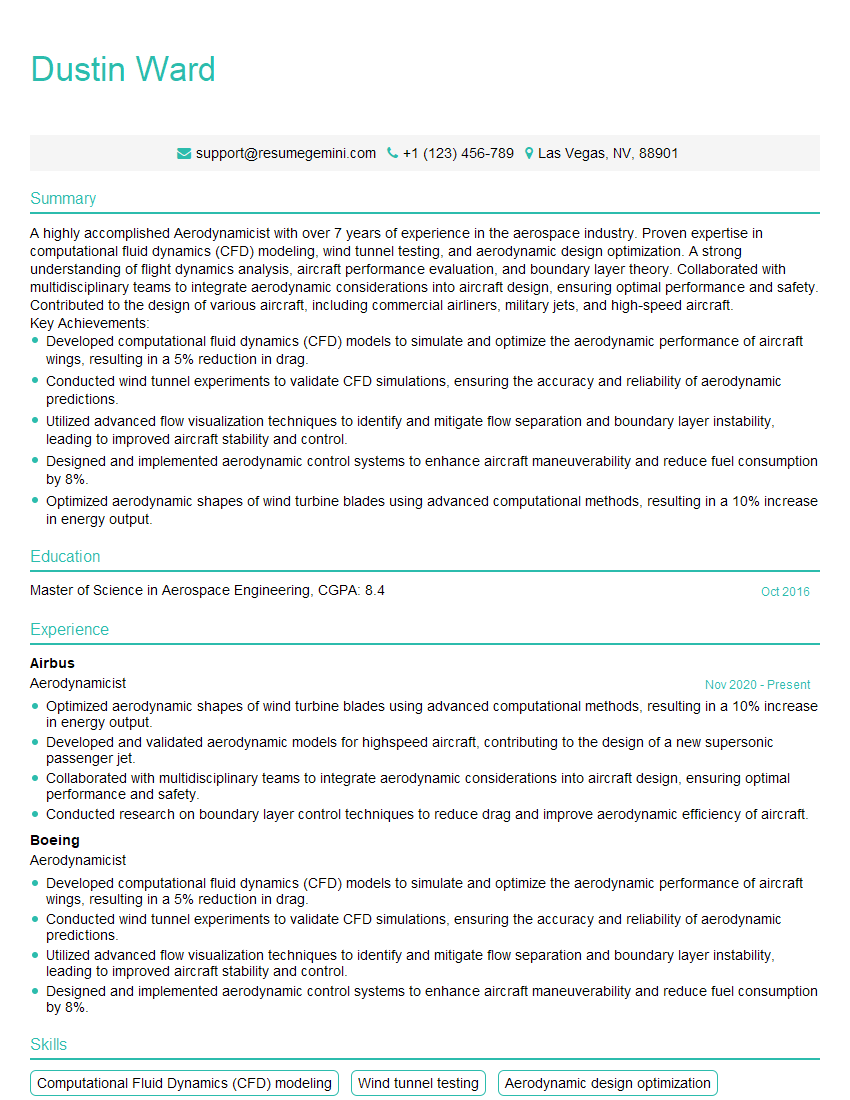
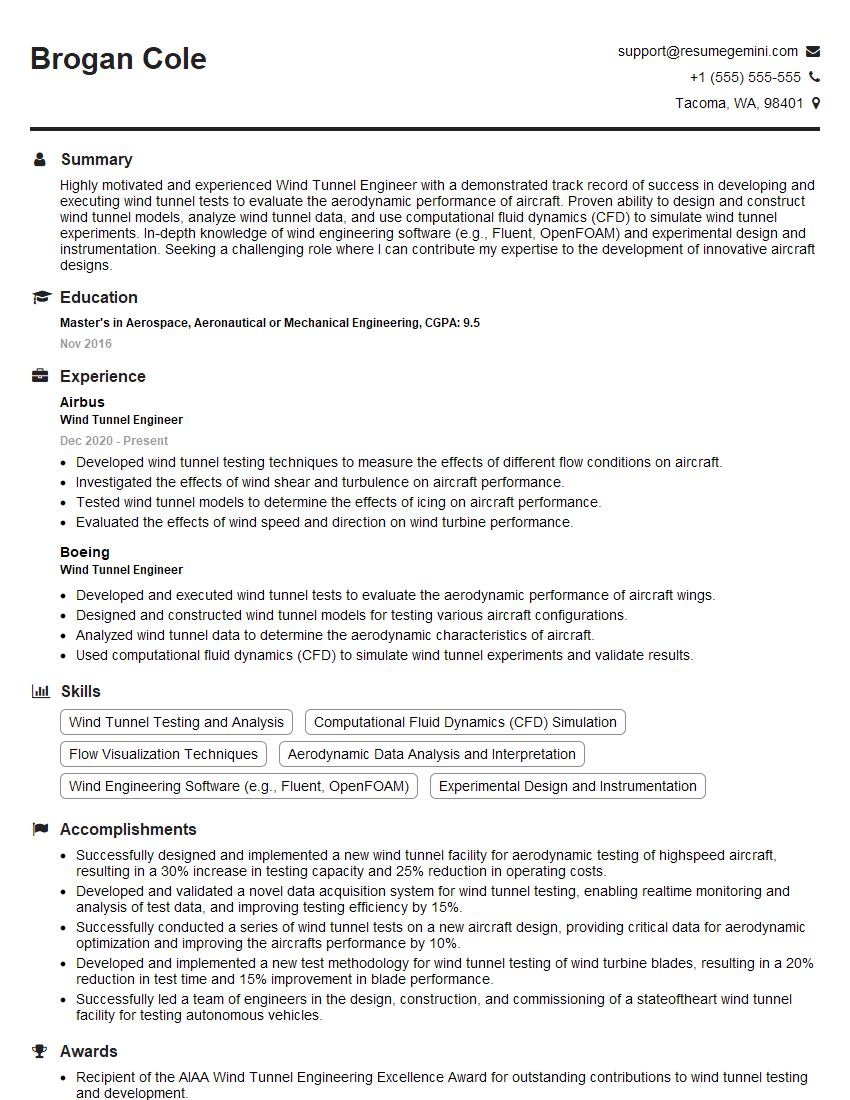
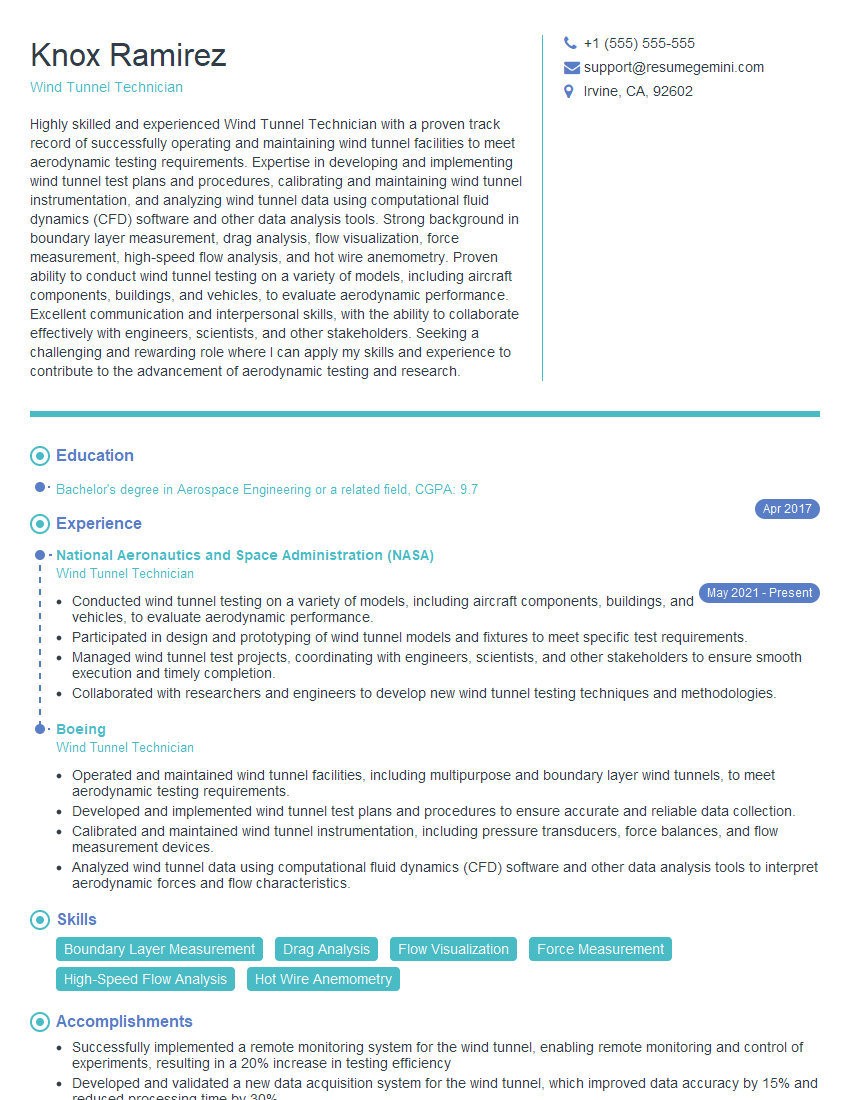
Mastering Wind Tunnel Testing and Analysis opens doors to exciting and challenging careers in various engineering fields. To maximize your job prospects, creating a compelling and ATS-friendly resume is paramount. ResumeGemini is a trusted resource that can significantly enhance your resume-building experience, helping you present your skills and experience in the most effective way. Examples of resumes tailored specifically to Wind Tunnel Testing and Analysis professionals are available to help you craft a winning application.
Explore more articles
Users Rating of Our Blogs
Share Your Experience
We value your feedback! Please rate our content and share your thoughts (optional).
What Readers Say About Our Blog
Hello,
we currently offer a complimentary backlink and URL indexing test for search engine optimization professionals.
You can get complimentary indexing credits to test how link discovery works in practice.
No credit card is required and there is no recurring fee.
You can find details here:
https://wikipedia-backlinks.com/indexing/
Regards
NICE RESPONSE TO Q & A
hi
The aim of this message is regarding an unclaimed deposit of a deceased nationale that bears the same name as you. You are not relate to him as there are millions of people answering the names across around the world. But i will use my position to influence the release of the deposit to you for our mutual benefit.
Respond for full details and how to claim the deposit. This is 100% risk free. Send hello to my email id: [email protected]
Luka Chachibaialuka
Hey interviewgemini.com, just wanted to follow up on my last email.
We just launched Call the Monster, an parenting app that lets you summon friendly ‘monsters’ kids actually listen to.
We’re also running a giveaway for everyone who downloads the app. Since it’s brand new, there aren’t many users yet, which means you’ve got a much better chance of winning some great prizes.
You can check it out here: https://bit.ly/callamonsterapp
Or follow us on Instagram: https://www.instagram.com/callamonsterapp
Thanks,
Ryan
CEO – Call the Monster App
Hey interviewgemini.com, I saw your website and love your approach.
I just want this to look like spam email, but want to share something important to you. We just launched Call the Monster, a parenting app that lets you summon friendly ‘monsters’ kids actually listen to.
Parents are loving it for calming chaos before bedtime. Thought you might want to try it: https://bit.ly/callamonsterapp or just follow our fun monster lore on Instagram: https://www.instagram.com/callamonsterapp
Thanks,
Ryan
CEO – Call A Monster APP
To the interviewgemini.com Owner.
Dear interviewgemini.com Webmaster!
Hi interviewgemini.com Webmaster!
Dear interviewgemini.com Webmaster!
excellent
Hello,
We found issues with your domain’s email setup that may be sending your messages to spam or blocking them completely. InboxShield Mini shows you how to fix it in minutes — no tech skills required.
Scan your domain now for details: https://inboxshield-mini.com/
— Adam @ InboxShield Mini
Reply STOP to unsubscribe
Hi, are you owner of interviewgemini.com? What if I told you I could help you find extra time in your schedule, reconnect with leads you didn’t even realize you missed, and bring in more “I want to work with you” conversations, without increasing your ad spend or hiring a full-time employee?
All with a flexible, budget-friendly service that could easily pay for itself. Sounds good?
Would it be nice to jump on a quick 10-minute call so I can show you exactly how we make this work?
Best,
Hapei
Marketing Director
Hey, I know you’re the owner of interviewgemini.com. I’ll be quick.
Fundraising for your business is tough and time-consuming. We make it easier by guaranteeing two private investor meetings each month, for six months. No demos, no pitch events – just direct introductions to active investors matched to your startup.
If youR17;re raising, this could help you build real momentum. Want me to send more info?
Hi, I represent an SEO company that specialises in getting you AI citations and higher rankings on Google. I’d like to offer you a 100% free SEO audit for your website. Would you be interested?
Hi, I represent an SEO company that specialises in getting you AI citations and higher rankings on Google. I’d like to offer you a 100% free SEO audit for your website. Would you be interested?
good