Are you ready to stand out in your next interview? Understanding and preparing for Window Treatment Measurement and Fitting interview questions is a game-changer. In this blog, we’ve compiled key questions and expert advice to help you showcase your skills with confidence and precision. Let’s get started on your journey to acing the interview.
Questions Asked in Window Treatment Measurement and Fitting Interview
Q 1. What are the different types of window treatments you are familiar with installing?
I’m experienced in installing a wide variety of window treatments. This includes:
- Blinds: Venetian blinds (both wood and aluminum), mini-blinds, cellular shades, bamboo blinds, and roller shades.
- Shades: Roman shades, roller shades, cellular shades, and bamboo shades.
- Curtains/Draperies: Various styles including pinch pleat, goblet pleat, grommet top, and rod pocket curtains. I work with a range of fabrics, from lightweight sheers to heavy, lined drapes.
- Shutters: Interior shutters, both plantation style and café style.
My expertise spans both standard and custom installations, ensuring a perfect fit and flawless finish for any window type.
Q 2. Describe your process for measuring windows for blinds.
Measuring for blinds requires precision. My process involves these steps:
- Assess the Window: Determine the type of window (casement, double-hung, slider, etc.) and note any obstructions (molding, trim, etc.).
- Measure Width: Measure the width of the window at three points: top, middle, and bottom. Record the narrowest measurement; this is crucial to avoid gaps.
- Measure Height: Similarly, measure the height at three points. Record the longest measurement to ensure complete coverage.
- Inside Mount vs. Outside Mount: Decide whether the blinds will be mounted inside the window frame (inside mount) or outside the frame (outside mount). Inside mount requires more precise measurements to ensure a snug fit.
- Depth Measurement (Inside Mount): For inside mount, measure the depth of the window frame to make sure the blinds will fit properly.
- Record Measurements: Carefully record all measurements and note the window type, mounting style, and any relevant details (e.g., obstructions).
For example, if I have a window with a narrowest width of 35 inches and a longest height of 48 inches and I’m installing inside mount, I’ll make sure I use these numbers when ordering the blinds, factoring in any necessary deductions for a snug fit.
Q 3. How do you accurately measure for curtains with pleats?
Measuring for pleated curtains involves accounting for the pleats themselves, which add to the overall width. The process begins with deciding on the curtain style and desired fullness.
- Determine Fullness: Generally, curtains need 1.5 to 2.5 times the width of the window rod for a nice, full look. This is known as fullness factor.
- Measure the Rod Width: Measure the length of the window rod or the space where the curtain rod will be installed.
- Calculate Fabric Width: Multiply the rod width by the desired fullness factor (e.g., 2.5). This gives you the total fabric width needed.
- Measure Length: Measure the desired length of the curtains from the rod to the floor or desired bottom position. Consider adding extra length for hems.
- Account for Pleats: The amount of fabric taken up by pleats depends on the style (e.g., pinch pleats use more fabric than grommets). Consult instructions or sample swatches to get an estimate of fabric needed. Add this extra fabric to your calculations.
For instance, if your rod is 60 inches wide and you want 2.5 times fullness, you need 150 inches of fabric. If the pleat style adds another 2 inches to your width per section, you add that to the total fabric width. Always check the fabric requirements mentioned by the manufacturer
Q 4. Explain the process of installing Roman shades.
Installing Roman shades is a fairly straightforward process, but attention to detail is key for a professional look.
- Prepare the Shade: Check all the components; carefully inspect the shade for any defects before beginning installation.
- Determine Mounting Location: Decide on inside or outside mount. Inside mount usually involves attaching brackets directly to the window frame. Outside mount allows for more flexibility in placement.
- Install Brackets: Secure the brackets using appropriate screws. Ensure they are level and securely fastened.
- Attach the Shade: Carefully slide the shade onto the brackets, ensuring proper alignment. Some shades may require specific methods to attach to the brackets, check the instructions.
- Adjust and Test: Raise and lower the shade several times to check for smooth operation and ensure the lift cord mechanism works perfectly.
- Final Inspection: Inspect the installation from various angles to verify proper alignment, smooth operation, and a professional finish.
Remember to always follow the manufacturer’s specific instructions included with the Roman shades. A well-installed Roman shade adds elegance and functionality to a room.
Q 5. How do you handle challenging window shapes or sizes?
Challenging window shapes and sizes require creative problem-solving. My approach involves:
- Precise Measurements: I take multiple measurements, breaking down complex shapes into smaller, manageable sections.
- Custom Solutions: For unusual windows (e.g., arched, angled, or bay windows), custom-made window treatments often provide the best solution. I work with manufacturers to create bespoke designs that perfectly fit the window’s unique dimensions and shape.
- Multiple Treatments: Sometimes, combining different treatments is the most effective approach. For example, a bay window might be addressed with a combination of Roman shades and curtains, or valances and vertical blinds.
- Fabric Selection: Choosing fabrics with drape and tailoring properties to suit the challenge. The fabric chosen plays a role in how well it accommodates the curves and angles.
I’ve worked on projects involving bay windows, arched windows, and even triangular windows, tailoring my approach to ensure a seamless and beautiful result each time.
Q 6. What safety precautions do you take during installation?
Safety is my top priority. My safety precautions include:
- Proper Tools: I use only high-quality, well-maintained tools, ensuring they are in good working order before starting the job.
- Ladder Safety: When using ladders, I always adhere to safety guidelines. This means using a properly sized and stable ladder, placing it on a level surface, and ensuring proper balance.
- Protective Gear: I use safety glasses and gloves to protect myself from potential hazards during installation.
- Secure Work Area: I clear the work area of any obstacles before beginning the installation.
- Weight and Balance: Always work with a helper for large, heavy window treatments to avoid injury from dropping or handling heavy equipment.
I believe that a safe work environment is crucial for ensuring a quality outcome and the well-being of both myself and my clients. Safety is a non-negotiable aspect of my work process.
Q 7. How do you calculate the fabric needed for custom drapery?
Calculating fabric for custom drapery requires careful consideration of several factors.
- Measure Window Width: Measure the width of each panel separately and then add to determine the total width.
- Determine Fullness: Decide on the desired fullness (1.5x to 2.5x the width). The higher the number, the fuller the drapes look.
- Calculate Total Fabric Width: Multiply the total panel width by the fullness factor.
- Measure Drape Length: Measure from the top of the rod or track to the desired bottom length.
- Account for Hem and Seam Allowances: Add extra fabric at the bottom for the hem, and add extra fabric for seam allowances (check instructions). This varies with drapery style.
- Consider Pattern Matching: For patterned fabrics, you may need extra fabric to ensure the pattern matches seamlessly across the panels.
For example, if a window needs two panels, each 36 inches wide, and we want 2x fullness, we’d need 144 inches of fabric width (2 panels x 36 inches/panel x 2 fullness). Adding hem and seam allowances pushes the fabric quantity up, the manufacturer’s instructions provide a clear idea on that.
Q 8. What tools and equipment are essential for your work?
Accurate window treatment installation hinges on precision measuring and the right tools. My essential kit includes a high-quality measuring tape (at least 25 feet, ideally with a locking mechanism), a level, a pencil, a screwdriver set (both Phillips and flathead), a drill with various drill bits, safety glasses, and a sturdy ladder. For more specialized installations, I also carry a stud finder, a power screwdriver, and various types of mounting hardware (screws, brackets, anchors). I always ensure my tools are well-maintained and calibrated for accuracy. For example, I regularly check my measuring tape for any stretching or damage to ensure every measurement is precise.
Q 9. How do you deal with uneven walls or window frames?
Uneven walls and window frames are a common challenge. Ignoring them can lead to crooked blinds or curtains. I address this by taking multiple measurements at various points along the window and wall. I then carefully analyze these measurements to identify the most prominent inconsistencies. For small variations, I may adjust the mounting brackets accordingly, ensuring a level installation. For more significant irregularities, I might need to use shims (thin pieces of wood or plastic) to create a level surface for mounting. Think of it like leveling a picture frame on a slightly slanted wall – the shims act as the support to ensure a straight hang. In extreme cases, a custom solution might be necessary, involving modifications to the window treatment itself or the frame.
Q 10. Describe your experience with installing motorized blinds.
I’ve extensive experience installing motorized blinds, from simple single-unit systems to complex, multi-window setups involving integrated smart home systems. The process involves careful wiring and integration with the power source and the control system. Safety is paramount. Before beginning, I always ensure the power is switched off. I thoroughly check all wiring connections to prevent shorts or malfunctions. My work includes programming the remote control and integrating them with various home automation systems – for example, ensuring the blinds automatically adjust to sunlight levels or connect to a user’s smart phone app. I’ve successfully installed various motorized systems like Lutron Serena, Somfy, and Hunter Douglas PowerView, understanding their unique requirements and integrating them seamlessly into various home designs.
Q 11. What are the common problems encountered during installation?
Common problems include inaccurate measurements leading to ill-fitting treatments, difficulty locating wall studs, problems with the mounting hardware (stripping screws, incorrect anchors), and damaged window frames during installation. Electrical issues during motorized blind installation are another frequent concern. Improper alignment and incorrect operating mechanisms are also common problems, leading to functionality problems. For example, I once encountered a situation where the customer’s window frame was made of unusually soft wood. This made it impossible to use standard screws. We had to switch to more robust alternatives to ensure the longevity of the blinds.
Q 12. How do you troubleshoot installation issues?
Troubleshooting begins with a careful review of the initial measurements and installation process. I systematically check each step, starting with the measurements and verifying the accuracy of the mounting. For instance, if the blinds are crooked, I recheck the levelness of the brackets and look for any shimming discrepancies. If the motor isn’t working, I carefully check the wiring connections, circuit breaker and power supply to identify and rectify the problem. I always prioritize safety and take appropriate measures such as de-energizing the system before troubleshooting electrical issues. A methodical approach, combined with experience, usually quickly pinpoints the root cause. Communication with the client is critical to understanding the nature and extent of the problem
Q 13. What is your experience with different types of mounting hardware?
My experience spans various mounting hardware, including standard screws for wood frames, drywall anchors for plaster walls, and specialized brackets for unusual window types or heavy treatments. I select hardware based on the wall material, the weight of the window treatment, and the specific installation requirements. For instance, using standard screws on drywall would lead to the treatment falling off. Here, I would use appropriate drywall anchors. Understanding the strengths and limitations of each type of hardware is crucial for ensuring a safe and secure installation. I am also familiar with innovative, hidden mounting systems that offer a cleaner, more discreet look.
Q 14. How do you ensure a precise fit for window treatments?
Achieving a precise fit involves meticulous measurement and careful consideration of the window’s dimensions, the type of window treatment, and the desired functionality. I always measure the width and height at multiple points and take the smallest measurement to avoid any overhang issues. I also consider factors such as the stacking space needed for the blinds or curtains when they are open or closed. A crucial aspect is determining the correct inside or outside mount options for optimal fit and functionality. For example, with inside mount, a precise measurement ensures minimal gaps between the treatment and the window frame. Outside mount measurements consider the desired overhang or spacing.
Q 15. Describe your experience with different fabric types and their properties.
My experience with various fabric types is extensive, encompassing everything from delicate silks and linens to durable cottons and heavy-duty blackout materials. Understanding fabric properties is crucial for successful window treatment installation and longevity.
- Silk: Luxurious and elegant, but delicate and requires careful handling during installation and cleaning. It’s perfect for formal settings where a touch of opulence is desired.
- Linen: A natural fiber with a relaxed, slightly textured look. It’s durable but can wrinkle easily. Linen drapes beautifully and adds a touch of casual elegance.
- Cotton: Versatile and easy to maintain, cotton is a popular choice for window treatments. It comes in various weights and weaves, allowing for diverse styles and light control.
- Blackout: Designed to block out light completely, these fabrics are typically heavy and may incorporate a lining. Ideal for bedrooms or media rooms.
- Polyester Blends: Often used for their durability, wrinkle resistance, and affordability. They offer a good balance of practicality and aesthetics.
Choosing the right fabric is a collaborative process, involving client consultation to determine the desired aesthetic, light control, and budget.
Career Expert Tips:
- Ace those interviews! Prepare effectively by reviewing the Top 50 Most Common Interview Questions on ResumeGemini.
- Navigate your job search with confidence! Explore a wide range of Career Tips on ResumeGemini. Learn about common challenges and recommendations to overcome them.
- Craft the perfect resume! Master the Art of Resume Writing with ResumeGemini’s guide. Showcase your unique qualifications and achievements effectively.
- Don’t miss out on holiday savings! Build your dream resume with ResumeGemini’s ATS optimized templates.
Q 16. How do you maintain accuracy during large-scale installations?
Accuracy during large-scale installations is paramount. We employ a multi-pronged approach to ensure precision. This begins with meticulous pre-installation measurements, often involving multiple team members for verification. We utilize laser measuring tools and digital templates for complex shapes, documenting everything with detailed sketches and photographs.
Before any installation begins, we create a detailed installation plan, allocating specific tasks and timelines to each team member. Regular check-ins throughout the process ensure that we’re on schedule and that the work meets our standards. Finally, a rigorous quality control check is conducted upon completion of the installation, comparing the final product against the original plan to identify and rectify any discrepancies immediately.
For example, in a recent large hotel project, we used a combination of laser measurement and 3D modeling software to ensure that hundreds of custom-made drapes were precisely sized and hung correctly. The plan even accounted for potential variations in wall structure and window dimensions.
Q 17. What is your experience working with different window styles (e.g., bay windows, arched windows)?
My experience encompasses a wide range of window styles, including the challenging ones like bay windows and arched windows. Each type requires a specialized approach to ensure a perfect fit and aesthetically pleasing outcome.
- Bay Windows: These require multiple measurements and often involve custom-made treatments to follow the curves of the window. We carefully consider the angles and the overall shape to create drapes or shades that fit seamlessly.
- Arched Windows: Similar to bay windows, arched windows demand precise measurements and often require custom-made components. Fabric manipulation is crucial to achieving a smooth, elegant drape that complements the architectural detail.
- Standard Rectangular Windows: Even standard windows require careful measurement to ensure a proper fit with adequate fabric fullness, avoiding gaps or excessive bunching.
We use various techniques, like creating custom templates and employing specialized tools to adapt to unique window shapes. Each project is treated uniquely, ensuring the best possible solution for the client and window type. For instance, a recent project involved creating a cascade of Roman shades to highlight the unique curves of a bay window.
Q 18. Explain your understanding of window treatment terminology.
A strong understanding of window treatment terminology is essential. This includes knowledge of various styles (Roman shades, roller shades, Venetian blinds, curtains, drapes), components (headrails, valances, liners), and measurements (width, length, drop, stack).
- Headrail: The top bar of a window treatment to which the fabric is attached.
- Valance: A decorative fabric panel that covers the top of a window treatment.
- Drop: The vertical measurement from the top of the window treatment to the bottom.
- Stack: The space the treatment takes when fully opened.
- Fullness: The amount of extra fabric used to create a pleasing drape.
Precise terminology ensures clear communication with clients and within the team, minimizing misunderstandings and maximizing efficiency.
Q 19. How do you manage your time and prioritize tasks during a busy workday?
Managing time effectively during a busy workday requires a structured approach. I use a combination of project management software and personal organizational strategies.
Each morning, I prioritize tasks based on urgency and complexity, focusing on the most time-sensitive projects first. I break down larger tasks into smaller, manageable steps to avoid feeling overwhelmed. I also allocate specific time blocks for different activities, scheduling client meetings, installations, and administrative tasks. Unexpected issues are addressed through flexible scheduling and clear communication with clients. Regular review of the schedule ensures I remain on track and proactive in addressing potential delays.
Q 20. Describe your experience working with clients and addressing their concerns.
Working with clients involves building rapport, understanding their needs and preferences, and providing expert guidance. This starts with an initial consultation where we discuss their vision, budget, and window styles. We provide samples, discuss fabric options, and offer professional advice to help them make informed decisions. Throughout the process, we keep clients informed about progress and address any concerns promptly.
For example, recently a client was hesitant about the fabric choice. By showing examples of the fabric in different lighting and illustrating how it would look in their space, we were able to allay their concerns and ensure their satisfaction.
Q 21. How do you handle customer complaints or issues regarding installation?
Handling customer complaints involves a calm and professional approach. We listen carefully to the client’s concerns, validate their feelings, and strive to understand the root cause of the problem. We aim to resolve the issue quickly and efficiently, whether it’s a minor adjustment, a replacement component, or a re-installation. Our goal is to restore client satisfaction and maintain our reputation for quality workmanship.
If the complaint is about a product defect, we work closely with the supplier to initiate a warranty claim. For installation issues, we thoroughly investigate the situation and promptly rectify any mistakes made. Even when a situation is challenging, we maintain professionalism and transparency, keeping the client informed at every step of the process.
Q 22. What are your preferred methods for cleaning different types of window treatments?
Cleaning window treatments depends heavily on the material. Think of it like caring for different fabrics – a delicate silk scarf needs a different approach than a sturdy cotton shirt.
- Fabric Blinds (e.g., linen, cotton): These are usually best cleaned using a vacuum cleaner with a soft brush attachment. For tougher stains, spot clean with a damp cloth and mild detergent, always testing in an inconspicuous area first. Avoid harsh chemicals or excessive moisture.
- Wood Blinds: Dust regularly with a soft cloth or duster. For deeper cleaning, use a slightly damp cloth and mild wood cleaner. Avoid getting wood wet, as this can warp or damage the wood.
- Faux Wood Blinds: These are more durable and can often tolerate a damp cloth and mild detergent. However, always test in an inconspicuous area first.
- Roller Shades: Most roller shades can be dusted with a soft brush or cloth. Some are washable, check the manufacturer’s instructions carefully before attempting to clean them. A slightly damp sponge may work for spot cleaning, but again, test first.
- Cellular Shades (honeycomb): These should be dusted regularly with a vacuum cleaner or a soft brush. Spot cleaning is possible with a damp cloth and mild detergent, but always check the manufacturer’s instructions.
Remember to always consult the manufacturer’s care instructions for the specific type and brand of window treatment.
Q 23. How do you ensure the longevity and proper maintenance of installed window treatments?
Ensuring longevity and proper maintenance involves a multi-pronged approach, focusing on both regular cleaning and careful handling.
- Regular Cleaning: As discussed previously, consistent dusting and cleaning tailored to the material prevents the buildup of dirt and grime, which can damage the fabric or mechanisms over time. Think of it like regular car maintenance – small, consistent efforts prevent larger problems down the line.
- Proper Operation: Teach your clients (or family members) to operate the blinds and shades correctly. Avoid forcing them open or closed, and ensure the cords are not tangled or damaged. This prevents broken cords, jammed mechanisms, and accidental damage.
- Periodic Inspections: Regularly inspect the window treatments for any signs of damage, such as fraying cords, loose slats, or broken parts. Address minor issues promptly to prevent them from escalating into more significant problems. Think of it as a preventative health check-up.
- Environmental Protection: Protect your window treatments from direct sunlight, which can cause fading and damage, especially to fabrics. Consider using light-filtering curtains or blinds in conjunction with your main window treatments.
By following these steps, you can significantly extend the lifespan of your window treatments and avoid costly repairs or replacements.
Q 24. What is your experience with specific brands or manufacturers of window treatments?
I have extensive experience with a wide range of brands, including Hunter Douglas, Levolor, and Graber. Each brand offers unique product lines and features, and understanding their specific installation procedures is crucial. For instance, Hunter Douglas’s PowerView automation system requires specialized knowledge and training, while Graber’s cellular shades have their own nuances in terms of measurement and installation.
Beyond these major brands, I’m familiar with many smaller, specialized manufacturers offering custom designs and materials. My experience allows me to confidently work with diverse materials, styles, and functionalities. This extensive knowledge allows me to advise clients on the best options based on their needs and budget, while ensuring a quality installation, regardless of the brand.
Q 25. How do you adapt your measurement and installation techniques to different homes and environments?
Adapting to different homes and environments is crucial in this line of work. Each home presents unique challenges, from unusual window shapes to existing architectural features.
- Detailed Measurements: I always take meticulous measurements, considering window frames, molding, and any obstructions. I use multiple measurement techniques to ensure accuracy, including measuring the width at multiple points and taking precise height measurements. I also consider how the treatment will operate in the existing space.
- On-Site Assessment: A thorough on-site assessment is vital. I note existing obstructions (like radiators or deep window sills), the type of window (casement, double-hung, etc.), and the desired level of light control. This allows for adjustments to the installation plan and ensures a seamless fit.
- Material Selection: The environment plays a role in material choice. In a humid environment, moisture-resistant materials are preferable. In sunny locations, fade-resistant fabrics are essential. My understanding of these factors allows me to recommend the best material to suit the specific conditions.
For example, in a historic home with ornate window frames, precise measurements and careful installation are critical to avoid damaging the existing woodwork. Conversely, in a modern home with large windows, special attention might be needed to ensure the proper operation of large window treatments.
Q 26. How do you work effectively within a team during installations?
Teamwork is essential for efficient and safe installations. Clear communication and assigned roles are paramount.
- Pre-Installation Briefing: Before any installation, the team reviews the project details, including measurements, materials, and installation plans. This ensures everyone understands their roles and responsibilities.
- Role Assignment: Each team member has specific tasks, such as measuring, cutting, installing, and cleaning up. This division of labor optimizes efficiency and prevents confusion.
- Communication: Open communication is key. We constantly communicate during the installation to resolve any unforeseen issues and ensure the final product aligns with the client’s expectations. This might include adjusting plans on the fly if something unexpected is discovered during the installation.
- Safety First: Teamwork also involves prioritizing safety. We carefully handle tools and materials and ensure the workspace is secure. This includes using appropriate safety equipment, especially when working at heights.
Effective teamwork leads to smoother installations, reduced errors, and a more positive experience for both the team and the client.
Q 27. Describe a time you had to overcome a significant challenge during a window treatment installation.
One memorable challenge involved installing plantation shutters in a Victorian home with unusually shaped windows and very deep window recesses. The windows were not standard sizes, and the recesses presented unique challenges for secure mounting.
The initial plan faced difficulties due to the varying depths and angles of the recesses. We had to adapt our approach by creating custom brackets and utilizing specialized mounting techniques. This involved careful measurement, precise cutting of the brackets, and secure fastening to ensure the shutters were both aesthetically pleasing and securely installed. We also had to be mindful of the age and fragility of the window frames themselves. Through collaborative problem-solving and creative adjustments, we completed the installation successfully, exceeding the client’s expectations and showcasing our ability to handle complex situations.
Q 28. How do you stay updated on the latest trends and techniques in window treatment installation?
Staying updated is vital in this field, as trends and techniques constantly evolve. I employ several methods:
- Industry Publications and Websites: I regularly read industry magazines and websites to keep abreast of new products, technologies, and installation techniques.
- Manufacturer Training: I participate in training sessions offered by major manufacturers like Hunter Douglas and Graber. These provide hands-on experience with new products and installation methods.
- Trade Shows and Conferences: Attending trade shows and conferences allows me to see new products and network with other professionals, exchanging ideas and best practices.
- Continuing Education Courses: I actively pursue continuing education courses to enhance my skills and knowledge in areas like measuring techniques, material selection, and installation methods.
Continuous learning is crucial, ensuring I’m proficient with the latest materials, styles, and technologies, providing my clients with the highest quality service.
Key Topics to Learn for Window Treatment Measurement and Fitting Interview
- Accurate Measurements: Mastering techniques for precise window measurements, including height, width, depth, and identifying obstructions. Understanding different measurement styles for various window treatments (e.g., blinds, curtains, shades).
- Fabric Selection & Calculations: Knowing how to calculate fabric requirements based on measurements, considering factors like fullness, heading styles, and lining. Understanding different fabric types and their suitability for various window treatments.
- Installation Techniques: Familiarity with different installation methods for various window treatments, including hardware selection and appropriate tools. Demonstrating knowledge of safe and efficient installation practices.
- Problem-Solving & Troubleshooting: Addressing common installation challenges, such as uneven window frames, difficult-to-reach areas, and unusual window shapes. Understanding how to adapt measurements and installation techniques to overcome obstacles.
- Client Communication & Consultation: Effectively communicating with clients to understand their needs and preferences. Providing professional advice on suitable window treatment options and managing client expectations.
- Safety Procedures & Regulations: Adhering to workplace safety regulations and employing safe practices during measurement, installation, and handling of materials. Understanding relevant industry standards and best practices.
- Understanding Different Window Treatment Types: Demonstrating comprehensive knowledge of various window treatment types (e.g., Roman shades, roller blinds, cellular shades, drapes), their functionalities, and appropriate measurement techniques for each.
Next Steps
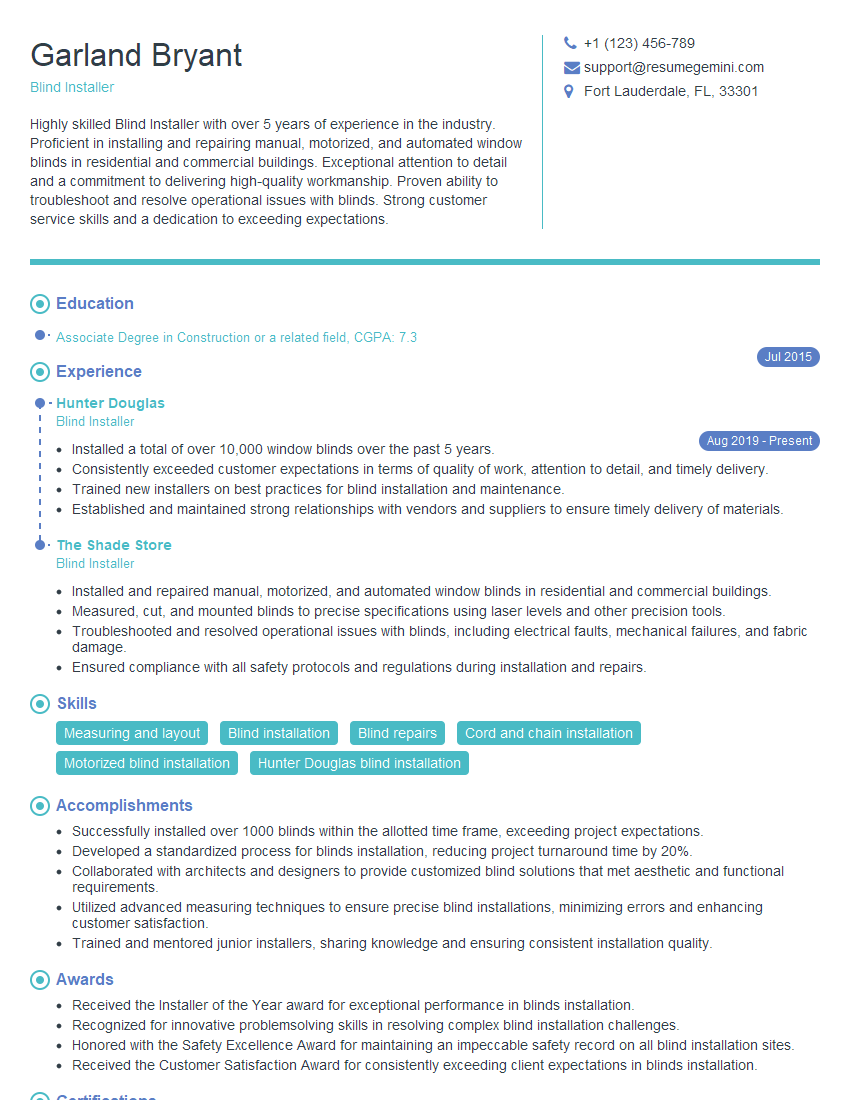
Mastering Window Treatment Measurement and Fitting opens doors to exciting career opportunities in the interior design and home improvement industries. A strong understanding of these skills is highly sought after, leading to increased job prospects and higher earning potential. To maximize your chances of landing your dream job, it’s crucial to present yourself effectively. Create an ATS-friendly resume that highlights your skills and experience in a way that Applicant Tracking Systems can easily recognize. ResumeGemini is a trusted resource that can help you craft a professional and impactful resume. They provide examples of resumes tailored to Window Treatment Measurement and Fitting, ensuring your application stands out from the competition. Take the next step towards your successful career today!
Explore more articles
Users Rating of Our Blogs
Share Your Experience
We value your feedback! Please rate our content and share your thoughts (optional).
What Readers Say About Our Blog
Attention music lovers!
Wow, All the best Sax Summer music !!!
Spotify: https://open.spotify.com/artist/6ShcdIT7rPVVaFEpgZQbUk
Apple Music: https://music.apple.com/fr/artist/jimmy-sax-black/1530501936
YouTube: https://music.youtube.com/browse/VLOLAK5uy_noClmC7abM6YpZsnySxRqt3LoalPf88No
Other Platforms and Free Downloads : https://fanlink.tv/jimmysaxblack
on google : https://www.google.com/search?q=22+AND+22+AND+22
on ChatGPT : https://chat.openai.com?q=who20jlJimmy20Black20Sax20Producer
Get back into the groove with Jimmy sax Black
Best regards,
Jimmy sax Black
www.jimmysaxblack.com
Hi I am a troller at The aquatic interview center and I suddenly went so fast in Roblox and it was gone when I reset.
Hi,
Business owners spend hours every week worrying about their website—or avoiding it because it feels overwhelming.
We’d like to take that off your plate:
$69/month. Everything handled.
Our team will:
Design a custom website—or completely overhaul your current one
Take care of hosting as an option
Handle edits and improvements—up to 60 minutes of work included every month
No setup fees, no annual commitments. Just a site that makes a strong first impression.
Find out if it’s right for you:
https://websolutionsgenius.com/awardwinningwebsites
Hello,
we currently offer a complimentary backlink and URL indexing test for search engine optimization professionals.
You can get complimentary indexing credits to test how link discovery works in practice.
No credit card is required and there is no recurring fee.
You can find details here:
https://wikipedia-backlinks.com/indexing/
Regards
NICE RESPONSE TO Q & A
hi
The aim of this message is regarding an unclaimed deposit of a deceased nationale that bears the same name as you. You are not relate to him as there are millions of people answering the names across around the world. But i will use my position to influence the release of the deposit to you for our mutual benefit.
Respond for full details and how to claim the deposit. This is 100% risk free. Send hello to my email id: lukachachibaialuka@gmail.com
Luka Chachibaialuka
Hey interviewgemini.com, just wanted to follow up on my last email.
We just launched Call the Monster, an parenting app that lets you summon friendly ‘monsters’ kids actually listen to.
We’re also running a giveaway for everyone who downloads the app. Since it’s brand new, there aren’t many users yet, which means you’ve got a much better chance of winning some great prizes.
You can check it out here: https://bit.ly/callamonsterapp
Or follow us on Instagram: https://www.instagram.com/callamonsterapp
Thanks,
Ryan
CEO – Call the Monster App
Hey interviewgemini.com, I saw your website and love your approach.
I just want this to look like spam email, but want to share something important to you. We just launched Call the Monster, a parenting app that lets you summon friendly ‘monsters’ kids actually listen to.
Parents are loving it for calming chaos before bedtime. Thought you might want to try it: https://bit.ly/callamonsterapp or just follow our fun monster lore on Instagram: https://www.instagram.com/callamonsterapp
Thanks,
Ryan
CEO – Call A Monster APP
To the interviewgemini.com Owner.
Dear interviewgemini.com Webmaster!
Hi interviewgemini.com Webmaster!
Dear interviewgemini.com Webmaster!
excellent
Hello,
We found issues with your domain’s email setup that may be sending your messages to spam or blocking them completely. InboxShield Mini shows you how to fix it in minutes — no tech skills required.
Scan your domain now for details: https://inboxshield-mini.com/
— Adam @ InboxShield Mini
support@inboxshield-mini.com
Reply STOP to unsubscribe
Hi, are you owner of interviewgemini.com? What if I told you I could help you find extra time in your schedule, reconnect with leads you didn’t even realize you missed, and bring in more “I want to work with you” conversations, without increasing your ad spend or hiring a full-time employee?
All with a flexible, budget-friendly service that could easily pay for itself. Sounds good?
Would it be nice to jump on a quick 10-minute call so I can show you exactly how we make this work?
Best,
Hapei
Marketing Director
Hey, I know you’re the owner of interviewgemini.com. I’ll be quick.
Fundraising for your business is tough and time-consuming. We make it easier by guaranteeing two private investor meetings each month, for six months. No demos, no pitch events – just direct introductions to active investors matched to your startup.
If youR17;re raising, this could help you build real momentum. Want me to send more info?
Hi, I represent an SEO company that specialises in getting you AI citations and higher rankings on Google. I’d like to offer you a 100% free SEO audit for your website. Would you be interested?
Hi, I represent an SEO company that specialises in getting you AI citations and higher rankings on Google. I’d like to offer you a 100% free SEO audit for your website. Would you be interested?