Interviews are opportunities to demonstrate your expertise, and this guide is here to help you shine. Explore the essential Structural Concrete interview questions that employers frequently ask, paired with strategies for crafting responses that set you apart from the competition.
Questions Asked in Structural Concrete Interview
Q 1. Explain the different types of concrete mixes and their applications.
Concrete mixes are categorized based on their strength, workability, and intended application. The mix design is crucial for achieving the desired properties. Let’s explore some common types:
- Normal Strength Concrete (NSC): This is the most common type, typically used for general construction like foundations, slabs, and walls. Its compressive strength usually ranges from 25 to 40 MPa (Megapascals).
- High-Strength Concrete (HSC): HSC boasts a compressive strength exceeding 50 MPa. It’s ideal for structures requiring high load-bearing capacity, slender elements, or where minimizing the structural cross-section is important. Think of high-rise buildings or bridges.
- High-Performance Concrete (HPC): HPC goes beyond high strength, encompassing superior durability, workability, and other performance attributes like resistance to chemicals or freeze-thaw cycles. It’s employed in demanding applications like marine structures or chemically aggressive environments.
- Lightweight Concrete: This type utilizes lightweight aggregates, reducing the overall density. It’s beneficial in reducing dead loads on structures, particularly in seismic zones or where structural weight is a concern. Examples include using lightweight aggregates like expanded clay or shale.
- Fiber-Reinforced Concrete (FRC): Incorporating fibers (steel, synthetic) enhances tensile strength and crack resistance. It’s commonly used in pavements, shotcrete applications, and other areas prone to impact or cracking.
The choice of concrete mix depends heavily on the project requirements, budget, and environmental conditions. For instance, a residential foundation might use NSC, while a bridge pier would benefit from HSC or even HPC to withstand heavy loads and environmental factors.
Q 2. Describe the process of concrete curing and its importance.
Concrete curing is the process of maintaining adequate moisture and temperature conditions to allow the hydration of cement to proceed effectively. This hydration process is what leads to the hardening and strength gain of concrete. Think of it like baking a cake – you need the right conditions (temperature and moisture) for it to set properly.
Importance of Curing: Proper curing is critical for achieving the desired strength, durability, and minimizing shrinkage cracking. Insufficient curing leads to:
- Reduced Strength: The concrete won’t reach its design strength.
- Increased Permeability: The concrete becomes more porous, susceptible to water ingress, and damage from freeze-thaw cycles or chemical attack.
- Increased Shrinkage: This results in increased cracking.
Curing Methods: Several methods exist, including:
- Water Curing: Keeping the concrete surface continuously wet, often through ponding, spraying, or covering with wet burlap.
- Membrane Curing: Applying a curing compound to retain moisture.
- Steam Curing: Used for precast concrete elements, accelerating the strength gain by using steam.
The choice of curing method depends on the concrete type, environmental conditions, and project schedule. Regardless of the method, consistent moisture and temperature control are crucial for achieving optimal results.
Q 3. What are the common causes of concrete cracking and how are they prevented?
Concrete cracking is a common occurrence, often stemming from a combination of factors. Understanding these causes is key to prevention.
- Plastic Shrinkage Cracking: Occurs during the early stages when water evaporates from the surface faster than it can be replenished, causing shrinkage stresses.
- Drying Shrinkage Cracking: Continues after the initial setting, driven by the loss of moisture as concrete dries out over time.
- Thermal Cracking: Caused by temperature differences within the concrete, leading to expansion and contraction stresses. This is often seen with large pours or rapid temperature changes.
- Reinforcement Corrosion Cracking: Corrosion of steel reinforcement expands the volume, putting pressure on the surrounding concrete and causing cracking.
- Overloading: Simply exceeding the concrete’s load-bearing capacity leads to cracking.
- Settlement Cracking: Uneven settlement of the foundation or surrounding soil can induce cracks.
Prevention Strategies:
- Proper Mix Design: Using low water-cement ratio reduces shrinkage.
- Effective Curing: Prevents rapid moisture loss.
- Temperature Control: Minimizes thermal stresses.
- Adequate Reinforcement: Controls cracking due to tensile stresses.
- Proper Foundation Design: Prevents settlement cracking.
- Construction Joint Design: Properly planned and executed construction joints minimize cracking at these locations.
Often, a combination of factors contributes to cracking. A thorough understanding of the specific conditions and careful implementation of preventive measures are crucial for avoiding this common problem.
Q 4. Explain the concept of creep and shrinkage in concrete.
Creep and shrinkage are two time-dependent deformations that occur in concrete. They affect the long-term behavior of concrete structures and must be considered in design.
Creep: This is a gradual increase in strain (deformation) under sustained stress. Imagine a heavy object placed on a concrete slab; over time, the slab will deform slightly more under the constant load. This is creep. It’s caused by the internal flow of the cement paste and is influenced by factors like the applied stress, temperature, and humidity.
Shrinkage: This refers to a reduction in volume due to the loss of moisture from the concrete. As the concrete dries, it shrinks, leading to internal stresses and potential cracking. Several factors influence shrinkage, including the mix design, environmental conditions (temperature and humidity), and size and shape of the member.
Design Considerations: Both creep and shrinkage must be accounted for in the design of concrete structures, especially for long-span structures or those subjected to sustained loads. Overlooking these factors can lead to excessive deflections, cracking, and potential structural failure. Modern design codes incorporate methods for estimating and compensating for these time-dependent deformations.
Q 5. How do you design for durability in concrete structures?
Designing for durability in concrete structures involves ensuring that the structure can withstand the expected environmental and service conditions throughout its design life. This involves a multi-faceted approach:
- Material Selection: Using high-quality cement and aggregates appropriate for the exposure conditions. For example, sulphate-resisting cement in aggressive soil conditions.
- Mix Design: Low water-cement ratio minimizes permeability, making the concrete less vulnerable to chemical attack and freeze-thaw damage. Using admixtures to enhance durability is also common.
- Concrete Cover: Providing sufficient concrete cover over the reinforcement protects it from corrosion.
- Protection from Environmental Exposure: Employing appropriate surface treatments, such as coatings, to resist chemical attack, abrasion, or freeze-thaw damage. Proper detailing at joints to minimize water penetration.
- Crack Control: Using proper reinforcement detailing and mix design to control cracking and minimize permeability.
- Drainage: Proper drainage design to prevent water accumulation around the structure.
For instance, in a marine environment, high-performance concrete with a low water-cement ratio and specialized coatings would be essential to resist chloride ingress and corrosion of reinforcement. In areas with frequent freeze-thaw cycles, air-entrained concrete would improve its resistance to freeze-thaw damage.
Q 6. What are the different types of reinforcement used in concrete structures?
Concrete structures rely on reinforcement to handle tensile stresses, which concrete itself is weak in. Several types of reinforcement are available:
- Steel Reinforcement Bars (Rebar): The most common type, made of deformed steel bars to improve the bond with the concrete. Different grades of steel are available, providing various strengths.
- Welded Wire Fabric (WWF): A mesh of welded steel wires, commonly used in slabs and pavements for distributing tensile stresses.
- Fiber Reinforcement: As mentioned earlier, fibers (steel, synthetic) are added to the concrete mix to enhance tensile strength and improve crack control. They are particularly useful for preventing cracking from shrinkage or impact loads.
- Fiber-Reinforced Polymers (FRP): These are non-corrosive reinforcement materials used in aggressive environments or where corrosion of steel reinforcement is a concern. They have high tensile strength and are lightweight.
The type of reinforcement chosen depends on the structural requirements, the exposure environment, and cost considerations. Steel rebar remains the most commonly used, but other types are gaining popularity where their properties offer specific advantages.
Q 7. Explain the design considerations for reinforced concrete columns.
Designing reinforced concrete columns involves considering several key aspects:
- Axial Load Capacity: The column must be able to withstand the vertical compressive forces. Design involves calculating the effective area, concrete strength, and reinforcement contribution.
- Slenderness Effects: Tall, slender columns are susceptible to buckling under compressive loads. Design must account for this by checking slenderness ratios and considering additional design factors.
- Confinement Reinforcement: Lateral reinforcement, typically hoops or spirals, is crucial to confine the concrete core, preventing buckling and improving the column’s ductility under high axial loads. The amount and spacing of confinement reinforcement are carefully calculated based on design codes.
- Shear Capacity: Columns may be subjected to shear forces, especially eccentrically loaded ones. Shear reinforcement, in the form of ties or stirrups, is needed to resist these forces.
- Ductility: The column must exhibit adequate ductility to absorb energy during seismic events. This is influenced by the type of reinforcement, concrete strength, and confinement.
- Fire Resistance: Providing adequate concrete cover and considering the column’s fire resistance rating are important, especially for structural members in fire-prone areas.
Design codes provide detailed procedures for designing reinforced concrete columns, considering various load combinations and potential failure modes. Software tools are commonly used to perform these calculations and optimize the design for strength, efficiency, and durability.
Q 8. Describe the design process for reinforced concrete beams.
Designing reinforced concrete beams involves a systematic process that ensures the structure can safely carry its intended load. It begins with understanding the load requirements – dead loads (the weight of the beam itself and any permanent fixtures) and live loads (variable loads like people, furniture, or equipment). Then, we determine the beam’s geometry (length, width, depth). The next crucial step is calculating the required reinforcement. This involves using design codes like ACI 318 (American Concrete Institute) or similar standards, which outline procedures for determining the area and placement of steel reinforcement based on the calculated stresses and strains within the concrete and steel. We consider factors like bending moments, shear forces, and torsion. A simplified design process can be outlined as follows:
- Load Calculation: Determine all relevant loads (dead and live).
- Moment and Shear Calculations: Use structural analysis techniques (e.g., statics, moment distribution) to determine bending moments and shear forces along the beam.
- Section Design: Based on these forces and material properties (concrete compressive strength and steel yield strength), determine the required area of steel reinforcement using appropriate design equations from the code.
- Reinforcement Detailing: Specify the size, number, and placement of reinforcing bars, taking into account spacing requirements, cover for corrosion protection, and detailing for crack control.
- Check for Shear and Deflection: Verify that the design satisfies shear and deflection limits, to ensure structural integrity and serviceability.
For example, a simply supported beam carrying a heavy machine would require a larger depth and more steel reinforcement compared to a beam supporting a lighter load. Software tools are frequently used to automate and refine these calculations, assisting engineers in finding optimal and cost-effective solutions.
Q 9. How do you determine the required concrete strength for a given structure?
Determining the required concrete strength is crucial for ensuring the structure’s safety and durability. The required strength is dictated by several factors, including the anticipated loads, environmental conditions, and the desired service life of the structure. Design codes provide guidance for determining the minimum compressive strength (typically denoted as f’c). These codes account for factors of safety to compensate for uncertainties in material properties, construction practices, and the actual loads applied. The design process often involves iterative calculations where initial assumptions about strength are made, and the design is then checked against code requirements. If the required strength exceeds the initially assumed value, adjustments are made and the calculations are repeated until a satisfactory solution is achieved. For example, a structure subjected to aggressive environmental conditions, such as exposure to de-icing salts, would require a higher concrete strength than a similar structure in a less harsh climate. This is because aggressive environments accelerate deterioration, and higher strength concrete offers better resistance to cracking and damage. The selection of concrete strength is also influenced by economic considerations; using excessively high-strength concrete increases material costs without necessarily yielding significant performance improvements.
Q 10. What are the different types of concrete testing methods?
Concrete testing is critical for ensuring quality control throughout the construction process. Various methods are used to evaluate different properties:
- Compressive Strength: This is the most common test, where a cylindrical specimen is subjected to a compressive load until failure. The maximum load is used to calculate the compressive strength (f’c).
- Slump Test: This assesses the workability of fresh concrete. The slump cone test measures the consistency and flowability of concrete.
- Air Content Test: This determines the amount of air entrained in the concrete, which affects its durability and resistance to freeze-thaw cycles.
- Unit Weight Test: This measures the mass of a known volume of concrete to calculate the unit weight, which is relevant for estimating material quantities and structural design.
- Flexural Strength Test: This assesses the tensile strength of concrete by loading a beam specimen until failure. It’s particularly important for pre-stressed concrete elements.
- Durability Tests: These are specialized tests that evaluate the concrete’s resistance to factors like freezing and thawing, chemical attack (e.g., from de-icing salts), and abrasion. They may involve exposure to accelerated weathering conditions.
The frequency and type of testing are governed by design specifications and project requirements. Detailed records of test results are essential for documentation and quality assurance.
Q 11. Explain the importance of quality control in concrete construction.
Quality control in concrete construction is paramount to ensuring the structure’s safety, durability, and longevity. It encompasses all aspects of the construction process, starting from material selection and production to placement, curing, and finishing. Without rigorous quality control, even minor deviations can lead to significant problems, such as reduced strength, increased cracking, and premature deterioration. Effective quality control involves:
- Material Quality Control: Ensuring that the aggregates, cement, and admixtures meet specified requirements.
- Mix Design and Batching Control: Accurate measurement and mixing of materials to achieve the desired concrete properties.
- Placement and Consolidation: Proper techniques to eliminate air pockets and ensure uniform concrete density.
- Curing: Maintaining adequate moisture and temperature conditions to promote proper hydration and strength development.
- Testing and Inspection: Regular testing to verify that the concrete meets specifications, along with visual inspections to identify any defects.
- Documentation: Detailed records of all materials used, tests conducted, and inspection findings.
A robust quality control program minimizes risks and costs associated with rework, repairs, and potential structural failures. It is essentially an investment in the long-term performance and safety of the structure.
Q 12. How do you deal with unexpected site conditions during concrete construction?
Unexpected site conditions, like encountering unstable soil or unforeseen underground utilities, pose significant challenges during concrete construction. Dealing effectively requires a proactive and adaptable approach:
- Thorough Site Investigation: This should be carried out *before* construction begins, to identify potential issues and plan accordingly. Geotechnical investigations, surveys, and utility locates are crucial.
- Contingency Planning: Develop plans for dealing with potential problems; this might involve having alternative construction methods or materials readily available.
- On-Site Engineering Expertise: Having experienced engineers available to assess the situation and make appropriate decisions based on the site conditions.
- Communication and Collaboration: Open communication among the engineers, contractors, and other stakeholders is essential to ensure a coordinated response.
- Modifications to Design: Sometimes, adjustments to the original design are necessary to accommodate the changed site conditions. This requires careful evaluation and adherence to relevant codes.
- Documentation: Changes due to unexpected conditions must be meticulously documented.
For instance, if unexpectedly soft soil is encountered during foundation construction, grouting or soil stabilization techniques may be needed, potentially leading to project delays and increased costs. Effective communication and planning will significantly improve the chances of successfully addressing these challenges.
Q 13. What are the safety precautions involved in concrete construction?
Concrete construction involves inherent risks, so safety precautions are of utmost importance. A comprehensive safety program includes:
- Personal Protective Equipment (PPE): Hard hats, safety glasses, gloves, and steel-toed boots are mandatory for all workers.
- Fall Protection: Appropriate measures are required at heights, including scaffolding, guardrails, and safety harnesses.
- Heavy Equipment Safety: Proper training and procedures are crucial for operating heavy machinery like cranes and concrete pumps.
- Hazard Communication: Clearly communicating potential hazards, such as confined spaces, hazardous materials, and electrical risks.
- Confined Space Entry Procedures: Strict protocols are essential when workers enter confined spaces like trenches or formwork.
- Emergency Preparedness: Having emergency plans in place, including first aid and evacuation procedures.
- Proper Handling of Materials: Safe storage and handling of cement, aggregates, and other materials to prevent injuries and spills.
Regular safety inspections and training sessions are crucial to maintain a safe working environment. Safety should always be prioritized over speed or productivity.
Q 14. Explain the different types of concrete finishes.
Concrete finishes greatly impact the structure’s aesthetics and durability. The choice of finish depends on factors like intended use, architectural design, and budget.
- Smooth Finish: Achieved by using a power trowel to create a smooth, level surface. It’s commonly used for floors and other areas where a smooth surface is desired.
- Broomed Finish: Created by brushing the surface with a stiff broom while the concrete is still plastic. This provides a textured surface, enhancing slip resistance.
- Exposed Aggregate Finish: The surface is treated to expose the aggregate particles, revealing their natural color and texture. This creates a visually appealing and durable finish, but requires specialized techniques.
- Stamped Concrete: Impressions are stamped into the concrete surface to create patterns that mimic natural stone or brick. It’s a popular choice for patios and driveways.
- Stained Concrete: Adding color to the concrete surface using acid-based or water-based stains. This allows for a wide range of colors and patterns.
- Polished Concrete: Grinding and polishing the surface to create a high-gloss finish. This is often used in commercial and industrial settings.
Selecting the appropriate finish requires careful consideration of the project’s specific requirements. Proper curing and maintenance are essential for preserving the desired finish and preventing deterioration.
Q 15. Describe your experience with different concrete formwork systems.
My experience with concrete formwork systems spans a wide range, from traditional timber formwork to advanced systems like steel and aluminum formwork, and even specialized systems for complex geometries. Timber formwork, while cost-effective, requires skilled labor and meticulous attention to detail for accurate placement and alignment. I’ve used it extensively on smaller projects, where its adaptability shines. Steel and aluminum formwork, on the other hand, offers greater reusability and precision, making it ideal for larger projects and repetitive elements. I’ve managed projects employing these systems, emphasizing quality control and safety protocols to prevent issues like formwork blowouts or concrete leakage. Furthermore, I have familiarity with specialized formwork for curved surfaces and complex shapes, such as those utilized in architectural features and bridges. My experience encompasses not only the selection and erection of the appropriate formwork but also the stripping, cleaning, and maintenance procedures to ensure its longevity and safety across multiple projects.
Career Expert Tips:
- Ace those interviews! Prepare effectively by reviewing the Top 50 Most Common Interview Questions on ResumeGemini.
- Navigate your job search with confidence! Explore a wide range of Career Tips on ResumeGemini. Learn about common challenges and recommendations to overcome them.
- Craft the perfect resume! Master the Art of Resume Writing with ResumeGemini’s guide. Showcase your unique qualifications and achievements effectively.
- Don’t miss out on holiday savings! Build your dream resume with ResumeGemini’s ATS optimized templates.
Q 16. How do you calculate the amount of concrete required for a given structure?
Calculating concrete quantity involves determining the volume of the structure’s concrete elements and adding a small percentage for waste. This is typically done in cubic meters (m³). First, you need detailed drawings that show dimensions of all concrete components – walls, columns, beams, slabs, footings, etc. Then, the volume of each element is calculated using appropriate geometric formulas (e.g., length × width × height for rectangular shapes, πr²h for cylindrical columns). For irregularly shaped elements, more complex calculations or approximations might be needed. Finally, all the individual volumes are summed to get the total volume. It’s crucial to add a waste factor (typically 2-5%, depending on the complexity of the pour and transportation) to account for spillage, shrinkage, and other losses.
Example: Let’s say we have a rectangular slab (5m x 10m x 0.2m). The volume is 5m * 10m * 0.2m = 10 m³. If we add a 3% waste factor, we’d need 10 m³ + (10 m³ * 0.03) = 10.3 m³ of concrete.
Q 17. Explain the concept of slump test in concrete.
The slump test is a simple yet crucial method for assessing the workability of fresh concrete. Workability refers to how easily the concrete can be placed, consolidated, and finished. The test involves filling a standard slump cone (a truncated cone-shaped metal mold) with freshly mixed concrete. The cone is then carefully lifted, and the slump (the amount the concrete settles) is measured. The slump is expressed in millimeters (mm) and indicates the consistency of the concrete. A higher slump means more workable (or wetter) concrete, while a lower slump indicates stiffer concrete.
Slump values are essential for ensuring the concrete is suitable for the intended application. Too much slump can lead to segregation (separation of the components of the concrete mix), while too little can make placement difficult. Slump tests are routinely conducted on-site to maintain quality control throughout the project and ensure the concrete is within the specified range for the particular application.
Q 18. What are the common problems associated with concrete pumping?
Concrete pumping, while efficient for placing large volumes of concrete, comes with its own set of potential problems. One major concern is blockages. This can be caused by aggregates (stones) that are too large for the pump’s diameter, or by the concrete mix being too stiff or having inadequate lubrication. Segregation of the concrete mix is another issue, where the larger aggregates separate from the cement paste, resulting in weaker concrete. This often happens if the pump line is too long or if the concrete sits in the line for too long. Wear and tear on the pump can also cause problems if the equipment isn’t properly maintained. Poor quality concrete, such as inadequate mixing or use of improper materials, can also contribute to issues during pumping. Finally, inadequate cleaning of the pump after use can lead to blockages in subsequent jobs. A thorough understanding of the pump’s capabilities and the concrete mix design is key to avoiding these problems.
Q 19. How do you ensure the proper consolidation of concrete?
Proper concrete consolidation is critical for ensuring a dense, strong, and durable structure. This involves removing air voids and ensuring the concrete fully fills the formwork. The methods employed depend on factors such as the type of concrete, the size and shape of the member, and accessibility. Techniques include:
- Vibration: Using internal or external vibrators to compact the concrete and eliminate air pockets. This is the most common method for most applications.
- Rodding: Manually poking the concrete with a rod to help it settle into place, suitable for smaller sections.
- Spading: Using a flat-bladed tool to work the concrete into corners and around reinforcement.
The success of consolidation depends on proper techniques and the experience of the personnel carrying them out. Over-vibration can lead to segregation, while under-vibration will leave air voids. Visual inspection for the absence of air bubbles and a uniform surface finish is often used to assess the effectiveness of consolidation.
Q 20. What are the different types of concrete admixtures and their functions?
Concrete admixtures are chemical additives that modify the properties of concrete. They are used to improve workability, strength, durability, and other characteristics. Common types include:
- Water reducers (superplasticizers): Increase workability without increasing water content, leading to higher strength and durability.
- Accelerators: Speed up the setting time of concrete, useful in cold weather or when rapid construction is required.
- Retarders: Slow down the setting time, useful in hot weather or for large pours.
- Air-entraining agents: Introduce air bubbles into the concrete mix, improving its resistance to freeze-thaw cycles.
- Pozzolans: Supplementary cementitious materials that react with calcium hydroxide to improve durability and strength over time.
The selection and dosage of admixtures are critical and must be done carefully, following manufacturer recommendations. Incorrect use can lead to adverse effects on the concrete’s properties.
Q 21. Explain the principles of prestressed concrete.
Prestressed concrete involves introducing compressive stresses into the concrete structure before service loads are applied. This is done by using high-strength steel tendons that are tensioned and then anchored. When the tendons are released (after the concrete has cured), they exert a compressive force on the concrete member. This pre-compression counteracts the tensile stresses that develop under normal loading conditions. The result is a structure that is significantly stronger and more resistant to cracking than conventionally reinforced concrete.
Two main methods are employed:
- Pretensioning: The tendons are tensioned before the concrete is placed around them. Once the concrete has hardened, the tendons are released, transferring the compressive force to the concrete.
- Post-tensioning: The tendons are tensioned after the concrete has hardened. Ducts are placed in the concrete to allow for the tendons to be threaded through and then tensioned and anchored.
Prestressed concrete is widely used in bridges, buildings, and other structures where high strength and slender sections are required. It allows for longer spans and lighter weight structures compared to conventional reinforced concrete.
Q 22. Describe your experience with different types of concrete structures.
My experience encompasses a wide range of concrete structures, from simple cast-in-place slabs and beams to complex high-rise buildings, bridges, and retaining walls. I’ve worked on projects utilizing various concrete types, including high-strength concrete for demanding applications like columns in skyscrapers, and lightweight concrete for situations requiring reduced self-weight, such as long-span beams. I’m also familiar with precast concrete elements, their design, and their integration into larger structures. For instance, I was involved in a project where we used precast concrete wall panels to significantly expedite the construction of a multi-story apartment complex. This involved careful consideration of connections, tolerances, and overall structural integrity.
Furthermore, I have experience with specialized concrete structures such as reinforced concrete shear walls, which are critical for resisting lateral loads in tall buildings, and post-tensioned concrete structures, which allow for longer spans and increased load-bearing capacity by introducing compressive forces after the concrete has cured. Each project presented unique challenges and opportunities to refine my understanding of concrete behavior under various load conditions and environmental influences.
Q 23. How do you address issues related to concrete deterioration?
Addressing concrete deterioration requires a multi-pronged approach involving thorough investigation, accurate diagnosis, and appropriate repair strategies. The first step is to identify the cause of deterioration. Common issues include:
- Corrosion of reinforcing steel: This is often caused by chloride ingress from de-icing salts or seawater, leading to expansion and cracking. Remediation involves methods like cathodic protection or the application of corrosion inhibitors.
- Alkali-aggregate reaction (AAR): This chemical reaction between certain aggregates and alkalis in cement leads to expansion and cracking. Mitigation involves using low-alkali cement or aggregates that are known to be non-reactive.
- Freeze-thaw damage: Water trapped in the concrete pores expands upon freezing, causing damage. Using air-entraining admixtures during concrete mixing helps mitigate this by creating interconnected air voids.
- Sulfate attack: Sulfates in soil or groundwater can react with cement, causing expansion and weakening. Using sulfate-resistant cement is crucial in such environments.
After identifying the cause, repair methods are selected. These can range from simple surface treatments to more extensive repairs involving concrete removal and replacement. For example, in a project dealing with chloride-induced corrosion, we implemented a combination of surface cleaning, crack sealing, and electrochemical chloride extraction to arrest the corrosion and restore the structural integrity. Each solution is tailored to the specific situation, considering factors such as the extent of damage, structural significance, and cost-effectiveness.
Q 24. What are the sustainable practices used in concrete construction?
Sustainable practices in concrete construction are becoming increasingly important. Several strategies are employed to minimize the environmental impact:
- Using recycled materials: Incorporating recycled aggregates (e.g., crushed concrete, recycled glass) reduces reliance on virgin materials and minimizes waste in landfills. This also reduces the carbon footprint associated with extraction and transportation of new materials.
- Reducing cement content: Cement production is energy-intensive and contributes significantly to greenhouse gas emissions. Using supplementary cementitious materials (SCMs) like fly ash, slag, or silica fume reduces the cement content while maintaining desired strength and durability.
- Optimizing mix design: Precisely calculated mix designs ensure that only the necessary amount of materials is used, minimizing waste and optimizing the concrete’s performance characteristics. This reduces unnecessary consumption of raw materials and lowers transportation costs.
- Improving durability: Designing concrete to resist deterioration minimizes the need for repairs and replacements, thus extending the lifespan of the structure and reducing material consumption over the long term.
- Embodied carbon reduction: This involves a lifecycle assessment of the carbon emissions associated with materials, production, transportation, and construction processes. Strategies such as using low-carbon cement and optimizing transportation routes help reduce embodied carbon.
Adopting these sustainable practices not only helps protect the environment but can also contribute to cost savings in the long run.
Q 25. Explain your understanding of building codes and standards related to concrete.
My understanding of building codes and standards related to concrete is comprehensive. I’m proficient in interpreting and applying codes like ACI 318 (Building Code Requirements for Structural Concrete) and relevant local building regulations. I understand the requirements for design, materials, construction methods, and inspection procedures, ensuring compliance throughout the project lifecycle. For example, I know the specific requirements for detailing reinforcement, ensuring proper concrete cover for corrosion protection, and specifying appropriate strength grades for concrete based on the anticipated load and environmental conditions. This detailed understanding is crucial for safe and reliable concrete structures.
I am also aware of the importance of keeping up-to-date with code changes and amendments, and regularly consult updated code publications and industry best practices. This ensures that the designs I develop meet the latest safety and performance standards.
Q 26. How do you handle conflict resolution on a concrete construction site?
Conflict resolution on a construction site requires a proactive and collaborative approach. My strategy emphasizes open communication, active listening, and a focus on finding mutually beneficial solutions. I believe in addressing issues promptly and directly to prevent escalation. I would start by clearly understanding each party’s perspective, identifying the root cause of the conflict, and facilitating a discussion to find common ground. This may involve mediating between the contractor, subcontractors, and inspectors.
If discussions fail to resolve the conflict, I’d implement a structured approach involving documentation of the issue, communication with relevant stakeholders, and if necessary, escalation to higher management for resolution. My goal is always to maintain a positive and productive work environment, minimizing disruptions and ensuring project completion within the agreed-upon timeframe and budget. I’ve found that focusing on shared project goals rather than individual differences helps navigate conflicts effectively.
Q 27. Describe your experience with using software for concrete design and analysis (e.g., ETABS, SAP2000).
I possess significant experience in using software for concrete design and analysis, including ETABS and SAP2000. I’m proficient in modeling complex structures, defining material properties, applying loads, and analyzing structural behavior. My skills extend to generating detailed design drawings and reports that conform to industry standards. For example, I’ve utilized ETABS to model and analyze the structural behavior of a high-rise building under seismic loading, ensuring compliance with relevant building codes and optimizing design for both strength and serviceability. SAP2000 has been instrumental in analyzing complex bridge structures, accurately predicting deflections and stress distributions under various loading scenarios.
Beyond analysis, I’m comfortable using the software to generate detailed reinforcement drawings and schedules, ensuring accurate placement of reinforcing steel and facilitating efficient construction. My proficiency extends to understanding the limitations of the software and incorporating appropriate safety factors into the design. I am continuously updating my skills to take advantage of the latest features and enhancements of these programs.
Q 28. What are your strengths and weaknesses related to structural concrete engineering?
My strengths lie in my strong analytical abilities, problem-solving skills, and deep understanding of structural concrete principles. I am detail-oriented, ensuring accuracy in design and calculations. I excel at collaborating effectively with cross-functional teams and effectively communicating complex technical information to both technical and non-technical audiences. My experience with various software packages, building codes, and diverse project types allows me to approach challenges from multiple perspectives.
While I possess a broad range of skills, one area I aim to continuously improve is my familiarity with the latest advancements in sustainable construction materials and techniques. Although I have a foundational understanding, staying abreast of the rapidly evolving landscape in this field is an ongoing commitment. I actively seek opportunities to enhance my expertise through professional development and participation in industry conferences to address this.
Key Topics to Learn for Structural Concrete Interview
- Material Properties: Understanding the behavior of concrete under stress, including compressive strength, tensile strength, elasticity, and creep. Practical application: Designing for specific load requirements based on material properties.
- Mix Design and Quality Control: Knowing the factors influencing concrete mix design (cement content, water-cement ratio, aggregates) and quality control methods to ensure desired strength and durability. Practical application: Specifying concrete mixes for different structural elements and ensuring consistent quality throughout a project.
- Reinforcement Design: Mastering the principles of reinforced concrete design, including detailing, spacing, and the interaction between concrete and steel reinforcement. Practical application: Designing reinforcement layouts for beams, columns, slabs, and foundations to resist bending, shear, and axial loads.
- Analysis and Design Methods: Familiarizing yourself with various design codes (ACI, Eurocode) and methods for analyzing and designing concrete structures, including limit state design and working stress design. Practical application: Selecting appropriate design methods and performing structural calculations to ensure safety and serviceability.
- Finite Element Analysis (FEA): Understanding the basics of FEA and its application in analyzing complex concrete structures. Practical application: Utilizing FEA software to verify designs and investigate structural behavior under various loading conditions.
- Construction Methods and Practices: Gaining knowledge of common construction methods and practices related to concrete structures, including formwork, placing, curing, and quality control. Practical application: Understanding potential construction challenges and proposing solutions during the design process.
- Durability and Sustainability: Understanding the factors affecting the long-term durability of concrete structures, including corrosion, cracking, and environmental impact. Practical application: Specifying appropriate materials and design details to enhance durability and minimize environmental impact.
Next Steps
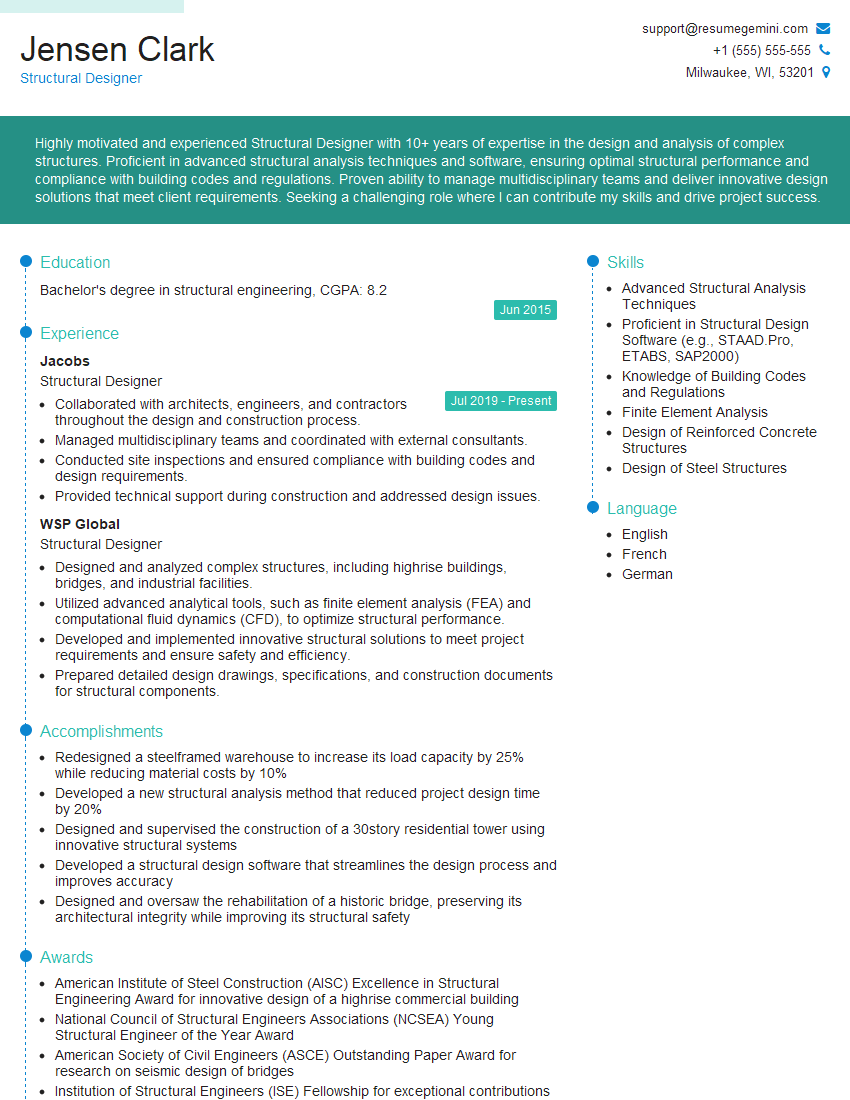
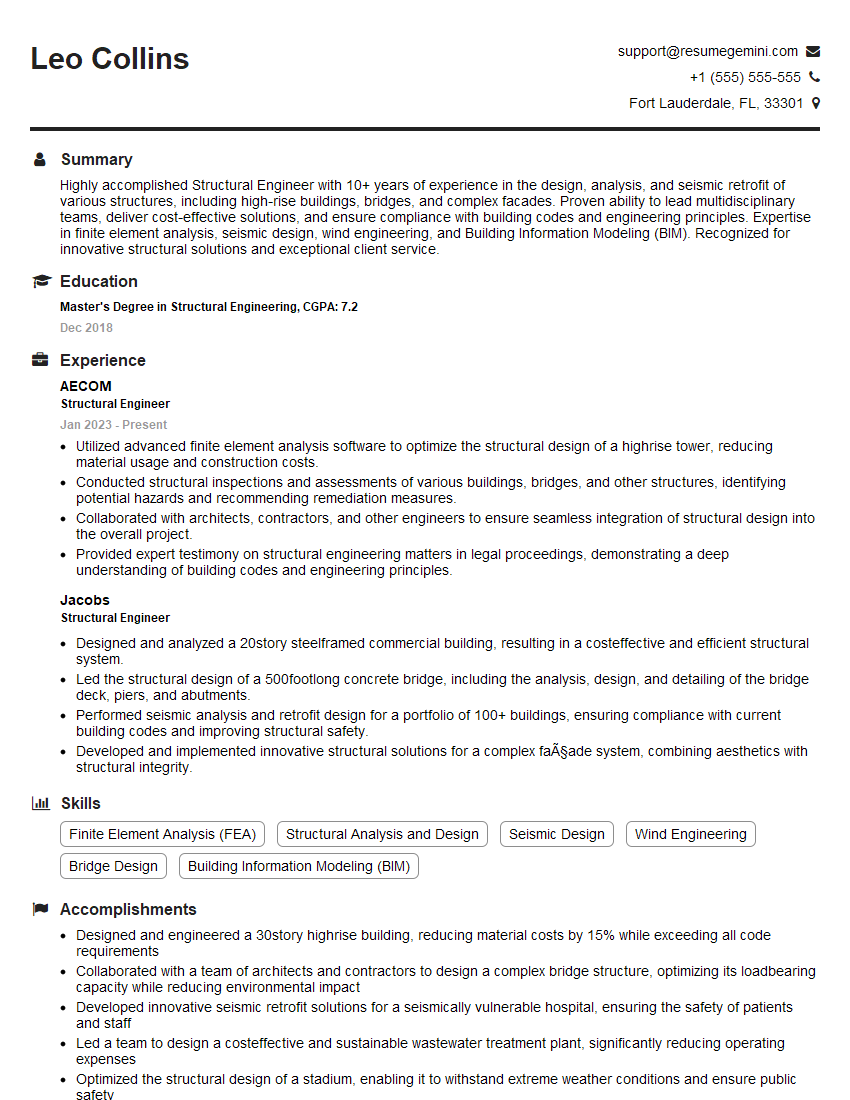
Mastering Structural Concrete principles is crucial for career advancement in the construction and engineering industries, opening doors to challenging and rewarding roles. A well-crafted resume is your key to unlocking these opportunities. Creating an ATS-friendly resume is essential for getting your application noticed by recruiters. To significantly improve your resume’s effectiveness, consider using ResumeGemini. ResumeGemini provides a user-friendly platform to build professional resumes, and examples of resumes tailored to Structural Concrete are available to help you showcase your skills and experience effectively.



Explore more articles
Users Rating of Our Blogs
Share Your Experience
We value your feedback! Please rate our content and share your thoughts (optional).
What Readers Say About Our Blog
Very informative content, great job.
good