Cracking a skill-specific interview, like one for Foundation Analysis, requires understanding the nuances of the role. In this blog, we present the questions you’re most likely to encounter, along with insights into how to answer them effectively. Let’s ensure you’re ready to make a strong impression.
Questions Asked in Foundation Analysis Interview
Q 1. Explain the different types of foundation systems.
Foundation systems are broadly categorized based on their depth relative to the ground surface and their load-carrying mechanism. We primarily classify them into shallow and deep foundations.
- Shallow Foundations: These transfer loads to the soil near the ground surface. Examples include:
- Spread Footings: Individual footings supporting isolated columns or walls. Imagine a large, flat stone under a single table leg – that’s essentially a spread footing.
- Combined Footings: Used when two or more columns are close together, sharing a single footing. Think of it as supporting two tables with a single, larger base.
- Strip Footings: Continuous footings supporting walls or long rows of columns. Picture a continuous concrete strip along a wall’s base.
- Raft or Mat Foundations: A large, continuous footing covering the entire building footprint, used when the soil bearing capacity is low or when differential settlement is a major concern. Imagine a solid concrete slab under the entire house.
- Deep Foundations: These transfer loads to deeper, stronger soil strata. Examples include:
- Pile Foundations: Composed of individual piles driven or drilled into the ground, transferring loads to deeper soil layers or bedrock. These are like long, slender nails driven deep into the ground to anchor the building.
- Caissons: Large-diameter drilled shafts filled with concrete, offering high load-carrying capacity. These are like creating a large, reinforced concrete cylinder deep in the ground.
- Pier Foundations: Similar to caissons, but often smaller diameter and can be constructed in various ways depending on the soil conditions.
The choice of foundation system depends on several factors, including soil conditions, building loads, and site constraints. A thorough geotechnical investigation is crucial for selecting the appropriate foundation type.
Q 2. Describe the process of conducting a soil investigation for foundation design.
A soil investigation is a crucial preliminary step in foundation design. It’s like getting a detailed medical history before treating a patient. The process involves:
- Desk Study: Reviewing existing geological maps, aerial photographs, and historical data to gather preliminary information about the site.
- Site Reconnaissance: Visiting the site to visually assess the topography, vegetation, and any signs of previous construction or ground instability.
- Subsurface Exploration: This involves techniques like:
- Test Pits: Excavating small pits to visually inspect the soil layers. It is a direct and simple way to assess soil conditions.
- Borings: Drilling boreholes to collect soil samples at various depths for laboratory testing. This allows for a more detailed analysis of soil properties.
- Cone Penetration Tests (CPT): Pushing a cone-shaped probe into the ground to measure soil resistance, providing continuous data on soil stratigraphy and strength.
- Standard Penetration Tests (SPT): Driving a standard split-barrel sampler into the ground and measuring the number of blows required to drive the sampler a certain distance, indicating soil density and strength. This is a classic method to evaluate soil strength.
- Laboratory Testing: Soil samples collected during subsurface exploration are tested in the laboratory to determine their properties, including grain size distribution, consistency limits (for clays), shear strength, and compressibility.
- Report Preparation: A geotechnical engineer prepares a comprehensive report summarizing the findings of the investigation and recommending appropriate foundation design parameters.
The extent and type of soil investigation depend on the project’s size, complexity, and the perceived risk associated with the site conditions.
Q 3. How do you determine the bearing capacity of soil?
Bearing capacity refers to the maximum pressure a soil can withstand without excessive settlement or failure. Determining it is a critical step in foundation design. There are several methods:
- Empirical Methods: These use simplified equations based on soil properties obtained from laboratory tests and field investigations. Common methods include Terzaghi’s bearing capacity equation, which considers soil cohesion and friction angle. For example, a simplified equation might look like:
qult = cNc + γDNq + 0.5γBNγwherequltis ultimate bearing capacity,cis cohesion,γis unit weight,Dis depth of footing,Bis footing width, andNc, Nq, Nγare bearing capacity factors dependent on the soil’s friction angle. - Limit Equilibrium Methods: These involve more complex analyses using principles of soil mechanics to estimate the bearing capacity. These are more sophisticated methods that consider stress distribution around the foundation more accurately.
- Load Tests: Conducting a load test on a trial footing at the site allows direct measurement of the soil’s bearing capacity. This is the most direct way to determine the bearing capacity, but it can be expensive and time-consuming.
The chosen method depends on the project’s complexity, accuracy requirements, and the availability of resources. A safety factor is always applied to the determined bearing capacity to account for uncertainties and variations in soil properties.
Q 4. What are the factors influencing the settlement of foundations?
Settlement, the downward movement of a foundation after construction, is influenced by several factors:
- Soil Type: Clayey soils are more compressible than sandy or gravelly soils, leading to greater settlement. Think of squeezing a sponge (clay) versus squeezing a pile of sand.
- Soil Properties: Parameters like compressibility, consolidation characteristics, and shear strength dictate how much the soil will compress under load.
- Foundation Load: Heavier loads cause greater settlement. A heavier building will settle more than a lighter one, all other factors being equal.
- Foundation Type and Size: The size and type of foundation influence the stress distribution in the soil, affecting settlement. A larger footing will distribute the load over a wider area, resulting in less settlement.
- Groundwater Conditions: High water table levels can reduce soil strength and increase compressibility, leading to increased settlement.
- Time Dependency: Settlement occurs over time as the soil consolidates under load. The rate of settlement varies depending on soil type and drainage conditions.
Understanding these factors is essential for predicting and mitigating settlement in foundation design.
Q 5. Explain the concept of differential settlement and its implications.
Differential settlement refers to the uneven settlement of different parts of a foundation. Imagine one corner of a building settling more than another. This is unlike uniform settlement, where the entire structure settles by the same amount.
Implications: Differential settlement can cause significant structural damage, including:
- Cracking in walls and floors: Uneven settlement creates stresses in the structure, leading to cracks.
- Damage to finishes: Cracks can propagate through walls and floors, damaging finishes like paint and tiles.
- Door and window misalignment: Uneven settlement can cause doors and windows to jam or become difficult to operate.
- Structural instability: In severe cases, differential settlement can compromise the structural integrity of the building, leading to collapse.
Minimizing differential settlement is critical in foundation design. This involves selecting appropriate foundation types, performing thorough soil investigations, and implementing measures to control settlement, such as using soil improvement techniques or designing foundations to distribute loads more uniformly.
Q 6. How do you design a shallow foundation?
Designing a shallow foundation involves several steps:
- Soil Investigation: Conduct a thorough geotechnical investigation to determine soil properties and bearing capacity.
- Load Determination: Calculate the total load the foundation must support, including dead loads (building weight) and live loads (occupancy loads).
- Footing Design:
- Size Determination: Determine the size of the footing based on the allowable bearing pressure of the soil and the total load. The equation is straightforward:
Area = Total Load / Allowable Bearing Pressure - Reinforcement Design: Design the reinforcement to resist shear and bending stresses. The amount of reinforcement depends on the size of the footing and the magnitude of the loads.
- Depth Determination: Determine the depth of the footing, considering frost depth, water table elevation, and soil strength.
- Detailing and Drawings: Prepare detailed drawings showing the footing dimensions, reinforcement details, and construction specifications.
- Check for Settlement: Estimate the expected settlement using appropriate methods and check for the serviceability limit state requirements.
The design process should adhere to relevant building codes and standards. For example, designing a spread footing for a column involves calculating the required area to satisfy the allowable bearing pressure and then ensuring adequate reinforcement to resist moments and shear forces.
Q 7. How do you design a deep foundation?
Deep foundation design is more complex than shallow foundation design and depends heavily on the chosen type (piles, caissons, piers).
- Geotechnical Investigation: A detailed investigation is necessary to determine the soil stratigraphy, load-bearing capacity at depth, and groundwater conditions.
- Pile/Caisson/Pier Selection: Select the appropriate type and dimensions of deep foundation elements (piles, caissons, or piers) based on geotechnical data, load requirements, and construction constraints.
- Capacity Analysis: Determine the individual capacity of each pile, caisson, or pier using appropriate methods, often involving soil mechanics principles and empirical equations.
- Settlement Analysis: Estimate the settlement of the deep foundation system under the design loads using advanced analytical methods, considering both immediate and consolidation settlement.
- Group Action Analysis (for piles): If multiple piles are used, analyze their group behavior, accounting for the interaction between piles.
- Structural Design: Design the structural elements of the deep foundation, such as pile caps or caisson tops, to transfer loads to the foundation elements effectively.
- Construction Considerations: Account for construction methods and potential challenges during the design phase. This includes assessing the suitability of different pile driving methods.
Detailed design calculations involving soil mechanics principles are essential. For example, the design of a pile foundation involves determining the required number and arrangement of piles to support the load, considering their individual capacity and group action effects. Software tools are frequently used for these complex calculations.
Q 8. What are the advantages and disadvantages of pile foundations?
Pile foundations, essentially long slender columns driven into the ground, offer several advantages and disadvantages. Let’s examine them:
- Advantages:
- Increased Bearing Capacity: Piles transfer loads to deeper, stronger soil strata, ideal for weak surface soils or heavy structures. Imagine trying to build a skyscraper on sand – piles are the solution!
- Improved Settlement Control: By distributing loads over a larger area at depth, piles minimize differential settlement, ensuring structural stability. Think of it like spreading your weight evenly across a wide base instead of standing on one leg.
- Suitable for Difficult Ground Conditions: Piles can traverse problematic layers like soft clays or filled ground, reaching stable bearing strata beneath.
- Waterlogged Conditions: Piles are effective in waterlogged areas, where shallow foundations would be impractical.
- Disadvantages:
- High Initial Cost: Pile installation is expensive, requiring specialized equipment and expertise. It’s a significant upfront investment.
- Potential for Noise and Vibration: Driving piles can create significant noise and vibrations, impacting nearby structures and residents. Consider the disruption before commencing.
- Difficulty in Inspection: Once installed, inspecting piles can be challenging, needing specialized techniques.
- Potential for Pile Damage During Installation: Improper installation can damage piles, compromising their integrity. Proper planning and execution are critical.
Q 9. Explain the different types of pile foundations.
Pile foundations come in various types, categorized by material, installation method, and load transfer mechanism. Here are some key types:
- Based on Material:
- Timber Piles: Relatively inexpensive, suitable for less demanding applications, but prone to decay and insect infestation.
- Concrete Piles: Durable, versatile, and strong, often precast or cast-in-situ (formed and poured in place). These are a popular choice for their adaptability.
- Steel Piles: High strength and slenderness, ideal for deep foundations or where high capacity is needed. However, susceptible to corrosion.
- Based on Installation Method:
- Driven Piles: Driven into the ground using hammers or vibratory drivers, most suitable for cohesive soils.
- Bored Piles: Holes are bored into the ground, and concrete is poured in. Better suited to loose, granular soils.
- Auger Cast Piles: A hollow auger creates the hole, concrete is added, and the auger is slowly withdrawn.
- Based on Load Transfer:
- End-Bearing Piles: Transfer loads to a strong, deeper stratum at their tip.
- Friction Piles: Transfer loads primarily through skin friction along their shaft.
Q 10. How do you analyze the stability of retaining walls?
Retaining wall stability analysis involves assessing its resistance to various forces, ensuring it won’t fail. Key factors considered include:
- Soil Pressure: Lateral earth pressure acting on the wall, determined by the soil properties and wall geometry. We utilize theories like Rankine or Coulomb to estimate this.
- Overturning Moment: The tendency for the wall to rotate due to soil pressure and surcharge loads (loads on top of the soil). We need to ensure the resisting moment (from wall weight and soil pressure) is greater.
- Sliding: The tendency for the wall to slide horizontally. The resisting force (friction between wall and soil) needs to be greater than the driving force (soil pressure).
- Bearing Capacity: Ensuring the soil beneath the wall can support the combined loads. This requires analysis considering soil strength.
Stability is typically checked using limit equilibrium methods, calculating factors of safety against overturning, sliding, and bearing capacity failure. Software packages are commonly used for this complex analysis.
Q 11. Explain the concept of lateral earth pressure.
Lateral earth pressure refers to the horizontal pressure exerted by soil on a structure, such as a retaining wall or buried structure. This pressure arises from the soil’s weight and inter-particle forces. Several theories exist to estimate this pressure:
- At-Rest Pressure (K0): The pressure exerted when the soil is undisturbed and no movement occurs. The coefficient of earth pressure at rest (K0) is usually estimated from soil properties.
- Active Pressure (Ka): The pressure exerted on a retaining wall when the soil moves away from the wall (fails). This is the minimum pressure exerted.
- Passive Pressure (Kp): The pressure exerted when the soil is pushed towards a retaining wall (the soil is compressed against the wall). This is the maximum pressure.
The choice of theory depends on the soil conditions and wall movement. For example, active pressure is used in retaining wall design, while passive pressure is considered when analyzing soil resistance against movement.
Q 12. What are the different methods for analyzing soil-structure interaction?
Analyzing soil-structure interaction (SSI) involves understanding how the soil and the structure influence each other’s behavior. Common methods include:
- Equivalent Spring Approach: Simplifies the soil as a series of springs connected to the foundation. Easy to implement, but less accurate for complex soil conditions.
- Finite Element Method (FEM): A powerful numerical technique that discretizes the soil and structure into elements, solving for the interactions using computer software. More accurate and versatile.
- Boundary Element Method (BEM): Another numerical method focusing on the boundary between the soil and structure. Efficient for certain problems, but can be limited in its applicability.
- Simplified Methods: Various simplified methods exist based on empirical equations and assumptions, suitable for preliminary assessments or specific soil types.
The selection of the method depends on project requirements, available resources, and the complexity of the soil-structure system.
Q 13. Describe the finite element method and its application in foundation analysis.
The finite element method (FEM) is a powerful numerical technique used to solve complex engineering problems, including foundation analysis. It divides the structure and soil into smaller elements (finite elements), creating a mesh. Each element has simple equations describing its behavior. The computer solves these equations simultaneously for all elements, resulting in a solution for the entire system.
In foundation analysis, FEM is used to:
- Analyze stress and strain distributions: Determining the stress and strain within the foundation and surrounding soil.
- Model complex soil behaviors: Simulating nonlinear soil behaviors like plasticity and liquefaction.
- Study SSI effects: Accurately modeling the interaction between the foundation and soil.
- Assess settlement and stability: Predicting foundation settlement and evaluating stability under various loading conditions.
Software packages such as ABAQUS, ANSYS, and PLAXIS extensively utilize FEM for sophisticated foundation analysis.
Q 14. How do you account for seismic effects in foundation design?
Seismic effects significantly impact foundation design, requiring careful consideration. We incorporate seismic effects by:
- Seismic Site Response Analysis: Determines how the soil amplifies or modifies earthquake ground motions. This involves analyzing the soil profile and its properties.
- Dynamic Analysis: Performing dynamic analyses of the structure-soil system subjected to seismic loads. This may involve time-history analysis or response spectrum analysis.
- Seismic Design Codes: Following relevant seismic design codes (e.g., ASCE 7) to determine the seismic loads and design requirements.
- Foundation Damping: Considering the energy dissipation within the soil due to seismic shaking. This reduces the structure’s response to the earthquake.
- Liquefaction Assessment: Evaluating the potential for soil liquefaction (loss of strength) under seismic shaking, especially for sandy or silty soils. This might require soil testing and numerical analysis.
Seismic design aims to ensure the foundation can withstand the anticipated earthquake forces and prevent collapse or significant damage.
Q 15. What are the common failure modes of foundations?
Foundation failure can be a catastrophic event, leading to significant structural damage and even collapse. Understanding the common failure modes is crucial for safe and reliable design. These failures are broadly categorized into settlement-related issues and shear/bearing capacity failures.
Settlement: This refers to the vertical movement of the foundation, and it can be either uniform (all parts of the foundation settle equally) or differential (unequal settlement of different parts). Differential settlement is particularly problematic, as it can lead to cracking and structural distress. For example, a building on a foundation with varying soil conditions might experience differential settlement, causing cracks in walls and floors.
Bearing Capacity Failure: This occurs when the soil beneath the foundation can no longer support the applied load. The foundation literally punches into the ground, leading to a sudden and potentially catastrophic collapse. This often happens in cases of overly aggressive loads or unexpected soil conditions.
Shear Failure: This type of failure involves the soil failing in shear around the foundation. Think of it like cutting through butter – the soil simply gives way under the load. It’s often associated with sloping ground or poor soil quality.
Lateral Failures: These are related to the horizontal movement of the foundation, frequently caused by lateral earth pressure, seismic activity, or hydrostatic pressure. For example, a retaining wall foundation could fail laterally if the earth pressure exceeds its design capacity.
Identifying and mitigating these failure modes requires careful site investigation, appropriate foundation design, and rigorous quality control during construction.
Career Expert Tips:
- Ace those interviews! Prepare effectively by reviewing the Top 50 Most Common Interview Questions on ResumeGemini.
- Navigate your job search with confidence! Explore a wide range of Career Tips on ResumeGemini. Learn about common challenges and recommendations to overcome them.
- Craft the perfect resume! Master the Art of Resume Writing with ResumeGemini’s guide. Showcase your unique qualifications and achievements effectively.
- Don’t miss out on holiday savings! Build your dream resume with ResumeGemini’s ATS optimized templates.
Q 16. Explain the importance of ground improvement techniques.
Ground improvement techniques are vital for enhancing the bearing capacity, reducing settlement, and improving the overall stability of the soil supporting a foundation. This is particularly important in situations where the native soil is weak, compressible, or susceptible to liquefaction. Without these techniques, constructing safe and stable foundations might be impossible or prohibitively expensive.
For instance, imagine building a high-rise building on soft clay. The clay’s low bearing capacity would require an extremely large and deep foundation, significantly increasing costs. Ground improvement techniques can strengthen the clay, allowing for a smaller, more economical foundation. Similarly, in areas prone to earthquakes, improving the ground’s resistance to liquefaction is crucial for preventing catastrophic foundation failure. The improvement techniques essentially allow you to ‘upgrade’ the soil to better support the intended structure.
Q 17. Describe different ground improvement methods and their applications.
Numerous ground improvement methods exist, each tailored to specific soil types and project requirements. Here are a few examples:
Compaction: This involves mechanically compacting the soil to increase its density and strength. This is a relatively simple and cost-effective method often used for granular soils. Think of it like firmly packing sand into a container – it becomes much stronger and less likely to settle.
Vibroflotation: This technique uses a vibrating probe to loosen and compact loose, saturated granular soils. It’s effective in improving the bearing capacity of sandy or gravelly soils.
Stone Columns: These involve installing vertical columns of compacted granular material (like gravel) into weaker soils to improve their bearing capacity. This provides localized reinforcement, similar to reinforcing concrete with steel bars.
Soil Stabilization: This involves mixing the soil with binding agents like cement, lime, or fly ash to increase its strength and stiffness. This is effective for a wide range of soil types.
Deep Mixing: In this method, columns of treated soil are created by mixing a stabilizing agent (e.g., cement, lime) into the ground using specialized machinery. This is frequently applied for soft clay improvements.
The selection of a particular method depends on factors such as soil type, project budget, and environmental considerations. A geotechnical engineer carefully analyzes the soil conditions to recommend the most appropriate technique.
Q 18. How do you select the appropriate foundation type for a given site condition?
Selecting the appropriate foundation type is a critical step in the design process. It requires a thorough understanding of the soil conditions, structural loads, and project constraints. The process often involves a series of steps:
Site Investigation: This involves collecting soil samples and performing laboratory tests to determine soil properties such as strength, compressibility, and permeability.
Load Determination: Calculating the total loads that the foundation needs to support, including the weight of the structure, live loads (occupancy, furniture, etc.), and any other relevant loads.
Foundation Type Selection: Based on the soil properties and loads, the appropriate foundation type is selected. Options include shallow foundations (spread footings, rafts, strip footings) for strong soils and deep foundations (piles, caissons, piers) for weak or unstable soils. For example, a small residential building on stable soil may only require spread footings, while a high-rise building on soft clay will likely necessitate pile foundations.
Foundation Design: This involves determining the dimensions and reinforcement details for the selected foundation type.
Analysis and Verification: The foundation design is analyzed using appropriate software to verify its stability and safety.
This iterative process ensures that the foundation is adequate to support the structure safely and economically under anticipated conditions.
Q 19. What software do you use for foundation analysis?
Throughout my career, I’ve utilized a range of software for foundation analysis, each offering unique capabilities. Popular options include:
Plaxis 2D/3D: A powerful finite element program for analyzing soil-structure interaction. It’s excellent for complex geotechnical problems and provides detailed stress and deformation analyses.
ABAQUS: A general-purpose finite element analysis software also capable of handling sophisticated geotechnical analyses. It offers a higher degree of flexibility and customization but requires more expertise.
GeoStudio: A suite of geotechnical software that simplifies analysis and design of various aspects like slope stability, seepage analysis, and foundation design. It’s known for its user-friendly interface and provides useful visualization tools.
My selection of software depends on the complexity of the project and the specific analysis requirements. For straightforward projects, simpler programs may suffice. However, for complex projects involving highly variable soil conditions or unusual structural geometries, advanced finite element software is necessary.
Q 20. Explain your experience with geotechnical report preparation.
I possess extensive experience in geotechnical report preparation, having authored numerous reports for diverse projects ranging from small residential buildings to large-scale infrastructure developments. The preparation of these reports typically involves the following stages:
Data Compilation and Analysis: Gathering and interpreting data from various sources, including site investigation reports, laboratory test results, and historical data.
Soil Classification and Characterization: Classifying soil types based on their engineering properties and characterizing their behavior under various loading conditions.
Assessment of Geotechnical Hazards: Identifying potential geotechnical hazards such as liquefaction, settlement, and erosion and assessing their potential impact on the project.
Foundation Recommendations: Providing recommendations for appropriate foundation types and design parameters based on the soil conditions and structural loads.
Report Writing and Presentation: Preparing a comprehensive report that clearly and concisely communicates the findings and recommendations to the project stakeholders.
I ensure that each report is clear, concise, well-documented, and complies with relevant industry standards. I’ve consistently received positive feedback for the clarity and thoroughness of my geotechnical reports.
Q 21. Describe your experience with foundation design drawings and specifications.
My experience extends to the preparation of foundation design drawings and specifications, creating detailed documentation crucial for successful construction. This involves:
Design Drawings: Creating detailed drawings showing the dimensions, reinforcement details, and location of all foundation elements. These drawings are essential for contractors to understand the design intent and build the foundation correctly.
Specifications: Writing clear and unambiguous specifications outlining the materials, construction methods, and quality control procedures. This ensures consistency and quality throughout the construction process.
Coordination with other disciplines: Collaborating with structural, architectural, and other engineering disciplines to ensure that the foundation design integrates seamlessly with the overall project design. This includes considering factors such as utilities, drainage, and access requirements.
Calculations and Analysis: Supporting design decisions with detailed calculations and analysis to demonstrate the foundation’s stability and safety under design loads. These calculations need to be accurately presented and traceable, usually in a separate calculation report.
I strive to create design drawings and specifications that are clear, concise, and easily understandable by the construction team, minimizing the potential for errors and misunderstandings during construction.
Q 22. How do you handle unexpected site conditions during construction?
Unexpected site conditions are a common challenge in foundation engineering. My approach involves a multi-stage strategy focusing on proactive measures and reactive adaptation. Firstly, thorough pre-construction investigation is paramount. This includes detailed geotechnical site investigations, such as boreholes, in-situ testing (like Standard Penetration Tests or CPTs), and laboratory testing of soil samples. This data informs the initial design and highlights potential problem areas.
Secondly, contingency plans are essential. These plans should address potential scenarios, such as encountering unexpected bedrock depths, weaker soils than anticipated, or the presence of underground utilities not identified during the initial survey. These plans may include alternative foundation designs, such as switching from shallow to deep foundations, or incorporating ground improvement techniques like soil stabilization or grouting.
Thirdly, during construction, close monitoring and regular communication are vital. This includes daily site inspections, regular testing of soil conditions as excavation progresses, and ongoing communication between the geotechnical engineer, contractor, and project manager. If unexpected conditions arise, a thorough assessment is conducted to determine the best course of action. This might involve revising the design, implementing temporary support systems, or even halting work until a revised plan is approved. Detailed documentation of all changes and their justifications are crucial for project transparency and liability purposes.
For example, on a recent project, we encountered unexpectedly soft clay layers deeper than predicted. Our contingency plan, which included the design of deeper piles, was immediately activated. We revised the design, obtained necessary approvals, and successfully mitigated the risk, ensuring the project’s structural integrity and schedule adherence.
Q 23. How do you manage and mitigate geotechnical risks in a project?
Geotechnical risk management is a crucial aspect of foundation engineering. It involves identifying, assessing, and mitigating potential risks related to soil properties and ground conditions. My approach is systematic and uses a risk-based methodology.
- Risk Identification: This involves a thorough review of the geotechnical investigation reports, identifying potential risks such as variations in soil strength, groundwater levels, seismic activity, and potential for ground movement.
- Risk Assessment: This step quantifies the likelihood and potential consequences of each identified risk. This often involves probabilistic analyses and considering the potential impact on project cost, schedule, and safety.
- Risk Mitigation: This is where we develop and implement strategies to reduce the likelihood or consequences of identified risks. Mitigation strategies can include detailed site investigation, alternative foundation designs, ground improvement techniques, construction monitoring, and contingency planning. Cost-benefit analysis plays a crucial role in selecting the most appropriate mitigation measures.
- Risk Monitoring and Control: This involves continuously monitoring the project during construction to identify any emerging risks and to ensure that the mitigation strategies are effective. Regular progress reports, site inspections, and testing are crucial components of this phase.
Consider a project near a river. The risk of erosion and potential undermining of foundations needs careful evaluation. Mitigation could involve installing reinforced retaining walls, incorporating scour protection measures, and using deep foundations with sufficient embedment depth to resist undermining. Using a risk matrix helps prioritize these measures based on their likelihood and potential impact.
Q 24. Explain your approach to solving a complex foundation design problem.
Solving complex foundation design problems requires a structured and iterative approach. My strategy generally involves these steps:
- Problem Definition: Clearly define the scope of the problem, including the structural requirements, site conditions, and project constraints. This involves a thorough understanding of the building’s loads, its intended use, and the surrounding environment.
- Data Acquisition and Analysis: Collect all relevant geotechnical data, including site investigation reports, soil parameters, and hydrological information. Perform detailed analysis to determine the bearing capacity of the soil, potential settlements, and other geotechnical considerations.
- Preliminary Design: Develop a preliminary design based on initial analyses and project requirements. Consider multiple foundation options (e.g., spread footings, pile foundations, raft foundations) and evaluate their feasibility and cost-effectiveness.
- Detailed Analysis: Conduct detailed analyses using appropriate software and methods to refine the preliminary design. This may involve finite element analysis, settlement analysis, and stability analysis. Verify the design against applicable codes and standards.
- Design Optimization: Iterate on the design to optimize performance and cost-effectiveness. This may involve exploring different foundation types, modifying the geometry, or incorporating ground improvement techniques.
- Review and Documentation: Thoroughly review the design to ensure compliance with codes, safety requirements, and project specifications. Prepare comprehensive design documentation, including drawings, calculations, and reports.
For instance, designing a foundation for a high-rise building in a seismically active zone necessitates sophisticated modeling to account for seismic forces. This would involve dynamic analysis and considering soil liquefaction potential. The design would need to ensure adequate stability and minimize settlement under these extreme conditions.
Q 25. Describe a challenging foundation project you worked on and how you overcame challenges.
One particularly challenging project involved designing the foundation for a large industrial facility on a site with highly variable soil conditions. The site consisted of a mix of loose sands, soft clays, and occasional pockets of peat. The initial geotechnical investigation indicated significant settlement potential and the need for extensive ground improvement.
The challenge was to design a foundation system that would meet the stringent settlement criteria of the heavy machinery housed within the facility while remaining cost-effective. We overcame this by implementing a hybrid foundation system, combining deep and shallow foundation elements. We used driven piles in areas with soft clays and loose sands to provide adequate load transfer and settlement control. In areas with better soil conditions, we employed spread footings. The design also incorporated ground improvement techniques, such as vibro-compaction and stone columns in the weaker soil zones to enhance the bearing capacity and reduce settlement. This multi-faceted approach successfully addressed the complex soil conditions, leading to a stable and cost-effective foundation system.
Throughout the process, detailed communication with the construction team and ongoing site monitoring were crucial for ensuring design adherence and detecting any unforeseen problems.
Q 26. What are your strengths and weaknesses in the context of Foundation Analysis?
My strengths lie in my analytical skills, problem-solving abilities, and experience with a wide range of foundation designs and ground improvement techniques. I’m proficient in using various geotechnical software packages and possess a strong understanding of geotechnical principles and relevant codes. I thrive in collaborative environments and can effectively communicate complex technical concepts to both technical and non-technical audiences.
An area I am constantly striving to improve is my familiarity with the latest advancements in cutting-edge technologies for foundation analysis, such as advanced numerical modeling techniques and the application of machine learning in geotechnical engineering. I actively seek opportunities to expand my knowledge in these areas through professional development courses and research.
Q 27. How do you stay updated with the latest advancements in Foundation Analysis?
Staying current in the rapidly evolving field of foundation analysis requires a multifaceted approach. I regularly attend industry conferences and workshops, participate in continuing education courses offered by professional organizations such as ASCE (American Society of Civil Engineers) and participate in relevant webinars. I actively read peer-reviewed journals and technical publications, particularly those focused on innovations in ground improvement and advanced numerical modeling. I also actively participate in online forums and discussions with other professionals in the field, exchanging insights and staying informed about cutting-edge practices. Furthermore, maintaining professional affiliations keeps me connected with the latest standards, practices, and research.
Q 28. Explain your understanding of geotechnical codes and standards.
I have a thorough understanding of various geotechnical codes and standards, including those published by organizations like ASCE, AASHTO (American Association of State Highway and Transportation Officials), and relevant local building codes. My knowledge encompasses the provisions related to soil investigation, foundation design, construction practices, and safety regulations. I’m familiar with the use of these codes to ensure that foundation designs meet the required safety and performance criteria. Understanding these codes is paramount to responsible and compliant design practices, ensuring structural integrity and public safety. I’m also well-versed in the application of these codes across various projects, recognizing the need for site-specific interpretations and considerations. For instance, seismic design requirements vary significantly based on location, necessitating the use of relevant seismic codes and design methodologies.
Key Topics to Learn for Foundation Analysis Interview
- Soil Mechanics Principles: Understanding soil behavior under load, including shear strength, consolidation, and settlement. Practical application: Assessing the bearing capacity of a foundation.
- Foundation Types and Selection: Familiarize yourself with various foundation types (shallow, deep, etc.) and the factors influencing their selection. Practical application: Choosing the appropriate foundation for a given soil profile and structural load.
- Settlement Analysis: Mastering methods for predicting foundation settlement, both immediate and long-term. Practical application: Designing foundations to minimize differential settlement and ensure structural stability.
- Bearing Capacity Analysis: Understanding the theories and methods used to determine the ultimate bearing capacity of soils. Practical application: Ensuring the foundation can safely support the intended loads.
- Lateral Earth Pressure: Analyzing the forces exerted by soil on retaining structures and foundations. Practical application: Designing foundations for retaining walls or structures subjected to lateral loads.
- Ground Improvement Techniques: Knowledge of various ground improvement methods (e.g., compaction, grouting, etc.) and their applications. Practical application: Improving weak soil conditions to support foundations.
- Foundation Design Codes and Standards: Familiarity with relevant building codes and design standards. Practical application: Ensuring designs comply with regulations and safety requirements.
- Numerical Modeling (optional): Understanding the application of finite element analysis or other numerical methods in foundation analysis. Practical application: Advanced problem-solving and optimization of designs.
Next Steps
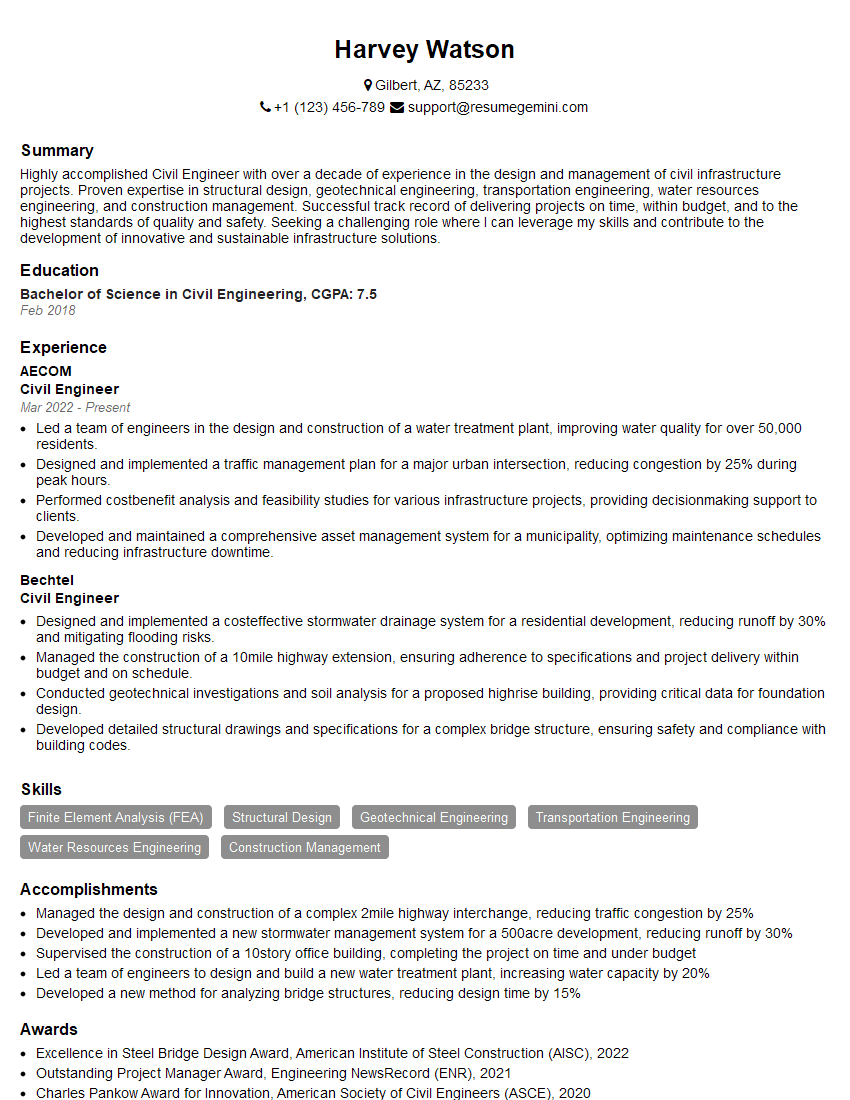
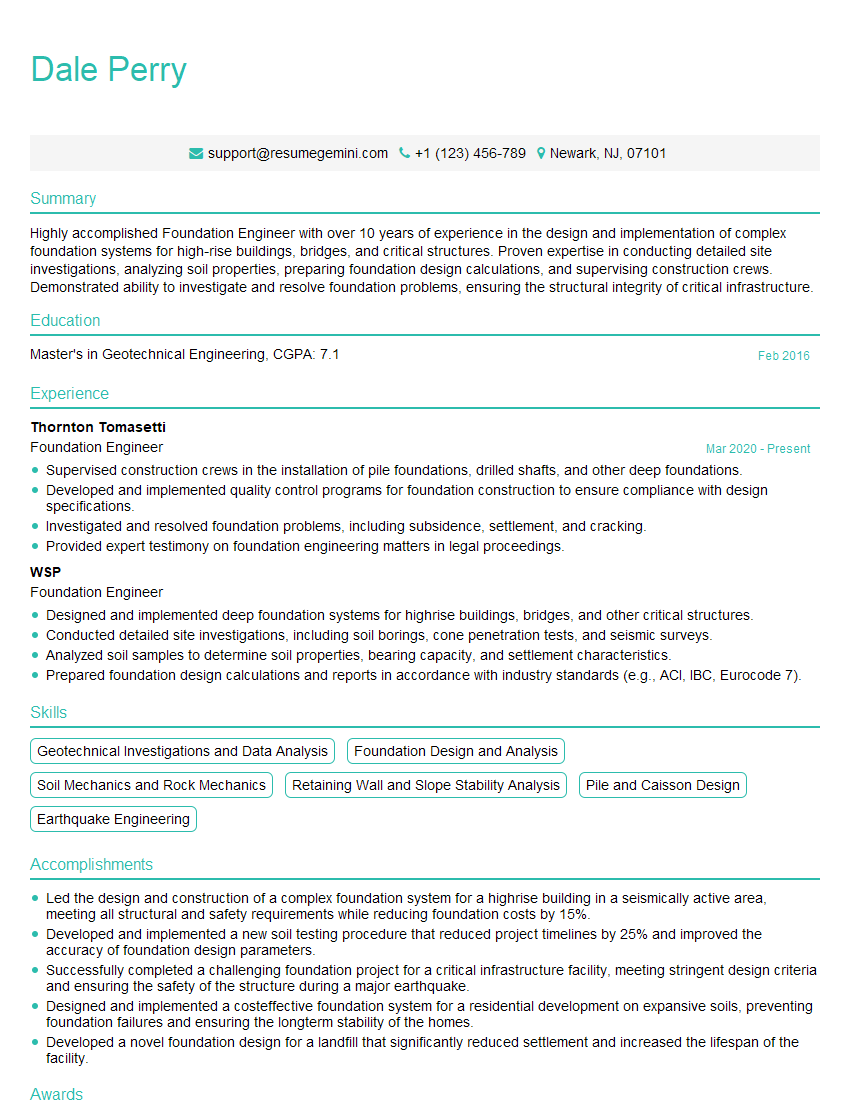
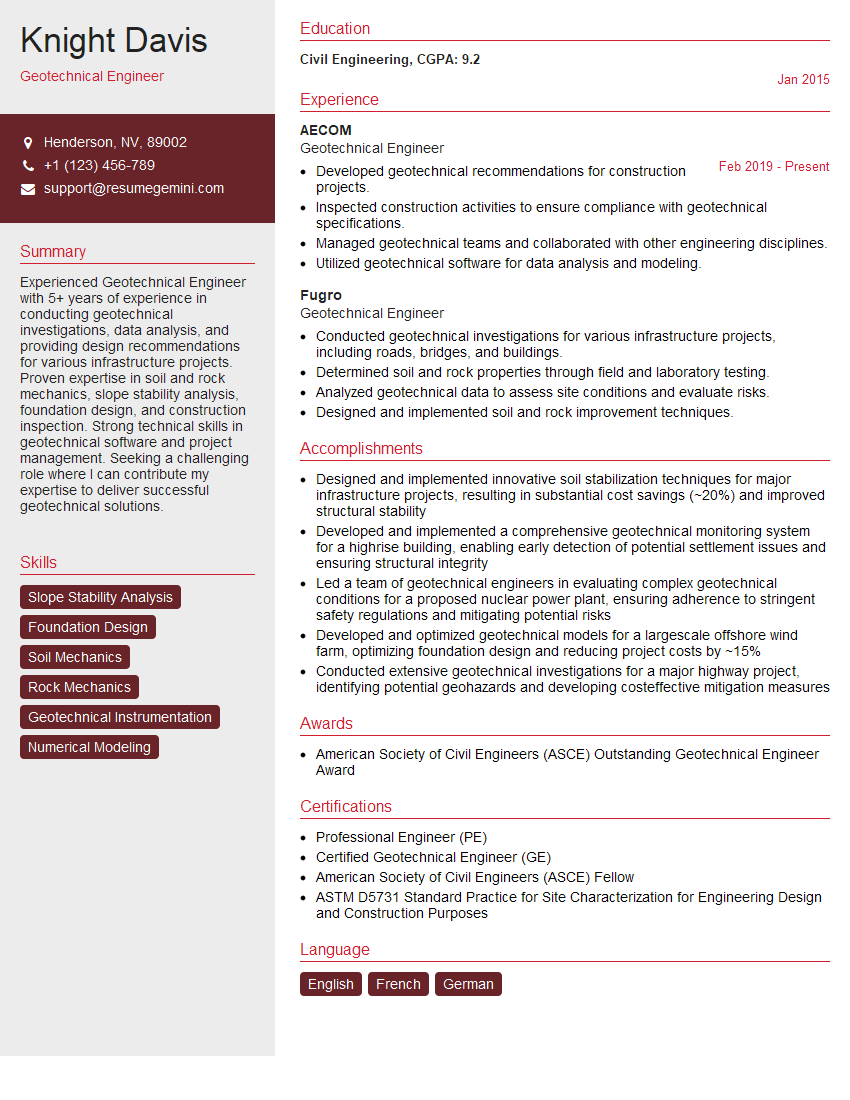
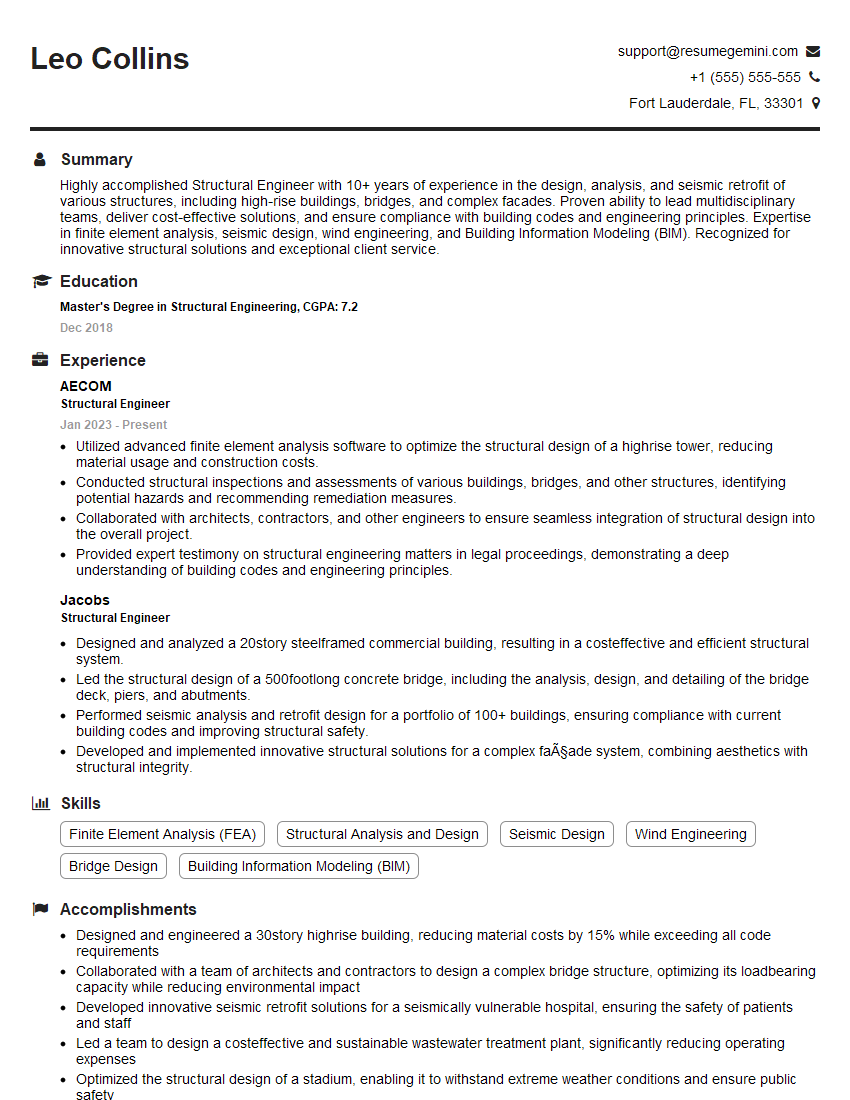
Mastering Foundation Analysis is crucial for career advancement in geotechnical engineering and related fields, opening doors to challenging and rewarding projects. To maximize your job prospects, it’s essential to present your skills effectively. Create an ATS-friendly resume that highlights your expertise in these key areas. ResumeGemini is a trusted resource for building professional resumes that get noticed. Take advantage of their tools and resources to craft a compelling resume showcasing your Foundation Analysis skills. Examples of resumes tailored to Foundation Analysis are provided to guide you.
Explore more articles
Users Rating of Our Blogs
Share Your Experience
We value your feedback! Please rate our content and share your thoughts (optional).
What Readers Say About Our Blog
Very informative content, great job.
good