Are you ready to stand out in your next interview? Understanding and preparing for Fire Hydraulics interview questions is a game-changer. In this blog, we’ve compiled key questions and expert advice to help you showcase your skills with confidence and precision. Let’s get started on your journey to acing the interview.
Questions Asked in Fire Hydraulics Interview
Q 1. Explain the principle of water hammer in fire sprinkler systems and how it’s mitigated.
Water hammer in fire sprinkler systems is a dangerous phenomenon caused by the rapid deceleration of water flow. Imagine turning off a garden hose quickly – you hear that loud bang? That’s a mini water hammer. In a sprinkler system, this happens when a valve suddenly closes, stopping the flow of water. The momentum of the water creates a pressure surge, a shockwave that travels through the pipes. This surge can cause significant damage, including pipe bursts, joint failures, and even damage to the fire pump itself.
Mitigation involves several strategies. First, air chambers or pressure relief valves are installed to absorb the shockwave. Think of an air chamber as a cushion; it allows the water to compress the air instead of impacting the pipe walls directly. Pressure relief valves simply allow excess pressure to safely escape. Second, slow-closing valves are crucial. They gradually reduce water flow, minimizing the pressure spike. Third, proper pipe sizing and material selection contribute to the system’s resilience to water hammer. Oversized pipes can reduce the velocity of the water, decreasing the impact of sudden stops. Finally, regular system maintenance and inspection are essential to identify and address potential weaknesses before they lead to problems.
Q 2. Describe the different types of fire pumps and their applications.
Fire pumps are the heart of a fire protection system, providing the necessary water pressure and flow rate to fight fires. There are several types:
- Electric Fire Pumps: These are the most common type, powered by electricity from the building’s power supply. They are reliable and relatively quiet. A common scenario is a large office building utilizing an electric fire pump.
- Diesel Fire Pumps: These are backup pumps, typically used when the main power supply fails (during a power outage). They’re essential for ensuring a continuous water supply during emergencies. Imagine a hospital needing continuous fire protection even during a blackout – this is where a diesel pump is vital.
- Jockey Pumps: These small pumps maintain pressure within the system, compensating for minor leaks and water usage. Think of it as the system’s ‘top-up’ mechanism, preventing pressure drops that could affect sprinkler operation.
- Vertical Turbine Pumps: These pumps are frequently used for high-rise buildings to move water to considerable heights. The design helps increase efficiency for lifting the water over larger vertical distances.
The choice of pump depends on factors such as the building’s size, fire risk, and local regulations. For instance, a small residential building may only require an electric fire pump, while a large industrial facility needs both electric and diesel pumps for redundancy.
Q 3. What are the key components of a fire sprinkler system?
A fire sprinkler system comprises several critical components working together to suppress fires. These include:
- Water Supply: This can be from a municipal water main, a fire pump, or a water storage tank. This is the source of the water used to extinguish the fire.
- Fire Pumps (if applicable): Provide the necessary water pressure and flow rate. As previously discussed, these can be electric, diesel, or other types.
- Piping Network: A network of pipes that distributes water throughout the protected area. The design and material of these pipes are critical for system performance and longevity.
- Sprinkler Heads: These are heat-sensitive devices that activate when exposed to high temperatures, releasing water to extinguish the fire. The type of sprinkler head chosen is dependent on the occupancy.
- Backflow Preventers: These devices prevent contamination of the potable water supply from the fire sprinkler system. This is a key safety feature.
- Control Valves: These valves allow for the isolation or control of specific sections of the system. They allow for easier maintenance and repair without shutting down the whole system.
- Alarm System (often integrated): Notifies the fire department and building occupants when the system activates.
Q 4. How do you calculate the required water flow rate for a fire sprinkler system?
Calculating the required water flow rate for a fire sprinkler system is a complex process, requiring specialized software and expertise. It’s not a simple equation. The calculation considers several crucial factors:
- Occupancy classification: Different building types have different fire hazards and require varying water flow rates. An office building will have different requirements compared to a warehouse.
- Area to be protected: Larger areas require more water to control a fire effectively. The size of the building, and specifically the size of the areas within the building, dictates the demand.
- Sprinkler density: The number of sprinklers per square foot influences the needed flow. A higher density means more water is needed to deliver the desired coverage.
- Type of sprinklers: Different sprinkler types have different discharge rates.
- Hydraulic calculations: This involves detailed calculations using hydraulic software to determine the pressure and flow requirements at each point in the system. This accounts for friction loss in the pipes, elevation differences, and other factors.
Professional engineers use specialized software that considers these factors and applicable fire codes to determine the appropriate flow rate. It is not a calculation that should be undertaken lightly.
Q 5. Explain the importance of water supply calculations in fire protection design.
Accurate water supply calculations are paramount in fire protection design because they directly impact the system’s ability to effectively control a fire. Insufficient water supply can lead to catastrophic consequences. Imagine a scenario where a fire breaks out, and the sprinkler system doesn’t have enough water pressure or flow rate to suppress it. This could result in extensive property damage and loss of life.
These calculations ensure that the system meets the required flow and pressure at all points, even during the most demanding fire scenarios. They account for water availability from the source (municipal water main, tank, or pump), pipe friction losses, elevation changes, and the expected fire demand. The calculations provide a margin of safety, ensuring the system can handle a larger fire than anticipated.
Neglecting proper water supply calculations can lead to undersized systems, resulting in inadequate fire protection and putting lives and property at risk. It’s a critical aspect of fire protection engineering that demands precision and attention to detail.
Q 6. What are the different types of fire hydrants and their pressure ratings?
Fire hydrants are essential components of a community’s fire protection infrastructure. Several types exist, categorized primarily by their design and pressure capabilities:
- Wet-barrel Hydrants: These hydrants always contain water, making them readily available for firefighting. They’re commonly found in areas with consistently low freezing temperatures. This allows for immediate access to water during an emergency.
- Dry-barrel Hydrants: These hydrants have a dry barrel, and the water enters only when the valve is opened. This design is common in areas prone to freezing temperatures, preventing damage from ice formation within the barrel.
- Frost-proof Hydrants: These have a design that minimizes the water volume in the barrel, reducing the risk of freezing. This is a hybrid option, balancing readiness with frost resistance.
Pressure ratings vary depending on the location, water source, and system design, but typically range from 50 to 150 psi (pounds per square inch), and potentially higher. Local regulations and building codes determine appropriate pressure ratings for specific areas and applications. Higher-pressure hydrants support higher water flow rates, crucial for large-scale firefighting operations.
Q 7. Describe the process of fire hydrant testing and inspection.
Fire hydrant testing and inspection are critical for ensuring the reliability of the fire protection system. Regular maintenance prevents failures during emergencies. The process typically involves:
- Visual Inspection: Examining the hydrant for any signs of damage, corrosion, or leaks. This is a quick check to notice any superficial damage that can be easily addressed.
- Flow Test: Measuring the water flow rate and pressure at the hydrant using specialized equipment. This verifies the system’s capacity to deliver the required water volume and pressure.
- Operational Test: Checking the functionality of the hydrant’s valves and nozzles to ensure they open and close smoothly and without leaks. This test checks the overall mechanical operation of the hydrant itself.
- Pressure Gauge Check: Ensuring the pressure gauge readings are accurate.
- Painting and Maintenance: Cleaning and repainting the hydrant to protect it from corrosion. This is the final step in ensuring the longevity of the hydrant.
The frequency of testing and inspection varies according to local regulations, but it’s usually performed annually or semi-annually to maintain the effectiveness of the community’s fire protection system. Detailed records of all inspections and tests should be carefully maintained.
Q 8. What are the design considerations for fire water storage tanks?
Designing fire water storage tanks requires careful consideration of several crucial factors to ensure adequate water supply during a fire. These factors include:
- Capacity: The tank must hold enough water to meet the fire flow demand for the duration of the fire, considering the occupancy type and building size. This is often determined by fire protection engineering calculations.
- Location: The tank’s location should be easily accessible to fire trucks, minimize elevation head loss, and be protected from potential hazards like freezing or vandalism. Elevated tanks offer gravity feed, simplifying the system.
- Material: The tank material must be durable, corrosion-resistant, and compatible with the stored water. Common materials include steel (often with protective coatings), concrete, and fiberglass reinforced plastic (FRP).
- Level Indicators: Accurate level indicators are crucial for monitoring the water level and ensuring timely refilling. This is essential for preventing system failure during a fire.
- Overflow Protection: An overflow system is critical to prevent water damage in case of overfilling. This usually involves an overflow pipe leading to a safe drainage point.
- Maintenance Access: Proper access points for inspection, cleaning, and maintenance are necessary for long-term tank functionality and safety. Regular inspection helps identify and address any potential issues.
For example, a large hospital might require a substantial tank capacity, potentially even multiple tanks, to support its diverse fire protection needs. Conversely, a small office building might require a smaller, simpler tank solution.
Q 9. Explain the concept of fire flow and its relevance in fire protection design.
Fire flow refers to the rate at which water is delivered to fight a fire, typically measured in gallons per minute (gpm) or liters per minute (lpm). It’s a critical element in fire protection design because it directly impacts the effectiveness of fire suppression. The required fire flow depends on several factors, including:
- Building occupancy: High-occupancy buildings like schools or hospitals require higher fire flows.
- Building construction: Fire-resistant materials can reduce fire spread, allowing for lower fire flows.
- Building size and layout: Larger buildings with complex layouts require more water to extinguish fires.
- Type of hazard: The presence of flammable materials might necessitate higher fire flows.
Fire protection engineers use established standards and formulas (often based on NFPA standards in the US) to calculate the necessary fire flow. Insufficient fire flow can lead to uncontrolled fire spread and significant property damage, while excessive fire flow can lead to unnecessary costs and resource consumption.
Imagine a scenario where a warehouse containing highly flammable materials is designed with inadequate fire flow. A fire could rapidly overwhelm the system, resulting in catastrophic losses.
Q 10. How do you determine the appropriate pipe sizing for a fire sprinkler system?
Appropriate pipe sizing for a fire sprinkler system is critical for ensuring adequate water pressure and flow to all sprinkler heads. Undersized pipes lead to insufficient water pressure and reduced fire suppression effectiveness. Oversized pipes increase costs without providing a proportional benefit. The process involves several steps:
- Determine the required fire flow: This is based on the occupancy type, building size, and hazard analysis as discussed before.
- Calculate friction loss: Friction loss in pipes reduces the water pressure available at the farthest sprinkler head. Engineers use specialized software or hydraulic calculation methods (e.g., Hazen-Williams or Darcy-Weisbach equations) to determine this.
- Apply pressure drop allowances: Account for pressure drops in fittings, valves, and other components. These pressure drops accumulate throughout the piping network.
- Select pipe size: Based on the calculated friction loss and pressure drop allowances, select the pipe diameter to maintain the necessary pressure at all sprinkler heads. This often involves iterative calculations and adjustments.
- Verify design: Perform a hydraulic analysis of the entire system to ensure it meets the required fire flow and pressure at all points.
This iterative process requires specialized software and a deep understanding of fluid mechanics. Incorrect sizing can compromise the system’s effectiveness. For instance, a poorly sized system can leave areas with insufficient water pressure, resulting in unsuppressed fires.
Q 11. What are the different types of fire sprinkler heads and their applications?
Various types of fire sprinkler heads cater to different applications and fire hazards. Some common types include:
- Standard Response Sprinkler Heads (Upright, Pendant, Sidewall): These are the most common type, discharging water when the temperature reaches their activation threshold. Orientation (upright, pendant, sidewall) is chosen based on ceiling height and space constraints.
- Early Suppression Fast Response (ESFR) Sprinkler Heads: Designed for high-rack storage areas, these heads activate quickly to suppress fires before they spread significantly. They discharge a greater volume of water than standard heads.
- Deluge Sprinkler Heads: These heads are always open, but are activated by a fire detection system. This provides rapid, widespread water discharge.
- Concealed Sprinkler Heads: These are aesthetically integrated into the ceiling, maintaining a cleaner look, but require careful consideration to ensure they are accessible for maintenance.
- Special Hazard Sprinkler Heads: These heads are designed for specific hazards, such as those involving flammable liquids or high-value assets, and may include features like increased discharge pressure or specialized nozzle designs.
Choosing the correct sprinkler head type is critical for effective fire suppression. An unsuitable head type can lead to inadequate fire protection.
Q 12. Explain the concept of friction loss in fire sprinkler piping systems.
Friction loss in fire sprinkler piping systems is the reduction in water pressure caused by the resistance of water flow against the pipe walls and fittings. The longer and narrower the pipe, the greater the friction loss. This loss must be carefully accounted for during design to ensure adequate pressure at the most distant sprinkler head. Several factors contribute to friction loss:
- Pipe diameter: Smaller diameter pipes experience greater friction loss.
- Pipe length: Longer pipe runs result in increased friction loss.
- Pipe roughness: Rougher pipe interiors increase resistance to water flow.
- Number of fittings: Elbows, tees, and valves create additional pressure drops.
- Flow rate: Higher flow rates lead to higher friction loss.
Friction loss is calculated using formulas like the Hazen-Williams or Darcy-Weisbach equations, often utilizing specialized hydraulic analysis software. Ignoring friction loss can result in insufficient water pressure at the sprinkler heads, leading to inefficient fire suppression.
Think of it like pushing water through a straw versus pushing it through a garden hose. The narrow straw offers far greater resistance (friction loss), requiring more force to push the same amount of water.
Q 13. How do you design a fire protection system for a high-rise building?
Designing a fire protection system for a high-rise building presents unique challenges due to its height, occupant density, and potential for rapid fire spread. The system typically incorporates:
- Multiple fire pumps: High-rise buildings often require multiple fire pumps to ensure redundant water supply and meet the high fire flow demands.
- Standpipes: These vertical pipes provide water supply for fire hoses, allowing firefighters to reach all floors quickly.
- Sprinkler systems: High-rise buildings utilize comprehensive sprinkler systems with strategically positioned heads, often using different types of heads based on floor usage.
- Fire alarm systems: Integrated fire alarm systems alert occupants and fire services of any fire event, initiating emergency responses.
- Zone-based systems: Large high-rise buildings often use a zone-based approach for both fire suppression and alarm systems, enabling compartmentalization and efficient response.
- Water tanks: Elevated water tanks and/or fire pump water supply reservoirs provide gravity-fed and/or pumped water supplies to compensate for elevation differences.
The design requires meticulous consideration of hydraulic calculations, building codes, and emergency egress strategies. A thorough risk assessment is essential to identify potential vulnerabilities and mitigate them through appropriate design choices.
For example, a high-rise hotel would have a vastly different fire protection system than a high-rise office building, reflecting the differing occupancies and associated risks.
Q 14. Describe the role of backflow preventers in fire protection systems.
Backflow preventers are crucial safety devices in fire protection systems. They prevent the contamination of potable water supplies by backflow from the fire system. This is essential to protect public health. Backflow can occur due to several reasons:
- Pressure fluctuations: Fluctuations in water pressure can reverse the flow direction.
- System malfunctions: A leak or break in the fire system can draw contaminated water into the potable water supply.
- Cross-connection: Accidental or intentional connections between the fire system and potable water can cause backflow.
Different types of backflow preventers exist, including:
- Reduced-pressure principle backflow preventer (RP): This is the most common and effective type, providing double protection against backflow.
- Double-check valve backflow preventer (DC): This type uses two check valves to prevent backflow, but offers less protection than an RP device.
Proper selection and installation of backflow preventers are essential for compliance with health codes and to protect the public from potential water contamination. Regular inspection and testing are also mandated to ensure their continued functionality.
Imagine a scenario where a fire sprinkler system lacks a backflow preventer. If the system develops a leak, contaminated water from fire suppression could potentially flow back into the drinking water supply.
Q 15. What are the common codes and standards related to fire hydraulics?
Several codes and standards govern fire hydraulics design, installation, and maintenance, ensuring the safety and effectiveness of fire protection systems. These vary by region but some of the most commonly referenced include:
- NFPA (National Fire Protection Association) Standards: NFPA 13 (Standard for the Installation of Sprinkler Systems) is a cornerstone, detailing sprinkler system design, installation, and testing. Other relevant NFPA standards include NFPA 20 (Standard for the Installation of Stationary Pumps for Fire Protection) and NFPA 25 (Standard for the Inspection, Testing, and Maintenance of Water-Based Fire Protection Systems).
- IFC (International Fire Code): This code adopts many of the NFPA standards and provides a model code for fire prevention and protection in building construction.
- Local Building Codes: Jurisdictions often have their own building codes that incorporate or modify the NFPA and IFC standards to fit local needs and conditions. Always check your local regulations.
- FM Global (Factory Mutual Global): While not a code per se, FM Global’s standards are widely respected and frequently referenced in high-hazard industrial facilities, providing even stricter guidelines than basic codes.
Understanding and adhering to these standards is crucial for ensuring the reliable performance of fire hydraulic systems and complying with legal requirements. For example, a deviation from NFPA 13 could lead to inadequate water pressure during a fire, compromising the effectiveness of the sprinkler system.
Career Expert Tips:
- Ace those interviews! Prepare effectively by reviewing the Top 50 Most Common Interview Questions on ResumeGemini.
- Navigate your job search with confidence! Explore a wide range of Career Tips on ResumeGemini. Learn about common challenges and recommendations to overcome them.
- Craft the perfect resume! Master the Art of Resume Writing with ResumeGemini’s guide. Showcase your unique qualifications and achievements effectively.
- Don’t miss out on holiday savings! Build your dream resume with ResumeGemini’s ATS optimized templates.
Q 16. Explain the difference between a wet pipe and dry pipe sprinkler system.
The main difference between wet pipe and dry pipe sprinkler systems lies in the state of the piping and the presence of water within the system before activation.
- Wet Pipe System: In a wet pipe system, the piping is always filled with water under pressure. When a sprinkler head activates due to heat, water immediately flows out. This provides the fastest response time, making it ideal for areas that are not subject to freezing temperatures. Think of it as a water gun always ready to fire.
- Dry Pipe System: A dry pipe system is designed for areas where freezing temperatures are a concern. The piping is filled with compressed air or nitrogen. When a sprinkler head activates, the air pressure drops, triggering a valve to open and allow water to flow into the system. There’s a slight delay in water discharge compared to a wet pipe system. This is like a water gun that needs to be primed before firing.
Choosing the right system depends heavily on environmental conditions. Imagine a warehouse in a cold climate – a dry pipe system is essential. Conversely, a supermarket in a warm climate would benefit from the faster response time of a wet pipe system.
Q 17. What are the safety precautions to be taken during fire hydraulics system maintenance?
Safety during fire hydraulic system maintenance is paramount. The procedures should always prioritize the safety of personnel and the integrity of the system.
- Lockout/Tagout Procedures: Before any maintenance activity, implement strict lockout/tagout procedures to isolate power sources to the pumps and other components. This prevents accidental activation and ensures no one gets injured.
- Personal Protective Equipment (PPE): Appropriate PPE, including safety glasses, gloves, and hearing protection, should be worn at all times. When dealing with high-pressure systems, specialized protective clothing might be needed.
- Confined Space Entry Procedures (if applicable): If maintenance requires entering confined spaces such as pump rooms or pipe trenches, strictly follow confined space entry procedures to prevent oxygen deficiency, hazardous atmosphere exposure, and engulfment hazards.
- Pressure Relief: Before working on any pressurized component, ensure that the system pressure is relieved safely and completely.
- Water Testing: When working with water-based systems, be cautious of potential water hazards, especially during testing.
- Proper Training and Certification: Only trained and certified personnel should perform maintenance on fire hydraulic systems.
Failing to follow these precautions can lead to serious injuries, system damage, or even compromise fire protection capabilities. Safety is never negotiable.
Q 18. How do you troubleshoot a malfunctioning fire pump?
Troubleshooting a malfunctioning fire pump requires a systematic approach. Here’s a step-by-step process:
- Check the Power Supply: Confirm power is reaching the pump motor by checking circuit breakers, fuses, and power meters. A simple power failure is often the root cause.
- Inspect the Pump Motor: Look for visible damage to the motor, such as burned windings or loose connections. Listen for unusual sounds like grinding or whining.
- Check the Pump Priming: Ensure the pump is properly primed with water, as airlocks can prevent operation. Check for leaks in the suction line.
- Examine the Pressure Gauges: Verify that the pump is building sufficient pressure. Low pressure could indicate a problem with the pump, valves, or piping.
- Check the Valves: Make sure all valves in the system are fully open. A closed valve can restrict water flow and prevent the pump from working correctly.
- Inspect the Couplings and Shaft Alignment: Couplings connect the motor to the pump. Misalignment can lead to vibrations, damage, and pump failure.
- Check the Automatic Controls: Many fire pumps are controlled automatically. Test the automatic controls to ensure they are functioning correctly and responding to pressure changes.
- Consult Maintenance Logs: Review previous maintenance logs for any clues about past issues or scheduled repairs.
If you cannot identify and fix the problem, always contact a qualified fire protection specialist.
Q 19. Describe the process of commissioning a fire sprinkler system.
Commissioning a fire sprinkler system is a critical process ensuring it meets design specifications and functions correctly. It involves a series of systematic checks and tests.
- Pre-Commissioning Inspection: A thorough inspection verifies the system’s installation conforms to the approved plans and relevant codes (like NFPA 13). This includes checking pipework, fittings, sprinkler heads, and the pump.
- Pump Testing: The fire pump is tested to confirm it can deliver the required flow and pressure as per design specifications. This typically includes flow tests and pressure tests.
- System Flushing: The entire system is flushed to remove any debris or sediment from the pipes, ensuring clear water flow to all sprinkler heads.
- Leak Testing: A leak test is conducted under pressure to identify any leaks in the system. This ensures that the system remains intact and retains its pressure.
- Sprinkler Head Testing (Partial): A small number of sprinkler heads are tested to verify they operate correctly at the designed pressure.
- Pressure Testing: The entire system is subjected to a pressure test to ensure it can handle the operational pressure and to identify any weak points.
- Documentation: All testing and inspection results are thoroughly documented, providing a complete record for future reference.
- Final Inspection and Acceptance: Once all tests are satisfactory and documentation is complete, a final inspection is done before official system acceptance. This is often done by an authority having jurisdiction (AHJ).
The thoroughness of commissioning is crucial. Imagine a scenario where commissioning is inadequate – a leak could go undetected, leading to a failure during a fire. Proper commissioning ensures a reliable system.
Q 20. What are the different methods of fire water supply?
Fire water supply methods vary depending on the size, location, and risk level of the building. Common methods include:
- Municipal Water Supply: The most common method, connecting directly to the public water main. Reliable and readily available, but requires sufficient water pressure and flow rate.
- Gravity Tanks: Water is stored in elevated tanks, using gravity to provide water pressure. This is a backup supply, often used in conjunction with municipal water.
- Pressure Tanks: Water is stored under pressure in tanks. This provides a readily available supply, particularly useful for smaller buildings.
- Fire Pump Systems: A fire pump increases water pressure from a water source, providing sufficient pressure even if the water supply pressure is low. This is crucial for high-rise buildings.
- Private Water Reservoirs or Wells: Some larger facilities maintain their own water reservoirs or wells, independent of the municipal supply, providing redundancy.
The choice of method depends on factors like building height, fire risk assessment, local regulations, and budget constraints. Imagine a high-rise building – a fire pump system is essential to deliver water to upper floors. A smaller building might rely solely on municipal water.
Q 21. Explain the importance of regular inspections and testing of fire protection systems.
Regular inspections and testing of fire protection systems are essential for ensuring their continued reliability and effectiveness. Neglecting this can have serious consequences.
- Early Detection of Problems: Regular inspections help to detect minor problems early, preventing them from escalating into major failures. A small leak, for example, can be fixed inexpensively early on, avoiding costly repairs later.
- Compliance with Codes and Standards: Regular testing helps ensure compliance with relevant building codes and insurance requirements. This prevents penalties and potential insurance issues.
- Maintenance of System Integrity: Regular maintenance keeps the system in optimal working order, maximizing its efficiency and reliability.
- Life Safety: Ultimately, the purpose is life safety. A properly maintained fire protection system significantly increases the chances of successfully extinguishing a fire and protecting lives and property.
Think of a car – regular maintenance is crucial for its longevity and performance. Similarly, consistent inspections and testing for fire protection systems maintain their readiness during an emergency. It’s a cost-effective way to protect lives and investments.
Q 22. How do you ensure compliance with fire codes and regulations in fire protection system design?
Ensuring compliance with fire codes and regulations is paramount in fire protection system design. It’s not just about meeting minimum requirements; it’s about designing a system that effectively protects lives and property. This involves a multi-step process:
- Thorough Code Review: We begin by meticulously reviewing all applicable codes – NFPA 13 (Standard for the Installation of Sprinkler Systems), NFPA 20 (Standard for the Installation of Stationary Fire Pumps), local building codes, and any relevant jurisdictional requirements. This ensures we understand the specific mandates for the project location and building type.
- Design Calculations: Precise hydraulic calculations are performed to determine the appropriate pipe sizes, pump capacity, sprinkler densities, and pressure requirements. These calculations must demonstrably meet or exceed the code-specified minimums.
- System Modeling: We often utilize specialized software (discussed in the next answer) to create detailed models of the system. These models allow us to simulate various scenarios, including fire events, and ensure the system performs as designed under worst-case conditions.
- Documentation and Submittal: Comprehensive documentation is essential. This includes detailed calculations, system diagrams, equipment specifications, and a narrative explaining the design choices. This package is submitted to the relevant authorities for review and approval.
- Inspections and Testing: We actively participate in inspections and testing throughout the project lifecycle to ensure compliance and adherence to the approved plans. This includes witnessing hydrostatic tests, flow tests, and other required verifications.
For example, in a recent high-rise project, we had to navigate stringent requirements regarding riser placement and pump redundancy, ensuring compliance with both local and international fire codes. This involved extensive modeling and detailed justification within our submittal package.
Q 23. What software or tools do you use for fire hydraulics calculations and design?
Several software tools are indispensable for accurate and efficient fire hydraulics calculations and design. My experience spans various platforms, each with its strengths:
- HydraCAD: This software is widely used for its comprehensive capabilities in sprinkler system design. It allows for detailed modeling of pipe networks, pump curves, and sprinkler performance, providing accurate pressure and flow calculations.
- WaterCAD: Excellent for larger, more complex systems, WaterCAD offers sophisticated hydraulic modeling features that handle extended networks efficiently, incorporating aspects like water storage tanks and pressure reducing valves.
- Autosprink: This user-friendly software provides a strong foundation for performing sprinkler design calculations, especially valuable for smaller projects or quick estimations.
- FireFlow: A robust software capable of handling detailed hydraulic analysis, including diverse sprinkler types and system layouts. It also incorporates features for simulating different fire scenarios.
The choice of software depends heavily on project specifics. For instance, while HydraCAD is excellent for detailed sprinkler layouts, WaterCAD might be preferred for large-scale industrial facilities incorporating extensive pipe networks and various pressure management devices.
Q 24. Describe your experience with different types of fire protection system calculations.
My experience encompasses a broad range of fire protection system calculations. This includes:
- Sprinkler System Design: This is the most common type of calculation, involving determining pipe sizes, sprinkler spacings, and pump requirements to ensure adequate water supply to extinguish a fire. This often incorporates different sprinkler types and activation patterns (e.g., early suppression, fast response).
- Standpipe System Design: These calculations focus on providing sufficient water pressure and flow rate to fire hoses at various locations within a building. This involves considerations of hose length, friction losses, and potential simultaneous use of multiple hose lines.
- Fire Pump Calculations: We assess pump capacity, head pressure, and required NPSH (Net Positive Suction Head) to ensure reliable water supply to the fire protection system. This often involves pump curve analysis and consideration of alternative power sources.
- Water Supply Analysis: Evaluating the adequacy of the existing water supply source (municipal water main, reservoir, etc.) to meet the demands of the fire protection system is crucial. This involves hydraulic modeling and consideration of potential pressure drops in the supply lines.
- Water Tank Design: In cases where a fire pump relies on water storage, tank sizing and outflow calculations are necessary, considering water levels and pressure demands.
For example, a recent project required the integration of a new fire sprinkler system into an existing building with a limited water supply. This necessitated meticulous water supply analysis to ensure the existing infrastructure could support the additional demands without impacting other systems.
Q 25. Explain your understanding of the different pressure-reducing methods in fire protection systems.
Pressure reduction methods are vital in fire protection systems to avoid excessive pressure that could damage pipes and fittings, or create unequal water distribution. Several techniques are employed:
- Pressure Reducing Valves (PRVs): These are mechanical devices installed in the piping system to maintain a consistent downstream pressure regardless of upstream fluctuations. They are crucial for protecting sensitive components and ensuring even water distribution throughout the system.
- Pressure-Regulating Devices: These devices, often incorporating flow control, ensure consistent pressure and flow to different sections of the system. They are particularly helpful in high-rise buildings or complex layouts.
- Flow Control Devices: While not directly pressure-reducing, flow control devices like orifice plates or flow restrictors manage the water flow to different zones, indirectly affecting pressure distribution. They are used to ensure that specific areas receive the correct flow rate.
- Multiple Pump Zones: Dividing the system into separate zones, each fed by its own pump, can reduce pressure variations throughout the system and allow for more precise control.
- Elevating Water Tanks: By storing water at a higher elevation, the system can naturally reduce pump pressure required while ensuring adequate pressure at higher floors.
Selecting the appropriate pressure-reducing method depends on several factors including system layout, pressure requirements, and the sensitivity of system components. For instance, PRVs are common in high-rise buildings to maintain pressure in different zones, while elevated tanks can provide a natural pressure reduction in low-rise applications.
Q 26. Describe a challenging fire hydraulics project you have worked on and how you overcame the challenges.
One particularly challenging project involved the retrofitting of a fire sprinkler system into a historic landmark. The building’s unique architecture, with its intricate piping layouts and sensitive structural elements, posed several obstacles:
- Limited Access: Navigating narrow spaces and avoiding damage to the existing building fabric required careful planning and specialized equipment.
- Historical Constraints: We had to integrate the new system without compromising the building’s historical integrity. This involved working closely with preservation specialists and using methods that minimized disruption.
- Complex Piping Layout: The existing building infrastructure didn’t lend itself easily to a standard sprinkler layout, requiring creative solutions and detailed hydraulic modeling to ensure adequate water distribution.
We overcame these challenges through a multi-pronged approach:
- Detailed 3D Modeling: We created highly accurate 3D models of the building’s interior, including existing pipework and structural details. This allowed for precise planning of the new system’s routing and minimized unexpected conflicts during installation.
- Collaboration with Specialists: Close collaboration with preservationists, structural engineers, and historical building experts ensured that our design and installation methods respected the building’s history and integrity.
- Phased Installation: We divided the installation into phases to minimize disruption and allow for flexibility in addressing any unforeseen complications.
The project ultimately resulted in a fully compliant and effective fire sprinkler system that seamlessly integrates with the historical structure. The success speaks to the value of meticulous planning, creative problem-solving, and effective teamwork.
Q 27. How do you manage multiple priorities and deadlines in a fast-paced fire protection project?
Managing multiple priorities and deadlines in a fast-paced fire protection project requires a structured approach. I use a combination of techniques:
- Prioritization Matrix: I employ a matrix to rank tasks based on urgency and importance, ensuring that critical activities are addressed first. This involves careful consideration of project timelines, regulatory deadlines, and potential impacts of delays.
- Project Scheduling Software: Software like MS Project or Primavera P6 helps me create detailed schedules, track progress, and allocate resources effectively. This allows for proactive identification and management of potential delays.
- Regular Team Meetings: Frequent communication with the project team, clients, and contractors is essential. Meetings provide opportunities to address challenges, resolve conflicts, and keep everyone informed of the project’s progress.
- Risk Management: Identifying and mitigating potential risks is a crucial aspect of project management. This involves developing contingency plans to address unforeseen events and minimize their impact on the project schedule.
- Clear Communication: Maintaining transparent and effective communication with all stakeholders keeps everyone informed and minimizes confusion or misunderstandings that could lead to delays.
In a recent project with tight deadlines, employing this strategy allowed us to successfully complete the project on time and within budget despite unexpected site constraints and supply chain challenges. Proactive risk management proved invaluable in mitigating delays.
Q 28. What are your continuing education plans to stay updated on the latest fire hydraulics technologies and standards?
Staying current with the latest fire hydraulics technologies and standards is crucial for providing the best possible service. My continuing education strategy involves a multi-faceted approach:
- NFPA Code Updates: I actively follow updates and revisions to the NFPA codes (NFPA 13, NFPA 20, etc.) to remain abreast of changes in regulations and best practices.
- Industry Conferences and Seminars: Attending relevant industry conferences and seminars provides valuable opportunities to learn about new technologies, best practices, and network with other professionals.
- Professional Development Courses: Participating in advanced training courses and workshops focused on fire protection engineering and hydraulics keeps my skills sharpened and expands my knowledge base.
- Professional Organizations: Membership in professional organizations such as the Society of Fire Protection Engineers (SFPE) provides access to resources, publications, and networking opportunities to stay informed about industry trends.
- Software Updates and Training: Staying updated with the latest versions of design software and participating in related training ensures proficiency in using the most advanced tools available.
This commitment to ongoing learning ensures that I can deliver innovative, safe, and compliant fire protection designs that incorporate the latest technologies and meet the evolving demands of the industry.
Key Topics to Learn for Fire Hydraulics Interview
- Water Supply Systems: Understanding various water sources (municipal, tanks, reservoirs), pump types and their characteristics (centrifugal, positive displacement), and pressure management within the system.
- Pump Operation and Maintenance: Practical knowledge of pump curves, troubleshooting common pump issues, understanding preventative maintenance schedules, and safety procedures related to pump operation.
- Fire Hose and Nozzle Selection: Calculations for appropriate hose size and nozzle selection based on required flow rate and pressure, understanding friction loss in hoses, and the impact of different nozzle types on fire stream patterns.
- Hydrant Systems and Location: Familiarity with different hydrant types and their placement strategies, understanding the importance of hydrant spacing and flow testing procedures.
- Fire Sprinkler Systems: Knowledge of different sprinkler types (wet pipe, dry pipe, pre-action), activation mechanisms, water flow calculations, and system design considerations.
- Water Flow Calculations and Pressure Loss: Ability to perform calculations to determine water flow rates, pressure losses due to friction and elevation changes, and applying these calculations to real-world scenarios.
- Fire Protection System Design Principles: Understanding the fundamental principles of fire protection system design, including water supply adequacy, pipe sizing, and system layout.
- Safety Regulations and Codes: Familiarity with relevant fire codes and safety regulations pertaining to fire hydraulics and water supply systems.
- Troubleshooting and Problem-Solving: Ability to diagnose and solve problems related to fire hydraulic systems, such as low pressure, leaks, or malfunctioning equipment.
- Hydraulic Modeling and Simulation Software: Understanding the use of software to model and simulate fire hydraulic systems, which demonstrates advanced skills.
Next Steps
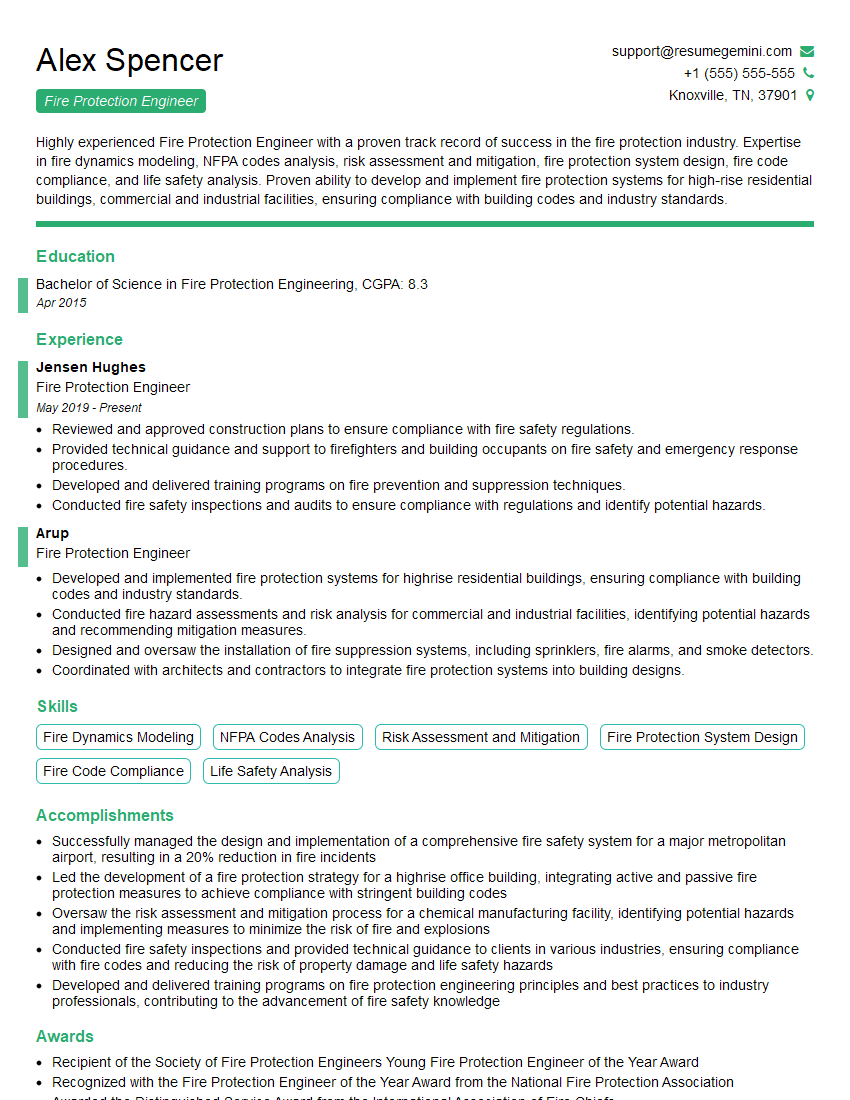
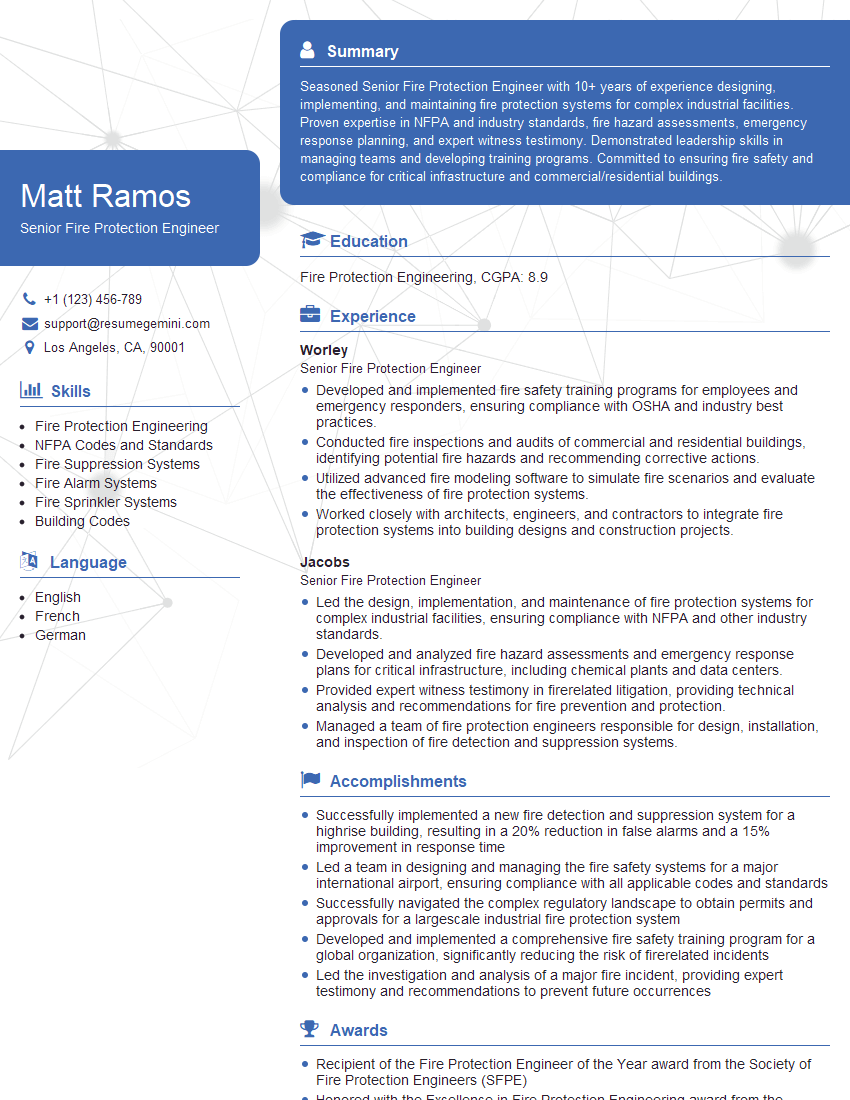
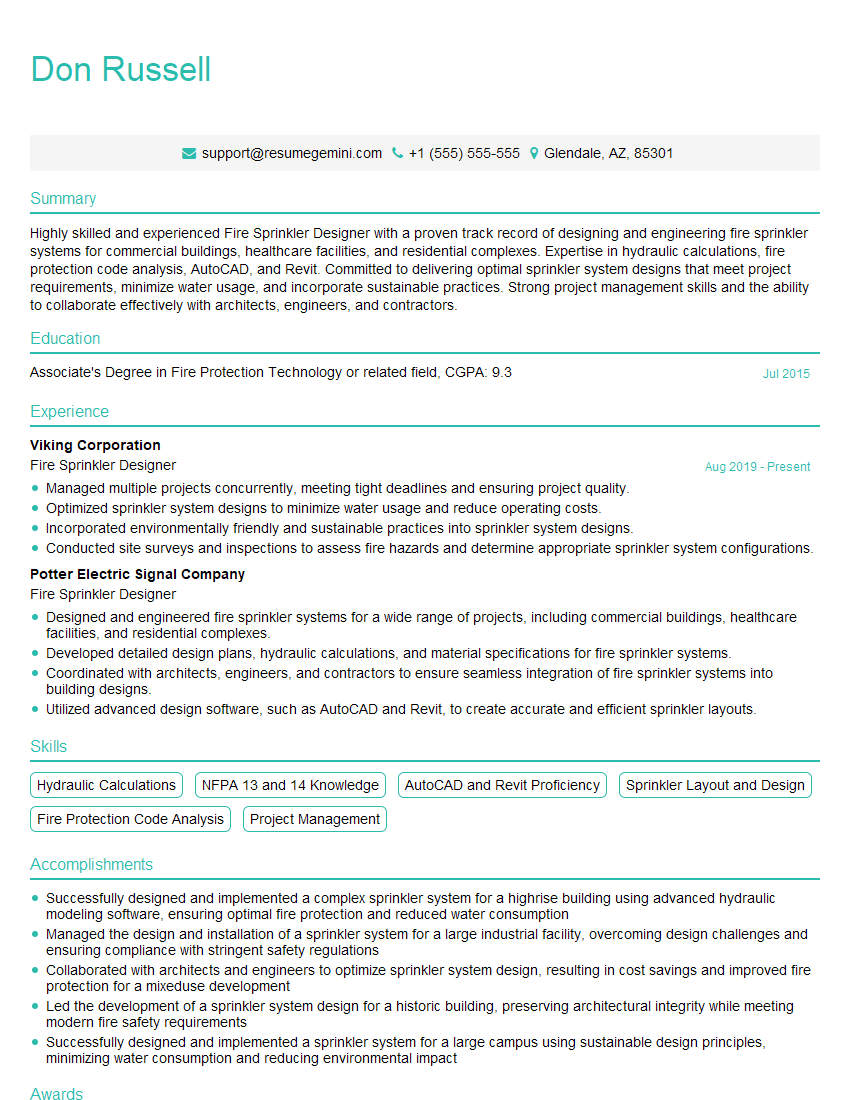
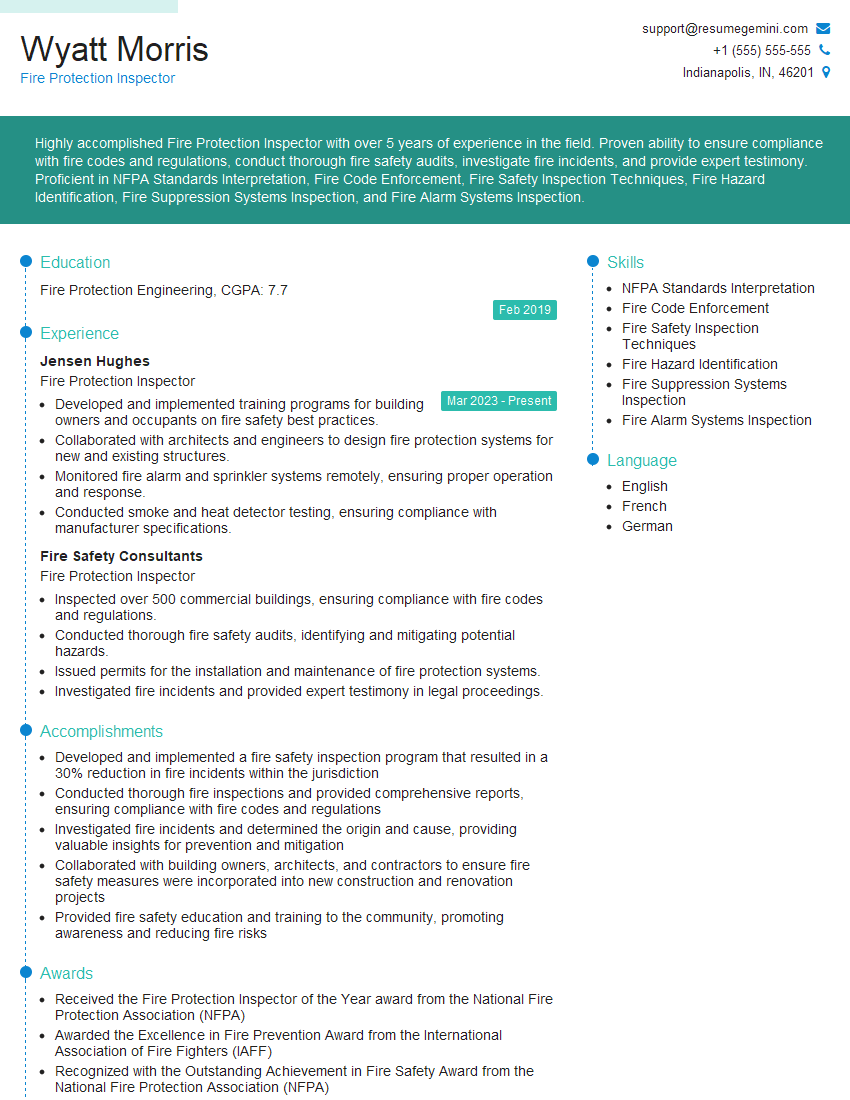
Mastering Fire Hydraulics is crucial for career advancement in the fire protection industry, opening doors to specialized roles and increased earning potential. A well-crafted resume is your key to unlocking these opportunities. Creating an ATS-friendly resume ensures your application gets noticed by recruiters and hiring managers. To build a powerful resume that highlights your skills and experience effectively, we recommend using ResumeGemini. ResumeGemini offers a user-friendly platform and provides examples of resumes tailored to the Fire Hydraulics field, helping you present yourself in the best possible light.
Explore more articles
Users Rating of Our Blogs
Share Your Experience
We value your feedback! Please rate our content and share your thoughts (optional).
What Readers Say About Our Blog
Very informative content, great job.
good