The right preparation can turn an interview into an opportunity to showcase your expertise. This guide to Uncertainty Quantification and Error Analysis interview questions is your ultimate resource, providing key insights and tips to help you ace your responses and stand out as a top candidate.
Questions Asked in Uncertainty Quantification and Error Analysis Interview
Q 1. Explain the difference between aleatory and epistemic uncertainty.
Aleatory and epistemic uncertainties represent two fundamentally different sources of uncertainty. Think of it like this: aleatory uncertainty is inherent randomness, like the roll of a die – no matter how much you know about the die, you can’t predict the outcome perfectly. Epistemic uncertainty, on the other hand, stems from our lack of knowledge. It’s the uncertainty we could potentially reduce with more information or better models. For example, the exact height of Mount Everest is subject to epistemic uncertainty – we have measurements, but they are subject to error and future surveys may reveal a slightly different value. Aleatory uncertainty is irreducible, while epistemic uncertainty is, at least in principle, reducible.
Aleatory Uncertainty: This type of uncertainty is inherent in the system itself and reflects the natural variability of a process. It’s often referred to as ‘irreducible uncertainty’ because it can’t be reduced by acquiring more information. Examples include the random fluctuations in weather patterns or the inherent variability in the strength of materials.
Epistemic Uncertainty: This type reflects our lack of knowledge about a system. It is, in theory, reducible through further research, better models, or more accurate measurements. Examples include uncertainty in model parameters due to limited data, uncertainty in the boundary conditions of a simulation, or uncertainty stemming from simplifying assumptions in a model.
Q 2. Describe various methods for propagating uncertainty through a model.
Propagating uncertainty through a model means accounting for how the uncertainties in the input parameters affect the output predictions. Several methods exist, each with its strengths and weaknesses:
- Monte Carlo Simulation: This is a powerful method that involves generating numerous random samples of the input parameters based on their probability distributions. The model is then run for each sample, and the resulting output distribution provides a measure of the uncertainty in the model predictions. It’s computationally intensive but very versatile.
- First-Order Second-Moment (FOSM) Method: This is an approximate method that uses a Taylor series expansion to linearize the model around the mean values of the input parameters. It’s computationally efficient, but it’s only accurate for models that are approximately linear within the range of uncertainty.
- Stochastic Finite Element Method (SFEM): Used extensively in structural engineering and other fields, SFEM treats uncertain parameters as random variables and incorporates the randomness directly into the governing equations. The solution is then a random field representing the probabilistic nature of the quantities being calculated (e.g., stresses, displacements).
- Polynomial Chaos Expansion (PCE): PCE represents the model output as a polynomial expansion in terms of orthogonal polynomials of the input random variables. It offers a good balance between accuracy and computational efficiency, particularly for smooth, well-behaved models.
The choice of method depends on the complexity of the model, the computational resources available, and the desired level of accuracy.
Q 3. What are the advantages and disadvantages of Monte Carlo simulation?
Monte Carlo simulation is a widely used technique for uncertainty quantification, but like any method, it has advantages and disadvantages.
- Advantages:
- Versatility: It can handle highly complex models and non-linear relationships between inputs and outputs.
- Relatively easy to implement: The basic concept is straightforward, though sophisticated variance reduction techniques may require more expertise.
- Provides full probability distributions: Instead of just providing point estimates, it generates the entire distribution of the model output, giving a comprehensive picture of the uncertainty.
- Disadvantages:
- Computationally intensive: It requires a large number of model runs, making it time-consuming, especially for computationally expensive models.
- Statistical convergence: The accuracy of the results depends on the number of simulations; more simulations are needed for higher accuracy, which increases computational cost.
- Can be sensitive to random number generators: The quality of the random number generator can affect the results.
Q 4. How do you assess the accuracy of a numerical method?
Assessing the accuracy of a numerical method involves comparing its results to a known solution or a more accurate solution. This often involves analyzing different types of errors:
- Convergence studies: Refine the numerical solution (e.g., by reducing the mesh size in finite element analysis or increasing the number of terms in a series expansion). If the solution converges to a stable value, it suggests the method is accurate. Plotting the error versus the refinement parameter (e.g., mesh size) can show the rate of convergence.
- Comparison with analytical solutions: If an analytical solution exists for a simplified version of the problem, the numerical solution can be compared against it. This helps to quantify the error introduced by the numerical approximations.
- Benchmarking: Comparing the results of the numerical method against well-established benchmark solutions or results from other numerical methods. This is particularly useful for complex problems where analytical solutions are not available.
- Verification and validation: Verification ensures the numerical method is implemented correctly (does it solve the equations it was intended to solve?), whereas validation checks if the numerical model accurately represents the real-world system.
The choice of accuracy assessment method depends on the problem’s nature and the availability of reference solutions.
Q 5. Explain different types of error in numerical computation (e.g., truncation, round-off).
Numerical computation errors arise from various sources. Here are some key types:
- Round-off error: This error results from the finite precision of computers. Real numbers are represented with a limited number of digits, leading to approximations. It accumulates during calculations, potentially affecting the accuracy of the final result. For example, representing 1/3 as 0.333333… introduces round-off error.
- Truncation error: This arises from approximating infinite mathematical processes with finite ones. For instance, representing a function using a finite number of terms in a Taylor series expansion truncates the infinite series, resulting in an error. The more terms included, the smaller the truncation error.
- Discretization error: This occurs when continuous mathematical problems are approximated using discrete representations, like replacing a differential equation with a finite difference equation. The smaller the discretization step (e.g., mesh size), the smaller the discretization error.
These errors often interact, and understanding their sources is crucial for designing robust numerical methods and interpreting results accurately.
Q 6. Describe the concept of sensitivity analysis and its importance in UQ.
Sensitivity analysis is a crucial aspect of uncertainty quantification. It determines how sensitive the model output is to variations in the input parameters. This helps prioritize efforts in reducing uncertainty. A highly sensitive parameter, even with a small uncertainty, can significantly impact the output, making it a primary focus for further investigation or improved measurement.
Methods for Sensitivity Analysis:
- Local methods: These methods assess sensitivity around a specific point in the input parameter space. Examples include methods based on partial derivatives, like the adjoint method.
- Global methods: These methods explore a larger region of the parameter space. Examples include variance-based methods like Sobol indices, which quantify the contribution of each input parameter to the variance of the output.
Importance in UQ:
- Resource allocation: Sensitivity analysis helps prioritize data collection and model refinement efforts by identifying the most influential parameters.
- Model simplification: Parameters with low sensitivity can be fixed or simplified, reducing model complexity without significantly affecting accuracy.
- Risk assessment: Identifying parameters with high sensitivity helps assess the potential impact of uncertainty on critical model outputs.
For instance, in climate modeling, sensitivity analysis might reveal that the uncertainty in aerosol forcing is more crucial than uncertainty in some other input parameters. This guides further research toward improving our understanding and measurements of aerosol forcing.
Q 7. How do you quantify uncertainty in model parameters?
Quantifying uncertainty in model parameters involves determining their probability distributions. This process relies on available data and expert knowledge:
- Prior distributions: Before any data is analyzed, prior distributions reflect initial beliefs or assumptions about the parameter values. These are often informed by physical constraints, previous studies, or expert judgment. A common approach is to use informative priors based on existing data or subjective knowledge. If little prior knowledge is available, a non-informative prior might be selected.
- Data-driven methods: Analyzing experimental data or observational data is essential for improving our knowledge of model parameters. This can involve fitting probability distributions (e.g., Gaussian, uniform, log-normal) to the data using statistical methods like maximum likelihood estimation (MLE) or Bayesian inference.
- Bayesian inference: This framework formally combines prior knowledge with data to obtain posterior distributions. The posterior distributions represent updated beliefs about the parameter values given the observed data. Markov Chain Monte Carlo (MCMC) is a common computational method used for Bayesian inference with complex models.
The choice of method depends on the data availability, model complexity, and the degree of prior knowledge. Ideally, a combination of prior information and data analysis provides a robust and reliable characterization of the uncertainty in model parameters.
Q 8. Explain different methods for uncertainty quantification in experimental data.
Uncertainty quantification (UQ) in experimental data focuses on characterizing and quantifying the variability and uncertainty inherent in measurements. Several methods exist, depending on the nature of the uncertainty.
Classical Methods: These methods rely on statistical analysis of the data itself. For instance, we might calculate the standard deviation or standard error of the mean to quantify the uncertainty in a single measurement or an average. We often assume a normal distribution, which is a common but not always accurate assumption.
Propagation of Uncertainties: If the measurement involves multiple variables with their own uncertainties, we use techniques like the method of differentials or Monte Carlo simulation to propagate these individual uncertainties to the final result. Imagine measuring the area of a rectangle: errors in measuring length and width will combine to create uncertainty in the area.
Data-Driven Methods: These leverage advanced statistical techniques to model the relationship between input variables and output measurements. This includes methods like bootstrapping (resampling with replacement to create many pseudo-datasets), robust regression (less sensitive to outliers), and Bayesian methods (discussed in the next question). For example, bootstrapping can be used to estimate the variability of a regression model’s coefficients.
The choice of method depends on factors like the size of the dataset, the nature of the uncertainties (random vs. systematic), and the desired level of detail in the uncertainty analysis.
Q 9. What are Bayesian methods and how are they applied in UQ?
Bayesian methods provide a powerful framework for UQ by explicitly incorporating prior knowledge or beliefs about the parameters of interest. Unlike frequentist methods which focus on the frequency of events, Bayesian methods treat parameters as random variables with probability distributions.
Application in UQ: A Bayesian approach starts with a prior distribution representing our initial belief about a parameter (e.g., the mean of a process). We then collect data and use Bayes’ theorem to update the prior, resulting in a posterior distribution that reflects our updated belief after observing the data. This posterior distribution provides a comprehensive representation of the uncertainty in the parameter, capturing both aleatoric (inherent randomness) and epistemic (lack of knowledge) uncertainties.
Example: Imagine estimating the failure rate of a component. We might have some prior belief based on previous experience, which can be represented by a prior distribution (e.g., a Gamma distribution). After testing a batch of components and observing failures, we update this prior using Bayes’ theorem to obtain a posterior distribution reflecting our refined estimate of the failure rate, and associated uncertainties.
Bayesian methods can handle complex models, incorporate multiple data sources, and provide a natural way to quantify the uncertainty in model predictions.
Q 10. Describe different types of probability distributions used in UQ.
Many probability distributions are used in UQ, each suited to model different types of uncertainties.
Normal (Gaussian): A bell-shaped curve, often used to model random errors that are symmetrically distributed around a mean.
Uniform: Represents equal probability across a given range. Useful when we have no prior knowledge about the distribution.
Exponential: Models processes where the probability of an event decreases exponentially with time (e.g., time to failure of components).
Beta: Used to model probabilities, particularly useful for representing uncertainty in proportions or percentages.
Gamma: Models positive-valued variables, often used for representing waiting times or failure rates.
Lognormal: Used when the logarithm of the variable is normally distributed; often appropriate for modeling variables with skewed positive values.
The choice of distribution depends on the nature of the variable and the available information. Often, data analysis and visual inspection of histograms can help guide the selection.
Q 11. How do you handle correlated uncertainties?
Correlated uncertainties arise when the uncertainty in one variable impacts the uncertainty in another. Ignoring these correlations can lead to underestimation of the total uncertainty.
Handling Correlated Uncertainties:
Covariance Matrices: These matrices quantify the correlations between variables. For example, in Monte Carlo simulations, we sample from a multivariate distribution that accounts for the correlations using the covariance matrix. This ensures that the simulated samples reflect the realistic dependencies between uncertain variables.
Copulas: These are mathematical functions that link marginal distributions of individual variables to create a joint distribution that captures their correlation structure. Copulas provide flexibility in modeling complex dependencies, especially when marginal distributions are known but the joint distribution is not.
Polynomial Chaos Expansion (PCE): This method approximates functions of uncertain variables using orthogonal polynomials. The coefficients of this expansion explicitly incorporate the correlation structure of the uncertain variables. This allows for efficient propagation of uncertainty through complex models.
Failing to account for correlated uncertainties can lead to optimistic assessments of the risk. For instance, in structural engineering, correlations between material properties of different components significantly influence the overall structural reliability.
Q 12. What are surrogate models and their use in UQ?
Surrogate models are simplified approximations of computationally expensive computer models or simulations. They are used in UQ to efficiently propagate uncertainty through the model without repeatedly running the original, computationally expensive model.
Use in UQ: Surrogate models are constructed by training on a set of input-output pairs from the original model. Once trained, the surrogate model can be used to rapidly make predictions for new inputs, and these predictions, along with associated uncertainties, are then used for UQ analysis, like sensitivity analysis or reliability assessment.
Examples of Surrogate Models:
Polynomial Regression: Approximates the model using a polynomial function.
Kriging: A Gaussian process regression model that accounts for spatial correlation.
Neural Networks: Complex models capable of approximating highly non-linear relationships.
Surrogate models are particularly valuable when the original model is computationally intensive. For example, in aerospace design, simulating the aerodynamic performance of an aircraft can be computationally expensive. A surrogate model can accelerate the process of exploring the design space and quantifying the uncertainty in aerodynamic predictions due to uncertainties in the input parameters.
Q 13. Explain the concept of a confidence interval.
A confidence interval is a range of values that is likely to contain the true value of a population parameter with a certain level of confidence. It’s a frequentist concept based on repeated sampling.
Explanation: Imagine repeatedly drawing samples from a population and calculating a statistic (e.g., the mean) for each sample. A 95% confidence interval means that if we were to repeat this process many times, 95% of the calculated intervals would contain the true population parameter. It does *not* mean there’s a 95% probability the true value lies within the specific interval we calculated from our *single* sample.
Example: A 95% confidence interval for the average height of women might be (162 cm, 168 cm). This suggests that if we were to repeat our height measurements many times, 95% of the resulting confidence intervals would encompass the true average height of all women.
Q 14. What is a credible interval and how does it differ from a confidence interval?
A credible interval is a Bayesian counterpart to the frequentist confidence interval. It represents a range of values within which the true parameter value lies with a specified probability, according to the posterior distribution.
Difference from Confidence Interval: The key difference lies in the interpretation. A credible interval is a direct statement about the probability that the parameter lies within the interval, based on our updated belief after observing the data. A confidence interval, on the other hand, is a statement about the long-run frequency of intervals containing the true parameter in repeated sampling.
Example: In our example of estimating the failure rate of a component, a 95% credible interval might be (0.01, 0.03). This means there is a 95% probability that the true failure rate lies between 0.01 and 0.03, based on our updated belief after considering the data and the prior information.
Choosing between credible and confidence intervals depends on whether you prefer a frequentist or Bayesian approach to uncertainty quantification.
Q 15. Describe how you would validate a UQ model.
Validating a UQ model is crucial to ensure its reliability and accuracy. It’s like testing a new recipe – you wouldn’t serve it without tasting it first! We validate by comparing the model’s predictions of uncertainty with observed uncertainty from real-world data or from high-fidelity simulations. This comparison often involves statistical tests.
A common approach is to use a hold-out dataset: We train the UQ model on a portion of the data and then use the remaining data to assess how well the model predicts the uncertainty in unseen data. We might look at metrics like coverage probability (does the uncertainty interval contain the true value a specified percentage of the time?) and calibration (are the predicted uncertainties consistent with the observed uncertainties?). For instance, if the model predicts a 95% confidence interval, we’d expect that approximately 95% of the true values fall within those intervals in the validation dataset. Visualizations, such as reliability diagrams, are helpful tools to check calibration.
Discrepancies between the model’s predictions and the observed data indicate areas for improvement, prompting us to refine the model, perhaps by incorporating more complex relationships or improving the input data quality.
Career Expert Tips:
- Ace those interviews! Prepare effectively by reviewing the Top 50 Most Common Interview Questions on ResumeGemini.
- Navigate your job search with confidence! Explore a wide range of Career Tips on ResumeGemini. Learn about common challenges and recommendations to overcome them.
- Craft the perfect resume! Master the Art of Resume Writing with ResumeGemini’s guide. Showcase your unique qualifications and achievements effectively.
- Don’t miss out on holiday savings! Build your dream resume with ResumeGemini’s ATS optimized templates.
Q 16. Explain the concept of model calibration.
Model calibration is the process of adjusting a model’s parameters to ensure its predictions are consistent with observed data. Imagine you have a weather model that consistently underpredicts rainfall. Calibration would involve adjusting the model’s parameters to better align its predictions with historical rainfall data. This doesn’t necessarily mean improving the model’s accuracy, rather ensuring the model’s stated uncertainty reflects the actual uncertainty.
A well-calibrated model provides realistic uncertainty estimates. If a model claims a 90% confidence interval, calibration ensures that approximately 90% of observations from the real world fall within these intervals. Techniques for calibration include methods like Platt scaling (for classification) or isotonic regression, which adjust the model’s output to match observed frequencies. A poorly calibrated model may appear accurate, but its uncertainty quantification will be misleading, leading to poor decision-making.
Q 17. How do you handle outliers in your data when performing UQ?
Outliers are a common challenge in UQ. They can significantly skew the results and lead to inaccurate uncertainty estimates. Simply removing them isn’t always the best solution, as they might represent genuine extreme events. Instead, we need a nuanced approach.
First, we investigate the cause of the outliers. Are they measurement errors, data entry mistakes, or genuinely extreme events? If they are errors, we correct or remove them. However, if they are genuine, robust methods are necessary. Robust statistical techniques, such as using median instead of mean, or employing robust regression methods that are less sensitive to outliers, are crucial. Non-parametric methods are often preferred as they make fewer assumptions about the data distribution. We might also consider modeling outliers explicitly, for example, by using a mixture model that accounts for a separate distribution for the outliers.
Visual inspection of the data, using box plots or scatter plots, is a good starting point for outlier detection. Furthermore, we should document our approach to outlier handling transparently, justifying our decisions.
Q 18. Discuss your experience with different software packages used for UQ (e.g., MATLAB, Python libraries).
My experience encompasses several software packages for UQ. Python, with its rich ecosystem of libraries like NumPy, SciPy, Pandas, and UQpy, is my primary tool. UQpy, in particular, provides functions for various UQ methods, including polynomial chaos expansion and Monte Carlo simulation. I find its flexibility and open-source nature very beneficial. I’ve also used MATLAB extensively, particularly for its visualization capabilities and built-in statistical functions. MATLAB‘s toolboxes, such as the Statistics and Machine Learning Toolbox, are well-suited for many UQ tasks. For specific tasks, such as Bayesian inference, I might leverage specialized packages like Stan or PyMC3 (Python) or the Bayesian Optimization Toolbox in MATLAB.
The choice of software depends on the specific problem, project requirements, and team expertise. However, efficient coding practices and documentation are crucial regardless of the chosen package.
Q 19. Explain your understanding of the central limit theorem and its relevance to UQ.
The Central Limit Theorem (CLT) states that the distribution of the average of a large number of independent and identically distributed (i.i.d.) random variables, regardless of their original distribution, will approximate a normal distribution. This has profound implications for UQ.
In many UQ applications, we deal with uncertainties stemming from multiple sources. The CLT justifies the use of the normal distribution to approximate the combined uncertainty, even when individual uncertainties are not normally distributed. For example, in a structural analysis, the uncertainties in material properties, geometry, and loads might be described by different distributions. The CLT allows us to approximate the overall uncertainty in the structural response using a normal distribution, simplifying the UQ analysis. However, it’s crucial to remember that the CLT’s assumptions must be reasonably met. If the individual uncertainties are heavily skewed or dependent, the approximation might be inaccurate, requiring alternative methods.
Q 20. How do you choose an appropriate uncertainty quantification method for a given problem?
Choosing the right UQ method depends on several factors: the nature of the uncertainties (aleatoric or epistemic), the computational cost, the required accuracy, and the available data.
- Monte Carlo Simulation: A general-purpose method suitable for complex models, but can be computationally expensive.
- Polynomial Chaos Expansion (PCE): Efficient for models with smooth responses, but can struggle with discontinuous or highly non-linear functions.
- Sampling Methods (Latin Hypercube Sampling, etc.): Provide efficient ways to explore the parameter space, often used to reduce the computational cost of Monte Carlo.
- Bayesian methods: Ideal when prior knowledge is available or when model parameters need to be estimated.
For instance, if we have a computationally expensive finite element model and limited data, we might opt for efficient sampling techniques combined with metamodeling. If we have a simple model and plenty of data, Monte Carlo might suffice. The choice involves careful consideration of the trade-offs between accuracy, computational cost, and the available resources.
Q 21. Describe a situation where you had to deal with high dimensionality in UQ.
I encountered high dimensionality in a project involving the UQ of a groundwater flow model. The model had a large number of input parameters (hydraulic conductivity, porosity, etc.) each defined across a spatial domain, resulting in a massive parameter space. Direct Monte Carlo simulation was computationally prohibitive.
To address this, we employed a combination of techniques. First, we used dimensionality reduction techniques, like principal component analysis (PCA), to reduce the number of effective input parameters. This identified the most influential parameters affecting the model’s output. Then, we used a combination of sparse polynomial chaos expansion and efficient sampling techniques, like Latin Hypercube Sampling, to approximate the model’s response and quantify the uncertainties efficiently. Furthermore, we employed emulator models (surrogate models) to approximate the computationally expensive groundwater flow simulations. This approach allowed us to manage the high dimensionality and provide reliable uncertainty estimates within reasonable computational time.
Q 22. How do you communicate complex UQ results to a non-technical audience?
Communicating complex Uncertainty Quantification (UQ) results to a non-technical audience requires translating technical jargon into plain language and focusing on the implications rather than the intricate details. I start by establishing a shared understanding of the problem being addressed – what are we trying to predict or understand? Then, I focus on conveying the confidence in our predictions. Instead of discussing probability distributions, I might use phrases like ‘high likelihood’, ‘likely range’, or ‘substantial uncertainty’.
For example, instead of saying ‘the 95% credible interval for the predicted yield is [100, 120] tons’, I might say: ‘We’re highly confident that the yield will be between 100 and 120 tons, but there’s some uncertainty involved.’ Visual aids are crucial. Instead of histograms or complex plots, I prefer simple bar charts showing ranges of possible outcomes or easily interpretable visuals such as maps with color-coded uncertainty levels.
Finally, I always frame the results in the context of the decision-making process. What does the uncertainty mean for the stakeholders? What actions should they take, considering the possible range of outcomes?
Q 23. Explain the difference between prediction and forecasting, and how UQ relates to both.
Prediction and forecasting both involve estimating future outcomes, but they differ in their timeframe and approach. Prediction typically focuses on shorter time horizons and utilizes existing data to estimate the likelihood of different outcomes. Think of predicting tomorrow’s weather based on current atmospheric conditions. Forecasting, on the other hand, often involves longer timeframes and incorporates more complex models, potentially including external factors and assumptions about future trends. An example would be forecasting the demand for a product over the next five years.
UQ plays a vital role in both. In prediction, UQ quantifies the uncertainty associated with the model’s parameters, the input data, and the model structure itself, providing a measure of confidence in the prediction. For forecasting, UQ becomes even more crucial because longer time horizons introduce greater uncertainty due to unpredictable external factors. By explicitly quantifying these uncertainties, we can build more robust and reliable predictions and forecasts, making them more useful for decision-making.
Q 24. Describe your experience with different visualization techniques for UQ results.
My experience encompasses a wide range of visualization techniques tailored to the specific UQ results and the audience. For simple scenarios, box plots effectively communicate the median, quartiles, and range of predicted values, clearly showing the spread of uncertainty. For more complex scenarios involving multiple sources of uncertainty or multiple predictions, I use techniques like:
- Violin plots: These combine the advantages of box plots and kernel density estimations, showing both the probability density and the distribution of data.
- Heatmaps: These are useful for visualizing the sensitivity of predictions to different input parameters or for showing spatial uncertainty.
- Contour plots: For displaying the probability density function of two or more variables, providing a clear picture of the joint uncertainty.
- Interactive dashboards: For complex scenarios or when the audience needs to explore the results themselves, interactive dashboards allow users to dynamically explore different aspects of the UQ results.
The choice of visualization always depends on the specific context, the type of uncertainty, and the audience’s technical expertise. The goal is always clarity and effective communication.
Q 25. How do you assess the influence of different sources of uncertainty on the overall uncertainty of a prediction?
Assessing the influence of different uncertainty sources requires a structured approach. One common method is to perform a sensitivity analysis. This involves systematically varying each input parameter while keeping others constant, observing the impact on the output. Techniques like variance-based methods (e.g., Sobol indices) can quantify the contribution of each input parameter to the total output variance. This helps identify the most influential sources of uncertainty.
Another useful approach is to use decomposition methods, which break down the overall uncertainty into contributions from different sources. For example, we might separate uncertainty due to model error, input parameter uncertainty, and numerical error. This allows us to pinpoint areas where further investigation or improvement is needed. For instance, if the model error dominates the overall uncertainty, then focusing on improving the model might yield the biggest gains in accuracy. If parameter uncertainty is significant, further investigation into improving parameter estimation techniques would be beneficial. This targeted approach increases efficiency and helps to focus on high-impact improvements.
Q 26. What are some common pitfalls to avoid when performing UQ?
Several common pitfalls can undermine the validity and usefulness of UQ studies. One is the underestimation of uncertainty. This often stems from neglecting important sources of uncertainty, oversimplifying models, or relying on overly optimistic assumptions. Another pitfall is the misinterpretation of probability – confusing confidence intervals with prediction intervals, or failing to properly account for correlations between uncertainties.
Another frequent problem is the lack of validation. UQ results should be validated against experimental data or independent simulations whenever possible. Finally, using inappropriate methods for the problem at hand is a common error. Choosing a UQ method based on familiarity rather than its suitability to the specific problem and data can lead to inaccurate or misleading conclusions. Always carefully consider the assumptions and limitations of any UQ method before applying it.
Q 27. Describe your experience with using UQ methods in a real-world application.
In a previous project involving reservoir simulation, we used UQ techniques to quantify the uncertainty in predicting oil production from a newly discovered field. The primary sources of uncertainty included geological parameters (porosity, permeability), fluid properties, and the reservoir model itself. We employed a Monte Carlo method to sample the uncertain parameters and ran multiple reservoir simulations.
The UQ analysis revealed that the uncertainty in permeability was the dominant factor affecting production predictions. This information was critical for decision-making. It allowed the company to focus resources on obtaining more accurate permeability data through additional well logging and seismic surveys. This ultimately helped to refine the production forecasts, reduce the risk associated with investment decisions, and optimize the development plan, leading to more cost-effective and efficient oil extraction.
Q 28. How do you stay updated on the latest advancements in Uncertainty Quantification?
Staying updated in the rapidly evolving field of UQ requires a multi-pronged approach. I regularly attend conferences like the International Symposium on Uncertainty Modeling and Analysis and workshops organized by relevant professional societies. I actively follow leading researchers and journals in the field, including publications in Reliability Engineering & System Safety, SIAM/ASA Journal on Uncertainty Quantification, and others.
Furthermore, I participate in online communities and forums, engage in collaborative research projects, and actively seek out opportunities to learn from colleagues and experts in different fields. Continuous learning through online courses and tutorials on platforms like Coursera and edX helps me stay abreast of new methods and software tools. This holistic approach keeps me at the forefront of advancements in Uncertainty Quantification.
Key Topics to Learn for Uncertainty Quantification and Error Analysis Interview
- Probability and Statistics Fundamentals: Understanding probability distributions (Gaussian, uniform, etc.), statistical inference, and hypothesis testing forms the bedrock of UQ and error analysis. Consider reviewing concepts like confidence intervals and Bayesian methods.
- Sources of Uncertainty: Learn to identify and categorize different sources of uncertainty, including aleatoric (inherent randomness) and epistemic (lack of knowledge) uncertainty. This is crucial for a practical understanding of the field.
- Propagation of Uncertainty: Master techniques for propagating uncertainty through models and calculations. This includes methods like Monte Carlo simulation, sensitivity analysis, and Taylor series expansion.
- Model Calibration and Validation: Understand how to assess the accuracy and reliability of your models, using techniques like residual analysis and cross-validation. This demonstrates practical application of theoretical concepts.
- Specific UQ Methods: Familiarize yourself with specific methods like Polynomial Chaos Expansion (PCE), Gaussian Process Regression (GPR), and methods for handling high-dimensional uncertainty.
- Error Metrics and Analysis: Learn how to quantify and interpret different types of errors, including bias, variance, and mean squared error. Understanding the trade-offs between these is essential.
- Applications in Your Field: Connect the theoretical concepts to applications relevant to your specific area of interest within Uncertainty Quantification and Error Analysis. This shows proactive engagement and understanding.
Next Steps
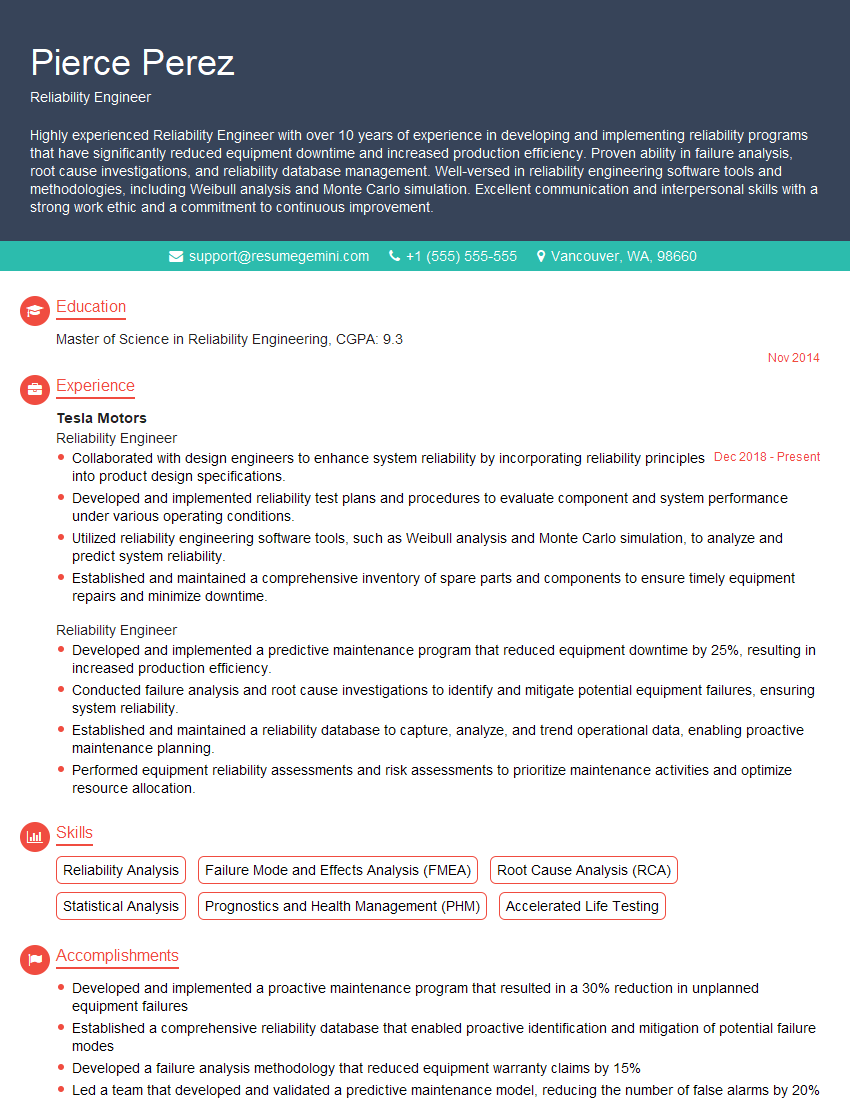
Mastering Uncertainty Quantification and Error Analysis opens doors to exciting career opportunities in diverse fields, from engineering and finance to climate science and healthcare. A strong foundation in this area significantly enhances your problem-solving skills and makes you a highly valuable asset to any team. To further boost your job prospects, crafting an ATS-friendly resume is vital. ResumeGemini is a trusted resource that can help you build a professional resume that highlights your skills and experience effectively. Examples of resumes tailored to Uncertainty Quantification and Error Analysis are available through ResumeGemini to help guide your resume development process, ensuring your qualifications shine through to potential employers.

Explore more articles
Users Rating of Our Blogs
Share Your Experience
We value your feedback! Please rate our content and share your thoughts (optional).
What Readers Say About Our Blog
Very informative content, great job.
good