Are you ready to stand out in your next interview? Understanding and preparing for Two-Year-Old Management interview questions is a game-changer. In this blog, we’ve compiled key questions and expert advice to help you showcase your skills with confidence and precision. Let’s get started on your journey to acing the interview.
Questions Asked in Two-Year-Old Management Interview
Q 1. Describe your experience managing the emotional needs of two-year-olds.
Managing the emotional needs of two-year-olds is crucial for their healthy development. At this age, emotions are intense and often unpredictable. My approach focuses on understanding the root cause of their distress, providing comfort and validation, and teaching them healthy coping mechanisms. I believe in creating a secure and predictable environment where children feel safe to express their feelings.
- Empathy and Validation: When a child is upset, I get down to their level, acknowledge their feelings, and use simple language to reflect their emotions. For example, if a child is crying because they can’t reach a toy, I might say, “You’re feeling frustrated because you can’t reach the toy. That’s okay to feel frustrated.”
- Setting Clear Boundaries: While providing empathy, it’s important to establish consistent boundaries. This teaches children self-regulation and helps them understand expectations. If they are hitting, for instance, I would firmly but gently say, “Hitting hurts. We use kind hands.”
- Teaching Coping Mechanisms: I introduce strategies like deep breaths or taking a break in a quiet space to calm down. I model these behaviors myself, showing them that it’s okay to take time to manage big emotions.
- Positive Reinforcement: I actively praise positive emotional expression and self-regulation. Celebrating successes reinforces desired behavior and builds confidence.
For example, I once worked with a child who was extremely anxious about separation from their parent. We used a visual schedule to help them anticipate the transitions, and I offered comfort objects like a favorite stuffed animal. Over time, their anxiety significantly reduced.
Q 2. Explain your approach to potty training two-year-olds.
Potty training is a significant developmental milestone, and my approach is patient, positive, and child-led. I avoid pressure and focus on readiness cues. It’s less about a strict schedule and more about observing the child’s signals.
- Readiness Cues: I look for signs like staying dry for longer periods, showing interest in the potty, or being able to pull their pants up and down.
- Positive Reinforcement: Successes are celebrated with praise and small rewards. This positive association motivates the child.
- Consistency: A consistent routine is vital. Regular trips to the potty, especially after waking up, before meals, and after naps, are important.
- Patience and Understanding: Accidents happen! I respond to accidents calmly and without punishment. The focus remains on positive reinforcement and encouragement.
- Modeling: Children learn by watching, so modeling appropriate potty behavior can be beneficial.
I wouldn’t use punishment or shaming. Instead, I’d focus on encouraging the child and showing them how to use the potty properly. For instance, with a child who was reluctant, we made it into a game, using potty training books and songs to make the experience fun and less intimidating.
Q 3. How do you handle aggressive behavior in a two-year-old?
Aggressive behavior in two-year-olds stems from a lack of communication skills, frustration, or unmet needs. My response always prioritizes safety and teaching appropriate behaviors.
- Understanding the Cause: The first step is determining *why* the child is behaving aggressively. Are they tired, hungry, or overwhelmed? Is there a communication breakdown?
- Calm and Firm Response: I address the aggression calmly but firmly, explaining that hitting or biting is not okay. I would remove the child from the situation temporarily, if necessary, to help them calm down.
- Teaching Alternatives: I teach the child alternative ways to express their frustration, such as using words or taking deep breaths. Role-playing can be helpful.
- Modeling Appropriate Behavior: I consistently model appropriate behavior, showing them how to resolve conflicts peacefully.
- Ignoring Attention-Seeking Behavior: If aggression is attention-seeking, ignoring the behavior (while ensuring safety) can be effective.
For example, if a child bites another child, I would immediately separate them, offer comfort to the bitten child, and calmly explain to the biting child that biting hurts and isn’t acceptable. Then, I might involve them in a calming activity like a puzzle to redirect their attention and help them regain control.
Q 4. What strategies do you use to foster language development in toddlers?
Fostering language development in toddlers requires a multi-sensory, interactive approach.
- Reading Aloud: Regularly reading age-appropriate books, pointing to pictures, and engaging in conversations about the story is crucial.
- Singing Songs and Rhymes: Nursery rhymes and songs help develop vocabulary, rhythm, and pronunciation.
- Talking and Engaging: Constantly talking to the child, describing activities, and asking questions encourages language development.
- Playing Language Games: Simple games like “I Spy” or naming objects expand their vocabulary.
- Providing Opportunities for Communication: Creating situations where children need to communicate, like asking for help or expressing their needs, naturally encourages language.
For instance, I might engage a child in a conversation while building blocks: “Let’s put the red block on top of the blue one. That’s a tall tower! What color is that block?” I’d encourage them to name the colors and participate in the conversation, even with simple words.
Q 5. Describe your experience implementing a developmentally appropriate curriculum for two-year-olds.
Implementing a developmentally appropriate curriculum for two-year-olds means focusing on play-based learning that caters to their physical, cognitive, social, and emotional needs. The curriculum should be flexible and responsive to the children’s interests and individual learning styles.
- Play-Based Learning: The majority of activities are centered around play, as this is how two-year-olds learn best. Play allows for exploration, experimentation, and problem-solving.
- Focus on Sensory Experiences: Activities that stimulate their senses—touch, sight, sound, taste, and smell—are incorporated into the curriculum.
- Social Interaction: The curriculum should promote social interaction and cooperation through group activities and collaborative play.
- Developmentally Appropriate Activities: Activities are chosen based on the children’s developmental stage and abilities. This means avoiding tasks that are too challenging or too easy.
- Regular Assessment: Ongoing observation and assessment allows me to tailor the curriculum to the individual needs of each child.
For example, a typical day might include free play, art activities like finger painting, music and movement, story time, and outdoor play. The activities are structured to support various developmental areas, from fine motor skills (coloring) to language development (story time) and social-emotional growth (group play).
Q 6. How do you create a safe and stimulating learning environment for toddlers?
Creating a safe and stimulating learning environment is paramount for two-year-olds. This involves careful consideration of the physical space and the learning activities offered.
- Safety First: The environment must be safe, with appropriate safety measures in place (e.g., childproof locks, secure furniture, age-appropriate toys).
- Stimulating Environment: The space needs to be engaging and stimulating, with a variety of textures, colors, and materials to explore.
- Organized and Accessible: Materials and toys should be organized and easily accessible to the children, promoting independence.
- Designated Areas: Different areas for different activities—like a quiet corner for reading, a block area for construction, and a dramatic play area—should be created to cater to different interests.
- Natural Light and Ventilation: Adequate natural light and good ventilation contribute to a healthy and comfortable environment.
For instance, I might create a cozy reading corner with soft cushions and colorful books, a dramatic play area with dress-up clothes and kitchen sets, and an art area with various art supplies. The furniture would be child-sized and sturdy, ensuring both safety and accessibility.
Q 7. What are some common developmental milestones for two-year-olds?
Two-year-olds are experiencing rapid development across various domains. Some common developmental milestones include:
- Physical Development: Walking, running, climbing stairs, kicking a ball, scribbling, turning pages in a book, and beginning to show hand preference (right or left-handed).
- Cognitive Development: Increasing vocabulary, understanding simple instructions, engaging in pretend play, and beginning to solve simple problems.
- Social-Emotional Development: Showing increased independence, expressing a wider range of emotions, beginning to show empathy, and engaging in parallel play (playing near but not directly with other children).
- Language Development: Speaking in two- to three-word sentences, understanding simple questions, and following simple directions.
It’s important to remember that development is individual, and children reach these milestones at their own pace. Variations within the normal range are expected. If there are significant delays or concerns, seeking professional guidance is essential.
Q 8. How do you assess a two-year-old’s developmental progress?
Assessing a two-year-old’s developmental progress involves a holistic approach, considering various developmental domains. We use a combination of observation, standardized developmental screening tools, and parent input.
- Physical Development: We observe gross motor skills (walking, running, jumping), fine motor skills (grasping, stacking blocks, drawing), and self-help skills (eating, dressing). For example, we’d note if a child can climb stairs with alternating feet or if they can use a spoon effectively.
- Cognitive Development: We assess language skills (vocabulary, sentence structure, understanding instructions), problem-solving abilities (puzzle-solving, shape sorting), and memory. A key observation here might be their ability to follow a two-step instruction or to remember a short sequence of events.
- Social-Emotional Development: We evaluate their social interactions (playing with peers, sharing, showing empathy), emotional regulation (managing frustration, expressing feelings), and self-control. We’d look at things like whether a child can engage in parallel play or if they can soothe themselves when upset.
Standardized tools like the Denver Developmental Screening Test II (DDST-II) can provide objective measures, but these are always interpreted in conjunction with ongoing observations and parental reports. Early identification of any delays allows for timely intervention.
Q 9. How do you handle separation anxiety in toddlers?
Separation anxiety in toddlers is a normal developmental phase, but it can be challenging for both the child and caregiver. A consistent and reassuring approach is key.
- Establish a predictable routine: Consistent drop-offs and pick-ups minimize uncertainty.
- Create a warm and loving goodbye: Short, sweet goodbyes are more effective than lingering. Avoid sneaking away. A quick hug and a reassuring phrase like “I’ll be back to pick you up after naptime” work well.
- Provide a transitional object: A favorite blanket or stuffed animal can provide comfort during separation.
- Collaborate with parents: Working closely with parents helps understand the child’s triggers and develop strategies together. For example, parents can leave a familiar item with scent from home.
- Positive reinforcement: Praise and positive attention upon reunion helps reinforce a positive association with separation.
Remember, patience and understanding are crucial. Each child’s experience with separation anxiety is unique; what works for one child might not work for another.
Q 10. How do you manage picky eating in two-year-olds?
Picky eating is very common in two-year-olds. It’s crucial to approach this with patience and understanding, avoiding power struggles. The focus should be on creating a positive relationship with food.
- Offer a variety of healthy foods: Repeatedly introduce new foods, even if they’re initially rejected. It often takes multiple exposures before a child accepts a new food.
- Avoid forcing a child to eat: This can create negative associations with mealtimes.
- Make mealtimes enjoyable: A calm and relaxed atmosphere encourages eating. Involve them in age-appropriate food preparation.
- Be a role model: Children often mirror their parents’ eating habits.
- Limit distractions: Turn off the TV and engage in conversation during mealtimes.
- Offer small portions: Overwhelming a child with large portions can lead to refusal.
If concerns persist, consulting a pediatrician or registered dietitian is recommended to rule out any underlying medical issues or nutritional deficiencies.
Q 11. What are some effective strategies for managing tantrums in toddlers?
Tantrums are a normal part of toddler development, stemming from their limited communication skills and emotional regulation abilities. The goal is to teach them more effective coping mechanisms.
- Remain calm: Your own calm demeanor helps de-escalate the situation.
- Ignore the behavior (if safe): If the tantrum is not harmful, calmly ignoring it can sometimes help it end more quickly.
- Offer comfort and support: Once the tantrum subsides, provide comfort and empathy. Avoid punishment.
- Set clear expectations: Establish consistent routines and boundaries.
- Offer choices: Giving toddlers choices (e.g., “Do you want the red cup or the blue cup?” ) can empower them and reduce frustration.
- Positive reinforcement: Praise appropriate behavior.
Understanding the underlying cause of the tantrum is crucial. Is the child tired, hungry, or overwhelmed? Addressing the root cause can prevent future tantrums. If tantrums are frequent or severe, seeking professional help is advisable.
Q 12. How do you ensure the health and safety of toddlers in your care?
Ensuring the health and safety of toddlers requires constant vigilance and a proactive approach.
- Safe environment: Childproofing the environment is paramount. This includes covering electrical outlets, securing cabinets, and removing potential hazards.
- Hygiene practices: Frequent handwashing, proper food handling, and regular cleaning of toys and surfaces are essential to prevent the spread of germs.
- Supervision: Constant, attentive supervision is vital, especially near water, stairs, or other potential dangers. Never leave a toddler unattended.
- Accident prevention: Install safety gates, use car seats appropriately, and teach basic safety rules (e.g., looking both ways before crossing the street).
- First aid knowledge: Having basic first aid knowledge and a well-stocked first-aid kit is crucial.
- Emergency plan: A clear emergency plan, including contact information for parents and emergency services, should be in place.
Regular health checks and adherence to immunization schedules are also vital components of ensuring the well-being of toddlers.
Q 13. Explain your experience with creating daily schedules for toddlers.
Creating daily schedules for toddlers is about establishing a predictable and consistent routine that promotes their development and well-being. Flexibility is crucial, as toddlers have fluctuating energy levels and interests.
A typical schedule might include:
- Morning: Wake up, diaper change, playtime, snack, outdoor activity.
- Mid-day: Lunch, quiet time/nap, story time.
- Afternoon: Playtime (structured and free play), snack.
- Evening: Dinner, bath time, bedtime routine.
Schedules should be age-appropriate and individualized. Some toddlers might need longer naps than others. The schedule also needs to account for planned activities, like playdates or doctor’s appointments. The key is to maintain consistency to provide a sense of security and predictability for the child. Visual schedules with pictures can be beneficial for toddlers to understand the daily flow.
Q 14. Describe your approach to working with parents of two-year-olds.
My approach to working with parents of two-year-olds is based on open communication, collaboration, and mutual respect. I believe that a strong parent-caregiver partnership is essential for a child’s successful development.
- Regular communication: Daily or weekly updates on the child’s progress, including anecdotes and observations, are provided. We communicate any concerns promptly and proactively.
- Collaboration: We work together to establish consistent routines and strategies for managing behaviors or challenges. For instance, we might collaboratively work on strategies for managing bedtime routines.
- Active listening: I actively listen to parents’ concerns and perspectives, validating their feelings and experiences.
- Sharing expertise: I share my knowledge and expertise to support parents in understanding their child’s development and providing guidance.
- Respectful boundaries: I maintain professional boundaries while fostering a warm and trusting relationship with parents.
Regular meetings or informal chats facilitate open dialogue and allow for a partnership where we share information, address concerns, and celebrate milestones together.
Q 15. How do you handle sibling rivalry in a childcare setting?
Sibling rivalry is common among toddlers, stemming from competition for attention, resources, and parental affection. In a childcare setting, proactive strategies are crucial. We focus on preventing conflict before it arises, using techniques such as:
- Individualized attention: Each child receives dedicated one-on-one time, ensuring they feel valued and seen. This helps reduce the need for attention-seeking behavior through rivalry.
- Positive reinforcement: When children demonstrate positive interactions, like sharing or playing cooperatively, we praise and reward them. This encourages the desired behaviors.
- Fairness and consistency: We emphasize fairness in distributing resources and applying rules, avoiding any perception of favoritism. Consistency is key; children thrive with predictable routines and boundaries.
- Teaching conflict resolution: We actively guide children through conflict-resolution strategies, teaching them how to express their feelings, compromise, and share.
- Separate play spaces: Providing designated areas for individual play can reduce friction when children need some space apart. This is especially useful during times of high emotion.
For instance, if two siblings are fighting over a toy, we don’t immediately intervene. We first observe and assess the situation. If it escalates, we calmly guide them towards a solution, perhaps suggesting taking turns or finding a similar toy to share. It’s about teaching them valuable life skills, not just stopping the immediate fight.
Career Expert Tips:
- Ace those interviews! Prepare effectively by reviewing the Top 50 Most Common Interview Questions on ResumeGemini.
- Navigate your job search with confidence! Explore a wide range of Career Tips on ResumeGemini. Learn about common challenges and recommendations to overcome them.
- Craft the perfect resume! Master the Art of Resume Writing with ResumeGemini’s guide. Showcase your unique qualifications and achievements effectively.
- Don’t miss out on holiday savings! Build your dream resume with ResumeGemini’s ATS optimized templates.
Q 16. Describe your experience with mealtime routines for toddlers.
Mealtimes for two-year-olds are not just about nutrition; they are about establishing healthy eating habits and social skills. Our routine emphasizes a calm and positive environment. We:
- Establish a consistent schedule: Regular meal and snack times create predictability, reducing power struggles and promoting healthy appetites.
- Offer a variety of nutritious foods: We expose children to a wide range of healthy foods, introducing new options gradually and patiently. We avoid labeling foods as “good” or “bad,” focusing on descriptive language like “crunchy” or “sweet.”
- Encourage self-feeding: We provide age-appropriate utensils and encourage self-feeding, promoting independence and fine motor skill development. Messes are expected and accepted – it’s part of the learning process!
- Create a pleasant atmosphere: We make mealtimes enjoyable with engaging conversations and positive interactions, avoiding distractions like screens. We use positive language and role model good table manners.
- Limit distractions: We avoid screens and other distractions during mealtime to encourage focused eating and reduce overstimulation.
For example, we might start with a small portion of food, allowing the child to ask for more if needed, rather than serving large portions that can lead to food waste or feelings of being overwhelmed. We celebrate small victories, like trying a new vegetable, with positive reinforcement.
Q 17. How do you promote independence in two-year-olds?
Promoting independence in two-year-olds is vital for their development. We use strategies that focus on building self-reliance and confidence:
- Age-appropriate choices: We offer age-appropriate choices throughout the day, allowing children to feel a sense of control. This could be as simple as choosing between two outfits or selecting a book for storytime.
- Self-help skills: We encourage self-help skills like putting on shoes and coats, washing hands, and using the toilet (with appropriate support and guidance).
- Clear instructions and expectations: Simple, clear instructions and consistent expectations help children understand what is expected of them. Breaking tasks into smaller, manageable steps is key.
- Positive reinforcement: We praise and encourage attempts at independence, even if the task isn’t perfectly executed. This builds confidence and motivates continued effort.
- Patience and support: Learning takes time and patience. We offer support without taking over, allowing children to experience success, even with small steps.
For example, we might show a child how to put on their shoes, then gradually encourage them to do it independently, offering help only when needed. We celebrate their efforts, even if they initially struggle. This approach fosters a sense of accomplishment and encourages self-reliance.
Q 18. How do you handle sleep routines for toddlers?
Establishing a consistent and predictable sleep routine is essential for toddlers. This contributes to their physical and emotional well-being. Our approach includes:
- Consistent bedtime and wake-up time: A regular sleep schedule helps regulate their internal clock, making it easier for them to fall asleep and wake up refreshed.
- A calming bedtime routine: This might include a warm bath, reading a book, singing songs, or quiet playtime. Consistency is paramount; the routine signals the body it’s time for sleep.
- Creating a conducive sleep environment: A dark, quiet, and cool room is crucial for optimal sleep. We ensure comfortable bedding and minimize external stimuli.
- Addressing separation anxiety: We address any separation anxiety gently and patiently, offering comfort and reassurance as needed. A transitional object, like a favorite stuffed animal, can be helpful.
- Positive reinforcement: We reward and acknowledge positive sleep behaviors, such as staying in bed or going to sleep without excessive fuss.
For example, if a child is struggling to fall asleep, we might use calming techniques like gentle massage or whispering a soothing story. We avoid screens before bed, as the blue light can interfere with sleep. A consistent routine provides comfort and security, helping children to feel safe and secure.
Q 19. What are your strategies for fostering positive social interactions among two-year-olds?
Fostering positive social interactions is a key element of our curriculum. We utilize several strategies, including:
- Structured play activities: We organize activities that encourage cooperation, sharing, and turn-taking, such as building blocks, playing with toys, and engaging in group games.
- Modeling positive social behaviors: We demonstrate positive social skills through our own actions and interactions with the children, creating a positive social model.
- Teaching emotional vocabulary: We help children identify and express their feelings using appropriate language, such as “happy,” “sad,” “angry,” and “frustrated.”
- Conflict resolution: We guide children in resolving conflicts peacefully and respectfully, teaching them to communicate their needs and find compromises.
- Positive reinforcement: We praise and reward children for positive interactions, such as sharing, cooperating, and showing empathy.
For example, during playtime, we might actively encourage children to share toys or work together on a project. If a conflict arises, we guide them to communicate their feelings and find a solution. We celebrate their positive interactions, reinforcing the desired behavior.
Q 20. How do you incorporate play-based learning into your curriculum?
Play-based learning forms the cornerstone of our curriculum. We believe that play is the primary vehicle for learning at this age. Our approach involves:
- Structured and unstructured play: We balance both structured activities with defined learning objectives and unstructured free play, allowing children to explore their interests and develop creativity.
- Theme-based learning: We use themes to integrate learning across various domains, such as exploring animals, colors, shapes, or seasons, through play-based activities.
- Sensory exploration: We incorporate various sensory experiences, such as playdough, finger painting, water play, and sandboxes, to stimulate learning and development.
- Dramatic play: We encourage dramatic play, role-playing, and imaginative scenarios to promote social interaction, language development, and emotional regulation.
- Outdoor play: Outdoor play is essential for gross motor development, exploration, and sensory experiences. We provide ample opportunities for outdoor activities.
For example, a theme on ‘animals’ might involve building animal habitats, acting out animal sounds and movements, or reading animal-themed books. We use play to explore concepts in a fun and engaging manner.
Q 21. How do you handle discipline issues with two-year-olds?
Discipline with two-year-olds requires patience, consistency, and a focus on positive guidance. We avoid punitive measures and instead emphasize:
- Positive reinforcement: We praise and reward positive behaviors, catching them doing something right. This is much more effective than focusing on negative behaviors.
- Setting clear limits and expectations: We establish consistent rules and boundaries, ensuring children understand what is expected of them. Simple, clear instructions are key.
- Redirection: When a child engages in undesirable behavior, we redirect their attention towards a more appropriate activity. This is particularly useful for attention-seeking behaviors.
- Time-outs (used cautiously): We use time-outs sparingly and only for serious misbehavior, ensuring the time-out is brief and supervised, focusing on calming the child.
- Ignoring minor misbehavior: We often ignore minor misbehaviors, such as whining or minor tantrums, unless they pose a safety risk. Often, ignoring the behavior leads to its extinction.
For instance, if a child hits another child, we separate them calmly, explain that hitting is not acceptable, and then help them find a solution, such as using words to express their feelings. We focus on teaching appropriate responses rather than simply punishing the behavior.
Q 22. Describe your experience with inclusive practices for toddlers with diverse needs.
Inclusive practices for toddlers with diverse needs are crucial for creating a supportive and enriching learning environment for every child. This means recognizing that each toddler develops at their own pace and has unique strengths and challenges. My approach focuses on individualizing learning experiences, adapting activities to accommodate different abilities, and fostering a sense of belonging for all children.
For example, I worked with a toddler who had a diagnosed speech delay. Instead of focusing solely on verbal communication, we incorporated alternative communication methods like picture cards and sign language. We also created opportunities for him to participate in group activities that minimized the pressure to speak. Another example involved adapting physical activities. For a toddler with limited mobility, I modified games to accommodate his physical limitations, ensuring he could actively participate alongside his peers.
Furthermore, I always collaborate closely with parents and any relevant therapists (e.g., speech therapists, occupational therapists) to develop individualized education plans (IEPs) or support plans that reflect each child’s unique needs and goals. Regular communication and ongoing assessment are critical to adapting our approach as the child progresses.
Q 23. How do you maintain accurate records of toddlers’ progress and care?
Maintaining accurate records is essential for monitoring toddler progress, ensuring their safety, and facilitating effective communication with parents. I use a combination of methods to achieve this.
- Daily Logs: I maintain detailed daily logs, documenting each toddler’s activities, meals, naps, diaper changes, mood, and any significant events. For example, I’ll note if a child was particularly engaged in a specific activity, showed signs of illness, or experienced a challenging moment and how it was addressed.
- Developmental Checklists: I use standardized developmental checklists to track each child’s progress in key areas such as gross motor skills, fine motor skills, language development, and social-emotional development. This allows for objective monitoring of progress over time.
- Anecdotal Records: I also incorporate anecdotal records, which are detailed descriptions of specific incidents that provide richer insights into a child’s behavior, interactions, and learning processes. For instance, I might note a specific instance of problem-solving or a display of empathy.
- Digital Portfolio (with parental consent): Photos and videos of children engaged in activities are documented (with parental consent) in a secure digital portfolio. This visual record allows parents to see their child’s progress and engagement.
All records are kept securely, adhering to all relevant privacy regulations. This organized system allows for efficient tracking of each child’s development and facilitates seamless communication with parents and other professionals.
Q 24. What are some common health concerns for two-year-olds?
Two-year-olds are prone to a variety of common health concerns. These include:
- Upper Respiratory Infections (URIs): Colds, the flu, and other viral infections are common. Symptoms include runny nose, cough, and fever.
- Ear Infections (Otitis Media): These infections are frequent in toddlers due to the structure of their Eustachian tubes.
- Gastrointestinal Issues: Diarrhea, vomiting, and constipation can be caused by viral infections or dietary factors.
- Allergies: Food allergies (like milk, eggs, peanuts) and environmental allergies (like pollen) are common and can cause a variety of symptoms.
- Dental Cavities: Good oral hygiene is important to prevent cavities.
Recognizing these common concerns and following proper hygiene protocols, alongside prompt communication with parents about any signs of illness, are crucial aspects of ensuring the wellbeing of toddlers in my care.
Q 25. Explain your knowledge of child development theories.
My understanding of child development theories informs my approach to toddler care and education. I draw upon several key theories:
- Piaget’s Theory of Cognitive Development: This theory highlights the stages of cognitive development in children. At the sensorimotor stage (birth to 2 years), toddlers learn primarily through their senses and motor actions. My activities are designed to engage these senses, promoting exploration and discovery. For example, playing with different textured objects or engaging in simple cause-and-effect activities.
- Vygotsky’s Sociocultural Theory: This emphasizes the role of social interaction and cultural context in cognitive development. I encourage interaction between toddlers, as well as group activities that promote collaboration and learning from each other (with appropriate adult guidance).
- Erikson’s Stages of Psychosocial Development: This theory focuses on the development of personality and social skills. At this age, toddlers are navigating autonomy vs. shame and doubt. I create an environment where toddlers have choices and opportunities for self-expression, promoting their independence and sense of self.
- Attachment Theory: A secure attachment relationship with caregivers is fundamental to a child’s emotional and social development. I strive to create a warm and nurturing environment that fosters secure attachments with the toddlers in my care.
Integrating these theories allows me to create a developmentally appropriate and supportive learning environment tailored to the needs of two-year-olds.
Q 26. How do you adapt your teaching strategies to meet the individual needs of each toddler?
Adapting teaching strategies to meet individual needs is paramount. Two-year-olds are at vastly different developmental stages, even within the same age group. My approach involves:
- Observation and Assessment: I closely observe each child’s interests, abilities, and learning styles. This forms the foundation for individualized planning.
- Differentiated Instruction: I modify activities and materials to suit different learning styles and developmental levels. For example, some toddlers might need more one-on-one support, while others thrive in group activities.
- Flexible Curriculum: The curriculum isn’t rigid; I adapt activities based on children’s interests and needs. If a group is fascinated by trains, we might integrate train-themed activities into our play.
- Positive Reinforcement: Encouragement and positive feedback are essential to build confidence and motivation. I focus on celebrating successes, no matter how small.
- Collaboration with Parents: Parents are invaluable partners in understanding their child’s unique needs and preferences. Regular communication ensures a consistent approach at home and in the childcare setting.
For instance, if one child excels in building block activities while another struggles with fine motor skills, I’d provide age-appropriate activities such as large blocks for the latter child, focusing on building gross motor skills and gradually introducing finer motor skills activities.
Q 27. Describe your experience with emergency procedures and safety protocols.
Emergency procedures and safety protocols are of utmost importance. I am trained and certified in first aid and CPR, and I have a thorough understanding of the emergency procedures specific to this childcare facility. This includes:
- Emergency Contact Information: I ensure that I have up-to-date contact information for parents and emergency contacts for each child.
- Evacuation Plan: I am familiar with the facility’s emergency evacuation plan, including designated assembly points and procedures in case of fire or other emergencies.
- First Aid and CPR: I’m trained to administer first aid and CPR, and I know how to respond to various medical emergencies, from minor injuries to more serious situations.
- Allergy Management: I’m trained in managing allergies, including the proper administration of epinephrine (EpiPen) if necessary and knowing which children have allergies and how to react appropriately.
- Reporting Procedures: I know the proper procedures for reporting accidents or incidents to relevant authorities and parents.
- Safe Environment: I meticulously maintain a safe environment, ensuring that all potential hazards (e.g., sharp objects, choking hazards) are removed or secured.
Regular drills and training sessions help ensure that I and the other caregivers are prepared to handle emergencies effectively and safely.
Q 28. How do you communicate effectively with parents and other childcare professionals?
Effective communication is the cornerstone of successful toddler care. I use a multi-faceted approach to communicate with parents and other childcare professionals:
- Daily Communication: I provide daily updates to parents, either verbally or through written notes, about their child’s day, including activities, meals, naps, and any notable events.
- Parent-Teacher Conferences: Regular conferences provide opportunities for in-depth discussions about a child’s progress, concerns, and goals.
- Open-Door Policy: I maintain an open-door policy, encouraging parents to drop by and observe the classroom or have a quick chat whenever they wish.
- Written Communication: I use emails or newsletters to share information about upcoming events, facility policies, or important announcements.
- Collaboration with Professionals: I maintain close contact with other childcare professionals, such as therapists or specialists, to share information and coordinate care plans.
- Active Listening: I prioritize active listening to both parents and colleagues to ensure that everyone feels heard and understood. This helps in establishing trust and resolving issues efficiently.
Clear, consistent, and open communication creates a collaborative environment conducive to the child’s optimal development and well-being.
Key Topics to Learn for Two-Year-Old Management Interview
- Child Development & Milestones: Understanding typical developmental stages, recognizing variations, and adapting your approach to individual needs. Practical application: Discussing how to create age-appropriate activities and assess a child’s progress.
- Classroom Management & Behavior Guidance: Strategies for positive reinforcement, proactive behavior management, and addressing challenging behaviors effectively. Practical application: Developing and explaining a plan to handle tantrums or aggression in a calm and consistent manner.
- Curriculum Planning & Implementation: Designing engaging and educational activities aligned with early childhood learning standards. Practical application: Describing your approach to lesson planning, incorporating play-based learning, and assessing learning outcomes.
- Health & Safety: Understanding hygiene protocols, recognizing potential hazards, and implementing safety measures in a classroom setting. Practical application: Explaining procedures for handling accidents or illnesses, and maintaining a safe and clean environment.
- Communication & Collaboration: Effective communication with parents, colleagues, and administrators. Practical application: Describing your strategies for building positive relationships with parents and working collaboratively within a team.
- Assessment & Documentation: Methods for observing, documenting, and assessing children’s progress. Practical application: Explaining how you would track a child’s development and share that information with parents.
Next Steps
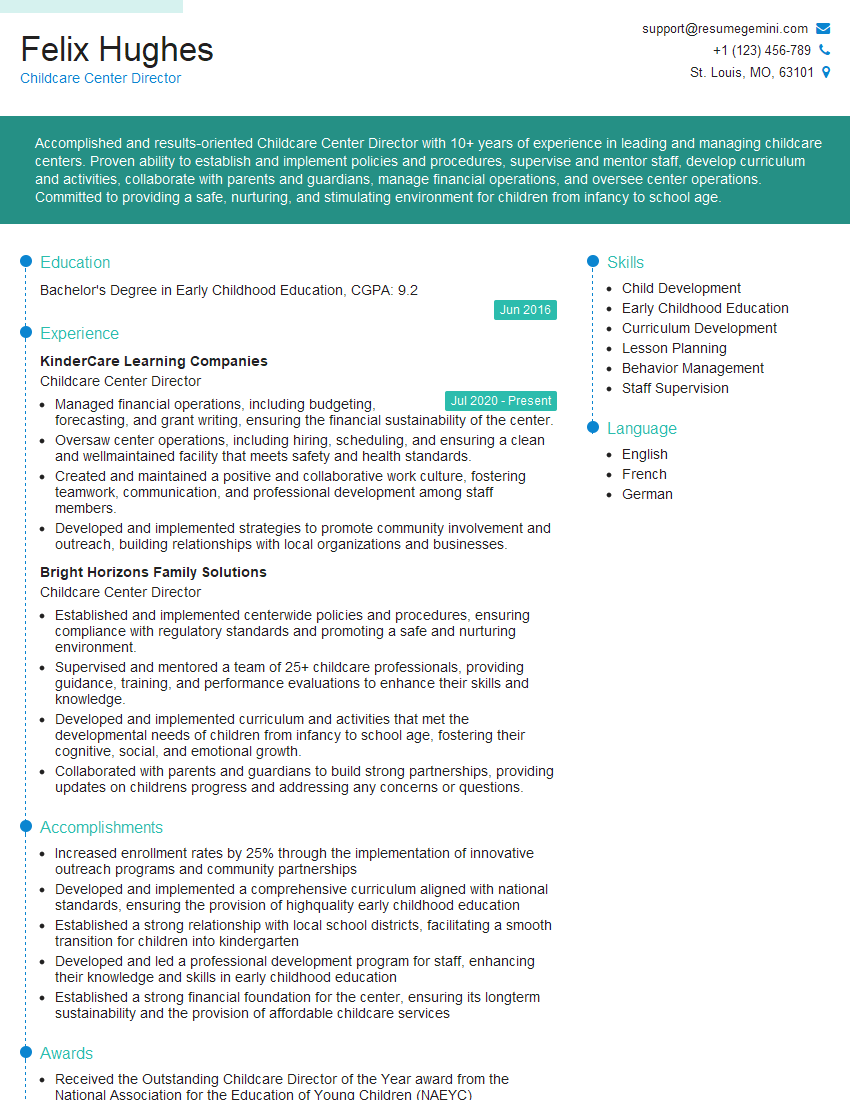
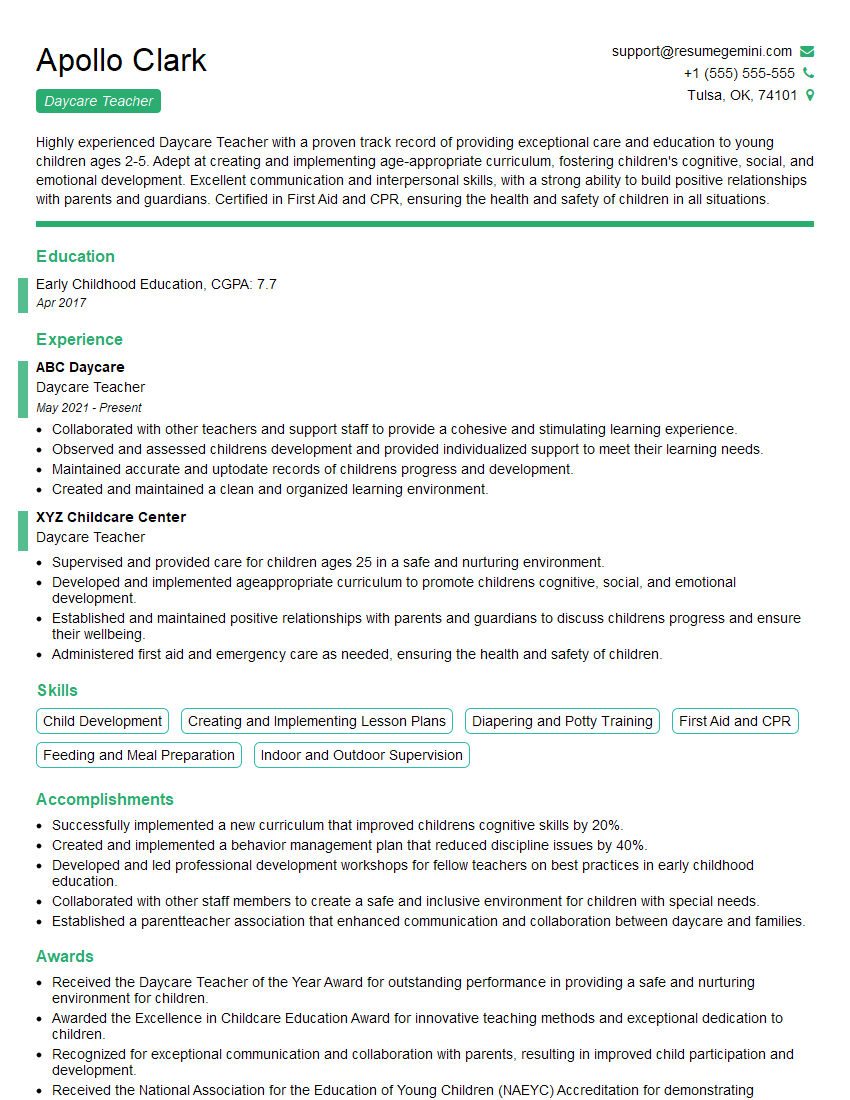
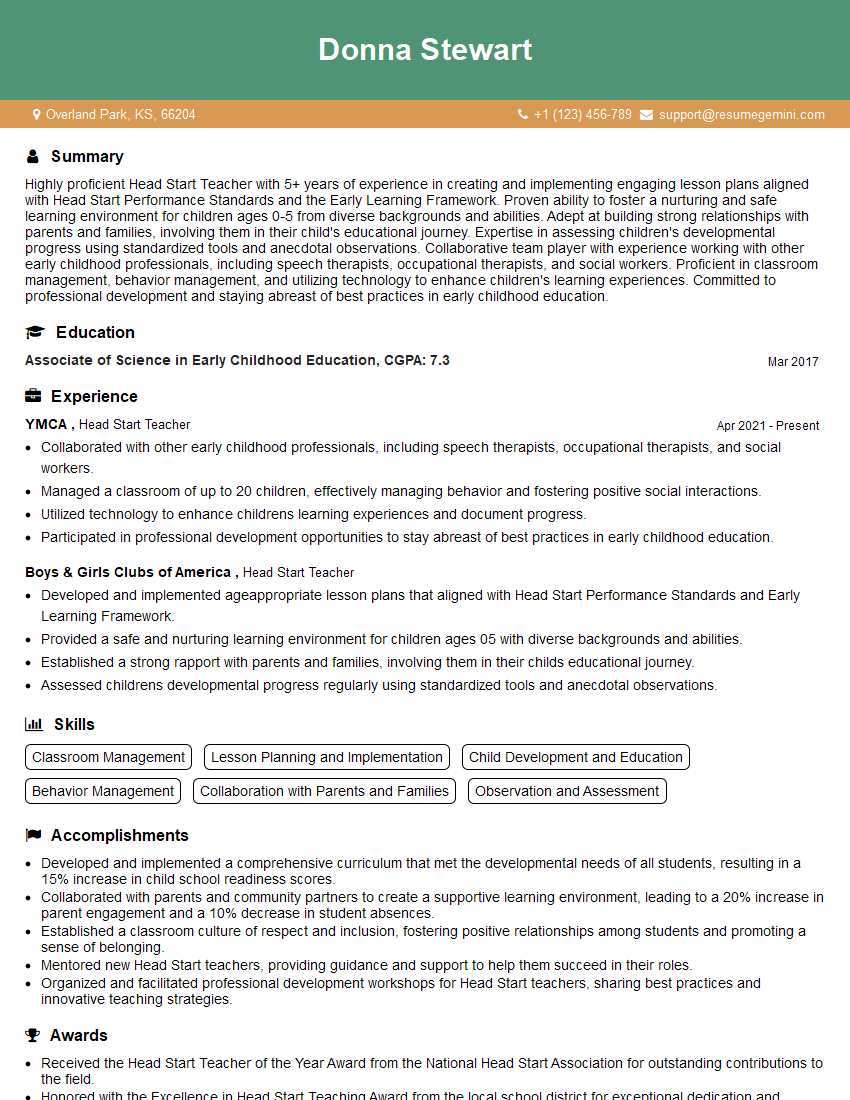
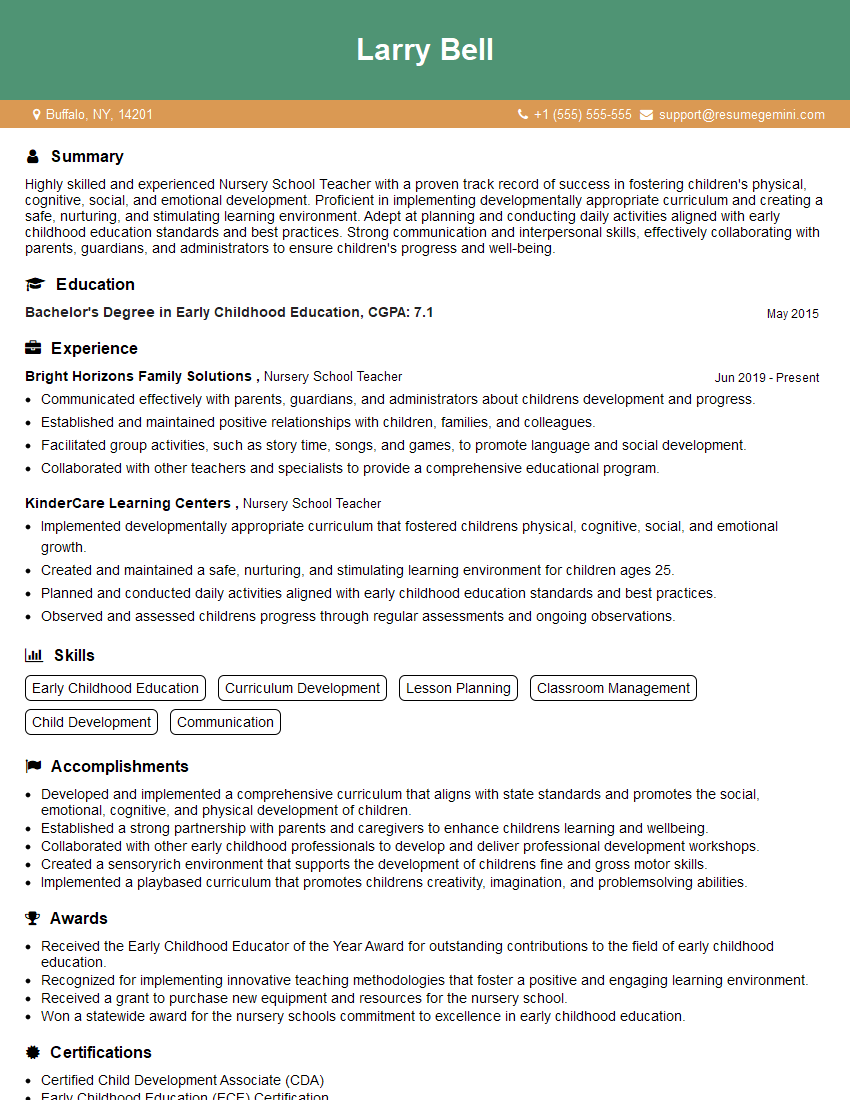
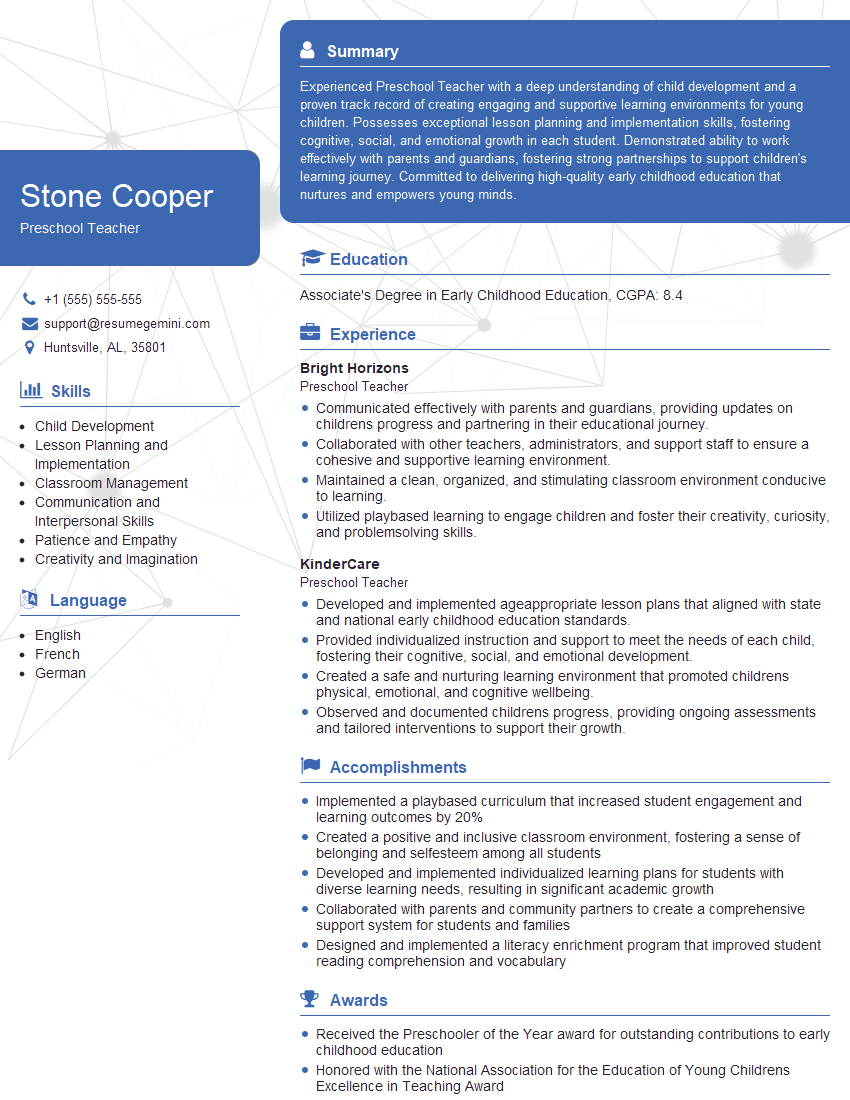
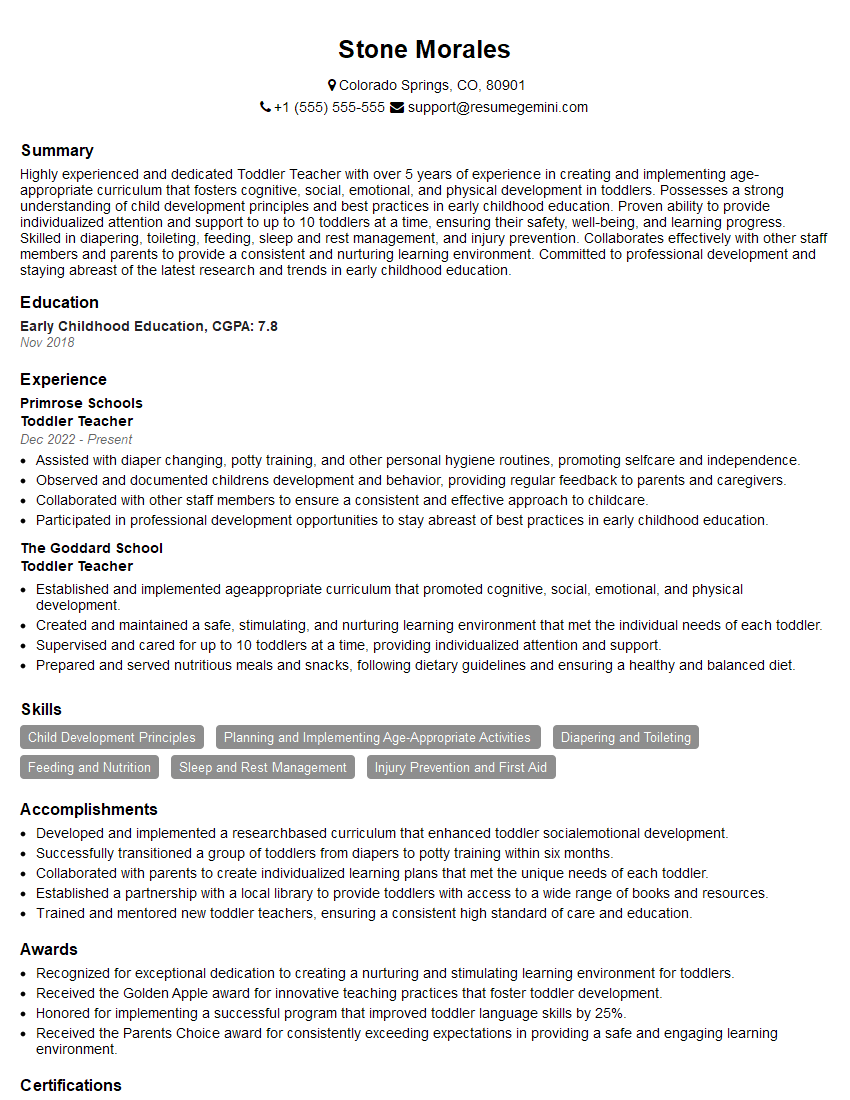
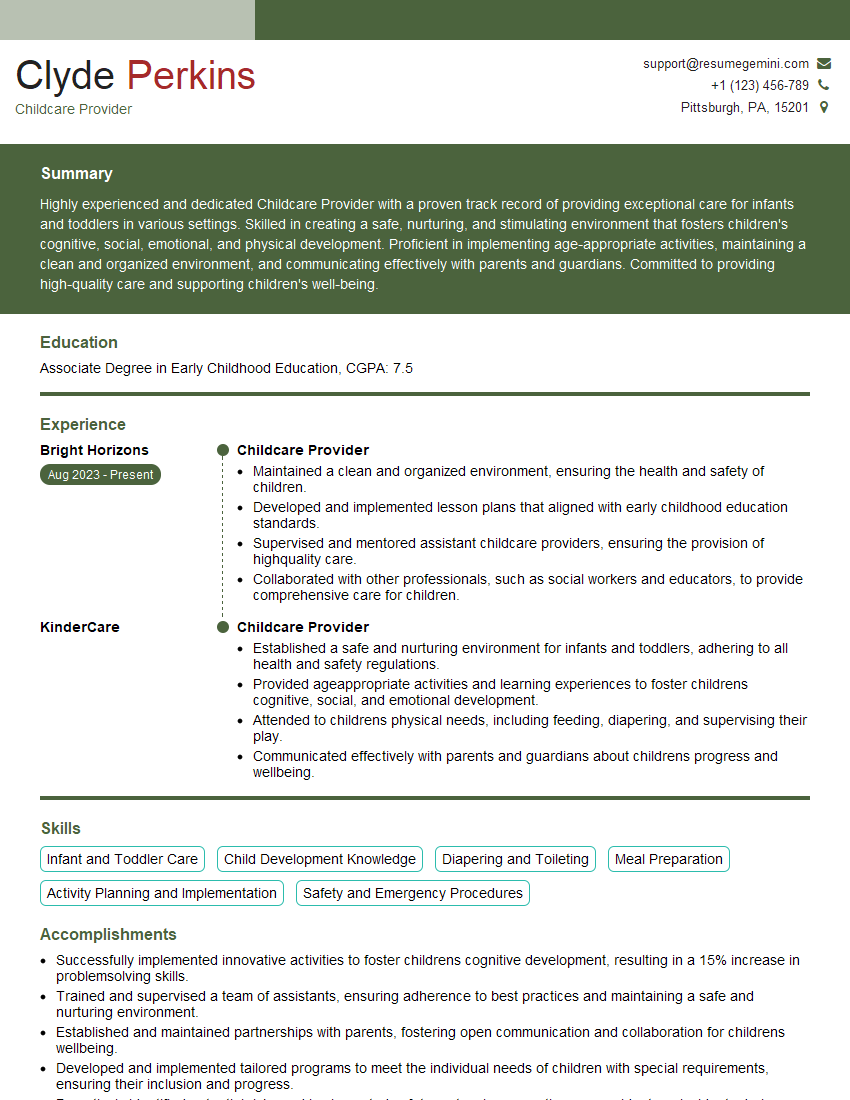
Mastering Two-Year-Old Management opens doors to rewarding careers in early childhood education, offering opportunities for professional growth and making a significant impact on young children’s lives. To enhance your job prospects, crafting an ATS-friendly resume is crucial. ResumeGemini can be a valuable tool in this process, helping you build a professional and impactful resume that highlights your skills and experience effectively. We offer examples of resumes tailored to Two-Year-Old Management positions to help guide you. Take advantage of these resources to present yourself in the best possible light.
Explore more articles
Users Rating of Our Blogs
Share Your Experience
We value your feedback! Please rate our content and share your thoughts (optional).
What Readers Say About Our Blog
Very informative content, great job.
good