Unlock your full potential by mastering the most common Plate Extrusion interview questions. This blog offers a deep dive into the critical topics, ensuring you’re not only prepared to answer but to excel. With these insights, you’ll approach your interview with clarity and confidence.
Questions Asked in Plate Extrusion Interview
Q 1. Explain the difference between flat-die and profile extrusion.
The core difference between flat-die and profile extrusion lies in the shape of the final product. Flat-die extrusion produces sheets or plates with a consistent thickness and a rectangular cross-section. Think of it like squeezing toothpaste out of a tube with a flat nozzle – you get a flat sheet. Profile extrusion, on the other hand, creates products with more complex cross-sectional shapes, like pipes, channels, or even intricate window frames. Imagine a tube of toothpaste with a nozzle shaped like a star – the resulting shape mirrors the nozzle’s form. The die design is the key differentiator; a flat die has a simple, flat opening, while a profile die has a much more intricate, three-dimensional cavity.
Q 2. Describe the process of plate extrusion, including key steps and equipment.
Plate extrusion is a continuous process where molten polymer is forced through a flat die to create a sheet of consistent thickness. Here’s a breakdown of the key steps:
- Feeding: Polymer pellets are fed into a hopper, usually via a gravimetric or volumetric feeder ensuring consistent material supply.
- Melting and Mixing: The pellets are conveyed to a screw extruder where they are melted and mixed to a homogenous melt. This is crucial for consistent product quality.
- Pumping: A high-pressure pump ensures a constant flow of the molten polymer to the die. Consistent pressure is key to uniform plate thickness.
- Die Extrusion: The molten polymer is squeezed through the flat die, forming the plate. Die design is paramount for dimensional control.
- Cooling and Solidification: The extruded plate passes through a cooling system, often a water bath or air cooling system, to solidify it to the desired level of rigidity.
- Calibration: The plate might then pass through a set of rollers to ensure precise thickness and flatness. This is especially important for high-precision applications.
- Cutting and Winding: Finally, the cooled plate is cut to the desired length and wound onto a roll, or cut into individual sheets.
Key equipment includes a hopper, extruder (single or twin-screw), high-pressure pump, flat die, cooling system, calender rollers, cutting and winding mechanisms.
Q 3. What are the common challenges in plate extrusion, and how are they addressed?
Common challenges in plate extrusion include:
- Variations in thickness and width: Inconsistent melt flow, die wear, or temperature fluctuations can cause variations. This is addressed through precise control of melt temperature, pressure, and die design, as well as regular maintenance of equipment.
- Surface defects: These include melt fracture, gels, or air bubbles. Careful control of melt rheology, proper degassing, and filtration helps minimize these issues.
- Dimensional instability: Shrinkage or warping after cooling can occur. This is often controlled by careful selection of polymers and optimized cooling procedures.
- Die clogging: Improper material handling or degraded polymer can clog the die, leading to downtime. Preventive maintenance and thorough material screening are crucial.
- High energy consumption: Extrusion is an energy-intensive process; optimizing screw design and process parameters helps minimize this.
Addressing these challenges often involves a combination of careful process control, regular maintenance, and advanced process control techniques.
Q 4. How do you ensure the dimensional accuracy of extruded plates?
Ensuring dimensional accuracy in extruded plates involves a multifaceted approach:
- Precise die design: The die’s dimensions must be precisely engineered to the required plate thickness and width. Advanced CAD/CAM techniques and meticulous manufacturing are essential.
- Melt flow control: Consistent melt flow ensures uniform plate thickness. This involves precise control of screw speed, melt temperature, and backpressure.
- Calibration: Calender stacks or chill rolls precisely control the plate’s thickness and flatness after extrusion.
- Cooling control: Uniform and efficient cooling minimizes shrinkage and warping.
- Regular maintenance: Maintaining the die’s condition is crucial to prevent variations in product dimensions due to wear and tear.
- Process monitoring and feedback control systems: Real-time monitoring of key parameters and automated adjustments help maintain consistency.
For example, using laser-based thickness measurement systems provides real-time feedback, allowing immediate adjustments to parameters to maintain tight tolerances.
Q 5. Explain the role of the die in plate extrusion and its design considerations.
The die is the heart of the plate extrusion process, shaping the molten polymer into the desired plate form. Its design is critical for product quality and dimensional accuracy. Key considerations include:
- Land length: The length of the die’s flow channel before the exit affects pressure and flow distribution.
- Die gap: This directly determines the plate thickness. Precise control is critical to achieve desired tolerances.
- Die lip geometry: The shape and smoothness of the die lip affect the surface finish of the extruded plate and prevent melt fracture.
- Material selection: The die must be constructed from materials resistant to wear and corrosion at high temperatures and pressures.
- Cooling system: An efficient cooling system within or around the die helps maintain temperature uniformity.
For instance, a die with a tapered land length can be used to improve melt flow and reduce the chance of non-uniform thickness.
Q 6. What are the different types of polymers commonly extruded into plates?
Numerous polymers are extruded into plates, each with unique properties making them suitable for specific applications:
- Polyethylene (PE): Used extensively for films, bags, and other packaging applications due to its flexibility and low cost.
- Polypropylene (PP): Known for its stiffness and impact resistance, it finds use in various industrial applications and consumer products.
- Polystyrene (PS): A versatile polymer used for food containers, insulation, and various other applications.
- Polyvinyl Chloride (PVC): Used in pipes, window frames, and other applications due to its durability and weather resistance.
- High-Density Polyethylene (HDPE): A stronger, more rigid version of PE, often used in bottles, pipes, and containers.
- Polycarbonate (PC): A high-strength, high-temperature-resistant polymer used in demanding applications like automotive parts.
- ABS (Acrylonitrile Butadiene Styrene): A tough, impact-resistant polymer widely used in housings and enclosures.
The choice of polymer depends on the end-use requirements of the plate, such as mechanical properties, thermal resistance, chemical resistance, and cost.
Q 7. Describe the process of melt flow control in plate extrusion.
Melt flow control in plate extrusion is paramount for consistent product quality and dimensional accuracy. It involves precisely controlling the flow rate of the molten polymer through the die. Several methods are used:
- Screw design: The extruder screw design, including its length, channel depth, and flight angle, significantly impacts melt flow.
- Screw speed: Adjusting the screw speed alters the amount of polymer pumped to the die.
- Melt temperature: Higher melt temperatures reduce viscosity, increasing flow rate.
- Backpressure: Applying backpressure at the die enhances homogeneity of the melt and prevents variations in thickness.
- Pumping systems: High-pressure gear pumps or other types of melt pumps provide precise control over melt flow rate and pressure.
- Online rheometers: These instruments provide real-time measurements of melt viscosity and flow properties, facilitating adjustments to maintain optimal flow conditions.
Imagine a water hose: changing the water pressure and flow rate using a valve is analogous to controlling melt flow in extrusion. Precise control ensures a constant and uniform flow through the die, producing a plate of consistent thickness.
Q 8. How do you troubleshoot issues with uneven thickness in extruded plates?
Uneven thickness in extruded plates, often manifesting as variations in the final product’s dimensions, is a common problem stemming from inconsistencies within the extrusion process. Troubleshooting involves a systematic approach, checking several key areas.
Die Design and Wear: An improperly designed die or one with excessive wear can create uneven flow of the material, leading to thickness variations. Inspect the die for any damage, wear, or imperfections. Consider die refurbishment or replacement.
Extrusion Pressure and Speed: Inconsistent extrusion pressure and speed fluctuations directly impact material flow. Monitor these parameters throughout the process using appropriate sensors and control systems. Ensure the equipment is properly calibrated and maintained.
Material Properties: The material’s viscosity and temperature significantly affect its flow. Inconsistent material properties (e.g., improper mixing, temperature variations in the material feed) can result in uneven extrusion. Careful monitoring of material properties before and during the process is crucial.
Cooling System: Uneven cooling can lead to warping and thickness variations. Check for blockages, leaks, or malfunctioning elements in the cooling system. Ensure even cooling across the entire plate width.
Equipment Alignment and Maintenance: Misalignment of the extruder components can cause uneven material distribution. Regular maintenance and alignment checks are essential to prevent issues.
For example, imagine a scenario where one side of the extruded plate is consistently thicker. This could indicate a problem with die wear on the thinner side, or perhaps a blockage in the cooling system on that side. By methodically investigating these areas, we can pinpoint the root cause and implement the appropriate corrective actions.
Q 9. What are the safety precautions associated with plate extrusion equipment?
Safety is paramount in plate extrusion. The high temperatures, pressures, and moving machinery present significant hazards. Comprehensive safety protocols are essential. These include:
Lockout/Tagout Procedures: Before any maintenance or repair work on the extrusion line, the power must be completely isolated and locked out, preventing accidental startup.
Personal Protective Equipment (PPE): Employees must wear appropriate PPE, including heat-resistant gloves, safety glasses, hearing protection, and steel-toed boots to minimize the risk of burns, eye injuries, hearing loss, and foot injuries.
Emergency Shut-off Switches: Easily accessible emergency stop buttons must be strategically placed throughout the extrusion area.
Regular Inspections and Maintenance: Preventative maintenance schedules minimize the risk of equipment malfunction. Regular inspections ensure the equipment is in safe working condition.
Training and Education: All personnel involved in plate extrusion must receive comprehensive safety training covering hazard identification, risk assessment, and emergency procedures.
Emergency Response Plan: A well-defined emergency response plan, including procedures for handling fires, injuries, and material spills, must be in place.
For instance, a failure to follow lockout/tagout procedures could result in serious injury or even death from the unexpected startup of the equipment. Comprehensive safety training and adherence to established protocols are non-negotiable.
Q 10. Explain the importance of temperature control in plate extrusion.
Temperature control is critical in plate extrusion, impacting every stage of the process from material melting to final product quality. Precise temperature management ensures consistent material flow, avoids defects, and optimizes the final product’s properties.
Material Melting: Insufficient heating leads to incomplete melting, resulting in poor material flow and the potential for defects like inclusions or porosity. Overheating can cause degradation or discoloration.
Extrusion Process: Maintaining a consistent temperature throughout the extrusion process prevents variations in viscosity, ensuring a uniform flow rate. Fluctuations can cause uneven thickness and surface imperfections.
Cooling Process: Controlled cooling is essential for minimizing internal stresses and warping. Rapid cooling can lead to cracking or residual stresses.
Think of it like baking a cake: you need the right oven temperature to get the desired consistency and texture. Similarly, in plate extrusion, precise temperature control ensures the final plate meets the required specifications, avoiding undesirable structural changes or defects.
Q 11. How do you inspect the quality of an extruded plate?
Inspecting the quality of an extruded plate involves a multi-stage process encompassing visual inspection, dimensional measurements, and potentially destructive testing, depending on the application’s criticality.
Visual Inspection: Check for surface defects like cracks, scratches, pitting, or discoloration. Assess the overall uniformity of the plate’s surface.
Dimensional Measurements: Verify the plate’s thickness, width, and length against specifications using precision measuring instruments (e.g., calipers, micrometers). Check for any bowing or warping.
Mechanical Testing: Depending on the application, mechanical tests like tensile strength, yield strength, elongation, and hardness testing might be performed to validate the material’s mechanical properties.
Non-destructive Testing (NDT): Methods such as ultrasonic testing or X-ray inspection may be used to detect internal flaws without damaging the plate.
For example, a visually perfect plate might still fail a dimensional check, revealing an unacceptable thickness variation. Thorough inspection ensures compliance with quality standards and prevents the use of substandard materials.
Q 12. Describe the different types of defects found in extruded plates and their causes.
Various defects can occur during plate extrusion, each with a specific cause. Understanding these defects is crucial for implementing corrective actions.
Surface Cracks: These can result from excessive internal stresses caused by rapid cooling or improper material properties.
Internal Voids or Porosity: These are usually caused by trapped gases or incomplete material melting.
Inclusions: Foreign materials embedded within the plate, often caused by contamination during material handling or processing.
Surface Roughness: This may stem from die wear, improper lubrication, or inconsistent extrusion parameters.
Warping or Bowing: Uneven cooling or internal stresses can lead to warping or bowing of the plate.
Thickness Variations: As previously discussed, these can result from issues with the die, extrusion pressure, material properties, or the cooling system.
For example, detecting internal voids suggests a problem with material degassing or the melting process, prompting a review of material preparation and extrusion parameters.
Q 13. What are the methods used for surface finishing of extruded plates?
Surface finishing of extruded plates aims to enhance their aesthetics, improve their corrosion resistance, and/or prepare them for subsequent processes. Several methods are used.
Machining: Techniques like milling, turning, or grinding can be used to achieve precise dimensions and surface finishes.
Grinding and Polishing: These processes remove surface imperfections and improve surface smoothness, enhancing the plate’s appearance and corrosion resistance.
Chemical Etching: This removes surface irregularities and can create a specific texture.
Shot Blasting/Bead Blasting: These methods impart a specific surface texture, increasing surface area, and improving adhesion properties for coatings.
Coating: Applying coatings like paint, powder coating, or anodizing enhances corrosion resistance and improves aesthetics.
The choice of finishing method depends on the application requirements and the desired surface properties. For instance, a high-precision application might demand machining, while improving corrosion resistance may necessitate a coating.
Q 14. How do you calculate the extrusion pressure?
Calculating extrusion pressure is complex and depends on several factors. There isn’t a single, universally applicable formula. However, a simplified approach incorporates the following key factors:
Material Viscosity: Higher viscosity materials require higher extrusion pressure.
Die Geometry: The die’s shape and dimensions (land length, orifice shape) affect the pressure required for material flow.
Extrusion Rate: Higher extrusion rates typically require higher pressure.
Friction: Friction within the extruder and die contributes to the overall pressure requirement.
Empirical formulas and Finite Element Analysis (FEA) are often used to model and predict extrusion pressure in more realistic scenarios. These complex calculations consider the material’s non-Newtonian behavior, temperature gradients, and other factors. Accurate pressure calculation is crucial for optimizing the extrusion process and preventing equipment damage.
In simpler terms, imagine trying to squeeze toothpaste out of a tube. A thicker toothpaste (higher viscosity) requires more force (pressure). Similarly, a smaller nozzle (die) requires greater pressure to extrude the same amount of material.
Q 15. What is the role of the cooling system in plate extrusion?
The cooling system in plate extrusion is crucial for controlling the solidification of the molten polymer. Imagine pouring hot honey onto a cold surface – it cools quickly and solidifies. Similarly, in plate extrusion, the cooling system rapidly cools the extruded polymer plate to achieve the desired dimensions and mechanical properties. This cooling is typically achieved using water or air, circulated through channels or sprayed onto the plate. Insufficient cooling leads to warped plates and inconsistent thickness, while excessive cooling can cause internal stress and brittleness.
A typical cooling system might involve a series of rollers with integrated cooling channels, allowing for even temperature distribution. The temperature of the coolant, flow rate, and contact time between the plate and the cooling system are all critical parameters that are carefully controlled.
Career Expert Tips:
- Ace those interviews! Prepare effectively by reviewing the Top 50 Most Common Interview Questions on ResumeGemini.
- Navigate your job search with confidence! Explore a wide range of Career Tips on ResumeGemini. Learn about common challenges and recommendations to overcome them.
- Craft the perfect resume! Master the Art of Resume Writing with ResumeGemini’s guide. Showcase your unique qualifications and achievements effectively.
- Don’t miss out on holiday savings! Build your dream resume with ResumeGemini’s ATS optimized templates.
Q 16. How do you optimize the process parameters to achieve the desired plate properties?
Optimizing plate extrusion process parameters is a balancing act. The desired properties, like tensile strength, impact resistance, and surface finish, are directly influenced by factors such as melt temperature, extrusion pressure, die geometry, and cooling rate. For example, a higher melt temperature can improve flow and reduce defects, but it can also lead to degradation of the polymer and reduced mechanical strength. Similarly, increasing extrusion pressure improves the thickness uniformity of the plate, but excessive pressure can cause equipment damage.
To optimize, we use a combination of techniques, including experimental design (like Design of Experiments or DOE) and process simulation software. We might start with a baseline set of parameters and then systematically vary each parameter to observe its effect on the final product. This data is then analyzed to identify the optimal parameter settings. Statistical process control (SPC) is then implemented to maintain consistency during production.
Q 17. Explain the impact of material viscosity on the extrusion process.
Material viscosity plays a dominant role in plate extrusion. Think of squeezing toothpaste through a nozzle – a highly viscous toothpaste (high viscosity) is much harder to squeeze than a low-viscosity one. Similarly, the viscosity of the polymer melt dictates how easily it flows through the die. High viscosity requires higher extrusion pressure, which can lead to increased energy consumption and potential equipment wear. Lower viscosity, however, can result in poor dimensional control and surface imperfections.
The relationship between viscosity, temperature, and shear rate is complex and depends on the polymer type. Temperature is often used as a control variable to adjust viscosity – higher temperatures lower viscosity, and vice-versa. Rheological testing, which characterizes the flow behavior of the polymer melt under different conditions, is crucial for understanding and predicting its behavior during extrusion.
Q 18. Describe the maintenance procedures for plate extrusion equipment.
Regular maintenance is paramount for ensuring the safety and efficiency of plate extrusion equipment. This includes a scheduled preventative maintenance program encompassing several key areas:
- Die cleaning and maintenance: Regular cleaning of the die is essential to remove build-up and ensure consistent plate thickness and quality. This often involves specialized cleaning solutions and tools.
- Screw and barrel inspection: The screw and barrel should be regularly inspected for wear, corrosion, and damage. This is crucial as wear can impact the melt quality and cause inconsistencies in extrusion.
- Cooling system checks: The cooling system’s functionality is vital. Regular checks for leaks, blockages, and proper temperature control are essential.
- Hydraulic system maintenance: Hydraulic systems require regular checks and maintenance to ensure proper pressure and function.
- Electrical system checks: Routine inspections of electrical systems, including motors, control panels and wiring, ensure safe and efficient operation.
Proper documentation of all maintenance activities is crucial for tracking equipment history and identifying potential problems early on.
Q 19. What are the different types of dies used in plate extrusion?
Various die designs are used in plate extrusion, each catering to specific needs and desired plate properties. The selection depends on the plate thickness, width, and desired surface finish:
- Land-type dies: These are simple dies with a long, flat land section before the exit, resulting in a uniform plate thickness.
- Co-extrusion dies: These allow for the extrusion of multiple layers of different polymers, creating multi-layered plates with varied properties (e.g., high-strength core with impact-resistant outer layer).
- Cushion dies: These use a variable gap to create plates with a specific thickness profile, potentially thinner at the edges.
- Spider dies: These utilize a central mandrel with radial flow channels, efficient for very wide plates but challenging to maintain uniform thickness.
Die design is critical, and optimization often requires finite element analysis (FEA) to predict flow patterns and ensure a consistent and defect-free plate.
Q 20. How do you manage waste generation in the plate extrusion process?
Waste generation in plate extrusion comes primarily from start-up and shut-down material, which isn’t of the same quality as the main production run. Also, any defective plates produced have to be disposed of. Managing this waste involves several strategies:
- Optimized start-up and shut-down procedures: Minimizing the amount of material wasted during transitions between production runs.
- Recycling of scrap material: Regrind material can often be reused, either as a direct addition to the main feedstock or as a component in lower-grade products.
- Improved process control: Reducing the incidence of defective plates through tighter control of process parameters.
- Responsible disposal: Proper handling and disposal of non-recyclable waste materials in accordance with environmental regulations.
Implementing a comprehensive waste management plan, including detailed tracking and analysis of waste streams, is essential for both environmental responsibility and economic efficiency.
Q 21. How do you ensure the consistency of the extruded product?
Ensuring consistent extruded product quality is a top priority. This is achieved through a multi-faceted approach:
- Precise process parameter control: Maintaining consistent melt temperature, pressure, and die temperature.
- Regular quality control checks: Frequent measurement of plate thickness, width, and other relevant properties. Statistical process control (SPC) charts help to monitor variations and identify potential problems proactively.
- Calibration and maintenance of equipment: Regular calibration of measuring instruments and scheduled maintenance of equipment are essential to ensure consistent performance.
- Raw material consistency: Using consistent batches of raw material with verified properties.
- Operator training: Well-trained operators are crucial for maintaining consistent operation of the equipment and detecting any deviation from normal.
A robust quality management system (QMS) that integrates all these elements is fundamental to consistently producing high-quality extruded plates.
Q 22. What is your experience with different types of polymers used in plate extrusion?
My experience with polymers in plate extrusion spans a wide range, encompassing both commodity and engineering plastics. I’ve worked extensively with thermoplastics like HDPE (High-Density Polyethylene), LDPE (Low-Density Polyethylene), PP (Polypropylene), and PVC (Polyvinyl Chloride) for applications requiring high impact resistance, flexibility, or chemical resistance. For higher performance applications demanding superior strength and heat deflection, I’ve utilized engineering thermoplastics such as PC (Polycarbonate), ABS (Acrylonitrile Butadiene Styrene), and POM (Polyoxymethylene). Understanding the unique rheological properties of each polymer – its melt flow index, viscosity, and temperature sensitivity – is crucial for optimizing the extrusion process and achieving the desired product quality. For example, HDPE requires precise temperature control to avoid degradation while maintaining sufficient melt flow for efficient extrusion. Conversely, PC’s high melting point necessitates higher processing temperatures and careful control to prevent thermal degradation.
- HDPE: Commonly used for packaging and general-purpose applications due to its strength and durability.
- PC: Ideal for high-impact applications requiring optical clarity and high heat resistance.
- ABS: A versatile choice for applications requiring good impact strength and chemical resistance.
Q 23. Describe your experience with troubleshooting and problem solving during the plate extrusion process.
Troubleshooting in plate extrusion often involves a systematic approach. I begin by meticulously reviewing the process parameters – melt temperature, screw speed, die pressure, and cooling conditions – to identify any deviations from the established set points. For instance, encountering excessive surface defects like sharkskin or melt fracture usually points to issues with melt flow instability, often requiring adjustments to screw design, melt temperature, or back pressure. Dimensional inconsistencies, on the other hand, might indicate problems with the die design or cooling system. I’ve utilized advanced diagnostic tools, including online sensors for melt pressure and temperature monitoring, to quickly pinpoint the root cause. One specific instance involved a sudden increase in die pressure resulting in product defects. Through analysis of sensor data and visual inspection, we discovered a blockage in the die land caused by polymer degradation. Implementing preventative maintenance, like regular die cleaning, resolved this recurring issue.
My problem-solving methodology is iterative, employing a series of tests and observations to fine-tune process parameters until optimal quality is attained. I document each step of the troubleshooting process, ensuring the root cause is accurately identified and that corrective measures are effectively implemented to prevent future occurrences.
Q 24. How do you handle unexpected situations or emergencies during operation?
Unexpected situations, such as equipment malfunctions or material contamination, demand immediate action. My approach prioritizes safety first. In the event of a machine malfunction, I immediately shut down the equipment and initiate established emergency procedures, alerting relevant personnel. If material contamination is suspected, I’ll isolate the affected batch and thoroughly investigate the source of contamination. Effective communication is vital during such events. I maintain clear and concise communication with my team, supervisors, and maintenance personnel to ensure efficient and coordinated response. For example, a power outage once interrupted production. Following the emergency shutdown protocol, we performed a controlled cool-down of the extruder and, upon restoration of power, resumed operations according to our restart procedures. We also thoroughly checked the product quality before resuming extrusion.
Q 25. Explain your experience with automation and control systems used in plate extrusion.
My experience includes extensive work with PLC (Programmable Logic Controller)-based control systems and SCADA (Supervisory Control and Data Acquisition) software for automated plate extrusion lines. I’m proficient in programming and troubleshooting PLC systems, managing recipe control, and integrating online quality monitoring systems. These systems allow for precise control of extrusion parameters, resulting in consistent product quality and reduced waste. For example, we used a SCADA system to monitor and adjust melt temperature, screw speed, and die pressure in real-time, minimizing variations in the final product thickness. The automation systems enable remote monitoring and predictive maintenance functionalities, significantly enhancing overall process efficiency and minimizing downtime. Data acquisition and analysis capabilities have played a vital role in data-driven decision making, leading to continuous improvements in process optimization.
Q 26. How do you ensure the quality and safety of the extruded product meets regulatory standards?
Ensuring product quality and safety involves a multi-faceted approach. We adhere strictly to all relevant regulatory standards, including those related to food safety (if applicable), material composition, and environmental impact. This includes rigorous testing of raw materials and final products for compliance. We utilize statistical process control (SPC) charts to continuously monitor key quality parameters and identify potential deviations from the norm early on. Regular calibrations of measuring instruments, such as thickness gauges and melt index testers, are crucial in ensuring accurate measurements and data integrity. Detailed documentation of all process steps, testing results, and corrective actions is meticulously maintained, allowing for traceability and compliance audits. For example, we conduct regular testing for heavy metals and other contaminants in our products, ensuring they meet stringent food-grade standards.
Q 27. Describe your experience with continuous improvement methods used in plate extrusion.
Continuous improvement is a cornerstone of my approach. I’ve implemented Lean manufacturing principles like Kaizen (continuous improvement) and Six Sigma methodologies to identify and eliminate waste in the extrusion process. Data analysis from our SCADA system helps identify bottlenecks and areas for optimization. For instance, we used DMAIC (Define, Measure, Analyze, Improve, Control) methodology to reduce the occurrence of a specific surface defect by optimizing cooling parameters. This led to a significant reduction in waste and improvement in product quality. Regular training and knowledge sharing within the team ensures everyone actively participates in improvement initiatives, fostering a culture of continuous improvement.
Q 28. How do you prioritize tasks and manage your workload during busy periods?
During busy periods, effective prioritization is crucial. I employ a combination of techniques, including task scheduling tools and prioritization matrices (such as Eisenhower Matrix), to manage my workload. Urgent and important tasks receive immediate attention. Less urgent but important tasks are scheduled for completion within reasonable timeframes. I regularly review my task list, adjusting priorities based on evolving needs and circumstances. Effective communication and delegation are also key to preventing overload. For example, during periods of high production demand, I delegate certain tasks to other qualified team members, ensuring a smooth workflow and timely completion of all tasks without compromising quality or safety.
Key Topics to Learn for Plate Extrusion Interview
- Material Science & Properties: Understanding the behavior of different materials under high pressure and shear, including their flow characteristics and limitations. Consider how material selection impacts the final product quality.
- Extrusion Process Fundamentals: Mastering the principles of pressure generation, die design, and material flow within the extrusion process. Be prepared to discuss different types of plate extrusion dies and their applications.
- Equipment & Machinery: Familiarize yourself with the various components of a plate extrusion system, including the extruder, die, and cooling systems. Understand their operation, maintenance, and troubleshooting.
- Process Optimization & Control: Discuss techniques for optimizing the extrusion process to achieve desired product properties, such as thickness, surface finish, and mechanical strength. Be ready to explain how variables like temperature, pressure, and speed are controlled and monitored.
- Quality Control & Assurance: Understand the methods used to ensure the quality of extruded plates, including inspection techniques and defect analysis. Be prepared to discuss common defects and their causes.
- Safety Procedures & Regulations: Demonstrate knowledge of safety protocols and industry regulations related to high-pressure equipment and material handling in plate extrusion.
- Troubleshooting & Problem Solving: Practice identifying and solving common problems encountered during plate extrusion, such as material defects, equipment malfunctions, and process inconsistencies.
- Automation and Advanced Control Systems: Understanding the role of automation in modern plate extrusion processes, including PLC programming, sensor technologies, and data acquisition.
Next Steps
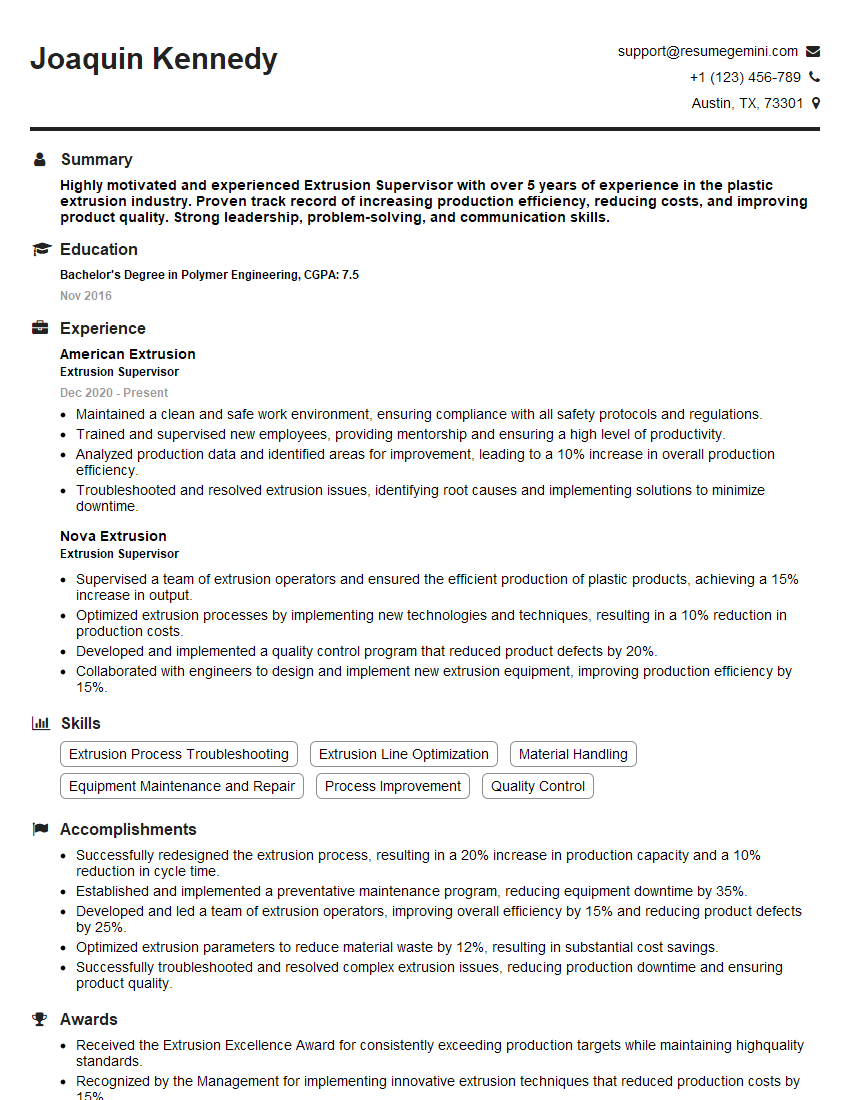
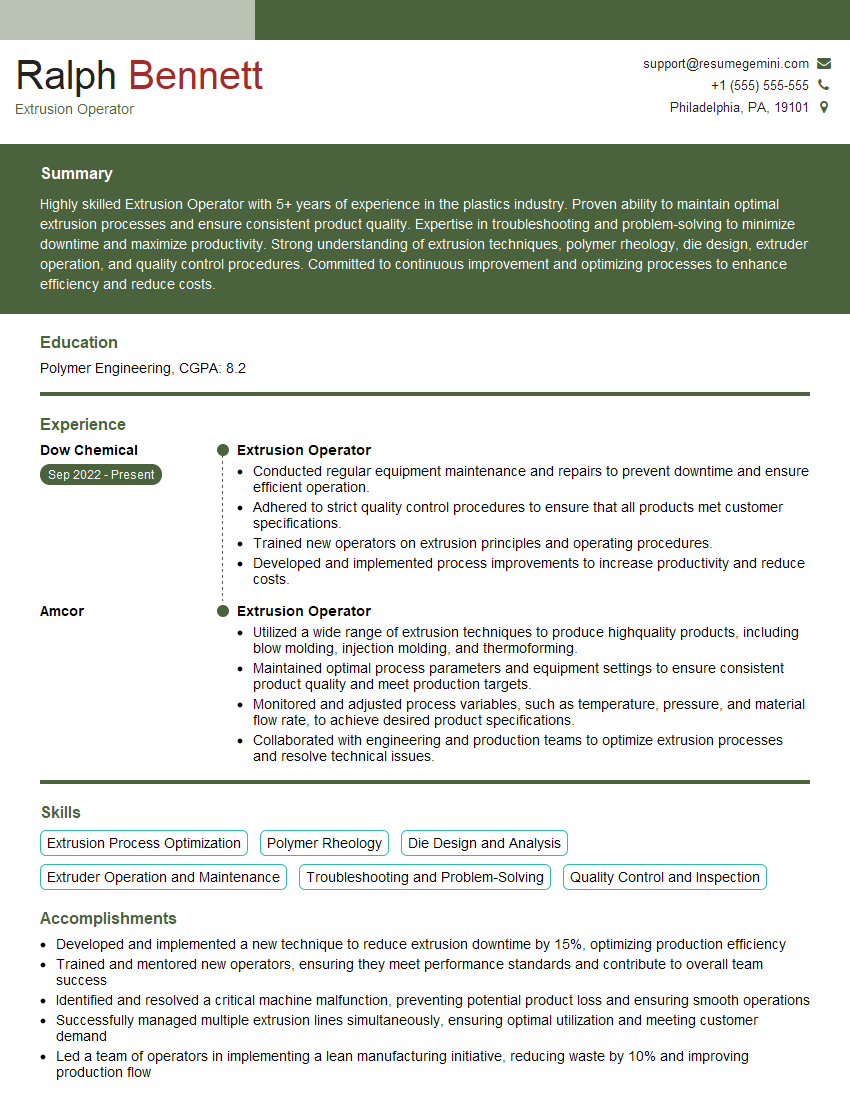
Mastering plate extrusion opens doors to exciting career opportunities in manufacturing, materials science, and engineering. A strong understanding of this process is highly sought after in today’s competitive job market. To significantly increase your chances of landing your dream role, crafting a compelling and ATS-friendly resume is crucial. ResumeGemini is a trusted resource that can help you build a professional and effective resume tailored to the specific requirements of plate extrusion positions. Examples of resumes specifically designed for this field are available to guide you. Invest the time to create a strong resume—it’s an investment in your future success.

Explore more articles
Users Rating of Our Blogs
Share Your Experience
We value your feedback! Please rate our content and share your thoughts (optional).
What Readers Say About Our Blog
Very informative content, great job.
good