Unlock your full potential by mastering the most common Pâtisserie interview questions. This blog offers a deep dive into the critical topics, ensuring you’re not only prepared to answer but to excel. With these insights, you’ll approach your interview with clarity and confidence.
Questions Asked in Pâtisserie Interview
Q 1. Explain the difference between pâte à choux and pâte brisée.
Pâte à choux and pâte brisée are both fundamental pastry doughs, but their compositions and resulting textures differ dramatically. Think of it like this: pâte à choux is the airy, light backbone of cream puffs and éclairs, while pâte brisée is the buttery, crumbly base of a classic tart.
- Pâte à choux: This dough is unique because it relies on steam for its expansion. It’s made with water, butter, flour, and eggs. The high water content creates steam within the dough during baking, causing it to puff up dramatically. The flour provides structure, and the eggs add richness and elasticity.
- Pâte brisée: This is a simple, classic dough primarily composed of flour, butter, and water (sometimes with the addition of an egg). The key is to keep the butter cold and work it into the flour gently, so that it remains in small pieces. This creates a flaky, tender texture when baked. It’s the foundation for many tarts and quiches.
In essence, pâte à choux is all about air and puffing, resulting in a light and hollow interior, while pâte brisée focuses on the delicate interplay of fat and flour, leading to a crisp, crumbly crust. They are entirely different approaches to dough making.
Q 2. Describe the process of making a classic French macaron, including troubleshooting common issues.
Making a perfect French macaron requires precision and patience. The process involves several critical steps:
- Macaronage: This is the crucial step where you gently fold the dry ingredients (almond flour and powdered sugar) into the meringue. The goal is to incorporate the dry ingredients without deflating the meringue, achieving a lava-like consistency. Overmixing results in flat macarons, while undermixing leads to cracked tops.
- Piping: The batter is piped onto a baking sheet in even, round circles. The size and consistency of the piped rounds will determine the final macaron’s size and shape.
- Resting: The piped macarons need to rest at room temperature for 30-60 minutes to form a skin. This skin prevents the macarons from spreading unevenly during baking.
- Baking: Baking requires careful monitoring of the oven temperature and baking time. The macarons should have a slight foot (a small skirt around the base) and a smooth, glossy surface when they are done.
- Filling and Assembly: Once cooled, the macarons are carefully paired and filled with a delicious ganache, buttercream, or jam.
Troubleshooting:
- Cracked Tops: This usually indicates overmixing of the batter or too much air in the meringue.
- Hollow Feet: Insufficient resting time or too high an oven temperature can result in hollow macarons.
- Flat Macarons: Overmixing or improper macaronage is the most common cause of flat macarons.
- Unevenly Baked Macarons: Uneven oven temperature or inadequate resting time.
Consistent results require attention to detail, precise measurements, and practice. Don’t be discouraged if your first batch isn’t perfect – every pâtissier has had their share of macaron mishaps!
Q 3. What are the different types of chocolate and how do their properties affect their use in pastry?
Chocolate comes in various types, each possessing unique characteristics that affect its use in pastry:
- Dark Chocolate: Higher cocoa content (typically 70% or more), intense flavor, and bitterness. Its higher fat content provides richness and shine in ganaches and coatings. It’s ideal for making intensely flavored truffles and creating elegant, smooth glazes.
- Milk Chocolate: Lower cocoa content, sweeter flavor profile due to added milk solids. Its creamy texture makes it a popular choice for fillings, mousses, and confections where a gentler flavor is preferred.
- White Chocolate: Contains no cocoa solids, only cocoa butter, sugar, and milk solids. It’s known for its creamy texture and sweet flavor. Its lower melting point requires careful tempering. It works wonderfully in fillings, glazes, and decorations that need a lighter, sweeter note.
- Couverture Chocolate: High-quality chocolate with a specific cocoa butter content, allowing for easy tempering and a beautiful sheen. It’s crucial for creating professional-looking chocolates, bonbons, and other showpieces.
The chocolate’s fat content significantly influences its behavior when melted and tempered. Higher fat content leads to a smoother, shinier final product, while lower fat content may result in a duller finish.
Q 4. How do you temper chocolate and why is it important?
Tempering chocolate is a crucial process that involves carefully heating and cooling chocolate to create a stable, crystalline structure. This ensures the chocolate will have a glossy sheen, snap cleanly, and melt smoothly in the mouth. Improper tempering results in a dull, grainy, or blooming chocolate (a whitish coating that forms on the surface).
Process: There are several methods, but a common one is the seeding method:
- Melt a portion of the chocolate: Gently melt a larger part of the chocolate, avoiding burning.
- Seed with tempered chocolate: Add a small amount of finely chopped, already-tempered chocolate (seeds) to the melted chocolate and stir until smooth. This introduces stable crystals to the melt.
- Cool and stir: Gradually cool the mixture while stirring constantly until it reaches the proper seeding temperature (around 86-88°F for dark chocolate). The chocolate should be thick enough to leave a trail when you drag a spatula through it.
- Check the temperature: Use a thermometer for precision. The final temperature varies depending on the type of chocolate.
Importance: Tempered chocolate creates a professional-looking, and delicious finished product. It’s essential for creating beautiful, shiny chocolates, bonbons, and elegant coatings for cakes and desserts. The tempering process aligns the fat crystals, ensuring that the chocolate sets properly and displays optimal gloss and snap.
Q 5. Explain the importance of proper ingredient storage and its impact on pastry quality.
Proper ingredient storage is paramount in maintaining the quality and freshness of pastries. Poor storage can lead to staleness, rancidity, or even spoilage, negatively impacting flavor, texture, and overall quality.
- Flour: Store in an airtight container in a cool, dry place to prevent insect infestation and absorption of moisture.
- Sugar: Store in an airtight container in a cool, dry place to prevent clumping.
- Chocolate: Store in a cool, dark, and dry place to prevent blooming or off-flavors. Properly wrapped is crucial.
- Butter: Refrigerate in its original wrapping or an airtight container. Avoid freezing unless long-term storage is necessary.
- Eggs: Refrigerate in their original carton or an airtight container to maintain freshness.
- Fruits and Nuts: Properly storing these will extend their shelf life and prevent oxidation and rancidity. Store them in airtight containers in a cool, dry place.
Following proper storage guidelines will not only extend the shelf life of ingredients but will significantly improve the quality and consistency of your pastries. Imagine the difference between using perfectly fresh butter versus butter that’s been sitting open on the counter – the results will be night and day.
Q 6. Describe your experience with different types of yeast and their applications in pastry.
Different types of yeast offer unique characteristics and are suited for different applications in pastry.
- Active Dry Yeast: This is the most common type, requiring activation in warm water before use. It’s versatile and suitable for bread, brioche, and other enriched doughs.
- Instant Yeast: Doesn’t require pre-activation and can be added directly to dry ingredients. It’s convenient and often preferred for quick breads and pastries.
- Fresh Yeast (Cake Yeast): A moist yeast that needs to be refrigerated and used quickly. It adds a rich flavor to pastries like croissants and brioche. It requires more precise handling and timing.
The choice of yeast depends on the recipe’s requirements and desired outcome. Active dry yeast is a good all-around choice, while instant yeast offers convenience, and fresh yeast delivers superior flavor in enriched doughs. Using the wrong type can greatly affect the rise and texture of your pastry.
For instance, using active dry yeast in a delicate croissant dough might lead to a less layered and tender texture, while using fresh yeast in a simple bread recipe might require too much attention to timing.
Q 7. How do you ensure the proper texture and consistency in mousses and creams?
Achieving the proper texture and consistency in mousses and creams requires careful attention to several factors:
- Fat Content: The type and amount of fat (cream, butter, etc.) will significantly impact the texture. Higher fat content contributes to a richer, smoother mousse, while less fat leads to a lighter, less dense consistency.
- Whipping Technique: Properly whipping the cream or egg whites to stiff peaks is crucial for achieving the desired lightness and airiness. Over-whipping can result in a grainy texture, while under-whipping results in a lack of volume.
- Stabilizers: Ingredients like gelatin, agar-agar, or even cornstarch can help stabilize mousses and creams, preventing separation and maintaining their shape over time.
- Temperature Control: The temperature of the ingredients can affect the whipping process and the final texture. Cold ingredients are essential for whipping cream to its proper consistency.
- Folding Technique: When incorporating whipped ingredients into other components (such as chocolate or purées), gentle folding is essential to maintain the air incorporated during whipping. Rough mixing will result in a denser and less airy mousse.
For example, a light and airy chocolate mousse will require carefully whipped cream folded gently into a smooth chocolate ganache. In contrast, a denser mousse might incorporate less whipped cream or include other ingredients, such as gelatin, for a more stable texture.
Q 8. What are the key considerations when creating a balanced and flavorful pastry?
Creating a balanced and flavorful pastry is a delicate dance of contrasting elements. It’s about achieving harmony between sweetness, acidity, richness, and texture. Think of it like composing a symphony; each instrument (ingredient) plays a crucial role in creating the overall masterpiece.
Sweetness: This is usually the dominant flavor, but it shouldn’t overpower the other elements. We carefully choose sugars – granulated, powdered, invert – depending on the desired texture and browning. For example, using a combination of granulated and invert sugar in a caramel creates a smoother, less crystalline result.
Acidity: A touch of acidity – from lemon juice, vinegar, or even fruit – cuts through the sweetness and brightens the flavors. It’s essential in preventing cloying sweetness and enhances the overall taste profile. Consider the classic lemon tart; the tartness of the lemon curd beautifully complements the sweetness of the pastry crust.
Richness: Elements like butter, cream, and egg yolks provide richness and mouthfeel. The balance here is crucial; too much can make the pastry heavy and feel greasy, while too little can leave it bland. A rich chocolate ganache, for example, balances well with a lighter, flaky crust.
Texture: The interplay of textures is as important as the flavors. A crisp exterior contrasts beautifully with a soft, creamy interior, or a smooth mousse against a crumbly base. A classic example is the contrast between the crisp shell and the soft, creamy filling of a macaron.
Mastering these elements allows me to create pastries that are not only delicious but also beautifully balanced and memorable.
Q 9. Explain your understanding of sugar work and its artistic applications.
Sugar work is a fascinating art form that involves manipulating sugar into various shapes and forms using heat and specialized tools. It requires precision, patience, and a keen eye for detail. It’s not just about creating visually appealing decorations; it’s about understanding the science of sugar crystallization and the properties of different sugar types.
Techniques: I’m proficient in several techniques including pulled sugar (creating ribbons and shapes), spun sugar (creating delicate webs), and isomalt work (creating clear, glassy decorations). I also regularly use sugar for delicate decorations like modeling chocolate or creating beautiful sugar flowers.
Artistic Applications: Sugar work finds its place in a wide variety of pastries. Think of the intricate sugar decorations adorning wedding cakes, or the elegant spun sugar accents on desserts, or even the precise sugar crystals on a delicate macaron shell. Each application requires a different technique and level of skill.
Example: I once created a showpiece cake featuring a sugar sculpted swan, requiring hours of work using pulled sugar techniques to achieve the delicate plumage and elegant posture. The result was stunning, showcasing the versatility and artistry of sugar work.
The beauty of sugar work lies in its ability to transform a simple pastry into a breathtaking piece of art.
Q 10. How do you manage your time and prioritize tasks in a busy pastry kitchen?
Time management in a busy pastry kitchen is crucial. My approach is a combination of planning, prioritization, and efficient execution.
Planning: I begin each day with a detailed plan, outlining tasks based on production schedules and order priorities. This involves checking orders, confirming ingredient availability, and estimating production times.
Prioritization: I prioritize tasks based on urgency and deadline. Items with tight deadlines or special requirements are tackled first, ensuring smooth workflow and timely delivery.
Efficient Execution: I employ techniques like mise en place (preparing all ingredients beforehand) and streamlining workflows to minimize wasted time. I also delegate tasks effectively, utilizing my team’s strengths.
Flexibility: Despite meticulous planning, unexpected issues arise. I adapt quickly to changes, re-prioritizing as needed and communicating effectively with the team to maintain efficiency and morale.
My experience has taught me that effective time management isn’t just about speed; it’s about strategic planning and consistent execution.
Q 11. Describe your experience with different types of ovens and their impact on baking results.
Different ovens significantly impact baking results. My experience encompasses various types, each with its unique characteristics:
Conventional Ovens: These are versatile and widely used. Understanding their heat distribution is key; I often use baking stones or sheets to create even baking. For example, I adjust baking times and temperatures slightly depending on the oven’s performance.
Convection Ovens: The fan-assisted circulation ensures even heat distribution, leading to faster and more consistent baking. This is particularly useful for delicate items that require precise temperature control. I often use convection for macarons, ensuring even browning and preventing cracking.
Proofing Ovens: These low-temperature ovens are vital for creating an ideal environment for dough rising. Maintaining consistent temperature and humidity is crucial for achieving optimal rise and texture.
Rotary Ovens: Used for large-scale production, these ovens rotate to ensure even baking of numerous items simultaneously. Understanding their heat patterns and adjusting baking times is essential for consistent results.
Adapting my techniques to the oven’s type and quirks is crucial for achieving consistent, high-quality results.
Q 12. How do you handle recipe scaling and conversion for large-scale production?
Scaling recipes for large-scale production requires precision and a deep understanding of baking principles. Simply multiplying ingredients proportionally doesn’t always work; some ingredients’ roles change when quantities increase.
Ingredient Ratios: I carefully analyze the role of each ingredient. For example, increasing the amount of liquid might require adjusting the flour to maintain the proper consistency. This requires understanding the underlying science of baking – hydration, gluten development, etc.
Baking Times and Temperatures: Scaling up often means longer baking times due to increased mass. I adjust baking times and temperatures empirically, monitoring closely to avoid over or under-baking. This often requires test batches.
Equipment Considerations: The size and capacity of the equipment also influence scaling. For large-scale production, I use specialized equipment like industrial mixers and ovens, and adjust techniques accordingly.
Example: Scaling up a recipe for croissants requires careful consideration of the dough’s hydration and proofing time. I’ve found that large batches require slightly longer proofing times to ensure proper fermentation and layer development.
Recipe scaling is more than just arithmetic; it’s about a nuanced understanding of the interactions between ingredients and how they change with scale.
Q 13. Explain your methods for maintaining food safety and hygiene standards in a pastry environment.
Maintaining food safety and hygiene is paramount in a pastry environment. My approach is based on a combination of preventative measures, strict protocols, and continuous monitoring.
Personal Hygiene: Handwashing, hairnets, and appropriate attire are non-negotiable. Regular hand sanitizing is also incorporated throughout the workflow.
Food Handling: I rigorously follow FIFO (First In, First Out) principles for ingredient storage and rotation. I maintain proper temperature controls, ensuring ingredients are stored at appropriate temperatures to prevent spoilage. Thorough cleaning and sanitization of all equipment and surfaces after each use is crucial.
Pest Control: Regular pest control measures are in place to prevent infestation. Proper waste disposal is also vital to minimize potential contamination.
Cross-Contamination Prevention: I use separate cutting boards and utensils for raw and cooked ingredients, and maintain strict separation to prevent cross-contamination.
Documentation: Maintaining accurate records of temperatures, cleaning schedules, and ingredient sourcing is crucial for traceability and accountability. This also assists in tracking down any potential source of contamination.
Food safety is not just a checklist; it’s a culture of responsibility and vigilance.
Q 14. Describe your experience with various pastry decorating techniques.
I have extensive experience with various pastry decorating techniques, continually expanding my skillset to stay ahead of the culinary trends. My repertoire includes:
Piping: I’m proficient in various piping techniques, using different nozzles and pressures to achieve various textures and designs, from delicate rosettes to intricate borders.
Glazing and Icing: I can create smooth and glossy glazes and icings, using different methods and ingredients like chocolate ganache, mirror glaze, and royal icing. This includes techniques for achieving perfect coverage and a flawless finish.
Fondant and Gum Paste Modeling: I’m adept at creating three-dimensional decorations using fondant and gum paste, including flowers, figurines, and decorative elements. This requires precision, patience, and artistic skill.
Fruit Carving: I can intricately carve and arrange fruit to create visually appealing garnishes and decorations.
Airbrushing: I utilize airbrushing to create delicate color gradations and unique patterns on pastries, offering subtle and elegant detailing.
My aim is to always choose the most appropriate decorating technique to enhance the overall aesthetic appeal and complement the flavors of the pastry.
Q 15. How do you ensure the stability and longevity of your pastry creations?
Ensuring the stability and longevity of pastry creations involves a multifaceted approach focusing on ingredient quality, proper techniques, and appropriate storage. Think of it like building a house – a strong foundation (ingredients) and careful construction (techniques) are crucial for a long-lasting structure.
Ingredient Quality: Using fresh, high-quality ingredients is paramount. For example, using good quality butter significantly impacts the texture and shelf life of a croissant compared to using a cheaper alternative. Similarly, using fresh eggs contributes to a more stable meringue.
Precise Techniques: Mastering techniques like proper creaming, folding, and chilling is key. Overmixing a cake batter can lead to a tough texture, while undermixing can result in uneven cooking. Chilling doughs, like for pie crusts or puff pastry, allows gluten development and reduces shrinkage, increasing stability.
Appropriate Storage: Understanding how different pastries should be stored is critical. Cakes are best stored in an airtight container at room temperature (unless they contain cream fillings), while delicate pastries such as macarons need to be kept in a cool, dry place away from moisture. Proper packaging also helps prevent staleness and maintain freshness.
Career Expert Tips:
- Ace those interviews! Prepare effectively by reviewing the Top 50 Most Common Interview Questions on ResumeGemini.
- Navigate your job search with confidence! Explore a wide range of Career Tips on ResumeGemini. Learn about common challenges and recommendations to overcome them.
- Craft the perfect resume! Master the Art of Resume Writing with ResumeGemini’s guide. Showcase your unique qualifications and achievements effectively.
- Don’t miss out on holiday savings! Build your dream resume with ResumeGemini’s ATS optimized templates.
Q 16. What are your strategies for managing pastry inventory and minimizing waste?
Managing pastry inventory and minimizing waste requires meticulous planning and execution. It’s all about balancing supply and demand and making the most of each ingredient.
Careful Forecasting: Accurate forecasting of demand based on past sales data, seasonal trends, and special events is essential. This allows for precise ordering of ingredients and prevents overstocking.
FIFO (First-In, First-Out) System: Implementing a FIFO system for inventory management ensures that older ingredients are used before newer ones, minimizing spoilage. This simple system is crucial to avoid losses due to expired ingredients.
Creative Repurposing: Leftover ingredients can be creatively repurposed. For example, stale bread can be made into bread pudding or croutons. Fruit that’s past its prime might be suitable for jams or compotes.
Portion Control: Accurate portioning of ingredients minimizes waste during the baking process. Investing in accurate measuring tools contributes significantly to efficient ingredient utilization.
Q 17. Describe your experience with working with different types of fruit and their applications in pastry.
Working with different types of fruit in pastry requires understanding their unique characteristics and how they react during baking. Each fruit brings a different flavor profile, texture, and moisture content to the finished product.
Berries: Delicate berries like raspberries and strawberries are best used in tarts, cakes, or mousses where their delicate flavor and texture won’t be compromised by high heat. Their high water content might require adding thickening agents to prevent soggy bottoms.
Stone Fruits: Plums, peaches, and apricots, with their higher sugar content, can be used in pies, crumbles, or jams. Their firmer texture holds up well to baking.
Citrus Fruits: Lemons, limes, and oranges offer bright acidity and aromatic oils, often used in glazes, curd fillings, and cakes for balancing sweetness.
Choosing the right fruit for a particular pastry involves considering its flavor, texture, and moisture content. This ensures the best possible outcome and prevents issues like soggy bottoms or loss of flavor.
Q 18. How do you troubleshoot common baking problems, such as soggy bottoms or collapsed cakes?
Troubleshooting baking problems is a key skill for any pastry chef. It often requires understanding the underlying causes.
Soggy Bottoms: This is frequently caused by excessive moisture in the filling or inadequate baking time. Solutions include pre-baking the crust, using a crumb layer, reducing the amount of liquid in the filling, or increasing the baking time and temperature.
Collapsed Cakes: Collapsed cakes can result from several factors, including underbaking, opening the oven door too soon, incorrectly creamed butter and sugar, or insufficient leavening agent. Careful attention to recipes, oven temperature and baking time is crucial. A properly creamed butter and sugar mixture incorporates air into the batter which helps create a lighter cake that holds its shape.
Systematic troubleshooting involves identifying the potential causes and systematically eliminating them through experimentation and adjustments. Keeping detailed notes on recipes and any adjustments made aids learning and prevents repeat mistakes.
Q 19. Explain your understanding of different types of icings and glazes.
Icings and glazes provide both aesthetic appeal and flavor enhancement to pastries. They differ in their consistency and application methods.
Buttercream: A classic, rich icing made from butter, sugar, and sometimes eggs or flavorings. There are various types, including American buttercream (light and fluffy), Swiss meringue buttercream (stable and smooth), and Italian meringue buttercream (shiny and glossy).
Fondant: A smooth, pliable icing used for covering cakes and creating intricate decorations. It’s ideal for creating a perfect, seamless finish but requires some skill to work with.
Ganache: A mixture of chocolate and cream, which can be used as a filling, icing, or glaze, depending on the ratio of chocolate to cream. It ranges from a thick, spreadable consistency to a pourable glaze.
Glazes: These are generally thinner than icings and often used for a glossy shine or flavor enhancement. They can be made from simple sugar syrups, fruit purees, or chocolate.
The choice of icing or glaze depends on the desired texture, flavor, and visual effect. For example, a delicate cake might be best suited with a light buttercream, while a rich chocolate cake might benefit from a ganache glaze.
Q 20. How do you incorporate seasonal ingredients into your pastry creations?
Incorporating seasonal ingredients adds freshness and excitement to pastry creations. It’s a great way to showcase the best flavors of each season. Think of it as painting a seasonal masterpiece.
Summer: Summer fruits like berries and stone fruits can be used in tarts, pies, and mousses. The vibrant colors and fresh flavors are perfect for lighter desserts.
Autumn: Autumn offers apples, pears, and pumpkins which are ideal for pies, crumbles, and cakes. Spices like cinnamon and nutmeg add warmth and depth.
Winter: Richer flavors, like citrus fruits, chocolate, and spices, dominate winter desserts. Cakes, tarts, and warm drinks highlight the flavors of the season.
Spring: Spring brings lighter flavors like rhubarb, strawberries and other early berries. These flavors perfectly complement light, delicate pastries.
Using seasonal ingredients not only enhances flavor but also supports local farmers and reduces the environmental impact of transporting produce long distances.
Q 21. Describe your experience with creating visually appealing and creative pastry designs.
Creating visually appealing pastry designs is as important as the taste. It’s about capturing the essence of the dessert in a way that engages all senses.
Color Palette: Choosing a harmonious color palette is crucial. Using contrasting colors or complementary shades can create striking visual effects. The use of natural food colorings derived from fruits and vegetables adds an extra layer of refinement.
Texture Contrast: Combining different textures, like smooth and rough, or crisp and soft, adds depth and interest to the design. A simple contrast between a smooth ganache and a crunchy crumble topping provides visual interest.
Piping Techniques: Mastering various piping techniques allows for creating intricate patterns and designs. From rosettes and swirls to lettering and delicate lines, piping adds finesse and artistry.
Modern Techniques: Incorporating modern techniques like airbrushing, stenciling, and mold making allows for creating intricate designs and unique shapes. These advanced techniques allow for a personalized creative expression.
Ultimately, the goal is to create a pastry that is not only delicious but also visually stunning and memorable. A well-designed pastry invites the eye just as much as it does the palate.
Q 22. What are some innovative pastry trends you’re currently following?
The pastry world is constantly evolving! Currently, I’m fascinated by several innovative trends. One is the increasing focus on hyper-local and seasonal ingredients. This not only elevates the flavor profiles but also reduces the carbon footprint. Think using foraged berries in a tart or incorporating heirloom tomatoes into a savory tartlet. Another exciting trend is the rise of avant-garde techniques. This includes the use of liquid nitrogen for instant freezing, creating unique textures, and the exploration of modernist culinary concepts like spherification to add textural complexity.
Furthermore, I’m seeing a growing interest in fermentation and sourdough techniques in pastry. This adds depth of flavor and complexity, moving beyond the traditional reliance on yeast alone. Finally, the demand for vegan and plant-based options is driving innovation in ingredient sourcing and techniques to create delicious and visually appealing pastries that cater to a wider range of dietary preferences.
Q 23. How do you adapt recipes to meet dietary restrictions or allergies?
Adapting recipes for dietary restrictions is a critical skill. My approach is systematic. First, I identify the allergen or restriction (e.g., gluten, dairy, nuts). Then, I substitute ingredients carefully. For example, replacing wheat flour with gluten-free blends like almond flour or rice flour requires adjusting the liquid content to achieve the correct texture. Dairy can be substituted with plant-based milks, creams, or vegan butter, but again, this needs careful consideration of the fat content and its impact on the final product.
For nut allergies, I meticulously check all ingredients and use alternative ingredients like sunflower seeds or pumpkin seeds. I maintain separate preparation areas and tools to avoid cross-contamination. Finally, thorough testing and adjustments are crucial to ensure the adapted recipe achieves the desired taste, texture, and visual appeal. Documentation is essential for reproducibility and consistency.
Q 24. Explain your understanding of cost control and profitability in a pastry kitchen.
Cost control and profitability are fundamental in a pastry kitchen. It’s a delicate balance. I begin by carefully analyzing recipes to optimize ingredient costs without compromising quality. This involves finding reliable suppliers offering competitive pricing and managing inventory efficiently to minimize waste. Portion control is another vital aspect— accurately measuring ingredients prevents overspending and ensures consistent product size.
Labor costs are also significant. Efficient workflow design and staff training minimize labor time per unit produced. Pricing strategies need careful consideration. This involves analyzing competitor pricing, calculating the cost per item (including overhead), and setting a profit margin that ensures both viability and attractiveness to customers. Regular monitoring of sales data allows for adjustments in menus and pricing to maximize profitability.
Q 25. Describe your experience with leading and training a pastry team.
Leading and training a pastry team requires strong communication, delegation, and mentorship skills. I foster a collaborative environment where team members feel empowered to share ideas and learn from each other. My approach focuses on hands-on training, demonstrating proper techniques and providing constructive feedback. I use a combination of individual coaching and group training sessions, tailored to different skill levels and experience.
Regular performance reviews and feedback sessions are crucial for identifying areas for improvement and celebrating achievements. Creating a positive work environment where team members are valued and respected is vital for maintaining high morale and productivity. I also encourage professional development opportunities, such as attending workshops or participating in competitions, to enhance their skills and knowledge.
Q 26. How do you maintain consistency in the quality and appearance of your pastry products?
Maintaining consistency in pastry quality and appearance is paramount. It begins with standardized recipes and precise measurements. We use standardized equipment and tools to ensure uniformity. Careful attention is paid to baking temperatures and times. Visual standards are defined using photography and samples to guide production.
Regular quality control checks at each stage of production, from ingredient inspection to the final product, help to identify and address any deviations. Team training, emphasizing attention to detail and adherence to established procedures, is essential for consistency. Using a well-maintained production schedule helps in keeping track of workflow, order, and inventory management.
Q 27. How do you handle customer complaints or feedback regarding pastry quality?
Customer feedback, even negative, is invaluable. When handling complaints, my approach is empathetic and proactive. I listen carefully to the customer’s concerns without interrupting and acknowledge their feelings. I apologize for any inconvenience caused, regardless of fault. I ask clarifying questions to understand the specific issue—was it the taste, texture, or appearance of the pastry? This information is crucial for determining the root cause.
Depending on the nature of the complaint, I offer a solution, such as a replacement item, a refund, or a discount on a future purchase. I also use the feedback to improve processes and product quality. Even positive feedback is valuable; it reinforces what we’re doing well and provides direction for future innovation.
Q 28. Describe a challenging pastry project you’ve completed and how you overcame the obstacles.
One challenging project involved creating a bespoke wedding cake for 200 guests. The design was extremely intricate, incorporating multiple tiers, sugar flowers, and edible lace. The biggest challenge was balancing the aesthetic complexity with structural integrity to ensure the cake remained stable and visually stunning throughout the event.
To overcome this, I meticulously planned the cake construction, utilizing internal supports and lightweight materials. I created detailed blueprints and diagrams to guide the team. We practiced assembling the cake several times to refine the process and address any potential issues. The result was a show-stopping cake that delighted the wedding party and guests, demonstrating careful planning and problem-solving capabilities.
Key Topics to Learn for Pâtisserie Interview
- Classic Pâtisserie Techniques: Understanding foundational techniques like creaming, whisking, macaronage, and tempering is crucial. Consider the nuances of each and how they impact final product quality.
- Ingredient Knowledge: Deep familiarity with various flours, sugars, fats, and leavening agents is essential. Be prepared to discuss their properties and how they interact in different recipes.
- Recipe Development & Adaptation: Demonstrate your ability to understand existing recipes and modify them to suit specific needs, dietary restrictions, or creative visions. Highlight examples from your experience.
- Baking Science: Understanding the scientific principles behind baking, such as gluten development, emulsification, and Maillard reaction, will impress interviewers. Be prepared to explain how these processes affect your work.
- Production & Efficiency: Discuss your experience with large-scale baking, time management, and efficient workflow in a professional kitchen. Highlight any strategies you employ to maintain quality while managing time constraints.
- Hygiene & Safety: Demonstrate a strong understanding of food safety regulations and best practices for maintaining a clean and sanitary work environment. This is paramount in a professional kitchen.
- Troubleshooting & Problem-Solving: Interviewers want to know how you handle unexpected challenges. Be ready to discuss instances where you successfully solved a problem related to baking or recipe execution.
- Sensory Evaluation & Quality Control: Explain your methods for evaluating the quality of your products, considering factors like texture, taste, aroma, and visual appeal. Highlight your attention to detail.
- Decoration & Presentation: Showcase your skills in creating visually appealing pastries. Discuss your techniques and preferred styles for decorating different types of pastries.
- Teamwork & Communication: Working effectively in a team is vital in a pâtisserie. Be prepared to discuss your collaboration experiences and communication styles.
Next Steps
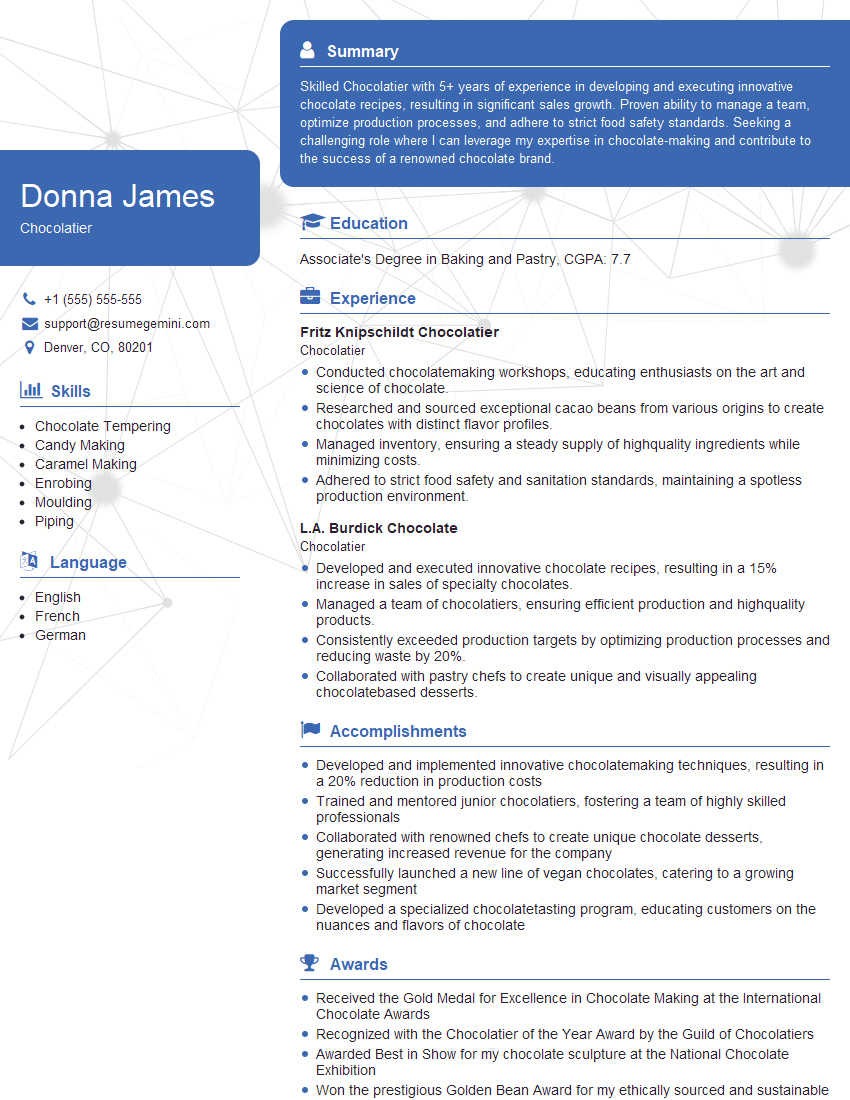
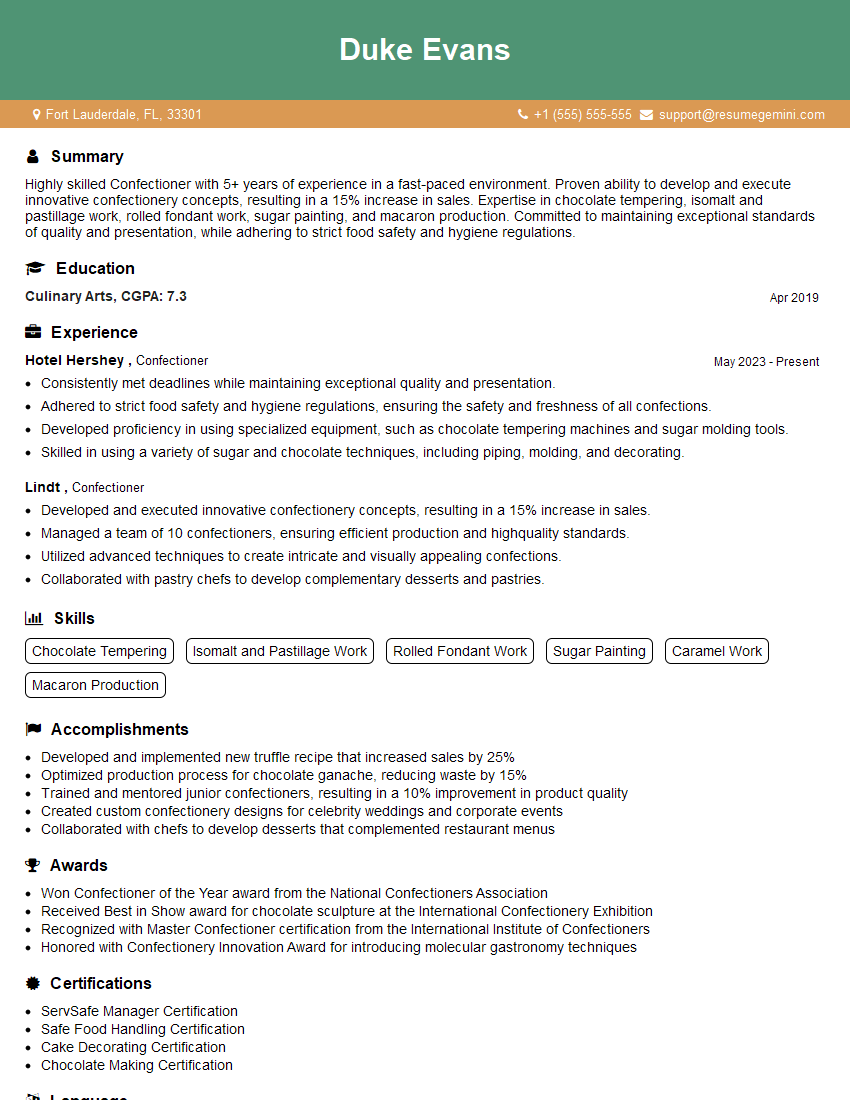
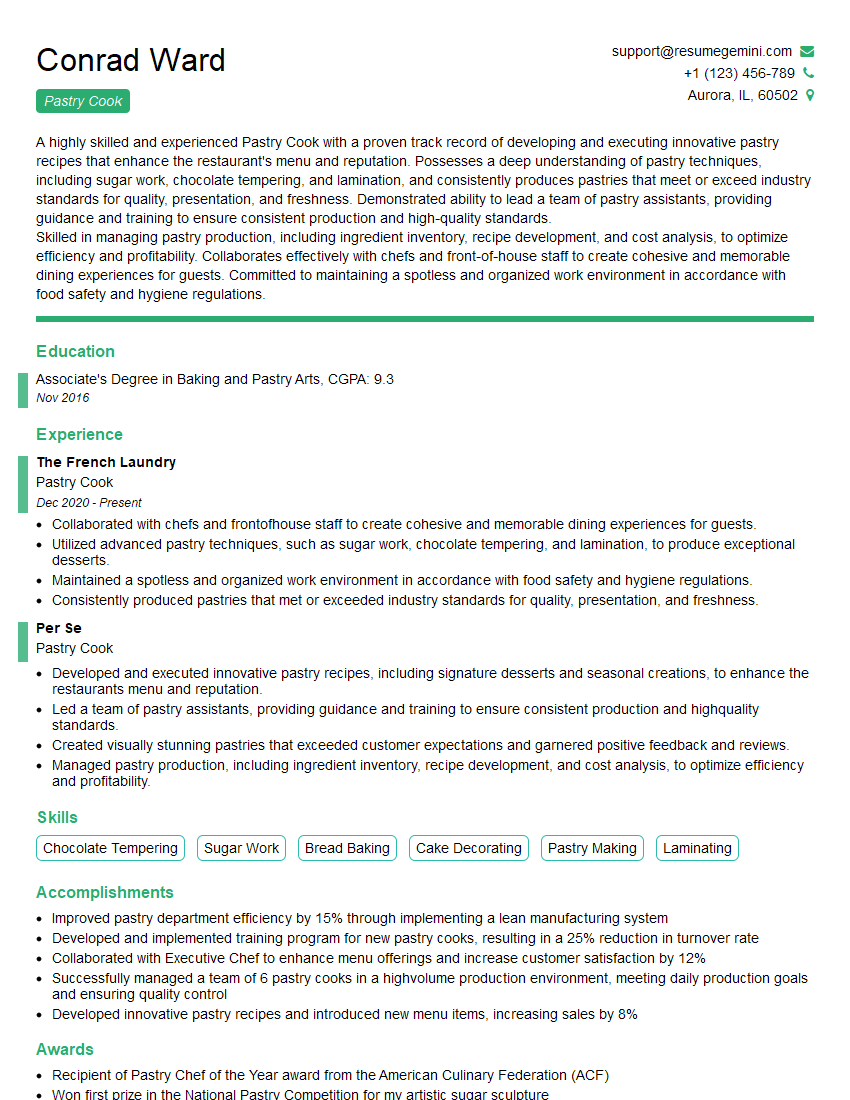
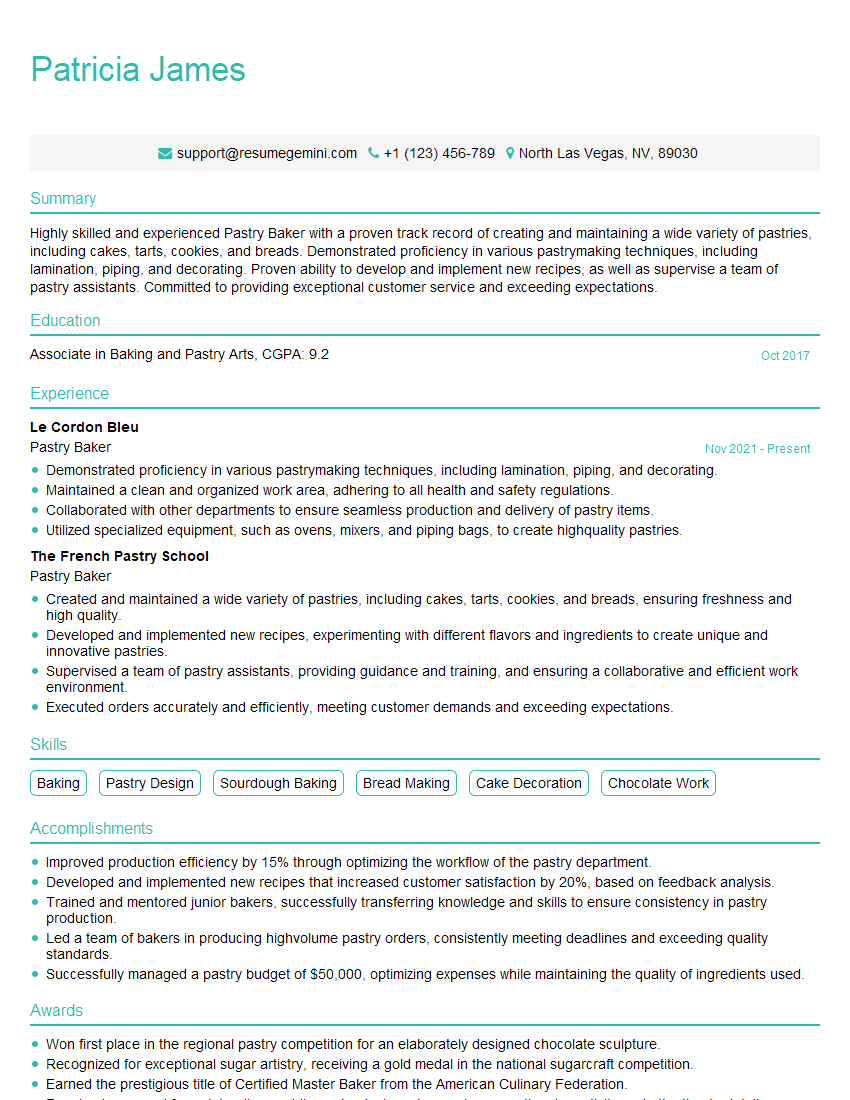
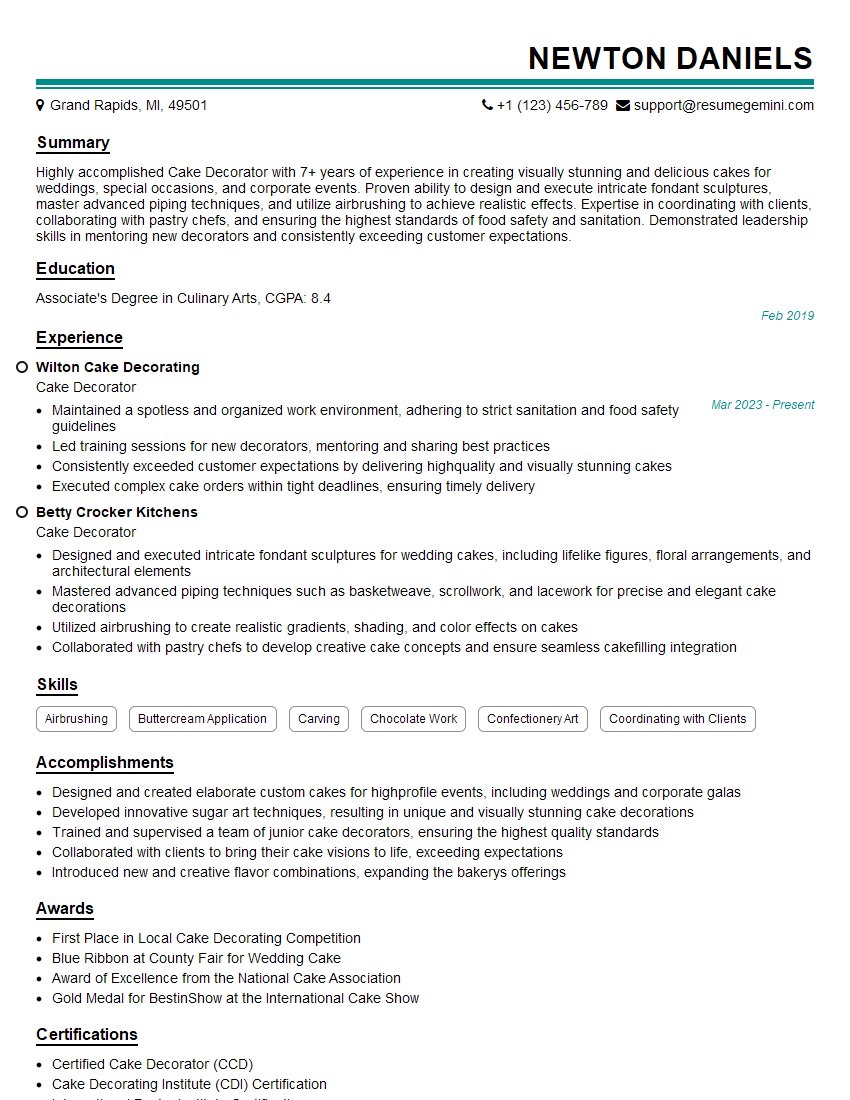
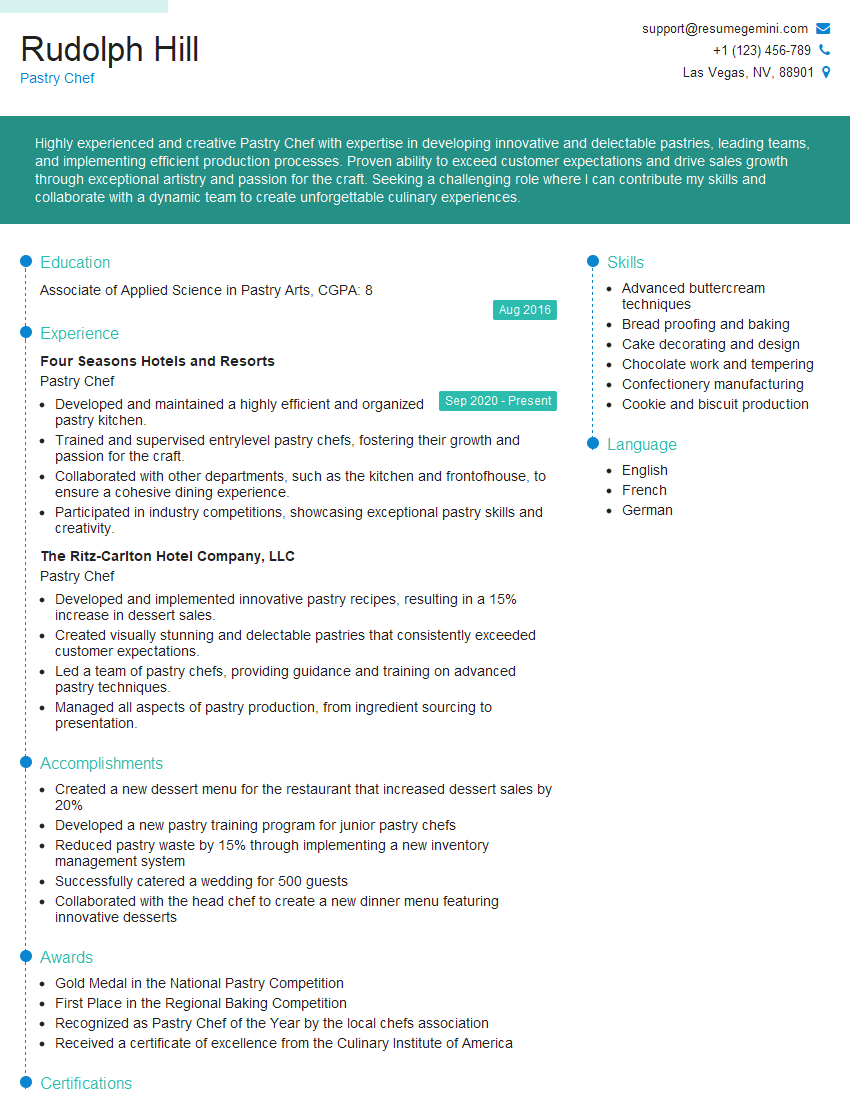
Mastering the art of Pâtisserie opens doors to exciting career opportunities, from renowned restaurants to independent boutiques. To maximize your job prospects, creating a strong, ATS-friendly resume is crucial. ResumeGemini is a trusted resource that can help you build a professional resume that highlights your skills and experience effectively. Examples of resumes tailored to Pâtisserie roles are available, further enhancing your job search success.
Explore more articles
Users Rating of Our Blogs
Share Your Experience
We value your feedback! Please rate our content and share your thoughts (optional).
What Readers Say About Our Blog
Very informative content, great job.
good