Unlock your full potential by mastering the most common Anodizing Equipment Operation interview questions. This blog offers a deep dive into the critical topics, ensuring you’re not only prepared to answer but to excel. With these insights, you’ll approach your interview with clarity and confidence.
Questions Asked in Anodizing Equipment Operation Interview
Q 1. Describe your experience with different anodizing processes (e.g., sulfuric acid, chromic acid).
My experience encompasses both sulfuric acid and chromic acid anodizing processes, though sulfuric acid is far more prevalent due to its environmental friendliness and cost-effectiveness. Sulfuric acid anodizing, which I’ve extensively used, produces a thicker, more porous coating ideal for dyeing and sealing. I’ve worked with various parameters like acid concentration, temperature, and current density to achieve desired coating thicknesses and surface finishes. Chromic acid anodizing, while offering superior corrosion resistance, is less common now due to its toxicity. My experience with this process included handling the hazardous chemicals with utmost care and adherence to strict safety protocols. I’ve personally overseen the transition of several facilities away from chromic acid processes to more sustainable alternatives.
A key difference I’ve observed is the resulting oxide layer – sulfuric acid produces a more porous layer, while chromic acid yields a harder, less porous, and thinner layer. This directly affects the applications of the final product. For example, a sulfuric acid anodized part might be ideal for a decorative application requiring dyeing, whereas a chromic acid anodized part might be preferred for a component needing superior abrasion resistance.
Q 2. Explain the role of current density in the anodizing process.
Current density plays a crucial role in anodizing, directly impacting the coating’s thickness, quality, and efficiency of the process. Think of it like this: current density is the rate at which electricity flows through the anodizing solution per unit area of the workpiece. A higher current density leads to faster coating growth, but exceeding the optimal range can cause defects like burning, pitting, or uneven coating. Conversely, too low a current density results in slow anodizing, increasing processing time and potentially leading to a thin, less durable coating.
In practice, I carefully monitor and control current density based on the material being anodized (aluminum alloys have different optimal ranges), the desired coating thickness, and the anodizing solution’s temperature and concentration. For instance, anodizing aerospace-grade aluminum requires precise control of current density to meet stringent quality standards. I’ve developed proficiency in adjusting current density using rectifiers and monitoring systems to ensure consistent results across large batches.
Q 3. What are the common defects found in anodized parts, and how are they identified?
Common defects in anodized parts include pitting (small holes), burning (localized melting of the surface), staining (discoloration), cracking, and uneven coating thickness. Identifying these defects requires a keen eye and the use of appropriate inspection techniques.
- Pitting appears as small holes or depressions on the surface, often caused by impurities in the solution or insufficient pre-treatment.
- Burning shows as a darkened or melted area, usually resulting from excessively high current density or inadequate agitation of the bath.
- Staining is evident as discoloration, stemming from contamination in the solution or improper rinsing.
- Cracking, indicated by fissures in the coating, points to issues with the anodizing process parameters or the substrate’s stress levels.
- Uneven coating thickness can be detected using thickness measurement tools or visual inspection. It results from inconsistent current distribution or insufficient agitation.
We use visual inspection, microscopy, and thickness gauging to identify these defects, ensuring that non-conforming parts are rejected before shipping. Documentation of these inspections is crucial for quality control and identifying root causes for corrective actions.
Q 4. How do you ensure the quality and consistency of the anodizing process?
Ensuring quality and consistency in the anodizing process relies on meticulous control of multiple factors. This begins with rigorous pre-treatment of the aluminum parts, including cleaning, degreasing, and etching to create a suitable surface for anodizing. During the anodizing process, we closely monitor parameters like temperature, current density, and solution concentration, maintaining them within the prescribed ranges to achieve the desired coating properties. This is done through automated systems and real-time monitoring, along with regular quality checks. Regular testing of the anodizing solution (e.g., acid concentration, conductivity) is essential to maintain solution quality. And lastly, consistent post-treatment (rinsing, sealing) is necessary to ensure the longevity and desired aesthetic properties of the final product.
Statistical Process Control (SPC) methods help us identify trends and deviations from the expected quality parameters, allowing for proactive adjustments to maintain consistency. Regular calibration and maintenance of equipment further contribute to process stability.
Q 5. Describe your experience with different types of anodizing equipment (e.g., rectifiers, tanks, rinsing systems).
My experience encompasses a variety of anodizing equipment. I’m proficient in operating and maintaining rectifiers (which supply the direct current for the process), various tank sizes (ranging from small lab-scale units to large production tanks), and different rinsing systems (including counter-current rinsing for efficient chemical usage). I’ve worked with both automated and manual systems and am comfortable troubleshooting issues with all of them. Specifically, I’m familiar with the operation and maintenance of programmable logic controllers (PLCs) that automate many aspects of the process, including temperature control, current regulation, and tank agitation.
For example, I’ve had experience in selecting and specifying anodizing equipment for new lines, considering factors such as production volume, part size and geometry, and desired anodizing parameters to ensure optimal efficiency and quality. I’ve also overseen the implementation of improved rinsing systems to minimize water consumption and chemical waste.
Q 6. Explain the process of troubleshooting common anodizing equipment malfunctions.
Troubleshooting anodizing equipment malfunctions requires a systematic approach. I typically follow a structured problem-solving process:
- Identify the problem: Pinpoint the exact malfunction. Is it a rectifier issue, a tank problem, or a rinsing system failure? Collect data such as error messages, operational logs, and visual observations.
- Analyze the cause: Once the problem is identified, determine its root cause. Is it a faulty component, a process parameter deviation, or a procedural error?
- Develop a solution: Based on the root cause analysis, develop a solution. This might involve replacing a faulty component, adjusting process parameters, or implementing a new procedure.
- Implement and test the solution: Implement the chosen solution and carefully test its effectiveness. Monitor the system’s performance to ensure the problem is resolved.
- Document the solution: Document the problem, its cause, and the implemented solution for future reference.
For example, if the rectifier is malfunctioning, I might start by checking the power supply, fuses, and circuit breakers. If the problem persists, I would check the rectifier’s internal components or even consult the manufacturer’s technical support.
Q 7. How do you maintain and clean anodizing equipment to ensure optimal performance?
Maintaining and cleaning anodizing equipment is essential for optimal performance and longevity. This involves a combination of regular preventative maintenance and periodic thorough cleaning. Preventative maintenance includes regular inspections of all equipment components, such as checking for leaks, corrosion, and wear and tear, and addressing issues before they escalate into major problems. We have a schedule for regular maintenance tasks, such as checking and tightening connections, replacing worn parts, and lubricating moving parts. Equipment-specific guidelines, such as those provided by the manufacturer, are always followed.
Cleaning anodizing tanks and equipment involves the careful removal of accumulated sludge, scale, and other impurities. The procedure varies depending on the type of tank and solution used. For sulfuric acid tanks, specialized cleaning agents might be used and the process often involves neutralization of the acidic solution. Strict safety protocols, including personal protective equipment (PPE), are mandatory during the cleaning process. Proper rinsing after cleaning is crucial to remove any residue that might affect the quality of future anodizing batches. Regular cleaning minimizes the buildup of contaminants and ensures consistently high-quality anodizing.
Q 8. What safety precautions do you take when operating anodizing equipment?
Safety is paramount in anodizing. My approach is layered, starting with adherence to all relevant OSHA and company safety regulations. This includes mandatory PPE like acid-resistant gloves, aprons, eye protection, and respiratory protection, especially when handling corrosive chemicals. I always inspect equipment before operation, checking for leaks, damaged components, or frayed wiring. Proper ventilation is critical to minimize exposure to hazardous fumes. Before starting any process, I ensure the emergency shut-off systems are easily accessible and understood. I regularly participate in safety training and refresher courses to stay updated on best practices and handle any evolving safety concerns. For instance, during a recent sulfuric acid spill, my immediate action was to isolate the area, notify the appropriate personnel, and follow our company’s established spill response procedures.
- Regular equipment inspections
- Strict adherence to PPE guidelines
- Emergency shut-off procedures understanding
- Regular safety training participation
Q 9. What is your experience with different types of anodizing solutions and their handling?
My experience encompasses various anodizing solutions, primarily sulfuric acid (the most common), chromic acid (for harder coatings but less environmentally friendly), and oxalic acid (for specific applications like architectural finishes). Handling these solutions requires meticulous care. Sulfuric acid requires careful dilution (always add acid to water, never water to acid!) and constant monitoring of its concentration. Chromic acid is highly toxic and requires specialized handling and disposal protocols – in fact, its use is declining due to environmental regulations. Oxalic acid, while less hazardous than sulfuric acid, still needs careful handling. I’m proficient in using titration methods to monitor and maintain the precise concentration of each solution, as even slight variations impact the anodizing process quality. I also maintain detailed records of solution preparation, use, and disposal, complying fully with environmental regulations.
For example, when working with chromic acid, the proper use of specialized pumps, storage containers, and personal protective equipment, along with adhering to strict waste management protocols, are absolutely crucial.
Q 10. Explain your understanding of the parameters that influence the anodizing process (e.g., temperature, time, voltage).
The anodizing process is sensitive to several parameters. Temperature significantly affects the coating’s thickness and quality. Higher temperatures generally lead to faster processes but could compromise the coating’s uniformity and hardness. Time dictates the coating thickness; longer anodizing times usually yield thicker coatings. Voltage controls the current density, directly impacting the coating’s growth rate and porosity. Too low a voltage results in a thin, weak coating, while excessive voltage can lead to burning or uneven coating formation. Other important factors include the electrolyte’s concentration, agitation (ensuring even current distribution), and the aluminum alloy being anodized.
Imagine baking a cake: Temperature (voltage) needs to be just right, as too high or too low ruins the cake (coating). The baking time (anodizing time) determines how well the cake rises (coating thickness). The recipe itself (alloy and electrolyte) matters, and proper mixing (agitation) ensures even cooking (coating distribution).
Q 11. Describe your experience with the use of process control instrumentation in anodizing.
I have extensive experience using process control instrumentation, including computerized data acquisition systems, automated titrators for electrolyte concentration monitoring, temperature controllers, and ammeters/voltmeters for precise current and voltage regulation. We utilize PLC (Programmable Logic Controller) based systems in our facility to automate certain aspects of the process, optimizing consistency and reducing the chance of human error. Data logging features allow for continuous monitoring of key parameters, enabling proactive adjustments and analysis for quality control. For example, we use a system that automatically adjusts the voltage based on real-time feedback from the current density and temperature sensors. This automated control significantly improves the consistency and quality of the anodizing process compared to manual adjustments.
Q 12. How do you interpret and record data from the anodizing process?
Data interpretation and recording are crucial. I collect data from the process control instrumentation (temperature, voltage, current, time, electrolyte concentration) and meticulously record it in our database or log books. This data is then analyzed to monitor process stability, identify trends, troubleshoot potential issues, and optimize parameters for improved efficiency and coating quality. Anomalies in the data, like sudden temperature fluctuations or inconsistent current density, can indicate problems such as a faulty heating element or electrolyte depletion, allowing for prompt intervention. The data also helps us to track the performance of specific batches, identify potential areas for improvement, and ultimately, ensure consistent high-quality results. We often use statistical process control (SPC) charts to visually monitor the anodizing process and detect any significant variations.
Q 13. How do you perform preventative maintenance on anodizing equipment?
Preventative maintenance is vital for equipment longevity and consistent process performance. My routine includes regular cleaning of tanks and components, checking for leaks, inspecting and replacing worn parts (seals, pumps, heating elements), and ensuring proper ventilation. I follow a detailed maintenance schedule, often involving visual inspections, functional tests, and calibrations of instruments. We also perform periodic chemical analysis of the anodizing solutions to ensure their concentration and purity are within acceptable ranges. For instance, we have a regular preventative maintenance schedule for our rectifier units, including checking their cooling systems, inspecting the connections and diodes, and verifying their output voltage and current. This allows us to identify and address any potential issues before they lead to production downtime or equipment failure.
Q 14. Describe your experience with different types of aluminum alloys and their anodizing characteristics.
My experience covers various aluminum alloys (e.g., 6061, 5052, 3003), each exhibiting unique anodizing characteristics. 6061, a common aerospace-grade alloy, typically produces a durable and aesthetically pleasing coating. 5052, known for its corrosion resistance, might require slightly modified anodizing parameters. 3003, often used in architectural applications, presents its own set of considerations. Understanding these nuances is crucial for tailoring the anodizing process to achieve the desired coating properties for each alloy. For instance, a higher voltage might be necessary for certain alloys to obtain the required coating thickness, while a different electrolyte might be more suitable to avoid staining or discoloration on others. I often refer to industry standards and material data sheets to ensure I employ the correct anodizing parameters for each alloy type to achieve optimal results.
Q 15. Explain the importance of pre-treatment processes in anodizing.
Pre-treatment in anodizing is crucial because it directly impacts the quality, adhesion, and overall performance of the final anodized coating. Think of it like preparing a wall before painting – you wouldn’t paint directly onto a dirty, uneven surface, right? Similarly, the aluminum surface needs to be meticulously cleaned and prepared to ensure a uniform, strong anodize layer.
The pre-treatment process typically involves several stages:
- Cleaning: This removes oils, grease, and other contaminants using alkaline cleaners or detergents. We often use ultrasonic cleaning for intricate parts to ensure thorough cleaning.
- Desmutting: This removes any metallic smut or oxides formed during previous processing. Acid desmutting is common, using solutions like nitric acid.
- Etching (Optional): This roughens the surface slightly, improving the adhesion of the anodize layer. This step is often used for applications requiring high durability.
- Rinsing: Thorough rinsing between each stage is critical to remove chemicals and prevent contamination. Multiple rinse tanks are usually used with deionized water.
Without proper pre-treatment, the anodize layer may be uneven, prone to peeling, or less corrosion-resistant. For example, if grease isn’t completely removed, the anodizing process might not adhere properly, leading to coating failure.
Career Expert Tips:
- Ace those interviews! Prepare effectively by reviewing the Top 50 Most Common Interview Questions on ResumeGemini.
- Navigate your job search with confidence! Explore a wide range of Career Tips on ResumeGemini. Learn about common challenges and recommendations to overcome them.
- Craft the perfect resume! Master the Art of Resume Writing with ResumeGemini’s guide. Showcase your unique qualifications and achievements effectively.
- Don’t miss out on holiday savings! Build your dream resume with ResumeGemini’s ATS optimized templates.
Q 16. What is your experience with sealing anodized parts?
Sealing anodized aluminum is essential to improve its corrosion resistance and dye retention. The porous nature of the anodized layer needs to be sealed to prevent moisture and contaminants from penetrating and causing corrosion. I have extensive experience with various sealing methods, ensuring the choice aligns perfectly with the specific application and desired outcome.
Q 17. Describe your experience with different sealing methods (e.g., hot water sealing, nickel sealing).
My experience encompasses a wide range of sealing techniques. Hot water sealing is a common and cost-effective method, using temperatures around 95-100°C. The boiling water hydrates the aluminum oxide, reducing porosity. I’ve found it particularly suitable for simpler applications where high corrosion resistance isn’t paramount.
Nickel acetate sealing provides superior corrosion resistance compared to hot water sealing. It involves immersing the anodized parts in a nickel acetate solution, where nickel ions fill the pores, creating a denser, more protective layer. This method is ideal for applications requiring enhanced corrosion protection, such as outdoor components.
I have also worked with other sealing methods, including dichromate sealing (though its use is diminishing due to environmental concerns) and other proprietary sealants. The selection depends heavily on factors like the required corrosion resistance, color stability, and environmental considerations.
Q 18. How do you determine the appropriate anodizing parameters for a specific application?
Determining the appropriate anodizing parameters is crucial for achieving the desired coating properties. This involves understanding the specific application requirements and the characteristics of the aluminum alloy being anodized. The key parameters include:
- Current Density: This determines the thickness and quality of the anodize layer. Higher current density leads to faster growth but can also lead to inferior quality if not controlled properly.
- Voltage: This is often adjusted to maintain a consistent current density.
- Temperature: This influences the rate of anodizing and the final coating characteristics. Lower temperatures typically produce denser coatings.
- Acid Concentration: This varies depending on the anodizing process (sulfuric acid is most common). Precision in concentration is crucial for consistent results.
- Anodizing Time: This is directly related to the desired coating thickness.
Before starting an anodizing run, we always conduct small-scale test runs to optimize these parameters. For instance, if we are working on a complex aerospace component, we will perform extensive testing to ensure the anodize coating meets the stringent performance requirements specified in the design documents. Data logging and analysis are essential to achieve consistent, repeatable results.
Q 19. Describe your experience with color anodizing.
Color anodizing adds aesthetic appeal and potentially improves UV resistance. This involves introducing organic dyes into the porous anodize layer before sealing. My experience includes working with a wide range of dyes, from standard colors to more complex custom shades. The dyeing process is particularly sensitive to temperature and time, requiring precise control to achieve consistent results. Furthermore, the choice of dye and the sealing method significantly impact the color’s longevity and lightfastness. I’ve managed projects where matching precise color specifications was critical, demanding careful calibration of the dye bath and rigorous quality control measures.
Q 20. What are the environmental concerns associated with anodizing, and how are they mitigated?
Anodizing involves chemicals that pose environmental concerns, primarily the use of acids and the generation of wastewater. Mitigation strategies are crucial for responsible operation. We employ several methods:
- Wastewater Treatment: Our facility uses a multi-stage wastewater treatment system, neutralizing acids, removing heavy metals, and reducing chemical oxygen demand (COD) before discharge. This adheres to all relevant environmental regulations.
- Chemical Management: We minimize chemical waste by optimizing process parameters and regularly monitoring chemical concentrations. Spent solutions are handled and disposed of correctly, following established procedures and regulations.
- Closed-Loop Systems: We utilize closed-loop systems wherever feasible, reducing water consumption and minimizing wastewater generation.
- Regular Inspections and Audits: Our facility is regularly inspected and audited to ensure compliance with environmental regulations and best practices. This includes maintaining detailed records and ensuring all necessary permits are in place.
By diligently implementing these strategies, we ensure our anodizing operation minimizes environmental impact and operates within legal and ethical boundaries.
Q 21. What are the common causes of pitting in anodizing?
Pitting in anodizing, those small holes or imperfections in the coating, is a common issue, often stemming from several factors:
- Improper Cleaning: Incomplete removal of contaminants from the aluminum surface before anodizing can lead to pitting. These contaminants can act as nucleation sites for the formation of pits.
- Contaminated Anodizing Bath: Impurities in the anodizing bath can interfere with the uniform growth of the oxide layer, resulting in pitting. Regular monitoring and filtration of the bath are essential.
- Excessive Current Density: Overly high current densities can lead to uneven coating growth and pitting. Careful control of the anodizing parameters is critical.
- Aluminum Alloy Composition: Certain aluminum alloys are more susceptible to pitting than others. Choosing the appropriate alloy for the application is important.
- Surface Defects: Existing surface defects on the aluminum can act as sites for pit formation.
Troubleshooting pitting involves systematically investigating these potential causes. Microscopic analysis of the affected parts can help determine the root cause, allowing for corrective actions like improving cleaning procedures, modifying the anodizing parameters, or selecting a different aluminum alloy.
Q 22. How do you ensure proper racking and handling of parts during the anodizing process?
Proper racking and handling are crucial for consistent anodizing. Think of it like baking a cake – if you don’t prepare the pan correctly, the cake won’t turn out right. We use specialized racks designed to ensure even current distribution across the parts. This prevents uneven coating thickness and other defects.
- Part Preparation: Before racking, parts are thoroughly cleaned to remove oils, grease, and other contaminants that could interfere with the anodizing process. This often involves multiple cleaning stages, including alkaline cleaning and acid etching.
- Rack Design: Racks are meticulously designed to allow for optimal electrolyte flow around each part. Poor rack design can lead to ‘shadowing’ – areas where the anodizing solution doesn’t reach effectively.
- Loading Technique: Parts are carefully loaded onto the racks to avoid contact between them or short circuits. Overcrowding can also lead to uneven anodizing.
- Insulation: We often use insulating materials between parts and the rack to prevent short-circuiting and ensure even current distribution. For example, we might employ rubber or plastic components.
- Inspection: Before entering the anodizing tank, the loaded racks undergo a careful inspection for potential issues. Any irregularities are addressed before proceeding.
For instance, I once had a batch of intricate aluminum components that required a custom rack design to avoid shadowing. By carefully considering the geometry of the parts and ensuring proper spacing, we achieved a uniform anodize across the entire batch.
Q 23. Explain your understanding of the difference between hard anodizing and standard anodizing.
Hard anodizing and standard anodizing differ primarily in the thickness of the oxide layer and the resulting properties. Think of it like building a house: standard anodizing is like building a regular house with standard walls, while hard anodizing is like building a fortress with extra thick walls.
- Standard Anodizing: Typically produces a thin oxide layer (0.5 to 25 microns), providing corrosion resistance, aesthetic appeal, and improved dye absorption. It’s suitable for applications requiring basic protection and decorative finishes.
- Hard Anodizing: Creates a much thicker oxide layer (25 to 250 microns or more), resulting in significantly enhanced wear resistance, hardness, and abrasion resistance. This is ideal for applications requiring exceptional durability, such as aerospace components and industrial tooling.
The key difference lies in the anodizing process parameters. Hard anodizing uses higher voltages and lower temperatures, along with a more concentrated acid solution, compared to standard anodizing. This results in a denser and thicker oxide layer with enhanced properties. The process also requires specialized equipment.
Q 24. Describe your experience with troubleshooting issues related to current flow and voltage.
Troubleshooting current flow and voltage issues is a critical aspect of anodizing. Unstable current flow, for example, can lead to uneven coating thickness or even completely failed anodizing.
- Low Current: Low current might indicate poor contact between parts and racks, insufficient electrolyte concentration, or a problem with the power supply. We systematically check each of these areas, using multimeters and other diagnostic tools. For example, we might use a clamp meter to check the actual current flowing through each rack.
- High Current: This often points to a short circuit. We carefully inspect the racks for contact between parts or issues with insulation. Sometimes, it might be a problem with the electrolyte itself, such as excessive conductivity.
- Fluctuating Voltage/Current: These fluctuations can be caused by rectifier issues, problems with the power supply, or even imbalances in the tank’s solution itself. Troubleshooting involves checking the power supply, rectifiers, and conducting chemical analyses of the anodizing bath.
- Systematic Approach: We use a systematic approach, starting with visual inspection of racks and parts and moving to detailed testing of the electrical system and the anodizing bath. I often use flow charts or checklists to ensure thorough diagnosis.
For instance, I once encountered inconsistent current flow due to corrosion on the rack contacts. By cleaning and replacing the affected contacts, we restored stable current flow and were able to successfully complete the anodizing run.
Q 25. What is your experience with waste treatment and disposal in anodizing?
Waste treatment and disposal in anodizing is paramount due to the corrosive nature of the chemicals used. We follow strict protocols to minimize environmental impact and comply with regulations.
- Neutralization: Spent acids are carefully neutralized before disposal. This often involves adding a base to reduce the pH to a safe level.
- Filtration: The anodizing bath is frequently filtered to remove solid particulates. This prevents clogging of equipment and ensures a consistent anodizing process.
- Chemical Treatment: Specialized chemical treatment processes are sometimes employed to remove or reduce the concentration of heavy metals or other harmful substances before discharging wastewater.
- Recycling: Where possible, we recycle materials such as aluminum chips or used chemicals. This significantly reduces waste and environmental impact.
- Disposal through Licensed Facilities: All hazardous waste is disposed of through appropriately licensed waste management companies who follow rigorous environmental regulations.
We maintain detailed records of all waste generated, treatment processes, and disposal records, ensuring complete traceability and compliance. This is critically important for auditing and environmental reporting.
Q 26. How do you ensure compliance with relevant safety and environmental regulations?
Compliance with safety and environmental regulations is non-negotiable. It’s not just about following the law; it’s about protecting our employees and the environment.
- Personal Protective Equipment (PPE): Employees always use appropriate PPE, including gloves, eye protection, and protective clothing. Training is regular and covers safe handling of chemicals.
- Emergency Procedures: We have well-defined emergency procedures in place to deal with spills, accidents, and equipment malfunctions. Regular drills are conducted to keep our team prepared.
- Regular Inspections: The facility undergoes regular inspections to ensure compliance with all safety and environmental regulations. This includes inspections of equipment, safety systems, and waste handling practices.
- Record Keeping: We maintain meticulous records of all chemical usage, waste generation, and safety incidents. This information is essential for compliance audits and incident reporting.
- Training Programs: Comprehensive training programs ensure all employees understand and adhere to safety protocols and environmental regulations.
Our adherence to regulations goes beyond mere compliance. We actively seek opportunities to improve our safety and environmental performance. This includes regular review of safety protocols, investing in new technologies to minimize waste, and promoting a strong safety culture within the team.
Q 27. What are your problem-solving techniques when facing unexpected issues during the anodizing process?
Problem-solving in anodizing requires a methodical and systematic approach. It’s about understanding the root cause, not just addressing the symptoms.
- Identify the Problem: Begin by clearly defining the problem. Is it a coating defect, an equipment malfunction, or a chemical imbalance?
- Gather Data: Collect relevant data, such as process parameters (voltage, current, temperature, time), visual inspection results, and chemical analysis of the anodizing bath.
- Analyze the Data: Use the collected data to identify potential causes. This may involve comparing the current process parameters to historical data or consulting technical manuals.
- Develop Solutions: Based on the analysis, develop potential solutions. This often involves reviewing operating procedures, adjusting process parameters, or conducting further tests.
- Test and Implement: Implement the proposed solution on a smaller scale before applying it to the entire production run. Carefully monitor the results to confirm the effectiveness of the solution.
- Document Results: Document the problem, the analysis, the implemented solution, and the results. This helps prevent similar issues in the future.
I once encountered a recurring coating defect that was initially difficult to diagnose. By meticulously analyzing process data and conducting additional chemical tests, I traced the problem to an impurity in the anodizing bath. Changing the bath and implementing a stricter filtration process resolved the defect.
Q 28. Describe your experience with using computerized process control systems in anodizing.
Computerized process control systems are becoming increasingly important in anodizing, offering improved precision, consistency, and efficiency. These systems allow for automated control of various parameters, leading to enhanced quality and reduced waste.
- Data Acquisition: These systems continuously monitor critical parameters such as voltage, current, temperature, and time. This real-time data allows for immediate detection of deviations from set points.
- Automated Control: Based on the collected data, these systems can automatically adjust parameters to maintain optimal process conditions. This improves consistency and reduces the likelihood of defects.
- Recipe Management: These systems enable the storage and retrieval of anodizing recipes. This simplifies the process for different materials and coating requirements.
- Data Logging and Reporting: Automated data logging and reporting capabilities help track process performance, identify trends, and facilitate quality control. This information is invaluable for continuous improvement initiatives.
- Troubleshooting and Diagnostics: Some advanced systems provide diagnostic capabilities that help identify potential issues before they impact product quality.
My experience with computerized process control systems includes using software to manage anodizing recipes, monitor process parameters in real time, and generate comprehensive reports. This automation not only improved the consistency of our anodizing but also reduced the need for manual adjustments, minimizing human error.
Key Topics to Learn for Anodizing Equipment Operation Interview
- Anodizing Process Fundamentals: Understanding the chemical reactions, electrical principles, and overall process flow of anodizing aluminum.
- Equipment Operation and Maintenance: Practical knowledge of operating and troubleshooting various anodizing equipment, including rectifiers, tanks, and filtration systems. This includes routine maintenance procedures and safety protocols.
- Process Parameter Control: Understanding the impact of voltage, current density, temperature, and bath chemistry on the anodizing process and the resulting coating quality. This includes knowing how to adjust parameters to achieve desired outcomes.
- Quality Control and Inspection: Familiarity with various quality control methods used to ensure the anodizing coating meets specifications, including thickness measurement, dye penetration testing, and corrosion resistance testing.
- Safety Procedures and Regulations: Demonstrating a thorough understanding of all relevant safety regulations and procedures related to handling chemicals, operating heavy machinery, and working in an industrial environment.
- Troubleshooting and Problem Solving: Ability to identify and troubleshoot common problems encountered during the anodizing process, such as inconsistent coating thickness, pitting, or discoloration. This includes understanding root cause analysis and preventative maintenance techniques.
- Waste Management and Environmental Compliance: Knowledge of proper waste disposal methods and adherence to environmental regulations related to the anodizing process.
- Material Handling and Storage: Safe and efficient handling and storage of aluminum parts and anodizing chemicals.
Next Steps
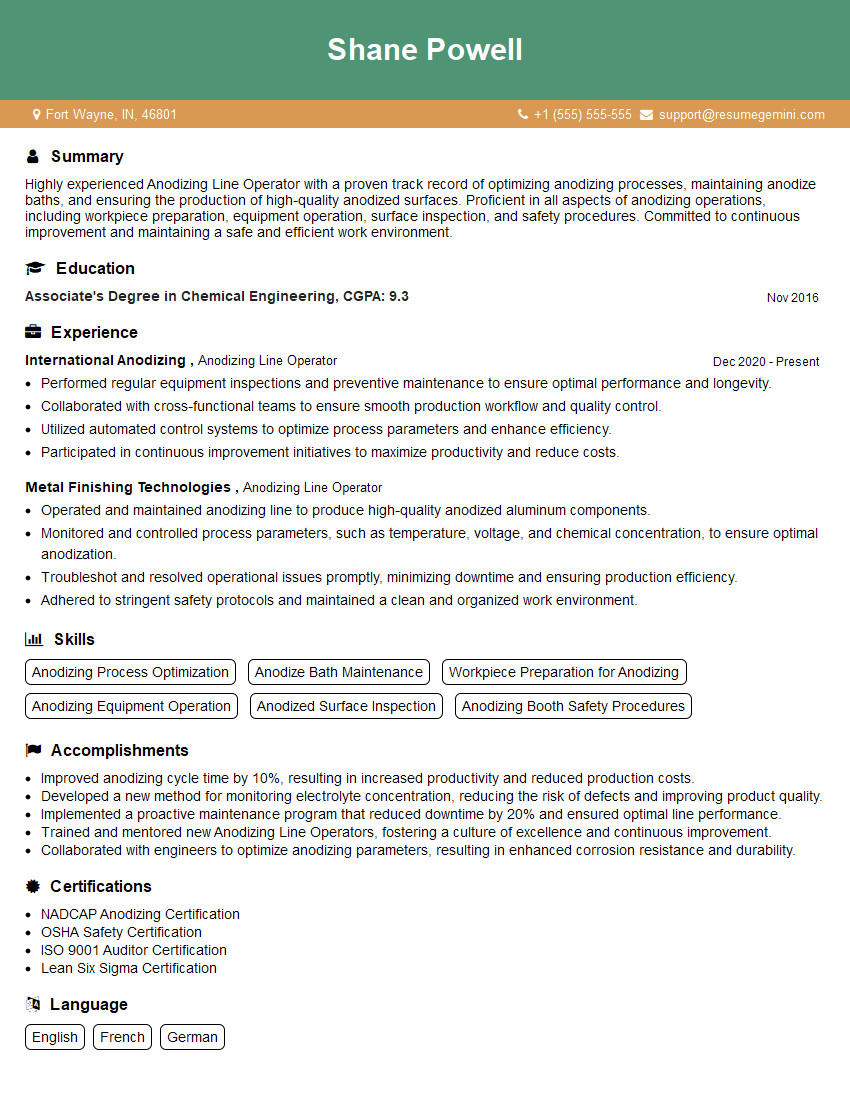
Mastering Anodizing Equipment Operation opens doors to exciting career opportunities with significant growth potential within the manufacturing and finishing industries. To maximize your chances of landing your dream job, a well-crafted resume is crucial. Creating an ATS-friendly resume is essential to get past applicant tracking systems and into the hands of hiring managers. ResumeGemini can help you build a professional and impactful resume tailored to the specifics of your Anodizing Equipment Operation experience. We provide examples of resumes specifically designed for this field to guide you. Invest time in crafting a strong resume—it’s your first impression and a critical step in securing your next role.

Explore more articles
Users Rating of Our Blogs
Share Your Experience
We value your feedback! Please rate our content and share your thoughts (optional).
What Readers Say About Our Blog
Very informative content, great job.
good