Interviews are opportunities to demonstrate your expertise, and this guide is here to help you shine. Explore the essential Sequential Art Scripting interview questions that employers frequently ask, paired with strategies for crafting responses that set you apart from the competition.
Questions Asked in Sequential Art Scripting Interview
Q 1. Explain the difference between a plot outline and a script breakdown.
A plot outline is a high-level overview of your story, focusing on the major plot points and character arcs. Think of it as the skeleton of your narrative. A script breakdown, on the other hand, is a much more detailed document that translates that plot outline into a visual script, specifying panel descriptions, dialogue, sound effects, and camera angles – the muscles and flesh on the skeleton.
For example, a plot outline might say: “Hero discovers villain’s plan, confronts villain, and defeats villain.” A script breakdown would then elaborate each of those points into individual panels: Panel 1: Close-up on hero’s face, realizing the villain’s plan. Panel 2: Wide shot of hero confronting villain. Panel 3: Action sequence showing the hero’s struggle. Panel 4: Close-up on villain’s defeated expression.
Q 2. Describe your process for creating compelling character arcs in a sequential art script.
Creating compelling character arcs begins with a strong understanding of your character’s core values and desires. I use a method I call the “Internal-External Conflict” approach. First, I identify the character’s internal conflict – their personal struggle, fear, or ambition. Then, I introduce an external conflict – a challenge, obstacle, or antagonist that forces the character to confront their internal struggle.
For instance, a character might internally fear failure, but externally be challenged by a high-stakes competition. Throughout the story, I show the character grappling with their internal conflict, making choices that either reinforce or challenge their core values. The external conflict serves as a catalyst, pushing the character to grow and change. The arc concludes with the character either overcoming their internal conflict or accepting it as part of their journey, leading to a significant transformation.
Q 3. How do you ensure pacing and visual storytelling work harmoniously in your scripts?
Pacing and visual storytelling are intrinsically linked. Slow pacing can build tension or create intimacy, while fast pacing conveys excitement or urgency. I achieve this harmony by carefully considering the number and size of panels, the types of shots used (close-ups, wide shots, etc.), and the overall rhythm of the sequence.
For example, a slow-paced sequence might use a series of large panels with detailed artwork and minimal dialogue, focusing on character emotions and the environment. Conversely, a fast-paced sequence might employ smaller panels, quick cuts, and dynamic action lines to communicate speed and intensity. I often create a visual storyboard first to experiment with pacing before I write the script.
Q 4. Explain your approach to writing dialogue that’s both engaging and visually effective.
Dialogue in sequential art needs to be concise and impactful because it shares space with the visuals. My approach is to avoid exposition dumps and write dialogue that reveals character and advances the plot simultaneously. Each line of dialogue should have a purpose, whether it’s revealing a character’s personality, creating conflict, or providing vital information.
Instead of “The weather is nice today,” which is visually uninteresting, I might write something like, “The sun felt good on his skin, a rare comfort in this grim city.” This uses dialogue to describe the setting and also hints at the character’s state of mind, making it more engaging visually.
Q 5. How do you incorporate sound effects and visual cues into your scripts?
Sound effects and visual cues are crucial for enhancing the reading experience and conveying information that dialogue alone cannot. I integrate them directly into the script, using descriptive words within the panel descriptions or using special notation.
For example, I might write: “Panel 3: SFX: *WHOOSH* as the spaceship blasts off. Visual cue: Motion lines trailing the ship.” This makes the intended visual and auditory elements clear to the artist. I use italics for SFX and CAPITAL LETTERS with asterisks for emphasis on visual cues. This approach keeps everything organized and understandable for the artistic team.
Q 6. Describe your process for creating effective panel layouts.
Effective panel layouts guide the reader’s eye through the page, creating rhythm and pacing. I consider factors like panel size, shape, and arrangement, as well as the gutter space between panels. I might use a combination of large and small panels to vary pacing, or use a sequence of smaller panels to show a fast-paced action sequence.
I often start with thumbnails, sketching out different layout options to test the flow and impact before deciding on a final arrangement. Think of it as composing a visual symphony; each panel is a note, and the overall layout is the melody.
Q 7. How do you balance storytelling with the visual aspects of sequential art?
Balancing storytelling and visual aspects requires a deep understanding of both. Storytelling provides the foundation—the narrative arc, characters, and themes. The visuals enhance and expand on the story, bringing it to life. A strong script will use visual elements—panel arrangement, character expressions, setting details—to complement and deepen the narrative.
I often brainstorm visual concepts alongside my narrative development. This helps me determine what can be conveyed through visuals and what needs to be conveyed through dialogue or narration. The goal is a synergistic relationship—where the story strengthens the visuals, and the visuals elevate the story.
Q 8. Discuss your experience with different scripting formats (e.g., Marvel, DC).
My experience spans various scripting formats, primarily Marvel and DC styles, but also including independent comic styles. Marvel tends towards a more action-oriented, fast-paced approach, often using a panel layout that emphasizes dynamic movement. Their scripts frequently prioritize concise dialogue and impactful visuals. DC, on the other hand, can range from gritty realism to fantastical epics, often allowing for more nuanced character development and introspective moments within the narrative. Their scripts might incorporate more descriptive narration and focus on establishing atmosphere.
For example, a Marvel script might focus on a single, dynamic splash page showing a superhero’s dramatic entrance, relying on strong visuals to convey the scene’s excitement. A DC script might achieve the same result by building suspense through multiple panels, revealing the character’s approach slowly, focusing on details of the environment to build tension before the big reveal. I adapt my style based on the specific project requirements and the publisher’s house style guidelines. I’ve also worked with scripts for independent projects, which offer more creative freedom but often require a more detailed script to guide the artist.
Q 9. How do you handle feedback and revisions on your sequential art scripts?
Handling feedback and revisions is a crucial part of the process. I approach it as a collaborative effort to refine the story. I begin by actively listening to the feedback, understanding the concerns and suggestions from editors and artists. I then organize the feedback systematically, categorizing it into major and minor points. For major structural changes, I create a revised outline to ensure the narrative flow remains consistent. For minor revisions, I make direct edits to the script, making sure the changes enhance rather than detract from the overall story.
I maintain clear communication throughout the revision process, asking clarifying questions when needed. For example, if an artist suggests a change to a scene’s setting, I’ll discuss how that might affect the dialogue or character actions. I always strive for a positive and productive feedback loop where everyone feels heard and valued. A well-managed revision process leads to a stronger, more polished final product.
Q 10. Describe your experience with different art styles and their impact on scripting.
My experience encompasses a variety of art styles, from realistic to cartoonish, and each influences my scripting approach. A realistic style requires more detailed descriptions of character features, environments, and action, ensuring the artist has clear guidance to achieve the desired visual effect. A more cartoonish or stylized style, on the other hand, may allow for more freedom in description, focusing on key elements and leaving room for the artist’s interpretation.
For example, a script for a realistic crime comic would necessitate detailed descriptions of lighting, shadows, and facial expressions to capture the mood and atmosphere. A script for a whimsical fantasy comic, however, might focus more on the fantastical elements and allow the artist to interpret the visual style. I understand that the visuals are as important as the words, and I strive to write scripts that complement the artist’s style, not contradict it.
Q 11. How do you adapt your scripting style for various target audiences?
Adapting my scripting style to various target audiences is crucial. For younger audiences, I employ simpler sentence structures, more direct dialogue, and focus on visual storytelling, perhaps incorporating more gags and slapstick humor. For older audiences, the narrative can become more complex, the dialogue more nuanced, and the themes explored deeper, dealing with mature topics and character development.
For example, a children’s comic might rely heavily on visual humor and clear, concise dialogue, while a mature readers’ comic might incorporate more complex metaphors, ambiguous imagery, and subtextual narratives to engage a more sophisticated reader. I always consider the intended age range and interests of the audience when developing the story’s structure, language, and themes. Audience awareness informs every aspect of the scripting process.
Q 12. How do you manage deadlines and collaborate with artists effectively?
Managing deadlines and collaborating effectively with artists involves meticulous planning and clear communication. I begin by creating a detailed schedule, breaking down the project into manageable phases with clear deadlines for each stage – script completion, artist feedback, revisions, and final approval. I maintain consistent communication with the artist, regularly checking in to address questions or concerns, ensuring they have all the necessary information to complete their work efficiently.
I utilize project management tools and platforms to track progress, share files, and maintain a clear record of communication. I foster an open and collaborative environment where the artist feels comfortable asking questions and offering feedback. Respecting the artist’s time and creative process is essential for a successful collaboration. Missed deadlines can be detrimental, so proactive planning and regular check-ins are paramount to completing projects smoothly.
Q 13. Explain your understanding of page turns and their impact on storytelling.
Page turns are crucial for pacing and suspense. They control the reader’s experience, creating anticipation and impact. A well-placed page turn can highlight a dramatic reveal, enhance emotional tension, or simply shift the reader’s perspective. Understanding this is vital for creating a compelling narrative. A poor page turn, however, can disrupt the flow and diminish the overall impact.
For example, ending a page on a cliffhanger, showing only a character’s worried expression before a major event unfolds on the following page, can significantly enhance the tension. In contrast, ending a page with a mundane detail before moving to a critical scene disrupts the reader’s engagement. The strategic use of page turns is a subtle but powerful tool in sequential storytelling, influencing the reader’s emotional investment and narrative experience.
Q 14. Describe your experience with incorporating subtext and symbolism into your scripts.
Incorporating subtext and symbolism adds layers of meaning and depth to a comic script. Subtext allows for unspoken emotions and motivations to emerge through character actions and dialogue, making the narrative more intricate and engaging. Symbolism enriches the visual storytelling by using imagery to represent abstract ideas or concepts, adding depth and resonance to the narrative. Both can significantly contribute to a memorable and thought-provoking reading experience.
For instance, a character’s repeated sighing might subtly communicate their weariness without explicitly stating it. Similarly, recurring imagery like a wilting flower could symbolically represent the decay of a relationship or a character’s diminishing hope. This approach allows me to create a richer and more impactful storyline. I carefully weave these elements throughout the script, ensuring they enhance, rather than confuse, the narrative. A skilled reader can appreciate the depth created by this subtle artistry.
Q 15. How do you create a sense of place and atmosphere in your sequential art scripts?
Creating a strong sense of place and atmosphere in sequential art is crucial for immersing the reader. It’s about painting a vivid picture using words, not just describing the setting. I achieve this through a multi-pronged approach focusing on descriptive language, sensory details, and pacing.
- Descriptive Language: Instead of saying ‘It was a dark night,’ I might write, ‘The moon, a sliver of bone against the inky black sky, cast long, skeletal shadows across the cobblestone streets.’ This uses evocative language to paint a more compelling image.
- Sensory Details: Engage all five senses. Describe the smells of the environment (damp earth, woodsmoke), the sounds (creaking floorboards, distant howls), the tastes (salty sea air, bitter herbs), and the tactile sensations (rough stone, soft velvet). The more senses involved, the more immersive the experience.
- Pacing: Slow pacing, through detailed descriptions and close-ups, can build suspense and tension. Faster pacing, achieved through broader panels and quicker descriptions, can convey a sense of urgency or chaos. Think about how you want the reader to *feel* in a particular scene and adjust the pacing accordingly.
For example, in a scene set in a bustling marketplace, I might describe the cacophony of sounds – the cries of vendors, the bleating of sheep, the clatter of metal on metal – to create a sense of vibrant energy. Conversely, a quiet forest scene might focus on the stillness, the rustle of leaves, and the distant chirping of crickets to evoke a sense of mystery and peace.
Career Expert Tips:
- Ace those interviews! Prepare effectively by reviewing the Top 50 Most Common Interview Questions on ResumeGemini.
- Navigate your job search with confidence! Explore a wide range of Career Tips on ResumeGemini. Learn about common challenges and recommendations to overcome them.
- Craft the perfect resume! Master the Art of Resume Writing with ResumeGemini’s guide. Showcase your unique qualifications and achievements effectively.
- Don’t miss out on holiday savings! Build your dream resume with ResumeGemini’s ATS optimized templates.
Q 16. How familiar are you with industry-standard software for comic book creation?
I’m proficient in several industry-standard software programs for comic book creation. My experience includes using Clip Studio Paint, which is widely favored for its powerful inking, coloring, and page layout tools. I’m also familiar with Adobe Photoshop for more advanced image manipulation and digital painting, and I have experience using Adobe Illustrator for creating clean line art and vector graphics. My familiarity extends to using these programs in collaboration with other artists and in different stages of the production pipeline.
Beyond the specific software, I understand the workflow involved in digital comics, from script to pencils to inks to colors and finally, the output formats for print or digital publication. This comprehensive understanding allows me to effectively communicate my vision to the artist, ensuring a smooth and efficient collaborative process.
Q 17. Describe your experience with creating scripts for different lengths and formats.
I’ve worked on projects ranging from short, self-contained stories for anthologies to longer, multi-part series. Adapting my scripting style to different formats is a skill I’ve honed over time. For shorter stories, I focus on a tight, impactful narrative, prioritizing economy of language and a strong, singular idea. Longer projects require more detailed world-building, character development, and meticulous plot planning. The format itself also influences the script: a webcomic might require shorter chapters and a more visual approach, whereas a graphic novel might allow for longer, more in-depth storytelling.
For example, a four-page comic requires a completely different approach than a 200-page graphic novel. The former necessitates a focused narrative with immediate impact, while the latter allows for more complexity and character arcs. I’ve successfully adapted my approach to meet the unique demands of each length and format, ensuring a cohesive and engaging reading experience regardless of page count.
Q 18. How do you handle complex plots and multiple plot lines in your scripts?
Handling complex plots and multiple plot lines requires careful planning and organization. My approach involves creating detailed outlines, using tools like mind maps and storyboards to visually represent the interconnectedness of various plot threads. I ensure each plot line has a clear purpose and contributes to the overall narrative arc. I utilize plot points to link different storylines, introducing them gradually and strategically.
A crucial element is using a clear and concise scripting style, employing scene headings and action lines that clearly identify which plot line is being developed in each panel. I also use character-specific subplots to enhance the complexity without overwhelming the reader. The key is to create a structure that feels organic rather than forced, making the interconnectedness of the plot lines feel natural and satisfying to the reader.
Q 19. Explain your approach to world-building in a comic book script.
World-building in a comic book is similar to building a world for any narrative medium, but with the added layer of visual storytelling. I approach it by constructing a detailed foundation consisting of key elements like geography, history, culture, societal structures, and magic systems (if applicable). It’s a iterative process, refining these elements as the narrative develops.
I often start with a central concept or theme, allowing the world to organically grow around it. For instance, if the theme is social injustice, the world’s political structure, class system, and cultural norms would reflect this. Consistency is key; all aspects of the world must logically interconnect. I maintain a detailed world-building document, regularly updating it as the story unfolds to ensure consistency and avoid plot holes. This also helps with visual descriptions in the script to provide the artist with a rich and detailed world to illustrate.
Q 20. How do you develop memorable characters with distinct visual and narrative elements?
Developing memorable characters starts with a strong understanding of their motivations, flaws, and relationships. I delve deep into their backstories, creating detailed character profiles that include physical descriptions, personality traits, and personal histories. This allows me to write dialogue and actions that are consistent with their established personality. I ensure each character has a distinct voice and visual design.
Visual elements are just as important as narrative elements. I work closely with the artist to establish a visual language that reflects the character’s personality and role within the narrative. Specific clothing choices, hairstyles, and even the way a character holds themselves can contribute significantly to their memorability. Think about iconic characters like Batman—his silhouette alone speaks volumes about his personality.
Q 21. Describe your process for outlining a sequential art project.
My outlining process is iterative and involves several stages. It begins with a high-level concept, exploring the central idea, themes, and potential narrative arcs. This is followed by a detailed synopsis, fleshing out the plot and character arcs. Then, I create a chapter outline, breaking the story into manageable sections and identifying key plot points within each section. Finally, I craft a scene-by-scene breakdown, outlining the events of each individual scene.
I use a combination of methods, including mind maps to visualize character relationships and plot points, and spreadsheets to track character arcs and plot developments across different chapters. Throughout this process, I frequently review and revise my outline, refining the story and ensuring a cohesive and engaging narrative. This structured approach helps to avoid plot holes and ensures that the story flows logically from beginning to end.
Q 22. How do you manage the balance between text and visuals in your scripts?
Balancing text and visuals in sequential art is crucial for a compelling narrative. Think of it like a dance – neither partner should overshadow the other. Too much text overwhelms the reader, while too many visuals without context can leave them confused.
My approach involves a pre-visualization stage. I create a storyboard, roughly sketching panels and noting the key dialogue and actions. This helps me determine the visual weight needed for each scene. If a scene is emotionally charged, I might prioritize a large, impactful panel with minimal text, letting the art convey the emotion. Conversely, a scene with lots of exposition might require more text, but I would break it into smaller, easily digestible panels. I always prioritize showing, not telling, aiming to visually represent the story’s core elements rather than relying solely on dialogue to convey them. For example, instead of writing ‘John was angry,’ I might show John clenching his fists, his face red, steam practically coming out of his ears.
I also use caption boxes sparingly, mostly for scene-setting or internal monologues. It’s about carefully considering the impact of each element and ensuring they work together harmoniously to create a powerful and engaging narrative experience.
Q 23. Explain your understanding of gutters and their role in sequential art.
Gutters are the spaces between panels in sequential art. They’re often overlooked, but they play a vital role in pacing, rhythm, and creating a sense of visual flow. They represent the passage of time and the transitions between moments. Think of them as the rests between notes in a musical composition.
The size and shape of the gutter can drastically alter the reader’s experience. A large gutter can signify a significant time jump or a change in location, while a small gutter suggests a seamless transition. For example, a series of small, almost nonexistent gutters between panels of quick action creates a sense of urgency and speed. In contrast, a large, distinct gutter might separate two scenes that are emotionally or thematically distinct.
I carefully consider the gutter’s impact on the narrative flow, using them to control the reader’s engagement and understanding of the story’s rhythm. It’s a subtle yet powerful tool that skilled sequential artists use masterfully to guide the reader’s eye and control the pacing of the narrative.
Q 24. How do you ensure consistency in character design and visual style throughout the script?
Maintaining consistency in character design and visual style is essential for a cohesive and believable world. It establishes a visual identity that resonates with readers and creates a sense of immersion. Inconsistency can disrupt the reading experience and detract from the storytelling.
My method involves creating a comprehensive style guide from the outset, including character model sheets with multiple views (front, side, back, etc.) showing details like hair, clothing, body type, and even common facial expressions. This guide acts as a reference point for me and any collaborators. For visual style, I define the overall aesthetic – whether it’s realistic, cartoony, or stylized – including color palettes, line weights, and shading techniques. I typically create a mood board to visualize the desired tone and atmosphere.
During the scripting process, I consistently refer to this style guide, ensuring consistency in character appearances and visual elements. Even small details are important: If a character has a scar in one panel, it needs to be present in subsequent appearances. This attention to detail helps build reader trust and enhances the overall reading experience.
Q 25. Discuss your familiarity with different types of panels and their applications.
Panels are the individual frames of a comic, and their shapes and sizes are vital tools for the storyteller. Different types of panels serve different purposes, influencing pacing, emphasis, and the overall feel of the story.
Here are a few examples:
- Standard Rectangular Panels: These are the most common and are used for straightforward storytelling.
- Irregular Panels: Panels that are shaped unusually (circular, triangular, etc.) can emphasize the action or emotion within, mirroring the character’s state of mind or creating a visually striking effect.
- Large Panels: Used for dramatic moments or to showcase an important setting or character detail.
- Small Panels: Can represent fleeting moments or convey a feeling of quick action.
- Splash Pages: Full-page panels used for breathtaking visuals, pivotal moments, or impactful introductions.
- Bleeding Panels: Panels that extend beyond the borders of the page, often used to create a sense of dynamic energy or a wide, expansive scene.
I choose panel types based on the specific narrative needs of each scene. A fast-paced action scene might use a series of small, irregularly shaped panels, while a scene focused on character interaction might utilize larger, more standard panels. The strategic use of panels contributes significantly to the overall visual rhythm and impact of the sequential artwork.
Q 26. How do you incorporate themes and motifs effectively into your sequential art work?
Themes and motifs are the backbone of a successful sequential art project, weaving a richer tapestry of meaning and creating a more memorable experience. They’re the recurring symbols, images, or ideas that subtly (or overtly) underscore the narrative’s core message.
My approach is to establish the themes and motifs from the start, during the initial concept development. This ensures that they are carefully woven into the story’s structure and visual elements. For example, if the theme is isolation, I might use recurring imagery of empty spaces, distant figures, or characters separated by physical barriers. A motif could be a particular type of flower that represents a character’s memory or a recurring symbol appearing in various forms throughout the artwork.
The key is subtlety and consistent application. I avoid overt exposition; instead, I let the images and carefully chosen symbols communicate these themes organically, allowing the reader to discover the deeper meanings themselves. It’s about creating layers within the narrative – the story on the surface and the deeper, thematic resonance running beneath. This layered storytelling makes the work richer and more impactful in the long run.
Q 27. Explain your experience working with different genres of sequential art.
My experience spans various genres of sequential art, from superhero comics to slice-of-life narratives, historical fiction to science fiction. Each genre requires a different approach to scripting, considering pacing, visual style, and narrative conventions.
For example, a superhero comic demands high-octane action sequences and dramatic cliffhangers, while a slice-of-life story emphasizes character development and subtle emotional moments. I adapt my scripting style to suit each genre’s unique demands. In superhero comics, I focus on clear panel composition for action scenes, using a variety of panel shapes to emphasize the dynamism. In slice-of-life pieces, I prioritize intimate character moments and subtle visual details to convey emotion. Understanding the expectations and conventions of each genre is critical for crafting compelling and satisfying narratives. The technical skills remain consistent, but my creative approach must evolve to complement each genre’s unique storytelling needs.
Q 28. Describe a challenging scripting project and how you overcame the obstacles.
One particularly challenging project involved a historical fiction graphic novel set during a complex period of political upheaval. The challenge was to accurately portray the historical context without overwhelming the narrative, while simultaneously maintaining the emotional core of the character-driven story.
I overcame this by utilizing a multi-stage approach. First, extensive research was crucial to ensure historical accuracy. I meticulously researched the period, focusing on the key events and social dynamics. Second, I created detailed outlines for each chapter, focusing on major plot points and character arcs. Third, I developed a system of visual cues to subtly convey the historical context without explicit exposition. For instance, costumes, architecture, and background details were key in establishing the setting. Finally, I used the storyboard phase to experiment with different panel layouts and visual compositions, ensuring the story flowed effectively while maintaining historical accuracy. By breaking down the problem into smaller, more manageable tasks and employing visual storytelling techniques, I successfully navigated the complexities of the project.
Key Topics to Learn for Sequential Art Scripting Interview
- Narrative Structure & Pacing: Understanding how to build compelling narratives through sequential art, controlling the reader’s experience through panel layouts and pacing techniques. Practical application: Analyzing existing comics to identify successful pacing strategies.
- Character Design & Development: Creating believable and engaging characters through visual storytelling, considering their visual representation and how it reflects their personality and role in the narrative. Practical application: Developing character sketches and descriptions that inform the visual storytelling.
- Panel Composition & Layout: Mastering techniques for effective panel arrangement to guide the reader’s eye, create visual rhythm, and enhance the storytelling. Practical application: Designing different panel layouts to convey specific emotions or actions.
- Visual Storytelling Techniques: Understanding the use of visual metaphors, symbolism, and other visual elements to convey meaning and enhance the emotional impact of the story. Practical application: Analyzing how visual metaphors are used in published works.
- Scriptwriting for Sequential Art: Understanding the specific formatting and conventions of sequential art scripts, including panel descriptions, dialogue, and sound effects. Practical application: Writing a short comic script following industry standards.
- Collaboration & Communication: Understanding the collaborative nature of sequential art creation and effective communication with artists and editors. Practical application: Describing your experience working in a team environment.
- Genre Conventions & Styles: Familiarity with various genres of sequential art (e.g., superhero, manga, graphic novel) and their stylistic conventions. Practical application: Discussing your preferred genre and its unique visual storytelling aspects.
Next Steps
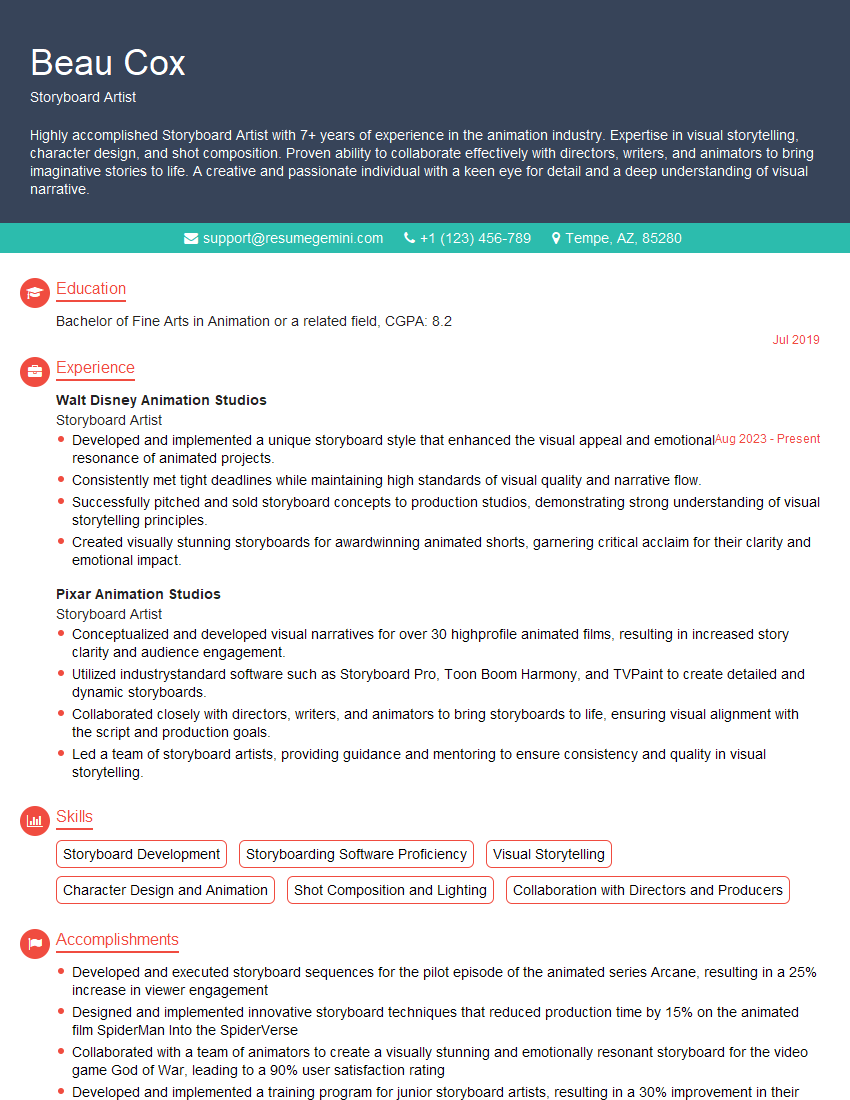
Mastering sequential art scripting opens doors to exciting careers in comics, animation, graphic novels, and beyond. To significantly boost your job prospects, focus on creating an ATS-friendly resume that highlights your skills and experience effectively. ResumeGemini is a trusted resource that can help you build a professional and impactful resume. They provide examples of resumes tailored to Sequential Art Scripting, ensuring your application stands out.
Explore more articles
Users Rating of Our Blogs
Share Your Experience
We value your feedback! Please rate our content and share your thoughts (optional).
What Readers Say About Our Blog
Very informative content, great job.
good