Cracking a skill-specific interview, like one for Tattoo Dotwork, requires understanding the nuances of the role. In this blog, we present the questions you’re most likely to encounter, along with insights into how to answer them effectively. Let’s ensure you’re ready to make a strong impression.
Questions Asked in Tattoo Dotwork Interview
Q 1. Explain your understanding of dotwork shading techniques.
Dotwork shading relies on the strategic placement of individual dots to create the illusion of tonal variation and depth. It’s not about filling areas solidly, but rather using varying dot density to represent light and shadow. Think of it like pointillism in painting, where tiny dots of color combine to form a larger image. In tattooing, denser clusters of dots create darker areas, while sparser dots create lighter tones. This technique allows for incredibly smooth gradients and subtle shading effects when executed properly.
For example, to create a smooth transition from dark to light, I’d start with closely packed dots in the darker region, gradually increasing the space between dots as I move toward the lighter areas. The size of the dots can also influence the shading – smaller dots provide a smoother, more refined effect, whereas larger dots can create a more textured or bolder look.
Q 2. Describe your experience with different needle configurations for dotwork.
My experience with needle configurations for dotwork is extensive. I primarily use round liners, ranging from 3RL to 11RL, depending on the desired dot size and the intricacy of the design. A 3RL is great for fine details and tiny dots, while an 11RL is suited for larger dots and faster shading of larger areas. I also experiment with different needle groupings within a single liner configuration, such as a 5RL magnum for a more textured dot application, to achieve specific effects. The key is understanding how the needle configuration impacts the saturation and feel of each dot, along with the amount of time spent creating each one.
For instance, a 7RL provides a balance between detail and speed, making it versatile for many dotwork projects. Using the right needle is crucial for creating a consistent and even look across different areas of the tattoo.
Q 3. How do you achieve consistent dot density and placement?
Achieving consistent dot density and placement is paramount in dotwork. It requires a combination of skill, practice, and the right tools. I use a combination of techniques to ensure evenness. First, a well-planned sketch is essential, serving as my guide for dot placement. I often create a grid or use guidelines on my stencil to help maintain consistent spacing. Second, maintaining a consistent hand and angle is critical. I focus on steady pressure and a rhythmic dotting pattern to avoid unevenness. Third, I regularly assess my progress during the tattooing process, stepping back to check for any inconsistencies and making necessary adjustments along the way. Even the slightest change in needle depth or angle can affect dot size and saturation.
Think of it like building a brick wall: you need consistent brick size and spacing for a clean finish. In dotwork, the dots are the ‘bricks,’ and consistent placement is key to a visually appealing result. I use a magnifier to carefully observe the work up close and adjust as needed.
Q 4. What are the challenges of creating intricate details in dotwork?
Creating intricate details in dotwork presents unique challenges. The primary difficulty lies in controlling dot placement and density, especially in areas requiring fine lines or sharp transitions. Very small dots are prone to bleeding together if too much ink is used or if the pressure isn’t perfectly consistent. There’s a higher risk of creating uneven shading or blurry details. Another challenge is the time commitment. Intricate designs require meticulous work and patience, leading to longer tattooing sessions and increased precision.
For instance, rendering fine hair strands or intricate patterns demands extraordinary precision and attention to detail. To mitigate these challenges, I take frequent breaks, ensuring my hand remains steady and precise throughout. I may also choose to break a complex section into smaller parts, completing one area before moving to the next. Proper aftercare instructions become even more important to prevent smudging of the highly detailed areas.
Q 5. How do you plan and sketch a complex dotwork design?
Planning and sketching a complex dotwork design is crucial for a successful outcome. I begin by consulting with the client to understand their vision and preferences. Then I create several sketches, exploring different compositional approaches and dot patterns. I often create a refined digital version, enabling me to experiment with shading and density before transferring the design to skin. This allows for refinement of density and value, and is important for communication with the client.
My sketching process involves creating detailed line art, followed by translating that line art into a dot pattern, considering how dot density will create depth and form. I’ll often utilize grayscale studies to plan shading and value ranges, thinking of how different dot sizes and spacings will create those values in the final tattoo.
Q 6. Explain your approach to stenciling and transferring designs for dotwork.
Stenciling and transferring designs for dotwork requires a delicate approach. I prefer using high-quality stencil paper and transfer solutions to ensure a clear and precise outline on the client’s skin. A crisp stencil is vital for accurate dot placement. Once applied, I carefully check the stencil for any smudging or misalignment before beginning the tattooing process. This is where using a stencil that’s designed to resist smearing is vital.
I use a fine-tipped stylus to make small adjustments to the stencil, if needed, before applying the stencil and outlining the design. Careful and precise outline application is vital for the success of the dotwork tattoo, as any mistakes here will be difficult to correct.
Q 7. How do you manage client expectations for dotwork tattoos?
Managing client expectations for dotwork tattoos is crucial. I conduct thorough consultations, showcasing my portfolio and explaining the intricacies of the technique, including the time commitment involved. I emphasize the importance of detailed planning and the potential for minor variations due to the nature of hand-poked work. Realistic timelines are essential. I discuss the healing process and the potential for slight color changes during healing. Open communication is key throughout the entire process.
For example, I’ll show clients examples of similar designs I’ve completed, highlighting the variations in dot density, dot sizes, and saturation. I always show clients multiple options of sketches, so we can select the best one together. By clearly setting expectations and maintaining open communication, I ensure a positive experience for my clients and a successful tattooing experience.
Q 8. Describe your experience working with various skin tones and types.
Working with diverse skin tones and types in dotwork tattooing requires a nuanced approach. The key is understanding how different skin reacts to ink and adjusting my technique accordingly. For example, lighter skin tones generally require less ink saturation to achieve the desired depth and contrast, while darker skin tones may need slightly more passes or a slightly larger needle grouping to ensure the dots are visible. I also consider skin elasticity and thickness; thinner, more elastic skin might require more careful needle depth control to avoid blowouts. I always have a detailed consultation before starting any tattoo to assess the client’s skin and discuss the best approach. I might use different needles, varying needle depths, or adjust ink density to ensure optimal results for each individual.
For instance, I’ve found that for clients with olive skin, a slightly deeper needle depth with a consistent, steady hand is crucial to prevent the dots from fading too quickly. In contrast, for clients with very fair skin, I might use a finer needle to create more delicate dots and reduce the risk of blowouts. Ultimately, successful dotwork on any skin type depends on meticulous planning, precision, and adaptation.
Q 9. How do you adapt your dotwork style to different design themes?
Adapting my dotwork style to different design themes is about understanding the visual language of each theme and translating it into the dotwork medium. A geometric design, for instance, will require precise, evenly spaced dots to create sharp lines and angles. Organic themes, such as floral or animal designs, demand a more free-flowing application, allowing for variations in dot size and spacing to capture the natural curves and textures.
For a realistic portrait, I might use varying dot sizes and densities to create shading and depth, almost like stippling with a brush. For a minimalist design, I’d focus on clean lines and simple shapes achieved with precisely placed dots. I regularly sketch different iterations of a design before beginning the tattoo process, and I often collaborate with clients on achieving the desired outcome.
Think of it like painting with dots – the same medium, but an infinitely varied palette of expression based on arrangement and density.
Q 10. What are your favorite dotwork artists or inspirations?
My biggest inspirations come from artists who masterfully blend technical skill with artistic vision in dotwork. I’ve always admired the precision and detail in the work of artists like [Artist Name 1], who is known for their intricate geometric designs, and [Artist Name 2], whose work beautifully blends realism with the dotwork technique. Their ability to create depth and texture using only dots is truly inspiring. I also find inspiration in other art forms – the stippling techniques in traditional printmaking, for example, inform my own approach to shading and texture in dotwork.
It’s not just about copying styles, it’s about studying the principles behind their work—how they build forms, use shading, and create balance. This allows me to develop my own unique style while continuously refining my technique.
Q 11. What software or tools do you use for dotwork design?
While the actual tattooing is done with a tattoo machine and needles, my design process relies heavily on digital tools. I primarily use [Software Name 1] and [Software Name 2] to create my designs. These programs allow me to accurately plan the placement and density of dots, ensuring a cohesive and balanced final product. I can digitally manipulate images, create intricate patterns, and zoom in to fine-tune every detail. I can even experiment with different dot sizes and spacing to achieve the desired look and feel. This meticulous planning translates to a more efficient and precise tattooing process.
For example, I might use [Example Code Snippet or description of a tool's use in the design process, if applicable] to create a repeating pattern or to accurately scale a design to fit the client’s body.
Q 12. How do you maintain hygiene and safety standards while performing dotwork?
Maintaining hygiene and safety is paramount. My studio adheres to strict sterilization protocols. All equipment, including needles, tubes, and grips, are sterilized using an autoclave before each use. I use single-use disposable items whenever possible, and my work surfaces are disinfected before and after each client. I always wear fresh gloves and practice proper hand hygiene. I also ensure my clients understand the importance of proper aftercare to minimize the risk of infection.
Before starting any tattoo, I conduct a thorough consultation to discuss the client’s health history and allergies. This allows me to identify any potential contraindications and take appropriate precautions. I provide a detailed explanation of the process, and make sure my client feels comfortable and confident in the safety measures taken. Client safety and health are my top priorities.
Q 13. Describe your aftercare instructions for dotwork tattoos.
Aftercare is crucial for the healing process and the longevity of the dotwork tattoo. I provide my clients with detailed written instructions and a follow-up appointment. These instructions usually include washing the tattooed area gently with unscented soap and water twice a day, applying a thin layer of unscented, fragrance-free moisturizer several times a day, avoiding direct sunlight, and refraining from picking or scratching the tattoo. I advise against swimming, using hot tubs, or soaking the tattoo for at least two weeks. I emphasize the importance of keeping the tattoo clean and hydrated to prevent infection and promote proper healing.
I also instruct them on how to recognize signs of infection and recommend they contact me or their doctor immediately if they experience any complications such as excessive swelling, unusual redness, or pus.
Q 14. How do you handle client requests for modifications during the tattoo process?
Handling client requests for modifications during the tattoo process requires a balance of professionalism, artistic judgment, and collaboration. If a client requests a minor adjustment, such as a slight repositioning of a dot or a small change in shading, I’m usually happy to accommodate them if it doesn’t compromise the overall design integrity. However, significant modifications mid-process can be challenging and might affect the final result.
My approach is to have an open dialogue with the client. I explain the potential consequences of major changes and offer suggestions that maintain the artistic coherence of the design. I always prioritize creating a tattoo that the client loves while ensuring it remains aesthetically pleasing and technically sound. Open communication is key to resolving these situations and ensuring client satisfaction.
Q 15. How do you price your dotwork tattoos?
Pricing dotwork tattoos is a multifaceted process. It’s not simply about the size of the piece, but also the intricacy, detail, placement, and the time investment required. I typically base my pricing on an hourly rate, which factors in my experience and skill level. For smaller, simpler pieces, I might offer a flat rate. However, for larger, more complex designs, especially those involving extensive detail and shading through stippling, I’ll provide a detailed estimate after a thorough consultation with the client, including sketches and discussions regarding their vision. This ensures transparency and prevents misunderstandings. For example, a small, simple dotwork design on the wrist might be priced differently than an intricate, full-back piece, which could take multiple sessions. The hourly rate helps ensure fair compensation for the time, skill, and artistry involved.
Career Expert Tips:
- Ace those interviews! Prepare effectively by reviewing the Top 50 Most Common Interview Questions on ResumeGemini.
- Navigate your job search with confidence! Explore a wide range of Career Tips on ResumeGemini. Learn about common challenges and recommendations to overcome them.
- Craft the perfect resume! Master the Art of Resume Writing with ResumeGemini’s guide. Showcase your unique qualifications and achievements effectively.
- Don’t miss out on holiday savings! Build your dream resume with ResumeGemini’s ATS optimized templates.
Q 16. Describe your experience with different types of dotwork machines.
My experience with dotwork machines spans various types, from rotary to coil machines. Each has its own nuances. Rotary machines, known for their smooth and consistent operation, are my preferred choice for the majority of dotwork. Their consistent speed and controlled needle depth make them ideal for creating fine, even dots, essential for achieving intricate details and smooth shading. I’ve also experimented with coil machines, finding them suitable for bolder, more aggressive dotwork styles, though they require more skill to master and maintain consistent dot placement. The choice of machine often depends on the specific design and desired aesthetic. For very fine lines and extremely dense shading, a high-quality rotary machine with a specifically tuned needle configuration is key. I’ve found that experimenting with different needle groupings (e.g., 3RL, 5RL, 7RL) allows me to achieve a wide range of effects from fine, delicate dots to thicker, more impactful ones.
Q 17. What are the common mistakes to avoid when doing dotwork?
Common mistakes in dotwork can significantly impact the final result. One major issue is inconsistent dot placement – dots should be evenly spaced and consistent in size to achieve a smooth, professional finish. Another is applying too much pressure, which can lead to blowouts, uneven dots, and skin irritation. Poor aftercare instructions to the client can also lead to issues like infection or fading. Finally, neglecting proper stencil application can result in the design being misaligned or blurry. To avoid these issues, I emphasize practicing consistent pressure and hand movement, using high-quality stencils, and providing detailed aftercare instructions which my clients must carefully follow. Working on a smaller practice piece before applying it to the client’s skin is essential.
Q 18. How do you ensure the longevity and vibrancy of dotwork tattoos?
Longevity and vibrancy in dotwork tattoos depend on several factors, including proper aftercare, the quality of the inks used, and the artist’s technique. Using high-quality inks that are specifically formulated for tattooing is crucial. These inks tend to be less prone to fading over time. Beyond that, my clients must follow my specific aftercare instructions meticulously, which include keeping the tattoo clean, moisturized, and protected from the sun. Sun exposure is a major culprit for tattoo fading, so proper sun protection is crucial. Ensuring the client avoids excessive sun exposure and uses high SPF sunscreen is key to preserving the dotwork’s color and detail for years to come. A great tattoo, properly cared for, can maintain its detail and color for decades. Of course, certain factors, like the placement of the tattoo (highly exposed areas tend to fade more quickly), and the client’s individual skin type and healing process, can also impact the longevity and vibrancy.
Q 19. Explain your process for creating realistic dotwork portraits.
Creating realistic dotwork portraits demands a keen eye for detail and a mastery of value and shading through stippling. My process begins with a high-resolution reference photo. I then create a detailed sketch, meticulously mapping out the values and tones to determine the density of dots needed to represent each area. Lighter areas will have fewer, more spaced-out dots, while darker areas will have denser clusters. This value mapping is crucial in achieving realism. I use a range of needle groupings to achieve this, using finer needles for subtle transitions and larger needles for bolder, darker areas. I carefully work through the portrait, gradually building up the image dot by dot, frequently stepping back to assess the progress and make adjustments. Patience and precision are key – it’s a slow, meticulous process, and accuracy is paramount.
Q 20. Describe your approach to working with geometric dotwork patterns.
Geometric dotwork patterns present a unique set of challenges and opportunities. My approach focuses on precision and symmetry. I begin by sketching the geometric design, paying close attention to angles and proportions. I then transfer the design onto the client’s skin using a high-quality stencil. With geometric dotwork, maintaining consistent dot size and spacing is critical in creating clean, crisp lines and sharp angles. I meticulously execute the pattern, using rulers or other tools to ensure accuracy. In certain designs, I might use a combination of dot sizes and densities to add depth and dimension. Creating a solid foundation with consistent dot placement is essential for a successful geometric dotwork piece.
Q 21. How do you deal with difficult or sensitive skin areas during dotwork application?
Working on sensitive areas such as ankles, ribs, or inner elbows requires extra care and attention. These areas often have thinner skin, making them more prone to irritation or discomfort. I always communicate openly with the client about potential sensitivities and use a lighter hand and smaller needles when necessary. Taking frequent breaks, applying numbing cream, and paying close attention to their reaction are also crucial. Working in smaller sections and ensuring proper aftercare are equally essential for the client’s comfort and the proper healing of the tattoo. Communication is key. If the client experiences pain, I always stop and reassess the situation, never pushing through the discomfort.
Q 22. Explain your understanding of the healing process of dotwork tattoos.
The healing process of a dotwork tattoo is similar to other tattoos, but the density of the dots can influence the healing time and appearance. It generally involves three phases:
- Inflammatory Phase (Days 1-5): The skin is inflamed, red, and may be slightly swollen. There’s some plasma leakage, leading to a slight crust formation. This is the body’s initial response to the trauma of needle penetration.
- Proliferative Phase (Days 5-21): The body starts rebuilding the skin. New collagen fibers are produced, and the crust begins to shed. It’s crucial during this phase to avoid picking or scratching the tattoo, as it can cause scarring and disrupt the healing process. The dotwork might appear slightly raised or uneven during this time. The dots themselves will also begin to soften and blend subtly.
- Maturation Phase (Weeks 3+): The skin continues to heal, and the scar tissue remodels. The final color saturation and clarity of the dots become apparent. Full healing can take several weeks to several months, especially for larger, denser dotwork pieces.
Proper aftercare, including regular cleaning with a mild, unscented soap and applying a thin layer of unscented moisturizer, is vital throughout the entire healing period to minimize scarring and maximize the longevity of the tattoo’s sharpness.
Q 23. How do you manage pain management for clients during dotwork procedures?
Pain management is crucial for a positive client experience. I prioritize open communication and utilize several strategies:
- Pre-Tattoo Consultation: We discuss the client’s pain tolerance, medical history, and any anxieties. This allows me to adjust the session length and pacing accordingly.
- Topical Anesthetics: I offer and explain the use of topical numbing creams like lidocaine, applied 30-60 minutes before the procedure to significantly reduce discomfort. I always clearly outline the limitations and potential side effects of any anesthetic.
- Frequent Breaks: During the procedure, we take frequent breaks to allow the skin to recover, preventing excessive discomfort and reducing the risk of skin trauma. This is particularly important with dotwork, due to its repetitive nature.
- Distraction Techniques: Engaging conversation, music, or even a TV show can help divert the client’s attention from the sensation of the needle.
- Hydration and Nutrition: I encourage clients to stay well-hydrated and nourished before their appointment as this can affect pain tolerance.
Ultimately, my approach is to create a relaxed and comfortable environment to minimize the pain and make the experience as pleasant as possible. I always remain attentive to my client’s signals and am prepared to stop the procedure if the discomfort becomes too intense.
Q 24. How do you address potential issues like scarring or infection with dotwork?
Scarring and infection are potential risks with any tattoo, but can be largely mitigated through proper hygiene and aftercare.
- Sterile Environment: I maintain a meticulously clean and sterile work environment. This includes using autoclaved needles and equipment, single-use disposable items, and adhering to strict hygiene protocols.
- Aftercare Instructions: I provide detailed and comprehensive aftercare instructions, emphasizing the importance of gentle cleaning, moisturizing, and avoiding sun exposure. I clearly communicate potential signs of infection (increased redness, swelling, pain, pus, fever) and instruct clients to seek medical attention if necessary.
- Infection Prevention: If I detect any signs of infection during the healing process (which is rare with proper procedure and aftercare), I advise the client to immediately consult a doctor. Early intervention is key to minimizing complications.
- Scarring Prevention: Proper technique, proper needle depth, and avoiding excessive trauma to the skin are critical in preventing scarring. Client adherence to aftercare instructions is also vital.
To further minimize risk, I always screen clients for any underlying skin conditions that could increase the risk of complications.
Q 25. How would you handle a client who is unhappy with the progress of their dotwork tattoo?
Handling an unhappy client requires empathy, professionalism, and clear communication. My approach is:
- Listen and Understand: I patiently listen to the client’s concerns without interruption, trying to understand their perspective.
- Assess the Situation: I objectively examine the tattoo to identify the specific issues the client is unhappy about. This could involve anything from the placement, the shading, to the overall design.
- Offer Solutions: Depending on the nature of the problem, I might offer solutions such as minor touch-ups, adjustments to the design, or in rare cases, a partial or full cover-up (discussed in detail). I’m open and honest about the possibilities and limitations.
- Document Everything: I maintain thorough documentation of the entire process, including the initial consultation, the tattooing session, and any subsequent discussions. This is vital for transparency and legal protection.
- Mediation if Needed: In extremely difficult situations, I might suggest mediation with a third party, especially if the issues are not easily resolvable. I always prioritize finding a solution that satisfies both parties.
My goal is to resolve the situation in a way that is fair and reflects my commitment to client satisfaction. Building a strong rapport and clear communication are key to preventing such situations and handling them effectively when they do arise.
Q 26. Describe your experience with color application in dotwork tattoos (if any).
While dotwork is predominantly known for its black and grey aesthetic, color application can be effectively incorporated, albeit with some modifications to the technique.
My experience involves using a layering technique. Instead of solid blocks of color, I use densely packed dots of various colors to build depth and dimension. This helps avoid the harsh lines that are sometimes associated with color in dotwork. The colors are carefully selected to complement the overall design and enhance the dotwork’s texture. Smaller dot sizes are often used to maintain the delicate feel associated with dotwork and blend the colors smoothly. I typically use a multi-needle machine to build lighter color areas quickly and efficiently. Maintaining precise color placement is more challenging than in traditional tattooing; therefore, patience and careful planning are essential.
I find that colors work particularly well in specific designs such as nature-inspired pieces, geometric patterns with vibrant highlights, or adding subtle accents to a predominantly black and grey piece. It’s important to note that color saturation might be less intense compared to traditional color tattoos in this style.
Q 27. How do you balance artistic expression with client preferences in dotwork?
Balancing artistic expression with client preferences is essential for a successful dotwork tattoo. My process involves:
- Consultation: A thorough consultation is vital to understanding the client’s preferences, their vision, their inspiration images, and their expectations. I ask detailed questions about their style, themes they like and dislike, and the placement of the tattoo.
- Collaboration: I present my artistic interpretation, offering my expertise and suggestions, while remaining flexible and open to the client’s feedback. The process is collaborative, not dictatorial. I might present sketches or mood boards to get a better sense of their taste and style.
- Compromise: Sometimes, compromise is necessary. I might modify certain aspects of my original design to incorporate the client’s feedback while preserving the overall integrity and quality of the artwork.
- Refinement: I refine the design through multiple sketches, incorporating revisions and feedback. This iterative process ensures both the client’s vision and my artistic integrity are respected.
This collaborative approach fosters trust, ensures client satisfaction, and leads to a unique and meaningful piece of body art. I always document and explain the reasons behind design choices to ensure transparency and understanding.
Q 28. What are your future goals and aspirations in the field of dotwork tattooing?
My future goals involve continually refining my dotwork technique, exploring new creative avenues within the style, and expanding my knowledge and skills.
- Technical Mastery: I aim to achieve even greater precision and control over my dot placement and shading, resulting in ever more intricate and detailed pieces.
- Artistic Exploration: I’m keen to experiment with different themes and styles within dotwork, possibly incorporating more color and incorporating new techniques and elements into my work.
- Mentorship: I aspire to mentor and teach aspiring artists, sharing my knowledge and experience to help elevate the standards and the community in general.
- International Recognition: I’d like to gain recognition for my unique style and contribute to the broader world of dotwork tattoo art, potentially exhibiting my work or participating in tattoo conventions globally.
Ultimately, I want to create timeless and meaningful artwork that will leave a lasting legacy, contributing my own unique style to the world of body art.
Key Topics to Learn for Your Tattoo Dotwork Interview
- Understanding Dotwork Principles: Explore the foundational techniques, including dot placement, density control, and line creation using dots.
- Shading and Value: Learn how to create depth and dimension through varying dot sizes, spacing, and layering. Understand the relationship between dotwork and light/shadow.
- Design and Composition: Discuss your approach to translating concepts into dotwork designs. Explain your understanding of visual balance, focal points, and negative space.
- Equipment and Materials: Demonstrate familiarity with various machines, needles, and inks specifically suited for dotwork. Discuss appropriate aftercare techniques.
- Style and Influences: Articulate your understanding of different dotwork styles and your personal artistic influences. Be prepared to discuss your unique approach.
- Client Consultation and Design Collaboration: Explain your process for understanding client needs and translating those needs into a personalized dotwork design.
- Hygiene and Safety Protocols: Discuss your knowledge and application of strict hygiene and safety practices essential for tattooing.
- Problem-Solving and Adaptability: Describe your approach to handling unexpected challenges during the tattooing process, such as skin reactions or design adjustments.
- Portfolio Development and Presentation: Be ready to discuss your portfolio and how it reflects your skills and artistic vision. Practice articulating your creative process.
Next Steps
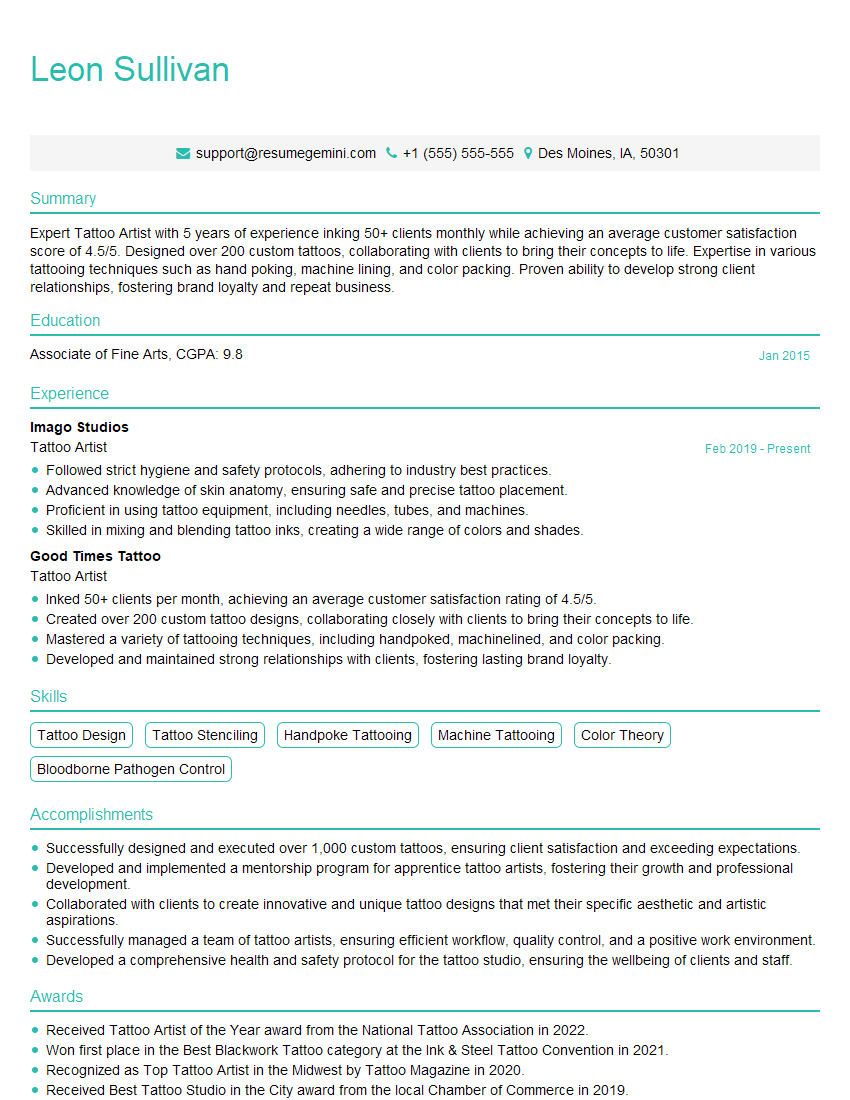
Mastering Tattoo Dotwork opens doors to exciting career opportunities in a growing artistic field. A strong portfolio is essential, but your resume is your first impression. Creating an ATS-friendly resume is crucial for maximizing your job prospects. ResumeGemini is a trusted resource to help you build a professional and impactful resume that highlights your unique skills and experience. Examples of resumes tailored to the Tattoo Dotwork field are available to help you get started.
Explore more articles
Users Rating of Our Blogs
Share Your Experience
We value your feedback! Please rate our content and share your thoughts (optional).
What Readers Say About Our Blog
Very informative content, great job.
good